All Categories

Subcategories

  • Panama: Another Odebrecht blow

    LatinNews 08 February 2017 Hits: 23145

    Panama is another Latin American country where the Odebrecht corruption scandal is having a negative impact on this year’s growth prospects. In its plea bargain deal with the US Department of Justice the company admitted paying US$59m in bribes to Panamanian government officials in 2010-2014. Kenia Porcell, a Panamanian prosecutor, opened a case file and said that Odebrecht had agreed to pay US$59m (an amount equivalent to the bribes paid) as an initial surety, pending the outcome of investigations. Unlike Peru, the Panamanian government has only formally banned Odebrecht from bidding for new government contracts and not issued a blanket ban on its participation in existing contracts. However, Odebrecht will still lose some of its existing US$3bn worth of contracts in the country. Job losses among its 8,000 employees are also expected.

    Odebrecht’s continued participation in a number of Panamanian projects is in doubt. The financing for the US$1.9bn Metro Line 2 project, where the company is in partnership with other contractors, is still not fully in place, but the company may remain involved. Odebrecht is dropping out from Metro Line 3 (valued at US$2.6bn) and the fourth Panama Canal Bridge however, two projects for which it had reached the pre-qualification stage. The government says it is ending a contact to build a US$1bn 213MW hydroelectric project in Bocas del Toro that had been also awarded to Odebrecht. A particular cause for concern is the future of the US$800m contract to build a new terminal at Tocumen International airport (serving Panama City).

    Alvaro Alemán, minister for the presidency, said in early February that the government was taking a “clear position”. It expected Odebrecht to meet its contractual obligations on the Metro Line 2 project, on the Tocumen airport terminal, and on a contract to build 5,000 residential units at Lagos del Colón. Odebrecht, however, has formally withdrawn from the fourth Panama Canal Bridge, and Alemán said he expected it to announce a similar decision on Metro Line 3. The government’s position is causing some controversy. Donaldo Sousa, a Panamanian lawyer, said that the government needs to prevent big projects from coming to a halt, and should ideally replace Odebrecht on all projects, hiring other companies to do the work. Guillermo Cochez, another lawyer, criticised the government for keeping Odebrecht in play on some projects, warning, “when Odebrecht goes bankrupt, Panama is going to have problems”.

    Jorge Fidanque III, the manager of Tocumen International Airport, commented, “Each day we are hearing of more accusations against Odebrecht, and that is a source of worry for Tocumen, because we need to complete the expansion work”. He added that the airport was in a dilemma. The new terminal project was 60% complete, making it very difficult to change contractors at such a late stage. On the other hand, there was no guarantee that Odebrecht would be in a position to finish the job. “We need a Plan B” he added.

    There are yet no detailed projections on the impact of cancelled or delayed projects on this year’s economic growth rate, but it is an issue of concern. Economy Minister Dulcidio de la Guardia has remained upbeat, claiming that GDP rose by about 5.2% in 2016 and will grow “even more” in 2017.

  • ECONOMIC OVERVIEW: BOLIVIA

    LatinNews 27 September 2017 Hits: 1861

    New petrochemicals plant: On 14 September, President Morales inaugurated a new petrochemical plant in Bulo Bulo town, Cochabamba department, marking the start of a new era of industrialisation of Bolivia’s natural gas production sector. Hydrocarbons Minister Luis Sánchez told reporters that the US$938.3m plant, which was constructed by the South Korean firm Samsung over the last five years – the biggest such project in Bolivia’s history – will be able to produce 1,200 tonnes (t) a day of ammonia and 2,100t a day of granulated urea which is used as fertilizer in agriculture. Construction of the plant generated 3,500 direct and 7,000 indirect jobs and it will now employ 250 workers directly and another 800 indirectly. A government press release notes that of the urea produced, 80%-90% will be exported with Brazil, Argentina, Peru, and Paraguay lined up as potential markets.

    Gas deposits: On 2 September, Hydrocarbons Minister Luis Sánchez revealed that a natural gas deposit found at the Madre de Dios basin, located in the north of the country (spanning the departments of La Paz, Pando, and Beni), has potential reserves of 32trn cubic feet (tcf) of natural gas, more than triple the country’s currently certified natural gas reserves of the 10 tcf. In an interview with the state-owned radio station, Patria Nueva, Sánchez said the discovery had been made by French consultancy firm Beicip-Franlab although he underlined that this was just preliminary assessment that will be confirmed by seismic work to be carried out by Bolivia’s state-oil company Yacimientos Petrolíferos Fiscales Bolivianos (YPFB). Sánchez also said that within the next two years, two boreholes will have been drilled. This is in line with the Morales government’s pledge last month to apply two-year hydrocarbon exploration cycles for surface-installed technology, compared with the traditional seven-year or ten-year cycles.

    LNG exports: On 3 September, the president of state-oil company YPFB, Oscar Barriga, revealed that between 2013 and July 2017, exports of liquified petroleum gas (LNG) to Paraguay, Peru, and Uruguay totalled US$113.58m. According to Barriga, between 2013 and July 2017, the firm exported 270,825 tonnes (t) of LNG to these three countries, of which Paraguay accounted for 171,517t; Peru, 97.8t; and Uruguay, 1,506t. Barriga told reporters that Bolivia has been selling LNG abroad as a result of two new natural gas liquids separation plants, one which began operating in Río Grande, Santa Cruz department, in 2013, and the other in Yacuiba, Tarija department, in 2015.

    New electric train: Work has officially begun on Bolivia’s first electric train network, connecting Cochabamba city in central Bolivia to the surrounding municipal area. President Morales formally inaugurated the project on 17 August. While the initiative once looked in doubt, as the planned start date in 2015 came and went, prospects have improved again, with plans confirmed for the metropolitan train, which will connect the five municipalities of Sipe Sipe, Vinto, Quillacollo, Colcapirhua, and Sacaba to central Cochabamba, with 43 stations spanning three lines. The original estimate for the cost of the project was US$630m. The Bolivian government considered this too high, and the project was suspended until this year, when it was determined that the State could provide the US$448m that more recent estimates have suggested will be sufficient.

  • Brazil: Pension reform won’t go away

    LatinNews 09 March 2018 Hits: 767

    After around 18 months of effort the government of President Michel Temer has finally abandoned all attempts at pension reform. But the problem won’t go away: with elections due in October Brazilian politicians are going to find they can’t avoid the awkward subject.

    For years the elephant in the room of Brazilian politics has been pension reform. It is widely accepted that the pay-as-you go state pension system is too generous for some privileged groups of workers, while completely ignoring others. Above all else, it is eye-wateringly expensive and financially unsustainable. The IMF calculates that Brazilian public and private pension payments represent 11.3% of GDP, one of the highest rates in the world and well above the Organisation for Economic Co-operation and Development (OECD) average of 7.8%. As the population ages, and in the absence of any reform, it expects that proportion could increase to 26% by 2050, driving up public sector debt.

    The average age of retirement in Brazil is 57, also well below the OECD average of 64. Accordingly, the Temer government came up with a plan to impose a minimum retirement age of 65 and adjust paying-in amounts and rules, so as to achieve fiscal savings. The original version of the plan would have saved around US$254bn over the first ten years after its introduction, reducing the fiscal deficit by around 2.2 percentage points of GDP. But in an attempt to gain congressional support the proposals were diluted in various ways, with the expected savings coming down by between 20% and 40%. By late last year it was already evident that even if approved, the Temer pension reforms would not really fix the problem: the next government, due to take office in January 2019, would probably have to make further adjustments.  

    In the end, however, Temer failed to get support for even the watered-down version of the reforms. His reform package came in the form of a constitutional amendment, which required three-fifths support in congress. The intention had been to put it to a vote in the chamber of deputies in February, where it needed the backing of 308 of the 513 deputies. But the support just wasn’t there. In what some see as a face-saving move, in February Temer also signed a decree ordering the army to take charge of security in Rio de Janeiro state. Current regulations prohibit amendments to the constitution when a military intervention is in progress, effectively blocking consideration of pension reform. “This was a very unpopular proposal and it was sure to be defeated,” commented André Cesar of Hold, a consultancy, adding “So instead of putting it to a vote, it was more intelligent for the government to change the agenda: intervention was the solution.”

    As expected, credit rating agencies were disappointed. Samar Maziad of Moody’s Investor Services described the failure of pension reform as “a credit negative development that will severely restrict the authorities’ ability to comply with the government spending ceiling in coming years”. Fitch cut Brazil’s credit rating to BB- from BB, pushing it further down into junk status. However, Brazil’s equity markets were unmoved, with the Bovespa remaining relatively buoyant.

    Initial indications are that most candidates in the race for the October election now realise they can’t afford to ignore pension reform and will have to make proposals on the subject. Centrist presidential hopefuls include finance minister Henrique Meirelles (Social Democratic party, PSD), lower house speaker Rodrigo Maia (Democrats, DEM), and Sao Paulo governor Geraldo Alckmin (Brazilian Social Democracy Party, PSDB). They have all said that if elected they will support some version of pension reform in the future (as finance minister, Meirelles of course was the main author of the Temer plan).

    On both the centre left and the left, even among parties that opposed reform, there is also recognition that something needs to be done. Former senator Marina Silva (Sustainability Network, Rede) has said she would support a minimum retirement age of 65 for men and 62 for women. She criticised the “easy narrative” opposing pension reform, given that it was necessary, something that all previous governments had come to realise. However, she did criticise Temer’s proposal that private sector workers should make 25 years of non-interrupted contributions to qualify for a pension. This, she said, was excessive given the high incidence of informal employment in the country.

    The Partido dos Trabalhadores (PT), which once said it would oppose a reduction in workers’ pensions in all circumstances and “even if pigs could fly”, is now suggesting it would back a tax reform package to better finance social security programmes including pensions. Former PT minister Carlos Gabas has said a sliding scale based on age and contributions history could be used to determine the point of permitted retirement, in a way that contemplates an increase in the average age of retirement. Ciro Gomes (Democratic Labour Party, PDT) said he was not against reform but also suggested a variable minimum retirement age since working conditions in the arid and impoverished northeast of the country are much harsher than in the south.

    Perhaps the least crystallised pension ideas have come from the main far-right candidate, Jair Bolsonaro (Social Christian party, PSC). He has criticised the proposed minimum retirement age of 65 and attempts to change retirement benefits for the military (Bolsonaro is a former army officer). One of his advisers, Paulo Guedes, has advocated private pension provision, but it is not known if Bolsonaro agrees with that. More generally, Bolsonaro has said Brazil’s large social security deficit should be tackled by increasing taxes on large corporations, bringing in mining royalties, “cracking down on criminal groups” and ceasing the practice of incorporating bonus payments into public sector salaries.

  • ARGENTINA: Time to improve the Hidrovía

    LatinNews 16 March 2021 Hits: 2116

    Suddenly, it seems, everyone is interested in the Paraná-Paraguay Hidrovía, or river transport waterway. It is a network of 3,000 km of rivers stretching across five countries which is particularly important for Argentina. The government of President Alberto Fernández seems to have suddenly remembered that importance.

    The ‘hidrovía’ network of navigable rivers stretches across Argentina, Bolivia, Brazil, Paraguay, and Uruguay. Coming down from the north the rivers all feed into the Paraná River, and from there into the River Plate estuary and out to the Atlantic. In 1992 the five countries signed a treaty to cooperate and regulate the system. The World Bank says it is the second largest freight waterway in Latin America, after the Amazon. According to the Argentine ministry of transport it carries 85% of the country’s merchandise exports and 90% of containerised trade. In all, around 60% of the country’s total trade, worth US$70bn, is shipped through the hidrovía every year. Cargos include soya exports, car components for assembly plants near the port of Zárate, crude and refined petroleum products, natural gas, and raw material imports for the iron and steel industry.

    In the 1990s, responsibility for maintaining the Argentine section of the hidrovía was contracted out to a private consortium formed by Belgium’s Jan de Nul and Argentina’s Emepa. They were given the right to charge shipping tolls, and responsibility for dredging and maintenance. It is an attractive business, with revenues estimated to total as much as US$190m a year. However, with the concession up for renewal in April this year, a wide range of interest groups have been lobbying. Environmentalists say that because of deforestation in the Amazon and Pantanal regions of Brazil, there is less downstream rainfall and river depths have been falling, reducing navigability and increasing the need for dredging. The Argentine association of environmental lawyers (AAdeAA) argues that the correct approach should be to adapt ships to changing river conditions, rather than the other way round.

    Private sector agro-industrial exporters are keen to see more investment in the waterway, to cut transport costs. They reacted strongly last year when the more radical ‘kirchnerista’ wing of the Peronist government proposed nationalising the management of the river, to be achieved by the creation of a state-owned company that would be 51% owned by the federal government and 49% owned by seven provinces that use the Paraná. Argentine shipping interests also asked for the main river navigation route to be modified. Their concern is that the current River Plate route runs to Montevideo, the Uruguayan capital and port, which benefits from added stopovers and transhipment business. Their preferred solution is to develop the Magdalena canal as an alternative route.

    The government has tried to adapt to these diverse pressures. In November last year it published Decree 949/20 which maintains the public-private partnership approach and calls for a tender process covering toll-funded operations of the waterway within a framework that allows feasibility studies on route changes and additional works. The federal government and seven provinces will have oversight of overall waterway management, but there will still be a private operator. Afip, Argentina’s tax authority, will implement a digital platform to monitor ship and cargo movements and customs declarations and to collect toll fees. The transport ministry will also create a hidrovía ‘Integrity and Transparency Observatory’ to scrutinise the tendering process and to consult interested parties on its operation. 

  • MEXICO: USMCA labour rights arbitration avoided

    Patrick de Courcy 12 August 2021 Hits: 2195

    The Mexican press reported on 8 July that the Mexican and US authorities had reached an agreement over the reparations to be offered to make up for the labour rights violations denounced at a General Motors (GM) automobile assembly plant in Mexico’s Guanajuato state. The case was the first to be filed with the US-Mexico-Canada Agreement (USMCA) on regional trade’s Rapid Response Labour Mechanism (RRLM) [EB-21-07]. The amicable resolution of the dispute is the first positive outcome of the USMCA when it comes to upholding labour rights in Mexico.

    Both countries agreed to provide workers at the plant with a vote to approve their union’s contractual agreement under free and democratic conditions, something that the US authorities demanded in May after concerns were raised about irregularities in a previous union voting process that took place in April. After Mexico accepted the request and carried out a review of the case, talks about reparation measures were started on 25 June. 

    Mexico has reportedly agreed to ensure that the new vote will be carried out by 20 August at the latest; to allow inspectors from the federal labour ministry (STPS) and independent domestic observers into the company’s premises to witness the vote, as well as impartial international observers from the International Labour Organisation (ILO); to distribute accurate information to the workers; to investigate and sanction any person found to be responsible for the irregularities in the April vote and of any other legal violations; and to establish an email address and a telephone number to receive and respond to workers’ complaints over the process.

    On 29 July, the STPS confirmed that the vote will take place on 17 and 18 August. It was also revealed that in addition to observers from the ILO, domestic observers will be members of the national electoral institute (INE) to ensure that the process is carried out freely and transparently. The agreement, which specifies that the reparations must be finalised by 20 September, has thus made it possible for Mexico to avoid an international arbitration and the imposition of trade sanctions.

  • NICARAGUA: Freedom of expression under further threat

    Sarah Sheldon 15 October 2021 Hits: 1045

    In recent weeks Nicaragua’s attorney general’s office has issued arrest orders for one of the country’s most prominent writers, Sergio Ramírez, and leading journalist Carlos Fernando Chamorro, the director of opposition media outlet Confidencial, (both in exile) on what are widely considered trumped-up charges. The arrest orders come among other signs that, as a local rights group recently warned, independent journalism is under “ferocious attack” by the Frente Sandinista de Liberación Nacional (FSLN) government led by President Daniel Ortega ahead of the November general elections.

    Once a close Ortega ally, serving as his vice president (1985-1990) during Ortega’s first presidency, Ramírez split from the FSLN in 1995 along with other Sandinista dissidents, amid concerns about Ortega’s perceived authoritarianism. The recipient of various international prizes including the Premio Cervantes, the most prestigious literary award in the Spanish-speaking world, Ramírez has remained a prominent Ortega critic ever since. On 8 September the attorney general’s office accused him of acts that “foment and incite hatred and violence”. It also accused him of having received, through his Fundación Luisa Mercado, a non-profit which promotes cultural and educational development, funds from local press freedom NGO Fundación Violeta Barrios Chamorro (FVBC), whose former director Cristiana Chamorro has been accused of money laundering. The daughter of former president Violeta Chamorro (1990-1997), Cristiana Chamorro, a leading presidential contender, was the first opposition figure detained in the latest crackdown which began in late May [SSR-21-07]. Her brother Carlos Fernando Chamorro, who left the country in June after his offices were raided the previous month, was also accused on 24 August of charges including money laundering.

    As well as targeting individuals, on 13 August authorities raided the Managua office of La Prensa, a leading Ortega critic and the country’s oldest and largest newspaper. Dating back nearly 100 years to 1926, La Prensa’s former editor was Pedro Joaquín Chamorro, the father of Carlos and Cristiana, whose murder in 1978 sparked the unrest which ultimately brought about the demise of the Somoza dictatorship (1936-1979). Following the raid, La Prensa publisher Juan Lorenzo Holmann was arrested for alleged customs fraud and money laundering. Condemned by the US State Department and press watchdogs like the Inter American Press Association (IAPA), the raid occurred the day after La Prensa’s board of directors announced that they were pausing the paper’s print edition due to the customs authorities repeatedly withholding imported supplies, including newsprint. In September 2019, La Prensa reported that customs authorities had been withholding imported newsprint and ink supplies, although it said that these were lifted in February 2020, allowing the publication to continue printing.

    The escalating crackdown comes amid ongoing warnings from press watchdogs and human rights groups that freedom of expression is under serious threat in Nicaragua. On 9 September local human rights group Colectivo de Derechos Humanos Nicaragua Nunca Más released a report which found that since April 2018, at least 30 journalists and media workers had suffered “persecution and criminalisation as a reprisal for their work”. This includes one assassination; ten arrests; and five forced to face justice “arbitrarily tried for defamation with the clear objective of silencing investigative journalism”. It identified eight “types and levels of repression” which include criminalisation and judicialisation; attacks on physical and psychological integrity; patrimonial damage; obstacles to carrying out journalism; fiscal and customs persecution; and guarantees of impunity for aggressors.

    • IAHCR-OHCHR warning

    On 18 August the Inter-American Commission on Human Rights (IACHR) and its Office of the Special Rapporteur for Freedom of Expression (RELE) and the Central America regional office of the UN High Commissioner for Human Rights (OHCHR) issued a joint statement “energetically condemning repeated acts of persecution carried out by the Nicaraguan authorities against the media, journalists and press workers in the context of the general elections.” According to the press release in the two months prior, the institutions had documented at least 12 journalists forced into exile for fear of reprisals.

  • NICARAGUA: Leaving the OAS

    Patrick de Courcy 25 November 2021 Hits: 5768

    Last week President Daniel Ortega denounced the charter of the Organization of American States (OAS), effectively triggering Nicaragua’s official withdrawal from the hemispheric body, a process expected to take two years. This follows the recent OAS resolution [WR-21-46] deeming that the 7 November election, which produced a victory for Ortega, was “not free, fair or transparent and has no democratic legitimacy”. Nicaragua’s decision to cut ties with the OAS once again underlines its growing isolation on the international stage following the election which was widely discredited.

    On 19 November, Nicaragua’s foreign minister Denis Moncada confirmed Ortega’s decision to denounce the OAS charter, a move approved days earlier by the legislature, on the grounds that the OAS had meddled in Nicaragua’s domestic affairs. Predictably the decision was backed by allies such as Cuba (which the OAS suspended in 1962) and Venezuela, which in 2017 began a two-year process to withdraw from the hemispheric body, although in January 2019 the OAS approved a resolution refusing to accept the legitimacy of Nicolás Maduro’s second term and subsequently accepted Gustavo Tarre, the envoy of Venezuela’s opposition leader Juan Guaidó, as Venezuela’s representative to the OAS.

    OAS secretary general Luis Almagro confirmed receipt of the Nicaraguan government’s decision but failed to comment further. The full implications of the move have yet to emerge although the topic is likely to be addressed at a meeting due to be held by the OAS permanent council before the end of the month. However, on 20 November the OAS’s Inter-American Commission on Human Rights (IACHR) issued a statement lamenting the decision, warning about its impact on the Nicaraguan people and on victims of “human rights violations in a context where serious human rights violations are being committed”.

    New human rights report

    The IACHR’s statement came two days after 15 Nicaraguan human rights organisations including Centro Nicaragüense de Derechos Humanos (Cenidh) and Colectivo de Derechos Humanos Nicaragua Nunca Más, among other groups, presented a report (which the IACHR endorsed) which accused President Ortega of crimes against humanity.

    President Ortega has faced similar accusations in the past related to the government crackdown on its opponents following unrest which erupted in April 2018. However, this was the first report to include the period up to and including the election. Entitled ‘Dictatorship and repression in Nicaragua: the fight against impunity’, the report tallies at least 355 dead and some 2,000 injured by state agents or civilians acting in acquiescence with these forces, since 2018. It reports at least 1,614 victims of arbitrary detention for having participated in acts of protest or opposition, with over 100,000 people forced to flee the country and over 90 journalists forced into exile.

    The report also outlines six stages of repression since April 2018, starting with generalised repression of citizens’ protest and including the imposition of a state of terror via Operation Clean-up (where parastatal Orteguista groups in coordination with the state security forces carried out extrajudicial executions to dismantle roadblocks); arbitrary arrests and the detention of political prisoners; express kidnappings, torture, and the use of clandestine prisons; and the imprisonment and criminalisation of electoral opponents.

    Back in February, Cenidh, along with Paris-based human rights NGO International Federation for Human Rights (FIDH), published a report which monitored the country over the 2018-2020 period and came to similar conclusions.

    Parrales

    On 22 November Edgard Parrales, Nicaragua’s former ambassador to the OAS (1982-1986) under the first Ortega government (1979-1990), was detained in Managua after he reportedly said Ortega’s moves to withdraw from the OAS would not take effect immediately. Parrales was cited by the media as saying “it is not so easy to get out of the OAS…It takes two years for this to take effect, during which Nicaragua is still committed by the statutes to respect human rights.” Parrales’ arrest was condemned by human rights watchers such as

    José Miguel Vivanco, the Americas director of US-based NGO Human Rights Watch, who tweeted: “Ortega’s message is clear: He is going to go after anyone who criticises him.”

  • TRACKING TRENDS

    Abbi Dicker 20 June 2024 Hits: 1994

    ARGENTINA | Inflation boost. Annual inflation was 276.4% in May, according to the national statistics institute (Indec). Inflation hit 211.4% in 2023 but private analysts consulted by the central bank (BCRA) are now forecasting that it will be 146.4 % in 2024, with monthly rates of below 4.5% until November. Inflation increased by 4.2% in May on the previous month, the first single-digit increase since the 8.3% inflation recorded last October.

    Meanwhile, the executive board of the International Monetary Fund (IMF) approved the eighth review of its Extended Fund Facility (EFF) with Argentina, disbursing US$800m. It assessed the programme to be “firmly on track”. The cabinet chief, Guillermo Francos, is hoping to get it even more “on track” by persuading deputies in the lower chamber of congress to reinstate income tax to the fiscal reform bill approved by the senate last week [WR-24-23]. He argues that because the article pertaining to income tax was removed it can be reinserted. Article 81 of the constitution says deputies can approve the senate bill with “additions or amendments” by a simple majority. It makes no mention of articles outright rejected and their reinstatement. The opposition argues that rejection by the senate means an article cannot be revived in any form.

  • BRAZIL: Supreme court justice seeks to resist US pressure

    Abbi Dicker 21 August 2025 Hits: 2993

    Supreme court (STF) justice Flávio Dino ruled on 18 August that legal decisions, laws, decrees, and executive orders of foreign countries cannot take effect in Brazil without the incorporation or approval of Brazilian authorities. Although his ruling did not directly reference the US sanctions imposed on fellow STF justice Alexandre de Moraes on 30 July [WR-25-30], Dino’s ruling has been widely interpreted as a move to resist US pressure, which could further escalate bilateral tensions. 

    De Moraes is the judge presiding over a case in which former president Jair Bolsonaro (2019-2023) and his allies stand accused of plotting a coup to help Bolsonaro stay in power after losing the 2022 presidential election. On 15 August the STF confirmed that the trial sessions to judge the charges brought against Bolsonaro and the other alleged masterminds of the coup plot will take place from 2-12 September. Tensions in Brazil as well as diplomatic tensions between the US and Brazilian governments are expected to run high, with less than two weeks until the start of what is expected to be one of Brazil’s most politically charged trials in recent years.

    The US government sanctioned De Moraes in late July partially as a move by President Donald Trump to express solidarity with the far-right ‘Bolsonarismo’ movement. De Moraes was sanctioned for “serious human rights abuses” under the Global Magnitsky Act, US legislation which authorises travel bans and asset freezes. Aside from De Moraes, Brazil’s health minister, Alexandre Padilha, also claims to be the victim of US pressure. On 15 August Padilha said that the US had cancelled the visas of his wife and ten-year-old daughter.

    The travel ban on Padilha’s family is not related to the Bolsonaro coup plot case, rather it is due to his role in Brazil’s ‘Mais Médicos’ (More Doctors) healthcare access programme. Padilha previously served as health minister in the administration of former president Dilma Rousseff (2011-2016) and launched Mais Médicos in 2013. The US government is revoking the visas of officials tied to Mais Médicos because the programme used to involve Cuban doctors providing healthcare services in Brazil. Earlier this year the US expanded the Cuba-related visa restriction policy to apply to government officials with ties to Cuban overseas medical missions as well as their family members.

    Amid the pressure on De Moraes, there has been speculation in the media over the possibility of more US sanctions on Brazilian officials. On 14 August Reuters published an interview with Bolsonaro’s third son, federal deputy Eduardo Bolsonaro, who is currently residing in the US to rally international support for the Bolsonarismo movement and has called for more US measures against Brazil. In the interview Eduardo Bolsonaro said he expects additional US sanctions and possibly more tariffs due to what he considers to be the STF’s legal persecution against his father. He also anticipated that Padilha would face sanctions and said he expected sanctions on De Moraes’ wife.

    Controversial ruling

    In an apparent move to protect De Moraes from asset freezes, Dino’s ruling on 18 August ordered banks and participants in the national financial system not to comply with the decisions of foreign governments to block accounts and transactions. Legal experts cited in the national press this week have suggested that this decision has put the banking sector in a difficult position. Financial services firms and banking institutions reportedly do not want to incur the wrath of the US government and potentially face penalties for flouting sanctions, but nor do they want to face punishment in Brazil for defying Dino’s order.

    According to some media reports, Dino’s order might lack the full backing of all 11 STF justices. He is not even the judge appointed to preside over the case regarding the validity of US sanctions in Brazil. In early August, federal deputy Lindbergh Farias, of the ruling left-wing Partido dos Trabalhadores (PT), submitted an appeal requesting the STF to strike down the sanctions against De Moraes and prohibit financial institutions from enforcing a decision which has not been approved by any Brazilian authority. The judge chosen to oversee this appeal was STF justice Cristiano Zanin, who reportedly planned to proceed with more caution and take his time to pronounce a ruling. However, Dino seems to have pre-empted a decision over which Zanin was still in the process of deliberating.

    More pressure on Bolsonarismo

    Meanwhile, De Moraes has been piling more pressure on Bolsonaro and his allies, after the federal police (PF) submitted a report on alleged efforts by Bolsonaristas to intimidate the STF and obstruct justice. Published on 20 August, the police report highlighted evidence found on Bolsonaro’s phone, which was confiscated on 18 July. Messages on the phone indicated that Bolsonaro was in contact with his son Eduardo and other allies in the US in July to discuss efforts to lobby the US government to impose sanctions on De Moraes.

    The phone also contained conversations between Bolsonaro and Pentecostal pastor and televangelist Silas Malafaia, who the PF believes was involved in discussions about pressuring the STF. On the day that the report was published, De Moraes ordered for Malafaia’s phone to be seized and prohibited him from leaving the country and contacting Jair and Eduardo Bolsonaro.

    Another key finding highlighted in the PF report was a possible attempt by the former president to flee justice. On Bolsonaro’s phone the police found an unsigned letter addressed to Argentina’s President Javier Milei requesting political asylum. According to the PF report, the file on Bolsonaro’s phone containing the asylum request was first saved on the device on 10 February 2024, two days after De Moraes ordered Bolsonaro’s passport to be seized [WR-24-06].

    De Moraes ordered Bolsonaro’s lawyer to explain this asylum request document, but it is unclear how the judge will respond. Bolsonaro is already under house arrest and cannot meet with anyone without the permission of the STF [WR-25-31]. A more punitive approach, such as further restrictions or a transfer to prison to serve the rest of his pre-trial detention, might further inflame tensions and possibly elicit a tougher response from the US government. Tensions are already expected to intensify in September when the Bolsonaro trial is likely to the dominate national news agenda.

    Mining sector appeal

    Dino’s ruling on 18 August to invalidate foreign laws and legal decisions which have not been approved by Brazilian authorities derives from a separate case unrelated to the Bolsonaro coup plot trial. The ruling arose from case involving the mining sector. Samarco, a joint venture co-owned by Brazil’s largest mining company, Vale, has faced legal action in foreign jurisdictions due to the high-profile disasters resulting from the collapse of tailing dams; namely, the Mariana dam disaster in 2015 and the Brumadinho disaster in 2019. The national mining association (Ibram) filed an appeal against potential rulings by foreign courts ordering compensation payments to local towns impacted by the disasters.

    Governor launches presidential bid

    The right-wing governor of Minas Gerais state, Romeu Zema, announced on 16 August that he plans to run for president in the October 2026 election. He has made some nods to the far right, but he is not known to be a close ally of Bolsonaro. The sons of the former president have previously criticised right-wing governors who are seeking to win over Bolsonaro’s political support base but who do not want to align themselves too closely with Bolsonarismo. On 17 August Bolsonaro’s second son, Carlos Bolsonaro, took to social media to describe the behaviour of the governors vying for Bolsonaro’s blessing as “opportunistic”, even comparing them to “rats”.

  • Humala names all but two ministers

    LatinNews 25 July 2011 Hits: 500

    Development: On 24 July Peru’s president-elect, Ollanta Humala, named another eight ministers, which leaves only two (culture and education) of the 18 cabinet jobs unfilled.

    Significance: Humala has yet to appoint a prominent left-winger to a major job. Some of his appointments have been distinctly odd and one has already started a row. The incoming defence minister, Daniel Mora, upset Chile by claiming that Peru should build up its military forces to uphold its rights if it won its case (now at the International Court of Justice at The Hague) on the maritime border against Chile.

    Key points:

    • Chile has yet to respond formally to Mora’s statement, but Iván Moreira, a member of the Chilean lower chamber’s foreign relations committee, called Mora’s comments “provocative, threatening and rash” and suggested, insultingly, that Humala should order Mora “not to start playing with his little lead soldiers.”

    • The outgoing president, Alan García, announced that he would break with tradition and not attend Humala’s inauguration on 28 July. This may be a payback for Humala’s decision to postpone an Andean presidential summit, which García would have hosted on 23 July, until after the inauguration.

    • Some of the eight ministers named on 24 July are surprising. The radical Left, which backed Humala, is muttering about not getting any ministries while former President Alejandro Toledo (2001 to 2006) is picking fights with all and sundry, miffed that Humala has given him only two of the four ministries he expected.

    • The two most important appointments made on 24 July were justice, which went a solid constitutional lawyer, Francisco Eguiguren, and interior, which went to a retired army officer-turned-businessman, Oscar Valdez Dancuart, who tried (and failed) to become mayor of Tacna, a city on the border with Chile.

    • Two other appointments are surprising. Alberto Tejada, a kidney specialist, gets the health ministry despite being heavily criticised while he was mayor of San Borja, a suburb of Lima, for spending a lot of time on soccer: Tejada was a prominent referee. The other surprising appointment is of Miguel Caillaux, a prominent rancher who has become a fierce critic of Peru’s biggest dairy company, Gloria; Gloria has an 82% share of the country’s milk market.

  • ECONOMIC HIGHLIGHTS

    Abbi Dicker 16 October 2026 Hits: 256

    ECUADOR | Tighter energy rationing for industry. On 8 October Ecuador’s environment and energy ministry announced tighter rationing of electricity for major industrial energy consumers. As of 12 October, industrial users in the ‘high voltage 1’ and ‘medium voltage’ categories were disconnected from the electricity grid for three days per week, rather than two. The government said that this would “optimise the consumption of large users, preserve energy reserves, and strengthen the stability [of the grid] … prioritising continued electricity supply to Ecuadorean homes”. Ecuador’s electricity system suffered repeated blackouts in 2023 and 2024 due to low water levels at hydroelectric stations, and the El Niño climate phenomenon poses a renewed threat over the coming months with a higher risk of drought. The impact on industry could heighten public dissatisfaction with President Daniel Noboa’s government, which faced demonstrations by trade unions in various cities on 8 October in rejection of its economic policies and to demand improvements in salaries, healthcare, and education. Such protests are likely to grow more frequent in the run-up to the 29 November regional elections, in which the main left-wing opposition party, Revolución Ciudadana (RC), has been controversially excluded.

    COLOMBIA | Successful gas exploration campaign wraps up. On 5 October the state oil companies of Colombia and Brazil, Ecopetrol and Petrobras, concluded a 30-month offshore natural gas exploration campaign in Colombia’s Caribbean waters. In a social media post, Ecopetrol said that the exploration had helped “strengthen knowledge of Colombia’s gas potential and contribute to its energy sovereignty”. Ecopetrol said that the project had involved around US$1bn in investment and had resulted in the drilling of five wells. These are now set to be developed by the two companies, with Ecopetrol holding a 55.6% stake and Petrobras a 44.4% stake.

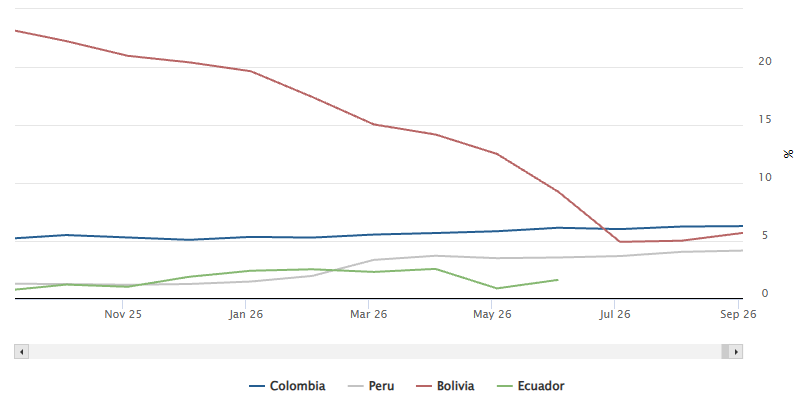
    Andean countries: inflation rate
    Percentage variation (year-on-year)

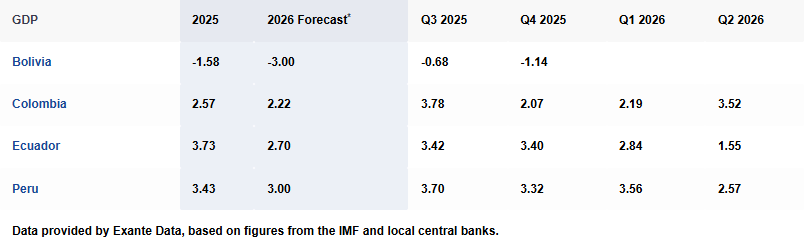
    Andean countries: GDP growth (%)
    Quarterly figures are year-on-year growth

  • NAFTA BRIEFS

    LatinNews 12 October 2011 Hits: 209

    US ambassador: On 8 June US President Barack Obama formally nominated Earl Anthony Wayne, currently the country’s deputy ambassador in Afghanistan, to become the next US ambassador to Mexico. The formal nomination suggests that the Mexican government, which was consulted about Wayne’s nomination at the end of May, has no objection. The US Senate must approve Wayne’s nomination.

    Remittances: The inflow of remittances from expatriates rose 4.7% year-on-year in April 2011 to reach US$1.87bn. Remittance inflows, from expatriates based mostly in the US, have now risen for seven months consecutively, according to the Banco de México.

    The increase is slightly odd, because the construction and housing industries, which are big sources of jobs for Mexicans in the US, are still in trouble. It  appears that the number of people remitting has increased: the size of the average transaction in April was up 2% year-on-year at US$331, but the number of transactions was up by 2.6% at 5.7m. Easter, which fell in April this year but in March in 2010, may have been a factor in the increased number of transactions. For the first four months of 2011 the total inflow of remittances was up 5.3% at US$6.97bn.

    Charitable giving: A study by Johns Hopkins University in the US, cited by Jorge Castañeda in his new book, Mañana o Pasado: El Misterio de los Mexicanos, found that Mexico comes plumb last in the ranking of countries by charitable giving. Mexicans give the equivalent of only 0.04% of the country’s GDP to charity. Castañeda, a prominent intellectual and a former foreign minister under the government led by Vicente Fox (2000 -2006) argues that this figure shows that Mexicans are less community-minded and more individualist than most Latin Americans.

    • On 28 June the federal government of Mexico filed an application to delay the execution of Leal García before the US Supreme Court. The Mexican government is arguing that the Supreme Court should not allow the rights of the state of Texas to override Leal García’s constitutional rights. The Mexican government argues that the Supreme Court should at least suspend the execution until the fate of the Leahy proposal in congress is clear.
  • In Brief – Andean

    LatinNews 02 February 2012 Hits: 1320

    Ecuador | Army chief resigns. On 1 February President Rafael Correa of Ecuador accepted the resignation for “personal reasons” of General Patricio Cárdenas, the commander of the army who had just two months left in his two-year term. President Correa decreed the appointment of General Marco Aurelio Vera as his replacement.

    Venezuela | “Snitch law”. The opposition in congress came out strongly on 1 February against the newly approved organic law against organized crime and terrorism financing, arguing that it violates up to 20 constitutional norms and criminalises key civil-political rights such as the right of association and the right to protest. Deputy José Antonio España of the opposition Movimiento al Socialismo said that the law “makes suspects of us all” and noted that the creation of an office against organized crime and terrorism financing undermines the authority of the public prosecutor. His Copei colleague, Eduardo Gomez Sigala, complained about the law’s “vagueness and imprecision” and the apparent obligation of ordinary citizens (on pain of fines) to report any “suspicious” activity, saying that the government led by President Hugo Chávez had implemented a “snitch law” (Ley Sapo) under the premise of “legislating for the enemy”.

  • Risk pointers

    LatinNews 13 June 2012 Hits: 548

    *** Putin issues warning, protesters to take a breather.  Faced with renewed street-based opposition to his rule, Russia’s President Vladimir Putin issued a warning on 12 June.  Speaking at a Kremlin reception, he said: “For a country as huge as Russia, with its multiethnic population and its complex federative arrangements, the undoubted value of evolutionary, gradual development is obvious.  We cannot accept anything that weakens our country and divides society.  We cannot tolerate any decisions and steps that could lead to social and economic shock.”

    His comments coincided with the first big anti-government rally since he returned to the Kremlin.  However, on 13 June, Solidarity activist Sergey Davidis suggested that there would probably be no more big mass events in Moscow until the autumn.  In the meantime, the disparate opposition is beginning to implement its plans to set up a coordinating council to prepare future protests.  According to Davidis: "No-one either elected or authorized” the current organizing committee, and the committee has often been criticized for not having any mandate.  Now, he says, there is “an initiative to form single coordinating bodies of the protest movement on the basis of democratic procedures".

    Davidis added that this week "a small group consisting of universally recognized leaders, [Aleksey] Navalnyy, [Sergey] Udaltsov, and several more people, will work out certain rules of game. There are different versions: elections only in the internet, or in the internet and also off-line.  There are several schemes, there are questions including technical ones, but they can be solved.  This scheme will be drawn up within quite a short period of time, maybe a month.  Voting will take another month.”

    *** Increased North Korean military activity.  According to South Korean government sources, North Korea is displaying “an unusual amount of military activity”.  On 12 June, one government official said: “North Korea has deployed a bunch of Sukhoi and MiG jet fighters to some frontline military airfields, such as those in Taetan and Nuchon-ri, South Hwanghae.  They are dramatically bulking up the military drills of those aircraft.”  It is said that Pyongyang’s new leader, Kim Jong-un, has ordered an increase in the duration of air force military exercises.  Pyongyang is also ratcheting up its anti-Seoul propaganda through China-based social networking services.

    *** Germany opposes military intervention in Syria.  On 11 June, Germany’s Defence Minister Thomas de Maiziere complained about the “continued waffling by people who bear none of the responsibility [which] creates expectations in regions like Syria, thereby causing terrible disappointment”.  He added that he found it “hardly bearable that some coffee house intellectuals call for the deployment of soldiers in the world without being accountable for it”.

  • ARGENTINA: El peso oficialmente estable; devaluado por los mercados

    LatinNews 23 July 2012 Hits: 635

    El gobierno puede negar que ya esté en camino una masiva pero, de acuerdo con los mercados, ya está en marcha. Esta semana, un ex ministro de economía, Domingo Cavallo (1991-1996 y 2001), dijo que el gobierno se encaminaba a un “corralón” –una clara referencia al “corralito” impuesto después de una masiva devaluación que puso fin a su plan de convertibilidad. Para empeorar las cosas, Cavallo también dijo que “el único economista que podría sacar las papas del fuego [al gobierno], pero con pocas probabilidades de éxito, es [el ex ministro de economía Roberto] Lavagna (2002-2005)”.

    El llamado ‘dólar blue’ (dólar paralelo) trepó esta semana, alcanzando un récord de altura de AR$6,8/US$ después de cerrar en AR$6,75 el 18 de julio. Esto significa que desde que la administración de la Presidenta Cristina Fernández introdujo controles sobre el mercado de cambio de moneda en noviembre pasado, el margen entre la tasa oficial de cambio (AR$44,5/US$) y el ‘dólar azul’ se ha incrementado en 47,7%, y en 17% tan sólo en las dos semanas pasadas.

    La creciente brecha entre los dos valores simplemente corrobora una verdad innegable: el apetito de los argentinos por los dólares ha permanecido intacto, pese a los esfuerzos de Fernández para convencer a los ahorristas que deben poner sus fondos para la época de las vacas flacas en moneda local [IL-12-22]. La pregunta que permanece es si la brecha ya ha llegado a su máximo límite; los expertos simplemente no pueden ponerse de acuerdo sobre cuándo el dólar llegará a su valor de equilibrio. El movimiento de alzas y bajas del 18 de julio indica que el valor más alto (AR$6,8) era simplemente demasiado alto, pero nadie puede garantizar que lo que era demasiado caro esta semana permanecerá así en la semana próxima, o dentro de un mes.

    Mientras el banco central de Argentina (BCRA) alega que solamente el 2% del mercado de cambio de moneda está directamente relacionado con el valor del ‘dólar blue’’, los economistas advierten que el valor del blue es la referencia usada cuando elaboran pronósticos de devaluación e inflación.

    Esto significa que como los cálculos de inflación de las consultaras privadas son tomados en cuenta en lugar de los confiables cálculos oficiales por el instituto nacional de estadísticas (Indec), los empresarios y del mismo modo los ahorristas privados han comenzado a tomar el valor del blue como su verdadero punto de referencia, incrementando la especulación y estimulando la sobre-información de importaciones y la sub-información de exportaciones. Esto último puede dañar los esfuerzos del gobierno para mantener un superávit comercial y una tasa de cambio estable. El mercado está enviando un claro mensaje: es esperada una devaluación; cuándo o cómo es una adivinanza.

    Manos fuera del ámbito de Famatina

    Esta semana, el magistrado Daniel Flores de la corte del distrito de Chilecito, provincia de La Rioja, resolvió la suspensión del acuerdo de exploración minera concretado por la compañía minera provincial (Esme) y Osisko Mining, de Canadá, en relación al ámbito de Famatina. La decisión del juez está basada en la decisión de la corte suprema de justicia (CSJ) emitida antes en este mes, que ordenó la implementación de la ley de glaciares del 2010.

    De acuerdo con la ley, todas las provincias deben mantener registros de todas las áreas de glaciares y peri-glaciares en sus territorios antes que cualquier contrato minero, para exploración y/o explotación, pueda otorgarse. De acuerdo con funcionarios del gobierno de La Rioja, hay solamente un puñado de glaciares en la provincia; sin embargo, los expertos geológicos dicen que la definición de áreas de glaciar y peri-glaciar es mucho más amplia de lo que puede detectarse a simple vista y ubican el número total de glaciares en la provincia en más de 400.

    • Famatina, el símbolo de una lucha más amplia

    Las protestas anti-minería en Famatina y Chilecito contra la exploración en el Cerro General Belgrano, comúnmente conocido como el Nevado de Famatina, se ha convertido en el símbolo de los movimientos anti-minería a través del país [IL-12-05]. El alcalde local, Ismael Bordagaray ha presentado una orden judicial contra el acuerdo de exploración. El alcalde ha denunciado en los medios nacionales que desde que él ha cuestionado el acuerdo, el gobierno federal y el provincial (que son de su mismo partido, el Frente para la Victoria) han cortado las transferencias de pagos a la municipalidad, forzándolo a él y a los residentes locales a limpiar las calles y recolectar la basura por ellos mismos.

  • In Brief - Dominican Republic

    LatinNews 13 August 2012 Hits: 1063

    Dominican Republic| Anti-drug trafficking agreement signed with Mexico. On 13 August the prosecutor generals of Mexico and the Dominican Republic, Marisela Morales Ibáñez and Radhamés Jimémez Peña respectively, signed a new anti-drug trafficking and anti-crime cooperation agreement in Santo Domingo. The new agreement will cover cooperation in investigations and judicial proceedings on crimes related to terrorism, organised crime and other related crimes. It also calls for the exchange of information and experience in cases involving corruption, people and drug trafficking and money laundering. Morales and Jiménez Peña said that “currently the Dominican Republic and Mexico are immersed in an unprecedented fight against transnational organised crime… and that is why we have decided to coordinate the application of public policies that will add our efforts to that of other countries in order to avoid such crimes from crossing our borders”. Mexico was put in charge of setting up a new Inter-American security system after the last Organization of American States (OAS) summit held in Cartagena de Indias, Colombia, in April. Since then, Morales has visited Peru, Ecuador and Colombia, where she has signed similar agreements.

  • TRACKING TRENDS

    LatinNews 10 October 2013 Hits: 995

    COLOMBIA | Fulfilling rural sector demands. The Colombian government announced last week that it would be restricting imports of nine agricultural products in order to fulfil the agreements reached with the local agricultural sector that brought an end to the national strikes staged by the sector throughout July and August. The announcement was made by the outgoing trade minister, Sergio Díaz-Granados, following a ministerial meeting at the Casa de Nariño presidential palace, also attended by Agriculture Minister Rubén Darío Lizarralde, Interior Minister Aurelio Iragorri and social prosperity department director, Bruce Mac Master.

    Díaz-Granados said that the government would introduce restrictions on: fresh and pre-cooked potatoes, milk whey, powdered milk, onions, beans, peas, tomatoes, pears and fresh cheese; as had been “agreed” with the agricultural producers.

    In addition Díaz-Granados said that the government was working on increasing the level of Colombian exports to Venezuela after the government of President Nicolás Maduro expressed an interest in purchasing increased levels of Colombian products [WR-13-37]. Díaz-Granados said that after signing a new trade deal with Venezuela, Colombia was looking to determine “exactly what products, quantities and values”, Venezuela is looking to purchase. He added that “we are [also] waiting to have a clear and swift payment mechanism in place, in order to expand our exports to Venezuela”.

    Meanwhile the recently appointed Lizarralde announced that the government would also present a new agrarian debt restructuring bill to congress aimed at helping agricultural producers with overdue debt payments to pay off their debts. Lizarralde also said that the government would inject more capital into the agricultural sector financing fund (Finagro) so that it “can continue to have the capacity to offer credit to small and medium sized agricultural producers”, although he failed to provide any figures.

    Finally Lizarralde revealed that the government is also preparing a proposal to extend for another year the ‘4 por mil’ tax levied on financial transactions and to redirect the funds raised by the measure to the agricultural sector. It is estimated that the agreement reached with the agricultural sector, which also includes freezing the price of diesel and eliminating taxes on agricultural inputs (i.e. pesticides) will cost the government some Col$3.1bn (US$1.58m).

    The tax on financial transactions has been in place in Colombia since 1998, despite the fact that it has often been criticised by the private sector. In 2010 congress approved Santos’s tax reform proposal, which among other things called for the gradual elimination of the tax by 2018. Providing a convincing argument for extending the financial transactions tax could prove to be more difficult due to the fact that Finance Minister Mauricio Cárdenas recently revealed that tax revenues for the year stood at Col$76.8bn, Col$5bn over last year’s figures and already above the official target for the year.

    VENEZUELA | Sidor strike. Yunis Hernández, the head of the workers’ union at the Siderúrgica del Orinoco (Sidor), Venezuela’s largest steel works, announced late on 8 October that the 14,000 Sidor employees would return to work after a partial resolution to a long-running pay dispute. The workers had been on strike for more than three weeks demanding the payment of backdated bonuses to the tune of BF150,000 (US$23,810 at the official exchange rate) each, which the union claims are owed since the firm was nationalised in 2008. Under the tentative accord, workers will receive BF40,000 in two lump sums on 31 October and 16 December, but no agreement has been reached over a final payout.

    President Nicolás Maduro had adopted a tough stance against the union accusing it of trying to hold the country to ransom. Maduro deployed army (FANB) and Bolivarian militia battalions to Puerto Ordaz, where Sidor is located and threatened to break up the picket lines set up around the plant if the strike was not lifted. “I expect an immediate rectification or else I and the Venezuelan people, the working class will recover Sidor… I will not show weakness in front of delinquent and anarchist unions,” Maduro had warned.

    Hernández maintained that the workers were only demanding that the debt be recognised and that a payment schedule be agreed. He added that Sidor’s situation was “deplorable just like other State firms, because there is no investment in their upkeep”.

    • Caribbean oil exploration

    On 3 October Colombia’s state oil firm, Ecopetrol, announced that along with its Indian partner, ONCGC Videsh, it had begun oil exploration efforts in the Caribbean Sea off the coast of La Guajira department, on the border with Venezuela. An Ecopetrol statement said that following the arrival in the area of an exploratory vessel, Poseidon, the ship was now set to spend the next 10 days exploring the RC-9 exploratory bloc located 27kms off the coast looking for an ideal spot to set up a deep sea oil rig. Once successfully installed, the new rig will become only the third to operate in Colombian waters joining the Chuchupa A and Chuchupa B rigs jointly run by Ecopetrol and Chevron, which are also located off the coast of La Guajira.

  • Making the grade on human rights?

    LatinNews 31 October 2013 Hits: 435

    The United Nations Human Rights Council (UNHRC) has conducted its Universal Periodic Review (UPR) of Mexico’s progress on the human rights front. The Mexican government says it believes that it has “done very well” in the review. But many local and international rights advocacy groups beg to differ and have renewed their calls for the Mexican government to do a lot more to improve human rights in the country.

    Following the conclusion of the UPR (which was conducted at the United Nations headquarters in Geneva, Switzerland), Juan Manuel Gómez Robledo, the deputy minister for human rights and multilateral affairs at Mexico’s foreign ministry, remarked that “The common denominator has been the recognition of the great strides that have been made in the past couple of years in the different aspects of this subject area”. According to Gómez, all 89 delegations that took to the floor in the process “without exception” recognised the “enormous progress” made by the country in recent years, particularly from the “juridical-institutional point of view”. Gómez said that in particular Mexico’s efforts to overhaul its legislation and public policies so as to address some of the relevant human rights issues affecting the country were recognised.

    These efforts, which Gómez said included: the reform of the penal code to more heavily punish the crime of forceful disappearance as per international standards; the 2011 constitutional reform which amended 11 articles so as to recognise the universality of human rights and the international treaties that uphold them; and the January approval of the law of victims, which also required minor constitutional changes, and which for the first time establishes the Mexican State’s obligation to compensate the victims of human rights violations committed in the country, all appear to be significant. It is no wonder that Gómez concluded that the latest UPR “greatly contrasted” with the first one four years ago. when the UNHRC presented Mexico with 91 recommendations aimed at strengthening human rights in the country.

    Foreign Minister José Antonio Meade Kuribreña, who also attended the UPR, made the point that Mexico had accepted and addressed 83 of the previous recommendations by providing increased assistance to the victims of crime and human rights violations, all of which he put forward as “proof that Mexico is addressing its public security problems with a new focus”. Nevertheless, Meade also recognised that “an important” number of delegations also pointed to the significant challenges faced by Mexico in “perfecting the foundations which we now put down”. After analysing the results of the UPR, the UNHRC will issue its verdict on Mexico’s progress and propose more recommendations if necessary.

    Not enough

    While the government is keen to portray itself as responsive to the concerns over the human rights situation in the county expressed by the international community, the efforts made by Mexico are largely considered insufficient by prominent human rights advocacy groups both inside and outside the country. Many claim that while positive, the various efforts pursued by the Mexican government don’t go far enough in ensuring the effective implementation of some of the recent institutional changes made in order to promote the defence of human rights [RM-13-10].

    In fact in the run-up to the UPR, Amnesty International (AI) issued a statement on 21 October in which it called on the Mexican government to “do more” to defend human rights in the country and not limit itself to resorting to “fine words” to present itself as an example to follow. According to AI’s Mexico researcher, Rupert Knox, “While the Mexican government is unrivalled in its rhetorical commitment to human rights, it continues to fail to take the decisive measures it committed to”. Knox adds that the government continues to ‘turn a blind eye’ to many of the human rights violations in Mexico: “The new government, like the previous one, claims that protection of human rights is at the heart of its public security operations. However, arbitrary detentions, torture and ill treatment and disappearances continue to impact the lives of thousands of Mexicans”.

    Knox accuses the Mexican government of failing to fulfil all the recommendations made by the UNHCR after the last UPR, concluding that “If the Mexican government is serious about human rights, it has to do more than come out with bold proclamations… it must fully implement the recommendations set out by the United Nations”.

    Token gesture?

    On 29 October Mexico’s congress approved anther addenda to the federal penal code, giving the executive the power to pardon any prisoners whose rights had been “seriously” violated. Deputy Ricardo Anaya, one of the main proponents of the change, explained that it will allow congress to request a pardon for anyone convicted of a federal or common crime whenever there is sufficient evidence of serious violations of the accused’s rights, including due process. Anaya said that the new legislation could be used to free Alberto Patishtán Gómez, a Tzotzil tribesman and teacher who was given a 60-year prison sentence after he was found to be the sole person responsible for  ambush and murder of seven police officers in Chiapas state in 2000.  In August, AI released a report into Patishtán’s case which found a series of irregularities in the due process, leading AI to denounce his sentence as “unjust”.  President Enrique Peña Nieto has already signalled that he intends to pardon Patishtán as soon as the new law is published in the official gazette

    • Peña Nieto meets with SCJN

    On 29 October President Peña Nieto attended a working lunch with the 11 members of the Suprema Corte de Justicia de la Nación (SCJN), Mexico’s supreme court. According to a presidential statement, the purpose of the meeting was to address a number of issues including “the promotion and defence of human rights and the administration of justice and due process” in the country. The meeting was also attended by Interior Minister Miguel Angel Osorio Chong, Attorney General Jesús Murillo Karam, and the presidential legal adviser, Humberto Castillejos Cervantes.

  • COLOMBIA: Farc raises concerns over peace process

    LatinNews 09 January 2014 Hits: 3734

    The high command of the Fuerzas Armadas Revolucionarias de Colombia (Farc) released a statement on 5 January raising “serious doubts” about the commitment of the “Colombian State and its imperial master” to the peace process in Havana. The Farc secretariat was responding directly to the publication on 21 December of a long and detailed piece of investigative journalism in The Washington Post outlining the extent of the US role in the Colombian military campaign to target the Farc leadership in recent years.

    Citing 30 sources in the US intelligence community, military, and diplomatic corps and Colombian officials, The Washington Post piece claims that “a [Central Intelligence Agency] CIA covert action program” to provide “real-time intelligence that allows Colombian forces to hunt down individual Farc leaders” was backed by “a multibillion-dollar black budget […] not a part of the $9 billion package of mostly US military aid called Plan Colombia, which began in 2000”. This program began to take shape after former President George W. Bush (2001-2009) authorised CIA action shortly after the Farc killed one and kidnapped three US contractors involved in coca eradication in 2003; it remains “classified and ongoing”, according to The Post.

    The Post article says that a US Embassy Intelligence Fusion Cell, dubbed ‘the Bunker’, was set up in the US embassy in Bogotá; eight people monitored satellite maps of the jungle, searching for Farc hiding places, while voice intercepts were decrypted by the National Security Agency (NSA). The CIA also helped train Colombian interrogators to question Farc deserters more effectively but “without the use of the ‘enhanced interrogation’ techniques approved for use on al-Qaeda”, and assisted in the development of a database cataloguing the results.

    The US provided the Colombians with a GPS guidance kit to transform heavyweight bombs into “highly accurate smart bombs”, one of which was used in the March 2008 bombing raid on a Farc encampment across the border with Ecuador which claimed the life of the Farc’s number two ‘Raúl Reyes’ (Luis Edgar Devia Silva).

    As well as raising doubts about the government’s commitment to the peace process in the wake of the publication of this article, the Farc said it displayed “the sum of interests driving the deepening of the armed conflict”. The Farc said that while it was certainly not ignorant of much of what was reported, the article “clears up some things”. Ecuador’s President Rafael Correa, who broke off diplomatic relations with Colombia over the Reyes bombing, speculated that behind the “very serious” revelations could be interests opposed to the peace process. Colombia’s former president Alvaro Uribe (2002-2010) tweeted his response. He said that the US had helped Colombia locate Farc leaders so that the Colombian security forces, “under my responsibility”, could carry out the relevant operations.

    It was somewhat ironic that the piece should have maintained that “the pace of operations against the Farc” had “greatly increased” under President Juan Manuel Santos with “almost three times as many Farc leaders — 47 vs. 16 — hav[ing] been killed under Santos as under Uribe.” Uribe’s main criticism of Santos is that he has allowed the security situation in Colombia to deteriorate. This week Uribe complained that there were no guarantees for his party Centro Democrático (CD) to conduct a national campaign ahead of congressional and presidential elections in March and May respectively. Santos fired back a series of statistics designed to rebuff Uribe’s claims (see sidebar), although he was not brazen enough to cite this particular statistic.

    • Security gains

    President Santos claimed this week that major security gains were recorded in 2013. He said that there had been an 8% decline in the homicide rate on 2012 to 14,782 cases; 2,757 members of ‘emerging criminal groups’ (Bacrims), had been captured and 1,658 members of the neo-paramilitary group Los Urabeños in 2013; kidnapping had fallen by 4%, with no reported cases in 981 of 1,123 municipalities; “terrorist activity” had fallen by 24%; and 347 tonnes of marijuana were seized, the largest amount since 1993.

  • COSTA RICA: Solís under pressure to address key priority

    LatinNews 05 June 2014 Hits: 1132

    Private sector lobbies like the Cámara de Industrias de Costa Rica (CICR) and the Unión Costarricense de Cámaras y Asociaciones del Sector Empresarial Privado (UCCAEP) are again calling on President Luis Guillermo Solís and his new centre-left Partido Acción Ciudadana (PAC) government to address the problem of high energy tariffs as the main obstacle to economic growth. With the cost of electricity reportedly one of the factors in the recent decision by US chipmaker Intel to up sticks and leave the country [WR-14-15], this remains a key concern given that, along with redressing social inequalities, attracting investment is a declared priority of the new PAC administration.

    On 27 May the CICR presented a study to Solís on private sector perspectives vis-à-vis the state of the industrial sector. Of the sample of 200 companies in the study (of which 53% were small scale, 31% large and 16% medium-sized), 80% cited electricity costs as the main hindrance to growth – which is forecast as average for Central America (see sidebar) and competitivity. As if to illustrate the point, the following day Costa Rica’s utilities’ regulator, Autoridad Reguladora de Servicios Públicos (Aresep) approved yet another increase in fuel prices – the third so far this year - with a litre of ‘super’ gasoline now costing C$786 (US$1.41), up from C$778 (US$1.40), and that of diesel costing C$689 (US$1.24), up from C$677 (US$1.22). In mid-March the local daily, El Financiero, had cited figures from Aresep showing that electricity tariffs had risen by 33% in the past six years – from C$61.15 (US$0.11) per kWh in 2007 to C$81.31 (US$0.15) in 2013 [WR-14-11].

    Proposals

    The cost of electricity had previously led private sector lobbies like the UCCAEP to call for the approval of a bill proposed by Solís’s predecessor, Laura Chinchilla, of the centrist Partido Liberación Nacional (2010-2014) which, among other things, would raise the permitted limit of energy generated by private companies, from 15% to 25% of the total. However, business representatives cited in the local press at the time of the release of the CICR study appear to have abandoned this idea, aware that any mention of privatisation is unlikely to be well received. Instead they are proposing other measures like removing taxes on fuel or cutting the costs of bureaucratic procedures.

    So far Solís has yet to provide a satisfactory response to the private sector. Having pledged in his manifesto to cut tariffs through revising the conditions of loans offered by the Instituto Costarricense de Electricidad (ICE) - the state run electricity and telecommunications services provider – and improve the efficiency of state-run generating facilities, on 13 May he said that he will call on the Aresep and the state oil refinery, Recope to revise the methodology of adjusting fuel tariffs in the country, with the aim of lowering prices.

    • FDI up

    Despite the private sector doom and gloom and continued concerns regarding investment, it is worth pointing out that foreign direct investment (FDI) in Costa Rica continues to rise.

    According to the latest (May 2014) report by the Economic Commission for Latin America & the Caribbean (Eclac), FDI inflows were up 15% last year, reaching US$2.68bn - the highest level ever. The report notes that “manufacturing, mostly maquila activities, used to receive the bulk of FDI entering Costa Rica, but a series of reforms in 2011 opened the door to FDI in electricity, insurance and telecoms and shifted the distribution towards services.” The report also noted that “for the first time, real estate activities received the largest share, at US$1.2bn, on the back of several hotel, shopping mall and office complex developments, mostly by companies from other Central American countries”.

    • Growth

    A May report by the Economic Commission for Latin America & the Caribbean (Eclac) forecasts 4.0% GDP growth for Costa Rica for 2014, up from 3.5% in 2013, which was down from 5.1% the previous year. The 2014 figure for Costa Rica is average for Central America - above El Salvador (2.3%); Honduras (3.0%) and Guatemala (3.5%) but below Panama (7.0%) and Nicaragua (5.0%).