All Categories

Subcategories

  • TRACKING TRENDS

    Abbi Dicker 12 March 2026 Hits: 1373

    MEXICO | USMCA negotiations. The Mexican and US governments announced last week that they will begin negotiations on renewing the United States-Mexico-Canada Agreement (USMCA) in the week of 16 March. US Trade Representative (USTR) Jamieson Greer and Mexican Economy Minister Marcelo Ebrard said negotiators will meet regularly, with Canada expected to join the talks later.

    Under the terms of the USMCA, it could be renewed for a further 16 years; continued without renewal, which would leave it in place until 2036; or discontinued after six months of notice.

    The USMCA review begins as Mexican government officials are predicting an economic recovery will gather pace. In 2025 GDP growth was only 0.6%, deeply affected by uncertainty over US President Donald Trump’s changing tariff policies. This week Finance Minister Edgar Amador Zamora said he is predicting a recovery with 3.0% GDP growth in 2026, although he said that remained conditional on healthy domestic demand, a “stable” global economy, and a reduction in trade tensions.

  • BRAZIL: Ruling party to back centrist figure for Rio governorship

    Abbi Dicker 23 April 2026 Hits: 1058

    Brazil’s ruling left-wing Partido dos Trabalhadores (PT) has confirmed that it will not field one of its own members to run for the governorship of the third largest state, Rio de Janeiro. Instead, it will back the gubernatorial bid of Eduardo Paes of the centrist Partido Social Democrático (PSD), who served as the mayor of the state capital from 2009-2017 and again from 2021-2026.

    The former mayor of Rio de Janeiro had attempted a run at the governorship in 2018, when he lost in the run-off vote to Wilson Witzel of the right-wing Partido Social Cristão (PSC), who was temporarily unseated in 2020 and later officially impeached in 2021 due to corruption charges.

    Witzel’s deputy governor at the time, Cláudio Castro of the far-right Partido Liberal (PL), served out the rest of the term and then won re-election in the 2022 election. Castro stepped down in March this year to run for a seat in the senate, although the superior electoral court (TSE) has imposed an electoral ban on him after pronouncing him guilty of misusing public funds during his 2022 election campaign.

    Given that Castro’s former deputy governor, Thiago Pampolha, is also subject to a TSE electoral ban, the current acting state governor of Rio de Janeiro is Ricardo Couto, the president of the top state court. Normally when both a governor and deputy governor are unable to hold office, the next in line would be the head of the Rio state legislative assembly (Alerj), who is currently Douglas Ruas (PL).

    Ruas is serving on an interim basis following the temporary leave of state deputy Rodridgo Bacellar, of the centrist União Brasil, who was briefly arrested in December in relation to alleged ties to organised crime. However, there is currently legal uncertainty over whether Ruas would be allowed to assume the role of governor for the rest of 2026. Ruas could not assume the governorship after Castro’s resignation in March because he was only holding the Alerj leadership role on an interim basis.

    On 26 March the Alerj officially voted to declare Ruas as the new head of the state assembly. But the opposition abstained from the vote, and a state court annulled the vote on the grounds of alleged irregularities.

    On 17 April the Alerj held another vote to swear in Ruas as its president. But the federal supreme court (STF) is still reviewing a petition as to whether Ruas should be allowed to assume the governorship or whether the state of Rio should hold direct public elections.

    According to Brazilian news website G1, the left-wing PT, which leads the federal government but is in opposition in the Rio state assembly, is pushing for direct elections to decide who should be governor for the remainder of 2026. This is significant because whoever is in control of state government coffers would likely be in a position to provide indirect support for the electoral campaigns of their political allies.

    If the STF were to allow Ruas to assume the governorship it would be a boost for the PL and its right-wing allies and a blow for centrist and leftist figures, such as Paes and PT politicians in Rio.

    Senate contender

    The local leaders of the PT in Rio de Janeiro state decided not to field one of their own party members in the gubernatorial race, but they have confirmed that federal deputy Benedita da Silva will be the party’s candidate to run for one of the two senate seats for Rio up for grabs in the congressional elections in October.

  • PARAGUAY: Strike exposes cracks in economic success model

    Abbi Dicker 16 October 2026 Hits: 304

    Paraguay’s President Santiago Peña has done much to boost his country’s economic credentials, but he has also been criticised as being aloof to the needs of many ordinary citizens. He recently got another taste of the simmering discontent resulting from the rising cost of living and tight government purses. In August, Paraguay’s doctors’ union (Sinamed) led strikes and protest action, demanding more pay and denouncing a shortage of medical supplies and poor working conditions. Physicians and other healthcare workers in the public sector resigned en masse.

    The Peña administration, which won investor praise and obtained a series of credit rating upgrades due to the fiscal discipline it demonstrated since taking office in August 2023, had resisted Sinamed’s demands out of concern they would put a further dent in public coffers. Sinamed estimated its pay demands would have cost the government US$127m, which unions argued was not even 1% of the country’s budget.

    But after doctors went on a nationwide strike from 24-28 August and congress created a special committee on 7 September to look into the matter, Peña realised it was time to make concessions. On 13 September he replaced his health minister, María Teresa Barán Wasilchuk (2023-2026), with Isaías Fretes, who had been head of the Instituto de Previsión Social (IPS), Paraguay’s social security institute. “We must improve management, be closer to the people, and ensure that every Paraguayan receives the attention they deserve,” Peña wrote on X when announcing the ministerial change.

    A day later the government reached an agreement with Sinamed, which included a G$2m (US$333) pay increase for doctors, compared with the G$3m originally demanded. Peña praised the agreement in a statement on social media, saying: “I want more doctors, a stronger public health system, and a Paraguay where every citizen receives the care they deserve.”

    The episode is in line with Peña’s policy shift in the second half of his tenure, from hardcore fiscal discipline that saw unpopular belt-tightening measures, to increased government spending and social welfare. The change of direction came after bigwigs in Peña’s Asociación Nacional Republicana-Partido Colorado (ANR-PC) aired concerns that the government’s budgetary zeal was undermining its electoral prospects, particularly ahead of the 4 October municipal elections, where the opposition notched some victories, including winning in Asunción.

    Based on the country’s economic performance, Peña and his party should be doing fantastically well. GDP is expected to grow 4.4% this year, according to projections by the International Monetary Fund (IMF). That is well above the projection for most countries in the region. Meanwhile, the IMF expects Paraguay’s inflation this year to be around 3.5%, on target with the central bank’s goal.

    And yet the popularity of the 47-year-old economist and former central banker has fallen, as the country’s macro-economic success has failed to trickle down to many ordinary citizens. His government has been criticised for delays in social policies, poor public transport, and the lack of institutional transparency. On 30 September credit ratings agency Fitch also cited institutional weaknesses as one of the reasons it fell short of granting Paraguay investment grade status, maintaining its rating of ‘BB+’, still a notch below investment grade.

    Support for healthcare

    Indicative of his attempts to appease concerns of the sector, Peña said on 13 September that healthcare would continue to be a “top priority” for his government. He highlighted that, over the past three years, the government had allocated more than US$500m to healthcare infrastructure and opened two new state-of-the-art hospitals, with seven more under construction. In addition, he said the government had earmarked US$195m for the national cancer institute (Incan), which he described as an increase of approximately 290% compared to 2023. By 2027, he said his administration will have allocated US$760m for medications and medical supplies, which he claimed would be an increase of nearly 200% compared to his first year in office.

  • Risk pointers

    LatinNews 10 October 2012 Hits: 571

    *** India claims more evidence of Pakistani subversion.  India’s National Investigation Agency (NIA) says that it has evidence that Pakistan’s Inter-Services Intelligence (ISI) is funding the Babbar Khalsa International (BKI) group in an attempt to revive militancy in Punjab.  Funds are said to be reaching BKI via informal money-transfer networks in Britain, Thailand, and Malaysia.

    NIA says that BKI has a “large network” of sleeper cells in Punjab and that these are at the centre of a plot to revive 1980s-style militancy in the region.  BKI’s two top leaders, Wadhwa Singh and Mehal Singh, are believed to have been in Pakistan recently for meetings with top ISI officials.

    Last week we reported that Indian counter-intelligence had sent out a special advisory to police intelligence units and special branches in southern India warning about Pakistani spy activity.  The advisory said that Pakistan had developed a “formidable” network in Sri Lanka with a view to spying on key Indian defence and strategic installations in the southern region.  The advisory called for “a special drive to target ISI [Pakistani intelligence] backed espionage networks in the area”.

    *** German warning on Salafist activity.  Hans-Georg Maassen, the head of Germany’s domestic intelligence service, the Federal Office for the Protection of the Constitution, has warned that hardline Salafists are trying to spread their influence among Islamists in Germany.  A German-language media centre has been set up with the intention “to exert influence on Islamists in Germany”.  It is said that over the past few months some 50 Salafists have left Germany to go abroad, mostly to Egypt.

    *** Surge in North Korean trade with China.  A South Korean parliamentary report on 8 October revealed that trading volumes between China and North Korea reached US$3.54bn in the first seven months of 2012, an increase of 14.5% over the same period in 2011.  The trade figure for 2011 ($5.62bn) was itself up 62.4% on the previous year.

    The same report showed that in 2011 China accounted for 89.1% of North Korea’s trading with foreign countries.  This is up from 67% in 2007, 72.9% in 2008, and 82.9% in 2010.  The North’s annual food imports from China came to 155,000 tons in 2008.  In 2011 the figure was 380,000 tons.

    By contrast, aid to North Korea from South Korea has plummeted under President Lee Myung-bak.  The total amount of government and private-sector aid between early 2008 and August 2012 came to US215.1m, which is about a quarter of the average level of aid to the North provided under the two previous administrations.

  • BOLIVIA-CHILE: Crecimiento ‘exponencial’ del flujo de drogas hacia el sur

    LatinNews 19 November 2012 Hits: 462

    Tan pronto el Presidente Evo Morales terminó de dar rienda suelta a su crítica acerca del duro tratamiento que recibió Bolivia de parte del gobierno de EU en su evaluación del desempeño antidroga que algo del mismo tipo provenó de un sector totalmente inesperado: el cónsul general de Chile en La Paz.

    En una entrevista con el diario El Deber, publicada el 10 de noviembre, el cónsul general de Chile, Jorge Canelas, dijo: “Uno de los puntos de nuestra relación que más nos preocupa es el crecimiento exponencial de la cantidad de drogas incautadas que proviene de Bolivia.”

    Él dijo que en el pasado la policía chilena interceptaba cargamentos de 50, 80, y hasta de 100 kilos de droga, mientras que en estos días se ha convertido en algo común  incautar cargas de media tonelada o incluso de hasta 1,7t. A fines de octubre, la policía de Santiago interceptó una carga de 1,7t de marihuana, cocaína clorhídrica y pasta base de cocaína –la incautación de drogas más grande jamás registrada.

    Canelas agregó que como resultado de los crecientes volúmenes interceptados, las autoridades chilenas habían tenido que ajustar los controles a mercaderías procedentes de Bolivia que pasan a través de puertos chilenos y que están afectando el flujo del comercio. Una preocupación agregada es que los puertos chilenos podrían terminar siendo considerados “puntos de peligro” o conductos para el comercio de la droga.

    El canciller boliviano, David Choquehuanca, dijo que organizaciones tales como la ONU habían sostenido que Bolivia era un país de tránsito, no un país productor de drogas. También subrayó que la Oficina de la ONU sobre Drogas y Delito (UNODC) había verificado una reducción neta del 12% en el área dedicada al cultivo de la coca en Bolivia. El gobierno de Morales sigue insistiendo en que el grueso de la cocaína que pasa a través de Bolivia procede de Perú.

    Cooperación con los vecinos

    En lo que parece ser un claro intento de disipar las dudas acerca del compromiso de los esfuerzos antidrogas de Bolivia, el 14 de noviembre en Lima, el ministro del interior de Bolivia, Carlos Romero Bonifaz, firmó un acuerdo con su par peruano, Wilfredo Pedraza, y el ministro de justicia brasilero, José Eduardo Cardozo, para establecer un grupo técnico de trabajo para preparar dentro de 60 días, una serie de mecanismos prácticos para la acción conjunta antidrogas.

    La misión del grupo incluye el fortalecimiento de la acción conjunta en el control de fronteras (terrestre, aéreo, y fluvial), y una incrementada cooperación en cuestiones policiales e intercambio de inteligencia, así como también compartir experiencias en la lucha contra las drogas. Pedraza dijo que el grupo de trabajo debe ser eminentemente técnico y no político, “porque de otro modo no habrá progresos”.

    Asistiendo a la reunión estaba una constelación de funcionarios de alto rango: la ministra de justicia de Perú, Eda Rivas, el vicecanciller Fernando Rojas, el representante de UNODC, Flavio Mirella, más funcionarios de alto nivel involucrados en funciones antinarcóticos en los tres países.

    Los tres firmantes del acuerdo insistieron en que ellos tomarían la fecha límite seriamente, y que esperaban reunirse de nuevo pronto para empezar a tomar decisiones sobre la base de los esfuerzos del equipo de trabajo técnico. Vale señalar que los tres países ya están involucrados en ejercicios similares a nivel bilateral.

  • PERÚ: Humala acusado de seguir una vía rápida hacia el Chavismo

    LatinNews 06 May 2013 Hits: 811

    La oposición y la mayor federación empresarial de Perú, Confiep, están asustadas con la popularidad del Presidente Ollanta Humala –y de lo que esto podría significar. Esta parece ser la única explicación real por la exagerada reacción ante su sugerencia de que el gobierno está ponderando la adquisición de acciones de una refinería de propiedad de la compañía de energía española, Repsol, para la firma petrolera del estado, Petroperú. Este anunció llegó inmediatamente después de la asistencia de Humala a la investidura del Presidente de Venezuela, Nicolás Maduro, que ellas presentan como una prueba positiva de que Humala se está preparando para adoptar el Chavismo en su totalidad, incluyendo la intervención del Estado en la economía y utilizar su popularidad para allanar el camino para que su aun más popular esposa, Nadine Heredia, puede sucederlo en el 2016.

    El presidente de Confiep, Alfonso García Miró, no anduvo con vueltas en una entrevista con el diario nacional El Comercio el 29 de abril, en respuesta a una reunión entre Humala y el jefe ejecutivo (CEO) de Repsol, Antonio Brufau, una semana antes y la subsiguiente revelación que su gobierno estaba considerando comprar una participación mayoritaria en la refinería de petróleo de La Pampilla (que tiene una capacidad de 102.000 barriles diarios, y es una de las dos principales refinerías del país), unas 300 estaciones de servicios y Solgas, una planta de gas licuado.

    “Está claro para mí que esto será el comienzo de la transformación de Perú en un Estado dominante, controlador y autoritario como en Cuba, Bolivia, Venezuela, y Argentina,” dijo García Miró.

    Humala dejó en claro que el gobierno solamente procedería con la compra de los activos de Repsol si esto era en el interés del pueblo peruano y llenase “criterios técnicos”. García Miró respondió que “con lo que [Humala] llama ‘criterios técnicos’ él podría terminar comprando todo el país. Esta no es una explicación racional ni aceptable para el pueblo peruano”. Y agregó que “nacionalizar un sector competitivo es el primer signo de que el gobierno está yendo contra el desarrollo económico de Perú”, y que Confiep se opondría a esto con uñas y dientes porque “ese modelo podría ser aplicado a cualquier sector bajo cualquier pretexto”.

    Una buena parte de la oposición siguió el ejemplo, con Perú Posible (PP) amenazando con cortar su alianza ad hoc con el gobierno; y el predecesor de Humala, Alan García (1985-1990; 2006-2011), expresando su desconfianza diciendo que “estamos retornando al primitivismo”  al buscar abrazar la nacionalización (como él hizo mientras estuvo en el poder entre 1985 y 1990).

    El ministro de economía & finanzas, Luis Miguel Castilla, un economista ortodoxo, pidió calma. Dijo que nada había sido decidido aún, y que el gobierno estaba sopesando los costos y beneficios de la adquisición. Hablando, con suficiente ironía, al margen del Foro Económico Mundial en su edición de Latino Americana que tiene lugar en Lima, Castilla insistió en que el gobierno no estaba cambiando de curso y que permanecía totalmente comprometido con proteger, y atraer, la inversión privada en Perú para conducir el desarrollo. También dijo que cualquier compra involucraría a la inversión privada.

    Circularon rumores de que Castilla había considerado renunciar por la cuestión –pero él negó estos rumores. Vale señalar que no solamente el primer ministro, Juan Jiménez Mayor, enfatizó que “Perú no está en rumbo hacia el estatismo, sino con rumbo a la inversión”; sino que también Heredia salió a elogiar al sector privado y su inversión para incentivar el crecimiento de Perú. “Somos idealistas, pero también somos responsables,” dijo ella, agregando que el gobierno no actuaría de una “manera improvisada” o “repitiendo fórmulas [...] que dejaron sufrimiento”. En una entrevista televisada el 28 de abril, Humala se extendió sobre el tema. “Las decisiones que el gobierno tome, cuando ellas deben ser tomadas, estarán basadas estricta y escrupulosamente en aspectos comerciales y económicos, no ideológicos”, dijo.

    El horror de Confiep ante la perspectiva de un creciente estatismo fue avivado por la asistencia de Humala a la asunción de Maduro en Venezuela. Las cuidadosas deliberaciones sobre la compra de las acciones de Repsol (por sugerencia de Brufau), sin embargo, no encajan exactamente con las improvisadas expropiaciones por las que el ex presidente Hugo Chávez ganó renombre. Tampoco el reconocimiento de Humala de Maduro como presidente, lo marca como una excepción en América Latina, donde jefes de Estado de todas partes han reconocido su triunfo como legítimo. Humala también estaba en buena compañía viajando a Caracas para la ceremonia de juramento de Maduro. El hecho de que Perú está ejerciendo en la actualidad la presidencia pro témpore de la Unión de Naciones Suramericanas (Unasur), que había votado por el reconocimiento de Maduro, significa que él tenía otra opciones más que estar presente en la ceremonia.

    La oposición política en Perú está preocupada porque la popularidad de Humala (47% en la última encuesta) es inusualmente alta para un mandatario peruano en esta etapa de su mandato, y su esposa alcanza el 60%. El feroz ataque sobre la posible intervención del estado en la economía, proveniente de García, el fujimorismo y el PP, para nombrar solamente a tres, sugiere que la oposición, poseída por una arraigada convicción de que Humala quiere retener el poder a través de su esposa, es buscar una grieta en su coraza. Humala eludió una pregunta acerca de Heredia durante su entrevista televisada, enfatizando que “candidatos avanzados” para el 2016  simplemente tienen temor de su popularidad que, él dijo, ella ya tenía antes de llegar al poder.

    • Las regulaciones de Petroperú

    La federación empresarial, Confiep, también se refirió a la publicación de  nuevas regulaciones para la firma estatal Petroperú, el fin semana, como una evidencia de que la administración Humala estaba intentando profundizar la intervención del Estado en la economía. El gobierno publicó regulaciones que permiten a Petroperú tomar parte en todas las actividades de hidrocarburos: exploración; producción; procesos industriales; y venta minorista.

  • RASTREANDO TENDENCIAS

    LatinNews 27 May 2013 Hits: 801

    PERÚ | Presionando por el TPP. El 20 de mayo grupos empresariales peruanos pidieron a los representantes de los 11 países que toman parte en la 17ma ronda de negociaciones del acuerdo de asociación transpacífico (TPP), que trabajen duro para que las negociaciones sobre lo que puede convertirse en la mayor zona de libre comercio del mundo puedan concluir este año. La concreción del acuerdo TPP establecería los fundamentos para la creación de una zona de libre comercio que cubriría la región Asia-Pacífico, que en años recientes se ha convertido en una de las más dinámicas áreas geográficas de la economía global (representando el 30% del PIB global), e incluye a economías desarrolladas como las de EU y Canadá, e importantes economías emergentes tales como Vietnam, México, Chile, y Perú.

    La actual ronda de negociaciones, que comenzó el 17 de mayo, está teniendo lugar en Lima hasta el 24 de mayo. Esto está siendo aprovechado por el sector privado local, que está entusiasmado con que el acuerdo pronto se convierta realidad, creyendo que abrirá el camino para nuevas oportunidades de negocios y la creación de nuevos empleos. Como dijo el presidente de la sociedad de comercio exterior de Perú (Comex), Carlos Chiappori: "Esto es algo muy importante [y] tenemos que enfatizar que nosotros [los empresarios] estamos interesados y estamos pidiendo a los gobiernos que concluyan el acuerdo TPP antes de fin de año".

    Está programado que las negociaciones concluyan en octubre después de la inclusión de Japón, el último país en expresar interés en unirse al acuerdo económico, en la mesa de negociaciones, que se espera que tenga lugar en julio. Las negociaciones del TPP están siendo conducidas en privado y sus términos no han sido hechos abiertamente públicos por ninguna de las partes. De todos modos, Chiappori dijo que Comex espera que el acuerdo sea uno de genuino libre comercio sin excepciones, eliminando barreras tarifarias y no-tarifarias, permitiendo el libre intercambio de productos así como también de servicios, con normas de origen y provisiones de propiedad intelectual flexibles. Esto después de que se filtraron rumores de que los negociadores estadounidenses del TPP están buscando introducir mayores regulaciones sobre la propiedad intelectual cubriendo material online y el otorgamiento de patentes.

    COLOMBIA | Dando forma a la Alianza del Pacífico. El 22 de Mayo la VII Cumbre de la Alianza del Pacífico formalmente empezó en Cali, Colombia, con la reunión de cancilleres y ministros de comercio de los cuatro países miembros (Colombia, Chile, Perú, y México). La cumbre de Cali es significativa para el naciente bloque pues se espera que durante la reunión de jefes de estado el 23 de mayo, los líderes formalmente firmaran el tratado de comercio del bloque, estableciendo los fundamentos para la inmediata liberación del 90% de todo el comercio dentro del bloque, a menos de un año de la creación de la Alianza del Pacífico. Por lo tanto la cumbre de Cali, en la cual Colombia asumirá la presidencia pro-témpore de manos de Chile, presenta a Colombia con la oportunidad para ejercer su liderazgo para avanzar en el ambicioso proyecto de integración económica y de comercio, que el Presidente de Colombia, Juan Manuel Santos, ha descrito como "el más importante proyecto de integración en la historia de América Latina".

    El ministro de comercio de Colombia, Sergio Díaz-Granados, subrayó la relevancia de la cumbre de Cali señalando que mientras los miembros de la Alianza del Pacífico han respondido la pregunta del '¿por qué?' cuando ellos optaron por más integración en la cumbre anterior ellos ahora responderán a la pregunta del '¿cómo?', esto tendrá teniendo lugar. Aunque la Alianza del pacífico fue inicialmente concebida como una manera de energizar las relaciones comerciales entre América Latina y la región Asia/Pacífico, Santos también ha declarado que él cree que el bloque podría convertirse en una importante fuerza para la integración económica regional. En este contexto, Santos ha expresado el compromiso de su gobierno de promover el desarrollo de la agenda de la Alianza del Pacífico, a fin de producir "resultados tangibles" en todas las áreas acordadas incluidas la cooperación comercial y económica.

    Parte de esta agenda también incluye la expansión del bloque, que ha producido un significativo nivel de interés, no solamente entre países en la región sino también más allá. De hecho, los representantes de otros nueve países que han expresado un interés en unirse al bloque, también asisten a la cumbre como observadores.

    Estos incluyen a los presidentes de Panamá y Costa Rica, ambos ya han sido aceptados como miembros observadores de la Alianza del Pacífico y están en el proceso de convertirse en miembros plenos. Comentando sobre el alto nivel de interés en la Alianza del Pacífico, la vicecanciller de Colombia, Mónica Lanzetta, dijo que "cinco países más ya han solicitado convertirse en miembros". Como resultado Lanzetta dijo que el gobierno colombiano cree que es necesario establecer directrices claras para la admisión de países durante la cumbre de Cali.

    • China devuelve dinero a Ecuador

    El 22 de mayo la ministra de defensa de Ecuador, María Fernanda Espinoza, reveló que el gobierno ecuatoriano había recibido US$39m del gobierno chino, después de activar la garantía de devolución del dinero relacionado con la compra de cuatro radares hechos en China. Ecuador adquirió los radares de vigilancia aérea en el 2009, sólo para encontrar años más tarde que estos eran defectuosos. Hablando con periodistas, Espinoza dijo que "la cuestión de los radares ha sido completamente resuelta [...] pues hemos recobrado todos los fondos asignaos para la compra de los radares, gracias a la garantía". Según Espinoza, el dinero fue transferido al banco central el 17 de mayo.

  • POINTERS

    LatinNews 04 July 2013 Hits: 2629

    BOLIVIA | Legislation on arms control and aircraft shootdown. On 6 June the senate approved an arms control bill that imposes strict penalties on anyone trafficking illegally in arms or munitions (10-15 years imprisonment; 25 if the guilty party is member of a criminal organisation), manufacturing arms (4-8 years; 5-10 if linked to a criminal organisation), bearing unauthorised arms (2-6 years; up to 8 if military-use arms are involved). Theft of arms or munitions from military or police arsenals is punished by up to 30 years imprisonment without entitlement to pardon if the thief is a member of the police or armed forces. The chamber of deputies is due to start debating this bill in early July.

    Defence Minister Rubén Saavedra has announced that a second bill authorising the interception of aircraft flying illegally over Bolivian airspace, and their shootdown if they fail to obey orders to land, is due to be submitted soon to congress. Saavedra said that the air force has Pilatus PC-7, Mark T-33 and Karakorum K-8 aircraft equipped for that task, but still lacks an adequate radar system. In May Bolivia signed an agreement with Argentina whereby the latter will assist in the installation of such a system.

    BOLIVIA | Targeting the gangs. The police’s Fuerza Especial de Lucha Contra el Crimen (Felcc) has launched a campaign in Cochabamba against criminal youth gangs — a second version of the Plan Chachapuma conducted in Santa Cruz in April. Its main targets were the establishments where alcohol was served to minors. In the first five days of June Felcc made 859 arrests, mostly of minors but also of proprietors. Several of the minors, said Felcc director Remy Ampuero, were members of eight identified gangs.

    Across the whole department, he said, 89 gangs had been identified, not only in the province of Cercado (which includes the departmental capital, Cochabamba City) but also in Quillacollo City (west of the capital) and Sacaba (capital of the province of Chapare).

    A third version of Plan Chachapuma was launched later in the month in La Paz and El Alto.

    ECUADOR | Investigating indigenous violence. On 11 June President Rafael Correa set up a commission to investigate the disputes between two Amazonian indigenous peoples, the Taromenane (who voluntarily live in isolation) and the Huaorani (who are more integrated into mainstream Ecuadorean society). The commission, which has been given six months to do its work, will report to the new Secretaría Nacional de Gestión de la Política (literally ‘National Secretariat for the Management of Politics’, established in May, in a complex reshuffle of government structures).

    Animosity between the two groups is not new, but it made headlines in March this year when it was reported that members of the Huaorani had murdered several Taromenane, and had abducted two Taromenane girls as a reprisal for the deaths of two Huaorani elders. When this was first reported in the media, the government dismissed it as a fabrication. The UN special rapporteur for the rights of indigenous peoples, James Anaya, urged the government to take steps to curb the violence.

    Correa responded by asking the UN to tell him how to end the violence. ‘This issue is extremely complex,’ he said, ‘and must be managed responsibly. The question is, how do we protect the lives of those who are not in contact without contacting them?’  The new commission has been charged with proposing the actions the Ecuadorean state must take to overcome the existing differences between the two groups and ensure their physical integrity. Its mandate could be extended for an extra six months.

  • ARGENTINA: Economic problems await Fernández on return

    LatinNews 09 January 2014 Hits: 3263

    President Cristina Fernández appears to be taking seriously her doctors’ advice to work less. After a little over a month’s medical leave of absence in October and November, she took a further 18-day break over Christmas. Her usually busy Twitter feed has been inactive since 13 December. In her absence the government has been struggling with a wage dispute with the provincial police forces that culminated in widespread rioting, and a heatwave that left much of Buenos Aires without power for days on end. Government communication has also suffered, as demonstrated by contradictory statements on a possible property tax hike.

    On her return on 7 January, President Fernández held meetings with Jorge Capitanich, the cabinet chief; Julio De Vido, the planning minister; Oscar Parrilli, the general secretary of presidency; and Carlos Zannini, the presidential legal adviser. She also met Axel Kicillof, the economy minister, and the head of the tax office (Afip), Ricardo Echegaray. At the end of last week, Echegaray said that taxes on property would be reassessed to reflect current market value. On 7 January, Kicillof said that he had spoken to the President and could confirm that the government had no plans to change the tax. He also said that the idea had not even been discussed and that he intended to call Echegaray to find out what he was talking about. Kicillof’s apparent mockery of Echegaray has contributed to local media speculation that he wants the head of Afip out, in order to reassert the economy ministry’s control over the agency.

    Another reason for Kicillof to stamp on Echegaray’s comments is to prevent news of a tax increase obscuring the start of the latest government attempt to control the prices of staple goods. Beginning this weekend in a few supermarket chains in coastal cities, the Precios Cuidados' plan will see 194 basic goods have their prices fixed, under a voluntary agreement between the government, retailers and suppliers. Eventually the idea is to roll out the plan nationwide, with regional variations.

    Though the move represents a new, softer approach to price fixing, Kicillof himself admitted the timing was not perfect. “It’s not the best date of the year,” he said. “It’s the start of the summer holidays and many people are on the move. But we expect 100% compliance.” Representatives from the supermarkets’ association pointed out that stock is low at this time of year and that there were often no deliveries at weekends.

    To ensure the supply of the 194 goods, the government is lifting import restrictions on those items. Interestingly, one of the first goods allowed in will be Brazilian tomatoes, due to the fact the Argentine crop was particularly poor this year. In Brazil, tomatoes have been considered the iconic symbol of inflation over the past year. The cost of the item rose an average of 48.3% in Rio de Janeiro in 2013.

    The summer holidays have also resulted in a rise in the price of the black market, or ‘blue’, dollar, which reached a peak of Arg$10.90 as tourists sought more greenbacks. Asked about its impact on the Argentine economy, Capitanich acknowledged it had some effect, but that the market was “illegal and marginal”.

    • Tucumán police protests

    On 7 January a judge in the north-western province of Tucumán remanded eight police officers in custody for their role in unrest in the province in December. The eight are accused of sedition and other crimes carried out during the wage protests which led to looting of stores and homes. According to investigators, there are photos, video recordings, and witness statements that prove their participation in an “armed uprising against the public provincial power” in an attempt to get the provincial government to accept their demands. Tucumán’s government eventually agreed to a 35% wage increase. In some provinces, such as Chaco and Entre Ríos, the salary increases awarded to police forces are now being challenged, with local courts arguing they were obtained under duress.

    • Vaca Muerta deal

    Wintershall, the largest crude oil and natural gas producer in Germany, signed a deal with the Patagonian province of Neuquén on 7 January to explore and develop 97 square kilometres of the Vaca Muerta shale gas and oil field. Wintershall, which has been operating in Argentina since 1978, will drill up to six wells in its initial exploration phase; an investment of 80m euros. The Vaca Muerta field is one of the largest of its kind anywhere in the world. The US Energy Information Administration (EIA) estimates it holds up to 16.2bn barrels of oil and 308 trillion cubic feet of gas.

  • RASTREANDO TENDENCIAS

    LatinNews 10 April 2015 Hits: 556

    BOLIVIA | Avanzando con el proceso de industrialización del litio. El Presidente de Bolivia, Evo Morales, anunció el 1 de abril que el Banco Central de Bolivia (BCB) había aprobado un total de B$4,26mm (US$617m) en préstamos para la siguiente fase del proceso de industrialización del litio, luego de la conclusión de las pruebas piloto en el Salar de Uyuni en Potosí.

    Morales dijo que el préstamo será invertido durante los próximos tres años en un planta de industrial de potasio de B$1,25mm (US$181m) y en la construcción de un planta de bicarbonato de litio de B$601m (US$87m), entre otras cosas.

    El gobierno de Morales lanzó su estrategia de industrialización del litio en abril del 2008, con un decreto que declaraba como prioridad nacional el desarrollo de los llanos de sal de Uyuni, los cuales contienen la mayor parte de las reservas de litio de Bolivia, un componente vital para los teléfonos móviles y baterías de automóviles eléctricos. De acuerdo con un informe de materias primas minerales del 2015 del Servicio Geológico de EU (USGS, siglas en inglés), Bolivia posee 9m del total de las 13,5m de toneladas (t) de las reservas globales de litio.

    El ministro de minería & metalurgia de Bolivia, César Navarro, admitió en junio del 2014 ante los medios internacionales que había un “significativo retraso” en los planes para la industrialización de los recursos de litio de Bolivia que él atribuyó a la falta de “un método universal para explotar el metal”.

    El titular del departamento de recursos evaporativos de la compañía minera estatal, la Corporación Minera de Bolivia (Comibol), Luis Alberto Echazú, le dijo a los periodistas el 5 de abril que el contrato para la construcción de la planta de litio sería otorgado el 5 de mayo.

    COLOMBIA | Cae el desempleo a su punto histórico más bajo. La tasa de desempleo de Colombia llegó a su nivel histórico más bajo en 15 años, de acuerdo con el Departamento Nacional de Estadísticas (Dane). El desempleo cerró febrero en un 9,9%, cayendo 0,8 de punto porcentual sobre el mismo mes del 2014. El desempleo cayó en 15 de las 23 ciudades incluidas en los cálculos del Dane, y en seis de estas la tasa fue de un solo dígito.

    “Es una buena noticia, que muestra que nuestra economía aún está creciendo en medio de una incertidumbre internacional”, dijo el Presidente Juan Manuel Santos. Mientras que Santos celebró el hecho de que se habían creado 699.000 nuevos empleos, comparado con febrero del 2014, enfatizó que “aún hay mucho por hacer”, agregando que su gobierno se había fijado la meta de crear 700.000 empleos más para fin de año.

    ECUADOR | Crecimiento poco satisfactorio. La economía de Ecuador creció un 3,8% en el 2014, anunció la semana pasada el Presidente Rafael Correa. “A pesar de que los precios del petróleo comenzaron a desplomarse en septiembre, nosotros estamos entre los cuatro países que más crecieron en América Latina”, dijo Correa.

    Este es un ponto de vista optimista. Sin embargo, el crecimiento real del PIB se desaceleró del 4,6% registrado en el 2013, y no alcanzó el crecimiento proyectado por el gobierno del 4,5% - 5,1% para el 2014. El crecimiento en el cuarto trimestre del año pasado fue del 3,5% año en año y sólo un 0,5% trimestre en trimestre. El sector petrolero se expandió un 2,2%, comparado con un 3,2% en el 2013, mientras que el sector no-petrolero creció un 4,3%.

    El gobierno está pronosticando un crecimiento del 4,1% para fin del 2015, aunque los analistas locales están prediciendo que esta cifra es excesivamente optimista y algunos incluso predicen que la economía de Ecuador podría contraerse como consecuencia de los bajos precios del petróleo. Ellos alegan que el presupuesto del 2015 está basado en un precio proyectado del barril de petróleo de US$79,7 por barril (/b), y que hay muy pocos elementos que sugieren que el precio actual del petróleo pronto convergerían con el precio proyectado en el presupuesto.

    De acuerdo con los últimos datos del banco central, las exportaciones de petróleo de Ecuador totalizaron en enero US$619m, una caída del 43% en valor, comparado con el mismo mes del año pasado. Los precios del petróleo han llegado a su punto más bajo en nueve años, con el West Texas Intermediate –la referencia para el petróleo ecuatoriano– comercializándose en un promedio de US$40/b. Correa insistió en que su gobierno estaba preparado para “casos extremos”, incluido un precio promedio del petróleo de solamente US$20/b.

    Aún así, bajo el presupuesto nacional, la administración Correa planea invertir US$8,1mm en desarrollo social y proyectos de infraestructura este año. En un signo de cómo el gobierno pretende cubrir cualquier déficit presupuestario, el ministro de finanzas, Fausto Herrera, anunció el 23 de marzo que el gobierno había asegurado una nueva línea de crédito de US$2mm de China; y un préstamo de US$800m del Banco Interamericano de Desarrollo (BID). De acuerdo con Herrera, estos fondos serán usados para financiar varios proyectos de infraestructura pública.

    • Recorte en el pronóstico de crecimiento de Colombia

    El 7 de abril el Presidente de Colombia, Juan Manuel Santos, recortó el pronóstico de crecimiento económico del gobierno para el 2015, de un rango de entre el 4% y el 4,5% a comienzos del año, a un rango de entre el 3,5% y el 4%. “Seguiremos creciendo más que cualquier otro país de América Latina”, dijo Santos, agregando que, “en el contexto presente esto es un fuerte crecimiento”.

  • ST LUCIA: Opposition UWP back after five-year hiatus

    LatinNews 09 June 2016 Hits: 606

    The United Workers Party (UWP) returned to power on 6 June after one term in opposition when it won St Lucia’s tenth elections since independence in 1979. The UWP, led by Allen Chastanet, defeated the St Lucia Labour Party (SLP) under Prime Minister Dr Kenny Anthony. The UWP won 11 seats in parliament to six for the SLP, reversing the results of the previous general elections in 2011.

    Anthony, who also served as Prime Minister for two terms between 1997 and 2006, got off to a bad start after being re-elected in 2011 by ruling out the customary day of public holiday to celebrate the results and promising that “the days ahead will be hard, it will be difficult”. Anthony introduced a deeply unpopular sales tax and was damaged by s scandal surrounding 12 police killings, which prompted the US to cut off aid. Chastanet won on a ticket promising to cut taxes and unemployment, and to resolve the police scandal. He said there would be a significant position for Stephenson King, the UWP Prime Minister from 2006 to 2011 who he defeated in a leadership battle in 2013.

  • CHILE: Government stung by ‘legislative drought’ criticism

    LatinNews 05 July 2018 Hits: 605

    President Sebastián Piñera reacted angrily on 1 July to accusations that his government has been slow to pass new laws. Claims of a “legislative drought”, Piñera said in an interview with the national daily La Tercera, were “invented by the [opposition] Partido Socialista [PS]”. Piñera went on to accuse the opposition of having a “certain kind of obstructionist attitude”.

    In the interview President Piñera was on the defensive. Governments, he said, should not be judged on how many laws they passed, but on whether they are able to raise the citizens’ quality of life. “I’m sure that Chile is a lot better today than it was on 11 March,” he said, referring to the date he was sworn in as president. The issue is sensitive, since Piñera himself is on record criticising congress for what he said was its slow work rate and its tendency to spend time criticising the government, rather than approving legislation. Since March the government has tabled 21 legislative initiatives, 17 bills, and 45 urgent motions Piñera said, adding that some opposition members of congress had “taken the road of obstruction”.

    Tension between the centre-right government and the parties of the former centre-left Nueva Mayoría ruling coalition rose as a result of the polemic over the supposed ‘legislative drought’. Piñera’s Vamos Chile coalition lacks an outright congressional majority so it has to negotiate to get legislation through. Government officials said orders had been given to speed up the passage of various laws announced during Piñera’s first 100 days in office. These included a new migration law, a constitutional reform to guarantee gender equality, and a law to establish the imprescriptibility of sexual crimes against children. A new law on anti-social behaviour is also promised. Gonzalo Blumel, minister secretary-general to the presidency, was dispatched to meet senate president Carlos Montes (PS) and the head of the constitutional commission, Senator Francisco Huenchumilla (Democracia Cristiana – DC), to discuss cooperating on the legislative timetable. Other legislative initiatives were discussed, including the proposed anti-terrorism law.

    Senator Huenchumilla said the meeting had been long overdue, adding “I think after our conversation it must have been clear to the minister that with a dialogue things can move forward faster than if there are no meetings”. Blumel also met various other members of congress. The official line is that meetings of this type have been going on since the government took office; however, there does seem to be a new government realisation that it must improve its lines of communication with congress.

    In his first 100 days in office Piñera has focused on his electoral promise to double Chile’s rate of growth, and this may well be in reach, with the Organisation for Economic Co-operation and Development (OECD) forecasting 3.6% expansion this year compared to 1.6% growth in 2017. Arguably, faster growth does not require new legislation, and if delivered will boost Piñera’s popularity. Piñera has on the other hand taken a step back on his campaign promise to cut the 27% corporate tax rate, saying the money was needed to fund social reforms in education and health and to reform the pension system.

    At the end of May, Piñera abandoned plans for a pension reform that had been inherited from the previous government. He will therefore be under scrutiny as he comes up with his own new draft pension law. He has said it will deliver higher pensions, incorporate independent workers and entrepreneurs, and create incentives for later retirement. Also up for examination is Piñera’s promise of a new migration law. The law, Piñera has said, will be designed to “open the doors to those who do Chile good” while closing it to “criminal networks and delinquents”. According to the 2017 census 6.1% of the country’s population are foreign born, up from around 1% a decade earlier. The government has already introduced measures tightening up visas and setting quotas for Haitian migrants.

    • Jara Sentences

    A Chilean court sentenced eight retired military officers each to 15 years and one day in prison after finding them guilty of the kidnap and murder, 45 years ago, of musician and left-wing activist Víctor Jara, and of Littré Quiroga, who at the time was director of prisons. A ninth officer was sentenced to five years and one day’s imprisonment for covering up the crime. Jara was captured after the 1973 military coup and held in the main stadium in Santiago with other prisoners; there he was tortured before being shot dead.

  • TRACKING TRENDS

    LatinNews 07 May 2020 Hits: 4390

    EL SALVADOR | Economic package approved. The majority of El Salvador’s opposition parties in the legislative assembly set aside serious differences with President Nayib Bukele on 5 May to approve an economic reactivation plan tabled by Nelson Fuentes, the finance minister. Fuentes presented the plan, which calls for the issuance of US$1bn of debt to mitigate the impact of the coronavirus (Covid-19) pandemic, on 24 April. Some US$360m of this will be made available in the form of loans to businesses unable to operate under the country’s full lockdown. A further US$140m will go towards a programme of subsidies for micro, small, and medium sized enterprises (MSMEs) to help meet employee wages; and US$100m to support the informal sector. The remaining US$400m will be used to bolster the budget.

    The latest economic package comes on top of the legislative assembly’s approval of the issuance of US$2bn of sovereign debt to address the public health emergency. This includes a series of programmes, such as a US$300 direct payment to the country’s most vulnerable families, who will also benefit from some 1.7m food packages to be distributed for the duration of the pandemic, for which the government has set aside US$50m per month.

    Opposition deputies supported the economic plans amid acute political tensions with the Bukele administration. Bukele has vetoed several legislative initiatives in recent weeks. On 30 April, he vetoed an initiative approved by deputies to protect human rights during the country’s rigorous lockdown, preserving the fundamental rights of individuals taken to containment centres for violating the terms of the quarantine. Bukele said it was “unconstitutional”.

    The main opposition, comprising the right-wing Alianza Republicana Nacionalista (Arena) and left-wing Frente Farabundo Martí para la Liberación Nacional (FMLN), mustered a two-thirds majority to overturn this presidential veto, and another one blocking some 4,500 Salvadoreans stranded abroad from returning to the country. It is now up to the supreme court (CSJ) to adjudicate and determine if the legislative initiatives are constitutional or not. Bukele has already shown, however, that he is prepared to defy the CSJ.

    REGION | IDB warns of unemployment. A working paper published last month by the Inter-American Development Bank (IDB), which estimates redundancies in the formal sector per country and job type in Latin America, has predicted that the coronavirus (Covid-19) pandemic will have a severe impact on employment and social security in Central America.

    According to the IDB study, the worst affected country will be El Salvador, which could lose between 8.6% and 23.9% of formal sector workers depending on different timescale scenarios, and Panama, which likewise could see losses of between 8.4% and 23.7%. Meanwhile, Costa Rica (7.9-22.4%), Guatemala (7.5-21.1%), Honduras (7.9-21.7%) and Nicaragua (7.5-20.9%) all show similar figures that far exceed numbers elsewhere in Latin America such as Argentina (1.2-4.8%), Brazil (4.2-14.8%) and Peru (3.3-11.8%).

    Regional contraction

    At the end of last month, the Guatemala-based think-tank Central American institute for fiscal studies (Icefi), released its latest 2020 growth projections for Central America, which incorporate the possible impact of the pandemic. Icefi forecasts that in the most optimistic scenario, regional growth for 2020 could close at 1.5%, while in the most pessimistic scenario, growth could contract by 4%. The same report points out forecasts from the International Monetary Fund and the World Bank which expect Central America’s GDP to contract by 3.5% and 3% respectively.

  • CHILE: Protests mark coup anniversary ahead of plebiscite

    LatinNews 17 September 2020 Hits: 3700

    This year’s commemorations of the 11 September 1973 coup which overthrew president Salvador Allende (1970-1973) and installed the dictatorship of Augusto Pinochet (1973-1990) in Chile took place in an even more divisive climate than usual. The legacy of the Pinochet dictatorship remains a polarising issue in Chilean society, a polarisation now reflected and exacerbated in the discussions ahead of the 25 October referendum on whether to re-write the country’s Pinochet-era constitution.

    Civil society organisations and opposition left-wing parties traditionally mark the military coup in which Allende lost his life 47 years ago by paying homage to the deposed socialist president and to the victims of the 17 years of repressive regime that followed. Despite the coronavirus (Covid-19) pandemic, this year was no different – although the rumblings of discontent stemming from last October’s social uprising and the context of the campaign for this October’s plebiscite added a new dimension to the commemorative events, with some marked by violence between civilians and the security forces.

    The anniversary of the coup saw events and demonstrations held across the country, with notable marches through Santiago to the La Moneda presidential palace and the capital’s general cemetery, organised by left-wing political parties and organisations of the families of those who were persecuted during the dictatorship. Demonstrators also gathered on the Plaza Italia, the heart of the protests in late 2019, under the slogan ‘Let’s light up Chile with truth and justice’. Some demonstrations, including those at the cemetery and the Plaza Italia, were involved in clashes with the police.

    • Violence

    According to the Carabineros militarised police, 108 people were arrested on 11 September, two civilians and 16 police officers were injured and there were cases of cars being set alight and police barracks being attacked. On Plaza Italia in Santiago, a youth was hit in the face by a teargas canister, while the homicide brigade is investigating the death of a person in the Santiago metropolitan region (RM), reportedly from injuries sustained after being hit by a projectile. 

    For organisers of the 11 September events, this year’s commemorations took place in an atmosphere of optimism with the hope that the referendum on a new constitution will mark an important turning point for the country. Marcia Tambutti, the president of the Fundación Salvador Allende and a granddaughter of the former president, described the plebiscite as a “historical opportunity for the collective construction of a more just society”. Representatives from opposition parties such as the Partido Socialista (PS) echoed this, declaring that the time had come for Chile to let go of the painful past that remains present in the 1980 constitution.

    Not everyone shares this view, although polls suggest support for a new constitution is dominant. President Sebastián Piñera also referenced the upcoming referendum in a speech marking the anniversary of the coup. Acknowledging that the coup and its consequences “still produce painful divisions and disagreements amongst Chileans”, Piñera called for unity in the country, and for this to be reflected in the constitution. “We are convinced that the immense majority of Chileans want to perfect, modernise or change our constitution,” he admitted. His government has officially pronounced itself neutral on the referendum, but the question of whether to hold it in the first place had divided the ruling right-of-centre Chile Vamos coalition last year.

    A plebiscite during a pandemic

    The referendum, which will ask Chileans whether they want a new constitution and their preferred mechanism for drafting one (a newly elected constituent assembly or one made up half of current lawmakers and half newly elected delegates), was one of the main concessions made by the Piñera government to protesters last year. Initially scheduled for 26 April, it was delayed because of the pandemic. Although official campaigning for the re-scheduled 25 October vote has begun, concerns remain that it might be delayed further still, or take place under less than ideal conditions [WR-20-34].

    Last week, Piñera extended the state of catastrophe implemented in March in the face of the pandemic for a further 90 days, citing the ongoing threat presented by the coronavirus. This means that, in the run-up to the referendum, the army remains in charge of public security and the government has the power to limit civil liberties, increasing the risk of demonstrations and campaigning seeing repression and violence.

    • Coronavirus

    Chile began gradually lifting strict confinement measures in Santiago, one of the areas worst hit by the coronavirus along with Valparaíso and Antofagasta, in July, but some neighbourhoods and regions remain in lockdown – the first category of a five-stage plan to lift restrictions. The country now has around 438,000 confirmed cumulative cases and over 12,000 deaths. Stricter measures have been announced for the Fiestas Patrias national holiday on 18 September and the weekend that follows.

    The electoral authorities (Servel) are also trying to establish sanitary protocols to keep voting safe from a public health perspective, and recently confirmed that people who know they are Covid-19-positive will not be allowed into polling stations. While acknowledging the importance of keeping the population safe, the national human rights institute (INDH) has raised concerns over infected Chileans’ right to suffrage and noted that the government has a duty to guarantee ways for them to cast their vote. There are proposals under discussion in the national congress to implement a voting system which does not require a voter’s physical presence in a polling station, but it is unlikely that it will be in place in time for 25 October.

    Still no resolution in La Araucanía

    Violent incidents continue to shake the southern Araucanía and Bío Bío regions, where indigenous Mapuche activists lay claim to ancestral land. Under pressure to resolve the insecurity, but with public opinion on the side of the Mapuche and of a peaceful resolution to the conflict, President Sebastián Piñera’s government announced on 8 September that it had set up a presidential committee to seek dialogue with the Mapuche and to discuss the development of La Araucanía. But the violence has continued, with reports of police officers and forestry workers being shot at on 15 September, while a 13-year old Mapuche boy who was occupying land with his father sustained serious injuries from pellet shots to the abdomen on 13 September.

  • TRACKING TRENDS

    LatinNews 08 October 2020 Hits: 3527

    ARGENTINA | Back in discussions with the IMF. A technical mission from the International Monetary Fund (IMF) arrived in Buenos Aires on 6 October to analyse the situation on the ground in Argentina and to start a new round of discussions with the government led by President Alberto Fernández over the country’s outstanding debt with the multilateral. The Fernández government wants to renegotiate the US$57bn Stand-by Arrangement (SBA) that the previous government signed with the IMF in 2018. This includes some form of relief over the US$44bn outstanding debt owed to the IMF while maintaining continued financial support.

    The arrival of the mission comes after the Fernández administration announced last month that, following the successful renegotiation of the country’s sovereign bonds, it is ready to resume debt talks with the IMF, which it decided to suspend earlier this year. The government is seeking to extend the debt repayment schedule. However, Fernández is adamant that he will not accept the imposition of conditions for further fiscal adjustments by the IMF that would force his government to reduce spending sharply. This has raised questions over whether the two sides can reach a deal. The mission led by the IMF’s Deputy Director for the Western Hemisphere, Julie Kozack, is scheduled to meet government officials, political and business leaders, and civil society representatives throughout this week before heading back to draft a technical report that will serve as the basis for formal negotiations.


    CHILE | Draft budget. President Sebastián Piñera presented his government’s proposed 2021 draft budget to congress on 29 September. The draft budget is for US$73.23bn, a 9.5% increase compared with this year’s budget. In a televised address, Piñera described the proposed budget as “austere…but generous with the resources that attend to the true needs and priorities of Chilean families”.

    The budget proposes a 14.9% increase in public investment, as well as providing additional resources to combat the coronavirus (Covid-19) pandemic and for purchasing vaccines. The spending plan also includes a significant focus on recovering the thousands of jobs lost due to the pandemic. It further allocates funds to build over 230,000 affordable homes, and a US$120m fund for tourism and small and medium-sized enterprises (SMEs).

    In a nod to fiscal responsibility, Piñera added that the government would undertake a review of all its programmes and sources of public expenditure to see where it can cut excess costs.

    The draft budget projects a structural deficit of 4.7% of GDP, Chile’s highest ever, and a total public debt of up to 36.4% of GDP by the end of 2021.

  • PERU: Mining protests under the spotlight

    Patrick de Courcy 16 December 2021 Hits: 2186

    The government said on 15 December that it was ordering police to clear roadblocks by residents protesting various mining projects. Interior Minister Avelino Guillén said the aim was not to use “lethal weapons” or to harm protesters, but to also bear in mind that blocking traffic was a criminal offence, and that his ministry had an obligation to “maintain domestic order”.

    Guillén said that a police operation had already concluded on the same day to break up a blockade at the Cerro Lindo zinc and copper mine in the southern region of Ica. The protest had been blocking the access road to the mine since 8 December, which had resulted in the suspension of mining production.

    Prime Minister Mirtha Vásquez also said the government had sent a negotiating team to the giant Las Bambas copper mine, owned by China’s MMG, where residents of the neighbouring community of Chumbivilcas are demanding compensation for environmental, social, and cultural damage. Vásquez said the conflict had reached “a critical state” and government mediation could help to reach a resolution.

    The national mining association, Sociedad Nacional de Minería, Petróleo y Energía (SNMPE), says Las Bambas accounts for 1% of GDP and 16% of national copper production, so its forced closure is having a significant negative impact on the economy. The mine workers’ union says around 8,000 workers and suppliers are affected by the stoppage.

    The mining disputes have placed the left-wing president, Pedro Castillo, in a difficult position. Many of those who voted for him earlier this year come from poor communities that have suffered from the impact of mega-mining. In November in an attempt to deliver for that part of his political constituency, Castillo said that licences for four precious metal mines in Ayacucho would not be renewed.

    Yet as a result of lobbying by the mining industry and conservative opposition parties, this was followed by one of Castillo’s characteristic U-turns, and it was announced that the extensions would be permitted after all. The latest announcements seem to point in a similar direction with the government now shifting to prioritise the right to free transit over the right to protest.

    Rising expectations for change, coupled with the relaxation of coronavirus (Covid-19) controls, may be fuelling the rise in social protests. A report by the independent Observatorio de Conflictos Mineros (OCM) says social tension is most acute in the area known as the southern mining corridor, where mega-mines like Las Bambas, Antapaccay, and Hudbay are located.

    OCM says this area, where Castillo won the highest level of electoral support anywhere in the entire country, currently has 42 “socio-environmental conflicts” in progress, many of which are longstanding and still unresolved. Castillo won no less than 81.5% of the vote in Apurímac, where Las Bambas is located, and 82.6% in Ayacucho in his second-round run-off triumph over Keiko Fujimori in June.

    The OCM says conflicts have been growing at a moderate pace across the second half of this year, since many residents “believe the government represents them and hopes it will meet their outstanding demands”. Rising metals prices have also encouraged local communities to step up their demands.

    While Castillo may have helped raise expectations and the potential for conflict, he is not alone in doing so. In the first six months of Castillo’s rule, mining-related conflicts were actually less than those that occurred in the first six months of rule by two of his predecessors, the late Alan García (2006-2011) and Ollanta Humala (2011-2016).

    The problem for Castillo is that, unlike García and Humala, his popularity rests on support from these regions and more than either of them he is running up against hard obstacles in congress. The far-left Perú Libre (PL) would support a more radical stance but despite being the largest force in the unicameral legislature it still only holds 37 of the 130 seats, while the centrist and right-wing opposition that controls congress would most likely look askance at any government policy that won the support of the PL.

    Apurímac and Ayacucho

    Apurímac and Ayacucho are two of the four regions in the country where the poverty rate is higher than 50%, according to the Instituto Peruano de Economía (IPE), and the lack of economic development most marked. They form part of the central spine of the country, Andean highland regions which backed Castillo en masse in the elections.

    Castillo interview postponed

    After defeating an impeachment motion on 7 December, President Castillo still faces questioning by the prosecutor general, Zoraida Ávalos, who is investigating allegations that he interfered unlawfully in military appointments in an attempt to promote officers close to him.

    The interview had been set for 14 December, but was postponed at Castillo’s request, Ávalos said on social media, with a new date due to be announced later.

    The allegation of interference was made by the three military commanders, who had been appointed - and replaced - by Castillo within the first three months of his presidency. They said the-then defence minister and presidential general secretary, Bruno Pacheco, had placed them under improper pressure to promote certain officers.

  • VENEZUELA: Censorship – or boredom?

    Patrick de Courcy 30 May 2024 Hits: 1934

    Venezuela’s President Nicolás Maduro claims he is the victim of a “communications blockade” and that social media platforms are censoring him. The opposition believes he is much more of a censor than a victim of censorship. Either way, social media is moving centre-stage in the running battle over the 28 July presidential election.

    In President Maduro’s telling, there is a plot to prevent his government from making its voice heard on social media. The ruling Partido Socialista Unido de Venezuela (PSUV) says on its website that it is the victim of “imperialist censorship”. In a TikTok livestream on 19 May, Maduro thanked those who had protested over the “banning” of his accounts and said the government was launching a new information campaign called ‘Medios, Redes, Calles y Paredes’ (‘Media, Networks, Streets and Walls’) which he said would stop it being a victim of news manipulation during the election campaign. He called for the “democratisation” of TikTok, Instagram, and WhatsApp. 

    The government returned to the theme again on 26 May. Communications Minister Freddy Ñáñez said a presidential speech in the state of Nueva Esparta had been broadcast on VTV, the state-run television channel, and streamed on YouTube where it attracted only around 21,000 viewers. Ñáñez said this was a low audience number and reflected “deliberate censorship”.

    The problem with the government narrative is that no concrete evidence has been produced to back it up. Maduro’s government already controls almost all conventional media outlets and appears to enjoy at least equal access to social media platforms. Luis Serrano, general director at Redes Ayuda, a Venezuelan NGO that campaigns on social media issues, says the government has not specified when, how, and with what technology Maduro’s speech was supposedly censored. As for the low audience, he suggested: “This isn’t censorship, it’s just a subject people aren’t interested in, it’s not part of the day-to-day Venezuelan social media conversation.” He also pointed out that Maduro cannot quite consider himself to be a social media victim, since he has about 8m followers across X, Instagram and TikTok.

    • US economic sanctions

    Luis Serrano, director of Redes Ayuda, an NGO that campaigns on social media issues, acknowledged that US economic sanctions do restrict social media advertising in Venezuela, but that applies to the opposition as well. 

    What is clear is that social media is a major battlefield in the current election campaign. A 26 May BBC report on state propaganda in Venezuela featured an interview with one of the government’s so-called “digital soldiers” who are paid to post pro-Maduro messages and promote an official “hashtag of the day” so as to achieve “trending” status. As a security guard he earns about US$80 a month, but by posting pro-government content can earn an additional US$10. Significantly perhaps, the interviewee said that despite his propaganda role, he is not himself a government supporter because of its record on arbitrary arrests, expropriations, low wages and what he describes as Maduro’s “lack of charisma”. This suggests that under certain circumstances, ‘digital soldiers’ might change sides.

    The opposition coalition Plataforma Unitaria Democrática (PUD), led unofficially by the disqualified María Corina Machado and represented in the election by her proxy presidential candidate, Edmundo González, is also waging a social media battle. While it lacks resources and has been subjected to multiple legal obstacles, the González campaign seems to be ahead. A survey published on 10 May by local pollster Consultores 21 gave González 50% support, with 32% favouring Maduro.

    Opposition voters are now being encouraged to form comanditos (‘command units’) consisting of between five and 20 members who register online with the opposition leadership and take up a range of campaign tasks. In January Machado had talked of recruiting 600,000 activists to help run the opposition campaign. That is unlikely to be achieved but Magalli Meda, a close associate of Machado currently granted asylum in the Argentine embassy in Caracas, said that there were at least 15,000 comanditos in operation at the beginning of May. That is a significant number since those who sign up are potentially vulnerable to government persecution.

    Invitation to EU electoral observation mission withdrawn

    The national electoral council (CNE) on 28 May withdrew its invitation to the European Union (EU) to send an electoral observation mission to monitor the 28 July polls.

    CNE president Elvis Amoroso said the decision had been taken because the EU had ratified sanctions against members of the government. The EU had earlier temporarily lifted personal sanctions against Amoroso himself, a move that he rejected, saying all sanctions against Venezuela should be lifted. The CNE head went on to describe the EU sanctions as “colonialist, coercive, unilateral and genocidal”.

    EU response

    The EU said it regretted the CNE decision to withdraw the invitation to its election monitors and said that Venezuelans have a right to choose a president through “credible, transparent and competitive elections backed up by international observation”. It noted that under the October 2023 Barbados Agreement with the opposition, President Maduro’s government had specifically pledged to allow EU observers to monitor the election [WR-23-42].

  • ECONOMIC HIGHLIGHTS

    Abbi Dicker 21 June 2024 Hits: 2367

    VENEZUELA | Investment agreement with China. Venezuela’s Vice President Delcy Rodríguez and China’s deputy trade minister Wang Shouwen signed an agreement on 22 May on the reciprocal promotion and protection of investments. Wang said that “this agreement will undoubtedly provide a strong boost to investment relations,” adding that China will carry out its internal processes related to the deal “as soon as possible”. Rodríguez said that the agreement resulted from President Nicolás Maduro’s visit to China in September last year. No specific details on the deal were made public, although it comes as the Maduro administration is making a concerted effort to attract Chinese investment in Venezuela’s special economic zones (SEZs).

    BOLIVIA | Anger over dollar shortages. Trade unions and associations of traders and transport workers staged protests and roadblocks in Bolivia on 17 May in the western department of La Paz, the south-western department of Oruro, and the eastern department of Santa Cruz, over various complaints. Chief among these was the ongoing shortage of US dollars, which has been afflicting the country for over a year and which led the left-wing Movimiento al Socialismo (MAS) government in February to announce the lifting of export restrictions, the offering of assorted incentives to try and reduce spending on fuel imports, and the issuance of bonds in US dollars by the central bank (BCB). The BCB has also been selling off some of its gold reserves in order to boost liquidity.

    PERU | Mining production up. Peru’s central bank (BCRP) announced on 10 June that mining production in the first quarter of 2024 was up by 8.8% compared with the same period in 2023. There was a year-on-year increase in the production of all metals measured by the BCRP – copper (+4.4%), gold (+22.1%), zinc (+4.7%), molybdenum (+26.2%), silver (+9.3%), iron (+6.1%), lead (+13.4%), and tin (+279.9%). The large increase in tin production was due to the resolution of social conflicts which had paralysed the sector in 2023.

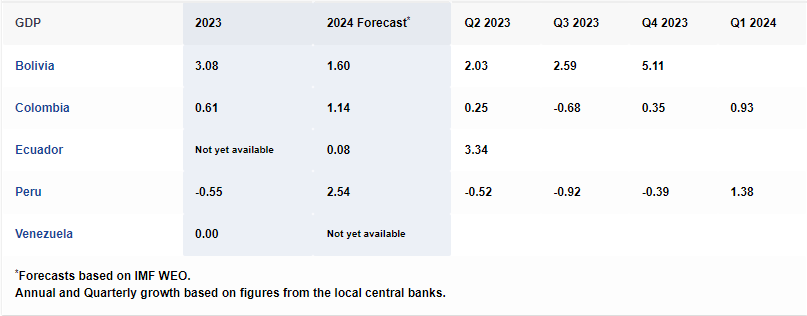
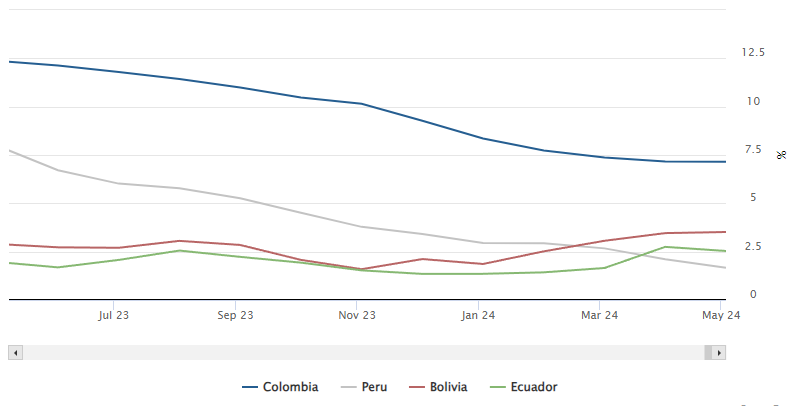
    Andean countries: inflation rate
    Percentage variation (year-on-year)

    Andean countries: GDP growth (%)
    Quarterly figures are year-on-year growth

  • COLOMBIA: Petro’s constituent plans rebuffed

    Abbi Dicker 11 July 2024 Hits: 1695

    Colombia’s President Gustavo Petro suffered a setback this week when his proposal for a constituent assembly to redraft the constitution met with resounding opposition. Petro appeared to calculate that the appointment of a new interior minister in the form of moderate veteran Juan Fernando Cristo of the centre-left Partido Liberal (PL) to preside over negotiations to forge a national accord behind the idea [WR-24-26] would win over those that had responded with such hostility when he first raised the possibility of a constituent assembly in March. That has not proven to the case.

    The most crushing criticism of President Petro’s plans to convene a constituent assembly came from the president of the constitutional court, José Fernando Reyes. In a statement of incisive candour, Reyes said the constitution could not be treated as “a misshapen, gelatinous, and bland dough that can be changed at will but rather a rigid text with very relative flexibility”. He also said that authoritarian governments were mushrooming across the globe and that “revolutions are no longer so much armed as about taking control of the constitution”. He made no mention of Petro but the allusion was clear.

    Among politicians the responses ranged from outright objection on the right, and suspicion that Petro is motivated by a desire to amend the constitution to permit re-election, to concern among centrists that a constituent assembly would jeopardise Colombia’s hard-won institutional stability. There was also a palpable lack of enthusiasm among many on the left. The most prominent exception was former vice president Germán Vargas Lleras (2014-2017), the leader of the right-wing Cambio Radical (CR), who expressed support for convening a constituent assembly right now. “There is no sense doing it in two years’ time when there is another president and another government,” Vargas Lleras said. His desire to “grab the bull by the horns” appears to owe to his confidence that Petro’s party would fare badly in constituent elections and that it would backfire badly for him.

    Constituent assembly

    Some of President Petro’s critics questioned what articles in the constitution he actually wanted to change, arguing that the vast majority of the issues he had raised should be addressed through congressional debate. They also fastened on to the ever-present warning to Colombia across the border in Venezuela of what can happen when a body with plenipotentiary powers is misused by an authoritarian government to exert full control over the state.

  • BRAZIL: Top court greenlights trial for Bolsonaro

    Abbi Dicker 27 March 2025 Hits: 4464

    A panel of five justices in Brazil’s supreme court (STF), known as the ‘Primeira Turma’ (first chamber), unanimously voted on 26 March to accept the charges submitted last month [WR-25-07] by the office of the attorney general (PGR), which accused former president Jair Bolsonaro (2019-2023) and some of his allies of plotting a military coup in 2022. Even though a date has not yet been set, the court’s decision means a trial will be held, which many expect could lead to Bolsonaro’s imprisonment. 

    It was widely anticipated that the Primeira Turma, none of whose five justices were appointed by Bolsonaro, would decide to take the coup plot case to trial. Only two STF justices are Bolsonaro appointees – Kassio Nunes Marques and André Mendonça – but they both sit in the court’s second chamber.   

    Of the Primeira Turma, three justices were nominated to the STF by President Luiz Inácio Lula da Silva: Cármen Lúcia Antunes Rocha, Flávio Dino, and the head of the panel, Cristiano Zanin. The other two justices on the panel, Luiz Fux and Alexandre de Moraes, were appointed to the top court by former presidents Dilma Rousseff (2011-2016) and Michel Temer (2016-2019), respectively. Bolsonaro’s legal counsel has sought to petition the STF to bar Dino, Zanin, and De Moraes from judging the case, alleging a lack of impartiality, but the president of the STF, Luís Roberto Barroso, rejected this petition on 28 February. In recent weeks, appeals were filed against Barroso’s decision, but the STF upheld his rulings.

    The defence lawyers of Bolsonaro and his allies included the removal of Dino, Zanin, and De Moraes from the case as one of their procedural objections put before the panel on 25 March. They also objected to the case being heard by the STF, arguing that lower courts should hear it first. Other objections included complaints over the way evidence was gathered, and accusations that the STF had carried out ‘document dumping’ (responding to requests for information with a large quantity of material), among other complaints; all of which were rejected by the Primeira Turma.

    The ruling was made on 26 March, the day after the defence’s arguments and objections were discussed. Bolsonaro and seven other allies were officially declared as defendants. The other suspected conspirators who will stand trial are General Walter Braga Netto, who held various cabinet roles under Bolsonaro from 2020-2022 and was his 2022 running mate; General Paulo Sérgio Nogueira de Oliveira, who served as defence minister (2022-2023); General Augusto Heleno Ribeiro Pereira, Bolsonaro’s former presidential security chief (2019-2023); Anderson Torres, a former justice minister (2021-2023); Admiral Almir Garnier Santos, former commander of the Brazilian navy (2021-2023); Alexandre Ramagem, who served as the director of the national intelligence agency (Abin) from 2019-2022; and Lieutenant-colonel Mauro Cid, Bolsonaro’s former aide-de-camp.

    Bolsonaro and these seven allies are the first of the 34 suspects listed in the PGR’s indictment in February to be officially pronounced as defendants. The PGR has divided the total list of suspects into several groups. The eight suspects declared as defendants on 26 March were considered the central group, the leading figures of the coup plot, while the other groups include individuals suspected of carrying out different roles in the coup conspiracy, such as planning military operations and spreading disinformation. The Primeira Turma will review the charges against the second and third groups in April, and the fourth group’s charges will be discussed in May.

    Lula weighs in 

    Until recently President Lula has avoided weighing into public debates about the charges against his predecessor, having previously made cautious statements about how everyone deserves to be presumed innocent until proven guilty. But after the STF panel’s decision on 26 March, Lula said that “it is clear that the former president tried to stage a coup in this country, it is clear that he tried to contribute to my assassination”, referring to alleged plans by Bolsonaro’s allies to send special forces operatives to eliminate political adversaries.