All Categories

Subcategories

  • URUGUAY: Opposition guns for government over Guantánamo

    LatinNews 02 October 2014 Hits: 1007

    The political opposition launched a new line of attack on the ruling left-wing Frente Amplio (FA) coalition this week ahead of general elections in just over three weeks from now. It criticised the unilateral decision by President José Mujica to offer to receive six detainees from the US prison camp in Guántanamo, Cuba and sought clarification from the FA candidate, former president Tabaré Vázquez (2005-2010), of his stance on the matter. The attack is designed to exploit friction within the FA over Mujica’s Guántanamo proposal as well as exposing, once again, the FA administration’s poor record on transparency and accountability.

    Both Luis Lacalle Pou, the presidential candidate for the opposition Partido Nacional (PN, Blancos), and Pedro Bordaberry, the candidate for the opposition Partido Colorado (PC), criticised President Mujica over his Guántanamo offer. On 25 September Lacalle Pou said that while he had no problem with Uruguay accepting families of Syrian refugees he was “totally opposed” to the idea of taking in Guántanamo prisoners, who should go to the US; Bordaberry, for his part, commented that “we have enough troubles of our own without importing the troubles of others,” adding “there are other priorities, not Guantánamo”.

    Lacalle Pou’s running mate, Jorge Larrañaga, went further four days later. He said that the public had a right to know what Vázquez felt about “a pact that nobody knows anything about”. He said that while the Partido Comunista (PC), part of the FA, had criticised the “Yankee pact”, Vázquez had responded with “silence, silence and more silence”.

    Mujica, who formally proposed the idea to his US peer Barack Obama during a visit to the White House on 12 May in a bid to expedite the closure of a camp he described as a “shame of humanity”, obliquely responded to Lacalle Pou’s remarks by saying that he should concentrate on his campaign as he had not been “invited to this party yet” (in other words he is not president yet so it is none of his concern). This cut no ice with Larrañaga who said that Vázquez needed to explain to the public where he stood on the matter personally and what would happen with the prisoners once Uruguay took them in.

    More intriguingly the US ambassador to Uruguay, Julissa Reynoso, responded to Lacalle Pou by commenting that the US had struck an agreement with the government of Uruguay and not between two parties. She said the US government had enjoyed “a positive relationship with Lacalle Pou’s party historically” before adding, with perhaps the hint of a threat, “the idea is to continue having this type of relationship in the future.” Reynoso nonetheless added that it would be preferable if the prisoners were taken in by Uruguay before the new presidential term begins next March. She concluded by saying that the US saw the acceptance of the prisoners as “an extremely humanitarian gesture”.

    * The latest opinion polls suggest that while support for the FA is slightly increasing this has not been at the expense of backing for the opposition and will not be sufficient to win in the first round (something which the coalition has reluctantly accepted) or to secure a majority in the lower chamber of congress and the senate. This potentially puts the small Partido Independiente (PI) of Pablo Mieres, who is polling 3%, in the enviable position of being able to supply the eventual victor with decisive votes in congress. This has not been lost on Mieres. Last week he came out with an offer to ally the PI with whichever candidate makes it through to a November run-off in exchange for the adoption of some of his party’s key campaign proposals, including reforming State companies and bringing Uruguay into the Pacific Alliance trade bloc of Mexico, Colombia, Peru and Chile.

    • Lorenzo given green light

    Uruguay’s electoral court has ruled that former economy minister Fernando Lorenzo (2010-2013) is eligible to stand for election for congress next month. Lorenzo’s candidacy had been challenged by Senator Ope Pasquet, of the opposition Partido Colorado (PC), on the grounds that Lorenzo is still under investigation for his involvement in the handling of the bankruptcy of the national airline Pluna.
  • Brazil stops demarcating land for indigenous people

    LatinNews 25 January 2017 Hits: 678

    The Brazilian government has caved in to the demands of agricultural lobbyists and stopped automatically demarcating the land for indigenous people. Indigenous groups such as the Conselho Indigenista Missionário (CIMI) say they are “worried and surprised” by the move that could lead to the undermining of their rights.

    Until now, the government agency charged with representing indigenous people, Funai, had been responsible for determining which land belongs to local tribes. However, in a statement issued on 18 January by in the Diário Oficial da União official gazette, Justice Minister Alexandre de Moraes announced that a new group of government-appointed specialists (GTE) would also be involved in arbitrating land disputes. While the measure has not yet been approved by President Michel Temer, the decree is widely expected to get the greenlight.

    Changes to the demarcation system would boost agribusinesses looking to expand, but threaten the rights of indigenous tribes. The extra layer of bureaucracy introduced by the new system could make land demarcation for indigenous people a “virtually endless” process, said the former Funai head, Marcio Santilli, in an interview with the Thomas Reuters Foundation, Reuters’ charitable arm.

    Environmentalists have also criticised the proposed changes to land demarcation procedures by pointing out that indigenous people generally take better care of the areas they live in than other land owners. A recent report by the World Resources Institute found that deforestation rates are 2.5 lower in areas owned by indigenous groups. Therefore, denying indigenous people the right to lay claim to their ancestral territories could jeopardise Brazil’s commitment to combat global warming as part of the 2016 United Nations Climate Change Conference (COP22), which Brazil undersigned.

    Human rights and minority advocacy groups have argued that the proposed new system fails to comply with the government’s obligation to represent indigenous people as per Brazil’s constitution. The government published these proposed changes, reportedly without consulting indigenous groups, while public attention in the Amazon region was diverted to the prison riots. Further diminishing the impression that indigenous people’s interests are fully represented by the Brazilian government was Moraes’s decision to name a new Funai head, Antônio Fernandes Toninho Costa, without their prior approval. The new Funai head, appointed on 12 January, is affiliated to the Partido Social Cristão (PSC), an ally of the current centre-right government led by Temer, in what critics say was a politically motivated decision.

    While Costa has a master’s degree in indigenous health, some indigenous groups feel he is not qualified to act as a spokesman for them. “The PSC does not have any political record of representing indigenous concerns. On the contrary, many [indigenous] leaders fear that Funai is going in a politically conservative direction which could worsen tensions with the indigenous movement”, Daniel Pierr from the Centro de Trabalho Indigenista NGO remarked in an interview with news site G1. The government defended Costa’s appointment by arguing that the indigenous community had failed to come up with a credible candidate of their own.

    • Yellow fever: Brazil’s next epidemic?

    Cases of yellow fever are on the rise in Brazil, public health officials have warned. So far, the disease’s outbreak has mainly been confined to the southern state of Minas Gerais, where over 270 people have been infected and 25 people have died according to statistics from the federal health ministry. While there is now a vaccine for yellow fever, the uptake is low. On 13 January, the federal government sent an extra 735,000 doses of the vaccine to Minas Gerais to help tackle the outbreak. But the World Health Organization (WHO) has warned that the mosquito-borne virus could quickly spread and cause an epidemic as the Zika virus did last year.

  • ECONOMIC HIGHLIGHTS

    Patrick de Courcy 15 September 2021 Hits: 1788

    PANAMA | Exports surge. On 19 August Panama’s national statistics institute (Inec) released new figures which show that Panama’s exports totalled US$1.66bn in the first half of the year, a 108.7% increase on the same period in 2020. The Inec report in particular highlights the performance of copper and its concentrates which accounted for US$1.3bn of exports and was up 185% on the same period last year, followed by teak (US$34m, up 64%), and palm oil (US$16.5m, up 61.6%). According to Inec director Samuel Moreno, the export markets to have seen the highest increase were: mainland China which accounted for US$581.5m of exports, a 326.1% increase on the same period in 2020; South Korea (US$183.5m, up 236.5%; and Japan (US$176.0m, up 486.1%).

    HONDURAS | Foreign debt inches up. On 16 August Honduras’s central bank (BCH) released new figures which show that foreign debt (public and private) totalled US$11bn as of June 2021. This is up from the US$10.98bn registered at the end of 2020. Of the total foreign debt as of June 2021, 82.1% corresponds to the public sector and 17.9% to the private sector. According to the BCH, 65.9% of the public foreign debt was contracted with multilateral organisations, 21.5% with commercial institutions (financial institutions and providers), and the remaining 12.6% with bilateral organisations.

    GUATEMALA | FDI rises. On 6 September Guatemala’s economy ministry’s national competitiveness programme (Pronacom) announced that the country has attracted a total of US$815m in foreign direct investment (FDI) over the first eight months of 2021, providing some 14,000 jobs in the formal sector. In the month of August alone, seven new investment and reinvestment projects were confirmed, totalling over US$154m and generating 3,200 new jobs, according to Pronacom. This is up from US$140m in new projects announced for the previous month. The economy minister, Antonio Malouf, has set a target of US$1.2bn in FDI for this year.

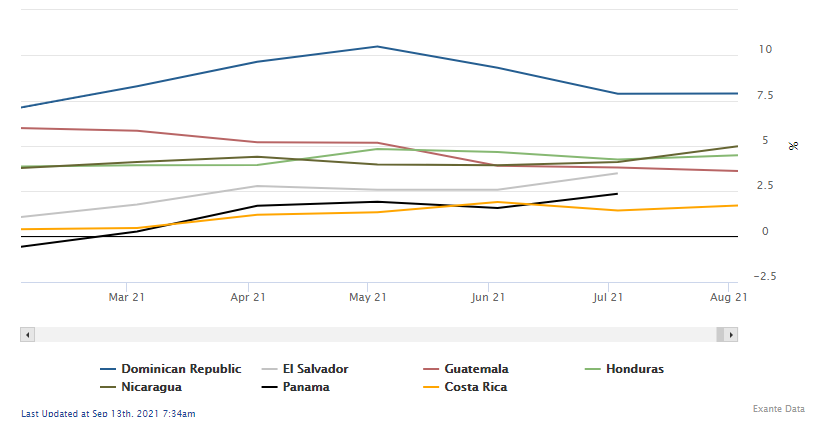
     Central America & Caribbean: Inflation Rate

    Percentage variation (year-on-year)

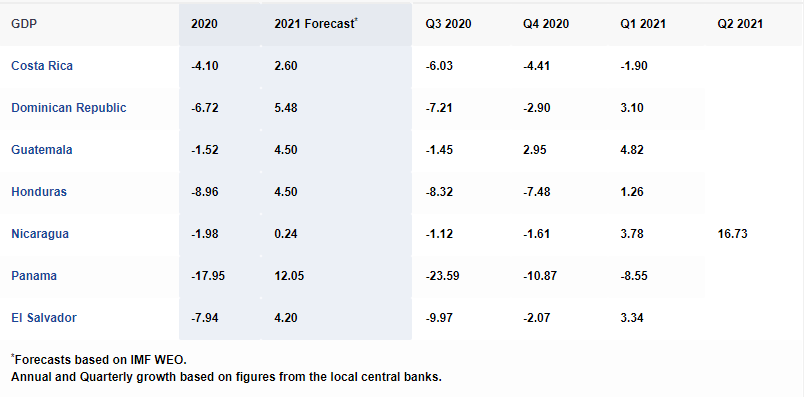
     Central America & Caribbean: GDP Growth (%)

    Quarterly figures are year-on-year growth

  • REGION: Mercosur-EU deal hangs in the balance

    Patrick de Courcy 11 August 2023 Hits: 3957

    It’s been about a quarter of a century since the European Union (EU) and the South American trade bloc Mercosur first started exploring the possibilities of a trade agreement, but every time it looked like it was a done deal, it wasn’t.

    So, reading the tea leaves on the latest efforts to clinch an accord is a particularly challenging endeavour. At a two-day Mercosur summit in Puerto Iguazú, Argentina, on 3 July the prospects of any significant progress any time soon seemed dim. There Brazil’s President Luiz Inácio Lula da Silva blasted the EU’s proposed ‘side letter’, which seeks to impose additional environmental guarantees, saying that Brussels was “threatening with punishment” and that a relationship between strategic partners should be based on “mutual trust, not suspicion and sanctions”.

    Ever since a trade deal was agreed in 2019 between the EU and the four-nation South American bloc made up of Brazil, Argentina, Paraguay, and Uruguay, concern in Europe over environmental protection, particularly in the Amazon, had been the main holdup in getting final approval for the accord from legislators. That touched a raw nerve in Brasília, even though Lula is all too aware of the environmental destruction that took place in his country over the last four years. Still, publicly his argument is that Brazil doesn’t need to prove its green credentials to Brussels because more than 80% of its electricity production comes from renewable sources, a rate that most European states are still far from reaching.

    Then there was the usual internal squabbling with Uruguay refusing to sign a joint Mercosur statement, which didn’t bode well for a common negotiating position allowing for a deal.

    Several weeks later at a summit of EU and Latin American leaders in Brussels, Lula still pledged a firm response from Mercosur to the EU’s environmental demands but sounded much more upbeat on the possibilities of making progress and eventually signing a deal. “For the first time, I’m very optimistic that we’re going to conclude this deal this year,” the Brazilian leader said. He shares the timeline of EU commission president, Ursula von der Leyen, who has vowed to wrap up the agreement before the end of the year. “Of all the meetings with the EU that I’ve participated in, this has been the most successful meeting of all,” Lula said. “I have rarely seen so much political and economic interest from the EU countries towards Latin America.”

    Mixed signal

    So, there have been mixed signals on the ambience surrounding the latest push to finally get an EU-Mercosur trade deal put to bed. The road to the finish line is a potentially bumpy one, including quite steadfast opposition from a few EU member countries with strong agricultural lobbies like Austria.

    But it’s also true that South America and Europe probably need each other more than at any other point of those 25 years of negotiations. Following the war in Ukraine and growing tensions with China, Europe is desperately seeking new markets and sources of raw materials and renewable energy. Meanwhile, economic growth in much of South America has slowed considerably and public coffers are as stretched as ever. While Chinese investments are still enticing, there have also been more sobering experiences with Beijing that may furthered the argument of increased diversification through new trade deals.

    EU puts money where its mouth is

    Perhaps one of the reasons that Lula was so optimistic about the prospect of getting the EU-Mercosur deal over the line during the meeting in Belgium was that Brussels expressed interest in Latin America not only with words but with a US$50bn investment plan for the region.

  • ECONOMIC HIGHLIGHTS

    Abbi Dicker 19 June 2026 Hits: 910

    MEXICO | Remittances continue to rise year-on-year. On 1 June Mexico’s central bank (Banxico) released remittance figures for April 2026, announcing that remittances to the country totalled US$4.98bn. This represents a 3.7% increase year-on-year but is down from US$5.39bn in March. April represents the third consecutive month of annual increases in the remittance total, following an increase of 4.9% in March and 0.4% in February. From January-April 2026, remittances totalled US$19.68bn, up 2.6% on the US$19.18bn received during the same period in 2025.

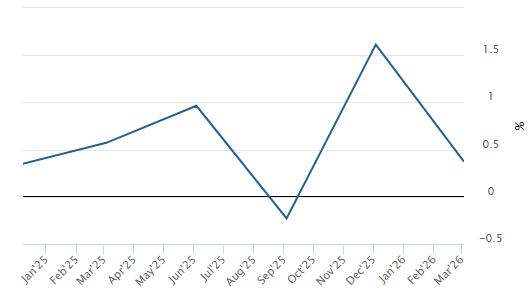
    MEXICO | Economy contracts in first quarter. On 25 May Mexico’s national statistics institute (Inegi) released figures on the country’s economic activity in the first quarter of 2026, showing a quarterly contraction of 0.6%, compared to growth of 0.7% in the final quarter of 2025. In yearly terms, economic activity was up by 0.4% in real terms. The quarterly contraction was the largest since the final quarter of 2024, when economic activity dropped by 1.1%. Activities in the primary sector (agriculture) were down by 1.7% in quarterly terms, while those in the secondary sector (manufacturing) were down 1.0% and the tertiary sector (services) dropped by 0.4%. In annual terms, the primary sector was up by 0.3% and the tertiary sector by 1.1% while the secondary sector was down by 1.1%.

    MEXICO | Industrial production down. On 11 May Mexico’s national statistics institute (Inegi) reported a 0.6% fall in industrial activity in March 2026 compared with February and a 1.5% drop in yearly terms. The monthly decrease was driven by a fall of 3.3% in construction and a 0.2% drop in manufacturing industries. This was offset somewhat by a 0.3% increase in utilities (electricity generation and transmission, provision of water and gas) and a 1.7% rise in mining. In yearly terms, construction was down 5.3%, while manufacturing dropped 1.6%. Utilities rose 0.3% year-on-year while mining was up 5.8%.

    Mexico: GDP growth
    Percentage variation (year-on-year)

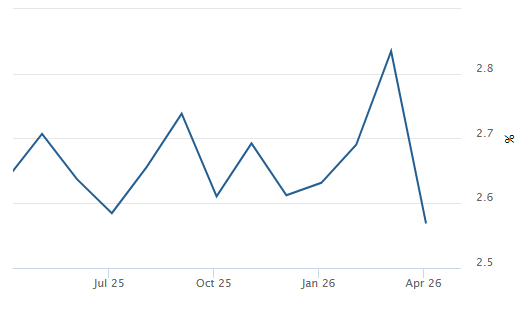
    Mexico: unemployment rate
    Economically active population

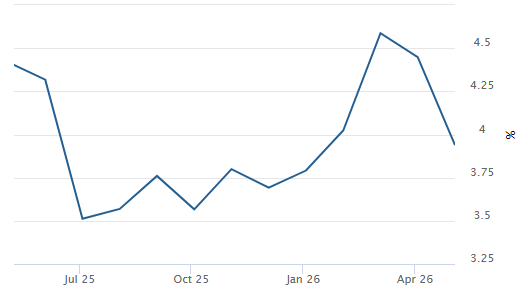
    Mexico: inflation rate
    Percentage variation (year-on-year)

    Source (all graphs): National Statistics Institute (Inegi)

  • Risk pointers

    LatinNews 06 September 2011 Hits: 339

    *** China Xinjiang terror fears.  The Shanghai Cooperation Organization (SCO) held an anti-terror exercise in China’s Muslim province of Xinjiang in early May.  Speaking on 6 May, a Chinese official involved with the exercise said: “The drill was conducted considering the present anti-terror condition.  There are signs that terrorists belonging to the East Turkestan movement have returned, and it is highly likely that they will enter China through Central Asia.”  The Uighur independence movement refers to Xinjiang as “East Turkestan”.

    According to Li Wei, director of the Centre for Counterterrorism Studies at the China Institute of Contemporary International Relations: “The terrorists have long been attempting to return to China. They are always waiting in Central Asia for opportunities to come back and attack.”

    China has pursued an intense crackdown in Xinjiang since 2009, when riots in the regional capital Urumqi led to the deaths of nearly 200 people and some 2,000 injuries.

    *** ‘Saudization’ intensified.  On 8 May, Saudi Arabia announced new plans to provide more jobs for Saudi nationals in the private sector.  The country’s work force is dominated by 8m expatriate workers, but there are around 450,000 Saudi job seekers.  Companies will now be categorized green, yellow, or red according to their performance in providing jobs for Saudis.  Those categorized as red will be prevented from renewing the work visas of expatriate workers.  Only 10% of the private-sector work force is currently Saudi Arabian.
    Labour Minister Adel Fakieh said: “Saudization has become a national necessity rather than a choice.”

    *** Taleban in praise of bin Laden.  In a statement issued on 7 May by the Afghan Taleban movement, the leadership council said that by killing Osama bin Laden, the US had helped him fulfil his wish to be a martyr.  It also said that bin Laden’s death would not weaken the jihad in Afghanistan.

    The statement said: “Osama bin Laden, peace be upon him, had been seeking martyrdom since the launch of the jihad.  He courageously fulfilled his wish.  If the US and their allies think that the martyrdom of Osama bin Laden, peace be upon him, will weaken the morale or ranks of the mojahedin in Afghanistan and other occupied Muslim countries, it will be their serious blunder...hundreds of others will come forward to make sacrifices for martyrdom after the martyrdom of [Osama bin Laden].”

  • TRACKING TRENDS

    LatinNews 12 July 2012 Hits: 2152

    PERU | Gold sales to South Africa. On 10 July Peru’s embassy in South Africa announced that Peru had exported US$20m worth of gold since August 2011 to the African country, the world’s fourth largest gold producer. Peru’s ambassador to South Africa, Daúl Matute Mejía, explained that Peruvian gold sales to South Africa began in 2011 “a phenomenon that surprised all of us” given that South Africa produces more gold than Peru. Matute argued, however, that it had been recognised that Peruvian gold “is of a better quality of 18 carats and comes in all three colours which makes it valuable for jewellery work”.

    Matute pointed out that this has attracted South African mining companies to set up their operations in Peru, such as Goldfield which produces 300,000 ounces of gold in the north-eastern region of Cajamarca and has plans for a US$1.2bn investment in another mine in southern Peru. Matute added that mining deposits are in general more accessible in Peru and that this is another factor why South African miners are interested in the South American country: “in South Africa companies have to dig up to 4,000m underground to extract gold, while in Peru it is more accessible and there are other minerals that can also be extracted before reaching a mine’s main resource,” Matute said.

    COLOMBIA | Coffee production picks up. According to Colombia’s national coffee growers’ federation, FNC, coffee production in June amounted to 714,000 60-kilogram sacks, 52% more than in the same period last year. This is positive news for the sector which in the past four years has seen decreasing production levels due to the spread of rust all over the country as a result of consecutive winters with torrential rains. Indeed, last year production levels decreased by 18% to 7.3m sacks. Producers have also been affected by a decrease in international coffee prices, as well as the peso’s appreciation. As a result of all this, Colombian coffee exports have also suffered experiencing a 16% drop in the last harvest from October 2011 to June 2012.

    The FNC has attributed the increase in production to its members’ crop renovation programmes which involve the replacement of old plants with newer ones, many of which are rust resistant varieties. According to FNC figures, in the last three years over 300,000 hectares of coffee have been renovated, 117,000 of which have been converted.

    FNC general manager, Luis Genaro Muñoz, said that “the rebound in production and the acceleration of the coffee crop renovation programmes reaffirm the commitment of producers to the future and the sustainability of the sector”. Recently President Juan Manuel Santos urged coffee producers to bring annual production back to 11-12m sacks.

    ECUADOR | Plans to increase gas production drastically. On 5 July Ecuador’s state-owned oil company, Petroecuador, announced plans to increase its natural gas production by 60% to 100m cubic feet a day by 2013. Petroecuador’s natural gas division manager, Francisco Rosero, explained that the company, which took over the Amistad offshore gas field in 2010 after US firm, Noble, refused to accept the renegotiation of it exploitation contract proposed by the Ecuadorean government, currently only has five gas wells in production, producing 60m cubic feet a day and that the plan is to drill six new wells.

    According to Rosero, Petroecuador has already contracted British firm, Petrex, which will bring a drill over from Egypt that should be in operation by the end of August. It has been estimated that drilling the new wells will cost the government between US$162m-US$180m.

    Rosero explained that the objective behind the idea to increase Ecuador’s gas production was to supply it to the domestic market in order to reduce the need for the country to import oil derivative fuels such as diesel, which are heavily subsidised by the State.

    Incidentally, after Rosero made his announcements, Petroecuador general manager, Marco Calvopiña, told the press that due to delays in the maintenance work being conducted at the country’s main refinery at Esmeraldas, Ecuador will have to import an additional 4m barrels of oil derivative fuels to supply its domestic market, which could cost the State up to US$400m at current oil prices.

    • Venezuelan imports of US fuels up

    On 11 July the US Department of Energy revealed that after seven years of low US exports of refined oil fuels such as petrol, heavy fuels, liquefied petroleum gas and additives these are now increasing. According to Department of Energy data US fuel exports to Venezuela were practically stopped in March 2005 but since then they have risen steadily and now average over 1m barrels a month. In 2011 the US sold 11.8m barrels of refined fuels to Venezuela, and this year that is set to increase as exports are now 40,000b per day. Embarrassingly for Venezuela, the fourth largest supplier of crude oil to the US, it pays the handsome price of US$200 per barrel of US refined products while the price of Venezuelan crude currently is US$92.87 per barrel.

  • GUYANA: Ramotar and PPP likely to edge back into power

    LatinNews 10 March 2015 Hits: 1083

    Guyana’s People’s Progressive Party/Civic (PPP/C) government, led by President Donald Ramotar, will face the electorate on 11 May, more than 18 months before it had to. Ramotar called the election in order to end the political deadlock produced by the 2011 result in which the PPP/C won the presidency (by gaining the most number of votes) but failed to win control of the 65-member parliament. A notable difference this time around will be that the main opposition grouping, A Partnership for National Unity (APNU), has formed an electoral alliance with the country’s third political force, the Alliance for Change (AFC). However, opinion polls suggest that this innovation has so far failed to sway the electorate in significant numbers. This election, like the last one, is likely to be tight.

    It has been said often enough, but race remains the key factor. Since the electoral reform forced on President Desmond Hoyte and the Afro-Guyanese dominated People’s National Congress (PNC – now the main component of the APNU) in 1990, the PPP/C has held power thanks to the preponderance of Guyanese of Indian descent. The Indo-Guyanese make up 43.4% of the population, according to the 2002 census, whereas the Afro-Guyanese constitute 30.2%. Mixed-race Guyanese represent another 16.7%, while the indigenous population makes up 9.1%.

    While the PNC held power from 1964 to 1992 (partly as a result of a split in the PPP in 1955 and partly as a result of its adherence to a pro-communist ideology during the height of the Cold War), the determining racial factor has been evident in all post-1990 elections. The split between the two main parties in subsequent elections has been: 1992, PPP 28 seats, PNC 23 (out of 53); 1997, PPP 29 seats, PNC 22 (out of 53); 2001, PPP 34 seats, PNC 27 (out of 65); 2006, PPP 36 seats, PNC 22 (out of 65).

    The nearest the PNC has come to returning to power was in 2011, when the PPP won the presidency on the basis of receiving most votes but with only 32 seats failed to gain a majority in the 65-seat parliament. APNU won 26 seats and the Alliance for Change won the remaining seven.

    In addition to its demographic advantage, the PPP/C government can also point to a relatively effective economic record. According to the International Monetary Fund (IMF), Guyana has been a regional star performer in the years since the 2011 election. The Caribbean region as a whole suffered a severe recession in 2011 (-3.6% according to the United Nations Economic Commission for Latin America and the Caribbean - Eclac) and was only growing by 1.9% in 2014. The IMF figures show Guyana growing by 5.44% in 2011, 4.82% in 2012, 5.22% in 2013, and by 3.32% in 2014 (or 4.5% by Eclac’s estimate).

    Less positively for the PPP/C, its standing ahead of the present electoral contest has not been helped by the president’s decision to prorogue parliament in November (to dodge a no-confidence motion) and then to delay announcing his intentions for holding an election. A prorogation, as opposed to a dissolution, could have been maintained for six months and possibly repeated. This prevarication led to international criticism, including from the British High Commissioner to Guyana, Andrew Ayre, who announced that the Commonwealth was considering sanctions against the government and a reduction in financial aid on the grounds that the prorogation was “a clear breach of the Commonwealth charter and breach of Guyana’s constitution”.

    The criticism from Britain was easily dismissed by the PPP/C, which said that Guyana had gained independence from the UK in 1966 and no longer has “to listen to what Britain says”. Less easily dismissed was the criticism from the European Union, which announced that it was suspending some budget assistance to Guyana “until all eligibility criteria, inter alia budget oversight, are satisfactorily addressed”.

    The other factor that could help the five-party APNU is the electoral pact with AFC, although there is some concern among PNC supporters that the AFC has been given too much in the pre-election agreement. The AFC controlled 21% (7) of the total of 33 opposition seats (26 held by APNU) in the outgoing parliament, but it has been guaranteed 40% of the cabinet posts should the APNU-AFC combination win power.

    APNU is made up of PNC Reform (PNCR), the Working Peoples’ Alliance (WPA), the National Front Alliance (NFA), the Guyana Action Party (GPA), and the Justice for All Party (JFAP). The AFC has also secured the opposition’s slot for prime minister (Moses Nagamatoo) and two vice-presidential posts. APNU-AFC are to contest the election with a single list of candidates.

    APNU’s presidential candidate is PNC leader David Granger, and according to the alliance agreement, should APNU-AFC win the election he will hand over significant additional powers to the prime minister, including the right to chair cabinet meetings and control over domestic national affairs. The president will be head of state and government as well as commander-in-chief. He will also have responsibility for foreign affairs, international relations, national security policy, and the joint intelligence committee.

    The latest opinion polls, however, suggest that the APNU-AFC alliance still has more to do to persuade the electorate. According to a poll in early March conducted by the North American Caribbean Teachers Association (Nacta), voters are still predominantly divided along racial lines. Respondents are closely divided on who will win, with a three-way split between those who believe the PPP/C will win, those who see APNU/AFC winning, and those who say it is too close to call. However, delving a bit more deeply, the poll found that 51% say they are better off under the PPP/C administration. Worryingly for the opposition, there seems to be quite a high level of negativity among AFC supporters about the electoral pact with APNU.

    The PPP/C’s clear strategy is to paint the opposition as a destructive influence. At the launch of its campaign on 8 March, President Ramotar said of the opposition and its control over parliament in the past term that it was never patriotic or interested in the development of Guyana. He said: “I had narrow-minded people who seem to believe that they can make things bad in our country and drive us back to the time when we had to line up for a quarter pint of oil … in the hope that it will change their political fortune. That is what I had to deal with over the last three years.”

    The president added: “Not one day did they use their one-seat majority to say ‘Donald Ramotar, build more roads in Berbice, build more schools for our people, build more hospitals for our people, not one single day. Instead, they used the one-seat majority to cut $89 billion from our budget, $89 billion that could have gone to develop the people of our country, and I tried, my friends, I really tried.”

    The PPP/C’s candidate for prime minister is career diplomat Elisabeth Harper. Harper, 57, is the director-general of the ministry of foreign affairs. Introducing her as his running mate, Ramotar described Harper as “a consummate public servant” who has “for many years labored in the ravines of international diplomacy in service of our country and people”.

    • “While the PNC held power from 1964 to 1992 (partly as a result of a split in the PPP in 1955 and partly as a result of its adherence to a pro-communist ideology during the height of the Cold War), the determining racial factor has been evident in all post-1990 elections. The split between the two main parties in subsequent elections has been: 1992, PPP 28 seats, PNC 23 (out of 53); 1997, PPP 29 seats, PNC 22 (out of 53); 2001, PPP 34 seats, PNC 27 (out of 65); 2006, PPP 36 seats, PNC 22 (out of 65).”
    • “APNU’s presidential candidate is PNC leader David Granger, and according to the alliance agreement, should APNU-AFC win the election he will hand over significant additional powers to the prime minister, including the right to chair cabinet meetings and control over domestic national affairs. The president will be head of state and government as well as commander-in-chief. He will also have responsibility for foreign affairs, international relations, national security policy, and the joint intelligence committee.”
  • Peru: Claudia Cooper’s in-tray

    LatinNews 06 October 2017 Hits: 489

    Claudia Cooper became Peru’s latest minister of economy and finance on 17 September, following a cabinet reshuffle forced by a congressional vote of no confidence in the cabinet led by Prime Minister Fernando Zavala. Cooper becomes the third minister in charge of the economy in the last 14 months. She inherits a full in-tray.

    At one level, Cooper’s task is simple: to deliver on the promises of growth and recovery made by her two ministerial predecessors to date under the presidency of Pedro Pablo Kuczynski. These were Alfredo Thorne (July 2016 – June 2017) and Fernando Zavala (June-September 2017, a period when he doubled up as both prime minister and economy and finance minister). Both men were forced to step down as a result of no-confidence votes delivered by the opposition Fuerza Popular (FP, Fujimorista) party, which holds an outright majority in the legislature, so Cooper is taking on a politically sensitive role.

    She is no newcomer to the ministry (known by its Spanish acronym, MEF). In fact, she served as deputy minister to Thorne and Zavala, as well as being a MEF adviser back in 2008-2009. As part of Thorne’s team last year, she was directly involved in implementing his project to cut the rate of VAT by one percentage point to 17%. Cooper studied economics at the Universidad del Pacífico and took a Master’s degree at New York University (NYU). She has worked for Banco de Crédito del Perú (BCP) and as a consultant for a range of organisations.

    According to Carlos Oliva, a former deputy at MEF, Cooper will face at least five major challenges. The first, as he puts it, is just keeping on top of the “day to day” job, since the minister has a whole range of extra duties including presiding over the national investment agency Proinversión and the development fund Fonafe, as well as sitting on the board of the (troubled) state oil company Petroperú.

    The MEF role also entails the politically-tricky task of trying to secure congressional support for economic policy. This leads to Cooper’s second and immediate challenge, which is to steer the 2018 budget through the Fujimorista-controlled congress. Zavala, her immediate predecessor, had just submitted the draft budget earlier in September. Contemplating a 10.3% increase in the total public sector spend to PEN157.16bn (US$48.2bn), the draft plan prioritises health, education, security and reconstruction (following the floods and mudslides caused by the El Niño Costero weather pattern earlier this year). In some of her first statements as minister, Cooper said she would maintain fiscal stability, despite pressures from within and without the government.

    The new minister’s third challenge is to consolidate the new system for managing the pipeline of major public and private investments, known as Invierte.pe. This is of great importance, as maintaining a good flow of major investment projects is one of the keys to securing a good rate of GDP growth.

    A big part of the slowdown in GDP growth this year (to an expected 2.8%) is being attributed to delays in the investment pipeline, such as the postponement of the US$7bn Gasoducto del Sur Peruano (GSP) and the US$520m Cusco airport project, both affected by claims of corruption and other irregularities. The new minister says she plans to pick up the pace, making US$9bn worth of investment projects viable this year.

    Cooper has also indicated that she may revisit the issue tax reform, suggesting that tax breaks for small and micro-enterprises are inefficient and are being abused. Congress rejected a first attempt to eliminate these tax concessions, but Cooper says she will take up the issue again.

    The fourth big task is to try and revert the long slump in private sector investment – set to contract for the fourth year running in 2017. The difficulty here is that both her predecessors promised that an investment recovery was just around the corner. Cooper risks sounding like a broken record, and will have to do something to make this claim more credible. That said, she has admitted that private sector investment will fall by 2.3% this year, before growing by 3.5% in 2018. The economy posted GDP growth of 2.4% year-on-year in the second quarter, up from 2.1% registered in the first quarter, according to the national statistics institute (Inei). This was largely driven by reconstruction work to deal with the El Niño-related damage, but apart from this investment remained stagnant.

    Finally, according to Costa, amid all these short- to medium-term challenges, Cooper will also need to find the time to think long-term, in particular about one of the most important issues facing the country – the need to improve productivity and competitiveness.

    Mining recovers

    Peru could receive US$11.4bn between now and 2020 in investment in new mining projects according to Magali Arellano, manager at a local trade journal publisher, Peru Top Publications, who was speaking at a recent mining convention in the southern city of Arequipa. This is expected to come from 15 new projects (some of which expand existing ones) at five copper mines, one silver mine, two iron mines, one zinc mine, and one tin mine. Some of the main copper producing mines are the Ariana and Toromocho projects in the central Junín region, the Quellaveco project in southern Moquegua region, and the Toquepala project in the southern Tacna region.           

    Peru’s mining sector is beginning to grow again following three years of contraction, Cooper told the convention. In the second quarter, mining sector activity rose by 1.9% year on year, on Inei data, reflecting not only higher metals prices but also improving investment confidence.

    Peru targets service exports

    Peru is the world’s second largest producer of copper, silver, and zinc, and an important producer of a wide variety of agricultural crops, as well as fish and other traditional items. As such, it has long been known as a primary export country. However, according to Luis Torres Paz of Promperú, the Kuczynski government has decided to target the expansion of service exports, in a bid to diversify and add higher value to the country’s export basket.

    Service exports will be worth about US$6.76bn in 2017, according to Torres Paz, and the aim is to double this to US$13bn by 2021. Promperú reports average annual growth of 10.5% in service exports in in the 11 years between 2005 and 2016, going from US$2.3bn to almost US$5bn. Services exports accounted for 13% of total exports last year. (The country’s total exports were valued at US$36bn in 2016.)

    He makes the point that Peru, for instance, has developed an expert business and legal services sector in recent decades, firstly on the back of privatisation and more latterly centred round international infrastructure tenders – with a group of local companies now looking to export this expertise to third countries. It also has an expert tourism services sector, that the government also believes can be exported around the region.

    In early October, the seventh ‘Peru Service Summit’ was held in Lima, attended by 100 Peruvian service export companies, along with 150 business people and investors from 19 countries. According to Promperú, which helps organise the forum, since its first event in 2011, the Peru Service Summit has positioned itself as one of the main business services events in the region. The 2017 summit, running from 2-5 October, seeks to benefit Peruvian entrepreneurs exporting services including software, engineering, Business Process Outsourcing (BPO), marketing, graphic design, and editorial and graphics services. Buyers and investors from Argentina, Brazil, Bolivia, Canada, Chile, Colombia, Ecuador, Mexico, Spain, the US and Panama were attending. Opening the summit, the trade and tourism minister, Eduardo Ferreyros, said the organisers expected sales commitments worth some US$95m.

    Torres noted that this year’s summit started from a “an auspicious legal mark”, following approval in July of a brand new law to promote services and tourism. He said he expected final sales commitments to exceed the projected US$95m. He also noted that Peruvian service companies increasingly are specialising in niche international market areas, such as specialist software for mining activities, environmental services, IT, and 3-D design and animation, to name just a few. These add to the 33 or so existing service categories including banking and financial services, business services, transport and tourism.

  • EL SALVADOR: Key judicial posts filled

    LatinNews 29 November 2018 Hits: 582

    After nearly four months of delay, El Salvador’s 84-member legislature has elected four new magistrates for the five-member constitutional chamber (SC) of the supreme court (CSJ), along with one new magistrate to the civil chamber, for nine-year terms. Widely viewed as having defended due process and the rule of law, as well as issuing various emblematic rulings, the outgoing four SC justices (nicknamed the ‘Fantastic Four’) had been uncharacteristically independent, proving a thorn in the side of both the ruling left-wing Frente Farabundo Martí para la Liberación Nacional (FMLN) and the main right-wing opposition Alianza Republicana Nacionalista (Arena). Given this, the appointments of their replacements came under considerable scrutiny.

    The ‘Fantastic Four’ (Belarmino Jaime, Florentín Meléndez, Sidney Blanco, and Rodolfo González), whose mandates concluded at the end of July 2018, had delivered some ground-breaking rulings which at times resulted in clashes with other branches of government. These included the July 2016 decision to overturn the 1993 Amnesty Law, which had prevented prosecutions of grave human rights abuses or war crimes committed during the country’s 1980-1992 civil war. They also challenged the excessive power traditionally exercised by the main political parties’ leadership committees over the country’s political system through rulings such as that issued in 2010 which paved the way for independent candidates to stand in municipal and legislative elections and ended the much-criticised practice of closed-list ballots.

    Electing their replacements was bound to be contentious in the legislature where the FMLN has just 23 seats to 37 for Arena. The choices were made from a list of 30 candidates, half of whom were proposed by the law association (Fedaes) and the other half from the national judicial council (CNJ), an autonomous state institution charged with judicial training and review.

    After a long impasse the FMLN and Arena, along with the smaller parties, Gran Alianza por la Unidad Nacional (Gana), Partido de Concertación Nacional (PCN), Partido Demócrata Cristiano (PDC), and Cambio Democrático (CD), finally approved the choices of Aldo Cader, Carlos Avilés, Marina Marenco de Torrento, and Carlos Sánchez for the SC, along with Roberto Calderón for the civil chamber. The breakthrough occurred when the FMLN and Gana stopped insisting on the appointment to the SC of current procurator general Sonia Cortez (who reportedly scored poorly on rankings done by civil-society groups monitoring the election). Instead she was chosen as an alternate.

    Speculation persists as to how far the new justices will continue in the pioneering footsteps of their predecessors. Yet Leonardo Bonilla, the only independent deputy in the legislative assembly, condemned the election for “lacking transparency”, complaining that the decisions took place behind closed doors and through agreements which were hidden from the public.

    Another post pending

    As well as the need to fill the vacant posts on the SC, another appointment which has attracted considerable attention is that to replace the attorney general, Douglas Meléndez, whose three-year term concludes in January 2019. Under the watch of Meléndez, a career lawyer with no overt party-political affiliation, significant progress has been made in anti-impunity efforts – not least the unprecedented conviction for corruption earlier this year of former president Tony Saca (Arena, 2004-2009).

    Yet on 5 November the Alianza Social por la Gobernabilidad y la Justicia (Asgoju), a group of local NGOs, urged the unicameral legislature not to re-elect Meléndez, complaining that he has not done enough with regard to investigating corruption involving past and present Arena members. Saca, who received a 10-year prison sentence, parted ways with Arena after the 2009 general election and founded Gana.

    In its statement, Asgoju complained that the attorney general failed to provide sufficient proof with regard to a case involving relatives of the late president Francisco Flores (Arena, 1999-2004), accused of embezzling US$15m of donations provided by Taiwan for victims of the 2001 earthquake in El Salvador. Flores died of a brain haemorrhage in January 2016 shortly before he could stand trial. Earlier this year, the supreme court (CSJ) ruled that his relatives did not have to pay back the funds.

    The FMLN has already made it clear that it will back Meléndez, who has also been key to efforts to bring former president Mauricio Funes (FMLN, 2009-2014), accused of embezzlement and money laundering, to justice. Meanwhile, prominent members of Arena such as the president of the legislative assembly, Norman Quijano, have indicated that they will support Meléndez’s re-election. A total of 33 candidates have registered to participate in the election. They will then be considered by a congressional committee before being voted upon by the full plenary.

    • Complaints concerning Meléndez

    In its statement released on 5 November Asgoju also complains that the attorney general’s office has failed to do enough to go after other Arena officials such as the country’s former vice president Ana Vilma de Escobar (2004-2009). De Escobar has been implicated in a corruption case known as Fecepe (a special fund set up under former president Saca for the creation of jobs in strategic productive sectors) related to the alleged mismanagement of over US$30m.

  • VENEZUELA-COLOMBIA: Maduro accuses Duque of military plans

    LatinNews 20 December 2018 Hits: 819

    Venezuela’s President Nicolás Maduro has accused his Colombian counterpart Iván Duque of plotting a military attack against his Bolivarian Revolution, and announced on 17 December that he had ordered the country’s armed forces to prepare for an attack on Venezuela. Maduro was speaking at an event with representatives of the armed forces in Caracas, in which he claimed to want to improve relations with his country’s neighbours, but warned once again of a conspiracy being drawn up between Colombia, Brazil, and the US.

    President Maduro called upon the Bolivarian armed forces (FANB) to carry out both defensive measures – particularly against any infiltration by Colombian paramilitary groups – and preparations for an offensive against any enemy that “dares to strike at Venezuelan soil”. Earlier in the week, Maduro claimed to have evidence that 700 mercenaries are being trained in Colombia to simulate an attack on that country, in order to provide justification for a military intervention in Venezuela.

    Although President Duque’s predecessor Juan Manuel Santos (2010-2018) took a stance for the majority of his mandate of trying to avoid direct confrontation with Maduro, Duque’s criticism of Santos’s foreign policy in this regard – as well as Duque’s decision for Colombia to spearhead the unprecedented move to petition the International Criminal Court (ICC) to investigate potential crimes against humanity in Venezuela – makes the prospect of a direct confrontation more likely, although sabre-rattling remains far more likely. Indeed, it seems as though Maduro is deliberately trying to provoke a reaction, or to see how far Duque can be pushed.

    • Maduro-Duque spat

    President Maduro accused President Duque of being too immature and inexperienced to govern Colombia, claiming that the Colombian population had already realised this. In response to Maduro’s claims of external military intervention, Duque issued a statement reaffirming Colombia’s commitment to international law and multilateral organisations.

  • PARAGUAY: Fly me to Asunción

    LatinNews 20 February 2020 Hits: 2355

    Medium-term economic growth (despite a slow year in 2019) and new routes are increasing traffic at Asunción’s ‘Silvio Pettirossi’ international airport. The authorities are moving ahead with plans for a new terminal.

    Earlier attempts to modernise Paraguay’s main airport ran into trouble. In 2018, plans for a US$149m new terminal were cancelled amid disputes over the public-private partnership (PPP) tendering process. At the time, the main contenders to do the work were Sacyr-Agunsa of Spain, Vinci Airports of France, and Tocsa of Paraguay. Since then there have been complaints that the airport is operating beyond its capacity of 1m passengers a year. There is also a legal dispute between the national civil aviation authority (Dinac) and commercial tenants in the main terminal offering currency exchange and bag-wrapping services, which Dinac is trying to evict. 

    The plan now is to build a new terminal and two new runways at a cost of around US$200m (some estimates range up to US$270m) which Dinac will finance from its own funds. The tendering process, including a feasibility study, is to be managed through the International Civil Aviation Organisation (Icao). Work is expected to start in July this year and be completed by late 2022. Expansion will take overall capacity up to 6m passengers a year. Dinac believes this will allow the airport to cope with new regional routes (daily Asunción-Bogotá and Asunción-Brasília routes opened in December 2019), as well as to become more of a hub airport within South America.

    Dinac president, Edgar Melgarejo, says that there has been virtually no new investment in the airport since it came into service four decades ago. Work to improve the existing terminal is underway and will conclude in March. This has involved expanding the passenger embarkation area. Dinac is also seeking to improve security with the addition of new X-Ray scanners and the construction of a perimeter wall.

  • COLOMBIA: The battle for Buenaventura

    LatinNews 25 March 2021 Hits: 4448

    The Colombian government needs to dismantle criminal networks and corruption in the south-western Pacific port city of Buenaventura, said Juliette de Rivero, a representative of the Office of the United Nations High Commissioner for Human Rights (OHCHR), on 19 March, after a visit to the city.

    According to the UN, in the year-to-date Buenaventura, which has a population of 432,000, has experienced 41 homicides, 13 forced disappearances, the displacement of around 8,000 residents, and a multitude of threats against community leaders and human-rights defenders.

    The port is an important drug-smuggling route. De Rivero said rival armed groups were clashing for control of the drugs business, and that the resulting violence was destroying the culture and social fabric of Afro-Colombian and indigenous groups who make up a large part of the local population. High rates of poverty and inadequate government services make the population particularly vulnerable.

    In January this year the ombudsman’s office had warned of an increased risk of violence because of growing gang warfare. Then, on 10 February, community groups formed a 23km human chain around the city in an attempt to publicise their ‘SOS Buenaventura’ campaign for peace and against violence. The UN argues that this should now be supported by government-backed initiatives to improve security, strengthen the judiciary, invest in social programmes, and protect human rights.

    The root causes of the violence are complex – in recent years it has been connected to the rise and fall of different criminal organisations. Buenaventura, which is located on the Naya River corridor relatively close to Cali, the capital of the department of Valle del Cauca, has always been an attractive exit point for drug exports to the US and Asia, as well as an entry point for general contraband. In addition, criminals target local businesses though extortion rackets. Current clashes are taking place between two rival groups within a criminal gang called La Local.

    Matters are complicated by the involvement of powerful national groups. La Local is reported to work under contract to the Clan del Golfo, which is considered to be Colombia’s most powerful criminal group. Also active in Valle del Cauca are dissident guerrillas from the Fuerzas Armadas Revolucionarias de Colombia (Farc), who refused to accept the 2016 peace agreement, and members of the Ejército de Liberación Nacional (ELN). Local security analysts suggest that these bigger groups may be using the rival factions of La Local to fight a proxy war. Certainly, the local groups seem to be able to access heavy weaponry that might not otherwise be available to them.

    Rival gangs

    Colombia’s interior ministry has offered rewards of up to US$57,000 for information leading to the capture of the leaders of the two rival sub-groups, Los Espartanos and Los Shotas, which emerged in 2019. After a truce in 2020 the dispute appears to have re-ignited this year.

  • TRACKING TRENDS

    Abbi Dicker 20 March 2025 Hits: 2374

    PANAMA-HONDURAS | Blackouts. Panama’s national public services’ regulator (Asep) has announced an investigation into a national blackout which occurred in the late evening of 15 March after a thermoelectric plant, Pan Am Generating Ltd in La Chorrera district, Panamá Oeste province, exploded. Asep said the investigation would seek to clarify three key aspects: the cause of the explosion; how this led to the collapse of the electricity system; and the reason for the delay in services being restored.

    The attorney general’s office has also announced an investigation into the causes of the explosion and whether it was the result of possible arson, as has the fire service. A report published the previous day by national daily La Prensa, highlights that, since its installation in 1999, the thermoelectric plant has been subject to controversy, facing complaints regarding pollution and judicial processes for alleged environmental damage.

    Just over two weeks earlier, on 1 March, Honduras was also hit by a national blackout. State electricity company Empresa Nacional de Energía Eléctrica (ENEE) said the outage was caused by “a transitory and atypical fault in the connection between Honduras and Nicaragua” and, specifically, a 98km transmission line connecting a substation in Honduras’ Choluteca department with one in Nicaragua’s León department. It said that investigations were under way to identify where the fault took place, pointing out that 23km of the transmission line is in Honduras with the rest in Nicaragua.

    ENEE also highlighted that the national grid (SIN) has faced a “structural problem due to a lack of investment in transmission over the last 15 years”, adding that to address this, since 2022, it had been implementing a L21bn (US$821m) investment plan, which sought to improve transmission infrastructure and the stability of the country’s electricity system.

  • BOLIVIA: Judge assassinated as Marset’s cartel fractures

    Abbi Dicker 07 May 2026 Hits: 1120

    There were warnings in the aftermath of the March capture of Bolivia-based Uruguayan drug kingpin Sebastián Marset that his organisation, the Primer Cartel Uruguayo (PCU), would carry out reprisals [WR-26-11]. Two months later, President Rodrigo Paz said on 4 May that a string of contract killings in recent weeks, including the murder of a magistrate on the agro-environmental court (TA), were a sign of turmoil within the PCU.

    TA magistrate Víctor Hugo Claure was shot dead while riding in the back of a taxi in the eastern city of Santa Cruz on 1 May. Local media has highlighted that Claure, who was appointed to the TA by popular vote in the 2024 judicial elections, had issued a ruling in December 2025 that ordered a crackdown on illegal mining along the Madre de Dios River. His work on the TA encompassed a broad range of contentious issues including land-titling disputes and environmental crimes.

    President Paz said that Claure’s assassination was part of a surge in contract killings in the aftermath of Marset’s capture in Santa Cruz on 13 March. “Marset has fallen and, evidently, part of what we’re seeing at the moment is the recomposition of those mafias that the MAS [the previous left-wing Movimiento al Socialismo government] permitted for 20 years, and which we’re attacking,” Paz claimed. He did not clarify how Claure’s murder might relate to a factional dispute within the PCU or provide any evidence for the cartel’s involvement.

    Nevertheless, there is some evidence that a power struggle within the PCU is now taking place. Speaking after the murder of a Colombian citizen in Santa Cruz on 2 May, the police commander for Santa Cruz department, Colonel David Gómez, said that “our hypothesis is that some score-settling is going on and that Marset’s group has been fracturing”. Another Colombian, Elkin Deivi Bravo Omen, was arrested on 30 April in relation to the murder of a pilot who allegedly worked for Marset, José Pedro Rojas Velasco, alias ‘Pepa’.

    Violent crime remains far lower in Bolivia than in the country’s Andean neighbours. However, as shown by the experiences of Ecuador and, more recently, Peru, this can change quickly. A fracturing of the formerly dominant PCU in the wake of Marset’s capture could spark a wider battle for control of coca cultivation that mostly takes place in Cochabamba department and the Yungas region of La Paz, and for drug smuggling routes that primarily lead to Brazil’s Atlantic ports.

    Condemnation

    Responding to the murder of TA magistrate Víctor Hugo Claure, the Ibero-American Group of the International Association of Judges issued a statement warning that “it is particularly alarming that this crime occurs in a context in which other acts of violence against justice operators in Bolivia have been reported, without any serious effort by the Bolivian authorities to address the situation”.

    Protests

    Highways were blocked in the departments of Santa Cruz, Potosí, Beni, Cochabamba, Oruro, and Tarija on 5 May, as transport workers stepped up their demands for compensation for engine damage caused by contaminated fuel, and for guarantees regarding the quality of future fuel deliveries [WR-26-06]. The drivers’ union Confederación Sindical de Choferes de Bolivia (CSCB), which is coordinating the protests, has said it will step up the disruption if it does not receive an adequate response from President Paz’s government.

    The fuel protests coincided with demonstrations by hundreds of peasant farmers who arrived in La Paz on 4 May at the end of a three-week march from the Amazonian departments of Pando and Beni. The demonstrators are calling on Paz to row back on his proposal for a new land law which would allow smallholdings to be used as collateral for bank loans, which they warn will open the door to mass foreclosures in the event of commodity price crashes, resulting in the takeover of land by large agricultural corporations.

  • RASTREANDO TENDENCIAS

    LatinNews 01 October 2012 Hits: 461

    BRASIL | Fitch reduce pronóstico para el 2012 a sólo 1,5%. La agencia de rating Fitch, ha cortado su pronóstico del PIB real anual para Brasil en el 2012 a solamente 1,5%, reduciendo un punto porcentual de su pronóstico previo de 2,5%.  La agencia espera que la inflación permanezca por encima del 5%. Y señala que Brasil es el de peor desempeño en el grupo BRICS este año, muy detrás de China (7,8%), India (6%) y Rusia (3,5%), pero espera que el crecimiento brasilero se elevará al 4,2% en el 2013 después de “una depresión cíclica”. Sin embargo esto aún está por debajo de su pronóstico original de 4,5%.

    BRASIL | Indicador de Fiesp pesimista acerca la actividad industrial. El indicador de la actividad del sector de las manufacturas, compilado por la confederación de industrias de São Paulo (Fiesp) cayó un 0,3% mes en mes y un agudo 7% anual en agosto, informó Fiesp. La cifra a 12 meses fue de un -5,3%, mientras que cayó un 6,6% año en año  en enero-agosto del 2012. La utilización de la capacidad industrial en São Paulo fue del 81,1% en agosto, cayendo del 82,4% el año anterior. Aún así, la confianza del sector industrial se elevó a 52,3 puntos en septiembre, subiendo de 50,5 en agosto (cualquier cosa debajo de 50 puntos indica sentimiento negativo), sugiriendo que el despliegue de medidas de estímulo de parte del gobierno han sido absorbidos. Sin embargo, en general, incluso el gobierno ahora reconoce

  • RASTREANDO TENDENCIAS

    LatinNews 04 February 2013 Hits: 896

    BRASIL | Sin alcanzar la meta. El 30 de enero, el banco central de Brasil informó que el superávit fiscal primario para 2012 fue de R$105mm (US$52,5mm), o un 24,9% menos que la meta de R$139,8mm fijada por el gobierno de la Presidenta Dilma Rousseff. Aunque el superávit primario aún es sustancial, representando el 2,38% del PIB de Brasil, sigue siendo una preocupación para el gobierno dado que la cifra del 2012 fue menor que los R$128,7mm que reportó en el 2011.

    El banco central atribuyó la cifra menor principalmente debido a la menor tasa de crecimiento de Brasil el año pasado, como resultado de la “crisis económica global”, señalando que el gobierno había recibido menores niveles de impuestos causado por la reducida actividad económica, particularmente en el sector corporativo. Sin embargo, el banco también dijo que la toma fiscal fue afectada por las variadas exenciones tributarias introducidas por el gobierno apuntando al sector de las manufacturas en un intento por instar a la economía interna a crecer más rápidamente. En otras palabras, los planes del gobierno para estimular el crecimiento parecen haberle costado mucho al gobierno sin haber realmente producido mucho impacto en la obtención de un incrementado crecimiento económico.

    Esto debería ser causa de preocupación para el gobierno, y en particular para los estrategas económicos en Planalto, quienes insisten en que las varias medidas adoptadas por el gobierno eventualmente producirán los resultados deseados en la estimulación de la economía. De hecho el gobierno de Rousseff ha dicho que a pesar de que el superávit primario fue menor de lo esperado, seguirá llevando adelante su ambicioso programa de inversión en infraestructura, el programa de aceleración del crecimiento (PAC).

    URUGUAY | Sufre el turismo. Los ingresos del turismo cayeron un 6,1% en el 2012 con relación al año anterior, a US$2,04mm, al caer el número de visitantes a 2,85m, un 3% menos comparado con el 2011, cuando se fijó el estableció el récord de 3m. En la primera quincena de enero, la cifra cayó un 14% en comparación con el mismo periodo del 2012. La ministra de turismo, Liliam Kechichián, dijo que hubo en juego un número de factores, incluyendo la pérdida de competitividad con Brasil, y el hecho de que los problemas de conexiones no han sido resueltos por completo desde el cierre de la aerolínea insignia, Pluna.

    El gobierno está tratando de estimular el sector turismo con una serie de medidas. En diciembre, Kechichián anunció un nuevo programa de promoción del turismo bajo el cual los visitantes extranjeros reciben un reembolso del 10,5% del impuesto al valor agregado (IVA) sobre compras con tarjetas de débito y crédito. Mientras tanto, la firma petrolera del estado, la Administración Nacional de Combustibles, Alcoholes y Portland (Ancap), reducirá los precios de sus combustibles para aviones un 8%, a partir del 1 de febrero, en un esfuerzo por atraer más tráfico aéreo al país.

    • Ajustando las cifras fiscales

    El banco central de Brasil ha señalado que tal como lo ha hecho en los últimos dos años, ajustará las cifras fiscales, como está permitido por la ley brasilera, a fin de cumplir con la meta fijada. “La meta establecida para el año será cumplida después de haber descontado los gastos para el Programa de Aceleração do Crescimento (PAC) como está provisto por la ley presupuestaria,” concluye la declaración del banco. Según el banco, unos R$34,8mm usados en los proyectos de inversión del PAC serán descontados de los libros este año, asegurando de esta manera que la meta oficial será formalmente cumplida.

  • ECONOMIC OVERVIEW: PANAMA

    LatinNews 15 May 2013 Hits: 5324

    Energy crisis: On 7 May the government of President Ricardo Martinelli declared a state of emergency in four regions - Coclé, Veraguas, Los Santos and Herrera - and ordered several energy-saving measures to avoid the imposition of scheduled blackouts. This as a result of power shortages caused by a lack of rain which saw water levels in the reservoirs of Bayano and Fortuna, the country’s largest, fall to just one metre above their minimum level. According to the latest figures from the US Energy Information Administration (EIA), “hydroelectric power accounted for almost 60 percent of Panama's electricity generation in 2010, with most of the remainder attributable to oil-fired thermoelectric plants”. The measures, which took effect on 8 May, called for air conditioners in public sector offices to remain off while the private sector was recommended to apply this between 11am and 3pm (although companies which specifically required the use of air conditioners for their services were exempt). Public schools and universities were also closed between 8-12 May. On 8 May the Panama Canal authority (ACP) also announced special energy saving measures such as suspending the use of hydraulic assistance to help push ships out as they leave locks and placing two ships in a lock at a time rather than one. The various measures, which were coordinated by Panama’s public services regulator, Autoridad Nacional de los Servicios Públicos (Asep), the national power company, Empresa de Transmisión Eléctrica, S.A. (Etesa) and the national dispatch centre, Centro Nacional de Despacho (CDN) provoked an angry response from private sector lobbies such as the Asociación Panameña de Ejecutivos de Empresa (Apede), which held the Etesa management responsible. In a strongly worded statement Apede declared it “unacceptable” that “after 14 years of private investment, the electric energy service is not more reliable and efficient”.

  • ARGENTINA: Drug accusations shake up Buenos Aires contest

    LatinNews 06 August 2015 Hits: 2075

    It was not the first time that Aníbal Fernández, President Cristina Fernández’s abrasive cabinet chief, has been accused of involvement in drug-trafficking and murder. But the allegations, broadcast on 2 August, that he was ultimately responsible for the ‘triple crimen’, the murder of three people in 2008 over control of the ephedrine trade, came just a week before he contests the primary to run as the Frente para la Victoria (FPV) candidate in the Buenos Aires gubernatorial elections.

    Periodismo Para Todos (PPT), an investigative television programme hosted by the journalist Jorge Lanata, has long proven a government irritant. On Sunday, it broadcast testimony from a number of witnesses which claimed that the murder of three men near Route 24 (General Rodríguez) was orchestrated by Aníbal Fernández and members of the Argentine intelligence services in order to secure control over the trafficking route of one of the key chemical precursors for methamphetamine. Following the accusations, the front of Lanata’s apartment building was pelted with stones, in what government officials insist was an unrelated act.

    Fernández vehemently denied the charges, though they are not the first time that they have been levelled at him. In 2013, Graciela Ocaña, a former health minister, said that there were suspicions that Fernández had been involved in the ‘triple crimen’. The cabinet chief accused his rival for the FPV nomination in Buenos Aires, Julián Domínguez, of being behind the report. “This is outright aggression, financed by the millions of my rivals in the FPV primaries,” he said. “They’re trying to hurt me electorally.”

    Domínguez, the president of the federal lower chamber of congress, and his running mate, Fernando Espinoza, have used much of their campaign advertising to promise a tough line on drug trafficking, while Fernández has backed legalisation campaigns in the past. But Domínguez, denied any involvement in the story, calling the accusation “lamentable” and noting its “suspicious” timing. Nevertheless, Fernández criticised his rival’s apparent lack of solidarity. A joking performance on a popular TV dance show, Showmatch, by Domínguez, and Espinoza, also irritated many senior FPV politicians.

    Daniel Scioli, the current governor of Buenos Aires province who is running for the presidency for the FPV, has downplayed the allegations against Fernández. Though the two men are far from close, Scioli said he did not believe the accusations against a fellow party member which were part of a “series of political and media moves”. PPT is broadcast by Channel 13, owned by the Clarín media group, long at loggerheads with the government.

    With the caveat that the opinion polls in the primaries have proved unreliable in the past, the latest survey puts Fernández, from the party’s more diehard Kirchnerista wing, 15 percentage points clear of Domínguez, a more orthodox, pragmatic Peronist. Analogías, the polling company, put Fernández on 30.8% of voter intentions, versus 14.1% for Domínguez. Whichever candidate wins is likely to beat the main opposition candidate, María Eugenia Vida, from the centre-right opposition Propuesta Republicana (PRO). Though the city of Buenos Aires leans towards the PRO, the province is firmly Peronist.

    Even prior to the latest allegations, the battle between Fernández and Domínguez had turned bitter. Fernández had claimed that Domínguez and his allied mayors would try to hide paper ballots the day of the election to hurt his chances of winning in the province. At the same time, Espinoza, an orthodox Peronist and head of the Partido Justicialista (PJ) chapter of BA province, drew attention to the “communist” past of Martín Sabbatella, Fernández’s running mate. Espinoza also accused Sabbatella of not being a Peronist. In a sign of the division the contest is causing, Scioli said on 4 August that he will not take part in either of Fernández’s or Domínguez’s closing campaign rallies.

    • Tax revenues up 36.3% in July

    Speaking on 3 August, Ricardo Echegaray, the head of Argentina’s federal tax agency (Afip), announced that tax revenues for July had reached record levels, bringing in Ar$145bn (US$15bn at the official exchange rate), an increase of 36.3% on the same month of the previous year. So far in 2015, the agency has collected Ar$867.05bn, almost Ar$30bn higher than the target set for this point in 2014.

  • Trinidad & Tobago: Unhappy New Year

    LatinNews 29 January 2016 Hits: 2123

    The government of Trinidad & Tobago has announced its initial response to the slump in energy prices. Reconciling its desire to balance the budget with protecting low income households and boosting employment, not to mention the fairly hawkish policy of the Central Bank of Trinidad & Tobago, will not be easy.

    Economic conditions in Trinidad & Tobago have been deteriorating over the last year. GDP contracted by 2.0% in real terms over the year to the end of September. The fiscal deficit in the year to the end of June was TTD5,724mn (US$894mn), or 3.2% of GDP. Excluding revenues from the energy sector (which account for about one third of the total), the deficit would have been TTD28,845mn, or 16% of GDP.

    These figures do not include the surge in spending by the previous government, prior to the general election that was held on 7 September. Government spending has contributed to consumer price inflation, which was running at just under 5% over the year to the end of September [1]. These figures also do not include the impact of the latest slump in the price of oil to around US$30 per barrel (West Texas Intermediate) and of natural gas to US$2.22 per million British Thermal Units (mmBTU). At the end of 2014, both prices had already fallen from their peaks and stood at US$73 per barrel and US$3.8 per mmBTU. The current budget (for the fiscal year to 30 September 2016) had assumed that the price of oil would be US$45 per barrel. Meanwhile, production of crude oil has dropped from 90,000 barrels of oil per day (BOPD) in 2014 to 80,000 BOPD in 2015, while natural gas production has been broadly static at 3.8bn cubic feet per day – or less than the 4.2bn cubic feet per day that is needed by Trinidad & Tobago’s LNG, petrochemicals, and power-generation industries.

    Chart 1: The worst and latest data:
    A snapshot of Trinidad & Tobago's economy
    Real GDP Growth (year-on-year) -2.0 September
    Year-on-year CPI inflation (%) 4.9 September
    Unemployment Rate (%) 3.2 June
    WTI Crude Oil Price (US$/bbl) 30.80 January 21
    Henry Hub Natural Gas Price (US$/mmbtu) 2.22 January 19
    Total Exports (US$Mn) 1,894.4 June
    Total Imports (US$Mn) 1,434.0 June
    BOP Current Account Balance (US$Mn) 186.2 June
    BOP Overall Surplus/Deficit (US$Mn) -259.3 June
    Foreign Direct Investment (US$Mn) -518.0 June
    Net Official Reserves - US$ Millions 10,312.3 September
    Import Cover (months) 11.8 September
    Central Government Total Revenue (TT$Mn) 14,056.3 June
    Central Government Total Expenditure (TT$Mn) 15,133.6 June
    Overall Fiscal Balance (TT$Mn) -1,077.3 June
    Non-Energy Fiscal Balance (TT$Mn) -5,457.9 June
    Commercial Banks: Private Sector Credit (TT$Mn) 50,124.4 September
    Money Supply M-2 (TT$Mn) 85,473.1 September
    Commercial Banks Basic Prime Lending Rate (end of period; %) 8.5 September
    Repo Rate (end of period, %) 4.75 September
    Sources: CBTT, EIA, Bloomberg

    A major theme of the address to the nation delivered by Prime Minister Dr Keith Rowley on 29 December was that Trinidad & Tobago has a cushion of savings that have been accumulated over the years. These include around US$10bn in official reserves (which would have been around US$2bn higher but for sales of US dollars to meet demand from importers and other parties over the course of 2015), around US$5.6bn in the Heritage & Stability Fund (HSF- the national Sovereign Wealth Fund). Resident deposits with commercial banks amount to about US$3.6bn. In addition, the National Insurance Board of Trinidad & Tobago (NIBTT – the central institution within the country’s social security system) also has significant overseas assets.

    Much of Dr Rowley’s address was devoted to the actions that the government will take to address the problems arising from the slump in energy prices [2]. Every government ministry, state-owned enterprise (SOE), and statutory body, as well as the Tobago House of Assembly has been asked to present plans on a reduction in operating expenses by the end of January 2016. Land and Building Taxes will be reintroduced from January, and VAT will be introduced for a number of food items with effect from the beginning of February. Tax arrears will be collected.

    Chart 2: The government's response
    Every ministry, SOE and statutory body and THA to cut operating expenses by 7% - without reducing jobs
    Land and Building taxes to be restored from January 2016
    VAT charged on some foods from beginning of January 2016
    Tax arrears to be collected
    Negotiations with labour and business interests to moderate wage increases and discourage excessive profits
    Incentives to encourage private capital to build houses
    Merger of Trinidad & Tobago Mortgage Finance and Home Mortgage Bank
    Use of US$1bn of Heritage & Stability Fund in 2016 and US$0.5bn in 2017
    Separation of Heritage & Stability Fund into Heritage and Stability elements
    Possible development of Loran-Manatee gas field on border with Venezuela
    Increase in Personal Income Allowance**
    Continuation of spending on Unemployment Relief Programme and CEPEP*
    *Community-based Environmental Protection & Enhancement Program
    **The Personal Income Tax Exemption Limit will be lifted from TTD5,000 per month to TTD6,000 month. The number of people who pay no income tax will rise by 59,000 to 302,000
    Sources: 21 January 2016 Presentation to Cabinet of Minister of Finance Colm Imbert, 29 December 2015 Address to the Nation by Prime Minister Dr Keith Rowle.

    The government also expects to draw US$1.0bn from the HSF in the current fiscal year and, perhaps, another US$0.5bn in the September 2017 fiscal year. The government also plans to separate the HSF into two elements: Stability (ie a financial cushion for the government at times like the present, when lower energy prices have hit revenues badly) and Heritage (a source of alternative income to offset the depletion of non-renewable energy resources and a fund for future generations).

    The government hopes to boost activity in the construction sector, by encouraging private sector investment. The plan includes facilitation of mortgage lending through the merger of Trinidad & Tobago Mortgage Finance (TTMF – which lends to low and middle income households on concessional terms) and the Home Mortgage Bank (HMB – the central institution in the secondary mortgage market, which also originates mortgages for middle income households). Given the fairly different focus of the two institutions, it is not entirely clear how the merger would provide an impetus to lending (and construction). Ultimately, the NIBTT, as majority shareholder in both TTMF and the HMB, will decide whether or not the merger goes ahead.

    The government has also taken steps to boost the disposable income of poorer households, especially as the costs of food will rise as a result of the changes to the scope of VAT. With effect from the beginning of December, several thousand pensioners have benefited from an increase in the cap on their pension benefits from TTD4,500 to TTD5,000 (US$781) per month. The Personal Income Tax Exemption limit has been increased from TTD60,000 per year to TTD72,000 per year. This means that the number of people who will not have to file personal income tax returns or pay tax on a Pay As You Earn (PAYE) basis will rise by around 59,000 to 302,000. The government will also maintain the Unemployment Relief Program (URP) and the Community-based Environmental Protection and Enhancement Program (CEPEP – which seeks to boost employment of unskilled and semi-skilled people and help local communities to improve their local environments through landscaping etc.)

    The government recognises that it cannot solve the budgetary problem on its own. Dr Rowley noted that the government will enter into tri-partite negotiations with the business community and the labour movement in order to limit wage rises and excessive profits.

    A clearer indication of the scale of the economic and fiscal challenge facing the government will come from the CBTT’s next monetary policy announcement, which is due to be released on 29 January 2016. Over the last two years, the CBTT has increased its key repo rate from 2.75% to 4.75%. Commercial bank prime lending rates have also been rising, and stand currently at 8.75%. Caution on the part of the banks and their customers has been reflected in the slow increase in credit to the private sector, from TTD47,397 in September 2014 to TTD50,124mn in September 2015.

    It remains to be seen whether the latest slump in energy prices – and general deterioration in the global economy – has an impact on the CBTT’s policy over the coming weeks and months. On 24 December, former Governor Jwala Rambarran was removed from his post – having served about three-and-a-half years of a five year term. Officially, this was because he had breached section 56 of the Central Bank Act and section 8 of the Financial Institutions Act by disclosing the names of the largest buyers of foreign exchange in Trinidad & Tobago and the quantities that they had purchased. Mr Rambarran was replaced by Dr Alvin Hilaire, who had served as Deputy Governor of the CBTT.

    In short, the government is trying to do several things simultaneously. It wants to reduce the impact on the budget of the slump in energy prices. It is trying to boost economic growth and employment (notwithstanding that, at a little over 3% in June 2015, the unemployment rate was fairly low). It wants support from organised labour and the business community. All these aims need to be reconciled with the CBTT’s hawkish monetary policies. Achieving all of these objectives will not be easy.