
All Categories

Subcategories

  • EL SALVADOR: Bukele announces trade talks with China as economic prospects darken

    Sarah Sheldon 12 December 2022 Hits: 213

    On 9 November, El Salvador’s President Nayib Bukele announced that his country would start negotiating a free trade agreement (FTA) with China.

    Bukele made the announcement alongside China’s ambassador to El Salvador Ou Jianhong and talked up a potential trade agreement as “very important” for the country, citing the size of China’s economy. “For a long time, El Salvador had been isolated from that potential,” he said. An FTA would mark the latest stage in El Salvador’s alignment with China after the two nations established ties in 2018 under former president Salvador Sánchez Cerén (2014-2019) of the Frente Farabundo Martí para la Liberación Nacional (FMLN) party. In order to do so, El Salvador had to end relations with Taiwan, and on 7 November a court upheld a decision to suspend an FTA signed with Taipei in 2007.

    The deepening of ties with Beijing also comes at a time of worsening economic distress due to a failed bet on the cryptocurrency bitcoin and mounting fears of default. In September 2021 a law took effect adopting bitcoin as legal tender, and President Bukele has bought tokens with public funds. However, use of bitcoin has been limited and the value of the cryptocurrency has plummeted. El Salvador has lost an estimated US$70m on its bitcoin investments, according to Ricardo Castaneda, a senior economist at Guatemala-based think tank, Instituto Centroamericano de Estudios Fiscales (Icefi), which he said is significant in a country where that sum is equivalent to the annual budget of the agriculture ministry he said.

    The bitcoin experiment has also discouraged the International Monetary Fund (IMF) from agreeing an economic support package that would have helped El Salvador to meet its debt payments. “If Bukele dreamed that he could create a different and innovative political economy, against the advice of the IMF, that dream has failed,” said Luis Membraño, a Salvadorean economist, told British newspaper The Guardian in an article published on 15 November. “There are no easy alternatives, no short-cuts.”

    Fears of a default have been mounting for some time. In September, international credit ratings agency Fitch downgraded El Salvador’s Long-Term Foreign Currency Issuer Default Rating (IDR) to ‘CC’ from ‘CCC’ warning that a “default of some sort [was] probable”. Fitch cited “El Salvador's tight fiscal and external liquidity positions and extremely constrained market access amid high fiscal financing needs and a large US$800m external bond maturity in January 2023.” On 7 November El Salvador’s Vice President Félix Ulloa sparked speculation that China had agreed to step in and help, telling Bloomberg that China had offered to help the country refinance its foreign debt. However, a spokesperson for China’s foreign ministry told Bloomberg that he was not aware of the matter, and Ulloa soon rowed back on his comments.

    Bukele had hoped to end his country’s reliance on traditional lenders by betting big on bitcoin, but the failure of the experiment has seen him backed into a corner. While China has distanced itself from suggestions that it would buy El Salvador’s distressed debt, closer relations with El Salvador make a certain amount of sense for both parties.

    Bukele has tried to end his reliance on relations with the US amid Washington’s criticism of democratic backsliding during his term in office, and China maintains a policy of non-involvement in domestic politics. Beijing has also been working to increase its presence in Latin America for strategic reasons, and locking in close relations with El Salvador fits that pattern, Castaneda told Deutsche Welle (DW) a German public state-owned international broadcaster, in an article published 17 November.

    That said, it is difficult to envisage how China will be able to help El Salvador escape from the economic bind in which it finds itself. Researcher Désirée Reder of the Hamburg-based German Institute for Global and Area Studies (GIGA) told DW in the same article that El Salvador could see some benefits in terms of infrastructure, but “nothing is free” and China will expect something in return, including exclusivity in certain commercial relationships or projects in sensitive areas. And Evan Ellis, a senior associate at the US-based Centre for Strategic & International Studies, told The Guardian that China is like a “payday lender,” adding that “they often find a way to tie the loans to long-term commercial and strategic benefits opening the way for Chinese companies”.

    While many countries in Latin America are deepening commercial ties with China for varying reasons, Bukele’s decision looks to have been influenced by the way in which his government has damaged relationships with traditional partners such as the US and the IMF. This means that his position is much weaker, and he will likely be forced to agree terms that are more economically advantageous to China in order to secure financial assistance.
  • COSTA RICA: Work begins on major infrastructure projects

    LatinNews 10 March 2015 Hits: 850

    President Luis Guillermo Solís paid a visit to the Caribbean port city of Limón on 8 March to attend the groundbreaking of the US$1bn Moín Container Terminal. The new port is the most significant of a series of infrastructure projects on which the centre-left Partido Acción Ciudadana (PAC) government is now embarking, including the expansion of the road leading from the capital, San José, to Limón and the San José-San Ramón highway.

    Long delayed over labour and environmental disputes, the new terminal is expected to take three years to build. It will sit on an 80-hectare island to the west of the original Moín docks. According to Paul Gallie, the managing director of APM Terminals, the Dutch contractor that will carry out the work, the project will result in the most advanced container port of its kind in Central America, capable of hosting Post-Panamax ships. The new terminal will have four times Moín’s current capacity, eventually reaching 2.5 million TEUs, twenty-foot equivalent units.

    In the World Economic Forum’s 2014-2015 Global Competitiveness Report Costa Rica came 115th out of 144 countries surveyed in terms of its port infrastructure. Gallie told the press attending the groundbreaking ceremony that the new port would offer Costa Rica the chance to take advantage of its proximity to the Panama Canal after years of scant investment.

    Initially, the construction project will require 700 workers; when the first phase is complete another 600 people will be contracted to operate the terminal. Though many of the jobs will go to locals, there is a severe skills shortage in the city. Only 17% of Limón’s school children graduate from high school, meaning many positions will be filled by newcomers to the area.

    Roads

    Speaking at the groundbreaking ceremony, Solís said that the port was one of several projects in the works that would improve the city. In late February, congress approved a US$395m loan from the Export-Import Bank of China to fund the US$465m expansion of Route 32, which connects San José with the Caribbean coast. One of the conditions of the loan was that the project, to expand the 107km highway from two lanes to four, be developed entirely by China Harbour Engineering Company using only Chinese workers. As such, six lawmakers, including five from the ruling PAC voted against the bill.

    Another project approved by congress in late February is the upgrade to the San José-San Ramón highway. At present the 58km road is just a two-lane highway, by the time of completion the road will be expanded to eight lanes in some sections, easing congestion along the northern Costa Rican stretch of the Inter-American Highway. Some 84,000 drivers are expected to use the new road every day, each paying Col$3,500 (US$6.50) for a round trip.

    The project had been severely delayed due to protests during the administration of former president Laura Chinchilla (2010-2014). Her government had granted the concession to the Brazilian construction firm OAS at a cost of US$524m, but the project was cancelled after a number of irregularities came to light, obliging the government to indemnify the company to the tune of US$35m. Now, Solís has created a trust, to be funded with the profits of state agencies, to bankroll the US$473m cost of the upgrade.

  • Mexico: Still ticking over

    LatinNews 12 January 2018 Hits: 1431

    With presidential elections due in July and the fate of the North American Free Trade Agreement (Nafta) hanging in the balance, 2018 will be a momentous year for the Mexican economy. But despite these high levels of uncertainty economists are on balance projecting another reasonably good, albeit transitional year.

    There may be high political drama in Mexico this year, and further twists and turns in the country’s troubled relationship with the Donald Trump administration in the United States. But for the moment most economists are predicting a fairly average year. The Economic Commission for Latin America and the Caribbean (Eclac) projects GDP growth of 2.4%, up from an estimated 2.2% for last year. The Mexican central bank expects growth of 2.0%-3.0% this year, up from an estimated 1.8%-2.3% in 2017. A group of local analysts polled by Spanish news agency EFE came up with a consensus figure of 2.5% GDP growth in 2018. Many are factoring in that the government will want to boost spending in an election year. Gabriela Siller of Banco Base says she expects a public spending boost and an improvement in consumer confidence in 2018. Delia Paredes, an analyst at Banorte says there are “important challenges” in 2018, but her bet is that they will ultimately be resolved and that risks will dissipate as the year progresses. Her judgement is that whoever wins the presidential race, market and political realities will discourage very radical changes in economic policy.

    The Mexican peso weakened in the tail end of 2017, depreciating to MXN19.73 to the US dollar. Analysts predict volatility will continue this year, with much in the short term depending on the outcome on the sixth round of tripartite Canada-Mexico-US negotiations on the future of Nafta (see next article, Decisive round for Nafta?). Siller says the currency could drop further if any of the presidential candidates makes a formal commitment to reverse the liberalising oil and gas sector reforms of 2014, which ended the state monopoly on production. Currency depreciation may also be driven by a trend among US companies and investors to repatriate capital in response to rising US interest rates and falling corporate taxation levels (the latter forming an important part of the US President’s tax reform package). Some analysts say that because of the close links between the two economies Mexico may need to consider a tax reform package of its own to discourage excessive capital flight.

    A weaker peso will boost the pass-through effect on inflation. The central bank estimates inflation rose to 6.6% in 2017, well above the existing 3.0% target. Siller thinks it will take at least two years to get back on target, with the rate dropping this year to around 5.1%. The Banco Base economist also points out that the uncertainty over Nafta has already taken a toll on foreign direct investment (FDI) into Mexico that fell by 11% in 2017. She calculates the fall would have been much greater – around 30% – if it had not been offset by new inward FDI coming into the oil and gas sector. The overall consensus seems to be that with major issues unresolved, this will be a transition year. The main milestones will include a decision on the fate of Nafta (which could be resolved at any point this year or might conceivably be pushed back to 2019); the result of the Mexican presidential elections (July this year); the result of the US mid-terms which will influence Trump’s Nafta and Mexico policies (November); and, finally, the policies that the new Mexican government will begin to implement when it takes office (December 2018).

    A tortilla crisis?

    Bad economic news often comes at the beginning of the year in Mexico. Last year it was the gasolinazo – a sharp increase in fuel prices of up to 20% caused by the phased deregulation of the local energy market. That led to some protests and incidents of looting. This year there is controversy over the price of tortilla, the traditional flatbreads made from finely ground maize that are a staple of the Mexican diet.

    The tortilla producers’ union, (Unión Nacional de Industriales de Molinos y Tortillas – Unimtac) claims price increases ranging between 1.50 and 3.00 pesos a kilo are on the way. These would represent an increase of 10.7% to 21.4% relative to the national average price of 14.01 pesos a kilo (there are some quite sharp regional price variations). Unimtac, which represents 80,000 small tortilla producers, says prices are being pushed up by changes in the market for maize, and by higher energy costs for natural gas, petrol, and electricity. But the economy ministry and consumer protection agency Procuradoría Federal del Consumidor (Profeco) have accused Unimtac of getting its facts wrong (they say maize prices actually dropped 11% last year) and potentially breaking the law by trying to ‘talk up’ prices. The dispute is further complicated by arguments over whether locally produced white or imported yellow maize is being used. Tortillas are important: a recent study suggests 101m Mexicans are regular consumers and that the market is worth MXN81bn (US$4.16bn) in sales each year.

  • RASTREANDO TENDENCIAS

    LatinNews 24 October 2014 Hits: 434

    PARAGUAY | Descubrimiento de petróleo. Setenta años después de haberse perforado el primer pozo petrolero en Paraguay, el primer importante descubrimiento de petróleo en el país, en la cuenca del Pirity en la región occidental del Chaco, fue anunciado por la compañía británica, President Energy el 20 de Octubre. La compañía dijo que su pozo ‘Lapacho’ podría contener alrededor de 200m de barriles de petróleo liviano convencional, y si se puede confirmar a través de pruebas que es comercialmente viable para fin de  noviembre, la primera fase de producción comenzaría lo más pronto posible el año próximo.

    “Mientras que estamos muy satisfechos con este descubrimiento, President Energy ahora está concentrada en perforar la meta original [la subyacente formación Devoniana Santa Rosa] que aún descansa frente a nosotros”, dijo el presidente ejecutivo de la compañía con sede en Londres, Peter Lavine. Sobre la base de que este descubrimiento apoya la presencia de hidrocarburos líquidos en los depósitos de areniscas más profundos en el área, President Energy ahora también reingresará en su cercano pozo de Jacarandá, el cual suspendió operaciones el pasado agosto después de haber perforado a una profundidad de 4.500 metros. El pasado enero, la compañía reveló que una auditoría independiente de sus tres concesiones en la cuenca del Pirity han confirmado la potencial existencia de reservas petrolíferas de 1mm de barriles. El gobierno liderado por el Presidente Horacio Cartes ha dejado en claro que Paraguay construiría una refinería para procesar cualquier crudo extraído en el país para así satisfacer la demanda local de alrededor de 27.000 barriles por día. Esto ayudaría a reducir la factura por la importación de petróleo y derivados del país, de US$1,7mm.

  • HONDURAS: Weighed down by debt

    LatinNews 30 July 2014 Hits: 1881

    According to a new study by the Central American Institute of Fiscal Studies (Icefi), if Honduras’ high fiscal deficit is maintained in the next few years it will be impossible to reduce public debt in the medium term, with the risk that the country could fall into a vicious circle of unsustainable debt servicing. The study comes as the government is trying to finalise talks with the International Monetary Fund (IMF) on a new US$200m stand-by agreement.

    The study, which was released on 8 July and entitled ‘Honduras, the dangerous route towards indebtedness. Diagnosis of public finances 2010-2013 and prospects for 2014’, singles out a soaring fiscal deficit and a fast-growing public debt as the two key financial issues faced by the country. In 2013 the fiscal deficit and public debt respectively reached 7.9% and 42.5% of GDP; and according to the study, estimates for both figures in 2014 are set to remain high, with the fiscal deficit projected at 4.7% of GDP and public debt expanding to 52% of the GDP. The study underlines that debt weighs so heavily on Honduran public finances that by the end of 2014 it will be necessary to direct more than 40% of fiscal revenues to fund its repayment. Public debt in Honduras has almost doubled over the last four years, going from US$4.8bn in 2009 to US$8bn in 2013. Last year the country raised around US$1bn through its first issue of foreign debt bonds in international markets.

    The study also criticises the fiscal reform promoted by the government led by President Juan Orlando Hernández, commenting that even if it turns out to be “one of the most productive” of its kind, it will not significantly improve economic performance due to its focus on taxing basic consumption. Hugo Noé Pino, the study’s coordinator, said that Honduras needs to steadily diminish its fiscal deficit. Pino suggested that a possible solution would be to “substantially reduce the deficit in the framework of a fiscal pact allowing for the establishment of spending priorities, revenue uniformity and transparency in the use of resources”. Ricardo Barrientos, an economist who contributed to the study, echoed Pino’s words, calling for “a fiscal pact to trace a path to stabilisation and the improvement of public finances”.

    Ethanol plant

    President Hernández and the secretary general of the Organization of American States (OAS), José Miguel Insulza, inaugurated Honduras’s first ethanol producing plant on 15 July. Construction of the L10m (US$474,000) plant, located in the campus of the Universidad Nacional de Agricultura (UNA) in Catacamas, Olancho, was made possible thanks to technical assistance provided by the OAS and the Brazilian and US governments.

    In a speech, President Hernández said that the plant, expected to produce 36 litres of ethanol per hour from African palm oils, will help to boost biofuel production in the country. “This will allow us to generate energy with resources that we already have,” Hernández said, pointing out that one of his objectives is to continue promoting the production of African palm oil in a bid to turn Honduras into a “highly productive source of energy resources”.

    Honduras is currently the third largest African palm oil producer in Latin America, behind Colombia and Ecuador, and the world’s eighth largest exporter of African palm oil - which is widely used by the global commercial food industry - with 300,000 tonnes of raw of oil exported to the US, European and Mexican markets last year.

    Hernandez said that the government plans to invest L1.35bn (US$71.9m) over the next four years to expand African palm oil plantations in the country from the current 135,000 hectares (ha) to 260,000ha, to boost palm oil production and diversify its uses into other areas including biofuels.

    Insulza said that the plant was “a step forward for the development of a sustainable energy and for Honduras’s economic development”. He added that it would provide “energy security, create economic sustainability and promote the sector’s competitiveness in the region”.

    • Prison service intervened

    On 28 July President Hernández announced the dismissal of the head of the prison service, Santos Simeón Flores, and his replacement by Col. Francisco Gálvez Granados. A presidential press release gave no reason for the move but it is believed to be linked to the recent escape of 13 prisoners from the maximum-security prison, Tamara. Hernández also named Col. Kennet Odbulio Sabillón as the new deputy director and Col. Orlando Francisco Maradiaga as the new prison inspector.

  • JAMAICA: Texas company moves into power sector

    Abbi Dicker 23 May 2025 Hits: 4055

    Excelerate Energy of Texas, a liquid natural gas (LNG) producer, announced in April that it had agreed to pay US$1.05bn to acquire the Jamaican assets of New Fortress Energy.

    The transaction means that Excelerate is acquiring the Montego Bay LNG Terminal, the Old Harbour LNG terminal, and a 150MW combined heat and power co-generation plant (CHP) located in Clarendon. Excelerate said the acquisition complemented its existing operations in Jamaica and offered “future growth opportunities as natural gas becomes an increasingly essential part of Jamaica’s energy mix”. The Texas company said its intention is to expand the Clarendon CHP plant, increase bunkering services, and gain new LNG customers within Jamaica’s existing industrial base.  

  • Southern Cone

    LatinNews 21 November 2019 Hits: 372

    The Southern Cone is home to two of the most developed ecommerce markets in the whole of Latin America: Argentina and Chile. 

    The former is the second-largest economy in South America, and the birthplace of MercadoLibre (see case study), the largest online marketplace in Latin America. Citizens have good access to the internet, with 61% of homes online and 29m out of a total population of around 44m with 4G internet access via a smartphone. Encouragingly for online retailers, ecommerce has continued to perform well, according to the Argentina Chamber of Ecommerce (CACE), despite the economic crisis that has affected the country in the runup to elections in October 2019. The country accounts for 6.3% of all retail ecommerce sales in Latin America, according to eMarketer, and sales grew by 47% in 2018 reaching a total of ARG$229.8bn (US$8.2bn), according to data from CACE. Digital payment firm Worldpay forecasts this growth will continue, with the market set to grow 83% from 2018-2022.

    Uruguay is a much smaller market but statistics from the Uruguayan Chamber of Ecommerce (CEDU) make for interesting reading. For example, 5% of respondents had made more than one online purchase per month in the past twelve months, 9% had made seven-12 purchases, and 30% had made two or more. In addition, 52% of respondents bought clothes, shoes, or accessories, 44% paid for transport services, and 44% had ordered food, while 53% used Uruguayan marketplaces to make their purchases, 20% in Uruguayan online shops, 16% in foreign marketplaces, and 5% in foreign online shops. The country is also home to PedidosYa, a food delivery firm founded by Rubén Sosenke, Álvaro García, and Ariel Burschtin that now operates in seven Latin American countries.

    Chile

    Details based on indicators above:

    Income: US$13,610 GNI per capita

    EGDI: 0.7350 42 of 193

    IIE: 1 of 15 Latin America, 16 of 100 globally

    LPI: 3.32 (34 of 160)

    DB: 71.81 (56 of 190)

    It is Chile that will be the main focus of the Southern Cone section. In 2018, ecommerce sales in Chile reached US$5.2bn according to the Centro Economía Digital of the Camara de Comercio de Santiago (CCS), and the trade body forecasts that sales will hit US$7bn in 2019. Travel and tourism represents the most important sector (29% of sales), followed by financial and property services (20%), and durable goods (20%). Clothing and shoes saw a high number of orders but represent just 6% of sales by value. Food contributed 5% of sales by value, but the sector grew 127% over the course of the year and that growth looks set to continue. 

    Ecommerce in supermarkets represented 4% of total digital retail sales in 2018, equivalent to US$160m, and this success has attracted attention from Walmart. In May 2019, the supermarket giant announced that it would bring the first ‘dark stores’ in South America to Chile. ‘Dark’ facilities aren’t open to the public, instead serving shoppers working for delivery apps such as Cornershop and Lider. The idea is to relieve congestion at traditional locations, in the same way that popular restaurants operate ‘dark restaurants’ specifically for Deliveroo and Uber Eats drivers.

    The CCS predicts that 10% of total retail trade sales will be made online in 2020, a similar rate to the United States. Interestingly, purchases from foreign ecommerce sites made up just 20% of sales in 2018, which is lower than many other Latin American markets with less developed ecommerce ecosystems. And mobile devices are playing an increasingly important role, representing 25% of ecommerce sales in 2018 with an increase to 34% forecast in 2019. 

    Chile leads the Southern Cone, and the whole of Latin America, in terms of ecommerce transactions per capita, according to consultancy firm Mazars Chile. It also comes in third in terms of the percentage of purchases made online (35%), compared with Argentina (39%) and Brazil (37%). This number looks set to increase as incomes and internet access continue to grow, said Mazars, and 50% of goods and services could be bought online within five years. To drive further growth the use of electronic payment systems needs to be expanded, according to Mazars, and efforts must be made to increase consumer confidence in ecommerce. The consultancy also recommends improving 5G access and distribution infrastructure, as well as making efforts to implement regional ecommerce regulations that would encourage cross-border digital purchases within South America.

    However, the ecommerce sector may have to adapt to a changing regulatory environment as a law on digital platforms makes its way through congress. Ride hailing apps Uber and Cabify are particularly concerned by the potential regulations. As things stand, Uber has 2m active users in 26 different cities, but operations could be affected by proposed laws that would impose new taxes and stricter requirements for drivers. This would level the playing field with traditional taxi drivers, who have protested against the app, as in many other countries around the world. Uber has encouraged users – 99% of whom say they want the app to keep functioning as it is – to complain about proposed regulations. While this is evidently a skewed sample, it is interesting to note that Uber is attempting to leverage some political influence.

    Other ecommerce businesses would also be affected by proposed taxes on digital platforms. According to Eclac, Chile could collect US$40m under one proposed model. A previous estimate from the Chilean government mentioned a 19% tax that would raise US$97m per year, and in August 2018 finance minister Felipe Larraín said such a tax would likely be collected by holding on to a percentage of credit card transactions.

  • Is Latin America disproportionately sanctioned?

    Patrick de Courcy 12 August 2024 Hits: 1308

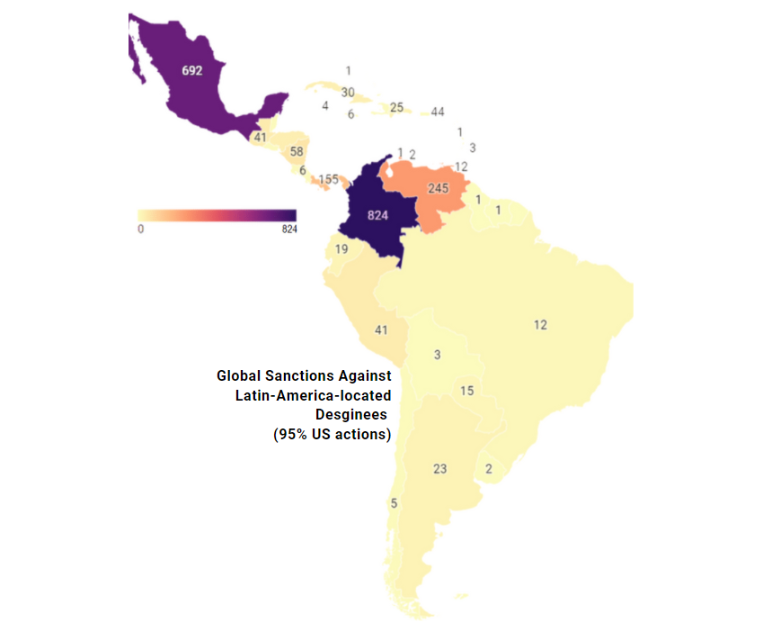
    According to Castellum.AI, a security risk and compliance data company, Latin America and the Caribbean is one of the most-sanctioned regions of the world. Using official lists of designees (persons, companies, or groups targeted by sanctions) as of October 2021, it found there were 1,990 sanctions in place against entities in Latin America and the Caribbean, of which 1,897 or 95% were put in place by the United States. This put the LAC region ahead of Iran in the most-sanctioned ranking (1,672 global designations) and also ahead of North Korea (899 global designations).

    Politically the three most prominent country targets for US sanctions within LAC are Cuba, Venezuela, and Nicaragua. However, looking at the weight of numbers Castellum says that the top US sanctions priority in the LAC region is represented by narcotics traffickers who are the targets of 85% of total US sanction actions. This explains the large numbers of designees in countries like Mexico and Colombia. In Cuba, Venezuela, and Nicaragua comprehensive sanctions are imposed largely due to those country’s authoritarian governments which remain locked in political conflict with the US. The comparatively high number of sanctions directed against entities in Panama and the British Virgin Islands (BVI) reflects the use of those jurisdictions as tax havens and money-laundering centres.

    Global Sanctions Against Latin-America-located Designees (95% US actions)

    Source: Castellum.AI

    Castellum AI raises two further interesting points. The first is that only three out of the 35 countries in North and South America publish sanctions lists: they are the United States, Canada, and Argentina. This is in line with the fact that only about one-fifth of counties worldwide utilise autonomous sanctions lists geared to country specific national security concerns independent of global or regional lists maintained by the likes of the UN and EU.

    The US lists, published by OFAC, contain by far the largest number of entries and are seen as the most comprehensive. Canada’s list, set up by the Special Economic Measures Act (SEMA), is said to be constrained somewhat by poor data quality. Argentina’s Registry of Persons and Entities Linked to Acts of Terrorism (RePET) is deemed to be well-structured and of good quality but in some respects difficult to access. Most Latin American governments do not actively impose sanctions and hence do not maintain lists of designated entities or persons. Argentina is the exception because of the 1994 bombing of AMIA, the Jewish community centre in Buenos Aires, which killed 85 people and led the government to set up the dedicated watch list. In fact, Argentina was the first country in Latin America to designate Hezbollah as a terrorist organisation.

    The second point is that despite the OFAC list’s size and sophistication it lacks some important functionalities. While it contains press releases and FAQs issued by the sanctioning office, it does not link them directly to sanctions. As a result, it can be difficult to understand why some entity or person is being listed in the database. This is important since the Washington government relies on US companies and citizens not to trade with sanctioned entities. If information on them is hard to access, corporate due diligence becomes more costly and less effective.

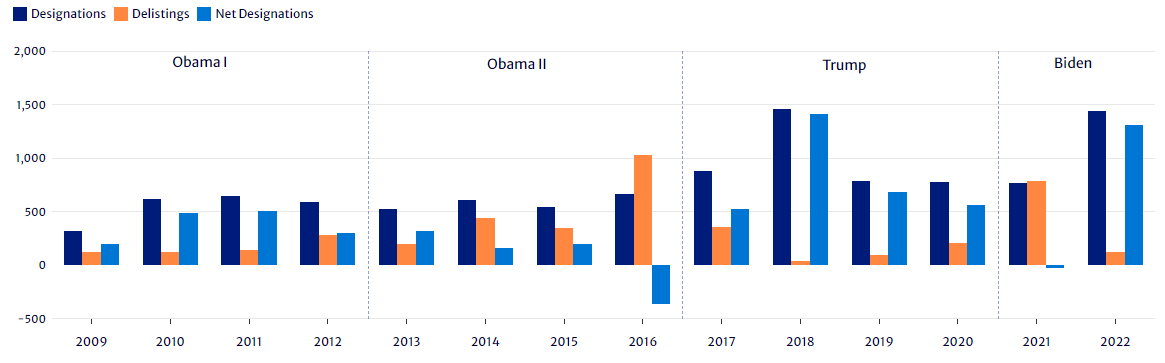
    In April 2024 Theodore Khan, a director at political risk company Control Risks, assessed the impact of Ukraine war-related growth in sanctions and export controls on the LAC region. He noted a two-year surge in sanctions against Russia, particularly affecting government and military officials, financial institutions, and specific companies in the energy, technology, and manufacturing sectors. With the US also targeting Iran, OFAC had added nearly 5,000 new designees to its lists in 2022-2023. In Kahn’s view the knock-on impact in the LAC region was relatively limited. With the exception of Costa Rica, most LAC countries chose not to enforce US sanction rules.

    Latin American trade with Russia meanwhile averaged US$1.8bn a month in the year to October 2023, slightly higher than in the 12 months preceding the invasion. Trade included vehicle and nuclear components that could be deemed to have dual use capabilities (in other words to have both military and civilian use). Kahn warned that Latin American companies doing business with Russia “thus face reputational damage and potential enforcement actions if their commercial partners are linked to sanctioned entities”.

    In recent years sanctions enforcement has clearly become a growth industry. Kahn says that over the past two years “targeted entities have used an ever-growing ecosystem of shell companies, transhipment routes, and complex transactions to evade sanctions and maintain access to restricted goods and financial assets”. While he acknowledges that much of this evasive activity occurs in sanctioned countries like Nicaragua and Venezuela which have close political ties with Russia, he says large economies like Brazil and Mexico will be scrutinised by OFAC and other US agencies, because they are used as transhipment hubs for trade with Russia. More generally, the presence in those countries of weak anti-money laundering (AML) controls, strong organised crime groups, and illicit gold mining are all factors that assist sanctions-busting efforts.

    In recent times there has been significant expansion of US export controls restricting the shipment of sensitive products to both Russia and China. Among others they affect electrical equipment, nuclear reactors, plastics, and chemicals. In March this year the US Bureau of Industry and Security (BIS) tightened restrictions on exports with potential military use to Nicaragua, citing concerns over the Managua government’s security cooperation with Russia. At first glance, and since they are a third party, Latin American companies should not be affected by such controls. But the detailed text of the relevant regulation establishes that the export controls imposed by the US also apply to foreign companies that use inputs, software, or technology that originates in the US.

    US Sanctions Designations and Delistings, 2009–2022

    Source: Centre for Economic and Policy Research (CEPR)

  • URUGUAY: ECONOMIC OVERVIEW

    LatinNews 08 November 2012 Hits: 333

    The economy and transport ministers, Fernando Lorenzo and Enrique Pintado respectively, were hauled in front of the senate on 29 October to explain the fiasco surrounding the bankruptcy of the national flag carrier Pluna in July and the failed auction of seven of the company’s planes. The opposition Partido Nacional (PN, Blancos) and Partido Colorado (PC, Colorados) had presented a motion calling for the resignation of the two men, as well as the president of the Banco República, Fernando Calloia, because of the lack of transparency surrounding the auction. The motion was narrowly defeated because the ruling Frente Amplio (FA) has a 16-15 majority. PN Senator Carlos Moreira said the auction had turned into “a soap opera” and was “compromising the country’s prestige”.

    In July 2007, Leadgate Investment bought a 75% stake in Pluna, while the Uruguayan government maintained a 25% stake. Pluna promptly acquired seven 90-seat Bombardier CRJ-900 aircraft. In April 2010, despite the severe pressure on airlines in the wake of the subsequent global economic downturn, Pluna placed an order for a further seven Bombardier jets at a cost of US$200m. The acquisitions failed to turn around the company’s fortunes. In June 2012 the government reached an agreement with Leadgate, under which the company agreed to leave the airline in an “orderly fashion” to allow the State to find a more suitable partner.

    In July the government decided to liquidate Pluna. It sold off seven planes in an auction in early October to the little-known Spanish airline, Cosmo Líneas Aéreas for US$137m, and leased six planes in order to raise funds to pay off the company’s US$300m debt. However, Cosmo pulled out of the purchase, claiming it did not have enough capital and the future of the planes, and the company’s 700 employees, is now up in the air again. There was some talk that Uruguay’s BQB Líneas Aéreas (Buquebús) would step in, and the carrier’s workers’ union is in talks with the government about establishing a workers’ cooperative to run the company with government subsidies.

  • HONDURAS: Bonilla pushes to unleash his ‘Tigers’

    LatinNews 15 May 2013 Hits: 11282

    The 26 July 2012 draft legislation for a new elite military-police unit called ‘Tigres’ (Tropa de Inteligencia y Grupos de Respuesta Especial de Seguridad - Intelligence Troop and Special Security Response Troop) is to be taken up for a second time by congress, prompting fresh concern about the militarisation of internal security in Honduras.

    The new elite unit is the brainchild of the national police chief, Juan Carlos ‘El Tigre’ Bonilla as part of the reform and overhaul of the widely discredited national police force. Back in July 2012 the plan was to fire around 4,000 of the 12,000-strong national police force and replace part of it with the new elite Tigres, who would focus on providing citizen security and battling organized crime. The root and branch police reform has been very slow to get off the ground; to date the clear-out has not yet happened so now it appears that the new unit, which may be set up with a US$57m loan from the Inter-American Development Bank, would be in addition to the existing force. Los Tigres would receive military training and be stationed at military bases close to the country’s crime hotspots, including the main urban areas of San Pedro Sula and the capital, Tegucigalpa. The unit, to be staffed by young recruits aged 18-22, would be under the command of the security ministry but be independent of the national police. In times of war it would fall under control of the defence ministry.

    Honduras already has an elite national police force, the Cobras, which receives training from US swat team experts. That begs the question as to whether there is concern in the security ministry that the Cobras also have been infiltrated by organised crime. Moreover, it is also the case that the government has already deployed the military onto the streets of the country’s most violent city, San Pedro Sula, using a state of emergency (recently extended to January 2014) under which the military is empowered to act in a policing role. (For further details see the April 2013 edition of our sister publication Latin American Security & Strategic Review.)

    The national university rector, Julieta Castellanos, the leading advocate for police reform since her son and his friend were murdered by renegade officers, has expressed opposition to the idea of Los Tigres being under military command. Castellanos said she acknowledged the need for an elite police force with the capacity to tackle high profile crimes like drug trafficking, money laundering, extortion and kidnapping, but she questioned the need for it to sit under the military, noting that between 19636 and 1993 the police was under the control of the armed forces and was equally “corrupt and criminal”.

    Meanwhile, the troubled police reform process continues to run into legal obstacles. On 14 May the pernickety supreme court, which in December 2012 already ruled parts of the police reform unconstitutional (prompting a major institutional crisis with the congress), ordered Bonilla to supply within 24 hours legal documentation in support of his decision to remove several police commissioners. The court warned that failure to present the documents would result in an automatic ruling in favour of the applicants. Over in the security ministry, however, the new ‘super minister’ Corrales is making waves, axing and re-assigning dozens of senior police officials since he took office on 1 May. The newly appointed head of the police purification unit (DIECP), Eduardo Villanueva, also said that the results of ‘confidence tests’ on the police leadership would be ready by end-month.

    • The US backs Bonilla

    The tiger-in-chief, Bonilla, has himself been the subject of some concern, including by the US State Department, which in August 2012 suspended some law enforcement cooperation funds (worth up to US$3.0m) for Bonilla and his immediate agents pending an investigation into his human rights record. The allegations against Bonilla included claims that he ran a death squad in the period 1998-2002. He was acquitted (of murder) in 2004 in the only case filed against him ever to make it to court, with the verdict upheld by the supreme court in 2009.

    After the news got out, the US embassy in Honduras on 13 August last year issued a statement seeking to downplay any rift in bilateral security relations: “US law authorising assistance for the armed forces and the national police of Honduras requires the Department of State to send to congress a report certifying that the government [of Honduras] is implementing policies to protect the freedom of expression and association and the due process of law. [It] must also mention if the government is investigating and processing… military or police personnel… allegedly involved in the violation of human rights, and whether the armed forces and the police are cooperating with the civil judicial authorities… This report must be submitted before 20% of the available funds for these institutions can be released”. Given that the state department report concluded that the Honduran government had complied, "the US has no plans to reduce or eliminate assistance to the Honduran armed forces or the police”, the embassy emphasised.

    Ambassador Lisa Kubiske highlighted that a full 80% of the US law enforcement funds for Honduras (amounting to US$56m for 2012) were in place. The-then foreign minister, Arturo Corrales (now security minister), downplayed the issue: “They have asked for information and we have given it. What happened a decade ago for us is something that has already been adjudicated…We expect the investigation to be completed as quickly as possible”, he said. President Porfirio Lobo reiterated his full support for Bonilla, appointed just weeks earlier, calling him “a breath of fresh air”.

    On 13 May the US Assistant Secretary of State for the Bureau of International Narcotics and Law Enforcement Affairs, William R. Brownfield, said in a press interview that he “respected and admired” Bonilla’s “effective” work, and stated that he had not seen that the State Department had reached any conclusion in support of the accusations against Bonilla. “For reasons of prudence, we are working with those parts of the police force that do not report directly to the director general (i.e. Bonilla). But I understand that he has taken steps to clean up the police and professionalise it, and that he has been effective in putting a better force on the streets”. Brownfield intimated that the issue was largely procedural and was in the process of being resolved. “I want to make clear that I am working with the Honduran police”, he underlined.

    • TSE says no money for elections

    On 13 May David Matamoros officially became the chief magistrate on the supreme electoral court (TSE). The TSE is due to call the November general election by 23 May, however some in the institution have complained of a lack of funds to organise the 2013 ballot. Matamoros said President Lobo had guaranteed him sufficient funds.

    • Which suitor suits best - Taiwan or China?

    The Lobo government has recalled the Honduran ambassador to Taiwan for consultations, amid fresh rumours that Honduras is about to formally establish diplomatic relations with mainland China. It was also reported locally that Taiwan’s deputy foreign minister Simon Ko had been refused a meeting with President Lobo on a recent trip to Tegucigalpa. President Lobo has suggested that it is possible to have relations with both. There has been speculation that moves by Honduras to pivot its foreign axis towards Chinese-allies in the region like Ecuador and Venezuela, as well as the likes of Palestine and Russia, may be the prelude to formalising diplomatic ties with Beijing.

  • RASTREANDO TENDENCIAS

    LatinNews 28 August 2015 Hits: 329

    ARGENTINA | Fernández pone límites a las privatizaciones. El 20 de agosto la Presidenta Cristina Fernández anunció una nueva ley que asegurará que las futuras privatizaciones de los activos en empresas de utilidades o compañías de energía del Estado, requerirán de una mayoría de dos tercios en el congreso nacional.

    Además, Fernández quiere crear una nueva agencia para administrar los holdings del Estado. Si es aprobada, la ley asegurará otro elemento de su legado, que es probable que ate las manos de quien sea el que la suceda en el palacio principal, Casa Rosada.

    ARGENTINA | Hotesur. Un juez argentino ha ordenado al gobierno que provea información sobre el estatus fiscal y legal de Hotesur, una compañía propiedad de la Presidenta Cristina Fernández y su familia.

    El pedido es técnico y relativamente menor, pero altamente sensible políticamente. La cuestión es que, en medio de la creciente intensidad de la campaña electoral, cualquier evidencia que se encuentre que podría servir de apoyo a las afirmaciones de la  oposición política de que Hotesur ha sido usada como un vehículo para el lavado de dinero.

    BRASIL | ¿Volviendo a las viejas malas costumbres? Con el banco central de Brasil (BCB) pronosticando una contracción cercana al 2% del PIB este año, y muchos analistas ahora esperando que el 2016 sea de nuevo un año de crecimiento económico negativo, el gobierno está recurriendo a movidas cada vez más drásticas para estimular la economía. En su última táctica, la Caixa Econômica Federal y el Banco do Brasil han anunciado un total de R$14mm (US$3,84mm) en líneas de crédito para las empresas locales. Muchos economistas fueron críticos de la medida, alegando que la misma recordaba a las desacreditadas políticas intervencionistas de Guido Mantega, el ministro de finanzas de la Presidenta Dilma Rousseff durante su primer mandato (2010-2014).

    “Estamos en una encrucijada”, dijo Miriam Belchior, la presidenta de la Caixa. “Además del ajuste fiscal, necesitamos tener las condiciones para superar este periodo. Nosotros, los bancos, hemos sido emplazados”. La Caixa anunció su programa de créditos de R$5mm (US$1,37mm) el 18 de agosto, que ofrecerá créditos baratos a compañías que se comprometan a no despedir a sus empleados. Un día más tarde, el Banco do Brasil anunció su programa de R$9mm (US$2,47mm); y ya ha determinado a las 354 compañías que son elegibles para recibir el dinero.

    Para Silvio Campos Neto, un economista de Tendências Consultoria, el crédito barato es “contradictorio”, dado que el BCB continúa elevando las tasas de interés, lo que socava el consumo, mientras que los bancos estatales bombean dinero barato en la economía. “El gobierno no ha sido curado de su deseo de estimular la economía con un empujón”, dijo Campos.

    Después de las noticias, las acciones de los grandes bancos de Brasil cayeron levemente. Joaquim Levy, el actual ministro de finanzas, dijo que no habría ningún impacto sobre el programa de ajuste fiscal del gobierno.

    BRASIL | Desempleo. Se podría decir que la mayor preocupación para la administración de la Presidenta de Brasil, Dilma Rousseff, es el creciente desempleo. El 20 de agosto, el instituto de estadísticas de Brasil (Ibge), difundió sus datos de desempleo para el mes de julio: en un 7,5% se elevó un 0,6% sobre junio; y un 3,6% sobre julio del 2014. Este resultado fue mucho más alto que el consenso esperado por los economistas. Los datos de la organización de estadísticas vinculada con el ministerio del trabajo, Caged, muestran que en julio se perdieron 157.905 empleos, el peor resultado desde 1992. Con la recesión camino a profundizarse, y el desempleo siendo un indicador rezagado, se espera que el escenario se deteriore aún más.

    • La inflación de Brasil se desacelera

    El instituto nacional de estadísticas de Brasil (Ibge) anunció que en agosto su índice de inflación IPCA-15 fue del 0,43%, menor que el 0,59% informado en julio. El índice acumulado a 12 meses del IPCA-15 es ahora de 9,57%.

  • Panama: The virtuous circle

    LatinNews 02 August 2013 Hits: 2743

    Over the long-term, the Panama Canal may face competition from other projects that provide transportation links through Central America between the Atlantic and Pacific Oceans. Over the short-to medium term, though, the country should continue to benefit from an investment boom which involves far more than an approximate doubling of the Canal's capacity. The boom takes place in the context of continuing fiscal and monetary stability and reducing risk.

    Unsurprisingly, the 2012 annual report (and other publications) of the Autoridad del Canal de Panamá (ACP), the state-owned enterprise that manages the canal, give prominence to the US$5.33bn Expansion Program. Sometimes referred to as the ‘Third Set of Locks Project’, this will roughly double the overall capacity of the Panama Canal, and enable the passage of ships that are bigger than the Panamax size vessels that currently are the largest that can make the passage across the isthmus between the Atlantic and the Pacific Oceans. The program is on track to become operational in 2015.

    The Canal program is separate from, and in addition to, the ACP's ongoing investment program, which involves about 100 individual projects that, collectively, involve spending of US$1.74bn. The largest single component of the on-going investment program is the new bridge to be built across the canal on the Atlantic side: according to the ACP, this will involve expenditure of US$325m, most of which took place in 2012. Details of both the Expansion Program and the continuing investment program are shown in chart 1.

    At a time that global economic growth has been patchy, the operational and financial performance of ACP over the last three years or so has been impressive. According to the ACP's own key metric, the tonnage that passed through the Panama Canal in 2012 was about 10% more than in 2010. Thanks to fees that have increased, and which have been higher than budgeted for by the ACP, total revenues have risen from US$1.97bn in 2010 to US$2.41bn in 2012.  Whether measured against sales, assets or equity, profitability has been high. The surpluses that have been transferred to the Panamanian government have consistently been above budget and, in the last two years, exceeded the minimum prescribed by the relevant law (28 of 2006). Details are shown in chart 2.

    In short, even if the plans to build rival canals (or coast-to-coast railways) in Nicaragua or other parts of Central America go ahead - and they will take years to complete - the ACP will remain a formidable competitor. The real growth in its business has in recent years exceeded the real growth in the global economy. The ACP clearly has pricing power. It is the proven operator of infrastructure that enables the global shipping industry to transit Central America. As recognised by the International Monetary Fund (IMF), the near-doubling of the Panama Canal's capacity should produce substantial economies of scale (as well as allowing the passage of much larger ships than at present).

    The Canal expansion program has contributed to Panama's strong overall economic growth: for its part, the IMF notes that the economy's real expansion of an estimated 10.7% last year made it the fastest growing economy in Latin America.  However, the Canal expansion is dwarfed by the US$15bn Public Investment Program (PIP), which involves expenditure of over 50% of Panama's 2010 GDP. According to the IMF, “the PIP focuses on logistics, tourism, agriculture and financial services, which were selected as sectors where economic growth returns and employment generation would be the highest”.

    As charts 4 and 5 indicate, Panama is a small, open economy that emphasises free trade. A number of free trade agreements (FTAs) are in place or are in the process of being negotiated (17 in all are in place at present, according to Panama’s trade ministry website). The local currency, the Balboa, is pegged at parity to the US dollar, and both circulate freely within the economy. In spite of the sluggish growth of the global economy, activity at the Colón Free Zone (CFZ) has expanded strongly over the last three years or so. As is indicated by the PIP priorities, the financial services sector is large relative to the overall economy: Panama's banking system is well capitalised. Transfers from the ACP basically cover the budget deficit.  Public sector debt accounts for a little over 40% of GDP and has been falling. A sizeable current account deficit is covered by inwards Foreign Direct Investment (FDI).

    The rise in FDI over time is one indicator that perceptions of risk associated with Panama have been falling. Panama obtained an investment grade credit rating in 2010. In late March this year, the IMF noted that “following an upgrade by Moody's, Panama is now among the highest rated emerging markets, on par with Brazil, Mexico and Peru”. Risk should be further lowered by the development of the Fondo de Ahorro de Panamá (FAP), which was established by law 38 of 2012. As chart 5 shows, the FAP serves as a contingency fund, from which the government may withdraw money provided that certain conditions are met.  The FAP will be boosted by payments from the ACP to the government, starting in 2015, once these have reached 3.5% of GDP. This threshold, at around US$1.30bn, is not dramatically greater than the US$1.02bn in total direct contributions that the ACP made to the government in 2012.

    It remains to be seen how the revenues, net income, surpluses and direct contributions of the ACP to the government grow from 2015, when the Canal expansion program becomes operational. Nevertheless, it is reasonable to assume that the direct contributions will grow strongly as a result of at least one of: higher fees; expansion in trade through Panama thanks to the further development of the CFZ; recovery in at least some of the larger developed economies; the near doubling of capacity of the canal thanks to the expansion program; and custom for the first time from the ‘next generation’ vessels that are larger than Panamax size. Over time, the FAP should emerge as a major player in domestic fixed income markets and a key actor that helps the development of local capital markets. In summary, Panama should remain in a virtuous circle of superior growth and reducing risk for the foreseeable future.

  • CARIBBEAN POINTERS

    LatinNews 05 November 2015 Hits: 1658

    *** GRANGER UPGRADES GUYANA’S DEFENCE. Guyana’s new president, David Granger, told a gathering of Guyana Defence Force (GDF) officers on 15 October that the country needed a plan for “total national defence”. The president argued that threats to Guyana’s borders and territorial waters still existed and that “Guyana’s National Defence Strategy should focus on deterrence based…to dissuade a potential adversary from resorting to a particular course of action by convincing him that the costs of pursuing it will outweigh the potential gains.”

    Among the president’s proposals was the reconstitution of a ‘reserve force’, previously the Guyana People’s Militia, which should have a minimum strength of 50% of the ‘regular force’. Other changes would be required to develop the GDF’s capacity “to provide continuous surveillance over Guyana’s air, territorial, and maritime borders and approaches”.

    A few days later, Granger told parliament: “The chronicle of Venezuela’s provocations and aggression towards Guyana since independence is well known. Through unsubtle threats and undiplomatic coercion, Venezuela has sought to establish itself as the arbiter of Guyana’s development of the entire Essequibo…Venezuela’s claims are not only illegal, they are injurious to the economic development of Guyana.”

    *** ANTIGUA’S PREMIER CHALLENGES ECLAC PROJECTIONS. Antigua’s Prime Minister Gaston Browne said on 19 October that the latest forecasts from the Economic Commission of Latin America and the Caribbean (Eclac) will need to be revised upwards. Eclac recently dropped its economic growth 2015 forecast for Antigua from an earlier prediction of 5.4% to 2%. Browne told parliament: “By the time they would have gotten all the information…I believe strongly that by the end of this year we would have posted 3.5%.” In 2014, the Antiguan economy grew by 2.8%.

    Separately, the IMF has urged Antigua to cut tax concessions. It says that the tax ratio to GDP is 17% and that there is “scope for that to increase”. The IMF says that “stronger revenue mobilization” can come from removing concessions and reducing the size of exemptions rather than from increasing tax rates.

    *** JAMAICA’S OPPOSITION LEADER ATTACKS MURDER RATE. The leader of the opposition Jamaica Labour Party (JLP), Andrew Holness, has warned that serious crime is worsening under the People’s National Party (PNP) government of Prime Minister Portia Simpson-Miller.

    Speaking at a political rally on 30 October, Holness warned: “If you keep the PNP in power, the truth is that you could lose your life. If you keep the PNP in power and the crime rate continues to rise, the truth is that the next murder victim could be you.”

    Holness based his attack on the latest figures from the Jamaica Constabulary Force which show that there were 1,016 murders between 1 January and 23 October this year, a 24% increase on the same period last year when there were 822 murders.

    The further political point made by Holness was that under the last JLP government, the annual murder total was brought down to 1,125 in 2011. In fact in 2014, under the present government, the total was 1,005, down from 1,200 in 2013, but it is now clearly on the increase again.

  • NICARAGUA: US continues to pile on the pressure

    LatinNews 19 April 2017 Hits: 880

    Earlier this month US legislators announced they were reactivating a bill known as the Nicaraguan Investment Conditionality Act (NICA). It is the latest version of the initiative approved by US House of Representatives in September 2016 which would prevent the government led by President Daniel Ortega from accessing international financing until reforms are implemented that “promote democracy, strengthen the rule of law, respect human rights, and until Nicaragua holds free, fair, and transparent elections overseen by electoral observers”. The initial NICA [RC-16-10] was drawn up in response to concerns surrounding the November 2016 general elections in which Ortega was re-elected for the ruling Frente Sandinista de Liberación Nacional (FSLN) in a highly questioned process. Prompting an angry response from the FSLN government, the US legislators’ latest move shows Ortega’s efforts to address these democracy-related concerns have ultimately failed to convince.

    A 5 April press release by US Representatives Ileana Ros-Lehtinen (R-FL) and Albio Sires (D-NJ) notes that the latest version of the NICA “goes one step further than the previous version” by calling for the Ortega government “to actively combat corruption and take significant steps to protect human rights defenders and activists” – an issue which has again come to the fore (see box).

    It comes despite Ortega’s efforts to address concerns raised by the foreign community. These efforts include a Memorandum of Understanding (MOU) which his government inked on 28 February with the Organization of American States (OAS). The MoU had been announced back in January as part of a joint document signed by the two sides after a three-month period of talks. These in turn followed an October 2016 agreement to establish a mechanism of “conversation and exchange”. A key provision of the 28 February MoU (which was also slammed by local civil society groups – see sidebar) was that the OAS would “accompany” local municipal elections scheduled to take place in November this year. The refusal by President Ortega, who first took office in 2007 and has been re-elected twice, albeit in processes described as fraudulent by the opposition, to allow any credible international observers to oversee last year’s elections was a major bone of contention both with local civil-society groups and the international community.

    Human rights concerns

    On 28 March, the World Organisation Against Torture (OMCT) and the International Federation for Human Rights (Fidh) requested urgent intervention in Nicaragua in light of “worrying reports” from the local human rights centre, Centro Nicaragüense de Derechos Humanos (Cenidh), regarding defamatory acts and threats against Cenidh’s director Vilma Núñez de Escorcia; against Lottie Cunningham, founder of the centre for justice and human rights on the Atlantic coast (Cejudhcan), and its director Juana Bilbano; and against Francisca Ramírez, leader of the Consejo por Defensa de la Tierra, Lago y Soberania (Consejo Nacional) protest group which opposes the US$50bn ‘Gran Canal’ project to link Nicaragua’s Caribbean and Pacific coasts.

    The OMCT-Fidh press release cites a message received by Cejudhcan on 17 March “replete with…infamy and serious threats” against the four women. The same press release notes that on 8 March nine government ministers and deputy ministers sent a letter to the US embassy describing Núnez as “a person whose diatribes; insults; and practices have repeatedly offended the people and Nicaraguan government”. This was in response to an event at the US embassy on International Women’s Day in which Núnez was praised for her efforts and in which it was announced that she had been nominated for the International Women of Courage award handed out by the US State Department each year.

    • Frente Amplio por la Democracia (FAD)

    In a statement issued in response to the 28 February Memorandum of Understanding (MoU) signed by the Ortega government and Organization of American States (OAS) secretary general Luis Almagro, the Frente Amplio por la Democracia (FAD) opposition coalition complained that Nicaraguans have been submitted to an “authoritarian and dynastic regime…established through successive and massive electoral fraud”. Warning that an OAS accompanying mission “will not change these conditions”, the statement calls on Almagro to publicly present the OAS report on the 2016 electoral process undertaken with the Nicaraguan government as part of the mechanism of conversation and exchange.

  • HONDURAS: Relations with China progressing amid scepticism from private sector

    Sarah Sheldon 24 September 2024 Hits: 592

    On 13 August President Xiomara Castro met with China’s vice foreign minister Hua Chunying to discuss the free trade deal (FTA) that the two countries have been negotiating.

    The pair met in the Honduran capital Tegucigalpa for talks which also covered Chinese financial support for various projects in Honduras. Honduras’ minister for economic development Fredis Cerrato said that the meeting was “very fruitful,” adding that negotiations over an FTA had “advanced rapidly in a year,” with 22 chapters agreed and one left to discuss. That same day, Honduras’ foreign minister, Eduardo Enrique Reina, and China’s ambassador in Honduras, Yu Bo, signed an agreement for a feasibility study for the construction of 300 educational centres in Honduras.

    The two countries forged bilateral relations in March 2023, after Honduras severed ties with its long-time ally Taiwan in search of Chinese trade and investment. Since then there have been six rounds of negotiations over an FTA, as well as a deal over an early harvest agreement (EHA) to allow Honduran shrimp and other seafood products to enter the Chinese market duty-free, which took effect on 1 September.

    This agreement, which is a preliminary step towards a full FTA, marks a significant step in strengthening bilateral trade relations. Approved by the Honduran congress in July, the EHA has already facilitated the shipment of two containers of shrimp to China, and Honduras has prepared nine shrimp packing plants certified for export to the Chinese market. The Castro government is hoping that the full FTA will provide a major export channel for Honduran seafood and other key exports such as melon, tobacco, bananas, and cacao.

    But others have questioned the impact that an FTA, and relations with Beijing more widely, will have on the economy as a whole. For example, Honduran international trade expert Enrique Mejía Uclés told local daily Tiempo that the FTA will have a “harmful” effect, with cheap Chinese imports replacing locally made products. In an article published 16 August, he predicts that the FTA will allow Honduras to export products worth US$25-40m to China, with US$1bn in imports coming the other way. 

    Mejía also claimed that Taiwan used to buy Honduran shrimp at preferential prices, but China is negotiating cut price deals. Graco Pérez, an international law expert, made the same point to business magazine Revista Estrategia y Negocios in an article published 12 August, claiming that China is attempting to pay half of what Taiwan paid before. Alejandro Kaffati, an economic policy adviser with private sector lobby Consejo Hondureño de la Empresa Privada (Cohep), told local digital outlet HonduDiario in an article published on 16 August, that hundreds of jobs in shrimp-producing areas in the south of the country have already been lost due to the decision to end relations with Taiwan. He added that Cohep had warned of the impacts of an FTA on Honduran industry on multiple occasions.

    Kaffati questioned the logic of ditching Taiwan in favour of China, predicting that the FTA would increase the country’s trade deficit. He highlighted the fact that promised Chinese investment has not been forthcoming, and that the FTA in its current form would not solve Honduras’ problems with productivity and job creation.

    Meanwhile in a piece published 12 August, Cerrato told Revista Estrategia y Negocios that Chinese negotiators are inflexible and “pretty tough,” with Honduran negotiators unable to secure the benefits for which they are pushing.

    • Flexibility?

    The Honduran government has reportedly asked China to be more flexible during the remaining negotiations, with greater access for Honduran tobacco products a priority. Honduras is also pushing to be allowed to export a greater volume of products to China. 

    Cerrato has also said that China wants the FTA to be finalised before it provides financing for other projects, as it wants any potential disputes to be handled by the United Nations (UN) rather than the International Centre for Settlement of Investment Disputes (Icsid), which is part of the World Bank.

    So far, the impact of switching allegiances to China has been limited. A L6.8bn (US$276m) cooperation agreement to improve education infrastructure was signed in March while in late August, following a business event held in Tegucigalpa organised by the Honduran and Chinese governments, Cerrato announced that four agreements had been signed by businesses from both countries, with the potential to export US$17m worth of products such as coffee and palm oil. However, Honduras has not secured funding for strategic areas including infrastructure projects, such as a transoceanic railway line that is part of a so-called dry canal linking Pacific and Atlantic coasts. 

    In recent years Chinese priorities have shifted away from investment in large-scale infrastructure towards what Beijing calls “new infrastructure,” or innovation-related sectors such as electric vehicles, information and communications technology (ICT), and urban infrastructure, which it wants to use to drive its own economic growth.

    While this could bring some benefits to Honduras, with Chinese telecoms firm Huawei increasingly involved in the communications network, Beijing’s changing strategy may leave Honduras wanting. The country is less suited to innovation-related projects than others in Latin America, such as Mexico and Brazil, which have a strong track record in high-end manufacturing, nor does it offer a huge market for digital services. 

    On the other hand, a new report from the UN Economic Commission for Latin America and the Caribbean (Eclac) shows that Chinese firms were significant contributors to foreign direct investment (FDI) project announcements in 2023, mostly in natural resource- and labour-intensive industries (see previous page).

    While the agreement of the FTA may unlock Chinese investment in some areas, there is a risk that Beijing’s policy shift leaves President Castro struggling to justify the decision to switch allegiances from Taiwan. The Honduran government’s policies and legislation have “created a climate of uncertainty that has driven a decline in private investment and job creation” according to the US State Department’s 2024 Investment Climate Statement on Honduras. Increasing tensions with Washington, which saw Castro end her country’s extradition treaty with the US on 28 August (see our other publications for more discussion of this), could also reduce the chances of investment from the US and its allies, leaving Honduras increasingly reliant on China.

    Rejecting US investment report

    In mid-July Honduras’ foreign minister, Eduardo Enrique Reina, rejected the US State Department’s latest investment climate report on Honduras which claims that “in recent months increasing numbers of companies report they are experiencing challenges operating in the country”. It says these include difficulties in operations due to the central bank’s “strict and often onerous process governing the sale of dollars”, along with “uncertainty surrounding the implementation of pending legislation…politically motivated threats of criminal prosecution and expropriation of private assets, unreliable and expensive electricity, non-tariff measures against US imports, and increasingly frequent armed land invasions”. The report states that over 200 US companies operate enterprises in Honduras.

  • PANAMA: Gov’t rails against tax haven lists

    Sarah Sheldon 16 December 2024 Hits: 471

    At the end of October Panama’s President José Raúl Mulino energetically rejected the Netherlands’ continued inclusion of Panama on its blacklist of tax havens. Mulino’s ire follows recent efforts by his government to lobby for the European Union to remove Panama from what it dubs “discriminatory financial lists” – a key priority for the Mulino administration which took office in July. Efforts to improve Panama’s image have assumed increased importance following the loss of investment grade earlier this year due to the 2023 closure of the massive Cobre Panamá cooper mine in response to major unrest over the approval of a new contract, since struck down by the supreme court (CSJ) [EB-24-08].

    President Mulino made his comments regarding the Netherlands’ continued inclusion of Panama on its list on 30 October, when he also announced that Dutch companies would be excluded from participating in public tenders or “public acts”. Indicative of efforts to remove Panama from such lists, Mulino paid a trip to France earlier that month. There, he met his French counterpart Emmanuel Macron on 21 October whom he lobbied to pledge support for Panama’s removal from the blacklist drawn up by the European Union of “jurisdictions which are deemed non-cooperative” in terms of compliance with international standards of tax transparency and fair taxation.

    On 8 October this year the European Union opted to leave Panama on its list of non-compliant countries regarding the treatment of tax havens. This, despite the fact that in October 2023 – in what was hailed by the previous Laurentino Cortizo administration (2019-2024) as a major achievement – the Paris-based Financial Action Task Force (FATF) of the Organisation for Economic Co-operation and Development (OECD) removed Panama from its ‘grey’ list of countries with strategic deficiencies in their anti-money laundering (AML) and counter-terrorist financing (CFT) frameworks.

    In a statement released in response to the FATF’s decision in October 2023, the Cortizo administration boasted that the FATF had determined that Panama had “strengthened its anti-money laundering and counter-terrorist financing prevention system and implemented substantial regulations and actions that have allowed the country to take an important step forward in international transparency.” The US State Department’s most recent (July 2024) investment climate statement also highlights various steps taken by Panama to address concerns regarding tax transparency. These include the fact that in 2015 Panama strengthened its legal framework, amended its criminal code, harmonised legislation with international standards, and passed a law on AML/CFT, among other things.

    Other legislation

    The US State Department’s investment climate statement notes that Panama approved Law 18 (2015), which severely restricts the use of bearer shares; companies still using them must appoint a custodian and maintain strict controls over their use. It highlights that in 2019 Panama passed a law criminalising tax evasion, defining it as a money laundering predicate offense as well as noting that in 2021 Panama passed Law 254, which modifies six distinct laws in order to give the non-financial regulator more authority and strengthen know-your-customer (KYC) requirements.

    Firming up ties with China

    Amid concerns regarding Panama’s image as an investment and trading partner (foreign direct investment to the country was down 22% in 2023 compared to 2022, according to an August report by the United Nations Economic Commission for Latin America & the Caribbean [Eclac] [EB-24-09]), Mulino recently met with China’s ambassador, Xu Xueyuan, to discuss interest by Chinese companies within the isthmus and promote Panamanian exports.

    There are currently around 40 Chinese firms operating in Panama in sectors such as finance, telecoms and logistics, many in the Colón free zone (ZLC). A presidential press release dated 8 November highlights that China’s investment interests centre on logistics and infrastructure, renewable energy & green technology, tourism, property development, telecommunications, and agriculture. It cites Chinese companies’ interest in expanding in ports and logistical zones of the Caribbean and Pacific.

  • RASTREANDO TENDENCIAS

    LatinNews 21 September 2011 Hits: 489

    ARGENTINA | Aún fuerte. La economía creció 8,8% en la primera mitad de 2011, comparado con igual periodo de un año antes, informó el instituto nacional de estadísticas (Indec). El crecimiento del PIB en junio fue de 8,2%, completando 22 meses de crecimiento consecutivo desde agosto de 2009. La producción industrial se incrementó en 9% en la primera mitad, conducido por el sector automotriz, que se expandió en 24% produciendo 80.795 vehículos, pero es vulnerable a la desaceleración en Brasil.

    BRASIL | Alemania de América Latina. Las exportaciones de mercancías de Brasil ha promediado poco menos de US$1bn por día en 2011, de acuerdo con el ministerio de desarrollo, industria y comercio exterior. Las importaciones promediaron US$870m/día. Con las exportaciones aún sobrepasando a las importaciones el superávit comercial acumulado (hasta la tercera semana de agosto) fue de US$18,4bn, subiendo un impresionante 60% año en año sobre los US$11,5bn informado para el mismo periodo de 2010, con exportaciones de US$157,98bn e importaciones de US$139,2bn. Las exportaciones primarias aún disfrutan del boom en los precios de las materias primas, y la continuada demanda china por soja y mineral de hierro en particular, pero el hecho que los productos manufacturados también se mantienen por sí mismos en mercados clave como el de EU, pese al fuertemente sobrevaluado Real, es prueba de los esfuerzos de los exportadores para impulsar la competitividad en un encarnizado mercado internacional.
    Por el lado de la importación, hay un continuado crecimiento en bienes intermedios y bienes de capital, que sugiere que las firmas aprovechan el fuerte Real para invertir en máquina y equipamientos, reduciendo sus costos. La otra cara de la moneda es que las firmas locales de manufacturas están recibiendo una fuerte competencia en el mercado de parte de proveedores extranjeros baratos. El gobierno está muy ansioso para evitar que se instale una des-industrialización. Ya ha avanzado para proteger a selectas industrias locales vía incentivos fiscales y de crédito y barreras temporales no tarifarias a la importación. La Presidenta Dilma Rousseff no hace concesiones acerca de abogar por una política industrial. Ella apunta a evitar la ‘Enfermedad Holandesa’, una plaga típica de los exportadores de productos primarios. Los productores locales dan la bienvenida al apoyo, pero continúan presionando por reformas estructurales de largo plazo.

    BRASIL | ¿Crisis? ¿Cuál crisis? Las ventas minoristas declinaron menos de lo esperado en junio, registrando un crecimiento de 0,2% mes a mes sobre mayo y 7,1% año en año. Los economistas habían esperado que las ventas se estanquen pues los consumidores sienten el impacto de una mayor inflación y de las tasas de interés. La inflación anual creció cerca del 7% en julio. De todos modos, el resultado minorista de junio fue el tercero peor de este año, después de una contracción de 0,2% en abril y un tibio resultado de 0,1% en febrero. Las ventas de los supermercados en realidad cayeron 0,4% en junio. El índice general de ventas minoristas, que incluye ventas de vehículos y materiales de construcción se elevó 0,5% en junio, cayendo 0,9% en mayo.
    Las ventas de vehículos, siempre una buena representación para el estado de la demanda del consumidor, subió 8,6% año en año en los primeros siete meses de 2011. Las importaciones de autos creció 46%, apoyadas en un Real fuerte. La fabricante de autos de lujo de Alemania BMW se informó que ha vendido 2.000 autos por día en Brasil y está incluso discutiendo sobre su primera planta en el país para atender el mercado de Brasil toda América del Sur.
    El banco central está buscando calmar los nervios acerca de una burbuja crediticia. Carlos Hamilton Araújo, el director de política económica del banco, espera que el ritmo del crédito crezca moderadamente a cerca de 15% anualmente para finales del año, de 20% en la primera mitad. El crédito total es ahora de alrededor de 47% del PIB. En países desarrollados la norma es que el crédito total exceda el 100% del PIB.
    A pesar de la rápida subida del crédito entre los consumidores de la nueva clase media, que los analistas advierten que son poco educados acerca de los caros productos financieros que toman, la tasa de default del consumidor promedio era manejable en 5,6% en julio, de acuerdo con datos del banco central. Los bancos como el Banco do Brasil, el más grande banco de América Latina por activos, recientemente informó de incrementos de dos dígitos en sus ganancias, gracias a las estables tasas de default y a las provisiones de pérdida de créditos más bajas de lo esperado. El ingreso neto del Banco do Brasil en el segundo trimestre fue de R$3,33bn (US$2,05bn), subiendo de R$2,73bn un año antes.

    CHILE | Impresionante. La economía creció en 6,8% en el segundo trimestre de 2011, la más rápida expansión durante ese periodo en seis años, dijo el banco central. El crecimiento fue menor del 10% registrado en el primer trimestre, aunque eso fue anormalmente alto y se debe a la baja tasa de comparación debido a las repercusiones del terremoto de febrero de 2010. El crecimiento fue conducido por la demanda interna, que se incrementó en 9,4%, y las exportaciones, subieron 10,2%. Las importaciones crecieron en 14,8%.

  • POINTERS

    LatinNews 22 July 2016 Hits: 1007

    GUYANA | HOPES FOR MOVE BY UN SECRETARY-GENERAL. Guyana’s President David Granger told the Caricom heads of government summit on 6 July that he has hopes that outgoing UN Secretary-General Ban Ki-moon will push the Guyana-Venezuela territorial dispute towards a resolution by the International Court of Justice (ICJ).

    Granger said: “All Mr Ban Ki-moon has to do within the remaining months and weeks of his office is select a course that doesn’t involve warfare…We’ve asked him to choose a course that would take the controversy to a juridical settlement and we hope he does this within the next four months before he demits office.” Ban Ki-moon leaves his UN post on 31 December 2016.

    In May 2015, Venezuela greeted a significant oil find by ExxonMobil in Guyana’s territorial waters by issuing a decree re-establishing Venezuela’s claims to Guyana’s Essequibo Region and adjacent waters, including the area of the oil find.

    The issue has become even more pertinent following the announcement of another large oil discovery by ExxonMobil. The first find (Lisa-1) was put at 700m barrels; now ExxonMobil says that it has discovered a further 800m-1.4bn barrels in the same area (Lisa-2).

    BELIZE-GUATEMALA | SMALL STEP TOWARDS REFERENDA. Belize and Guatemala have an agreement dating from December 2008 to hold referendums in each country over whether to refer their territorial dispute to the International Court of Justice (ICJ). Originally the idea was to hold simultaneous referendums, but plans to hold the votes were held up over a provision in the conditions for the Belize poll that required a minimum voter turnout of 60%.

    Belize’s Prime Minister Dean Barrow has now indicated that this minimum turnout provision could be scrapped. Speaking on 29 June, Barrow admitted that the threshold was considered “abnormal” by many in the international community and that “a vote on that basis would not be a fair vote in terms of internationally accepted standards”. He said Belize is now prepared to remove the condition.

    However, Barrow added that “there is no way we can make such a change while the matter of Sarstoon is still outstanding”. This was a reference to the recent spate of incidents along the Sarstoon River. The official border is the mid-point of the river, and to the south of Sarstoon Island where the river divides around the island. Recently, Guatemala has been interfering with the free movement of Belizean vessels, and matters escalated further on 20 April when a 13-year-old Guatemalan boy was killed in a night-time exchange of fire between Belizean troops and Guatemalans said to be farming illegally at Cebada in Belize’s Chiquibul National Park. Morales described the boy’s shooting as “murder” and despatched 3,000 troops to the border. Activist nationalists on both sides are determined to ensure that their respective governments give no ground – and, in the case of Belize, do more to prevent illegal fishing and farming on Belizean territory by Guatemalans.

    BAHAMAS-US | TIT-FOR-TAT WARNINGS. On 8 July, The Bahamas warned its citizens to take particular care when traveling to cities in the US affected by violence related to the “Black Lives Matter” demonstrations. In particular, the warning said that Bahamians need to “exercise extreme caution in their interaction with the police”. On 12 July, the US returned the favour with a travel advisory to US citizens visiting The Bahamas. They were warned to take special care at ATM machines and about the “significant increase in armed robberies”.

  • Venezuela: The constituent assembly

    LatinNews 04 August 2017 Hits: 346

    Venezuela’s President Nicolás Maduro is reading a new constituent assembly that plans major economic policy changes. It is not clear in which direction these changes will go – the country’s need for cash and investment in the oil sector may require some rather more ‘neo liberal’ measure than expected.

    The new assembly will have almost unlimited powers. But while there are major concerns over its political ambitions, including fears that it will shutter the national legislature and impose a Cuban-style one party regime, Venezuela’s ambassador to Cuba, Alí Rodriguez Araque, said at a Havana press conference on 1 August that the new assembly would concentrate initially on taking “urgent decisions” to help resolve Venezuela’s deep economic crisis.

    The government’s remaining supporters might read this a pledge to rescue the domestic economy for its deep recession. However, while Venezuelan people continue to endure harsh economic conditions on the ground, first and foremost for the Maduro government is to avoid a debt default, with a large bunching of payments coming due in the fourth quarter (for the sovereign and the state oil company Pdvsa).

    Maduro has hinted that the government intends to use new assembly to look for fresh financing for the crippled oil sector in particular. So for example, the assembly will be able to rewrite or amend the constitution to alter rules on joint oil ventures (so as to allow for more foreign participation, for example), change tax and royalty regimes and refinance and/or issue additional public debt, for example. Or alternatively, it could go the other way and seek to nationalise even more of the energy sector, potentially including the gas sector (in which foreign majors like Italy’s ENI and Spain’s Repsol have a strong presence); as well as intervening further in the local private sector in support of the plans for a Cuban-style centrally planned economy (even as Cuba itself has moved away from that model).

    The consensus opinion, however, is that most foreign governments are unlikely to recognise the laws approved by this largely un-recognised constituent assembly, with Western financial investors (and potentially also Chinese state actors), set to remain vary, as Venezuela becomes a pariah state on international capital markets.

    Russia, on the other hand, appears more interested in leveraging the Venezuelan situation for its own ends. According to a widely cited recent Reuters report, Russia’s Rosneft has been seeking to swap its recently acquired stake in Citgo, the US-based refiner that it now owns in conjunction with Venezuela’s state-owned oil company PDVSA (having taken 49% of Citgo in late 2016 as collateral for a loan to the cash-strapped Venezuelan oil operator), for additional stakes instead in Pdvsa oil and gas fields on the ground in Venezuela.

    This has given risen to warnings by some conservative US commentators that US sanctions risk pushing Maduro further into Russia’s orbit, allowing Russia to continue to build up again a strategic presence in the Caribbean (Cuba, also under US pressure, is likewise turning anew to Moscow).

    Likewise, according to oil sector commentators, Pdvsa has contingency plans in place for US sanctions on the oil sector. China and India reportedly have pledged to purchase Venezuelan heavy crude oil if the US bans imports of Venezuelan oil, while Pdvsa talks reportedly are also well advanced to source alternative sources of light crude (for diluent) from the likes of Angola, Gabon and other African suppliers.

  • REGION: Record remittances to northern Central American nations in 2025

    Sarah Sheldon 24 March 2026 Hits: 267

    El Salvador, Guatemala, and Honduras received remittances worth a total US$47.73bn last year, a 20% increase compared to 2024, according to data compiled by the International Organization for Migration (IOM).

    El Salvador received US$9.99bn in remittances, up from US$8.48bn in the same period in 2024, which is equivalent to a 17.8% increase, while Guatemala received US$25.53bn, up from US$21.51bn, and an increase of 18.7%. As for Honduras, in 2025 the country received US$12.21bn, a 25.3% rise compared to the US$9.74bn received in 2024. This is the latest stage in a sustained increase in the value of remittances to the three nations, which has risen steadily from US$15.65bn in 2016 to US$23.01bn in 2020 and now US$47.73bn in 2025.

    These three nations have become highly reliant on remittances. The vast majority of remittances to northern Central America are sent from migrants in the US, meaning that the economy of the sub-region is highly exposed to economic and policy changes in that country. One example is the immigration crackdown imposed by US President Donald Trump after he returned to office in January 2025, which may have encouraged migrants to send more money than they might under normal circumstances due to concerns over being deported back to their home countries. If Trump succeeds in deporting large numbers of undocumented workers, as he has said he wants to do, then 2025 might represent a peak in terms of the value of remittances.

    US authorities could also make it more difficult to send money home, for example by charging extra fees for payments sent abroad or imposing more onerous compliance procedures designed to gather data on undocumented people living in the country. The country already imposed a new 1% federal tax on remittances sent using cash, money orders, or cashier’s checks, effective from 1 January this year. Although this means that the vast majority of payments will avoid the levy, it would be easy for these rules to be updated to affect a far larger share of overall remittances.

    Given the importance of remittances in supporting households in northern Central America, particularly those at the lower end of the income spectrum, Trump’s policies constitute a significant risk to national economies. For example, many households would likely fall into poverty if remittances are significantly reduced, and domestic consumption would be badly impacted too, with knock-on effects on economic activity and GDP growth. 

    Although there is some evidence that Trump’s hardline immigration policies are encouraging migrants to move to alternative destinations such as the European Union, in particular Spain and Italy, the only real solution for national governments to insulate their economies from the policies of the White House is to attract investment and generate jobs at home. However, this is no easy task, as proven by the fact that so many people have left the region in search of opportunities in recent decades.

    There is little to suggest that governments will succeed in turning this situation around anytime soon, leaving northern Central America vulnerable to factors that affect the value of remittances, including the aforementioned policy changes and a potential downturn in the US economy. As a result there are considerable risks that a major source of national income is reduced in the coming years, which would drive up poverty rates and increase the risk of social and political unrest, with tensions exacerbated by the fact that deported migrants will increasingly compete with those entering the workforce for a limited number of jobs. On the other hand, Trump may decide that restricting remittances is not worth the risk of setting off another wave of migration to the US southern border, or the 2028 US elections may result in a Democrat administration that is less hostile to immigration.