All Categories

Subcategories

  • HONDURAS: Supreme court appointments excite controversy

    LatinNews 11 February 2016 Hits: 1057

    The Honduran national congress on 10 February managed in a fifth session to elect three of seven remaining new supreme court magistrates. The final four were expected to be chosen in a sixth session as we went to press. The renewal of the 15-strong supreme court bench, which takes places every seven years, has been particularly fraught this year as the country’s new opposition parties have refused to go along with efforts by the two traditional parties, the ruling Partido Nacional (PN) and the Partido Liberal (PL), to divvy up the posts between them, as has been the custom.

    The final slate of 15 candidates comprised eight affiliated to the PN and seven affiliated to the PL. The first round of voting, held in late January, elected eight justices: five affiliated to the PL, two affiliated to the PN, and one independent. The ousted former president and head of the opposition Libertad y Refundación (Libre) party, Manuel Zelaya (2006-2009), this week decried that eight deputies had been offered bribes by the PN to vote for its candidates in the final seven justices. Zelaya’s complaints followed allegations by a local journalist that the PN has funnelled cheques for thousands of US dollars to Libre and other opposition deputies via a PN-linked trade association, in return for their support in congress. Meanwhile, the selection process for the magisterial candidates – as well as the final slate – was heavily criticised by external observers and the US embassy in Tegucigalpa.

    The whole affair makes it fairly clear that the new Mission for Support against Corruption and Impunity in Honduras (Maccih), signed by President Juan Orlando Hernández and the Secretary General of the Organization of American States (OAS), Luis Almagro, on 19 January, has its work cut out. Maccih provides for an international team of investigators and prosecutors to collaborate with Honduran counterparts to pursue corruption cases and implement systemic judicial reform.

  • Panama: Varela deploys another elite task force

    LatinNews 03 May 2017 Hits: 476

    President Juan Carlos Varela last month announced the deployment of an elite task force (FTC-Águila) to towns in the provinces of Panamá, Panamá Este, Panamá Oeste and Colón in order to combat organised crime. The move points to ongoing government concerns regarding insecurity and crime, the chief public complaint, which President Varela attributes to the increase in drug production in neighbouring Colombia.

    In a presidential press release issued on 24 March announcing the new 300-strong FTC-Águila task force, President Varela said that the problem of increased crime stemmed from clashes between rival drug trafficking gangs disputing territorial control of trafficking routes.

    The deployment of the task force, which comprises agents from the public security ministry (Minseg), the national police (PN), the border service (Senafront), the national air service (Senan), the institutional protection service (SIP), and migration authorities, follows other major operations launched in recent months. These include ‘Colón Seguro’, launched in Colón City in October 2016 with the support of PN chief Omar Pinzón, executive secretary of the national security council Rolando López, and Carlos Rumbo Pérez, the provincial PN director. ‘Operación Escudo’ ran from 9 May until 17 June 2016, while Operación Patria ran from 20 October to 20 December 2015, both in border areas, involving a specialised joint task force.

    A Minseg press release dated 13 April noted the impact of the task force. It states that between 24 March and 10 April, a total of 4,004 police actions took place resulting in “a significant fall in homicides”. According to Minseg, there were just eight homicides over this 18-day period in the different areas targeted: two in Tocumen city (Panamá), two in Colón city (Colón), one in San Miguelito district (Panamá), one in the Boca La Caja area (Panamá), one in Arraiján district (Panamá Oeste) and one in La Chorrera city (Panamá Oeste).

    Meanwhile, President Varela also continues to trumpet progress in tackling insecurity. In the same 24 March press release, he highlighted that between 2014 – when he took office – and 2016, homicides in Panama fell by 31.7% from 568 to 388; while femicides fell by 60% from 40 in 2014 to 16 in 2016. However, it is worth pointing out that, as in previous years, this progress has yet to have much impact on the public who still cite security as their chief concern. The most recent poll by Dichter & Neira (released in March 2017) showed insecurity topped the list of public concerns – cited as such by 33% of respondents, up from 30% in January. Second was unemployment (cited by 12% of respondents, up from 11% in January) and then corruption (10%, up from 5% in January). The poll, which interviewed 1,200 people across the country bar the comarcas (indigenous administrative regions) and Darién jungle region, showed President Varela’s approval was at 41% – up from 37% in February.

    Also indicative of government efforts to take the issue seriously, on 24 March Minseg presented the findings of its first ever victimisation survey (ENVI) which was carried out by the national integrated system of criminal statistics (SIEC) and is intended to help in drawing up public security policies. The first of its kind undertaken in Panama, the survey interviewed 16,296 households. It showed that while 81% of respondents had not been victim of any crime, 66% of those interviewed said that they felt unsafe. The crime most commonly cited was bribery (cited by 49% of respondents). This was followed by violent robbery (12%), threats (9.1%), fraud (5.8%) and household burglary (5.4%).

    Praise from the US

    In its latest International Narcotics Control Strategy Report (INCSR) report, released in March 2017, the US State Department hailed efforts by the Panamanian government to address narco-trafficking, noting that it “built on past efforts to improve its security institutions, enhance interdiction capacity, and ensure citizen security” with an increase in the public security ministry’s budget in 2016 for the eighth consecutive year.

    According to the INCSR the Panamanian government seized approximately 63 tonnes (t) of illicit drugs in 2016, including approximately 56t of cocaine – up from the 52.3t of cocaine seized in 2015. The INCSR attributes this to “the increasing ability of Panama’s security services to act on operational intelligence, better analysis, and a more aggressive operational posture”.

    The INCSR also highlights that the “overall magnitude of the drug threat exceeds the capacity of Panama’s security services to manage it alone”, indicating the need for continued cooperation with neighbours like Colombia and Costa Rica.

    • INCSR

    In its report on Panama the US State Department’s latest International Narcotics Control Strategy Report (INCSR) notes that “Several local drug trafficking organizations in Panama continued to provide logistical support to international trafficking organizations smuggling cocaine into Panama for further distribution northward in Central America”. It notes that based along both of Panama’s coastlines, these organisations “coordinated the receipt of ‘go-fast’ vessels from organizations in Colombia. Once in Panama, these vessels typically refuel and offload and store their drug shipments for transport farther north”.

  • Mexico: Growth continues despite political noise

    LatinNews 06 September 2017 Hits: 449

    These continue to be uncertain times for Mexico, with the 2018 presidential elections looming large and the fate of the North American Free Trade Agreement (NAFTA), the country’s main trade pact with Canada and the US, undecided. But despite these clouds, the economy is still growing.

    On a quarter-on-quarter basis, Mexican GDP rose by 0.6% in April-June, down from 0.7% in January-March, according to the national statistics institute (Inegi). In annual terms, second quarter growth was 1.8%. Although growth did slow marginally, the finance ministry said that expectations had improved based on a solid domestic market, good external demand, and “greater confidence in the strength of the relationship with our main trading partner”.

    On 30 August, the central bank (Banxico) revised up its growth forecasts, raising this year’s prediction for GDP growth to a range of2.0-2.5% (up from 1.5-2.5% previously). It also boosted the 2018 growth prediction to a range of 2.0-3.0% (from 1.7-2.7% previously). Banxico noted that “the balance of risks for growth has improved, due to the perception that the probability of the most extreme downside risks materialising has diminished” – a statement described by the Financial Times as the closest thing the typically prudent central bank would come to “pumping its fist in the air”.

    Banxico held its benchmark interest rate steady at 7% in August, pausing a seven-month tightening cycle. This reflects confidence that inflation is being brought under control. The outgoing Banxico head Augustín Carstens, who leaves his post in November after eight years, said it was difficult to estimate the cost to Mexico if the US withdrew from NAFTA, but that a return to World Trade Organisation rules would not have major macroeconomic consequences. Meanwhile, there was good news on manufacturing output. The Markit Mexico Manufacturing Purchasing Managers’ Index (MXPMIM) rose to 52.2 in August, up from 51.2 in July. A reading above 50 signals expansion. Output and new orders both picked up.

    Uncertainty may recur, but so far, the evidence points to a degree of continuing resilience in the Mexican economy. In early September, the government was involved in the second round of the NAFTA renegotiation talks, while President Enrique Peña Nieto was visiting China to promote trade and investment opportunities. It remains to be seen if the resilience continues as the NAFTA talks reach a critical stage and the 2018 presidential race comes into closer focus.

  • BOLIVIA: MAS revives re-election debate

    LatinNews 28 September 2017 Hits: 1564

    The Movimiento al Socialismo (MAS) is working its way through the different options of seeking to remove the constitutional limits on presidential re-election to allow President Evo Morales to run again in 2019 for a fourth consecutive term. Following its surprise defeat in the February 2016 referendum on whether to change the constitution (approved in 2009 under Morales), the MAS filed an appeal before the constitutional court (TCP) on 18 September against the articles in question. The move has predictably been slammed by a handful of prominent opposition figures and is likely to subject the TCP to considerable scrutiny.

    Article 168 of the current constitution allows both the president and vice-president to stand for a single consecutive re-election. First elected in 2005 and then re-elected in 2009, Morales had already been permitted to stand again in October 2014 on the grounds that this was his first re-election under the new constitution. Since then, the MAS sought to lift this ban via a public referendum which took place in February 2016 although this delivered a surprise defeat, with 84.45% of the 6.5m electorate voting by 51.30%-48.70% against amending the constitution. The result was attributed in large part to a corruption scandal which broke shortly before the vote, implicating Morales but over which he was subsequently vindicated [WR-16-08].

    The ruling party now looks to be employing the same argument as that used in other countries such as Costa Rica, Honduras and Nicaragua to remove the constitutional limits on re-election – that it represents an infringement of basic human rights (see sidebar). Announcing the party’s intent to file the petition before the TCP, MAS Senator Milton Barón, who chairs the legislative justice committee, pointed to the 1969 American Convention on Human Rights (also known as the Pact of San José) as well as the terms of Bolivia’s constitution itself. Both affirm the right of all citizens to be elected, which Barón highlights is in conflict with the current restriction on re-election.

    This motion before the TCP is one of four ‘democratic’ ways of seeking to allow Morales to stand again, which were approved at a MAS congress which took place in December 2016 in Santa Cruz department. After the appeal before the TCP, the second option would be by means of a partial reform of Art. 168 – via a referendum convoked by a citizens’ initiative (after sufficient signatures are collected). The third is by reforming Art. 168 though a two-thirds majority in the MAS-controlled bicameral plurinational legislature. The fourth calls for Morales to resign six months before the end of his mandate so that technically the re-election would not be consecutive.

    Response

    The ever-fragmented political opposition has censured the MAS’s latest attempt to get around the ban on re-election. On 21 September, former presidents Jorge Quiroga (2001-2002) and Carlos Mesa (2003-2005) along with former vice-president Víctor Hugo Cárdenas (1993-1997) and two current opposition leaders – the governor of Santa Cruz department, Rubén Costas, and the president of the main opposition Unidad Nacional party, Samuel Doria Medina – all approached the TCP calling for it to reject the petition put forward by the MAS.

    The latest manoeuvring to change the constitution comes at a critical point for the judiciary, with popular elections due to take place on 3 December for Bolivia’s top courts, including the TCP and supreme court (CSJ). With the outcome of the MAS’s petition unlikely to be until after the vote, the re-election issue will ensure the outcome of the judicial elections is followed keenly.

    • Familiar argument

    The argument that the prohibition on re-election is at odds with the human right to be elected was used in Costa Rica successfully in April 2003, when Oscar Arias (1986-1990, 2006-2010) was allowed to seek and win a second term in office. It was also used in Nicaragua, in 2009, allowing President Daniel Ortega to seek further re-election, and most recently in Honduras where a controversial April 2015 ruling by the supreme court (CSJ) has allowed President Juan Orlando Hernández to seek a further term in November.

  • Argentina: Big reforms in the pipeline?

    LatinNews 10 November 2017 Hits: 275

    President Mauricio Macri’s ruling Cambiemos coalition did well in the October mid-term elections, strengthening its position in congress, although it still fell short of achieving an outright majority. Macri is now half-way through his four-year term, with analysts speculating that he may run for a second four-year term in 2019. In a keynote speech after the elections, he mapped out an ambitious programme of structural reforms.

    Two forces now seem to be influencing Argentine economic policymaking. There is a degree of tension between them. Firsly, with the mid-term elections behind it, the government is now committed to a substantial programme of economic reform and modernisation. Secondly, the Macri team recognises that that to get its reform agenda approved by congress, it will need to negotiate a number of deals with opposition political parties, trade unions and business lobbies. So there is both a sense of urgency and an awareness of the political realities and/or obstacles that might hold things back.

    In his speech, delivered on 30 October, Macri outlined his agenda for change. He noted that with the exception of the internationally-competitive agricultural sector, Argentina remains a largely-closed and uncompetitive economy, with entrenched special interests opposed to modernisation (he called them “mafias”). To create a more open economy, everyone would have to cede something. Specifically, reforms were needed covering taxes, pensions, labour, competition policy, trade barriers, fiscal deficit reduction, inflation and competitiveness.

    Ministers and officials are signalling a general consultative approach to this complex set of issues, with industry and other interested parties to be consulted before reform bills are submitted to congress. The government will also listen to the IMF, which has just sent a mission to Argentina under the now-reinstated Article IV consultation process (suspended for over a decade by the previous administration). Rather than a ‘big bang’ approach, the thinking is that reforms will be implemented gradually and in stages. Cabinet Chief Marcos Peña gave pension reform as an example, saying that much-needed reform of the loss-making state pension system could be introduced over a three-year timeframe, in set-by-step fashion, as and when agreements are reached.

    There also seems to be agreement that tax reform is one of the top priorities. Argentina represents the worst of both worlds as far as taxation is concerned. The country has high taxation rates combined with comparatively low tax revenues – reflecting still widespread tax evasion. Finance Minister Nicolás Dujovne therefore is seeking an adjustment whereby tax rates will be cut on average (albeit some individual rates will be increased), but their scope will be widened, and evasion reduced.

    One significant innovation is that the government is planning to introduce a tax on interest-bearing deposits. Argentina is one of only a few countries where such deposits are still largely tax free. Some economists claim that this has encouraged the over-development of the microcentro – the financial district in Buenos Aires (also known as La City)– at the expense of investment in commercial and industrial investment.

    According to reports, the government is looking to tax interest income from dollar deposits at a 15% rate. Fixed term peso deposits would be taxed at 5%. High taxes on some products (such as a 17% tax on mobile phones) may be reduced, while those on luxury cars and yachts may be increased.

    Dujovne has admitted he will have to navigate a tricky path between cutting tax rates to boost consumption and enterprise and reducing the fiscal deficit to keep a lid on government debt. A significant challenge is that to reduce the deficit, the federal government will need the collaboration of the country’s 23 provincial administrations. Different factions of the opposition Peronist party control 10 of those provinces. One of the reforms being sought will affect ‘co-participación’, the regulations setting out how federal tax revenues are shared out with the provinces.

    Argentina: an optimistic growth outlook?
    GDP y-o-y % (actual to Q217, forecast from Q317)

    GDP

    Source: INDEC and BBVA

    The markets have welcomed the results of the mid-terms and broadly interpreted them as strengthening the prospects for reform. Credit agency Standard & Poor’s raised its Argentina rating to B+ from B, with a ‘stable’ outlook. It said it was expecting “moderate but sustained” real annual GDP growth of around 3% per annum over the next three years. Marcelo Capello of the Fundación Mediterránea/IERAL think tank said he wouldn’t be surprised if GDP rose by 4% in 2018, although he warned that the big challenge for the Macri government was to create employment in those economic sectors most closely linked to international trade.

    Energy privatisation?

    According to an official quoted off the record by Reuters, the government is considering plans to sell off its shareholding in a number of energy companies, with a view to raising up to US$1bn next year; which would be used to help fund infrastructure projects.

    The companies slated for offer include the thermal power stations Central Térmica Guemes and Central Puerto, along with some power distribution companies. As part of a general restructuring, a new umbrella company – Integración Energética Argentina – would be set up to manage a variety of energy infrastructure investments, including two hydroelectric projects in Patagonia and four gas pipelines. So far, the Macri administration has denied intermittent opposition claims that it is planning large-scale privatisation.

    In the 2015 elections, however, Macri specifically stated that he would not privatise either the national oil company, Yacimientos Petrolíferos Fiscales (YPF), or the country’s airline, Aerolíneas Argentinas (AA), both of which had been renationalised by the preceding government.

  • PANAMA: Poverty continues to pervade Panama’s indigenous population

    LatinNews 14 June 2018 Hits: 478

    Panama may have one of the strongest economies in Latin America, with 5.5% growth in 2017, expected to rise this year and through to 2019, but the country’s indigenous communities continue to be crippled by inequality and poverty. In March, the World Bank (WB) approved a US$80m loan to aid the implementation of the Comprehensive National Plan for Indigenous Peoples (PDIPIP), created on the recommendation of James Anaya, former United Nations (UN) Special Rapporteur on the rights of indigenous peoples (2008-2014), following his July 2013 visit to the country.

    The project focuses upon much-needed infrastructure and equipment in the short term, the pilot-testing of services in the medium term, and transforming the capacity of government and indigenous communities to work collaboratively in the long term. The plan will directly benefit 200,000 people, though Panama’s seven indigenous groups – Emberá, Wounaan, Naso/ Tjërdi, Guna, Bribrí, Buglé and Ngäbe – totalled 417,559 people in the 2010 census, making up 12.3% of the population.

    The government led by President Juan Carlos Varela has been vocal regarding its commitment to recognising “the rights of native peoples as the backbone of Panamanian culture”, in the words of María Luisa Romero, former interior minister (2017-2018), who claims to be “leading the integration of Panama’s indigenous peoples in building a new Republic”. Recent policies have acknowledged the specific challenges faced by indigenous communities; the security ministry’s (MinSeg) launch of the National Strategy for Public Safety (ENSC) in April concentrates on marginalised indigenous groups and women. In July 2017, José Graziano da Silva, Director-General of the United Nations (UN) Food and Agriculture Organization (FAO), signed four cooperation agreements with Varela, in efforts to tackle malnutrition which affects some 60% of indigenous peoples.

    Yet many of Panama’s indigenous communities struggle to obtain territorial rights. The 1972 Constitution lawfully recognised indigenous, semi-autonomous territories known as ‘comarcas’, but only five were created. Panama is one of few Latin American countries that is yet to ratify International Labour Organisation (ILO) Convention 169 – considered the main international treaty on the human rights of indigenous peoples – despite repeated promises to do so. Meanwhile, a law passed in 2008,(Ley 72) represents an alternative means to obtain the titling of collective lands beyond comarca boundaries, but few grants have been issued. March saw the Wounaan indigenous people protest outside the environment ministry (MiAmbiente), appealing to environment minister Emilio Sempris for collective ownership, after two years of delays.

    Life within comarcas is by no means free of challenges, and while semi-autonomous, comarcas are still threatened by external activities, without consultation or consent; the controversial Barro Blanco hydroelectric project, which promised to bring benefits to local communities, flooded the Ngäbe-Buglé territory, the largest, most populous comarca, located in the west of the country. Comarcas suffer shocking poverty rates of over 70%, with extreme poverty affecting over 40%. Access to healthcare is limited, reflected in high infant mortality rates. Education is a continued problem, with scarce resources and teachers. Informal labour is common, working conditions poor and most labour laws unenforced.

    Varela’s policy-building since his term began in 2014 may have bold ambitions and international backing, but it is yet to make significant improvements to the difficult and daily reality faced by Panama’s indigenous communities.

  • Paraguay: PCC kingpin arrested in Paraguay

    LatinNews 22 August 2018 Hits: 685

    A wanted leader of Brazilian criminal organisation Primeiro Comando da Capital (PCC) has been arrested by law enforcement officials in Paraguay. The arrest has been hailed as coup against organised crime. However, it has also been taken as a further worrying sign of the growing presence of the PCC in Paraguay and its attempts to infiltrate the country’s institutions.

    Eduardo Aparecido ‘Piska’ de Almeida was arrested by agents from Paraguay’s anti-narcotics agency (Senad) during an operation in Paraguay’s capital, Asunción, on 18 July. Senad head Hugo Vera explained that Senad had been tailing De Almeida, believed to be third-in-command of the PCC and in charge of the criminal group’s operations in Paraguay and Bolivia, for some time. According to Vera the Paraguayan authorities had been alerted by their Brazilian counterparts that De Almeida, who is wanted on drug trafficking, arms trafficking, kidnapping, and murder charges in Brazil, had settled in Asunción after illegally entering the country and acquiring fake identification documents.

    • Migratory movements

    Vera said that the Paraguayan authorities have no record of De Almeida legally entering the country but Brazilian law enforcement did discover records of De Almeida’s daughter repeatedly travelling to Paraguay in recent months. This was one of things that led the authorities to suspect that the kingpin had moved to Paraguay.

    More worryingly, Vera revealed that the home where De Almeida was residing in an affluent Asunción neighbourhood at the time of his arrest was protected by an armed guard, who was later identified as Carlos Alfredo Mendoza, an officer in Paraguay’s national police (PNP). Mendoza, as well as a second Brazilian national, were also arrested during the Senad operation targeting De Almeida’s home. This generated suspicions that De Almeida had succeeded in infiltrating the PNP and probably had various other PNP officers on his payroll. Notably, De Almeida often used Mendoza’s identity documents while in Paraguay to help him move around freely.

    De Almeida’s detention was hailed by Vera. He said that it represented a major blow to the PCC given that De Almeida is “an important link” in the criminal organisation. Vera added that De Almeida would be transported to the eastern city of Ciudad del Este (CDE), on the border with Brazil, where he would be delivered to Brazil’s federal police. This handover took place a few days later. However, the main concern in Paraguay following the announcement are the suspicions that De Almeida’s presence in Asunción answered to the fact that he may have managed to infiltrate and make friends in high places at the PNP. In relation to this, Vera said that it would now be up to prosecutors to investigate Mendoza and his dealings with De Almeida.

    Internal probe

    Pointedly, following the arrest of De Almeida and Mendoza, the PNP leadership announced the opening of an internal investigation into the case. As part of this, the PNP leadership suspended the commissioner and deputy commissioner of Asunción’s fourth district police station, where Mendoza was stationed. At the same time, Paraguay’s attorney general’s office also announced the opening of an official investigation into the case. By 24 July, the attorney general’s office’s specialised anti-drug trafficking unit announced that it was charging the chief of the Asunción fourth district police station, Hugo Adalberto Ayala, with drug trafficking, criminal association, and aiding a criminal; and that it had requested Ayala’s preventative detention pending trial.

    The prosecutors said that they had found evidence that Ayala had taken advantage of his position to help De Almeida avoid capture and to carry out elicit activities from Paraguay. The charges against Ayala were presented following the apprehension of Paraguayan national Jorge Cristaldo, who was detained just days after De Almeida, after his name appeared in documents seized in De Almeida’s house. Cristaldo is accused of also lending his name to De Almeida so that he can could buy properties and open back accounts in Paraguay. Cristaldo was arrested in his office, where prosecutors found all kinds of documents and records of some of the illicit activities carried out by De Almeida, which included a copy of the logbook of the Asunción fourth district police station.

    Prosecutors believe that Ayala was aware of De Almeida’s presence in Asunción and of his activities, and that Ayala was protecting De Almeida in exchange for money. The copy of the logbook found in Cristaldo’s office contains details of police movements and planned operations in the area, which would keep De Almeida informed of police movements and any potential action targeting him. It is worth noting that Senad is independent from the PNP and this may help to explain the success of the operation launched against De Almeida.

    Criminal network dismantled in Salto del Guaira

    Following the successful operation against De Almeida, Senad launched an operation against another criminal network that had infiltrated the local authorities. Senad agents launched a major operation in the eastern border department of Canindeyú on 1 August. During the operation they arrested PNP, navy, customs, municipal, and even local Senad officers stationed in the departmental capital of Salto del Guairá, suspected of forming part of a ring involved in the smuggling of marijuana from Paraguay into Brazil. According to the official reports, the ring used small, fast boats to smuggle marijuana from Salto del Guairá across the Paraná River into the Brazilian city of Guaíra, Paraná state, and paid bribes to local officials to turn a blind eye. In fact, the arrests were made after Senad agents found records of presumed bribe payments paid to the various government institutions during a raid in Salto del Guairá. Among those arrested was a local anti-drug trafficking prosecutor, Wilson Gauto Campuzano, who is suspected of alerting the smugglers of upcoming anti-narcotics operations so that they could avoid capture. Following the arrests, the entire PNP contingent in Salto del Guairá was dismissed while the local Senad officers were all arrested.

  • MEXICO: Economic effects of the pandemic will undermine investment

    LatinNews 15 July 2020 Hits: 88628

    The International Monetary Fund (IMF) on 24 June updated its economic forecasts for 2020, arguing that the coronavirus (Covid-19) pandemic is having a much greater impact globally. As a result, economic recessions worldwide will be much more severe, and recovery will be more gradual than initially thought. Crucially, the IMF points out that while every region will face a recession this year, there will be significant differences across individual countries. In Latin America, the picture looks much worse, as its economic output could shrink by 9.4%, with Mexico facing an even larger contraction of 10.5% of GDP (larger than the IMF’s April projection of a 6.6% fall in GDP). This estimate is gloomier than those of the World Bank (7.5%), the Organisation of Economic Cooperation and Development (8.6%), and the United Nation Economic Commission for Latin America and the Caribbean (6.5%). This means that Mexico is likely to experience its worst recession since the 1932 Great Depression. Moreover, the IMF said that recovery will largely depend on stimulus support, which has been extremely limited in Mexico.

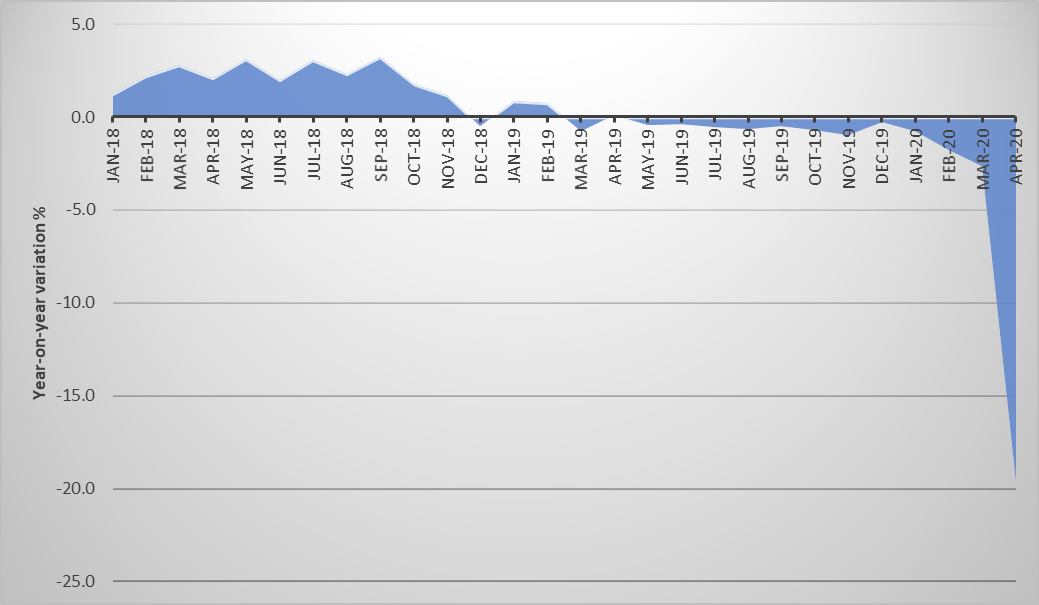
    Figures from Mexico’s national statistics institute (Inegi), updated on 26 June, show that its global indicator of economic activity (IGAE), which measures economic output on a monthly basis, fell to 2010 levels by the end of April, when it recorded a fall of 19.7% relative to the same month in 2019. The graph below shows monthly year-on-year IGAE variations between 2018 and 2019.

    Global Indicator of Economic Activity

    Source: National Statistics Institute (INEGI)

    In this context, President López Obrador’s 1 July statement that Mexico’s economy had touched bottom and that the second half of 2020 would be marked by a process of recovery, appears misplaced. Not surprisingly, specialists disagree and point out that it will take Mexico between four to six years to return to pre-Covid-19 levels of economic activity. Gabriela Siller, the head of economic and financial analysis at Banco Base, points out that confidence among consumers and businesses is still low, so any recovery is only likely to start later in 2020. Crucially, the restrictions on activity implemented to stop the spread of Covid-19 have not been completely lifted in many areas of the country, including Mexico City (CDMX), the country’s economic hub. So, it is considered to be early to claim that a recovery is on its way.

    Similarly, Jessica Roldán Peña, the head of economic analysis at Finamex, highlights that the economic growth needed to offset the collapse in economic activity that has been recorded in the last few months –which has compounded a domestic economic slowdown that started in 2019-  is enormous. Indeed, Gabriel Casillas of the Mexican institute of finance executives (Imef) points out that the current forecasts for 2022 and 2023 are that GDP will grow by only 1%-2% , which will not offset the expected contraction in 2020, regardless of whether the economy indeed grows by 3.3% in 2021, as the IMF has forecast.

    In addition, there is growing concern that Mexico may lose the investment grade it has held for almost two decades. In a research note produced by analysts at investment bank JP Morgan on 29 May, it is estimated that Mexico could become a ‘fallen angel’ (a country or firm that sees its credit ratings downgraded below investment grade) as early as late 2021 or early 2022 if the government maintains its economic policy. The analysis points out that despite the López Obrador administration’s fiscally conservative approach, policy decisions that have included the cancellation of major investment projects and changing the terms of existing contracts, particularly in the energy sector, have significantly eroded investors’ trust in the government.  

    Within this context it is not surprising that Mexico fell off the list of the 25 most attractive jurisdictions for foreign direct investment (FDI) compiled every year by consultancy firm, AT Kearney, the latest edition of which as released on 17 June. Mexico had been in the list since AT Kearney started compiling it in 1998, with the exception of 2011. The reasons attributed to Mexico falling of the top 25 are well known: the cancellation of the new Mexico City International Airport (AICM) that was already under construction, the prioritisation of infrastructure works with limited economic impact (such as two new oil refineries in Tabasco state and an alternative airport for Mexico City in Santa Lucía, Estado de México), changes in the energy sector, and the cancellation of approved investment projects such as the Constellation Brands beer plant in Baja California state.

  • BRAZIL: Lula focuses on social promises and climate change agenda

    Patrick de Courcy 10 November 2022 Hits: 2431

    With political tensions still high in Brazil, after one of the most polarised elections in the country’s recent history, president-elect Luiz Inácio Lula da Silva, of the leftist Partido dos Trabalhadores (PT), is rushing to make arrangements to ensure the sustainability of his future government, which will be inaugurated on 1 January. Facing the challenge of uniting a deeply divided country after narrowly defeating President Jair Bolsonaro of the right-wing Partido Liberal (PL) in the 30 October run-off, former president Lula (2003-2011) started work on two fronts this week. First, to find resources to finance his campaign promises, particularly in the social arena – a daunting challenge given Brazil’s dire fiscal situation. Second, to increase the country’s engagement in the global fight against climate change – which in the view of Lula’s allies could boost international support for his government. 

    Lula’s victory unleashed a wave of protests in the election’s aftermath, with Bolsonaro supporters blocking roads and rallying in front of army headquarters to call for a military coup to prevent Lula’s inauguration. Although a few of the protests persisted this week, they were a fraction of the size of the movements that had taken to the streets soon after the 30 October vote [WR-22-44].

    The declarations of the president of Brazil’s top electoral court (TSE), Alexandre de Moraes, that the anti-democratic movements are a “crime” and participants could be investigated, may have helped to curb attendance at the most radical rallies. Pro-Bolsonaro activists continued to use social media, however, to call for protests, falsely claiming that the election was rigged.

    Despite the campaign threats that “only God” could remove him from the presidency, after the election Bolsonaro vowed to follow Brazil’s constitution and seems resigned to the fact that his arch rival will take office. On 4 November, vice-president-elect Geraldo Alckmin (Partido Socialista Brasileiro, PSB) kicked off the power transition after meeting Bolsonaro, his chief-of-staff Ciro Nogueira, and the secretary-general to the presidency, Luiz Eduardo Ramos, who are collaborating with a transfer of data and information to the new government. “[Bolsonaro expressed] the government’s readiness…to help. We have a transition guided by the public interest,” Alckmin said in an effort to provide reassurance.

    Alckmin, who is leading Lula’s transition team, also met federal senator Marcelo Castro (Movimento Democrático Brasileiro, MDB), who was responsible for the 2023 budget bill in the senate. Alckmin and Castro discussed the possibility of approving an emergency measure in congress to allow Lula to spend more than the sum that is provisioned for in the 2023 budget to finance some of his campaign promises.

    On 7 November, after a few days resting in the north-eastern state of Bahia, Lula joined his transition team in planning the best strategy to pursue to obtain this extra spending power. His allies estimate that he needs R$175bn (US$33.9bn) in resources to finance his most basic campaign pledges, according to Brazilian newspaper Folha de S. Paulo.

    Out of these resources, R$52bn would be used to keep Auxílio Brasil’s welfare programme at R$600 (US$120) per month; R$18bn to give beneficiaries a new extra payment of R$150 per child of up to six years of age; and R$3.9bn-R$6bn to finance an above-inflation minimum wage increase.

    Lula needs to seek an emergency measure allowing him to spend more because a 2016 reform limited the yearly growth of government expenditure in Brazil to the rate of inflation, creating the so-called ‘spending ceiling’. In June, congress gave Bolsonaro a waiver to spend beyond this cap, allowing him to rise Auxílio Brasil from R$400 to R$600. To finance his pre-electoral spending spree, Bolsonaro also counted on one-off revenues from privatisations and cut education and health spending.

    Lula has promised that fighting poverty and hunger is going to be the number one priority of his government, but now he needs to find resources to make good on these pledges, having limited room for manoeuvre due to the government’s difficult fiscal situation. To get a waiver to circumvent the spending ceiling through a constitutional amendment (PEC), as Bolsonaro did, Lula needs the support of 309 of Brazil’s 513 federal deputies and 49 of the 81 senators. This seems to be the president-elect’s ‘plan A’, but with congress set to be dominated by centre and right-wing forces, negotiations will be arduous.

    Another option would be to change the 2023 budget, convincing legislators to give up on some of their projects to funnel resources to the new government’s priorities – but this will not be easy either. Finally, a third option would be to allow the new spending through executive decrees, after gaining approval from the federal court of accounts Tribunal de Contas da União (TCU).

    Auxílio Brasil is a conditional cash transfer programme in which poor families receive payments provided that all family members comply with key human development conditions. All the children must be enrolled in school and fulfil their vaccination requirements, for instance, and pregnant women must complete their prenatal visits. Called Bolsa Família under PT administrations, the programme amounted to 0.5% of GDP from 2003 to 2019, but now its total costs could have escalated to 1.5% of GDP, with more than 21m people receiving the benefit, according to Mansueto Almeida, a former national treasury secretary (2018-2020).

    As Lula will govern a divided country, his team sees the budget cap waiver as crucial to sustaining his approval rating at the beginning of his government, when he will probably face fierce political opposition, and potentially protests. Without the waiver, Auxílio Brasil would return to R$400 in January, and, according Alckmin, Brazil could see the “interruption of services and construction works”. 

    It is true that a ‘licence to spend’ might not play well to the financial markets, which will be monitoring the incoming left-wing administration closely for any signs of mismanaging spending. On the other hand, Lula has signalled that he may appoint an economic team committed to fiscal prudence for the new government.

    On 8 November, Lula designated several members of his government’s transition team, including the coordinators of the economic group – among them liberal economists Pérsio Arida and André Lara Resende, two of the architects of the plan that stabilised Brazil’s economy in the 1990s, beating hyperinflation. The main index of Brazil’s stock exchange (Ibovespa) climbed 0.71% on the same day.

    “The nominees seem to be leaning to the centre,” Geizebel Schieferdecker, of the Brazilian investment firm Squad Capital, said to Folha de S Paulo. The transition team will assess the data handed over by the current administration and make plans for the new government. Its members will not necessarily be in the new cabinet, but this is likely to be a ‘test’ of those involved in the team and an indication of where the new government is going.

    Twitter

    Twitter’s new owner, Elon Musk, has promised to check why the accounts of some political personalities were blocked in Brazil. Following decisions by Brazil’s top electoral court (TSE), Twitter Brasil suspended profiles of several pro-Bolsonaro politicians and influencers accused of attacking democratic institutions and spreading fake-news about the elections. Paulo Figueiredo Filho, a commentator at the right-wing media group Jovem Pan posted a complaint about these suspensions on social media. “Hey @elonmusk, your company has been imposing a draconian ideological censorship of the Brazilian people’s right to free speech,” Figueiredo tweeted. “We thought you bought Twitter exactly for this reason! Rise and lift the censorship now!” Musk replied that he “will look into this”.

    New environmental minister?

    The fact that environmentalist and former presidential candidate Marina Silva (Rede Sustentabilidade) will attend COP27 as part of Lula’s delegation has fuelled rumours that she could head Brazil’s environment ministry under the new government. Silva served as environment minister (2003-2008) under Lula’s government, and as a senator from 2008 to 2011. She was previously a PT member but after 2014 grew estranged from Lula’s party after the campaign of former PT president Dilma Rousseff (2011-2016) – then seeking re-election – helped destroy her chances in the presidential race with harsh criticism of her policies and character. Recently, she was reconciled with Lula, supporting him in the 30 October election.

    Climate change agenda

    As Lula joined his transition team in São Paulo, the PT confirmed that one of his first engagements as president-elect would be to travel to Sharm el-Sheikh, in Egypt, in order to take part in the United Nations (UN) COP27 climate summit, on 14 November. A group representing the PT already arrived at the meeting this week.

    Since his campaign, Lula has pledged a radical shake-up of Brazil’s current environmental policies, which have defended development over conservation in the Amazon region.

    Bolsonaro’s administration has reduced the budgets and forced out qualified staff from environmental agencies. NGOs and scientists say that, partly due to such policies, deforestation soared to a 15-year high in Brazil in 2021 and there was also an increase in illegal activities in the Amazon, such as logging, mining, and land-grabbing.

    Lula has promised to protect the Amazon and to reach net zero deforestation through reforestation programmes. He has also defended indigenous rights and vowed to give Brazil a leading role in the global response to the climate crisis – which explains why he was invited to COP27. The president-elect will participate in the meeting as part of the delegation of the state of Pará, in the Amazon region, which is governed by one of his allies (Bolsonaro’s government will also send a delegation). Still, he is expected to hold bilateral meetings to discuss his future administration’s environmental policies.

    During the COP27, the international community will be able to glean a clearer idea of how fast and how far Lula intends to go to fulfil his environmental pledges.

    “[Lula] should commit to rebuilding the capacity of federal agencies responsible for environmental protection and upholding indigenous rights,” Maria Laura Canineu, Brazil director at the NGO Human Rights Watch (HRW), said.

    Environmental laws

    NGOs support the idea that the Lula administration should re-start the demarcation of indigenous territories and protected areas, as well as improve the capacity of state agencies to enforce environmental laws. Former US vice-president Al Gore (1993-2001) seemed optimistic: “Brazil chose to stop destroying the Amazon,” he said during his COP27 speech, referring to the results of the country’s elections.

  • ARGENTINA: Bonafini’s passing exposes political rift

    Patrick de Courcy 01 December 2022 Hits: 2545

    A large crowd accompanied the Madres de Plaza de Mayo on 24 November to scatter the ashes of Hebe de Bonafini, the group’s leader, in the square in the hub of Buenos Aires city where she made her name protesting against the abuses of the military dictatorship. Bonafini, who died four days earlier at the age of 93, became the scourge of plenty of democratic governments after the fall of the junta in 1983, until the advent of Kirchnerismo in 2003 when she became an ardent supporter of both presidents Néstor Kirchner (2003-2007) and his wife and successor Cristina Fernández (2007-2015). Her death laid bare the ‘grieta’, the partisan dividing line in Argentine politics.

    The event by the Pirámide de Mayo, the oldest monument in the capital city, in the Plaza de Mayo, was attended by prominent Kirchnerista politicians, including the governor of the province of Buenos Aires, Axel Kicillof, and the federal interior minister, Eduardo De Pedro. Vice President Fernández, who recently survived an assassination attempt in September, opted to stay away but eulogised Bonafini on Twitter as “a global symbol of the human rights struggle and the pride of Argentina”.

    Bonafini was a fierce critic of the previous right-of-centre government led by Mauricio Macri (2015-2019) but she also gave a lukewarm reception to the incumbent government led by President Alberto Fernández, which rapidly turned cold, as she accused him of betraying the cause of Kirchnerismo, especially for striking an accord with the International Monetary Fund (IMF). President Fernández decreed three days of national mourning to pay tribute to Bonafini who he described as “a tireless fighter”, adding that she had “confronted genocidal leaders” and demanded “truth and justice together with the Madres y Abuelas”. But this was met with a cutting retort from the Madres de Plaza de Mayo on Twitter, saying that “linking the struggle of our president to another organisation is an insult”, in reference to the rival Abuelas de la Plaza de Mayo group he had alluded to in his tweet, and adding “fortunately Hebe made public everything that she thought about you”.

    This comment made clear the divisions within the Partido Justicialista (PJ, Peronists). Bonafini’s death was also greeted with a studied silence from the right-of-centre Juntos por el Cambio (JxC) opposition. The one politician to break this was María Migliore, the human development minister in the city of Buenos Aires government of Horacio Rodríguez Larreta, a JxC presidential aspirant. Migliore, who described Bonafini as “a symbol of struggle driven by an agenda of justice and human rights”, received a torrent of abuse on social media, citing some of Bonafini’s more provocative comments.

    Cristina Fernández

    “This tribunal is a firing squad,” Vice President Cristina Fernández said in her final remarks on 29 November, filmed from her senate office, before the verdict is delivered on 6 December in the Vialidad case, in which she stands accused of illicit association and fraud for alleged irregularities surrounding the awarding of 51 public works contracts during her two-term presidency (2007-2015). “It is not an illicit association…Does anyone really believe that we committed fraud against the public administration? My government? That paid off the International Monetary Fund in full? We defrauded the country, when living conditions were so much better then than now?”

  • TRACKING TRENDS

    Patrick de Courcy 20 April 2023 Hits: 3033

    BRAZIL | Government aims to cut deficit. Brazil’s planning and budget ministry (MP) submitted to congress a draft bill for budgetary guidelines (PLDO) on 14 April. The proposed bill aims to reduce the country’s primary deficit to zero in 2024 and then transition to a surplus of 0.5% of GDP in 2025 and 1% of GDP in 2026.

    Government spending for 2024 was projected at R$172bn (US$34.1bn), although the MP admitted that this estimated limit on spending would not work without approval of the new fiscal framework, a set of fiscal discipline rules which would limit the growth of expenditure in any given year to 70% of the rise in revenues.

    In a press conference on 17 April, the planning minister, Simone Tebet, highlighted the importance of the fiscal framework, stating that “if we do not approve the framework, we will not have resources for Minha Casa, Minha Vida, for roads, for basic education, for basic health treatment, Farmacia Popular, among many other programmes”. The bill for the fiscal framework was submitted to congress on 18 April and a vote on the bill is expected to be held by 10 May.

    Since these upcoming rules and guidelines on spending depend on the country’s GDP, boosting economic activity would be essential to ensuring the government has enough to finance its policy agenda. However, the latest data from Brazil’s central bank (BCB) showed a slight contraction in economic activity.

    The IBC-Br index, a leading indicator of GDP, for February fell by 0.04% on the previous month. The national statistics institute (Ibge) also found a monthly decline (-0.2%) in industrial production for February. 


  • DOMINICAN REPUBLIC: Back to the drawing board

    Abbi Dicker 15 November 2024 Hits: 1394

    On 19 October President Luis Abinader, who took office again mid-August following a landslide victory in May, dropped a small bombshell. His administration, he said, was withdrawing from congress a fiscal reform package that had occupied a central position in plans for his second term (2024-2028). 

    In a statement President Abinader said he recognised the bill lacked the necessary congressional support to be passed in its current form. In fact, the bill had been heavily criticised by business associations, by the tourism industry, and by protestors who came out on the streets. Its main aim had been to increase government revenue by US$2bn, an amount equivalent to around 1.5 percentage points of GDP, to be achieved by raising income, corporate, and property taxes. Additional measures in the package included a reduction of tax breaks for the film and tourism industries and a sharp rise in vehicle circulation tax.

    Abinader said the government would go back to the drawing board to re-think its approach. “A true democratic government doesn’t fear changing its decisions when it has heard the people” he said, adding “I’m a president who listens. I am not isolated; I don’t live in a bubble.” But despite these protestations, there is still some real uncertainty over what the next steps will be. Ricardo Penfold of US-based trading group Seaport Global said the decision was a “significant setback” to Abinader’s ambition to secure an investment grade rating for the Dominican Republic before the end of his tenure. Penfold warned that “how fiscal consolidation will be achieved remains unclear, despite a fiscal rule limiting real term primary spending”.

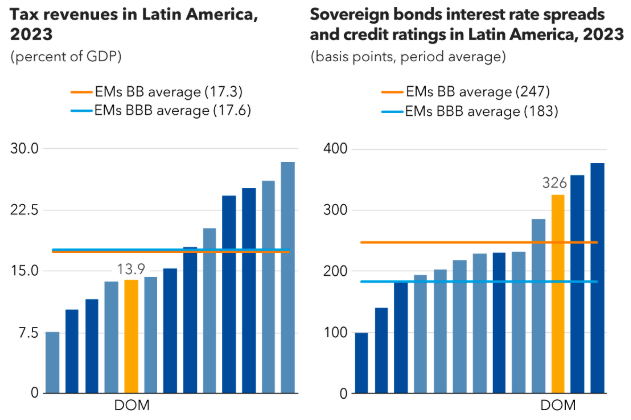
    Even though the Dominican Republic has one of the fastest growing economies in Latin America, worries over a low tax-to-GDP ratio and high financing costs have been around for years. In a paper written in June for the International Monetary Fund (IMF), Emilio Fernandez-Corugedo, Pamela Madrid, and Frank Fuentes say that despite progress in reducing poverty and improving living standards the Dominican Republic has costly tax exemptions and very high thresholds before personal income taxes begin to apply. At 13.9%, the tax-to-GDP ratio is well below the Latin American average; as measured by bond spreads the Dominican Republic also pays higher interest rates than many of its peers. The authors estimate that streamlining tax incentives and exemptions could offer a gain equivalent to around 5% of GDP.

    Even a more modest target of boosting tax revenues permanently by an amount equivalent to 2% of GDP would, the paper says, “allow for sustainable increases in key public investment and social spending – helping to boost productivity and private consumption while reducing inequality and poverty.”  A comprehensive tax reform would raise GDP by 1% after ten years and by 2% after 30 years. Long term growth would also be enhanced by additional investment in climate resilience and improvement in electricity efficiency.

    For context, the World Bank (WB) estimates that economic growth this year will be 5.1%, led by services and industry with inflation at 3.8%. The recovery will be fuelled by monetary easing and strong public investment. The fiscal deficit is expected to total 3.3% of GDP this year, while the primary budget balance (excluding interest payments) will register a small surplus equivalent to 0.1% of GDP. Total public debt as a proportion of GDP is forecast at 58.3% by the end of this year. In a comment written before the withdrawal of the tax reform bill, the World Bank said, “the re-election of President Abinader with a bi-cameral majority sets the stage for crucial reforms in taxation, energy and labour market to bolster sustainable development.”   

    Credit rating boost
    Bringing tax revenues up to peers could boost the credit rating, reducing bond spreads

    Source: IMF

    With the tax reform on hold, business groups are critical. Antonio Cruz Rojas of retail and business association Consejo Nacional de Comerciantes y Empresarios de la República Dominicana (Conacerd) said governments have been postponing politically tricky tax reforms for the last 12 years. He also notes that the law providing temporary incentives for the development of the tourism sector has been on the statute books for 24 years. He suggested that at some point, if the incentives have proven to be successful, they should no longer be needed by a more mature and established industry.

    Economist Antonio Ciriaco said that in his opinion the government will “inevitably” have to resume discussions on tax reform. Other analysts suggested that officials should look at the spending side, and “optimise” budget expenditure so as to close the fiscal deficit. Journalist Rolando Hernández, writing for newspaper El Jaya, in a piece published on 26 October, suggested there could be cut-backs in government advertising, a thinning-out of unproductive public employees, and major cuts in existing subsidies for fuel, electric power, and key food products. The El Jaya piece cites official data from the economy ministry which suggest that these subsidies totalled D$147.88bn (US$2.46bn) last year. Hernández also claimed that the Dominican Republic’s political class is “one of the most expensive in Latin America and the Caribbean”.  Apart from being paid a salary, members of congress receive a monthly budget for discretionary spending known as the cofrecito and worth D$200,000 (US$3,300).

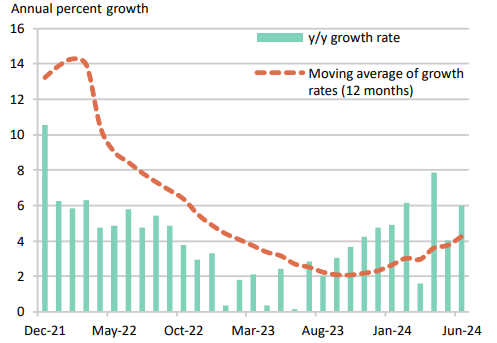
    Dominican Republic / Index of monthly economic activity (IMAE)

    Source: World Bank calculations based on Central Bank data

  • TRACKING TRENDS

    Abbi Dicker 02 April 2026 Hits: 1488

    MEXICO | Unemployment edges up in February. Mexico’s national statistics institute (Inegi) released its latest national employment survey (Enoe) on 27 March, showing that the unemployment rate in February 2026 stood at 2.6% of the economically active population - people over the age of 15 who are employed or seeking employment. This equates to around 1.6m people, up 76,000 compared with February 2025. The unemployment rate was up by 0.1 of a percentage point from February 2025, while the unemployment rate was similar to that registered in January 2026. In February, the informality rate stood at 54.8%, up from 54.5% in February 2025.

    This comes as, on 16 March, Mexico’s government hailed January’s unemployment rate as the lowest among the 38 member countries of the Organisation for Economic Co-operation and Development (OECD). The labour ministry (STPS) noted that the rate of 2.6% in January meant Mexico had a lower unemployment rate than countries including Japan (2.7%) and South Korea (3.0%), which it said reflected the “solidity of the Mexican labour market and the dynamism of the national economy”. However, Mexico’s informality rate remains among the highest of OECD countries.

  • RASTREANDO TENDENCIAS

    LatinNews 11 September 2011 Hits: 155

    ARGENTINA | Petróleo. El gigante Español-Argentino de energía, Repsol-YPF ha anunciado el más grande descubrimiento de petróleo de Argentina en dos décadas. Dijo que había hallado 150m barriles de petróleo bituminoso en un yacimiento en Loma La Lata, en la provincia patagónica de Neuquén, cerca de donde había descubierto 4,5 trillones de pies cúbicos de gas bituminoso en diciembre pasado. En un discurso televisado, la Presidenta Cristina Fernández dijo que el hallazgo elevaría el total de reservas de crudo de Argentina en 6%. Las formaciones bituminosas están compuestas de rocas sedimentarias de grano fino: ellas pueden ser ricas fuentes de petróleo y gas natural, pero su extracción es más costosa que la de yacimientos tradicionales.

  • An investor's haven

    LatinNews 12 October 2011 Hits: 2210

    The government of President Ollanta Humala is eager to present itself as a safe bolt hole in a risky world and investors are responding. The first three months of President Humala’s term in office have brought a record US$3.6bn worth of investment pledges, according to the Inter American Development Bank (BID). But much of this is dependent on China’s continued growth – something which Economy Minister Luis Castilla says he prays for every night. However, China is not the only country eyeing up Peru. Brazil has been preparing the ground for an extensive investment package, as has Argentina. The top growth sectors are infrastructure and extractive industries.

    Forbes Magazine ranks Peru second, behind Chile, as the region’s most business-friendly investment location. Furthermore, Peru is still among 50 countries which expect to record substantial economic growth this year and next.  These plusses are offset by poor infrastructure in the interior of the country.

    Long-standing partnerships, such as that between a major Brazilian construction company, Odebrecht, and the Peruvian government, will not only survive but thrive under the new Humala administration, it seems. Odebrecht’s leadership of the Interoceanic Highway, linking Brazil with Peru’s gateway to the Pacific, was the brainchild of former Brazilian President Lula da Silva (2003-2010) and his then-counterpart in Peru, Alejandro Toledo (2001-2006).

    Other well established investment partners like Repsol are looking to extend their portfolio in Peru. On 6 October Prime Minister Salomón Lerner announced a tender for an upgrade of the state-owned Talara refinery, operated by the state firm Petroperu. Respol is already due to modernize its refinery, La Pampilla, in order to boost productivity and reduce waste and harmful emissions. The company is also in talks with the government over the building of the long-talked of gas pipeline to supply gas to southern Peru from the main Camisea gas field.

    The government is trying to encourage more foreign investment. On 5 October it announced that it would reduce the time taken to issue new hydrocarbon concessions from two years to eight months. The next step, according to Lerner, is to reduce the timeframe within which informed consultation and environmental impact assessments must be completed. He says this acceleration in the reduction of red tape is essential to ensure Peru’s hydrocarbon sector remains competitive.

    The approval, in the first month of President Humala’s time in office, of the consultation law was a fillip to indigenous groups who are now legally assured of prior informed consultation [RA-11-09]. However, reducing the time needed for consultations leaves the government open to accusations of double standards. Indigenous groups and environmentalists will have to get sharper in reacting to project proposals.

    The first concessions, negotiated after the new tax and consultation law frameworks were approved, were unveiled on 3 October. Argentina’s Tecpetro leased another block off the north coast. In July, just before Humala took office, exploration blocks in Peru’s Eastern Amazon were also awarded to Colombia’s Ecopetrol, and to two British firms, Pitkin Petroleum and Hydrocarbon Exploration. These projects are dependent on a new contractual clause to make them compliant with the law of prior consultation.

    Tecpetro is expected to invest between US$5m and US$10m. Pitkin, Hydrocarbon Expo and Ecopetrol’s anticipated investments are put at around US$50m per block.

    • Follow Peru’s lead

    The World Bank announced that it had recommended Zambia and Zimbabwe to take note of Peru’s national public investment model, known as the Sistema Nacional de Inversión Pública (Snip). This system is meant to ensure that public investment projects meet quality and transparency criteria. That said, a recent report by the investigative journalist group IDL-Reporteros uncovered consistently over-extended budgets to meet escalating costs and unexpected delays associated with the Private Public Partnerships (PPPs) favoured by the previous Alan García (2006-2011) administration. PPPs, nevertheless, look to be a core part of future public investment plans. Brazil’s Odebrecht is the main construction partner in most of them.

  • TRACKING TRENDS

    LatinNews 24 May 2012 Hits: 2418

    BRAZIL| Auto sector stimulus package announced. On 21 May Brazil’s finance minister, Guido Mantega, announced that the government was implementing temporary reductions on its industrial products tax rate (IPI) and its tax on financial transactions (IOF) conducted by physical persons, which are aimed at stimulating the automobile sector. Mantega explained that the government will be reducing the IPI tax rate on imported cars and those that meet local assembly regulations by as much as seven percentage points until 31 August. Thus in the case of locally produced cars, the rate will fall to 0% from 7% for cars with 1.000cc engine sizes; imported cars with the same engine size will see rates drop to 30% from 37%. For cars with bigger engine sizes, the rates will be lowered to 5.5%, from 11%, for locally produced vehicles fitted with flex engines (capable of using ethanol and gasoline) and to 35%, from 41%, for imported vehicles with similar characteristics. Finally, the rates will decrease to 6.5%, from 13%, for petrol-only vehicles that are produced locally; and to 36.5%, from 43%, for imported ones. In addition Mantega announced that the IOF rate will be reduced to 1.5%, from 2.5%. It was also announced that the central bank would adjust its overnight reserve requirements for banks in order to free some US$8.8bn so that the banking system can offer more car loans for individuals. Explaining the government’s decision, Mantega said that they were designed to counteract the impacts of the ongoing international economic crisis. “We are facing a worsening of the international financial crisis… [and this] demands that we intensify our efforts to maintain reasonable growth rates”, Mantega said. He pointed out that the government chose to stimulate the automobile sector because it represents 20% of Brazil’s industrial GDP.

    ARGENTINA| Repsol cancels gas provision contract. A Spanish hydrocarbons firm, Repsol, announced on 18 May that it was cancelling its gas provision contract with Argentina’s state-owned energy distribution company, Enarsa. A Repsol spokesman said that Repsol had already sent a formal letter to Enarsa explaining the company’s decision. This was based on the fact that the company had found Enarsa to be in “breach of contract” as it had failed to pay for the latest shipment delivered and requested a reduction in the price of future shipments. As a result, Repsol considers the contract to have been nullified and said that it reserves the right to “claim damages” from Enarsa. Argentina’s planning ministry has issued a statement saying it had “expected that Repsol would not uphold its contract”.  A spokesman for the planning ministry, Horacio Mizrahi, said that the government has already secured delivery of liquefied natural gas shipments from “four other providers at similar prices to the ones paid by other countries in the region” without providing further details. Mizrahi also remarked that “if the agreement with Repsol would have been more accommodating, it would have made up for the damages it was producing for us in other aspects such as the drop in oil production at YPF due to lack of investment”.

    PARAGUAY| BCP forced to intervene to arrest dollar appreciation. Paraguay’s central bank (BCP) was forced to intervene in the currency market by selling US$5.6m in order to counteract the sharp rise in the US dollar on 23 May. As the European financial crisis continues to drag on, the US dollar has experienced an unexpectedly strong appreciation and many central banks in the sub-region, including those of Brazil, Chile and Paraguay, are concerned that a stronger dollar may have a negative effect on their domestic markets. The BCP’s open market operations chief, Hernán Colmán, said that the bank had offered some US$10m but that demand in the market was lower than expected. This led Colmán to conclude that the dollar’s appreciation is not being driven by local demand pressures. The BCP’s intervention prompted the exchange rate to fall to G$4,567, thus easing concerns that a dollar at G$4,630 observed on 22 May would have triggered increases in fuel prices.

    • Tombini defends current exchange mechanism

    On 20 May Brazil’s central bank president, Alexandre Tombini, said that despite the volatile fluctuations in the value of the US dollar, the bank was determined to stick to its current system of managing the Real’s exchange rate without introducing any modifications. The Real appreciated sharply against the dollar last year and during first few months of this year, but now this trend is reversing as the dollar is experiencing a strong appreciation, forcing the central bank to intervene. Yet according to Tombini, “we have always maintained that the floating exchange rate system can fluctuate either way… we manage it whenever necessary by intervening in the market; and although the international situation is challenging, we have the tools” to do so.

  • CUBA: National Assembly election results

    LatinNews 14 February 2013 Hits: 2246

    On 3 February, direct elections were held for 612 National Assembly seats. The Cuban system has only one candidate per seat (nominated and selected in public meetings in the months leading up to the vote), and to take a seat in the National Assembly, they must win more than 50% of the valid votes; if they do not, a new candidate must be chosen and the election for that seat re-run.

    Although Cuban electors have no choice of candidate, they are able to express disapproval by refusing to vote or spoiling their ballot. The percentage turnout and percentage of valid votes therefore provide some indication of the degree of public enthusiasm for the electoral process and confidence in the candidates. The results also show the proportion of voters who return a voto unido (united vote: acceptance of the official slate of candidates, rather than selecting them individually), which has traditionally been seen as a measure of support for the selection process. On all three counts, the results of the 2013 poll appeared less supportive of the system (see table) than the past three elections.

    Results of National Assembly election


    1998   

    2003

    2008

    2013

    Turnout (% of registered electorate)           

    98.4

    97.6

    96.0

    90.9

    Blank or spoiled ballots (% of votes cast)

    5.0

    3.9

    4.8

    5.8

    Valid votes (% of registered electorate)

    93.5

    93.8    

    91.4    

    85.6

    Voto unido (% of valid votes)           

    88.2

    89.2

    91.0

    81.3

     The significance of these trends is uncertain. The decline in the turnout confirms a waning interest in the political process, which has been observed among younger voters in particular. The ideology of the Cuban revolution puts great emphasis on public participation, so a doubling of the proportion of people abstaining from the election, to almost 10%, might be viewed with concern by the leadership. It also reflects the changing nature of Cuba’s economy and society, with an increase in the number of people who derive their living outside state organisations, a waning enthusiasm for mass mobilisations and revolutionary slogans, and influence of culture and aspirations inspired by contact with the outside world.

    The increase in blank or spoiled votes (one in 17 ballot papers in 2013, compared with one in 26 in 2003) may be a stronger indicator of rising hostility to the political system, although the proportion remains remarkably small for a government that has been in power for more than 50 years. A larger proportion of votes for individual candidates rather than the official slate might be seen as an indicator of less passive voting decisions, which would be in line with the government’s own emphasis on encouraging more critical engagement. In previous elections, the official media has carried propaganda beseeching electors to voto unido, but this was absent this time, perhaps confirming less insistence on unity than before.

    The 2013 election was also significant as a step towards the replacement of Cuba’s ageing leaders, many whom have been dominating political life since 1959, with a new generation of loyal successors. Although members of the old guard (including the country’s president, Raúl Castro, and his deputy, first vice president José Ramón Machado) remain in the top jobs, 52% of the national assembly’s new intake is reported to be under 35, and the average age is 48.

    The proportion of women is also reported to have increased, to 49%. Ricardo Alarcón (75), who has been president of the National Assembly for two decades, has stepped down, creating a vacancy to be filled by the new Assembly when it holds its first full session, on February 24th. Raúl Castro (81) has introduced a two-term limit for the presidency, and has so far completed only one, although he was acting president for two years before officially assuming the post in 2008.

    He has given no indication that he will be standing down, and there appears to be little expectation that he will do so. If he retains the presidency, there will be a high risk of a sudden departure due to ill health before the end of his five-year term, so the choice of first vice president will be an important one. José Ramón Machado is 83, and is likely to be replaced. There are therefore at least two important vacancies for leadership positions, both of which are likely to be filled by people who are already in prominent roles.

    No official indication has been given of the favoured candidates, but two of the people who have been widely tipped as potential candidates for promotion are the foreign minister, Bruno Rodríguez, and Miguel Diaz Canel, one of the seven vice presidents. Their advancement would create a further set of high-level jobs to be filled by younger figures, among whom Josefina Vidal, deputy foreign minister, and Olga Lidia Tapia Iglesias, a National Assembly deputy and member of the Central Committee of the Partido Comunista de Cuba (the Cuban Communist Party), appear to be favoured.

    • Seeking investors for Cienfuegos refinery

    Cuba is looking to woo international investors to the tune of US$6.0bn to help it continue the modernisation and expansion of its main Cienfuegos refinery. Cuba has previously sought external foreign partners – both public and private – for the development of its key domestic sectors, including the oil & gas, telecoms and tourism industries; but the timing of this latest initiative suggests that Cuba is hedging its bets ahead of the possible scaling back of its Venezuelan subsidies and indications that China is also becoming more demanding of Venezuela. Ricardo Caballero, executive president of Cubavenpetrol, the joint Cuban-Venezuelan entity that administers Cienfuegos recently told journalists during a tour of the refining complex that a final proposal to be presented to international financial investors was almost ready.

      The Russian-built Cienfuegos was closed in 1995 and only re-opened in 2007 thanks to Venezuelan assistance. The new funds would go towards the plan to boost refining capacity from 65,000 barrels per day (b/d) to 150,000 b/d, in addition to the construction of a new natural gas liquefaction plant.

      Cubavenpetrol had originally said that China would finance the project and be paid in Venezuelan oil exports. China signed a letter of intent in 2011, but according to Caballero at present China’s only involvement is in providing the basic engineering for the planned expansion along with the Italian unit of the French firm Technip. Cuba estimates that it has 20bn barrels of offshore oil in the deep waters of the Gulf of Mexico, but three wells drilled last year by Spain’s Repsol, Venezuela’s Pdvsa and Malaysia’s Petronas turned up dry. A fourth is currently being drilled by Russia’s Zarubezhneft. Venezuela sends Cuba an estimated 115, 000 b/d, about two thirds of its daily oil needs. END BOX

    • Fibre optic cable shows signs of life

    State telecommunications company, ETECSA, recently published a statement in the Communist party mouthpiece Granma, confirming that internet traffic is being carried by Cuba’s first submarine fibre-optic cable, Alba-1, which connects the island to Venezuela. According to the 24 January statement, ETECSA has been carrying international voice traffic since August 2012, while data-traffic tests have been conducted on the cable since 10 January 2013. The Granma statement is the first by the Cuban government on the progress of the cable, which was laid by France’s Alcatel-Lucent in 2011.

      Cuba has had to access the internet via expensive and slow satellite connections. When the testing process is completed, however, ETECSA noted that the launch of the cable “will not automatically mean that the possibility of access will increase,” adding that investment in the domestic telecoms infrastructure is required and that even then the goal is “gradual growth of a service that we offer mostly for free and with social aims in mind.” END BOX

    • Internet use

    The government reported that the number of Cubans using the Internet had increased by 40% in 2011 compared with a year earlier to 2.6m. This is not private internet access, which remains highly restricted, but rather government monitored ‘intranet’ offered through state-run computer clubs, schools and offices.


  • In Brief - Haiti

    LatinNews 08 March 2013 Hits: 1436

    JUSTICE | Préval follows Duvalier into court.  Following the appearance in court on 1 March of the former Haitian dictator Jean-Claude Duvalier (1971-1986) to answer questions on human-rights abuses during his rule, on 7 March it was the turn of former president René Préval  (1996-2001, 2006-2011) to face questioning in court over the murder in April 2000 of the journalist Jean Dominique. The court session lasted for only 30 minutes and was held behind closed doors. Préval and Dominique had been allies in the fight to depose Duvalier, and Dominique’s wife, Michèle Montas, was among those who pushed for Duvalier to face trial after he returned to Haiti two years ago.  When the news came that Préval was to appear in court, Montas commented: “Suddenly pulling the case out of a hat at a time when Jean-Claude Duvalier is expected to be heard by the court is preposterous”.

  • ARGENTINA: Running out of options

    LatinNews 27 March 2013 Hits: 1195

    “The petition is denied”. With little explanation or fanfare the 2nd US Circuit Court of Appeals rejected one of Argentina’s last remaining options to avoid paying its holdout bondholders in full. Argentina had sought to overturn a ruling that prevented it from treating restructured-debt holders more favourably than bondholders who demand the original value of the country’s debt. The decision now leaves Argentina with just one appeal outstanding before the court: it has a 29 March deadline to spell out the “precise terms” of the offer it would make to holdout creditors.

    Argentina defaulted on around US$100bn in debt in 2001, and has since restructured its debt twice, covering around 75% of the nominal value of the bonds and 93% of bondholders. But hedge funds NML Capital and Aurelius Capital Management, which bought up some of the original defaulted debt at steep discounts, refused to go along with the restructurings and are suing to recover 100% of the bonds’ value, a total of US$1.3bn. Legal analysts are sceptical that any new offer to these holdouts will satisfy the appeals court. One last throw of the dice may be an appeal to the US Supreme Court, but it is unlikely to hear a case based on New York State contract law.

    The home front

    Meanwhile, back in Buenos Aires, the government has proudly trumpeted the arrival of the ‘Supercard’. This new credit card will be managed by the major supermarket chains and will have a monthly limit of Arg$3000 (US$585, at the official rate). The supermarkets will undercut the 3% commission private banks charge on purchases with a maximum commission of 1%. The new payment method will also offer a 22% annual interest rate for consumers’ financed purchases. Unofficially, inflation is running at around 26% annually.

    When Guillermo Moreno, the interior commerce secretary who acts as the enforcer on most of the unorthodox aspects of government policy, first proposed the card, the idea was that it would be managed by the state-owned Banco de la Nación. It would also become the only credit card that could be used in the major supermarket chains. Those ideas have been rejected for now. Allowing the supermarkets to manage the card has allowed Moreno to secure a further price freeze of most products for another two months (until 31 May). The government has not ruled out, however, making the Supercard the only way to purchase on credit in those stores.

    Moreno was the man President Cristina Fernández called on to lower the rate of the ‘blue dollar’ (the black market rate for a dollar) when it rose almost 50 centavos in a day last week. Calling on his network of government-aligned bankers to dump dollars on the market, Moreno successfully brought down the rate from Arg$8.75 on 20 March to Arg$8.39 on 22 March. The official rate is just over Arg$5.

    The latest surge in the peso’s black market value was triggered by the decision of the tax office (Afip) to slap an extra 5% tax on all credit and debit card purchases abroad, as well as any form of foreign travel. In September 2012 the government introduced a 15% tax on goods purchased abroad or online with foreign currency; the latest announcement suggests that the policy has failed to curb Argentines’ appetite for foreign currency and for spending their money abroad.

    The government’s short-termist economic policymaking, in terms of arbitrary taxation, currency controls and price freezes, may help stem the amount of dollars flowing out of the country, but it does have unintended consequences on dollar inflows. Since the beginning of the year the US dollar in Argentina in the so-called marginal market has soared by 29% and the central bank has lost over US$2.2bn in international reserves, which now stand at US$41bn. Since it is effectively cut off from international capital markets, in part because of its struggle with the holdouts, the US$41bn stockpile is a vital source of funds for paying foreign creditors. 

    • Pope visit

    Pope Francis will make his first trip to Argentina as head of the Catholic Church in December this year. There had been some speculation that he would tie in a trip to the country following a visit to Rio de Janeiro in July for World Youth Day. By coming in December, the pope will avoid impacting the legislative elections which will take place in October.

  • ST KITTS & NEVIS: Douglas clinging to power

    LatinNews 17 April 2013 Hits: 2745

    The prime minister of St Kitts & Nevis (SKN), Dr Denzil Douglas, is clinging to power despite losing his majority of elected members of the National Assembly, but it is uncertain as to how long he can continue to hold on without calling an election.

    There are eleven elected members of parliament, three appointed senators, and the attorney-general, who sits ex officio. In the 2010 general election, Douglas’s Labour Party (SKNLP) won six seats, to which it could add two appointed senators to give it eight. The opposition seats were split as follows: two for the People’s Action Movement (PAM), two for the Concerned Citizens’ Movement (CCM), and one for the Nevis Reformation Party (NRP), plus one opposition senator.

    Since then, two Labour Party ministers have defected, leaving the government with just four elected members. However, to this can be added two senators, one opposition member, and – controversially – the attorney general. As Douglas puts it: “We can pass any law and we can win any debate in parliament because the government of the Labour Administration is in fact a Majority Government…We have 10 members on our side. Those on the other side are only five, and even if the two Judas’s were to go over to their side… two from 10 leaves eight and 5+2 is seven…so it is eight against seven.”

    There are two problems with this arithmetic. The first is the controversial appointment of the attorney-general as a senator; the second is the fact that on a vote of no confidence only elected members can vote – which is why the opposition has been trying to table a no confidence motion since 11 December and the government has been avoiding it.

    Six of the elected members say they are ready and willing to form a unity government, two from PAM, two from CCM, and the two former Labour ministers who now say they are independents. PAM deputy leader Eugene Hamilton warned the Organization of Eastern Caribbean States (OECS) Assembly on 26 March of possible civil unrest in SKN if the prime minister continued to refuse “to follow the constitution and Westminster traditions” in allowing the debate of a no-confidence motion.