All Categories

Subcategories

  • TRACKING TRENDS

    Abbi Dicker 24 October 2024 Hits: 1625

    BRAZIL | Brazil registers record tax take in September. The Receita Federal do Brasil (RFB), the tax authority tied to Brazil’s finance ministry, released its latest revenue figures on 22 October, which showed a tax take of R$203.17bn (US$35.7bn) in September. This marks an increase on the monthly revenue of R$201.62bn registered in August and from R$174.32bn in September last year. The accumulated tax take in the first nine months of 2024 totalled R$1.93trn, up 9.68% in real terms compared with the same period in 2023.

    In a press release, the RFB stated that these are the highest figures on record for the month of September and for the January-September period. The RFB attributed the rise in revenue to factors such as positive macroeconomic indicators, including increases in industrial production, services sector activity, and total wages.


    BRAZIL | TotalEnergies sells fuel distribution business. French multinational oil company TotalEnergies announced on 18 October that it has signed an agreement to sell its fuel distribution operations in Brazil to local firm SIM Distribuidora. The buyer is part of the Grupo Argenta conglomerate, headquartered in the southern state of Rio Grande do Sul, which has over 500 petrol stations and other fuel distribution services throughout the country.

    If the acquisition is authorised by the relevant authorities, SIM Distribuidora would gain a network of around 240 petrol stations from TotalEnergies, as well as several storage facilities for petroleum products and ethanol. Although the amount of the deal has not been disclosed, national newspaper Valor Econômico has cited its industry sources as estimating that the sale could be worth R$300m (US$53m). With this acquisition, Valor Econômico reports that SIM would rank among the top five fuel distribution companies in Brazil, behind ALE, Vibra, Ipiranga, and Raízen.

  • CHILE: Debate keeps Kast in pole position

    Abbi Dicker 11 December 2025 Hits: 822

    José Antonio Kast and Jeannette Jara took part in their last televised face-to-face presidential debate on 9 December, five days ahead of Chile’s second-round run-off ballot, which is due on 14 December. The debate was a tense affair with both candidates ducking and weaving and occasionally landing some punches. The majority of analysts concluded that the result was a tie; but given the difference in polling numbers, a tie must be interpreted as favourable to Kast.

    The debate, which went on for the best part of two hours, was hosted by Antel, the television industry association. The latest polls show Kast remains ahead: according to DatosRTVE, Kast was set to win the second-round run-off with 51% against 34.9% for Jara. A Cadem poll conducted on 3-5 December gave Kast, of the far-right Partido Republicano (PR), 47% compared to 36% for Jara, of the ruling left-wing coalition.

    Kast benefits from attracting right-wing swing voters who aligned with other candidates in the first round, but whose priority now is to stop Jara, a member of the Partido Comunista de Chile (PCCh). He also benefits from dissatisfaction with the existing administration. To win, Jara has the daunting task of trying to eliminate a 11-to-16 percentage point deficit. With less than a week to change minds, that task may ultimately prove to be impossible.

    In the debate Jara adopted a more aggressive stance, accusing her opponent of being inexperienced, of ducking questions, of being nervous, and of making mistakes. She seized on the fact that Kast has been using a bullet-proof glass cage to protect himself against any assassination attempt in public events, saying that he is exaggerating the threat. Kast responded by citing recent attacks on politicians in Ecuador and Colombia, and by saying that he had been threatened various times.

    Crime loomed large in the debate. Kast was somewhat on the backfoot when Jara reminded him that one of his congressional deputies had defended pardoning perpetrators of child abuse in certain cases. “I will never pardon someone who abuses children,” Kast said, although he argued that pardoning certain historic human rights violations by members of the military might be justified. Jara insisted that “the candidate and his parry are offering reduced sentences for child rapists”.

    On the topic of immigration, Kast has been focusing on the estimated 330,000 undocumented migrants in Chile (many originally from Venezuela). He has repeatedly said that they must leave Chile. He is also calling for the military to be deployed to high crime zones and for the creation of a new unit to deport illegal aliens modelled on the US Immigration and Customs Enforcement (ICE). But Jara claimed that his many statements on the subject have been confusing and sometimes contradictory.

    “First you were going to expel them, then you were going to invite them to leave, and now you are going to deny them social benefits,” Jara said. Kast hit back on this subject saying, “your president” (the incumbent, Gabriel Boric) “has not even been able to open a humanitarian corridor to better control migration flows”. Jara, who has taken some political distance from Boric during the campaign shot back, “speak to him whenever you want…and calm yourself down”. For his part, Kast dismissed Jara’s idea of creating a registry of undocumented migrants (she says that those who do not register will be liable for deportation).

    While Kast’s campaign has been largely negative, focusing on the current government’s record of comparatively low economic growth, crime, and irregular migration and promising an emergency government, Jara has presented a much more optimistic vision, saying, “Chile is not a disaster”. While Kast said a Jara government would be fixated on an ideological view of the world, the left-wing candidate sought to present herself as a pragmatist and dealmaker, with more experience than her opponent. 

    On the economy, Jara has been claiming that, to fund Kast’s promise to cut the government budget by US$6bn over 18 months, he will seek to reverse two key reforms introduced by the outgoing government: the introduction of the 40-hour working week and the special pension for low income earners known as the Pensión Garantizada Universal (PGU). Kast waited until this last debate to finally make a public promise to keep both programmes in place.

    If, as looks most probable, Kast wins, the elections will be a milestone in various senses. Kast will be by far the most right-wing Chilean president since the dictatorship of General Augusto Pinochet (1973-1990) came to an end. He will also be seen as an example of a rising conservative tide in Latin America as several elections in 2026 are likely to be won by forces of the centre, right, and ultra-right. Chile may join the likes of Argentina, Ecuador, and El Salvador as countries closely aligned with US President Donald Trump’s administration.

    No congressional majority

    As a relatively inexperienced ‘outsider’ politician, José Antonio Kast would lack an outright majority in the legislature, although his far-right Partido Republicano (PR) has significantly expanded its congressional presence. This will leave him needing to negotiate deals with other more traditional right-of-centre parties represented in congress in order to advance his legislative agenda.

    Which Kast will govern?

    Patricio Navia, a professor at New York University, told Reuters news agency “If he [José Antonio Kast] starts governing from the far right, he’s going to be a minority president and he won’t be able to do anything…the most important thing on Sunday isn’t going to be if Kast wins, we know that already, but what he says in his speech: will it be a sign of unity or division?”

    Rumblings in the south

    November was the most violent month this year in the Macrozona Sur, the area where some Mapuche indigenous groups are conducting a campaign for independence. According to an association of local civil society groups known as Multigremial La Araucanía, there were eight violent attacks in the region, double the number during the preceding month, and suggesting that there will be disruption throughout the summer and during the forest fire season. Responsibility for four of the eight incidents was claimed by the militant Weichán Auka Mapu (WAM).

  • RASTREANDO TENDENCIAS

    LatinNews 19 December 2011 Hits: 507

    COLOMBIA | Cae contribución de la coca al PIB. La contribución del cultivo de la coca y la producción de cocaína en la economía colombiana cayó a 0,3% del PIB, de 1,4% entre 2001 y 2009, de acuerdo con un informe presentado en Bogotá por la Oficina sobre Drogas y Delitos de la ONU (Unodc). “La exhibición de poder y riqueza [por las cárteles] ha exagerado [el comercio de la cocaína] el impacto económico y distorsionado nuestro entendimiento del mismo,”dijo el autor del informe, Ricardo Rocha. Él alega que la emergencia de los cárteles mexicanos y los controles más apretados sobre el lavado de dinero han reducido de manera significativa los ingresos de la cocaína que fluyen dentro de Colombia. “Los años dorados, cuando los cárteles [colombianos] de la droga monopolizaban el mercado mayorista, han terminado. Ahora esas ganancias están siendo apropiadas por Centroamérica, Venezuela y México,” afirmó.

  • TRACKING TRENDS

    LatinNews 14 February 2013 Hits: 1121

    ARGENTINA-BRAZIL | Vale still waiting for Argentina’s answer. On 7 February a Brazilian government source told Reuters that Brazil’s mining giant, Vale, was still awaiting an official response from the Argentine government to its request for additional fiscal incentives in order to go ahead with its planned US$6bn potassium mine project in the Argentine province of Mendoza. Argentina’s President Cristina Fernández said the Río Colorado mining project was of “strategic importance” when it was first announced in July last year. Vale estimates that the Río Colorado mine has 430m tonnes (t) of potassium and could produce some 4.35m t a year. With production scheduled to begin by 2014, Argentina could become the fifth largest potash producer in the world overnight. (Potash is potassium derivative widely used in fertilizers). In December 2012 Vale announced that it was revising its investment plans for 2013, given a “shift in the international markets towards lower prices for some minerals. Vale’s net profits fell 66.2% year-on-year in 2012.  In January Vale notified the Argentine government that it was indefinitely suspending the Río Colorado project while evaluated the “variations in the economic fundamentals” in Argentina.

    In particular, Vale expressed concerns about higher production costs in Argentina on the back of high inflation (according to local economists, Argentina’s ‘true inflation’ is running at around 25%); and of the comparatively high value of the peso, which is artificially propped up by the central bank. According to Reuters, Vale asked Argentina for value added tax (VAT) exemptions and for some leeway in the country’s exchange rate controls as pre-conditions for re-starting the project. Reuters was unable to get confirmation on this from Vale, but an unnamed source in Brazilian government confirmed this, adding that Vale would wait until 28 February for a response.

    Vale’s operations in Argentina are of interest to the Brazilian government led by President Dilma Rousseff as Brazil currently imports 90% of all the fertilizers used in the county and is keen on sourcing cheap potash from its main partner in the Southern Common Market (Mercosur). The government source told Reuters that Vale had already invested more than it initially foresaw in the project, with US$1.8bn spent on the initial physical infrastructure and so is not prepared to go over budget. The 28 February deadline could be extended on the assumption that President Rousseff might discuss the matter with President Fernández at their next bilateral meeting, scheduled for early March in Argentina.  

    PARAGUAY| BCP intervenes. On 13 February Paraguay’s central bank (BCP) intervened in the local currency market for the first time this year, spending US$9.0m to buy up US dollars. The BCP was forced to act after the exchange rate reached a new low of G$4,100/US$, falling 15 basis points in just three days. The BCP said the move was intended to reduce exchange rate speculation on the back of “an important inflow of dollars”. The Guaraní’s strength against the dollar is pushing up inflation. In its last monetary policy meeting on 7 February, the BCP revised up its inflation forecast for the year to just over its official target rate of 5%. January’s month-on-month inflation was a strong 1.2%, on the back of “stronger-than-expected domestic demand, which is putting upward pressure on prices”. The annual rate was 4.1%. A stronger Guaraní could further fuel domestic demand and inflation, hence the BCP’s haste in trying to control it. Problematically, its intervention did little; on the day the Guaraní gained a further 5% against the dollar. The BCP has announced plans to purchase some US$75m in the next five weeks. However the bank may also have to look to increase interest rates, which have remained steady at 5.5% since last year.

    • ‘Shopping Favela’

    On 13 February a Brazilian entrepreneur, Elias Tergilene, unveiled a US$11.5m plan to build a new shopping mall in Rio de Janeiro’s recently ‘pacified’ Complexo do Alemão, one of the city’s largest favelas. Tergilene, the owner of a budget shopping mall chain, Uai, which has a presence in Belo Horizonte and Manaus, said that the mall would be sited on an abandoned 15,000m2 barn in the so called Morro do Alemão, with plans for four cinemas and 20-30 small shops, as well as a 23,000m2 parking lot. Tergilene said that the idea is not only to bring shops to favela dwellers but also to provide employment for locals. According to Tergilene, international and local retailers including Burger King, Chili Beans, Camisaria Colombo and Barred’s have already expressed an interest.

  • TRACKING TRENDS

    LatinNews 21 November 2013 Hits: 765

    REGION | Growth. The most recent report by the Central American bank for economic integration (Cabei) on economic prospects for the region is expecting Panama to lead the sub-region, with 7.6% GDP growth forecast for 2013. This is followed by Nicaragua (4.2%); Costa Rica and Guatemala (3.5% apiece); Honduras (2.8%); Belize (2.5%); the Dominican Republic (2%) and El Salvador (1.6%). As regards inflation, the Cabei is expecting Nicaragua to top the region with 7.7% inflation projected for 2013, followed by Honduras (5.4%); Costa Rica (4.7%); Guatemala and the Dominican Republic (4.5% each); Panama (4.2%); El Salvador (1.9%) and Belize (1.3%).

  • Argentina: Debating poverty again

    LatinNews 07 April 2017 Hits: 426

    According to official data released by the national statistics institute (Indec), 30.3% of the population was living in poverty in the second half of 2016, down from 32.2% in the second quarter of the same year. The numbers could be read as good news for President Mauricio Macri, who proclaimed “zero tolerance” of poverty when he took office in December 2015 and who has argued that his policies are bringing the country out of recession. Yet the Indec poverty numbers have been a political football for some years now, and are likely to remain subject to varying interpretations.

    The former government led by President Cristina Fernández (2007-2015) was notorious for its manipulation of Indec, which was obliged to produce ‘good news’ data, and leaned upon to stop publishing data considered inconvenient.

    The last time Indec had published a poverty survey was in October 2013, when it claimed that only 4.7% of Argentines lived in poverty. No further surveys were carried out in that government term, but the 4.7% figure was used by President Fernández to claim during a June 2015 visit to the UN’s Food and Agriculture Organisation (FAO) headquarters in Rome, Italy, that poverty rates in Argentina were lower than those in either Germany or Denmark. The claim was widely ridiculed and dismissed as unbelievable. Shortly thereafter, in July 2015, a private survey carried out by the Universidad Católica Argentina (UCA) put the poverty rate in Argentina at 28.7%. After the Macri administration took office in December of that year, a major effort was made to rebuild Indec as an impartial and credible statistical agency. Indec relaunched the regular poverty survey last year. It now defines poverty as a situation in which households have insufficient income to afford a basket of basic food and non-food items – currently costing the equivalent of around US$800 a month for a family of four.

    While the Macri government can claim to be more in touch with reality than its predecessor, it cannot entirely escape criticism over the poverty numbers. Indec’s rebuilt poverty index shows a short-term falling trend, but only over two very recent measurement points. The UCA, by contrast, shows an upward trend. It has continued carrying out its own separate survey, which is now the only methodologically-consistent series that covers the last few years. This shows that poverty has gradually and steadily been increasing, reaching 32.9% in Q316 (above the Indec number). On UCA’s measurement, a total of 13m Argentine are now living in poverty. UCA said that the Q316 poverty rate was 3.9 percentage points higher than at the end of 2015, and the highest level in the last seven years. High inflation during Macri’s first year in office, along with sharp increases in public utility tariffs, have taken a toll.

    The UCA data also suggests that inequality is increasing, with the gap between the richest and poorest 10% widening. According to Augustín Salvia, one of those responsible for the UCA survey of 5,700 homes, “A large part of the Argentine population is excluded. Something more than economic growth is required. Social programmes are not enough to guarantee a platform of lasting inclusion”. His view is that in reality poverty and indigence numbers have been stagnant in Argentina over the last decade – in effect, a criticism of all governments. To tackle them, long term national and regional development policies would be needed, together with steps to increase productivity in small and medium-sized firms, he says.

  • The Zombie theory hypothesis

    Patrick de Courcy 10 November 2021 Hits: 1371

    The military coups of the 1970s and 1980s deeply affected the thinking of analysts and policymakers across the region. Understandably they focused on the military’s presumed ongoing thirst for power, its tendency to infringe civil liberties, and the range of defensive actions that could and should be taken by civilian institutions – everything from reducing budgets to tightening political and administrative oversight. There was however a tendency to think that every civilian-military incident must necessarily be a step in a continuum leading to the seizure power. Concerned that this has been taken too far, some analysts have warned of the danger of seeing everything from the 1970s perspective.

    One is Román D Ortiz, writing for Real Instituto Elcano, who notes the tendency of academic debates in Latin America “to rumble on long after the political and social conflicts that generated them have been superseded”. In his view there is a “zombie debate” in progress around the alleged predilection for coups among the Latin American armed forces. He argues that more than three decades after General Augusto Pinochet handed power in Chile back to civilians, civil military relations are more complex and do not fit neatly into the ‘coup-d’etat’ mould. Things have changed since the 1970s. Despite the crisis interventions listed in the previous section of this report, over the last two decades the armed forced have displayed no underlying appetite for taking and holding on to political power. In Ortiz’s words “the armed forces seem to be utterly convinced that their role does not lie in politics, and that crises need to be resolved by the civilian elites”. Where interventions have happened, the military have supported some civilian factions over others, “subsequently falling back to their institutional role so politicians could continue at the helm and seek a definitive way out of the crisis, typically by means of the ballot box”.  

  • ECONOMIC HIGHLIGHTS

    Patrick de Courcy 21 January 2022 Hits: 2131

    PERU | Las Bambas back in action. Operations resumed at the Las Bambas copper mine in Peru’s Apurímac region on 30 December, after being suspended for nearly two weeks in response to protests that blocked access roads to the mine. MMG, the Chinese company that holds a majority stake in Las Bambas, issued a statement announcing that roadblocks had been lifted in Chumbivilcas province (Cusco region) – some 200km from the mine – following negotiations brokered by Prime Minister Mirtha Vásquez. Those negotiations saw MMG agree to include Chumbivilcas in its area of social and environmental responsibility, and the government pledge to pave and maintain the access road running through the province, where severe dust pollution has been a major factor in the protests. Negotiations will resume on 18 January to address residents’ other main demand of increased employment opportunities in the mine’s operations.

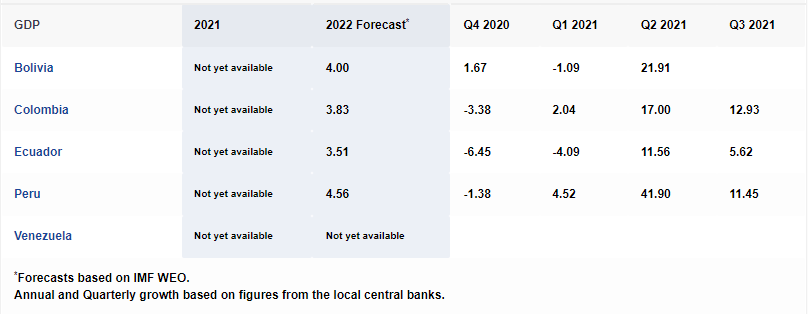
    COLOMBIA | Inflation at five-year high. Colombia’s national statistics department (Dane) released the latest figures for the consumer price index (IPC) on 5 January, showing that inflation increased by 0.73% in December compared with the previous month. In year-on-year terms, inflation was up 5.62% on December 2020. Dane stated that inflation in December was principally driven by price increases for food and non-alcoholic drinks (+17.23% year-on-year) and restaurants and hotels (+8.83%). The two categories that saw annual deflation in December were information and communication (-12.1%) and clothing and shoes (-2.6%). The 5.62% annual inflation rate was the highest in Colombia since 2016 and was significantly above the central bank’s target rate of 3%.

    Andean countries: inflation rate
    Percentage variation (year-on-year)

    Andean countries: GDP growth (%)
    Quarterly figures are year-on-year growth


  • MEXICO: New US food labels cause concern among trade officials

    Abbi Dicker 19 April 2024 Hits: 2561

    Mexican officials have criticised the introduction of new US food label claims which they say are “discriminatory” to Mexican products. This complaint could escalate to become the latest trade dispute between the two neighbours.

    The controversy stems from an 11 March US Department of Agriculture (USDA) announcement of new rules that stipulate that the ‘Product of USA’ and ‘Made in the USA’ label claims can be used on meat, poultry, and egg products “only when they are derived from animals born, raised, slaughtered and processed in the United States”. These claims could previously be used on products from animals which were imported into the US before being slaughtered, as well as imported meat that had been repackaged or processed. The aim is to “prohibit misleading US origin labelling in the [US] market, and help ensure that the information that consumers receive about where their food comes from is truthful,” said the USDA.

    However Mexican trade officials have protested the move. The economy ministry (SE) said the ruling could “create barriers in binational production chains, in particular, to Mexican exports of live cattle and beef and their derivatives”. For its part, the agriculture & rural development ministry (Sader) said the measure “does not consider the nature of the deep integration of the North American livestock and meat sectors”, adding that in 2023 Mexico exported nearly US$3bn of cattle, beef, and beef products to the US. Sader also pointed out that the move may contravene a 2015 World Trade Organisation (WTO) ruling that Mexico and Canada were permitted to impose retaliatory tariffs as US meat labelling rules had cost the two nations more than US$1bn.

    Mexico and Canada could make a complaint about the decision, Mexican agrifood consultancy Grupo Consultor de Mercados Agrícolas (GCMA) told local media outlet El Universal in an article published 18 March. Although food companies are not required to include the claims on their products, both Mexico and Canada believe the voluntary labels constitute unfair and discriminatory treatment of their products. The case could eventually be considered by a dispute resolution panel under the US-Mexico-Canada Agreement (USMCA) trade deal.

    Trade tensions

    Although Mexico has become the top trading partner of the US due to nearshoring and geopolitical tensions between Washington and Beijing, the label claim dispute is not the only trade dispute between the two nations. The US has complained that Mexico’s ban on imports of genetically modified corn violates the USMCA, and it has also threatened to request a dispute settlement panel over Mexico’s energy policies.

  • ARGENTINA: Child disappearance raises alarm on human trafficking

    Abbi Dicker 02 August 2024 Hits: 2170

    Demonstrators took to the streets on 13 July in the town of 9 de Julio, in the north-eastern province of Corrientes, to mark one month since a young boy named Loan Danilo Peña went missing. Since his disappearance, police have arrested suspects in relation to the possible kidnapping, and public concern has risen over human trafficking near Argentina’s border regions.

    The five-year-old boy’s last known location was an orange grove near his grandmother’s home, in a rural area outside of 9 de Julio. After the family had lunch on 13 June, he went orange picking with his cousins, uncle, and two friends of his uncle, before the family noticed that he was missing. His uncle, Bernardino Antonio Benítez, and the two friends, Daniel Ramírez and Mónica del Carmen Millapi, were the last adults to be seen with the boy and have been arrested as suspects. Two other guests at the lunch, Carlos Pérez and María Victoria Caillava, were also arrested on suspicion of involvement in the supposed kidnapping.

    Details of the suspects’ testimony have since been revealed in the national press, but the veracity of the confessions has been questioned. Another suspect in custody, Laudelina Peña, the boy’s aunt and the wife of Benítez, initially told the police that Pérez and Caillava had accidently run over the child. The couple were the only guests who drove their own car to the lunch.

    However, she later provided more testimony in which she admitted that she had lied in her previous confession and that she had been bribed to mislead authorities by saying that the child was killed in a car accident. She claimed that the bribe came from a senator in the bicameral provincial legislature of Corrientes, Diego Pellegrini, who is reportedly an ally of the province’s governor, Gustavo Valdés. Police are seeking to verify these allegations of a political cover-up. Media speculation on possible corruption was also heightened when reports revealed that the local police chief in 9 de Julio, Walter Maciel, was arrested a week after the disappearance for allegedly obstructing the investigation.

    One of the leading theories of the judge presiding over the case, Cristina Elizabeth Pozzer Penzo, points to human trafficking. On 25 June Argentina’s security minister, Patricia Bullrich, visited Corrientes to discuss the case with Pozzer Penzo, who sits on a federal court in the city of Goya. Speaking to journalists outside the Goya court building after her meeting with the judge, Bullrich described the case as a “possible kidnapping”. She added that federal security forces and the special prosecution office on cases involving trafficking and exploitation of people (Protex) will work with local police detectives on the investigation. 

    According to figures collected by Protex, authorities received 812 reports of kidnapping and human trafficking nationwide from January-May 2024, 30 of which were in Corrientes. Of the 812 reports, 121 of the disappearances are of children. Regarding the suspected intentions of the kidnappers, 276 of the 812 total cases are believed to be trafficking for labour exploitation and 199 for sexual exploitation. Government figures show that 594 victims of kidnapping and human trafficking have been rescued in the first five months of 2024. At the time of writing, Loan Danilo Peña’s whereabouts are unknown. Argentine police are working with Paraguayan, Brazilian, and Uruguay authorities, as Corrientes province borders these countries and trafficking groups often work transnationally.

    Alleged corruption and abuse

    On 15 July national daily Clarín published a report in which it cited members of a group of 44 women in Corrientes who call themselves the ‘Madres Corajudas’ (Brave Mothers) who take part in demonstrations and pressure authorities to find Loan Danilo Peña. The leader of the group called for a change in the “corrupt leadership” of the police force in 9 de Julio, referring to local commissioner Walter Maciel, who has been detained on suspicion of hindering the search. Clarín reported that Maciel has been transferred between several police stations in Corrientes, after he was reportedly accused of sexual abuse in 2019.

  • CHILE: Opposition denounces crackdown on protest

    Abbi Dicker 11 June 2026 Hits: 439

    Chile’s left-wing opposition Partido Socialista (PS) and Frente Amplio (FA) accused the far-right government led by President José Antonio Kast of championing a heavy-handed approach to policing of protests after a march convened by the main national student union Confederación de Estudiantes de Chile (Confech), resulted in at least 35 arrests and multiple injuries. Confech was protesting against the controversial Escuelas Protegidas bill approved by congress a week earlier designed to combat violence in schools, and cuts to the education budget.

    Some 4,500 protesters took part in the Confech demonstrations in Santiago on 3 June. The march was not authorised by regional authorities and when protesters started to move down the Alameda avenue towards the La Moneda presidential palace, the militarised police Carabineros fired water cannon and tear gas to disperse them. According to local media reports, 13 protesters were injured in the resulting clashes, of whom five were taken to urgent care, and a dozen Carabineros.

    Protesters were responding to the final approval a day earlier of the ‘Escuelas Protegidas’ bill by congress, which includes tougher penalties for students involved in violence in schools, bag checks, and a ban on face coverings. The bill was fast-tracked through congress by the Kast administration after the fatal stabbing in late March of a teacher who tried to intercede in a knife attack by a student on classmates in a school in the city of Calama, in the northern region of Antofagasta.

    The political opposition denounced the bill as draconian and doing nothing about the root cause of violence in schools and wider society. After the Confech protests descended into violence, the PS issued a statement expressing “profound concern and rejection of the excessive use of force by the Carabineros”. It called for “an exhaustive and transparent investigation to ensure that incidents like this do not happen again”. The president of the FA, Constanza Martínez, accused the government of transforming a legitimate student protest against cuts affecting public education into a confrontation that ended in disproportionate repression.

  • MEXICO: Renewed concerns over journalist safety

    Abbi Dicker 04 September 2026 Hits: 789

    The safety of journalists in Mexico has once again been thrown into the spotlight, with the murder of five journalists in under two months between early June and mid-July. The fact that many of those killed had reported receiving threats but did not receive sufficient protection has led to further calls for the government led by President Claudia Sheinbaum to improve protection mechanisms for journalists.

    One of the most eye-catching recent cases is that of Francisco Alejandro Leyva Aguilar, a veteran journalist and columnist, who was killed in the state of Oaxaca by an unidentified gunman on 22 July. Leyva was best known for directing the Corporación Oaxaqueña de Radio y Televisión (CORTV), a Oaxaca state government agency responsible for radio and television networks, from 2016 to 2020 and for writing the online political column ‘El Zumbido del Moscardón’. His murder was the seventh of a Mexican journalist so far this year, according to international press freedom organisation Reporters Without Borders (RSF), which recorded nine journalist murders in Mexico for the whole of 2025.

    Just over a year before his death, Leyva had filed a complaint with Oaxaca’s human rights ombudsman’s office for reported death threats. He linked these threats to critiques his work had received during the official press conferences of the state governor, Salomón Jara, who is affiliated with the federally ruling Movimiento Regeneración Nacional (Morena).

    The political opposition was quick to denounce Leyva’s murder as evidence of the links between Morena and drug cartels, saying Leyva was killed for trying to reveal this alleged collusion. The leader of the centrist opposition Partido Revolucionario Institucional (PRI), Alejandro Moreno, wrote on social media that Leyva’s “murder reveals a state subjugated by violence, where journalists live under threat and authorities allow impunity to continue shielding criminals”.

    Press freedom groups also raised the alarm about the fact that Leyva was killed despite having denounced threats. In a 23 July social post, the Mexican branch of global human rights NGO Amnesty International stated that: “It is particularly concerning that the Oaxaca state human rights commission, the federal attorney general’s office, and the Oaxaca state attorney general’s office were aware of the threats Francisco was facing. Yet, they failed to prevent his murder.” Given that other journalists murdered in recent months had also denounced threats, Sheinbaum’s government is likely to come under

    • Journalists

    Leyva’s murder followed that of Josué Martínez Contreras, of news outlet Noticias San Martín Texmelucan, who was killed in Puebla state on 16 July; Alex Serna, an environmental journalist whose death was confirmed on 3 July in Guerrero state; Luis Ángel López Valdez, editor and digital journalist for Reportaje Veracruzano, who was murdered on 11 June in Veracruz state; and Roxana Guzmán Ramírez, of Facebook news page Pulso Informativo del Sureste, who was kidnapped on 2 June and found dead weeks later in Veracruz.

  • TRACKING TRENDS

    LatinNews 27 October 2011 Hits: 2766

    VENEZUELA | Bold budget. The planning and finance minister, Jorge Giordani, has announced a further surge in public spending ahead of presidential elections in October next year. Giordani presented to the national assembly a budget for 2012 of B297.8bn (US$69.3bn), a massive 46% increase on this year’s budget. The details will emerge when deputies begin debating the budget on 27 October.

    Giordani justified the decision for the huge increase in the budget on it being predicated on an average oil price of US$50 per barrel, up from US$40 per barrel in recent years. This is still only about half of the average oil price for 2011 of US$100 per barrel, the excess being siphoned off into various opaque development funds for the government of President Hugo Chávez to administer as it sees fit.

    Chávez claimed this week that he is fully recovered from cancer, after a check-up in Cuba, and would be fighting fit by the October 2012 elections. It would be a remarkable achievement if he had indeed defeated the illness within five months, especially given that his refusal to divulge what type of cancer he was up against fuelled understandable speculation that it was very serious.

  • BRAZIL: Brazil is prepared, says Lobão

    LatinNews 18 April 2012 Hits: 2423

    Edison Lobão, the energy and mining minister, insisted on 17 April before a public audience in the federal senate that Brazil was adequately prepared to deal with any potential oil spills in the offshore deepwater sector or any other exploration fields. The minister made his comments just days after the state oil giant Petrobras confirmed a crude leak in its Roncador field, in the deepwater Campos basin, which lies adjacent to the Chevron-operated Frade field at the centre of recent high profile leaks.

    In late April 14 cabinet ministers will meet to agree changes to the National Contingency Plan, which will then be rolled out across the country. The plan is being updated at the request of President Dilma Rousseff after the authorities were found wanting for two years in a row when faced with torrential rains, mudslides and hundreds of civilian casualties. Lobão said that the Frade field leaks were “of no significance” to the amended plan, as the spill had not affected the Brazilian coast. He pointed out that the November 2011 spill leaked 2.4m barrels of oil over a period of 10 days in ultra deep waters, without any effect on coastal areas. By way of contrast, he noted that in the Gulf of Mexico disaster in 2010, in which 11 oil workers died, 4.9m barrels of oil leaked into the ocean over the course of 87 days. The minister explained that in the case of the Brazilian leaks the lack of a “published plan” did not mean that the government did not act. “There was an integrated federal government action”, he said, adding, “Back in 2006, Petrobras already prepared a contingency plan of the highest quality. In fact, that plan was the one used to help Chevron”.

    No end in sight to corruption scandals

    Senator Demóstenes Torres, of the right-wing opposition party Democrátas (DEM), quit the party on 11 April amid a mounting corruption scandal centred on his links with a former businessman, Carlos Augusto Ramos, who is currently imprisoned for running an illegal gambling/gaming mafia. He will retain his senate seat, as an independent.

    Torres has long been a high profile anti-corruption crusader, making his fall from grace all the more spectacular. This fresh corruption scandal is damming for the DEM (formerly Partido da Frente Liberal), which is struggling to stay relevant in Brazilian politics. The DEM governor of the federal district of Brasília, José Roberto Arruda, was forced out in an equally high profile graft scandal in 2010.

    The case erupted in March after the press leaked details of two federal police investigations into corruption and money laundering in the illegal gaming industry, Operation Monte Carlo and Operation Las Vegas. Wiretaps apparently turned up extensive links between Torres and Carlos Augusto Ramos, known locally as ‘Carlinhos Cachoeira’ (roughly, ‘Charlie Waterfall’). Torres is alleged to have lobbied on behalf of Carlinhos to regularise illegal bingo pools and slot machines, in return for personal gain.

    The senator, along with the governor of Goiás, Marconi Perillo (of the opposition Partido da Social Democracia Brasileira), will be the subject of the new CPI, which should get underway in coming days. (Goiás is the state surrounding the federal district). José Roberto Arruda’s successor in the federal district, Agnelo Queiroz of the federally ruling Partido dos Trabalhadores (PT), may also be implicated. The executive dreads these CPIs, as they tend to politically polarise congress and delay the legislative agenda. The PT leader in the lower house, Deputy Jilmar Tatto, denied on 16 April that the Rousseff government had tried to prevent or delay the CPI. “The government did not try to put a lock on the CPI. That is legislative issue”, he stated, adding that likewise the PT was not working against the enquiry, “There is no position on the part of the PT not to have a CPI”.

    • New royalties framework still pending

    Lobão expressed government concern over the congressional delay in approving a new regulatory framework for the division of the offshore oil royalties between the three oil producing states and the rest of the federation.  “The government would like this to hurry along because we need to hold new licencing rounds”, he explained.  Deputy Carlos Zarattini of the ruling Partido dos Trabalhadores (PT), author of the draft bill, is due to present it to representatives of both oil and non-oil producing states on 24 April for discussions.

  • GUATEMALA: Pérez Molina raises more human rights concerns

    LatinNews 05 July 2012 Hits: 2200

    The recent closure of the Peace Archives, an agency established under the Alvaro Colom administration (2008-2012) dedicated to advancing understanding of the 1960-1996 civil war, is one of various developments that have aroused civil society concerns in recent weeks regarding the right-wing government of a former general, President Otto Pérez Molina.

    The closure of the Archives, which employed 17 workers, took effect on 29 June but was announced a month earlier by Antonio Arenales Forno, the head of the presidential peace secretariat (Sepaz). Arenales was cited in the local press as saying that “the decision was made to eliminate the Directorate, cancelling contracts for which I find no justification and the functioning of an office I find makes no sense”. He also said that more than a hundred “unnecessary” positions in the Sepaz, which was set up in 1997 to supervise the fulfilment of the peace accords, could face the axe. Pérez Molina’s insistence that the Peace Archive would be redistributed among various government institutions has yet to pacify his detractors (see sidebar).

    Fears regarding the future of the UN-backed International Commission against Impunity in Guatemala (Cicig) and attorney general Claudia Paz y Paz, a well-respected human rights activist, under a Pérez Molina government have yet to be borne out [RC-11-12]. However, some grounds are starting to emerge for concerns regarding the continuation of efforts to bring former military officials to justice – a process begun under Colom. On 26 June, an appeals court suspended the trial, which involves the former dictator Efraín Ríos Montt (1982-1983), looking into the Las Dos Erres massacre, one of the most brutal civil war atrocities. The charges against Ríos Montt, announced in May last, were the second ones filed against him, following the historic announcement in January that there was “sufficient evidence” to try him for genocide and war crimes in relation to 72 incidents involving an estimated 1,771 deaths and the displacement of nearly 30,000 Guatemalans [RC-12-01].

    In a move slammed by human rights groups as a major setback in efforts to address past impunity, the court admitted the appeal presented by Ríos Montt’s lawyers, which is based on a decree (8/86) passed under the Oscar Mejía Víctores regime (1983-1986) that established a general amnesty for all those who fought between 1982 and 1986. On 27 June the attorney general’s office and the Asociación de Familiares de Detenidos-Desaparecidos de Guatemala, which represents families of those disappeared during the civil war, presented an appeal before the constitutional court against the appeals court ruling.

    New human rights ombudsman

    The recent election by congress of the new human rights ombudsman, a government post responsible for monitoring human rights as outlined in the constitution, also came under criticism from prominent civil society activists such as Iduvina Hernández of the Centro de Acción Legal en Derechos Humanos (CALDH) as well as some 15 human rights organisations.

         On 31 May, Jorge de León Duque, a lawyer and deputy for the right-wing Compromiso, Renovación y Orden (Creo), led by the academic Eduardo Suger (who came third in September’s presidential election), was overwhelmingly chosen by the 158-member unicameral congress with 142 votes in favour.

         De León Duque is the son of the late Ramiro de León Carpio, a human rights ombudsman (1989-1993) and former President (1993-1996) under whose administration Pérez Molina headed up the notorious presidential general staff (EMP). As well as criticising the lack of transparency surrounding the process of De León’s appointment, which she dubbed a “show”, Hernández also denounced the “interference” of Pérez Molina, who publicly backed the new ombudsman.

    • Peace Archives

    Since its establishment under the Alvaro Colom administration (2008-2012), the Peace Archives has digitalised some two million government documents relating to the civil war. The agency has provided expert testimonies for the attorney general’s office in several key human rights cases as well as publishing nine reports on issues such as forced disappearance, child trafficking, the presidential general staff (EMP) and the national police archives.

  • Sigifredo López freed again

    LatinNews 15 August 2012 Hits: 1418

    Development: On 14 August Sigifredo López, the former deputy of the Colombian department of Valle del Cauca, who was accused of self-kidnapping and assisting in the kidnapping and subsequent murder of 11 of his colleagues in 2002, was freed from house arrest by Attorney General Eduardo Montealegre.

    Significance: López holds the record for being the only person freed twice - once by the Fuerzas Armadas Revolucionarias de Colombia (Farc), which held him hostage for seven years (2002-2009), and now by the state, which held him under arrest for 90 days (36 in a cell of the prosecution’s ‘bunker’ in Bogotá and 54 in his home in Cali, Valle del Cauca). But the case is not over: yesterday Montealegre recognised that recent investigations show that at least four witnesses, whose testimonies had served as the basis to accuse López, had been lying. The attorney general’s office will now investigate the false witnesses as well as the role of the 38th prosecutor of Cali, who filed the accusation against López and ordered his arrest.

    Key points:

    • López has always maintained his innocence and the relatives of the 11 murdered deputies remained behind him even after his arrest. “I have regained freedom, it now remains for them [the prosecution] to return me my honour”, he said during a press conference yesterday.

    • A US Federal Bureau of Investigations (FBI) test of a recording, in which López allegedly instructed the Farc about the layout of the departmental legislature’s building, found that the voice in the video did not match López’s. The FBI’s conclusions, however, went against findings by the Colombian police; Montealegre yesterday said that “in light of this opposition of criteria, the doubt must be resolved in favour of the person under investigation”.

    • In an interview with the local political weekly Semana, López said he is convinced the arrest was “a complot. I repeat, I was always convinced that everything was part of a judicial mistake until 20 June when they notified me of the arrest order [i.e. the supreme court and Bogotá’s superior tribunal rejected his appeal against the arrest warrant issued on 16 May]; I added up the behaviour of the prosecution and this demonstrated that there was bad faith in its actions”.

  • RASTREANDO TENDENCIAS

    LatinNews 28 January 2013 Hits: 987

    PARAGUAY | Deleitándose con la exitosa emisión de bonos en Wall Street. El 18 de enero, el gobierno paraguayo anunció que había completado exitosamente la primera emisión de bonos en la historia del país en el New York Stock Exchange (NYSE), donde su emisión de US$500m en bonos a 10 años ofreció un rendimiento del 4,62%, el más bajo ofrecido por bonos soberanos haciendo su debut en los mercados internacionales. El récord previo fue de Bolivia que en una emisión comparable de US$500m ofreció un rendimiento del 4,8%. De acuerdo con el ministerio de finanzas de Paraguay, más del 97% de los bonos de Paraguay fueron adquiridos por inversionistas de EU (a pesar del hecho que los ratings del riesgo soberano del país actualmente está debajo del nivel de inversión, el mejor estando en Ba3 [IL-13-02].

    Este es un éxito total para el gobierno paraguayo encabezado por el Presidente Federico Franco en dos aspectos. Le permite al gobierno reunir los muy necesitados fondos con los cuales financiar proyectos de infraestructura claves en el corto tiempo del que dispone antes de las elecciones generales del 21 de abril. También muestra la confianza de los inversionistas en la economía paraguaya incluso aunque el país afrontó inestabilidad política el año pasado, luego del juicio político del ex presidente Fernando Lugo (2008-2012) y registrará un crecimiento económico negativo como resultado de los impactos negativos sufridos por su importante sector agrícola. Franco señaló que el hecho de que la emisión fue sobre suscrita en US$5,6mm, es decir, 11 veces su valor, demostraba que los inversionistas ven a Paraguay como “un país serio”.

    Él dijo que todos los fondos recaudados serían utilizados para los muy necesitados proyectos de infraestructura como la reparación y expansión de las carreteras y el mejoramiento de la red nacional de distribución de la energía. El ministerio de finanzas del Paraguay calcula que esto podría estimular el PIB del país por hasta un 6%, encima del 8,5% previsto para este año.

    URUGUAY-BRASIL | Continúan las restricciones en el comercio automotor. El 21 de enero, el gerente general de la subsidiaria local del fabricante de automotores China, Lifan, Pablo Revetria, dijo en una entrevista con diario local de Uruguay, El País, que su compañía aún experimentaba problemas con las exportaciones de vehículos a Brasil. El año pasado, Brasil adoptó restricciones comerciales sobre las importaciones de automóviles de Uruguay, afirmando que las mismas no cumplen con las normas de origen del Mercado Común del Sur (Mercosur), y representan un intento de países afuera del Mercosur de ingresar al mercado interno de Brasil.

    Las restricciones sólo fueron levantadas después de que interviniera personalmente el Presidente de Uruguay, José Mujica; después de reunirse con su contraparte brasilera, Dilma Rousseff, los dos países acordaron un nuevo protocolo que aseguraría que las exportaciones uruguayas no encontrarían ningún problema más para ingresar a Brasil. Sin embargo, Revetria dijo que el primer embarque de este año, de 30 vehículos (de un total de 2.500 destinados para la exportación a Brasil este año) ha estado atascado en la frontera por dos semanas debido a que las autoridades aduaneras de Brasil, la Receita Federal (la agencia impositiva), lo ha retenido alegando que carecía de la documentación necesaria. Revetria afirma que el embarque tiene “toda la documentación necesaria establecida en el último protocolo”, pero que la Receita está constantemente exigiendo nuevas documentaciones. Él agregó que ya había estado en contacto con el ministerio de industria de Uruguay para alertarlo de la situación y buscar asistencia.

    Revetria dijo que “de ahora en adelante, las cosas son resueltas de gobierno a gobierno”. Preguntado aun más acerca de la situación, Revetria declaró filosóficamente que “Brasil tiene políticas comerciales restrictivas en general. No es solamente un problema con Uruguay. Pero nosotros estamos siendo afectados por políticas que pretenden proteger [su] mercado interno”. Es muy probable que las preocupaciones acerca de las exportaciones uruguayas han resurgido en Brasil, debido al hecho de que el creciente valor del Real está volviendo los productos brasileros cada vez menos atractivos (la tasa de cambio actual es de Ur$9.223/R$1).

    Según, El Observador, otro diario uruguayo, el año pasado su ‘indicador de la tasa de cambio real’, que mide las fluctuaciones en las tasas de cambio y la inflación entre la economía local y sus principales socios comerciales como una manera de medir la competitividad de los productos uruguayos, llegó a su nivel más alto en una década, pues el valor de los productos y servicios uruguayos cayeron un 15,85%, comparados con los de Brasil y un 18,7% comparados con los de Argentina.

    • BCCH mantiene constante su tasa de interés por todo el año

    El 17 de enero, el banco central de Chile (BCCH) anunció que después de su última reunión de política monetaria, El Banco decidió mantener su tasa de interés referencial en 5%, el mismo nivel en el cual ha permanecido desde enero del 2012. A diferencia de otros bancos centrales de la región que han reaccionado a una declinación en sus economías internas recortando las tasas (Brasil y Colombia por mencionar a dos), el BCCH ha optado por mantener la tasa de interés constante en tanto su economía continúa desempeñándose por encima de las expectativas, pero el BCCH aún alberga preocupaciones acerca de un crecimiento económico global más débil. El BCCH explicó su decisión afirmando que “continúa el débil crecimiento de las economías desarrolladas”, pero también señaló que “hay signos positivos observados en China”. Por lo tanto, el BCCH al parecer está contento de continuar sentado aguardando claros signos de la economía global.

  • Venezuela: It's ok for some…but not for most

    LatinNews 10 March 2017 Hits: 523

    Things are not getting any better in ‘Zimbazuela’, as inflation continues to skyrocket.

    According to a 2 March article in Forbes magazine, Venezuela last year was among the top 10 countries for ownership of private jets. With some 340 registered last year (up 7% over 2015), it was ranked 7th, just after the UK (with 345) and ahead of China (277), France (227) and Australia (193).

    No doubt President Nicolás Maduro would point to the US position at the very top of the list (with 12,717 registered private jets last year), followed by Mexico (950) and Brazil (786). And while the gap between rich and poor in the US, Mexico and Brazil is appalling to citizens of those countries, it will be particularly difficult for Venezuelans to stomach their country’s place on this latest ranking, given the desperate state of affairs right now for most people in the country.

    The daily press stories of dying hospital patients, malnourished babies and rubbish-scavenging children are too becoming too numerous to mention (and can be difficult to verify from outside the country), but there is little doubt that daily life on the ground in places like Caracas these days is a very far cry from the jet-set modus operandi still enjoyed by some of the country’s wealthy elite, who can afford to go to Miami to escape it all. Equally painful to stomach is the widespread perception that many of these people are from within the Socialist government itself.

    According to the latest nationwide annual survey of households known as the Encuesta Condiciones de Vida (Encovi), released on 27 February by the private Andrés Bello Catholic University (UCAB), 82% of Venezuelan homes did not have sufficient income last year to meet their basic needs, with almost half (49%) of those newly in that situation, as the economic crisis in the country extended into a third consecutive year. This means that cyclical poverty is edging into structural poverty in many households, the UCAB warned, which has devastating consequences across many indicators (including health, education and personal security, to name but a few).

    The much-reported supply shortages of consumer goods and medicines are but one side of the problem for Venezuelan consumers, the other, much bigger issue, is that despite the government’s continual double digit increases in the minimum wage and associated benefits, inflation is running away in the country, in large part because of the central bank’s continual money printing to finance the government’s budget deficit (which private economists estimate at anywhere between 15% and 25% of GDP).

    On 8 January, President Maduro announced that the minimum wage would be increased by 50%, to BsF40,638 per month. Including food vouchers, known as ‘Cestaticket’, the so-called integral minimum wage now stands at BsF104,358. At the weakest official exchange rate, that amounts to US$60 (US$154 including food vouchers), but at the black-market exchange rate these figures amount to just US$12 and US$31 respectively.

    Hikes to the minimum wage are becoming more frequent, and getting bigger each time, triggering warnings about hyperinflation. The latest increase marked the fifth in 12 months. The minimum wage was BsF9,648 a month at the beginning of 2016, less than a quarter the new rate. The integral wage has increased even more rapidly, by over six times, over the course of 2016. This reflects worsening food shortages, with the government seeking to compensate by providing more food vouchers, albeit that doesn’t tackle the underlying lack of availability.

    The difficulty is that these wage hikes are funded by printing money. Monetary aggregates were already rising at a rate of nearly 160% year on year end-December 2016.

    For the past 2-3 years, the central bank (BCV) has ceased releasing macroeconomic data, ostensibly on national security grounds. The last inflation release was on 18 February 2016, when the bank reported end-year 2015 inflation of 181% year-on-year. As such, figures for inflation in Venezuela vary wildly. Citing BCV sources, Reuters in January suggested that last year’s inflation had hit 800%, with a real GDP contraction of 18.6%. The US-based Troubled Currencies Project, run by John Hopkins University and the conservative Cato Institute, estimated that inflation ended 2016 at 290% and calculated that the country entered into hyper-inflationary territory in November 2016 (typically defined as at least two months of inflation over 50% month-on-month). The International Monetary Fund (IMF) put 2016 inflation at 476%, and has a very dramatic forecast of 1,660% in 2017.

    In the prolonged absence of the BCV data, the opposition-controlled national assembly (AN) is now launching its own national inflation index, which it will publish every month. The index has been drawn up under the supervision of the opposition deputy José Guerra, a respected economist and currently head of the AN’s finance and economic development commission.

    Guerra said that using the BCV’s own methodology, the finance commission had estimated inflation of 550% in 2016. He suggested that prices rose by 18.7% month-on-month in January. If correct, that would be the highest recorded for the month since inflation data began to be compiled in 1945, he observed. On that basis, the commission projects inflation of 679.7% by year-end 2017.

    The AN’s inflation index will be released the 15th day of each month, “so that Venezuelans know how much their salary is worth”, Guerra noted. He said that salaries should be linked to “an economic policy that seeks to contain inflation”, noting that, “it’s of no use increasing salaries when consumer purchasing power is undermined by inflation”. He also called for a policy to restrict money supply. “What generates high inflation the world over is when central banks inundate the market with money to finance the fiscal deficit. It’s a universal lesson”, he noted.

  • ARGENTINA: Massa’s battle to avoid default and devaluation

    Patrick de Courcy 20 April 2023 Hits: 4173

    Even by Argentine standards, the situation of the country’s economy is alarming. Inflation topped 100%, GDP is projected to contract by 3% this year, and international reserves are critically low. Poverty levels are again approaching near-record highs of around 40%, while a devastating drought is undermining the country’s all-important farm exports. 

    That’s a recipe for disaster for any political party trying to get itself re-elected. Not surprisingly, the administration of President Alberto Fernández is performing a high-balance act to prevent a full-blown crisis before national elections in October. Economy Minister Sergio Massa launched a flurry of measures in recent days and weeks, the majority aimed at avoiding a devaluation of the currency and a default on the country’s domestic debt.

    The latest came on 5 April when Massa detailed a preferential exchange rate for agricultural products. Exporters will receive Ar$300 for each dollar they are paid from abroad, compared to Ar$217 they would normally receive under the official exchange rate. The deal is available for soybean producers through the end of May, for others until August. The idea, as during previous iterations of sector-specific exchange rates, is to anticipate exports and thereby fill central bank coffers with dollars as quickly as possible. That is to help prop up the currency and avoid an official devaluation before the election, which could trigger financial chaos and immediate monthly inflation of 30% or more.

    Despite price controls on thousands of items and the multiple currency control mechanisms, inflation not only topped 100% in the 12 months to February but accelerated in March for the fourth consecutive month to levels not seen since Massa took office last August.

    IMF targets

    In addition, the administration convinced the International Monetary Fund (IMF) to slash its monetary reserve requirements, arguing poor harvests will shave between US$15bn and US$20bn off export earnings. All of the quarterly targets before the election were slashed and the year-end target for net reserve accumulation was cut to US$8bn from US$9.8bn.

    Debt acrobatics

    Managing the limited amount of dollars and helping to prop up the peso has been one of Massa’s big juggling acts in recent weeks. The other was to ensure that the government continues to manage rolling over its domestic debt, as investors become increasingly wary of the country’s delicate financial health. The government’s budget recorded a massive deficit in January and February, raising red flags over its ability to service debt.

    • Currency swap

    In a related move to help stem the peso and ease inflationary pressure, Massa in late March ordered all public entities to swap dollar-denominated bonds for peso-denominated securities, a move designed to preserve monetary reserves and take help stem the currency. Credit rating agencies downgraded Argentina, arguing coercive currency exchange equals selective default.

    To that extent the government in March began swapping as much as Ar$7trn (US$35bn) in local currency bonds maturing through June for new notes due in 2024 and 2025. That essentially buys the administration time and dramatically reduces the risk of domestic debt coming due without the government being able to pay it. “We want to leave behind the idea that Argentina is always weeks away from a default,” Massa said in early March when the programme started.

    The problem is that the government is simply postponing economic hardship. Even if the ruling Frente de Todos coalition somehow survives the election in October, it would itself inherit a worse budget and debt situation than today. 

  • TRACKING TRENDS

    Abbi Dicker 18 September 2025 Hits: 1114

    MEXICO | US makes good on aviation threat. The US Department of Transport announced on 15 September that it was revoking the antitrust immunity it had granted to a joint venture between Mexico’s flag carrier, Aeroméxico, and US airline Delta Air Lines.

    The US had first mooted the move in July as part of wider restrictions announced against Mexico’s aviation industry, citing anti-competitive behaviour as a motivation [WR-25-29]. Both Aeroméxico and Delta have stated that they regret the decision, which affects common pricing, capacity management, and revenue sharing.