All Categories

Subcategories

  • PANAMA: Big plans for Panama Canal

    Abbi Dicker 18 September 2025 Hits: 1860

    The administrator of the Panama Canal, Ricaurte Vásquez, presented the strategic plan of the Panama Canal Authority (ACP) for the next 10 years on 16 September. During his presentation, ‘Panama Canal: Vision for the future’, Vásquez said the main focus would be on ensuring adequate water supplies after the drought of 2023-2024 and safeguarding the waterway’s long-term sustainability.

    With these objectives in mind, the ACP’s 10-year plan includes planned investment of US$8bn in strategic projects, foremost among which are the construction of the Rio Indio reservoir, to “enhance the reliability of canal transits” and a 76km pipeline, as part of an ‘Interoceanic Energy Corridor’, to transport up to 2.5m barrels of energy products per day across the isthmus without crossing the locks. The ACP said the pipeline would generate 45,000 jobs during the construction phase and 11,000 during operations.

    The presentation of the plan comes at the most challenging time for the ACP since the transfer of sovereignty of the canal from the US in 1999 following US President Donald Trump’s threats to “take back” the canal earlier this year. Trump has been critical of former president Jimmy Carter for ceding sovereignty to Panama (under the terms of the 1977 Carter-Torrijos treaty). Bilateral tensions with the US have subsided in recent months but Trump’s gaze is likely to shift back to the Panama Canal at some stage.

    10-year plan

    As part of its 10-year plan and strategic vision, the ACP also seeks to turn the Panama Canal into a logistics hub, “strengthening Panama’s competitive edge in world commerce”.

  • CARIBBEAN POINTERS

    LatinNews 18 April 2013 Hits: 2385

    * OIL CONTROVERSIES IN BAHAMAS AND BELIZE. On 16 April, Belize’s Supreme Court declared null and void offshore oil drilling contracts awarded by the government between 2004 and 2007. The challenge to the contracts was launched by groups campaigning against offshore drilling in Belize. The court’s view was that the government had failed to properly assess the environmental impact of the proposed drilling. The court also held that the contracts had been awarded to companies that did not have the requisite expertise to avoid environmental damage. Public opinion appears to be strongly against offshore drilling, fearing the damage that could be done to Belize’s coral reef and its tourism industry as a result of an oil spill.

                Meanwhile, in The Bahamas, Prime Minister Perry Christie is under pressure for reneging on his pre-election promise to hold a referendum on the question of oil drilling. Last May, the Progressive Liberal Party (PLP) leader told a rally: “Bahamians, we aren’t the FNM [Free National Movement]. We actually care about what you want. And there will not be oil drilling in The Bahamas unless you want it – we are on the record in favour of a national referendum.” Even at that time, however, it was suspected that there was some cynicism in this promise as it came after revelations that Christie was a paid consultant of Bahamas Petroleum Company (BPC). Now, the government has announced the award of an exploration licence to BPC and a postponement of any plan to hold a referendum until end-2014 or early 2015 (see sidebar).

    * MORE ECONOMIC CONTRACTION FOR BARBADOS. The Barbados economy contracted by 0.4% year-on-year in the first three months of 2013, and the Central Bank has said that it expects the economy to remain flat for the whole year. However, on 9 April, it added that recently increased capacity in the tourism industry, together with current investment plans, should provide a “foundation for growth” in 2014 and beyond. The bank called for more investment in specialist areas such as eco, sports, and cultural tourism.

                The bank added: “Also, more investment is needed in marketing international Business and Financial Services and increasing capacity in agro processing and alternative energy. Efforts must be redoubled to remove barriers to Barbados’ competitiveness, the most damaging of which are inefficiency of Government bureaucracy, insufficient financing for new ventures, and poor work attitudes in the workforce.”

    * FORMER PREMIERS IN COURT. Two former premiers of British Overseas Territories, Mckeeva Bush of the Cayman Islands (2009-2012), and Michael Misick of the Turks & Caicos Islands, TCI (2003-2009) are getting closer to facing their day in court.

                On 16 April Brazil’s official gazette published its justice ministry’s decision to refuse an application for political asylum submitted by Misick due to “lack of evidence” that he was facing political persecution back in the TCI. Misick, who has an outstanding Interpol arrest warrant issued to his name, is wanted in the British Overseas Territory on charges of corruption and mismanagement. Misick was originally arrested in Rio de Janeiro on 7 December but was released on bail on 8 February. He was re-arrested on 14 April in São Paulo.

                As for Bush, the latest court documents allege that, inter alia, he made cash withdrawals of up to $50,000 from casinos in the US using a government credit card. Bush faces two charges of misconduct in public office, four charges of breach of trust by a member of the Legislative Assembly, and five charges of theft. Bush’s case is next scheduled to come before the courts on 26 April.

    • Oil in The Bahamas

    On 13 April, BPC’s chief operating officer, Paul Gucwa, described the chances of discovering oil in The Bahamas as between 25% and 30%. Kenred Dorsett, minister for the environment and housing, said earlier this month that the discovery of oil in commercially exploitable quantities would be “economically transformative”. It is expected that BPC would pay between 12.5% and 25% in royalties to the government on extracted oil.


  • VENEZUELA: Turning once again to the bank of China

    LatinNews 25 July 2013 Hits: 1037

    The government of President Nicolás Maduro is hoping to secure a loan of up to US$5bn from China within the next two weeks, the president of the state social and economic development bank (Bandes), Temir Porras, said. The loan, which will be negotiated in Caracas with the China Development Bank (CDB), would finance the Joint China-Venezuela Fund which invests in housing, infrastructure and production projects, and repays loans with shipments of oil.

    Vice-President Jorge Arreaza visited China last week, and was clearly on a mission to persuade the Chinese to stump up more financing for the Fund. China has raised doubts about how efficiently the financial resources have been used in the past, and it will not be overly impressed by the fact that significant sums of cash have allegedly been embezzled from the Fund: eight employees were arrested last week in Venezuela charged with siphoning US$84m from the Fund, which is administered by Bandes.

    Bandes is becoming a byword for corruption. The US Securities and Exchange Commission (SEC) recently charged four people linked to a New York-based brokerage firm DAP in a massive US$66m kickback scheme to secure the bond-trading business of Bandes. A portion of this was illicitly paid to the vice-president of finance at Bandes [WR-13-24].

    The opposition claims that the vast amount of money being borrowed by Venezuela from China is mortgaging the future of the country’s younger generation. A new interactive database launched by the US thinktank Inter-American Dialogue this week (see sidebar) put total loans to Venezuela from China over the five years to August 2012 at US$44.5bn, more than the combined loans from China to the whole of the rest of the region over this period. Oil Minister Rafael Ramírez claimed last August that Venezuela had repaid US$17.9bn of these loans.

    • China-Latin America Finance Database

    The China-Latin America Finance Database launched by the Inter-American Dialogue aims, in its own words, to provide “up-to-date information on Chinese lending in Latin America by country, lender, sector and year”. It claims that since 2005, China has provided upwards of US$87bn in loan commitments to Latin American countries, and that the loan commitments of US$37bn in 2010 outstripped those of the World Bank, Inter-American Development Bank, and US Export-Import Bank combined.

  • CHILE: Bachelet pushes forward on key pledges

    LatinNews 20 May 2014 Hits: 3417

    President Michelle Bachelet is trumpeting progress on three of her electoral pledges: fiscal reform, which in turn will lay the foundations for her promised education reform; and also political-electoral reform, by way of an end to the binominal electoral system, a legacy of the 1973-1990 military dictatorship.

    While the fiscal reform faces predictable opposition from the centre-right opposition, Alianza por Chile (comprising the traditional Unión Demócrata Independiente [UDI] and Renovación Nacional [RN]), as well as from the private business sector, the political-electoral reform exposed divisions within the ruling leftist Nueva Mayoría coalition – which comprises the quadripartite Concertación alliance plus the Partido Comunista de Chile [PCCh]).

    Meanwhile students – the bane of Bachelet’s predecessor, Sebastián Piñera (2010-2014) – staged their first mass demo under the new government, reiterating their demands for an end to for-profit education in return for voting Bachelet into office for a second time last year. With some student groups threatening to radicalize their actions, education is set to remain the most pressing political issue.

    On 14 May, the 120-member chamber of deputies approved the fiscal reform bill, sent down by the executive on 31 March, with 72 votes in favour and 48 against. Of those in favour, 67 votes came from the ruling coalition, as well as a few independents, plus one from Gaspar Rivas, an RN deputy. While some tweaks were made, the bulk of the reform – which aims to raise US$8.2bn in additional revenues annually in order to provide completely free higher education in Chile within six years – remained intact. The main change is a phased increase in the corporate tax rate over a four-year period to 25%, from the current 20%, while the top rate of personal income tax will be cut from 40% to 35%. It also scraps a tax exemption on reinvested profits (known as the ‘Fondo de Utilidades Tributables’ [FUT]).

    The initiative now goes to the 38-member senate (where Nueva Mayoría has 21 seats), where further minor changes are expected. President Bachelet and her finance minister, Alberto Arenas, have been clear that the “heart of the reform” is not up for debate, although others, like Senator Ricardo Lagos of the Nueva Mayoria’s Partido por la Democracia (PPD), son of the former president Ricardo Lagos (2000-2006) and chair of the senate finance committee, stress that while the ruling coalition has sufficient votes in both houses to pass the reform, there is flexibility to discuss aspects of the bill in order to ensure a strong consensus behind it. Weber says he expects the bill to receive final approval by late August or early September.

    The efforts to build a consensus already have run up against a strong campaign. Political opposition figures including the UDI president Ernesto Silva have described the initiative as “a terrible project for Chile”. Silva accused the Bachelet government of “bulldozing it through [congress] by imposing its majority” rather than allowing for a constructive debate, warning that it would hit the middle classes. Private business sector lobbies like the Confederación de Producción y Comercio (CPC) as well as prominent figures like the multi-millionaire Eliodoro Matte, chairman of the forestry company Empresas CMPC, continue to warn about the impact on investment at a time of slowing growth, particularly in light of the abolition of the FUT.

    That these concerns have had an impact was suggested in a survey released by Adimark on 7 May. According to the polls, while President Bachelet’s approval rating was largely unchanged in April (at 53%) compared to the previous month (54%), her disapproval rating shot up 20 percentage points to 32%. Part of this increase was attributed to the government’s handling of the tax reform proposals. (Adimark interviewed 1,171 people nationwide on 4-30 April. The poll had a 2.9% margin of error.)

    In response, the government deployed a contingent of ministers to tour the country on a PR mission to explain the benefits of the reform. Education Minister Nicolás Eyzaguirre was sent to the O'Higgins region; the government spokesperson, Álvaro Elizalde, to Cerrillos; the labour minister, Javiera Blanco, to Biobío, the public works minister, Alberto Undurraga, to Atacama; the agriculture minister, Carlos Furche, to San Felipe and Los Andes, while the women’s minister, Claudia Pascual, was sent to Arica. President Bachelet insists that the tax changes will only affect the “richest 1%” of the population (or around 4,500 wealthy families).

    First mass student marches

    Upping the pressure on Bachelet, the umbrella student organisation, Confederación de Estudiantes de Chile (Confech), staged the first mass march demanding an end to for-profit education.

    This suggests that initial hopes for an understanding between the government and the Confech - which saw the Confech desist from taking part in the so-called ‘March of Marches’ staged on 22 March by other civil society groups [RBS-14-04]) - were premature.

    On 8 May demos were held in eight cities, including in the capital Santiago, with a turnout of about 40,000 on police figures (although the Confech put it at 100,000). While student protests had become increasingly radicalised and violent under the previous Piñera administration, these latest demos were largely peaceful, with only minor clashes reported. The authorities reported 101 arrests, with 20 police officers injured across the country.

    Worryingly for Bachelet however, former student leaders-turned-deputies like Camila Vallejo, Karol Cariola and Gabriel Boric, all opted to take part. Boric is a member of Izquierda Autónoma, while Vallejo and Cariola are deputies for the PCCh. Indicative of the PCCh pledge to keep ‘one foot in government and one on the street’, Vallejo told reporters: “There is no contradiction between legislating and mobilising, the fight to transform the education system takes places across all spheres”.

    With some groups like the secondary school students’ Asamblea Coordinadora de Estudiantes Secundarios (ACES), and the Federación de Estudiantes de la Universidad de Santiago (Feusach), threatening to further radicalise their protest actions (see sidebar), the pressure was on Education Minister Eyzaguirre to make good on his pledge to send three legislative bills on education reform to congress before 21 May, when Bachelet was due to deliver her state-of-the-nation address to congress.

    Binominal reform – again

    Chile’s binominal electoral system, which assigns two deputy seats to each electoral district, has long been a source of complaint by smaller parties, who argue that it favours the country’s two main political coalitions. The first step towards getting rid of this system was taken in January 2014 under the outgoing Piñera government, when the lower chamber ratified an amended bill, approved by the senate in December 2013, eliminating the constitutional provision (Art. 47) fixing the number of lower chamber seats at 120.

    On 23 April Bachelet presented an initiative to merge a number of electoral districts and increase both houses of congress, adding 12 seats to the senate (to bring it to 50) and 35 to the lower chamber (to reach 155). Among other things, the initiative also seeks to improve gender equity, stipulating that no more than 60% of any party's candidates can be of the same sex (thereby ensuring a minimum 40% representation for women).

    Unlike the fiscal reform however, approval of this initiative in congress is likely to prove more complicated, as a three-fifths qualified majority is necessary – meaning that opposition support will be essential. The proposal aroused opposition from the Right – with figures like Senator Juan Antonio Coloma (UDI) warning that increasing the size of congress was "a bad signal", as it would likely result in an increased representation of populous metropolitan districts, at the expense of rural areas.

    Of greater concern for the executive, however, was the response from within the ruling coalition. The president of the lower chamber, Deputy Aldo Cornejo of the Partido Demócrata Cristiano (PDC, the biggest party in Nueva Mayoría), failed to attend the presentation of the bill in protest at not being consulted about it in advance. Another deputy from the ruling coalition, Fidel Espinoza of Bachelet’s own Partido Socialista (PS) was more explicit, tweeting: "I oppose the increase in the number of deputies and the fusion of districts".

    Bachelet in Argentina

    Having pledged that her foreign policy would focus on deepening regional integration and boosting South-South cooperation (as well as strengthening ties with the Asia-Pacific region) [RBS-14-03], President Bachelet paid her first official visit overseas to Argentina, where she met her ally, President Cristina Fernández.

    During the meeting, on 12 May, the two left-leaning leaders pledged to deepen bilateral ties, which had weakened under Chile’s previous centre-right Piñera government. In part this was because of the case of Sergio Galvarino Apablaza, a former guerrilla wanted in connection with the murder in 1991 of the UDI’s founder, Jaime Guzmán. While Argentina’s supreme court had approved Apablaza’s extradition in 2010, subsequently he was granted political asylum, after the Fernández government opted to allow Argentina’s national committee for refugees (Conare) to decide on his fate.

    Bachelet and Fernández reportedly discussed the Apablaza case. Chile’s Foreign Minister Heraldo Muñoz would only say to reporters that the case “remains in the judicial sphere”.

    The two women also discussed re-launching the bilateral Maipú treaty. Inked in 2009 under Bachelet’s first government (2006-2010), it aimed to improve infrastructure connecting the two countries across their joint 5,000km border. Examples include an Andes railway crossing connecting the town of Luján de Cuyo in Argentina’s Western province of Mendoza with the Chilean city of Los Andes in the Valparaíso region. End box

    • Rethinking priorities?

    In a national TV interview on 16 April, President Bachelet said she was considering adjustments to the national budget and could re-allocate funds expected from her proposed new fiscal reform to finance reconstruction efforts after the 1 April earthquake in the north of the country and a 12 April fire in Valparaiso - the worst urban fire in the country's history. On reports from Chile’s national emergency office (Onemi), the fire, the cause of which is still unknown, resulted in the deaths of 16 people while 2,500 houses were destroyed, 11,000 people evacuated and 1,145 hectares of land affected overall.

    • Ezyguirre

    On 9 May the Asamblea Coordinadora de Estudiantes Secundarios (ACES) and the Federación de Estudiantes de la Universidad de Santiago (Feusach) asked the comptroller general’s office to investigate Education Minister Nicolás Eyzaguirre for “negligence of duties”. They accuse him of reneging on a campaign promise to end for-profit education. Other student organisations – like the prominent Confederación de Estudiantes de Chile (Confech), have not backed the action, deeming the 8 May protest marches a sufficient means of exerting pressure on Eyzaguirre and the Bachelet government to clarify and expedite the government’s promised education reform.

    • New Codelco leadership

    On 12 May Chile’s President Bachelet appointed an economist, Oscar Landerretche, at the helm of the board of directors at the state-owned copper mining company, Codelco. Bachelet also appointed two new Codelco directors: Dante Contreras and Laura Albornoz. Also likely to be replaced is the company’s CEO, Thomas Keller, appointed in 2012 by Bachelet’s predecessor, Sebastián Piñera (2010-2014).

  • PERU: Fresh twist to Odebrecht scandal

    LatinNews 13 February 2020 Hits: 4518

    Just as Peru’s President Martín Vizcarra was looking to accelerate his anti-corruption political and judicial reform agenda with a new congress, his energy and mines minister, Juan Carlos Liu, suddenly resigned in a scandal involving the disgraced Brazilian construction firm Odebrecht. If the manner of Liu’s departure were not damaging enough for Vizcarra it comes as Odebrecht has turned its relationship with the Peruvian state on its head. After signing a plea bargain deal with Peruvian prosecutors this time last year to reveal details of its involvement in bribery, Odebrecht is now taking legal action against the Peruvian state to demand compensation to the tune of US$1.2bn for a cancelled public works contract.

    A report released by the Peruvian current affairs programme Panorama on 9 February revealed that through his company, Conasac, Liu had provided services to Odebrecht between 2010 and 2014 at the same time as he was serving as an adviser and consultant to the energy and mines ministry for which he had been tasked with drawing up a report into the Gasoducto Sur Peruano (GSP) gas pipeline project. President Vizcarra revealed the following day that Liu, facing accusations of conflict of interest, had tendered his resignation.

    Liu authored the report in December 2012. It was presented the following month by the energy and mines minister at the time, Jorge Merino, who is currently being investigated for collusion in the Odebrecht bribery scandal. Liu said that the report was not a viability study, as presented, and that Panorama had only revealed what was already public knowledge. But his links to Odebrecht, poisonous for Peruvian politicians, had not been brought to the attention of the public. As Vizcarra’s credibility, and popularity, hinges on his unswerving commitment to combating corruption, Liu’s position became untenable.

    Odebrecht offensive

    The US$7bn GSP project was awarded to an Odebrecht-led consortium in 2014, but it was cancelled by the government in 2017 on the grounds that the Brazilian firm had failed to obtain the necessary financing to complete it amid the bribery scandal in which it was embroiled. Odebrecht agreed to pay just PEN$610m (US$184m) civil compensation in February last year over 15 years as part of a plea bargain accord with Peruvian prosecutors in return for revealing details of bribes it paid out in the hope of securing lucrative public works contracts, such as the GSP project.

    But shortly before Liu’s resignation, Odebrecht Latinvest, a subsidiary of the Brazilian firm, filed a request before the International Centre for Settlement of Investment Disputes (Icsid), part of the World Bank, to institute arbitration proceedings in the GSP case. “It is ironic that…despite all the evidence [of wrongdoing], responsibilities assumed and acknowledged, [Odebrecht] still has the gall to seek arbitration,” Peru’s Prime Minister Vicente Zeballos said. Rafael Vela, the special prosecutor in the Lava Jato case, went further. “It’s absurd to declare yourself guilty while simultaneously filing a lawsuit,” Vela said. It is possible that Odebrecht is going to Icsid because of pressure brought to bear by its creditors. But whatever the reason, it is difficult to see how it can sustain the anomalous position of cooperating with the Peruvian justice system while filing a lawsuit against the Peruvian state.

    • Odebrecht lawsuit

    Odebrecht is demanding compensation to the tune of US$1.2bn from the Peruvian state for the cancellation of the GSP project, which it argues violated a bilateral treaty on the promotion and reciprocal protection of investments. This sum is significantly more than Odebrecht is set to pay the Peruvian state in civil compensation (US$184m) for its massive bribery scheme.


  • TRACKING TRENDS

    LatinNews 27 August 2020 Hits: 3641

    PERU | Record GDP contraction. Peru’s GDP declined by an unprecedented 30.2% year-on-year in the second quarter of 2020, Peru’s national statistics institute (Inei) announced on 20 August, with the country now officially in recession after recording a 3.4% contraction in the previous quarter. The steep decline is due to measures to contain the coronavirus (Covid-19) pandemic, which have forced the suspension of much economic activity and the closing of national borders. The same figures show a 27.7% fall in domestic consumption year-on-year, with a 57.7% decline in gross fixed investment as construction projects were paused and orders cancelled. A 39.6% fall in employment was reflected in a 22.1% decline in household consumer spending, while government consumption fell by 3.2%.

    As countries around the world slide into recession, falling demand for Peruvian goods and services caused exports to decline by 40.3% year-on-year. The 34.1% decline in mineral, gas, and oil extraction will be of particular concern to the government, given Peru’s dependence on the mining sector. Peru’s economy is expected to be among the world’s worst-affected by the pandemic, due to extensive lockdown orders and high government spending that failed to contain the disease’s spread. 


    ECUADOR | Warning of job losses. Up to 550,000 jobs could be lost in 2020 due to the impact of the coronavirus (Covid-19) pandemic, with Ecuador’s economy forecast to contract between 7.3% and 9.6% this year, Verónica Artola, the governor of Ecuador’s central bank (BCE), warned in a webinar held with Spain’s chamber of industry and commerce in Quito (Camespa) on 20 August. Ecuador’s GDP contracted by 2.4% in the first quarter of 2020 compared with the same period in 2019.

    Artola said that the country was facing the worst crisis since records began in 1927. Her comments follow a survey released earlier this month by the national statistics institute (Inec), conducted from May to June, which showed there were over 1m unemployed people in the country during this period, accounting for 13.3% of the economically active population of 7.6m people. The survey interviewed 10,397 households across the country. By contrast, in June 2019, 4.4% of the economically active were unemployed, while in December 2019 this figure had fallen to 3.8%.

    The BCE is also warning of the impact of a fall in remittances, which is expected due to the economic situation in the US, Spain, and Italy, where most Ecuadoreans abroad reside. In the first quarter of 2020, remittances to Ecuador totalled US$721m, down by 14.48% on the previous quarter, and by 2.04% year-on-year. In June the BCE predicted a 22% slump in remittances in 2020.


    VENEZUELA | Fuel crisis continues. Venezuela’s Nicolás Maduro announced on 20 August that the commission tasked with restructuring state-owned oil company Pdvsa, launched in February to tackle “the energy emergency in the hydrocarbon industry”, had been extended for another six months, as oil production in Venezuela continues to plummet.

    The sector has suffered at the hands of both economic mismanagement and the intense pressure created by US efforts to undermine the Maduro government. An oil spill at the coastal El Palito refinery, in Carabobo state, is the latest disruption to production and has drawn additional criticism from opposition figures in light of the environmental damage done by the spill, contaminating the nearby Morrocoy national park.

    The country’s federation of agricultural producers (Fedeagro) has warned that fuel shortages may soon lead to food shortages, as many farmers have been left unable to harvest their crops. Fedeagro president Aquiles Hopkins warned that the agricultural sector is facing “its most complex moment in the last 50 years” and insisted that “the re-engineering and innovation of our productive activity” is urgently needed if severe food shortages are to be avoided.

    US pressure

    On 23 August Maduro thanked the Iranian government for helping Venezuela to overcome US sanctions targeting its oil industry. Fuel tankers from Iran have provided emergency supplies to Venezuela as domestic production has plummeted, but the alleged seizure of four such tankers last week by US forces could see this lifeline cut. What Venezuela really needs is to reactivate its own oil industry, in order to reduce this dependence on foreign support, but the arrival of Iranian engineers and supplies has yet to reverse the sector’s fortunes.

  • TRACKING TRENDS

    Patrick de Courcy 14 April 2022 Hits: 1643

    ECUADOR | Referendum on investment bill. President Guillermo Lasso revealed on 12 April that his government will shortly begin the process of organising a national referendum for September or October this year on various issues, including a series of constitutional reforms and, crucially, his government’s investment bill, which was recently shot down by the opposition-controlled national assembly [WR-22-12].

    Lasso maintains that the bill would attract US$30bn of investment in oil, mining, energy, telecommunications, and infrastructure projects through public-private partnerships (PPPs), creating some 2m jobs. Ecuador’s economy expanded by 4.2% in 2021, according to the managing director of the central bank, Guillermo Abellán, surpassing the projected annual growth figure of 3.55%. However, the construction sector, which makes up 58% of total national investment, declined by 6.6%, the third consecutive year of contraction. Foreign investment was down sharply in 2021 at US$620.6m, a heavy contraction of 43.2% on 2020.

    Abellán announced an increase in the 2022 GDP growth forecast from 2.55% to 2.8%, but he cautioned that more private investment was necessary to drive growth. Abellán said that GDP growth could reach as much as 4.04% in 2022 with greater local and foreign investment. “We cannot postpone this if we want to reach higher levels of growth, create employment, and combat poverty,” Abellán said.

    By contrast with the decline in investment in 2021, Ecuador received a record US$4.36bn of remittances, according to a central bank report, up 4.2% on the previous year. Just under two-thirds of the remittances came from the US, with the bulk of the rest from Spain and Italy.

    The tax take also increased significantly, up by 29% in the first quarter of 2022 to US$4.46bn compared with the same period in 2021, according to the tax agency (SRI). In March, the SRI collected US$1.48bn, excluding the temporary contributions established in the economic development and fiscal sustainability law designed to mitigate the impact of the coronavirus (Covid-19) pandemic, with which the total was US$1.87bn.

  • BELIZE: Shrinking the debt

    Patrick de Courcy 20 April 2023 Hits: 4174

    Belize’s public debt as a proportion of GDP has been more than halved from 133% down to 64.1%, according to the concluding statement of an International Monetary Fund (IMF) mission to the country from 2-14 February. This eye-catching statistic came amid a general improvement in the economic outlook as the country emerged from the coronavirus (Covid-19) pandemic.

    A combination of factors explains the remarkable reduction in Belize’s debt burden. One is the re-basing of the national accounts which shows GDP has been significantly larger than earlier estimated. This alone cut the official estimate of the public debt burden in 2020 from 133% of GDP down to 101%. Further fiscal consolidation, including a temporary 10% cut in public sector wages and a debt-for-marine protection swap with US-based not-for-profit organisation, The Nature Conservancy, as well as strong GDP growth, brought it down further to 80% of GDP in 2021. In 2022 there was in addition a “material discount” of US$129m (equivalent to 4.4% of GDP) on oil debts owed to Venezuela under its discounted oil initiative PetroCaribe programme, coupled with further economic growth, that took the total public debt burden down to 64.1% of GDP.

    Overall, the IMF strikes an optimistic tone about the country’s economic outlook. After contracting by 13.4% in 2020 – the worst year of the pandemic – GDP rebounded by 15.2% in 2021 and by 11.6% in the first nine months of 2022, led by wholesale and retail trade, tourism, and business process outsourcing. Tourism visitor arrivals recovered to three quarters of their pre-pandemic levels. Unemployment halved, but inflation persisted (3.2% in 2021 and 6.3% in 2022) as a result of higher global food and fuel prices despite a government cap on petrol and diesel prices. 

    The IMF expects economic growth to moderate as the Covid rebound plays out, with 11.4% expansion in 2022 slowing to 3.0% in 2023, and stabilising at around 2% over the medium term.  It expects medium-term inflation to ease to about 1.2% per annum. The primary fiscal balance will remain in surplus in fiscal year 2022 despite the reinstatement of the 10% cut in public sector salaries and the costs of Hurricane Lisa. The medium-term outlook is for the primary balance to remain at around 1.2% of GDP, with public debt falling to a sustainable 53% of GDP by 2028.

    The current account deficit will widen to 8.5% of GDP, but it will be financed by foreign direct investment, meaning international reserves will remain at manageable levels.  The IMF warns, however, that risks to financial stability remain high, with non-performing loans (NPLs) rising from 5% of total lending in the banking system in 2021 to 7% in 2022. The Fund calls on the government to implement structural reforms to boost growth and make it more inclusive and resilient to natural disasters, while remaining vigilant over financial sector risks.

    Blue economy

    Interest in the blue or marine-based economy has been growing, with various initiatives underway including a World Bank project called Unleashing the Blue Economy of the Caribbean (UBEC) with an initial US$56m phase focused on the Eastern Caribbean. Private sector estimates are that the world ocean economy is worth around US$1.5tn and growing fast. Discussions in the Caribbean have focused on fisheries, tourism, shipping, energy, and natural resources. Proposals have include reducing plastics pollution and using sargassum to generate green hydrogen.

    Small islands go blue

    Trinidad and Tobago and Antigua and Barbuda could gain significant benefits by developing “sustainable blue economies”. That was the conclusion of a joint report published in March by the Commonwealth Secretariat, the United Nations (UN) Environment Programme (UNEP), the University of Portsmouth, and consultancy Howell Marine Consulting. The report provided a rapid readiness assessment (RRA) of the transition to a greater marine-based economy.

    In the case of Trinidad and Tobago the RRA highlighted the role of the oil and gas sector, tourism, and fisheries, and called for more integrated cross-sector ocean polices and legislation. In Antigua and Barbuda, the government is working on a National Ocean Policy; the RRA called for marine spatial planning and better coordination.

  • URUGUAY: Inflation becomes a problem

    LatinNews 02 December 2011 Hits: 454

    Inflation is still running above the government’s target levels, suggesting that the authorities will have to tighten up monetary policy again, despite protestations by Economy Minister Fernando Lorenzo that such a move is unwarranted.

    In October, the monthly inflation rate was 0.7%, bringing the annual rate to 7.9%. The government’s target is for an annual inflation rate of between 4% and 6%.  To be fair, inflation has been edging down from a peak of 8.6% in June.

    The problem for policymakers is that the high inflation this year, and the strength of the local economy, is pushing up wage demands. Few economists think that inflation will be come back down to target levels in 2012. The consensus is for an annual rate of 8% in 2011 and 7% in 2011.

    The big problem with such volatile and internationally high levels of inflation is that they complicate the development of a local capital market. If inflation falls heavily, lenders, at current rates, will make gains at the expense of borrowers.  The big question is whether the government will be prepared to borrow at current rate when it is sure that rates will fall in the future.

    The other issue is about inflationary expectations. If the government does not take steps to bring inflation down towards its target level, investors will believe that its real target is only to avoid double-digit inflation rates.

    GDP: Although industrial output fell by 2.8% year-on-year in September, over the third quarter it increased by 4.5% year-on-year. The problem with this indicator is that it is heavily affected by the Ancap oil refinery, whose output fluctuates heavily month-to-month. One guess is that between the second and third quarter Ancap’s oil refining output fell by 2.4%. Stripping out Ancap, industrial production was probably up by 2% quarter-on-quarter.

    Exports have also been weakening: in the first quarter export revenues were up 30% year-on-year; in the second quarter this rate of growth fell back to 11%. A fall in meat exports in the third quarter (on the back of a foot & mouth scare) could reduce export growth to 6.0% in the third quarter, according to estimates by the financial advisory firm, Deloitte.

    • Uruguayan imports

    The dollar cost of imports is accelerating, suggesting that domestic demand is strong. In the third quarter domestic demand rose 30%, while in the second quarter imports were up by 20%. Sales of new cars are showing signs of stabilising, but at the comparatively high level of 4,500 a month.

  • ARGENTINA: Government denounces rumours of debt negotiations

    LatinNews 06 November 2014 Hits: 1100

    “At the end of the year, when the instruments the vulture funds have used for extortion disappear, there will be better possibilities for dialogue”, Argentina's economy minister, Axel Kicillof, said to the Mexican daily, La Jornada, on 3 November. A day later, the minister vehemently rejected the interpretation that the government would negotiate with its 'holdout' creditors in 2015. “Pure lies,” he said. Analysts from the investment bank Credit Suisse recently met with both the government and opposition figures. In a note to clients, the bank concluded that “the government is likely to negotiate with holdout creditors in early 2015”.

    Holdouts

    Most understood Kicillof’s original comment as a reference to the expiry of the Rights-Upon-Future-Offers (RUFO) clause in Argentina’s debt restructuring agreements. Until 31 December this year, if Argentina offers its holdout creditors a better offer, it risks being overwhelmed with demands for equal treatment from its exchange creditors, those who have already accepted a significant write-down in the value of their bonds. Once that clause expires, in 2015, Argentina will be able to negotiate with the “vulture funds”, who hold around 7% of its debts, without fear of repercussions from its remaining creditors.

    Among the holdouts, NML Capital and Aurelius Capital Management have led the case against Argentina in the US courts. In June this year, US District Court Judge Thomas Griesa appointed a mediator, known by the legal term of ‘Special Master’, to attempt to break the deadlock between the two sides. Daniel Pollack succeeded in bringing the Argentine government and representatives from the two hedge funds together for a face-to-face meeting, but talks quickly broke down.

    Argentina blamed Griesa and Pollack, arguing that negotiators required the participation of all of the holdouts, not just NML and Aurelius. On 3 November, Griesa issued a court order allowing Pollack to call other holders of the unrestructured bonds to join the discussions. Lawyers for the exchange bondholders said Griesa’s move could force Argentina to offer bigger payments to the holdouts, but it could also ensure that the matter is resolved more speedily.

    Exchange bondholders

    There are dangers for Argentina attempting to kick the can down the road indefinitely. At the moment, Argentina is not paying any of its creditors anything. A Griesa court order has blocked US banks from delivering Argentine government deposits to exchange bondholders until it has resolved its dispute with the holdouts. The bondholders who accepted the 2005 and 2010 debt write-downs are not accepting this state of affairs quietly.

    On 30 October the grace period for payment of the interest on Argentina’s Par bonds expired, with no payment delivered to creditors. According to a Bloomberg report, Owl Creek, one of Argentina’s exchange bondholders, is now discussing how to accelerate the repayment of its Par bonds due to mature in 2038. Owl Creek could seek a restructuring as early as January 2015. With the grace period on the Par bonds now expired, any group with at least 25% of the US$5.4bn of dollar-dominated debt has the right to seek acceleration on payment. The Argentine government reacted by suggesting Owl Creek take the matter up with Griesa.

    On 3 November, another group of funds, including George Soros’s Quantum Partners asked a London judge to ensure payment on a €1.3bn (US$1.6bn) investment in Argentine bonds, following Griesa’s block on payments. The investors are “innocent third parties” in the dispute between Argentina and creditors who are refusing to participate in a restructuring deal, their lawyer said, arguing that the US court orders should not apply to bonds governed by jurisdictions outside of the US. A few days earlier, a group of Italian investors lost their bid to retrieve interest payments made by Argentina and held by its original trustee, Bank of New York Mellon.

    • Fernández hospitalised

    On 2 November President Cristina Fernández checked into a Buenos Aires clinic after falling ill with a bacterial infection of the colon. The presidential spokesman, Alfredo Scoccimarro, said that Fernández was in a stable condition and was taking antibiotics. The hospital visit forced Fernández to cancel a meeting with Chile’s President Michelle Bachelet on 3 November. Fernández, who is 61 years old, had an operation last year to remove blood that pooled on her brain following a fall.

  • REGION: A key moment for Caricom

    LatinNews 13 July 2016 Hits: 1001

    There were three issues in particular that endowed the 4-6 July Caribbean Community (Caricom) heads of government summit with more than usual significance: security issues; the crisis with correspondent banking; and the desire to reaffirm the members’ commitment to further regional integration, particularly given the developments in Europe.

    The security issue was highlighted in opening remarks by Keith Rowley, the prime minister of Trinidad and Tobago. He argued that security was central to the economy as well as to the well-being and quality of life of Caricom citizens. The assembled leaders concurred, and they agreed to institute a review of the Caricom Crime and Security Strategy (CCSS), which had been introduced with much fanfare in February 2013.

    The 2013 adoption of the CCSS was categorised at the time as “an historic and defining moment” for Caricom, and it was portrayed as being not just a security initiative but a potentially significant contribution to “improving the economic viability” of the region.

    The CCSS identified four “tiers” of threat, and in the “immediate significant” category it included “transnational organised criminal activities involving illicit drugs and illegal guns; gangs and organised crime; cyber-crime; financial crimes and corruption”. It noted that it was these “immediate significant” threats that were responsible for the Caribbean having one of the highest homicide rates in the world, at 30 people killed per 100,000 inhabitants per year (the world average, the CCSS noted, was five).

    Importantly, the CCSS admitted that the criminals responsible for these Tier-1 threats were “supported by…unscrupulous and corrupt professionals within key sectors of the economy such as the financial, legal, justice, law enforcement and security [sectors], public officials, and even government officials who help them to secure and conceal their assets”.

    There were big ambitions for the CCSS from the outset. At its launch, Caricom claimed that “with sufficient political will and bold and courageous leadership, the implementation of the [CCSS] could significantly reduce crime within the next three years”.

    But that doesn’t seem to have happened, or at least not consistently. In Jamaica, for instance, while the number of murders dropped from 1,200 in 2013 to 1,005 in 2014, which was the lowest rate since 2003, it jumped back up to 1,192 in 2015. This is a rate of 45 murders per 100,000 inhabitants, which is still very high. Also, it can be noted, the major decline in murders in Jamaica came from 2005 (when there were 1,674 murders, or 58 per 100,000 inhabitants) and again after the 2010 arrest of notorious drug kingpin Christopher ‘Dudus’ Coke. These declines predated the CCSS initiative.

    The second focus of concern for the Caricom summit, namely the crisis in correspondent banking, has direct links back to the crime question. Correspondent banking is the process that makes possible payments by non-bank customers across national borders and which gives banks in any one country access to services and products available in another. Now, however, the strict requirements for US banks to avoid any taint from money laundering or the funding of terrorism has led to many of them withdrawing from correspondent banking relationships (CBRs) with their Caribbean counterparts.

    This withdrawal of CBRs has prompted the International Monetary Fund (IMF) to warn that the process “has reached a critical level in some affected countries, which can have a systemic impact if unaddressed”. It adds: “Coordinated efforts by the public and private sectors are called for to mitigate the risk of financial exclusions and the potential negative impact on financial stability.”

    Belize is one of the worst affected countries. According to the IMF: “Only two of the country’s nine domestic and international banks…have managed to maintain CBRs with full banking services.” Even the Central Bank of Belize has lost two of its CBRs.

    The Caricom leaders warned that “trade, economic welfare, and the transfer of remittances [are] gravely affected by the de-risking strategies of foreign banks”. And in response to the threat, the leaders agreed to host a “Global Stakeholder Conference” to assess the impact of the withdrawal of correspondent banking on the region. The conference is to include banks and regulators from the Caribbean, the US, Canada, and Europe.

    In a speech to the Financial Stability Board (FSB) in Tokyo in March, Dr DeLisle Worrell, the governor of the Central Bank of Barbados, listed the problems faced not just by Belize but also by Barbados, Jamaica, Guyana, the Organisation of Eastern Caribbean States (OECS), the Cayman Islands, and the Bahamas. Dr Worrell argued that there needs to be a reduction in “the burden on banks of collecting and reporting detailed information for a variety of purposes…There also needs to be consistency among regulators about the information that is required as well as limits to banks’ liability to fines and penalties in cases of inefficiency where there has been no proven illegal activity.”

    The third area of major concern for the 4-6 July Caricom summit was the commitment to further integration, particularly given the recent vote by Britain to withdraw from the European Union (EU), but also in the light of Jamaica’s decision to launch a review of its Caricom membership.

    The summit received an update on progress with the Caricom Single Market and Economy (CSME) and agreed to institute a comprehensive review for February. The leaders also agreed to convene a meeting of chief immigration officers and other relevant officials “to address the challenges experienced by Community nationals travelling throughout the region”. Free movement is an area of particular concern to Jamaica, and it was raised by Jamaica’s Prime Minister Andrew Holness in his opening remarks to the summit. Jamaicans generally feel that they are discriminated against when travelling within Caricom.

    It was only a week before the summit, on 28 June, that Holness launched Jamaica’s Caricom Review Commission, which is to be chaired by former Jamaican prime minister Bruce Golding. Announcing the commission, Holness sought to reassure other Caricom members by saying: “We cannot pre-empt what the commission will say, but it was never the intention to lay any groundwork or chart any path out of Caricom. This is about strengthening Jamaica’s position within the regional integration process, which is absolutely important for Jamaica’s economic growth and development for the next 50 years.”

    Nevertheless, given the advent of Brexit, some nervousness on the part of Jamaica’s Caricom partners is understandable. After all, it was a referendum in Jamaica in September 1961 that was the catalyst for Jamaica’s withdrawal from, and the subsequent demise of, the West Indies Federation.

  • TRACKING TRENDS

    LatinNews 06 August 2020 Hits: 3631

    CHILE | Pandemic’s economic toll worsens. Chile’s grim economic outlook was brought into sharp focus this week as the central bank (BCCh) revealed on 3 August that the monthly index of economic activity (Imacec), a proxy for GDP growth, contracted by 12.4% in June, after the national statistics institute (INE) reported on 31 July that unemployment had reached 12.2% in the second quarter of 2020.

    Unemployment is officially at its highest level since current records began in 2010, but local media are reporting that it is in fact at its highest since 1987. The employed population has fallen by 20% over the past year, while the population outside of the workforce has increased by 31.6%, a direct consequence of the coronavirus (Covid-19) pandemic as potential workers have stopped looking for employment under the current circumstances. The retail, construction, and hospitality sectors have been the hardest hit, with a 24%, 30.6%, and 48.5% decrease in employment, respectively.       

    The poor performance of these sectors drove the 12.4% decline in economic activity in June, while the mining Imacec expanded by 2.2% (excluding figures for the mining industry, economic activity contracted by 14% in June). Finance Minister Ignacio Briones noted that this was a “substantial fall”, although “a smaller fall than forecast by the market” – which had been braced for a 17% contraction – and stressed that the government’s focus is on stimulating employment.

  • ECONOMIC HIGHLIGHTS

    Patrick de Courcy 14 July 2023 Hits: 1605

    BOLIVIA | Lithium deals with Russia and China. Bolivia’s state-owned lithium company Yacimientos del Litio Bolivianos (YLB) announced on 29 June that it has signed agreements worth US$1.4bn to develop its lithium production with Russia’s state atomic energy corporation Rosatom and Chinese investment group CITIC Guoan Group. According to Bolivia’s hydrocarbons & energy minister, Franklin Molina, the new agreements mean that Bolivia will be able to produce over 100,000 tonnes (t) of lithium carbonate per year by 2025. Molina said that the investment would fund the construction of two direct lithium extraction (DLE) processing plants in the salt flats of Pastos Grandes and Uyuni Norte in Potosí department, which would be capable of producing at least 45,000t of lithium per year. CITIC Guoan, which is investing US$857m in Uyuni, is also seeking to invest in the development of battery factories and an electric vehicle assembly plant. Speaking at the official announcement, Bolivia’s President Luis Arce said that Bolivia has signed agreements this year worth US$2.8bn for the industrialisation of lithium, following a deal signed in January with a consortium including Chinese consortium CATL BRUNP & CMOC (CBC).

    PERU | El Niño mitigation. On 25 June, Peru’s economy & finance ministry (MEF) approved extraordinary funds to mitigate the impact of the El Niño weather phenomenon for the regions of Amazonas, Áncash, Cajamarca, Ica, La Libertad, Lambayeque, Lima, Piura, San Martín, and Tumbes where a state of emergency has been declared. The MEF has assigned the transfer of over PEN196m (US$54m) to finance the acquisition of mechanical engineering equipment, vehicles to provide logistical support, and technical support equipment and related spending. This follows the announcement earlier in June that President Dina Boluarte had approved PEN1.2bn in spending to address the impact of this year’s El Niño event.

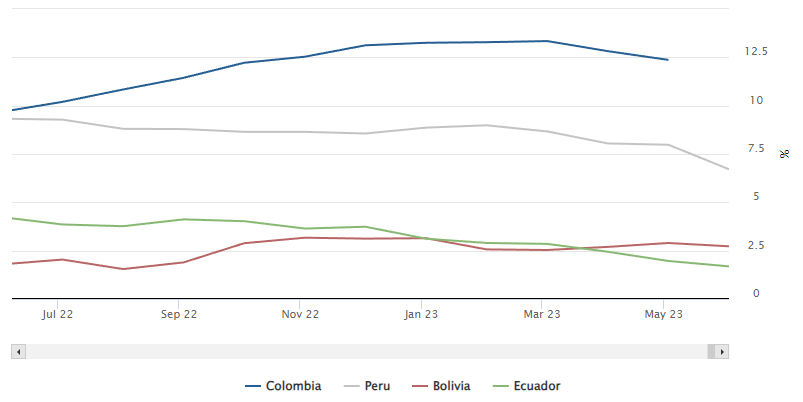
    VENEZUELA | Inflation on the rise again. Venezuela’s central bank (BCV) released new figures on 19 June stating that monthly inflation was 5.1% in May. This was up from the 3.8% monthly inflation recorded in April and broke a three-month period of decelerating inflation since January, when the BCV put it at 42.1%. The BCV does not provide annual inflation figures. The economic think tank Observatorio Venezolano de Finanzas (OVF), which publishes its own inflation estimates, has calculated monthly inflation in May to be 2.5 percentage points higher than the BCV’s figure, at 7.6%, which it said brings annual inflation to 458%.

    Andean countries: inflation rate
    Percentage variation (year-on-year)

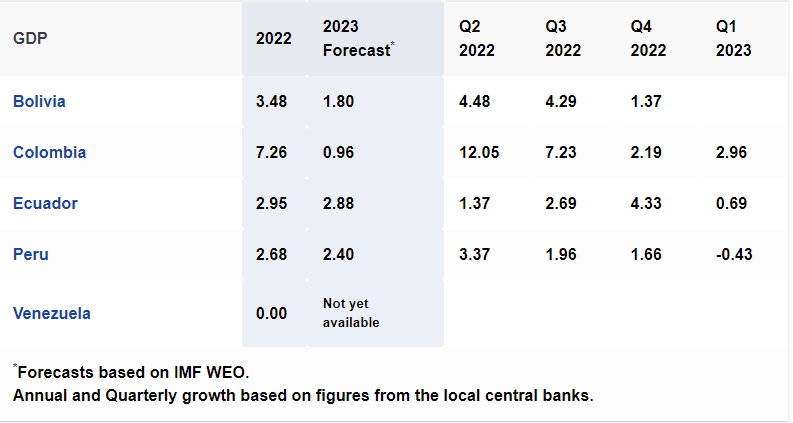
    Andean countries: GDP growth (%)
    Quarterly figures are year-on-year growth

  • HONDURAS: Proposed prison draws criticism

    Abbi Dicker 02 August 2024 Hits: 2009

    In June Honduras’ leftist Partido Libertad y Refundación (Libre) government led by President Xiomara Castro announced 14 emergency measures to further tackle insecurity, following on from its declaration of a state of emergency back in November 2022 to crack down on extortion and gangs, which had already drawn concern [SSR-24-01]. One of these measures is proving particularly controversial – the proposal to move on the construction of a maximum-security penal facility on Islas del Cisne (Swan Islands), a chain of three islands located in the north-western Caribbean Sea, which would house 2,000 inmates. The initiative has sparked criticism over human rights and environmental concerns.

    Having first announced the proposed prison in April 2023 following a series of deadly clashes in the country’s maximum security prisons [SSR-23-06], on 15 June, the government unveiled a series of new security measures which included the stipulation that the bidding process for its construction must begin in no later than two weeks. On 4 July Honduras’ natural resources & environment minister, Lucky Medina, then confirmed that the government had authorised the environmental licence to construct the prison on the islands, which in 1991 were declared a national marine park, and which are some 250km from the mainland and form part of the national system of protected areas (SINAPH).

    Ahead of Medina’s announcement, Honduras’ human rights ombudsman’s office (Conadeh) issued an alert in June, warning of the potential risk of serious human rights violations facing future inmates of the proposed penal colony. It highlights the lack of accessibility to the facility, warning that this could prevent families from visiting their incarcerated relatives, as well as hindering access by judges and other judicial officials. This issue was also raised in an April meeting by the United Nations (UN) Committee Against Torture (CAT), which warned that “it would be impossible for public and private defenders to visit such a facility” and questions whether “the consequences of this plan [had] been assessed.”

    The move has also provoked outcry from environmental groups which highlight the unique biodiversity of the islands which, due to their distance from the mainland, have yet to be extensively studied. A 12 July statement by Honduras’ national public university, Universidad Nacional Autónoma de Honduras (UNAH), for example, highlights that constructing a maximum-security prison is “a major intervention” with environmental impacts not just limited to construction, but issues of supplies and waste management, among other things. It notes that the islands are home to fragile ecosystems and unique biodiversity, underlining in particular, 29 species of coral, 65 species of bird, six species of reptile and 54 species of fish found on the islands.

    Homicides

    The Castro administration’s continued pursuit of repressive security measures comes as it has nonetheless claimed progress on reducing violence. At the start of the year, the government claimed that homicides in 2023 totalled 3,030, which it said was 631 less than in 2022. This translates into a rate of 31.09 homicides per 100,000 inhabitants, down from 38.14 per 100,000 in 2022. Nonetheless, the country has among the highest homicide rates in Latin America and the Caribbean, and the highest rate in the sub-region.

    Other measures

    The 14 emergency measures announced on 15 June include plans to construct a 20,000-capacity ‘mega prison’ between Olancho and Gracias a Dios departments, and calls for the ministries of security and defence, the armed forces (FFAA), and military police (PMOP) to plan and execute interventions in municipalities with the highest incidence of gang-related crimes. Other measures include calls for the legislature to amend the criminal code to classify gang members as terrorists, and reform the criminal procedural code to allow pretrial detention for those who commit such crimes. As with the state of emergency first declared in November 2022, the government’s pursuit of a more repressive security policy has met with alarm from the foreign community, most recently drawing criticism in July from Alice Shackelford, the UN representative in Honduras, and Isabel Albaladejo, the local representative of the Office of the UN High Commissioner for Human Rights (OHCHR). 

  • Is Latin America ready?

    Abbi Dicker 16 May 2025 Hits: 2673

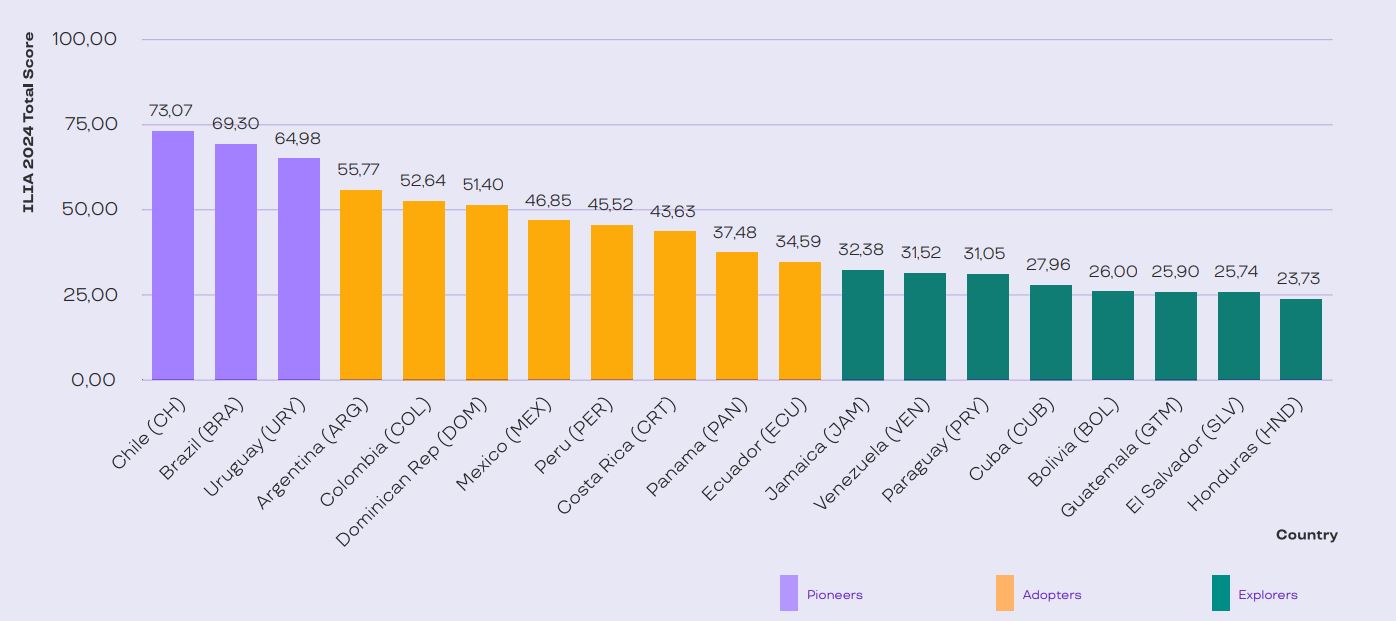
    In 2023 and 2024 a research team formed by Chile’s National Centre for Artificial Intelligence (CENIA) and the UN’s Economic Commission for Latin America and the Caribbean (Eclac) began publishing an annual Latin America Artificial Intelligence Index (known by its Spanish acronym ILIA) covering 19 of the region’s countries. The ILIA is intended to measure readiness to adopt AI. Countries are given a score on a range from zero to 100, with the higher scores designating higher levels of preparedness.

    In the 2024 ILIA Chile obtained the top spot with 73.07 points, followed by Brazil (69.30) and Uruguay (64.98). These three countries are described as AI pioneers in the region. A second group of countries were described as ‘adopters’ and includes Argentina (55.77), Colombia (52.64), and Mexico (51.40). The report says that on average over the last eight years LAC has doubled its AI talent concentration within the workforce but still lags when compared to the global north.

    The pioneer group stands out because of its better performance in three critical areas, namely enabling factors; research, development and adoption; and governance. CENIA-Eclac says the pioneers “have not only made progress on implementing AI-based technologies but are also orienting their national strategies towards the consolidation and expansion of these technologies in all sectors of their economy and society”. Chile, Brazil, and Uruguay are also praised for creating a “conducive environment” fostering “research, development, and adoption of relevant technologies.”

    Latin America AI Readiness index

    Source: ILIA (Indice Latinoamericano de Inteligencia Artificial). 2024. Latin American Index of Artificial Intelligence 2024.

    Looking at recent patterns of AI development in LAC, the report established that Brazil, Chile, Uruguay, and Mexico are ahead of the field in research, development, and adoption. In terms of AI infrastructure, the leaders are Uruguay, Chile, and Costa Rica. Looking at data availability Brazil and Uruguay stand above the rest. In terms of a generally supportive background the two most industrialised economies, Brazil and Mexico, have better rates of patenting, more high-tech workers, unicorn companies, and the manufacturing of cutting-edge technology. Looking at regulation, Chile is seen as a leader in the adoption of AI regulation in “an ethical and responsible way”.

    Aisén Etcheverry, Chile’s minister for science and innovation, who was present at the launch of ILIA 2024 highlighted the intensity of change associated with AI. She said “Soon those who will be voting are not going to get information door-to-door or from what they read in formal media outlets, but instead from social media content. For young people the future they imagine is full of fear about how AI will replace them.”

  • ECONOMIC HIGHLIGHTS

    Abbi Dicker 14 August 2026 Hits: 276

    ECUADOR/COLOMBIA | Electricity exports resumed. Ecuador’s environment and energy ministry announced on 5 August that the country has once again begun receiving electricity imports from Colombia, after electricity transfers were suspended by Bogotá in January amid a trade war between the two countries. Ecuador’s government announced that it was planning to import 288 megawatts from Colombia on 5 August, which would cover 6.2% of Ecuador’s daily energy needs. It said that this electricity was being purchased at US$0.33 per kilowatt hour (kWh), which it said was “approximately 67% lower than in previous operations, when the price reached US$0.99 per kWh”. The statement added that the electricity transfer agreement enables “the exchange of energy when this is convenient for the operation of the [electricity] system, guaranteeing the operational security of electricity grids and respecting the conditions of availability in each nation”. Droughts in both countries have caused drops in hydroelectricity production in recent years, with Ecuador particularly affected.

    PERU | Trade surplus widens. Peru’s central bank (BCRP) released figures on 22 July showing that the country registered a trade surplus of US$3.47bn in May, up from US$3.17bn in April and US$1.96bn in May 2025. Exports in May totalled US$9.42bn, up 38.9% year-on-year, while imports totalled US$5.94bn, up 23.2%. The increase in exports was driven by traditional products, which grew by a combined 52.2% year-on-year, mostly due to growth in mining exports (+54.4%) and oil and gas exports (+63.4%). Exports of traditional agricultural products were also up by 7.2%. Meanwhile, non-traditional exports fell by 2.3% year-on-year.

    COLOMBIA | Gas discovery. On 3 August Colombian state oil firm Ecopetrol and Brazilian state oil company Petrobras have announced a new natural gas discovery in the GUA-OFF-O block off the Colombian coast. In a joint statement, they said that the exploratory Sandía-1 well is located some 42km offshore at a depth of 1,285m, in the vicinity of three other wells – Sirius-1, Sirius-2, and Copoazu-1. Ecopetrol holds a majority share of 55.6% in the GUA-OFF-O joint venture, with Petrobras holding the remaining 44.4%.

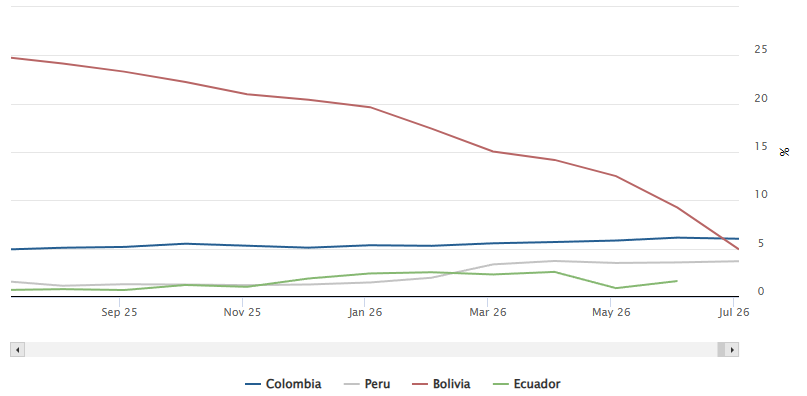
    Andean countries: inflation rate
    Percentage variation (year-on-year)

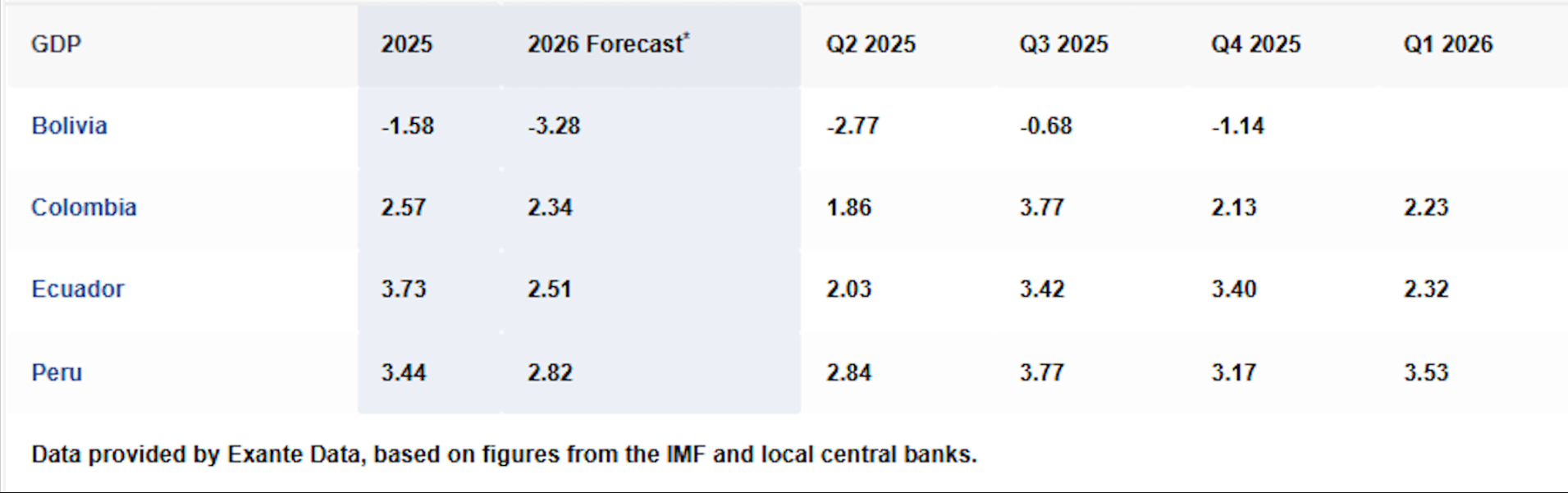
    Andean countries: GDP growth (%)
    Quarterly figures are year-on-year growth

  • PARAGUAY: Referendum will have major electoral impact

    LatinNews 13 October 2011 Hits: 2039

    Paraguayans went to the polls on 9 October to approve a referendum that will have serious repercussions for future elections. They might not have turned out in droves - indeed only 12.5% of the 3m Paraguayans eligible to vote cast their ballots - but voters created the second largest electoral constituency after Asunción: it will lie on foreign soil. Paraguayans living abroad will now be eligible to vote – and they will be courted assiduously by future presidential candidates – assuming congress raises no objections to the referendum. At a stroke the size of the electorate will increase by very nearly 25% to 3.76m.

    The referendum amending the 1992 constitution to grant the vote, and the right to stand for elected office, to Paraguayan expatriates was approved by 78% of those who decided to vote. The referendum was the first such to be staged since Paraguay’s return to democracy in 1993 and only the second in the last 70 years. It must now be approved by congress, but, having allowed it to be staged, it is unlikely deputies or senators would seek to block it now.

    Paraguayans living abroad will be able to vote in general elections from 2013, and the electoral authorities will begin registering them in embassies and consulates abroad. They will also now be eligible to run for the presidency and the vice-presidency, and compete to become national senators or deputies to the Mercosur parliament (Parlasur). A further reform would be required, however, before they could seek to become national deputies, or run for governor or municipal positions.

    Ironically, just over half turned out to vote (some 375,000), than the additional number that will now be added to the electoral roll (over 700,000). The electoral tribunal estimates that there are as many as 722,000 Paraguayan expatriates eligible to vote living abroad, the vast majority (551,000) in Argentina, followed by Spain (87,000), the US (50,000) and Brazil (29,000). Presidential aspirants will now need to appeal to this significant new constituency. This could change the dynamic of the relationship with Argentina, which after Asunción will now be the second largest Paraguayan constituency.

    Setback for Lugo?

    It was the lowest turnout for an election since records were compiled (admittedly this only dates back until 1996). Turnout in the municipal elections last year was 55% and in the 2008 general elections it was 66%.The next lowest turnout was 50%, in the 2006 municipal elections. The poor turnout is a bit of a setback for the government of President Fernando Lugo. While the constitutional amendment will still take effect (there was no minimum threshold required), the low turnout pokes fun at Lugo’s oft-stated objective to increase citizen participation in Paraguayan democracy. As it suggests there is little public appetite for greater involvement

    At least that is one possible reading, favoured by the political opposition. Another reading is that this particular referendum failed to set the public pulse racing because it did not feel very meaningful for those living in Paraguay (although it is a significant number of extra voters who could sway the outcome of an election without ever having to live in the country and feel the effects of government policy). Congress has thwarted the Lugo administration’s efforts to hold referendums which would excite far more interest, such as publicly gauging the performance of congress and the judiciary and, more recently, an attempt by Lugo’s leftist coalition, Frente Guasú, to win approval for a referendum to allow presidential re-election.

    Frente Guasú will be hoping to gain most from the referendum entitling Paraguayans living abroad to vote, on the grounds that some of them are exiles (or their relatives) from the years of the Stroessner dictatorship, although in recent years those leaving the country have been economic migrants whose political affiliations less clear.

    Lugo seeks to crack down on guerrillas

    President Fernando Lugo promulgated a state of exception for 60 days in the northern departments of Concepción and San Pedro on 10 October to track down members of the Ejército del Pueblo Paraguayo (EPP). Congress approved the measure last week.

    Lugo appointed Brigadier General Félix Pedrozo, to head the armed forces deployed to the area and General Aldo Pastore, to head the anti-terrorist police force in the joint military-police task force. Both will sit on the operational command. They will need to improve coordination between the two forces considerably: in May 2010, during the last state of exception declared in five northern departments, soldiers engaged in an intense gunfight with police in Concepción in a botched operation to raid a supposed birthday party of an EPP leader, and little progress was made against the guerrillas.

    “This is a government that closes neither its eyes nor its ears to the real problems the country faces,” Lugo said. The interior minister, Carlos Filizzola, said the armed forces would back up the police, which was in charge of internal security.

    Congress exerted pressure on the Lugo administration for a new state of exception to be declared after two police officers were shot dead in an overnight raid by the EPP on a police substation in Horqueta in Concepción on 21 September. Two days earlier an explosive device was hurled at the state prosecutor’s office in Horqueta.

    Despite these actions, the biggest threat to the Lugo administration in these departments comes not from guerrillas but from a potentially devastating outbreak of foot-and-mouth disease. Paraguayan authorities announced this week that they had vaccinated 27,602 cattle against foot-and-mouth to contain the outbreak, which was first reported on 18 September, in San Pedro [WR-11-38]. They also ordered the culling a week later of 819 infected or susceptible cattle, and applied quarantine measures on farms as well as restricting movement of livestock in the region.

    Beef exports, which reached US$881m last year (not far behind Argentina) played a big part in stellar economic growth figures of 14.5%, have been suspended as Brazil and Argentina banned imports from Paraguay. The last outbreak of foot-and-mouth disease in Paraguay was in July 2003.

    • The expatriate vote

    Paraguay joins six other countries in South America where expatriates are also eligible to vote: Argentina, Bolivia, Brazil, Colombia, Peru and Venezuela. A referendum to allow expatriates the vote in Uruguay won just 37% support in October 2009. Chile’s left-wing opposition Concertación is keen for the vote to be extended to Chilean expatriates because they are predominantly made up of individuals or families who went into exile during the Pinochet dictatorship.

    • Exports

    Fresh, chilled and frozen meat exports in the first half of 2001 totalled US$445.5m, accounting for 16% of Paraguay’s primary-industry exports. Soybean exports led the way over this period on US$1.24bn, according to the industry and commerce ministry.

  • In times of crisis, Rio de Janeiro calls on the army

    LatinNews 16 August 2017 Hits: 1026

    On 28 July, over 10,000 troops once again descended upon Rio de Janeiro state. The troops – sent from the army, the federal highway police (PRF), and the national public security force – have been tasked with tackling rising crime in the state as part of the federal government’s national security plan.

    Rio de Janeiro state residents are already used to the sight of soldiers on the streets. Troops were sent to reinforce security in 2014-2015 in the run-up to the 2016 Summer Olympic Games hosted by the eponymous state capital and to control the outbreak of the Zika virus in 2016. They were also on standby before carnival this year in case the local police force went on strike over poor pay and working conditions. Until now, the federal security forces’ presence in Rio de Janeiro has been short-lived. But this time the federal troops are scheduled to stay in Rio de Janeiro until at least 31 December 2017, under a decree issued by President Michel Temer.

    The federal government has called in the troops after police operations failed to keep crime levels in Rio de Janeiro down. A 2008 initiative to introduce pacification units (UPPs) in the favelas (slums) that surround the state capital initially reduced crime rates in 2009-2014. But by 2015, crime rates started shooting up again. Following a series of human rights abuse cases, relations between police officers and local communities in the favelas began to deteriorate, leading to an increase in violence in these areas.

    Meanwhile Brazil’s ongoing economic crisis has exacerbated long-standing problems within Rio de Janeiro’s state police force. Due to budget cuts, the police forces in Rio de Janeiro have been unable to hire new recruits or pay their existing staff any overtime due to a lack of funds, meaning fewer officers are out on patrol. Nevertheless, sending in federal troops to replace the police is no panacea. Cracking down on crime could provoke a counter-reaction, leading to a ‘war’ between criminal gangs and the security forces, according to the federal defence minister, Raul Jungmann. “Difficult and extraordinary times call for difficult and extraordinary decisions” but people “should not expect miraculous and immediate results”, Jungmann told local news outlet G1 on 27 July.

    At present, the army is one of Brazil’s most trusted institutions. In a recent survey of 2,771 people conducted by Pesquisa Datafolha on 21-23 June, 40% of respondents said they trusted a great deal in the armed forces, compared to just 3% in the presidency and only 2% in political parties. However, it will be interesting to see whether that figure changes the longer the army remains in Rio de Janeiro. Some human rights activists fear the conflicts between the local authorities and favela residents could worsen unless the army builds stronger ties with the local community.

    Crime Rates in Rio de Janeiro

    Figures from Brazil’s public security institute (ISP) show that violent crime in Rio de Janeiro has shot up since 2016. In the first half of 2017, the greatest increase was in ‘autos de resistência’ – when someone dies during confrontation with the police – with 577 cases, up by 45% from the 396 cases recorded over the same period in 2016. The second greatest increase was in ‘latrocínio’, robbery followed by death, up by 21% with 138 cases, whilst homicide has seen the third greatest increase, with a total of 2,718 homicides, up by 10.9% (or 230 victims) compared with the same period in 2016. A total of 91 police officers have also been killed in Rio de Janeiro state since January, more than the total number of police deaths recorded in 2016. Gun crime in general is an increasing problem; Brazilian daily O Globo reported on 28 July that more than 600 people – an average of three per day – have fallen victim to stray bullets so far this year.

    • Doria blags free security equipment in China

    The mayor of the city of São Paulo, João Doria, has secured donations of surveillance equipment from two rival Chinese security technology firms during a recent visit to the city of Hangzhou, the capital of China’s eastern Zhejiang province. Doria persuaded rival firms, Hikvision and Dahua, to donate 1,000 CCTV cameras and a drone each to São Paulo’s ‘City Cameras’ scheme, part of the wider ‘safe city’ programme. Given São Paulo municipal government’s R$7.5bn (US$2.4bn) budget deficit, Doria made it clear that his administration had no choice but to request donations. But the firms were also invited to participate in a public-private partnership with the São Paulo municipal government to provide further public security services.

  • CHILE: Broken retail faces adjustments

    LatinNews 24 January 2020 Hits: 1188

    Chile is facing something of a retail industry melt-down as the upheaval caused by social and political protests enters its fourth month. According to themds.com, a global online fashion business journal, protests and demonstrations have tipped retail sales into a downward spiral with falls of 27% (Hong Kong and Paris, also in the throes of widespread and sometimes violent political demonstrations, are suffering a similar trend).

    Before the protests, Chilean retailers already had a few challenges to deal with.  The economic crisis in neighbouring Argentina had led to a drop in inward tourism and shopping. Physical outlets were also having to respond to the rapid growth of online retailing. The protests made things much worse. Many retail premises were damaged or burnt down. Shoppers stayed away. The estimate of a 27% fall in sales comes from the Santiago chamber of commerce (CCS). Visits to shopping malls plummeted by 28% from 15.7m a year to 11.3m a year. A pre-Christmas survey carried out by consultancy Deloitte found that 61% of respondents – up from 43% before the protests began – expected to reduce their spending in the holiday period.

    International pharmacy chain, Walgreens Boots Alliance, reported a 2.7% global fall in fourth quarter 2019 retail sales, partly attributed to Chile where its Farmacias Ahumada retail subsidiary is considering more closures and staff reductions. Chilean chain AD Retail has sought bankruptcy protection. US supermarket giant Walmart said over 130 of its Chilean stores were burnt.

    However, some see opportunity amid the crisis: Colombian low-cost supermarket chain, Justo y Bueno, says it plans to begin operating in Chile this year. The Deloitte research suggests Chilean consumers may now be relying more on neighbourhood stores and less so on the big malls. Universidad de Chile retail expert, Marcel Goic, says companies will have to adjust to operating in a society that has become less disposed to make concessions and, in some ways, less consensual. He suggests that one defensive response will be for retailers to try and build better relationships with their local communities. In 2020 they will have to rebuild and reposition their shops; he sees the market outlook as remaining uncertain.      

  • BOLIVIA: Major gas discovery likely to ease export difficulties

    Patrick de Courcy 10 February 2022 Hits: 4492

    Bolivia’s President Luis Arce announced the successful drilling of a major gas well on 5 February, which he said would add an additional US$260m to the treasury in royalties each year. The well, in the Margarita-10 gas field that straddles the departments of Tarija and Chuquisaca and is jointly operated by Spanish company Repsol and Bolivia’s state-owned Yacimientos Petrolíferos Fiscales Bolivianos (YPFB), contains an estimated 300-350bn cubic feet of natural gas. It will go some way towards reviving the fortunes of the gas sector, which has been struggling to meet export quotas to Argentina.

    Bolivia’s natural gas sector has been in steady decline in recent years, with production in 2021 coming in at approximately 45m cubic metres per day, down from a peak of 61m cubic metres per day in 2014, according to YPFB. YPFB’s president, Armin Dorgathen, said that the new well at Margarita-10 will boost production by 3m cubic metres per day once operations commence in June, making it Bolivia’s largest source of natural gas.

    That should succeed in relieving some of the pressure on Bolivia’s export capacity, amid ongoing efforts to renegotiate the country’s gas export contracts to Argentina. Bolivia has endeavoured to reduce its cross-border gas provision over the southern hemisphere winter in order to prioritise the domestic market. The latest discovery at Margarita-10 is unlikely to significantly change the long-term downwards trajectory of Bolivian gas production, but it should at least stabilise the sector for the coming year by enabling YPFB to meet its export quotas.

    La Paz governor arrested

    Santos Quispe, the governor of La Paz department, was arrested on 2 February and charged with misuse of state funds, after being found in his office surrounded by empty beer cans, and video footage showed him apparently struggling to stand up. Quispe, who represents the left-wing populist Jallalla party, claimed that the cans had been “planted” by political rivals seeking his removal from office, but he refused to take a breathalyser test. On 4 February, a judge subjected Quispe to pre-trial house arrest between 9pm and 7am and temporarily forbade him from drinking. Quispe is permitted to continue in his role as governor ahead of his trial, but he must now face down calls for his impeachment.