All Categories

Subcategories

  • ECUADOR: Correa chalks up milestone with campaign rally

    LatinNews 19 January 2017 Hits: 877

    President Rafael Correa marked his 10th anniversary since coming to power on 15 January with a special event in Guayaquil, Ecuador’s port city and business hub, that doubled as an electoral campaign rally for the ruling left-wing Alianza País (AP). Correa was accompanied on stage by Lenín Moreno, the AP’s presidential candidate, and Jorge Glas, his running mate who began a brief leave of absence as vice-president on 5 January in order to stand for election.

    In a 45-miunte address to a crowd of supporters in Guayaquil, President Correa gave an impassioned defence of the economic and social achievements of his Citizens’ Revolution, especially in the face of serious challenges over the last two years. Correa said he would leave office in May confident that he was handing over a stable economy despite a quadruple whammy in the form of sustained low oil prices; the appreciation of the US dollar; a devastating coastal earthquake in April last year; and the necessity to fork out US$1.1bn in the last six months to foreign oil firms after adverse rulings in international courts.

    “Oil revenue has been barely one-fifth of central government revenue, when before it was half, and in the last two years it has been zero,” Correa said. “In the last two years, exports have plummeted by almost 40%, unprecedented, almost US$10bn in losses. For the first time since Ecuador began exporting oil instead of receiving funds from the state oil companies Petroamazonas and Petroecuador the government has had to give them US$1.6bn to stave off bankruptcy,” he went on.

    “Many suspected that the economy would collapse,” Correa said. “But not only did the economy not collapse, it is showing important signs of recovery and all of this without the paquetazos [shock economic reform policies] that, in the face of far less than we have had to confront, the parties of yesteryear, the governments of the ‘old country’ used to give us.” Correa said he would bequeath his successor a stable economy predicted to grow by 1.4% in 2017. “Ecuador has overcome recession with a minimal cost and in record time,” he said.

    Moreno picked up the baton from Correa, applauding the government’s social welfare policies, in particular alleviating poverty. Moreno said that if he were to win election on 19 February he would concentrate on tourism, agroindustry, and youth employment. Moreno also stressed that “We have offered what we can fulfil…250,000 jobs a year, which would mean full employment within two years, because a candidate that is going to win has to deliver or sooner or later he will be taken to task. A candidate who is going to lose can offer whatever he wants…such as generating 1m, 2m, 3m jobs,” a clear allusion to Guillermo Lasso, the presidential candidate for the opposition Movimiento Creo (Creando Oportunidades) running second in the opinion polls. Moreno added that reducing taxes (a major Lasso campaign proposal) was “irresponsible” as they were essential to maintain teachers, judges, doctors and other professionals.

  • NICARAGUA: Ortega slams Colombia following ICJ ruling

    Patrick de Courcy 31 May 2022 Hits: 2147

    Nicaraguan President Daniel Ortega has said that Colombia doesn’t want to accept an international ruling on maritime activity in disputed waters in order to “keep trafficking the drugs they take to Europe and the US”.

    Ortega made the comments on 5 May following the 21 April ruling by the International Court of Justice (ICJ) at The Hague, which ruled that Colombia must “immediately cease” its efforts to control maritime activity in disputed waters off the Colombian archipelago of San Andrés and Providencia. The ICJ ruled that the waters are part of Nicaragua’s exclusive economic zone (EEZ), although its decision does not change the map of either country’s territory.

    Speaking at an official event in Managua, Ortega said that Colombia is “the world’s biggest producer of drugs,” and “that’s the best business that the Colombian government has.” Colombia is a “narco-state”, said Ortega, and hailed what he said were successful anti-trafficking efforts by Nicaraguan security forces. Colombian President Iván Duque responded to Ortega on 5 May, vowing to continue to defend his country’s sovereignty and calling his Nicaraguan counterpart a dictator.

    Some analysts such as Wilder Alejandro Sánchez of US-based consultancy Second Floor Strategies, consider the verdict represents a “defeat for Colombia”, as he outlined to US state-owned radio broadcaster Voice of America on 22 April, because it says the country violated Nicaragua’s sovereignty. “This will affect Colombia’s international image negatively as Nicaragua can obviously now say that even an international court agrees that Colombia has violated Nicaraguan maritime sovereignty,” he said.

    The latest ICJ verdict follows a previous ruling in November 2012 which saw Colombia maintain sovereignty over the archipelago, but lose some 75,000km2 of sea to Nicaragua [SSR-12-11]. Colombia rejected that ruling, however and the latest ICJ case relates to Colombia’s violation of those new territorial boundaries. Since 2012 both countries have filed complaints about the other alleging rule breaking in the area. Despite the latest ruling it appears that the dispute will rumble on, as fishermen based in the archipelago will not want to stop fishing in areas that they have traditionally been able to use.

  • CHILE: Communist minister faces teachers’ strike challenge

    Patrick de Courcy 31 August 2023 Hits: 2685

    Around 5,000, or 37%, of Chile’s 13,500 state schools were closed on 29 August, marking the beginning of an indefinite teachers’ strike. The stoppage, involving over 100,000 teachers, is both a challenge and a political opportunity for Nicolás Cataldo, appointed only days earlier as the country’s first-ever education minister who is also a member of the Partido Comunista de Chile (PCCh).

    Cataldo was appointed only 13 days before the start of the strike. The teachers’ union, Colegio de Profesores, has an eight-point list of demands that includes timetable improvements, a reduced workload, payment of wage differentials, government action to reduce school violence, a change in the school funding model, and payment of delayed retirement bonds.

    Also on the list is the thorny issue of the ‘historic debt’ owed to teachers. This relates to a decision in 1981, during the military dictatorship, to transfer responsibility for public education from the national government to the municipalities, which meant that teachers were excluded from mandated public sector wage reviews.

    In his election campaign, President Gabriel Boric promised to do something about this historic debt. Considering backdated interest charges, the sum owed is so large that payment in full is unlikely. The union recognises this, saying it is looking for “reparations” instead.

    The new minister made a positive start to the job. He was able to negotiate an end to a 21-day strike by some 9,000 nursery and kindergarten workers at the state-run Fundación Integra. He secured agreement from six out of seven unions for a plan to reduce disparities in pay and conditions which will start to be implemented in November. The agreement also enables Integra to start hiring new workers.

    Initial negotiations between Cataldo and the Colegio de Profesores did not produce a breakthrough but as this issue went to press there were indications of progress and a possibility that the strike could end in a matter of days. According to union sources, Cataldo was updating a formal document setting out the government proposals. The union leadership was planning to put the document to the membership for a decision on whether to continue the stoppage or to return to work pending final resolution of the dispute.

    If Cataldo does succeed in getting schools re-opened relatively quicky then it will build his reputation as an effective negotiator, and perhaps deflect some of the hostility of the right-wing opposition. In the lower chamber of congress, Marcia Raphael from the right-of-centre opposition Renovación Nacional (RN) said that having a “militant communist” in the ministry of education was “very bad news”.

    Raphael also claimed that it was ironic that Cataldo was facing demands to reduce school violence since it was his own PCCh that had “introduced and promoted violence”, particularly in the better-known secondary schools.

    In response to this criticism, Cataldo told the national daily La Tercera that “having a minister from the PCCh doesn’t mean we’ll start reading Marx and Lenin in schools”. In fact, Cataldo, a history professor from Universidad de Valparaíso who held various government positions during the second left-wing presidency of Michelle Bachelet (2014-2018) and in the Boric administration, has established a reputation for his ability to work with political opponents when the need arises.

    Boric and Cataldo’s career paths have crossed at various points. The two men are not particularly close in personal terms but do share a relationship of trust. The political significance of the relationship comes because Boric, without a majority in congress, has been struggling to cope with an emboldened and aggressive right-wing opposition and is looking for ministers described as “strong but also pro-dialogue”.

    Cataldo

    Jaime Bellolio, a presidential spokesperson during the second right-wing administration of Sebastián Piñera (2018-2022), has described Cataldo as a warm and sympathetic personality “not someone who starts out with the typical Communist party speech”. According to Bellolio, Cataldo was prepared to listen “even though we disagreed on practically everything”. Cataldo is also said to have earned respect because he is reputed to answer all his telephone and WhatsApp calls.

    Problem over land seizures

    Contrasting with a potential breakthrough in the teachers’ strike, the ruling left-of-centre coalition once more showed itself to be accident-prone during a congressional discussion of new legislation on illegal land seizures on 29 August.

    The proposed law is part of the ‘fast tracking’ of security measures agreed by the government and opposition parties and managed by the interior minister, Carolina Tohá. With Tohá and other key government figures absent from the lower chamber of congress, and members of the ruling coalition disagreeing amongst themselves, all the right-wing amendments to the bill were approved. They included a controversial clause allowing civilians to evict land invaders at any point, invoking the principle of “legitimate defence”.

    Members of the ruling coalition had opposed the idea because they were concerned that it could give rise to vigilante groups illegitimately taking the law into their own hands. But they were unable to vote in a coordinated manner. In three out of five amendments the opposition view prevailed because members of the Partido Comunista de Chile (PCCh) and the Frente Amplio (FA), Acción Humanista (AH), as well as various members of the Partido Socialista (PS), abstained.

    An amendment proposed by the ruling coalition to limit the punishment for non-violent land seizures to the payment of fines was comprehensively defeated by 111 to 24 votes and six abstentions.

    Jaime Araya, an independent deputy within the Partido por la Democracia (PPD), said he had been given voting assurances that were then ignored, adding: “They voted against what was agreed. You expect a minimum level of loyalty, of decency to keep to what was promised, and to stop making us look ridiculous.”   

  • TRACKING TRENDS

    Patrick de Courcy 12 October 2023 Hits: 2042

    BRAZIL | Inflation rises in September. Monthly inflation for September rose by 0.26%, marking the third consecutive month that inflation had risen, the national statistics institute (Ibge) reported on 11 October. The accumulated inflation rate for the 12 months until September came to 5.19% and annual inflation for January-September 2023 came to 3.50%.

    Private sector analysts consulted by Brazil’s central bank (BCB), whose forecasts are released in the BCB’s weekly Focus bulletin (last published on 9 October), predicted that inflation this year would close at 4.86%. This suggests that the analysts expect inflation to slow down in the final quarter of 2023 compared with the third quarter.

    Inflation in September was mainly driven by the rising cost of gasoline, which increased by 2.80%. Of the nine categories of products and services measured for the consumer price index, the transport category, in which gasoline is included, registered the highest inflation rate with 1.40%. This was followed by housing (0.47%) and personal spending (0.45%).


    BRAZIL | Proposed laws against pyramid schemes. The lower chamber of Brazil’s congress concluded a committee inquiry (CPI) on 9 October which investigated financial pyramid schemes that allegedly took place between 2019 and 2022, especially focusing on investments in cryptocurrency. In a unanimous vote, federal deputies on the committee approved the inquiry report detailing the main findings from the CPI, which officially opened proceedings on 13 June.

    According to the CPI’s president Aureo Ribeiro, of the centre-left Solidariedade party, more than 3m Brazilians have been affected by pyramid schemes in recent years. In the report, the CPI proposed a package of legislative initiatives to tighten regulations and punish financial crimes, as well as recommending legal action against 45 individuals and companies implicated in such schemes.

    The CPI suggested updating existing laws against financial crimes to set a 6-10 year prison sentence for perpetrating pyramid schemes and an 8-12 year sentence for pyramid schemes involving cryptocurrencies. Other proposed initiatives covered tighter regulations on air miles programmes in the travel and aviation sectors; on the advertising of cryptocurrencies carried out by online influencers; and on the transfer of virtual assets.

  • ECONOMIC HIGHLIGHTS

    Abbi Dicker 23 February 2024 Hits: 3175

    PARAGUAY | First international bond issuance in local currency. Paraguay’s President Santiago Peña said on 6 February that the country had “made history”, with its first ever issuance on international markets of bonds in the local currency (guaraní), worth US$500m. According to an official statement, Peña said that bonds were issued for US$1bn of which half were issued in local currency. He said that demand for both the bonds issued in local currency and in US dollars exceeded US$5bn. The bonds issued in local currency have a coupon rate of 7.9% and are due to mature in seven years while the bonds issued in US dollars have a 6% coupon rate and mature in 12 years. Peña and his economy & finance minister, Carlos Fernández Valdovinos, said that the response showed “confidence in our currency and in the policies implemented by the government.” According to the government, the funds obtained through the sale of the bonds will be used to finance public works earmarked in the 2024 state budget and to repay debts with creditors inherited from the previous government, among other things.

    BRAZIL | Oil and gas production rises in 2023. Brazil’s state-controlled oil company Petrobras announced on 26 January that it met annual production targets last year with an average output of 2.78m barrels of oil equivalent per day (boepd) in 2023. This total production figure for oil and gas marks a 3.7% increase compared to 2022. Oil and gas output from the pre-salt deposits hit new records, with 2.17m boepd, making up 78% of total production. Petrobras highlighted strong results from four floating, production, storage and offloading (FPSO) units located in offshore deposits near Brazil’s south-eastern coast: Almirante Barroso, Sepetiba, Anna Nery, and Anita Garibaldi. The combined daily production figures of these four FPSO facilities reached 480,000 boepd of pre-salt oil and gas at peak periods last year. Meanwhile, overall oil and gas production in Brazil also reached new records, according to the Agência Nacional de Petróleo, Gás Natural e Biocombustiveís (ANP), which on 2 February informed that 2023 production grew 11.7% year-on-year to 4.34m boed, with 3.4m barrels per day of oil specifically.

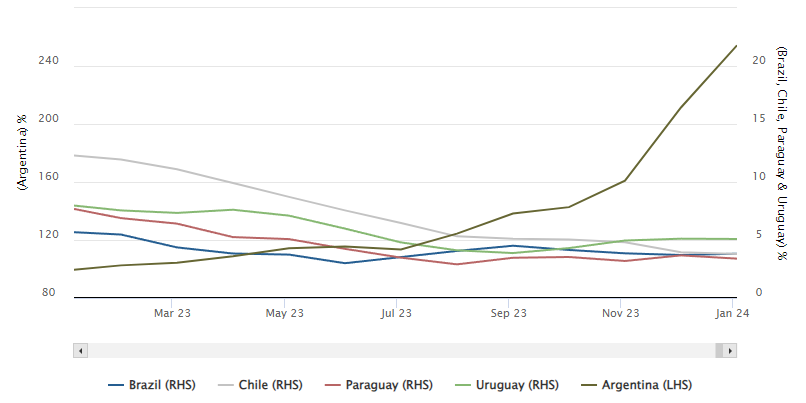
    Brazil & Southern Cone: inflation rate
    Percentage variation (year-on-year)

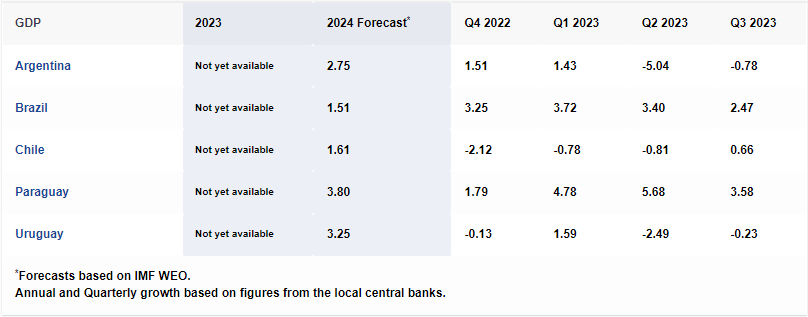
    Brazil & Southern Cone: GDP growth (%)
    Quarterly figures are year-on-year growth


  • ECONOMIC OVERVIEW: GUATEMALA

    LatinNews 10 July 2013 Hits: 1779

    Petrocaribe: On 2 July Guatemala’s Vice-President Roxana Baldetti said that the government was analysing the possibility of Guatemala signing up to Petrocaribe, Venezuela’s oil trading scheme, on the condition that interest rates charged are less than 2%. Under the initiative, Venezuela offers oil to the scheme’s 17 members on concessionary terms, whereby members pay 40% at market rate within 90 days and the remaining 60% spread over 25 years at an interest rate of 1%, as long as oil prices are over US$100/b. When oil prices fall below US$100/barrel, the conditions are tightened, so that 50% is demanded upfront. However, both Guatemala and Honduras – which Venezuela’s President Nicolás Maduro announced on 5 May at a Petrocaribe summit in Caracas that would now be included in the scheme – claim that the Venezuelan government has doubled interest rates to 2%. Guatemala had signed up to Petrocaribe in 2009 under the Alvaro Colom administration (2008-2012), but it ultimately failed to ratify the agreement amid last minute differences with Venezuela over its terms and conditions. Honduras first signed up to Petrocaribe in December 2007 under the former president, Manuel Zelaya (2006-2009), but was suspended after Zelaya was ejected in a coup in June 2009. The change in interest rates was notably not mentioned in the final statement issued at the most recent Petrocaribe summit, held in Managua, Nicaragua, on 29 June. What did come out of the Managua summit, however, was the possibility of boosting trade between Petrocaribe members in regional transportation, communication, agriculture, tourism and social service projects although specifics were not provided.

    Tax setback: Guatemala’s President Otto Pérez Molina has admitted defeat over a key initiative – tax reform. On 14 June, the unicameral 158-member legislature approved a presidential decree halving the Impuesto Sobre Circulación de Vehículos (ISCV), vehicle tax. The tax, which the Pérez Molina government hoped would generate some Q1.2bn (US$53.45m) annually, was part of a reform package passed in February 2012 [RC-13-03]. However the influential private sector lobby, the Comité de Coordinación de Asociaciones Agrícolas, Comerciales, Industriales y Financiera (Cacif), has since challenged various provisions of the package before the constitutional court. The resultant uncertainty led Vice-President Roxana Baldetti to remark that the government would have to revise its projected tax take for 2012 of Q$49.1bn (US$6.3bn) in view of the change.

    Remittances: According to figures from Guatemala’s central bank (Banguat), family remittances sent by Guatemalans living abroad (most of whom live in the US) amounted to US$2bn in the first five months of 2013. The total for 2012 was a record US$4.78bn, up from US$4.38bn in 2011.

  • TRINIDAD & TOBAGO: PP face more difficulties

    LatinNews 06 November 2013 Hits: 2259

    The ruling People’s Partnership (PP) and its main constituent party, the United National Congress (UNC) are going through a torrid time, with the UNC suffering its fourth electoral defeat this year in the St Joseph by-election. Some of the blame can be attached to the fall-out with former minister Jack Warner, who has been taking votes away from the ruling coalition with his Independent Liberal Party (ILP), but Warner has not made as much progress as he would have liked since his triumph in the Chaguanas West poll in July. The UNC and the PP now have 18 months to return to electoral favour before the next general election in 2015.

    The first defeat of the year for the PP came in the January Tobago House of Assembly election, in which the PP coalition partner – the Tobago Organization of the People (TOP) – was humiliated by the main opposition People’s National Movement (PNM) which won all 12 seats. This was followed in July by the highly embarrassing loss of Chaguanas West to the supposedly disgraced Jack Warner and his newly formed ILP.

    It was this backdrop that gave the 21 October municipal elections and the 4 November St Joseph by-election added significance, and the possibility of the ILP splitting the UNC vote that made forecasting the results particularly fraught.

    The PNM duly triumphed in the local elections, winning eight of the 14 corporations, but the ILP did not make the progress it predicted. The PP held five corporations, leading Prime Minister Kamla Persad-Bissessar to proclaim: “The UNC has retained its base”.

    The ILP, by contrast, failed to win any corporations and won only two of the eight seats in the Chaguanas borough (the other six being split equally between the PP and the PNM). As importantly, only one corporation was won by the PNM as a result of the ILP stripping away votes from the PP.

    An analysis of the results by local expert Nigel Henry showed that in fact the ILP took more or less as many votes from the PNM as from the PP. According to Henry: “When compared against the 2003 local government election results, which were nearly identical to this year’s results in terms of the district-level outcomes, the PNM lost 11 points from 53.3% in 2003 to 42.2% this year. The United National Congress (UNC)/National Alliance for Reconstruction (NAR) accommodation lost 12 points from 46.4% to 34.5% this year for the PP. This means that each party or coalition contributed roughly equally in terms of historical supporters to the ILP’s 23% support in 2013.”

    The failure of the ILP to make much of an impact, particularly in Chaguanas, led ILP chairman Robin Montano to say: “The results show the country has retreated to tribalism…so we have failed. It’s clear from the results we didn’t win. But we’ll try again tomorrow.”

    If by “tomorrow” Montano meant in the St Joseph by-election on 4 November, he was to be disappointed there as well. The St Joseph seat has traditionally swung between the PNM and the UNC. The UNC first took the seat from the PNM in 1986, lost it in 1991, then held it from 1995-2007 before reclaiming it in 2010 with the since-defected Herbert Volney as its candidate.

    The UNC went into the by-election with host of the popular local TV show, Crime Watch, Ian Alleyne as its high-profile candidate, and it ran a campaign based on the importance of erstwhile UNC supporters not splitting the vote by voting for the ILP and thus enabling a PNM victory. The PNM retaliated with various legal challenges to the UNC’s “split vote” advertisements (which purported to be a thank you from opposition leader Keith Rowley to ILP leader Jack Warner) and to the use by Alleyne of the Crime Watch theme tune at his political meetings.

    A further legal challenge was mounted when the opposition asked the Integrity Commission to look into the use of state resources for projects in St Joseph. The PNM complained about “vicious manipulation” of state resources which was “ultimately to the detriment of the people, particularly when the works and projects are being done at the very last minute and solely for the purpose of winning an election”.

    On the day of the election, one local commentator noted: “Today’s decision will either see the UNC retaining the marginal seat; establish the ILP as a major force with a firmer footing in the political landscape; or, like the results of last month’s elections, signal the resurgence of the PNM.”

    In the event, it was the latter outcome that prevailed on a 53% turnout. The PNM candidate, Terrence Deyalsingh, won with 6,356 votes to the Alleyne’s 5,577 for the UNC. The ILP candidate took 1,976. This is not all bad for the PP/UNC. First of all, the result still leaves the PP with a very comfortable 27 seats in the 41-seat House of Representatives against the PNM’s 13. Secondly, the winning margin was just 779 votes. And, thirdly, the ILP is clearly not making much headway, although it is clearly still a nuisance as less than half of its votes would have made the difference between winning and losing for the UNC.

    Although it didn’t seem to make any difference in Chaguanas West, one of the ILP’s problems may be that the corruption allegations against Jack Warner are not going away. In the latest move, on 20 October the Equality Council of Trinidad & Tobago wrote to the Integrity Commission demanding an investigation into Warner’s tax affairs after a local newspaper claimed he had failed to disclose tens of millions of dollars in cash gifts. Warner, however, remains defiant about the corruption allegations and upbeat about the ILP, describing the setback in St Joseph as a “growing pain”.

    For its part, the PNM is clearly in no mood to let the question of the improper use of state resources by the UNC candidate rest. After his victory, the PNM’s Deyalsingh said that he planned to continue with the 25 projects secured from the government by Alleyne. He added, mischievously, that he was also going to request mobile phone numbers for the government ministers involved in agreeing the projects. He said: “Apparently it is easy to get things done now, you just have to call a number. I want all their cell numbers to get things done.”

    More seriously, PNM leader Rowley said he would be pressing on with his complaints about government’s actions with the Integrity Commission. He said: “This government has thrown every single thing at its opponents in this election. The government has misbehaved once again, it has broken the law and has disgraced itself.”

    Rowley also questioned why the government had handed out money over the weekend before the election to people purported to have been affected by floods in the Aranjuez area. He said: “We can’t recall when that flooding took place in Aranjuez and why it wasn’t dealt with before. That has to be wrong.” It looks set to be a long and dirty road to the 2015 general election.

  • CHILE: Bachelet’s authority tested

    LatinNews 06 February 2014 Hits: 1437

    With just over a month until president-elect Michelle Bachelet takes office, her authority has already come under question in relation to education – a key electoral issue. While Bachelet’s selection of a veteran politician, Nicolás Eyzaguirre, as her education minister [WR-14-04] prompted grumbling from students, her choice of education consultant, Claudia Peirano, as Eyzaguirre’s deputy, proved so unpopular with the students and radical members of her Nueva Mayoría alliance that a week later Peirano announced she would not take up the post. This underscores the difficulty Bachelet will face in keeping the Nueva Mayoría united once she takes office.

    The appointment of Eyzaguirre, a member of the Nueva Mayoría’s Partido por la Democracia (PPD) and a former finance minister under Ricardo Lagos (2000-2006), was well received by teachers’ unions like the Colegio de Profesores, but it prompted complaints from student leaders such as Melissa Sepúlveda, the president of the Federación de Estudiantes de la Universidad de Chile (Fech), who questioned his background in finance rather than education.

    However Peirano’s appointment, announced on 30 January, sparked an outcry. Peirano, who is closely associated with Democracia Cristiana (DC), the Nueva Mayoría’s most centrist party (although she is not officially a card-holder), owns a consultancy firm which provides services to a network of private colleges owned by her former husband, Walter Oliva. While this raised concerns about a possible conflict of interests, her commitment to Bachelet’s proposed education reform was called into question in light of a letter she co-signed, which was published in the national daily El Mercurio in 2011, against free higher education.

    A former Fech leader, Camila Vallejo, who is due to take up a legislative seat for the Nueva Mayoría’s Partido Comunista (PCCh) in March, slammed the appointment, as did other former student leaders and deputies-elect, Gabriel Boric (Izquierda Autónoma) and Giorgio Jackson (Revolución Democrática). This prompted Peirano to announce on 4 February that she would not take up the post. While Peirano has since been replaced by a less controversial choice - Valentina Quiroga, a member of Bachelet’s campaign team and a former director of the non-profit education foundation, Política Educativa de Educación 2020 - members of the outgoing Coalición por el Cambio have been quick to flag up the episode as the first major setback for Bachelet and indicative of the power wielded over the president by the Nueva Mayoría’s less moderate members.

    • HidroAysén – another challenge

    Aside from education, the HidroAysén mega-dam project could also pose problems for the incoming Bachelet government. On 30 January, after a meeting with a special ministerial committee, Energy Minister Jorge Bunster announced more studies were needed on the project, which involves building five dams in Aysén (Region XI). The committee found that two out of the 35 discussion points required additional investigation, effectively deferring the final decision on whether it should proceed to the next government. The local press is reporting that these studies could take between eight months to a year.

    In her manifesto, Michelle Bachelet said that “as it stands HidroAysén is not viable”. Bachelet’s appointment of Máximo Pacheco Matte, a member of her Partido Socialista (PS), as her new energy minister has not been well received by environmentalists as Group Matte (with which he has familial links) has a 35% share in Chilean energy company Colbún, which owns 51% of HidroAysén (with the remainder owned by Endesa of Spain). Pacheco hinted at his support for the project in his acceptance speech (see sidebar), although it is worth noting that the new environment minister, Pablo Badenier, opposes it.

    • HidroAysén

    The incoming energy minister, Máximo Pacheco Matte, said president-elect Bachelet has “many doubts” regarding the HidroAysén project which is a “complex project” but “unfortunately decisions regarding energy are all very complex because they have a lot of impact…people need energy in their homes…Chile needs to resolve these issues”.

  • Mining: Maduro government on a major push to resurrect mining

    LatinNews 21 March 2016 Hits: 2647

    Venezuela’s socialist government has hit on a new key sector – mining.

    On 29 February Venezuela’s planning minister, Ricardo Menéndez, held a meeting in Beijing with the president and the vice-president of China’s National Development and Reform Commission, Xu Shaoshi and Ning Jizhe, respectively, to discuss the prospect of Chinese cooperation in various economic sectors as part of the Caracas government’s plans to revitalise domestic productive economic activity.

    In an official statement, Menéndez said that he had discussed Chinese participation in sectors including pharmaceutical, industrial, petrochemical, hydrocarbons and mining.  Menéndez said that attracting Chinese investment was part of the “government’s strategy for the country’s economic reconstruction”. He celebrated that China planned to “invest in the development of these sectors in Venezuela, which is highly important to consolidating the union between our countries, along with China’s direct participation in things like the Arco Minero and the Orinoco belt”. Venezuela later hosted a forum, on 2 March, under the banner of ‘The 14 engines of Productive Economy’, in which investment opportunities were presented to over 50 Chinese companies.

    The Orinoco belt is the 55,314km2 area in northern Venezuela under which much of the country’s oil reserves – the world’s largest after Saudi Arabia – are located and where Chinese oil firms have a growing presence. The ‘Arco Minero’ (‘mining arch’), meanwhile, is an 111,000km2 area in central Venezuela that goes from the country’s border with Guyana in the east to its border with Colombia in the west. The Venezuelan government has long held that this region contains high quantities of gold, coltan, diamonds, bauxite, iron ore and other minerals, all of which the government is once again looking to exploit as part of an urgent bid to find new sources of growth (and foreign exchange earnings) after the country’s GDP contracted by 5.7% in 2015 on the back of the fall in international oil prices (see box below). The fact that mining prices too have come off their previous record highs does not seen to be an issue for the now severely cash-strapped Maduro administration, albeit it could be a disincentive for Chinese or other companies looking to invest large sums in Venezuela’s already-fragile and highly unpredictable domestic economic environment.

    To this end, the Maduro administration recently signed a US$5bn settlement deal with the Canadian-US company, Gold Reserve Corporation, to end a seven-year expropriation dispute. As part of the deal, Gold Reserve will invest/loan US$2bn to revive and develop the Brisas mine (in Bolívar state) at the centre of the dispute, as well as the adjacent Cristinas gold-copper project, recovering a 40%-45% share in the overall project, with 55% to be held by the Venezuelan government. According to a 29 February company press release, once developed, the combined Brisas-Cristinas Project “is anticipated to be the largest gold mine in South America and one of the largest in the world”.

    Camimpeg

    There is also much speculation as to the purpose of a new state company that appears to increase the Venezuelan military’s involvement in both the oil and mining sectors. The 10 February daily gazette announced details of a new military company, Cia Anónima Militar de Industrías Mineras, Petrolíferas y de Gas (Camimpeg), authorised to take part in a variety of oil services and mining activities.

    Camimpeg will report to the defence ministry, which will appoint the company’s board and president. Eulogio Del Pino, who doubles as Venezuela’s energy minister and president of the state oil company Petróleos de Venezuela (Pdvsa), said that Camimpeg would provide Pdvsa with various oil services, including the maintenance of wells and drilling rigs, transport and the commercialisation of chemicals and, apparently, provide support for security. “It will help Pdvsa in all the necessary areas. For instance in border areas, we’re going to increase our security, in operational issues where our soldiers are perfectly prepared,” he was quoted as saying by newswire Reuters.

    However, commentators put forward various other theories. Aside from the continuing complaints about the creeping militarisation of the Venezuelan government under President Maduro, these include a suggestion that the new company could be used as a vehicle to shield Pdvsa assets from being seized in the event of a debt default. Russ Dallen, of a Miami-based consultancy, Latinvest, made the point to Bloomberg that “the state can take away the rights to the oil, gas and resources of Pdvsa at any time, leaving it largely worthless to creditors and protecting Venezuela’s ongoing cash generation from oil sales from Pdvsa creditors.” He added that the new company “could also help the government maintain operations if unpaid bills to joint-venture partners and oil service providers start to impact output”. And, in another scenario, “it could also be used as a bargaining chip in any deal with China”.

    Others suggested that the new company is simply part of the government efforts to resurrect a mining sector in the country. Del Pino revealed in late January that Venezuela was moving to certify its precious metal resources and was interested in producing diamonds. A subsequent Pdvsa press release noted that Del Pino and the central bank president, Nelson Merentes, had met with Ahmed Bin Sulayem, chairman of the Kimberley Process, an organisation that monitors the sale of conflict diamonds, as part of its certification efforts.

    Tumeremo massacre underlines operating risks in remote mining belt

    In the midst of these efforts by the Maduro government to open up the mining sector, some two dozen informal miners in Bolívar state, which lies at the centre of the Arco Minero, were murdered and abducted in early March, with relatives accusing local security forces of involvement.

    Relatives reported that an armed gang attacked the informal miners on 4 March in a bid to take control of the Atenas gold mine, located near the town of Tumeremo. They claimed that 28 miners had been captured. Initially, some local reports suggested that the victims had been killed and the bodies violently dismembered by a gang using chainsaws. Controversially, some of the relatives suggested the complicity of local military forces, arguing that corrupt local officers were seeking spoils from the mine. The long-serving governor of Bolívar state, Francisco Rangel, of the ruling Partido Socialista Unido de Venezuela (PSUV), initially denied that anything was amiss, and on Twitter accused the political opposition of making things up for political gain. The allegations of the families were “absolutely false”, he insisted. He was later obliged to backtrack.

    The incident quickly prompted comparisons with Mexico’s infamous Iguala case, in which protesting students were kidnapped by a gang in cahoots with the local security forces. Moreover, local critics have alleged that this is not the first such incident to take place under Rangel’s watch in Bolívar (he has been governor since 2004). As the news made local and international headlines, the government scrambled the air force in search of the victims, with Defence Minister Vladimir Padrino López pledging that it would not rest until the victims were located.

    The attorney general, Luisa Ortega Díaz, two weeks later confirmed that authorities had found the remains of 17 people in a common grave. Several of the corpses, which included two females, were identified as some of the missing. Officials said the people found in the common grave had been shot to death.

    Ortega said the grave had been found in Nuevo Callao, “deep in the jungle” near the border with Guyana. She said authorities believed that 21 and not 28 miners had been taken, albeit the families of the missing continue to insist otherwise. Ortega announced an arrest warrant for the leader of a local criminal gang identified as Jamilton Andrés ‘El Topo’ Ulloa Suárez, reportedly an Ecuadorean native, and said that authorities had already arrested one of his close accomplices, Rosa Saida Gil Salazar.

    The Venezuelan opposition has called for Rangel’s resignation over the case.

    A grim picture

    On 18 February, the central bank (BCV) released economic data to end 2015. According to the bank, the country registered an overall real annual GDP contraction of 5.7% in 2015 (following a contraction of 3.9% in 2014), with inflation of 181%.

    The GDP figures are grim. Domestic demand contracted by 10.1% year-on-year, led by fixed investment (-17.6%), private consumption (-7.8%) and even government consumption (-2.4%). Import demand fell by 18.7%.

    Local private economists immediately challenged the inflation figures in particular, suggesting that they were underestimated.

    Even the Spanish telecoms giant Movistar was moved to comment, issuing a statement complaining that fixed-price services were out of sync with the reality of inflation in the country, adding that this made investment in Venezuela “unviable”. “An average monthly Movistar plan costs 476 bolivars. Much less than a kilo of ham,” it noted dryly.

    Inevitably, the country posted a huge current account deficit of US$18.2bn, on preliminary figures, as oil exports (96% of the export basket) collapsed. More notably, imports fell by almost 19% last year, which explains the goods shortages in the heavily import-dependent country. Meanwhile, the government spent US$10.9bn last year on external debt servicing, the bank data revealed.

    Meanwhile the opposition Mesa de la Unidad Democrática (MUD) has reacted angrily to President Maduro’s latest devaluation-led economic adjustment package. Noting that the measures (including devaluation and the first rise in local gasoline prices in almost two decades) would do nothing to resolve the structural economic problems on the ground, the moderate Henrique Capriles Radonski accused Maduro “of putting his hand in people’s pockets”.            Under the new dual exchange rate system, which took effect as of 10 March, a new Divisa Protegida (Dipro), fixed at BF10/US$1, will be used for all essential imports, including food and medicines. A second Divisa Complementaria (Dicom) will float, starting at BF206/US$1, and thereafter should be determined by the market, according to Miguel Pérez Abad, the new economic policy czar.

    Crucially, Pdvsa will be able to sell dollars at the Dicom rate, which will help boost its parlous financial position, and perhaps settle the nerves of investors wondering about a potential Pdvsa ‘credit event’ in the fourth quarter. Addressing this fear, Abad stressed that Venezuela did not have a solvency problem but a cash-flow problem.

    In the absence of official data, private sector economists put the fiscal deficit at upwards of 25% of GDP. While devaluation will help that position, the politically-sensitive rise in fuel prices on the position of Pdvsa may ultimately be negligible, as according to President Maduro the revenues from the fuel price increase are to be put into yet another new off-budget fund controlled directly (and unaccountably) by the executive – the Fondo Nacional de Misiones (the national missions fund).

    Reaction to the new FX system has been muted to date, as the sharp difference between the upper and lower rates, and the continued dollar scarcity, means continued distortions. The illegal black market rate was still trading at over BF1,200/US$1 on 21 March.

    Like Venezuela, Ecuador is also struggling

    On 25 February Ecuador’s President Rafael Correa said that the government had reduced its 2016 budget oil price assumption to US$25 per barrel (/b), a US$10 cut on the original price.

    With Ecuadorean crude oil prices hovering just north of US$30/b, an adjustment by the left-wing Correa government to its US$29.8bn 2016 ‘austerity budget’, built on an oil-price forecast of US$35/b, was inevitable. While Ecuador is only a small producer, its oil earnings typically have accounted for over 50% of export earnings, 30% of fiscal revenues, and 15% of GDP. As such, after Venezuela it is the most badly affected country in Latin America by the oil-price shock.

    President Correa admitted that the loss in oil revenues last year cost the country about 7% of GDP (so in excess of US$7bn). And with the domestic economy stagnant, the treasury’s US$15.5bn in tax revenue projections for 2016 looked over-optimistic from the outset. In January alone, on preliminary figures, tax revenues fell by 20% year-on-year, while oil income was down 12% year-on-year. Ecuador’s position as an (increasingly uncompetitive) dollarised country doesn’t help matters, making its liquidity crisis all the more acute.

    The US$10 cut oil-price forecast could translate into a 15% cut in the budget, private economists suggest. Patricio Rivera, the coordinating minister for economic policy, stressed that a bigger effort needed to be made “to look for margins of priority”. He emphasised an aim to ring-fence public sector jobs. The rate of urban unemployment was reported at 5.65% in December 2015 but this masks a rise in underemployment and part-time employment, which has prompted new labour reform efforts by the government, to effectively relax temporarily the country’s strict labour laws in an effort to help companies keep people in work.

    Correa said the cuts would be “surgical”, and would not affect the general population. This throws the onus of any adjustment onto capital expenditure, potentially including planned investments by the state-owned oil company, Petroamazonas, or even the divestment/privatisation of state assets. The government has already reworked legal frameworks to try to attract more private sector investment into the oil sector, as well as into the nascent mining sector; additional efforts to build bridges with private investors may be forthcoming.

    The central bank (BCE) has now cut its real annual GDP growth forecast for 2016 to just 0.4%, from 1% previously, albeit the BCE president, Diego Martínez, was at pains to stress that this still constituted positive growth. Ecuador registered a similar result in 2015.

    With still no sign of a global agreement on an oil production freeze, Ecuador’s level of international reserves is something to be watched, as a key indicator of its liquidity position. According to the BCE, international reserves stood at just U$2.8bn on 18 March.

    Taxation for Inclusive Growth

    The Executive Secretary of the United Nations (UN) Economic Commission for Latin America and the Caribbean (ECLAC), Alicia Bárcena, and the Executive Director of Oxfam International, Winnie Byanyima, in February presented a new report on the high levels of inequality in Latin America, entitled ‘Time to Tax for Inclusive Growth’. Despite a 10% decrease in inequality between 2003 and 2013 in the subcontinent, from 54.2 to 48.6 on the Gini Index (0 representing perfect equality and 100 perfect inequality), the report highlighted that it is the “most unequal region in the world”; the wealthiest 10% of the population own a substantial 71% the wealth.

    Bárcena and Byanyima stressed the urgent need for reform of “poorly designed tax systems” and the prevention of tax avoidance and evasion, which costs Latin America “billions of dollars” that should be invested in confronting inequalities in the distribution of the region’s economic growth. Tax evasion cost Latin America US$190bn in 2014 alone.

  • IMF sees tentative positive signs in Brazil

    LatinNews 20 July 2016 Hits: 1732

    In its 19 July update of its World Economic Outlook (WEO), the International Monetary Fund (IMF) revised slightly upwards its forecasts for Brazil, citing “some tentative signs of moderation in Brazil’s deep [economic] downturn”.  The IMF now expects the 2016 contraction to be “slightly less severe”, with a return to positive growth in 2017.

    “Consumer and business confidence appears to have bottomed out in Brazil, and the GDP contraction in the first quarter was milder than anticipated”, the IMF noted in its latest WEO update, which examined global economic prospects in the wake of the United Kingdom (UK)’s vote to leave the European Union (EU). Consequently, the IMF now expects a real annual GDP contraction of 3.3% this year (up from -3.8% previously), with mild growth of 0.5% in 2017 (from zero growth previously). Brazil, along with Russia and China, were among only a few of the large emerging global economies to get a positive forecast revision from the IMF, which downgraded its global economic growth forecast to 3.1% this year and 3.4% in 2017 (from 3.2% and 3.5% previously) and warned that, depending on the evolution of the divorce negotiations between the UK and the EU “more negative outcomes are a distinct possibility”.

    After a less-bad-than-expected first quarter GDP result (of -0.3% quarter-on-quarter and -5.4% year-on-year) and the change of government that saw the interim Michel Temer administration adopt a more orthodox economic policy, sentiment on the ground in Brazil is also a little more positive. The consensus of private economists in the central bank (BCB)’s 15 July ‘Focus’ report was for a real GDP contraction of 3.25% this year, up from from -3.44% a month ago, with expectations for next year improving marginally to +1.1%, from +1% previously. And with inflation beginning to fall and the Real strengthening, the BCB’s monetary policy committee was expected to leave the benchmark Selic interest rate stable at 14.25% at its 20 July meeting. Private economists expect monetary easing from August, with the Selic expected to end the year at 13.25%, before coming down to about 11% by end-2017.

    Despite improving business and consumer sentiment, the BCB’s index of economic activity (IBC-Br) came in at -0.5% month-on-month (and -5.5% year-on-year) in May. This result was a little disappointing, after the IBC-Br had ended a run of 15 consecutive months of falling activity to register a mild positive result of 0.1% in April. The weakness in May remained broad-based moreover, with a notable fall in retail sales, along with lower activity in the agricultural and industrial sectors. Nonetheless, local economists suggest that Brazil’s domestic economy has – finally – reached bottom. Much will depend, however, on the ability of the interim Temer government to deliver its promised fiscal reforms (including in tricky areas like pensions), which would be supportive of business confidence and an eventual recovery in private sector investment.

    Meanwhile, exports should benefit from a weaker Real. According to preliminary data from the industry, foreign trade and services ministry, total accumulated exports to mid-July were worth US$99.6bn, with imports of US$73bn, generating a trade balance surplus of US$26.65bn. Exports in June were running at about 6% higher year-on-year, led by manufactured and semi-manufactured goods including oil rig equipment, landscaping machines and other equipment, car engines, molten iron, raw sugar, cut wood and cellulose, among others. The latest Focus consensus was for a trade surplus of US$50.5bn this year, with foreign direct investment (FDI) of US$63.5bn. The stronger export position will allow the country’s current account deficit to fall to about US$15bn this year (about 1.4% of GDP), before rising back to around US$20bn in 2017 as import demand recovers.

    • Selling state assets

    As it continues with ambitious fiscal adjustment plans, the interim Michel Temer government estimates that it could generate up to R$120bn (roughly US$36bn) from the divestment/privatisation/concession of state assets. The federal government has an estimated R$2trn (US$568bn) in direct or indirect stakes in around 77 companies. Upon taking office, President Temer mooted the sale of minority stakes in the fuel distribution unit of the state-run oil firm, Petrobras, and the electricity company Furnas Centrais Elétricas, as well as assets partly owned by the airport authority, Infraero

  • MEXICO: Educational performance slips

    Patrick de Courcy 12 January 2024 Hits: 3171

    Mexico’s President Andrés Manuel López Obrador has dismissed the results of an international report on education standards released on 5 December that revealed a backsliding in the performance of Mexican high schools. López Obrador claimed the results were based on “parameters created in the neoliberal period”, in a familiar rebuke of those that counter his government’s narrative.

    The Programme for International Student Assessment (Pisa) is an Organisation for Economic Co-operation and Development (OECD) survey that evaluates education systems worldwide, measuring 15-year-olds’ ability to use their knowledge and skills to meet real-life challenges. The latest Pisa report revealed a drop in the level of Mexican students across the three core areas tested: maths, reading, and science. Students in Mexico scored an average of 395 points in maths, a drop of 14 points since the previous report in 2018, the year López Obrador took office. Smaller declines were also recorded in science, which dropped down nine points to 410, and reading, which dropped five points to 415. In all subject areas, the scores declined to levels seen around 2006.

    Mexican students also performed poorly as compared to the average for OECD countries. In Mexico, a smaller proportion of students than OECD average were top performers (levels five or six) in at least one subject. Similarly, a smaller proportion of students than on average achieved a minimum level of proficiency (level two or higher) in all three subjects. In maths, 34% of Mexican students attained at least level two proficiency compared to an OECD average of 69%, while almost no students were top performers, compared to an OECD average of 9%. The discrepancy in reading was smaller but still significant – 53% of students in Mexico attained level two or higher compared to an OECD average of 74%, while 1% of students scored a level five or higher (OECD average: 7%). Again, in science, Mexican students performed far below OECD averages, with 49% attaining the lowest level or higher (compared to 76%) and almost no students achieving the highest levels (compared to 7%).

    Mexico’s federal education ministry (SEP) has taken a similar stance on the report as President López Obrador. In a statement, the SEP said that the survey took place in the context of the final stages of the health emergency caused by the coronavirus (Covid-19) pandemic, which forced schools to close and move teaching online. The SEP noted that all countries “faced this terrible circumstance in a different way” and that this should be reflected in the survey. The SEP stated that Mexico’s approach to pandemic-era teaching prioritised security above all else to ensure students’ return to the classroom, which it claimed had been successful.

    The SEP also noted that Mexico’s education system was undergoing a process of transformation, with the implementation of the Nueva Escuela Mexicana (New Mexican School) under López Obrador, an educational model with a focus on student wellbeing, integral training, and humanism. However, this new education model has sparked concerns over the level of schooling in Mexico in recent months. As part of the plan, the government distributed new free textbooks to schools in August [SSR-23-10]. Education specialists and opposition politicians stated the textbooks were politically biased and riddled with factual inaccuracies and errors. In a column for national daily Milenio on 7 December, journalist Carlos Marín stated that maths – the area which saw the greatest decline in the Pisa – had all but disappeared in the new textbooks, which he said did nothing to raise the quality of teaching.

    ‘Offending’ teachers

    According to President López Obrador, the neoliberal period was characterised by efforts to promote supposedly high-quality education and excellence along with the “disappearance of public education”. “Never in the history of Mexico have teachers been as offended as in the neoliberal period,” claimed López Obrador on 6 December.

  • CHILE: Codelco’s tricky copper-lithium balance

    Abbi Dicker 19 July 2024 Hits: 3178

    Chile is in some ways perfectly placed to benefit from the global trend to swap fossil fuels for more sustainable alternative energies. The country is the world’s leading producer of copper and second supplier of lithium, both needed for the batteries used in electric vehicles (EV) and in solar energy storage. It also has huge potential to generate green hydrogen, sought after by heavy industries and transportation companies as an emissions-free alternative.

    In an attempt to maximise the potential benefit for the country, President Gabriel Boric expanded the mandate of state-owned copper giant Codelco to include sustainable energy and lithium. His government has also launched a national lithium plan [EB-23-05] that aims to put most of the country’s reserves under state control. It declared the Atacama and Maricunga salt flats as strategic resources that can only be exploited by joint ventures in which Codelco or Chilean state miner Enami have a majority stake.

    Straddling the old and the new world of mining is, however, proving more challenging than expected. Codelco’s copper production has been falling, while developing the new lines of business takes years. That potentially means massive capital expenditures in the short-term with uncertain returns in the future for commodities that command wildly fluctuating demand and prices on global markets.

    Chile’s copper production last year fell to its lowest in over two decades, according to statistics from the mining ministry (5.25 million metric tonnes, equivalent to 25.9% of global production). In the first quarter of this year Codelco reported a 9.4% decrease in its copper production from the same period a year earlier. In December the S&P ratings agency cut Codelco’s long-term foreign currency rating two notches from A to BBB+, citing rising debt levels to upgrade existing projects and develop new ones.

    Codelco’s woes are in large part due to underinvestment during previous governments that siphoned off profits for unrelated projects. Management insists that many of the issues have been dealt with and that production is set to accelerate in the second half of this year and exceed 2023 levels by year-end. Still, questions remain over the profitability going forward, as the quality of the ore Codelco is processing has been decreasing.

    Meanwhile, the development of lithium projects will take time. Codelco in January completed the acquisition of Australia’s Lithium Power International (LPI), which owns the Blanco project in the Maricunga salt flat. The government said it has received no less than 88 proposals from companies interested in partnering with Codelco to develop the mine.

    But Codelco will only choose a partner to develop the project in the first quarter of 2025. If all goes well, production could start in 2030. Negotiations are complex due to concerns by local communities over the use of groundwater in the region and the use of new technologies that would recycle filtered brine from which lithium is extracted.

    Codelco also signed an agreement with SQM in May to form a joint venture in the Salar de Atacama but would only start receiving any significant amount of income starting in 2031. Until then demand and prices could fluctuate wildly, as new battery and sustainable energy technologies are developed. Lithium prices fell to US$12.5 in early July from over US$42 a year earlier.

    Partnering with automakers?

    Auto companies have become increasingly proactive in securing their own lithium reserves, as the most expensive part of an electric vehicle is the battery. In the US, for example, GM is investing US$650m in Lithium Americas to help develop a lithium mine in Nevada, while Tesla will invest over US$1bn to build its own lithium hydroxide refinery in Texas. During President Boric’s visit to Europe in June, Codelco chief Máximo Pacheco met with executives from German automaker BMW and Swiss engineering group ABB.

  • Risk pointers

    LatinNews 06 September 2011 Hits: 202

    *** The new Islamist threat in Indonesia.  Since about 2009, there has been a noticeable shift in the organization of violent jihadism in Indonesia.  The big groups such as Jemaah Islamiyah (JI) and Jamaah Ansharut Tauhid (JAT) are concentrating more on building up a mass base of support rather than engaging in major bombings that lead to the loss of innocent Muslim lives.  However, parallel to this, a number of small independent groups have sprung up, particularly in Medan and Lampung on Sumatra and in Bandung and Klaten on Java, that are targeting officials seen as enemies of Islam.  Their favoured tactic is ightiyalat, or targeted assassinations.  Police top the list of targets, as seen with the 15 April 2011 suicide bombing of a police station in Cirebon.  There has not been a mass-casualty bombing in Indonesia since the bombing of the JW Marriott and Ritz-Carlton hotels in 2009.

    In response to the new threat, the Indonesian military (TNI) has been tasked with using its huge network of territorial commands to counter the spread of hate speech and radicalism during Friday prayers.  The army maintains bases at the district, regency, municipal, and provincial levels and has more than 400,000 active personnel.  The military also has a long history, under Soeharto, of suppressing domestic opposition, whether communist or religious.

    *** Putin-Medvedev rivarly extends to arms procurement.  Russia’s President Dmitriy Medvedev and Prime Minister Vladimir Putin are engaged in a vigorous behind-the-scenes contest for the 2012 presidential election.  Putin, having served a term as prime minister can now stand again for the presidency.  Medvedev, however, wants a second term and is no longer behaving as Putin’s obedient poodle.  This week saw yet another example of the all-pervading nature of this contest.  On 26 July, Putin re-emphasized his view that the Russian army should buy its weapons from Russian manufacturers, and he said that in order to improve the quality of Russian arms the state was allocating a massive 50% more for the purchase and modernization of weaponry in 2011.  He said: “The government hopes and expects that these enormous funds will be used to improve the quality of the work of the defence industry...”  In contrast, on 12 July, Medvedev told Defence Minister Anatoliy Serdyukov that the defence ministry should not buy “junk” and should instead import weaponry of the requisite standard.

    *** Nasrallah warns Israel.  Israel and Lebanon’s disputed maritime border has increased in significance because of the oil and gas finds in the Leviathan Basin.  On 26 July, Lebanon’s Hezbollah leader Hassan Nasrallah said: “We warn Israel not to attempt to steal this area or Lebanon’s resources from its territorial waters...It is necessary to warn Israel.”  The US Geological Survey estimates the Basin has 1.7m barrels of recoverable oil and 122 trillion cubic feet of recoverable gas.

  • EL SALVADOR: What does the electorate want?

    LatinNews 30 March 2012 Hits: 2582

    The legislative election on 11 March gave a boost to the rightwing Alianza Republicana Nacionalista (Arena) which lost the presidency in 2009. It won 33 seats in the 84-seat assembly, a couple more than the ruling Frente Martí para la Liberación Nacional (FMLN). Arena’s problem is that the boost was not enough to give it a majority. Indeed the FMLN can probably cobble together a majority with the support of Gana (which was created by defectors from the Arena) and the other three parties with seats in the assembly.

    The Right argues that the political polarisation over the past 10 years has hampered GDP growth, which was a disappointing 1.5% in 2011 and is likely to be 2.5% at most in 2012.

    The Right argues that the government now needs to do more to rein in public spending. The Right concedes that counter-cyclical economic policies were needed in 2008 and 2009 but now, perhaps, this support for poorer households can be withdrawn. The FMLN has yet to do that. The Right argues that the government’s carelessness over public spending is to blame for the loss of the country’s investment grade status: in 2011 Moody’s downgraded the country to Ba2.

    Trade deficit: In January the country’s trade deficit jumped by 33% year-on-year to US$385m. Exports were up 10% in value at US$449m (and 13% in volume), on central bank figures, but imports were up 20% at US$833m.

    The big factor in the increase in the import bill was oil, whose cost was up 66% year-on-year at US$180m. The main reason for the increase was that the volume increased substantially, while the average price was up by 8% at US$107.5 a barrel.

  • RASTREANDO TENDENCIAS

    LatinNews 23 April 2012 Hits: 636

    ARGENTINA-URUGUAY | Inversiones en energía eólica. El 12 de abril, la Corporación América de Argentina anunció que invertirá US$100m en la construcción de dos granjas de energía eólica en Uruguay. De acuerdo con una declaración de la compañía, la administración nacional de transmisión de energía de Uruguay (UTE) otorgó a dos consorcios (Fingano y Vengano), ambos dirigidos por la Corporación América, contratos para construir y operar dos granjas eólicas en el departamento uruguayo de Maldonado. Las granjas, que ocuparán 2.000 hectáreas de tierra, tienen programado producir 40 a 50 mega watts.

         El gobierno uruguayo actualmente está tratando de diversificar su matriz de producción de energía a fin de reducir su dependencia de su poco confiable producción de energía hidroeléctrica que suplementa cada año comprando energía de sus vecinos Argentina y Brasil en un mercado de intercambio. Mientras que el gobierno argentino se ha mostrado renuente a permitir que Uruguay compre el exceso de energía de Paraguay, que debe pasar a través de la red de Argentina, al parecer las compañías argentinas están preparadas para aprovechar las oportunidades que provee el mercado energético uruguayo.

    CHILE | La corte suprema da luz verde a HidroAysén. El 4 de abril, en una votación dividida (3-2), la corte suprema de Chile decidió levantar varios mandatos judiciales –la mayoría de los cuales fueron impuestos sobre bases medioambientales por legisladores y la sociedad civil local y grupos ambientalistas– sobre el altamente controversial proyecto hidroeléctrico HidroAysén, que debía ser construido en la región patagónica chilena de Aysén. Problemáticamente para el gobierno, la cancelación del proyecto HidroAysén es una demanda clave del Movimiento Social por Aysén (MSA), que ha estado protestando en la región desde mediados de febrero. El gobierno ha llegado recientemente a un acuerdo preliminar con el MSA para abordar sus demandas. Las protestas en Aysén han sido un gran problema para el gobierno, que ha sido criticado por su manejo del conflicto.

         El mismo día, la oposición en el congreso presentó una queja formal contra el ministro del interior, Rodrigo Hinzpeter, responsabilizándolo por varios actos de abuso de la policía, denunciados por los residentes de Aysén. Sin embargo, el vicepresidente ejecutivo de HidroAysén, Daniel Fernández, ha dicho que él confía que después de la decisión de la corte suprema el proyecto seguirá adelante en un futuro cercano. Según Fernández, si la compañía toma una decisión, podría comenzar la construcción de las represas propuestas “inmediatamente” dado que la firma ha mostrado que ha seguido todas las recomendaciones hechas en el informe de la evaluación del impacto ambiental (EIA) durante los últimos tres años. Sin embargo, Fernández también señaló que la idea de construir el complejo hidroeléctrica era para proveer energía al país, lo cual requiere la construcción de líneas de transmisión; por tanto, hasta que estas tengan aprobadas sus EIA, “nosotros no comenzaremos la construcción”.

    CHILE | El banco central controla sus nervios. El banco central de Chile ha decidido mantener su política monetaria de tasas de interés sin cambios, en un 5% el 17 de abril. Hubo especulación en los mercados en el sentido de que el banco podría elevar la tasa, pues la economía de Chile continúa experimentando una demanda interna más fuerte de la esperado, que lentamente empuja la inflación hacia arriba. Sin embargo, en su declaración, el banco central explica que su decisión siguió el hecho de que el banco aún ve volatilidad y riesgo en los mercados globales que amenazan la estabilidad económica global. “El riesgo en la Eurozona aún es alto y [...] las tensiones financieras en esos mercados han resurgido [...] Mientras que el dinamismo de China y otras economías emergentes han sido más moderadas en meses recientes,” dijo el banco.

        Volcando su atención hacia la economía interna, el banco señaló que la actividad económica y la demanda en el país están evolucionando como esperado; pero advierte que el mercado laboral “permanece con margen estrecho”. En cuanto a la inflación, el banco admite que la inflación nominal en un 4,3% estaba cerca del rango superior de su meta, pero dijo que la inflación subyacente está en alrededor de 3%, bastante dentro del rango. El banco concluyó que su decisión reafirma su compromiso de conducir una política monetaria “flexible” para que la inflación retorne a su proyectada meta de largo plazo de 3%. En su primera política monetaria del 2012, el banco inesperadamente recortó la tasa de interés por 0,25 puntos porcentuales en medio de preocupaciones de que la economía chilena estaba desacelerando.

    • Aprovechando de nuevo los mercados internacionales

    El 17 de abril, el tesoro de Brasil anunció que había obtenido R$3mm (US$1,615mm) en los mercados internacionales a través de la emisión de bonos de la deuda pública que expiran en el 2024. El tesoro señaló que los bonos BRL2024 han sido vendidos en los mercados de EU y de Europa y que espera reunir R$300m (US$161m) adicionales luego que los bonos fueron ofrecidos a inversionistas asiáticos. De acuerdo con el tesoro, los bonos tienen un rendimiento anual de 8,5% que será pagado cada seis meses. La última vez que Brasil emitió bonos en los mercados internacionales fue en enero, cuando emitió los bonos BRL2021, que obtuvo US$825m y que fue ofrecido con un rendimiento de 3,449%.

  • RASTREANDO TENDENCIAS

    LatinNews 13 May 2013 Hits: 796

    PERÚ | Buscando ser el segundo mayor productor de cobre del mundo. El 6 de mayo el ministro de energía & minas de Perú, Jorge Merino Tafur, reveló que el gobierno peruano espera que el país eleve al doble su actual nivel de producción de cobre en los próximos pocos años, para convertirse en el segundo mayor productor de cobre para el 2016.

    Merino Tafur dijo que los varios proyectos mineros de cobre nuevos que ya han sido aprobados en el país, tales como Las Bambas (Región de Cuzco), Antapaccay (Cuzco), Toromocho (Junín), y la expansión de la mina Antaminas (Ancash) para nombrar unos pocos, ayudarán a incrementar el nivel actual de producción de cobre de Perú, de 1,3m de toneladas (t) al año, a 2,8m t al año.

    Merino Tafur hizo esta revelación cuando visitaba las instalaciones de la última gran mina de cobre programada para comenzar a producir pronto, la mina Cerro Verde en la Región de Arequipa.

    Según Merino Tafur, la mina de US$4,4mm de Cerro Verde, propiedad de una firma local que comparte el mismo nombre, se espera que comience a producir unas 550.000t de cobre al año para el 2015, convirtiéndose en el “segundo mayor sitio de producción del mundo”. Además, Merino Tafur dijo que el proyecto de Cerro Verde también incluirá la construcción de una planta procesadora de cobre con capacidad para procesar 360.000t del metal, la más grande de este tipo en el mundo.

    Perú es actualmente el tercer mayor productor de cobre del mundo, detrás de China y su vecino regional, Chile.

    VENEZUELA | Se desploma el comercio con EU. El 2 de mayo la cámara de comercio venezolana-americana (Venamcham) anunció que, de acuerdo con sus cifras, el comercio bilateral Venezuela-EU ha cayó un 17,2% a US$11,3mm en el primer trimestre del año. Las cifras de Venamcham, presentadas en una conferencia en Caracas, muestran que esto es el resultado de una aguda caída en las exportaciones de petróleo a EU.

    De acuerdo con Venamcham, las exportaciones totales de Venezuela durante el periodo cayeron un 24,21%, a US$7,84mm, conducidas por una caída del 23,98% en las exportaciones de petróleo (a US$7,5mm). Por otro lado, las exportaciones no-petroleras cayeron en una proporción aún más elevada, del 29,51% a sólo US$294m, destacando la fuerte caída general en el comercio de Venezuela con EU.

    Preocupante para Venezuela, aunque las exportaciones generales de EU al país cayeron un 6,99%, a US$3,46mm, el monto de exportaciones de petróleo refinado experimentó un agudo incremento del 123,32%, a US$877m. Es importante señalar que considerando toda la fuerte retórica anti-EU, y la creciente animosidad entre los dos países, EU aún es, por lejos, el principal socio comercial de Venezuela, al cual le vende aproximadamente el 60% de todas sus exportaciones de petróleo, la principal fuente de ingresos del país.

    Aún así, las cifras de Venamcham muestran que, crecientemente, EU se está volviendo menos dependiente del comercio con Venezuela, mientras que Venezuela luce crecientemente dependiente del comercio con EU.

    ECUADOR | Pronóstico positivo. El 8 de mayo el banco central de Ecuador (BCE) difundió su pronóstico de crecimiento económico para el año: 4%. El pronóstico fue presentado por el presidente del BCE, Diego Martínez, quien dijo que la cifra era “una buena” dado que la economía ecuatoriana está experimentando un suave descenso de la expansión del 8% del PIB registrada en el 2011.

    Martínez señaló que el año pasado la economía presentó “una extraordinaria” tasa de crecimiento del 5% después de su fuerte desempeño en el 2011, y que este enfriamiento había continuado este año, con una “robusto crecimiento basado en el consumo interno y mejores cifras de exportación”.

    De hecho, según Martínez, se espera que el nivel general de las exportaciones de Ecuador, incluidas las petroleras y las no-petroleras se incrementen este año. En cuanto a la inflación, Martínez dijo que el BCE estaba pronosticando que la cifra a final del año estaría alrededor del 4,4%, levemente más elevada que el 4,16% registrado el año pasado.

    Esto hizo que Martínez concluya que la economía de Ecuador está en “buena salud” y mejorando. Señaló que el pronóstico del 4,4% ubica al país por encima del promedio de los pronósticos de crecimiento regional del 3,7%.

    • Colombia se prepara para encabezar la Alianza del Pacífico

    El 6 de mayo el gobierno colombiano dijo que nueve jefes de estado habían confirmado su asistencia a la próxima cumbre de la Alianza del Pacífico, que se celebrará en Cali, Colombia, el 23 de mayo. Como el anfitrión de la primera cumbre, Chile fue el primer presidente pro tempere del bloque, y ahora Colombia tiene programado asumir ese cargo. El gobierno colombiano ha dicho que quiere consolidar el bloque impulsando una mayor integración entre los miembros actuales, así como también avanzar en la incorporación de otros. De acuerdo con el gobierno, además de los otros tres jefes de estado de la Alianza del pacífico, aquellos de España, Guatemala, Costa Rica, Panamá, y Canadá, todos los cuales han expresado su interés en unirse al bloque, han confirmado su asistencia a la cumbre.

  • TRACKING TRENDS

    LatinNews 16 January 2014 Hits: 2033

    COLOMBIA | Coal exports halted. On 8 January the Colombian government ordered the US-owned Drummond mining company to halt all coal-loading operations at its port in Ciénaga, located in the Bay of Santa Marta in the Caribbean department of Magdalena, after officials corroborated that the firm was not adhering to new environmental provisions affecting coal shipments that came into full effect at the start of the year.

    Drummond is the second largest coal producer in Colombia, extracting between 80,000 and 90,000 tonnes (t) of coal a day, and so the decision by the government led by President Juan Manuel Santos effectively shut down the country’s coal export market. In fact news of the suspension of Drummond shipments triggered an immediate 3.2% increase in European coal prices given that Colombia is the second largest supplier of coal to the European Union. The decision will have negative consequences for the Colombian economy. Drummond’s operations translate into Col$2.47bn (US$1.27m) in tax revenues for the State a day; but the government has said that it was forced to take action because its commitment to preserving the national environment is solid.

    Concerns over the way in which coal export shipments are handled in Colombia became a national issue in 2011 after it was denounced that the use of open air barges to ferry coal from mines located inland down the Magdalena River to Caribbean ports was producing irreparable damage to the River and Caribbean Sea ecosystems as the barges allowed large amounts of coal dust to escape into the environment. In response the government introduced new legislation banning the use of open-air barges and establishing 1 January 2014 as the deadline for all coal mining firms to adopt alternative and more environmentally friendly ‘direct-loading mechanisms’.

    Although Drummond complained that it needed more time to comply with the regulations and asked the Santos government for this deadline to be extended, following the January 2013 incident in which three Drummond barges containing 500t of coal sank near the port of Ciénaga- one of the biggest environmental accidents in Colombia in years for which Drummond was fined US$3.6m by the environment ministry - the government decided to adopt a tough stance warning Drummond that it expected full compliance with the new regulation by the set deadline. Consequently after conducting an in situ inspection of the Ciénaga port, Environment Minister Luz Helena Sarmiento announced the total ban on coal shipments from the port stating that: “We know that this is a very costly decision for the country, but what is at stake here, apart from environmental and social issues, is the institutional credibility of the Colombian authorities. The law is for everyone and our obligation as a government is to enforce it”.

    It is not yet clear how long it will take Drummond to overhaul its coal transport operations; the firm previously called for the deadline to be extended to February or March. In the meantime, losses will mount for both Drummond and Colombia, the world’s fourth largest coal exporter, which shipped 85m t of the mineral valued at US$6bn last year.

    PERU-ECUADOR | Adex warns of Ecuadorean restrictions. Peru’s exporters’ association (Adex) warned on 12 January that recent measures adopted by the Ecuadorean government were affecting Peruvian agricultural, manufacturing and fish exports destined for its northern neighbour. According to Adex, as result of Ecuador’s national normalisation institute (Inein)’s 2 December 2013 decision to demand export certificates for a list of 120 products, including foods, agro-industrial products, meats, textiles and electrical equipment, a number of Peruvian export shipments are being turned away at the border.

    In announcing its decision to demand export certificates Inein said this answered to the efforts of the government of President Rafael Correa “to substitute imports gradually and promote the national industry”. However, Adex president, Eduardo Amorrortu, said that Ecuadorean businessmen themselves have also expressed concerns that the measure is negatively affecting them, with many finding themselves unable to source raw materials and equipment from abroad. “With these changes Peruvian exporters are finding it tough to export to Ecuador, while Ecuadorean businesses are having trouble sourcing products necessary for production, creating problems and unexpected costs on both sides of the border,” Amorrortu said. Amorrortu then revealed that Adex has already alerted Peru’s foreign trade & tourism ministry (Mincetur), as well as the foreign ministry, about the situation in the hope that the government addresses the issue with its Ecuadorean counterpart.

    Trade between Andean Community (CAN) members Peru and Ecuador has been free since 2005 and since then it has steadily increased to reach US$3.1bn in 2012, the last year for which full figures are available.

    • Peru Panettone exports fall

    Peruvian exports of Panettone, a type of Italian sweet bread traditionally eaten during Christmas, amounted to US$3.71m during the January-November 2013 period, 22% less than in the comparable period in 2012, Peru’s national statistics institute (Inei) revealed on 9 January. With the export figures for December 2013 yet to be made available, Inei said that it was unlikely that the full-year figures would be able to match the 2012 export level of US$4.9m. Despite this Inei highlighted that overall Peru’s Panettone exports have been on the rise since 2007 when 696 tonnes (t) of the product were exported, compared to the 1,294t exported in 2012, a sizeable 78.7% increase. According to Inei, the main export markets for Peruvian Panettone are the US, Bolivia, Chile, Venezuela and Japan.

  • TRINIDAD & TOBAGO: Constitutional controversy

    LatinNews 09 September 2014 Hits: 1022

    Trinidad & Tobago’s People’s Partnership (PP) government led by Prime Minister Kamla Persad-Bissessar is entering its final year in office, with elections due by September 2015. In preparation for this contest, the prime minister has been pushing through controversial constitutional changes, including provisions for runoff elections in constituencies where the winner has not received 50% of the vote.

    The proposals were approved on 28 August by 18-12 votes in the 31-member senate (where the government has 16 senators including the senate president who does not vote) and by 23 votes to 14 in the 41-member lower chamber on 12 August. However the process has proven controversial, with the main opposition People’s National Movement (PNM), led by Dr Keith Rowley, vehemently opposed to the changes, particularly the provision for runoff elections. Initially the proposal was that the runoffs would include the two leading parties who failed to secure 50% of the vote – prompting fears among the PNM that third-party voters would be more likely to switch to the PP’s predominant party, the United National Congress (UNC), in any runoff than to the PNM. However a change introduced prior to the senate vote establishes that a third party candidate may participate if they win at least 25% of the vote or are within a margin of not less than five percentage points of the second-placed candidate.

    The final version of the bill passed by the senate also included a provision for constituencies to recall non-performing MPs although an amendment was accepted to raise the threshold from 10% to 20% for a recall application to be approved by the Elections and Boundaries Commission. Meanwhile two-thirds of the constituents must support the recall petition before an MP can be recalled. Other constitutional changes include a provision for prime ministers to serve only two terms, and a restriction on the prime minister’s right to set the date of an election.

    The opposition has not held back in its criticism of the changes. During the parliamentary debate on the bill in mid-August, Rowley argued that the runoff proposal would produce political chaos and corruption. He said that it would allow for 15 days of “electioneering and campaigning” after a general election while parties awaited for the results of the runoff polls, warning that: “It creates the environment for bribery, splurging and chaos to try and change the results”.

    One of the fiercest critics of the runoff proposal was Ramesh Lawrence Maharaj, a former attorney general (1996-2001) and former UNC MP (2007-2010), who has said that it is a means for the government to ensure victory in 2015. He said: “This is a gimmick, a device to do fraud to steal from the people of Trinidad & Tobago the results of the elections…The only reasonable inference and implications to be drawn is that the government knows that on the basis of the present rules and laws, it cannot win the next general elections.”

    Where the public stands on all this is confused. A Mori poll released ahead of the 26 August debate in the senate suggested that 55% of the public agreed with constitutional change in principle. On the other hand, a poll commissioned by the Trinidad Express newspaper, and conducted by Market, Facts & Opinions (MFO), found that 85% wanted more consultation with the public before the changes are implemented. This latter finding chimes with one of the main points made by Ramesh Maharaj, namely that the consultation process did not include any discussion of the proposal for runoff elections.

    • Appeals

    Maharaj and other opponents have not given up and are hoping to block the constitutional changes with an appeal to the Privy Council. On 29 August the Independent Liberal Party (ILP), the party founded in 2013 by disgraced former security minister Jack Warner (2012-2013), filed a constitutional appeal against the approved law.

  • CENTRAL AMERICA: Ambitious plans for Central American integration?

    LatinNews 28 January 2020 Hits: 871

    Plans for regional integration in Central America have been progressing, and representatives discussed further initiatives at a forum in El Salvador.

    Following the summit, which took place from 4-5 December 2019, the Central American integration system (Sica) announced a new plan which aims to improve regional connectivity through infrastructure projects such as railways and motorways; integrate security systems and air travel regulations; and guarantee free movement of citizens. Entitled ‘Development Plan for Central America & the Dominican Republic’, the plan will be developed by Sica members Costa Rica, El Salvador, Guatemala, Honduras, Nicaragua, Panama, Belize, and the Dominican Republic in 2020.

    The region currently suffers a major infrastructure deficit which makes trade more difficult and expensive. Improvements would make Central American economies more competitive, according to Melvin Redondo, secretary general of the secretariat for Central American economic integration (Sieca) reducing logistical costs and attracting investment.

    • Opening up air travel

    One idea floated by Roberto Kriete, president of airline Avianca, which is headquartered in Colombia, is to develop regional aviation laws and a Central American aviation regulator in order to open up air travel and enable better business and tourism connections. Kriete pointed out that a regulatory framework already exists in the shape of the ‘CA4’ agreement, signed in June 2006, which allows citizens of Guatemala, El Salvador, Honduras, and Nicaragua to travel between those nations using an ID card rather than a passport.

    Vinicio Cerezo, Sica general secretary and former president of Guatemala (1996-2001), emphasised that the regional market is the second most important for Central American economies after the US, and integration is key to driving economic growth in the region. One of the main aims for regional leaders is to boost intra-regional trade and given that average tariffs have traditionally been low (around 2% according to the United Nations Economic Commission for Latin America and the Caribbean [Eclac]), reducing non-tariff barriers, such as administrative issues and a lack of infrastructure, is the focus.

    So far there has been some success, but issues have also arisen that call into question the viability of further integration. In June 2017, Guatemala and Honduras matched tariff rates, coming together in one unique customs territory. This reduced customs formalities for 80% of bi-national trade from around 10 hours to less than 15 minutes, according to Sieca. In 2018, El Salvador agreed to join the customs union, deepening integration. Further south, Panama and Costa Rica also reached an agreement for integrated binational control systems between the two nations, with US$75m in funding approved by the Inter-American Development Bank (IADB) in April 2018.

    However, Nicaragua, where since April 2018 the government led by President Daniel Ortega has been carrying a crackdown on its opponents, presents a significant barrier to further integration. Ortega has more pressing issues at hand than regional integration, and his country straddles the width of the isthmus. Efforts may also be hampered by the impact of a raft of migration deals signed by Honduras, Guatemala, and El Salvador with the US last year which will see migrants detained at the US southern border sent back to these countries to seek asylum there first. This could have a destabilising effect on the region that pushes integration down the political agenda. However, further integration is supported by Eclac, the European Union as well as the Central American bank for economic integration (BCIE). The latter approved a US$1.5m donation to strengthen the ‘Northern Triangle’ customs union in March 2016 and US$550m in financing for a light railway system in Costa Rica, among other projects.

    Much more investment will be needed in order to realise the dream of Central American integration, and a lot depends on the stability of national politics. In terms of global trends, the tide may be turning against integrationist projects, such as the European Union, at a time when economic and political nationalism appears to be on the rise.

  • TRACKING TRENDS

    LatinNews 24 September 2020 Hits: 3512

    SURINAME | China and the US. On 17 September Mike Pompeo became the first serving US secretary of state to visit Suriname since it gained independence in 1975. Foreign Minister Albert Ramdin said the visit was a crucial show of support for recently elected president Chandrikapersad Santokhi just two months after his government came in. While most of the focus was on Pompeo’s efforts to drum up support for the tough US stance on Venezuela, which was not shared by Santokhi’s predecessor Desi Bouterse (2010-2020), the role of China in Suriname also came up for discussion.

    “No state-owned operation can beat the quality of the products and services of American private companies,” Pompeo said. “We’ve watched the Chinese Communist Party invest in countries, and it all seems great at the front end and then it all comes falling down when the political costs connected to that becomes clear,” he added. China’s ambassador to Suriname, Quan Liu, accused Pompeo of having made “unfounded accusations and attacks against China and deliberately maligned China’s relations with other countries…under the guise of democracy, free speech, and human rights”.