All Categories

Subcategories

  • RASTREANDO TENDENCIAS

    LatinNews 03 October 2011 Hits: 374

    GUYANA | Elecciones. El parlamento de Guyana de 65 bancas fue disuelto el 27 de setiembre ante las elecciones generales, que se celebrarán a fines de noviembre o principios de diciembre. Hay cierta especulación en torno a que el gobernante por mucho tiempo People’s Progressive Party/Civic (PPP/C) desea avivar el sentimiento nacionalista por medio de la petición a la ONU, a fin de elevar las chances de su candidato Donald Ramotar. El Presidente Bharrat Jagdeo, que como su par venezolano, Hugo Chávez, ha retenido el poder desde 1999, no competirá de nuevo.

    David Granger, un ex comandante de la Fuerza de Defensa de Guyana, se presenta por el principal opositor, el People’s Nacional Congress/Reform (PNC/R), aunque la oposición está dividida: el PNC/R no ha logrado concretar una alianza con el más pequeño opositor, la Alliance for Change (AFC), por el cual compite Kemraj Ramjattan.

  • Honduras: Some improvement, but structural problems persist

    LatinNews 20 May 2016 Hits: 645

    Recent macroeconomic reviews of the Honduran economy point to gradual improvements in some key variables. Yet persistent structural problems underline the fragility of the country’s growth rates.

    Under the terms of a three-year stand-by agreement with the International Monetary Fund (IMF) worth US$188.6m agreed in December 2014, the Honduran economy has been subject to regular reviews by the IMF. The last IMF mission visited the country in February this year and liked what it saw. It estimated GDP growth in 2015 a little higher than expected at 3.6%, with inflation at 2.4%, well below the central bank’s 4.7% target. The mission attributed this to the recovery in US growth, improved terms of trade, and stronger remittance inflows (most of which come from Honduran migrant workers in the US). Honduras is an oil importer, so the fall in global prices has also helped boost the domestic economy and hold down inflation. Net international reserves rose by 12.3% in 2015 to US$2.783bn.

    The IMF mission was fairly upbeat about prospects for 2016, predicting real annual GDP growth of 3.5%, with inflation at 4%. It was encouraged by the progress of structural reforms, such as the strengthening of tax administration and work on a new fiscal responsibility law (the law was approved by the legislature in April: it caps future deficits at no more than 2.5% of GDP and creates a mechanism to limit growth in public spending). One of the few notes of concern was a comment that reforms at the long-struggling Empresa Nacional de Energía Eléctrica (ENEE), the state-owned power company, whilst continuing, were doing so only slowly, with 32% of the firm’s output still being lost.

    In early May, the World Trade Organisation (WTO) carried out one of its regular five-year Trade Policy Reviews (TPRs) of Honduras. Perhaps because this document covers a longer time span and focuses on trade more than on short-term macroeconomic management, it makes for a more worrying read. It notes that real annual GDP growth in 2009-2014 averaged only 2.5%, leaving per capita GDP (which reached US$2,236 in 2014) at a virtual standstill. The country’s economic structure had not changed substantially since 2010, with manufacturing’s share of GDP declining slightly and the country remaining highly dependent on agriculture, both for exports and for domestic employment. The WTO states bluntly, “Although the economic outlook is positive, Honduras is faced with the highest level of economic inequality in Latin America and is vulnerable to external shocks”. Despite a tax reform in 2013 that focused on eliminating exemptions, “the central government deficit remained high during the review period”.

    The WTO is also relatively downbeat on Honduras’ trade performance. It describes Honduras as an open economy (total trade was equivalent to 103% of GDP in 2014), but notes that despite efforts to diversify, “neither the composition of Honduran exports nor the markets have varied substantially since 2010”. The main agricultural exports remain coffee (20.6% of the total by value), bananas (11.2%), palm oil (7.6%) and shrimp and lobster (7.5%). The main manufacturing export is clothing, produced by the máquila assembly plants, which benefit from a favourable tax regime (and import raw materials from the US for manufacture and re-export back to the US). The country’s main export markets are the US, CAFTA-DR (the Central American Free Trade Agreement plus the Dominican Republic) and the European Union (EU). The WTO also notes that the country remains heavily dependent on family remittances, from abroad (mostly from the US), which represented 17.2% of GDP in 2014. Previously, remittances have accounted for about a fifth (20%) of GDP.

    Honduras - Main Economic Indicators
    2013 2014 2015*
    Annual % change
    GDP 2.8 3.1 3.4
    GDP per capita 1.3 1.6 2
    Inflation 4.9 5.8 2.5
    Money (M1) -5 8.4 19
    Real effective exchange rate 0.8 -2.8 -0.3
    Terms of trade -6.4 2 2.7
    Annual average %
    Open urban unemployment 6 7.5 8.8
    Central government balance (% GDP) -7.9 -4.4 -3.9
    Nominal interest rate (deposits) 7.6 7.3 6.7
    Nominal interest rates (loans) 20.1 20.6 20.8
    US$mn
    Exports of goods and services 8,818 9,159 9,571
    Imports of goods and services 12,633 12,854 13,468
    Current account balance -1,763 -1,444 -1,351
    Capital and financial balance 2,235 1,904 1,580
    Global external balance 473 459 229


    * ECLAC estimates as of January 2016
    Source: UN Economic Commission for Latin America and the Caribbean (ECLAC)

    The net result, with the economy poised to do relatively well in 2016 while remaining vulnerable to external shocks, is that both pessimists and optimists have credibly good cases to make. The optimists include businessman Luis Larach of the influential local private sector lobby, Consejo Hondureño de la Empresa Privada (Cohep), who in April observed: “The efforts currently being made put us on track for a healthier economy. Government, workers and the business community are working together to get the economy to grow faster than last year’s 3.6%. The Plan Honduras 20/20 gives us a route to boost investment and employment”. The conservative and business-friendly government led by President Juan Orlando Hernández (of the traditional Partido Nacional) in late February presented Plan Honduras 20/20. This new national development plan calls for US$13bn in investment between now and 2020, and aims to create 600,000 new jobs. The plan suggests that the country focus on four key areas of development: tourism, textiles, manufacturing (principally of auto parts and electronic components), and business process outsourcing. A further reason for optimism, according to Juan Carlos Sikaffy, vice-president of the national investment council (Consejo Nacional de Inversiones) is that some HNL16-20bn (US$708m-US$885m) will be invested this year in road, housing, airports and port infrastructure.

    The pessimists point to a range of important factors that are still holding back growth. Inequalities of income and wealth remain pronounced. In 2013, 59.4% of the population was living below the poverty line (defined as US$4 per day or less), and unlike the experience of many Latin American countries, there had been no significant improvement since 2004. Around 60% of businesses are informal, meaning they operate outside the tax and benefits system. Combined unemployment and underemployment reached 60.5% of the economically active population in 2013. According to World Bank data, Honduras is the most unequal country in Central America. Extremely high levels of violence are also a strong disincentive to economic development. Although the situation has been improving in the last couple of years, Honduras still has one of the world’s highest homicide rates. The cost of violence and crime has been estimated at 9.6% of total GDP. The net result of these factors is that any upturn in the economy has a very limited positive multiplier effect.

    It also means that many Hondurans continue to flee their own country. Writing for the US-based lobby group Inter-American Dialogue, authors Manuel Orozco and Enrique Benavides say that much of this emigration is undocumented, but according to US data for 2015, of total deportations from the US, Honduran nationals comprised the fourth biggest group.

    The authors contend that “Honduras’ economic model has been based on two primary sources of income, exports and migration, with a ‘missing middle’, the informal economy, which contributes 20% of GDP and includes the large majority of the labour force. Basically over 70% of the economy is connected to three sources of income”.

    They argue that as far as exports are concerned, Honduras has limited linkages to world markets. Remittances, on the other hand, have been largely “overlooked” by policy makers. They note that expatriate Hondurans spend approximately US$382m a year in “nostalgic trade exports”, as well as coming back for family visits, texting and calling by telephone, and making philanthropic donations.

    One creative response by the government has been the promotion of ‘model cities or ZEDES (Zonas de empleo y desarrollo económico). These are intended as autonomous administrative areas designed to attract new business investors and empowered to have their own courts, police and local regulations. The idea is that these largely self-administered zones be able to cut through red tape and emerge as development poles. However, no Zedes is yet operational and critics fear that they will be no more, potentially, than free trade and tax enclaves, with limited multiplier effects across the rest of the country. Orozco and Benavides also draw attention to the need to develop education and skills, saying, “It does not matter if corporations are willing to come and invest in these ‘free cities’. Until there are enough educated and skilled citizens to fulfil the job requirements and to compete in the 21st century economy, the country will continue to be stagnant. Currently, the number of adolescents migrating each year is higher than the annual enrolment in secondary school”.

  • BRAZIL: Congress approves tax on e-commerce giants

    Abbi Dicker 06 June 2024 Hits: 2300

    Brazil’s senate approved legislation on 5 June which proposes imposing an import tax on cheap items purchased from international e-commerce and fast fashion companies. Brazilian retailers and industry groups have long claimed that foreign competitors enjoy unfair advantages and exploit tax loopholes, although raising taxes on online shopping is also a politically contentious issue, which has exposed divisions among Brazilian authorities.

    On 28 May the lower chamber of congress approved a bill to establish the ‘Programa Mobilidade Verde e Inovação’ (Mover), an initiative to create tax incentives for electric vehicle (EV) manufacturers, which was first launched in a temporary decree signed by President Luiz Inácio Lula da Silva in December 2023. However, when the legislation was being reviewed by deputies, an amendment unrelated to EVs was attached to the bill – a proposal to impose a 20% import tax on items that cost less than US$50 purchased from international e-commerce giants. This legislative tactic is known as a ‘jabuti’ (tortoise). The term derives from a traditional proverb in Brazil about how tortoises do not climb trees, so if you see a tortoise on a tree, it means someone has put it there on purpose.  

    The jabuti legislative manoeuvre allowed the tax proposal to be easily approved by riding on the coattails of the Mover programme, an uncontroversial initiative that was not going to face much resistance in congress. If the jabuti had not been placed in the tree (in this case, the Mover legislation), it would likely have sparked fierce debates among legislators.

    Even within the Lula government there are mixed opinions regarding the issue of import taxes. Imposing taxes on the shipments of fast fashion items would serve the interests of Fernando Haddad, the finance minister, as he seeks to raise more revenue to meet fiscal targets. Vice President Geraldo Alckmin, who serves as the minister for industry & trade, has also reiterated the concerns of national industrial lobby groups who have complained that Brazilian retail chains and clothing manufacturers are struggling to compete with the sheer amount of cheap goods shipped in by Chinese e-commerce giants such as AliExpress and Shein. President Lula, on the other hand, has resisted attempts to raise taxes on foreign e-commerce firms, as he is conscious that Brazil is a huge market for fast fashion items made in China and that Brazilian consumers welcome the low prices in their online shopping.

    If the government backed a measure to significantly raise taxes on e-commerce, the Lula administration’s approval among the many customers of AliExpress and Shein in Brazil would likely suffer. Following the approval of the 20% tax rate passed by the lower chamber, executives from the Brazilian branches of AliExpress and Shein were cited in the press as saying that the people who would be most heavily affected by import taxes are Brazilian shoppers with lower incomes.

    Brazilian industry lobbies have welcomed the decision by congress to impose import taxes. The Instituto para Desenvolvimento do Varejo (IDV), which represents national retailers, and other associations which lobby for the interests of Brazilian clothing and textile companies, such as the Associação Brasileira da Indústria Têxtil e de Confecção (Abit) and Associação Brasileira do Varejo Têxtil (Abvtex), have signed a joint statement praising legislators for inserting the jabuti into the Mover legislation. The IDV had previously called for a 60% import tax rate, but it still considered the latest tax initiative as a step in the right direction to protect domestic retailers.

    Compromise on tax rate

    In an interview with news broadcaster CNN Brasil on 5 June, the national party president of the ruling Partido dos Trabalhadores (PT), Gleisi Hoffmann, said that President Lula will probably not veto the proposal to raise import taxes on international e-commerce items. National media outlets have reported that the 20% tax rate was the result of negotiations between Lula and the president of the lower chamber, Arthur Lira. According to media commentators, neither wants to face a public backlash for potentially raising costs of online shopping, but nor do they want to antagonise Brazil’s retail and industrial sectors, so 20% was deemed a reasonable compromise by Lula and Lira.  

  • A turbulent week for Mexico

    LatinNews 17 November 2011 Hits: 1982

    The past week has produced one shock and two surprises. The shock was the helicopter crash on the morning of 11 November which killed the interior minister, Francisco Blake Mora, and the other seven passengers flying with him (see page 3). Almost certainly the crash was an accident. The first surprise was the victory of the Partido Revolucionario Institucional (PRI) in the gubernatorial election in Michoacán on 13 November. This was the last major election before the presidential and congressional elections on 1 July 2012. The second surprise was Andrés Manuel López Obrador’s easy annexation, on 15 November, of the Left’s presidential nomination for 2012.

    López Obrador’s victory in the two opinion poll primaries held by the Partido de la Revolución Democrática (PRD) over the weekend of 4 to 6 November and Fausto Vallejo’s election as the next governor of Michoacán surprised political commentators and opinion pollsters alike. The last opinion polls published in Michoacán had President Felipe Calderón Hinojosa’s sister, Luisa María, the Partido Acción Nacional (PAN) candidate, comfortably ahead. In the event, Vallejo, a longtime mayor of the state capital, Morelia, won by 2.7 percentage points (35.4% to 32.7%) from  Luisa María Calderón, who is refusing to accept the official result. To make things worse for her, Marko Cortés, her main rival for the PAN’s gubernatorial nomination, may have won the mayorship of Morelia. That election is so tight, (fewer than 500 votes out of 260,000 cast with almost 10,000 declared null) that there is likely to be a full recount. Even if Cortés fails to win Morelia, his strong performance means he has pole-position as the PAN’s candidate in the next gubernatorial election.

    Nationally, Luisa María’s failure in the family’s home state further weakens President Calderón’s already declining influence over who his successor will be. If she had won, he might have been able to push his candidate for the PAN’s presidential nomination, his former finance minister, Ernesto Cordero, who has never stood for public election. Now any support from Calderón is likely to be counter-productive for Cordero. The beneficiary of Cordero’s problems is likely to be Josefina Vázquez Mota, who leads the opinion polls for the PAN presidential nomination.

    The PAN’s problems were further compounded on 16 November when the Tribunal Electoral del Poder Judicial de la Federación (Trife) ruled, unanimously, that the PAN could not, as it wanted and agreed on 18 October, just appoint 141 candidates for congressional seats and another 24 for senate seats. The Trife ruled that the party must have some sort of primary, upholding the complaints lodged by 1,455 party members who said that their rights to run for public election had been ignored. Significantly, Vázquez Mota had opposed the PAN’s “appointing” (dedazo in Spanish) initiative while Cordero had supported it.


    Cortés’s near victory in Morelia underlines the political power of Elba Esther Gordillo, the leader of the teachers’ union and the Partido Nueva Alianza (Panal).  He aligned himself more closely with the Panal than Luisa María Calderón had done. Across the state, the Panal fought the gubernatorial and municipal in alliance with the PAN and clearly helped in pushing up the number of municipalities under the allies’ control from 18 to 31 (out of a total of 113).

    The success of the PAN-Panal alliance in Michoacán is, however, a potential problem for Vázquez Mota. She was appointed education minister when President Calderón took office in December 2006 and fell foul of Gordillo. If Vázquez Mota were to be the PAN’s presidential candidate, she would not want Gordillo’s support, which would almost certainly go to the frontrunner, Enrique Peña Nieto, the most likely candidate for the PRI.

    The PRI hierarchy hailed the victory in Michoacán as further evidence that the party is on course to win back the presidency, and probably control both houses of congress, in next year’s elections. The PRI has won all the important elections this year, after a wobble in 2010 when alliances between the PAN and the PRD propelled PRI dissidents to victory in three important gubernatorial races: Guerrero, Oaxaca and Puebla.


    Ebrard backs AMLO

    What happened on 15 November when the left-wing PRD surprisingly chose Andrés Manuel López Obrador, rather than Marcelo Ebrard, as its 2012 presidential candidate suggests that Peña Nieto will face a fight to win the presidency. The crucial point here is not that López Obrador won, but that Ebrard, the mayor of Mexico City, accepted the verdict and refused to split the Left.

    The decision was the result of the agglomeration of two opinion polls. Ebrard’s consolation prize is that he will have a free hand to pick his successor as PRD candidate for mayor of Mexico City (formally the Distrito Federal, DF). The PRD is almost certain to retain control of the DF next year, unless the electoral tide in favour of the PRI is unprecedentedly high.

    López Obrador’s now unassailable position on the Left is unlikely to tempt Peña Nieto away from the conventional centre of the political spectrum. This could be a problem if the world economy misfires badly between now and the July 2012 elections and nationalistic (rather than free market) economic policies become the norm in Europe.

    At the moment, according to a Mitofsky opinion poll published in October, López Obrador is running third in the race for the presidency in 2012 with 15.5% support. Way out ahead is Peña Nieto with 47%. Vázquez Mota is only just ahead of López Obrador on 18.5%. These figures suggest that at least 18% of the electorate is still undecided between the three, and they also, probably, overstate Peña Nieto’s support. President Vicente Fox took just 42% of the vote when he won in 2000 and Calderón won 35.9% in 2006.

    Most commentators dismiss López Obrador as a possible winner in 2012 but it is worth recalling that he was only 0.6% of a percentage point behind Calderón and, arguably would have won if Patricia Mercado, of the now-defunct Partido Alternativa Socialdemócrata y Campesina, had not stood, taking 2% of the total vote.

    It is just possible, but unlikely, that the hardcore rump of the PAN could muster 25%, of the national vote, which combined with a residual antipathy to the PRI, might allow a left-wing candidate to get the 35% or so of the national vote needed to win in Mexico’s single round presidential election.

  • RASTREANDO TENDENCIAS

    LatinNews 20 August 2012 Hits: 552

    ECUADOR | El gobierno busca promover conectividad de vuelos. El gobierno del Presidente Rafael Correa ha anunciado que está analizando la posibilidad de agregar nuevas rutas de vuelo a fin de incrementar la conectividad del transporte con el resto del mundo a fin de estimular el turismo. En una conferencia en Guayaquil, Correa dijo que su gobierno estaba analizando cómo incorporar vuelos desde Ecuador a nuevas ciudades en países como EU, Argentina y Alemania.

    Correa dijo que la propuesta proviene de un proceso de análisis a las posibilidades de adoptar una política de “cielos abiertos”, remarcando que un equipo de funcionarios del gobierno rechazó la adopción de tales políticas considerando que ello podría permitir a las firmas el empleo de “estrategias anti-competitivas”. En cambio, el equipo está explorando alternativas tales como proveer incentivos específicos a compañías deseosas de establecer nuevas rutas. Correa explicó que la estrategia apunta a proveer “incentivos concretos” a las aerolíneas extranjeras y nacionales que buscan establecer nuevas rutas.

    Él mencionó como una opción, la posibilidad de ofrecer 40% de descuento en el costo del combustible requerido para operar las nuevas rutas. Correa dijo que el desarrollo de nuevas rutas tales como Guayaquil-Los Ángeles; EU o Guayaquil-Berlín, Alemania o Guayaquil-Buenos Aires; Argentina implica ciertos niveles de costos que el gobierno está actualmente evaluando antes de decidir qué incentivos específicos ofrecer.

    COLOMBIA | Continúa el crecimiento de las IED en el 2012. El ministro de comercio de Colombia, Sergio Díaz-Granados, anunció el 6 de agosto que las inversiones extranjeras directas (IED) en Colombia, en los primeros seis meses del 2012 fueron de US$9,33mm, o un 26,2% más que en el mismo periodo del año pasado. Las IED en Colombia han experimentado una impresionante oleada desde el año pasado cuando se reportó un record de crecimiento del 92%; si la actual tendencia continúa, Colombia podría no solamente romper ese record este año, sino que podría ver crecer las IED hasta llegar a los US$15mm.

    Díaz-Granados ha dicho que los actuales niveles de las IED “ratifican” el buen desempeño de la economía del país y la intención del gobierno es continuar promoviendo la confianza de los inversionistas en el país buscando nuevas alianzas estratégicas. Actualmente, Colombia tiene en vigencia acuerdos de inversiones con España, Suiza, Perú, China, e India; y ha firmado acuerdos con Japón y el Reino Unido y actualmente está negociando más con Turquía, Kuwait y Singapur.

    PERÚ | Crecen las exportaciones a Malasia. El 12 de agosto, la sociedad de comercio exterior de Perú (CómexPerú) reveló que las exportaciones a Malasia en la primera mitad del 2012 fueron de aproximadamente de US$8m, un significativo incremento del 196% comparado con el mismo periodo del año pasado. CómexPerú señala que el 59% de las exportaciones peruanas a Malasia, o aproximadamente unos US$3m, fueron exportaciones no-tradicionales. Las exportaciones se han incrementado en las áreas de químicos (26%), minerales no-metálicos (16%) y agricultura (14%).

    El producto químico que encabeza la exportación fue el ácido bórico con exportaciones por un valor de US$921.000 y con exportaciones de Bórax por US$218.000. Los dos principales productos agrícolas de exportación fueron carmín de cochinilla con US$698.000 en exportaciones y uvas frescas con US$585.000 en exportaciones.

    De acuerdo con CómexPerú, las cifras son alentadoras pues muestran que Malasia podría convertirse en un crecientemente importante destino para las exportaciones peruanas no-tradicionales, ayudando al país a diversificar sus mercados de exportación y quizá incluso atraer inversiones. CómexPerú agregó que Perú debe aprovechar al máximo la posibilidad de mejorar sus relaciones comerciales con un miembro los grupos de promoción del comercio como el foro de cooperación económica Asia-Pacífico (Apec, siglas en inglés) y de la asociación estratégica económica Trans-Pacífico (TTP, siglas en inglés).

    Perú no solamente está actualmente negociando su entrada en la TTP, sino que en junio pasado, junto con México, Chile, y Colombia, Perú creó la Alianza del Pacífico, el último bloque de integración económica y promoción del comercio, creado con el objetivo de estimular el comercio entre los países de la costa del Pacífico con una particular orientación hacia la promoción del comercio con Asia-Pacífico.

    • Chávez anuncia inversión conjunta en turismo con Cuba

    El 9 de agosto, el Presidente de Venezuela, Hugo Chávez, anunció que, con la ayuda de Cuba, el operador estatal de turismo de Venezuela, Venetur, construirá un nuevo complejo hotelero en el estado de Vargas que apunta a restaurar algunos de los hoteles que fueron abandonados después de las inundaciones de 1999 ocurridas ahí. “Hace pocos meses aprobé la liberación de un gran número de fondos para crear este complejo, y una firma cubana especialista en turismo ya ha comenzado las tareas en lo que solían ser los hoteles Macuto Sheraton y Sol Meliá”, dijo Chávez sin proveer más detalles. Y agregó que “el sector privado nunca recuperaría los hoteles [...] ellos no piensan que pueden hacer una ganancia”; pero que la inversión no solamente estimularía el turismo en Vargas, sino en toda Venezuela.

  • ARGENTINA: La Presidenta Fernández propina latigazos

    LatinNews 14 January 2013 Hits: 1318

    Escribir cartas parece figurar en lo alto de la lista de resoluciones de Año Nuevo de la Presidenta Cristina Fernández. Desde el comienzo del 2013, ella ha publicado dos; una diseñada para inflamar el sentimiento nacionalista, la otra para frenar las críticas internas. Primero, ella escribió una carta dirigida al primer ministro británico, David Cameron, publicada en los diarios The Guardian y The Independent el 3 de enero, exigiéndole que negocie sobre la soberanía de las Falkland Islands (Malvinas). Pocos días más tarde, ella puso en Twitter un link con una carta escrita al actor Ricardo Darín, que consistió en una airada respuesta a una pregunta que él expresó durante una  reciente entrevista en una revista, con relación al origen de la riqueza de los Kirchner.

    En su carta al Primer Ministro Cameron, Fernández alegó que “Hace ciento ochenta años en esta misma fecha, 3 de enero, en un descarado ejercicio de colonialismo del siglo 19no, la Argentina fue despojada por la fuerza de las Islas Malvinas, situadas a 14.000kns de distancia de Londres. Los argentinos en las Islas fueron expulsados por la Marina Real y el Reino Unido, posteriormente, comenzó un proceso de implantación de población similar a la aplicada a otros territorios bajo dominio colonial. Desde entonces, Gran Bretaña, la potencia colonial, se ha negado a devolver los territorios a la República Argentina, lo que le impide el restablecimiento de su integridad territorial”.

    La carta es el último intento por el gobierno argentino para presionar al Reino Unido (RU) a un diálogo, después del discurso de Fernández ante el Comité sobre Descolonización de las Naciones Unidas el pasado junio. El fuerte lenguaje de la carta, y el hecho de que fue elaborada en secreto para asegurar un máximo impacto –la oficina de prensa presidencial no estaba advertida de la misma hasta el día antes de su publicación– marcan una escalada en la retórica de Argentina sobre la cuestión de la soberanía, aunque el gobierno del RU reiteró su posición de que los isleños deben tener el derecho a la autodeterminación. Un referéndum está programado en las Islas en marzo; se espera que una abrumadora mayoría vote a favor de mantener la soberanía británica.

    A pesar de la publicación de la carta en la prensa británica, la audiencia real de esta fue sin duda la local. Después de un difícil 2012, el último sondeo de Management and Fit ubica el rating de aprobación de Fernández en sólo un poco más del 30%. Notoriamente susceptible, Fernández se ha vuelto crecientemente intolerante de la oposición, como fue demostrado por su intemperancia en la respuesta a las críticas de Darín. En una entrevista con la revista Brando, el ganador del Oscar y estrella del film de éxito internacional, El Secreto de Sus Ojos, cuestionó la fuente de la riqueza de los Kirchner. La respuesta sarcástica y serpenteante sorprendió a Darín y a los comentaristas políticos.

    “Quiero decirle que no ha habido funcionarios públicos [...] más denunciados penalmente e investigados por la justicia argentina en materia de enriquecimiento, que quien fuera mi esposo [el fallecido Néstor Kirchner, predecesor de Fernández como jefe de estado] y compañero de toda la vida, y quien le escribe,” expresó ella. Y también cuestionó una de las propias transacciones comerciales del actor, y aprovechó la oportunidad para plantear preguntas sobre el gobernador de la provincia de Buenos Aires, Daniel Scioli, sobre el hecho de haber admitido poseer una cuenta bancaria en dólares.

    En junio del año pasado, Fernández anunció su decisión de convertir sus ahorros en dólares en pesos argentinos y pidió a sus funcionarios que hicieran lo mismo. Pocos días antes de la publicación de la carta, Scioli, un miembro del mismo Partido Justicialista (PJ, Peronista) de Fernández, con los ojos puestos sobre la presidencia en el 2015, había irritado a la Casa Rosada apareciendo públicamente con el alcalde opositor de la ciudad de Buenos Aires, Mauricio Macri, en la inauguración de una planta de tratamiento de desperdicios.

    • El ‘subte’ de Buenos Aires

    El 1 de enero, el gobierno de la ciudad de Buenos Aires tomó el control de la conducción del servicio de transporte subterráneo de la ciudad (El ‘Subte’) de manos del gobierno federal. Al día siguiente el alcalde, Mauricio Macri, dijo que las tarifas podrían elevarse dramáticamente, hasta Arg$6 por una tarifa estándar. El gobierno de la ciudad tiene 180 días para decidir el precio, que actualmente está en Arg$2,5. Con ningún subsidio público presupuestado para el Subte en el 2013, Macri tendrá que hallar vías para cubrir los costos operacionales de Metrovías, que alcanzan aproximadamente Arg$1,1mm (US$223m) por año. Los subsidios públicos solían cubrir hasta Arg$720m hasta el 2011.

  • Risk pointers

    LatinNews 31 July 2013 Hits: 443

    *** Israeli attitudes towards peace.  A poll published by Israel Hayom on 29 July showed that 84.9% of Israelis are opposed to the release of Palestinian prisoners who have blood on their hands just to enable the resumption of direct negotiations with the Palestinian Authority.  A majority of 54.5% are against an agreement based on a return to the 1967 boundaries with other territorial concessions and border adjustments.

    According to Palestinian sources, Israel is holding 5,100 Palestinian detainees, including 250 under the age of 18 years.  A total of 537 prisoners are serving one or multiple life sentences.

    *** Security warning for Netanyahu.  Former Israeli deputy foreign minister Yossi Beilin has hinted at increased security dangers for Prime Minister Binyamin Netanyahu as he pursues a renewed peace process with the Palestinians.  Speaking on 29 July, and referring to the 1995 assassin of Prime Minister Yitzhak Rabin, Beilin said: “There might be people who are very much against the negotiations, and we have to prepare…We never believed there would be a…Yigal Amir.”

    *** India and Burma in navy talks.  Burma has long been seen as a virtual Chinese colony, but that is changing as the country opens up, and one of those most keen on encouraging this change is India.  On 29 July, Burma’s navy chief Thura Thet Swe met with his Indian counterpart Admiral DK Joshi in New Delhi to discuss the strengthening of navy-to-navy cooperation.  Ties have been strengthening over several years, and Joshi said that India wanted to take the existing “extremely cordial relations” to the next level.

    *** US warning to China over “aggression”.  On 29 July, US Air Force General Herbert Carlisle warned China about the dangers of its aggressive behaviour in the East and South China Seas.  He said: “Being fairly aggressive runs the risk of creating the potential for miscalculation.”  He added that some of China’s actions could lead to unintended consequences.  He said: “It’s a complex, changing environment.  Every action has unintended consequences and second and third order effects.”

    Carlisle pointed out that many of China’s actions are proving to be counter-productive, saying: “Some of their fairly assertive, aggressive behaviour has in fact brought our friends [closer] and they’re relying on us to be there and to be present.”

  • Ecuador: Good performance, but trouble ahead?

    LatinNews 27 November 2013 Hits: 2986

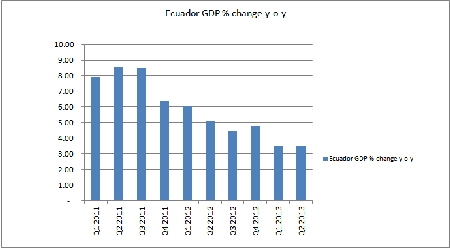
    The Ecuadorean economy posted real GDP growth of 3.5% year-on-year in the second quarter of 2013, maintaining the 3.5% rate achieved in the first, the central bank reported in early November. On a quarter-on-quarter basis, output was up 1.2%. Growth in the March-June period was supported by the construction, communications and oil sectors. While these numbers were taken as encouraging, the overall trend remains for growth to slow, both for Ecuador and the wider region.

    Ecuador’s registered real annual GDP growth of 5.0% last year, creating a feel-good factor that helped President Rafael Correa’s re-election in early 2013. This year, the president (an economist himself) is predicting that growth will moderate to a range of 3.7%-4.0%, as oil production and export prices have eased (the closure of the Esmeraldas refinery for maintenance has also reduced revenues). Factoring in some extra liquidity through a hoped-for return to international debt markets in 2014 (or further borrowing from China) Correa thinks GDP will begin to recover next year with expansion within the 4.5% to 5.1% range.

    While by most standards the Ecuadorean economy is performing well, opinion about the sustainability of Correa’s economic policies seems sharply divided. The president, who recently described himself as “an economist, but a good person”, clearly thinks he is doing very well, and some, but not all, independent analysts broadly agree with him.

    Correa was on form addressing an investment forum during a visit to Moscow at the end of October. He described Ecuador as a “marvellous country”, where very interesting things were happening. He stressed that in the ten years before he came to office in 2007, the country had gone through seven presidents and plenty of political instability.

    Since then, he had recovered stability and achieved average real annual GDP growth of 4.3%, even though the country lacks its own currency (Ecuador dollarised its financial system in 2000). Correa listed as a major achievement the increase in public sector investment, made possible, according to him, through three initiatives: rescheduling foreign debt; renegotiating oil contracts that had been “prejudicial for the country”; and boosting tax revenues “without increasing tax rates”. Public sector investment had been pushed up to 14% of GDP, while foreign debt had been reduced to 20% of GDP. In the process, unemployment had been cut to 4.2%. Correa claimed that around 1.0m Ecuadoreans (the country has a population of 15m) have been taken out of poverty between 2006 and 2012.

    Qualified support for an upbeat reading of the country’s economy had come a few weeks earlier from the ratings agency Fitch, which raised the country’s credit rating from B- to B, a move which it said reflected “the country’s continued healthy growth performance, monetary and financial stability underpinned by dollarization and a steady easing of external and fiscal financing risks as a result of still favourable oil prices, improved prospects in the oil sector and continued availability of bilateral financing from China and multilaterals”.

    Ecuador GDP

    But another group of analysts isn’t entirely convinced that the existing economic ‘model’ can go forward without significant risks. First of all, they note that after Ecuador’s debt default on US$3.2bn worth of bonds in 2007 and 2008 the international financial system remains wary about the country. Despite the encouraging words and the upgrade, Fitch still places Ecuador in junk bond territory (five notches below investment grade). Foreign direct investment last year was US$587m, the lowest-but-one of all Latin American countries.

    The nub of the question concerns the sustainability of a dollarized financial system in a period of future oil price weakness. In a dollarized system, the central bank cannot print money: the government must cover any fiscal or current account deficits by securing a net inflow of dollars.

    In a recent paper on Ecuador, UK based analysts Capital Economics noted: “We are concerned about the potential for balance of payments problems ahead, particularly if oil prices fall”. The paper pointed out that public oil revenues have struggled to keep pace with Ecuadorean government spending. “The budget deficit widened to US$3bn (or 3.5% of GDP) in the second quarter, on a 12-month rolling basis. That’s nearly as wide as in 2009, when global oil prices tumbled to a low of US$36 per barrel! By contrast, the price of ICE Brent (the global benchmark) has averaged around US$110 per barrel this year”, it went on.

    The reason for alarm then, is that the government is running a large fiscal deficit despite still-high oil prices. It has to be borne in mind that the boom in domestic US shale oil and gas production may, according to some analysts, lead to a medium term weakening in international crude oil prices. In this scenario, Latin American countries heavily dependent on oil exports (principally Venezuela and Ecuador) could find themselves no longer able to ‘export their way out of trouble’ as they have been so often been able to do in the past.

    Capital Economics’ conclusion is that “fiscal profligacy has left Ecuador a hostage to external events. In the absence of a concerted tightening of policy, we think there is a realistic chance of a currency crisis in the coming years.” It is over-dramatic to draw any comparisons, but nevertheless worth mentioning, that experiments with dollarisation in Latin America (Argentina being the best known) have not always ended well.

    Putin and Correa

    Details of a package of proposed Russian investments in Ecuador worth US$1.5bn were released on 30 October as Ecuador’s President Rafael Correa wound up a visit to Moscow hosted by his Russian counterpart, Vladimir Putin. “Very important things have been settled” Correa said on his second visit to Russia in four years. Significant Russian investment is the main prize for the Ecuadorean visitor.

    Russian banks signed a US$230m loan to finance a gas turbo-generator at the Termogas Machala facility in Ecuador, along with other work. A memorandum of understanding was signed under which RZD, Russia’s state rail company, will build a rail network linking Quito to Ecuador’s four main ports, potentially 1,800km long. The details and cost of this ambitious project will be determined through a feasibility study. Meanwhile Russia’s Gazprom is still assessing whether to exploit Ecuador’s natural gas deposits in the Gulf of Guayaquil. Oil company Rosneft and energy group Inter RAO were also reported to be in discussion on various projects with the Ecuadorean authorities.

    In terms of defence equipment, Russia has offered military trucks, Mi-171 helicopters and Yak-130 planes, along with a US$200m loan to facilitate their purchase. Correa has not yet officially responded, in part because the Ecuadorean constitution forbids arms purchases that could increase the trade deficit.

    Bilateral trade between the two countries was worth US$1.3bn last year, with a large surplus in Ecuador’s favour. Ecuador exported US$1.2bn worth of bananas, seafood and flowers, and imported US$116m of medical equipment, mineral fertilisers, and paper. “We have a growing trade with Russia, which now occupies third place among the list of destinations for our non-petroleum exports,” Correa said.

    Putin and Correa signed a further memorandum of understanding on a partnership between the Ecuadorean ‘City of Knowledge’ of Yachay and the Russian Skolkovo Innovation Centre, both of which are under construction. Yachay is part of Ecuador’s drive to pursue a transition away from dependency on oil extraction and exports and towards an economy based on knowledge, innovation, and sustainability, with the planned site set to be home to numerous universities and research centres. Correa has said in the past that Yachay is “the most important project” of his so-called Citizens’ Revolution, and he hopes it will become the hub of knowledge and innovation in Latin America. Skolkovo, meanwhile, will be a high technology business centre situated outside Moscow, and like Yachay will have the privilege of being a special tax zone.

    • The national court of justice, Ecuador’s top court, upheld a verdict on 12 November that US oil giant Chevron was responsible for polluting the Amazon. However, it halved the fine imposed by the provincial court of Sucumbíos in January 2012 to US$9.5bn, arguing that there was no legal basis for the additional US$9.5bn fine slapped on Chevron for refusing to apologise publicly for the pollution. Chevron spokesman James Craig said the ruling was “illegitimate and inapplicable”. Chevron is engaged in a legal battle in New York, where it is suing the US lawyer representing the plaintiffs, Steven Donziger, for having committed corruption to obtain the original ruling.
    • Vladimir Putin called Ecuador “one of our strategic partners in Latin America”, and added that the two countries had a lot to offer each other through “interesting and promising projects”.
  • CHILE: South serves up warning for Bachelet

    LatinNews 16 January 2014 Hits: 2022

    Most of the media focus in Chile is on the political wheeling and dealing surrounding President-elect Michelle Bachelet’s future cabinet and the myriad meetings to forge firm ties between her political team and deputies and senators in the Nueva Mayoría to drive her planned reform agenda through congress. Meanwhile, an issue which has received comparatively little media coverage, and still less attention in the policy discussions of Bachelet’s incoming government, is the mounting unrest in Araucanía, the ancestral homeland of the Mapuche in southern Chile. This is surprising because in 2008 Bachelet’s presidency (2006-2010) was rocked by Mapuche protests which took on the characteristics of an Intifada with marches, hunger strikes, fires and road blocks occurring daily.

    On 9 January a court in Angol, the capital city of Malleco province in Araucanía, absolved a Mapuche leader (‘werkén’), Daniel Melinao, from the murder of a carabinero sergeant, Hugo Albornoz, in April 2012. The interior minister, Andrés Chadwick, criticised the ruling absolving Melinao, claiming that there was more than enough evidence to convict Melinao (the prosecution was seeking a 30-year sentence) and that the government would appeal. Chadwick said similar rulings in recent years in Araucanía were creating “a sensation of impunity as convictions are not being obtained to punish people who eventually participate in extremism”. Melinao denied he had fired the shots that killed Albornoz and maintained that the charges against him were part of a systematic attempt to implicate the Mapuche community falsely.

    Chadwick stirred up further controversy on 4 January when he visited the children of a prominent farmer, Werner Luchsinger, and his wife, in Cautín, Araucanía on the first anniversary of their deaths in an arson attack, but refrained from meeting the family of Matías Catrileo, who was shot dead during a protest on 3 January 2008 by a carabinero lance corporal, Walter Ramírez. Chadwick argued that the difference was that Catrileo’s family had obtained justice. Ramírez received a two-year suspended sentence; he was expelled from the force last year.

    Chadwick also met the director general of the Carabineros in Araucanía, Gustavo González, who is supervising the investigations into a series of violent incidents in Araucanía. On 31 December Mapuche militants stormed the premises of a forestry company, Mininco, in Malleco province, lobbing Molotov cocktails at two firefighting helicopters, destroying one and damaging the other. Days earlier an explosive device was placed outside the local police court in Temuco, the regional capital, and a rural estate in the commune of Vilcún, was also attacked. The deputy interior minister, Rodrigo Ubilla, showed some of the pamphlets taken by the police, which were left at the estate and carried titles such as, “If there is no land, there will be war”. The government of President Sebastián Piñera cited this as justification to invoke the controversial anti-terrorist law from the dictatorship era of General Augusto Pinochet (1973-1990) to punish those found responsible. This did not deter the attackers. On 6 January there was an arson attack on a 200-hectare estate in Pidima belonging to Juan de Dios Fuentes, whose son was fired upon while trying to put out the blaze.

    President-elect Bachelet, who takes office on 11 March, has not undertaken to raise the Mapuche issue up her list of priorities in light of the recent unrest in Araucanía. If the attacks continue, and her government decides to apply the Pinochet-era anti-terrorist law in response, she will come under immediate pressure from human rights groups as she did during her first presidency to come up with more innovative methods to address the long-running Mapuche conflict.

    • Special prosecutor

    On 2 January Interior Minister Andrés Chadwick announced the designation of a special prosecutor in Araucanía in the wake of 12 violent incidents in late December. Alberto Chiffelle, the prosecutor of Temuco, was appointed to the role by the prosecutor’s office.

  • HONDURAS: Latest political reforms leave critical matters still unresolved

    LatinNews 13 February 2019 Hits: 2005

    A decade since the protracted political brinkmanship leading up to 2009 coup, Honduras has yet to fully deal with the bitter fallout. In some ways, little has changed, with the traditional political actors still entrenched in power, with little real voice for the under-represented underclass majority.

    On 27 January, marking the 12-month anniversary of Juan Orlando Hernández’ inauguration for a second presidential term, thousands took to the streets in the capital Tegucigalpa and across some 14 of the country’s 18 departments, calling for his resignation. According to local press, thousands of police mobilised to prevent protesters from obstructing movement of vehicles and individuals, which led to violent clashes and tear gas being fired.

    Days later, Mauricio Oliva, congress president and senior member of the ruling Partido Nacional (PN), declared a package of constitutional changes approved by the 128-member legislature as “the most important electoral reforms in the country’s history”.

    The changes incorporate recommendations that came out of the recent United Nations (UN)-facilitated national political dialogue in the country, which ended last year without a formal agreement. The dialogue process was called to address the severe crisis surrounding Hernández’ controversial re-election in November 2017, which was followed by weeks of fatal clashes between protestors and the security forces.

    The left-wing opposition, including the defeated presidential candidate Salvador Nasralla, still maintain that the November 2017 ballot was fraudulent. While the opposition participated in the election, thereby giving it legitimacy, it continued (and continues) to reject a prior 2015 supreme court ruling allowing for presidential re-election, which was expressly banned by the country’s convoluted 1982 constitution (written by the retreating military administration).

    This situation is exacerbated by (and ultimately dates back to) the June 2009 coup in the country, which saw the military ouster – on the orders of the supreme court and congress – of former president Manuel Zelaya (2006-2009), ostensibly on the grounds that Zelaya was seeking ways to perpetuate himself in power beyond his single four-year term, in contravention of the same 1982 constitution.

    Zelaya now heads up a radical leftist opposition bloc at the helm of his Libertad y Refundación (Libre) party, which backed Nasralla in the 2017 election, and which continues to wage a running battle against the country’s powerfully entrenched conservative PN. Under the military-linked Hernández, the PN has tacked to the hard right and re-consolidated its traditionally strong links with the country’s powerful land-owning elite and US-facing business sector. Meanwhile, the other traditional Partido Liberal (PL), last in office with Zelaya, never recovered from the 2009 coup and is much reduced, riven into competing factions.

    Having stacked the supreme court with sympathisers, and with the PN dominant in congress in his first term, Hernández’ move to run again in 2017 was a tale foretold. The key difference in 2017 was that Hernández had all the legal dressing for his move that Zelaya never managed to achieve. Inevitably, the situation created huge anger on the Left, which alleges the continued abuse of power by the traditional political class, long backed by its US equivalent.

    This bitterly polarised battle between the radical Left and the US-backed conservative Right has kept Honduras locked in perpetual conflict for a decade now since 2009, preventing anything other than marginal progress in lifting the majority of the population out of a long cycle of poverty and severe citizen insecurity, and prompting the most vulnerable, largely young men, women and children, to join the US-bound migrant caravans so publicly reviled by President Donald Trump.

    Political-electoral reform

    Approved on 25 January by 113 deputies – well over the two-thirds needed for constitutional changes – this latest reform package on paper answers many of the demands for reform made by Libre and external observers such as the UN and the European Union (EU). The package was put together by a special multi-party commission comprising nine deputies: three from the ruling PN; two from Libre; two from the traditional PL, currently split into two main factions, one aligned with bench leader Elvin Santos, and the other with the PL’s 2017 presidential candidate, Luis Zelaya; and one each from the Democracia Cristiana and Alianza Patriótica.

    The proof of the pudding will be in their implementation, however. Electoral rules and authorities are only as good as their enforcement and independence from political influence (and other vested interests).

    Among the main changes, the existing electoral authority – the TSE – is dissolved, and replaced with a new national electoral council, the CNE, henceforth to be responsible for organising and supervising electoral processes.

    A new electoral justice court (TJE) will be set up, with a remit to settle electoral disputes, including complaints related to electoral activity.

    This new CNE will comprise three main councillors and an alternate, elected for a five-year period, while the TJE will comprise three principal magistrates and two alternates, also serving five-year terms.

    The changes also restructure the much-discredited national registry office (RNP) – which administers the electoral roll. This now will be administered by a permanent commission, the three members of which will serve five-year terms and be tasked with purging the electoral register of anomalies, among other things.

    Finally, reforms would also allow for the possibility of forms of popular consultations and for a second round of voting to take place for the presidential election.

    Hailed by Oliva and Hernández, congressional approval of the initiative was also welcomed by the secretary general of the Organization of American States (OAS), Luis Almagro, and the UN representative in Honduras, Igor Garafulic. On 24 January, ahead of the final approval of the reforms, the long-standing US chargé d’affaires in Honduras, Heidi Fulton (carried over from the Barack Obama administration, 2009-2017), also tweeted: “The Honduran people deserve electoral reforms that strengthen Honduran electoral institutions, increase transparency, and inspire confidence in the electoral process – including a continuation of the Clean Politics Unit. We support efforts that improve democratic processes.”

    Re-election - and how often would you like that, sir?

    Even as Hernández and the PN take credit for these electoral reforms, the party is already thinking ahead. In early February, congressional vice president Antonio Rivera Callejas (PN) – one of two VPs – suggested a popular consultation to gauge public support for presidential re-election in the country, with a view to limiting re-election to once only.

    A few days earlier, his PN colleague, deputy Walter Chávez, had submitted an initiative to limit re-election to one term. After the contentious 2015 supreme court ruling, which left the matter open, Hernández – magnanimously – pledged legislation to limit re-election to a single term. However, Zelaya, backed by Libre and its allies (and some sections of the PL), rejected that gesture out of hand, because the reality was that the supreme court ruling left it open for Zelaya to run again too, and he clearly wanted (and still wants) to keep his options open. (Never let it be said that Honduran politicians miss a trick.)

    In reference to Chávez’s initiative, Rivera Callejas noted that it would be difficult for the PN to win support for it given its current (weaker) position in congress, where it now has just 61 seats. “In congress, we don’t have sufficient votes, but we could still regulate re-election by popular consultation,” he told journalists. He suggested that citizens could be asked whether they wanted re-election for one period or indefinitely.

    Callejas’ proposal will be yet another stick in the craw for Zelaya, whose wings were so severely clipped in June 2009 for merely proposing – never mind organising – a non-binding plebiscite on the issue of political reform, which his opponents took to mean term limits. Callejas, for his part, was unclear as to whether his proposed consultation would be binding or indicatory.

    But it is most likely, in our view, that long suffering Hondurans – still not too far removed from the last military period – would reject the idea of indefinite re-election. That would effectively put an end to Zelaya’s lingering presidential ambitions, and allow Hernández to take the credit for another ‘sensible’ and ‘modernising’ political reform in Honduras.

    Given the PN’s hold on the country – and the continued disarray in the opposition – it is also quite likely that the PN will manage to remain in office under a Hernández protégé, not least given the continued swing back towards the Right across Latin America, and the tacit US support for the PN.

    Calls for Hernández to be investigated

    While Hernández seems to have a strong grip on the country’s political and constitutional affairs, he may yet run into difficulties over apparent links to corruption and other illicit activities.

    Honduras remains well down on Transparency International (TI)’s Corruption Perceptions Index, ranking at 132 of 180 countries in 2018, with the local TI chapter noting continuing threats against corruption investigations, including by the OAS-sponsored Mission to Support the Fight against Corruption and Impunity in Honduras (Maccih). For local anti-corruption activists, the fate of the UN-backed anti-impunity commission in Guatemala (CICIG), the Maccih parallel in neighbouring Guatemala, will be a cautionary tale.

    On 21 January, Acción Ciudadana Contra la Dictadura (ACCD), an umbrella group including dozens of political and social organisations, filed a request with the attorney general’s office (AG) for Hernández to be investigated in relation to the arrest of his brother Juan Antonio ‘Tony’ Hernández. A former PN deputy (2013-2017), ‘Tony’ Hernández was charged on 25 November in the US with drug trafficking, among other offenses.

    Melvin López, a lawyer for the ACCD, told reporters that the request was for the AG to investigate Hernández’s “personal conduct” in his capacity as the country’s head of state and brother of a convicted criminal. The ACCD emphasised that Hernández, as president, possessed enough information and power to stop the illicit activities involving his brother. According to a US Department of Justice press release, Tony Hernández was charged in a Manhattan federal court with conspiring to import cocaine into the US, “related weapons offenses involving the use and possession of machineguns and destructive devices, and making false statements to federal agents”.

    • Other doubts over Hernández

    President Hernández previously faced some uncomfortable questions last year, after a lawyer defending one of the 38 suspects in the so-called ‘Pandora’ corruption case – uncovered by the Maccih – pointed to the existence of a “criminal organisation directed from the state”. The Pandora case involves claims that public funds to the tune of HL282m (US$11.7m) meant for agricultural, agro-industrial, and horticultural projects were used to finance the political campaigns of both the PN and the PL ahead of the 2013 general election (won by Hernández).

  • REGION: Mosquitoes recruited for anti-dengue sting

    Abbi Dicker 23 February 2024 Hits: 3434

    Two private companies said in December that they were working together to release mosquitoes across the Caribbean that have been bred with a bacterium that attacks the dengue virus.

    Dengue is a debilitating viral disease found in tropical regions, transmitted by mosquitoes. It causes sudden fever and acute pains in the joints. According to the World Health Organisation (WHO) in 2000-2019 there was a ten-fold increase in reported annual cases worldwide, from 500,000 to 5.2m. It is estimated that there were 4m dengue cases in the Caribbean and Latin America last year.

    The companies involved in the new project are Barbados-registered Orbit Services Partners and Verily, a US-based health technology firm. According to Orbit chairman Anthony Da Silva, both firms have been meeting government officials with the hope of gaining the necessary medical approvals and launching the project during 2024.

    Target countries include Barbados, Guyana, Jamaica, St Kitts & Nevis, St Maarten, St Martin, Suriname, Dominican Republic, and Haiti. The project involves breeding mosquitoes in laboratories with the Wolbachia bacteria. They are then released to the wild, where they breed further and multiply. The Wolbachia bacteria plays a key role since it blocks the dengue virus from reproducing inside the stomach of a mosquito.

  • ECUADOR: Four ministers face impeachment proceedings

    Abbi Dicker 08 August 2024 Hits: 1902

    Four ministers in President Daniel Noboa’s government are facing impeachment votes after Ecuador’s national assembly voted on 6 August to approve a report accusing them of dereliction of duty. The ministers of the interior, defence, environment, and tourism are accused by the left-wing opposition of supporting a controversial construction project in a protected area of rainforest in Santa Elena province. The development is being carried out by Vinazin SA, a company which is owned by First Lady Lavinia Valbonesi.

    With 94 votes in favour and 31 against, legislators approved a report by the national assembly’s commission of autonomous governments which recommended impeachment proceedings be brought against Interior Minister Mónica Palencia, Defence Minister Gian Carlo Loffredo, Environment Minister Sade Fritschi, and Tourism Minister Niels Olsen.

    All are accused in the report of failing to carry out their duty to protect nature and community rights in Comuna Olón, Santa Elena – the site of a luxury resort being developed by Vinazin. Victoria Desintonio, the president of the commission which wrote the report, said that the planning process for the resort had been irregular and had resulted in illegal deforestation, loss of habitat, and water contamination.

    The impeachment votes will cause additional difficulties for President Noboa given his wife’s involvement in the project. Arisdely Parrales, a legislator from Santa Elena for the left-wing opposition Revolución Ciudadana (RC), claimed that the construction project amounts to negligence by Noboa and reveals “his manoeuvres to use power to benefit his inner circle”.

    Security forces bolstered by new military hardware

    Ecuador’s security forces have received an influx of modern weaponry as part of the government’s plan to boost military capabilities in response to the growing power of criminal gangs. President Noboa attended a ceremony in Durán, Guayas province, on 6 August where he oversaw the delivery of 1,752 Israeli-manufactured MZFP automatic rifles to the national police. The armed forces received a delivery the following day of 51 tactical vehicles – 45 US-manufactured ‘David’ armoured personnel carriers and six South African ‘Mbombe’ armoured fighting vehicles.

  • HONDURAS: Zelaya comienza a forjar una estructura electoral

    LatinNews 12 September 2011 Hits: 224

    El ex presidente Manuel Zelaya no pierde el tiempo. Dos semanas después de su retorno a Honduras de su exilio en la República Dominicana, ha organizado una “asamblea de resistencia popular” en Tegucigalpa para el 26 de junio, para marcar el segundo aniversario de su derrocamiento el 28 de junio de 2009. El enfoque principal de la asamblea, dice Zelaya, es discutir la importancia de una asamblea constituyente y establecer una amplia coalición ante las elecciones en noviembre de 2013.

    Zelaya hizo el anuncio después de reunirse con miembros del izquierdista Frente Nacional de Resistencia Popular (FNRP) en la ciudad de Tocoa, en el departamento norteño de Colón. El multifacético FNRP, que surgió en apoyo de Zelaya después del golpe, hasta ahora ha respondido equívocamente a la perspectiva de convertirse en un partido político, y menos aún a la posibilidad de unir sus fuerzas con elementos del tradicional Partido Liberal (PL) en un amplio frente político [IL-11-22].

    La constitución actual prohíbe a Zelaya buscar la elección pero, siguiendo una tendencia que es crecientemente común a lo largo de la región, su esposa Xiomara está siendo considerada como una posible candidata. Zelaya dijo que la justicia solamente podría hallarse en las urnas. Extrañamente, el Presidente Porfirio Lobo enfatizó esta semana que él no se beneficiará de ninguna reforma constitucional necesaria para “modernizar” Honduras, mientras en una videoconferencia con el Subcomité del Hemisferio Occidental de la Cámara de Representantes de EU examinando la política de EU hacia Honduras, el ex presidente de facto Roberto Micheletti dijo que él sentía fuertemente después de la “sucesión constitucional” que “nuestros amigos [EU]” habían “no han vuelto las espaldas”. Micheletti, a quien le fue negada una visa por el Departamento de Estado para asistir en persona a la audiencia, estaba hablando días después de la publicación de los cables diplomáticos por WikiLeaks mostrando que el embajador de EU, Hugo Llorens, tenía conocimiento de las frenéticas discusiones que involucraban al congreso, la corte suprema y la oficina del fiscal general acerca de la vía constitucional para deponer a Zelaya, en las semanas que condujeron al golpe.

    • El Golpe

    En un cable de WikiLeaks del 2 de julio de 2009, el embajador Llorens alega que “las acciones tomadas para remover al Presidente son patentemente ilegales [...] el Fiscal General, los militares conspiraron con Micheletti y otros líderes del congreso para remover a Zelaya basados en su temor que él planeaba convocar a una Asamblea Constituyente [...]” El dijo que el presidente de la corte suprema, Jorge Rivera Avilés, le había dicho que un presidente en funciones solamente podría ser removido si el fiscal público presentaba un caso ante la corte, y si era hallado culpable. Una ley que permitía al congreso hacer juicio al presidente fue revocada en 2005. Un cable separado, de poco antes del golpe, Llorens es mostrado discutiendo la remoción de Zelaya con todos los actores principales: él aparece más preocupado acerca de la validez legal de cualquier acción más que disuadirlos de llevarla a cabo.

  • URUGUAY: Mujica recibe un revés minero

    LatinNews 20 September 2011 Hits: 491

    Tiene el potencial de ser la más grande inversión privada en la historia de Uruguay, pero una acalorada disputa política está amenazando de sacarla de curso. Minera Aratirí, la subsidiaria local de la compañía minera de la India, Zamin Ferrous, que había planeado invertir US$3bn en el desarrollo de los depósitos de mineral de hierro en los departamentos centrales de Durazno y Treinta y Tres, redujeron el proyecto en su lista de prioridades del primer lugar al cuarto basado en una disputa política y medioambiental en Uruguay. La compañía había estado explorando un área de 120.000 hectáreas buscando mineral de hierro por dos años.

    El Presidente Mujica aceptó que hubo excesiva discusiones políticas sobre el proyecto. El estaba molesto porque el opositor Partido Nacional (Blancos) y el Partido Colorado convocaron a tres ministros del gabinete ante el congreso el 14 de julio para responder a preguntas acerca del proyecto, que el secretario presidencial, Alberto Breccia, dijo (después del anuncio de Aratirí) que había causado incertidumbre jurídica a los inversionistas. La oposición ha acusado a la compañía de emplear tácticas sucias para ejercer presión sobre el gobierno con el anuncio.

    Mujica llamó a la oposición para sentarse juntos con el gobierno para analizar el futuro de la minería en el país después que el proyecto fue degradado. El dijo que ningún gobierno debía tomar arbitrariamente una decisión que tendrá repercusiones por 30 a 40 años, pero la oposición es reacia a ser salpicada por asociación con un proyecto que nunca va a ganar un amplio apoyo popular.

    Reacciones ante el proyecto
    La reacción del poderoso sector agrícola y ganadero de Uruguay no ha sido positiva, Julio Gómez, un vocero del lobby agrícola, dijo que la escala del proyecto era demasiado grande para un país de las dimensiones de Uruguay y que “alteraría seriamente el equilibrio medioambiental  (del área”. Dijo que eso resultaría en “la sustitución de una actividad productiva sustentable por una actividad extractiva de un recurso finito, hierro, que tiene un periodo de vida de 30 años,” y la degradación de la tierra, mientras 95% de la riqueza” beneficiaría a la industria de China y de la India, dejando a Uruguay sin “industria del hierro sino repercusiones medioambientales”.

    Sin embargo, algunos habitantes del pueblo local de Cerro Chato, que tiene 4.500 habitantes, miran el proyecto favorablemente como una fuente de empleo en una de las áreas más pobres del país. La compañía minera sostiene que serían creados 3.000 empleos locales en la construcción y 1.500 en la etapa operativa, entre la mina y la terminal en aguas profundas conectados por un conducto de desechos de 200km, al que también se oponen ambientalistas y agricultores. Mujica ha dejado en claro que en un escenario ideal el proyecto iría a un referéndum local pero que desafortunadamente no hay una provisión para ello en la constitución de Uruguay, en la manera que hay en algunos de los países más inclinados a la izquierda en la región que defienden una democracia más directa.

    • Minería

    La minería en pequeña escala en Uruguay de piedra caliza, yeso, piedras semipreciosas y oro suman 12m de toneladas por año, equivalentes en total, en promedio durante los últimos 20 años, a 0,27% del PIB. Aratirí predijo una producción anual de 18m de toneladas de hierro por año, un incremento de 150%. Los estudios han establecido depósitos de hierro de al menos 250m de toneladas de mineral de hierro, pero que la cantidad final recuperable podría llegar a ser cuatro veces más esa cantidad.

  • RASTREANDO TENDENCIAS

    LatinNews 26 November 2012 Hits: 358

    BRASIL | El déficit comercial causa sorpresa. Brasil reportó su peor déficit comercial semanal en 15 años, en la tercera semana de noviembre, de acuerdo con los últimos resultados (19 de noviembre) del ministerio de desarrollo, industria y comercio exterior (MDIC).

    Durante el fin de semana en Cádiz, España, la Presidenta Dilma Rousseff de nuevo advirtió a Europa y el resto del mundo desarrollado acerca de los peligros de mucha austeridad. El gobierno brasilero ya se ha resignado al bajo desempeño económico en el 2012; el último consenso del  pronóstico del sector privado compilado por el banco central es de un crecimiento de sólo el 1,5% para este año. Sin embargo, la administración Rousseff confía en que Brasil ha tocado fondo y se está recuperando, no menos gracias a una serie de medidas oficiales de estímulo, y Rousseff señaló a sus anfitriones europeos que Brasil es muy afortunado en tener más palancas de política económica a su disposición. Los funcionarios del MDIC también están promocionando una recuperación de China el año próximo. Aunque el sector externo de Brasil no es el único sustento (llega a menos del 15% del PIB), el mismo provee un importante estímulo en dinero efectivo para el gran mercado de consumo interno.

    Sobre una base acumulada en el año hasta la fecha, las exportaciones totales fueron valuadas en US$213,8mm hasta mediados de noviembre, cayendo un 5,3% año en año con importaciones en el año hasta la fecha de US$196,5mm, cayendo un 1,2% año en año. El superávit comercial resultante (US$17,3mm) cayó un 35,2% en relación al mismo periodo del 2011. El déficit comercial de US$952m registrado en la tercera semana de noviembre, fue el peor déficit semanal desde 1998, cuando el MDIC comenzó a compilar por primera vez las estadísticas semanales de comercio. El peor resultado anterior fue la semana final del 2008 (US$840m), en medio de la declinación financiera global.

    El Real se deslizó a una nueva baja de R$2,09/por dólar esta semana, provocando nuevas especulaciones de que el banco central está actuando en tácito apoyo de las exportaciones.

  • Venezuela goes for stealth devaluation

    LatinNews 17 December 2013 Hits: 1090

    Development: On 16 December Venezuela’s energy minister and vice president of economic affairs, Rafael Ramírez, announced that all imports bar essential food and medicines would henceforth come into the country under the secondary exchange rate (FX) agency, Sistema Complementario de Divisas (Sicad).

    Significance: Ramírez announced that oil investments and tourist dollars from now on will be charged at the Sicad auction rate, which is lower than the official rate of BF6.3/US$1 used by the main FX agency, Comisión de Administración de Divisas (Cadivi), from now reserved for essential imports only. The central bank (BCV) does not publish the Sicad rate auctioned off to bidders from pre-approved and officially designated ‘key import’ sectors, but local economists calculate that it has been selling US dollars at about BF11/US$1 on average in its weekly Sicad auctions. Ramírez said that some US$5.0bn will be sold through the Sicad in 2014, compared to an estimated US$1.3bn to date this year since the Sicad was launched in March. The Cadivi distributed US$33.0bn in the first nine months of the year.

    Key points:

    • “Sicad will evolve into a definitive mechanism for the control and management of our foreign currency” Ramírez declared. What it amounts to is a stealth devaluation. The (illegal) black market exchange rate is now trading at over ten times the official rate on the Venezuela-Colombia border. Most local private economists say this expansion of the Sicad is only part of the adjustment needed and they still expect the government to devalue the official rate anyway in the first quarter of 2014.
    • Allowing energy companies to charge expenses at the lower Sicad rate will also reduce the cost of investing in Venezuela, at a time when Ramírez, who is also president of the state oil company Petróleos de Venezuela (Pdvsa), is trying to encourage Pdvsa’s private sector partners and other new (foreign) players to up their investment in the country’s oil sector, still struggling to boost production at a time of falling international prices.
    • Moody’s Investors Service yesterday downgraded Venezuela by two levels to a Caa1 rating, from B2, with a negative outlook, citing “increasingly unsustainable macroeconomic imbalances and a materially higher risk of an economic and financial collapse”. Days earlier (on 13 December), Standard & Poor’s cut its Venezuela sovereign rating one notch to B-, with a negative outlook, on similar concerns. Despite this bearish sentiment however, the reality is that a big devaluation in the official FX rate next year probably would allow the government to wing its way through for another while without the feared economic collapse.
  • CHILE: Muñoz moots Mercosur-Pacific Alliance union

    LatinNews 20 March 2014 Hits: 968

    Chile’s experienced new foreign minister, Heraldo Muñoz, has spelt out his country’s new foreign policy direction, including an eye-catching proposal to merge the ailing Southern Common Market (Mercosur) and the burgeoning Pacific Alliance.

    The first foreign trip of President Michelle Bachelet will be to Argentina and Brazil. Muñoz argued in an article written for the Spanish daily El País on 13 March that Chile would prioritise its relations with the region, “especially South America”, and that its foreign policy objective was “convergence in diversity”, which he said “combines realism with political will to advance towards a more integrated and autonomous region”.

    During a conference organised by the United Nations (UN) Economic Commission for Latin America and the Caribbean (Eclac) on 12 March, Bachelet said Chile had “lost regional presence” under her predecessor Sebastián Piñera (2010-2014). Muñoz developed this in his piece, arguing that Chile would undertake a change in foreign policy away from “privileging economic relations – which will remain important for the country – towards an integral perspective that grants similar weight to the political, social and cultural dimensions of our ties”.

    Muñoz said that Chile would have no “ideological bias”. Bachelet has noticeably differed from Piñera in her response to the protests unfolding in Venezuela. “We will never accept that anyone, people or country, provokes through violent mechanisms the toppling of a legitimately elected president,” Bachelet said in an interview with the national daily El Mercurio on 16 March. Chile, Muñoz argued, wants to “build bridges over and above ideological or sub-regional differences”, adding that “sub-regional projects could be building blocks to a bigger and more inclusive Latin American integration”.

    Muñoz argued that integration movements in Latin America and the Caribbean have proliferated “to the detriment of its influence in a world organised in regional blocs”, and that it “lacks convergence and coordination”. He said that Chile would strengthen its presence in the region’s distinct integration mechanisms (critics might argue that Chile is keen to be in all of the integration clubs without really fully committing to any of them having been an associate member of Mercosur since 1996 and an associate member of the Andean Community [CAN] since 2006 after being a full member of the original Andean Pact from 1969-1976.)

    Muñoz went on to propose that “we should discuss the possibility of a convergence of the Pacific Alliance and Mercosur”, suggesting the application of “the European Union’s concept of ‘different speeds’, which would permit some countries […] to advance more rapidly than others in the integration process.” Given the enormous difficulties Mercosur is experiencing in consolidating a bona fide integration, these ‘speeds’ could be very different indeed.

    It must be a moot point whether Muñoz’s grand design gets off the drawing board, or whether he will become the latest in a long line of diplomats past and present, dating back to Simón Bolívar, who has dreamt of an overarching integration movement in the region. For one thing is this not exactly what the Community of Latin American and Caribbean States (Celac) purports to be?

  • ECONOMY: Unemployment ticks up sharply

    LatinNews 15 July 2015 Hits: 980

    Brazil’s unemployment rate continues to rise. On 10 July, the national statistics institute (Ibge) reported that the national rate of unemployment had reached 8.1% in the quarter ending in May. This was a major increase from 7.0% in the same period in 2014 and 7.4% in the previous quarter (December-February). The biggest reduction in jobs came in the automobile sector, with 78% of companies stating that they had cut back their staff.

    Two days earlier (8 July), the daily Folha de São Paulo published a survey showing that a majority of companies in the extractive and manufacturing industries had cut their work force to cope with the domestic economic recession.

    Of the 2,307 companies polled in the Folha survey, 50% said that they had fired employees during the October 2014- April 2015 period. Sixty per cent said that they had cut vacancies or taken other cost-cutting measures. Most of the companies surveyed (67%) cited a drop in production as the reason for cutting their workforce; around a third blamed financial difficulties for the move.

    A survey of economists by Reuters found that unemployment is expected to rise to 7% this year and 8% in 2016. Rising unemployment could help control inflation, currently running at close to 9%. But it is also likely to damage President Rousseff’s rock-bottom popularity. Employment had been one of the few bright spots in the Brazilian economy over the past year.

    New inflation target from 2017

    On 25 June the central bank’s monetary council announced that the ‘band of tolerance’ around the inflation rate target would be 1.5% from 2017. Since 2004 the central bank’s inflation target has been 4.5% plus or minus 2%. At present inflation is running at close to 9%, meaning that the central bank governor, Alexandre Tombini, will have to write to the finance minister, Joaquim Levy, to explain the failure to hit the target. Interest rates are likely to continue to rise in order to rein in inflation. Most analysts expect another 50 basis points rise in July.

    The reduction in the band of tolerance is meant to show that the government is serious about tackling inflation, despite the fact that it has failed to reach the 4.5% target since 2009. According to one source at the central bank quoted by the local O Estado de São Paulo, “the goal is challenging and the choice was made in search of greater credibility for the central bank”. Apparently, Levy was the driving force behind the reduction.

    With interest rates likely to continue to rise, some economists have expressed criticism at the government’s apparent willingness to tackle inflation at all costs. Luís Eduardo Assis, a former central bank director, has said that, “this is going to cost us another recession or a political crisis”. The central bank’s benchmark interest rate, the Selic, currently stands at 13.75%. The central bank now forecasts that Brazil’s economy will shrink by 1.1% in 2015, its worst performance since 1990.

    FDI – up or down?

    The latest foreign direct investment (FDI) report by the United Nations Economic Commission for Latin America and the Caribbean (ECLAC) says that after a decade of strong growth, FDI inflows to the region fell by 16% in 2014.

    Despite a couple of blips in 2006 and 2009, FDI flows into the region rose steadily over the last decade, from US$46.9bn in 2003 to a peak of US$189.9bn in 2013. But the trend broke last year, according to ECLAC, with a 16% drop to US$158.8bn. Behind this lay the impact of lower commodity export prices and slower GDP growth across the region. A further fall is expected in 2015 because of continuing sluggish growth. Comparatively speaking, Latin America and the Caribbean is slipping back in the FDI stakes relative to Asia. Although global FDI fell by 7%, much of this was due to reduced flows into developed economies. FDI into developing countries as a group rose by 5%, but this in the main reflected strong increases in Asia, offset by the 16% decrease in Latin America and the Caribbean.

    As usual, the two largest recipients of FDI in the region were Brazil and Mexico. Brazil recently has changed its methodology for calculating FDI. Under the old approach – which is comparable with other countries covered by ECLAC – FDI inflows last year were worth US$62.5bn, or 39.3% of the regional total. Under the new methodology, Brazil says its 2014 FDI was a higher US$96.8bn, or 50.2% of a correspondingly revised regional total of US$192.9bn. Using the old methodology for the purpose of comparison, Brazil saw a 2% fall in FDI last year. ECLAC makes it clear it expects FDI to continue on a falling trend in Brazil this year.

    As a share of regional GDP, FDI was 2.6% in 2014, a little below the long-term average. It was just 1.5% of GDP in Brazil (and 2.0% of GDP in Mexico). By source countries, the largest single investor in Latin America was The Netherlands (20% of the total that can be attributed to specific countries of origin), followed by the US (17% of the total) and Spain (10%). The Netherlands tops the list mainly because of its large investments in Brazil. end box

    • Alicia Bárcena, ECLAC’s executive secretary, said that Latin America should not make it a priority to recover last year’s fall in FDI inflows, but should focus instead on “attracting the FDI that contributes to productive diversification”. “This means”, she said, “articulating FDI with industrial policies and national development strategies based on quality and environmental sustainability”.
  • URUGUAY: Pain on the Left for Vázquez

    LatinNews 27 August 2015 Hits: 523

    The 30-day decree by the government led by President Tabaré Vázquez declaring education an essential public service – and therefore making strike action illegal – appeared to have backfired this week, with industrial action spreading across the country.

    Relations between the left-wing Frente Amplio (FA) coalition government of President Vázquez on the one hand, and the Plenario Intersindical de Trabajadores–Convención Nacional de Trabajadores (Pit-Cnt) union confederation and individual teachers’ unions on the other, have reached a low point. At issue is a long-running dispute over salary levels.

    After a series of rolling stoppages and tetchy negotiations, by 21 August the government felt it had hammered out a deal with Pit-Cnt representatives – or at least one that they would recommend for consideration by their members. It proposed a two-year salary agreement (2016-2017) and a commitment to raise the basic teachers’ monthly salary to Ur$25,000 (US$875) by 2020 (the teachers have been demanding a Ur$30,000 salary by that date).

    Economy & Finance Minister Danilo Astori insisted that public sector teachers have had a good deal. In the last 10 years of FA governments Astori said that the budget of the Administración Nacional de Educación Pública (Anep) has grown by 122% and the average salary of a teacher giving 20 hours of classes a week rose by 64% in real terms. At the same time the government said that under its current five-year budget plans education would get the greatest budget increases. As a share of GDP education spending would be 4.8% in 2015 and 2016, rising to 5% in 2017 and to 6% in 2019 (the unions want the 6% target to be reached much more quickly that this).

    But the deal was not accepted, and when the teachers’ unions called a further three-day strike, the government reacted with a hard line. On 24 August Education Minister María Julia Muñoz announced the ‘esencialidad’ decree, effectively banning strikes for a 30-day period, effective from 26 August. Muñoz said the aim of the decree was “to open a period of reflection for the government’s proposals to be accepted”, adding that the left-wing government felt “pain” issuing the decree, but was doing so because students’ rights were paramount.

    It does seem that on the government side the decree was a tactical move to try and make the last push to a settlement. In fact, government officials shortly afterwards suggested that the decree could be revoked if the unions simultaneously lifted their strike action.

    But despite the support of some Pit-Cnt leaders this deal also failed and it seems the government may have underestimated the strength of feeling among the teachers’ rank-and-file. The unions claim that the decree is itself an illegal restriction on the constitutional right to strike, and are initiating legal action against it in Uruguay and appealing abroad to the International Labour Organisation (ILO).

    On 26 August, the day the decree came into effect, many teachers defied it by remaining on strike. Anep, meanwhile, says it is struggling over how to implement the decree that sets out sanctions against teachers who do not attend. The government is caught in a dilemma: backing down would undermine its authority, but pressing on might lengthen the dispute and increase the political cost.

    • Vázquez and Sendic booed

    Protesters booed President Tabaré Vázquez during Uruguay’s Independence Day celebrations on 25 August at Piedra Alta, in the southern department of Florida. Vice-President Raúl Sendic, meanwhile, was booed outside the national congress by protesters, who shouted “traitor” at him.

  • BOLIVIA: Tensions rise ahead of campaign launch

    LatinNews 16 May 2019 Hits: 1691

    “If you want to talk about transparency first you have to be transparent.” This was a retort made by President Evo Morales to his main rival in October’s presidential election, former president Carlos Mesa (2003-2005) who is running for Comunidad Ciudadana (CC). The two have been exchanging increasingly heated words and accusations in recent days, in turn linked to a major corruption scandal in the police which is proving embarrassing for the Movimiento al Socialismo (MAS) government.

    On 3 May the attorney general’s office opened an investigation into “suspicious transactions” by Mesa after MAS deputy Susana Rivero accused him of receiving US$30,000 from Gonzalo Medina, who was sacked last month as director of the special forces against crime (FELCC) in Santa Cruz department and has been detained in relation to a police scandal (see below). Rivero’s claims relate to the sale of an apartment in 2009 by Mesa’s parents to a woman, Blanca Grimanesa Hinojosa Imanareco, who had a relationship with Medina. Rivero claimed that Mesa knew Medina, who was his head of security while President. Mesa denies knowing or having known the former FELCC chief personally and insists that he did not hold the post under his presidency. The Morales government has also accused Mesa and his family of tax evasion in relation to the sale of the apartment. On 9 May Communications Minister Manuel Canelas tweeted that “The price of the sale was [US$]55,000, however, the declared price was only 19,000 despite the assessed value being 29,000.”

    Mesa has been quick to claim that the charges are trumped up and he is being targeted by the Morales government which is on the defensive over the police scandal. This erupted after audio footage was leaked on 13 April of people discussing links between the police and narcotrafficker Pedro Montenegro Paz for whom Brazil had issued an arrest warrant in 2015. Montenegro reportedly handed himself in to the Bolivian authorities on 11 May. As well as Medina, who had been in the post since 2016, other police officials who have been implicated include FELCC Captain Fernando Moreira, Major Kurt Brun Ríos and Medina’s stepson Robin Justiniano Meruvia, who have also been detained. The police directors are accused of allegations of cover-up crimes of controlled substances, criminal association, and lying. Medina, Meruvia and Moreira were detained on 24 April, and Brun Ríos on 27 April.

    Evidence of high-ranking police officials colluding with drug traffickers is nothing new in Bolivia. Yet the scandal could cause problems for Morales ahead of October’s election. It is worth recalling that the issue of corruption had been considered a major reason for his defeat in the February 2016 popular referendum on whether to change the constitution in order to allow him to run again for the presidency [WR-16-08].

    • Other cases of police corruption

    In 2016 the general director of Bolivia’s coca control and industrialisation agency (Digcoin), Ricardo Paniagua, was forced to step down to be investigated for the unauthorised transportation of coca leaves. In March 2015 General Oscar Nina, a former commander of the national police and chief of the Fuerza Especial de Lucha Contra el Narcotráfico (FELCN), was arrested and charged with money laundering, illicit enrichment and association with the Mexican drug kingpin Joaquín ‘El Chapo’ Guzmán Loera. One of Nina’s predecessors, a director of the FELCN, General René Sanabria, was convicted in a US court in 2011 of conspiring to transport cocaine to that country.

    Mesa called the latest scandal “proof of the process of terminal disintegration [of the police], due to the government’s political meddling, which has destroyed its institutionalism”. Other opposition figures were also quick to seize upon it ahead of the election. Senator Oscar Ortiz, a presidential candidate for the Bolivia Dice No coalition, has called on the government to assume responsibility for the allegations, given that it oversees the appointment of police leaders.

    The latest opinion survey published on 28 April by Página Siete showed Morales on 34% of voting intentions, followed by Mesa on 28%, and Ortiz on 8%, while Félix Patzi, Jaime Paz Zamora, Víctor Hugo Cárdenas and Virgilio Lema were on less than 3%. The survey also showed that 24% of people were undecided.