All Categories

Subcategories

  • Vázquez Mota’s task

    LatinNews 29 February 2012 Hits: 735

    Josefina Vázquez Mota, 51, easily won the presidential nomination for the ruling Partido Acción Nacional (PAN) in a decisive first round victory on 5 February. The PAN immediately closed ranks around her. Vázquez Mota is the first woman to win the party’s presidential nomination and the first woman to have a real chance of becoming Mexico’s next president. Winning the presidential election this year, however, looks a tall order.

    Vázquez Mota’s victory was immediately endorsed by Ernesto Cordero, who was President Felipe Calderón’s preferred candidate, and the other candidate, Santiago Creel (who had also lost in the presidential primary in 2005).

    On 7 February President Calderón invited her to lunch at his official residence, Los Pinos, to demonstrate that there was no breach between them. This invitation also suggests that Calderón will not stand above the political fray in the forthcoming election campaign.

    Cordero’s consolation prize will be a senate seat. He topped the list and was followed by other Calderónistas, notably his sister, Luisa María (who narrowly lost the election to become governor of Michoacán in November 2011) at four, and a former education minister, Alonso Lujambio, who was seventh on the list.

    At the final count (99%) Vázquez Mota had won 53.7% of the 515,000 votes cast in the PAN primary. The electorate, composed of PAN members and supporters, numbered 1.8m on paper.

    Vázquez Mota, an academic economist, had little time to make a political mark before the presidential campaign went into its closed season. Vázquez Mota’s problem is that she is starting from a much worse position than President Calderón in his come-from-behind win against López Obrador in 2006. According to a leading opinion pollster, Mitofsky, at this point in the 2006 campaign Calderón was only about eight percentage points behind López Obrador. Furthermore, the third party PRI campaign was beginning to implode, polarising the electorate’s choice in 2006.

    Early in the 2006 campaign, López Obrador made a series of unforced errors, such as insulting President Vicente Fox and refusing to attend the first presidential TV debate: the empty rostrum demonstrated López Obrador’s alleged arrogance and disdain for reasoned argument. Such behaviour cost López Obrador his convincing lead, allowing Calderón to squeak home by 0.58%, with less than 36% of the votes cast on polling day. López Obrador’s crash and burn is an example of what Pena Nieto has to avoid.

    Vázquez Mota can see from the polls that about 17% of voters yet have to make up their minds about which way to vote. Her problem is that the polls also show that there is a general ennui about politics and the ability of politicians to change things for the better. She also does not score well as an alternative to López Obrador (who is again running for the presidency), suggesting that she will have to tempt Peña Nieto supporters to defect.

    There is a residual antipathy to the PRI, most obviously in urban areas, where 70% of the electorate lives. Her problem is that these votes and those of the over 50s appear to be solid for López Obrador.

    Although Vázquez Mota has served in high profile jobs in the cabinets of the last two presidents (first as welfare minister under Vicente Fox [2000-2006] and then as Calderón’s education minister) she is still something of an enigma. One example of this is her public position on abortion: Vázquez Mota attended the Instituto Panamericano de Alta Dirección de Empresa (Ipade), a business school founded by the ultraconservative Roman Catholic faction, Opus Dei. Yet her public position on abortion is carefully nuanced. Although she opposes abortion, she appears not to want it outlawed (which puts her at odds with many in her party), though she also says that she understands why some states have outlawed abortion. What she wants, she says, is more emphasis on preventing women getting into situations in which abortion becomes an option.

    How Vázquez Mota won

    Josefina Vázquez Mota carried 25 of the country’s 32 states in the PAN primary. Eight states (Estado de México, Guanajuato, Jalisco, Michoacán, Oaxaca, San Luis Potosí, Veracruz and Yucatán) provided 48% of her votes. She failed to win Nuevo León, which backed Cordero. Perhaps the most interesting case was Veracruz, which was the state where voting was heaviest for both her and Cordero. Worryingly for the PAN and its candidate for mayor of Mexico City, Isabel Miranda de Wallace, the turnout in Mexico City (DF) for both candidates was dismally low. Of the seven states with PAN governors, Vázquez Mota won four. She won in two states, Guanajuato and Jalisco, in which the PAN governors had backed Cordero. In both these states, the turnout in the gubernatorial primary was much higher than for the presidential primary.
  • Risk pointers

    LatinNews 17 July 2013 Hits: 511

    *** North Korean economy grows.  On 12 July, South Korea’s central bank estimated that the North Korean economy grew by 1.3% in 2012, the fastest rate since 2008 when the economy was estimated to have grown by 3.1%.  In 2010 and 2011 the North’s economy is thought to have contracted by 0.9% and 0.5% respectively. 

    The Hyundai Research Institute (HRI), a privately funded South Korean think tank, is even more positive about North Korea’s per capita income, saying it grew by 8.75% in 2012 to $783.  However, this is a tiny 3.4% of South Korea’s per capita income of $23,113.  The North Korean increase is attributed mostly to improved grain production as a result of more favourable weather.  Two other socialist economies in Asia, Vietnam and Laos, have per capita income of $1,528 and $1,446 respectively.

    *** Abe’s holiday message to China.  In a message released on 12 July ahead of Japan’s Marine Day holiday on 15 July, Prime Minister Shinzo Abe reinforced Japan’s determination to protect its sovereignty over the Senkaku Islands, which are claimed by China as the Diaoyu Islands. 

    Abe said: “Peace and prosperity in Japan as a maritime nation are based on free, open, and peaceful oceans.  I will protect [Japanese] interests in stable marine traffic routes, territorial waters, and exclusive economic zones.”  He added: “I have decided to preserve…maritime order governed by law, rejecting any attempt to alter the status quo by force.” 

    The nature of Abe’s words marking the holiday was said by Japanese officials to be “unusual”. 

    *** Iranian fighters for Syria.  Kuwaiti sources say that Hezbollah has asked Iran to send 2,000 more Iranian fighters to Syria.  Although it is not certain whether this is in addition to the 4,000 Iranian Revolutionary Guards who were said to have been committed to the Syrian fight by Tehran in June, it is the fact of the request that is interesting. 

    The request has apparently come from Hezbollah because it is being stretched too thinly to protect its own areas of Lebanon, as seen in last week’s bomb attack on its southern Beirut stronghold and again in the roadside bomb that targeted a Hezbollah convoy near the Syrian border on 16 July.  Hezbollah is said to be finding it difficult to protect its key interests in Beirut, the Beqaa Valley, and the south of Lebanon at the same time as engaging in the fight to shore up the Assad regime in Syria.

    *** Turkey targeting photographers.  The Turkish Association of Photographers says that 111 photographers were detained, targeted by violence, or had their photographs erased by police during the demonstrations in Ankara and Istanbul between 31 May and 8 July.

  • Risk pointers

    LatinNews 13 November 2013 Hits: 376

    *** Security concerns mount ahead of Sochi Winter Olympics.  Russia is to host the Winter Olympics from 7-23 February in the Black Sea resort of Sochi.  From a security point of view, the locality is dangerously close to the rebellious North Caucasus region.  The 21 October bombing of a bus in the southern Russian city of Volgograd has, in particular, raised fears of further attacks in the run-up to the Games. 

    The danger has been well flagged by the rebels themselves.  In July the leader of the self-proclaimed jihadist state in the North Caucasus, Dokka Umarov, issued a video in which he called on jihadist rebels to disrupt the Winter Olympics in retaliation for “barbaric” Russian policies in the region.

    Russia’s President Vladimir Putin responded to the threat by issuing a decree in August under which, for two months, only vehicles with a special permit would be allowed to enter Sochi.  Mass rallies in Sochi were also banned.  In a further sign of Russian concerns, on 31 October it was reported that Russia has begun taking saliva samples from religiously conservative Muslim women so as to better aid identification in the case of suicide bombings undertaken by women.  Then, on 3 November, Putin approved a further set of anti-terrorism laws under which the relatives and acquaintances of those who carry out suicide bombings will have to pay damages. 

    In a further sign of Russian concern (or preparation) while security operations in the North Caucasus carried out by the Russian security services in 2012 was down to 599 from 648 in 2011, this figure rocketed to 990 in the first 10 months of 2013.  Umarov, however, remains at large.

    *** Al-Qaeda threat to French citizens in Mauritania.  On 7 November, Al Qaeda in the Islamic Maghreb (AQLIM) issued a video in which it threatened to target French and other Western interests in Mauritania.  The video said that “the war against France and its allies continues and AQLIM will emerge victorious”. 

    This was followed by jihadist Habib Elmouritani promising to kill French citizens in the Mauritanian cities of Nouakchott, Kaedia, and Seilibabi.

  • Paraguay: EPP makes another bold show of strength

    LatinNews 23 September 2016 Hits: 378

    Eight Paraguayan soldiers were killed in an ambush attributed to the self-proclaimed Ejército del Pueblo Paraguayo (EPP) insurgent armed group. The 27 August attack was the deadliest single attack by the EPP against the security forces since the emergence of the armed group in 2008. Consequently, there is now heightened concern that despite the deployment in 2013 of a large military-police task force (FTC) to combat the EPP in the north of the country, the government led by President Horacio Cartes has failed to reduce the threat to national security posed by the EPP let alone defeat it, as Cartes pledged to do.

    The attack took place in the Arroyito area of the municipality of Horqueta, which lies in the middle of the so-called ‘EPP area of influence’ – the border areas of the northern Concepción and San Pedro departments. Initial FTC reports said that an FTC patrol vehicle was hit by a roadside bomb as it made its way down a local backroad. The driver and some of the soldiers were killed by the blast, while those that survived were shot dead by hidden gunmen. Later, FTC sources admitted that the soldiers were being ferried from one FTC camp to another, not in an armoured vehicle but in a military cargo truck.

    In any event, the nature of the attack and that fact that it came on the back of the kidnapping of a teenager from a Mennonite colony in San Pedro department the previous month [SSR-16-08] led the authorities to attribute it to the EPP. FTC commanders said that the patrol was in the area searching for the EPP camp where the authorities believe that the Mennonite youth may be being held. All of this only sparked severe criticism of the FTC and its operations, which in recent months has been accused of incompetence, and even corruption, due to the lack of concrete progress that it has made in dismantling the EPP. Critics are quick to note that the FTC’s deployment has cost the government millions of dollars, and yet it has failed to deliver any significant results.

    These criticisms prompted President Cartes to travel to Concepción to personally receive a detailed report of the incident from the FTC commanders. In an ensuing speech, Cartes energetically repudiated the attack, assumed any responsibility that the government may have in failing to protect the soldiers, and said that his administration would redouble its efforts to defeat the EPP, promising “clear results” before the end of his term in 2018. “I am here to lead the line and assume responsibility…we must transform this immense pain into results”, Cartes said. However, this is not the first time that Cartes has promised (to no avail) that his administration will redouble efforts to combat the EPP. Indeed the political opposition responded by demanding sweeping changes to the government’s security structure and strategy.

    This led to the holding of an extraordinary senate session on 29 September to discuss the security situation in the north of the country. The session ended with senators approving a declaration urging President Cartes to remove the interior minister, the FTC commanders, and all others responsible for the “internal insecurity situation in the country”. The declaration also calls for the government to adopt a new strategy to combat the EPP, including a complete revision of the FTC or even its dissolution. The senators argue that the FTC’s ability to combat the guerrilla group has proved to be deficient, as it appears to lack “an efficient strategic and operational command”.

    With Cartes yet to heed this demand, opposition political leaders, particularly on the Left, have argue that the FTC is nothing more than a counterproductive attempt to militarise northern Paraguay that only strengthens support for the EPP. They point to the increasing complaints of mistreatment by FTC patrols raised by local residents in Concepción and San Pedro, who say that this has led them to resent their presence. The FTC commanders have acknowledged that the task force’s interaction with local communities is difficult and dominated by mutual distrust. However, the calls for the FTC to be dissolved would only heighten concerns about a deterioration of public security in northern Paraguay.

    • International reaction

    The attack on the military-police task force (FTC) in Arroyito was immediately condemned by Brazil, Argentina, and the US, suggesting that they are all carefully monitoring the security situation in northern Paraguay and the Horacio Cartes efforts to combat the Ejército del Pueblo Paraguayo (EPP). This is particularly true in Argentina, where the authorities have said that they are investigating reports of the presence of an EPP cell in the border province of Misiones.

  • Jamaica murder surge continues into 2017

    LatinNews 27 January 2017 Hits: 598

    There has been a surge in the murder rate in Jamaica since 2014, when the total of 1,005 killings was the lowest since 2003. In 2015, there were 1,192 murders, and in 2016 this figure had jumped by a further 11% to 1,325. This worrying trend has continued into 2017.

    In the first 21 days of 2017, the country recorded 82 killings in total, up from 54 in the same period of 2016. The worst affected areas were the western parishes of Hanover, St James, and Westmoreland, which between them account for 43% of the total. The main problem for Jamaica is gang feuding, which is said to play a part in 70% of all murders in the country.

    Another worrying trend has been the increase in murders of women. According to official figures, 24 women were killed in domestic disputes during 2016, which represents a 60% increase over 2015.

    On 3 January, National Security Minister Robert Montague announced a series of measures intended to improve the effectiveness of the Jamaica Constabulary Force (JCF) during the current year.

    The first development is the delivery of two naval ships from the Netherlands in January which will be used by the JCF to combat smuggling of drugs and, most importantly, weapons. These two ships will be complemented later in the year by the addition of a surveillance plane. Another development will be the sending of 40 JCF officers to Cuba for training with sniffer dogs. The JCF can also expect to take delivery of 200 more vehicles during 2017. The intention is to improve the response times of police stations throughout Jamaica.

    A key target for 2017 is to crackdown on the carrying of weapons. Montague said that changes were coming to the Bail, Firearm, and Fingerprints Acts. He added: “The Firearm Act is special to me. The message must be clearly sent that when you take up a gun, you are going to spend a long time behind bars.”

    Another measure announced by Montague is increased coverage by CCTV cameras. He said: “We’re going to be expanding the closed-circuit television network. We have four towns with CCTV cameras and we’ll be expanding this into New Kingston.”

    He added: “Private persons with CCTV will also be able to send their footage to the police. We’re going to do facial recognition, geo-fencing, and licence-plate reading. We’re going to be investing heavily in the intelligence network to lead the operations of the Force.”

    There also appears to be an intention to increase the role of the military in crime prevention. In his New Year’s address, Prime Minister Andrew Holness talked about the need to increase the operational focus of crime prevention on the most-affected parishes in western Jamaica, and in this context he reiterated a previous announcement by Chief of the Defence Staff Major-General Rocky Meade that a 500-strong army battalion from the Jamaica Defence Force would be stationed in Montego Bay, which is in St James parish.

    • Jamaica’s murder rate is now 49 per 100,000, which is the highest in the Caribbean by some margin.
  • HAITI: Budget proves contentious

    LatinNews 11 October 2017 Hits: 10492

    President Jovenel Moïse is facing the biggest show of unrest since his Parti Haïtien Tèt Kale (PHTK) government took office in February. Last month, political opposition groups such as Platfòm Pitit Dessalines, the party of former 2015 presidential candidate Jean-Charles Moïse, and unions like Centrale Nationale des Ouvriers Haïtiens (CNOHA) began staging protests. The cause of complaint is the 2017-2018 national budget for G144bn (US$2.3bn), which was promulgated by President Moïse last month and which, these groups complain, lacks transparency and introduces unfair new tax increases and fees.

    Approved by the 30-member senate on 6 September and the 119-member chamber of deputies on 9 September, the budget – which introduces new fees for the issuing of passports, registering with the tax authorities, and drivers’ licences – has been routinely slammed by civil-society groups, unions, and the political opposition alike. In a statement signed on 11 September, five leading civil-society and human rights groups warned that it will further exacerbate existing problems of social inequality, injustice, and corruption. The groups to sign the statement were: Centre d'Analyse et de Recherche en Droits de l'Homme (Cardh); Unité de Recherche et d'Action Médico-légale (Uramel); Réseau National de Défense des Droits Humains (RNDDH); Plateforme des Droits Humains (POHDH); and Commission Episcopale Justice et Paix (CE-JILAP).

    As well as criticising “illegal taxes” which will directly affect the poorest, CE-JILAP coordinator Jocelyne Colas also flagged up as cause for concern the servicing of the national debt, which increases from G10.352bn to G14.70bn, as well as the allocation of G5bn to President Moïse’s “personal activities”, reportedly without there being any accountability. Another complaint has come from the professional association of magistrates which warns that the allocation of just 0.8% of the budget to the judiciary is far too low.

    This rejection of the budget has translated into unrest on the streets. On 11 September several thousand protesters took part in demos in the capital, Port-au-Prince, with the local media reporting that the national police (PNd’H) dispersed crowds with tear gas. On 13 September, the PNd’H reported that two people had been killed in the unrest while 12 people had been arrested. A week later, a local transport organisation, Association des Propriétaires et Chauffeurs d’Haïti (APCH), called a national strike (that was mainly respected in the Port-au-Prince metropolitan area) which received the backing of other unions such as CNOHA and the Commission Nationale des Transports Publics (CNTP). With a repeat of the unrest in the capital on 29 September, these protests have also spread. On 27 September ten people were injured in clashes between protesters and the PNd’H in Ouanaminthe town, Nord-Est department, on the border with the Dominican Republic (DR) while between 25 and 27 September, around 50 mayors from the departments of Nord, Nord-Est and Artibonite also went on strike in protest.

    Concessions

    The government has since offered some concessions to the transport sector. On 30 September the media reported that it had abandoned proposed increases in fines for drivers while the cost of obtaining tax discs had been reduced from G1,000 to G250. Talks are reportedly still underway over another bone of contention – the costs of drivers’ licences. The concessions have left the transport sector divided: one union, l’Association Syndicale Front Unifié des Transporteurs et des Travailleurs d’Haïti, has called off further strike action, while others have yet to follow suit. At the time of writing a further six days of protest had been called to take place between 5 and 17 October in Port-au-Prince as well as other parts of the country.

    • Three-day investment forum

    The unrest led the local private sector organisation Chambre de Commerce et d'Industrie d'Haïti (CCIH) last month to call for a moment of “reflection” and “dialogue” on the part of the country’s different sectors. The CCIH press release came as a three-day forum on competitivity and investment in Haiti, organised by the government’s investment facilitation centre, concluded on 22 September. Attracting investment to strategic areas like energy, agriculture, and construction remains a priority for the PHTK government. The most recent (August 2017) report by the United Nations Economic Commission for Latin America & the Caribbean (Eclac) on foreign direct investment (FDI) into Haiti shows that FDI was relatively stable in 2016, reaching US$105m.

  • TRACKING TRENDS

    LatinNews 08 February 2018 Hits: 1410

    REGION | Remittances. The general secretariat of the Andean community (CAN) reported on 6 February that remittance inflows into member countries increased by 9.5% in the second quarter of 2015 compared with the same period of 2016.

    A statement by the general secretariat said that remittances to Bolivia, Colombia, Peru, and Ecuador reached US$3.13bn in the second quarter of last year. The statement noted that this was driven by a 17% increase in remittances to Colombia, although remittances to all CAN member countries increased with inflows into Bolivia up by 7%, to Peru by 6.3%, and Ecuador by 4.4%.

    The report also pointed out that the total value of remittances into the CAN member countries in the second quarter of 2017 was equivalent to 12% of the value of the bloc’s goods exported during the quarter and 67.9% of the value of the bloc’s service exports. As for in-bloc remittances, the report found that Colombia is also the main recipient, while Ecuador is the principal source of remittances to other CAN countries.

    COLOMBIA | Exports up. Exports reached US$37.8bn in 2017, a 19% increase compared with the US$31.7bn reported the previous year, breaking a four-year negative growth trend, Colombia’s national statistics institute (Dane) reported this week.

    The value of Colombia’s exports across all categories grew compared to 2016, but exports of fuels and extractive products showed the most promising performance, registering positive year-on-year growth in 11 out of 12 months of the year.

    On their own, fuels and extractive exports were worth US$20.9bn in 2017, up 32.4% on 2016. This was due to a rise in coal, coke, and briquette sales. The second-largest export category in 2017 was food and drinks, with a notable increase also in the exports of palm oil and derivatives.

  • BRAZIL: Evangelical mayor under fire

    LatinNews 19 July 2018 Hits: 3784

    Protest votes do not always solve the problem that the voters want fixed. In October 2016, angry over corruption and mismanagement, no less than 59% of voters in the city of Rio de Janeiro chose Marcelo Crivella, a political outsider and former evangelical bishop, as their new mayor. Less than two years on, Crivella faces accusations of impropriety; he has narrowly escaped impeachment and may still struggle to complete his term in office.

    Crivella, a member and former bishop in the controversial Igreja Universal do Reino de Deus (Universal Church of the Kingdom of God), won the elections in part by playing down his religious affiliations and promising to run the city for all its residents. But, according to the latest accusations against him, Crivella has deliberately sought to favour his fellow believers.

    According to newspaper O Globo, at a recent meeting with 250 evangelical leaders, Crivella promised he could help members of their flocks skip waiting lists in the public health system and get fast-track treatment for a range of medical conditions, including operations for cataracts, varicose veins, and vasectomies.

    Crivella also reportedly offered to help evangelical churches get exemption from the urban land tax (IPTU); exemption is available for all churches, but requires a complex and lengthy procedure which, it appears, Crivella was offering to fast track for like-minded religious groups. Crivella also offered assistance to get bus stops, speed bumps, and traffic lights built near churches.

    On 12 July Crivella managed to survive a vote on whether to launch an impeachment process against him in the Rio de Janeiro City Council. Although Crivella’s Partido Republicano Brasileiro (PRB) is in a minority, his alliance with the Partido do Movimento Democrático Brasileiro (PMDB), the party to which President Michel Temer belongs, and other centrist parties, appears to have held up. Councillors voted 29-16 not to initiate impeachment proceedings.

    • Crivella’s survival

    If Rio de Janeiro Mayor Marcelo Crivella is to stay in office, he will most likely have to give much more power to his centrist allies. Some local analysts say real power in the city has already shifted to Crivella’s chief of staff, Paulo Messina, a member of the PMDB.

    But the legal threats to Crivella’s rule as mayor are not over yet. Federal judge Renato Borelli has opened an investigation into allegations that, in his previous role as minister for fishing (2012-2014), Crivella overpaid private contractors by around US$106,000 for work on glass windows and mirrors in the ministry building. As part of this investigation the judge has ordered a freeze on some BRL3.1m (US$805,000) held in Crivella’s personal bank accounts.

    A Rio de Janeiro court, meanwhile, has issued 12 specific restrictions on Crivella’s role as mayor. These include a ban on conducting a census on the religious beliefs of city employees; a ban on giving members of specific churches priority access to public services; and a ban on subsidising, or otherwise favouring, religious groups.

    Violation of any one of these restrictions could lead to Crivella’s removal from office pending trial. The Rio de Janeiro public prosecutor’s office (Ministerio Público – MP) has also opened an investigation.

    Homicide rate still rising

    The Rio de Janeiro electorate may also be dissatisfied with Mayor Crivella because of his inability to contain the crime wave in the city. However, the reality is that the city’s search for a saviour on the law and order front is not proving very successful. The hopes of some were raised in February when President Michel Temer ordered the army to take overall responsibility for public security in the city. Yet after six months of militarised security, amid a mixed batch of data, there is little evidence that Rio has actually become a safer place to live.

    According to official sources, the number of people who died during operations by the police and army in June was 155, up by 60% on the same month in the preceding year, and up by 9.2% on May 2018. However, the number of total homicides in June was 375, a fall of 3.8% on June 2017.

    According to a report by Universidade Cándido Mendes in Rio de Janeiro, in the five months since military intervention began, the murder rate has increased by 80% and the number of recorded shootings has increased by 37%. The report was critical of the authorities, saying a lot of money and resources was being spent on operations, while there was very little investment in intelligence gathering.

    Perhaps bearing out this criticism, a major sweep against crime gangs on 16 July involved the deployment of 4,300 soldiers and 200 police, but led to only six arrests.

  • Argentina: Tackling the deficit-inflation dilemma

    LatinNews 25 January 2019 Hits: 2130

    The good news is that Argentina is on track to meet its fiscal deficit-reduction targets agreed with the IMF. The bad news is that inflation is still high, and austerity is painful.

    Finance minister Nicolás Dujovne insists that Argentina is on track. The primary fiscal deficit (excluding interest payments) came down from 3.8% of GDP in 2017 to 2.4% in 2018, a fall of 1.4 percentage points. The reduction came despite the fact that as a result of court rulings, the federal government had to increase its transfers to the provinces to 47% of total tax revenue, up from 44% in 2017. Dujovne believes the reduction in the deficit will be enough to trigger the next US$10.8bn disbursement of Argentina’s record stand-by agreement with the International Monetary Fund (IMF), due in March. He is also upbeat about the plan to eliminate the primary deficit entirely during the course of 2019.

    The plan is that a lower deficit, coupled with tight central bank control of the monetary base, will eventually lead to reduced inflation. The key word in that sentence, open to interpretation, is “eventually”. The reality is that in its first three years in office, the administration of President Mauricio Macri has had a very poor record on inflation. Last year retail prices rose by 47.6%, the highest rate in 27 years. Admittedly, this reflects a crisis year when the currency came under repeated speculative attack with major pass-through effects on domestic prices. But it also shows the government’s inability to unwind an ongoing wage-price spiral.

    Across December and January, it was also evident that attempts to reduce energy and transport subsidies – dictated by the need to reduce the fiscal deficit – are having short-term inflationary effects. The government announced large increases in public utility tariffs. They included a 38% increase in public transport tariffs, a 55% increase in electricity rates, and a 35% increase in domestic gas prices. The increases triggered torchlight protests by some labour unions and other organisations on 10 January. Energy secretary Javier Iguacel announced his resignation and was replaced by Gustavo Lopetegui, a presidential adviser. Iguacel did not give a reason for his departure, but it was believed to be related to the downgrading of his role (his department lost ministerial status as a result of austerity measures).

    The large utility tariff increases are necessary to reduce subsidies (energy subsidies are calculated at US$4.3bn in the first 112 months of 2018). The government will seek to reassure all parties that after the adjustment, the monthly inflation rate will resume its downward trend. But the danger remains that the tariff increases will re-ignite inflationary expectations, boost wage demands, and once more fire up the cycle of wages and prices. The official projection is that inflation will fall to 28.7% this year, still uncomfortably high in an election year.

  • PARAGUAY: Growth despite the drought and the virus

    Patrick de Courcy 10 December 2021 Hits: 906

    In late October officials at Paraguay’s finance ministry said GDP growth was likely to come in higher than expected in 2021, at 4.5%.

    The optimistic growth projection came despite ongoing worries over the impact of the coronavirus (Covid-19) pandemic and a drought. It was in part based on recently strong activity indicators. In mid-November a data release showed that Imaep, the monthly economic activity indicator compiled by the central bank (BCP) was up by 5.7% in the first nine months of the year, relative to year-earlier levels. Quarterly GDP was positive on a year-on-year basis in both the second and third quarters of the year. According to the BCP, growth is being led by services, manufacturing, and construction. On the other hand, the agriculture, livestock, and electric power sectors have been lagging. 

    The bullish view of the Paraguayan economy was supported by international ratings agency Fitch Ratings which at the end of November reaffirmed its BB+ rating for the country’s sovereign debt with a ‘stable’ outlook based on what it said was “a track record of prudent and consistent macroeconomic policies anchored by a floating currency, an inflation-targeting regime, and a fiscal responsibility law (LRF)”.

    Fitch noted Paraguay had the shallowest recession across the region in 2020 (a 0.8% fall in GDP) and is likely to expand by 4.5% this year. The ratings agency noted that the drought has hit agriculture, disrupted river navigation (a key issue for the landlocked country), and had a negative impact on hydroelectric capacity. However, recent rains in soya-planting regions of the country have improved the outlook for the harvest in the 2021-2022 agricultural year. Looking to 2022, Fitch expects GDP growth of 4%, supported by the announcement of a major foreign investment in the pulp sector (this is a US$3.3bn plant in Concepción, developed by Paraguayan group Zapag and Girindus Investments of Sweden).

    A gradual fiscal tightening is expected, with the government aiming to narrow the fiscal deficit from 6.1% of GDP in 2020 to 4% in 2021 and to 3% in 2022. The reduction will be partially based on improved tax revenues (up by 19.2% in the first 10 months of this year). Inflation has recently increased due to higher food and energy prices, reaching 7.6% in October and triggering a monetary policy tightening by the central bank. There is also some uncertainty over the renegotiation of the Itaipú Treaty with Brazil, which governs prices and volumes of Paraguay’s share of the power generated by the jointly owned giant Itaipú hydroelectric complex.

    Fitch also warns that although Paraguay’s debt-to-GDP ratio is low, at around 30%, it has been rising rapidly, and momentum for structural reform is weak, reflecting the challenges that the administration of President Mario Abdo Benítez faces in in securing political support for the next electoral cycle (presidential elections are due in 2023). Fitch suggests that legislation to strengthen the LRF, improve public procurement regulation, reform the civil service, and reform the pension system is unlikely to progress rapidly in congress. It also notes that there are high levels of corruption and an ineffective judicial system. The Financial Action Task Force (FATF), a global money laundering watchdog, says Paraguay has insufficient measures in place against money-laundering and to counter the funding of terrorism (known as AML/CFT).

  • CARIBBEAN POINTERS

    Sarah Sheldon 21 February 2022 Hits: 1353

    *** JAMAICA MURDERS UP 10%. According to the Jamaica Constabulary Force (JCF), there were 1,463 murders in Jamaica in 2021, up 10% on the 2020 figure. However, according to the JCF, all other major crimes were down in 2021. Shootings were down 2%; there were 25% less reported rape cases; and robberies were down 24%.

    Jamaica’s outgoing Chief of the Defence Staff, Lieutenant General Rocky Meade, said on 16 January: “We consistently have murders in the mid-to-high forties per 100,000. That’s not normal whatever measure we want to use. Whether we want to use the measure of the Latin American and Caribbean region which is the highest in the world, averaging about 16 per 100,000, or whether we’re ambitious enough to use the world norm which is about six to seven per 100,000, or even if we want to set a higher norm than the highest region in the world, over 40 per 100,000 is not normal.”

    Meade made his remarks during a media presentation announcing the creation of a seventh Zone of Special Operations (Zoso) where security forces are given temporary additional powers of search, arrest, and detention.

    *** ARCO NORTE DELAY. On 21 January, Brazil’s President Jair Bolsonaro had to cut short a visit to Suriname and Guyana before he reached Guyana due to the death of his mother. On 20 January, while in Suriname, Bolsonaro held a trilateral meeting with Suriname’s President Chanrikapersad Santokhi and Guyana’s President Irfaan Ali to discuss energy cooperation, including hopes for Brazil’s state-owned oil company Petrobras to participate in Suriname’s oil and gas sector. Discussions on the Arco Norte project, however, could not be completed.

    Among the items on the agenda were a 1,500km road from Brazil’s Northern Roraima state to a new deepwater port in Guyana and a new bridge to link Guyana and Suriname. Also on the agenda were electric transmission and fibre optic links. The new infrastructure is intended to involve US$800m in projects, partly funded through private investment. The new deepwater port in Guyana is a US$200m project. Ahead of the meeting, Guyana’s Foreign Secretary Robert Persaud said: “The deepwater harbour is a major part of our transformation agenda, and we want Brazil to be part of it. Guyana offers the shortest and quickest access to the Atlantic for significant parts of northern Brazil.”

    The Arco Norte energy links are intended to include a 3,000 megawatt power interconnection linking Guyana, French Guiana, Suriname, and Brazil.
    A new gas pipeline will also be central to Arco Norte and is intended to be the catalyst for several new industrial and petrochemical projects, including a gas-fired aluminium smelter to process Guyana’s bauxite ore.

    Ahead of the 20 January meeting, Suriname’s President Santokhi said: “The joint operation on gas exploitation will generate cheap energy and will eventually be exporting gas to Brazil.” Guyana’s President Ali said the plan was to “leverage our energy resources for energy security and to potentiate growth and development opportunities in the northern flank of South America”.

    *** BELIZE OPPOSITION LEADER STEPS DOWN. The leader of Belize’s main opposition United Democratic Party (UDP), Patrick Faber, resigned with effect from 31 January following a complaint by his fiancé, Dr Shanika Arnold, to the Domestic Violence Unit. According to the police, the complaint was “one of a domestic nature where she is alleging that Mr Faber has caused damage to her laptop and had also assaulted her as she was about to leave their home…” Later, Arnold took to social media to say she had formally withdrawn the complaint, which had been the result of a misunderstanding, but by then the damage had been done.

    *** BAHAMAS TARGETING FISCAL DEFICIT. The Bahamas, in its recently published Mid-Term Debt Management Strategy report, has set out an aggressive plan to attack the fiscal deficit. The report says: “As set out in the 2021 FSR [Fiscal Strategy Report], the government is targeting an overall fiscal deficit of US$415.2m or 3.3% of GDP for FY2022/23, improving to US$263.7m in FY2023/24 and achieving near balance in FY2024/25, with the overall deficit narrowing to US$67.9m or 0.5 percent of GDP.” The Bahamian dollar is pegged 1-for-1 with the US dollar. However, the report recognises the high risk that external shocks could knock the plan off course, including natural disasters, a slowdown in global economic growth, a setback in tourism performance, and failure to implement fiscal and economic policy reforms. The government is projecting GDP growth this fiscal year of 6.9%, falling to 5.8% in FY2022/23 and further to 2.6% in FY2024/25.

    *** BARBADOS LOOKING FOR REBOUND. According to the Central Bank of Barbados, the economy grew by just 1.4% in 2021. Speaking on 26 January bank governor Cleviston Haynes said that “the continued depressing effect of Covid-19 on the tourism sector and on private sector investment tempered the extent of the recovery”. The overall decline in tourism arrivals for 2021 was 26%, and total arrivals were only 20% of 2019 levels.

    There was a late improvement in tourism, and in the final quarter of 2021, tourist arrivals reached 47% of the corresponding pre-pandemic level of 2019. However, on 1 February the chief executive of the Barbados Hotel and Tourism Association (BHTA), Rudy Grant, warned that a full recovery in tourism “may still be two or three years away”. He added that “the projection is for a reasonably well-performing winter with occupancies for the months of January, February, March, and April 2022 projected at 66%, 62%, 65%, and 45% respectively.” With regard to debt, at end-2021 the public debt ratio was equivalent to 136.3% of GDP, just 0.3 percentage points lower than at the end of 2020.

    *** CDB PROJECTS 9.1% GROWTH FOR REGION. On 1 February, the Caribbean Development Bank (CDB) projected growth of 9.1% in 2022 for its 19 Borrowing Member Countries (BMC). However, this figure is greatly boosted by projected growth of 47.5% for Guyana. The average growth rate for commodity-exporting members (Guyana, Suriname, and Trinidad & Tobago) will be 17.5%, that for service-exporting countries a much more modest 4.8%.

    In 2021, the CDB estimates that BMC economies grew by 3%, with the commodity-exporting economies growing by 2.7% and the service-exporting economies growing by 3.2%. According to the CDB, the growth in service-exporting economies “reflected an almost 10% increase in tourist arrivals between January and September 2021 relative to the same period in 2020”. However, it added that “despite the significant resurgence in regional tourism, arrival numbers for the January to September period were still 65% below those of the same period in 2019”. Among the commodity-exporting countries, the average growth rate of 2.7% was driven by Guyana’s advance of 19.9%. Both Suriname and Trinidad & Tobago suffered contractions.

    The CDB’s 19 BMCs and their projected growth rates for 2022 are: Anguilla (7.1%), Antigua & Barbuda (5.0%), Barbados (7.6%), Belize (6.5%), British Virgin Islands (4.0%), Cayman Islands (5.0%), Dominica (3.8%), Grenada (4.5%), Guyana (47.5%), Haiti (0.3%), Jamaica (4.3%), Montserrat (4.5%), St Kitts & Nevis (6.4%), St Lucia (8.1%), St Vincent & the Grenadines (4.0%), Suriname (1.8%), The Bahamas (6.3%), Trinidad & Tobago (5.4%), and the Turks & Caicos Islands (4.8%).

  • ECUADOR : Troubled SolGold looks to expand in mining sector

    Anna Grace 19 May 2022 Hits: 3996

    The Australia-headquartered mining company SolGold has announced plans to invest US$2.7bn in its Cascabel concession in Ecuador’s northern Imbabura province. The company claims the development would turn Cascabel into a global leader in low-cost, low-carbon copper and gold mining. Yet all is not well with SolGold, where an internal audit found last week that US$4.6m had been “misappropriated” by its Ecuadorean branch between 2017 and 2021. More broadly, SolGold will need to contend with an increasingly fraught social and legal backdrop, evidenced on 16 May by an armed attack on a mining concession in Azuay province.

    The Cascabel concession, obtained by SolGold in November 2021 at a cost of US$430m, is causing a stir among mining investors. A pre-feasibility study, published by SolGold on 20 April, said that Cascabel “is expected to be a top 20 South American copper and gold mine” with “world class, tier 1 potential to be a large, low-cost, and long-life mining operation”. Following the report’s estimate that the concession could generate average pre-tax profits of US$1.2bn over a predicted 26-year lifespan, SolGold’s shares jumped by 3.5% on the London stock exchange.

    That study may have set champagne corks popping in SolGold’s head office in Brisbane, but three weeks later the company’s Ecuadorean branch was causing shareholders a different kind of headache. On 13 May, SolGold’s executive director, Jason Ward, resigned after the company announced that an internal audit had uncovered corrupt practices in its Ecuador office. In a statement to shareholders, the company announced that the “misappropriation” of funds “resulted in the overstatement of our exploration assets by US$4.6m with the associated false expenses having been capitalised”.

    The embezzlement of millions of dollars in company funds, which may have caused SolGold to overpay for drilling work in Ecuador, will play on shareholders’ minds as the company asks them to cough up for the US$2.7bn investment in Cascabel. But SolGold is also likely to run up against external obstacles in Ecuador, where President Guillermo Lasso’s pro-mining drive sits at odds with strong community resistance to mining projects and an uncertain legal context.

    Pushback against extractive industry remains strong, driven by the powerful indigenous organisation Confederación de Nacionalidades Indígenas del Ecuador (Conaie). Conaie is pushing for bans on mining at the municipal level, most recently in Quito, where on 10 May the national electoral council (CNE) authorised the collection of signatures for a popular referendum on whether to ban mining around the capital district - home to six active mining concessions and a further 12 where licences have been granted. Triggering a referendum would require the signatures of 10% of Quito’s population, or 200,000 people.

    Meanwhile, a precedent-setting constitutional court ruling in December has generated further unease among mining companies, after the court found that exploration projects by state-owned mining company Enami had violated the rights of nature. That verdict generated fierce pushback from President Lasso, who has placed extractive industry at the core of his economic plan. Yet it upheld, for the first time, the protections for nature that are laid out in Ecuador’s constitution. In the long-term, the precedent set by this ruling, as well as intense community opposition to mining projects, may present SolGold with a bigger problem than the questionable accounting in its Quito office.

    Armed attack on mining concession

    Armed assailants attacked the Dos Chorreras mining concession in Pucará canton, Azuay province, on 16 May. Details on the attack remain hazy, although the concession, held by Ryreciamining Ecuador, is located in an area with high rates of illegal mining. According to witness reports cited by the local media, the attackers ordered workers to leave the mine. On 17 May the attorney general for Azuay, Leonardo Amoroso, confirmed that no one had been killed in the attack, following initial reports that ten workers had disappeared. 

  • ECONOMIC HIGHLIGHTS

    Patrick de Courcy 10 August 2022 Hits: 1469

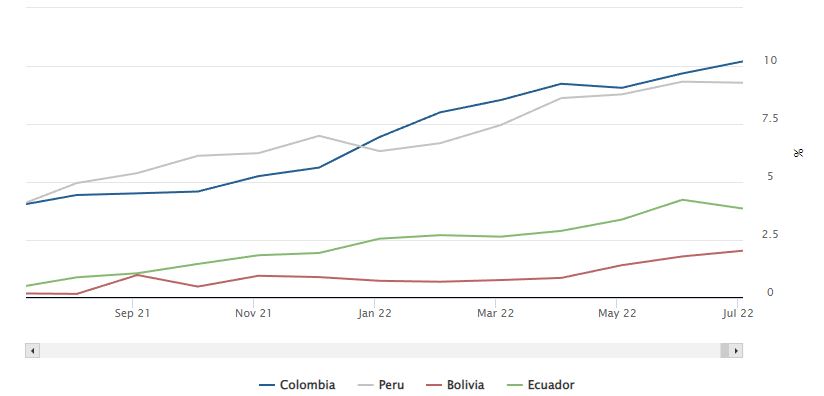
    PERU | Interest rate hike. Peru’s central bank (BCRP) raised the benchmark interest rate by 50 basis points to 6% on 7 July – its 13th consecutive hike since July 2021. In a statement, BCRP cited the fact that annual inflation was running at 8.81% in June, up from 8.09% in May, an increase that it attributed to global factors such as “international conflicts” – an allusion to the war in Ukraine. In a statement, the BCRP said that it expects annual inflation to begin falling from this month, but the annual rate is not expected to fall within the target range of 1-3% until Q2 or Q3 2023.

    BOLIVIA | Lithium cooperation. Bolivia’s state-owned lithium company, Yacimientos de Litio Bolivianos (YLB), signed a cooperation agreement with the Argentine state energy company Yacimientos Petrolíferos Fiscales Tecnologías (Y-TEC) on 28 July. The two companies pledged to increase information exchange and work together on projects to industrialise lithium production. Bolivia’s hydrocarbons and energy minister, Franklin Molina, said that the agreement will facilitate “scientific and technological cooperation for the production of cathodic materials and lithium-ion cells and batteries”.

    ECUADOR | First legal cannabis shipment. Ecuadorean cannabis company CannAndes announced on 27 July that it has carried out the country’s first legal cannabis export, sending flowers and extract to Switzerland for use in the pharmaceutical sector. Calling the shipment a “landmark moment” for the Ecuadorean cannabis sector, CannAndes said it had been made possible due to collaboration with the national police, with which it had developed an export protocol for the drug, and said the product had been inspected and verified by the national institute for agricultural research (INIAP). The production of cannabis for medicinal purposes and for the production of hemp was authorised in September 2019 following a reform to Ecuador’s criminal code.

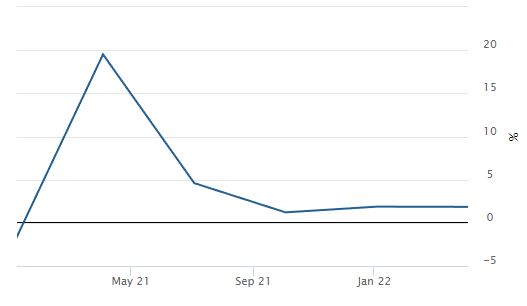
    Andean countries: inflation rate
    Percentage variation (year-on-year)

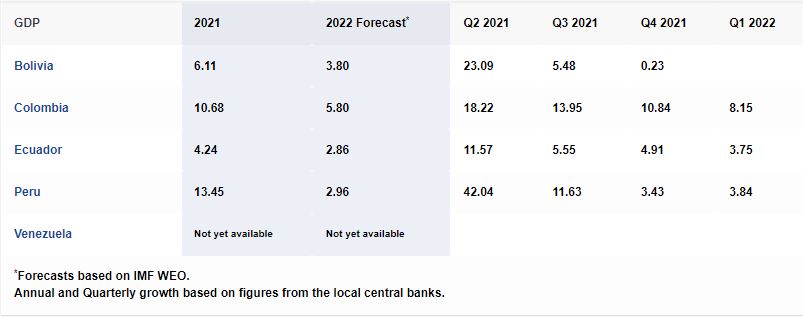
    Andean countries: GDP growth (%)
    Quarterly figures are year-on-year growth

  • ECONOMIC HIGHLIGHTS

    Patrick de Courcy 13 October 2022 Hits: 1053

    MEXICO | New economy minister named. On 7 October, Mexico’s President Andrés Manuel López Obrador appointed Raquel Buenrostro Sánchez as the new economy minister. Buenrostro, who had served as head of Mexico’s tax authority (SAT) since December 2019, takes over the role from Tatiana Clouthier, who announced her resignation the previous day. López Obrador thanked Clouthier for her contribution, saying her resignation was due to “personal reasons”.

    MEXICO | Gov’t announces deal to reduce food prices. On 3 October, President López Obrador announced an agreement with food retailers, producers, and distributors to combat rising food prices in the face of high inflation. The deal, known as the agreement to open up the market against inflation and high prices (Apecic), aims to reduce the maximum average price of the basic basket of food by 8% by 28 February 2023, from M$1,129 (US$56) for 24 products to M$1,039.

    MEXICO | Remittances on track for record year. On 3 October, Mexico’s central bank (Banxico) released new figures which show remittances to Mexico totalled US$5.12bn in August 2022, a yearly increase of 7.9%. With this figure, the total remittances received in the first eight months of the year equals US$37.93bn, a 15.2% increase on the US$32.94bn sent in the same period of 2021. Remittances to Mexico are currently on track to reach another record high this year and exceed the US$51.59bn sent to the country in 2021.

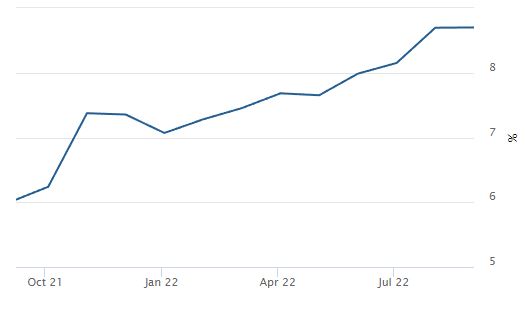
    MEXICO | Interest rates up again. On 29 September, Banxico raised its benchmark interest rate by 75 basis points to 9.25%. This represents the bank’s eleventh consecutive rate hike. In a statement, Banxico noted that “a wide range” of other central banks were also continuing to raise interest rates. Annual inflation in Mexico stood at 8.76% in the first two weeks of September.

    Mexico: GDP growth
    Percentage variation (year-on-year)

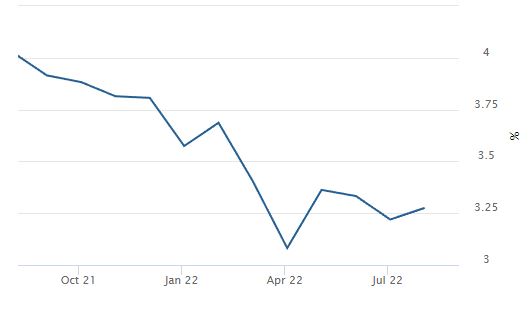
    Mexico: unemployment rate
    Economically active population

    Mexico: inflation rate
    Percentage variation (year-on-year)

  • ECONOMIC HIGHLIGHTS

    Patrick de Courcy 19 January 2024 Hits: 2083

    ECUADOR | S&P lowers outlook due to gang violence. On 11 January the international credit ratings agency Standard & Poor’s (S&P) lowered Ecuador’s outlook to ‘negative’ from ‘stable’, noting that “the government’s capacity to implement corrective [fiscal] policies will likely be limited…by the need to tackle increasing violence". Despite the worsening outlook, S&P maintained Ecuador’s credit rating at ‘B-’. S&P said that the emergency measures introduced by President Daniel Noboa in response to spiralling gang violence “might increase public acceptance of difficult economic decisions in the short term”. However, it added that “the full repercussions of the security problem on the economy and on future policymaking have yet to be seen”.

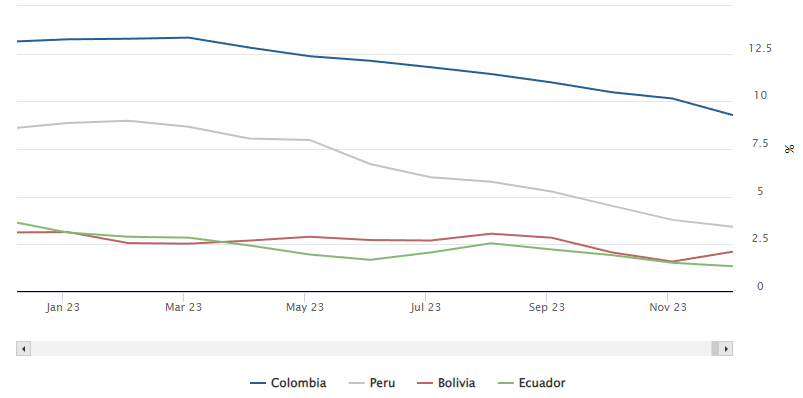
    PERU | Interest rate lowered. On 11 January, Peru’s central bank (BCRP) lowered its benchmark interest rate by 25 basis points to 6.50%. In a statement explaining the decision, the BCRP noted that monthly inflation in December was 0.41%, bringing the annual inflation rate to 3.2% – down from 3.6% in November. Annual inflation is now just outside the BCRP’s target range of 1%-3%, with the bank highlighting an accelerated decline between June and December last year. The BCRP said that despite a “moderate improvement” in some broader economic indicators, “the majority remain on a pessimistic trajectory”. The BCRP attributed this to the social unrest which swept Peru at the beginning of 2023 and the El Niño weather phenomenon, which it said have impacted economic activity and domestic demand.

    BOLIVIA | Record remittances. On 2 January, Bolivia’s central bank announced that remittances sent to the country from January-November 2023 totalled a record high of US$1.29bn, up US$2m on the amount received in the same period of the previous year. The greatest share of remittances was sent from Spain (30.3%), followed by Chile (21.9%), the US (21.4%), Brazil (6.5%), and Argentina (4.9%).

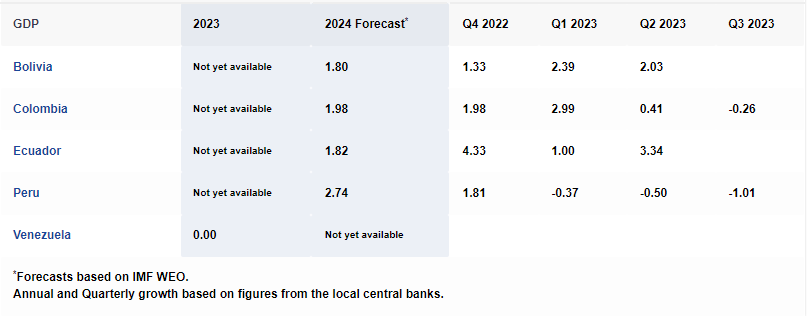
    Andean countries: inflation rate
    Percentage variation (year-on-year)

    Andean countries: GDP growth (%)
    Quarterly figures are year-on-year growth


  • JAMAICA & REGION: Jamaica holds course amid regional challenges

    LatinNews 01 September 2011 Hits: 1306

    Last month we reported on a paper published by the Washington-based Center for Economic and Policy Research (CEPR) that was strongly critical of the pro-cyclical nature of the IMF’s programme for Jamaica [RC-11-05].  There is, as yet, little sign that such siren voices are having an impact on Jamaica’s policymakers.

    Jamaica’s main problem is its high public debt, amounting to 129% of GDP in 2009/10 with interest on this debt absorbing 17% of GDP.  But for the CEPR, the tough fiscal policies advocated by the IMF are counter-productive.  It says: “Pro-cyclical macroeconomic policies implemented under the auspices of the IMF have...damaged Jamaica’s recent and current economic prospects”.

    But however attractive a bit of backsliding might sound to the government, it appears to be sticking to the prescribed regime.  Speaking at a World Bank training workshop in Kingston in mid-May Finance and Public Service Minister Audley Shaw said: “We have for the first time put in parliament a fiscal policy paper that outlines the macroeconomic programme, outlines the medium-term economic programme, and is signed by the minister of finance, and it says that we are committed to prudent management practices and if we don’t do it...then I subject myself to impeachment.”

    Shaw added that the positive side of this programme is that Jamaica now has adequate gross foreign exchange reserves, an exchange rate moving slowly upwards (by almost 5% over the last year), interest rates that are trending down, and inflation that is stable “even though it has to be lower”.

    Shaw repeated this message at the 25-26 May annual general meeting of the Caribbean Development Bank (CDB).  He said: “The initiatives of [Jamaica’s medium-term economic programme] have begun to yield positive results.  For the first time in a long time, all the macroeconomic variables are simultaneously pointed in the right direction; our exchange rate is stable, we have record foreign exchange reserves, interest rates are falling to historically low levels, our fiscal deficit is being contained, inflation is falling, employment is rising, and after 13 consecutive quarters of economic decline, the economy is estimated to have recorded growth of 1.5% during the March quarter of this year.”

    Earlier in the month, speaking in the budget debate in parliament, Prime Minister Bruce Golding pointed out that the Debt/GDP ratio of 128% was well within the ceiling of 139% set out by the IMF in the Standby Agreement and that the government was on target to reduce the ratio to 100% by 2016, as envisaged in the IMF programme.  He added: “If we focus our efforts seriously on investment and growth, we will reach that target even sooner.”

    The news on inflation is also encouraging.  According to Brian Wynter, the governor of the Bank of Jamaica, inflation should continue to fall this year, although by not as much as in 2010 when it fell 5.5 percentage points to 7.8%.

    Recently published US diplomatic cables indicate the degree to which Jamaica’s economic difficulties had come to alarm Washington at the height of the global economic crisis.  A US diplomatic cable sent from the embassy in Kingston to Washington in April 2008 warned: “If the current JLP [Jamaica Labour Party] government fails in its economic and national security reform efforts and Golding loses the next election…Jamaica could go the way of Haiti: fatally driven by crime, poverty, drugs, gangs, social disintegration, and emigration – all more reasons for strong US support for Golding’s ongoing reforms.”

    The wider challenges
    Meanwhile, back at the CDB’s annual general meeting, World Bank Managing Director Dr Ngozi Okonjo-Iweala gave a lecture on 24 May in which he outlined what he saw as the Caribbean region’s main challenges.

    During the global financial crisis (or the Great Recession, as Okonjo-Iweala called it), the Caribbean’s growth rate of 6% per annum for the years 2006-08 fell to around zero in 2009.  This was then followed by a sluggish recovery of 3.5% in 2010-12, compared with 4.5% for the main Latin American countries.

    However, for the World Bank’s managing director, the Caribbean’s problems pre-date the crisis.  For instance, in 1980 the Caribbean’s average per capita income was twice as high as that of the average developing country.  Now it is only one third higher.  Since 1970, the region has averaged just 2% growth compared to a global average of 3.5%.

    A key problem, relevant in particular to the region’s fiscal deficits, is that the small size of the region’s economies makes for a high fixed cost of government and providing public services.  It is estimated, for instance, that small states spend on average 3.7 percentage points more of their GDP compared to large states.

    On top of this, the Caribbean suffers from recurring natural disasters such as tropical storm Ivan which in 2004 destroyed the equivalent of 250% of Grenada’s GDP and affected 60% of its population.  The 2010 earthquake in Haiti caused damage equivalent to 120% of Haiti’s GDP.

    Okonjo-Iweala argued that fiscal discipline must underpin economic policy – and he pointed out that of the 15 member states of Caricom, 10 have a public debt-to-GDP ratio of over 60%.  Beyond that, he urged greater regional integration as “the only viable way to create scale for your economies”; more innovative ways of engaging the private sector to fuel growth; and improved governance and institutions.

    The importance of tourism to the Caribbean was emphasized (it now accounts for 29% of the region’s exports), but maximizing this potential must involve two things.  First, more collaboration (to the outside world, the recognized ‘brand’ is the Caribbean, not the individual countries of the region).  Secondly, the Caribbean must broaden its appeal beyond its traditional markets in North America and Europe.

    Okonjo-Iweala pointed out that while the US contributed 36% of the world’s GDP in the 1990s, this proportion had now fallen back to 21%.  On the other hand, the share of China and India had increased from 5% in the 1980s to 32% today.  Yet, against this “shifting economic geography”, Caribbean exports are still going primarily to the US and Europe (54% and 19% respectively).  The proportion for China and India is less than 1%, and, perhaps more surprisingly still, the proportion going to neighbouring Argentina, Brazil, and Mexico combined is only 3%.

    A final point made by the World Bank managing director is that the Caribbean is still lagging badly behind when it comes to access to (and affordability of) technology.  Broadband penetration in OECD (Organization for Economic Co-operation and Development) countries is over 30%; in the Caribbean it is around 8%.  Worse, the average price of one megabit down-speed service in the Caribbean is US$36 per month, which is nearly three times as expensive as in the US and seven times the price in the UK.

  • EL SALVADOR : Lagging

    LatinNews 26 January 2012 Hits: 783

    The economic outlook for 2012 is not encouraging. The UN’s Economic Commission for Latin America (Eclac/Cepal) is forecasting that the economy will again be the slowest growing in the region, registering only 2% growth in 2012 after 1.4% growth in 2011. Even Cuba, according to Eclac/Cepal is growing (and will grow) faster than El Salvador. 

    As the economy is the third or fourth biggest in Central America and the Caribbean, it is the biggest underperforming economy in the region.

    The key element in the economic mix is remittances which, in nominal terms,  are worth about 16% of GDP. That compares with agriculture (15% of GDP) and manufacturing (22%). Services account for about 60% of GDP. The importance of services in the economy reflects the importance of remittances. Some academics argue that, in the past 25 years, the country has gone from being the region’s industrial hub to being dependent on shopping malls for jobs.

    Salvadoreans’ privileged access in the US is a foreign policy priority. Unlike countries such as Guatemala or Mexico, Salvadoreans in the US benefit from Temporary Protected Status (TPS) which was first introduced as an “aid in kind” measure by President George W Bush in 2001 after the devastating earthquakes in El Salvador. The TPS measure has been renewed by the US every year since. Currently about 285,000 Salvadoreans living in the US benefit from TPS.

    In 2011 remittances came to US$3.648bn. This was US$218m or 6.4% more than for 2010 when remittances came to US$3.43bn, up 2.2% on 2009. It is worth noting that the rate of increase in remittances lags the rate of increase for Mexican remittances which in the first 11 months of 2011 were up 8%).

    One of the economy’s big problems has been the financial weakness of successive governments. This may now be changing after the national assembly approved a tax reform increasing income tax on high earning individuals and companies. This historic vote came on 14 December 2011.

    The ruling left-wing Frente Farabundo Martí para la Liberación Nacional (FMLN) government led by President Mauricio Funes claims that the reform will generate an additional US$150m a year from 2012. The government wants additional revenues in order to improve public health and education and to meet public demands to improve the parlous internal security situation. El Salvador’s tax take is just 13.6% of GDP, well below the Latin American average of 18%, according to the Inter-American Development Bank (IDB).

    The government claims that the reform will take the tax take up from 12.5% of GDP to 15.4%, still below the Latin American average (which is distorted by Brazil’s 40% tax take), but above the average for Central America.

    The El Salvador government is stressing internationally that the extra money will be used to reduce the deficit, not to increase spending, but the temptation to ramp up spending for this year’s congressional and next year’s presidential elections must be heavy.

    From January 2012, only individuals earning less than US$503 a month will be exempt from income tax. The reform retains the 10% levy on those earning between US$503 and US$6,000 a month, while those on more than US$6,500 a  month will now pay 30%. The government estimates that only 3,000 individuals in the country fall into this category. The other big change is that even loss making companies will have to pay a 1% tax on their sales revenues.

    On the corporate side, companies that report annual net profits of less than US$150,000 will continue to pay 25% but those reporting above this level will be taxed 30%. One concession made by the government to the private sector was to reduce the proposed tax on shareholders’ dividends from 10% to 5%.

    A 2009 report by the IDB and the Central American Institute of Fiscal Studies backed the government’s proposal, arguing that income tax reform should take precedence over other types of fiscal reform. The report, based on 2008 figures, showed that 30% of the income of the poorest 10% of households in El Salvador went on tax, while the wealthiest 10% contributed just 11% of their income.

    The finance minister, Carlos Cáceres, claims that in the 2012 thanks to the tax reform, the fiscal deficit will fall from 3.5% of GDP to 2.5% and foreign debt will come down from 52% of GDP to 50%. According to the central bank, foreign debt stood at US$6.4bn at the end of June 2011.

    Trade: In the first 11 months of the year, imports were up by 20% at US$9.25bn while exports were up by 18% at US$4.89bn. The worry for policymakers is that non-traditional exports were up by only 16% at US$2.9bn while traditional exports (principally coffee) were up by 83% at US$543m. One big reason for the increase in the import bill was the jump in oil imports (by 37%) to US$1.4bn.

  • Risk pointers

    LatinNews 03 October 2012 Hits: 465

    *** Indian warning on Pakistani spy network.  It has been reported in India that last week, Indian counter-intelligence sent a special advisory to police intelligence units and special branches in southern India warning about Pakistani spy activity.

    The advisory said that Pakistan had developed a “formidable” network in Sri Lanka with a view to spying on key Indian defence and strategic installations in the southern region.  The advisory called for “a special drive to target ISI [Pakistani intelligence] backed espionage networks in the area”.

    The advisory notes: “There is specific credible information which suggests that Pakistan’s ISI is now focusing in a big way on expanding its networks in southern India.  This is reflected in some of the recent incidents like spreading rumours to foment communal trouble in the wake of Assam violence...Recent information also reveals that a good network of ISI operatives is working out of Sri Lanka now.”

    *** Russian defence industry to quadruple output.  On 2 October, Russia’s Deputy Prime Minister Dmitriy Rogozin said that the output of Russia’s defence industries will increase by 80% by 2015 and that it will quadruple by 2030.

    Rogozin told the Russia Calling forum: “Taking into account the forecast growth trends, the industrial output of the defence-industrial complex in general will increase by 80% in 2015 [against 2011], by 50% in 2020 [against 2015], by 30% in 2025 [against 2020], and by more than 20% in 2030 [against 2025].”

    *** Nigeria’s Islamist Boko Haram declares war on northern leaders.  The radical Islamist group Boko Haram has declared war on governors and government officials in Nigeria’s Muslim north.  In a video, its leader Abubakar Shekau warned: “This message is for those in authority (emirs, governors, and government officials)...You have no resting place again and no resting time again...You have messed up yourselves and you have messed up your own situation.”

    The video also denied reports that the group is negotiating with the central government, saying “we are not in dialogue with anyone”.

    Shekau claimed that women associated with Boko Haram were being targeted by the security forces, with 7-10 currently in jail where they are being tortured.  He warned that the group would retaliate by focusing on women related to security and state officials.

  • TRACKING TRENDS

    LatinNews 20 December 2012 Hits: 2270

    PARAGUAY-ARGENTINA | Preparing for difficult Yacyretá negotiations. On 17 December Paraguay’s foreign minister, José Félix Fernández Estigarribia, said that the government of President Federico Franco is preparing to re-negotiate the Yacyretá bi-national treaty with Argentina which governs the eponymous hydroelectric dam shared by the two countries.

    After holding a meeting with the Paraguayan director at Yacyretá, Enrique Cáceres, Fernández Estigarribia pointed out that sections of the Yacyretá treaty are set to expire in March 2014 and that bilateral negotiations must begin in the coming months. He said that the Paraguayan government has already formed a commission tasked with preparing proposed changes to the treaty; and has called on all political parties and local experts to participate in a broad debate of the issue. Ominously, he added that the proposal “must reflect Paraguay’s new aspirations and expectations” regarding Yacyretá’s future, in particular the fate of Paraguay’s excess energy produced at the dam.

    Under the current treaty, both countries are entitled to use half of the energy produced at the plant, and any unused energy by one partner must be sold to the other at an agreed fixed price. Paraguay currently uses about 30% of its Yacyretá energy entitlement, selling the rest to energy-hungry Argentina for a price of US$9 per megawatt/hour, which amounts to approximately US$120m a year. However, in recent years Paraguay has sought to adjust the price so that it more closely resembles the going market rate, or to be allowed to sell its energy to third parties at market prices, all of which Argentina has rejected. The fact that Argentina’s payments for Yacyretá energy are often overdue given its difficulties in acquiring the funds that must be paid in US dollars (this year Argentina has only paid US$15m of the US$130m it owes) is also a source of worry for Paraguay.

    This situation has prompted Paraguay to look for other alternatives that would allow the country to make better use of its energy entitlement, namely radically improving Paraguay’s energy distribution infrastructure and further developing the country’s industrial sector to increase domestic consumption levels. Following Franco’s rise to power after former president Fernando Lugo’s (2008-2011) impeachment, which Argentina saw as a coup and does not recognise Franco, these efforts appear to have intensified. Indeed President Franco said that he will do everything he can to make sure that Paraguay uses all of its energy and does not sell any more of it to its neighbours. Paraguay also shares the Itaipú hydroelectric plant with Brazil governed under a treaty with similar terms.

    This is worrying for Argentina, which is already concerned about its future energy needs. Indeed Argentina has been lobbying Paraguay not only to increase production at Yacyretá, which currently operates at 60% capacity, but to expand the hydroelectric project by building another US$600m dam on the adjacent Aña Cua branch of the Paraná River, in addition to building a third brand new US$10bn bilateral hydroelectric plant on the Paraná at a site close to the border town of Corpus Christi in a bid to ensure future electricity supply.

    On the same day that Fernández Esitarribia made his revelations, Argentina’s planning minister, Julio de Vido, said that “everything is ready to launch the Aña Cua project”, adding that no decision on the project would be taken until April next year after “the Paraguayan people democratically express who their leader is”. The Argentine government might be looking to stall the Yacyretá negotiations until after the Paraguayan elections in the hope that a government more agreeable to its interests comes to power.

    BRAZIL-REGION | BSE outbreak. On 18 December the Brazilian government announced that Egypt and Saudi Arabia had temporarily suspended Brazilian beef imports following the confirmation by Brazilian authorities of an outbreak of Bovine Spongiform Encephalopathy (BSE) or ‘Mad Cow’ disease which took place two years ago. The Middle Eastern countries are following the lead of Japan, South Africa and China, all of which adopted similar measures a week after the Brazilian authorities confirmed on 7 December that the cause of death of a heifer in the southern state of Paraná in 2010 was a case of non-classic BSE.

    The decision by some of Brazil’s main beef export markets came despite the fact that the local and international zoosanitary authorities explained that a case of non-classic BSE meant there was no risk of an outbreak of the disease, or of it representing an “imminent human health risk”.

    The Brazilian government said it has been in contact with all the countries to which it exports beef in an attempt to deter them from adopting further trade restrictions. Brazil is the world’s top beef exporter with 1.02m tonnes exported in 2011, and the sector is important for its economy.

    • Uruguay investment plan

    On 14 December Uruguay’s vice-president, Danilo Astori, revealed that the government plans to implement a US$2bn public and private infrastructure investment programme in the next two years. Astori said that the government was looking to take advantage of the current “economic bonanza” in Uruguay to find entrepreneurs interested in working with it to improve Uruguay’s ageing infrastructure, “a pending issue for the country”. Uruguay’s under-fire economy minister, Fernando Lorenzo, revealed on 17 December that the government expects economic growth this year to be “no less than 4%”, meaning that Uruguay’s growth will be higher than the regional average of 3.2% for the eighth consecutive year.

  • TRACKING TRENDS

    Abbi Dicker 23 May 2024 Hits: 1824

    BOLIVIA | Anger over dollar shortages. Trade unions and associations of traders and transport workers staged protests and roadblocks in Bolivia on 17 May in the western department of La Paz, the south-western department of Oruro, and the eastern department of Santa Cruz, over various complaints. Chief of these related to shortages of US dollars, which have been afflicting the country for over a year and which led the left-wing Movimiento al Socialismo (MAS) government in February to announce the lifting of export restrictions, the offering of assorted incentives to try and reduce spending on fuel imports, and the issuance of bonds in US dollars by the central bank (BCB) [WR-24-07].

    As of 30 April, Bolivia’s net international reserves were at US$1.80bn, up US$88m on the amount registered at the end of 2023 but a far cry from the record US$15.12bn registered in 2014 as a result of the boom in commodities prices.