
All Categories

Subcategories

  • ARGENTINA: Macri advances with adjustment

    LatinNews 30 June 2016 Hits: 2962

    Despite the continuous domestic and global economic volatility, the Argentine government led by President Mauricio Macri is decisively moving ahead with the implementation of economic measures designed to fix the macroeconomic imbalances it inherited from the previous administration led by Cristina Fernández (2007-2015). But this is producing discontent as the domestic economy continues to suffer from the short-term negative effects of the measures.

    Following its successful moves to lift the foreign currency and exchange rate controls imposed by the Fernández administration and settling Argentina’s long-running debt dispute with its ‘holdout’ bondholders (those that still demanded full payment for their 2001 Argentine bonds) earlier in the year, the Macri administration announced plans to take yet another step to fully restore Argentina’s standing in international financial markets and improve its finances this week. On 28 June Argentina’s finance ministry announced a plan to buy back the GDP-linked bonds, which pay out a higher coupon whenever Argentina posts positive economic growth, issued by the country in 2005-2010 as part of the debt restructuring programme designed to help it come out of the 2001 debt default crisis.

    The statement said that the operation, under which the government would offer the holders of these bonds a one-off chance to sell them back to the Argentine treasury for a set price before the end of the year, will help to ease Argentina’s debt burden and free up additional funds to plough back into the faltering domestic economy. The ministry calculated that the operation would help the treasury save some US$9.4bn as the GDP-linked bond contingent debt amounted to US$13.83bn in April.

    Interestingly, the announcement came despite the fact that Argentina is expected to post negative GDP growth this year, partly as a result of the major macroeconomic adjustment implemented by the Macri administration. The International Monetary Fund (IMF) forecasts that Argentina’s GDP will contract by 1% this year. The Macri government has yet to release official GDP figures since it decided to overhaul the widely discredited national statistics institute (Indec). But a recent poll by local economists conducted by Reuters found that the consensus first quarter growth projection is -1.2%.

    However, government officials have repeatedly said that the changes in economic policies will start to produce positive results in the second half of the year, as the initial shock of the economic adjustment measures subsides. That the bond buyback announcement came a day before Indec is due to release its new quarterly economic figures, suggests that the government is confident that these will be positive.

    But there are few signs elsewhere that Argentina’s domestic economy has stabilised. Last week, on 23 June, the value of the Argentine peso against the US dollar fell by 2.6% to trade at Ar$14.45/US$1. This was mostly explained by the general volatility currently gripping international financial markets as a result of the uncertainty produced by the United Kingdom’s vote to leave the European Union. This has forced the central bank (BCRA) to intervene in the local currency market to try to manage the volatility.

    But the net effect of all this is inflation-inducing and is contributing to Argentina’s domestic inflation rate remaining high. The Indec’s brand new official inflation figures, released on 16 June, came in at 4.2% for the month of May. The high level of inflation is one of the main drivers behind the public discontent as it continues to eat away at the public’s purchasing power. Indeed the government’s decision to conclude the collective salary negotiations ahead of the second half of the year, which resulted in average increases of 40% compared to an average increase of 30% in the first half, has left some trade unions dissatisfied.

    The 40% average increase is higher than the 20%-25% increase advocated by the government. But still unions led by the Central de Trabajadores de la Argentina (CTA), headed by Pablo Micheli, staged demonstrations on 28 June to demand additional salary increases. Meanwhile oil workers’ unions in eight of the country’s 10 oil-producing provinces began a strike on 27 June in demand of additional salary increases. This backdrop has helped to push Macri’s disapproval rating up. A national poll by Poliarquía Consultores, released on 26 June, found that Macri’s disapproval rating had increased by 18 percentage points to 43% in June since Macri assumed office in December 2015, while his approval rating fell by 15 percentage points to 56%.

    • FPV desertions continue

    In positive news for Argentina’s President Mauricio Macri and the ruling Cambiemos coalition, more national legislators elected for the Frente para la Victoria (FPV, Kirchneristas) hard-line faction of the main opposition Partido Justicialista (PJ, Peronists) have decided to desert the party this week in the wake of ever growing corruption scandals implicating prominent figures from the previous FPV administrations. Three federal deputies and a senator quit the FPV last week in the wake of the arrest of the former deputy public works minister José López (2003-2015) [WR-16-24]. On 23 June they were followed by six other federal deputies, who announced that they would now form the ‘Peronismo para la Victoria’ bench. The FPV has now lost 21 federal legislators since February.
  • CHILE: Piñera presents spending plans

    LatinNews 02 November 2017 Hits: 376

    Sebastián Piñera, the centre-right frontrunner in Chile’s imminent presidential elections (polling day is due on 19 November) has presented a costed US$14bn programme of government.

    As a businessman and former president (2010-2014), Piñera is keen to assure voters that he has a detailed and carefully costed plan, ready to implement if he is elected. The implicit message is that the other candidates do not. Piñera accused them of “selling smoke” to the electorate.

    Piñera’s plan, totalling US$14bn worth of extra spending (equivalent to about 1.8% of GDP in each of the four years 2018-2022), was revealed on 30 October. A major aim is to protect Chile’s middle classes. The single biggest spending item is a programme known as “positive ageing and pensions with dignity” which will take US$3bn.

    This is followed by growth and quality of employment measures (US$2.8bn), infrastructure and connectivity (US$2bn), and health and education (each receiving around an additional US$1.5bn). Lower sums are earmarked for agriculture, sport, science, innovation and entrepreneurship.

    The plan gives some detail of where the extra money will come from. Half the total cost, or US$7bn, is to be found from the re-assignment of existing budgets away from poorly performing programmes; strict austerity measures; and public sector spending reductions. The plan proposes limiting public sector recruitment, travel expenses, overtime, and consultancy fees.

    The other US$7bn is to be raised as a result of the expected success of government efforts to accelerate the country’s economic growth. Chile Vamos – Piñera’s centre-right coalition – claims the country’s underlying economic growth rate will rise from the 2.6% assumed in the 2018 budget calculations to 3.5%. This, together with measures to reduce tax evasion and improve the efficiency of public sector companies, is deemed sufficient to boost revenue by the necessary amount.

    Piñera’s main rivals have not as yet produced similar plans. The latest poll by Centro de Estudios Públicos (CEP) places Piñera in front with 34.5% of voter intentions, followed by Alejandro Guillier, the independent centre-left candidate supported by the bulk of the ruling Nueva Mayoría coalition, with 16.4%, and by Beatriz Sánchez of the left-wing Frente Amplio, on 8.5%. That means that there is a 16-percentage-point difference between Piñera and Guillier.

    Guillier clearly faces an uphill struggle: his main hope is that Piñera will fall short of 50% support on 19 November, triggering a second-round run-off ballot on 17 December, in which Guillier could hope to attract cross-over votes from the supporters of other defeated first round contenders. Guillier has claimed that current opinion polls are “contradictory” but has also said that being behind Piñera by 10 percentage points is “reversible”, trailing him by 15 points is “complicated” and being behind by 20 points is “very difficult but still worth fighting”.

    Guillier represents a degree of continuity with the incumbent government’s policies – something which is unlikely to be much of an electoral asset – but has stressed his priorities are to address inequalities of income, diversify the country’s productive capacity, and step up Chile’s integration with neighbouring economies.

    • Piñera’s plan

    Sebastián Piñera’s US$14bn plan consists of 745 proposals. Piñera argued that these are needed to “correct” the policies of the outgoing centre-left Nueva Mayoría administration led by President Michelle Bachelet.

  • BRAZIL: Cinemateca fire reminder of wider issues

    Patrick de Courcy 05 August 2021 Hits: 4247

    A fire consumed parts of a warehouse of Brazil’s cinematheque in São Paulo on 29 July, destroying film archives and historical documents. With the cinematheque currently closed amid a judicial dispute over its management and the government having received multiple warnings, as recently as 20 July, as to the risk of fire, the incident is the latest in a line of cultural tragedies foretold which are a both a symptom and a consequence of the neglect and underfunding of the arts and culture sector in Brazil.

    With some 250,000 film rolls and over one million audio-visual documents, the Cinemateca Brasileira is considered to be the largest cinematographic archive in South America. Last week’s fire in its 6,000 m2 warehouse in the west of São Paulo city is believed to have destroyed around 300m2 worth of material, including archives from defunct state institutions for the audio-visual arts, copies of films from different collections, some of which were potentially unique, and objects which were destined for a future museum.

    Although it could have been prevented, the fire was not unexpected. The Cinemateca has been in crisis since 2013. Following allegations of financial wrongdoing which were poorly handled by the federal government of the time, led by Dilma Rousseff (2011-2016), the cinematheque’s reputation took a hit and financing began to dwindle.

    Management of the institution was taken over by the Associação de Comunicação Educativa Roquette Pinto (Acerp), a social organisation, but the Acerp’s contract was never renewed by the federal government – led by President Jair Bolsonaro at this point – after it ended in December 2019. In July last year, public prosecutors accused the government of abandoning the Cinemateca; the following month, the government seized the cinematheque’s keys, sent all its employees home, and effectively closed it down.

    The government’s special secretary for culture, Mário Frias, a telenovela actor, sought to blame the fire on the legacy of previous leftist administrations, but artists, cinephiles, and critics of Bolsonaro point the finger at his government. While the cultural sector’s struggles undeniably predate the current administration, they have worsened under the Bolsonaro government, whose neglect and even disdain for the sector reflect the ‘bolsonarista’ belief that the arts constitute a vehicle for subversive left-wing ideology.  

    Neglect

    This was the fifth fire suffered by the Cinemateca in its 70-plus-year history, but its severity brought to mind other recent cultural tragedies in Brazil: the fires that destroyed the national museum in Rio de Janeiro in 2018 and the museum of the Portuguese language in São Paulo in 2015. The latter re-opened on 31 July after remaining closed for almost six years, in a ceremony attended by São Paulo state governor João Doria, Portugal’s President Marcelo Rebelo de Sousa, and two former presidents of Brazil, but not the incumbent. Under Bolsonaro, who got rid of the culture ministry, funding for the struggling arts sector has been cut further, while the government has also been accused of censorship.

  • BRAZIL: Covid-19 inquiry targets healthcare provider

    Patrick de Courcy 29 October 2021 Hits: 3252

    In April this year a parliamentary commission of inquiry (CPI) was set up in the Brazilian senate to investigate the government led by President Jair Bolsonaro’s response to the coronavirus (Covid-19) pandemic. Since then, the CPI has heard testimonies from cabinet ministers, doctors, public officials from different levels of government, lawmakers, and representatives from a variety of businesses linked to medical procurement, as it seeks to uncover where and how the Bolsonaro government was remiss in its management of a pandemic which has left Brazil with over 600,000 dead, the second-highest official death toll in the world. In late August, a company called Prevent Senior came to the CPI’s attention.  

    Set up in the 1990s, Prevent Senior provides private healthcare plans, specifically targeting senior citizens, and operates a chain of hospitals in Greater São Paulo. The company now has over half a million clients and is said to be amongst Brazil’s top 10 biggest healthcare providers. It landed in the CPI’s crosshairs after a group of doctors – former and current Prevent Senior employees – sent  the commission a 10,000-page dossier containing serious accusations against the company. According to the allegations, Prevent Senior tested unproven Covid-19 remedies on patients without their consent; covered up the true number of Covid-19 deaths at its hospitals; and coerced doctors into pressuring patients to take a cocktail of unproven drugs known as the ‘Covid-19 kit’, or risk losing their job. Prevent Senior has repeatedly rejected the accusations.

    Bruna Morato, a lawyer representing the whistleblowing doctors, made further accusations against Prevent Senior when she appeared before the CPI in September. In October, three of the doctors revealed their identity on national television channel TV Globo’s ‘Fantástico’ programme and reiterated their claims, also describing how they were under pressure to attend to 60 patients in 12 hours and pushed to discharge patients early as part of Prevent Senior’s efforts to cut costs.

    Prevent Senior now faces various investigations, including from the CPI and federal public prosecutors, over its supposedly unethical and criminal practices. The CPI specifically is looking into the company’s possible links with the Bolsonaro government; during its earlier work, the senate commission established that Bolsonaro took advice on Covid-19 from a ‘parallel cabinet’, which amongst other things recommended the use of the drugs contained in Prevent Senior’s Covid-19 kit.

    In Brazil, a debate over the use of so-called ‘early treatments’ against Covid-19 has raged since the start of the pandemic. Bolsonaro is a big champion of these unproven remedies – which include hydroxychloroquine, an anti-malarial, and ivermectin, an anti-parasite drug – and continues to push them today, despite international health authorities having dismissed them as ineffective and potentially harmful. In April 2020 Eduardo Bolsonaro, a federal lawmaker and one of the president’s sons, praised Prevent Senior for its work on hydroxychloroquine, seemingly referencing the study the company is now accused of unreliably and unethically carrying out in the early weeks of the pandemic last year.

    One concern is that Prevent Senior is not the only company to have behaved the way it did in its provision of care to Covid-19 patients. José Davi Urbaez, the head of the Federal District’s society of infectious diseases, told the Associated Press that Prevent Senior’s “criminal” prescription of the Covid-19 kit is “just the tip of the iceberg”.

    • CPI revelations

    At time of writing, the CPI was yet to vote on its final report, unveiled at the end of October. Senators on the commission had previously said that its conclusions were “devastating”; the final report suggests prosecuting over 60 people, with a focus on President Bolsonaro, who is accused of having committed nine different crimes. To read the latest on the conclusion of the CPI, please see our sister publication, the Latin American Weekly Report.

  • BRAZIL: Dirty gold finds a place in smartphones

    Patrick de Courcy 10 August 2022 Hits: 1903

    There is a good chance that anyone who owns communication devices made by Apple or uses IT software and services provided by tech giants Amazon, Microsoft, or Alphabet (parent company of Google) is to some extent relying on small quantities of illegal gold mined in the Brazilian Amazon.

    That was the finding of an investigation by journalists from Repórter Brasil, reviewed by news agency Reuters, and published on 25 July. The report cited leaks from a Brazilian police investigation which has not yet been publicly released. The four tech giants had all used small amounts of gold supplied by an Italian company, Chimet, for use in circuit boards inside consumer electronics products and services. Chimet in turn was reported to have bought millions of dollars’ worth of the gold from a Brazilian company, CHM do Brasil, which is under police investigation and is alleged to have acquired the metal illegally from wildcat miners, known as ‘garimpeiros’.

    CHM do Brasil denied the claims, saying it only obtained gold from legal sources. Chimet said it had nevertheless broken off relations with CHM do Brasil in October 2021 when the police investigation began. It also says it has conducted an independent audit of its suppliers and in April this year was certified by bullion market association LBMA as meeting responsible sourcing standards. Police documents indicate Chimet bought some US$385m worth of gold from CHM do Brazil in 2015-2020. In response to the claims, Apple said its policies prohibit the use of illegally mined metals, and that companies that do not comply are removed from its supply chain. Amazon, Alphabet, and Microsoft did not immediately comment.

    The problem of illicit gold mining is well known in Brazil. Unauthorised miners in the Amazon are accused of chopping down trees and poisoning local rivers with mercury, which is used to pan for gold. They are also said to bring crime, prostitution, and contagious diseases. The garimpeiros have fought with local indigenous groups for control of profitable mining areas. Instituto Escolhas, a local think tank, has estimated that nearly half of Brazil’s total gold output is illegal. Illegal gold production is estimated at 84 tonnes in 2019 and 2020, the first two years of President Jair Bolsonaro’s four-year term in office, up by 23% on the two preceding years.

    A key part of the problem is that there is no effective system to distinguish between legal and illegal gold. Wildcat gold miners operating illegal mines in indigenous reserves can sell their gold to institutions authorised by the central bank. All they need do is fill out a form providing their personal details and identifying where the gold was mined. These statements are based on the presumption of good faith and are never checked. Falsifying the true origin of the gold is therefore incredibly easy.

    Various lobby groups have suggested reforms that would make it easier to certify where gold comes from. Instituto Escolhas had submitted a bill to the senate which aims to “set out a legal framework for tracing gold at all points in the supply chain”. It would use blockchain technology and radio isotopes to tag the metal’s DNA and build a secure electronic database. Central bank president Roberto Campos Neto has supported the idea, setting up a working group with police and mining association Ibram.

    Ibram president Raul Jungmann says large mining companies want to differentiate themselves from the illegal mining that is dominated by criminal organisations. He added: “Illegal mining impacts the sector’s reputation, which means restrictions in terms of social-environmental, image and market approval.”   Alexandre Pierantoni of Kroll, a consulting and security company, has commented that “the main point of concern for investors in Brazil currently is no longer corruption, but issues related to environmental impacts”.

  • REGION: Trump tariffs uncertainty causes widespread concerns

    Sarah Sheldon 28 May 2025 Hits: 1726

    Tariffs imposed by US President Donald Trump on 2 April on all imported foreign goods have set alarm bells ringing throughout Central America, with key economic sectors likely to be negatively affected.

    Trump imposed a blanket 10% tariff on Guatemala, Honduras, El Salvador, Costa Rica, and Panama, with Nicaragua hit by an 18% tariff, although this was later paused. This means Nicaraguan exports are currently subject to the same 10% tariff as those from the rest of the region, but the swift retraction demonstrates how volatile Trump’s trade policy has been so far, adding to the uncertainty that is already affecting the regional economy.

    According to figures from the secretariat for Central American economic integration (Sieca) obtained by Bloomberg Línea, a multi-platform business news brand, the US receives 32.1% of Central American exports. Significant sectors include textiles, which represent 29% of total regional exports to the US, and medical equipment, which make up 15% of the total, according to an analysis from international consulting firm Deloitte published in January, as well as agricultural products such as nuts and fruit, coffee, sugar, vegetables, and tobacco.

    Analysis by US multinational investment bank Citi shared with Bloomberg Línea found that Honduras, El Salvador, and Panama are the most vulnerable Central American nations, given their trade imbalances with the US, migration, drug trafficking, and dependence on remittances.

    In Guatemala, local private sector lobby Cámara de Industria de Guatemala (CIG) estimates that tariffs will cost businesses more than US$40m per month. This will affect the competitiveness of Guatemalan exports compared to those from countries not subject to tariffs, such as Mexico, CIG vice president Enrique Font was cited by national daily Prensa Libre as saying in an article published on 21 April. 

    According to Ricardo Barrientos, the executive director of regional thinktank Instituto Centroamericano de Estudios Fiscales (Icefi), tariffs will likely deepen the region’s dependence on remittances sent by migrants living in the US. As Trump’s trade policy has so far led to a weakening of the dollar against a basket of currencies, these remittances will likely be worth less to those receiving them, weakening their purchasing power and potentially pushing those that rely on them for basic necessities closer to poverty.

    Tariffs and the surrounding uncertainty could lead to job losses in the worst affected sectors, potentially increasing hunger and poverty while increasing the risk of social unrest. There are also widespread concerns that the tariffs will increase prices for US consumers, leading to a collapse in demand for imported products as people tighten their belts in the face of the rising cost of living, as well as tipping the US economy into recession. This would have important second-order effects on the service sector in Central America, including tourism and customer service call centres that cater to the US market.

    Business groups have pressed national governments to negotiate with the US, and officials have reacted cautiously so far. Even those countries that have had more difficult relations with the US in recent years, such as Nicaragua and Honduras, have not retaliated with their own tariffs.

    The Guatemalan government has criticised the tariffs for violating the terms of the Dominican Republic-Central America free trade agreement (Cafta-DR) with the US, but President Bernardo Arévalo has ruled out imposing retaliatory tariffs and said he will negotiate with the US. Arévalo also met with representatives of the country’s leading private sector lobby, Comité de Asociaciones Agrícolas, Comerciales, Industriales y Financieras (Cacif) on 8 April, and the government published a statement promising to work together with the private sector to deal with tariff-related challenges.

    In Costa Rica, Rodney Salazar, president of the Costa Rican chamber of foreign trade (Crecex), was cited by national daily La República as calling for calm, saying “This could temporarily dent our competitiveness in the US market, but we must avoid rash moves that disrupt supply chains or trade agreements”. The Costa Rican government led by President Rodrigo Chaves has said that it would attempt to secure better terms in negotiations with the US, but Salazar has also suggested that the government should look to other export markets to offset risks. “Diversifying markets is key to reducing our dependence,” he said.

    This will remain the case even if Trump eventually rows back on his tariffs completely, because Washington’s reputation as a reliable and rational partner has been dented. There are also further risks that Trump could impose tariffs on specific countries or industries in order to extract concessions on certain issues. For example, he continues to threaten to “take back” the Panama Canal, and he could use the threat of tariffs to achieve this aim, or to force President José Raúl Mulino to allow US ships to transit for free or at reduced rates.

    As things stand, it appears that Central American governments will continue to try and appease Trump so as not to draw his attention and antagonise him further. If they can succeed in securing more favourable terms, the impact on national economies could be lessened. However significant damage has already been incurred due to the uncertainty surrounding tariffs, which will have delayed investment decisions by both households and businesses.

    With many Central American economies already struggling to drive growth, this uncertainty will likely reduce economic activity and deepen issues surrounding stretched public budgets and unmet demands for social spending

    Building costs

    US tariffs on steel and aluminium will increase building costs in the region by up to 20%, the Centro de Estudios del Negocio Financiero e Inmobiliario (Cenfi), a Costa Rica-based thinktank, told Bloomberg Línea in an article published on 2 April. This will affect both private housebuilding and much-needed infrastructure projects in the region, increasing the price per square metre for both residential and commercial buildings and increasing rental costs, soaking up money which could otherwise have been spent in the wider economy or reinvested in businesses.

  • PARAGUAY: Carperos occupy indigenous lands

    LatinNews 14 September 2012 Hits: 728

    Paraguay’s self-proclaimed landless farmers (Carperos) regularly invade vast tracts of land that they consider to be underused or ill-gotten, demanding that the government appropriate and redistribute it. Often, the Carperos target the property of wealthy landowners, believing that this will help their cause. However, the most recent invasion in Canindeyú department took place on lands belonging to an indigenous community, the Aché. The Carperos’ actions prompted a strong reaction from the Aché, forcing the government to intervene as tensions flared. The incident has put renewed attention on the increasingly intransigent and aggressive nature of the Carperos. Critics accuse them of thuggery.

    The Kuêtuvy community is located 450km northwest of Asunción, where an Aché tribe has been awarded 4,600 hectares (ha) of land by the State. Carperos first arrived in the area last year, occupying an area denominated Finca 470. Initially, the Aché ignored the Carperos, believing their camp temporary. However, as numbers at the site swelled to 400, the Aché became uncomfortable with the presence. Although the Aché have been awarded the ownership of their ancestral land, they have not yet received the titles, due to the slow pace of Paraguayan bureaucracy.

    The Carperos often use the lack of formal land titles as an excuse to demand expropriation. In this case, their leader, Gustavo Aquino, claims that there are at least 3,000 ha of untitled and unused land in the Kuêtuvy community. According to some local press reports, the Carperos were encouraged by an   announcement made by President Federico Franco that the government was looking to establish a new settlement on surplus lands located in the area.

    Tensions reached boiling point on 26 August, when the Aché leader and former indigenous affairs minister, Margarita Mbywangi, presented a formal complaint at the interior ministry and told journalists that if the authorities did not intervene and evict the Carperos the Aché would forcibly remove them using their bows and arrows. Moreover, Mbywangi accused the Carperos of being the same violent group involved in a bloody confrontation in Curuguaty in mid June in which 17 people died, an incident that proved the catalyst for the impeachment of President Fernando Lugo (2008-2012) [RBS-12-07]. The Kuêtuvy community lies just 60kms from Curuguaty. Mbywangi said the Aché would give the Carperos three days to leave their lands.

    The government was forced to act in order to avoid a confrontation. Interior Minister Carmelo Caballero met Aché representatives on 27 August, followed by a visit to Finca 470, where Caballero and officials from the land and rural development institute (Indert) managed to establish a temporary truce. The Carperos agreed to peacefully vacate the land on the condition that they are provided alternative lands by the Indert in 22 days. Following their evacuation, a police cordon was set up metres outside the Aché lands. Caballero ordered the police to remain in the area for a month.

    There have long been allegations by the right wing traditional parties about close links between the Carperos movement and former president Lugo and his Frente Guasú (FG) leftist coalition. The Carpero’s national leader, José Rodríguez, added fuel to the fire last month when he declared that the group would back the FG’s 2013 presidential pre-candidate, Mario Ferreiro. Rodríguez has also declared that the group feels “threatened” by Franco, which could conceivably explain their eagerness to test his administration.

    • Landed Carperos

    According to Canindeyú’s governor, María Cristina Villalba, many of the self-proclaimed landless farmers occupying Aché lands already own lands and have no right to demand more. Using this argument, some critics question their underlying motives. Villalba said that he only way to resolve the dispute over Finca 470 was to for the government to adopt a “clear line… to impose the rule law”.

  • ARGENTINA: US considers backing Argentina over debts

    LatinNews 18 July 2013 Hits: 3435

    Expressions of South American unity were very much the fashion at the latest summit of the Southern Common Market (Mercosur) in Uruguay on 12 July. Regional leaders vied to demonstrate the greatest outrage over the refusal of various European countries to allow the Bolivian presidential plane travel through local airspace on the erroneous belief the fugitive US intelligence whistleblower, Edward J. Snowden, was on board. President Cristina Fernández had good reason to issue a statement of solidarity. “I am going to be extremely sincere,” she said. “I cannot fly to some countries in Europe with my presidential airplane, because there might be a judge who will issue a seizure order after a ‘vulture fund’ request.” Over the weekend, however, it emerged that the US government is now considering backing Argentina in its battle with the said ‘vulture funds’.

    Tango 1, the presidential jet, has since little action since the Ghanian authorities impounded the Libertad, an Argentine frigate and navy training vessel, on a visit to the West African country late last year, following a request by Argentina’s hold-out bondholders to a local judge. The frigate’s subsequent return to Argentina, after it was freed by the UN International Tribunal for the Law of the Sea, was celebrated with fireworks, flypasts and a bout of nationalistic speechifying.

    Since Argentina restructured its debts following its default in 2002, a number of US hedge funds, led by Paul Singer of Elliott Capital, have refused the terms of the deal and have been battling in US courts to force the country to pay up. Lately, the battle has been going the investors way, with Argentina losing repeatedly in the US lower courts, and being ordered to place US$1.33bn in an escrow account to pay its debtors. However, a new ruling is expected by the 2nd US Circuit Court of Appeals soon; in the meantime Argentina has requested the US Supreme Court examine the issue (which it will only consider following the lower court’s ruling).

    Battle moves to Washington

    On 13 July, The Washington Post reported that the US Barack Obama administration was now considering whether to weigh into the battle on Argentina’s behalf. The day before, US Justice Department officials met lawyers from both parties. According to the report, the department is now considering whether to file a brief at the US Supreme Court focused on defending the concept of sovereign immunity, which gives nations protection from lawsuits.

    Politics complicate the judicial principle. Singer, who is spearheading the investors’ efforts, is a major donor to the US Republican Party (GOP). The bondholders have also launched a massive PR campaign, highlighting Argentina’s relationship with Iran and questioning its commitment to combatting drug-trafficking. Congressmen from both sides of the house have been drafted in to help sway the government. Argentina and its allies label the investors ‘vulture funds’ seeking massive financial gains at the expense of an impoverished country. Anti-poverty campaigners have sought to make an issue of the principle, arguing that poor countries should be able to restructure their debts without fear of expensive lawsuits.

    • German courts reject bondholders

    The same arguments that proved effective in the US courts fell on deaf ears in Germany. On 11 July, the German courts rejected a petition from bondholders based on the same interpretation of the ‘pari passu’ clause the hedge funds used in New York. The ‘pari passu’ clause was interpreted by US courts as meaning that Argentina could either pay all its bondholders or none, but could not pay only those who cooperated with the 2005 restructuring and ignore the rest.

    German bondholders, identified under the name 'Laxhuber', had recently managed a favourable judgement for the payment of EUR1.5m plus interest, but their demands for additional payments were rejected by the courts. END BOX

    • Blue dollar rises again

    After several months in abeyance, the market for the so-called ‘blue dollar’ – the unofficial exchange rate, started to take off again in July. On 15 July, it reached Arg$8.58/US$, pushed by a higher demand due to the beginning of the winter holidays in Buenos Aires. The official rate isaround Arg$5.4/US$.

  • Brazil: PEC 241: the marathon begins

    LatinNews 27 October 2016 Hits: 2439

    For the last two years, Brazilian governments have been talking a lot about narrowing the fiscal deficit (currently somewhere above 10% of GDP), but not achieving very much by way of concrete measures. That, the current government hopes, changed on 10 October, when the lower house voted by 366 to 111 to support constitutional amendment proposal no. 241 (known as PEC 241). At the core of PEC 241 is a proposal to cap federal government spending for the next 20 years. Yet, as we explain here, it will remain something of a battle to get the amendment fully approved by December.

    Attending the BRICS summit in India, President Michel Temer described his recipe for Brazil’s political and economic recovery as a combination of “fiscal and social responsibility”. The president insists that the country’s large fiscal deficit must be brought under control, but that this must be done in a way that protects spending on education and health and does not get in the way of job-creation. Clearly, the Temer administration fears that conventional austerity – radical deficit reduction measures – will not work, and might even kill off the first, very tentative, signs of economic revival. It is a difficult balance to strike, and everything suggests that Temer and his key ministers will be busy for the rest of this year trying to get it right.

    The government appears to have decided that the key piece of legislation to achieve the necessary fiscal rebalancing that Brazil needs is the PEC 241, first sent to congress in June, after the Temer-led administration had taken over on an interim basis amid the impeachment process against President Dilma Rousseff.

    Temer’s finance minister, Henrique Meirelles, has already ruled out any increase in taxes next year, so the focus will be on expenditure control. The draft PEC states that for the next 20 years the annual increase in total federal government spending cannot exceed the rate of inflation. Next year, the upper limit is set at 7.2% – the current inflation forecast for 2017. Thereafter, the increase in nominal spending in any given year will be limited to the annual inflation rate registered in June of the preceding year. After the first ten years, the government of the day will have an opportunity to alter the way that the spending cap is calculated. The reform proposal also tackles the problem of ring-fenced expenditure: current constitutional provisions that fix education, health and other categories of spending as set proportions of the total government spend or of GDP. Taking these into account, it sets ‘floor’ levels for this kind of spending next year, and then subjects them to the same overall inflation-rate cap from 2018 onwards.

    After several months stuck in congress amid the impeachment process and surrounding political instability, the PEC 241 finally got a leg up on 10 October, but it will still face a multitude of challenges. As it is a constitutional amendment, the reform requires approval by a four-fifths majority in a total of four votes in the federal legislature, two in the lower house and two in the senate. The first of the four votes was the one held on 10 October. The bill needed 308 votes to achieve the four-fifths majority, but actually passed with 366 votes. That comfortable majority might suggest that the Temer government and its ruling coalition of parties will have no trouble winning the remaining three votes. On current plans, the PEC was due to face its second lower house vote in late October, with the senate scheduling its first and second votes for 29 November and 13 December. However, there could be complications.

    One risk is political, and is connected to the arrest of the former lower house speaker Eduardo Cunha, of the ruling Partido do Movimento Democrático Brasileiro (PMDB), on 19 October. Cunha faces multiple corruption charges. An old-style operator (often described as ‘Brazil’s Frank Underwood’ in reference to the central character in the US TV drama House of Cards), at one point Cunha was considered one of the country’s most powerful politicians. In September, he was expelled from the chamber of deputies, meaning that he lost his immunity from prosecution. The danger is that to reduce his potential sentence, Cunha may enter a plea-bargaining deal, in effect turning State’s evidence. He might incriminate existing members of the government, distracting and weakening its focus on the fiscal reforms. In a worst-case scenario, his revelations could again induce political paralysis in the ruling coalition. Cunha could even try to use his remaining influence among federal deputies to hold back approval of PEC 241.

    Another political problem is that public prosecutors have expressed concerns that PEC 241 might be used to limit resources allocated to anti-corruption investigations (however, Meirelles has noted that the text allows for some marginal above-cap spending in certain areas, to be offset by under-spending in others).

    On the more technical side, PEC 241 is only a first step to resolving Brazil’s structural fiscal imbalances. Action is also needed to control state-level spending. Nor does the PEC resolve the problem posed by the country’s generous pensions, which, according to some estimates, have led to a surge in unfunded pension liabilities to a massive BR$3.3trn (US$1.046trn, or roughly 50% of GDP). The Temer government is saying that it will tackle the thorny issue of pension reform (likely to involve unpopular measures such as lifting the retirement age and increasing pension contribution rates) during the course of next year. A report by the IMF at the end of September warned that, “if key reforms are watered down or get stalled in Congress, the boost to confidence will be short-lived and the recession may continue”.

  • COLOMBIA: Uribe case puts Duque under the spotlight

    LatinNews 10 September 2020 Hits: 3827

    Senator Iván Cepeda, of the left-wing Polo Democrático Alternativo (PDA), has been a nemesis of influential former president Álvaro Uribe (2002-2010) since the early years of Uribe’s rule, as one of the foremost voices in the fight against paramilitarism in Colombia. The developing legal case against Uribe [WR-20-32], increasingly focused on allegations of the former president’s alleged complicity in paramilitary violence, represents something of a triumph for Cepeda over his old rival - and has brought Colombia’s current government, led by Uribe’s protégé President Iván Duque, into the crossfire.

    Cepeda commented last week that “this is a matter that goes beyond political power, here there is a model of state at stake”, a model “which keeps the country in a permanent state of war”. In Cepeda’s eyes, President Duque is responsible for perpetuating this status quo, as demonstrated by the escalation of violence in Colombia in recent years, and by Duque’s alleged efforts to protect Uribe from conviction. On 4 September Cepeda appealed for the United Nations (UN) high commissioner for human rights, Michelle Bachelet, to take action against what he described as “this attack on the supreme court of justice [CSJ] and its judges”, referring to the passage of Uribe’s case from the CSJ to the attorney general’s office, following the former president’s resignation as a senator on 18 August.

    • Escalating violence

    The murder of 46-year-old lawyer Javier Ordoñez by two Bogotá police officers on 9 September proved to be the final straw for the Colombian public, as a video of the brutal attack spurred protests against police brutality in cities across the country. By the end of the night, in Bogotá alone, the city’s police reported that five civilians had been killed and 53 police stations attacked. Further footage showed police officers beating and even shooting at protesters, exacerbating a wave of unrest that looks set to become a significant problem for the Duque administration.

    Cepeda contends that giving the attorney general, Francisco Barbosa, a former adviser to Duque, appointed to the role in January, authority over Uribe’s case represents a breach of international standards on judicial independence. Cepeda last week filed a formal challenge against Barbosa’s involvement - and by association the involvement of Gabriel Jaimes Durán, who was appointed by Barbosa to oversee the case – but has as yet been unable to suspend proceedings. If Durán intends to favour Uribe, he is yet to show evidence of it; on 4 September he rejected the former president’s request to lift the house arrest order issued by the CSJ, insisting that the transfer of judicial responsibility will not affect the case.

    More disturbingly for Duque, however, there are signs that this critique of his supposed threat to the separation of powers is gaining traction on the international stage. The Berlin-based anti-corruption NGO Transparency International (TI) warned on 3 September of the “growing concentration of power” in the hands of the president, “to the detriment of civil liberties and other branches of power”. TI chair Delia Ferreira Rubio warned that “the system of checks and balances in Colombia has been affected by questions over the independence of institutions that must monitor and control the president”, seemingly in reference to the appointment of Barbosa in January, as well as of Duque’s former justice minister Margarita Cabello as prosecutor general on 27 August.

  • COLOMBIA: Vaccine diplomacy in Duque’s South Korea visit

    Patrick de Courcy 26 August 2021 Hits: 1803

    Colombia’s President Iván Duque arrived in South Korea on 24 August for his first major foreign trip since the start of the coronavirus (Covid-19) pandemic. The three-day state visit to Seoul delivered some benefits, with Duque and his South Korean counterpart, Moon Jae-in, pledging to deepen ties in digital, environmental, and cultural matters. Duque is still awaiting confirmation on whether he has secured the trip's biggest prize, however, having presented a letter of intent for Colombia to join the Seoul-based International Vaccine Institute (IVI). Approval, Duque said, would put Colombia at the forefront of vaccine research and development in the fight against Covid-19 and other diseases.

    President Duque had lofty ambitions for the state visit. Accompanied by a large delegation, including representatives from the coffee, medical, meat, fashion, and videogame sectors, among others, he was clear in his intention to deepen Colombia’s links with the Asian Tiger. Speaking during a stopover in Alaska on his way to South Korea, he outlined a number of objectives for a much closer economic relationship, including the doubling of coffee exports to 1m sacks per year, and the incorporation of South Korean medical technology into Colombia’s health system.

    It was Duque’s plans to reposition Colombia as a vaccine producer that caught the most attention at home, however. Colombia, which once had a fledging industry in the production of vaccines for diseases including yellow fever, rabies, and tuberculosis, has not manufactured a human vaccine since 2001, according to a November 2020 report by the comptroller general’s office. Unable to keep pace with increasingly stringent and costly international regulations, Colombia’s bioscience sector withered.

    The South Korea visit presented Duque with a major opportunity to turn back the clock. On 25 August he visited the IVI, the world’s leading authority in vaccine science, where he formally applied for Colombia to be registered as a member state. Duque was warmly received at the IVI, where Chairman George Bickerstaff said that the organisation “has much to gain from Colombia’s expertise and leadership” and expressed his “hope to demonstrate the breadth of opportunities across vaccine research and public health that we make available to our member states”.

    The congratulatory statements from the Colombian delegation and the IVI indicate that Colombia’s ascension to the international organisation is all but certain, pending ratification by Colombia’s congress. Duque also held a meeting with the president of the South Korean vaccine company SK Bioscience, Jaeyong Ahn, with whom he said he discussed investments in Colombia “for vaccine development and research”. He added that this would not be limited to Covid-19 but could also include the manufacture of vaccines and treatments for other widespread diseases in Colombia such as Dengue fever and Chikungunya (for which there is currently no vaccine).

    A memorandum of understanding was signed between the Bogotá chamber of commerce and the South Korean chamber of commerce and industry, with both chambers planning to meet every six months to establish goals for investment and trade. Duque and President Moon also signed memorandums of understanding for cooperation in the fields of public health, environmental protection, agriculture, the creative sector, entrepreneurship, and support for veterans of the 1950-1953 Korean war, in which Colombia participated.

    Humanitarian crisis in Nariño

    The international humanitarian NGO Médecins Sans Frontières (MSF) released a report on 24 August warning that mass forced displacements in Nariño represent one of the worst humanitarian crises in 20 years in the southern department. The report states that 21,106 people were displaced in the first six months of 2021 in Nariño’s ‘Telembí triangle’, which encompasses the municipalities of Barbacoas, Magüi Payán, Roberto Payán, and Tumaco. That figure, MSF claims, represents 23% of the local population. The displacement is being driven by clashes between rival dissident units of the disbanded Fuerzas Armadas Revolucionarias de Colombia (Farc) guerrilla group and the Clan del Golfo drug trafficking organisation. MSF warned that refugee camps in urban centres are overwhelmed, with “life-threatening conditions” including limited access to water, food, and medicines.

  • BOLIVIA: Gov’t claims progress on coca eradication

    Patrick de Courcy 03 February 2023 Hits: 4906

    Bolivia’s Interior Minister Eduardo del Castillo presented the latest figures on coca leaf cultivation and eradication on 20 December, announcing that, according to field data collected by the interior ministry, the government had exceeded its target for coca eradication for the second year running – achieving a net eradication of 10,260 hectares (ha) of coca leaf in 2022. This figure is 2.5% higher than that achieved in 2021.

    Del Castillo praised the “Bolivian model” for achieving this goal. Under a 2017 law passed under former president Evo Morales (2006-2019), the government permits the cultivation of 22,000 ha of coca per year for traditional usage, which must be distributed through one of the country’s two coca unions – the Seis Federaciones del Trópico de Cochabamba (SFTC) or the Asociación Departamental de Productores de Coca de los Yungas de La Paz (Adepcoca).

    Del Castillo said that “we are here to inform the Bolivian people and international bodies of the result of the Bolivian model; not only have we exceeded expectations, but we also demonstrated that our model works, and that violence isn’t necessary to reach our objectives”. He contrasted this with the methods that have been promoted by the US Drug Enforcement Administration (DEA) in other countries in South America, and emphasised that “whilst we are in power and we are the head of this ministry, the DEA will not return to this country”. The DEA was expelled from Bolivia in 2008 by Morales, who accused it of espionage and fomenting political unrest in the country.

    Contesting the UNODC’s figures

    Del Castillo claimed that Bolivia “is the only country in the region, of the producers, to have achieved a net reduction in coca production”. He also used the occasion to contest the figures outlined in a report by the United Nations Office on Drugs and Crime (UNODC), published 29 November, concerning coca production from 2020-2021. According to the UNODC, 29,400 ha were under coca cultivation in Bolivia in 2020, rising to 30,500 ha in 2021. Del Castillo claimed that the UNODC’s report has “some errors in measurements” and instead put the 2021 figure at 29,200 ha. If correct, Del Castillo’s figure would indicate a 0.7% reduction in coca cultivation between 2020 and 2021, compared to the 3.74% increase claimed by the UNODC.

    The Bolivian government’s contesting of international reports on coca is not a new trend, with Del Castillo previously describing the UNODC report as “a political, unilateral report with a weak methodology”. However, the UNODC did include both its own estimate (30,500 ha) as well as the figure presented by Bolivian government (29,200 ha) in its official report. Del Castillo said that the UNODC and the Bolivian government should work together in future projects to foster a “new methodology”.

    Cocaine seizures rise

    In a separate presentation on 30 December, Del Castillo said that seizures of cocaine were up in 2022 compared with the previous year. According to Del Castillo, 20.2 tonnes (t) of cocaine were seized, up from 19.7t in 2021 – a 2.53% increase on 2021. Del Castillo also said that in 2022, 190.5t of marijuana were seized, 65 cocaine processing laboratories discovered, and 67 illegal runways destroyed. He claimed that much of the seized cocaine was explained by Bolivia “being used as a transit country” for drugs that he said were mostly produced in Peru and smuggled to Brazil before being shipped to Europe.

    Synthetic drugs

    Troels Vester, the UNODC’s representative in Bolivia, warned on 29 November of a growing presence of synthetic drugs on Bolivia’s domestic drugs market. “There were seizures of synthetic drugs, including fentanyl, an opioid which has caused a great number of deaths in Europe,” Vester said, adding that “there is a national market – this is a problem for us and it will be for Bolivia”.

  • ECONOMIC HIGHLIGHTS

    Abbi Dicker 19 January 2024 Hits: 1938

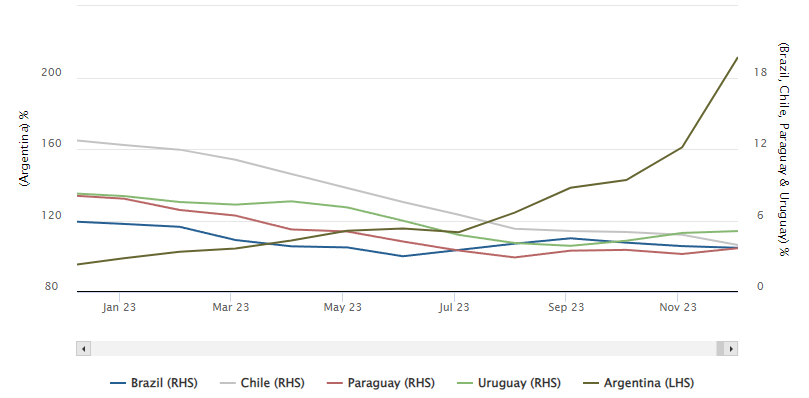
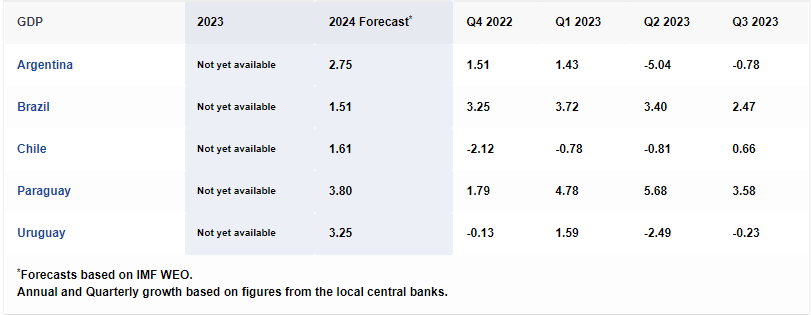
    URUGUAY | Year ends on report of Q3 contraction. Uruguay’s central bank (BCU) released new figures on 14 December which showed that the country’s GDP contracted 0.2% year-on-year in the third quarter. This negative result was driven by contractions in the construction, and electricity, gas & water sectors, which both registered -0.4% variations. This was offset partially by 0.5% year-on-year growth in agriculture, fishing & mining, while the transport, storage, information & communications segment also posted growth of 0.3%. In quarterly terms GDP expanded 1% Q2 2023. Uruguay’s economy is expected to grow just 1% in 2023, below the regional average of 2.2% according to the latest forecasts from the United Nations Economic Commission on Latin America and the Caribbean (Eclac). However, Eclac revised its projections for 2024 to 3.2% for Uruguay in December, up from 2.6% three months earlier.

    REGION | Dim prospects for Mercosur trade deal. Brazil handed over the six-months rotating presidency of the Southern Common Market (Mercosur) trade group to Paraguay on 7 December amid increasingly dim prospects for the ratification of the free-trade agreement that the regional bloc reached in principal with the European Union (EU) in 2019 after 20 years of drawn-out negotiations. The deal would do away with most tariffs and create the world’s largest free-trade area. But ratification has since stalled, largely due to pushback from European farmers and dissatisfaction in Brazil with subsequently added environmental provisions, and now looks unlikely as Paraguay’s President Santiago Peña had said he would end talks with the EU should the deal not be closed under Brazil’s pro-tempore presidency. The accession to power in Argentina of libertarian President Javier Milei – who has threatened to pull out of the bloc – also casts doubt over the stagnant regional group, which also comprises Uruguay and, since Brazil ratified its membership last month, Bolivia.

    Brazil & Southern Cone: inflation rate
    Percentage variation (year-on-year)

    Brazil & Southern Cone: GDP growth (%)
    Quarterly figures are year-on-year growth


  • BRAZIL: Further efforts to dismantle Lava Jato legacy

    Abbi Dicker 08 February 2024 Hits: 3830

    Supreme court (STF) justice José Antonio Dias Toffoli suspended a fine on Brazilian construction giant Novonor on 1 February. Novonor was formerly known as Odebrecht and was central to the Lava Jato corruption scandal, although Dias Toffoli represents factions in Brazil’s judicial institutions that have sought to redress the miscarriages of justice carried out during the sprawling corruption probe.

    In December 2016, Odebrecht, as it was known then, agreed to pay R$8.5bn (US$1.7bn) in fines as part of a leniency agreement made with the federal prosecutor’s office (MPF). Dias Toffoli’s decision also authorised Novonor to request the offices of the attorney general (PGR), comptroller general (CGU), and the solicitor general (AGU) to review the terms of the 2016 leniency agreement.

    The suspension of the fine resulted from a petition by Novonor to access materials from Operation ‘Spoofing’, a police investigation launched in 2019 into the hacking of the messages between Lava Jato’s lead judge Sergio Moro and the federal prosecutors of the investigative task force. Dias Toffoli ruled that the fine would be suspended while Novonor analyses the evidence obtained during Operation Spoofing, the private messages which might provide possible evidence of collusion or misconduct between Moro and the Lava Jato prosecutors in relation to the 2016 Odebrecht leniency agreement.

    In December 2023, Dias Toffoli suspended a fine for another company implicated in corruption schemes, J&F, parent company of the meatpacking company JBS. The MPF signed a leniency agreement with J&F in 2017, as part of which the agribusiness giant agreed to pay R$10.3bn in fines. The fine was suspended according to the same logic, so that J&F can access Operation Spoofing materials to review messages between Moro and prosecutors regarding their leniency agreement.

    In late-January, anti-corruption NGO Transparency International (TI) updated its global corruption perceptions rankings, in which Brazil ranked a lowly 104th out of 180 countries studied, down 10 places from its 2022 ranking [WR-24-04]. TI also released a country report, ‘Retrospectiva Brasil’, in which the NGO criticised Dias Toffoli’s suspension of the J&F fine in December and his decision in September 2023 to invalidate the evidence of bribery found on Odebrecht’s computer systems.

    The STF justice’s efforts to hold Lava Jato’s misconduct and abuses to account has sparked concerns over impunity for corruption. TI maintained that Brazil “became a graveyard of evidence for the largest transnational corruption case in history”. On 5 February Dias Toffoli ordered an investigation into an agreement signed in 2014 between the MPF and TI, in which the Brazilian chapter of the international NGO was contracted to assist the Lava Jato task force. According to an STF press release, Dias Toffoli wanted to investigate the handling of the 2017 J&F leniency agreement, alleging that the NGO received funds from the payment of the J&F fines, payments which should have been made to the Brazilian state.

    On 6 February TI’s chairperson, François Valérian, released a statement suggesting that Dias Toffoli’s “attack” against the NGO was retaliation against the comments made against Brazil’s judiciary in TI’s 2023 country report for Brazil. TI has stated that these allegations about mishandling funds were made before and that Brazil’s MPF had already investigated and disproven these claims in 2019. 

    Lava Jato remains divisive 

    Brazil’s attorney general, Paulo Gonet, petitioned the supreme court (STF) on 5 February to undo the suspension of the fine imposed in 2017 on J&F, parent company of agribusiness giant JBS, as part of the sprawling Lava Jato corruption investigation. The legacy of Lava Jato remains a divisive issue within Brazil’s judicial institutions. Some officials defend its achievements in punishing the endemic corruption among Brazil’s political and business establishments, while others, including current STF justice José Antonio Dias Toffoli and former STF justice and current justice minister Ricardo Lewandowski, have sought to redress the miscarriages of justice perpetrated during Lava Jato

  • NICARAGUA: Ortega triggers press concerns

    LatinNews 19 July 2011 Hits: 414

    The recent launch of a new TV channel (13) to be operated by three of President Daniel Ortega’s children, Camila, Luciana and Maurice, has set alarm bells ringing among civil society groups. Prominent organizations such as the human rights NGO Centro Nicaragüense de Derechos Humanos (Cenidh) and the Centre of Media Investigations (Cinco) warn that it represents a fresh threat to the independence of the ‘fourth branch’ of government.

    With Channel 13, known as Viva Nicaragua, the Ortega family now operates three of the eight main public TV channels. Run by another son, Carlos Enrique, Channel 4 has been in Sandinista hands since the 1990s. Channel 8 is managed by Carlos’ brother, Juan Carlos, following its purchase in January 2010 from local businessman Carlos Briceño, reportedly with funds from Albanisa, the main local operation of the Venezuela-led Alianza Bolivariana Para los pueblos de Nuestra América (Alba) initiative, which is closely linked to the Ortega family. The transaction was controversial due to the lack of transparency [RC-10-02] and concerns that it violated the telecoms law, which prohibits foreign-controlled entities from owning a majority stake in local media.

    With Nicaragua’s First Lady Rosario Murillo serving as the government’s official spokesperson and communications secretary, the new Ortega media dynasty is in line with national tradition. Former president Violeta Barrios Torres de Chamorro (1990-1997), who unexpectedly defeated the FSLN on the ticket of the briefly united US-backed opposition initially rose to fame via her marriage to Pedro Joaquín Chamorro, editor of an independent (and now leading) national daily La Prensa and a key opponent of the Somoza dictatorship, assassinated in 1978. During the first FSLN government (1979-1990), Chamorro steered the paper back towards its previous opposition stance to the government, although other family members did not agree with her line: in 1980, Nicaragua’s other main broadsheet, El Nuevo Diario, was founded as a pro-Sandinista paper by Pedro Joaquín’s brother Xavier Chamorro, while her son, Carlos –a well-known media figure today as director of analysis weekly, Confidencial (highly critical of Ortega) – edited the FSLN mouthpiece Barricada.

    While Chamorro continued her husband’s legacy as a champion of press freedom, lifting press restrictions and establishing the telecoms law creating Telcor, the communications regulatory authority, among other measures, the fact that her family was far from monolithic in its political affiliation meant that the press continued to reflect a wide range of ideologies. This cannot be said for Ortega however, whose various swipes at media independence continue to attract local and international attention – as recently flagged up in two recent reports, one by the NGO Freedom House and the other by the US State Department in its annual human rights report. The former noted the closure of five opposition radio stations over the last couple of years. The US report cited, among other concerns, complaints by opposition news sources that the government “continued to exclude independent media outlets from all official media events and to withhold government advertising contracts”.

    • El Nuevo Diario in new hands

    Concerns about press freedom were exacerbated by a recent bidding war for the national daily El Nuevo Diario. In May, the newspaper, whose majority shareholders are Xavier Chamorro’s five children, announced it was facing financial problems and was seeking a buyer, prompting fears that the ruling FSLN, which already has a 12% stake, would seek a majority share. After Nicaragua’s leading business group, Grupo Pellas (which is also linked to the Chamorros) offered to step in, another prominent businessman, Ramiro Ortiz Gurdián, of the financial conglomerate Grupo Promérica, eventually put in the winning bid, reportedly offering between US$4m-US$5m for a 62% stake.

  • TRACKING TRENDS

    LatinNews 24 November 2011 Hits: 1767

    HAITI | Restoration of the army. President Michel Martelly is moving ahead cautiously with plans to restore Haiti’s disbanded army. On 19 November he announced the appointment of a civilian commission which between now and independence day on 1 January will meet legislators, business and religious leaders, before producing a report into the role a future army would play when the UN stabilisation force (Minustah) leaves. Martelly, who was speaking on the anniversary of a military victory by Haitian rebels under Jean-Jacques Dessalines against the French in 1803 at Vertières, failed to provide a convincing explanation for why an army was needed instead of channelling resources into improving the national police. He claimed the army would combat smuggling and terrorism, although this is not a pressing concern in Haiti and would generally fall under the remit of the police.

  • RASTREANDO TENDENCIAS

    LatinNews 09 January 2012 Hits: 843

    ARGENTINA | Presupuesto 2012. El gobernante Frente para la Victoria (FPV) y sus aliados en el senado aprobaron el presupuesto de 2012 por 44 a 26, el 26 de diciembre, convirtiéndolo en ley tal como había sido aprobado por la cámara baja. El presupuesto permite un gasto total de Arg$ 505,13bn (US$117,22bn), con una inflación pronosticada de 9,2%, un crecimiento económico de 5,1%, permite el uso de US$5,67bn para el servicio de la deuda externa y estima una tasa de cambio promedio peso/dólar de Arg$ 4,40/US$ 1.

    ARGENTINA | Ley antiterrorismo. La Presidenta Cristina Fernández promulgó la Ley 26.734, llamada ley antiterrorismo, el 28 de diciembre. La aprobación de la ley había sido requerida por la Fuerza de Tareas de Acción Financiera (FTAF) para combatir el lavado de dinero y el financiamiento del terrorismo. Sin embargo, la extremadamente vaga elaboración del artículo que reforma el código penal ha provocado críticas tanto de sectores pro-gobierno como anti-gobierno, que dicen que la ley podría ser  usada para criminalizar las protestas sociales y perseguir a los oponentes políticos.

    URUGUAY | Record de exportación. Uruguay rompió su record de exportación en 2011. Las exportaciones totalizaron US$ 8,02bn, subiendo 18,5% sobre 2010, de acuerdo con cifras oficiales Es el segundo año consecutivo que Uruguay rompe su previo record. Sin embargo, una vez más, las exportaciones fueron superadas por las importaciones, que se incrementaron en 23,5% sobre 2010, a US$ 8,57bn el año pasado. Brasil sigue siendo el principal socio comercial de Uruguay, tomando 20,3%, o US$ 1,63bn, de las exportaciones totales. China es el segundo mayor receptor de las exportaciones uruguayas, llegando a US$665m, subiendo 78,3% sobre 2010, delante de Argentina, con 7,3%, o US$ 588m. La carne congelada fue el mayor producto de exportación, llegando a US$ 979m, o 12,2% del total, seguida por la soja (10,7%, US$ 858m) y el arroz (5,9%, US$ 475m).

    El gobierno del Presidente José Mujica también recibió un estímulo el mes pasado, cuando la Organización para la Cooperación y el Desarrollo Económico (OCDE) removió a Uruguay de su “lista gris” de naciones consideradas como que no han tomado suficiente acción para combatir la evasión fiscal. La OCDE difundió una declaración diciendo que Uruguay había mostrado su compromiso para cumplir con el estándar internacional firmando siete nuevos acuerdos fiscales bilaterales, más recientemente con Ecuador, Liechtenstein y Suiza, aunque todavía no firma acuerdos con Brasil o Argentina. El anuncio de la OCDE llega pocas semanas después que el Presidente de Francia, Nicolas Sarkozy, irritará a la administración de Mujica al incluir a Uruguay en una lista de naciones que debían ser rechazadas por la comunidad internacional por ser paraísos fiscales.

  • Risk pointers

    LatinNews 29 February 2012 Hits: 224

    *** Turkey’s Islamic arms sales.  It is noteworthy that eight out of 10 top countries to which Turkey exports weapons are Muslim countries at a time when Turkey’s total annual defence sales have reached $1bn.  According to the Union of Turkish Defence Exporters, all the top 10 buyers are Islamic countries except for the US and Italy.  The Islamic nations in the list are Saudi Arabia, the United Arab Emirates, Bahrain, Azerbaijan, Turkmenistan, Kazakhstan, Pakistan, and Lebanon.  The prospective buyers list can be extended to include Indonesia, Malaysia, and Qatar.

    A Turkish official says: “Being Muslim makes a difference.  The Muslim buyers see that you are Muslim and take up a better attitude.  In the coming years we expect better prospects to sell our products.”

    *** Turkey calls for liberation of Jerusalem.  Turkey’s Deputy Prime Minister Besir Atalay attended the International Conference on the Defence of Jerusalem in Doha on 26 February.

    He said: “Without the liberation of Jerusalem, no real peace and stability can be achieved in the Middle East or farther afield.”  He called Jerusalem “a captive city in the hands of Israel” and said that “Turkey will not allow...Israel’s oppressive attempt...at changing Jerusalem’s historic fabric by intimidating Palestinians.”

    *** China keeps warning its neighbours.  During the past week China has complained to Japan about its marine research activities in the East China Sea and to the Philippines about its plans to explore for oil and gas in the Spratly (Nansha) Islands.  China told the Philippines: “It is unlawful for any country or company to explore oil and gas in seas under Chinese jurisdiction without the permission of the Chinese government.”

    China has also been involved in a row with India over the visit of India’s Defence Minister AK Antony to the north-eastern Indian state of Arunachal Pradesh.  Antony visited the state for its silver jubilee statehood celebrations on 25 February.  China responded by saying that India should not take any actions that could “complicate” the border issue.  The Chinese foreign ministry asked India “to work with China to maintain peace and stability in the border areas”.

    India responded through External Affairs Minister SM Krishna, who said: “All seven states in north-eastern parts of India are part and parcel of India, and China has no rights to make adverse remarks on Antony’s visit to Arunachal Pradesh.”

    China claims Arunachal Pradesh as part of southern Tibet and regularly complains about high-level visits by Indian officials to the region.

  • TRACKING TRENDS

    LatinNews 27 June 2013 Hits: 961

    PARAGUAY | Looking for Spanish investment. On 24 June Paraguay’s President-Elect Horacio Cartes held meetings in Madrid with Spain’s Prime Minister Mariano Rajoy and King Juan Carlos in which he presented a series of investment projects that his future government is hoping to conduct with the help of foreign investors. The meeting was part of Cartes’ tour of Spain as he prepares to assume office on 15 August.

        During the meetings, Cartes reportedly told his Spanish hosts that he was committed to improving Paraguay’s investment climate; and that as soon as he assumed office he would promote the drafting of new legislation to promote public-private investment projects so as to help Paraguay secure sustained levels of economic growth.

        “Paraguay has great riches and great potential,” Cartes is said to have told King Juan Carlos, highlighting the energy resources of the country and the various investment opportunities that it presents, particularly in infrastructure development. King Juan Carlos replied that Spanish businessmen are “very eager” to invest in Paraguay.

        Afterwards Cartes met members of the Spanish business community during a forum held at the Casa de América in which he once again pledged that one of the first actions he will take when he assumes office is to work on legislation to offer greater security for foreign investments. He then roughly mentioned some of the various infrastructure projects that the country needs to develop in the coming years, such as dredging its two main navigable rivers, the Paraguay and the Paraná; the building of additional ports on these rivers; and the expansion of the national road system so as to increase the level of transport connectivity with Argentina and Brazil.

        While Cartes may not have provided many concrete details of the projects or indeed incentives for investors to come to Paraguay, the country’s latest economic performance figures should provide sufficient incentives. On 23 June Paraguay’s central bank (BCP) released its official first quarter economic figures which showed that economic growth in the country during this period had been 14.8%.

        Significantly, while the BCP pointed out that the results were driven by the impressive recovery in the agricultural sector, which posted a 47.4% growth rate, all of the other sectors in the economy, including manufacturing (7.2%), mining (11.8%) and construction (18.1%), posted very positive figures. The BCP’s year-end growth forecast for 2013 is of 13%.                                                                                                                                                                                                                                                                                                                                                                                                                                                                                                                      

  • El Salvador: Is the new fiscal deal enough?

    LatinNews 23 November 2016 Hits: 3004

    The good news is that after coming close to defaulting on its debts in October, the government of El Salvador has reached an agreement with the opposition on a fiscal responsibility law that allows it to borrow the extra money it needs and gradually reduce the deficit. The bad news is that a number of analysts don’t think the deal goes far enough to solve the problem.

    El Salvador’s ruling left-wing party, the Frente Farabundo Martí para la Liberación Nacional (FMLN), was in deadlock with the right-wing opposition Alianza Republicana Nacionalista (ARENA) for months. The government wanted to raise new loans and taxes; ARENA opposed new taxes and wanted a different approach focused on spending cuts to balance the budget. Neither party can command a congressional majority, but ARENA, in alliance with smaller parties, was strong enough to withhold authorisation for new borrowing. With a dollarised economy, the government cannot print money to cover its fiscal deficit. Therefore, having reached its borrowing limits in early October, it looked as if the government might simply run out of money and default on its debts.

    An eleventh-hour deal was struck in November. Congress voted a law enabling the government to raise US$550m worth of international bonds (less than the US$1.2bn the government had been seeking). US$307m of this will be used to pay off short term treasury bills (Letras de Tesorería, or Letes), thereby reducing total outstanding Letes debt. Of the rest, US$82m will go on transfers to municipal governments, US$65m on public sector wages, US$46m on electricity tariff subsidies, and US$40m on reducing government debts to suppliers.

    At the same time, the political parties agreed on a fiscal responsibility law (approved by 76 of the 84 members of congress). The law stipulates that in the three years commencing from January 2017, tax revenues must be increased to not less than 17% of GDP, while spending must be contained at not more than 18.5% of GDP.

    With estimates of the non-financial public sector (NFPS) fiscal deficit currently running at around 4% of GDP, this implies a commitment to reduce it to 1.0%-1.5% by 2020. The law also establishes that total non-financial public sector (NFPS) debt cannot exceed 45% of GDP, while total NFPS debt including pension liabilities must be capped at not more than 65% of GDP.

    The deal is clearly a step forward, but a number of analysts fear that it doesn’t go far enough. The international credit-rating agency Moody’s Investors Services has cut El Salvador’s rating twice, on 11 August (from Ba3 to B1) and on 8 November (to B3 with a negative outlook). According to Ariane Ortiz-Bollin, a Moody’s analyst, the fiscal deal (which was signed on 11 November) is a “good signal”, but does not really do enough to tackle the problem of high Letes debt.

    By law, governments cannot borrow more than US$1.3bn worth of Letes (the limit is set at 30% of current public revenue). But Ortiz-Bollin says that as far as Moody’s is concerned, the upper limit should be no more than US$800m. This is because local banks hold around 60% of the total Letes in circulation and for some, Letes exposure is equivalent to 20% of paid-up capital, a level that many consider to be too risky. Many local branches, which are subsidiaries of risk-averse international banks, are being told to cut their exposure. As a result, Ortiz-Bollin says, “it is difficult to know if the markets are going to be there for El Salvador when it issues the bonds”, suggesting that the country may find itself having to pay higher interest rates that it would have hoped (the timing has also coincided with a tightening of interest rates associated with the outcome of the US elections).

    Much will depend on whether the FMLN government can execute the kind of fiscal restructuring required by the new law, as well as tackling reforms to the pension system to reduce large unfunded liabilities. However, according to think-tank Fundación Salvadoreña para el Desarollo Económico y Social (FUSADES), if the government can achieve a reduction in the annual fiscal deficit equivalent to three percentage points of GDP over the next three years, coupled with average GDP growth of 2% per annum, then it will be able to cut its overall debt by an amount equivalent to 26.2% of GDP. In contrast, if nothing is done to manage the deficit, by 2025 total debt will reach 82.7% of GDP.