All Categories

Subcategories

  • RASTREANDO TENDENCIAS

    LatinNews 02 April 2015 Hits: 814

    ARGENTINA | Citibank suspendido de los mercados de capital. El regulador de valores de Argentina, la Comisión Nacional de Valores (CNV), suspendió el 27 de marzo al Citibank Argentina de operar en los mercados locales de capital. La decisión sigue a un acuerdo del Citibank con el Distrito Federal de EU del Juez Thomas Griesa para permitirle procesar los pagos de interesas sobre bonos argentinos, toda vez que sea por ‘unja sola vez’, lo que permitiría al grupo bancario salir de su negocio de custodia local. Griesa ha estado buscando bloquear todos los pagos del servicio de la deuda de Argentina, hasta que el país pague a un grupo de acreedores ‘holdout’ con quienes ha estado en disputa.

    La CNV ordenó una “suspensión preventiva” luego de hallar que el banco no cumplió con las leyes bancarias argentinas. La suspensión significa que el Citibank no podrá operar en el mercado local de acciones y bonos, pero si podrá continuar con sus actividades minoristas.

    De acuerdo con Reuters, Citibank Argentina abrió su primera sucursal en 1914. Es el 12do más grande banco del país en depósitos, con Arg$22,82mm (US$2,67mm) en diciembre del 2014, alrededor del 2,6% de todos los depósitos en el sistema bancario argentino.

    BRASIL | Producción industrial. Después de elevarse en 2% mes en mes en enero, la producción industrial cayó en 1,5% en febrero, de acuerdo con el instituto oficial de estadísticas de Brasil, Ibge.

    Fueron dadas varias razones, algunas más serias que otras. Un factor que ocurre ‘una sola vez’ fue el Carnaval, que este mes fue en febrero y no en marzo, que suma por al menos dos días de vacaciones.

    Sin embargo, lo más preocupante han sido los signos de pérdidas de empleos y la construcción de un inventario. Además el deterioro del Real significa que ciertas importaciones necesarias para la producción han agregado presión sobre los costos del sector.

    PARAGUAY | Resultados mixtos en la pobreza. Un total de 1,5m de paraguayos, o 22,6% de una población de 6,78m habitantes, viven en la pobreza, de acuerdo con un informe oficial difundido por la Dirección General de Estadísticas, Encuestas y Censos (DGEEC) el 31 de marzo. De estos, 710.173 personas, o 10,5% de la población vive en la pobreza extrema, o indigencia. La pobreza general cayó en 1,2 puntos porcentuales de 23,8% en el 2013, pero unas 33.084 personas adicionales cayeron en la pobreza extrema, subiendo en 4,7% sobre el 2013. Un total de 16% de residentes en las áreas urbanas se calcula que vive en la pobreza, una cifra que se eleva al doble, 32% entre la población rural.

    El informe no toma en cuenta el 2% de la población que vive en los departamentos occidentales de Boquerón y Alto Paraguay en la región del Chaco.

    URUGUAY | La economía supera a las proyecciones. Uruguay informó de su 12do año consecutivo de crecimiento económico en el 2014, uno de los más largos periodos en la historia del país. La economía se expandió en 3,5%, de acuerdo con el banco central (BCU). Mientras que fue menor del 5,1% de crecimiento del PIB registrado en el 2013, supera las predicciones de los analistas locales (3,3%) y del ministerio de economía (3%) para el 2014.

    Cada sector de la economía se ha expandido, excepto la construcción, que se contrajo en 1,8%, pues “el mercado de la vivienda ha alcanzado una meseta”, de acuerdo con el BCU. El crecimiento fue conducido por el consumo de hogares, que se expandió en 4,2% (cayendo de 5,2% en el 2013).

    Las exportaciones se incrementaron en 1% (subiendo de sólo 0,2% en el 2013) hasta alcanzar los US$9,16mm como un resultado de la entrada en operaciones de la planta de celulosa Montes del Plata, en Punta Pereira, en el departamento de Colonia, en la segunda mitad del año pasado, como también el conflictivo incremento en la producción  en la planta de celulosa UPM. Las importaciones, por otra parte, cayeron en 1,2% a US$10,76mm. El déficit comercial de Uruguay cayó en 12,5% a US$1,60mm en el 2014, el más bajo en cuatro años, de acuerdo con el BCU.

    Sin embargo, el ministerio de economía y finanzas aún está urgiendo “cautela” en el 2015, y está prometiendo mantener un estricto control sobre el gasto público. Esto se debe primariamente al hecho que las economías de los dos grandes vecinos de Uruguay están pasando por tiempos turbulentos: la economía de Brasil se ha estancado en el 2014 y la economía de Argentina casi ha llegado a un punto muerto.

    El efecto acumulativo de la constante expansión económica en Uruguay puede ser visto en la constante caída de los niveles de pobreza. La pobreza es de un solo dígito en el 2014, cayendo 1,8 puntos porcentuales, a 9,7%. El número de personas que vive en la indigencia también cayó de 0,5% a 0,3% de la población.

    Estos son los niveles más bajos para ambas series de cifras de la pobreza desde el retorno de la democracia en Uruguay en 1985. En términos absolutos, hay ahora 335.008 personas viviendo debajo de la línea de la pobreza en Uruguay; y un total de 10.360 personas viviendo en la pobreza extrema.

    • Alegatos de corrupción

    El 30 de marzo, Máximo Kirchner, el hijo de la presidenta de Argentina, Cristina Fernández, ha negado los informes de prensa en el sentido que él tiene cuentas en bancos extranjeros conjuntamente con Nilda Garré, la embajadora de Argentina ante la Organización de Estados Americanos (OEA). De acuerdo con investigaciones del diario argentino Clarín, y el semanario brasileño Veja, Kirchner y Garré son firmantes de cuentas en el Felton Bank en EU (ahora CNB) –que en una etapa tenía US$61m en fondos– y en el Bank Morval en las islas Cayman, con US$19m en fondos. También se ha afirmado que Garré tiene cuentas en el Tejarat Bank en Irán. Ambos han negado fuertemente las acusaciones.
  • TRACKING TRENDS

    LatinNews 13 August 2015 Hits: 1867

    ARGENTINA | Youth gets its chance

    A 26-year old economist, María Delfina Rossi, has been appointed director of Argentina’s largest bank, the state-run Banco Nación de Argentina. A decree announcing the appointment of Rossi, signed by President Cristina Fernández, the cabinet chief, Aníbal Fernández, and the economy minister, Axel Kicillof, was published in the official gazette on 12 August. The government has form on giving youth its chance when it comes to top economic positions: Martín Lousteau was named economy minister at the age of just 37 in 2007 (he lasted barely four months in the job) and Kicillof was only 42 when he assumed the post in 2013. But they were in their dotage compared to Rossi, who was not even a teenager when Argentina suffered its traumatic last financial crisis in 2001/02. Rossi’s qualifications for such a senior position do not appear to go far beyond a degree in economics obtained from Spain’s Universitat de Barcelona and an MA in economics from Florence, Italy. She lived in Barcelona for more than a decade and last year stood unsuccessfully for the European parliament for a Catalan coalition of leftists and greens, Iniciativa per Catalunya Verds-Esquerra Unida i Alternativa (ICV-EUiA). She also happens to be the daughter of the defence minister, Agustín Rossi.

    BRAZIL | First January-June primary deficit since 1997

    In June, the primary deficit for the central government was R$8.21bn (US$2.35bn), taking the total for the first six months of 2015 to R$1.60bn. This was the first primary deficit in the first six months of a year since 1997. In the first half, revenues were down by 3.3% and expenditures were up by 0.5%. The revised fiscal surplus target for 2015 is now R$8.75bn (0.15% of GDP). Over the past 12 months, the government has accumulated a deficit of R$45.7bn (0.8% of GDP). The “total” primary deficit (central government, state & local governments plus state enterprises) in June was R$9.3bn versus R$6.9bn in May. In the first half of 2015, the primary surplus was R$16.2bn versus R$29.3bn in the same period in 2014.

    CHILE | Lower copper prices ‘here to stay'

    Alejandro Micco, Chile’s deputy treasury minister, says that the fall in the price of copper is “here to stay”. So far this year, copper has averaged around US$2.67 per pound. Speaking at a meeting with leaders in the metal industry, Micco said that the decline in metal prices was having a significant impact on investment in mining countries such as Chile. The impact has been exacerbated by a strike in recent days by contract workers at Codelco, the state mining company and one of the government’s main sources of tax revenue, after a worker was shot dead in clashes with the police [WR-15-30].

    PARAGUAY | Inflation

    The central bank of Paraguay reported that inflation rose 0.8% in July, due to slight increases in the cost of durable goods, food and fuel. The accumulated data for this year, as measured by the Consumer Prices Index (CPI) amounted to 2.2%, down from 2.9% in the same period of 2014. Annual inflation is now running at 3.6%: the goal of the central bank is to keep inflation at 4.5% with a tolerance band of 2% either side. In July one of the main drivers for the increase in inflation was food, with rises recorded in the cost of dairy products. Petrol also became more expensive due to the rising value of the US dollar.

  • TRACKING TRENDS

    LatinNews 09 April 2020 Hits: 3894

    ARGENTINA | Debt crisis rolls on. International ratings agency Standard & Poor’s (S&P) downgraded Argentine debt on 7 April to SD (Selective Default), down from CCC-. This made it the third agency, after Fitch and Moody’s, to do so. The downgrade moves followed a government decree postponing debt service payment on US$10bn of dollar-denominated debts issued under local law.

    S&P said the postponement constituted a default, adding that “The Covid-19 crisis has exacerbated Argentina’s already stressed fiscal needs and resources, leading the administration of President Alberto Fernández to reconfigure its financial planning and budgetary priorities”.

    URUGUAY | Coronavirus fund approved. Uruguay’s lower chamber of congress unanimously approved the ‘Fondo Coronavirus’ on 2 April, an emergency health fund financed in part by the salaries of public sector officials and profits from public entities. Deputies and senators also voted to delay departmental and municipal elections, which were scheduled to be held on 10 May, until no later than 4 October this year. This required a constitutional change.

    • Election postponement

    There is no guarantee that the public health crisis will have improved sufficiently for departmental and municipal elections to be held in Uruguay by 4 October, the latest permissible date under the constitutional change carried out by congress. This is just after the end of the Southern hemisphere winter when public health services will also be under greater strain dealing with other illnesses. President Lacalle Pou himself acknowledged that “nobody knows when this is going to end”.

    President Luis Alberto Lacalle Pou, his cabinet ministers, and legislators will take a 20% salary cut for two months, with the option to extend this measure for a further two months. Departmental governors and directors of state institutions are among other public sector officials who will also make contributions to the fund from their salaries on a sliding scale between 5% for those receiving Ur$120,000 (US$2,749) per month to 20% for those making over Ur$180,000 per month. The same sliding scale will be applied to state pensions, including those of former presidents.

    “This is nothing to do with saving,” said Lacalle Pou, who came in promising economic austerity to reduce the size of the fiscal deficit. “When we decided to take this extreme measure it is because we are going to spend,” he added, in order to cover some of the costs associated with combating the virus, including essential support for those left without a job and struggling to make ends meet.

    The first indication of some of the domestic economic impact of the global coronavirus outbreak could be seen in figures released by the export promotion agency Uruguay XXI last week. Uruguay’s exports in March declined by 8.5% year-on-year, reaching US$656m, according to Uruguay XXI, primarily because of a 24% fall in exports to China of beef, wool, forestry products, and leather. China still remained the principal export destination, taking US$108m of Uruguay’s total exports, followed by Brazil on US$75m (to which exports were also down year-on-year, by 21%).

    Beef was Uruguay’s main export totalling US$168m, up 2% year-on-year, with the decline in exports to China compensated for by increased exports to the US, Russia, Israel, and Japan.

  • PERU:​ Outsider in pole position

    LatinNews 28 January 2021 Hits: 1906

    Date: 11 April 2021. Run-off to be held on 6 June if no candidate obtains 50%+1 of the vote in the first round.

    Type: Presidential and legislative elections (to a 130-seat unicameral congress).

    Main contenders: George Forsyth (Victoria Nacional); Keiko Fujimori (Fuerza Popular [FP, Fujimoristas]); Verónika Mendoza (Nuevo Perú); Julio Guzmán (Partido Morado [PM]); Yonhy Lescano (Acción Popular [AP]); former president Ollanta Humala (2011-2016) (Partido Nacionalista Peruano [PNP]); César Acuña (Alianza para el Progreso [APP]).

    More instability seems likely

    Huge uncertainty surrounds the outcome of the presidential and congressional elections in Peru on 11 April. The political tumult of the last five years, especially the tail end of 2020 when there were three presidents in the space of a week, makes predictions particularly challenging. But certain trends can be discerned. Further political instability is more likely than a long period of stability. Disillusionment with the political class is deep and deepening. The few established political parties that Peru has are discredited and unpopular. This favours outsiders and fringe parties. Whoever wins the presidency is more likely to face a fragmented congress than to secure a majority. This will complicate the next president’s plan of governance prospects for serving a full term.

    Many adjectives could be employed to describe the last five-year term: uneventful is not one of them. After pipping Keiko Fujimori to the presidency in 2016 but confronted by an obstructionist congress dominated by her Fuerza Popular party, Pedro Pablo Kuczynski faced a tall order to govern. After becoming ensnared in the regionwide Odebrecht corruption scandal, Kuczynski resigned before he could be impeached in March 2018.

    Kuczynski’s vice president Martín Vizcarra took over and launched an anti-corruption crusade as part of sweeping political and judicial reforms. This helped him become the most popular politician in Peru, but he was confounded by FP’s stalling tactics until the right-wing party overplayed its hand in October 2019 and presented him with the opportunity to disband congress. The public backed his decision to convene fresh congressional elections for 26 January 2020.

    These elections did not produce the change Vizcarra was looking for. FP was vanquished but public disenchantment with the political class and a lack of faith in any one party resulted in a new atomised congress which was no easier to work with for Vizcarra and continued to thwart his reform agenda, ultimately voting to impeach him for moral incapacity last November. In a bitter irony he was accused of corruption by various members of the congress being investigated for much more serious allegations of money laundering, corruption, and other crimes for which there was more abundant evidence than the comparatively tenuous accusations against Vizcarra.

    Vizcarra’s impeachment elevated the head of congress, Manuel Merino, to the presidency. Merino lasted just five days. Assailed by accusations of orchestrating a power grab, Merino faced protests which built in size and volume by the day, undermining his weak legitimacy. Merino’s position became untenable after his cabinet resigned en masse in the wake of the heavy-handed police response to these protests, which led to two fatalities.

    Francisco Sagasti was sworn-in as Peru’s third president in the space of one week on 16 November. Sagasti made it one of his top priorities to oversee this April’s elections, promising neutrality in the electoral process. More than 20 presidential candidates registered for the election, a new record, indicative of the openness of the contest and the public repudiation of established parties.

    Electoral surveys suggest that none of the options has really captured the public’s imagination. Peru does not operate a first-past-the-post system, with victory in the first round requiring more than 50% of the vote. This points to the near certainty of a second-round run-off on 6 June, pitting the two lead candidates against one another. Profound public disillusionment with the political class should also result in the eventual victor facing another fragmented congress with all of the associated governability problems that have been in evidence over the last five years ranging from frustrating the incoming administration’s legislative agenda to impeachment, although the president could also opt to dissolve congress. There is a higher probability of more political instability in the short-term than a long period of political stability.

    Who is favourite to secure the presidency?

    George Forsyth, a former goalkeeper in the Peruvian national football team, is the presidential frontrunner. He has led polls since mid 2020. Ever since Alberto Fujimori’s victory in 1990, outsiders have fared well in Peru and that axiom is as true as ever right now. Forsyth is running for Victoria Nacional, a right-of-centre party only founded in December 2020 to succeed the evangelical Restauración Nacional. He is not a political neophyte, having served as a councillor in La Victoria in 2010, before going on to become mayor of the district, one of the most populous in Lima, in 2018. He is not a populist authoritarian in Fujimori’s mould. He would most likely adopt an orthodox pro free-market economic position, while taking a tough stance on crime and corruption.

    Despite enjoying a commanding lead in electoral surveys, Forsyth enjoys the support of fewer than one-fifth of the electorate. He would need to fall significantly in the polls, however, to miss out on a place in a second round. These polls put Fujimori’s daughter Keiko in second place, but she enjoys just single-digit support, meaning that at least a dozen candidates are in striking distance. The most prominent are Julio Guzmán of the centrist Partido Morado (PM) and Verónika Mendoza of the left-wing Nuevo Perú (NP) who are joint third in the polls.

    Guzmán was polling strongly in the 2016 presidential race before being barred from competing, accused of a technical error in the registration of his candidacy. He is in with a shout, but polls suggest the novelty has worn off and he could suffer by association with the interim government led by Sagasti, who had been going to stand as his running mate, which is falling in popularity. Mendoza, a former member of congress for Cusco who benefitted from Guzmán’s withdrawal to finish third in the 2016 elections with 19% of the vote, advocates more-modern left-wing politics but she is hampered by disunity on the left. The left does not have a strong track record in Peru, with the exception of Ollanta Humala (2011-2016), who diluted his leftist discourse significantly to win election in 2011 after missing out when espousing more radical politics in 2006.

    If Forsyth could handpick his run-off opponent, he would most likely choose Keiko or Humala. They both have some hardened supporters, but their rejection rate is sky high, in Keiko’s case in excess of 70%, which is even higher than the previous two elections when she was defeated in the second round, where she faced a ‘No to Keiko’ vote. Keiko, who has reversed her previous position and vowed to grant a humanitarian pardon to her imprisoned father Alberto if elected, may yet be barred from participating in the elections. Special prosecutor José Domingo Pérez, a member of the Lava Jato anti-corruption team investigating her for campaign-finance irregularities, is appealing a ruling last December allowing her party to take part in the elections.

    Congressional elections

    As many as one in four voters are either undecided or intend to cast blank ballots in the presidential contest, according to opinion polls. The congressional elections are even more open. As congress as an institution enjoys an even lower public approval rating than usual, parties are trying to improve their image by putting forward fresh faces. Of the 3,026 candidates for congress, very few have first-hand experience: only 42 candidates have ever served as deputies, with a further 150 having worked in an advisory capacity to previous legislators.

    Acción Popular

    Before the impeachment of Martín Vizcarra, the centrist Acción Popular (AP) was the most popular party in Peru. It was the big winner in regional elections in October 2018, and it won more seats than any other party in congress in last year’s elections to replace the legislature dissolved by Vizcarra. But AP has been weakened by internal divisions and will struggle to dissociate itself from the deeply unpopular impeachment of Vizcarra, not least because the interim president of five days, Manuel Merino, belonged to the party.

  • CHILE: No respite for Boric

    Patrick de Courcy 30 June 2022 Hits: 3905

    It is all going sour for Chile’s youngest-ever president. There were high hopes when Gabriel Boric, 36, took office in March that the most left-wing president for nearly 50 years would take strides to improve social justice and equity, at the root of the huge protests in 2019. But far from advancing an ambitious reform agenda his government has struggled on a day-to-day basis, making a series of missteps that has seen Boric’s approval rating plunge.

    The latest Cadem survey published on 26 June showed Boric’s approval rating at a low of 34%. A biannual survey published by Chile’s most prestigious pollster, the Centro de Estudios Públicos (CEP), on 9 June gave Boric an approval rating of just 32%, the worst debut of any head of state since Chile’s return to democracy in 1990.

    Several allies urged Boric to take remedial action to arrest his fall. Expressing concern about Boric’s popularity slump, Raúl Soto, the president of the lower chamber of congress and a member of the centre-left Partido por la Democracia (PPD), called on him to consider an early ministerial reshuffle to “correct course” and get back in tune with citizens whose support “seems to be elusive”.

    The government spokesperson, Camila Vallejo, ducked questions about a cabinet reshuffle this week, saying that ministers constantly evaluated their performance to improve inter-ministerial coordination and collective work. The mining minister, Marcela Hernando, who has been caught up in the decision to close the Ventanas copper smelter on environmental grounds [WR-22-25], admitted that “there have been many communications failures by all of us”.

    • Copper strike

    A strike over the closure by the state-owned copper company Codelco of the Ventanas smelter, in the central region of Valparaíso, was called off by the umbrella copper miners’ union Federación de Trabajadores del Cobre (FTC) on 23 June just under 48 hours after it started. Union leaders for the Ventanas division agreed to sit down with representatives of Codelco to discuss the future of the 348 workers in the smelter (including reassignment, retraining, or early redundancy) and beefing up the onsite refinery. The government also agreed to allow Codelco to reinvest 30% of its profits from 2021-2024 (some US$583m this year).

    Boric’s credibility has also been damaged by an awkward development involving his wife, Irina Karamanos, and the office of the first lady. Last July, Boric said he was going to “abolish this institution and create a transparent entity based on merit…not blood ties or affinity with the president”. When he entered the La Moneda presidential palace, Karamanos, a social scientist, said she would reshape the first lady’s office instead. Last week the press got wind of a government resolution on 30 March renaming it ‘the Irina Karamanos cabinet’. An avalanche of criticism ensued, accusing the government of personalising an institutional role; the right-wing Unión Demócrata Independiente (UDI) even challenged the legality of the resolution before the comptroller general’s office. The government hastily backtracked, Vallejo blaming “an administrative error”, rebranding the role as “sociocultural coordinator of the republic’s presidency”.

  • BARBADOS/REGION: Mottley steps up debt relief campaign

    Patrick de Courcy 16 June 2023 Hits: 3256

    Barbados’ Prime Minister Mia Mottley stepped up her campaign for increased debt relief for countries suffering the impact of climate change at the end of April, with France and Zambia agreeing to support her Bridgetown Initiative.

    The Bridgetown Initiative was first launched in July 2022 and has gone through various versions. The essential proposal covers five points, including a pause in debt repayments for poor countries when they suffer natural disasters such as hurricanes or other forms of extreme weather; increased global funding for climate resilience; the creation of a global climate mitigation trust; wider eligibility to allow poor countries to access below-market interest rates; and, finally, a new global loss and damage fund, able to pay out when disasters hit. Various financial targets have been proposed, including the idea that the World Bank and the International Monetary Fund (IMF), through an issue of special drawing rights (SDRs), should mobilise up to US$1trn in extra resources to help developing countries strengthen climate resilience.

    Mottley’s initiative faces a number of challenges. One is the lack of political will among the more developed countries – they have for example fallen well short of promises, originally made in 2009, to provide US$100bn in resilience and energy transition funding (one estimate is that to date only US$16bn has been paid out). Another is the painful aftermath of the coronavirus (Covid-19) pandemic, which has depleted financial buffers world-wide and led to further growth in developing country debt.

    Nevertheless, Mottley has been building a new coalition, led among others by France, Spain, and Sierra Leone to try and move forward. In late April she said “The world is running out of time to fix its international financial system that is broken, outdated, infested with short termism and downright unfair. Too many countries are being prevented from fighting the climate crisis and from creating decent opportunities for billions of people – their citizens. If countries cannot access the finance they need at rates they can afford, the world will lose the battle, not simply the countries. What is good for the North is good for the South, East and West! This is the best development strategy for the people of the developing world. This is the best development strategy for the planet.”

    Meeting on global financial pact

    Mottley and France’s President Emmanuel Macron are co-hosting a 22-23 June meeting on a global financial pact, which will discuss reforming multilateral development banks, the debt crisis, and the potential for new international taxes and financial instruments (it has been suggested for example that a global 2% tax on fossil fuel exports could fund the proposed climate change “loss and damage” aid scheme). Economist Avinash Persaud, who has advised Mottley on the Bridgetown Initiative, describes the Caribbean as one of the world’s most indebted regions, with debt levels averaging 90.1% of GDP since the start of the coronavirus (Covid-19) pandemic. “We found that 50% of the increase in our regional debt could be traced back to some natural disaster that we had to pay for ourselves” he says.

  • GUATEMALA: Arévalo acts on anti-corruption pledge

    Abbi Dicker 11 April 2024 Hits: 2868

    Less than 100 days after taking office, Guatemala’s President Bernardo Arévalo has sacked his first minister, María José Iturbide. The departure of Iturbide, who headed up the environment ministry (MARN), followed media reports regarding the use of ministry vehicles and security by her daughter. Arévalo, who won the 2023 election by a landslide on the pledge to tackle institutional corruption, said the decision to fire Iturbide had been taken “to avoid any doubt about his administration’s commitment and zero tolerance for misuse of state resources and corruption”. It follows other signs of his commitment to this pledge.

    President Arévalo announced Iturbide’s departure on 7 April. This came three days after local news site Vox Populi reported that Iturbide’s 28-year-old daughter María Fernanda Iturbide had used MARN vehicles and security for her own personal use. The now former minister said by way of explanation that her daughter had faced “intimidation and persecution” in the capital. As well as announcing Iturbide’s dismissal, President Arévalo also revealed that he had instructed the recently launched national commission against corruption (CNC) [WR-24-09] to create “presidential guidelines for the use of official vehicles, guaranteeing their responsible and ethical use.”

    With Iturbide’s sacking clearly intended to set an example, Arévalo has begun a purge of corrupt officials since taking office. On 14 February he announced that 878 state officials had been dismissed after it was determined that their jobs were unjustified or even fictitious, or in most cases, where possible signs of corruption in their actions had been identified. More recently, on 25 March he sacked 17 of the 22 departmental governors appointed by the previous administration led by Alejandro Giammattei (2020-2024), who since leaving office has been blacklisted by the US for corruption [WR-24-03]. Arévalo was cited by Salvadorean news outlet El Faro as saying that this was because the governors “answered to corrupt interests that were already in place”.

    Gubernatorial appointments

    President Arévalo has also sought to make more transparent the process of selecting the departmental governors, which takes place every four years. While the governors are appointed by the executive, the process has previously taken place with limited oversight. The selection process for new governors began on 31 January, two days after the government published new rules establishing a more open process involving local communities. On 20 March President Arévalo confirmed eight new governors, while 12 of the candidates have been rejected, with replacements to be put forward.

    Genocide trial begins

    On 5 April the trial began of former general Benedicto Lucas García, the brother of former president Fernando Romeo Lucas García (1978-1982), for crimes of genocide, sexual violence, and crimes against humanity during the country’s 1960-1996 civil war, in which some 250,000 civilians were killed or disappeared, around 80% of whom were indigenous.

    The Catholic Church’s human rights office (Odhag) and local rights group Asociación Justicia y Reconciliación (AJR), which is bringing the case against the former general, accuse him of identifying the Mayan peoples of the country as enemies of the state and causing the deaths of at last 1,771 people, in over 32 selective and generalised massacres.

    The case represents one of the few times that senior military officers have been prosecuted for serious human rights violations since the 2013 verdict of genocide against former military dictator Efraín Ríos Montt (1982-1983), although that verdict was swiftly nullified by the constitutional court.

    In June 2023 Lucas García received a favourable ruling by an appeals court in relation to another case dating back to the civil war – that of the 1981 enforced disappearance of 14-year-old Marco Antonio Theissen and the illegal detention, torture, and rape of his sister Emma Molina Theissen, for which he and three other former officials were sentenced in 2018. The ruling ordering their release was slammed as the latest sign of Guatemala’s compromised institutions under Giammattei, under whose watch efforts to redress civil war impunity unravelled [WR-23-24]. 

  • Continued concern over crime and police corruption

    Ira Lee 19 December 2024 Hits: 207

    The killers who murdered Rio de Janeiro city councillor Marielle Franco in 2018, one of the most notorious political assassinations in Brazil in recent years, have been convicted. But Franco’s friends, family, and allies have highlighted that the path to justice for her killing must continue with the trials of those behind it, who are believed to be a network of allegedly corrupt local politicians and former police officers. Concerns over organised crime and police corruption have intensified again not only in Rio, but also in neighbouring São Paulo state.

    On 31 October a court in Rio found Ronnie Lessa and Élcio Vieira de Queiroz guilty of assassinating Franco and her driver Anderson Gomes, with Lessa sentenced to 78 years, nine months, and 30 days in prison, while De Queiroz was sentenced to 59 years, eight months, and 10 days. The two former military police officers are known to have ties with paramilitary criminal gangs known as ‘milícias’, which allegedly form alliances with local politicians in Rio, such as the Brazão family.

    This local political family includes former Rio state deputy Domingos Brazão (1999-2015) and former Rio city councillor (2005-2019) and current federal deputy João ‘Chiquinho’ Brazão, who allegedly held political grudges against Franco and her left-wing Partido Socialismo e Liberdade (PSOL). A former chief of the Rio state civil police, Rivaldo Barbosa (March-December 2018) allegedly helped the Brazão brothers plan Franco’s assassination and impeded the initial investigations in 2018.

    The milícias of Rio were founded as vigilante groups by former or active police officers, emerging in the past few decades as major criminal gangs which have been known to compete or collaborate with traditional drug trafficking organisations (DTOs). Even though it is in the favelas of Rio where milícia gangs first arose, the state of São Paulo has also seen concerns of police corruption and the possible rise of criminal activities resembling the extortion schemes of Rio’s milícias.

    National daily Folha de São Paulo reported in early October that state prosecutors and police investigators suspect that a member of the criminal group Primeiro Comando da Capital (PCC) might have travelled to Rio in 2022 to understand how milícias were run, allegedly with the intent of setting up similar ‘protection taxes’ in Guarujá, a municipality on the coast of São Paulo state. Investigators believe that the PCC might have been behind murders last year of current and retired policemen acting as security guards for local businesses in Guarujá. The PCC is suspected of offering its security services to replace these slain police officers, demanding monthly payments akin to the protection rackets used by Rio’s milícias.

    Authorities express concern

    On 11 November the São Paulo state public security secretary, Guilherme Derrite, said that investigators have not confirmed the possible involvement of corrupt policemen in the assassination of Griztbach, but he also said “we cannot discount the possibility”. The victim reportedly refused to join the state police’s official witness protection programme, instead hiring police officers to act as his personal bodyguards, but authorities are investigating the actions of his private security detail. But on the day of his killing in Guarulhos airport, only one of the policemen was with him, prompting speculations as to whether the other bodyguards had some connections to the killers and arrived late to the airport on purpose.

    PCC witness execution

    Concerns rose in November over suspected links between the PCC and São Paulo’s military police following the assassination of a businessman named Antônio Vinicius Lopes Gritzbach, who had previously taken part in money laundering schemes with the DTO. Gritzbach had agreed a plea bargain with state police and was willing to testify on the PCC’s activities, but on 8 November he was shot dead in public, in São Paulo’s Guarulhos airport. On 12 November the state security secretariat ordered the dismissal of eight military police officers suspected of involvement in the plans to assassinate Gritzbach.

  • EU to ban Brazilian meat despite Mercosur deal

    Ira Lee 25 June 2026 Hits: 172

    Less than a fortnight after the free trade agreement between the European Union (EU) and South America’s Mercosur bloc [EB-26-02] took provisional effect on 1 May, Brussels announced plans to ban Brazilian meat imports from September onwards, citing non-compliance with food safety standards. The move suggests that trade-related disputes could continue despite the landmark trade deal.

    On 12 May the European Commission announced that, starting 3 September, Brazil will be removed from the EU’s list of countries authorised to export animal products to the bloc on the grounds it did not meet EU standards on the use of antimicrobials in livestock. The EU prohibits the use of antibiotics that promote animal growth and that are reserved for human infections. Brussels argued that Brazil has failed to demonstrate compliance with those standards.

    The ban applies to beef, pork, chicken, fish, and derivative products such as eggs and honey, although it could be lifted once compliance is demonstrated. The news was not entirely surprising as the issue had been discussed before in bilateral meetings. In fact, the Brazilian government in April had already issued an executive order banning some antimicrobials used as animal performance enhancers, but the EU deemed this insufficient.

    Still, the timing of the move did raise questions over the prospect for European and South American trade, coming only two weeks after the EU-Mercosur trade agreement provisionally entered into force at the start of May. The deal created one of the world’s largest free trade zones, covering 700m consumers, slashing duties on 90% of goods over a 10-to-15-year horizon, and opening the EU to an additional 99,000 tonnes of South American beef under reduced tariffs.

    The EU-Mercosur agreement itself remains on shaky legal ground. It provisionally entered into force pending a challenge before the EU Court of Justice, which could take up to two years to issue a ruling. Meanwhile, Poland filed an additional legal challenge against the deal in May. In addition, the European Parliament has yet to give its formal approval.

    The Irish Farmers’ Association (IFA) celebrated the antimicrobial ban as vindication, calling it “an important first step” and noting that it followed an IFA and Irish Farmers Journal investigation into unregulated antibiotic use in Brazil.

    For European farming lobbies bruised by the Mercosur deal, the ban offers at least a partial political consolation – and a lever to push for stricter enforcement of equal production standards going forward.

    After the ban was announced, the government of President Luiz Inácio Lula da Silva was swift to defend its agricultural health credentials, pointing to its “robust health system of internationally recognized quality”. At the time of writing, the EU has not rolled back on its decision, despite the diplomatic efforts by Brazilian officials.

    On 8 June Vice President Geraldo Alckmin attended an agribusiness sector event in Bahia state where he insisted that the Lula administration is doing all it can to demonstrate that Brazilian meat products are up to standard and reverse the ban. The following day, national daily O Globo cited the European Commission spokesperson Olof Gill as suggesting that the ball is now in Brazil’s court, saying that he believed Brazil has the industrial capacity and knowledge to meet the EU’s sanitary requirements.

    Limited impact

    According to the figures of Brazilian meat exporters’ association (Abiec), Brazil is the world’s largest beef exporter, registering a total export volume of 3.5m tonnes (t) and an export value of US$18bn in 2025, up from 2.91m t and US$12.9bn the previous year. The EU, while an important premium market, accounts for a relatively small slice of the Brazil’s total beef trade, representing 5.1% of the total volume Brazil exported in 2025 and 5.9% of beef sector revenues. The top export destinations for Brazilian beef remain China and the US, with both countries combined accounting for over 50% of Brazilian beef exports.

  • ARGENTINA: With a little help from its friends

    LatinNews 27 March 2014 Hits: 4052

    On 25 March, the US supreme court revealed that Mexico, France and Brazil had presented statements of amicus curiae (friend of the court briefs) to the judicial body in support of Argentina’s case against its holdout bondholders. A further seven petitions were entered by private organisations and individuals, including Nobel-prize winning economist Joseph Stiglitz. The briefs argued that if the ruling is not reversed and Argentina is forced to pay the holdouts, who rejected debt restructurings after Argentina’s 2001 debt default, it could set a precedent that would make future sovereign restructurings more difficult and costly, potentially compromising the stability of global financial markets and the sovereignty of nations.

    Although the US government itself abstained from filing a brief to the court, Argentine officials now hope that support from Latin America’s two largest economies as well as a member of the G7 will increase the chances that the US supreme court will ask for the opinion of the US solicitor general.

    The US supreme court is due to decide whether to take the case by late May after Argentina asked it in February to review the court order requiring it to pay US$1.33bn to creditors led by the hedge fund, NML Capital, part of billionaire Paul Singer’s Elliott Management.

    If the supreme court agrees to hear the case, analysts say a decision would be most likely during the court’s next term, which starts in October and ends in June 2015. If the solicitor general is asked to give an opinion first, the case is more likely to extend into next year, when the term of Argentina’s President Cristina Fernández ends.

  • HAITI: Martelly to rule by decree

    LatinNews 14 January 2015 Hits: 1999

    Two last minute deals announced by Haiti’s President Michel Martelly ultimately did not avert the looming political crisis stemming from the failure to hold long overdue legislative and municipal elections. On 12 January the terms of all 99 national deputies and a third of the 30-seat senate (ten seats of which were already vacant) expired, rendering the legislature inoperative. This means that, as per the 1987 constitution, President Martelly can rule by decree. There had been signs of progress regarding the implementation of recommendations made by a presidential advisory committee set up in November 2014 which was tasked with finding a way out of the domestic political crisis – not least the resignations of Prime Minister Laurent Lamothe and the entire nine-member provisional electoral council (CEP) in December 2014. However, the power vacuum at the top, paralysis of the legislature and lack of any electoral authorities in place suggests that the crisis is only set to intensify.

    Assurances made on 13 January by President Martelly that his intention is not to rule by decree and that the “one decree that I will issue is to declare elections, which are absolutely necessary” are unlikely to convince the political opposition (which had controlled the legislature). The opposition had blocked the approval of the electoral legislation necessary to hold the elections citing concerns that the CEP set up by the President in May 2014 was unconstitutional [RC-14-11]. Indeed in the past, figures like Senator Steven Benoit of the opposition party Altenativ had accused Martelly of deliberately stalling efforts to hold the vote in order to consolidate himself in power [RC-14-11].

    There had been hopes that the crisis could be averted after some of the recommendations made by the advisory commission (which included well-known public figures from the Catholic Church, the private sector, political parties, and trade union sectors) were taken on board. On 14 December 2014 Lamothe, who was unpopular with the legislature in which Martelly’s Repons Peyizan had just three (lower chamber) seats, announced that he was stepping down. Four days later the entire CEP announced it was following suit while the head of Haiti’s supreme court (CSPJ), Arnel Alexis Joseph, indicated in the New Year that he will quit (another recommendation of the committee).

    These hopes of an end to the crisis were further boosted after the three branches of government reached a deal on 29 December 2014 to extend legislators’ terms and approve a new electoral law. Then on 11 January President Martelly announced another agreement. However, this optimism ultimately proved premature. Arguably President Martelly – who it is worth underlining has the full backing of key international actors like the United Nations (UN) and US (see sidebar) - already raised questions over his commitment to compromise by nominating Evans Paul as Lamothe’s replacement on 25 December 2014. A member of the opposition Konvansyon Inite Demokratik (KID) and a former mayor of Port-au-Prince (1990-1995), Paul was a controversial choice not least due to the fact that he was on the presidential advisory committee. It consequently came as little surprise that the legislature refused to ratify him (a constitutional requirement) on its one attempt on 4 January.

    With opposition figures like André Michel, a legal advisor to the opposition group Mouvement Patriotique de l'Opposition Démocratique (Mopod), calling for “civil disobedience” and threatening further protests demanding Martelly’s resignation and no CEP in place even if President Martelly does make good his promise to decree elections this year, the political crisis is only bound to intensify.

    • International backing

    On 13 January Sandra Honoré, the Special Representative of the United Nations Secretary-General in Haiti, and other members of the international community known as the ‘Core Group’ (comprising the ambassadors of Brazil, Canada, France, Spain, the US and the European Union; and the Special Representative of the Organization of American States) issued a statement expressing support for President Martelly in “the exercise of his constitutional duty to ensure the regular functioning of institutions”. Two days earlier the US embassy in Port-au-Prince released a statement underlining that “If such a solution cannot be reached by January 12, the U.S. will continue to work with President Martelly and whatever legitimate Haitian government institutions remain to safeguard the significant gains we have achieved together since the January 12, 2010 earthquake”.

  • PARAGUAY: Preparing to defend Petropar from international lawsuit

    LatinNews 28 July 2016 Hits: 663

    The Paraguayan government led by President Horacio Cartes is preparing to contest a legal action taken against the state-owned oil firm, Petropar, before the International Chamber of Commerce (ICC). The action was taken by Venezuela’s state-run oil firm, Pdvsa, and relates to the outstanding debt that Petropar has with it. The two cash-strapped firms disagree over the size and terms of the debt and each one appears determined to get its way. The case thus looks set to put Southern Common Market (Mercosur) members Paraguay and Venezuela at odds with each other once again, which will only heighten the existing political tensions within the regional trade bloc.

    Pdvsa notified the newly appointed Petropar leadership of its outstanding debt for the provision of fuel to the Paraguayan oil firm in early June. Pdvsa said that Petropar owed it US$287m under a contract signed in 2004 during the administration of Nicanor Duarte Frutos (2003-2008) and extended in 2011 under the administration of Fernando Lugo (2008-2012). According to Pdvsa, under the terms of the agreement, this balance was due on 10 June and that in the event of Petropar failing to pay, the Venezuelan oil firm would take legal action against it.

    Petropar questioned this. Firstly it pointed out that the agreement gives it a 15-year grace period to pay off the debt. Secondly it raised doubts about the size of the debt by noting that although the agreement was meant to run until 2014, Pdvsa stopped supplying fuel to Petropar in 2012 following Lugo’s impeachment - which led to Paraguay’s suspension from Mercosur and to Venezuela’s full incorporation into the bloc despite Paraguay’s opposition to this.

    Pdvsa rejected Petropar’s argument, contending that the 15-year grace period was not part of the original deal but rather introduced under a 2013 amendment that Pdvsa wants to revise as a result of non-payment. It also maintained that the US$287m figure (which includes a principal of US$265m plus interest) was correct.

    After the 10 June deadline came and went Pdvsa made good on its threat and requested the ICC to act as arbiter. The ICC formally notified Petropar of this on 20 July. Petropar reacted by saying that the ICC was not qualified to adjudicate in the dispute. In spite of this the president of Petropar, Eddie Jara, said that the firm would present its case before the ICC – headquartered in Paris – “out of responsibility”. On 25 July Petropar representatives travelled to France to try to find a local law firm to represent it.

    Meanwhile, Jara has told the local press that the Petropar legal representatives believed that the firm could even benefit from taking part in the ICC arbitration process. Jara explained that the bilateral energy cooperation agreement (AEC) under which the fuel provision deal was signed does not contemplate any form of arbitration, which could ultimately work in Petropar’s favour. “The action before the ICC was a unilateral decision by Pdvsa…we have no legal obligation to attend but…considering that it is a forum where we can also present our arguments, the tribunal could ultimately agree with us,” Jara said.

    Jara insisted that Petropar had attempted to reach a negotiated solution with Pdvsa on “countless occasions”. He also maintained that Pdvsa’s actions were part of a retaliatory move by the Venezuelan government led by President Nicolás Maduro against Paraguay for calling on Mercosur and the Organization of American States (OAS) to apply their respective democratic charters against the Maduro administration; and for seeking to prevent Venezuela from assuming Mercosur’s rotating presidency, something which it is scheduled to do this month.

    The Mercosur dispute is turning into a particularly sensitive issue as the bloc’s current pro-tempore president, Uruguay, is determined to pass on the presidency to Venezuela. But Paraguay argues that a country that does not abide by all of Mercosur’s provisions, and is currently mired in a deep economic crisis, cannot effectively lead the bloc. As such Paraguay has announced that it will not attend the Mercosur common market council (CMC) meeting called by Uruguay for 30 July, during which it plans to pass Mercosur’s pro-tempore presidency to Venezuela.

    • Legal costs

    Asked about the potential legal costs of taking part in the arbitration process at the International Chamber of Commerce (ICC) as requested by Pdvsa, the president of Petropar, Eddie Jara, recognised that these could be high. Jara said that in his opinion the legal costs of the arbitration process, which could last between one and two years, could be up to US$1.3m.

  • ECONOMIC HIGHLIGHTS

    Patrick de Courcy 20 May 2022 Hits: 1547

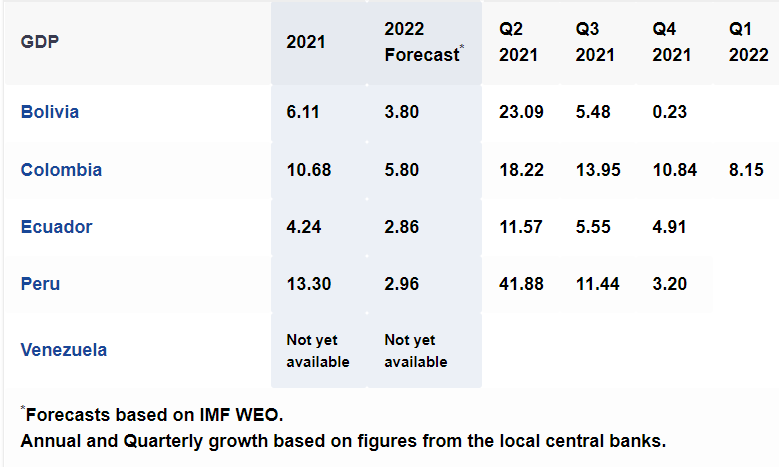
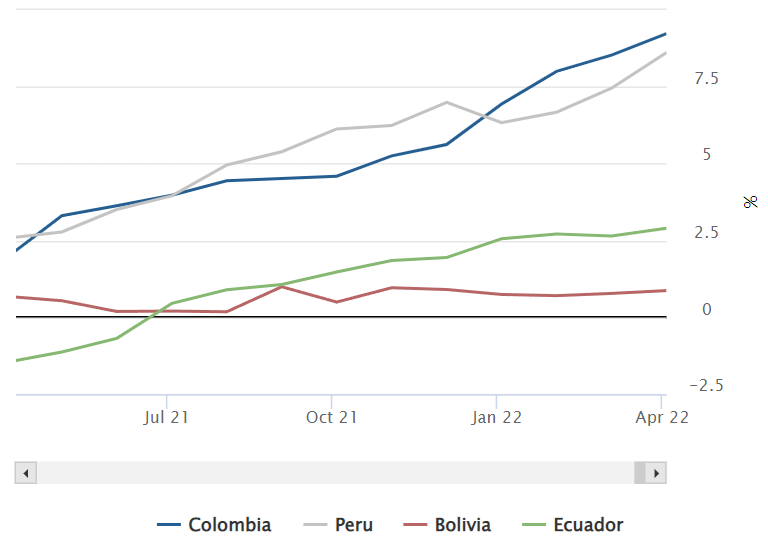
    COLOMBIA | IMF unconcerned by candidates. The International Monetary Fund (IMF) released a statement on 3 May outlining its confidence in Colombia’s economic trajectory, following the lender’s approval on 29 April of a new, two-year flexible credit line (FLC) worth US$9.8bn. The statement notes how “Colombia’s very strong policy frameworks and comprehensive policy response to the pandemic have supported the economy’s resilience,” resulting in better-than-expected growth in 2021 and declines in the fiscal deficit and public debt. The IMF also expressed confidence that candidates in the upcoming first round of the presidential election on 29 May did not pose a risk to economic stability. “Political assurances on policy continuity from the leading candidates provide a necessary safeguard for the proposed agreement,” the statement read.

    BOLIVIA | Minimum wage increase. Bolivia’s government and the country’s main workers’ union, Central Obrera Boliviana (COB), announced on 28 April that after reaching an agreement during annual wage negotiations the national minimum wage would increase by 4% this year while public sector workers and teachers would receive an additional 3% salary increase. The 4% increase will bring the monthly minimum wage from B$2,164 (US$315) to B$2,250. In a press release, Bolivia’s economy minister, Marcelo Montenegro, declared that “these salary increases will contribute to re-energising the national economy and benefiting the productive sector”. However, private sector representatives are seemingly not on board. Speaking to national newspaper El Diario, Marcelo Romero, the president of the federation of private business representatives (FDEPT) in Tarija department, described the wage increases as “an attack on stable, dignified, and sustainable business”.

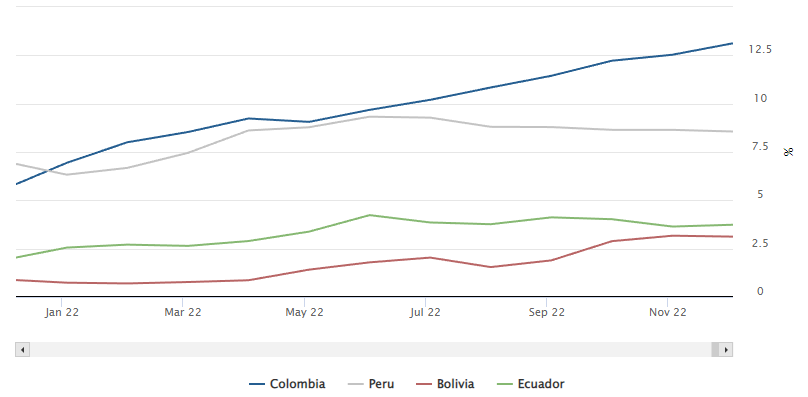
    Andean countries: inflation rate
    Percentage variation (year-on-year)

    Andean countries: GDP growth (%)
    Quarterly figures are year-on-year growth

  • ECONOMIC HIGHLIGHTS

    Patrick de Courcy 18 January 2023 Hits: 3589

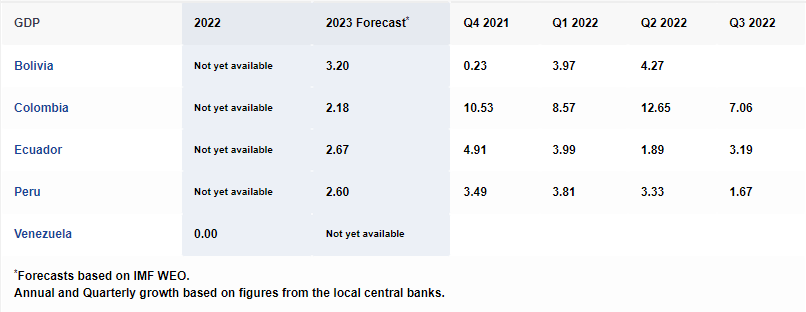
    PERU | Interest rate hike. On 13 January, Peru’s central bank (BCRP) raised its benchmark interest rate by 25 basis points to 7.75% in response to high inflation. In a statement explaining its decision, the BCRP noted that annual inflation increased slightly between November and December, rising from 8.45% to 8.46%. However, the BCRP forecast “a downwards trend in annual inflation from March, with a return to the target range [1%-3%] in the fourth quarter of this year,” and predicted that Peru would close 2023 with inflation of 4.30% – down from 4.68% in its November forecast.

    ECUADOR | FTA negotiations with China completed. Ecuador’s President Guillermo Lasso has announced that negotiations for a free trade agreement (FTA) with China “have concluded successfully” after ten months of talks. Writing on Twitter, Lasso added that “our exports will have preferential access to the largest market in the world, our industries will be able to acquire machinery and inputs at reduced costs”. The FTA will still require the approval of the constitutional court and the national assembly before it comes into force. According to a statement from the ministry of production, foreign trade, investment, and fishing (MPCEIP), the FTA “will allow preferential access for 99% of current exports from Ecuador to China,” with particular benefits for the agricultural and agro-industrial sectors. The MPCEIP also said that some tariffs would remain in order to protect Ecuador’s manufacturing sector but added that “tariff-free access to raw materials, inputs and tools” would “reduce production costs for Ecuadorean industry”.

    ECUADOR | Inflation rises. On 6 January, Ecuador’s national statistics institute (Inec) released the consumer price index for December, which shows monthly inflation of 0.16% and annual inflation of 3.74%. This was up from monthly deflation of –0.01% in November, when annual inflation stood at 3.64%. Monthly inflation was steepest for food and non-alcoholic drinks (+0.04%), goods and diverse services (+0.041%), and healthcare (+0.02%). Minor price decreases were registered for clothing and shoes, communications, alcoholic drinks and tobacco, domestic goods, and housing and utilities.

    Andean countries: inflation rate
    Percentage variation (year-on-year)

    Andean countries: GDP growth (%)
    Quarterly figures are year-on-year growth

  • BRAZIL: Conservatives in congress retaliate against supreme court

    Patrick de Courcy 28 September 2023 Hits: 2630

    Conservative lawmakers with ties to the agribusiness lobby in congress (known as the ‘bancada ruralista’) and to the evangelical caucus have expressed outrage at two recent rulings by Brazil’s supreme court (STF). On 21 September the STF ruled against the ‘marco temporal’ legal thesis, an interpretation which argued that indigenous communities can only lay claim to land they occupied as of October 1988. On 22 September the STF’s president, Rosa Weber, opened a session on whether to decriminalise abortion up to 12 weeks of pregnancy, with Weber casting her vote in favour of decriminalisation.

    Members of the two conservative caucuses held meetings on 25-26 September to discuss how to react and on 27 September, two right-wing opposition parties, the Partido Liberal (PL) and Novo, announced a legislative filibuster. The leader of the PL in the lower chamber of congress, Altineu Cortês, stated that this was an act to defend the “prerogatives” of the legislature, insisting that each branch of government “should stick to its role”.

    Cortês and other critics of the STF’s rulings have argued that the laws regarding issues being reviewed in legislative initiatives, such as indigenous demarcations, should be determined by the democratically elected representatives in congress. Supporters of the STF’s decisions, on the other hand, have argued that the magistrates are just doing their job by determining whether a piece of legislation or legal recourse is constitutional.

    The PL holds 99 of the 513 seats in the lower chamber and 11 seats in the 81-member senate, while Novo has three federal deputies and one senator. Even though the PL is one of the largest parties in congress, its attempts to filibuster government-backed legislation could be frustrated, due to accords that President Luiz Inácio Lula da Silva has negotiated with centrist and conservative parties such as Progressistas (PP), Movimento Demócratico Brasileiro (MDB), and União Brasil (União) – three of the largest right-of-centre parties, which have all been given seats in the cabinet of Lula’s left-leaning administration.

    But PL lawmakers and their allies in the ruralista and evangelical caucuses have been pushing for a proposal to amend the constitution – specifically article 49, which details the prerogatives of the legislature and judiciary – to allow congress to override supreme court rulings. National news broadcaster CNN Brasil reported on 27 September that the proposal has already gained 137 of the 171 signatures required for a constitutional amendment bill to be submitted for review in the lower chamber.  

    Constitutional reform could be a potential avenue for conservatives in congress to defend their bill (PL 2903/23, formerly registered as PL 490) from the STF’s ruling. The legislation would impose new regulations on the indigenous land demarcation process and was approved in the senate on 27 September by 43 votes in favour and 21 against, even though the bill has proposed enshrining into law the marco temporal thesis deemed unconstitutional by the STF. The bill would be promulgated after President Lula signs it, although left-wing lawmakers have called for Lula to withhold his signature and exercise his authority to veto congressional bills.

    The senate president Rodrigo Pacheco, of the centrist Partido Social Democrático (PSD), denied that the approval of this bill was an act of revenge against the supreme court. “I always defended the autonomy of the judiciary and the value of the STF,” Pacheco said on 27 September. “But we cannot fail to do our duty: to legislate”.

    Proposed plebiscite on abortion

    Meanwhile, the leader of the PL in the senate, Rogério Marinho, said in a press conference on 26 September that his party would push for a referendum for the public to decide whether to decriminalise abortion. A popular vote could be a recourse for conservative lawmakers to challenge a potential STF ruling in its session on the constitutionality of abortion up to 12 weeks of pregnancy. Marinho maintained that 11 judges should not be empowered to make such a momentous decision.

    In casting her vote in favour of decriminalising abortion at the outset of the online session, Chief Justice Weber, who is approaching the mandatory age for retirement of 75, argued that “criminalising the conduct of voluntarily interrupting the pregnancy, without restrictions hits the core of women’s rights to freedom, self-determination, intimacy, reproductive liberty and their dignity”. The other 10 STF judges are yet to vote.

    Abortion

    The outcome of a referendum on abortion rights would not be clear-cut. A survey by the pollster Ipsos, released on 22 August, showed that 43% of Brazilians were opposed to abortion, while 39% supported the mother’s right to decide.

  • HONDURAS: Zedes shot down

    Abbi Dicker 26 September 2024 Hits: 2242

    The supreme court of Honduras has declared the employment and economic development zones (Zedes) to be unconstitutional. The Zedes, which could implement their own administrative, judicial, security, and tax systems autonomously, were approved in 2013 under the right-wing Partido Nacional (PN) government of Porfirio Lobo (2010-2014) in an attempt to attract investment. They were dogged by controversy from the outset with the then-opposition left-wing Partido Libertad y Refundación (Libre) particularly vocal in criticising them for violating national sovereignty and promoting tax evasion.

    Soon after President Xiomara Castro came to power on the Libre ticket she revoked the legislative framework for the Zedes. Castro celebrated the verdict of the court, which she said was “patriotic, historic, just, and legal” as the Zedes “privatised our sovereignty”. The president of the supreme court, Rebeca Ráquel Obando, said the decision to annul the Zedes had been taken “in defence of our rule of law and national sovereignty”.

    Libre was not alone in criticising the Zedes. Unpopular with the public, they were savaged by the national anti-corruption council (CNA), a civil-society group, while the United Nations office in Honduras raised concerns about the risks they posed to Honduras’s fulfilment of human rights obligations. But there was still something eminently political about the verdict. Obando, who is affiliated to Libre and has family ties to Castro, said it would “provide the opportunity to come up with new development strategies to benefit the population in a more equitable manner, while respecting our institutions and promoting transparency”.

    Jorge Colindres, a Honduran lawyer and technical secretary of the Próspera Zede, accused the supreme court itself of contravening the constitution. He said the constitution did not give the court the power to declare a law “unconstitutional with retroactive effect”.

  • ECONOMIC HIGHLIGHTS

    Abbi Dicker 13 November 2025 Hits: 634

    BRAZIL | Energy legislation to benefit consumers and renewables. Brazil’s congress passed legislation on 30 October that grants consumers the right to choose their power supplier and provides tax breaks and compensations for renewable energy, among other measures. Within 24 months, commercial and industrial customers will be able to choose from which power company to buy electricity, while residential consumers will be able to do so in 36 months. Currently only large-scale users can freely choose their supplier. Subsidies for social welfare or other public interest programmes granted through the Conta de Desenvolvimento Energético (CDE), a fund financed through surcharges on power rates, will be capped from 2027. That helps limit additional costs and thereby the price of electricity in the long run. Generators of renewables will be compensated when their output is capped due to an ‘oversupply’ in the market. A surcharge was removed on renewable energies designed to limit their rapid expansion, which has made it difficult for the national power grid operator (ONS) to manage sudden spikes or declines in supply.

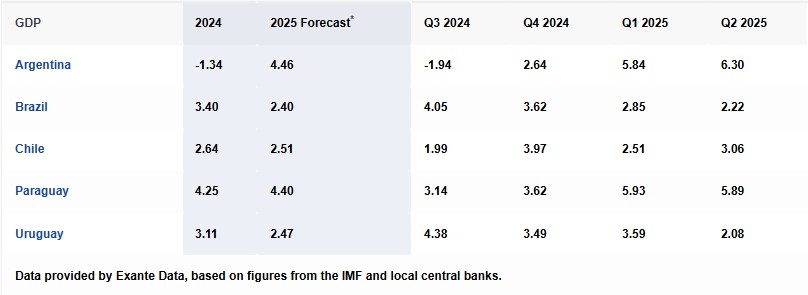
    CHILE | Codelco reports increased production. The state-owned copper mining company Codelco announced on 4 November that its copper production totalled 937,000 tonnes (t) between January and September, marking an increase of 19,000 t (+2.1%) on the same period of 2024. This increase was achieved despite a deadly accident at the major El Teniente mine in July, which forced a halt in operations. Codelco stated that after the accident it launched a safe return plan, including measures to strengthen critical controls and align safety behaviours. The company notes that the accident led to a drop in production in the second quarter. Earnings before interest, tax, depreciation, and amortisation (Ebitda) totalled US$4.16bn at the end of the third quarter, an increase of 3.4% compared to the same period of 2024. Codelco attributed this rise to the higher price of copper and some by-products such as molybdenum and gold.

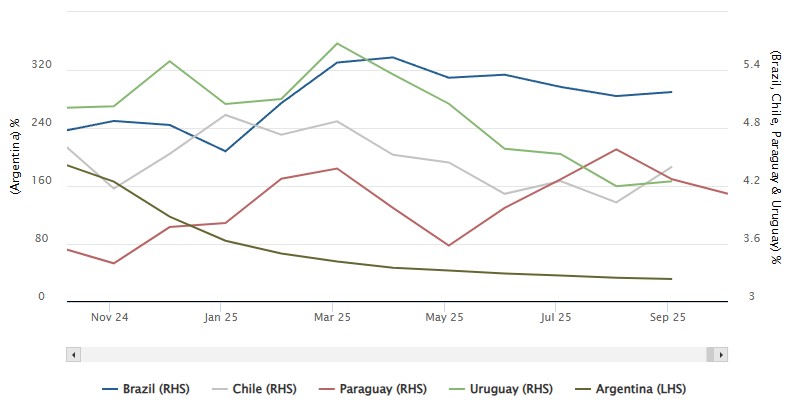
    Brazil & Southern Cone: inflation rate
    Percentage variation (year-on-year)

    Brazil & Southern Cone: GDP growth (%)
    Quarterly figures are year-on-year growth

  • GUATEMALA: OAS mission signals concern over judicial selection processes

    Sarah Sheldon 26 January 2026 Hits: 286

    A special mission of the Organization of American States (OAS) for the strengthening of democratic institutions in Guatemala recently paid a visit to the country to observe the selection processes due in 2026 in four key judicial institutions: the attorney general’s office, five-member electoral court (TSE), five-member constitutional court (CC), and comptroller general’s office (CGC). The mission’s visit was at the behest of left-of-centre reformist President Bernardo Arévalo, who took office in January 2024, but whose anti-corruption agenda has been held up by key figures such as Attorney General (AG) María Consuelo Porras, who has been blacklisted by the US, European Union, and other members of the foreign community.

    The OAS mission, which conducted its visit from 9-15 November, is a continuation of that deployed in 2024 to observe the selection processes for the supreme court (CSJ) and appellate courts. Ultimately these appointments failed to provide much relief for President Arévalo in his fight against corruption [SSR-24-11] despite theoretically providing his administration with the opportunity to preside over more transparent processes that would result in more suitable candidates.

    The TSE magistrates, CC magistrates, and AG are due to take office in March, April, and May respectively with the new comptroller general to be in post towards the end of the year. The TSE magistrates serve six-year terms, while the CC magistrates serve five-year terms, and the AG and comptroller general serve four-year terms. Only the CC is elected directly, with five institutions electing one member apiece: the executive, legislature, CSJ, bar association (Cang), and rector of San Carlos University (Usac), the country’s main public university. The TSE, AG, and CGC are appointed via shortlists presented by nominating committees which are temporary bodies comprising representatives from the judiciary, legal sector and academia. In the case of the TSE and CGC, congress makes the selection from the shortlists, while in the case of the AG, it is the president.

    In a 14 November statement, the OAS said that the mission held meetings with authorities from the three branches of government, along with the CC, Usac, private universities, students, Cang, women’s organisations and other civil society groups, among others. It highlighted that participants underscored the “central importance of the second-degree electoral processes… for the preservation of the rule of law, judicial independence, democracy, the fight against corruption”, inter alia. The OAS mission however reiterates familiar concerns regarding the misuse of criminal law, and disciplinary or administrative actions by institutions like the attorney general’s office [SSR-25-07]. It highlighted that a “recurring concern expressed to the Mission” was “the fear - among potential candidates, members of nominating commissions, lawyers, academics, human rights defenders, and other key actors – of being subjected to criminalization, smear campaigns, judicial harassment, or attacks on social media as a consequence of their participation in these processes.”

    A subsequent OAS statement issued on 3 December also expressed concerns about a governance crisis affecting Usac’s superior university council (CSU), which has a legal mandate to participate in some of the selection processes. The crisis stems from discrepancies over the latest election of CSU members. Warning that the lack of a functioning CSU could affect the legitimacy of the nominating commissions, the mission calls for a full CSU to be installed and recognised as soon as possible to ensure that the selection processes are legitimate, transparent, and reliable.

    • Governance crisis at Usac

    Usac elected a CSU for the 2022-2026 period in May 2022. Long-time CSU member, Walter Mazariegos, was elected as the university’s dean and CSU head. However, Mazariegos’ election has been denounced as fraudulent by some university officials who refuse to recognise him as dean. He was also blacklisted in 2023 by the US for undermining “democratic processes or institutions by accepting the position of rector of the public education institution in July 2022 following a fraudulent selection process”. His predecessor, Murphy Paiz Recinos, was arrested in 2021 in relation to a major scandal known as the ‘parallel commissions 2020 case’ involving allegations of interference by illicit groups in the justice system.

  • POINTERS

    LatinNews 02 September 2011 Hits: 1434

    *** NEW CARICOM SECRETARY-GENERAL. Irwin LaRoque, 56, is replacing Sir Edwin Carrington as secretary-general of the Caribbean Community (Caricom). LaRoque has been Caricom’s assistant secretary-general for trade and economic integration since September 2005. Prior to that he was a high-ranking civil servant in Dominica. Two issues in particular have been highlighted for the new secretary-general: the need to address overstaffing and lack of ability at the secretariat, and the need to boost adoption of the Caribbean Court of Justice (CCJ) as the final court of appeal by more member states.

    *** UPTO US$5BN MISSING FROM TURKS & CAICOS TREASURY. In a speech delivered on 14 July, the UK’s minister for Overseas Territories, Henry Bellingham, said that between US$2.5bn and US$5bn was missing from the TCI treasury as a result of the ousted Michael Misick government selling undervalued land. During his speech, Bellingham said that the next milestone on the way to new elections will be an ordnance on electoral reform. New constituency boundaries are to be drawn as a result of a consensus, and a formalization of the path to ‘belongership’ is still needed. There are some fears locally that the UK might use this as a way of diluting the native electorate.

  • GUYANA: Guyana blacklisting a consequence of malfunctioning political system

    LatinNews 04 December 2013 Hits: 1592

    The Caribbean Financial Action Task Force (CFATF) has blacklisted Guyana. Guyana’s attorney general and minister of legal affairs, Anil Nandlall, released a statement saying that CFATF had identified Guyana as a jurisdiction with strategic AML/CFT [Anti Money Laundering and Countering of the Financing of Terrorism] deficiencies and that it had “not made sufficient progress in addressing the deficiencies [and had] not complied with its Action Plan developed with CFATF to address these deficiencies”.

    For CFATF, the key point is that Guyana has failed to implement legislative reforms that are deemed to be essential to countering the financing of terrorism and addressing the issue of money laundering. And it accompanied its declaration of Guyana’s blacklisting with a notice that other member states “are…called upon to consider implementing counter measures to protect their financial systems from the ongoing money laundering and terrorist financing risks emanating from Guyana”.

    The problem is politics compounded by race.  Racially, Guyana’s most-important divide is between those of African descent (30% of the population) and those of East Indian origin (44%).  The balance is made up by mixed-race people (17%) and Amerindians (9%).  This racial divide produced a divided political outcome in the November 2011 general election in which the Indian-backed People’s Progressive Party/Civic (PPP/C) won the presidency – and with it the government of the country – while the two opposition parties ended up controlling 33 seats in parliament against the PPP/C’s 32 (26 are held by A Partnership for National Unity – APNU – and seven by the Alliance for Change – AFC).  And the APNU/AFC opposition has refused to back the bill to implement the CFATF demands.

    President Donald Ramotar has expressed his frustration with the opposition, saying: “Earlier this month, the opposition legislators withheld their support for the passage of the Anti-Money Laundering and Countering the Financing of Terrorism Bill despite having agreed six months ago for the legislation to go before a special select committee”.

    The blacklisting could have a significant impact on Guyana’s economy given that its financial, banking, and insurance sector will now come under close scrutiny and this could affect the purchase of goods and services both by the government and private sector. Prime Minister Samuel Hinds has also warned that “were Guyana not to put its house in order according to CFATF recommendations by February 2014, CFATF will be unavoidably called in by the FATF ICRF [International Cooperation Review Group]”. He added, in remarks made on 21 November, that “once a country is blacklisted it takes years to be white listed” even after full compliance is met.

    Caricom has added its concerns to the debate, warning about “the impact that any adverse action by the task force could have on the Guyanese economy, and by extension the Caricom region as a whole, particularly in the areas of trade and financial services”. Caricom has called for an “early resolution to the issues surrounding the implementation of recommendations to address deficiencies in Guyana's anti-money laundering regime”, which is of course just what Guyana’s government wants but is unable to implement because of the vagaries of the country’s hybrid presidential/parliamentary system.

    The government’s hope is that the seriousness of the crisis provoked by the CFATF blacklisting – well emphasized by organisations like Caricom - will persuade at least some of the opposition to back the bill when it is re-presented to parliament.  According to Cabinet Secretary Roger Luncheon, the government will be exploring the possibility of reaching a consensus with at least one of the opposition parties with a “main objective” of passing the bill by February 2014.  Attorney-General Anil Nandlall has also said: “If we are able to pass this bill – if not before February, then by May 2014 – Guyana can extricate itself from this list that it finds itself on, and we can be restored to some level of normalcy.”