All Categories

Subcategories

  • ECONOMIC HIGHLIGHTS

    Patrick de Courcy 21 January 2022 Hits: 2154

    BRAZIL | Unemployment improves, remains high. Brazil’s national statistics institute (Ibge) released the latest figures for unemployment on 28 December 2021, which show that the labour market continues to recover in Brazil. The unemployment rate stood at 12.1% in the rolling quarter ending in October 2021. While an improvement on the 13.7% unemployment rate recorded in the May-July rolling quarter, it remains high, with 12.9m Brazilians still in search of work. A further 29.9m are under-employed (working insufficient hours, for example). The employed population grew to 94m in the August-October rolling quarter, equivalent to a 54.6% employment rate. Employment has increased in the formal private sector (12m people, up 9.5% on the May-July quarter); amongst the self-employed (25.6m, up 2.6%); and amongst domestic workers (5.5m, up 7.8%). In terms of sectors, the retail sector, industrial sector, and hospitality & food all saw an increase in employment. The informality rate has risen by 0.5 percentage points to 40.7%, equivalent to 38.2m people. “Although there has been a significant increase in employment, the mass of income remains stable. This is because a worker’s salary has been shrinking – either because employment is growing in lower-paid positions, or because of the advance of inflation in recent months,” Adriana Beringuy, Ibge research coordinator, noted.

    URUGUAY | Mobile portability becomes reality. Uruguay’s minister for industry, mines, and energy, Omar Paganini, celebrated the coming into effect of mobile number portability in the country on 12 January. The measure is part of the reforms contained in the omnibus reform law (LUC) the was approved in 2020. Reminding that Uruguay is one of the last countries in Latin America to implement mobile portability, Paganini said “[A mobile number] is practically an ID card, giving people [number portability] is giving them a right and giving them freedom”. The minister believes the measure could benefit Antel, the state-owned telecoms company, which already dominates the mobile market with around 46% of mobile phone contracts (the two other players are Claro and Movistar). 

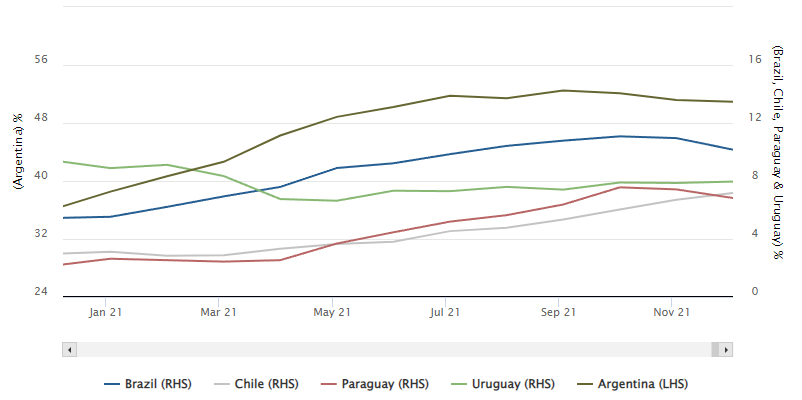
    Brazil & Southern Cone: inflation rate
    Percentage variation (year-on-year)

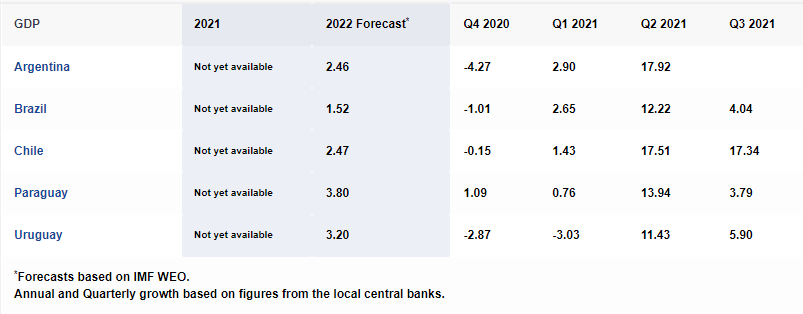
    Brazil & Southern Cone: GDP growth (%)
    Quarterly figures are year-on-year growth


  • TRACKING TRENDS

    Patrick de Courcy 24 August 2023 Hits: 2295

    ARGENTINA | Massa gets big funding boost. Argentina’s economy minister, Sergio Massa, the presidential candidate for the ruling left-of-centre Unión por la Patria (UP) coalition, visited Washington from 21-23 August for talks with financial institutions and members of US President Joe Biden’s administration. He returned to Buenos Aires having won significant funding pledges.

    The executive board of the International Monetary Fund (IMF) released a fresh disbursement of US$7.5bn after approving the fifth and sixth reviews of Argentina’s Extended Fund Facility (EFF) arrangement on 23 August. The IMF acknowledged that the country had missed programme targets as a result of “the historic drought”, but it also highlighted “policy slippages” as being responsible for the required approval of “waivers of nonobservance”, such as the accumulation of international reserves, the primary fiscal balance, and monetary financing of the deficit. It supplied no details of revised targets.

    Following a meeting with representatives of the World Bank (WB) and the Inter-American Development Bank (IDB), Massa also announced funding totalling US$1.3bn which he said would help boost Argentina’s international reserves and finance development.

    The WB provided two new lines of credit totalling US$650m. Of this, US$450m will be dedicated to Argentina’s food security programmes, with the remaining US$200m going towards financing exports of small and medium-sized enterprises (SMEs). The IDB financing of US$735m will go towards several major infrastructure projects and exports of companies in the knowledge economy.

    The fresh funding comes just over a week after the populist anti-system candidate, Javier Milei, won the most votes in the country’s primary elections, pushing Massa’s UP into third place behind the right-of-centre Juntos por el Cambio (JxC) opposition coalition, which chose the hardline former security minister, Patricia Bullrich, as its presidential candidate.

    Milei’s success has prompted significant political manoeuvring. The most eye-catching development involved former president Mauricio Macri (2015-2019). Macri, a member of Bullrich’s Propuesta Republicana (Pro) party, was very complimentary about Milei and said that the vote for the far-right populist and the JxC combined showed that “the vast majority of Argentines favour a profound change”. Milei responded by praising Macri and offering him a position in his government. This caused significant disquiet within the JxC. Macri insisted he remains supportive of Bullrich.


    BRAZIL | Fiscal framework bill fully approved. The long-awaited legislation for the government’s new fiscal discipline rules was approved in the lower chamber of congress on 22 August. The bill cleared its first vote in the lower chamber on 24 May and was then approved in the senate on 21 June.

    Senators made amendments to the draft legislation approved by the deputies, requiring the bill to be reviewed again in the lower chamber. Deputies kept some of the senate’s changes, including exemptions for some public funds from the bill’s limits.

  • TRACKING TRENDS

    Abbi Dicker 18 September 2025 Hits: 1279

    CUBA | The cost of the US embargo. On 17 September Cuba’s Foreign Minister Bruno Rodríguez put the cost of the decades-old US embargo and sanctions on Cuba from March 2024 to February 2025 at over US$7.56bn, up 49% on the same period the previous year.

    Rodríguez also said that the cost to Cuba of qualified people and work force who had fled the country due to these economic pressures was around US$2.57bn. He said that the US embargo against Cuba had cost the island some US$170.68bn in over six decades. He also claimed that if it had not been for the blockade, Cuba’s GDP could have grown by 9.2% last year, “one of the highest growth rates in the hemisphere”.

    Rodríguez was speaking during a press conference to present Cuba’s annual report on the repercussions of the US embargo ahead of its habitual resolution before the United Nations General Assembly (UNGA) calling for an end to the ‘blockade’.

    Since US President Donald Trump took office for a second term in January, Washington has hardened its line against Cuba, not least with the signing of a memorandum in June strengthening US policy toward the island. Among other things this bans direct or indirect financial transactions with entities controlled by the Cuban military, such as Grupo de Administracion Empresarial S.A. (Gaesa), and its affiliates; enforces the statutory ban on US tourism to Cuba; and reiterates support for the embargo. This, after Trump restored Cuba to the US list of state sponsors of terrorism soon after being sworn in again.

    Rodríguez’s comments regarding the continued impact of US sanctions on the Cuban economy come as, in July, the government confirmed that Cuba’s GDP had contracted 1.1% in 2024, far short of the 2% growth target included in its plan. According to the same report, Cuba’s GDP has contracted 11% over the last five years.

    GUATEMALA | IMF upbeat but urges more to be done. The International Monetary Fund (IMF) released a report on 12 September following the conclusion of an Article IV mission to Guatemala in which it highlighted “prudent macroeconomic management” by the left-of-centre government led by President Bernardo Arévalo but underlined that “more is needed to lift growth and reduce poverty”.

    According to the IMF, Guatemala’s economic growth is expected to tick up to 3.8% in 2025, from 3.7% in 2024, and beyond that it is projected to slightly exceed 3.5% while the fiscal deficit is expected to increase to 2.5% of GDP in 2025 and then remain close to 3% of GDP in the medium term.

    The IMF report owes growth to “infrastructure investments and ongoing reforms, including to improve governance and quality of public spending”. Yet it notes informality is running at 70%, poverty was at 55% in 2023, and social indicators remain “lacklustre”, and it calls on the government to do more to address this.

    PANAMA | Chiquita returns. Chiquita Panamá, the local subsidiary of the multinational banana giant Chiquita Brands International, will return to Panama before the end of the year after having shut down its operations in Bocas del Toro province and laid off thousands of workers in May amid a strike by banana workers.

    Panama’s minister of commerce and industry, Julio Moltó, said Chiquita had agreed to “modernise production under a model within Panamanian law known as sharecropping” under which landowners allow workers to exploit the land in exchange for a share of the profits [WR-25-21].

  • TRACKING TRENDS

    LatinNews 25 July 2013 Hits: 1102

    BOLIVIA | Banking. Bolivia’s recent banking reform regulations are a threat to the country’s financial system, local think-tank Fundación Milenio has claimed in a report. The report says the new regulations attempt to turn local banks into “social welfare entities”, and introduce upper caps on loan interest rates “that may not reflect a sector’s inherent risk”.

        The caps, Milenio argues, will create significant imbalances in the financial system. It also criticised the fact that banks will be required to lend to certain sectors, and that the appointment of directors and board members is subject to the approval of financial services regulator ASFI.

    BOLIVIA | Orvana. Canada’s Orvana Minerals Corp suffered a 10% fall in its share price after it announced it had halted production at its leach-precipitation-flotation (LPF) plant at the Don Mario copper-gold-silver Upper Mineralised Zone (UMZ) open pit mine in Bolivia. The company said the decision was due to a variety of factors including rising labour costs, inconsistent recoveries, and falling metal prices. Although not mentioned, the mine has also experienced a series of work stoppages as local unions enter the annual salary negotiations.

    COLOMBIA-PANAMA | Grupo Aval pushes into Panama. Colombia’s Grupo Aval has announced the acquisition of Spanish bank BBVA’s Panama subsidiary for a total of US$646m (US$490m of which will be in cash). The move appears to confirm a big push by Grupo Aval into the Central American financial sector. At the end of June Grupo Aval agreed to buy Guatemala’s Grupo Financiero Reformador for US$411m. Colombia’s richest man, Luis Carlos Sarmiento Angulo, controls Grupo Aval.

        Analysts say Colombian banks are drawn by Central America’s good growth prospects, but particularly by Panama which has experienced burgeoning growth for several years now and which they see strengthening its role as a regional trade hub.

        Earlier this year Bancolombia, a competitor to Grupo Aval, agreed to buy the Panama branch of HSBC for US$1.2bn. These deals will take some months to finalise and are subject to regulatory approval.

  • ECONOMIC OVERVIEW: CHILE

    LatinNews 20 May 2014 Hits: 2745

    Growth: Real GDP growth was 2.6% year-on-year in the first quarter of 2014 according to latest data from the central bank – the slowest quarterly expansion since 2010. In the run up to the latest results, national dailies like La Tercera reported that the central bank would cut its GDP growth forecast for 2014 to 3.2%, down from 3.4% in April. In early, the bank lowered its GDP forecast for 2014 to between 3%-4%, down from the 3.75%-4.75% projected in December 2013. The monthly Imacec index of economic activity, which acts as a proxy for GDP, rose 3% year-on-year in April, up from 2.8% in March.

    Inflation: The national statistics institute (INE) reported that monthly reported inflation in April was 0.6% - significantly higher than the 0.2% expected by private sector economists. This brings the accumulated rate for the year to 2.1%. The year-on-year rate was 3.3%. The April figure prompted analysts to revise up their full year forecasts to 3.7%, up from a previous 3.3%. Inflation ended 2013 at 3.3%.

  • ECONOMIC HIGHLIGHTS

    Patrick de Courcy 20 April 2023 Hits: 3158

    COSTA RICA | Costa Rica hails issuance of international bonds. On 27 March, Costa Rica issued US$1.5bn worth of bonds on international markets. Costa Rica’s finance minister, Nogui Acosta, said that Costa Rica received around 300 offers worth a total of US$7.3bn, which he said illustrates the country’s “strength and credibility”. In November 2022 Costa Rica’s 57-member unicameral legislature approved legislation authorising the government to issue up to US$5bn in international bonds over the next three years. International credit ratings agency Fitch pointed out that this was the first approval of bond issuances since 2019. The US$5bn is intended to cover upcoming financial obligations, such as a US$1bn debt repayment due in early 2023, and will be issued in four tranches – US$1.5bn in the first and second halves of 2023, US$1bn in 2024 and US$1bn in 2025.

    PANAMA | Panama and China consortium announce restart of key project. On 29 March, Panama’s minister for public works (MOP), Rafael Sabonge, and Wang Jun, the general manager of Chinese consortium Consorcio Panamá Cuarto Puente (comprising China Communications Construction Company LTD and China Harbour Engineering Company LTD), signed an addendum regarding the construction of the fourth bridge over the Panama Canal. The US$1.4bn contract to carry out the works, which will connect the centre of Panama City with the cities of Arraiján and La Chorrera in Panamá Oeste province, was signed in 2018 but was subsequently held up over issues of finance and changes to the design of the project. According to the Panamanian government, which describes the fourth bridge as “one of the most significant projects of the last 20 years”, it is expected to carry some 70,000 vehicles per day, will benefit over 1.7m Panamanians, and generate over 4,000 jobs.

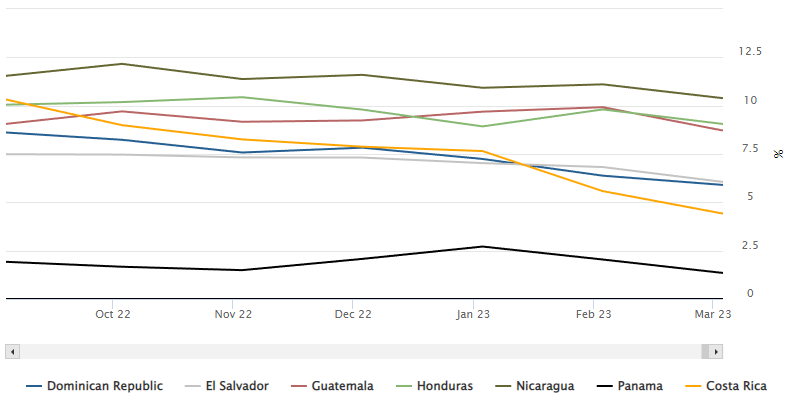
    Central America & Caribbean: inflation rate
    Percentage variation (year-on-year)

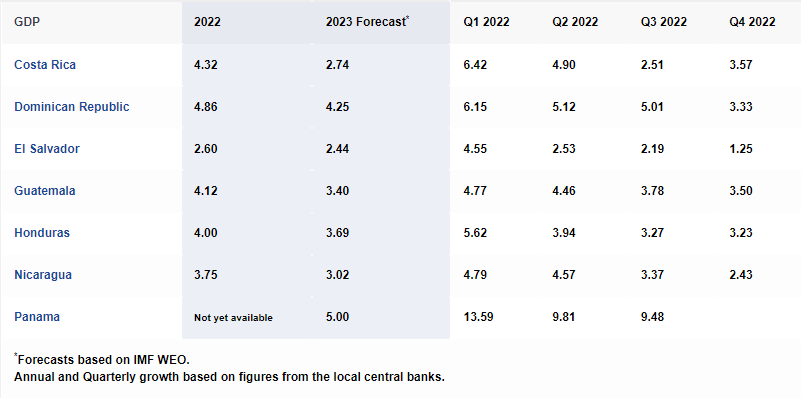
    Central America & Caribbean: GDP growth (%)
    Quarterly figures are year-on-year growth

  • PARAGUAY: Senate resolution re-sparks institutional and political crisis

    LatinNews 18 April 2012 Hits: 4034

    Paraguay’s senate has unexpectedly reignited a latent problem affecting the country’s judiciary system. Its decision that the majority of the supreme court (CSJ) judges should be replaced has triggered an institutional crisis after the CSJ rejected the resolution, prompting a stand off not only between the executive and judiciary branches but also between the ruling coalition and the opposition. There has been political paralysis in Paraguay for the best part of four years now.

    On 12 April the senate resolved that seven (of the nine) CSJ judges, including the CSJ president, whose five-year terms expired in 2010, must be replaced. The judges were retained in their posts following a political deal between Paraguay’s two largest parties, Partido Liberal Radical Auténtico (PLRA) and Asociación Nacional Republicana-Partido Colorado (ANR-PC), after neither party was able to ratify their preferred replacement nominees in the divided senate.

    This stalemate in the senate is the result of the political transition that took place in Paraguay following the historic electoral defeat of the ANR-PC, which until 2008 had ruled the country for 61 years continuously. Although the PLRA-led coalition won the 2008 presidential election with Fernando Lugo, the ANR-PC retained a small majority in the senate, allowing it to stymie attempts to change the political composition of the CSJ.

    In total the ANR-PC has seven judges in the CSJ and it is determined to fiercely defend this substantial majority. The prospect of a major institutional crisis forced the PLRA to agree to the deal in the first place by which the judges would be allowed to remain in place until further notice. Subsequently, the CSJ ruled that its judges were “immovable” in order to prevent any legal challenges against them.

    However, in an astute political manoeuvre, the PLRA managed to covertly introduce the issue onto the senate agenda and then secured the support of the opposition Partido Patria Querida (PQ) and Unión Nacional de Ciudadanos Eticos (Unace) to muster the necessary 27 votes to pass the resolution calling for the removal of the judges, even after the ANR-PC Senators left the chamber in protest. Senator Miguel Abdón Saguier (PLRA) introduced the initiative, which determined that the term of the seven judges in question had indeed expired; and said that since they were never re-ratified in their posts by the senate they must be replaced.

    The resolution affects five ANR-PC judges, including the CSJ president Víctor Núñez and two PLRA judges. Núñez has declared the resolution “unconstitutional” arguing the senate cannot intervene in the judiciary and so cannot force the CSJ to replace its judges. The CSJ’s organic laws stipulate that the court itself must determine whether there are any vacancies to be filled.

    Nevertheless, Saguier counters that the constitution clearly sets down a five year term for CSJ judges; and also that the nominees must be ratified by the senate, regardless of the CSJ’s internal regulations.

    The ANR-PC also rejected the senate resolution, describing it as “an affront to constitutional order”, adding (with no apparent irony) that it represented an attempt to create a “tailor made supreme court”. It warned that the senate’s decision could lead to “a serious political crisis”. More ominously, the ANR-PC’s president, Lilian Samaniego, who on 10 April announced her bid to become the ANR-PC’s next presidential candidate, said that the decision would “create institutional chaos” which could put the upcoming 2013 presidential elections “at risk”. Samaniego immediately called on the people to be ready “to defend institutionality”.

    • CSJ strikes back

    On 17 April, the president of Paraguay’s supreme court (CSJ), Víctor Núñez, asked the public ministry to launch an investigation into all the senators that voted in favour of the latest resolution, accusing them of “attacking the constitutional order and coercing constitutional entities”. Núñez cited constitutional Article 248, which states that in addition to the penalties prescribed by law for these crimes, “those that threaten the independence of judiciary and its magistrates will be disqualified from holding public office for five consecutive years”. Núñez and his colleagues maintain that they can only be removed via impeachment and that they are willing to take the case to the Organization of American States if necessary.

  • PARAGUAY: State promises action after high-profile murder

    LatinNews 06 November 2014 Hits: 1654

    Representatives of the Paraguayan government, the judiciary and legislature met on 3 November to discuss measures to combat the influence of drug trafficking in politics. President Horacio Cartes convened the meeting in the presidential palace, two weeks after the high-profile murders of Pablo Medina, an investigative journalist working for the national daily ABC Color and his assistant, Antonia Almada. Medina is believed to have been killed over his investigations into drug trafficking.

    Vilmar Acosta, a mayor from the ruling Asociación Nacional Republicana-Partido Colorado (ANR-PC), is under investigation over the murders, following the discovery of three tonnes of marijuana on his family farm. One of the agreements announced after the meeting in the presidential palace was a commitment by all political parties to bar candidates suspected of involvement with the drug trade, although how this can be achieved legally is open to question.

    Another result of the meeting was a commitment to bring all court rulings on drug trafficking to the capital, Asunción. “Judgements in the interior are much more vulnerable [to pressure],” Hugo Velázquez, the ANR-PC president of the chamber of deputies, said.

    Paraguay’s attorney general, Javier Díaz Verón, said that he was also examining how to ensure the proceeds from goods impounded during investigations into drug trafficking go immediately to the State. “This is a business, this is a crime, that does not only affect individuals and civil authorities, but also corrupts the very structures of the State”, Díaz Verón said.

    Medina and Almada were shot on 16 October while travelling by car in the eastern department of Canindeyú, one of the main areas of cultivation of marijuana, near the border with Brazil. The only survivor of the attack, Juana Ruth Almada, sister of Antonia, identified Wilson Acosta, brother of Vilmar, as one of the gunmen.

    • Marijuana

    Paraguay is the largest producer of marijuana in South America, much of which is smuggled to Brazil. When Uruguay became the first country in the world to legalise the cultivation, distribution, sale and consumption of marijuana last year, some supporters of the new law cited the rise in marijuana cultivation and trafficking in Paraguay as the negative example they were seeking to avoid. Paraguay’s President Horacio Cartes is not about to advocate following Uruguay’s lead though, having dismissed the move to legalise the drug as “utopian”.

  • TRACKING TRENDS

    LatinNews 09 July 2015 Hits: 1263

    URUGUAY | Sharp fall in exports in first half

    Exports for the first six months of 2015 fell 15.7% year-on-year to US$4.18bn, the Uruguayan exporters union (UEU) revealed on 1 July. The UEU report notes that exports have now fallen for seven consecutive months.

    The overall fall in exports was driven by a sharp 36.6% year-on-year fall in shipments in June. All of this was attributed to a 54% fall in shipments to China (5.5% for the year) – which nonetheless remains as the main market for Uruguayan exports – this on the back of falling soya, beef and dairy exports. But there was also a sharp 58.7% fall in shipments (20.7% for the year) to Brazil, the second most important market for Uruguayan goods abroad – due to lower sales of wheat and plastic products. In contrast exports to the US increased by 24.9% in June due to higher citrus sales, while exports to Finland increased by 18% thanks to the coming on stream of the UPM pulp mill.

    The Uruguayan government attempted to put a positive spin on the export results by declaring in an official statement published on 2 July, that the country’s “decrease in exports is the lowest in the region”. The statement is based on a report by Uruguay’s export and investment promotion institute, Uruguay XXI, which was focused on the May 2014-May 2015 period, slightly different to the UEU report. During this period, Uruguay’s overall exports fell by no more than 3.4%, compared to 14% in Argentina, 12% in Brazil, 11% in Paraguay, 16.4% in Colombia, 12.8% in Peru, and 6.3% in Chile.

    PARAGUAY | Falling exports prompt growth forecast cut

    On 29 June Paraguay’s central bank (BCP) announced in an official statement that it was revising down its GDP growth forecast from 4.5% to 4% for 2015. The BCP statement said that the downward revision was primarily explained by lower-than-expected electricity production at the country’s two main hydroelectric plants and lower overall exports.

    BCP chief economist, Miguel Mora, explained that at the start of the year the BCP predicted that the hydroelectric plants Paraguay shares with Brazil and Argentina (which sell their surplus output to the partner countries) would increase by 5% this year but that production had only increased by 0.5% to date due to low water levels. Mora said that the revision also answered to the weakness observed in foreign trade resulting from the fall in international prices of some of Paraguay’s main export commodities (soya, beef and maize).

    Indeed, a report by the centre for the analysis of the Paraguayan economy (Cadep), a local think-tank, published on 2 July, found that the country’s exports totalled US$2.93bn in January-May, 17% lower than the US$3.72bn recorded in the comparable period last year. According to the Cadep report, this fall in exports is explained by the relative economic difficulties affecting Paraguay’s main trade partners, which has led to lower demand for Paraguayan exports. The Cadep report found that exports to the European Union (EU), the main export destination for the period, fell by 27% year-on-year to US$653m; exports to the Southern Common Market (Mercosur), the second export destination for the period, fell by 22% to US$613m.

    CHILE | Unemployment increases on manufacturing decline

    The national statistics institute (INE) published is latest set of economic figures on 30 June, showing a marked fall in activity in the manufacturing sector and a marginal increase in the national unemployment rate. According to INE, manufacturing activity fell by 3.3% month-on-month in May, the biggest decline since August 2014 and much higher than the 1.2% contraction predicted by local economists. This led to an accumulated fall so far this year of 0.8%, which has been taken as a clear sign that the domestic economy has failed to recover fully from the slowdown it has been suffering since last year despite the adoption of expansive fiscal and monetary policies by the Chilean authorities.

    More worryingly for the government led by President Michelle Bachelet, the INE figures suggest that the slowdown is now resulting in the loss of jobs. According to INE the May unemployment rate was 6.6%, 0.5 percentage points higher than in the previous month and higher than the 6.3% predicted by local analysts. Meanwhile, on 6 July the central bank released the May instalment of its monthly economic activity index (Imacec), a GDP proxy, which also fell by 0.8% on the month, its poorest result since August 2014. This prompted the finance ministry to cut the growth forecast for the year to 2.5%, much lower than the 3.6% it originally forecast. Finance Minister Rodrigo Valdés said the Imacec figure “highlights the need to put [promoting] economic growth at the top of the [political] agenda”.

    • Odebrecht’s rating slashed

    The international ratings agency Standard & Poor’s (S&P) has revised down its global corporate credit rating of Brazilian construction company Odebrecht from ‘BBB’ to ‘BBB-’ with a negative perspective. The decision comes as a consequence of the arrest of Odebrecht’s CEO, Marcelo Odebrecht, over his suspected involvement in the corruption scheme uncovered at Brazil’s state-owned oil firm, Petrobras. S&P said that it decided to revise down the firm’s rating due to the “reputational risks” related to the arrest of its CEO and four other executives. Nevertheless, S&P maintained Odebrecht’s ‘brAAA’ in its national rating scale, although the perspective has been changed from ‘stable’ to ‘negative’.

  • GUYANA: Second major oil find to be “explosively transformative”

    LatinNews 13 July 2016 Hits: 927

    In May last year, Exxon-Mobil announced the discovery of an oil reservoir in waters off Guyana that it said could hold 700m barrels of oil or more. Just over a year later, it has announced an even bigger discovery in the same area, this time holding between 800m and 1.4bn barrels of oil. Guyana’s Natural Resources Minister Raphael Trotman described this latest find as likely to be “explosively transformative for the economic and social development of all Guyanese”. But the discovery seems certain to enflame passions in Venezuela, which claims that the waters in which the discoveries have been made are Venezuelan, and there are also concerns about Guyana’s own readiness to manage efficiently and honestly such an enormous bonanza.

    The Liza-1 and Liza-2 wells are both in the 26,800 sq km Starbroek block, situated just under 200km offshore. Venezuela’s claim to these waters is based on its claim to Guyana’s Essequibo Region and adjacent territorial waters. The claim was restated in a decree issued by Venezuela’s President Nicolás Maduro on 26 May last year which, to add insult to injury, happens to be Guyana’s Independence Day.

    Given the current high degree of instability in Venezuela, there is no telling how Caracas might react to the prospect of even greater amounts of oil being extracted from waters it claims as its own. At the very least, there could be further provocations such as the 30 May incident in which Venezuelan troops allegedly fired at officials from the Guyana Geology and Mines Commission (GGMC) when travelling by boat on the Cuyuni River.

    However, assuming that any reaction from Venezuela amounts to no more than nuisance value, Trotman was not exaggerating when he said that the discoveries would be economically transformative. Already, for instance, plans have been announced for the completion of the modernisation and expansion of the Cheddi Jagan International Airport (CJIA) and there is talk of resurrecting the defunct Guyana Airways. Further upgrading of CJIA is important as currently Guyana-based airlines are prevented from flying to the US because standards at CJIA are not high enough. The huge discoveries of oil are also likely to attract more direct flights from the US to Guyana.

    Less positively, the prospect of large quantities of oil money swilling around in the Guyanese economy has raised concerns about corruption. The government is trying to allay these fears, and it is planning to subscribe to the standards on good governance, transparency, and accountability espoused by the Extractive Industries Transparency Initiative (EITI). At a symposium on EITI standards on 29 June, Trotman assured participants that the government was convinced that “transparency, accountability, and good governance are the bedrock of strong economies and strong societies”. But another attendee, Mike McCormack of the Policy Forum, warned: “If we are going to manage extractive resources, there is a whole range of infrastructural changes that have to take place. Our governance arrangements are no way near in place for this projected shift.”

    The outgoing deputy chief of mission at the US embassy in Georgetown, Bryan Hunt, made much the same point in a radio interview on 30 June. He said: “I don’t think any country that has not been an oil producer is ever well-prepared for a discovery of that magnitude.” However, he added, there is “still time for the government to do things right”, and he said that he thought that Guyana “can be ready by the time the oil is ready to come out of the ocean floor”.

  • The opportunity and risks of AI

    Abbi Dicker 16 May 2025 Hits: 2276

    It is generally accepted that AI brings potentially vast opportunities and increased efficiency, while at the same time posing significant risks of various types of harm.  Eclac Acting Deputy Executive Secretary Javier Medina Vázquez sought to capture the dilemma by commenting that “AI can foster innovation and address key changes in health, education and the environment. AI can optimise government’s administrative processes, improve decision making and better meet citizen’s demands.” At the same time however, he said “it can also widen pre-existing socioeconomic gaps if we don’t act quickly and decisively, especially in terms of investment, infrastructure, education, computing capacities, and regulation”.

    In April 2025 US-based cybersecurity company Palo Alto Networks presented the results of a survey it had conducted among roughly 500 executives in European companies. A majority of 63% of the respondents said AI-related issues presented the most serious operational threats this year. A lower proportion, 42%, said that their companies were making progress to achieve cybersecurity solutions.

    Helmut Reisinger, a Palo Alto Networks manager, said AI-related security threats have become more acute because they are occurring in the context of “fragile” global geopolitics. He noted a changing pattern: in the past cyberattacks could last various days; now data theft can take place in less than a day; in 20% of reported cases, it happened over a few hours.

    Carme Artigas, former secretary for digitalisation and AI in the Spanish government, noted that AI is being used by both sides: those who seek to preserve cyber-security and those who seek to break it. She said AI is key for early threat detection, for automating responses, and to mitigate incidents and detect vulnerabilities. On the other hand, she warned that AI is being used in breach of ethical and legal regulations, and in systems which violate copyright and the privacy rights of users.

    An example of the geopolitical sensitivity of AI was given by Sarah Wynn-Williams, former public policy director of Meta, who left the company and published a book titled Careless People, alleging that company executives had worked “hand in glove” with the Chinese government on potential ways of allowing Beijing to censor and control content, in exchange for access to that lucrative market. Meta denies the allegations and has taken legal action in the US requiring Wynn-Williams to stop promoting and distributing the book.

  • TRACKING TRENDS

    LatinNews 13 October 2011 Hits: 1519

    URUGUAY | Gas and oil deposits. President José Mujica’s goal of energy self-sufficiency no longer looks like a pipe dream. Indeed Uruguay could become an energy exporter. Two recent reports by US government agencies indicated that Uruguay has potentially large and commercially viable gas deposits.

    The US Geological Survey, working with the US State Department, estimated mean volumes of 13.4 trillion cubic feet (368bn cubic metres) of potential technically recoverable shale gas and 508m barrels of technically recoverable shale oil resources in the Norte basin, which straddles the northern departments of Salto, Tacuarembó, Paysandú, Artigas and Rivera, bordering Brazil.

    The US Energy Information Administration estimated the potential of Uruguay’s recoverable natural gas reserves at 20.6 trillion cubic feet (588bn cubic metres), which would be the sixth largest in the region.

    The US firm Schuepbach has been surveying the Norte basin for the state energy company Administracion Nacional de Combustibles, Alcoholes y Portland (Ancap) for two years. Ancap will begin exploration in Salto and Tacuarembó in December.

  • Economic Highlights

    LatinNews 24 January 2020 Hits: 1282

    PARAGUAY| Fiscal deficit larger than anticipated. On 19 December 2019, Paraguay’s deputy economy minister, Humberto Colmán, had warned that the country may exceed its 2.5% fiscal deficit target in 2019. In November 2019, Paraguay’s congress had approved a bill which lifted the fiscal deficit cap of 1.5% of GDP, as set out in the 2013 fiscal responsibility law (LRF), to 3%. In its December 2019 report on the central government’s financial situation, the economy sub-secretariat reported that the year closed with a G$6.756trn (US$1.087bn) deficit, equivalent to 2.8% of GDP. The government has stressed that this is due to record levels of public investment, which totalled 2.9% of GDP.  

    BRAZIL| Exports suffer from global difficulties. On 2 January, the foreign trade secretariat at Brazil’s economy ministry (Secint/ME) released the figures for the country’s 2019 trade flows, which show that Brazil recorded its lowest trade surplus since 2015. Trade flows totalled US$401.363bn in 2019, with the country registering a US$46.674bn trade surplus (a 20.5% decrease on the 2018 surplus). Brazilian exports fell by 7.5% compared with 2018, driven by a 35.6% reduction in exports to Argentina, due to the economic crisis there. Sales to the Southern Common Market (Mercosur) trade bloc as a whole fell by 30.6%. An outbreak of swine flue in China affected Brazil’s soya exports there, while low demand in Argentina hit the manufacturing industry (notably automobile parts).

    BRAZIL| Natura &Co becomes world’s fourth-largest beauty company. On 3 January, Brazilian cosmetics group Natura &Co announced that it had closed the acquisition of US competitor Avon Products Inc, a deal announced last May and through which Natura becomes the fourth largest beauty company in the world, with an annual turnover of US$10bn and a global presence in over 100 countries. The Brazilian company already owns The Body Shop and Aesop. In a statement, Natura noted that from 6 January, its shares, which have already begun trading on the B3 São Paulo stock exchange, would be listed through American Depositary Receipts (ADRs) on the New York Stock Exchange (NYSE).

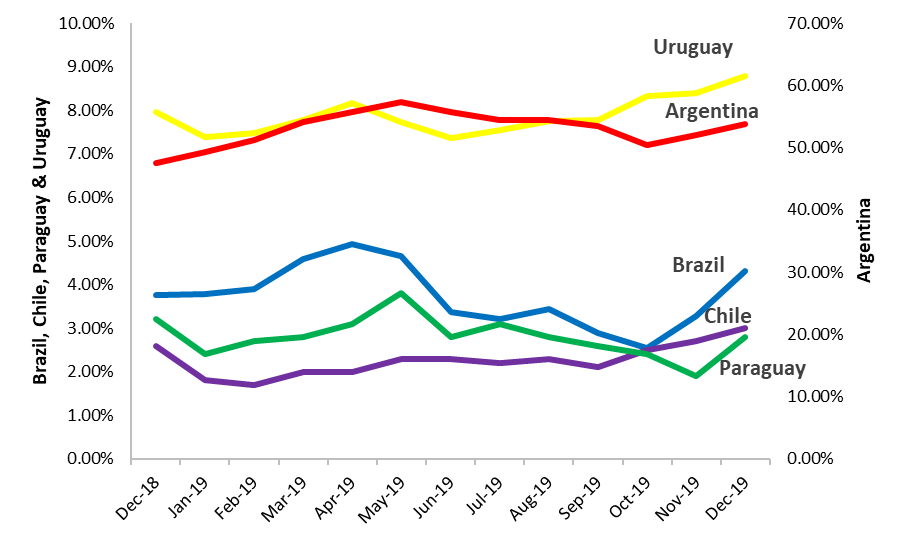
    Brazil & Southern Cone: Inflation
    Monthly year-on-year figures

    Brazil & Southern Cone: GDP growth (%)
    Quarterly figures are year-on-year growth
    Country End 2019 forecast* 2020 forecast * Q4 2018 Q1 2019 Q2 2019 Q3 2019
    Argentina -3.0 -1.3 -6.1 -5.8 0.6 Not available yet
    Brazil 0.8 1.7 1.2 0.6 1.1 1.2
    Chile 1.8 2.3 3.6 1.5 1.9 3.3
    Paraguay 0.2 3.0 1.2 -2.0 -3.0 2.8
    Uruguay 0.3 1.5 0.6 -0.2 0.1 0.9
    *Figures from the United Nations Economic Commission for Latin America & Caribbean Dec 2019
    Quarterly growth based on figures from the local central banks
  • HONDURAS: National blackout highlights continued issues in energy sector

    Sarah Sheldon 24 April 2025 Hits: 2073

    On 1 March the power went out throughout Honduras, the latest sign of ongoing fragility in the electricity system despite government promises to overhaul the energy sector.

    Honduras’ state electricity company Empresa Nacional de Energía Eléctrica (ENEE) said that 100% of electricity supply was restored by 3 March, and published a statement blaming the blackout on “a transitory and atypical failure in the connection between Honduras and Nicaragua.” It added that the fault had occurred on a transmission line connecting a substation in Honduras’ Choluteca department with one in the Nicaraguan department of León. 

    ENEE noted that just 23km of the 98km long transmission line lies in Honduran territory, but also highlighted that the national grid (SIN) has faced a “structural problem due to a lack of investment in transmission over the last 15 years.” It went on to blame “public-private corruption” for the shortfall of transmission infrastructure in recent years, although it also claimed that a L21bn (USR$821m) investment plan announced in 2022 would help to address this and improve the stability of the electricity system.

    There has been some recent progress, including the completion of the San Pedro Sula Sur - San Buenaventura transmission line. The 46km line cost L1.1bn and will link with other lines on the north coast, the east of the country and with Guatemala, said ENEE in a statement published 26 March. It will add capacity, improve resilience to faults and reduce dependence on thermal generation plants by prioritising renewable energy, added ENEE. 

    The company also announced that a 15MW generation plant had entered service in El Progreso municipality, Yoro department, on 17 March, as well as the start of a project to expand the electricity substation in Siguatepeque municipality, Comayagua department, on the same day. In a statement, ENEE said that “the aggressive investment of President Xiomara Castro’s government in the electricity sector is historic and is worth more than L23bn with the execution of more than 51 generation, transmission and distribution projects.”

    Looking ahead, ENEE is also working on a battery storage project at the Amarateca substation in the Valle de Amarateca district, Francisco Morazán department, which will boost transmission capacity and reduce the frequency of powercuts. The “pioneering” project will cost L1.3bn and become the largest energy storage project in Central America, according to ENEE. Despite these investments, the electricity sector faces serious issues. The country is struggling to satisfy a growing demand for electricity as little generating capacity has been added to the system in recent years, and it is highly reliant on hydroelectric plants whose operations have been impacted by recurrent periods of drought. 

    Significant investment is still required in both transmission and distribution infrastructure, but spending is disincentivised by the nature of the interconnected Central American power system, which means that even if one country invests heavily in its own network, blackouts can still be caused by faults in other countries. Castro promised to overhaul the sector at the beginning of her term which began in January 2022, but progress has been limited. Energy security will be a key electoral issue in the run up to the general elections scheduled for November, and the president will likely continue to trumpet investment in energy projects in the coming months. Nonetheless, fixing longstanding issues will require legislative reforms as well as significant funding.

  • RASTREANDO TENDENCIAS

    LatinNews 28 November 2014 Hits: 265

    COLOMBIA | Proyecto de ley de reforma fiscal ingresa formalmente al congreso. El 24 de noviembre el congreso nacional de Colombia anunció que comenzaría a debatir un proyecto de ley de reforma fiscal presentado por el gobierno liderado por el Presidente Juan Manuel Santos. La propuesta reforma fiscal, develada primero por primera vez por el ministro de finanzas, Mauricio Cárdenas, el mes pasado, está probando se altamente controversial. No menos porque después de que el Presidente Santos ratificara a Cárdenas en su puesto después de su reelección en junio, Cárdenas dijo que no había ninguna necesidad de una reforma fiscal exhaustiva antes de comenzar un nuevo mandato presidencial de cuatro años, sino solamente de “ajustes menores”. Sin embargo, después de que el gobierno de Santos presentara un borrador del presupuesto 2015 de Col$216,2bi (US$99mm) al congreso, Cárdenas anunció que el gobierno tendría que hallar unos Col$12,5bi (US$5,72mm) en ingresos fiscales el próximo año, a fin de financiar el presupuesto, que asigna significativos fondos a los variados programas de desarrollo social y económico promovidos por el gobierno de Santos en apoyo de las negociaciones de paz que actualmente está conduciendo con las guerrillas izquierdistas del país. Cárdenas dijo que así como la extensión del altamente impopular impuesto de ‘4 por mil’ a las transacciones financieras (una medida temporal introducida por primera vez en 1998) por otro cuatro años [IL-13-50], el gobierno también buscaría introducir un nuevo ‘impuesto a la riqueza’ (aplicable a individuos o firmas que poseen más de Col$1mm [US$479.000] en activos líquidos). Todo esto fue fuertemente criticado por el sector privado local, que se quejó de que el gobierno del Presidente Santos estaba renegando de su promesa de eliminar el ‘4 por mil’ y no incrementar la carga fiscal sobre el sector, afectando así su competitividad. Tales fueron las quejas del sector privado que Cárdenas se reunió con representantes de varios sectores para discutir las propuestas antes de someterlas al congreso. Luego de semanas de discusiones, para mediados de noviembre, Cárdenas anunció cambios a la propuesta original que convertirían al nuevo impuesto a la riqueza una medida temporal, que sería reemplazada con incrementos graduales y progresivos al ‘impuesto a la renta para la equidad’ (CREE, pagado en adicción a la tasa normal de 25% a las rentas fiscales) durante los próximos cuatro años. Sin embargo, el sector privado también ha rechazado la nueva propuesta, alegando que la incrementada carga fiscal (que según sus cálculos se elevará del 1,35% del PIB al 1,51%) sobre el sector desalentará la inversión y afectará los niveles de productividad, en momentos de incertidumbre económica en la región. Como Javier Díaz, el presidente del Consejo Gremial Nacional (CGN), un grupo de presión del sector privado, ha dicho: “Estamos preocupados debido a que mientras que nosotros incrementamos los impuestos, Perú los está bajando a alrededor del 26% para el impuesto a la renta; mientras que en Colombia nosotros estamos viendo un 43%”.

    PERÚ | Aprueban EIA de proyecto de energía en Ilo. El 25 de noviembre el ministerio de energía & minería (MEM) del Perú anunció la aprobación de la Evaluación del Impacto Ambiental (EIA) presentado por la firma consultora, Walsh Perú S.A., para el ‘proyecto del nudo de energético’ para la ciudad portuaria de Ilo, en la sureña región de Moquegua. El proyecto del nudo energético de Ilo, que está siendo desarrollado por la firma local Enesur, consiste en la construcción de una nueva planta de energía termoeléctrica de 500 Megawatts (MW), de ciclo combinado de alimentación a diesel y gas natural. La planta forma parte de los planes del gobierno del presidente Ollanta Humala para establecer un centro industrial y petroquímico en Ilo que será servido por el Gasoducto del Sur Peruano (GSP), un nuevo gaseoducto de 1.080kms de extensión que actualmente está siendo construido para llevar gas natural de los yacimientos de Camisea localizados en el centro de Perú hasta la costa sudoeste del país [IL-14-26]. El proyecto del GSP es uno de los más ambiciosos proyectos de infraestructura energética en Perú, que una vez que esté completado, el Presidente Humala ha dicho que ayudará significativamente a reducir los costos de la energía en el sur de Perú, ayudando a su desarrollo económico. La aprobación de la EIA del proyecto del nudo energético llega después de que el gobierno de Humala introdujera una serie de paquetes de estímulo económico, que entre otras cosas buscan racionalizar y modernizar el proceso de las aprobaciones ambientales para los grandes proyectos de inversión, como parte de su esfuerzo por apuntalar la lenta economía interna. Tales medidas son controversiales, con algunos sectores advirtiendo de negativas repercusiones ambientales y sociales. Pero el gobierno ha defendido sus medidas, alegando que éstas le darán nuevo vigor a la vacilante economía. Las últimas cifras del Instituto Nacional de Estadística e Informática (Inei) muestran que el crecimiento del PIB  año en año en el tercer trimestre fue de solamente el 1,76%, mucho menor que el 5,2% registrado en el tercer trimestre del 2013.

    • Arequipa entre los 10 destinos turísticos más recomendados

    Un ranking de destinos turísticos recomendados compilado el sitio web de comparación de precios de hoteles, Trivago, publicado el 17 de noviembre, ubicó a la ciudad peruana de Arequipa entre las primeras 10 de las 100 ciudades más recomendadas para visitar en el 2015. Arequipa, declarada herencia mundial por la Organización Educacional Científica y Cultural de las Naciones Unidas (Unesco) y capital de la región sureña del mismo nombre, fue ubicada en el 9no lugar – la de mejor ranking entre las ciudades de América Latina. Entre las atracciones de Arequipa, Trivago cita su asombrosa arquitectura colonial y sus bajos precios de hoteles. De acuerdo con Trivago, el promedio del precio de hotel por noche en Arequipa es de alrededor de €53 (US$66,14), que se compara favorablemente con el precio promedio de €49 (US$61,15) por pasar una noche en Mostar, Bosnia-Herzegovina, el destino ubicado al tope de la lista.

  • CARIBBEAN POINTERS

    LatinNews 07 December 2016 Hits: 656

    *** SVG OPPOSITION LEADER TO STEP DOWN. Arnhim Eustace, the 72-year-old leader of the main opposition party in St Vincent & the Grenadines, the New Democratic Party (NDP), is to step down. The NDP lost the December 2015 general election to the incumbent Unity Labour Party (ULP), led by Prime Minister Ralph Gonsalves, by just one seat. The ULP’s slim victory secured it a fourth consecutive term in office. Eustace has been reluctant to accept defeat, and he has taken to the courts in a so far forlorn effort to overturn the result.

    Eustace took over the NDP, and the premiership, from Sir James Mitchell in October 2000. Mitchell had kept the party in power for 17 years. But the party lost power in March 2001, only managing to hold on to three seats in the 15-seat parliament. Eustace, who was prime minister for just five months, led the NDP to three further election losses, and even if the party has now clawed its way back to within one seat of regaining power, it was not enough for Eustace.

    *** SURINAME ECONOMIC OUTLOOK “REMAINS CHALLENGING”. Following its latest Article IV consultation, the International Monetary Fund (IMF) is forecasting a 9% contraction this year for the Suriname economy. This follows on from a contraction of 2.7% in 2015. Inflation for end-2016 is expected to be 60%.

    The budget deficit for 2016 is expected to come in at 6% of GDP, with the debt-to-GDP ratio reaching 70% of GDP.

    The IMF mentions favourably preparations to introduce VAT, but it expresses concern about “the decisions to freeze fuel pump prices in nominal terms and partially reverse the increase in electricity prices”.

    The IMF warns: “Without a significant policy adjustment, Suriname risks deepening instability, with sharp exchange rate depreciation and accelerating inflation. There is limited financing to cover essential government spending - including public wages, pensions, and social support to the most disadvantaged - and the risk of resorting to central bank financing of the budget exists.”

    *** GRENADA REJECTS CONSTITUTIONAL CHANGES. The government led by Prime Minister Keith Mitchell has lost its bid to secure public support for seven constitutional changes in a referendum held on 24 November.

    Among the proposals were the abolition of appeal to the Privy Council in London in favour of the Caribbean Court of Justice (CCJ), fixed term parliaments, a maximum three terms for prime ministers, and a change in the oath of allegiance from the Queen to the state of Grenada. The proposals were decisively rejected, all by over 56% and some by over 70%, but on a low turnout of only 32%.

    The prime minister has sought to put a brave face on the outcome, but he is not under any great political pressure. The ruling New National Party (NNP) controls all 15 seats in the House of Representatives after the National Democratic Congress (NDC) failed to win a single seat in the 2013 general election. The NDC had gone into the election with four seats to the NNP’s 11.

    After the referendum, Mitchell said: “The only celebration we should have in this is the fact that we brought in for the first time an initiative [holding a referendum] that has never been attempted…I think history would record that during the period of my term in government the fact that we have started a process of looking and attempting to change our constitution.”

  • PERU: What next for Generation Z?

    Abbi Dicker 30 October 2025 Hits: 739

    In the middle of last week, Peru’s interim President José Jerí declared a state of emergency in Lima and Callao, restricting civil rights in an anti-crime campaign. Four days later the Generation Z movement called rallies at various locations in the capital defying those restrictions. This set of protests passed off peacefully, but the risk of violence remains present. There are plans for a further protest in November. In the short term at least, Generation Z may hold the key to the success or failure of the new interim government.

    October was a month of crisis for Peru. President Dina Boluarte was impeached on 10 October. There were violent clashes with anti-government protestors on 15 October, with one of them, Eduardo Ruiz, a rapper known as ‘Tryvco’, shot dead by a plainclothes police officer. A further protest was held on 25 October, this one marked by a small counterdemonstration by political far-right supporters and evangelical Christians.  

    A national strike has been called for 14 November, and the risk of further violence remains latent. Arguably none of this is new to Peru, which has experienced cyclical unrest for years. When Boluarte took office in late 2022 it triggered months of protests, especially in southern Peru, in which at least 50 people died.

    The new element, however, is the emergence of Generation Z, an international protest movement formed by people born roughly between 1995 and 2012. The movement, which uses social media as its organising platform, has been at the forefront of anti-government protests in a range of countries including Nepal, Morocco, and Madagascar.

    In Latin America, Generation Z has explicitly made an appearance only in two countries so far: Paraguay and Peru. Peruvian members of Generation Z outlined four major demands: justice for those killed in the 2022-2023 protests; pension reform; decisive action against organised crime; and the impeachment of President Boluarte (already achieved). The impeachment of Boluarte, however, has not removed the underlying structural tension between conservative-dominated institutions and the country’s largely excluded youth.

    The movement is made up of over 400 ‘collectives’, which include transport workers (many of whom are victims of extortion by street gangs). Lacking a formal leadership structure means Generation Z is flexible and responsive but may itself struggle to make clear decisions. This week there were different accounts of the next steps. One Generation Z leader, Orlando Carrasco, told radio station RPP that the 420 ‘collectives’ had not formally called for a strike on 14 November, preferring to “leave the initiative on the streets”. However, another leader, Yackov Solano, called directly for a nationwide strike across Peru’s coast, mountains, and jungles (“la costa, sierra y selva”).  

    Carrasco gave an insight into Generation Z thinking. He said the collectives “have quite a pure background in terms of our fight against corruption, we are not linked, and we are not led, by any political party, neither of the left nor of the right”. Although opposing traditional politicians, Carrasco said he encouraged members of the movement to develop a new generation who would see politics as a public service “divorced” from personal or commercial interests.

    The Jerí administration’s ability to manage a successful transition to next year’s general elections will in part depend on its ability to respond to Generation Z’s demands in a non-repressive manner.

    Presidential race

    The Ipsos survey found that half the respondents (49%) do not yet have a favoured candidate in the April 2026 presidential race. At this stage there are a total of 39 presidential candidates in the running. Latest polls suggest the most popular are the ultra-conservative mayor of Lima, Rafael López Aliaga (9%), the leader of the right-wing Fuerza Popular (FP), Keiko Fujimori (7%), and the brother of former president Martín Vizcarra (2018-202), Mario Vizcarra, also with 7%.

  • COSTA RICA: Science minister forced out over bungled media law

    LatinNews 14 April 2015 Hits: 2101

    Despite his attendance at the 10-11 April Summit of the Americas in Panama, Costa Rica’s President Luis Guillermo Solís found time to fire his science and technology minister in an attempt to shore up his country’s reputation for press freedom. In a statement released by the Casa Presidencial on the morning of 10 April, Gisella Kopper, the minister for Science, Technology & Telecommunications, as well as her vice-minister, Allan Ruíz, were asked to resign for “drafting a bill that contradicted Costa Rica’s principles of respect for freedom of expression”.

    Since its proposal, the bill has been greeted with outrage by local media organisations like the Instituto de Prensa y Libertad de Expresión (Iplex) and the Cámara Nacional de Radio y Televisión de Costa Rica (Canartel), plus international associations like the Inter-American Press Association (IAPA). Costa Rica has one of the best press freedom rankings in Latin America. The most recent (February 2015) Press Freedom Index by the international NGO Reporters Without Borders (RSF) ranked Costa Rica 16th of 180 countries surveyed, second only to Jamaica (9th) in the region.

    The proposed bill’s critics were especially outraged by provisions that they said could result in the closure of a radio or television station if it broadcast two “lies” or offended “moral standards” twice in a given year. National daily La Nación reported that many of the draft legislation’s most controversial articles were copied from media laws in Venezuela and Ecuador, nations criticized by RSF in its World Press Freedom Index for fomenting self-censorship and taking an aggressive stance toward the press.

    To head off some of the criticism, Solís had ordered the minister of the presidency, Melvin Jiménez, to investigate the circumstances surrounding the drafting of the bill. However, the president decided not to wait for the outcome of Jiménez’s report. In a statement to the press in Panama on 9 April, Solís said “Today and always, we are going to defend freedom of expression and press freedom because they are fundamental principles of a democracy that is an example to Latin America and the world. We are not going to permit anyone to tarnish these principles.”

    Kopper is now the third minister to resign this year, following the departure of María Elena López, from the health ministry, and Celso Gamboa, from the security ministry, in February. The president is also under pressure to fire Jiménez, a Lutheran bishop, who the opposition argues should be prohibited from holding public office according to the country’s constitution.

    When asked about Jimenéz’s future on 13 April, the president was, for the first time, lukewarm in his support for someone who had been considered his right-hand man. While refusing to be drawn on speculation that a wider cabinet reshuffle is likely in early May, to coincide with the president’s first year in office, Solís said that “no minister is chained to his post and no-one’s name is written in stone”.

    OECD invites Costa Rica to join

    On 9 April the Organization for Economic Cooperation and Development (OECD) formally invited Costa Rica to apply for membership, five years after the Central American country first began its attempt to join the club of 34 developed economies. Though Costa Rica’s economy is far smaller than most OECD nations, and still relies on partners like the US for security and development assistance, its strong record on education and healthcare puts it on a par with many OECD countries in terms of social indicators. As the OECD was extending its invitation, however, President Solís said he would lobby President Barack Obama for part of the US$1bn aid package proposed for Guatemala, Honduras and El Salvador. The challenge for Solís’ government will be to present itself as both developed and deserving of aid simultaneously.

    • FDI down

    Foreign direct investment (FDI) in Costa Rica fell 21% year-on-year in 2014 to US$2bn. The main reason for the drop was the lack of foreign capital flowing into the Costa Rican real estate market, which had received a major boost in investment in 2013. On average every year between 2008-2014, FDI accounts for around 5.1% of Costa Rica’s GDP.

  • CUBA: US-Cuba air cooperation takes off

    LatinNews 16 June 2016 Hits: 795

    On 10 June the US Department of Transportation authorised an initial batch of new scheduled air routes between the US and Cuba, with American Airlines poised to run eight flights a day to the island as of September.

    The newly revived US-Cuba aviation treaty, inked earlier this year, contemplates 110 daily flights by US airlines to Cuba, 20 to Havana and 10 each to nine other secondary airports on the island.

    The Department of Transport has awarded only non-Havana routes for now. The slots for Havana, the most lucrative and the most requested by interested US airlines, will be decided later in the year. According to US officials, US carriers requested three times the allocated daily number of 20 flights to Havana, indicating the expected surge in US demand for travel to Cuba’s main international airport in coming years.

    Meanwhile, American Airlines, which has a large hub in Miami, will run its eight regional Cuban flights a day as follows – twice a day to Holguín, Matanzas, and Santa Clara; and once a day to Camaguey and Cienfuegos. From Fort Launderdale, JetBlue Airways will offer three flights a day, one each to Camaguey, Holguín, and Santa Clara. Southwest Airlines will also run three daily fights, two to Matanzas and one to Santa Clara. Silver Airways, a small local player, will operate 39 flights a week from Fort Lauderdale to all nine secondary airports in Cuba, averaging 5-6 to day. It will fly small 34-seat turboprops.

    Elsewhere, the low cost Frontier Airlines plans 16 weekly flights from Chicago and Philadelphia to several Cuban airports, while Sun Country Airlines will fly once a week from its Minneapolis base to Matanzas and Santa Clara.

    These new scheduled flights are expected to be very competitive price-wise with existing charter flights to Cuba, which will continue to operate. Moreover, they will be able to fly at more convenient times, adding to their competitive edge. US travellers to Cuba must still fall under one of the 12 approved travel licences for Cuba – regular tourism remains strictly banned under the embargo. However, following recent US regulatory changes, US travellers now only need to ‘self-certify’ the purpose of their trip upon arrival at the airport check-in desk, thereby making it much easier to go to Cuba without hindrance. US travellers to date have also typically had to travel in organised groups certified to travel under one of the licence categories – for example, cultural exchange. This requirement too has latterly been relaxed.

    Two million tourists to date in 2016

    Cuba continues to enjoy a surge in tourism, now one of the mainstays of the economy and a critical source of foreign exchange for the cash-strapped government at a time of continued weak global prices for key exports like nickel. According to data released on 13 June by the national statistics institute (ONEI), Cuba has hosted 2m foreign visitors to date in 2016, a year-on-year increase of 11.9%. The main source markets remain Canada, Germany, the UK, France, Italy, Spain, Mexico and Argentina, with continued growth also in arrivals from the US. Cuban authorities now expect 3.7m tourists overall this year, up from 3.5m in 2015. Revenues thus also should rise from last year’s estimated US$1.94bn, which itself was a 10.7% increase over the previous year. Additional hotel capacity is planned for Havana, Varadero and Holguín, among other places.

    • Cubana

    It is unclear when Cuba’s state airline, Cubana de Aviación, might resume flights to the US – for years now it has not flown there for fear of having its planes seized under the US economic embargo. Apparently this difficulty has been settled under the terms of the restored aviation agreement, however it remains the case that Cubana planes may not yet meet US air transport safety standards.

  • HONDURAS: US weighs in ahead of Hernández decision

    LatinNews 09 November 2016 Hits: 585

    President Juan Orlando Hernández must decide by 11 November whether he will seek re-election. The ruling Partido Nacional (PN) is keen to hang onto office, but amid ongoing scandals centred on the infiltration of Honduran politics by dubious elements, the US government is sounding less supportive, suggesting a loss of faith in the current administration.

    “It’s up to the Honduran people to determine their political future through their democratic institutions and processes. I think that in general, rules of the democratic process such as term limits should not be modified for the immediate benefit of the incumbent”, said Mark Toner, US State Department spokesman, in the 7 November daily press briefing.

    The previous day, before a rally of PN supporters gathered at the Choci Sosa stadium in Tegucigalpa, Hernández said that he would reveal his decision before the registration deadline of 11 November. Hernández had first launched his presidential bid in the same venue four years earlier and the PN, which had bussed in thousands of supporters in expectation of a repeat announcement, was disappointed. While trumpeting the social, economic and security achievements of his government and calling for another four years in office for the PN, Hernández remained coy. He reminded the PN that the party had once gathered over 1.25m signatures to submit to the national legislature asking it to put limits on presidential election. “Today I call on deputies to act in the best interests of the country, that they look to other countries that put limits on re-election, but that no-one undermine the sacred right of every citizen to decide who to elect and who not to elect to the presidency”. “In the next five years”, he continued, “a nation of peace and tranquillity will be consolidated, a prosperous nation, a nation with opportunity for all and a socially-just Honduras, a Honduras that our children deserve”.

    PN supporters chanting ‘re-election’ seemed to take that as a positive declaration of intent, but in reality it was ambiguous. Notably, the PN has, with minimal notice, submitted to congress enabling legislation to implement the controversial April supreme court ruling to remove the constitutional ban on re-election. The enabling legislation needs a qualified majority of 86/128 to pass. The PN lacks a majority, but the opposition has voiced concerns about ‘the ting-a-ling’ (i.e., the payment of bribes). In its public statements, the Honduran opposition remains vehemently against re-election. On 5 November, the day before the president’s scheduled appearance at the PN rally, Libertad y Refundación (Libre), the radical left-wing party led by the ousted former president Manuel Zelaya (2006-2009), issued a statement reiterating its rejection of re-election.

    In this context, the fact that the US government has tacitly hinted that any enabling legislation might better allow for re-election from 2021 only, rather than immediately in 2017, or that consecutive re-election not be contemplated in the reform at all, appears a rather important comment.

    The State Department intervention also comes after Honduran media reported in early October that US authorities were investigating military and police officers, along with members of the judiciary and some three dozen politicians from municipal to cabinet level (potentially including the president’s own brother), in links to narco-trafficking (for full details see our sister publication, Latin American Security & Strategic Review, October 2016). At the same time, the US embassy in Tegucigalpa took the unusual move of publicly identifying eight Honduran nationals, including two members of the armed forces, who it said were under investigation for suspected ties to narco-trafficking and corruption. Hernández then revealed that an investigation was ongoing into an alleged plot by the Atlantic Cartel to assassinate the US ambassador to Honduras, James Nealon, as well as Hernández himself.

    Some serious questions are therefore being raised over the ability and/or the willingness of the Hernández administration to tackle the infiltration of the state by violent criminal elements. Rogue security officers were also implicated in the murder of the leading Honduran environmentalist Berta Cáceres in March 2016 (she had regularly accused special forces of being in the pay of ‘international corporations’), while before that, another scandal implicated one of the country’s most powerful clans, the Rosenthals, in corruption and links to the drug trade. Clearly under pressure, President Hernández on 12 October tweeted that “nobody is above the law” and denied that there had been any “cover up of any crime committed in or outside of the country”. US ambassador Nealon later tweeted a supportive message, declaring that “we will continue working together to end corruption and narcotrafficking”. However, the state of play between Hernández and the US is now a matter of some speculation.

    For now, Libre sticks with Xiomara

    Libre held internal elections on 30 October to select party coordinators for the country’s 18 departments, as well as 298 municipal representatives; 596 delegates for the party’s national assembly; and a national youth co-ordinator. The party set up 3,570 voting tables nationwide and according to Libre spokesperson Rixi Moncada, turnout was about 239,000, exceeding expectations of 150,000.

    Full results of the ballot were not released but it appears that Zelaya was ratified as ‘general coordinator’ of the party he helped found in 2011. It has also emerged that Patricia Rodas, who served as Zelaya’s foreign minister and was in exile for a time after the 2009 coup, was voted the new deputy coordinator, reportedly with 60% support. Rodas, a left-wing radical, rattled Honduran conservatives by pivoting the country away from its long-standing US alliance towards the regional radical left-wing bloc led by Venezuela. Honduras joined the Venezuela-led Alianza Bolivariana para los Pueblos de Nuestra América (Alba) in 2008 (but was withdrawn in 2009 by the interim administration that took over after Zelaya’s removal) and looked to become a Venezuelan oil client.

    Libre also re-confirmed Zelaya’s wife, Xiomara Castro, as the party’s presidential nominee, but noted that she was bidding with the support of five Libre currents (or factions), known as movimientos. This belies the splits within the party over Zelaya’s dominance, which stem in part from suspicion about his ambitions.

    Zelaya has vowed that if Hernández runs next year, then he too will throw his hat into the ring (with Castro apparently amenable to stepping aside for her husband). Libre, which has some nine factions, is not wholly united around the Castro ‘nomination’ – with rival presidential aspirants suspecting a pre-planned strategy to allow Zelaya to take over the slate next year once Hernández, as has been expected, is confirmed for the PN.

    Notably, in the internal elections, aside from the general vote, party members were also due to be asked whether they would support a future constituent assembly (which Castro has promised if elected) and, if Hernández stands for re-election, whether they would support Zelaya to run against him. Notably, the results of that internal plebiscite have not been made public either. In any case, Zelaya is covered – if Hernández decides against a bid, Xiomara can proceed as planned. Primary elections are due in March 2017, but these are not obligatory. And Zelaya may not want Libre ‘airing its dirty laundry’ in public.

    • Calls for reform

    Libre and the Partido Anti Corrupción (PAC) have requested reforms to constitutional articles 51, 52 and 54 so that they can gain representation on the electoral court (Tribunal Supremo Electoral, TSE), and the national citizens’ registry (Registro Nacional de las Personas, RNP), ahead of the 2107 election cycle.

    • Nasralla

    Salvador Nasralla, the former TV celebrity and leader of the Partido Anti Corrupción (PAC), is expected to bid for the presidency for a second time in 2017. In 2011 he came third and polls now suggest he is a strong contender again for 2017, with 50% support, in a scenario without the incumbent Juan Orlando Hernández on the ticket.