All Categories

Subcategories

  • Argentina

    Patrick de Courcy 21 December 2022 Hits: 313

    Argentina has been producing green hydrogen since 2008, but on a very small scale. The Hychico pilot project in the Argentine Patagonia has been producing around 52t H2/yr from wind power, using two alkaline water electrolysers with a joint capacity of 0.55 MW. The hydrogen is mixed with natural gas for power generation using a 1.4 MW generation unit that can operate over a wide range of gas/hydrogen blends, including pure hydrogen. The Hychico project also has Latin America’s only dedicated hydrogen pipeline system (2.3 km) and an underground storage facility.

    Yet several commercial hydrogen projects are beginning to come off the drawing board. On 28 April 2022, the Province of Tierra del Fuego and Texas-based energy company MMEX said they are developing a project to produce 55 tonnes per day of green hydrogen in the Río Grande, Tierra del Fuego area powered by 160 megawatts of wind energy. MMEX has agreements with Siemens Energy and Siemens Gamesa to deliver preliminary studies and technology for the wind energy, respectively. The idea is to produce and market ammonia in Europe or Asia. The location is ideal for ocean borne shipping east or west.

    Over 1,000 miles further north near the town of Sierra Grande in Rio Negro province, Australia’s Fortescue Future Industries intends to develop a massive green hydrogen project driven by a wind park. With a projected investment of $8.4bn and annual output of 2.2m tonnes of green hydrogen by 2030, it would be one of the biggest hydrogen endeavours in Latin America. During the pilot phase investments of US$1.2bn would allow the production of 35,000 tonnes of green hydrogen by the end of 2024. That’s sufficient to power roughly 250,000 households.

    Indicative of the types of problems that projects of this size often face, the proposal has run into stiff opposition from local activists who warn it could violate indigenous peoples’ land rights and endanger a conservation programme for the endangered Andean condor. The rhetoric being used by opponents also highlights to what extent export-oriented projects can be more prone to criticism.

    “It means using an important part of the area of the province to provide for countries in the Global North,” Leonardo Salgado, an environmental activist and palaeontology professor at the National University of Rio Negro, told Al Jazeera. It’s not only the 625,000 hectares of land but also the half-century concession, which is renewable for another 25 years, that has opponents concerned.

    But there are concerns on both sides of the equation. In a country with inflation of nearly 100% and foreign currency restrictions, it requires more than a leap of faith to put $8.5bn on the table. “They need to agree on a legal and economic framework that allows them to circumvent inflation and new rules of the game in case of political shifts,” says Agustín Jofre, a consultant with the Ministerio de Desarrollo Territorial y Hábitat, the rural development ministry.

    One example of a purely public and national approach to hydrogen production is an agreement signed between the Argentine federal government and the province of La Rioja to expand the Parque Eólico Arauco at a cost of $400m and produce hydrogen there from 2025.

    A big question in Argentina is how hydrogen would fit into an energy portfolio heavily dominated by natural gas. In recent years, Argentina’s use of compressed natural gas (CNG) and liquefied natural gas (LNG) as a fuel for heavy-duty transport along the country's principal motorways has expanded. CNG accounts for 12% of fuels used for road transport, and there are more than 1.7m vehicles using over 2,000 CNG refuelling stations. Low-carbon hydrogen could be blended into CNG up to a share of 20%, reducing C02 emissions but also increasing the cost of fuel unless a carbon tax or emissions trading system is established.

  • GUATEMALA: US agrees port modernisation deal

    Sarah Sheldon 23 June 2025 Hits: 1647

    On 22 May Guatemala’s President Bernardo Arévalo agreed a deal with the US to provide technical assistance for expansion projects at the country’s two main ports.

    The 30-year agreement was signed by the Guatemalan army and US Southern Command (Southcom), the military department that oversees activities in Latin America and the Caribbean. Work will be led by the US Army Corps of Engineers (Usace) but entirely funded by Guatemala. The deal was first discussed during US Secretary of State Marco Rubio’s visit to Guatemala in February, and a team of military engineers carried out an initial analysis of the existing port infrastructure shortly after. 

    It aims to expand and modernise port infrastructure to be “modern and efficient,” according to Arévalo, who called the agreement “a significant and historic step”. In the first stage, worth US$63m, work will focus on Puerto Quetzal, on the Pacific coast in Escuintla department, a vital conduit which handles 46% of Guatemala’s maritime trade. Planned improvements include extending the port terminal by 800m, doubling the number of berths to eight, and modernising infrastructure to allow the port to receive larger commercial vessels, significantly increasing operational capacity, according to a 30 April report by Southcom’s news website Diálogo Americas.

    It aims to speed up the passage of goods, which currently suffer from significant congestion that increases shipping times and thereby costs, while positioning Puerto Quetzal as a regional logistics hub that can benefit from its proximity to the Panama Canal. This will boost Guatemalan exports, as well as benefiting the local economy by providing more jobs during construction and operational phases. More ships will also mean more revenue for the national government, which receives 20% of the port’s annual profits, and the local municipality, which gets a 15% share according to the same report.

    In a second stage, similar efforts will be undertaken at the Puerto de Santo Tomás de Castilla, on the Atlantic side in Izabal department. The country’s ports have long been associated with corruption and illicit activity. By working with the US military, Arévalo will be able to reduce corruption risks at the ports, although the project will be funded by the Guatemalan state.

    Usace has also analysed the feasibility of revitalising Guatemala’s railway network, which is currently not in use, with the media reporting that the Usace mission presented a preliminary report regarding its findings on 23 May. An initial assessment concluded that freight and passenger services could be restarted, and a new light rail system known as Metro Riel built in Guatemala City. Arévalo has said that agreements similar to those signed for the port expansion project will be finalised in August this year. This chimes with Arévalo’s efforts to modernise the country’s infrastructure, including a road building programme designed to improve connectivity in rural areas, while combating corruption. 

    According to a statement from the US embassy in Guatemala published 21 February, the Usace visit “underscores the strategic importance of US-Guatemala relations and advances President [Donald] Trump’s America First policy of protecting our region by strengthening economic ties and developing infrastructure in partner countries, like Guatemala. These collaborations aim to position Guatemala as a regional hub of economic activity by creating jobs and fostering economic growth, while cementing trusted partnerships.”

    However, the US has not currently agreed to fund the projects, meaning that the timeline for completion will depend on Arévalo’s ability to secure the necessary investment. For now, Arévalo appears to be maintaining a strategy of close ties with the US, rather than turning to China for investment, as other Central American nations have done, but he will likely hope that his loyalty is rewarded with financing in the future.

    Other benefits

    Modernising port infrastructure will also help to deal with the threat of trafficking networks, criminal networks, and irregular migration, said Guatemalan defence minister Henry David Sáenz Ramos in an article published by the state news agency Agencia Guatemalteca de Noticias (AGN) on 22 May.

  • TRACKING TRENDS

    Patrick de Courcy 02 October 2025 Hits: 744

    BRAZIL | Job creation up in monthly terms. Brazil’s labour ministry reported on 29 September that a net 147,358 new jobs were created in August. New hires totalled 2.24m, while 2.09m people were dismissed. The job creation figure for August marks an increase from the net 134,251 jobs created in July but a decrease from the 239,069 jobs created in August last year.

    Meanwhile, Brazil’s unemployment rate remains relatively low. On 30 September the national statistics institute (Ibge) reported that the country’s jobless rate stood at 5.6% in the rolling quarter of June-August 2025, which is unchanged from the May-July quarter. This 5.6% is the lowest quarterly unemployment figure on record since the Ibge began recording this metric in 2012.


    BRAZIL | Public sector deficit decreases in August. Brazil’s central bank (BCB) reported on 30 September that the public sector’s primary deficit for August came to R$17.3bn (US$3.26bn), which is down from the monthly deficits of R$66.6bn in July and R$21.4bn in August 2024. The accumulated public sector deficit in the 12 months through August 2025 stood at R$23.1bn (0.19% of GDP), down from R$27.3bn (0.22% of GDP) in the 12 months through July.


    CHILE | Chile’s economic activity down on previous month. The central bank (BCCh) reported on 1 October that the country’s economic activity in August increased by 0.5% compared with August 2024 but decreased by 0.7% compared with July. The services sector saw a 2.4% year-on-year rise in activity but 0.6% decrease in monthly terms, while commerce registered yearly growth of 3.9% and a monthly increase of 0.1%. The production of goods posted a yearly drop of 3.4% and a monthly decrease of 0.7%. Mining activity also registered yearly and monthly declines, with the category registering an 8.6% year-on-year fall and a monthly fall of 2.3%.

  • Jamaica: Reaping the benefits of reform (and lower fuel prices)

    LatinNews 16 December 2015 Hits: 1552

    In mid-November 2015, Jamaican Prime Minister Portia Simpson Miller ended speculation that she might call an election in December – a year earlier than is required in the constitution (LN Caribbean & Central America December 2015). The latest economic developments suggest that she is right to wait.

    At the end of November, the Statistical Institute of Jamaica (SIJ) noted that the country’s merchandise trade deficit for the first eight months of the year was US$2,523m, or 11.5% less than in the previous corresponding period. Exports slipped by US$107m, or by 10.7%, however this was dwarfed by the fall in imports of 11.3% or US$434m. The main reason for the slump in imports was the US$530m (or 39%) fall in purchases of fuel and oil to US$839m. Jamaica is a major beneficiary of the drop in oil prices. Import volumes were lower as well.

    This was the latest piece of good news about an economy that is moving in the right direction. On 13 November, Uma Ramakrishnan, chief of the latest IMF Mission to visit Jamaica, noted that economic growth should accelerate from around 1.5% in the 2015/16 fiscal year to 2.5% in 2016/17. Thanks to growth in tourism and business outsourcing, the unemployment rate has fallen to 13.1% in July. In part because of lower fuel prices and in part because of the receding impact of drought, annual inflation dropped to a historic low of 1.8%.

    Ramakrishnan highlighted how the IMF is impressed with the progress that the government of Jamaica has made with the IMF-prescribed program. “With macroeconomic stability now well entrenched, and the debt dynamics improving, the authorities and mission agreed that a loosening of fiscal policy and a realignment of monetary policies were both warranted to support the real economy. To this end, a staff level agreement was reached to lower the target for the primary surplus to 7.25% of GDP for this fiscal year and to 7% of GDP for 2016/17. This additional fiscal space will provide an opportunity to increase public spending on capital outlays that boost growth and job creation as well as to continue to protect social spending. Further, a more expansionary monetary stance will help complement the fiscal expansion by supporting credit expansion and private sector activity.”

    Other reforms of which the IMF approves include the new Banking Services Act, the granting to the Bank of Jamaica (the central bank) of a broad mandate for financial stability, and changes to the operation of money markets. In the World Bank’s recently published Doing Business ratings for 2016, Jamaica was one of the ten most improved economies globally.

    Collectively, these details indicate that Jamaica’s economy is at an early stage in a virtuous circle of stronger growth, lower inflation, and reducing financial risk. Increased economic activity and lower inflation should boost household incomes. The government has greater fiscal leeway to spend. The benefits will be felt widely by voters. Simpson Miller has good reason to wait before she calls the next general election.

  • Region: Corporate Radar

    LatinNews 08 March 2017 Hits: 693

    Graña y Montero troubles: The Peruvian construction group Graña y Montero has been hit by the knock-on effects of corruption allegations involving Odebrecht, the Brazilian construction group it has partnered with on various large projects, including the US$7.3bn Gasoducto del Sur pipeline. One of the allegations is that former Peruvian President Alejandro Toledo (2001-2006) was paid a US$20m bribe to ensure that an Odebrecht-led consortium won the tender to build a segment of the Brazil-Peru Inter Oceanic highway. Jorge Barata, Odebrecht’s former Brazil represtentative and now turned state’s witness in Brazil as part of the major corruption investigations there, has claimed that the other companies in the consortium including Graña y Montero, were aware of the payment. Graña y Montero shares, which are listed in both Lima and New York, fell by 33.3% and 34.7% respectively on the news. The company rapidly denied the allegations that it had knowledge of any bribery payments, but this did not head off the announcement of a class action on behalf of shareholders led by Rosen Law of the US, alleging that the company’s shareholders had been given materially inaccurate information.

    Trump’s Mexico move could hit China’s Alibaba: President Donald Trump’s threat to crack down on remittances sent home by Mexican workers in the US could have an unexpected consequence: hitting the business interests of Jack Ma, leader of China’s Alibaba, one of the world’s largest e-commerce groups. Ma and Trump have met various times and are reputed to get on with each other. In January, Alibaba announced that it was acquiring MoneyGram, a US company specialised in international payments, which is number two in the market behind Western Union. The acquisition will require US regulatory approval. Sending money between the US and Mexico accounts for around 10% of MoneyGram’s total turnover. The purchase of MoneyGram by Ant Financial, an Alibaba subsidiary that also owns the Alipay international payments platform (a rival to PayPal), was widely interpreted as part of the Chinese group’s emerging globalisation strategy. Whether the Trump administration will be able to tax remittances sent from the US to Mexico is still a moot point. Various Republicans in the US Congress have suggested a 2% tax on remittances could be applied, with the proceeds earmarked to fund Trump’s proposed border wall on the frontier with Mexico. But critics say that such a tax, differentiating between people sending money out of the US on the basis of their nationality, could be unconstitutional.

    Rappi jumps the wall: Another technology company may be about to increase cross-border integration between Mexico and the US, at a time when the Trump administration is seeking to exert greater control of trade movements. The Colombian online courier company Rappi, which operates in major urban centres such as Bogotá and Mexico City, says it is about to expand into the US. So far, the company has specialised in carrying out deliveries or fulfilling bureaucratic chores for clients within each city. According to Adán Ramos of Rappi México, customers have nevertheless suggested a new service, which would allow people in the US to choose and pay for goods, for delivery, within hours, to friends and family in Mexico. The system would allow delivery of goods, medicines or money (a service known as Rappicash). Rappi has around 1m customers, but so far has little presence in the US. But its Mexican customers have family and friends north of the border; and thus Rappi is aiming to build up a presence in California, Texas, Illinois, New York and Florida.

    SQM seeks lithium boost: SQM, Chile’s chemicals and mining group, says it is positioned to benefit from an 8-10% increase in global demand for lithium this year. Lithium has a range of applications including in batteries, steel and aluminium manufacture, and in heat-resistant glass and ceramics. SQM is a leading global supplier of iodine and potassium nitrate. Gerardo Illanes, vice-president for finance at SQM, told the Chilean daily El Mercurio that lithium sales could help the company boost its Ebitda to US$1bn by 2020. The company is planning to invest US$100m this year to increase potassium nitrate and lithium hydroxide production capacity. Coupled with a capital injection for its mining operations in Argentina, total investment this year would reach US$300m, Illanes said.

  • CHILE: Controversy over prisoners

    LatinNews 16 April 2020 Hits: 4170

    Since the outbreak of wide-ranging protests last year, Chile’s President Sebastián Piñera and some of his supporters have shown an ability to make unforced errors in politically sensitive areas. They appear to have done so again, this time over the release of prisoners on health grounds.

    It is axiomatic that Latin America has overcrowded prisons. In the current crisis there have been serious concerns that they could act as centres of coronavirus infection and propagation. To try and control this risk, Chile’s congress passed special fast-track legislation allowing up to 1,300 prisoners, sentenced for minor crimes, to be released into house arrest.

    Those set to benefit include prisoners aged 75 or over, pregnant women, or young mothers. Legislators have broadly welcomed the idea as a sensible way of managing the Covid-19 crisis. Around 100 prisoners are reported to have the virus and the releases, it is calculated, will reduce overcrowding and contagion risk.

    But the legislation was delayed and almost blocked because a group of 14 senators from President Piñera’s ruling right-of-centre coalition Chile Vamos insisted that it was discriminatory, since it excluded prisoners held for human rights abuses and crimes against humanity during the dictatorship of General Augusto Pinochet (1973-1990).

    The senators threatened to take their case to the constitutional court. They wanted the release of around 70 of these prisoners, mostly held in the Punta Peuco prison which, according to a 2018 report published by Chile’s Human Rights Institute (INDH), could be classed as one of the country’s better detention centres, with spacious and well-lit cells, televisions, and tennis courts.

    Lorena Pizarro of the Association of Families of Disappeared Detainees (victims of the Pinochet era) complained that, “Faced by a global pandemic that is costing thousands of lives, our government is making an unethical and opportunist attempt to free convicted human rights criminals.”

    Piñera’s intervention – saying that human rights offenders also deserved to die with dignity – did little to defuse a divisive reference to the past. The senators eventually dropped their threat, allowing the bill to be approved.

    Supporting informal sector and SMEs

    President Piñera announced the creation last week of a US$2bn special fund to help workers in the informal sector affected by the coronavirus pandemic. Piñera said the fund would benefit 2.6m workers in the informal sector. He also announced that the government would guarantee bank loans to small and medium sized enterprises (SMEs). Piñera said this would enable banks to extend 48-month loans, equivalent to three months’ worth of sales, to SMEs with a six-month period of grace.

  • REGION: Dialogue of the deaf in Mercosur?

    Patrick de Courcy 12 August 2021 Hits: 2353

    A virtual summit of the Southern Common Market (Mercosur) members’ heads of state (Argentina, Brazil, Paraguay, and Uruguay) failed to resolve the deadlock over proposals to reduce the regional trade bloc’s common external tariff and allow a more flexible approach to trade deals.

    As a trade bloc that takes decisions by consensus, Mercosur is now facing two major and intractable issues. One, proposed by Brazil’s right-wing President Jair Bolsonaro, is that the common external tariff (CET) should be cut immediately by 10-20 percentage points. The main driver of this idea is Brazil’s Economy Minister Paulo Guedes, who believes that on the long run his country needs to become more competitive in the global economy. A more short-term consideration is that lowering tariffs on certain imported goods might help fight the current resurgence of inflationary pressures in Brazil’s domestic market. Brazil’s voice counts, since it represents around 75% of Mercosur’s GDP. At home, tariff reductions are strongly supported by the agricultural lobby – which is globally competitive – but resisted by the manufacturing sector, which is less internationally competitive and fears losing market share to imports.

    Issue number two is pushed by Uruguay’s President Luis Alberto Lacalle Pou, who is also right of centre on the political spectrum. Lacalle Pou wants to drop Resolution 32, a long-standing internal rule that dictates that no Mercosur member can negotiate trade deals with third parties without the agreement and participation of the other members. Lacalle Pou’s position reflects the fact that the small, largely services-based Uruguayan economy (3.5% of Mercosur’s GDP) does not have industries requiring high levels of protection, and benefits from being open to international trade. Uruguay has for long been interested in a trade agreement with China (resisted by Brazil on ideological grounds).

    In effect, Lacalle Pou used the July heads of state summit to pile on the pressure, saying his country would unilaterally begin negotiations with third parties, despite claiming it wanted to remain a “loyal” member of Mercosur. Yamandú Orsi, the governor of the Uruguayan department of Canelones and a possible left-wing presidential candidate in 2024, says Lacalle Pou’s intransigence is less of a thought-through strategic choice, and more of a convenient political posture, designed to impress his domestic political base.

    At the receiving end of these proposals, and forced into a defensive stance, is centre-left President Alberto Fernández of Argentina (20% of Mercosur’s GDP). With the Argentine economy slowly emerging from three years of recession, he is convinced that big reductions in the CET could decimate his country’s uncompetitive industrial sector – which, with key midterm congressional and regional elections due in November, he wants to avoid at all costs.

    Nevertheless, Argentine officials have sought to negotiate. They have offered a 10.5 percentage point tariff cut for a list of nearly 2,000 products starting next year, but which excludes sensitive items like automobile industry products. In response to Uruguay’s go-it-alone demands, Argentina has counter-suggested that the bloc should take a joint trade deal approach to countries like India, Indonesia, and Canada. Mercosur’s most consequential free-trade agreement – with the European Union (EU) – was concluded in 2019 but remains deadlocked with EU members saying they will not ratify it until there is an agreement on greater environmental safeguards (mainly resisted by Brazil).

    Right-wing President Mario Abdo Benítez of Paraguay (1.5% of Mercosur’s GDP) is trying to position himself as a deal maker between the rival camps. Paraguay’s largely agricultural economy depends in significant part on trade with both Brazil and Argentina, so Abdo Benítez has an interest in breaking the deadlock. He has also suggested that instead of online summits, there should be a face-to-face meeting of the presidents to resolve their differences.

    Perhaps more than any time in the past, the tone of the Mercosur debate has become embittered. Argentina’s productive development minister, Matías Kulfas, has said Mercosur members are taking positions that are “abrupt, dogmatic, and ideological”. President Bolsonaro, known for his often incendiary public utterances, has complained of “archaic defensive approaches”. With Brazil now holding the rotating Mercosur presidency for the second half of the year, prospects for an internal agreement are uncertain. Some analysts go as far as suggesting Mercosur could break up. However, a period of protracted deadlock looks more likely.

  • ECONOMIC HIGHLIGHTS

    Patrick de Courcy 09 November 2022 Hits: 822

    ECUADOR | Draft budget presented. On 31 October, Ecuador’s Finance Minister Pablo Arosemena presented the national assembly with the government’s budget for 2023, which outlines planned spending of US$31.50bn – a 3.5% increase on the 2022 budget. This will entail an expected fiscal deficit of US$2.63bn (2.14% of GDP). Social spending would represent nearly half of government costs, amounting to US$15.27bn – up from the current US$14.5bn. The budget was based on the following economic forecasts for 2023: GDP growth of 3.1%, with nominal GDP expected to come in at US$122.36bn; oil production of 514,759 barrels per day, with an average price of US$65 per barrel; and average annual inflation of 2.55%.

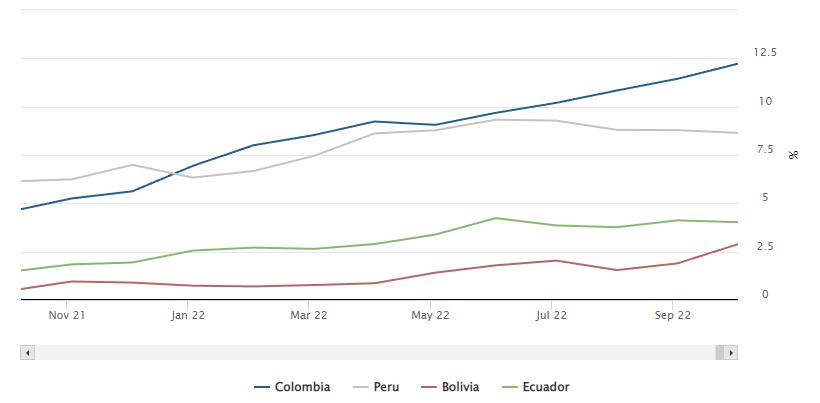
    COLOMBIA | Interest rate hike. On 30 October, Colombia’s central bank (Banrep) raised the benchmark interest rate by 100 basis points to 11%. In a statement explaining the decision, Banrep noted that annual inflation stood at 11.4% in September, up from 10.8% the previous month, and far higher than the bank’s target of 3%. The statement also highlighted the “worsening of financial conditions facing the economy, caused by global factors and idiosyncratic factors”.

    PERU | Inflation ticks up. Peru’s national statistics institute (Inei) released its latest consumer price index on 1 November, putting monthly inflation in October at 0.45% and annual inflation at 8.64%. The monthly increase in inflation was predominantly driven by price increases for transport (+1.10%), restaurants and hotels (+0.66%), alcoholic drinks and tobacco (+0.65%), and food and non-alcoholic drinks (+0.40%). Annual inflation remains nearly triple the central bank’s target range of 1-3%.

    Andean countries: inflation rate
    Percentage variation (year-on-year)

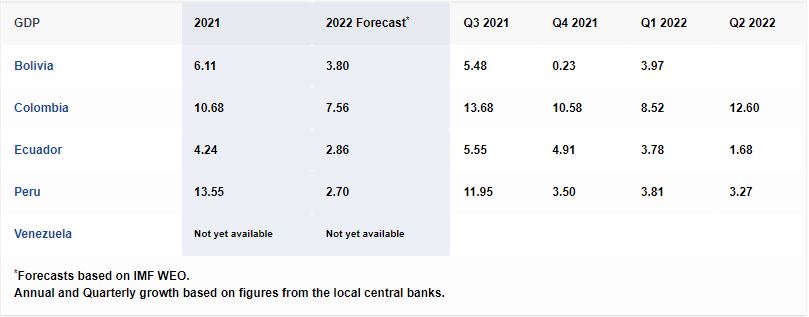
    Andean countries: GDP growth (%)
    Quarterly figures are year-on-year growth

  • PANAMA: Gov’t faced with protests sparked by rise in living costs

    Sarah Sheldon 16 August 2022 Hits: 709

    The Partido Revoluciónario Democrático (PRD) government led by President Laurentino Cortizo has recently faced some of the worst unrest in decades, over complaints regarding high fuel costs, rising prices for basic goods, deteriorating public finances, and economic mismanagement. The unrest bears stark contrast to claims that President Cortizo recently made in his state-of-the-nation address on 1 July, the anniversary of his third year in office regarding economic progress under his watch.

    In his balance sheet presented on 1 July, President Cortizo made multiple claims of progress, insisting that Panama was poised to maintain its position as “a benchmark for the region in democratic stability and social peace”. He cited Panama’s GDP growth of 15.3% in 2021, one of the highest in the region, without mentioning that the country suffered a 17.9% decline in 2020 due to the impact of the coronavirus (Covid-19) pandemic, the highest contraction in the region. Cortizo also highlighted strong trade, particularly in the Colón Free Trade Zone, which he said amounted to US$7.41bn in the first four months of 2022, up 17.6% on the same period in 2019. He said unemployment was back in single digits, to 9.9%, and also trumpeted social programmes such as Plan Panamá Solidario, which was set up during the pandemic to help the most vulnerable with food parcels and money transfers.

    On 6 July, however, Panama erupted in protests, which were subsequently spear-headed by three main protest groups Alianza Nacional por los Derechos del Pueblo Organizado (Anadepo), Alianza Pueblo Unido por la Vida (APUV), and representatives from the indigenous Ngäbe Buglé Comarca (indigenous administrative region) (see sidebar). The spark for the protests was rising fuel costs and inflation which has been affecting the sub-region and beyond, exacerbated by the Ukraine war. In Panama inflation was running at 5.2% in June, up from 4.2% in May which, while low compared to its neighbours, was high for Panama which has historically had low inflation due to its dollarised economy.

    The impact of price rises has been particularly powerful given that Panama is among the most unequal countries in Central America, and recent progress in reducing inequality was reversed from 2018-2019 when the country’s Gini coefficient (a measure of inequality in which 0 indicates perfect equality and 1 equals maximal inequality), rose from 0.501 to 0.506 according to the latest figures from the United Nations Economic Commission for Latin America (Eclac). Rural areas have increasingly been left behind, with poverty rates six times higher than in cities prior to the Covid 19 pandemic. That inequality increased after a period in which Panama recorded high, albeit declining, growth rates also contributed to increasing discontent with the political class.

    While Cortizo government blamed the cost-of-living crisis on the pandemic and Ukraine war, the situation has nonetheless subjected the government to familiar complaints regarding the lack of transparency in the management of the economy and corruption. On 1 July, the same day that Cortizo gave his balance sheet, the Fundación para el Desarrollo de la Libertad Ciudadana (FDLC), the local branch of anti-corruption NGO Transparency International, published a statement precisely bemoaning a lack of transparency in the management of the economy. FDLC criticised the fact that a government decision to authorise a further debt issuance of up to US$1.8bn on 29 June was able to pass without scrutiny, as the state of emergency declared at the start of the pandemic is still in force. This means that the management of public finances has suffered from a lack of transparency in the past two years, according to the statement, despite the government agreeing to a number of measures as part of an open governance plan in September 2021. And, in a 12 July statement, the FDLC flags up rising public debt, which it says has been destined for apparent “discretionary uses”, motivated by “political objectives” rather than public services or creating jobs.

    Protesters’ demands and concessions

    A reduction in living costs topped the list of eight demands presented by the protest groups during a dialogue table with the government which began on 21 July in Penonomé, the capital of Coclé province, mediated by the Catholic Church, aimed at putting an end to the unrest. The other demands included: reduced fuel prices; lowering the cost of, and ensuring the supply of, medicines without privatising the social security institute (CSS); assigning 6% of GDP to education; reducing energy costs; discussing the financial situation of the CSS; tackling the fight against corruption; and installing an inter-sectoral table to monitor agreements reached. 

    At the time of writing, the two sides had yet to reach a final agreement. However even before the dialogue began, the government was compelled to offer concessions. These include price caps on basic goods; a freeze on fuel prices to US$3.25 per gallon, down from an earlier pledge of US$3.95; and an order for public institutions to introduce austerity measures such as cutting payrolls by 10% and reducing discretionary spending. In the context of the dialogue, the government has since announced further measures. These include a 30% reduction in the cost of a basic basket of goods; price controls on a further 72 products; and temporary elimination of import tariffs on various products for six months, subject to renewal, among other measures.

    Impact

    The private sector has been quick to warn of the economic impact of the unrest and road blockades which were concentrated in the provinces of Chiriquí, Veraguas, Panama (including the metropolitan area), and Darién as well as strategic roads such as the Pan-American Highway, which connects Panama with the rest of the sub-region and is a key route for goods. Business lobby Cámara de Comercio, Industria y Agricultura de Panamá (CCIAP) was cited by the media as saying that protests were causing potential daily losses of US$16m. A 25 July statement by the International Committee of the Red Cross (ICRC) warned that fuel was in short supply, and food production was being lost at harvesting points (it cites media reports of US$500m in estimated losses in the production chain) or in cargo trucks stranded at blockades.

    Meanwhile international credit ratings agencies Moody’s and Fitch Ratings have warned of the fiscal implications of the government concessions. A Fitch report released on 26 July for example notes that while the government has approved spending up to US$200m (0.3% of GDP) to subsidise gasoline costs over three months, the announced subsidies could be maintained for longer if social unrest persists, or if increased or extended to other goods. The cost of extending social transfers granted through the pandemic, which the government had previously announced it would do, now looks likely to be more than the US$400m budgeted for 2022. Fitch notes that while the 2022 budget targets a 4% of GDP non-financial public sector (NFPS) deficit, down from 6.7% last year and compliant with the modified fiscal responsibility law, the initial fiscal response to the unrest points to higher risks that authorities miss their 2022 deficit target.

    This will also make it harder to reduce the country’s debt burden, which fell to 64.2% of GDP by end-2021 from 68.5% in 2020 on Fitch estimates. At the end of June, Panama’s debt hit US$43.18bn, up from US$26.61bn when Cortizo took office on 1 July 2019, according to monthly reports from the country’s finance ministry. This is an increase of US$16.6bn. While this period does include the Covid-19 pandemic, protesters demanding better management of public finances have not accepted this as an explanation for the increase in debt. 

    • Protest groups

    Anadepo which launched last month, represents teachers, university staff, and transport workers among others, while APUV groups leading unions, including Sindicato Único Nacional de Trabajadores de la Construcción y Similares (Suntracs), Confederación Nacional de Unidad Sindical Independiente (Conusi), and teachers’ unión, and Asociación de Profesores de la República de Panamá (Asoprof).

    • Questioning measures

    In its 26 July report Fitch questions measures announced by the government aimed at quelling unrest. For example, in the cast of austerity measures, it notes that “previous efforts at payroll reduction have yielded little (it rose to 6.0% of GDP in 2021 from a low of 3.9% in 2014)…we think it unlikely that large, rapid savings will be made via these measures, although capital expenditures may be cut to reduce spending pressures”.


  • GUATEMALA: President-elect proposes moderate economic reforms

    Sarah Sheldon 14 November 2023 Hits: 386

    President-elect Bernardo Arévalo, who continues to face considerable pushback from Guatemala’s discredited political establishment following his remarkable 20 August run-off victory, has highlighted as key objectives with regard to the economy the need to boost employment, reduce poverty, and improve infrastructure. Here we look at some of the proposals put forward by his left-of-centre Movimiento Semilla (Semilla) which is due to take office in January 2024.

    Semilla set out its economic plans as part of its 2024-2028 manifesto in the lead up to the two-round election, which saw Guatemalans head to the polls on 25 June and 20 August and ultimately elect Arévalo as the country’s next president. One key focus is improving the labour market in order to “combat poverty, hunger and uncertainty,” reads the manifesto, which proposes free training programmes targeted at boosting industrialisation and specialised services that will benefit an estimated 200,000 people.

    According to Semilla’s manifesto it is also aiming to develop a public service that will support recruitment and boost the number of formal jobs, as part of what it calls “a climate of support for entrepreneurship” and the “economic empowerment of women and young people,” benefiting 100,000 people. In addition, the manifesto proposes a national programme of temporary work placements for 1m people, which will pay agricultural workers to build roads or plant trees outside of harvest seasons.  Other proposed schemes include new credit lines ranging from Q2,500-100,000 (US$320-12,900), designed to support around 50,000 small businesses; the creation of a national innovation fund, aimed at improving productivity; and the distribution of computers and tablets. In all, the labour market plans are assigned a budget of Q6.9bn for 2024-2028.

    More key proposals include universal access to electricity through the investment of Q7.1bn mainly in small-scale renewable projects. Semilla also plans to lower prices for more than 1m customers by reducing the cost of street lighting. The manifesto does not detail how this will be achieved, but projects in other parts of the region have achieved significant cost savings by using smart management and control systems, for example. There are also plans to invest Q7bn in programmes to boost soil and water quality as part of a move towards an economy based on “regenerative, clean and circular production”.

    In addition, there are plans for more environmentally friendly public transport systems, such as the first metro line in Guatemala. The government also wants to consolidate the public transport system in the capital to improve mobility within the city and with nearby areas. Other plans for the transport sector include 500km of new and improved main roads; 1,820km of new and improved secondary roads; and 1,500km of new and improved rural roads. Semilla also plans to develop a masterplan to improve port and airport infrastructure.

    These spending plans will be financed by reducing corruption and unnecessary spending rather than increased taxes, which Semilla has said it is committed to retaining at current levels. Savings will be made by strengthening tax authorities, as well as cracking down on illicit financial flows, customs fraud, and contraband, according to the manifesto, which also explicitly says that there will be no tax amnesty under a Semilla government.

    Other measures include an audit of government debts from the last 20 years, as well as restructuring public debt over longer payment terms and at lower interest rates. Semilla believes its plan will grow the economy at around 4.2% of GDP per year, while at the same time cutting debt from 27.7% of GDP in 2023 to 26.8% of GDP in 2027. It also envisages a rise in the tax burden from 11.7% of GDP this year to 13.0% in 2027, and an increase in the percentage of government spending on public investment from 20.5% to 28.2% over the period. At the same time, the percentage of government spending on day-to-day running costs is forecast to fall from 79.5% of GDP to 71.8% over the period.

    As for economic reforms, Semilla aims to develop a “stable and modern” legal framework to boost investment and competition. The manifesto includes plans for a new competition law, which will seek to end uncompetitive practices by firms looking to prevent new entrants to their markets. It also proposes an investment law, which will set out incentives for companies to set up shop in Guatemala. Key sectors cited by Semilla include biotechnology, tourism, and sustainable forestry, among others.

    However, there are serious questions over governability in Guatemala. Vested interests are currently attempting to prevent Arévalo from taking power, and it seems unlikely that they will allow him to rule the country unimpeded if he does eventually come into office. Even if the transition had been orderly, Arévalo would have faced serious difficulties in enacting a reformist programme. For example, Semilla will have just 23 of 160 seats in the new unicameral congress, compared to 39 won by outgoing President Alejandro Giammattei’s Vamos party, which will be the largest in the legislature. Overall, Semilla’s programme is relatively modest in terms of reforming the Guatemalan economy, but the government will have to overcome powerful opposition forces desperate not to cede any of the privileges they have enjoyed up to this point.

    Education and health

    Semilla’s manifesto pledges to invest Q110bn (US$14bn) in education to provide an extra 540,000 student places and 70,000 new classrooms, and Q61bn for health to extend coverage for a further 7m people through creating 400 extra health-related posts.

    Poverty

    The manifesto also pledges to assign Q16.5bn (US$2bn) to address the structural causes of poverty, which the International Monetary Fund (IMF) estimates afflicted 55% of the population in 2022, as well as chronic malnutrition, which affects 46.5% of children under five in Guatemala - an issue which President Giammattei declared a priority but which he has singularly failed to address. In its manifesto, Semilla maintains that it would reduce malnutrition by 10%.

  • TRACKING TRENDS

    Abbi Dicker 31 July 2025 Hits: 1456

    BRAZIL | Rate hikes halted. Brazil’s central bank (BCB) has halted its cycle of interest rate hikes, holding the country’s benchmark interest rate (Selic) at 15.0%. The BCB had increased the Selic in all of its meetings since September 2024.

    In a statement, the BCB board did not indicate if rate cuts were on the horizon, suggesting that the Selic rate could remain at this level for a “prolonged period”.

    The government of President Luiz Inácio Lula da Silva will likely hope that interest rates can come down in the months before the next presidential race, due in October 2026, to allow for more economic activity, which could boost consumer confidence and public morale ahead of the election.

  • GUATEMALA: Exports boom

    LatinNews 15 December 2011 Hits: 320

    In the first 10 months of 2011 export receipts rose by 25%, year-on-year to US$8.68bn. 

    This was US$1.75bn up on the US$6.93bn the country earnt in the first 10 months of 2010. Coffee was the biggest single export earner in the first 10 months of 2011, pulling in US$1.08bn. Clothing came next with US$1.05bn.

    The US is the country’s biggest export market, buying US$3.6bn worth of goods in the first 10 months of 2011. Central America came next with US$2.3bn. Mexico accounted for US$406m and Europe US$575m.

    Imports in the first 10 months of 2011 were up 23%, according to the central bank at US$13.9bn. Raw materials and inputs came to US$4.4bn while fuel imports cost US$2.78bn.

    Remittances: In the first 11 months of 2011, remittances were up by 6%, year-on-year at US$3.99bn. Remittances in November came to US$344m compared with US$331m in November 2010. According to the foreign ministry there are 1.5m expatriate Guatemalans; most live in the US.  The government’s target of a remittance inflow of US$4.4bn looks realistic. In 2010 the full year total was US$4.1bn.

    Inflation: Consumer prices in November rose by 0.22% bringing the lagging 12 month rate to 6.1%, just outside the central bank’s target for 2011 for a rate of between 4% and 6%.

  • DOMINICAN REPUBLIC: Sticking to its guns on migration policy

    LatinNews 09 September 2015 Hits: 359125

    Despite all the negative attention and resultant diplomatic tensions with its neighbours, the Dominican government led by President Danilo Medina continues to implement its controversial migration policy. The international pressure for the Dominican authorities not to resort to the summary mass deportation of Haitian migrants and their Dominican-born children remains. But not even a visit by the new Secretary General of the Organization of American States (OAS) to the country (see sidebar) after the OAS’s offer to mediate in the dispute was rebuffed by the Medina government [RC-15-08] has deterred the Dominican authorities.

    “The implementation of the migration policies and the deportation of all those irregular immigrants that failed to adhere to the regularisation and naturalisation programme is non-negotiable”. This was the response that the Dominican Republic (DR)’s foreign minister, Andrés Navarro, gave on 20 August to the latest calls made by the Haitian government, the OAS and the Caribbean Community (Caricom) for the DR to stop deporting migrants to Haiti amid fears that this could result in the violation of the rights of a large number of Dominican-born individuals of Haitian descent.

    The Haitian government has been clear that while it is prepared to accommodate any Haitian nationals repatriated from the DR, it was not prepared to take in any individuals born in the DR and turned away from the country of their birth. Similarly, the OAS reiterated that the DR authorities had to ensure that no individual is denied their right to a nationality as a result of its new migration policies and no individuals are wrongfully deported to Haiti. These calls came after the Dominican authorities confirmed on 14 August that following the formal closure of their migrant regularisation and naturalisation programme in June, they had began repatriating Haitian migrants back to their country.

    The OAS had urged the DR to work with Haiti to develop a repatriation protocol before it began deporting individuals so as to avoid the situation turning into a humanitarian crisis. However, the Haitian authorities have complained that although the two governments have held a number of high-level meetings to come up with a joint protocol to deal with repatriations, the DR had begun this process before such a protocol had been fully established.

    The Dominican government maintains that its migration policies do not inherently violate any human rights and that it has adopted all the necessary measures to ensure the rights of all migrants in the country are respected. This was reiterated by Navarro, who insisted that the process of repatriating Haitian migrants was being carried out “without any inconveniences and with strict adherence to human rights”. Navarro said that so far 220 Haitians had been repatriated after their individual cases were reviewed. Citing interior & police ministry (MIP) figures, Navarro said that some 73,606 irregular Haitian migrants had so far decided to voluntarily leave the DR for Haiti, assisted by the Dominican authorities.

    Navarro was also adamant that this process had been observed by “various national and international organisations that have verified that the implementation of our migration policy is being done with full respect for human rights as ordered by President Medina”. He added that so far no one has presented “any evidence whatsoever” to show that there was anyone in the DR under threat of becoming ‘stateless’  as Haiti and some in the international community have warned. Indeed Navarro pointed out that 288,000 foreign migrants (the majority of which are Haitian) had successfully registered for the regularisation and naturalisation programme before its closure and that the MIP has already issued new identification cards to 84,000 of these migrants.

    But all of this failed to assuage the concerns of the international community. A few days after Navarro’s comments, on 26 August, Caricom Secretary General Irwin LaRocque said that the organisation will ask the United Nations (UN) to monitor the repatriation of migrants from the DR to Haiti to ensure that the rights of all migrants are being respected. LaRocque made the announcement after meeting Haiti’s foreign minister, Lener Renaud. LaRocque said that during the meeting Renaud presented him with the results of a survey carried out by the International Organization for Migration of migrants crossing the DR-Haiti border, which found that 27% of the 6,311 interviewed between 17 June and 13 August said that they had been deported from the DR despite having been born there and some of them (3.8%) had even been issued with Dominican identification documents.

    The day after Caricom’s announcement, the Inter-American Commission on Human Rights (IACHR) issued its own statement in which it reminded the DR of its obligation to protect the fundamental rights of all migrants. In particular the IACHR called on the Dominican government to ensure the protection of the rights of those individuals that had been born in the country and retroactively deprived of their nationality by a contentious court ruling that is suspected of violating international law (see sidebar).

    The implementation of the DR’s migration policies will clearly continue to be closely scrutinised by the international community. The Medina administration will remain under pressure to show that its handling of this thorny issue is exemplary. Otherwise the DR will leave itself open to cases of human rights violations being brought against it in international forums.

    • Almagro gets cold reception

    On 18 August the new OAS Secretary General Luis Almagro made his first official visit to the DR. Almagro’s visit came during the second annual general assembly of the Association of World Election Bodies held in Santo Domingo on 18-19 August. But because Almagro’s remarks about the situation of Haitian migrants in the DR - that “Hispaniola is an island and when you have an island there usually are not two countries, just one”- has been seen as biased and an affront to the DR’s independence by many Dominicans, he received a less than warm welcome. Figures such as Milton Guevara, the president of the DR’s constitutional court, criticised Almagro’s and the OAS’s “lack of impartiality” and once again rejected the OAS’s offer to help resolve the issue.

    • IACHR statement

    “The Commission reminds the Dominican State that it has the obligation to individually analyse and justify any deportations... as mass deportations are manifestly contrary to international law”, the IACHR statement reads. The IACHR then urges the Dominican government to “adopt all the measures to guarantee the rights that individuals born in the Dominican Republic have to live in Dominican territory and to claim Dominican nationality after they were arbitrarily and retroactively deprived of this by the [September 2013] TC/168/13 ruling by the [DR’s] constitutional court”.

  • TRACKING TRENDS

    Patrick de Courcy 19 February 2026 Hits: 1021

    BRAZIL | Petrobras waives right to control Braskem. The state-controlled oil company Petrobras announced on 12 February that it will refrain from exercising its right to buy a controlling stake in the petrochemical producer Braskem, the largest petrochemical company in Latin America. Petrobras currently holds a 47.0% stake in Braskem, while the majority shareholder is Novonor, formerly known as Odebrecht. The Brazilian engineering and construction giant is planning to sell its 50.1% stake in Braskem to an investment fund called Shine. Under the current shareholders’ agreement, Petrobras has pre-emption rights which would give it preferential rights to buy the shares of the majority stakeholder, but the oil firm has decided not to exercise this right, clearing the way for Novonor to sell its shares to other investors.

    BRAZIL | Annual grain harvest expected to fall. The national statistics institute (Ibge) released a new forecast on 12 February for the 2026 annual production of grains, cereals, legumes, and oilseeds, projecting a total harvest of 342.7m tonnes (t). This would mark a 1.0% decrease compared with 2025. The Ibge expects annual soybean production to reach 172.5m t this year, which would mark a 3.9% increase compared with 2025. However, other major grains products are projected to post annual declines. Maize production is expected to decline by 5.6%, while the production of rice (in the husk) is forecast to decrease by 7.9% in 2026. Soybeans, maize, and rice are expected to account for 92.9% of the total annual grain harvest this year.

    BRAZIL | Inflation forecast continues to fall. The central bank (BCB) released a new edition of its Focus bulletin on 18 February, a weekly survey including the forecasts of private sector economists and analysts, which showed an annual inflation projection of 3.95%. This marks the sixth consecutive week in which the market experts have lowered their inflation forecast. The forecast in the previous week’s bulletin was 3.97%, and one month ago the forecast stood at 4.02%. Meanwhile, the annual GDP growth projection remained unchanged in this week’s edition, with a forecast of 1.80%.

  • REGION: Tourism sector continues to grow

    Sarah Sheldon 20 July 2026 Hits: 141

    Visitor numbers to Central America recorded strong growth in the first quarter of this year, and the travel and tourism sector is forecast to keep growing.

    On 2 June, United Nations World Tourism Organization (UN Tourism) reported that international arrivals to Central America increased 18% year-on-year for the period January-March 2026, compared to an increase of 0.2% in the Caribbean and -1% in South America. It also outperformed the global average of 2%, although this low growth can be explained in part by disruption caused by the conflict in the Middle East. This was driven in part by a 43% increase in year-on-year Q1 visitor numbers in El Salvador, the third-highest increase for the period of any country in the world.

    On 4 June, El Salvador’s Tourism Minister Morena Valdez was cited by government-owned newspaper Diario El Salvador as saying that there were 2.1m visitors to the country from January-May, meaning that it has already hit 50% of its 4.2m annual target in just five months. Valdez highlighted growth in the number of foreign visitors from countries such as Spain, England, Germany, Colombia, Mexico, and Canada, as well as new direct flights to Madrid and Barcelona with Spanish-Portuguese airline Iberojet. She added that negotiations were ongoing with other European airlines too. 

    Guatemalans make up the largest share of foreign visitors, followed by the US and Honduras. The country’s tourism promotion strategy rests heavily on attracting visitors from these countries for shorter trips, rather than long-haul travellers. It is however also working to attract visitors from outside the region, positioning its beaches as a world class surf destination, focused on building out the Surf City project in El Tunco, La Libertad department, as well as trumpeting improvements in the security situation. The outlook will depend on whether the improvements in public security can hold without mounting evidence of human rights abuses damaging the country’s image abroad.

    Looking ahead, the UK-based World Travel & Tourism Council (WTTC) forecast that Central and South America’s travel and tourism sector would outpace the global average for the year. Although it does not publish disaggregated data for Central America, the latest Economic Impact Research (EIR) report did highlight the fact that Panama is set to record the strongest growth in travel and tourism gross domestic product, up 8.4% for the year, with Guatemala second on 6.1% GDP growth. International visitor spending is also projected to rise 8.9% in Panama and 9.3% in Guatemala. 

    The Central American Tourism Promotion Agency (CATA), which works to promote the region’s potential for multi-destination trips, met at the end of June to discuss upcoming actions. Among its top priorities was the organisation of the Central America Innovation Tourism + Talks and the Central America Travel Market (CATM) 2026, according to a statement published on 26 June. And in May, officials participating in the Wings of Change Americas 2026 (WOCA 2026) forum, which is organised by the International Air Transport Association (IATA), positioned the region as a bridge for air connectivity in the region.

    While this demonstrates continued effort to encourage visitors to travel to various countries in the region on a single trip, structural constraints such as the high prices of intraregional air fares continue to hold back integration. In addition, competing national strategies mean that there is limited political will to commit to this goal.

    Resistance

    Costa Rica has proven unwilling to facilitate intraregional air travel due to concerns that the high-spending international visitors that make up a significant part of its client base would find it easier to fly to neighbouring countries and therefore spend less time and money in Costa Rica.

  • TRINIDAD & TOBAGO: Assassination plot highlights divisions

    LatinNews 30 November 2011 Hits: 1541

    On 23 November, Trinidad & Tobago’s Prime Minister Kamla Persad-Bissessar announced that an assassination plot against her and three cabinet ministers had been uncovered two weeks earlier but that she was unable at this stage to provide full details because of the ongoing security operation.  In her initial statement, the prime minister emphasised that the plot proved that the government’s anti-crime drive was having an impact, seeming to confirm a security rather than a political purpose.  However, in Trinidad & Tobago crime is a political issue, and a racial one too, and it took no time at all for both politics and race to surface in the reactions to the plot.

    In her 23 November statement on the assassination plot, the prime minister made an immediate link between the plot and the imposition of a state of emergency (SOE) almost exactly three months earlier. According to the prime minister, 7,269 people had been arrested since the SOE was imposed.  The police had also seized T&T1.5bn (US$236m) worth of drugs, including one seizure worth T&T$55m (US$8.6m). Over 13,000 runs of ammunition have been seized in the same time, along with 173 firearms.

    According to Persad-Bissessar, the assassination plot was an attempt by “criminal elements” to carry out reprisals for the SOE.  She said: “Their actions have proven that the efforts of the government are having the desired effect.  We are flushing them out; we are making it almost impossible to operate as they would have in the past.”

    But the prime minister was also quick to introduce a political element, saying that “these nefarious elements” had reacted in such a way because they were “finally confronted by a government which possesses the political will, courage, and strength of conviction to stoutly defend and protect the citizens of our country”.  She added: “For far too long these criminals have been allowed to flourish as the untouchables, some with their sinister connections of legitimacy.”

    The People’s Party (PP) government, which is dominated by the prime minister’s Indo-Trinidadian oriented United National Congress (UNC), took power from the mainly Afro-Trinidadian People’s National Movement in May 2010.

    In her statement, Persad-Bissessar also introduced an element of mystery by saying that the criminals had “the support from others whose names will…come to light in time”.  As of 28 November, 14 suspects had been arrested, including four ex-members of the security forces (three ex-soldiers and one former coastguard).

    In our September report on crime in Trinidad & Tobago [RC-11-09], we looked at the degree to which race is at the heart of the issue.  It is estimated that there are 95 gangs in Trinidad & Tobago and that they are responsible for 60% of the country’s murders. Gang members are predominantly of African (76%) or Afro-Indian (19%) origins. Less than 5% of gang members describe themselves as being of East Indian origin. The position is further complicated by the fact that the police force (which solves only 20% of violent crimes) is predominantly an Afro-Trinidadian force.

    The fact that the prime minister and the three other cabinet ministers targeted by the would-be assassins – Attorney General Anand Ramlogan, Housing Minister Dr Roodal Monilal, and Local Government Minister Chandresh Ramlogan – are all of East Indian origin has not gone unremarked.

    A further potentially sinister aspect of the plot is the fact that members of an unnamed radical Muslim organization are said to have been involved.  In 1990, Jamaat al-Muslimeen (JAM), an extremist group supported mainly by Afro-Trinidadian converts to Islam, mounted an attempted takeover of the government under the leadership of Yasin Abu Bakr (formerly Lennox Phillips).  It portrays itself as the defender of all Afro-Trinidadians, even non-Muslims, and in 2005 it called on rich Muslims (ie Muslims of East Indian origins) to pay a percentage of income to charity or face “bloodshed and war”.  Over the years since the attempted coup, many of JAM’s members have been linked to gang-related crimes.  Other radical Islamic groups with an Afro-Trinidadian following include Waajihat-ul-Islamiyyah, Jamaat al-Murabiteen, and Jamaat al-Islami al-Karibi.

  • ARGENTINA: Macri deepens Mexico ties as Mercosur stumbles

    LatinNews 04 August 2016 Hits: 1844

    Argentina’s President Mauricio Macri hosted his Mexican peer Enrique Peña Nieto in Buenos Aires this week. The 24-hour visit was the first by Peña Nieto to Argentina as a head of state, providing further confirmation of the rapid warming of relations between the Southern Common Market (Mercosur) and the Pacific Alliance trade bloc led by Mexico.

    The visit served the purposes of both men. Peña Nieto lent explicit support to the Macri administration’s bid to stage the G-20 summit in 2018 and Argentina’s aspirations to join the Organisation for Economic Co-operation and Development (OECD). Chile and Mexico are the only other members of the OECD in Latin America and joining the exclusive club is Macri’s goal to demonstrate to the world that Argentina is a stable and reliable trade and investment partner. Macri has taken the geopolitical decision to improve ties with the outward-looking Pacific Alliance, attending the bloc’s last summit as an observer in June, at a time when Mercosur is facing one of its most serious internal crises over the assumption of the pro tempore presidency by Venezuela.

    For Peña Nieto, expanding ties with Latin America makes sense at a time of great uncertainty for Mexico’s future relations with its main trading partner pending the outcome of November’s presidential elections in the US. Peña Nieto, who said he “shared a common vision of the world” with Macri, with shared challenges to fight drug-trafficking, and defend human rights and the environment, signed 17 accords, the most important of which was the “broadening and deepening” of the ‘ACE 6’, signed 20 years ago, since when it has had minimal commercial impact (see sidebar). This just days after Brazil’s foreign minister, José Serra, visited Mexico to discuss deepening the ‘ACE 53’ bilateral trade accord [WR-16-29].

    • Argentine-Mexican trade

    “Trade between Argentina and Mexico in one year is the equivalent of trade between Mexico and the US in one day; there is enormous potential to work more together,” Argentina’s cabinet chief, Marcos Peña, said. The peak in bilateral trade was US$3bn in 2011, with a US$896m trade deficit for Argentina. But restrictions imposed by the previous government led by Cristina Fernández (2007-2015) saw this fall to US$2.35bn in 2014, down 25%.

  • Chile: Central Bank shifts to monetary easing

    LatinNews 08 February 2017 Hits: 2995

    Relatively weak economic activity and low inflation prompted the Banco Central del Chile (BCCh) to cut interest rates for the first time since 2014 in mid-January, with the bank also implying that a further easing of monetary policy is likely later in the year if recent economic trends persist. Given the proximity of the November general election, the leftist government led by President Michelle Bachelet will be hoping that a recovering economy will boost its chances of retaining power, amid rising levels of public frustration.

    The cut in interest rates did not come as a huge surprise. Although it had initially been believed that the BCCh, alongside many other Latin American central banks, would begin hiking interest rates in line with US monetary policy tightening, this assumption gradually lost resonance over the course of 2016. In Chile’s case, the BCCh first shifted towards a neutral stance mid-year 2016, before giving growing indications in the fourth quarter of the year about a potential cut in interest rates.

    The tipping point

    It seems that December’s inflation result was the tipping point, with the consumer price index falling for the first time in over a year. Monthly inflation contracted by 0.2%, with annual inflation falling to 2.7%, significantly lower than the 4.8% registered at the start of the year and falling into the lower-half of the official 2-4% target range. The fact that economic activity had been weak for several months is also likely to have played a role in the BCCh’s decision: the monthly economic index that serves as a broad proxy for GDP growth rose by a weak 0.3% year on year in October and by 1.1% in November, compared to growth of over 2% early in the year.

    Against this backdrop, the BCCh chose to increase the benchmark interest rate by a relatively mild 25 basis points on 19 January, to 3.25%, although the published minutes from the BCCh committee meeting show that a rate cut of 50 basis points was considered. The BCCh has also indicated that an additional 25 basis points cut is likely in the first quarter of 2017 if current economic conditions persist (which appears likely, in the absence of the prospect of any immediate domestic or external economic stimulus).

    The government will hope that the start of a period of moderate monetary easing will help boost domestic demand. At around 2% during 2015-16, real annual GDP growth is healthier than some flagging countries in the region, but the pace of expansion remains significantly lower than rates of 4-6% recorded in 2010-13. Final data from 2016 are as yet unavailable, but GDP growth is likely to have slipped well below the 2% mark (averaging just 1.6% in the first three quarters), from 2.3% in 2015. Having previously fuelled strong GDP growth, private consumption has been weak since mid-2014.

    Consumer confidence remains low

    This is mirrored by fairly weak levels of consumer confidence. The economics department of the University of Chile compile a quarterly survey of economic expectations and, according to the latest seasonally-adjusted results, consumer confidence contracted by 1.5% in December compared with September (and by 2.3% year-on-year). The index level remains well below the historic average.

    When asked about expected income levels during the coming 12 months, the share of respondents anticipating a pay cut or a pay freeze rose from 66.4% in December 2015 to 67.8% in December 2016. The number of people considering a purchase of durable goods in the next three months fell from 16.7% to 13.1% over the same period. Meanwhile, confidence in the future direction of the economy has also weakened, with the share of people believing that economic conditions in 12 months’ time will be better than currently fell from 40% in December 2015 to 31.2% in December 2016.

    These data were published in late January, but were collected at the end of 2016, prior to the interest rate hike. The authorities will hope that in cutting interest rates, these responses will begin to improve, particularly in the context of the looming November general election.

    Chile’s benchmark interest rate remains low by regional comparison, but relatively high compared with developed economies, implying scope for more extensive or prolonged monetary easing if domestic conditions remain weak.

    Much will depend on inflation, however, with the BCCh likely to prioritise price stability over boosting weak GDP growth. The exchange rate will play a role in price developments, with the fall in inflation registered during 2016 being aided by a steady appreciation of the Chilean peso, from Ps710:US$1 at the start of the year to Ps667:US$1 at the end of the year. This helped alleviate import costs, with tradable inflation falling from 4.8% in January to 1.8% in December (by contrast, non-tradable inflation edged down from 4.9% to 4%, but remained elevated).

    The Chilean peso has continued to appreciate in 2017, trading at around Ps640:US$1 in early February. This is largely the reflection of broad losses incurred by the US dollar, which shed around 4% of its value against several currencies (Chile’s included) during January as markets became increasingly concerned about the policy stance of the newly-inaugurated US President Donald Trump. Futures markets imply a further depreciation of the US dollar in coming months. As such, this should support continued appreciation of the Chilean peso, which in turn is likely to keep domestic inflation suppressed. This will create scope for further cuts in the benchmark interest rate.

    Copper price uncertainty

    The economic outlook will also be affected by copper prices. Copper mining accounted for around 8% of GDP directly in 2015 (down sharply from levels of 15% during the peak of the commodity boom), but the sector also has a significant impact on export and investment demand. Copper prices have risen since the lows recorded in late 2015 and early 2016, but remain a far cry from their 2011-13 highs. Moreover, copper production has either been stagnant or falling since early 2014, with full-year production in 2016 coming in at 5.5m tonnes, the lowest level since 2012 and sharply down on nearly 5.8m tonnes in 2015.

    The state copper commission, Cochilco, in late January stated that it was forecasting production to recover by around 4% in 2017, but given that copper reserves at many large mines are falling, fresh investment is needed to reverse the slide in production. Unless prices continue to rise in the coming months, significant new inflows seem likely. In the meantime, workers at BHP Billiton’s Escondida mine (the largest copper mine in the world) voted on 31 January to go on strike in early February over pay and working conditions. The industrial action has not yet been confirmed, with government efforts to mediate the dispute ongoing, but the issue has the potential to affect copper production in the near term, as well as affect investment decisions going forwards.

    Wildfires affect forestry

    Against this backdrop, Chile was hit by its worst ever wildfires in January. The government lifted the state of emergency in early February, with most continuing fires under control and no significant new ones spreading, but the fires have caused an estimated US$333m worth of damage, killing 11 people and destroying over 1,600 houses. Forestry output is likely to be affected in 2017 as a result, while unemployment in affected regions is also likely to rise. The government has pledged to re-allocate US$100m from budget funds in order to address the crisis and will tap rainy-day funds for the remaining US$233m. However, primary-sector GDP output and agricultural exports are both likely to be affected this year, even assuming a rapid government response.

  • URUGUAY: Military pension approved against tense backdrop

    LatinNews 25 October 2018 Hits: 479

    Congress has approved a reform of the Caja Militar, the military pension, in a protracted process which has been the source of serious friction between the left-wing Frente Amplio (FA) government led by President Tabaré Vázquez and the armed forces. The bill passed through the lower chamber of congress just days after Carlos Silva, the president of the association of active and retired officers Centro Militar, maintained that conditions were ripe in Uruguay for the military to take power again due to what he described as a dearth of democracy in the country.

    Reform of the Caja Militar has been under discussion since before President Vázquez returned to power for a second term in 2015. It currently drains state coffers of some US$550m a year, a figure set to rise to US$700m by 2020, while the social security bank (BPS) registered a deficit of US$582m in 2017 [WR-18-38]. The pension reform will not impact military officers with more than 15 years of service, while those with fewer years of service will see a phased change with employer contributions increasing from 15% to 19.5% (in line with the rest of the public sector) and personal contributions increasing from 13% to 15%.

    Three small amendments made by deputies mean the reform must go back to the senate for final approval, although the FA’s majority should ensure this is a straightforward process. Vázquez rejected an appeal by more left-wing parties within the FA, such as the Partido Comunista de Uruguay (PCU), to reduce the military pension thresholds.

    Vázquez handed down the top disciplinary sanction to the army commander, General Guido Manini Ríos, for his outspoken criticism of the pension reform last month. Manini Ríos was confined to his private residence for 30 days outside of working hours, but concluded the sanction three days early on 15 October after successfully appealing to Vázquez to allow him to fly to Spain to attend a ceremony to mark the ‘Día de la Hispanidad’, a visit authorised before the application of the sanction.

    The whole military pension debate has poisoned relations between the armed forces and the government. It was against this backdrop that Silva, a retired colonel rather than a serving officer, but one holding an influential position at the head of the Centro Militar, made his intemperate remarks in an interview with the local online publication Montevideo Portal on 11 October. When asked whether he would like to see the military back in power, Silva sidestepped the question by saying that what he would like to see is politicians “doing what they have to do” and the military carrying out their own duties. “This is logical but it is not happening,” Silva went on, adding that the military could take power “when democracy is not being respected, like now”.

    Silva went on to dismiss the defence minister, Jorge Menéndez, as “an incompetent bureaucrat”. But perhaps his most incendiary remarks came in relation to the military dictatorship (1973-1985), which he described as “just a power vacuum” which was the fault of the politicians at the time “who did not know how to manage the situation”. Silva added that the search for people who ‘disappeared’ during the dictatorship was “a waste of public resources”.

    Several human rights organisations filed a suit against Silva with the attorney general’s office last week. He now stands accused of apology for crime. Relatives of the disappeared gathered outside the attorney general’s office to demand that justice be served.

    The question troubling the Vázquez administration must be to what point Silva’s words are an expression of his own personal sentiment and to what extent they reflect the opinions of active members of the armed forces.

    • Military corruption

    General John Griffiths, the second-in-command of the Chilean army, was granted bail by a military court on fraud allegations on 18 October. Griffiths had resigned his position two days earlier. He stands accused of alleged irregularities between 2009 and 2014 in relation to five separate trips to the US, accompanied by his family, for which he claimed Cl$44m (US$65,000) in expenses.

  • HONDURAS: Zelaya - anti impunity commission for Honduras “a state emergency”

    LatinNews 10 September 2015 Hits: 38664

    As Guatemala makes history by obliging its elected president to resign under the weight of corruption allegations, pressure is intensifying in neighbouring Honduras and El Salvador for international commissions against impunity similar to the United Nations(UN)-backed Cicig that has proven itself to the citizens of Guatemala.

    The campaign for an international commission against impunity in Honduras (Cicih) continues to be led by the ousted former president, Manuel Zelaya (2006-2009), who now leads up the main opposition bench in congress at the helm of his new party, Libertad y Refundación (Libre). Zelaya has been a prominent supporter of ‘Los Indignados’ (roughly, ‘The Outraged’), a sizeable civic street protest movement that has peacefully staged nightly torchlit marches across the country for the best part of five months now demanding a Cicih and, in an echo of its fellow movement in Guatemala, calling for the resignation of the president, Juan Orlando Hernández, over a US$300m embezzlement scandal in the Honduran social security institute (IHSS) implicating the ruling Partido Nacional (PN).

    Hernández has insisted that Honduras does not need such international agency, arguing that Honduran institutions are robust enough and should be allowed to get on with their work against corruption. In late June, in the face of rising tensions, he went on national TV to announce a new internal anti-corruption system, Sistema Integral Hondureño de Lucha Contra la Corrupción e Impunidad (SIHCIC).

    As part of this new system, Hernández proposed five concrete measures: the creation of a unit of supervision and support against corruption and impunity for the public ministry; a similar unit for the council of the judiciary and the courts inspectorate; a special new unit for the security of judges, prosecutors, their families and judicial installations; a new observatory for the justice system; and finally, a new system of business integrity.

    The president said the SIHCIC would be accompanied by an “unconditional” national dialogue. He urged all of civil society and the private sector to “join our fight for dignity and transparency and the equal application of justice...the changes that we've been making are deep and irreversibly transform our nation. I assure you that we will not back away from these changes".

    Hernández then also moved to invite facilitators and mediators from the Organization of American States and the UN to oversee this dialogue. On 28 July a Chilean diplomat, John Biehl Del Río, was designated by the OAS Secretary General, Luis Almagro, as his special representative in Honduras to serve as a facilitator in the national dialogue.

    The Hernández proposal instantly met with scepticism, with critics suggesting that it was a cynical effort by the president to deflect from the IHSS scandal. The protest movement refused to trust, moreover, that the dialogue would be open and free of government-imposed conditions. Presidential Advisor Ebal Diaz’s dismissive comments about the protestors “they don’t believe in God, they don’t respect anyone and they are inclined to sow chaos”, didn’t help. Likewise, while the government’s general coordinator, Ramón Hernández Alcerro, stressed that the dialogue parameters were not “set in stone” and made clear that the president wanted to hear ideas and proposals from across the country, he too rejected the calls for a Cicih, stressing that Hondurans should resolve their problems themselves. He poured scorn on the achievements of the Cicig in Guatemala, “the Cicig has not resolved the problems of corruption and impunity in Guatemala, otherwise it wouldn’t have the problems it has today”, he stated. President Hernández’s proposal, he said, aimed “to open up a space, to lend a hand to a social dialogue, without any type of conditions as to what is needed, because there have been repeated calls for dialogue, but no-one says what they want to talk about… what is on the streets is more of a sentiment against corruption and impunity”.

    Unsurprisingly, this did not wash with the Indignados, who continued with their protests. Zelaya, meanwhile, proposed a national plebiscite to petition citizens as to whether the Hernández government should invite the UN to set up a Cicih. On 3 August, congress rejected that by 66 votes to 56. The PN congress president, Mauricio Oliva, urged Libre to join the dialogue process instead. Oliva said the Cicih proposal was “weak, unsubstantial and very superficial”; he also rejected “foreign intervention”.

    With tensions continuing to simmer, representatives of the Indignados and civil society organisations finally agreed to meet Luis Almagro of the OAS, who along with Biehl visited Honduras on 7 August to broker talks. Hernández received Almagro, who promised to “knock on all doors and enter those that are opened” and said that the OAS would later form an agenda for talks with specific goals and a timeframe.

    The Indigados staged what was meant to be a national strike on 26 August. While it did not succeed in bringing the country to a halt, the Indigados’ leadership later met with the Consejo Hondureño de Empresa Privada (COHEP), the country’s main business lobby. The COHEP to date has stuck fast by the Hernández government. However, of the country’s political parties, only the PN and its small ally, Unificación Democrática (UD), remain against the Cicih. The other traditional national party, Partido Liberal (PL), Zelaya’s old party, riven still between pro- and anti-Zelaya factions, has now reversed its objections, following a ‘unification’ meeting at which party members agreed to vote in favour of a Cicih if it ever comes before the house again. That prospect, however, seems unlikely.

    Zelaya remains undeterred. Following the momentous events in Guatemala, he has resumed his public calls for a Cicih. Following a meeting with Biehl in Tegucigalpa on 8 September, Zelaya issued a statement circulated by Libre in which he said that “the existence of a international commission of investigation against impunity and corruption is a state emergency, and is a guarantee for the investigation and penal prosecution of acts of corruption that are impune”. A Cicih, the statement continued, “is a necessity in Honduras in the face of the failure of the institutions of justice [which are] implicated in the rupture of the constitutional order, fraud and violations of the Constitution, and the laws of the Republic”. “The majority of Hondurans no longer have confidence in the protection of our rights”, the statement continued, accusing the president of leading “an authoritarian government that concentrates by extortion all the state powers; persecutes and represses the political opposition and systematically violates human rights”. President Hernandez, it went on, “controls the three state power, executive, legislative and judicial…and uses them for his sole two objectives: [to] maintain his impunity and guarantee his continuity [in power]”.

    Meanwhile, upon his latest arrival in Honduras on 7 September, Biehl said that “the saddest thing would be the rupture of Honduran democracy”. He said he was “optimistic” and noted that he was accompanied by an “expert in dialogue” designated by the UN and other senior OAS officials. He said he hoped that all parties, including the country’s seven registered political parties, would shortly agree on a working agenda. “What is feasible is that you [Hondurans] can agree between yourselves, you don’t need to be told when it is the moment to think first about Honduras”, he noted.

    • Libre contests re-election ruling

    Libre on 7 September submitted an appeal to the supreme court (CSJ) asking for the nullification of the historic April ruling by the court’s constitutional chamber allowing for indefinite presidential re-election.

    • CSJ up for renewal

    All 15 supreme court magistrates will be replaced by congress in January 2016. The support of 86 of the 128 deputies is required. Some 45 candidates, initially, will be considered by a nominating committee comprising various local organisations. An observer mission from the International Commission of Jurists (ICJ) visited Honduras in early September for talks with various parties.