All Categories

Subcategories

  • REGION: LGBTQ+ legal rights in the Caribbean and Latin America – a comparison

    LatinNews 10 April 2019 Hits: 1673

    The English-speaking Caribbean (ESC) and Latin America present two distinct realities as it relates to Lesbian, Gay, Bisexual, Transgender and Queer (LGBTQ+) legal rights. On the one hand, some of the most progressive legislation in the world in favour of LGBTQ+ rights can be found in Latin America. For instance, several Latin American states have enshrined in their constitutions laws that proscribe discrimination on the basis of sexual orientation, including Bolivia in 2009, Mexico in 2011, and Brazil from 2000- 2015. Cuba, Chile, Nicaragua and Uruguay have all banned discrimination against LGBTQ+ persons seeking employment and in the workplace. Additionally, same-sex marriage has been legal in Argentina since 2010, Brazil and Uruguay since 2013, and Colombia since 2016, while same-sex civil unions are permitted in Chile and Ecuador, since 2015 and 2008, respectively.

    On the other hand, LGBTQ+ legal rights in the English-speaking Caribbean are either non-existent or laggard. Specifically, nine out of the 15 Caribbean Community (Caricom) member states criminalise homosexuality. Caricom countries that have removed laws criminalising same-sex intimacy include Belize in 2016, the Bahamas in 1991, Monserrat in 2001, Haiti in 1791, Suriname in 1869, and most recently Trinidad and Tobago (T&T) in 2018.

    Some of these countries have maintained legislation that criminalises same-sex intimacy, specifically the sodomy laws. The sodomy laws, which police sexual intimacy between men, and in some cases, women, are remnants of British colonial rule, which date back to 1861.

    Others have found innovative ways to amplify these laws, such as the case of the immigration acts in T&T and Belize, which debar LGBTQ+ persons from entering those countries.

    Moreover, with a few exceptions, namely St. Lucia, Jamaica, and Belize, in the vast majority of the English-speaking Caribbean LGBTQ+ persons are not protected by law from discrimination, on the basis of sexual orientation or gender identity, at school, in the workplace, or elsewhere. While it should be noted that the sodomy laws and immigration acts have not been enforced in recent time, as the Inter-American Commission on Human Rights (IACHR) has argued, the fact that they exist promotes bigotry and increases the likelihood of violence against LGBTQ+ people.

    However, Latin America is no utopia for LGBTQ+ people. Homophobia and transphobia run rampant, even in those countries where progressive laws exist. In 2017 in Brazil, for example, at least 445 LGBTQ+ persons died as victims of homophobia, marking a 30% increase from 2016, according to Grupo de Bahia, a local LGBT watchdog group. In Honduras, between 2009 and 2017, some 275 LGBTQ+ persons were violently murdered, according to Cattrachas, a Honduran LGBTQ advocacy group.

    Violence towards trans women in Latin America is especially alarming, since trans women are the most visible, and as such, the most vulnerable group on the LGBTQ+ spectrum. A 2015 IACHR report on violence against LGBTQ + persons revealed that trans women in the region are killed mostly before 35 years old and they are particularly susceptible to violence perpetrated by law enforcement agents.

    Furthermore, the spread of LGBTQ+ legal rights in Latin America has not been linear across the region. While countries such as Argentina, and Uruguay can boast of the highest levels of acceptance towards LGBTQ+ people and inclusive laws, the reality in Central America, particularly in countries such as Guatemala, Honduras, and El Salvador, is starkly different.

    LGBTQ+ persons in those countries do not only face discrimination and violence but also, they remain largely unprotected by the law. On 27 November 2017, Amnesty International (AI) reported that LGBTQ+ persons in Guatemala, Honduras and El Salvador are at a heightened risk of violence, in already violence-prone territories, because the authorities fail to protect them. The report added that gay men and trans women are fleeing due to soaring levels of discrimination and gender-based violence committed by criminal gangs and members of the security forces.

    More recently, Guatemala came under heavy criticism both locally and internationally when a bill threatening the rights of women, girls and LGBTQ+ persons was introduced in September 2018, prompting AI to issue a call to the Guatemala congress to reject the piece of legislation. Put another way, besides the variance of LGBTQ+ legal rights between Latin America and the ESC, there is also disparity within Latin America itself.

    In the same token, it would be inaccurate to conclude that progress in terms of LGBTQ+ laws has not been made in the English-speaking Caribbean. Albeit slow-moving, Caribbean countries are becoming more and more inclusive of LGBTQ+ people and rights. For instance, since 2006, St Lucia included in its Labour Code the prohibition of unfair dismissal of employees based on their sexual orientation.

    Similarly, in 2017, Jamaica, which was once named “the most homophobic place on earth”, included a non-discrimination clause on the basis of sexual orientation in its 2017-2030 Youth Policy. In 2016, Belize granted constitutional protection for its LGBT citizens, while in April last year a high court in T&T ruled that the sodomy laws were unconstitutional. Additionally, last year, several English-speaking Caribbean countries, including Guyana and Barbados in June, and T&T in July celebrated their first official Gay Pride parades.

    Bearing this in mind, and despite some similarities between Central America and the English-speaking Caribbean, as far as the push back to LGBTQ+ legal rights is concerned, there exists a notable disparity between Latin America and the English-speaking Caribbean. In this regard, scholars attribute this variance to several factors, including the strong influence of the Evangelical church on everyday life and on politics in the English-speaking Caribbean, compared to a less influential Roman Catholic church in Latin America.

    Furthermore, the legacies of colonialism and slavery are also taken into consideration to explain this variation. Particularly, it is argued that British colonial laws, concerning homosexuality were far much harsher than those implemented by their Spanish counterpart. Additionally, it is also contended that the experience of slavery has heavily shaped attitudes towards homosexuality in the English-speaking Caribbean especially as it relates to perceptions of gender roles and of masculinity.

    However, these attitudes are not exclusive to the English-speaking Caribbean. ‘Machismo’ or the sense of being ‘manly’ can be found in all corners of the globe, including Latin America. It may be worth examining the work of LGBTQ+ grassroots organisations in both Latin America and the English-speaking Caribbean, as well as the political opportunity structures that are available to them to shed more light on the divergence of LGBTQ+ legal rights between Latin America and the English-speaking Caribbean.
  • ECONOMIC HIGHLIGHTS

    LatinNews 16 September 2020 Hits: 787

    CHILE| Strong FDI performance. InvestChile, the government agency responsible for promoting Chile on the global market, announced on 8 September that foreign direct investment (FDI) to the country grew 14% in January-July 2020, compared with the same period in 2019. Citing figures from Chile’s central bank (BCCh), InvestChile noted that Chile received US$9.97bn in FDI in the first seven months of the year, 44% above the average of the past five years for this period. FDI inflows in July totalled US$425m. Juan Araya, InvestChile’s acting director, stressed the importance of these strong FDI flows to Chile considering the global economic crisis resulting from the coronavirus (Covid-19) pandemic. “We need foreign investment in Chile to remain healthy, for more overseas companies to implement their projects in our country and, in this way, form part of the economic reactivation and job creation that Chile needs”, he said. 

    PARAGUAY | An ‘austere’ budget. On 1 September, Paraguay’s finance ministry presented the national congress with its draft budget for 2021, which Finance Minister Benigno López described as “austere and responsible”, in keeping with the economic situation resulting from the coronavirus (Covid-19) pandemic. The 2021 draft budget totals G$85.7trn (US$12.2bn), below this year’s G$86.3trn – the first time that the budget has decreased from one year to the next. López noted that the 2021 budget factors in an expected fall in this year’s tax revenue but added that there will not be government salary cuts nor an increase in taxes. As per the fiscal responsibility law (LRF), the fiscal deficit must not exceed 1.5% of GDP, although López has indicated that this is virtually impossible (the government was allowed to exceed the deficit this year to respond to the pandemic). “We’re going to end this year with a deficit of 7% [of GDP]…and we’re asking that a deficit of up to 4% be authorised for next year”, López said. The 2021 budget forecasts 5% GDP growth next year (after an expected 3.5% contraction this year) and sets the inflation target at 3.8%.

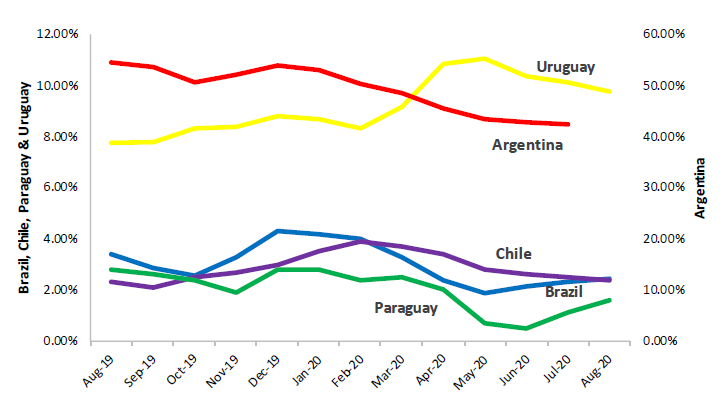
    Brazil & Southern Cone: Inflation
    Monthly year-on-year figures

    Brazil & Southern Cone: GDP growth (%)
    Quarterly figures are year-on-year growth
    Country End 2019  2020 forecast * Q3 2019 Q4 2019 Q1 2020 Q2 2020
    Argentina -2.2 -10.5 -1.7 -1.1 -5.4 Not available
    Brazil 1.1 -9.2 1.2 1.7 0.9 -11.4
    Chile 1.1 -7.9 3.3 -2.1 0.4 -14.1
    Paraguay 0.0 -2.3 2.8 3.5 3.5 Not available
    Uruguay 0.2 -5.0 0.9 0.2 -1.4 Not available 
    *Figures from the United Nations Economic Commission for Latin America & Caribbean Jul 2020
    End 2019 and quarterly growth based on figures from the local central banks


  • ECONOMIC HIGHLIGHTS

    Patrick de Courcy 15 October 2021 Hits: 2164

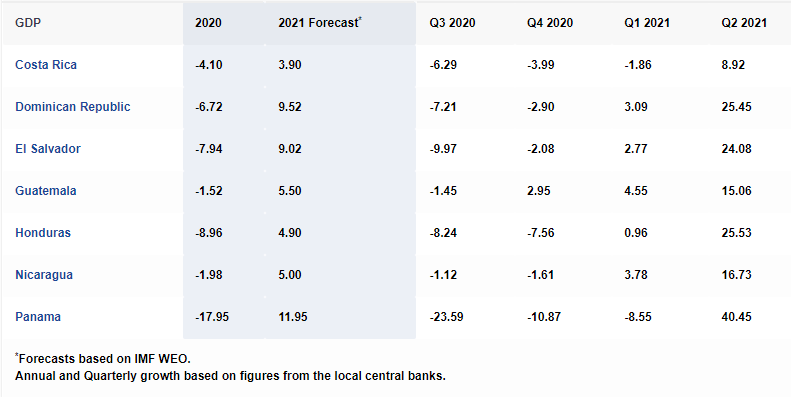
    HONDURAS | IMF expands assistance. On 13 September the International Monetary Fund (IMF) announced that its executive board had completed the fourth review of Honduras’ performance under its economic programme supported by a Stand-By Arrangement (SBA) and an arrangement under the Standby Credit Facility (SCF). It announced that it has approved an additional US$215.8m in loans and extended the duration of the SBA and SCF by two months until 14 January 2022. The two-year arrangements under the SBA and SCF were approved on 15 July 2019. According to the IMF, the completion of the review allows for immediate disbursements of US$125.8m to help Honduras meet its balance of payments and fiscal financing needs, which have been exacerbated by the ongoing coronavirus (Covid-19) pandemic and the effects of tropical storms ‘Eta’ and ‘Iota’ which made landfall in November 2020. According to the IMF, Honduras’ worse than expected economic contraction in 2020 (-9%) will only be partly reversed in 2021, with the Fund forecasting that GDP will grow 4.5%. The IMF adds that while the ongoing health emergency and significant reconstruction from Eta and Iota warrant a temporarily looser fiscal stance, the authorities “remain steadfastly committed to macroeconomic stability, fiscal responsibility, and structural reforms”.

    COSTA RICA | Fiscal deficit progress. On 20 September Costa Rica’s finance ministry released new figures which show the country’s fiscal deficit to August was ¢1.32trn (US$2.12bn), representing 3.46% of GDP. This compares with ¢2.0trn registered at the same point the previous year, which was equivalent to 5.55% of GDP. As of August 2021, public debt was ¢27trn (70.79% of GDP). Last year, following the impact of the coronavirus (Covid-19) pandemic, Costa Rica posted a fiscal deficit of 8.1% of GDP, and a public debt of 67.5% of GDP.

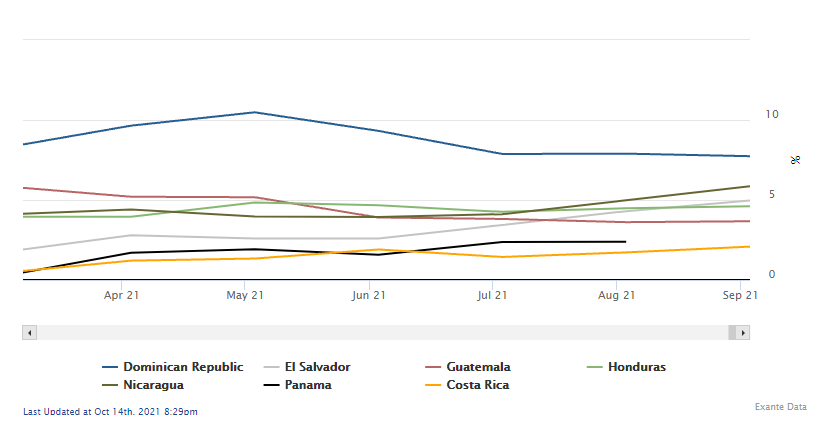
    Central America & Caribbean: Inflation Rate
    Percentage variation (year-on-year)

    Central America & Caribbean: GDP Growth (%)
    Quarterly figures are year-on-year growth


  • NICARAGUA: IMF gives thumbs up

    LatinNews 12 June 2012 Hits: 637

    An IMF delegation paid a visit to Nicaragua on 2-11 May for discussions on the 2012 Article IV consultation. In its final mission statement, the IMF was positive on the management of the economy by the left-wing government led by President Daniel Ortega. It noted that, “Helped by high export prices, large concessional and foreign direct investment flows, and broadly appropriate macroeconomic policies, the economy has averaged growth rates in excess of 4.5 percent during 2010-11”.

    In terms of future priorities, the Fund highlighted that “higher economic growth is essential to reduce poverty rates significantly over the medium-term. In this regard, measures to further strengthen institutions, reduce labor market informality, and enhance the effectiveness of public spending while reducing budget rigidities will be key…In addition, reforming the pension system is necessary for inter-generational fairness and long-term fiscal sustainability, and a more equitable tax system would also generate resources for needed infrastructure investment and social spending.”

    Tourism: According to a report by the national tourism institute (Intur), the tourist numbers increased 15.7% in the first quarter of the year over the same period of 2011 to reach 300,000. The report did not provide any updated revenue details. The Ortega government calculated that Nicaragua received a million tourists overall in 2011, with an average daily spend of US$44. According to Intur, 12% of the 8.5m tourists that travel to Central America every year visit Nicaragua, a proportion the government aims to increase to 15.5% by 2020.

    Inflation: According to the Nicaraguan Central Bank, monthly inflation in April was 1.06%, bringing the accumulated rate for the first four months to 2.85%. Year-on-year inflation was 8.98%, up 1.87 percentage points over April 2011. Inflation in 2011 was 7.95% - the highest in Central America - although it was down on the 9.23% registered in 2010.

  • HONDURAS: Financial fragility

    LatinNews 10 October 2013 Hits: 2483

    In February this year, the government of Honduras successfully raised US$500m in its first international bond issue, astutely taking advantage of the (then) strong global investor appetite for emerging markets risk. The central bank has taken steps this year to strengthen the banking system, which is relatively sound, and the government led by President Porfirio Lobo has introduced a new Investment Promotion & Public Debt Rationalisation Law in order to facilitate foreign investment in key sectors such as telecommunications. Nevertheless, the government's finances remain very fragile. Following the scheduled November general elections, et second election since the June 2009 coup, it will be important for the new government that takes office in January 2013, to be seen to be taking steps to achieve a material improvement of its financial position. At the time of writing, the main left-wing candidate Xiomara Castro, wife of the ousted former president Manuel Zelaya (2006-2009), looked to be edging the race over her main rival, Juan Orlando Hernández, Lobo’s former head of congress and effective lieutenant. Like her husband Castro is proposing radical left-wing policy measures that don’t appear to sit well with fiscal probity.

    At the end of August, the International Monetary Fund (IMF) issued a press release following a routine staff visit to Honduras. The IMF no longer has a formal agreement in place with Honduras after the last stand-by arrangement expired in March 2012. The Fund and the Lobo government were unable to agree on terms for a new facility, with the Lobo administration saying that though committed to budget probity, it simply could not implement the Fund’s recommended fiscal policy measures.

    Among other things, Mission Chief Lisandro Ábrego noted that “the authorities concurred with the team about the need to protect macroeconomic stability and move forward with the process of fiscal consolidation”. To achieve the latter, the Fund - as ever - stressed “the importance of working both on the expenditure and the revenue side”. It also noted that “strengthening the performance of public enterprises has a role to play in the process of fiscal consolidation, while contributing to supporting to medium-term economic growth”.

    This was a tactful assessment of the dilemma that faces the government in an election year. At about 16% of GDP, the government's revenues are by that measure only slightly larger than they are in the other five countries whose central banks co-operate through the offices of the Consejo Monetario Centroamericano (Semca); Costa Rica, El Salvador, Guatemala, Nicaragua and the Dominican Republic).  However, overall government debt has been rising rapidly relative to GDP over recent years, principally on rapidly mounting internal debt. This is especially true by the standards of the region, as Chart 1 shows.

    In Honduras, domestic debt outstanding has gone from 15.2% of GDP in 2008 to 25.2% last year. The looming general election means that the unpopular Lobo government simply cannot contemplate either a substantial hike in taxes or a reduction in spending. Indeed, key public sector workers, including teachers and doctors, have been striking (again) for much of this year in demand of the back payment of wages and/or an increase in salaries. The national telecoms company Hondutel, once the state’s golden goose, is now in desperate search of a private sector partner to prop it up (to the tune of US$500m). And even when the Lobo administration did try to implement a controversial ‘security tax’ on the local business sector, ostensibly to raise additional funds for its fight against drug-trafficking and organised crime, it was thrown out by the feisty supreme court.

    Honduras political cycle was one of two key challenges identified by the ratings agency Moody's Investors Service in late February 2013, when it amended its outlook for the sovereign from stable to negative (although the B2 ratings for the government's domestic and foreign bonds were reaffirmed). The other problem it cited was “deterioration in the economy's external finances, including a widening current account deficit, which remains only partially covered by foreign direct investment (FDI)”. Moody's highlighted three reasons for the fiscal slippage of the government since early 2012: “spending relating to the primary elections; support for loss-making state-owned enterprises (SOEs); and additional spending on conditional cash transfers”.

    As chart 2 shows, Moody's is not the only ratings agency to have expressed concerns about the government's financial position this year. However, the news flow has not been all bad.

    Honduras: Selected Developments - 2013
    Jan-13 Implementation of a rise in minimum wages of 6.4% (and of 7.5%) in the Maquilas.
    Jan-13 Banco Central de Honduras announces rules which require banks to reduce currency mis-matches between assets and funding. The BCH also increases the capital requirements of insurance companies.
    Feb-13 Moody's changes its outlook for the Government rating from stable to negative. The government's rating is kept at B2. Local currency bond and deposit ceilings are lowered from A3 to Ba3. Foreign currency bond and deposit ceilings are kept unchanged at Ba3 and B3 respectively.
    Feb-13 Standard & Poors revises its outlook for the Government rating from stable to negative. The government's long and short term ratings are kept at B+ and B respectively.
    Mar-13 Government of Honduras raises US$500mn in 11-year, 7.5% bonds. This is the first ever international bond raising. 40% of the funds raised are allocated to financing the budget. 40% is allocated to refinancing of maturing short-term debt. The remainder is allocated to repayment of amounts owing to providers of medicines and construction materials. Deutsche Bank, who is managing the transactions, receives bids from investors for US$2,500mn.
    Mar-13 (And Apr 13). Approval of around €31mn in development loans from KfW and other European banks
    Apr-13 New law faciitates banks' consolidation of the credits of their subidiaries.
    May-13 Interamerican Development Bank approves US$100mn loan to support the Bono 10,000 social program announced in 2010 to boost education, health and nutrition
    May-13 Banco Central de Honduras announces rules that facilitate investment by individuals and corporate bodies in public debt via Certificados de Inversión Primaria.
    Jul-13 New Investment Promotion & Public Debt Rationalisation Law facilitates foreign investment in natural resources, energy and telecommunications sectors.
    Source: Secretaría Ejecutiva, Consejo Monetario Centroamericano, REM169, August 2013


    The country’s first international bond issue (which raised US$500m), should be considered a milestone, and a success, in that it part-funded the budget and refinanced maturing short-term debt (at a much lower rate of interest). The timing of the bond issue was excellent. Global investor appetite for emerging markets risks was, at that time, so great that Deutsche Bank (which managed the bond issue) received bids from investors for US$2.5bn.

    More recently, Germany's KfW and other European banks have approved €31m or so in development loans for various projects in Honduras. For its part, the Inter-American Development Bank (IDB) has also approved a US$100m loan to support the Bono 10,000 social program, which the government launched in 2010. Further, in theory the new Investment Promotion & Public Debt Rationalisation Law should facilitate foreign investment in strategic sectors such as telecommunications, energy and natural resources. In the meantime, Banco Central de Honduras (BCH - the central bank) has announced measures to strengthen a banking system that was, by most metrics, already pretty sound: BCH also announced new rules that facilitate investment by individuals and corporate bodies in public debt.

    Nevertheless, six months after Moody's sombre assessment, many of the metrics that matter are still moving in the wrong direction, as chart 3 indicates. Inflation remains high by the standards of Honduras' main trading partners (e.g. the US) and has been rising, notwithstanding that a slowdown in the growth of broad money hints at a reduction of inflationary pressures in coming months.

    Honduras: Selected Economic Metrics


    Period

    2012

    2013

    Year-on-year inflation %

    July

    4.1

    5.6

    Year-on-year growth in production %

    May YTD Accumulated

    4.4

    2.8


    Fiscal Deficit US$m

    June YTD

    490

    527

    Est. Fiscal Deficit for Year US$m

    2012 and est. for 2013 as at June

    1,088

    975

    Est Fiscal Deficit for Year % GDP

    2012 and est. for 2013 as at June

    5.9

    5.3


    Total Public Debt US$m

    May

    8,146

    9,144

    Of which: Held locally

    May

    4,777

    4,899

    Held by foreigners

    May

    3,369

    4,245

    Total Public Debt % GDP

    May

    44.3

    49.8

    Of which: Held by foreigners as % of GDP

    May

    18.3

    23.1


    Central Bank Reserve US$m

    June

    2,690

    2,780

    Months of Imports

    June

    3.6

    3.9


    Current Account Deficit US$m

    2012 and est. for 2013 as at June

    1,744

    1,557

    Inwards remittances US$m

    2012 and est. for 2013 as at June

    2,842

    3,111


    Year-on-year growth in broad money %

    June

    10.4

    5.0

    Year-on-year growth in credit %

    June

    10.2

    10.4

    Private sector credit as % GDP

    June

    43.9

    49.5

    Foreign currency deposits as % of total

    June

    27.8

    29.7

    Foreign currency credits as % of total

    June

    24.2

    25.4


    Real local currency short term lending rate %

    June

    12.86

    14.16

    Real local currency 180 day deposit rate %

    June

    3.64

    6.34

    Policy interest rate

    June

    7.00

    7.00

    Average cash reserve ratio %

    June

    18.89

    18.89

    Average exchange rate US$/HNL

    July

    19.5

    20.5


    Source: Secretaría Ejecutiva, Consejo Monetario Centroamericano, REM168, August 2013


    Slippage in the currency (which has still appreciated in real terms) and increases in local interest rates over the last year or so show that the ratings agencies are not the only observers whose caution has increased. The continuing increase in the dollarisation of the banking system is another sign that perceived risks have grown. Overall GDP growth is slowing. Foreign reserves have stabilised, but are sufficient to cover less than four months of imports.  As is the case for other countries in the region, Honduras depends on remittances from expatriate workers (mainly from the US) to cover the current account deficit but, for now, these appear sufficient, notwithstanding the impact of rust disease on coffee exports.

    The bottom line is this: the Honduran government’s financial position remains very fragile. The new government taking office in January 2014 will inherit a country largely unchanged on four years ago, and on several measures in a worse socio-economic position than previously. Rampant poverty and stark income inequality are contributing to severe crime and security problems. The fiscal deficit remains well above 5% of GDP and debt dynamics have been deteriorating fast. Substantive fiscal reform remains essential but politically very difficult to achieve.

    Yet if the hard decisions are deferred, and the government's financial position continues to deteriorate, the IMF’s future assessments may be less tactful than that offered in August 2013.

  • RASTREANDO TENDENCIAS

    LatinNews 05 March 2012 Hits: 886

    ARGENTINA | Buenos Aires boicotea bienes del Reino Unido. El 29 de Febrero la agencia de noticias del estado argentino, Telam, informó que la ministra de industria, Débora Giorgi, ha pedido a varias compañías argentinas que sustituyan importaciones desde el Reino Unido (RU) con proveedores alternativos, lo que efectivamente es un boicot. Aunque la medida está en línea con las restrictivas políticas de importación que están siendo implementadas por el gobierno de la Presidenta Cristina Fernández durante la mayor parte de los dos años pasados, esto claramente tiene implicancias políticas, en medio del reciente incremento en las tensiones diplomáticas sobre el archipiélago de las Falklands/Malvinas.

    De acuerdo con el ministerio de industria, las nuevas medidas están diseñadas para poner freno al continuado deterioro en el superávit comercial de Argentina con el RU. Sin embargo, notablemente, el ministerio también dijo que Argentina desea favorecer las relaciones con “aquellos que respetan la integridad territorial del país, sus reclamos soberanos y los recursos que le pertenecen”. De acuerdo con el instituto nacional de estadísticas de Argentina (Indec), las importaciones de Argentina desde el RU fueron valuadas en sólo US$664,2m en el 2011, constituyendo apenas el 0,9% de sus importaciones totales. Sus exportaciones al RU fueron valuadas en US$779,5m.

    BRASIL | Los evangélicos van de pesca. El senador y obispo evangélico de alto perfil, Marcelo Crivella, del Partido Republicano Brasileiro (PRB), fue designado como nuevo ministro de pesca esta semana. Como el mismo Crivella admitió, él no sabe absolutamente nada acerca de la pesca, aunque las iglesias evangélicas en Brasil son muy buenas en pescar a los fieles durante las elecciones. La ministra para las relaciones institucionales, Ideli Salvattri, negó que la designación fuera una concesión a los evangélicos a fin de asegurar su apoyo en São Paulo antes de las elecciones municipales de octubre. El ascenso de Civella, dijo ella, era un tributo al ex vicepresidente y miembro del PRB, José Alencar, que sirvió bajo Lula da Silva (2003-2010) y murió luego de una larga batalla contra el cáncer a fines de marzo del 2011.

    BRASIL | Lenta aprobación de visas para haitianos. Brasil aprobó 30% de su nueva cuota de visas para haitianos en el primer mes de su nuevo sistema. El 10 de enero, el Consejo Nacional para Refugiados de Brasil (Conare) clasifico a los haitianos como migrantes económicos, después de decidir que los ciudadanos haitianos no enfrentan persecución en su país por motivos políticos, raciales o religiosos. Bajo las nuevas reglas introducidas el 18 de enero, los haitianos que buscan mudarse a Brasil deben aplicar por una visa en la embajada brasilera en Port-au-Prince. La embajada emitirá 100 permisos de ese tipo por mes. Los solicitantes que obtienen el permiso podrán vivir y trabajar legalmente en Brasil por cinco años. Para el 23 de febrero sólo se habían aprobado 30 visas.

    El embajador brasilero, Igor Kipman, señaló que muchos solicitantes no tenían la documentación correcta. Los candidatos deben proveer un pasaporte actualizado, prueba de residencia en Haití y un testimonio de su “buen carácter y antecedentes”. La solicitud cuesta US$200. Está permitida una visa por familia. Kipman admitió algunos problemas iniciales con el proceso burocrático, pero negó que el costo actuase como disuasivo. Señaló que los haitianos típicamente pagan a los traficantes de personas (coyotes) varios miles de dólares para que los introduzcan ilegalmente al Brasil.

    BRASIL | No es el típico consumidor de clase media entrado en años. De acuerdo con un nuevo estudio de la Federación de Minoristas de São Paulo (FécomercioSP), la nueva clase media de Brasil será responsable por el 40% del crecimiento acumulado que pronostica  para la economía brasilera para el 2020. A pesar de su más bien seco título: “La evolución de la clase media y su impacto sobre la venta minorista”, el estudio lanza algunos interesantes detalles sobre la rápidamente cambiante distribución de la riqueza hacia la clase media Brasilera. Por ejemplo, para el 2015, el valor del consumo total de la nueva clase media-baja, clase-C, que ya suma más del 50% de la población, igualará el consumo combinando de las clases A y B de más altos ingresos.

    Para el 2020 se estima que el consumo total por familia en Brasil llegará a unos R$3,53 billones (US$2,05bn), o el equivalente al 65% del total del PIB pronosticado para el 2020. Con la previsión de que población económicamente activa crecerá un 10% a 145m para el 2020, Brasil estará entre las cinco primeras economías globales. Pero, a diferencia de las economías Occidentales, donde el mercado consumidor está saturado y estancado, el boom de consumo Brasilero recién está comenzando a ponerse en marcha. FécomercioSP también destaca para los comerciantes minoristas la importancia de la población ya entrada en años. De una población total de 207m en el 2020, unos 26m de brasileros tendrán más de 60 años, más que los 18m en el 2011.

    • Proteccionismo argentino

    Paraguay está agregando su voz a la de Uruguay en protesta contra el proteccionismo comercial de Argentina. Funcionarios de las aduanas paraguayas dicen que tienen información que Argentina está tratando de implementar un único punto de entrada y salida para el comercio con Paraguay en la ciudad fronteriza de Clorinda, en los primeros días de marzo. Las exportaciones de Paraguay a Argentina llegaron a un valor de US$1,27mm en el 2010, el equivalente a 27,8% de sus exportaciones totales.

  • TRACKING TRENDS

    LatinNews 09 August 2012 Hits: 2626

    BRAZIL | Biodiesel sector forecasts mass investment. The Brazilian union of biodiesel and biokerosene (Ubrabio) and the association of Brazilian biodiesel producers (Aprobio) have said that they expect the biodiesel industry in the country to receive R$28bn (US$14bn) in investments by 2020. At an industry conference in São Paulo, Ubrabio and Aprobio, the biodiesel industry’s main organisations, said that they foresaw a “vigorous” future growth in the sector that will require multi-million dollar investments in order to meet the sector’s needs.

    The organisations explained that currently the Brazilian government is in the process of defining the regulatory framework for these kinds of biofuels with the aim of setting a new mandatory percentage requirement of biodiesel that must be mixed with regular diesel fuel sold in the country. Currently the percentage requirement stands at 5% as stipulated by the 2004 national biodiesel production and use plan. The plan stipulates that the requirement must rise to 10% by 2014 and to 20% by 2020. However, Ubrabio and Aprobio said that as Brazil has managed to position itself as one of the world’s top biodiesel producers, turning out 2.7bn litres in 2011 with an estimated worth of R$6.5bn (US$3.2bn), the government is now analysing the possibility of increasing the percentage requirement next year in order to expedite the increment process.

    In order to meet Brazil’s biodiesel needs, the sector needs to increase its production capacity in the coming years. It is estimated that currently the 60 biodiesel producing plants in Brazil represent only 40% of Brazil’s projected biodiesel production capacity.

    ARGENTINA| Tourism figures on course to set new record. According to Argentina’s national statistics institute (Indec) 189,375 tourists visited the country in June, 17% more than in the same period last year. In 2011 a record 2.7m tourists visited Argentina, 1.7% more than in 2010. The latest figures suggest that the country may be on course to break this record this year. Importantly, the Indec pointed out that visitors spent US$235.3m in Argentina in June, 3% more than in the same month last year. In a related statement, the tourism ministry said that the arrival of foreign visitors by air in the first half of the year “equalled the successful figures of the same period in 2011, when a record 1.3m arrivals were recorded”, adding that “a sharp increase in arrivals was observed in June”.

    CHILE | Qualified labour deficit in mining sector. Mining sector executives in Chile are becoming increasingly concerned about the lack of qualified workers available in the country to satisfy the sector’s short-term needs. According to a recent study conducted by Andrés Bello University, the mining industry forecasts that in the short-term there will be a shortfall of 69,000 professionals as the demand for mining, geology, metallurgy and engineering professionals far exceeds the current supply in the Chilean market. According to the study the demand for personnel in some specific areas such as geology is so high that the industry is increasingly resorting to looking for qualified personnel abroad. However, sector executives argue that relying on foreign qualified labour will not be sustainable in the long run and that the industry must invest in the development of local human resources in order to ensure that it has a reliable source of qualified labour. As a result, many mining companies are looking not only to spend more in training programmes but also to establish alliances with local universities in order to improve the formation of professionals and attract talent early. Yet the immediate need for professionals remains high with the industry expected to continue to expand creating 23,000 jobs a year in the next 10 years as important mining projects are already in the pipeline.

    PARAGUAY | Tax collection on the up. According to figures from the data from Paraguay’s finance ministry, overall tax collections in July were Gs. 1.46trn, 13.9% more than in the same month last year. The increase in collections by the government is surprising given that the Paraguayan economy is having a bad year and as it is still suffering the effects of the severe drought last year as well as decreased levels of trade with its partners due to barriers to trade with its larger Southern Common Market (Mercosur) partners, Brazil and Argentina. Yet the finance ministry reported that there was an increase in the intake at all levels driven by a 19.6% increase at the national customs authority, DNA, which is in charge of collecting taxes in the country’s port of entry. Meanwhile collections recorded by the general collections directorate were Gs. 234m, an 18.5% increase on the same month last year. Even collections by the state tax authority, SET, also exhibited a substantial 10.3% increase in July this year compared to the previous year.

    • Brazilian stimulus

    On 4 August Brazil’s state-owned development bank (Bndes) announced that it was expanding its special credit programme aimed at stimulating the popular economy from R$450m (US$225m) to R$1bn (US$500), a 122.2% increase. A Bndes statement explained that “the micro-credit programme seeks to promote the popular economy by offering funds to small scale productive activities, promoting job creation and social inclusion to complement social and development policies”. The funds in the programme are destined for public interest organisations, small credit societies, small & medium sized businesses, development agencies, and credit coops. To date the programme has disbursed funds to 73 organisations, according to Bndes data.

  • RASTREANDO TENDENCIAS

    LatinNews 29 August 2014 Hits: 721

    PERÚ | Nuevo recorte al pronóstico de crecimiento. El 20 de agosto el banco central de Perú (BCRP) anunció que estaba recortando su pronóstico de crecimiento para todo el año, de 4,4% a 4%. Esta es la segunda vez que el BCRP ha recortado su tasa de pronóstico del crecimiento este año, después de haberlo hecho lo mismo previamente en abril. La decisión confirma que la desaceleración en la actividad económica interna en Perú continúa este año a pesar de los paquetes de estímulos económicos diseñados para estimular los niveles de inversión implementados por el gobierno liderado por el Presidente Ollanta Humala y la adopción por parte del BCRP de una política monetaria expansionista.

    El anuncio de la revisión fue hecha por el gerente general del BCRP, Renzo Rossini, quien explicó que la misma se produjo después de que los datos del banco mostraran que el crecimiento económico para junio había sido de sólo un 0,3% año en año, la tasa de crecimiento más baja registrada por la economía peruana en casi cinco años. Según Rossini, el débil resultado llega en medio de una continuada caída en los niveles de producción del sector minero y el de manufacturas, en línea con una tendencia que ha sido observada desde inicios del año.

    El PIB de Perú creció un 5,1% en el primer trimestre del año, pero a una tasa mucho menor del 1,7% en el segundo, de acuerdo con las últimas cifras oficiales. Rossini, sin embargo, dijo que el BCRP cree que la caída en la actividad había llegado a un su punto más bajo y que ahora comenzaría a elevarse con un crecimiento del 3,4% proyectado para el tercer trimestre, y del 5,6% para el cuarto. De hecho, Rossini dijo que el BCRP espera que la economía se recupere totalmente el año próximo, para el cual el banco continúa pronosticando una tasa de crecimiento de más del 6%, respaldada por un incrementado gasto del gobierno como parte del paquete de estímulo económico y la entrada en funcionamiento de una serie de nuevos proyectos mineros.

    Mientras tanto, Rossini dijo que el BCRP continuará aplicando su política monetaria expansionista, “mientras la inflación lo permita”, señalando que la tasa acumulada de la inflación actualmente está en alrededor del 3%, al tope del rango meta establecido por el BCRP (1% - 3%).

    COLOMBIA | Perspectivas positivas para el carbón. El 25 de agosto la Asociación Nacional de Instituciones Financieras (Anif) de Colombia difundió un estudio proveyendo un panorama positivo del futuro de la industria colombiana del carbón. Colombia es el cuarto mayor productor de carbón del mundo, y el país ha visto sus exportaciones de carbón crecer en años recientes respaldadas por una estable demanda global del mineral. Si embargo, el repentino incremento en las provisiones globales de gas natural, como resultado del desarrollo y la expansión de las técnicas de fractura o ‘fracking’ usadas para extraer gas de esquistos había hecho que muchos analistas consideraran que la demanda del carbón comenzaría a caer en los mercados internacionales, en detrimento de la industria del carbón de Colombia.

    Pero el estudio de la Anif ha hallado que pese a la substancial caída en las exportaciones de carbón a EU, que en el 2009 compró el 25% de todas las exportaciones de carbón colombiano, la demanda global por el carbón ha permanecido fuerte, gracias a un incremento en la demanda del mineral primariamente en Europa. De acuerdo con el estudio, pese a las provisiones de la Unión Europea (UE) estableciendo metas de reducción de las emisiones de combustibles fósiles de un 20% para el 2020, el consumo de carbón (principalmente para generación de energía) se ha incrementado casi un 50% en algunos países europeos y esto ha ayudado a compensar la caída en la demanda en EU.

    El estudio señala que la demanda de carbón en Holanda se ha incrementado un 22% desde el 2008, con lo que ahora ese país se ha convertido en el principal mercado para la exportación de carbón colombiano, recibiendo el 23% de todas las exportaciones. Por otra parte, también hubo un significativo incremento en las exportaciones al Reino Unido (28%), Turquía (31%), e Israel (25%) durante el periodo.

    Además, el estudio también destaca que la caída en la demanda de China ha sido en parte compensada por un incremento en la demanda en India y en África. El estudio concluye que todo esto sugiere que aún hay espacio para que las exportaciones de carbón de Colombia continúen incrementándose en el corto plazo para beneficio del país.

    La difusión del estudio de Anif vino justo cinco días después de que la Agencia Nacional Minería (ANM) de Colombia revelara que la producción nacional de carbón alcanzó las 47,3m toneladas (t) en la primera mitad del año, un incremento del 14% sobre las 40,5m t producidas durante el mismo periodo del año pasado.

    De acuerdo con los datos de la ANM, el 90,9% de la producción de carbón de Colombia es actualmente exportada, proveyendo más evidencia de que la demanda internacional para el carbón colombiano permanece fuerte y que la misma continuará conduciendo la industria en  un futuro previsible.

    • Ecuador celebra reconocimiento

    El 21 de agosto el ministro de finanzas de Ecuador, Fausto Herrera, celebró el hecho de que la agencia de ratings Standard & Poor’s (S&P) haya decidido elevar el grado de rating de crédito de Ecuador, y que un informe reciente del Fondo Monetario Internacional (FMI) elogiara el desarrollo económico del país durante la última década como “confirmación de que Ecuador tiene una saludable y sustentable administración económica”. S&P elevó el rating de crédito de B a B+ el 20 de agosto, citando la incrementada flexibilidad fiscal del país, una sólida posición de liquidez y un mejoramiento en el ambiente de inversión. Por otra parte, en un informe difundido la semana pasada, el FMI destacó que “Ecuador ha logrado un importante progreso económico y social en la década pasada, que ha conducido a un crecimiento económico promedio del 4,5% y una gradual reducción en la inflación hasta alrededor del 3%”.

  • RASTREANDO TENDENCIAS

    LatinNews 12 June 2015 Hits: 539

    CHILE | ¿Estancándose en el 2015? La actividad económica de Chile se incrementó un 1,7% en abril, comparado con el mismo mes del 2014, de acuerdo con el Indice de Actividad Económica (Imacec) del país, un adelanto no oficial del PIB. Esta cifra es casi idéntica al incremento del 1,6% en la actividad económica registrado por el banco central (BCCH) en marzo y bastante por debajo de las expectativas de los economistas locales, quienes habían pronosticado que estaría entre el 2,2% y el 2,6%. De acuerdo con el BCCH, el resultado del Imacec de abril se produjo como resultado de un incremento en la actividad del sector de servicios, pero que fue en gran medida contrarrestado por una caída en el comercio mayorista.

    Chile informó de un crecimiento real del PIB de solamente el 1,9% el año pasado, su más baja tasa de crecimiento en los últimos cinco años. Desde entonces, el gobierno liderado por la Presidenta Michelle Bachelet ha dicho que esperaba una recuperación económica este año. Pero mientras que las figuras del Imacec para abril muestran que la actividad económica se está recuperando, esto está probando  ser mucho menor de lo anticipado. De hecho, las cifras económicas más débiles de lo esperado  hicieron que el BCCH revise hacia abajo su pronóstico de crecimiento económico para todo el año por un cuarto de punto porcentual, al 2,25% - 3,25%. Los analistas han atribuido la debilidad en la actividad económica no a ningún de los factores económico fundamental, sino a la falta de confianza producida por la crisis de credibilidad derivada del financiamiento ilegal de las campañas electorales y otros escándalos de corrupción que recientemente han sacudido al espectro político de Chile.

    Separadamente, y en un tono más positivo para el gobierno de Bachelet, el Servicio de Impuestos Internos (SII) de Chile y el tesoro nacional informaron el 8 de junio que hasta ahora en este año ha habido un incremento del 8,2% en la toma fiscal llegando a US$12,97mm, comparado con los US$11,98mm informados en esta etapa del año pasado. El impulso en la toma fiscal es explicado principalmente por el incremento de un punto porcentual (del 2505 al 21%) en la tasa fiscal corporativa de primera categoría corporativa, introducido como parte de la reforma fiscal promovida por el gobierno y aprobada por el congreso nacional el año pasado. De hecho, la parte del león de la toma fiscal proviene del impuesto aplicada a los corporativos de primera categoría (aplicable a las grandes firmas de  minería, así como también a otras grandes firmas), que representaron el US$10,678mm de la toma total. Hubo también un incremento en la base fiscal con 3,22m de contribuyentes registrados este año, un incremento del 5,5% comparado con el año pasado –otro producto de la reforma fiscal.

    PARAGUAY | Caída sin precedentes en el comercio exterior. El 8 de junio Banco Central del Paraguay (BCP) publicó sus últimas cifras de comercio exterior, que muestran que el superávit comercial del país cayó por un récord 51,9% año en año en mayo. Este resultado proviene de la aguda caída en el valor de las exportaciones e importaciones de Paraguay debido a la caída en los precios internacionales de sus exportaciones de materias primas (principalmente soja y carne vacuna). Según las cifras del BCP en los primeros cinco meses del año las exportaciones totales sumaron US$4,94mm, un 19,1% menos que en el mismo periodo del año pasado, mientras que las importaciones fueron de US$4,27mm, o un 9,5% menos que el año anterior. Estos resultados dejan a Paraguay con un superávit comercial de US$662,9m, comparado con US$1,38mm el año pasado.

    El informe del BCP apunta que la caída en las exportaciones fue conducida por una declinación del 34,6% en el valor de las exportaciones de soja, el principal producto de exportación de Paraguay. Por su lado, las exportaciones de carne, la segunda principal exportación de Paraguay, cayeron un 4,8% año en año en los primeros cinco meses del año. De acuerdo con el BCP, esto se debió a la caída en la demanda de Rusia, actualmente el principal consumidor de carne paraguaya, que importó un 30,2% menos de carne de Paraguay este año comparado con el año pasado. Del lado positivo, las exportaciones de productos industriales no-agrícolas se incrementaron un 5,5% a US$299,8m.

    La caída en el superávit comercial destaca una vez más la fuerte dependencia de Paraguay de su sector agrícola, y porqué el Presidente Horacio Cartes se ha mostrado tan entusiasta en promover la diversificación de la economía buscando atraer inversión al país durante su visita oficial de dos días a España el 8 y 9 de junio.

    URUGUAY | S&P sube rating de Uruguay. El 5 de junio la agencia de ratings, Standard & Poor’s (S&P), elevó su rating de la deuda soberana uruguaya de ‘BBB-’ en el largo plazo (A-3’ en el corto plazo) a ‘BBB’ (‘A-2’ en el corto plazo) con un panorama estable. Esta decisión, de acuerdo con el informe de S&P, es el resultado de la “creciente resistencia [de Uruguay]  a las tendencias externas negativas en la región mientras mantiene la estabilidad económica y un buen acceso a los mercados financieros internacionales”.

    El informe agrega que S&P espera la “continuidad en las políticas económicas clave” de Uruguay y una oportuna y adecuada política de respuesta a desarrollos externos  potencialmente adversos bajo el nuevo gobierno liderado por el Presidente Tabaré Vázquez.

    • Exportando pobreza

    Durante su visita oficial a España, el 8 de junio, el Presidente de Paraguay, Horacio Cartes, dijo que debido a la falta de oportunidades económicas, Paraguay ha estado “exportando pobreza” a España, en la forma de miles de migrantes que dejaron el país sudamericano en años recientes en busca de una vida mejor en Europa, Cartes señaló que unos 150.000 trabajadores paraguayos de bajas calificaciones actualmente viven en España, mientras que hay 13.000 trabajadores españoles calificados viviendo en Paraguay. “Exportamos pobreza a España y recibimos [a cambio] trabajadores calificados”, dijo Cartes antes de afirmar que su gobierno lo cambiaría mejorando la calidad de la educación en Paraguay. Los poco favorables comentarios de Cartes, le han ganado las críticas de paraguayos en España y en el país.

  • EL SALVADOR: Main political parties mired in corruption mudslinging

    LatinNews 13 January 2016 Hits: 971

    El Salvador’s main opposition is accusing the government led by President Salvador Sánchez Cerén of creating Venezuelan-style popular bodies in an attempt to circumvent the country’s elected authorities. The right-wing Alianza Republicana Nacionalista (Arena) alleges that the government is using public funds to advance party political guidelines of the ruling left-wing Frente Farabundo Martí para la Liberación Nacional (FMLN) presented during the party’s national congress between 6 and 8 November 2015. The FMLN brusquely dismissed the allegations, insisting that “a thief always judges others by his own standards”. The allegations come at the same time as former president Francisco Flores (1999-2004), of Arena, is going on trial for embezzlement.

    Venezuelan-style assemblies created
    The most significant party ‘guideline’ presented during the FMLN’s national congress last November, attended by some 20,000 members, is number 31, relating to the creation of popular blocs, or citizen assemblies. It stipulates that “a new society will be possible if it is transformed from the root…The great challenge of the FMLN is to be capable of leading and accompanying the people in this task. To overcome this challenge, it is necessary to build a bloc of ideological and political popular movements…needed to advance the revolutionary democratic transition”.

    President Sánchez Cerén swore in the representatives of the citizen assemblies one month after the convention, on 7 December, describing them in the process as “a new model of participation”. In essence, their remit seems to be to perform an advisory role for the government. Sánchez Cerén stressed that “dialogue and social organisation is a fundamental pillar of government policy”.

    Composed of 2,570 representatives of different communities nationwide, these citizen assemblies will inform the government of social problems, needs and priorities in each area. Ten ‘leaders’ (seven permanent members and three alternates) will be elected as representatives of local social organisations including, inter alia, communal groups, youth committees, women’s committees, cooperatives and associations of producers within each citizen assembly.

    All of the members of these municipal citizen assemblies within each department will make up a departmental citizen assembly, which will elect one member to represent them before a national consultative council. This council will include representatives of the interior ministry, the secretary for citizen participation and transparency, and the technical secretary. So far, 257 municipal citizen assemblies have been formed and 14 departmental citizen assemblies. This correlates almost exactly with the number of municipalities (262) and departments (14) in El Salvador.

    Arena is running scared that this is an attempt by the FMLN administration to undercut elected authorities in El Salvador, and to set up ‘communal councils’ as in Venezuela. It fears that the FMLN administration will later seek to transform the citizen assemblies into a powerful parliament to supplant not just mayoralties but also the legislative branch of government. This would be consistent with what the Venezuelan opposition is speculating that the government led by President Nicolás Maduro is endeavouring to do now in response to the adverse results achieved by the ruling Bolivarian Revolution in the legislative elections on 6 December last year when the opposition won a two-thirds majority in the national assembly which began sitting on 5 January.

    “These ‘base committees’ are being financed with budgetary funds and do not have a public policy in mind but rather have the end of politico-ideological indoctrination as part of a poor copy of the ‘base committees’ in Venezuela and Ecuador, from Chavismo and 21st century socialism,” Arena Legislative Deputy René Portillo Cuadra said in response to the creation of the new citizen assemblies.

    The secretary general of the FMLN, Medardo González, specifically said during his speech at the national congress that government officials should be more active in party issues. Guideline 119, for instance, stipulates that ‘All leaders, officials and FMLN members without exception must belong to a committee and actively participate in its tasks’.

    The president of the powerful (pro-Arena) private business lobby Asociación Nacional de la Empresa Privada (Anep), Jorge Daboub, savaged the new citizen assemblies: “The FMLN is not only using public resources…but they are also manipulating and making duplicitous institutions that should be resolving the problems of the public. They are creating a parallel State.”

    Arnoldo Marín, a deputy for the moderate centre-right Partido Demócrata Cristiano (PDC), also accused the government of “double standards”, channelling state funds to the FMLN party grassroots. FMLN Deputy Jackeline Rivera was dismissive of the allegations, accusing Arena of “fantasies” and “scaremongering”.

    Distraction from Flores corruption case?

    Arena could be seeking to distract public attention from the forthcoming trial of former president Flores. Flores stands accused of misappropriating US$5m of Taiwanese donations intended for earthquake relief and social programmes while he was president and funnelling a further US$10m into Arena party coffers to fund the party’s electoral campaign in 2004 when its candidate, Tony Saca, came to power.

    Flores did a good job of incriminating himself during his two appearances before a special commission of the legislative assembly looking into the Taiwanese donations in February 2014. Flores admitted he had received cheques in his name but claimed that he had handed them over. He revealed details on neither the amount received nor the date when it reached its recipients, whose safety, he claimed, would be compromised if he did. Flores said the donations constituted payments in exchange for El Salvador’s support of Taiwan in the United Nations (UN). The commission’s final 130-page report recommended that the attorney general’s office investigate Flores for bribery; illicit negotiations; embezzlement; money and asset laundering; and false testimony related to the “non-traditional” donations.

    On 18 December 2015, an appeals court dropped the charges of money laundering against Flores. It also allowed Flores to be transferred from the prison of the counter-narcotics division of the national police (DAN), where he had been sent two weeks earlier, to house arrest while awaiting trial. The FMLN expressed its “indignation” at the judicial ruling. The NGOs Iniciativa Social para la Democracia (ISD) and Fundación de Estudios para la Aplicación del Derecho (Fespad) accused the appeals court of exceeding its authority, arguing that its resolution contained “incongruities and irregularities that should [themselves] be the subject of an investigation”.

    The case against Flores was scheduled to commence on 18 January but it has been delayed. On 7 January, the San Salvador court handling the case decided to postpone it “until further notice” because of complications with some of the foreign witnesses.

    • Citizen assemblies

    The new citizen assemblies are described by the FMLN as “plural and permanent spaces for dialogue, planning and coordination between social actors and public institutions to take strategic decisions to orientate and guarantee participative management in territorial development”.

    • Earthquake donations

    Awkwardly for former president Flores, inhabitants of Las Colinas, a neighbourhood of Santa Tecla (a municipality in La Libertad department just outside San Salvador) which was devastated by the 2001 earthquake, claimed in a press conference that they had “never received any money” from Flores as part of the Taiwanese donations. The earthquake claimed nearly 1,000 lives and left over 100,000 people homeless.

  • Region: IMF cautiously optimistic

    LatinNews 09 June 2017 Hits: 698

    In its latest (May 2017) Regional Economic Outlook for the Western Hemisphere, the International Monetary Fund (IMF) said it expected Latin America and the Caribbean to gradually emerge from recession in 2017, with average regional growth of 1.1%, rising to 2% in 2018. However, it also warns that growth is expected to remain subdued at about 2.6% in the medium term. Echoing ECLAC it advises that regional countries need to address infrastructure, strengthen the business environment and tackle corruption so as to ensure stronger and more inclusive growth going forward.

    Economic growth in Latin America and the Caribbean in 2016 was the third-lowest in 30 years, contracting by 1% following stagnation in 2015, the IMF reports. Growth was held back by weak domestic demand, the Fund noted, amid lower commodity prices, ongoing fiscal and external adjustment in some countries, and other country-specific domestic factors.

    The outlook moving forward will be shaped by global economic and policy factors, including on a positive side a modest rebound in commodity prices and external demand, thereby boosting the export performance, but on the negative side the IMF flags the risk of higher global policy uncertainty. Finally, domestic developments will continue to play a decisive role in determining growth in many economies.

    “With heightened policy uncertainty at the global level but low market volatility, countries in our region should focus on insuring against downside risks, while targeting strong, sustainable, and inclusive growth,” Alejandro Werner, the director of the IMF’s Western Hemisphere Department, stated.

    Lock in the path to growth

    Given a challenging external environment, the IMF stressed that many countries in the region should look to advance fiscal and external adjustments to preserve or rebuild policy buffers (for example, by improving primary balances to stabilise rising public debt).

    However, “charting a course toward higher, sustainable and more equitable growth will also require domestic reforms”, it stresses. These vary by country, and include the likes of: closing infrastructure gaps; improving the business environment, governance, and education outcomes; deepening regional trade integration; and encouraging female labour force participation to boost medium-term growth and foster income convergence. These policies would help raise future growth by increasing contributions from labour, capital, and productivity, it emphasises.

    Regional Outlook

    For South America’s commodity exporters, the modest recovery in commodity prices will provide some relief, but not uniformly.

    In Argentina, the Fund notes, “the recovery is under way”. Its now expects real annual GDP growth of 2.25% 2017, driven by a rebound in private consumption, stronger public capital spending, and a bounce exports.

    In Brazil, the IMF says that growth is expected to return to positive territory after two years of recession, with a real GDP result of 0.2% in 2017. This will rest on a bumper soybean crop, a one-time boost to consumption, a faster-than-expected decline in inflation, and higher iron ore prices.

    In Venezuela, the Fund is blunt. It expects the economy “to remain in a deep recession and on a path to hyperinflation”. With no sign of a shift in economic policies, real GDP is expected to fall by 7.4% in 2017.

    Despite slightly better external conditions, the outlook for Chile remains subdued, the Fund notes, largely reflecting lingering domestic weaknesses. As such, it projects real GDP growth of 1.7% in 2017.

    In Colombia, meanwhile, “the orderly economic slowdown continued last year, as domestic demand has been adjusting to a permanent shock to national income”. While one-off factors led to a weaker-than anticipated growth in 2016, the Fund expects a mild rebound in 2017.

    Peru ’s economy rebounded at a decent pace in 2016. However, there is a problem in that investment continues to lag, with negative private sector sentiment exacerbated by domestic headwinds related to the Odebrecht bribery scandal. As if this wasn’t enough, Peru in early 2017 suffered the worst flooding and landslides in decades, which likely will be a drag on 2017 investment and growth.

    The outlook and risks for Central America and Mexico remain heavily influenced by their exposure to the US, via trade, migration, and foreign direct investment (FDI).

    Mexico’s real GDP growth is expected to decelerate to 1.7% in 2017, the Fund projects. Uncertainty about the future shape of the trade framework with the US in addition to higher borrowing costs, are expected to more than offset the positive effect from stronger US growth, it notes

    Growth in Central America, Panama, and the Dominican Republic is expected to remain broadly unchanged from last year in 2017. Strong US growth will help support exports and remittances (the latter a mainstay of domestic consumption; in some countries accounting for up to a fifth of GDP).

    Finally, the IMF says that prospects for the Caribbean are improving, “with growth in both tourism-dependent economies and commodity exporters projected to be in the 1.5-3% range for 2017 and 2018.

    Real GDP growth, % year on year, 2017-2018
      2017 2018
    Mexico 1.7 2.0
    Argentina  2.2 2.3
    Bolivia 4.0 3.7
    Brazil 0.2 1.7
    Chile 1.7 2.3
    Colombia 2.3 3.0
    Ecuador -1.6 -0.3
    Paraguay 3.3 3.7
    Peru 3.5 3.7
    Uruguay  1.6 2.6
    Venezuela -7.4 -4.1
    Costa Rica 4.0 4.0
    El Salvador 2.3 2.3
    Guatemala 3.3 3.5
    Honduras 3.4 3.6
    Nicaragua 4.5 4.3
    Panama 5.8 6.1
    Dominican Republic 5.3 5.0
    Haiti 1.0 3.0
    Jamaica 2.0 2.4
    Trinidad & Tobago 0.3 3.4
    Source: IMF

    Priorities

    The Fund identifies regional policy priorities moving forward as follows: maintaining exchange rate flexibility; easing trade-offs for monetary policy, managing corporate and financial sector risks; completing the fiscal adjustment; and finally, tackling structural bottlenecks.

  • REGION: IMF warns on challenges

    LatinNews 02 May 2012 Hits: 2231

    The International Monetary Fund (IMF), in its latest Regional Economic Outlook for the Western Hemisphere, warns that the Caribbean faces “vast challenges from high public debt levels and from adverse terms of trade”. 

    Tourism-intensive countries are expected to grow by just 1.5% in 2012 after 0.5% growth in 2011.  The IMF reports that prospects “are somewhat more favourable” for the commodity exporters (Guyana, Suriname, and Trinidad & Tobago), but even there the picture is mixed.  The commodity-exporting group is expected to grow by 3.5% this year, but the IMF’s just-concluded Article IV Consultation with Trinidad & Tobago forecasts growth of only 1.7% in 2012 after a 1.3% contraction in 2011. 

    On the region’s high levels of public debt, the IMF notes that the fiscal primary balance improved by an average of 1 percentage point in 2011 but warns, first, that public debt “persists at dauntingly high levels" and, secondly, that “the consolidation may have to be complemented with market-friendly debt restructuring".

    One of the more worrying parts of the IMF’s latest report looks at competitiveness in the tourism industry for the Caribbean, and it notes that the Caribbean has lost significant market share as a result of being uncompetitive.  Correcting a trend that has lasted for two decades will, the IMF says, require action on a number of fronts, including reducing the costs of labour, energy, and trade.

    The report points out that the cost of electricity in the Caribbean is some 16% higher than in the Pacific Islands and more than twice the level in the Indian Ocean tourism destinations of Mauritius and the Seychelles.  On the labour front, the cost of redundancy in the Caribbean is twice the cost of redundancy in the Pacific Islands.  And the cost of starting a business is twice the rate in the Indian Ocean islands.

    The warning that some countries might have to follow the lead of St Kitts & Nevis in seeking “market-friendly debt restructuring” is reinforced by a further warning that the risks to the region’s economy are mostly on the downside – with further problems in Europe and a potential oil-price spike from tensions in the Middle East top of the risk list.  The IMF warns: “On the domestic front, fiscal fatigue could undermine market confidence, and financial sector vulnerabilities could weigh on already-high public debt levels.”

    Meanwhile, in Trinidad & Tobago, the relatively strong fiscal position provides more scope for contra-cyclical policies than elsewhere.  In 2010/11, government finances were close to balance, and although the debt-to-GDP ratio has worsened from 25% in 2008 to 33% in 2011, it is still modest.  Relatively subdued inflation also provides scope for an accommodative monetary policy, with the policy rate being lowered by 75 basis points since end-2010 to 3%.  Inflation in January was 6.8%, but core inflation was only 1.8% after stripping out food-price increases.  With that background, the IMF “commended the authorities for implementing supportive policies, aided by ample buffers, which had helped maintain stability”.


  • TRACKING TRENDS

    LatinNews 24 April 2014 Hits: 2014

    ARGENTINA-PARAGUAY | Yacyretá negotiations. On 21 April Paraguay’s foreign ministry announced that the Paraguayan and Argentine governments had agreed to begin reviewing the terms of the treaty governing the Yacyretá bi-national hydroelectric dam shared by the two countries.

    For years, Paraguay has complained that the terms of the 1974 treaty under which Paraguay agreed to re-pay Argentina for the loans it took out to build Yacyretá and under which the partners are forced to sell any excess energy produced at the plant to each other at pre-set concessionary (below market) prices, are detrimental to the country.

    Paraguay sells the majority of its share of the energy produced at Yacyretá back to Argentina (94.3% of all energy produced by Yacyretá is now consumed by Argentina, accounting for 20% of the country’s electric energy demand). Yet Argentina reckons that Paraguay still owes it some US$11bn (US$6.4bn principle plus interest) for the construction of the dam. Successive Paraguayan governments have rejected this, arguing this would not be the case if Argentina were to accept the selling of Paraguay’s excess Yacyretá energy as repayment. Thus in 2012 Paraguay announced that it considered the debt to have been fully serviced and threatened to stop paying the annual interest charges (US$1bn) on the debt. But this view is not shared by Argentina and the issue has become a sore point in bilateral relations.

    Since then Paraguay has been impatiently waiting for the treaty’s 40th anniversary (marked on 27 March), when reviewing the treaty became an option, to present its case. This is now set to take place next month after a delegation led by Argentina’s foreign minister, Héctor Timerman, visited Asunción to go over the bilateral agenda. Afterwards Paraguay’s foreign ministry released a statement saying that the two governments had agreed to launch the Yacyretá treaty review process during a meeting between Paraguay’s foreign minister, Eladio Loizaga, and Argentina’s planning minister, Julio de Vido, in the “second half of May” at the Yacyretá plant.

    PARAGUAY | Record foreign reserves. Paraguay’s central bank (BCP) revealed last week that the country’s foreign reserves had increased by US$267m in the first three months of the year, taking the total figure to a new record of US$6.14bn. Paraguay’s foreign reserves have been growing consistently since 2010, when they stood at US$4.16bn, on the back of solid economic growth and an overall increase in levels of national savings.

    Rafael Lara, a member of the BCP’s board of directors, said that the “dynamic” increase in foreign reserves observed in the first quarter of the year was primarily driven by higher levels of deposits made in the local banking system. More deposits in the domestic banking system translate into increased levels of reserves via the reserve requirement mechanism by which a portion of all banking deposits are held by the BCP. According to Lara, BCP data shows that total bank deposits in February (the last month for which full figures are currently available) stood at US$12.44bn, 22% more than in the same month last year.

    Given that Paraguay’s economy is expected to continue growing strongly in the next couple of years - in its latest World Economic Outlook (WEO) report the International Monetary Fund (IMF) forecast growth rates of 4.8% for this year (the third highest in South America) and 4.5% for 2015 - it is likely that the country’s foreign reserves will continue to grow, providing an insurance policy against any external shocks for the government of President Horacio Cartes.

    CHILE | Hong Kong bond issue. On 16 April Banco de Chile, the country’s second largest commercial bank, announced that it had raised US$77m in bonds issued in the Hong Kong market. This is the fifth issue that the bank has carried out in Hong Kong, where it has succeeded in raising some US$421m to date.

    Banco de Chile’s treasury director, Sergio Karlezi, said that the five-year bonds offered a yield of 3.08%, similar to the bank’s previous international bond issues. Karlezi added that the funds raised through the operation will allow the bank to continue expanding over the next couple of years and consolidate its presence in new markets as “the bank continues with its policy of diversifying sources of funding”. In recent years Banco de Chile has issued bonds in financial markets in Switzerland, Japan, the US, Mexico and Peru.

    • Porteiro’s ‘Ferrari’

    On 22 April the newly appointed president of Uruguay’s state-controlled Banco de la República Oriental del Uruguay (Brou), Julio César Porteiro, said that in his view President José Mujica had put him put in charge of a “Ferrari”. Porteiro’s comments came after he officially took over control of the Brou, one of the country’s leading banks, the previous day. They are a reference to his 2002 appointment as president of the partly state-owned Nuevo Banco Comercial, created in the wake of the 2001-2002 financial crisis from the remnants of a number of local bankrupt banks. Back then Porteiro candidly said that he was aware that he had been put in charge of a ‘Frankenstein bank’ that would be difficult to manage.

  • TRACKING TRENDS

    LatinNews 30 April 2015 Hits: 1212

    ARGENTINA | Successful bond sale

    On 21 April Argentina sold around US$1.4bn in US dollar-denominated bonds to local banks and institutional investors. The economy minister, Axel Kicillof, immediately claimed that the sale “buried the idea that no one wants to invest in Argentina”. While the government will pay a high rate of interest, of 8.75% on the 10-year bonds, the fact that it was able to attract buyers at all is welcome news for the government. US District Judge Thomas Griesa has called for an urgent meeting with representatives of Argentina and so called ‘vulture’ funds to address the country’s move to issue dollar-denominated debt.

    CHILE | Chile-China tax agreement

    On 21 April Chile’s finance minister, Alberto Arenas, said that after 11 years, Chile had concluded its technical negotiations with China for the establishment of an agreement to eliminate double taxation. Arenas said that negotiating teams from the two countries had met in Beijing and settled on a draft agreement, which could be signed next month. According to Arenas, the draft agreement finalised in Beijing complies with the model agreement set out by the Organisation for Economic Co-operation and Development (OECD) and the highest international standards to prevent double taxation and tax evasion. Arenas added that all of this was “very good news for Chile” as once the agreement is in place it will help to “deepen trade relations with China”.


    URUGUAY | Public-private investment

    Uruguay’s economy minister, Danilo Astori, has revealed that the national budget over the five years that the government led by President Tabaré Vázquez will be in power will focus on public-private partnerships to guarantee the government’s planned projects. “The challenges we have in terms of investment surpass the possibilities that the State alone can provide,” Astori said. “This is why we will make a special effort to reach out to the domestic and foreign private sector,” he added.

    PARAGUAY| Low soya yield

    On 27 April Paraguay’s chamber of cereal and oilseeds exporters (Capeco) reported that the country’s 2014/2015 soya harvest cycle has yielded 8m tonnes (t), 16.2% lower than the previous harvest cycle (2013/2014). The result is a blow for the Paraguayan economy as the country is the world’s fourth largest soya exporter and oilseed is its main source of income. A Capeco report said the lower-than-expected yield was the result of high temperatures and low precipitation affecting the early-planted soya crops (those planted between August and September 2014), which led to a significant fall in the average yield per hectare (/ha). According to the report the total soya planting area in the 2014/2015 harvest cycle was 3.3m ha, slightly higher than the total planting area of the 3.2m ha total planting area recorded in the 2013/2014 cycle. However, the average yield for the 2014/2015 cycle was 2.4t/ha, substantially lower than the 2.8t/ha recorded in the 2013/2014 cycle. Capeco technical director, Luis Cubilla, said that last year many soya producers began planting much earlier than normal (October-November), with one-third of the total crop planted early amid fears of insufficient rain later in the year. However, this strategy did not pay off as the precipitation levels were low in August-September 2014. The drop in production comes as international soya prices have fallen by 32% in recent weeks. Back in February the US Department of Agriculture calculated that Paraguay would produce 8.5m t. of soya in the 2014/2015 harvest cycle. Capeco has put the cost of failing to reach that target at US$1bn-US$1.2bn in lost export revenue for the country, which will “negatively impact economic growth this year”.

    CHILE| Codelco investment

    On 28 April Chile’s state-owned copper mining firm, Codelco, the world’s largest copper producer, announced it would invest US$3.95bn this year, higher than the US$3.37bn the firm invested in 2014. Codelco CEO, Nelson Pizarro, said the investment plans would focus on overhauling old mines in a bid to increase production while at the same time significantly reduce production costs. Oscar Landarretche, the president of Codelco’s board, said that the investment plan would be financed by capital contributions from the government to the tune of US$800m and via the re-structuring or issuing of new debt.       

    • Brazil unemployment up

    The national statistics institute (Ibge) has released data showing that unemployment had risen to 7.4% in the three months leading up to and including February. This was higher than the 6.8% for the quarter which ended in January. This data is from Ibge’s survey based on a large national sample of 211,344 households in 3,500 municipalities.


  • RASTREANDO TENDENCIAS

    LatinNews 14 August 2015 Hits: 304

    REGIÓN | FAO advierte sobre impacto de la sequía. El 11 de agosto la Organización de Alimentos y Agricultura (FAO) de la ONU, urgió a todos los gobiernos de Centroamérica a que adopten medidas para minimizar los efectos negativos de la actual sequía sobre la seguridad alimenticia en la sub-región. El período de sequía producido este año por el fenómeno climático conocido como ‘El Niño’, ha agudizado la sequía en el llamado ‘Corredor Seco’ de Centroamérica, que se extiende a través de las costas del Pacífico en Guatemala, El Salvador, Honduras, Nicaragua, Costa Rica y Panamá. Tanto es así que los expertos internacionales creen que esta sequía puede incluso superar el período de sequía récord registrado en el área  el año pasado, el cual con 45 días sin lluvias entre julio y agosto fue el más largo y más seco en medio siglo.

    En una declaración el coordinador de la oficina subregional de la FAO, Ignacio Rivera, dijo que la falta de lluvia este año estaba contribuyendo al “continuo deterioro de las condiciones de vida”  de más de 1m de familias que viven en esta área y están dedicados predominantemente a la agricultura de subsistencia. Señalando que la sequía y el aumento en los precios de los alimentos que la acompañan, han exacerbado la imperante situación de inseguridad alimenticia en un área que tiene una tasa de desnutrición del 15%, casi el doble del promedio de América Latina del 7,9%, Rivera dijo que los países centroamericanos deberían adoptar medidas que involucren el fortalecimiento de la infraestructura, el mejoramiento de sistemas de advertencia temprana, el uso de los recursos naturales y la adaptación de sistemas productivos nacionales ante el cambio climático.

    “La desnutrición y los niveles de pobreza, junto con las recurrentes amenazas climatológicas hacen del ‘Corredor Seco’ una de las áreas en el mundo con el más alto riesgo de seguridad alimenticia”, dijo Rivera. “Es indispensable que los países [del ‘Corredor Seco’] y la comunidad internacional prioricen sus recursos para enfrentar las consecuencias que producen las insuficientes e irregulares precipitaciones en Centroamérica”, agregó.

  • HONDURAS: Supreme court election drags on under cloud of scandal

    LatinNews 10 February 2016 Hits: 993

    The fraught process to form a new 15-member supreme court bench, which takes places every seven years, has shone a glaring new light on the lack of transparency in Honduran politics.

    Congress failed for a fourth time on 9 February to elect seven judges outstanding as part of the supreme court renewal. The ousted former president and head of the opposition Libertad y Refundación (Libre) party, Manuel Zelaya (2006-2009), decried that eight deputies had been offered bribes from the ruling Partido Nacional (PN). His complaints followed controversial new allegations by a local journalist that the PN has been funnelling cheques for thousands of US dollars to Libre and other opposition deputies via a PN-linked trade association, in return for their support in the legislature. A handful of the deputies identified had quit Libre in previous weeks.

    Meanwhile, the selection process for the magisterial candidates – as well as the final slate of candidates – has also been heavily criticised by external observers and by the US embassy in Tegucigalpa. An international oversight committee created in October 2015 to oversee and assist with the Honduran process has suggested that its work (which included workshops for the nominating committee on international standards and best practices) made little or no difference. On 21 January, the American Bar Association - which along with the Centre for Justice and International Law (CEJIL), Impunity Watch and the Due Process of Law Foundation (DPLF) led the oversight committee - issued a statement critical of the nominating committee and the selection process, saying it had not been sufficiently “exhaustive” and “lacked transparency”.

    Local observers have been more forthright in declaring the whole process nothing more than an elaborate setpiece between the PN and the country’s other traditional political party, Partido Liberal (PL), to divvy up the supreme court between them, as has gone on for decades.

    Critics of the PN government led by President Juan Orlando Hernández also allege, moreover, that the Hernández administration brooks no dissent and is engaging in all sorts of machinations, both in and out of congress, to ensure that the supreme court remains effectively in its pocket. It is worth remembering that Hernández, who in the last PN administration led by President Porfirio Lobo (2009-2014) presided over congress with an iron hand, directly manoeuvred against the supreme court in December 2012 when it ruled against the government’s hardline security plans, replacing four of the five magistrates on the court’s constitutional chamber with sympathetic judges. The chamber has since gone on to remove the country’s ironclad constitutional ban on presidential re-election (in April), potentially paving the way for Hernández to seek another term in office following his current four-year term (January 2014-January 2018).

    It came as no surprise to local observers, therefore, when the final slate of 15 candidates chosen by congress, from a list of 45 submitted by the nominating committee, duly comprised eight candidates affiliated to the PN and seven affiliated to the PL.

    To be elected to the supreme court bench a candidate needs a minimum of 86 votes. The PN has 48 deputies in the unicameral congress, the PL has 27, Libre 31 and the also-opposition Partido Anti Corrupción (PAC) 13. Thereafter follow smaller parties with one deputy each including the Partido Innovación y Unidad Social Demócrata (PINU-SD), Unificación Democrática (UD), Partido Demócrata Cristiano (PDC) and one other independent deputy.

    The first round of voting, held in late January, elected eight justices: five affiliated to the PL, two affiliated to the PN and one independent. No candidate got the required 86 votes in three subsequent rounds, and Zelaya and others have accused the PN of manoeuvring, in cahoots with the PL, to get its preferred candidates elected among the final eight.

    David Romero Ellner, of Radio Globo, broke the congressional bribery story in early February. He also broke a major corruption scandal at the Honduran national social security institute implicating the last PN government, and so his latest allegations will be taken seriously locally.

    In this context, the new Mission for Support against Corruption and Impunity in Honduras (Maccih), signed by President Hernández and the secretary general of the Organization of American States, Luis Almagro, on 19 January last, looks to have its work cut out. The mission provides for an international team of investigators and prosecutors to collaborate with Honduran counterparts to pursue corruption cases and implement systemic judicial reform.

    Its stated aim is to improve the Honduran judiciary “through active cooperation, technical advice, supervision and oversight of the state institutions responsible for preventing, investigating, and punishing acts of corruption”. Significantly, it will have full and unobstructed access to official documents and the power to investigate corruption cases, after loud demands by the Honduran opposition and civil-society groups that it be given more teeth. Originally it was envisaged as more of an observatory body, with a remit to recommend and advise on reform.

    • Voting

    A fifth round of voting was due as we went to press on 10 February. Under the law, the existing supreme court bench remains in office pending replacement.

  • Region: FDI flows to LAC drop for fifth straight year

    LatinNews 09 June 2017 Hits: 679

    Foreign Direct Investment (FDI) flows to Latin America and the Caribbean fell by 14% to US$142bn in 2016, the fifth consecutive year of decline, according to the latest World Investment Report from the United Nations’ Commission for Trade and Development (UNCTAD), released on 7 June.

    Total global FDI flows fell by 2% to US$1.75trn last year, which the UN Secretary General. The Latin American figure matched the 14% drop in overall FDI to emerging economies António Guterres described as troubling. However, flows to advanced economies rose by 5% to US$1trn, with the US taking US$391bn of that. Advanced economies took a hefty 59% of global FDI in 2016, the highest level since 2016.

    With FDI yet to return to pre-2008 levels (international cross-border investments peaked in 2007), and with investors favouring the US and advanced economies over developing markets, even turning away from the likes of China and Asia, there are concerns about the implications for the global economic recovery. FDI flows to emerging Asian market contracted last year for the first time in half a decade, falling 15% to US$443bn. Investment in China (mainland) accounted for US$134bn of that – but that was a drop of US$2bn from 2015.

    Quoted by the UK’s Financial Times, James Zhan, lead author of the UCTAD report, expressed concern about the weak FDI in developing economies, noting that it remained ‘by far the largest external source of financing for the world’s developing economies, accounting for almost 50% of the US$1.4tn in external financial flows to developing economies last year’. That figure, however, was down from over US$2tn in 2010 and ‘well below the level needed to achieve the poverty reduction and other sustainable development goals agreed by the UN in 2015’. Adding to the concern, Zhan also pointed out several one-off ‘mega deals’ had underpinned FDI activity in advanced economies last year.

    The latest fall in FDI flows to Latin America reflected continued commodity price weakness, meaning continued sharp falls in investment in South America in particular, which took in US$101bn in new investment last year – an annualised drop of 14%. Notably though, FDI flows to all the Latin America sub-regions –South and North (meaning Mexico and Central America) – fell in 2016. In 2015 FDI flows to the North grew, while those in the South continued to contract

    Reflecting its ongoing recession, flows to Brazil, Latin America’s largest economy and principal recipient of FDI, fell by 9% per cent to US$59bn in 2016, from US$64bn in 2015, which the World Investment Report attributed to a sharp decline in the services sector in particular. FDI also fell in the sub-regional commodity exporters Bolivia, Chile, Ecuador and Peru. Chile took US$11bn in FDI, from US$16bn in 2015, while Peru registered an inflow of US$6.9bn, from US$8bn the previous year.

    Breaking the pattern was Colombia, which took in US$14bn last year, up 17% from US$12bn in 2015, with investor sentiment towards the country warming on the prospect of a resolution to the country’s long-running internal conflict with a left-wing guerrilla insurgency. While peace is not yet guaranteed in Colombia, the prospect of important new opportunities in sectors including agriculture, hydrocarbons, electricity, telecommunications, construction, mining, plus related services (and consumer sectors), is piquing foreign interest in the Andean country.

    The Colombian finance ministry (Minhacienda) recently reported that the country received FDI flows of US$2.4bn in the first four months of this year, down 16.7% in the same-period of 2016 and only 21.5% of its FDI inflow target for the year. However, Minhacienda said that discounting the US$1bn paid by the Canadian investment fund Brookfield Asset Management to acquire the government’s 57% share in the energy company Isagén in April 2016, then FDI inflows to date this year showed a 27.4% increase. Nonetheless, Minhacienda now projects about US$11bn in FDI this year, a notable drop on last year’s reported US$14bn.

    In the US-facing Central America, meanwhile, inflows fell by 14% to US$38bn, on slower gross fixed capital formation and export trade volumes, UCTAD reported.

    Mexico takes a hit

    Significantly, FDI flows to Mexico fell a sharp 19% per cent to US$27bn, from US$33bn in 2015, as investment in the services sector declined. “Flows to most of Mexico’s manufacturing industry also retreated, especially in automotive manufacturing”, the report noted. Inevitably, there will be concern that the election of a ‘disruptive’ and unpredictable US president in the form of Donald Trump weighed on investment decisions in Mexico.

    Mexico’s stock of inward FDI amounted to US$473bn in nominal terms in 2016. That’s the equivalent of 45.3% of GDP, compared to 12% in 1995, the year after the tripartite North American Free Trade Agreement (Nafta, comprising Canada, the US and Mexico) took effect (on 1 January 1994). The US Trump administration, having initially threatened to kill Nafta, now appears more agreeable to its renegotiation.

    Finally, flows to the Caribbean (exclusive of financial centres), fell by 9% to US$3bn, albeit this was not uniform. UNCTAD observes that a 9% rise in FDI flows to the Dominican Republic (to US$2bn) did not offset declines in Jamaica and Trinidad & Tobago.

    UNCTAD says that FDI prospects for Latin America and the Caribbean in 2017 “remain muted”. This owes the fact that economic growth is expected to remain well below the rates associated with higher inflows in previous years. Investment in the region’s extractive sector is “likely to remain modest”. The report notes that greenfield FDI project announcements for the primary sector (agriculture and extractives) in 2016 amounted to only US$4bn, “as operators continue to strengthen their balance sheets and restructure their capital expenditure plans”. “FDI to the region is also likely to be affected by uncertainties about economic policymaking in the United States”, it notes. 

    Multilatinas sitting on their hands too

    It is also worth noting that FDI outflows by the region’s multinational enterprises (multilatinas) fell by a colossal 98% to US$751m in 2016. “This was due to strong changes in intra-company lending flows that pushed overall outward investment into net divestment of foreign assets in Brazil and Mexico”, according to the report. It added that intra-group financing flows “were also strongly impacted by a large increase in reverse investment in debt instruments, as foreign affiliates funnelled capital raised in corporate debt markets back to their Latin American parents”.

    Financing

    While the IMF, the World Bank and others are a little more optimistic about global growth rates in 2017-2018, the problem of insufficient financing for and investment in and by developing economies remains a key red flag. The Organisation for Economic Cooperation and Development (OECD) says that a general lack of investment is a critical problem not only for international trade, but also for productivity (and real wages), which in turn threatens future potential growth.

    From its perspective, the World Bank calls for increased public-private financing. This is echoed by the UN Commission for Latin America and the Caribbean (ECLAC), which also persistently beats the drum of structural reform to regional governments (who pay polite, if somewhat non-committal, heed).

    • US still no.1 investor

    The US remains the largest investor in Latin America and the Caribbean, albeit its stock as of 2015 – US$244bn – is largely unchanged from 2010 levels (US$243bn). Spain lies in second place with a stock of US$165 in 2015, which is down from US$199bn in 2010.

  • COSTA RICA: Strike over fiscal reform roils Costa Rica

    LatinNews 03 October 2018 Hits: 322

    With a fiscal deficit this year forecast at 7.2% of GDP, the centre-left Partido Acción Ciudadana (PAC) administration of President Carlos Alvarado insists that tax reform is essential. Public sector employees’ unions, however, are protesting the measures put forward by his government, resulting in the shuttering of schools, universities and some hospitals as well as blockades on some of the country’s major highways.

    Proposals

    The government needs to boost 2019 revenues via tax reform, which is also a pre-condition to securing congressional approval for external financing. President Alvarado has described his measures as a “bitter pill” to swallow but “the only way to save this country”.

    Costa Rica faces a “critical fiscal situation” as financing the government’s widening budget deficit pushes interest rates higher and threatens to hurt economic growth, central bank (BCCR) president Rodrigo Cubero said in an interview. Cubero sees the US$57bn economy slowing this year to post 3.2% growth as consumption declines.

    Looking to 2019, growth will decelerate further if congress fails to approve the bill to strengthen public finances, aimed at reforming both the revenue and spending side of the ledger. Uncertainty around the government’s fiscal deficit is also contributing to economic cooling as companies hold off on investing and families slow spending, he warned.

    Unions argue that the tax-reform bill unnecessarily burdens the underprivileged. The government disagrees, arguing that 80% of the revenue collected through this new proposal will come from the top 20% of earners in Costa Rica. The president of the 57-member unicameral legislature, Carolina Hidalgo, presided over a meeting on 17 September where lawmakers discussed the tax-reform bill and said she was confident that the bill will pass before the end of September. As the strike continued into its second week, however, the government said the bill would probably not be approved until October.

    One of the most contentious proposals at the centre of the tax reform is the replacement of the current 13% sales tax for a value-added tax of the same value. This new value-added tax, however, would tax services.

    The strike by Costa Rica’s public employee unions against fiscal reform which began on 10 September (and which was ongoing at the time of writing) “could have a visible impact on economic growth if it continues”, Cubero said during an interview with local business newspaper El Financiero. The strike is already affecting economic activity and anecdotal evidence suggests it is having a negative impact on tourism, exports, transportation, and commerce, Cubero said.

    So far talks between the government and the unions have failed to resolve the stand-off. On 21 September, the president forecast an agreement “within hours” but negotiations broke down once again, with the government accusing union leaders of lying about the impact of the tax reform to prolong the industrial action.

    • New Central Bank chief

    Cubero took the helm of Costa Rica’s central bank on 1 August after 12 years as an economist at the International Monetary Fund (IMF). Previously, Cubero taught at the Latin America Centre at the University of Oxford. Public debt levels will climb to 58.4% of GDP next year from 53.8% this year, according to the bank. Moody’s Investors Service warned of the government’s heavy reliance on short-term financing. The central bank increased its benchmark interest rate by 3.25 percentage points to 5% in less than a year to stem a decline in the currency. The yield on Costa Rica’s bonds coming due in 2023 is up 51 basis points this September due to the greater perception of risk fomented by the deteriorating fiscal situation.

  • VENEZUELA: Maduro drums up support in the Middle East

    Patrick de Courcy 16 June 2022 Hits: 5097

    Venezuela’s President Nicolás Maduro embarked on a tour of the Middle East and North Africa on 7 June, where he has sought to rally support and deepen economic cooperation with the governments of Turkey, Iran, Kuwait, Qatar, and Algeria. The trip, which came as Venezuela’s diplomatic isolation was once again evidenced by its exclusion from the US-hosted Summit of the Americas (SoA), appears to have paid dividends.

    Diplomatic trips have become a rarity for Maduro. Aside from an appearance at the sixth summit of the Community of Latin American and Caribbean States (Celac) in September 2021, he has largely confined himself to the occasional trip to Cuba since the US Department of Justice placed a bounty on his head in March 2020 [WR-20-13]. Venezuela’s recent exclusion from the SoA again highlighted how Maduro has become increasingly housebound, even if it did generate fierce pushback from some major regional players.

    Maduro’s diplomatic tour appears to have been deliberately timed to coincide with the SoA, in an effort to demonstrate that he still has influential partners abroad. His visit to Iran, in particular, signified the deepening of an alliance which has helped keep his government in power despite suffocating US sanctions, with Iran having been a vital provider of fuel diluents that have kept Venezuela’s oil sector from collapse.

    Those ties have now been bolstered, with Maduro and Iran’s President Ebrahim Raisi signing a 20-year strategic cooperation agreement on 11 June to increase collaboration in the oil, chemical, food, technology, and tourism sectors. “Iran has always sought relations with independent countries in its foreign policy, and Venezuela has resisted the sanctions of enemies and imperialism and has shown exemplary resistance,” Raisi said at the signing ceremony. On the same day, Maduro announced that Iran had delivered an oil tanker with a storage capacity of 800,000 barrels to Venezuela.

    Venezuela’s increasingly close relations with Turkey also received a boost, with Maduro and his Turkish counterpart Recep Tayyip Erdogan signing a number of deals on 8 June to strengthen cooperation in agriculture, finance, and tourism. Erdogan highlighted booming bilateral trade between the two nations, saying that trade flows had increased from US$150m in 2019 to US$850m in 2021, and announcing a goal of increasing that figure to US$1bn by 2023. Maduro sought to position Venezuela as the main “port of arrival” for Turkish exports to Latin America and the Caribbean, and he promised Turkish investors “all legal guarantees”. Erdogan also announced plans to visit Venezuela in July.

    In Kuwait and Algeria, Maduro appears to have pushed diplomatic rather than economic goals. Speaking in Kuwait City on 14 June, he announced that the two countries “have agreed to launch a mixed commission with specific plans for cooperation…in politics and diplomacy…in oil and gas, and in strengthening Opec [the Organisation of the Petroleum Exporting Countries]”. In his visit to Algeria, Maduro expressed support for shared geopolitical goals with the government of President Abdelmadjid Tebboune, including independence for Palestine and Western Sahara.

    Maduro’s visits to these countries may not have provided the same level of legitimacy that a seat at the SoA would have done, but they nonetheless sent a message that his government is not as isolated as its absence from the Summit implied.

    Guaidó attacked

    The leader of Venezuela’s opposition, Juan Guaidó, has said that he will continue to campaign on the streets despite being attacked by a mob in the town of San Carlos, Cojedes state, on 11 June. Guaidó was shoved, struck, and had objects thrown at him by supporters of the Maduro government. Following the incident, Guaidó told Venezuelans to expect him in “every corner of the country”. The assault was condemned by the US, the European Union, and the Organization of American States (OAS). The Maduro administration has dismissed concerns over Guaidó’s safety, with the vice president of the ruling Partido Socialista Unido de Venezuela (PSUV), Diosdado Cabello, accusing Guaidó of “provoking” his attackers. 

  • PANAMA: Martinelli bets big on British investment

    LatinNews 30 November 2011 Hits: 1826

    During his mid-October official state visit to the UK, President Ricardo Martinelli highlighted that “Panama is one of only three countries in the world that is run by entrepreneurs, not politicians” – he identified the other two as Chile and Georgia. And in true businessman style, the President appeared to have one goal in mind: ‘sell, sell and sell’. This was clearly the purpose of the ‘Panama Invest 2011’ business summit organized by Proinvex, a new government agency ascribed to the ministry of commerce and industries (Mici) which aims to attract foreign investment and promote Panama’s exports. The agency, modelled after Britain’s UKTI (United Kingdom Trade & Investment), has announced that it will begin opening offices overseas in 2012 and the first one will be located in London.

    Proinvex’s national director, Michele Sellhorn, highlighted the sectors of logistics, agricultural industries, finance and tourism as key strategic areas for foreign investors to concentrate on, particularly those from the UK who, according to official UKTI figures, were the main source of Foreign Direct Investment (FDI) in Panama during 2011. And Panama does have clear advantages compared with other countries in the sub-region. First, Panama is highly diversified and no single sector accounts for more than 15% of the economy. According to Economy & Finance Minister Frank de Lima, this means that “Panama is Singapore, New York City and Costa Rica all rolled into one”; President Martinelli described it as “the little Dubai of the Americas”.

    Secondly, Panama has historically provided a link between Atlantic and Pacific shipping routes and today it serves as a global hub, connecting 144 maritime routes – in fact, 59% of all European exports entering Central America enter through Panama and are then distributed though the companies’ regional subsidiaries and partners. The expansion of the Panama Canal currently underway (and expected to be completed by 2014) will not only ease transport costs as larger ships will no longer have to unload at one end and re-load at the other, but will also free up some of the transport capabilities of the cargo railway line that connects Pacific and Atlantic ports.

    Though far from being a confirmed project, some ministers mentioned the possibility of opening up a passenger transport train on this railway line to encourage tourism. The Martinelli government also intends to reduce overland travel times between the two coasts with the construction of a new highway, which is partially completed; this would serve as a link not only for Panama City, but also for Panama Pacífico, arguably its most ambitious (mixed-use) community development project.

    • Panama Pacífico

    Located roughly 15 minutes from Panama City, and almost equaling the latter in size, Panama Pacífico is the government’s pet project to regenerate the area taken up by the former Howard US Air Force base. The master-planned development will include purpose-built areas for logistics companies, including large warehouses, business parks, new residencies and amenities required for employees to live and work in the same place, including an international airport, schools and shopping areas. Some 110 multinational companies have already purchased their office and logistics spaces in Panama Pacífico, having opted to transfer their Panama City offices there once the project is completed.

    The project is expected to create 40,000 new jobs and the companies will receive tax incentives for creating well-paid, highly-skilled posts. The development will also include a training centre for workers to acquire new skills such as learning English, undertake technology courses specific to their sector and learn how to manage their newly-acquired wealth.  A knock-on effect of the development will be to ease pressures on public transport and reduce traffic jams in the crowded capital.  – END BOX

    • Noriega poised to return

    A French appeals court has agreed to extradite Panama's former military ruler Manuel Noriega (1983-1989) to his native country to serve time for murder and corruption. The ruling by France – where Noriega was sentenced to seven years imprisonment for money laundering in 2010 [RC-10-07] – follows an extradition request from the Martinelli government in July. The process was rendered especially complex because, as the country that authorized Noriega's initial transfer to France, the US had to give its consent for his return.

      A former CIA informant, whose relationship with Washington deteriorated over links to drug traffickers and organised crime, Noriega had already served a 17 year prison sentence in the US for drug-trafficking, racketeering and money laundering and was held for several more years pending extradition to France.

     Accused in Panama of murdering opponents such as Moisés Giroldi, a military commander killed in 1989, and Hugo Spadafora, a former doctor killed in 1985, Noriega repeatedly indicated his interest in being repatriated, no doubt convinced of a more favourable outcome given a 2008 amendment to the country's criminal code, under the former Partido Revolucionario Democrático (PRD) government, allowing convicts over the age of 70 to serve prison time under house arrest. The amendment was widely assumed to be in preparation for Noriega's return. At the time of his extradition to France, local and international commentators had remarked on both the interest of Panama and the US in preventing his repatriation. In the case of the former, this was due to the potentially destabilising impact of his return to local politics while his possession of information could prove embarrassing for figures who served under the former Ronald Reagan (1981-1989) and George H. W. Bush (1989-1993) administrations.

      Martinelli initially suggested that if Noriega, who is 77 and suffers from a condition of partial paralysis following a stroke, did return to Panama, he would be in favour of him serving out the prison sentence under house arrest as he had been “punished enough”. However, he appears to have changed his stance, insisting that the decision would be left up to the courts.

    • Air hub

    According to official figures, Copa Airlines, Panama’s flagship carrier, has expanded at an average of 25% year-on-year, currently serving 56 destinations in 27 countries in the Americas, making Panama the eighth best air-connected country in the world. According to President Martinelli, this means that business leaders can easily hold meetings in other parts of the region and return to their Panamanian HQs on the same day. Panama’s air links to Europe, however, are nowhere near as numerous or convenient and President Martinelli made the point of asking British Airways (BA) to open a direct route between London and Panama City several times during his address to British business leaders.