All Categories

Subcategories

  • Region: IMF downgrades regional growth, but warmer on Brazil

    LatinNews 05 October 2016 Hits: 542

    The International Monetary Fund (IMF) released its latest half-year update to its World Economic Outlook (WEO) on 3 October with a continuing bearish tone, downgrading its overall forecast for global growth this year and warning of continuing uncertainty in 2017.

    The Fund expressed concern about the fact that “anti-integration policy platforms appear to be gaining more traction” in advanced economies, while emerging markets continue facing headwinds from still-weak commodity prices and uncertainty over China, among other things. Warning of “a generally subdued baseline for growth and substantial uncertainty about future economic prospects”, the Fund identified five main risks to its latest outlook: political discord and inward-looking policies (above all in the UK/Europe and the US); stagnation in advanced economies; the progress of China’s ongoing adjustment (from a reliance on investment, industry and exports towards greater dependence on consumption and services), plus associated spill over effects; still-uncertain financial conditions in emerging markets; and a range of additional noneconomic factors affecting various regions, from the migration crisis in the Middle East and Europe to the Zika virus in Latin America.

    With regards to Latin America, the Fund was more positive towards Brazil, noting that its outlook has strengthened relative to April. It suggested that while the economy remains in recession, “activity appears to be close to bottoming out as the effects of past shocks – the decline in commodity prices, the administered-price adjustments of 2015, and political uncertainty – wear off”.

    Overall however, economic activity in Latin America and the Caribbean continues to slow, and it now forecasts a contraction of 0.6% in 2016 (down by 0.1 percentage points on April). A recovery should take hold in 2017, with growth reaching 1.6% (0.1 percentage points up on April). However, the fund emphasised, as always, that aggregate regional aggregate growth “masks substantial heterogeneity”, and so while several countries remain mired in recession, “most countries in the region are continuing to expand” this year.

    By country, the Fund now forecasts real annual GDP growth of  -3.3% in Brazil this year, rebounding to 0.5% in 2017. This is up by about 0.5 percentage points on its forecasts for both years in April. Noting that confidence appears to have bottomed out, the Fund bases its forecast on the assumption of “declining political and policy uncertainty and the waning effects of past economic shocks”.

    Meanwhile Argentina is praised for having begun “an important and much needed transition to a more consistent and sustainable economic policy framework” which has, however, “ proven costlier than envisaged” this year, with real GDP growth now projected at -1.8% in 2016 (down from -1% in April). Optimistically, the Fund says that growth can strengthen to 2.7% in 2017, on the back of moderating inflation and “more supportive monetary and fiscal policy stances”.

    On Venezuela, the Fund is more pessimistic than in April, estimating that the country’s recession will deepen in 2016 and 2017 “as the decline in oil prices since mid-2014 has exacerbated domestic macroeconomic imbalances and balance of payments pressures”, it notes dryly, foregoing any reference to the political and social crisis in the country.  It now projects a real GDP contraction of 10% annually this year and -4.5% next year, with an average annual inflation rate of 475% and 1,660%, respectively. These dire forecasts will inevitably provoke a strong reaction from the left-wing Caracas government, which accuses the IMF in being in cahoots with the (alleged) US-led economic war against the Socialist ‘Bolivarian Revolution’.

    The also-left-leaning government of Ecuador, the Fund notes, “continues to face a challenging outlook given the reduced value of its oil exports and its dollarized economy”. However, citing the partial recovery in global oil prices and a more favourable external financing outlook, the Fund adjusted its projected contraction in activity for 2016 and 2017 to be less severe than it projected in April, at -2.3% and -2.7%, respectively; an fairly sizeable adjustment that President Rafael Correa took great delight in criticising in mid September, slamming the Fund’s forecasts as “astrology”.

    According to the Fund, most of the remaining commodity exporters in the region will experience some deceleration in activity in 2016. In Colombia, growth is expected to ease to 2.2%  (from 3.1% in 2015), reflecting tighter macroeconomic policies. Similarly, the protracted decline in the price of copper and policy uncertainties are weighing on Chile’s outlook, with growth declining to 1.7% in 2016, from 2.3% in 2015. In both countries, nonetheless, the Fund expects that growth will strengthen in 2017, “and gradually rise to potential thereafter”.

    Unlike most of its peers, Peru is expected to grow faster this year and next, with growth rising to 3.7% and 4.1% in 2016 and 2017, respectively, “on the back of expanding activity in the mining sector and higher public investment”. Those forecasts remain a bit more moderate than Peru’s new government led by President Pedro Pablo Kuczynski, which in its draft budget for 2017 projected real annual GDP of 4% this year and 4.8% in 2017. Nonetheless Peru remains the ‘darling’ of the IMF and international investors, who remain upbeat about its near term prospects.

    Finally, growth in Mexico is projected to decline to 2.1% in 2016 “due to a weak export performance in the first half”. The IMF expects a moderate acceleration to 2.3% in 2017 “as external demand recovers”, rising to 2.9% over the medium term, as the structural reforms implemented by the current government from 2013 take hold. The Fund does not allude to the ‘Trump Factor’, the concern in Mexico about the negative economic impact of a victory by the US Republican Party’s presidential candidate Donald Trump in the upcoming 8 November general election.

    Western Hemisphere: Real GDP, Consumer Prices, Current Account Balance, and Unemployment

    WEO Table

    Source: IMF World Economic Outlook, October 2016

  • TRACKING TRENDS

    LatinNews 19 December 2019 Hits: 1576

    VENEZUELA | 2020 budget. The constituent assembly (ANC), Venezuela’s de facto legislative body in which President Nicolás Maduro’s government holds a majority, voted on 16 December to approve a BS252.2bn (US$5.4bn) budget for 2020. Vice President Delcy Rodríguez described this as a “social equality budget”, and confirmed that 75.9% of the total will be committed towards social investment, in an attempt to resuscitate the country’s ailing economy, and minimise the impact of extreme deprivation.

    Venezuelan public spending has traditionally been financed by oil revenue, but a combination of high inflation and low oil prices, coupled with increasing sanctions from the US and the European Union (EU), is hitting ordinary citizens the hardest. This budget shows there is scant money to meet their basic needs.

    At the same time, the US government is also working to provide economic support to the Venezuelan people, as its congress included a US$400m package of humanitarian aid in the country’s own 2020 budget. In practice, however, the majority of this money will not be spent on the Venezuelan people but will instead go to regional rivals such as Colombia, as well as the domestic opposition.

    The ‘Venezuela Emergency Relief, Democracy Assistance and Development Act’ (VERDAD) was sponsored by Democratic Senator Bob Menéndez, who said this bill reaffirms support for Juan Guaidó - recognised by the US as Venezuela’s interim president - and “expands the strategic pressure against Maduro’s regime”.

    Funding Maduro’s critics and opponents may deliver long-term change in Venezuela, but for 2020, neither Venezuelan nor US budgets seem likely to deliver the investment urgently needed to help those hit hardest by the country’s economic crisis.

  • TRACKING TRENDS

    Patrick de Courcy 23 September 2021 Hits: 3650

    BRAZIL | Central bank continues monetary tightening. The monetary policy committee (Copom) in Brazil’s central bank (BCB) unanimously agreed to raise the benchmark interest rate (Selic) by 100 basis points to 6.25% on 22 September. This is the fifth consecutive rate hike since Copom began raising the Selic in March and the second consecutive 100 basis-point increase.

    Further monetary tightening is expected, with Copom indicating that another one-percentage-point rate hike is likely when it next meets in late October. The committee’s baseline scenario sees the Selic closing the year at 8.25% and rising to 8.5% in 2022. However, some private sector analysts expect the Selic could be increased to as much as 9% [WR-21-37] in the face of persistent inflation.

    Inflation in Brazil is currently the third highest amongst G20 countries (behind Argentina and Turkey). Annual inflation stood at 9.68% in August and is forecast to close the year at 8.35% according to the BCB’s latest weekly Focus bulletin – well outside of the BCB’s 3.75% +/-1.5 target range.


    BRAZIL | Temporary tax raise to pay for social programme. A temporary increase to Brazil’s tax on financial operations (IOF) came into effect on 20 September, after a decree instating the tax hike was issued by President Jair Bolsonaro four days earlier. The higher tax rate will be applied until 31 December, with the aim of generating some R$2bn (US$378m) in income for the government, which will be used to fund the new ‘Auxílio Brasil’ social programme.

    The Auxílio Brasil programme is due to substitute the existing ‘Bolsa Família’ conditional cash transfer programme and come into effect in November, but the availability of resources to fund it depends upon the approval of some reforms – including a tax reform – which are still pending in congress.

    The temporary IOF tax raise has been criticised by the Brazilian banking federation (Febraban), which maintains that an increase to taxes on credit raises the cost of loans even further, in a context of rising interest rates, and that this both disincentivises investment and increases costs for households which need loans.

     “This increase to the IOF is a factor which complicates the process of economic recovery”, the Febraban said in a statement on 17 September. The banking industry representative argued that “to face fiscal difficulties, avoid negative impacts on the cost of credit, and encourage a consistent economic recovery”, Brazil must focus on the structural reforms currently under discussion in congress.

  • Region: Corporate Radar

    LatinNews 16 December 2015 Hits: 4359

    New management at Aerolíneas Argentinas: A radical change is underway at the top of state airline Aerolíneas Argentinas. Out goes president and general manager Mariano Recalde and a group of senior managers closely identified with La Cámpora, the youth wing of the Frente Para la Victoria (FPV) faction of the Peronist party, which was voted out of office in November. His critics accused Recalde of running the loss-making airline as a political fiefdom. In comes Isela Costantini, appointed by newly elected President Mauricio Macri to bring in some private sector management expertise. Costantini was previously CEO of GM Argentina and president of ADEFA, the association of Argentine automobile manufacturers. Aerolíneas has had a troubled history, being controversially privatised in 1990 and equally controversially re-nationalised in 2008. During the election campaign, President Macri denied claims he would launch a new privatisation attempt; instead, he said, the company would remain in public ownership and efforts would be made to run it more efficiently. This job now falls to Costantini, who takes over in January. Significantly, the Brazilian born Argentina executive, listed by Forbes in 2013 as one of the world’s top 50 business women, has a reputation as a tough negotiator. She will have to establish good relations with Aerolíneas multiple and often militant trade unions.

    Odebrecht leaves Odebrecht: After six months in prison facing corruption charges linked to the “car wash” scandal centred on state oil company Petrobras, Marcelo Odebrecht has formally stepped down from his role as president and chief executive of Grupo Odebrecht, one of Brazil – and Latin America’s – largest civil engineering and construction companies. Marcelo, from the third generation of the family that founded and still controls the enterprise, also stepped down from a number of other companies in the group, including Braskem (petrochemicals) and other subsidiaries in oil and gas and real estate. The company has said it is confident that when the case comes to trial it will be cleared of any wrongdoing. But in November the federal police said it was widening its investigations to include the possible payment of bribes in construction contracts related to the 2016 Olympic Games in Rio de Janeiro. Odebrecht is reputed to be involved in half the Olympic Games construction contracts, measured by value.

  • ST KITTS & NEVIS: Harris struggling with Douglas legacy

    LatinNews 10 February 2016 Hits: 1055

    It is a year since Team Unity ended the 20-year premiership of Denzil Douglas, leader of the St Kitts & Nevis Labour Party (SKNLP). But Team Unity, under the leadership of SKNLP defector Timothy Harris, is still struggling with some of aspects of Douglas’s legacy, most notably the Citizenship by Investment (CBI) programme.

    The good news for the Harris-led government is that the SKN economy is forecast to grow by 4.6% in 2016, after an even stronger 6.6% growth estimated for 2015. At a press conference in late January, the prime minister noted that the strongly performing sectors in early 2016 are construction, tourism, manufacturing, agriculture, and professional and financial services.

    Harris also noted that SKN recorded a budget surplus in 2015. But herein lies a difficulty. This gratifying fiscal space is in part due to the continuing contribution of the controversial CBI programme. On 15 December, the prime minister told parliament that revenue from the CBI programme would be more than 40% ahead of budget for 2015, helping to boost the surplus to EC$222.1m (US$82m), 16% above budget. While in opposition, Harris had dismissed the CBI scheme as a “slush fund” for former prime minister Denzil Douglas, and controversies over the running of the programme are continuing to cloud relations with important partner countries such as Canada and the US.

    Under the CBI programme, the SKN government issued 10,777 passports between 2005 and 2015. The programme started slowly, with only six passports being issued in the first year and 19 in the second. But by 2011 over a thousand were being issued per year, and by 2013 this had climbed to over 2,000. The figure for 2014 was 2,329, with a further 2,296 being issued in 2015.

    This escalation in the CBI programme led the US to issue a warning in May 2014 that the Douglas administration was allowing “illicit actors” to benefit from the purchase of SKN passports. Then, in November 2014, Canada withdrew its concession of visa-free access for holders of SKN passports, citing in particular concerns over those entering Canada on passports issued under the CBI scheme.

    As a result of this pressure from Canada and the US, in December 2014 the government had to recall more than 15,000 passports issued between January 2012 and July 2014 as these no longer displayed the place of birth and any changes to names of the holders. According to Harris, the Douglas administration had removed this requirement specifically so that “illicit actors” could conceal their true identities and origins from immigration authorities in Canada and the US. Speaking in parliament in late December, the prime minister said of his predecessor: “All he wanted was money, money for his own sake, and he was prepared…to allow the illicit actors to be able to move about with disguise”.

    Having rectified this most glaring of problems with the CBI programme, the government is now engaged in urgent discussions with Canada for the restoration of visa-free travel. Foreign Minister Mark Brantley met with his Canadian counterpart on the side lines of the Commonwealth Heads of Government summit in Malta in November, and further informal talks were held with Canada’s new prime minister Justin Trudeau during his family holiday in Nevis in January. Following these talks, Brantley said: “I can’t make promises, but I feel optimistic that we will overcome this particular hurdle. I think it is important…because it is important for our reputation; it is important for our people to travel freely to as many countries as possible.”

    • “The good news for the Harris-led government is that the SKN economy is forecast to grow by 4.6% in 2016, after an even stronger 6.6% growth estimated for 2015. At a press conference in late January, the prime minister noted that the strongly performing sectors in early 2016 are construction, tourism, manufacturing, agriculture, and professional and financial services.”
  • Points of agreement: The wider security relationship

    LatinNews 05 September 2017 Hits: 130

    Mexico and the United States have had a good level of collaboration across a range of security issues. As we have noted, the advent of the Trump administration has not fundamentally changed that. Apart from sharp disagreements over NAFTA and how best to handle immigration, the authorities in both Washington and Mexico City share a common desire to protect their countries against cross-border terrorism, drug trafficking and organised crime. There seem to be no fundamental political or ideological disagreements in these areas. The danger, however, may reside in the fact that economic policy and immigration disagreements could spill over and affect security cooperation.

    Since the US and Mexico agreed the Mérida Initiative in 2007/2008, the two countries have enjoyed almost ten years of unprecedented security collaboration – at a much higher level than at any other time in their previous history. Under the Mérida programme the US provided roughly US$2.5bn in funding for Mexican security programmes, stepping up training and, among other things, providing equipment such as the Black Hawk helicopters that have been used in some anti-drug cartel operations. For the moment, security cooperation remains close. Plainclothes US border officers work with their Mexican colleagues in Mexico City airport, vetting travellers intending to fly to the US. Custom officers share X-ray scans of freight cargo from remote locations in both countries. Both countries also allow their citizens to be deported to face trial on the other side of the border (something that Mexico did not do at all before 1996). In fact, Mexico deported 79 suspects to the US in 2016, up from only 12 in 2000. US Drug Enforcement Agency (DEA) officers work inside Mexico with local law enforcement to share intelligence on drug cartels. US electronic surveillance has been used to help capture cartel kingpins, such as Joaquín ‘El Chapo’ Guzmán, the leader of the Sinaloa cartel, who is now in a US prison after being deported in January 2017. And Mexico has helped stem the flow of Central American refugees into the US, by clamping down on its own southern border with Guatemala.

    Mexico’s perception that President Trump is taking a series of openly hostile and humiliating steps against the country– protectionist measures, the construction of a border wall, the threat of large-scale deportations – could, however, be negative for security cooperation. One hypothesis is that the current or future Mexican government could retaliate by threatening to reduce security collaboration with the US, either as a bargaining tool to secure concessions on other fronts, or simply as a response to a sharp anti-US turn in domestic public opinion. Various analysts and stakeholders clearly believe there is a real risk of deterioration in security cooperation. David Shirk, a crime specialist at the University of San Diego, agrees that Mexico could take a number of damaging steps, including throwing open its southern borders, making secret pacts with the drug cartels, or providing false or misleading intelligence. However, he also noted that the current government was unlikely to do those things because of the degree of self-inflicted damage they might create.

    Former Mexican foreign minister Jorge Castañeda (2000-2003) told CNN that a “friendly, trustful relationship” had been built up which enabled collaboration to take place. If the relationship were to disappear, then so too would the collaboration. Mike Vigil, a former senior DEA officer warned that “there are a great deal of individuals in both the [Mexican] military and the federal police, but I’d say probably more so within the military, that are extraordinarily angered by what is going on with the Trump presidency”. Guillermo Valdés, former head of Mexico’s intelligence agency, Centro de Investigación y Seguridad Nacional (CISEN) in 2007-2011, said, “Put yourself in the shoes of a Mexican agent. If I see that the US government is now attacking Mexico, I will not be enthusiastic about doing a good job to stop, for example, drugs going to the United States.”

    Mexico’s economy minister, Idelfonso Guajardo, said that “If at some point in time things become so badly managed in the relationship, the incentives for the Mexican people to keep on cooperating in things that are at the heart of US national security issues will be diminished”. He went on to say that the US could not expect to worsen Mexico’s terms of trade and at the same time ask for Mexico to step up help with managing in-transit migration flows from other countries. Defence minister General Salvador Cienfuegos, while describing relations between the US and Mexican armed forces as “excellent”, acknowledged concerns that they might deteriorate because of hostile comments made by the US president. He was also quick to say that a major increase in the US security presence in Mexico through an initiative like Plan Colombia (launched in the late 1990s in that country to help combat drug cartels and guerrillas) would be “inadmissible” in current circumstances.

    There are powerful reasons why the US should value security cooperation with its southern neighbour. Sharply rising heroin/opioids consumption in the US is focusing the minds of policy makers on both sides of the border. As we have mentioned, heroin produced in Mexico is increasingly being laced with fentanyl, a powerful synthetic drug mainly manufactured in China. Fentanyl seizures in the US rose from 934 in 2013 to 13,000 in 2015. Roberta Jacobson, the US ambassador to Mexico, has said that more than 33,000 people died in the US in 2015 from opioid-related overdoses, and that she expects the number to rise further in 2016 and 2017. Data show that heroin production and trafficking has surged in Mexico, in response to increased US demand. Much of the fentanyl-heroin mixing is carried out by the Mexican drug trafficking organisations. According to US Assistant Secretary for International Narcotics and Law Enforcement Affairs William Brownfield, as much as 94% of the heroin now entering the US comes from Mexico.

    It therefore seems clear that joint action by the two countries could potentially deliver a win-win outcome with Mexico rolling back the power and criminal violence associated with the drug cartels and the United States reversing the sharp rise in the number of its citizens dying from drug overdoses. There are indeed signs that a cooperative approach in this area continues to be pursued and developed.

    One sign of this came at a four-way meeting between Rex Tillerson (US Secretary of State), John Kelly (then US Homeland Security Secretary), Luis Videgaray (Mexican foreign minister) and Miguel Angel Osorio Chong (Mexican interior minister) in May 2017. In their prepared speeches all four made no mention of the border wall proposed by US President Donald Trump. Instead, Tillerson stressed the importance of collaboration against drug trafficking. He called for a focus on illicit drug trafficking that was “affecting both our countries in very tragic ways”. His Mexican guests were pleased to hear Tillerson acknowledge the doctrine of shared responsibility, and to hear him stating that trafficking was not just a supply-side, but also a demand-side problem. As he put it, “We Americans must own this problem. There is no other market, it is all us. But for us, Mexico wouldn’t have a transnational organised crime problem.” Kelly said the US authorities would be seeking to develop a drug demand reduction programme.

    In a variety of ways Mexico has in turn been showing its willingness to step up its joint anti-drug trafficking activity in collaboration with the US. In April, US military officers took part, as invited observers, in Mexican army opium poppy eradication sweeps through the ‘golden triangle’ production area (the states of Sinaloa, Chihuahua and Durango). In May, Mexico hosted the First National Fentanyl Conference for Forensic Chemists in Mexico City. Alberto Elías Beltrán, Mexico’s deputy attorney general for judiciary and international affairs, told website InSight Crime that since the start of 2017 the country had made four seizures of synthetic opioids (a small number but still a significant increase on the average of just over one seizure a year in the previous decade). Meanwhile, in April, Brownfield said discussions were underway on the possibility of the US providing extra funding to help the Mexican opium poppy eradication programme.

    As things stand, there are two types of obstacles to successfully rolling back the surge in heroin/fentanyl trafficking and use. One is that US-Mexico quarrels on other issues may simply get in the way and tip the two countries back into a negative, win-lose way of seeing their relationship. The other and perhaps more fundamental problem is that even with two governments fully committed to working together in pursuit of win-win outcomes, reducing trafficking and addiction remains an intractable problem; experience shows both supply and demand have remained stubbornly resilient.

  • ECONOMIC HIGHLIGHTS

    Patrick de Courcy 12 August 2021 Hits: 1910

    COSTA RICA | IMF loan approved. On 19 July Costa Rica’s President Carlos Alvarado welcomed congress’s final approval of a US$1.78bn loan from the International Monetary Fund (IMF) for the country to address the impact of the coronavirus (Covid-19) pandemic. The 57-member unicameral national legislature approved the loan in a second debate on 19 July after voting in favour of it in an initial debate at the start of the month. Minister for the presidency, Geannina Dinarte, said the loan would “permit the country to exchange expensive debt for cheap debt”, enabling it to save US$68m in interest payments and settle US$178m worth of debt with the national social security institute (CCSS). Last year Costa Rica’s GDP shrank by 4.1% due to the coronavirus (Covid-19) pandemic and the country posted a fiscal deficit of 8.1% of GDP, and a public debt of 67.5% of GDP. On 20 July Costa Rica’s finance ministry released new figures which show the country’s fiscal deficit to May was ¢744.866bn (US$1.2bn), representing 1.97% of GDP – the lowest deficit in the last ten years. This compares with ¢1.37trn, registered at the same point in 2020, which was equivalent to 3.78% of GDP.

    EL SALVADOR | Minimum wage increased. In July El Salvador’s national minimum wage council, which comprises representatives from the government, workers, and the private sector, approved the proposal by the executive led by President Nayib Bukele to increase the national minimum wage by 20%, effective from August. Labour Minister Rolando Castro tweeted that the decision was approved by the workers and government but not the private sector and that 522,000 families would benefit from the extra income. The minimum wage was last increased in El Salvador in 2018 and currently ranges from US$300 a month for those employed in the sectors of trade, services, and industry to between US$200 and US$224 for agricultural workers.

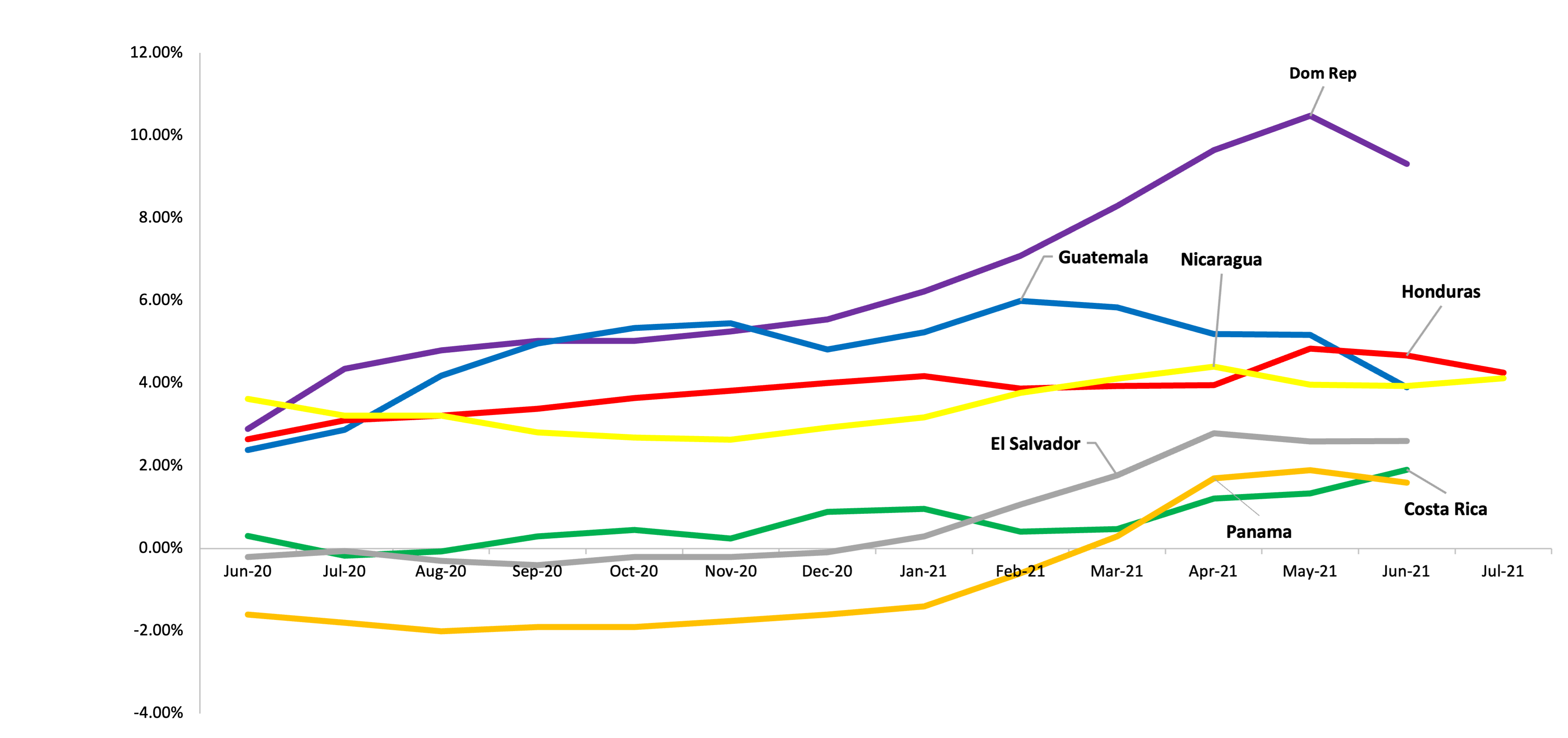
    Central America & Caribbean:​ Inflation
    Monthly year-on-year figures
    Central America & Caribbean, selected countries: GDP growth (%)
    Quarterly figures are year-on-year growth
    GDP  2020* 2021 forecast** Q2 2020 Q3 2020 Q4 2020 Q1 2021
    Costa Rica -4.2 3.2 -7.4 -6.4 -5 -1.3
    Dominican Republic -6.7 7.1 -16.9 -7.2 -2.9 3.1
    El Salvador -7.9 5.0 -19.2 -10.2 -2.3 3.0
    Guatemala -1.5 4.6 -8.9 -1.4 3.0 4.8
    Honduras -9.0 5.0 -18.5 -7.9 -7.6 1.3
    Nicaragua -2 2.0 -7.9 -2.5 -1.9 3.4
    Panama -17.9 12 -38.4 -23.6 -10.9 -8.5
    *From local central banks **Forecasts from the United Nations Economic Commission for Latin America & Caribbean July 2021
    Quarterly growth based on figures from the local central banks


  • REGION: IMF and others cautious about Caribbean growth

    Sarah Sheldon 14 November 2023 Hits: 376

    After a strong recovery post-coronavirus (Covid-19) in 2021 and 2022, the International Monetary Fund (IMF) is predicting a slowdown in Caribbean growth in 2023 and 2024.

    In the latest IMF World Economic Outlook (WEO) published on 13 October, growth in Latin America and the Caribbean (LAC) this year is revised up a little to 2.3% after a stronger performance in Brazil and Mexico. Regional growth for 2024 is also predicted at 2.3%. The IMF is cautious in what it has to say about overall factors affecting the region, citing a “normalisation” of growth because of tighter monetary policies alongside a “weaker external environment and lower commodity prices”.

    For prediction purposes the IMF has split the Caribbean in two. Eleven countries are in the “Caribbean: Tourism dependent” group. Here, the fastest growth is predicted for St Vincent & the Grenadines (6.2% in 2023 and 5.0% in 2024). Antigua & Barbuda, Dominica, and The Bahamas also do well. The second group of “Non-tourism dependent” countries sees much greater variation. Crisis-struck Haiti is expected to contract by 1.5% this year and to achieve only 1.4% growth in 2024. In dramatic contrast, oil-boom Guyana is expected to grow by an eye-watering 38.4% this year and 26.6% in 2024.

  • The hydrogen opportunity

    LatinNews 11 June 2021 Hits: 1697

    Globally, there is growing interest in developing green hydrogen, since it can work simultaneously as a zero-emission fuel, but also as a store of energy, useful in smoothing out the intermittent power supply from renewable energy sources (which have downtimes when winds are not blowing or the sun is not shining). ­­Green hydrogen (H2) can be split out from sea water (H2O) using a process of electrolysis powered by renewable energy (for example, by offshore wind farms).

    Currently the world’s largest green hydrogen project under development is the 26GW solar and wind powered complex at East Pilbara in Western Australia, owned by InterContinental Energy and Asian Renewable Energy Hub. Environmental approval has been granted for the first 15GW phase, with first production and exports due to start in 2027-28. The consortium is targeting hydrogen production costs of US$2/kg. It will sell both green hydrogen and green ammonia derived from the hydrogen. Ammonia is easier to transport by ship since it has greater energy density per unit volume and does not require such low temperatures to store in liquid form as hydrogen does. The Pilbara project will initially target buyers in the utility and fertiliser sectors in Japan and South Korea, which are facing pressure to reduce their emissions.

    What is happening in East Pilbara is particularly interesting to LAC countries. Intercontinental wants to follow a strategy of large-scale green hydrogen/ammonia production from sites which have surplus renewable energy so as to maximise economies of scale. In the main it is looking at coastal deserts with plenty of wind and sun. Sacha Thacker, the company’s chief strategy officer, says it is looking to develop mega-plants in three regions of the world that meet its criteria: Australia, the Middle East, and Latin America. “If you want to import on the seaborne market, you are likely to import from a low-cost exporter, and those low-cost exporters are likely to be focused in these three regions” he says. The company also believes green ammonia may be able to displace fuel oil and diesel as a marine fuel. Hydrogen takes up too much space to act as a shipping fuel, battery electric propulsion is also impractical, and while natural gas is “cleaner” than diesel it still pollutes. Thacker argues that natural gas “is quite helpful for your 2030 [decarbonisation] ambition but is grossly insufficient for your 2050 ambitions”. The International Energy Agency (IEA) says that ammonia, biofuels, and hydrogen could meet more than 80% of shipping fuel needs by 2070, using about 13% of the world’s hydrogen production. Latin America might be able to carve out a place in an emerging global hydrogen economy.

  • TRACKING TRENDS

    LatinNews 20 February 2014 Hits: 1903

    BRAZIL | Banco do Brasil’s good year. In spite of a poor final quarter, the state-owned Banco do Brasil, the country’s largest lender, reported that in 2013 it earned a record net profit of R$15.75bn (US$6.5bn), a figure 29.5% higher than that recorded in 2012 (and just above Itaú’s R$15.69bn profit for the year). The bank’s results mean that its profits for last year are the highest ever recorded by a Brazilian bank.

    In December 2013 Banco do Brasil’s volume of assets reached R$1.30bn (US$536m); an annual growth rate of 13.5% and up 3.5% on the previous quarter, thanks mainly to the expansion of its loan book.

    The bank’s loan portfolio reached R$692m in late December, an annual increase of 19.3%. The strongest growth area was in property. The bank’s default rate, which measures the percentage of debts payable over three months in arrears, fell from 2.06% at the end of 2012 to 1.98% in December.

    Banco do Brasil is controlled by the government, but some of its shares are traded on the São Paulo stock exchange.

    REGION | ‘Different speeds’ for Mercosur members. In a sign of increasing impatience with the Southern Common Market (Mercosur), the head of Brazil’s Confederação Nacional da Indústria (CNI), Carlos Abijaodi, called for a review of Mercosur rules, “particularly those which force all members to negotiate trade agreements jointly with third countries”. Abijaodi’s comments will have been music to the ears of Uruguayan economic and trade policymakers, who have long pushed for such flexibility but to no avail.

    Speaking ahead of a Brazil-Paraguay summit in Asunción, Abijaodi said that Brazilian industry wanted to negotiate trade accords with other countries at different speeds from the rest of Mercosur members. In particular the CNI head expressed concern about the painfully slow progress in negotiating a deal between Mercosur and the European Union (EU).

    “We at the CNI argue that Brazil should make a deal even if the rest of Mercosur is not ready,” Abijaodi said. This could be the last chance to advance in the agreement, since in May the European Commission is holding elections for a new president, and we don’t know if the next president will be so involved,” he added.

    At a Mercosur meeting in Caracas over the weekend, Argentina reacted angrily to the news that a Brazilian diplomat had told the EU parliament that the fault for the delay in securing the deal lay with Argentina. Argentina demanded a public retraction from Brazil and threatened to withdraw their delegation. Brazil refused to make a public retraction but did deliver a short statement at the Brazilian embassy in Argentina, claiming its ambassador’s comments did not “correspond” to Brazil’s “positive assessment” of Mercosur’s joint proposals.

    URUGUAY | Inflation headache. President José Mujica has admitted that inflation is likely to remain between 7% and 9% for the remainder of his mandate, which ends in March 2015. Inflation was 8.5% in 2013, and the January 2014 figure brought the 12-month inflation rate up to 9.10%.

    In order to keep inflation within the 7%-9% band, Mujica suggested that he would be willing to slash utility rates. As with many utilities in Uruguay, electricity is provided by the state, via the Administración Nacional de Usinas y Trasmisiones Eléctricas (UTE), and its losses are absorbed by the treasury. Half of Uruguay’s electricity is hydro and thus dependent on rainfall. When this is insufficient UTE relies on thermal generation, which is extremely expensive, because the country has to import oil and gas.

    The government also manages fuel, drinking water and sewerage rates. These are usually ‘adjusted’ in January and February in order to register a fall in the annual inflation growth tendency and help to keep inflation in check ahead of wage negotiations with unions.

    In 2013, UTE had a deficit of US$102m, down from US$206m the year before. Other public companies, such as the state telecoms firm, Administración Nacional de Telecomunicaciones (Antel); the waterworks company, Obras Sanitarias del Estado (OSE); and the fuel monopoly, Administración Nacional de Combustibles, Alcoholes y Portland (Ancap), all ran a deficit last year.

    Despite a decade of sustained growth Uruguay’s fiscal deficit reached 2.3% of GDP in 2013. Though this is an improvement on 2012, when it reached 2.8%, it is still above the government’s target of 2.1%. In real terms, the deficit stood at US$1.15bn, including US$350m of losses from state-owned companies.

    • Argentina-Uruguay spat

    Uruguay’s new economy and finance minister, Mario Bergara, ran into trouble last week when he expressed frustration with the unpredictable nature of economic policymaking in Argentina. Bergara said that while “it should not be Argentina which guides Uruguay’s macro(economic) decisions,” Argentina’s habit of “announcing one measure on one day [and] dismantling it the next day”, and the fact that “it’s not clear who is in charge”, made things very difficult. Argentina’s cabinet chief, Jorge Capitanich, snapped back that Bergara’s remarks were “inadmissible”. “We consider his comments unfortunate and an unwarranted interference in our sovereign affairs,” Capitanich added.

  • ECONOMIC HIGHLIGHTS

    LatinNews 21 May 2021 Hits: 1599

    PARAGUAY | Pandemic slows recovery prospects. On 27 April Paraguay’s central bank (BCP) released the March 2021 issue of its monetary policy report, in which it revised its 2021 GDP growth forecast down by 0.5 percentage points. The BCP now forecasts that Paraguay’s GDP will grow 3.5%, citing the “worsening of the health crisis” due to rising coronavirus (Covid-19) infections and the “slower than expected” immunisation of the population against Covid-19 as reasons for this slower recovery. Paraguay’s economy began giving signs of recovery in March, with the BCP’s monthly indicator of economic activity (Imaep) growing 8% year-on-year, the first positive year-on-year result for the Imaep in 2021. According to the BCP’s report, the Imaep increase in March was driven by rising activity in the services, manufacturing, and agricultural sectors, but weighed down by lower activity in the electricity production sector. 

    CHILE | Rush for third pension withdrawal. The Superintendencia de Pensiones (SP), Chile’s pensions authority, informed on 12 May that the country’s privately managed pension funds (AFPs) had received 5.6m requests from individuals for a third pension withdrawal, 10 days after a law came into force authorising Chileans to withdraw up to 10% from their pension pot for the third time in under a year, to help them weather the economic impact of the coronavirus (Covid-19) pandemic. Of these requests, 4.6m payments had been carried out at that date, averaging Cl$1.47m (US$2,090) per person and adding up to a total withdrawal of almost US$10bn from the pensions system. The rush for the third pensions withdrawal, which was reluctantly sanctioned by President Sebastián Piñera, was instant, with the SP reporting 4.3m withdrawal requests within the first 48 hours. The political opposition has already presented a bill for a fourth pension withdrawal, amid warnings from financial institutions such as the International Monetary Fund (IMF) that such a move should be avoided as it weakens the pension system – an argument shared by the Piñera government.   

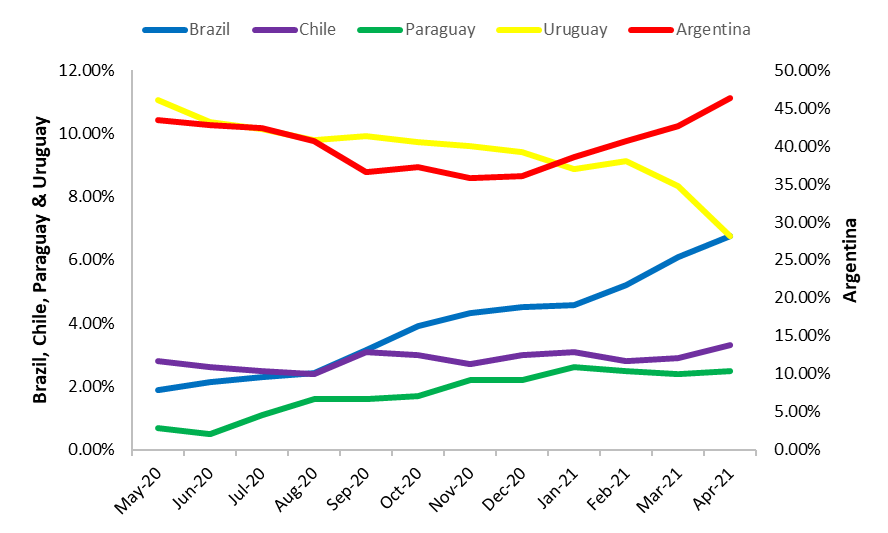
    Brazil & Southern Cone: Inflation
    Monthly year-on-year figures

    Brazil & Southern Cone: GDP growth (%)
    Quarterly figures are year-on-year growth
    Country 2020 forecast * 2021 forecast *  Q1 2020 Q2 2020 Q3 2020 Q4 2020
    Argentina -10.5 4.9 -5.4 -19.1 -10.2 -4.3
    Brazil -5.3 3.2 0.9 -11.4 -3.9 -1.1
    Chile -6.0 5.0 0.4 -14.1 -9.1 0.0
    Paraguay -1.6 3.5 3.5 -6.5 -1.2 1
    Uruguay -4.5 4.0 -1.4 -10.6 -5.9 -2.9
    *Figures from the United Nations Economic Commission for Latin America & Caribbean Dec 2020
    Quarterly growth based on figures from the local central banks


  • TRACKING TRENDS

    Patrick de Courcy 16 December 2021 Hits: 2160

    ARGENTINA | Mining law. There were violent clashes in Rawson, the capital of the southern province of Chubut, on 15 December between anti-mining demonstrators and police. Protesters threw stones and bottles while the police sought to disperse them with tear gas and rubber bullets. The catalyst for the protests was the approval by the provincial legislature of mining zones where the use of chemical mining treatments, but not cyanide, will be permitted.

    This could benefit Canada’s Pan American Silver which for the last decade has been seeking approval for developing the Navidad silver, copper, and lead mine in the province. The total investment value of the project is calculated at US$1.2bn. It would create around 2,600 jobs, and up to US$350m worth of annual exports, as well as generating royalties for the provincial administration. Navidad is located in Patagonian plateau or meseta.

    In a context of high local unemployment supporters of the Navidad project, including truck drivers, construction workers, and oil workers unions, point to its ability to create new jobs. Pan American Silver would be required to hire 80% of the workforce locally, as well as purchasing 50% of its supplies from local providers.

    Opponents of the project highlight the potential for water contamination from leaching and note that the collapse of a retaining wall at a Chilean mine in 1997 led to a surge which contaminated the Loa River.


    BRAZIL | IMF to leave Brazil. The International Monetary Fund (IMF) confirmed that it will be closing its office in Brazil, after Economy Minister Paulo Guedes said on 15 December that the Brazilian government will not be recognising the IMF office from next June.

    Guedes criticised the IMF during an event with business representatives in São Paulo: “I think it’s better if they go and make their predictions elsewhere,” he said.

    Amongst other things, the IMF had predicted a deep 9% GDP contraction for Brazil last year; the economy ended up shrinking 3.9%. In subsequent comments to the press, Guedes said that “The IMF was useful in the past, but Brazil has done an extraordinary job in the fiscal area”.


    BRAZIL | Inflation slows, stays high. Brazil’s national statistics institute (Ibge) released its latest figures for the consumer price index (IPCA) on 10 December, which indicate a slight slowdown in inflation – although it remains high.

    Inflation grew 0.95% in November, compared with 1.25% in October. In the 12 months to November, inflation stood at 10.74%, up from 10.67% a month earlier.

    Following the release of this data, private sector analysts surveyed weekly by the central bank (BCB) for its Focus bulletin revised down their 2021 inflation forecast, after 35 consecutive weeks of increasing their forecast. They now expect inflation to close the year at 10.05%, down from 10.18% a week earlier. The BCB’s inflation target range is an unattainable 3.75% +/- 1.5.

  • PANAMA: Lawmakers approve move to join Mercosur as associate member

    Sarah Sheldon 17 November 2025 Hits: 246

    On 9 October lawmakers unanimously approved a bill which ratifies an economic agreement between Panama and South American trading bloc Mercosur that will see Panama join as an associate member.

    Agreed in December 2024 at a summit in Uruguay’s capital, Montevideo, associate membership means that Panama gains preferential trade access, such as tariff reductions, rather than free market access, but does not have voting rights in Mercosur institutions. The country joins Chile, Peru, Colombia, Ecuador, Guyana, and Suriname in becoming an associate member of Mercosur, which counts Brazil, Argentina, Uruguay, Paraguay, and Bolivia as full members. The agreement establishes a joint legal framework that will improve safety and transparency for businesses; a framework designed to encourage investment; and a programme to boost economic cooperation. A free trade agreement has also been floated, which would eliminate tariffs and export restrictions on certain goods and services

    Panama’s minister for trade and industry, Julio Moltó, said the move reflects the vision of President José Raúl Mulino. “Panama is moving with conviction towards more regional integration, while always looking out for the interests of the country and its economic producers.” said Moltó, who believes that the move will increase exports in areas such as frozen fish, seeds, and cereals; attract investment; and boost the logistics sector. Following the approval of the bill, and Mulino’s signing of the new law, Moltó said that a new commission will be created in conjunction with the private sector and bilateral negotiations will begin with individual Mercosur countries. Any future agreement will have to be approved by the national assembly, he added. 

    The move comes at a time when Mulino is balancing geopolitical pressures centred around the Panama Canal, with the US and China stepping up an ongoing battle for influence. While the Mercosur deal is unlikely to significantly influence this great power competition, it could be useful for Mulino, with Brazil’s President Luiz Inácio Lula da Silva already underlining his support for Panamanian sovereignty and announcing plans to join the Treaty of Permanent Neutrality of the Canal.

    • Boosting ties with Brazil

    In a meeting which took place in Brazil at the end of August, delegations headed up by Presidents Lula and Mulino signed two memoranda of understanding. One was between the Panama Canal Authority (ACP) and Brazil’s ministry of ports and airports which commits the two sides to undertaking joint initiatives to maintain cooperation aimed at promoting the exchange of information and experiences relevant to the management of ports as well as maritime and fluvial transport logistics. The other was between Panama’s agriculture development ministry and Brazil’s agriculture and livestock ministry and seeks to stimulate broad development in the areas of agriculture and livestock systems. It focuses on the exchange of information, experiences and agricultural inputs among other things.

    These early signs are encouraging, but the overall impact of Panama’s new status is far from certain. While its accession to Mercosur as an associate member may improve market access for Panamanian exporters, and it could help to attract investment from Mercosur nations keen to use Panama as a gateway to Central America, trade officials will need to identify strategic niches to maximise the potential benefits. The impact will also be tied to Panama’s success in navigating geopolitical tensions and balancing great power competition in order to attract the significant investment necessary to execute strategic infrastructure projects, such as a proposed interoceanic gas pipeline and a new reservoir to improve water security at the Panama Canal, which are needed to secure its position as a logistics hub.

  • RASTREANDO TENDENCIAS

    LatinNews 26 September 2011 Hits: 546

    ARGENTINA | Cumbre narco colombiano en Rosario. Esta semana, el diario colombiano El Tiempo informó que miembros de la Drug Enforcement Administration (DEA) en Miami están tratando de establecer cómo dos de los más buscados traficantes de drogas de Colombia, ‘Valenciano’ (Maximiliano Bonilla Orozco) y ‘Sebastián’ (Ericson Vargas), lograron realizar tres reuniones en la ciudad de Rosario, Santa Fe, sin detectados por las autoridades argentinas. De acuerdo con el diario, la DEA cree que las reuniones tuvieron lugar durante la primera semana de setiembre, con el objetivo de dividirse el negocio de venta de drogas al menudeo en las calles de Medellín y evitar una escalada en la violencia ante las elecciones regionales en Colombia el 30 de octubre. Se cree que ambos traficantes viajaron con pasaportes centroamericanos; Colombia ofrece una recompensa de Col$2bn (US$1,07m) por ‘Sebastián’, mientras que EU ofrece US$5m por ‘Valenciano’.

    ARGENTINA | Moyano seguirá al frente del sindicato de camioneros. Esta semana, Hugo Moyano, el secretario general de la Confederación Argentina de Trabajadores (CGT) de Argentina, aseguró su sexta reelección como titular de la federación nacional de camioneros. La lista ’15 de diciembre’ de Moyano tuvo oposición en sólo tres distritos en el interior de la provincia de Buenos Aires –Junín, Mar del Plata (de donde proviene Moyano) y 9 de julio– pero aún así ganó esas contiendas. Sin embargo, la oposición fue solamente a nivel local; nadie compitió contra el liderazgo nacional de Moyano, que él aseguró con un histórico 75% de los votantes registrados (o 105.500 miembros del sindicato). La elección fue una prueba del poder de Moyano, cuyo mandato en la CGT expira en julio de 2012. Armando Cavallieri, el titular del Sindicato de Empleados de Comercio (SEC) de quien se rumorea que se convertirá en el desafiante de Moyano en la elección de 2012 en la CGT, fue reelecto como secretario general del SEC en junio, venciendo al candidato Moyanista, pero por solamente 15.000 votos.

    PARAGUAY | Ataques del EPP en Horqueta. A tempranas horas del 19 de setiembre, la oficina de la fiscalía del estado en la ciudad de Horqueta, departamento de Concepción, fue atacada con un artefacto explosivo lanzado por dos hombres que iban en una motocicleta. El edificio figuraba en una lista en un documento que fue incautada por las autoridades paraguayas en junio de 2010 como probable blanco del autoproclamado Ejército del Pueblo Paraguayo (EPP). Este fue el segundo ataque con bomba perpetrado por el EPP en Horqueta, habiendo atacado un auto patrullero de la policía con un artefacto explosivo en enero de este año. El miércoles 21 de setiembre, el EPP atacó la estación de policía 10ma de Horqueta, matando a dos miembros de la policía nacional. Se cree que el EPP usó granadas, además de armas de alto poder en este último ataque. Su inteligencia también fue buena: atacaron la única estación que no había recibido refuerzos de las fuerzas especiales de la policía (Fope), luego del ataque con bomba del lunes pasado, y que solamente contaba con seis policías que solamente tenían armas de mano y sin auto patrulla. Además, en el momento del ataque no se encontraban en el local policial ni el jefe de la estación ni otros tres miembros de la misma.

    La semana pasada contenía tres fechas simbólicas para el EPP: 1) Cecilia Cubas Gusinsky la primera víctima fatal de secuestro, fue secuestrada el 21 de setiembre de 2004; 2) ‘Claudio’ (Carlos Ramón Espínola) aparecerá en su primera audiencia ante la corte con relación a su participación en el secuestro de Cecilia Cubas y su supuesto entrenamiento en Colombia por las Fuerzas Armadas Revolucionarias de Colombia (Farc); y 3) Nimio Cardozo, importante miembro del EPP fue muerto el 24 de setiembre de 2010.

    URUGUAY-ARGENTINA | Acusan a Argentina de ocultar resultados medioambientales. La semana pasada, los miembros uruguayos del comité administrativo del Río Uruguay (Caru) pidió a sus pares argentinos que difundan los resultados de las primeras dos pruebas realizadas en la vecindad de la planta de celulosa UPM (antes Botnia). Argentina ha usado su derecho de “reservar su opinión”, lo que significa que los resultados de las pruebas realizadas por un laboratorio de Canadá no fueron revelados a la delegación uruguaya o a los medios. La controversia se convirtió en una riña pública a través de Twitter entre el canciller de Argentina, Héctor Timerman, y el diputado nacional uruguayo, Javier García. Supuestamente, los resultados no habían sido revelados debido a que indicarían que la planta no había tenido un impacto medioambiental negativo sobre el río.

  • ECONOMIC OVERVIEW: CHILE

    LatinNews 07 March 2013 Hits: 2546

    Historic low in unemployment: On 27 February, Chile’s national statistics agency (INE) released figures which put the unemployment rate for November 2012 to January 2013 at 6.0%, the lowest figure since Piñera took office in March 2010. The rate for November 2011 to January 2012 was 6.6%. Labour Minister Evelyn Matthei said that 817,000 new jobs had been created under the Piñera government. According to Matthei, the biggest annual increases were registered in financial intermediation (14.3%); fishing (13.2%); exploitation of mines and quarries (12.6%) and education (10.0%). At the end of January, the INE reported that Chile’s average unemployment rate in 2012 was 6.4%, well down from a 7.1% average in 2011 and 8.1% in 2010.

    Exports: According to figures released by Chile’s Central Bank on 25 February, Chile’s exports reached US$79bn in 2012, down 3.2% on the previous year. The bank highlighted a 5% drop in industry exports and 2.6% decline in mining, noting that exports to the European Union (EU), dropped 17% to US$14bn. Exports to the US also dropped 3% over 2012, to reach US$24bn. Of the US$79bn total, copper exports accounted for US$43bn, (out of total mining exports of US$47bn). This is down from 2011 where copper exports reached US$44bn and total mining exports reached US$49bn.

  • Ecuador: The quest for funds

    LatinNews 05 October 2016 Hits: 410

    In late September, Ecuador reopened its March 2022 US dollar bond for US$1bn, after it issued another tranche of 2022 bonds for US$1bn in July.

    The radical left-wing government again offered a hefty 10.75% yield on the six-year bonds, indicative of the high risk attached to the sovereign, which along with the also oil-export dependent Venezuela remains among the worst-rated globally.

    The sovereign has now issued US$5.5bn in bonds (in five tranches) since it returned to the market in 2014, following a selective default on US$3.2bn of debt declared ‘illegitimate’ by President Rafael Correa in December 2008. Upon its return in 2014, it successfully sold US$2bn in an oversubscribed issue, with a yield of 7.95% and a ten-year maturity. It then issued two US$750m five-year bonds in each of March and May 2015, with yields of 10.5% and 8.5% respectively, followed by the two tranches of US$1bn (each yielding a higher 10.75%) to date this year. Given that these issues have been short term and at fairly high interest rates, they will immediately increase payment obligations for the next government due to take office after the mid-February 2017 general election. Interest payments alone look set to rise to over 2% on GDP from next year. At a time when oil prices remain relatively weak, this will limit the net government’s room for manoeuvre when drawing up its budgets.

    According to the finance ministry data, total consolidated public debt as of 30 September was USS$37.81bn, or 39.2% of GDP and close to the 40% limit set under the 2008 constitution. This is up from US$20.9bn (22% of GDP) just three years ago and reflects the extreme difficulties faced by the Correa administration upon the collapse in global oil prices, starting in mid-2014. The latest issue will go towards the 2016 budget, the finance ministry said in a statement, as the government struggles to cope with a US$3bn reconstruction bill after the strongest earthquake in 40 years hit in mid April, devastating parts of Pacific coastal region, with over 600 deaths. Reconstruction work is underway, which the government hopes will help the stagnant domestic economy.

    Aside from rapidly accumulating new external debt since 2014, the Correa government has also taken to relying rather heavily on short-term (180-day) treasury notes, financed by the central bank. The bank’s total purchases of these are now estimated at over US$3bn, from just US$61m two years ago. For a dollarised economy like Ecuador, this will raise some alarm bells, amid its already stretched dollar liquidity position.

    Another concern for some private economists is the Correa’s government’s accumulating debt to strategic partner China. Within the total public debt figure reported in June, the finance ministry put bilateral debt to China at US$7.9bn, over one-third of the total reported public debt and the same as the country’s multilateral funding (also reported at US$7.9bn in June). However, by contrast with multilateral lending, Ecuador’s debt with China tends to be costlier and contracted at shorter maturities. Typically, it is also ‘tied-lending’, destined for specific projects. These mostly are infrastructure schemes, like the recent string of new hydroelectric plants built in the country; these were financed by China and constructed by Chinese firms using Chinese labour.

    Other credits from China are tied to future oil sales, and so the treasury does not classify them on its books as ‘debt’, but instead registers them as ‘oil pre-sales’. As such, the total does not appear in the officially reported total public debt figure. Economists argue that this ‘creative accounting’, also sometimes used by Venezuela in its strategic relations with China, could very easily come back to bite future administrations, while oil sector analysts also point out these cash-for-oil-deals (the terms of which are unknown) tie Ecuador into long term oil supply deals with China that may not necessarily be feasible (or profitable) for the country in decades to come. Venezuela, for instance, which is struggling to maintain oil production levels, is suspected of having to divert exports meant for top dollar-paying customers like the US to China, potentially earning less in the process.

    IESS accumulates government securities

    According to late September comments by Ricardo Espinosa, president of Ecuador’s social security institute (IESS), the institute now has total investments worth US$17.4bn, up from US$2.8bn previously, of which US$7.4bn is in finance ministry bonds. Espinosa insisted that the government securities were a good investment, with a favourable interest rate of about 7.5%. He insisted that the cash-strapped finance ministry “pays us interest, they are totally up to date”.

    Overall, Espinosa added, IESS investments generate an average return of 8%, with US$7bn invested in mortgage credits over terms of 20-25 years, another US$2bn in unsecured credits to IESS affiliates and retirees, and US$1.5bn in the private productive sector.

    The IESS has a total accumulated debt of US$80bn, Espinosa said, mostly destined for the construction and equipping of hospitals in the country.

    Exporters fret about EU association agreement

    Time is running out for the European Union (EU) to ratify Ecuador’s adhesion to its existing association agreement with the Andean (Colombia and Peru), which was agreed two years ago in 2014 but which has still not been ratified.

    While the talks were ongoing, the EU twice rolled over existing preferential tariff access for Ecuador under its Generalised System of Preferences (GPS). However, Ecuador’s inclusion in the GPS is set to expire for good on 31 December next, so unless it is part of the association agreement by then, local exporters will face a hefty increase in tariffs to European countries as of 1 January 2017.

    Part of the reason for the delay on the European side has been the Correa government’s imposition of import tariffs in a bid to defend the country’s balance of payments/liquidity position in response to the oil price shock. Following the temporary imposition (and then removal) of tariffs and quotas on imports from Colombia and Peru in early 2015, in March 2015 the Correa government instead moved to impose blanket global tariffs ranging from 5% to 45% on a basket of 2,961 designated non-essential imports (one-third of the total import basket). These so-called ‘balance-of-payments safeguards’ were added on top of some existing tariffs, much to the chagrin of some local manufacturers.

    These safeguards were due to expire in June this year, but they were extended for 12 months after the April earthquake, with the explicit permission of the World Trade Organisation (WTO). As part of the deal with the WTO, the external trade committee (Comex) agreed to draw up a schedule for the removal of the tariffs in April-June 2017, and immediately reduced by 5% the levy on around 700 items.

    The safeguards have worked from the point of view of the balance of payments, with imports falling faster than exports over the past 18 months, and this is despite the huge shock to exports from the collapse in oil prices. Indeed, according to the central bank, the country registered a small trade surplus of US$696m in the first half, compared with a deficit of US$1.2bn in the year-earlier period. While export revenues fell by 19% year on year (led by a 38% contraction in the value of oil sales and an 8% drop in the value of non-oil sales), imports fell by 35% in the same period. As a result the first quarter current-account deficit was the lowest in three years, at US$376m, or 1.5% of GDP, down from 3.3% of GDP in Q4 2015, providing important financial relief.

    But with strong demands both by Ecuadorean exporters for closure on the agreement, as well as pressure from European exporters for the removal of costly restrictions on European-made cars, Parma ham and other luxury foods still a major sticking point with Brussels, the Correa government has been obliged to move earlier. Thus in mid September the government announced that as of 26 October the highest import tariff would be reduced to 35% from 40%, with the mid-level 25% tariff eliminated and items in that tier henceforth subject to the 15% duty. Clearly, the aim of this is to accelerate towards ratification. However, even though the country’s foreign trade minister, Juan Carlos Cassinelli, and the vice-president, Jorge Glas, have lobbied hard in Europe in recent weeks, there is a real concern that Ecuador’s accession might not now occur until March 2017. Local export groups put the potential revenue loss to exporters at US$100m. President Correa has publically pledged state drawbacks to compensate. Exporters, however, argue that costs would go well beyond lost revenue to the permanent cancellation of their contracts in Europe, for example, and they also point out that the Quito government has already been quite tardy in providing compensation to local exporters under existing drawback schemes.

    And in Brussels, trade lawyers continue to say that while there may be political will to help out Ecuador amidst its current economic difficulties, particularly on the part of countries like Spain and Italy, two heavyweights within the EU, the deal technically cannot be ratified without the suppression of the safeguards.

  • MEXICO: Trade dispute over biotech crops escalates

    Patrick de Courcy 13 September 2023 Hits: 2017

    On 25 August Canada joined the US as a third party in its trade dispute against Mexico over genetically modified (GM), or biotech, corn. The US on 17 August called for an arbitration panel under the terms of the US-Mexico-Canada Agreement (USMCA) following Mexico’s ban on the use of GM corn in certain products.

    The US exports mostly yellow corn to Mexico, which is used for animal feed. According to press reports, Mexican imports of yellow corn average around US$3bn per year. In contrast, the country imports only small amounts of white corn because domestic production of the crop that is used for its staple foods (tortillas and dough) is much higher. White corn is mostly imported from the US and South Africa.

    The central argument of the US and Canada is that Mexico is failing to observe its obligations according to the chapter on phytosanitary and health measures of the USMCA. They claim that the case could lead to future adverse effects on agricultural trade as a result of barriers placed against crops that are not grounded on scientific evidence, international guidelines and recommendations, and appropriate risk assessments, as specified in the agreement.

    In turn, Mexico is arguing that its regulation regarding imports of yellow GM corn is consistent with the provisions of the agreement after the initial decree was modified. On 13 February the government of President Andrés Manuel López Obrador issued a decree that banned the use of GM corn for human consumption in staple foods and stated that GM corn would gradually be substituted in all other products for human consumption as well as from animal feed. On 24 June, the government imposed a tariff of 50% on imports of white corn in order to boost national production and prevent the use of GM corn by tortilla makers. The measures will be valid until the end of the year.  Mexico also claims that GM corn threatens native varieties of the crop.

    The economy ministry (SE) has said that it will be able to demonstrate that the exclusive use of native corn for tortilla and dough will have no commercial impact on the US because Mexico produces sufficient white corn that is used for its staple products. According to Enrique Campos Suárez, a business columnist with national daily El Economista, the arguments that the government will use at the panel have already been defeated in similar cases. In a dispute before the World Trade Organisation (WTO) the US won its case against the European Union (EU). Such precedents suggest that the Mexico will lose the panel, which could lead to retaliatory tariffs imposed on Mexican exports.

    Canada

    While Canada does not export corn to Mexico, its main agricultural export is GM canola, which is also exported to the US. Indeed, Canada was the sole exporter of canola to Mexico in 2022. Local press has reported that Mexican imports of canola seeds last year amounted to US$901m, an increase of 1.3% relative to 2021.

  • TRACKING TRENDS

    Abbi Dicker 12 March 2026 Hits: 1201

    BRAZIL | Industrial production rises in monthly terms. The national statistics institute (Ibge) reported on 6 March that the national industrial production level in January was up 1.8% compared with the previous month. This contrasts with the monthly decline in December, when industrial production declined by 1.2%. The accumulated annual production in the 12 months through January 2026 was up 0.5% on the preceding 12-month period.

    Of the 25 product categories measured by the Ibge, 19 posted monthly increases in production, with the greatest increases registered in machines, devices, and electronic items (+6.5%), vehicles, trailers, and car bodies (+6.3%), and chemical products (+6.2%).

  • The fourth industrial revolution

    LatinNews 22 December 2017 Hits: 322

    The attempt to bring a greater part of the Latin American population into the tax and social security system faces a major additional complication: the advent of a global digital revolution, sometimes called the ‘fourth industrial revolution’. This is the headline used to describe a range of technology developments including increased automation, the use of industrial robots, the Internet of Things (IoT), cloud computing, artificial intelligence, blockchain software, and 3D printing, among others. At a global level the effects of this revolution on traditional patterns of work and employment could be far-reaching; they are not yet fully understood. According to the IDB, existing global estimates say the share of jobs that could be replaced by robots ranges from 5% to 47%, depending on the method of calculation used.[1] Against this it is estimated that each new technology job can generate 4.9 other jobs as part of a ‘spillover effect’. The threat of job losses through technology varies from country to country and sector to sector.

    For the agricultural sector in Uruguay the risk is said to be as high as 82%, and particularly acute for those with low levels of formal education, the young, and for men. In the transportation sector in Argentina the risk is calculated at 76%. According to early information on robot numbers, Switzerland, Germany, Japan, and South Korea currently have the highest number of robots per industrial worker – more than 20 per thousand. In the LAC region Mexico and Brazil have the most robots, but at 1-2 per thousand industrial workers they are still far behind the more developed countries.

    It is possible that the fourth industrial revolution will radically erode the stability of employment in Latin America’s middle classes. On the other hand Marcelo Cabrol, an IDB expert, takes an optimistic stance. He argues that if Latin America and the Caribbean (LAC) respond with the right combination of reforms, strategic investment, and skill development, it will create an opportunity not just for new business ventures, but also to close some of its social and economic inequality gaps. The challenge, he argues, is to build innovative eco-systems and emulate what is being done by entrepreneurial states like those in South Korea and Israel.


    [1] Robotlution: The Future of Work in Latin American Integration 4.0

  • EL SALVADOR: Funes edges closer to key goal

    LatinNews 31 October 2012 Hits: 2853

    If poverty, exclusion and illiteracy are the root causes of crime and insecurity as President Mauricio Funes argues then El Salvador should steadily became a safer place. Illiteracy has fallen by some eight percentage points since Funes came to power in 2009, according to the publication of the annual household survey in October, to 12.8%. Funes also insisted during the presentation of the 2013 budget in September that his government’s overriding priority was social programmes, something which is borne out by proposed spending.

    President Funes revealed on 6 September, international literacy day, that 135,000 Salvadorean adults had been lifted out of illiteracy since 2010. Six of El Salvador’s 262 municipalities have also been declared free of illiteracy since the start of 2012, and the government aims to have achieved the same landmark in a further 15 municipalities by the end of this year.

    The results of the latest household survey, carried out by the statistics and census department (Digestyc) of the economy ministry, showed that illiteracy in those over the age of 10 fell to 12.8% in 2011, from around 20% when Funes took power. Unsurprisingly the figure is much higher in rural areas (20.7%) than urban areas (8.2%) and is most prevalent in adults over the age of 34. Of the 652,928 illiterate Salvadoreans, nearly two-thirds are women.

    Illiteracy is one of the legacies of the country’s brutal civil war in the 1980s, and one of the areas that Funes and the left-wing Frente Farabundo Martí para la Liberaciόn Nacional (FMLN), which brought him to power, promised to address in government. In March 2010, Vice-President Salvador Sánchez Cerén launched a programme, “Educating for Life”, in the western town of Izalco, where he said indigenous communities had been marginalised for years. The initiative established a national volunteer network and included technical and professional training. It targeted 65 of the country’s poorest municipalities.

    While the government has made important strides against illiteracy, it is worth noting that Sánchez Cerén, who until recently served as education minister, promised back then that illiteracy would be reduced to around 4% by the time of the next elections in March 2014. As Sánchez Cerén is the presidential candidate for the FMLN in these elections, he might not want to be reminded of this bold objective unless further progress is made quickly.

    With this in mind, the FMLN trumpeted the government’s commitment to social development spending in the draft budget proposal that Finance Minister Carlos Cáceres, presented to the legislative assembly in late September. The proposed budget for 2013 is, at US$4.51bn, up nearly 7% on this year.

    Social development accounts for US$2.09bn, or 45%, of the total proposed budget. By far the largest slice of the pie, US$882m, was set aside for education, just under 20% of the entire budget. That said the education budget was actually only up 4% (or US$35m in absolute terms) on this year’s budget, while health, for instance, received a bigger increase: up by over 8% to US$565.4m. By comparison, spending on justice and public security was US$356m, up by 9%.

    The opposition Alianza Republicana Nacional (Arena) described the budget as “unreal”, and based on a set of assumptions that simply failed to stack up. One of these, it argued, was that growth would be 2.3% in 2013, almost twice the growth to which the country has grown accustomed in recent years. The trade deficit, meanwhile, will increase to US$5.3bn. It was not so long ago that this used to be covered by remittances, but that is out of the question now.

    • Household survey

    The Digestyc household survey also produced a series of other interesting statistics. It found that 92.6% of Salvadorean households have electricity, for instance, and 83.8% have access to piped water (although this figure is closer to 66% in rural areas). Separately, it reported that 88% of households had a mobile phone; 84% a TV; 62% a refrigerator; and 12 % internet access.