All Categories

Subcategories

  • ECONOMIC OVERVIEW

    LatinNews 12 August 2015 Hits: 1956

    Unemployment: The rate of unemployment in the April-June period was 6.5%, down 0.1% on the preceding quarter, according to the national statistics institute (INE). According to the most recent (27 July 2015) report by the United Nations’ Economic Commission for Latin America & Caribbean (Eclac), unemployment in Chile averaged 6.4% in 2014. Eclac noted that this was “low” considering the sluggish economic environment, but added that it was an increase over the 2013 rate (5.9%), “as the participation rate rose by 0.25 percentage points while employment remained flat. In the first quarter of 2015, labour participation decreased, as both employment and unemployment rates fell (the latter to 6.1%)”.

    Growth forecast: In a 2 August interview with the national daily La Tercera, the president of Chile’s central bank (BCCh), Rodrigo Vergara, said that the BCCh would lower its economic growth forecast range for the year, on weak domestic investment. On 6 July, Finance Minister Rodrigo Valdés told reporters that the government had cut its forecast for real annual GDP growth this year to 2.5%, down from 3.6% previously. Last year, annual growth was just 1.9%. Although Vergara did not give a figure in the La Tercera interview, he did not rule out the possibility that the top of the new range would be under 3%.

  • ECUADOR: Defence minister claims to be lamb to the slaughter

    LatinNews 03 March 2016 Hits: 2754

    Ecuador’s defence minister, Fernando Cordero, resigned on 1 March, becoming the latest casualty of a still-simmering row over military pensions. Relations between the government led by President Rafael Correa and the military have hit a new low.

    The immediate row involves a recent government effort to claw back US$34m from the armed forces’ social security institute (Instituto de Seguridad Social de las Fuerzas Armadas, Issfa) in a dispute over the value of a land sale, which prompted a stand-off between the military leadership and the executive. The wider context is to do with Cordero’s attempts to overhaul military frameworks, including the pension system, in the past 18 months.

    Cordero, a senior member of the ruling Alianza País (AP) and former president of the national assembly, has been deployed by Correa before as a ‘problem solver’ (prior to the defence ministry he spent a year at the helm of the national social security institute). He may have overplayed his hand this time however. In mismanaging the Issfa dispute, he did Correa and his government political and PR damage at an already difficult time.

    The outgoing military top brass led by General Luis Garzón, having been removed by President Correa for insubordination over the Issfa incident, embarrassed Correa at the swearing-in ceremony for their replacements held on 26 February. Garzón dedicated his speech to complaining about poor conditions, declaring that regular soldiers were having to live on a US$3-a-day food mess stipend. This, Garzón declared, could not continue. He complained that promised repairs and upgrades to housing for officers were not yet complete. He also insisted that the armed forces were the “vertebral column” of Ecuador. Meanwhile, retired veterans – Issfa pensioners – sat stony faced for the best part of the ceremony at the Eloy Alfaro military school in north-eastern Quito, neglecting to stand when Correa arrived and later walking out during his speech, prompting him to describe them as ‘malcriados’ (roughly, ‘rude and badly brought up’).

    Correa, who had centred his speech around new reforms to the military pensions system (to correct distortions, inequities and discrimination between ranks) was left red-faced and apologetic over the minimal food stipend. Correa, who amidst the Issfa row had pledged that the government would “never fail” the armed forces, said he felt “shame”. Noting that Issfa pensions are among the highest in the region he said, “I don’t know how these inconsistencies have come about, the highest salaries in the region but barely three dollars a day for the mess, the absurdities that our government still commits, for which I ask forgiveness, above all to our troops, of course this problem must be corrected urgently”.

    Rare is such a display of awkwardness and humility by Correa. Recovering towards the end, Correa took issue with Garzón’s “vertebral column” comment, however, saying that he considered this “excluding and unfair to other social sectors”. “This is precisely what is in dispute, those two visions,” Correa stressed.

    Nevertheless, it was clear that Cordero would have to take the fall. Claiming that he was taking a “mature decision” to step aside, Cordero said that he was clearing the path for someone new to come in and “continue the [reform] process”. However, in a parting shot clearly aimed at the military, he made the point that he had used his 18-month stint at the ministry to overhaul some very large and distorted gaps in pay, working conditions and pension benefits between the top and bottom military ranks.

    He also announced two new ministerial accords that he said were aimed at promoting equity in the armed forces. One ostensibly reforms the military recruitment process so that it is more effectively based upon meritocracy and is more transparent. Military sources later took issue with this, pointing out that recruitment and promotion is already well established, perfectly transparent and based upon strict order of merit criteria.

    The second, more eye-catching reform, is an order that all soldiers, regardless of rank, have unrestricted access to the same military common areas and facilities, including bathrooms, dining rooms and recreational halls, an issue that Correa had taken great umbrage at in previous days, denouncing “discriminatory practices”.

    Finally, Cordero complained that he had been the victim of a campaign of “disinformation”, the insinuation being that this too had originated in the military. Correa has yet to name a new defence minister, having now had seven (and one interim) in his nine years in office, including three women.

    • Anti-government sentiment

    Also critical to this latest incident is the deepening economic crisis in the oil-dependent country, which is obliging the Correa government to leave no stone unturned in its efforts to adjust budgets. This is causing discomfort not only in the military but elsewhere. Fresh planned demonstrations by trade unions, students and other disgruntled sectors in mid-March will be of concern to the AP, which is heading into the February 2017 general elections without President Correa, who cannot run again.

  • POINTERS

    LatinNews 01 April 2016 Hits: 860

    COSTA RICA | Cuban migrant crisis. On 15 March, four months after arriving in Costa Rica, the final group of Cuban migrants stranded there en route to the US left for Mexico. This followed the launch of a pilot programme on 12 January 2016 to address the crisis caused by the surge in Cuban migrants seeking to reach the US via Central America [SSR-16-01]. The crisis made headlines in mid-November 2015 when Nicaragua closed its border with Costa Rica, leaving 4,817 Cubans stranded. Under the programme, Cubans were permitted to buy a US$555 ticket that included a flight to El Salvador, and then a bus journey into Mexico, from where they were permitted to make their own way to the US.

    According to a 15 March press release by Mexico’s foreign ministry, Mexico’s national institute of migration had received 6,000 Cuban nationals at Ciudad Hidalgo, Chiapas and through 38 direct flights from Panama and Costa Rica to Ciudad Juárez, Chihuahua and Nuevo Laredo, Tamaulipas respectively.

    There are signs, however, that the situation persists. On 24 March the Costa Rican government announced that it was reinforcing the country’s borders after 15 illegal Cuban migrants were picked up in Costa Rican territory. Meanwhile, on 17 March Panama’s President Juan Carlos Varela, who described the migrant situation as “very complicated”, said that there were still 1,600 Cubans in Panamanian territory bordering Colombia and Costa Rica. Costa Rican and Panamanian authorities continue to call for a regional solution, with support from international organisations like the International Organization for Migration (IOM). Meanwhile the local and international press is reporting that next month, deputy foreign ministers from Central America, Cuba, Ecuador, and Colombia will meet to discuss the Cuban migrant situation further.

    BELIZE-GUATEMALA | Border tensions. On 15 March Belize’s Foreign Minister Wilfred Elrington met his Guatemalan counterpart Carlos Raúl Morales in Washington at a meeting of donor countries of the Organization of American States (OAS) Peace Fund which is in charge of the adjacency zone between both countries.

    Presided over by head of the OAS Peace Fund Magdalena Talamás, the meeting came two days after the Belizean government led by Prime Minister Dean Barrow issued a press release stating that a confrontation took place on 12 March between Belize security forces (FOB) and Guatemalan armed forces (GAF) at the Starstoon River, in the area of Belize’s Forward Operating Base.

    According to the press release “the GAF approached the FOB, though they never actually attempted to come on to our land, and behaved in an extremely hostile and threatening manner, insisting that our troops should not be at the Sarstoon”. “The Belize Forces stood their ground and after some time the GAF withdrew. In the intervening period the BDF Commander General Jones had spoken to an opposite number in Guatemala and Prime Minister Dean Barrow had sent a message to President Jimmy Morales.”

    The press release states that that “despite the ultimately peaceful end to the standoff it is clear that tension with Guatemala over the Sarstoon and Belize’s insistence on its sovereignty rights in accordance with the 1859 Treaty demarcation of the river, is at an all-time high”. The press release notes that “A strongly worded protest note is being sent to Guatemala by the Belize Ministry of Foreign Affairs”.

    The confrontation attracted particular attention given aggressive statements that Morales made during his election campaign in 2015 regarding Guatemala’s historical territorial dispute with Belize. In 1995, Belize and Guatemala – which lays claim to 12,772km² of adjacent land and sea, over half of Belize’s current territory – began a dialogue process brokered by the OAS but the negotiations have so far failed to yield much progress.

    In May 2015 the two countries signed a Protocol to the Special Agreement between Belize and Guatemala in Guatemala City, which will allow both governments to hold separate public consultations with a view to submitting their dispute to the International Court of Justice (ICJ) at The Hague.

  • DOMINICAN REPUBLIC: Preparing for Minustah’s departure

    LatinNews 09 August 2017 Hits: 312

    The upcoming departure of the United Nations Stabilisation Mission in Haiti (Minustah) after 13 years could have negative repercussions for security not just in Haiti but also in the Dominican Republic (DR), with which Haiti shares Hispaniola Island. At least this is the consensus view of Dominican government officials. Consequently, the DR authorities are now working hard with their Haitian counterparts to reinforce security at the extensive shared land border ahead of the departure of Minustah’s sizeable military contingent to ensure that public order and security is maintained in the border area. While strengthening security at the border may be an objective for both countries, the manner in which this is achieved could serve as the latest source of bilateral tensions.

    First deployed to Haiti in 2004 in the wake of the revolt that led to the ouster of former president Jean-Bertrand Aristide (1991-1996; 2001-2004), Minustah is scheduled to be wrapped up in October. This followed a vote back in April by the UN Security Council (UNSC) to replace the deployment (which as at 28 June comprised 1,422 troops) with a much smaller new Mission for Justice Support in Haiti (Minusjusth) to be composed of “up to seven Formed Police Units – or 980 FPU personnel – and 295 Individual Police Officers” to support Haiti’s police (PNd’H). The significant reduction in size of the UN security forces in Haiti; the PNd’H’s relative lack of experience; and Haiti’s current lack of a military have generated serious concerns about the Haitian authorities’ capability to maintain public order and enforce the rule of law across the entire country. These concerns are not only felt in Haiti but also in the neighbouring DR, which has long had to contend with the lack of effective law enforcement and control over Haiti’s national territory by its authorities.

    DR government officials have been holding meetings with their Haitian counterparts and Minustah officials to discuss the post-Minustah plans for public security in the western half of Hispaniola. This was confirmed by the DR’s defence minister, General Rubén Darío Paulino Sem, who on 30 July revealed that the Dominican armed forces’ specialised border security force (Cesfront) was preparing a new border security plan aimed at reinforcing public security and surveillance along the over 300-kilometre shared land border with Haiti following Minustah’s departure. General Paulino said that Cesfront would come up with a pilot plan that would allow it to respond to any threats that may come from Haiti, including an increase in transnational criminal activity such as the smuggling of illegal drugs, people, and goods. General Paulino did not provide details but said the pilot plan would be presented in coming months.

    However, the potential increased military presence in the border area has already led human rights groups in the DR to warn about a potential increase in human rights abuses. Organisations such as the Movimiento Socio Cultural para los Trabajadores Haitianos (Mosctha) warn that an increased military presence could lead to more mass deportations of individuals of Haitian descent living in the DR. Mosctha noted that, following the end of the foreign migrants regularisation programme run by the Dominican government in 2014-2015 as a one-off opportunity for individuals living the DR to regularise their immigration status, there have been increased reports of mass deportations of individuals of Haitian descent even though many of these have adhered to the regularisation programme. Mosctha has said that these reports have increased ever since the 17 July deadline had passed for individuals who adhered to the regularisation programme (see sidebar) to conclude their regularisation process. This has led Mosctha to urge both governments to work together to ensure that all the rights of these individuals are respected.

    • Figures

    On official counts by the Dominican authorities, a total of 249,950 foreign nationals adhered to the foreign migrant regularisation programme, 244,366 of whom were identified as being Haitian. However, General Paulino has said that to July this year the Dominican authorities have deported 140,171 undocumented Haitian individuals back to Haiti. Meanwhile the DR’s national migration directorate has reported that so far 38,426 foreign nationals with irregular migrant status have been deported from the country as part of the national migrant regularisation programme. But organisations such as Mosctha argue that some individuals of Haitian origins who have been deported in recent weeks were individuals who had adhered to the migrant regularisation programme and had been issued with temporary residency documents.

  • EASTERN CARIBBEAN: Preparing for the worst

    Patrick de Courcy 18 November 2021 Hits: 868

    The United Nations (UN) International Organisation for Migration (IOM) convened a conference in Dominica from 4-6 October at which its report on Migration, Environment, Disasters and Climate Change Data in the Eastern Caribbean was presented and debated. The purpose of the conference was to discuss improvements in the way data is gathered in order to help decision-making and planning for climate resilience in the six independent member states of the Organisation of Eastern Caribbean States (OECS) – Antigua & Barbuda, Dominica, Grenada, St Kitts & Nevis, St Lucia, and St Vincent & the Grenadines. The conference also heard why this is of such pressing importance; how current arrangements for free movement can be improved; and why the international community needs to be more flexible in the way it allocates assistance to the vulnerable small island states (SIDS) of the Caribbean.

    The central message of the IOM’s report is that the Eastern Caribbean has been facing a changing climatic regime for two to three decades and now faces “an increased frequency and intensity of extreme climate events and related disasters”. As an example of the dire consequences of these trends, the report points out that during the 2017 hurricane season, when the region was affected by hurricanes Irma, Harvey, and Maria, approximately 3m people across 16 countries in the Caribbean and US were displaced. Similar effects were produced by Hurricane Dorian in August and September 2019, with the displacement of 464,000 people. Hurricane Dorian in 2020 led to the displacement of nearly 10,000 people in The Bahamas.

    Dominica is cited as one of the countries that took the brunt of Hurricane Maria in September 2017. As a result, about 80% of the population was displaced, with the loss of 30 lives and damage amounting to 176% of GDP.

    The paper notes that while the nature of the relationship between climate and environmental change, disasters, and human mobility “remains a highly debated topic among academics and policy circles”, it is undeniable that climate change impacts on SIDS across the Caribbean “could potentially accentuate the displacement and forced movement of people in the region”. There are also significant natural hazards in the region that exist regardless of climate change, as exemplified by the recent eruption of La Soufrière volcano.

    It is the movement of people as a result of such disasters that was the main focus of the conference, and the IOM paper acknowledges that OECS member states recognise that effective migration governance “can contribute to sustainable socioeconomic development and climate change adaptation”. Five out of six of the OECS’s independent state members (the odd one out being Antigua & Barbuda) voted, for instance, for the 2018 UN Global Compact for Safe, Orderly, and Regular Migration.

    In her address to the conference, the Regional Director of IOM, Michele Klein Solomon, said that it was important to remember how advanced the Eastern Caribbean region already was in terms of free movement of people. She said: “The Eastern Caribbean Economic Union provides OECS citizens the right to move and settle in any other participating islands. This protocol offers a much-needed solution for persons who must leave their countries due to the impacts of hurricanes or other hazards.” Without this free movement, she argued, the cross-border evacuations that happened during the 2017 hurricane season, or during the eruption of La Soufrière volcano, would have been much more difficult.

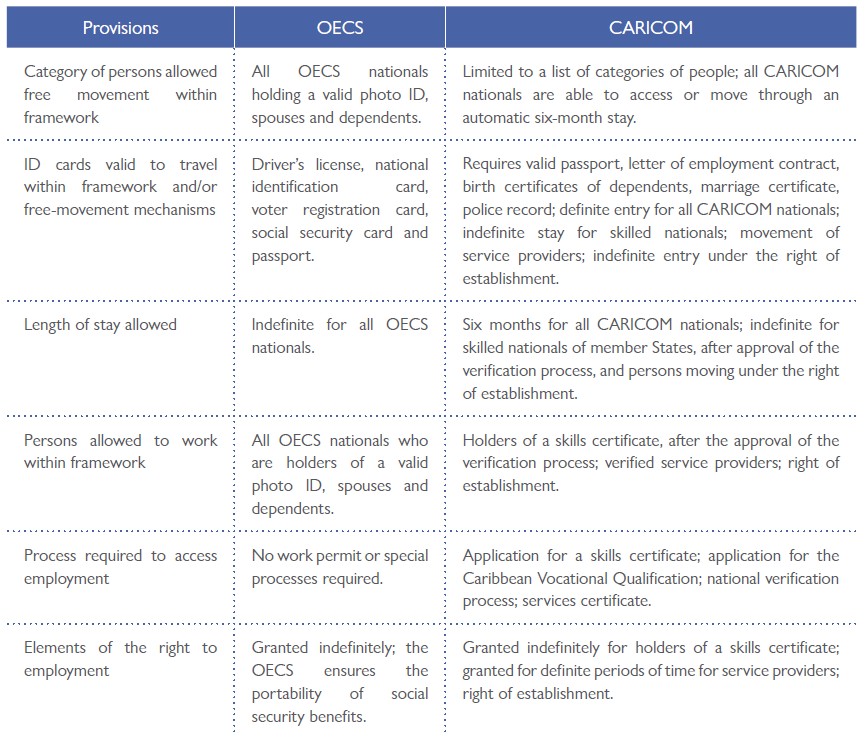
    The position, however, is not quite so encouraging when looking at the wider Caribbean. The Caribbean Community (Caricom), through the Caricom Single Market and Economy (CSME), allows for the free movement of skilled and professional persons but not for general free movement. Nor does the CSME include specific provisions for disaster displacement. In effect, the IOM report notes, “the free-movement regime developed under the CSME is focused on addressing skilled labour migration and economic integration, with limited consideration or reference to environmental migration or disaster displacement”. However, in the wake of Hurricane Maria, certain requirements were waived for displaced Dominicans.

    Table 1 below shows the difference in free-movement requirements between the OECS and Caricom.

    Table 1: Free Movement within Eastern Caribbean States

    Source: International Organization for Migration

    Keith Mitchell, the prime minister of Grenada and OECS chairman, used his address to the conference to reiterate the need to base assistance to vulnerable states on something other than GDP per capita income. He said: “For all our countries, the experiences of environmental hazards are the same. Significant loss in GDP, decimation of our agriculture and tourism sectors, loss of precious lives, significant displacement of people, and decades of economic development gains lost in just one major disaster.”  For this reason, he added, “we continue to advocate for the incorporation of a multi-dimensional Vulnerability Index”. In order to enable countries in the region to “build back better” following environmental shocks such as major hurricanes, financial institutions will need to give consideration to the extreme vulnerability of SIDS to these types of shock.

  • MEXICO: Remittances reach record levels

    Patrick de Courcy 10 December 2021 Hits: 905

    A report published on 17 November by the World Bank (WB) and the Global Knowledge Partnership on Migration and Development (KNOMAD) highlights that growth in remittance flows in 2021 has been exceptionally strong in Latin America and Caribbean. Remittances towards the region are likely to reach a new high of some US$125bn, up 21.6% on 2020. Within the region, Mexico has been the main recipient – accounting for 42% of the total, which is projected to add up to US$52.7bn by end 2021, due to extraordinary 25% growth rate in the first nine months of 2021, US$7.3bn more than compared to the same period of 2020. Mexico was the third main remittance recipient globally after India and China this year.

    The report notes that the growth of remittances within the region was largely due to the post-coronavirus (Covid-19) pandemic economic recovery in general, and in particular to the fiscal assistance measures adopted in host countries, especially the US. Other contributing factors were the high number of migrants, the recovery of employment levels - notably within the US’s construction sector, where Hispanics are widely employed -, and the effects of natural disasters, particularly hurricanes Ida and Grace. The relatively high number of migrants in transit, and migrants stranded in Mexico, particularly from Central America, seem have been a significant factor in the rise in remittances into the country, as relatives tried to help migrants to support themselves and pay smuggling fees. The report highlights that the number of foreign-born undocumented persons in the country increased to 264,772 during the first nine months of the year, above the 142,694 recorded in all of 2020. The fact that Mexico was the country of the G20 that recorded the lowest cost to receive remittances, with 3.5% on average (compared to 5.5% on average for sending US$200 to the region in 2021), is similarly likely to have contributed to the rise in remittance flows.

    Remittances are likely to exceed foreign direct investment (FDI) in Mexico. While Mexico’s FDI during the first half of the 2021 totalled US$18.4bn, according to economy ministry figures, remittances added up to US$23.65bn during the same period. Indeed, President Andrés Manuel López Obrador on 5 November singled out the fact that as of September remittances had totalled US$37.3bn and were likely to exceed total FDI to Mexico in 2021 as one of “several pieces of good news regarding economic matters” and a sign that Mexico was on the road to a healthy recovery. However, specialists disagree. According to Carlos Capistrán, economist for Mexico and Canada at Bank of America Securities, this is a particularly worrying development because it shows that Mexico has not recovered its pre-pandemic production levels, even though the US has been growing at particularly high rates. Capistrán points out that while retail sales in the US are 20% above pre-pandemic levels, in Mexico they are 10% lower than before the start of the pandemic. Similarly, investment levels are 20% below what they were in 2013, which is nothing to celebrate.

  • COLOMBIA: Tapping the San José’s US$20bn treasure

    Patrick de Courcy 22 March 2024 Hits: 2394

    If all goes according to plan, the first precious objects will be lifted from the shipwrecked San José galleon in the coming weeks, over three centuries after it was sunk in an epic naval battle off the coast of Cartagena.

    The exploratory mission announced in February by the Colombian government is officially an archaeological expedition designed to see if and how the precious cargo can be lifted by taking various samples to the surface. But the mission, which is to be carried out by a remotely controlled submarine acquired by the Colombian navy for that very purpose, has far-reaching economic and geopolitical consequences. The riches of gold, silver, and emeralds on board are estimated by some accounts to be worth around US$20bn. That would finance the Colombian government’s current budget for science, technology, and innovation for roughly 200 years.

    The expedition consolidates Colombia’s de facto control over the shipwreck that its navy discovered in 2015, some 600 metres below sea level near the island of Barú. The de facto control is significant because several parties lay claim to the bounty.

    The San José is seen by maritime adventurers as the holy grail of lost treasures, shrouded in a drama of epic proportions that ended with its sinking by a British squadron under Admiral Charles Wager in 1708. During that final voyage, the ship, with nearly 600 crew members and 64 cannons, is believed to have been carrying around 200 tonnes of gold coins, silver, and emeralds from Spanish colonies that were to help finance King Philip V in the War of the Spanish Succession.

    Whose is it?

    An American company called Sea Search Armada (SSA) claims it discovered the whereabouts of the San José in 1981 as part of an exploration accord with the Colombian government. But both sides failed to agree on any possible proceeds and SSA was denied the right to carry out any salvage operations. Decades of legal battles ensued, with SSA losing two court cases in the US.

    Spain too claims rights to the cargo, arguing the ship and its contents were owned by the Spanish crown at the time of its sinking. The Spanish government has offered Colombia a ‘bilateral agreement’ for the preservation of the treasure.

    In a separate case, Spain in 2012 won a court ruling that forced a US salvage company to hand over a US$500m treasure it had pulled out of the Nuestra Señora de las Mercedes, a galleon that sank off Portugal’s Atlantic coast in 1804.

    There is also a claim from Bolivia’s Qhara Qhara indigenous people who argue the gems and precious metals are theirs because their ancestors were forced by Spaniards to mine them in sacred lands in and around the Cerro Rico mine in Potosí.

    The legal situation regarding the ownership of the San José, and many other shipwrecks for that matter, is complex. The original owner of the ship can lay claims to recover its property, as can the country in whose territorial waters it lies. There is also a legal concept under which a country can claim sovereign immunity for state-owned, non-commercial ships – a sort of diplomatic status for property abroad. The 2001 Unesco Convention on the Protection of Underwater Cultural Heritage captures some of these concepts, but Colombia is not a signatory to it.

    In December 2022, SSA launched arbitration proceedings against Colombia citing the US-Colombia Trade Promotion Agreement and the arbitration rules of the United Nations Commission on International Trade Law, arguing expropriation of its interests in the discovery of the San José.

    Act of sovereignty

    Colombia’s President Gustavo Petro has made clear he is not interested in any type of negotiation or settlement that would lead Colombia to share the spoils. He wants the ship raised before his term ends in 2026. Colombia in 2013 approved a law stating that any sunken treasures in its territorial waters are part of its national heritage and must therefore be protected. The exact location of the shipwreck is a state secret.

    The first expedition to the galleon in April or May will cost Colombia Col$17.9bn (US$4.5m) and is being run by the culture ministry, the institute of anthropology and history (Icanh), the army, and the defence ministry’s maritime division (Dimar).

    Imagery taken during a previous exploratory dive by a remotely operated underwater vehicle (ROV) shows remains of the hull emerging out of the seabed, with loose cannons, porcelain cups, gold coins and clay caskets strewn over the site. One cannon had the place and date of manufacture stamped on its barrel: Real Fábrica de Artillería de Sevilla 1655.

    It will be a robotic arm of the British-Swedish ROV, Lynx, controlled via satellite from the Colombian navy ship ARC Caribe, that will bring in the first artefacts.

    At stake is not only the fate of the San José. In its immediate vicinity two more sunken ships have been found and the Colombian navy has identified some 200 ‘anomalies’ on the ocean floor that it suspects could be shipwrecks.

  • CHILE: Electoral success marred by sexual harassment claims

    Patrick de Courcy 28 November 2024 Hits: 1488

    There was good and bad news for President Gabriel Boric this last week. The good: his left-wing coalition performed well in the second round of gubernatorial elections on 24 November. The bad: he faces a historical sexual harassment case with questions being asked about whether his government has handled it appropriately.

    After a tough time in the opinion polls, President Boric was able to enjoy a very brief period of good news. The ruling coalition performed better than expected in the second round of the gubernatorial elections. Chile has 16 regional governors. As a result of the elections, the ruling coalition will govern in seven of them, while three more will be held by sympathetic independents. The remaining six were won by the right-wing Chile Vamos coalition. Boric was particularly pleased that in the Metropolitan Region of Santiago, the largest in the country, the incumbent Claudio Orrego, an independent backed by the government, secured re-election, defeating a far-right populist rival.

    Then came the morning after: the bombshell accusation that Boric had sexually harassed a woman a decade ago in the city of Punta Arenas, the capital of the southernmost region of Magallanes where he was completing a law degree.

    According to Jonatán Valenzuela Saldías, Boric’s lawyer, the complaint was filed by a woman who at the time had sent him 25 unsolicited and non-consensual emails, including one with “explicit images that were not requested or consented to”. Valenzuela Saldías said the allegations were “baseless” and Boric was actually the victim rather than the perpetrator. Boric, his lawyer said, had only become aware of the complaint through a routine review, and had decided to make it public.

    The allegations against Boric came shortly after a key government official, the former deputy interior minister, Manuel Monsalve, had to resign and was arrested facing charges of raping a 32-year-old female member of staff in a Santiago hotel. For a government committed to women’s rights, which claims to be feminist in outlook, having two very high-profile cases of alleged sexual abuse running in parallel is not a good look.

    From the government’s point of view things may yet get worse. In the Monsalve case opposition parties have accused the government of trying to keep the case hushed-up for 48 hours as it tried to decide what to do. It now seems that in the Boric case there are also some unanswered questions about procedures and timing that could provide further political embarrassment.

    • Mea culpa in Monsalve case

    Chile’s interior minister, Carolina Tohá, appeared before congress on 25 November to face questions about the government’s handling of the resignation of Manuel Monsalve. Monsalve stepped down on 17 October, but President Boric and Tohá have come under heavy fire for failing to adequately account for a 48-hour delay in forcing his resignation after they became aware of the accusations against him. In her appearance before an investigative commission in the lower chamber of congress, Tohá admitted that “clearly it would have been better [to have removed Monsalve] on 16 October”.

    Once more there appears to have been a delay, this time of around a month. The accusation against Boric was submitted by the complainant to the regional prosecutor’s office in Magallanes on 6 September. Government spokeswoman Camila Vallejo said the government first knew about the case on 9 September because of regular routine research of prosecution records. Cabinet ministers were told on 14 October before the municipal and regional elections. The case was made public by Boric’s lawyer on 26 November.

    The known timeline raises several questions. The far-right opposition Partido Republicano (PR) has accused the government of deliberately delaying the news in order to avoid losing votes in the gubernatorial elections.

    News website Ex-Ante has claimed that Vallejo may have publicly revealed the committing of a crime when she spoke of “researching prosecutor records”: under Chilean law the files in sensitive cases such as these are secret and government officials have no right to access or “research” them. The prosecutor’s office (Ministerio Público) has opened its own investigation into “illegal or undue access to case files in the matter relating to his excellency President of the Republic Gabriel Boric Font”.

  • BOLIVIA: Shift to the right confirmed in regional elections

    Patrick de Courcy 26 March 2026 Hits: 1014

    The regional and municipal elections that were held in Bolivia on 22 March confirmed the political fragmentation that followed the implosion of the long-ruling left-wing Movimiento al Socialismo (MAS) in last year’s general elections.

    Of the nine gubernatorial elections, only two were won outright, with another still awaiting confirmation following a recount. At least six of the contests will go to a second round. René Joaquino, of the left-wing Alianza Social (AS), and Gabriela de Paiva, of the right-wing Libre, won convincingly in their respective departments of Potosí and Pando. Leonardo Loza, a close ally of former president Evo Morales (2006-2019), may also have scraped a first-round victory in the Cochabamba gubernatorial election, with a recount underway. Loza represents the Alianza Unidos por los Pueblos (AUP) coalition, which is supported by Morales. The MAS did not field any candidates and remains riven by a three-way split between Morales, former president Luis Arce (2020-2025), and former senate president Andrónico Rodríguez (2020-2025).

    President Rodrigo Paz will be hopeful after his right-of-centre Patria coalition proceeded to the run-off in four gubernatorial elections in Beni, Chuquisaca, La Paz, and Tarija.

    At the municipal level, notable outcomes included the taking of the capital La Paz by centrist César Dockweiler (Innovación Humana, IH), Manfred Reyes Villa winning another term as Cochabamba mayor for the right-wing Autonomía para Bolivia – Súmate (APB-S), and the eastern city of Santa Cruz, Bolivia’s main economic hub, being won by the right-wing Manuel Saavedra (VOS) with over 71% of the vote.

    Camacho fails to make comeback

    The gubernatorial election in Santa Cruz department failed to deliver a comeback for former governor Luis Fernando Camacho (2021-2024), who was released from prison in August last year after being detained on controversial terrorism charges since December 2022. Camacho, of the right-wing Creemos, came third in the election, which will go to a run-off between two other right-wingers – Juan Pablo Velasco (Libre), and Otto Ritter (Santa Cruz para Todos, SPT).

  • RASTREANDO TENDENCIAS

    LatinNews 03 December 2012 Hits: 411

    MÉXICO | Gran hallazgo de petróleo en tierra firme. La compañía petrolera estatal de México, Pemex, ha hecho el “más importante” hallazgo de petróleo en tierra firme (onshore) en México en la última década, anunció el Presidente Calderón esta semana. Este es el tercer descubrimiento importante anunciado por Calderón en las últimas semanas, después de los dos significativos descubrimientos offshore hechos en aguas territoriales mexicanas en el Golfo de México [IL-12-40].

    Calderón hizo el anuncio en la inauguración de una nueva planta criogénica en Poza Rica, Veracruz, uno de los principales estados productores de petróleo. Él dijo que Pemex había hallado 500m de barriles de reservas 3p (probadas, probables y posibles) de crudo liviano en el pozo Navegante I en el vecino estado de Tabasco, a 20kms de la capital del estado, Villahermosa. Pemex ahora está perforando otros pozos cercanos, creyendo que Navegante I podría ser parte de un sistema que contiene más de 1mm barriles de petróleo.

    En una declaración oficial, Pemex dijo que el pozo había sido perforado en la formación geológica de las Cuencas del Sureste a unos 6.800 metros debajo del suelo, gracias a un “diseño tecnológico especial”, que condujo al descubrimiento de “crudo liviano de 45 grados API”. La declaración agrega que Pemex espera que Navegante I entre en producción a fines del próximo mes.

    Calderón señaló que esta era una “muy buena noticia” para el país, pues el descubrimiento “incrementa las posibilidades futuras de Pemex”. El señaló rápidamente que el descubrimiento fue hecho gracias a la reforma parcial del sector de la energía promovida por su gobierno, que abrió el camino para una limitada inversión del sector privado, y a los M$1mm (US$77m) invertidos en los esfuerzos de exploración. Él dijo luego que esta estrategia general de atraer más inversión privada y conducir más exploración “debe continuar”, señalando que los recientes descubrimientos “no eran coincidencia”.

    Todo esto, solamente reforzará el caso para la apertura de Pemex a más inversión del sector privado para que así la firma pueda convertirse de nuevo en uno de los productores líderes de petróleo en América Latina, como hace tiempo viene abogando Calderón, pocos días antes de la programada entrega del poder a su sucesor Enrique Peña Nieto, el 1 de diciembre. A pesar del hecho de que su propio partido tiene una actitud de sospecha hacia estas medidas, Peña Nieto ha indicado que su gobierno entrante asumirá la causa, creyendo que ayudará a propulsar el desarrollo económico de México.

  • BRAZIL goes begging

    LatinNews 28 February 2013 Hits: 2431

    The normally controversial finance minister Guido Mantega was on his best behaviour in New York this week, where he began an international road show seeking upwards of US$230bn in infrastructure investment. Mantega and his entourage plan to woo investors in the US, Europe and Asia in the next couple of weeks, and in support of that effort President Dilma Rousseff is also firmly on message back home, pledging clear rules of the game and a stable operating environment for investors. Having belatedly realised that private investors were scared off by the rolling and unpredictable policy changes of the past two years, the Rousseff administration is on a major charm offensive to win them back. Brazil bears have been unable to resist a bit of schadenfreude.

    Fourth quarter GDP figures, due out on 1 March, are expected to show that Brazil grew just 1% annually last year, with investment falling for a sixth consecutive quarter. At just 18.7% of GDP, the rate of gross fixed capital  investment is one of the lowest in the region. In the open export-led Andean economies of Peru and Chile, for instance, investment is running at 24%-25% of GDP. In Brazil’s main trade partner China, it is a whopping 48%.

    Critics of the government run since 2003 by the left-wing Partido dos Trabalhadores (PT) warn that the country’s long run (since 2004-2005) on the back of a lengthy commodities-fuelled consumer boom has finally ended, and that the Rousseff administration’s penchant for micro-managing (in a well-intended effort to maintain growth) has had the unintended effect of deterring private investment, with the industrial sector tanking as a result.

    The Rousseff team now seems to have come round to the idea that it might be better to let the private sector get on with it, and instead of hyperactively intervening with abrupt (and often schizophrenic) changes to monetary, exchange rate, tax and trade policies, to work to facilitate investment-led growth by tackling the main structural obstacles holding that back, like the exorbitant ‘Custo Brasil’.

    It is also the case that under Mantega the finance ministry has had real trouble with the basic stuff - like communications - to the point that The Economist newspaper late last year called on Rousseff to sack him, a call she pointedly ignored. According to the conservative daily O Estado, the finance ministry recently brought in a new private communications team to ‘re-brand’ and rebuild the ministry’s frayed relations with the business sector and the financial community, both in Brazil and abroad.

    The shiny new ‘Brazil is open for business’ message  and the ‘crusade’ against the Custo Brasil comes ahead of Rousseff’s bid for re-election in October 2014, ahead of which she and the PT desperately need to deliver stronger  - and more sustainable - growth. And that means rebalancing the economy.

    At an event on 27 February to mark 10 years since the PT’s creation of the council for economic and social development (Conselhão), Rousseff made a clear gesture to the markets in reaffirming her government’s commitment to the three pillars of Brazil’s macroeconomic policy stance - monetary stability, a floating exchange rate and fiscal stability. She also admitted frankly that there are limits to State action. Moreover, the president insisted that inflation was not out of control in Brazil, noting that stable inflation is a policy priority in itself. In the past week Mantega and the central bank president Alexandre Tombini have sent the strongest signals yet that interest rates may go up in response to stubborn inflation – that will also be music to the ears of financial investors.

    Tackling the Custo Brasil is no easy task, as evidenced by the continued port workers’ strike against the government’s new public-private reform plans for the sector. And it is unclear where the government’s micro-managing boundaries lie. For instance, Mantega appears to have rejected, for now, the urgent demands of the state oil company Petrobras for another increase in pump prices. His motivation is clear, given the inflation pressures; but with little market appetite for any new debt issues the cash-strapped Petrobras has now followed its regional counterparts in running into the arms of China. Energy Minister Edison Lobão this week said that Petrobras is seeking help from the Chinese state oil company Sinopec to finish building its new refineries Premium I, in  Maranhão, and Premium II, in Ceará. Lobão admitted to journalists that the refinery works in Maranhão were delayed due to “a certain financial difficulty”. Maria das Graças Foster, the Petrobras president, is in China this week personally overseeing the negotiations.

    Lobão also said that the pending round of concession auctions for the ‘pre-salt’ deepwater oil sector would take place from May. That may be wishful thinking; the supreme court plenary this week threw out a previous ruling by one of its magistrates, Luiz Fux, that effectively prevented the congress from going ahead with an urgent motion to throw out Rousseff’s veto over parts of the new regulatory framework for the distribution of oil royalties. The president vetoed sections of the new framework - which adjusts the way oil royalties are distributed between producing and non producing states - on constitutional and legal grounds, as they retroactively amended existing contracts. The congress seems set on defying the president, in which case the oil and gas auctions will not take place.

    Rousseff also took the opportunity on 27 February to rebuff the opposition’s rather personal insults. Speaking in Roussseff’s home town of Belo Horizonte, former president Fernando Henrique Cardoso (1995-2003) accused her of being “an ingrate” and of “spitting on the plate that she was eating from” in reference to her claims that the PT inherited a mess from Cardoso in 2003, when it first came to power under Lula da Silva (2003-2010). Like her mentor Lula, Rousseff has long refused to give any credit to Cardoso’s claims that his administration laid the foundations for Brazil’s economic ‘miracle’ under Lula.

    What of Abreu e Lima?

    Venezuela’s state oil company Petróleos de Venezuela (Pdvsa) has yet to fulfil its end of the bargain in the joint Abreu e Lima oil refinery with Brazil’s state oil giant Petrobras. Located in Brazil’s north-eastern state of Pernambuco, in its original vision, as imagined by President Hugo Chávez and his Brazilian ally, former president Lula, the refinery would help to promote the two countries’ industrial integration process by having the capacity to process Venezuela’s heavy crude.

    Under a deal struck between Chávez and Lula in 2008, Petrobras would provide the facility and Pdvsa the cash, in a 60%-40% joint venture deal. In the end, Petrobras was saddled with both building the refinery and shouldering the estimated US$15bn cost. Having effectively written off Pdvsa’s participation, it is now unclear whether the refinery will include any heavy crude processing capacity at all. In the initial scheme, about half of the planned 230,000 b/d refining capacity was to be used for heavy crude.

    Petrobras’s chief financial officer, Almir Barbassa, told the oil daily Platts in October 2012 that the refinery would begin operations in 2014, a year behind schedule. He said that the refinery would be “60% complete” upon start-up, indicating the strained cash flow at Petrobras as it tries to develop its new deepwater offshore oil fields. Barbassa also made clear that Petrobras’s three other planned new refineries are aimed at meeting Brazil’s growing demand for middle distillates. The oil coming out of Brazil’s new offshore sector is light, sweet crude; and so the country has no real need for heavy refining capacity, which is both expensive and more time consuming.

    Tiririca’s experience

    Brazil’s most voted deputy in the 2010 parliamentary elections, the former clown turned-politician Tiririca, has announced that he will step down from politics once his term ends in 2014. He is putting out a new record in which he sets out his disenchantment with politics, singing that congressionals are all talk and no action. He hopes to return to the entertainment industry, where he argues he can do more for the Brazilian people by making them smile. (He also says that he can earn more in a night on the circuit than in a month in congress).

    Lula’s martyr complex

    Former president Lula has compared himself to the US president Abraham Lincoln, drawing parallels between the press attacks on Lincoln in 1860 and the attacks on him by Brazil’s conservative press and political opposition. “And he didn’t have the internet to respond, he had to wait for the telegraph,” Lula joked. Speaking at an event to mark 30 years since the founding of the Central Única dos Trabalhadores (CUT), Lula called on the CUT to organise a communications group to create space for “the progressives”, so that social movements and unions would not have to rely upon traditional media.

  • TRACKING TRENDS

    LatinNews 16 April 2014 Hits: 1748

    CUBA | Diplomatic frenzy. Laurent Fabius became the most high-ranking French minister to visit Cuba for more than 30 years on 12 April. Fabius, the French foreign minister, visited Havana after accompanying President François Hollande on a state visit to Mexico. He held talks with his peer Bruno Rodríguez and President Raúl Castro. The visit takes place after Frans Timmermans became the first Dutch foreign minister to visit Cuba since the Revolution in January and shortly before the European Union (EU) is scheduled to recommence talks with Cuba in Havana on 29 April over trade, investment and human rights. Fabius said the approval by Cuba last March of a new law designed to entice new foreign investors [WR-14-13] was encouraging.

    On the same day as Fabius visited Havana, President Castro also held talks in Havana with El Salvador’s President-elect Salvador Sánchez Cerén. El Salvador established bilateral diplomatic ties with Cuba in 2009 for the first time since their severance after the Cuban Revolution. Sánchez Cerén made a point of visiting Central American neighbours and the Dominican Republic rather than starting with a special pilgrimage to Cuba, which the left-wing Frente Farabundo Martí para la Liberación Nacional (FMLN) announced he was visiting for medical reasons. He will head to the Vatican on 25 April for an audience with the Pope. The FMLN, although deeply influenced by the Cuban Revolution, never shared its anti-religious doctrine.

    EL SALVADOR | Military and political reform. The foreign media focused this week on a ruling by the constitutional chamber of the supreme court on 11 April that the use of the military to patrol crime hot spots did not contravene a provision of the constitution restricting its role in domestic security, and was justified by the “exceptional” levels of crime and insecurity in El Salvador. While this was significant, in the long-term developments on 12 April, unreported by the foreign media, could be even more so. The right-wing opposition Alianza Republicana Nacionalista (Arena) held a post mortem after its electoral defeat last month, during which 700 party members demanded sweeping internal reforms to make the party more electable. The main thrust of the recommendations to emerge from the congress, which will be amended and approved by an Arena national assembly on 3 May, were aimed at democratising Arena, especially the use of the secret vote and primary elections to end the imposition of mayoral and legislative candidates by party bigwigs.

  • ARGENTINA: Preparándose para la temporada de las primarias

    LatinNews 13 March 2015 Hits: 681

    Dentro de un mes, el 12 de abril, la provincia de Salta celebrará la primera Primaria Abierta Simultánea y Obligatoria (Paso), abriendo la para la temporada de elecciones en la Argentina. Santa Fe y Mendoza seguirán el camino poco después, y el 26 de abril la ciudad de Buenos Aires realizará sus primarias para las posiciones de alcalde, diputados y concejales de la ciudad. La semana pasada, las autoridades electorales anunciaron el cierre oficial del periodo para registrar candidatos para las primarias en la ciudad de Buenos Aires. El resultado de la elección para la alcaldía de Buenos Aires, que debe celebrarse en julio de este año, podría ayudar a determinar los resultados de las elecciones generales, proveyendo un impulso para cualquiera que sea el partido que gane el segundo cargo electoral más importante de la Argentina.

    Se han registrado 20 candidatos para competir por la alcaldía de Buenos Aires, con algunos de los principales partidos políticos del país presentando más de un candidato. La facción gobernante del Partido Justicialista (PJ, Peronistas), el Frente para la Victoria (FPV, Kirchneristas) ha registrado a cinco contendientes, mientras que el partido de centro-derecha Propuesta Republicana (PRO), del actual alcalde de la ciudad de Buenos Aires (y aspirante a la presidencia de Argentina), Mauricio Macri, ha presentado a tres.

    La facción Peronista disidente, Frente Renovador (FR), de Sergio Massa, un ex kirchnerista convertido en líder opositor que también compite por la presidencia, ha registrado a un solo candidato, Guillermo Nielsen, un economista. Un triunfo en la ciudad de Buenos Aires ya sea para el FR o el PRO podría proveer a Massa o a Macri un impulso útil para sus campañas presidenciales.

    Al tope de la lista del FPV está Mariano Recalde, actualmente presidente de la aerolínea del Estado, Aerolíneas Argentinas. La campaña de Recalde recibió un impulso esta semana, luego de develar el nuevo Airbus 330/200 de la aerolínea. La misma Presidenta Cristina Fernández asistió a la ceremonia de bienvenida del 70mo avión de la flota de la aerolínea, en el aeropuerto internacional Ezeiza de Buenos Aires. Fernández se declaró estar “inmensamente orgullosa” de los logros de la aerolínea. La competencia de Recalde para la nominación del FPV proviene de cuatro diputados nacionales del FPV.

    Candidatos de la oposición

    Por el PRO, los tres candidatos son: Cristian Ritondo, actualmente miembro de la asamblea de la ciudad de Buenos Aires; Gabriela Michetti, una senadora nacional; y Horacio Rodríguez Larreta, actualmente jefe de gabinete de la ciudad de Buenos Aires.

    Energía Ciudadana Organizada (ECO), una coalición de partidos nacionales de oposición de centro-izquierda, también ha registrado a tres candidatos. Los contendientes restantes son principalmente de partidos más pequeños de extrema izquierda.

    • La ex esposa de Nisman alega asesinato

    Alberto Nisman, el fiscal especial en la investigación del atentado a la Amia, no se suicidó, sino que fue asesinado, de acuerdo con su ex esposa, Sandra Arroyo Salgado. Arroyo, una jueza federal, dijo que un equipo de expertos forenses independientes había concluido que no era posible que Nisman se haya disparado él mismo. Viviana Fein, la fiscal a cargo de la investigación oficial sobre la muerte de Nisman, ha dicho que ella considerará el informe.

  • BRAZIL: New Year, same worries

    LatinNews 08 January 2016 Hits: 5

    In an editorial published in the Brazilian daily Folha de São Paulo on New Year’s Day, President Dilma Rousseff acknowledged that 2015 had been “a very hard year”. She expressed confidence, however, that Brazil would end 2016 in much better shape than most analysts predict. So far, however, there is little to justify that optimism. The weekly survey of 100 economists by the central bank found a majority predicting that Brazil would suffer its worst recession since 1901, with GDP growth for last year coming in at -3.71% and -2.95% in 2016. On some estimates, by the end of 2016, the Brazilian economy is expected to be 8% smaller than it was at the beginning of 2014.

    The new finance minister, Nelson Barbosa, has his hands tied. Twelve-month inflation is now running at over 10%. While the director of the central bank, Altamir Lopes, said that the institution would adopt whatever policies are necessary to bring it down to its 4.5% target, interest rates are already at 14.25%. Meanwhile, the president of the ruling Partido dos Trabalhadores (PT), Rui Falcão, said Brazil should refrain from cutting investments and consider raising inflation targets to avoid higher borrowing costs.

    While many of Brazil’s problems are of its own making, it is also facing an extremely unfavourable external scenario. China’s slowdown continues, with a new Purchasing Managers’ Index (PMI) survey showing activity in the service sector down to its lowest level in 17 months. Meanwhile, the US Federal Reserve’s decision to raise interest rates has hurt the currency values of many emerging markets, including Brazil. On 3 January, Stanley Fischer, the vice-chairman of the Fed, indicated that rates might go higher still if markets showed signs of overheating.

    In early January, the real slipped over the psychologically significant four to the US dollar threshold. Attempts by the Brazilian central bank to shore up the currency are having little effect. On 6 January the central bank revealed that it had spent almost R$90bn (US$22.3bn) in 2015, up 419% on 2014, on foreign exchange swaps to prop up the real.

    Swaps are designed to provide a measure of stability to Brazilian businesses with dollar debts: when the US currency rises, the central bank pays the difference; when it falls, the bank pockets the money. For the foreseeable future, the bank will lose out.

    Brazilian consumer confidence, as measured by the Fundação Getulio Vargas (FGV), reached a record low in December. Business confidence also fell throughout the year. One key measure of the economy’s animal spirits, vehicle purchases, had a bad 2015. Sales were down at their lowest level for eight years, while the sector showed its sharpest decline for practically three decades. In total, 2.57m units of cars, lorries and buses were sold, a decline of 26.6% compared to 2014. While many vehicles are assembled in Brazil, many car parts are imported.

    The fall in the value of the real has weighed down the automobile industry, as has both an increased tax burden and the high level of inflation. As a result many vendors have been compelled to put up prices, with the result that demand has been further depressed.

    The good news

    Amid the gloom, some unexpected pieces of good news. Unemployment levels dropped in November. According to the official statistics institute (Ibge), unemployment fell 7.5% in November, compared with 7.9% in October, though some analysts have attributed this to companies taking on extra sales staff in the run-up to Christmas. But retail sales also rose in October, in comparison to the month before.

    Fear of unemployment among Brazilians also decreased slightly in December, according to a survey commissioned by the national industry confederation (CNI). The same survey also showed a slight improvement among Brazilians’ perception of life satisfaction, although the CNI said in a statement that it was too early to say whether the numbers marked the start of a more positive trend for sentiment in Brazil.

    • Carnival & Car Wash

    As Rio de Janeiro gears up for Carnival, a factory in São Gonçalo has started production of ‘The Japanese Fed’ face-mask, in honour of the police officer of Japanese origin usually seen in photos of the arrest of high-profile Brazilian businessmen and politicians in the ‘Operation Car Wash’ scandal surrounding the state-run energy company Petrobras. Newton Ishii already has a popular “marchinha”, a type of Carnival song, singing his praises.

  • ECONOMIC OVERVIEW: CHILE

    LatinNews 19 July 2017 Hits: 1269

    Growth forecast cut: On 10 July Chile’s finance minister, Rodrigo Valdés, announced that the Michelle Bachelet government has updated its growth projections for 2017 and is now forecasting that GDP will grow by 1.5% this year, down from the 2.25% forecast made in September 2016. Valdés said that economic activity has been impacted by the miners’ strikes (see sidebar), while the country has also had to deal with unforeseen issues such as widespread forest fires in the south earlier this year. Meanwhile the latest figures for the monthly economic activity index (Imacec), released by Chile’s central bank (BCCh) on 5 July, shows that there was a 1.3% increase in economic activity in May compared with the same month last year. The mining Imacec was down by 4.6%, while the non-mining Imacec was up by 1.9%.

    Lithium: On 10 July Eduardo Bitran, the vice-president of the Chile’s economic production promotion agency (Corfo), announced that 12 companies from seven different countries had presented projects to manufacture value-added projects from the country’s lithium. The winning project will secure a steady supply of the metal at a favourable price, part of a deal Corfo made with US-based lithium producer Albemarle Corp, which has operations in Chile. Bitran told journalists that the proposals include projects to create “next-generation” batteries, lithium salts, lithium metal, and several other materials. Of the 12 companies that presented projects, a quarter were Chilean, while the other nine were from China, South Korea, Belgium, Russia, Canada and the US. A Reuters newswire also cited Bitran as saying that the selection process should be completed around January 2018 and that more than one winner could be selected.

    Chile currently has one of the largest lithium reserves in the world, producing approximately 80,000 tonnes (t) of lithium carbonate per annum; a figure which is expected to rise to 150,000t by 2021. An agreement approved on 4 January between Corfo and Albermarle (which owns a plant in which lithium carbonate from the Salar de Atacama is produced), requires that a percentage of the lithium extracted in Chile be manufactured domestically. This means Chile can export higher value-added products and develop a domestic industry around this increasingly sought-after resource. Bitran hailed the latest interest in Chile’s lithium as a “great success”, stating that as a result Chile would be able to enter fully into the global electromobility industry.

    • Escondida losses

    The local press has reported that the La Escondida copper mine, which is controlled by the Australian-headquartered multinational miner BHP Billiton, registered losses of US$184m in the first quarter of 2017, down 169% compared with the same period last year. This stems from the 44-day-long miners’ strike that ended on 23 March, which resulted in a 63% fall in production at La Escondida compared with the same period last year, with the mine producing 97,103 tonnes (t) of copper during the period.

  • BRAZIL: Dirceu release: a precedent for Lula?

    LatinNews 28 June 2018 Hits: 573

    The second circuit of Brazil’s supreme court (STF) took a 3-1 decision on 26 June to release a senior former cabinet minister, José Dirceu, pending the outcome of his appeal against a sentence of 30 years and 9 months for corruption, money laundering, and illicit association. The ruling could set a favourable precedent for former president Lula da Silva (2003-2011), also currently serving a prison sentence.

    Dirceu is a disgraced former right-hand man to Lula. He was president (1995-2002) of the Partido dos Trabalhadores (PT), the left-wing party Lula founded, and went on to serve as Lula’s chief-of-staff to the presidency (2003-2005). Notoriously, Dirceu was a key player in Brazil’s two major corruption scandals of the last decade: the ‘mensalão’ scandal (cash-for votes in congress) and ‘Lava Jato’ (contract rigging and political bribes in the state-run oil company Petrobras).

    Dirceu has been in prison since 18 May when a regional court, TRF4, rejected an appeal on his behalf. The court confirmed the earlier sentence, and ordered his imprisonment invoking a 2016 STF decision that allows a sentence to be executed once a defendant’s first appeal has been unsuccessful, even though further appeals may be in the pipeline.

    Despite this, on 26 June the second circuit of the STF accepted a habeas corpus writ and ordered Dirceu’s release (see sidebar). The dissenting vote came from Justice Edson Fachin, who is in overall charge of the ‘Lava Jato’ case within the STF, and who, according to press reports, is finding himself in the minority in a number of recent rulings that have ended up favouring ‘Lava Jato’ defendants.

    A key issue is how this may affect Lula himself. The former president was imprisoned on 7 April in the southern city of Curitiba after a first appeal against his sentence of 12 years and one month for corruption was turned down. He faces a further six corruption cases.

    Lula’s imprisonment has not stopped the PT from nominating him as its presidential pre-candidate, nor has it prevented him from being the frontrunner (with around 30% of voting intentions according to recent opinion polls) ahead of elections on 7 October.

    The legal battle may determine how Lula and the PT uses its influence. In another positive development for the party, on 19 June the STF dismissed corruption charges against PT party president Senator Gleisi Hoffmann. The STF said there was insufficient evidence that Hoffmann had accepted illicit campaign funding in the 2010 elections.

    Lula’s lawyers, who have filed many appeals, are seeking two main objectives. The first is to get Lula released from prison pending further appeals: at large, Lula is likely to be a major electoral asset for the PT, whether as a candidate or simply as a kingmaker endorsing someone else. The second is that they would like him to be able to register formally as a presidential candidate when inscriptions open in August.

    The balance of probabilities is that they will not achieve the second objective and that Lula will be prevented from running, since existing legislation specifically bans citizens whose criminal convictions have been upheld on first appeal from running for elected office. Under the ‘Lei da Ficha Limpa’, ironically signed into law by Lula himself in 2010, those who have had a guilty sentence upheld on appeal cannot stand for elective office.

    In formal legal terms, the Dirceu ruling does not set a precedent, as each case is judged on its merits. But Justice Fachin clearly fears the majority of his colleagues in the second circuit may be inclined to release Lula if the issue comes before them.

    An appeal for Lula’s release had in fact been due to be heard in the second circuit on 26 June, but Fachin used an administrative procedure to have the case switched to the full 11-member STF, where the balance of forces may be different. Bearing in mind that the STF has a winter break in July and it takes around 15 days to get a hearing scheduled, this means that Lula’s case will probably not be heard until August.

    Lula the football commentator

    Being locked up has not prevented former president Lula from experimenting with a new role. He has been sending his written comments on the Brazilian team’s progress in the Fifa World Cup to his friend, sports radio and television journalist José Trajano, who has been reading them out on air.

    On the Brazilian team’s first tie with Switzerland, Lula said “the truth is that we did not play well and the opponent did what they had to do, which was to block Brazil”.

    Under Brazilian law prisoners cannot give media interviews, but they have a right to write letters. Lula’s football letters, while apparently non-political, do give the former president valuable air time in a country where the links between football and politics are always close.

    Lula is not alone in trying to seize on public interest in the World Cup. In Venezuela, which did not even qualify for the competition, the central bank (BCV) released an advertisement in which a BCV team in a blue and white strip play against a team in a black kit emblazoned with names such as ‘economic blockade’, ‘international boycott’, and ‘currency attack’. The goalkeeper of the black-shirted team, called ‘economic war’, concedes a goal fired past him by a BCV striker.

    • Dirceu’s release

    STF Justices José Antonio Dias Toffoli, Ricardo Lewandowski, and Gilmar Mendes took the view that José Dirceu should be released because there was reasonable cause to believe that subsequent appeals might eventually succeed.

    • Enigmatic outlook for PT

    The political outlook for the PT and former president Lula is uncertain. But the way that uncertainty plays out may be the single most decisive factor in the outcome of this October’s presidential contest. Although the PT insists it has no ‘Plan B’ to nominate another candidate, it is widely expected that Lula will ultimately endorse someone else, and that this endorsement could swing the election results.

  • TRACKING TRENDS

    LatinNews 06 September 2018 Hits: 784

    EL SALVADOR | Exports to China up. Shortly after the government led by President Salvador Sáncez Cerén severed ties with Taiwan in favour of mainland China, El Salvador’s central bank (BCR) released a report, on 31 August, showing that, in the first seven months of 2018, the country’s exports to China were up by 197.8% to reach US$83.2m, while imports were US$873.5m, up 13%.

    Overall exports were up 3.6% over the same period to reach US$3.56bn, while imports amounted to US$6.73bn, up 12.2%.

    PANAMA | First LNG plant inaugurated. The Panamanian government led by President Juan Carlos Varela and energy company AES have inaugurated Central America’s first electricity generation plant based on natural gas. Varela said this had positioned Panama as “a liquefied natural gas [LNG] distribution hub in the region”. Costing US$1.15bn to construct, the plant is located in Colón city, the capital of the eponymous province, and has a capacity of 381MW.

    Varela said that “this work is another example of what can be achieved when we join the efforts of government and private enterprise”, pointing out that AES Panama is currently a mixed capital company of which the Panamanian state has 50.5%. The rest is owned by a subsidiary of the US company AES. President Varela also highlighted that more than 2,500 direct and indirect jobs were created with the construction phase, while the production period is likely to create 200 direct jobs.

    The AES Colón Project comprises two stages, of which the LNG plant is the first. The second includes the construction of an LNG storage tank which is currently 87% complete and expected to enter into operation in 2019. Varela describes the plant as “one of the most important works carried out in the Panamanian energy sector, not only because of the magnitude of the investment, but also…the entry into the market of a new source of safe and reliable energy”.

  • URUGUAY: Tensions with military burst into open

    LatinNews 27 September 2018 Hits: 1779

    Not since Uruguay’s ruling left-wing Frente Amplio (FA) coalition came to power in 2005 have relations with the military been so strained. It was widely predicted that the FA, which comprises former Tupamaros guerrillas among its myriad factions, would have a fractious relationship with the military once in office, but for the most part this has not been borne out. Indeed, despite its congressional majority, the FA ultimately even stopped short of repealing the Ley de Caducidad amnesty law shielding the military from prosecution for human rights abuses during the dictatorship (1973-1985). But the current debate over the proposed reform of the military pension system, Caja Militar, is causing intense friction.

    The FA government led by President Tabaré Vázquez took the unprecedented decision on 10 September to hand down the most serious disciplinary sanction to the army commander, General Guido Manini Ríos: 30 days of ‘arresto rigoroso’ under Article 81 of the general regulations of discipline for military personnel. This means Manini Ríos has been confined to his private residence outside of working hours and is unable to receive visits for the duration of the sanction. But despite the severity of the sanction, Vázquez did not stamp his own authority by pushing Manini Ríos into early retirement.

    Manini Ríos was accused of contravening military discipline enshrined in the constitution by intervening in political issues through his repeated criticism of the congressional reform of the Caja Militar. This culminated in a radio interview in which he indirectly accused the labour minister, Ernesto Murro, of lying. Manini Ríos made these remarks shortly after the senate approved the reform of the Caja Militar, and Murro maintained that the resulting pensions for the military would be “generous”. Manini Ríos said this was simply not true. He won the support of some of the political opposition which described his punishment as draconian as he was merely seeking to protect the military’s rights in the absence of a union to defend their cause. The army might not be far short of twice as large as the navy and the air force (FAU) combined but it is worth noting that both Admiral Carlos Abilleira, the head of the navy, and Brigadier General Alberto Zanelli, head of the FAU, have kept a studied silence over the matter.

    Reform of the whole pension system (not just the Caja Militar) has been in the pipeline for several years due to the financial strains imposed by Uruguay’s low birth rate and high life expectancy. The social security bank (BPS) registered a deficit of US$582m in 2017 (up from US$440m the previous year), and the government had to stump up US$550m for the Caja Militar (a figure set to rise to US$700m by 2020 without reform). The combination of pension benefits and early retirement (the average military retirement age is 49) are placing a heavy burden on the state. Top military pensions are three times higher than civilian pensions: 60,000 members of the military are draining state coffers as much as the pensions of 700,000 civil servants.

    FA senators stressed that the replacement rate for retired members of the military would be between 85% and 90%, higher than any other pensioner, and that those with more than 15 years of service would be unaffected by the reform. The government insisted the reform was about “social justice”, and that military benefits were decreed under the dictatorship and had been maintained despite the fact that the whole pension regime in Uruguay was reformed in 1997.

    The main centre-right opposition Partido Nacional (PN, Blancos) contended that it was inapposite to compare the military pension with other pensions because military salaries are very low (on average just two-thirds that of a member of the police, for instance), and careers shorter. The reform bill must still go to the lower chamber of congress. PN Senator Jorge Larrañaga accused the government of “prejudice, stigmas, and resentment”, saying the government was determined “to knock down the armed forces”. Larrañaga said the PN would reverse any reform approved by congress if it wins election next year.

    Military band plays political anthem

    The fierce defence of the military by the Blancos excited serious controversy after a military band closed the Prado Expo agricultural show in Montevideo on 15 September by playing the ‘Marcha de Tres Árboles’ in front of government authorities and representatives of the Asociación Rural del Uruguay (ARU). This military march dates back to the Viceroyalty of the Río de la Plata, before being adopted by the Argentine military and later by the PN, which put words to it and converted it into the party’s anthem. The PN version celebrates the victory of the revolutionary army of Blanco Colonel Diego Lamas over government forces of the Partido Colorado (PC, Colorados) commanded by José Villar at Paso Hondo del Arroyo Tres Árboles, in the department of Río Negro, in March 1897.

    The army spokesman, Wilfredo Paiva, said the person who had chosen the repertoire had been sanctioned. He said that marches are rotated to avoid repetition and there was absolutely no intent to show political affinity with the PN or protest at the sanction of Manini Ríos. The FA called for “respect for institutional and democratic order” on Twitter, while criticising the playing of the contentious march. Defence Minister Jorge Menéndez sanctioned the second in command of the army, General Marcelo Montaner, with three days of ‘arresto simple’, meaning he was compelled to stay with his troops and not permitted any other engagements.

    The two top leaders of the PN, Larrañaga and Luis Lacalle Pou, respectively, described the playing of the party’s anthem as “irrelevant” and “inopportune but insignificant”. But it seriously offended the sensibilities of the Colorados, for much of Uruguay’s history the main political rival of the Blancos. The Colorados had been critical of the sanction of Manini Ríos, but appeared to adjudge that nothing could be more rebarbative than the army playing the PN anthem. PC Deputy Ope Pasquet insisted “this is serious, now the government must act”.

    • ‘Military document’ leaked

    A fiercely critical document citing “top sources in the armed forces” was partially reproduced by the national daily El País and weekly Búsqueda on 19 September. “For more than two years now public opinion has been bombarded with twisted figures showing the military as enjoying privileged retirements, concealing their notoriously low salaries,” according to the document. “What alternative did the Commander [Guido Manini Ríos] have? Stay silent when two-thirds of the army will suffer from an unjust law?” It also accused the FA of “arrogance and hypocrisy” and exposing Manini Ríos to “public derision”. Defence Minister Jorge Menéndez sought an explanation the following day from the armed forces which professed ignorance of the document.

    • Spying

    Against the backdrop of tension with the armed forces, on 19 September FA Deputy Gerardo Núñez said that a congressional commission had uncovered incontrovertible evidence that the military spied on political parties, trade unions, and social organisations after Uruguay’s return to democracy in 1985 and up until 1999. The commission, which analysed some 14,000 military documents published by the weekly Brecha in 2015, urged the attorney general’s office to take legal action in what it said had been established as a criminal matter.

  • URUGUAY: Pension reform helps credit rating upgrade

    Patrick de Courcy 16 June 2023 Hits: 3858

    It took over half a year, but Uruguay finally approved a pension reform that soured workers and opposition parties but boosted the credibility of the country’s public finances.

    President Luis Alberto Lacalle Pou, who had made the reform a major promise during his 2019 election campaign, first presented the bill in October 2022. Two months later the senate had already approved it. But it then faced some resistance and a host of modifications in Uruguay’s 99-member lower chamber before its final approval in late April.

    The new legislation gradually raises the retirement age from 60 to 65, provided that contributions to the system were made for at least 30 years. An amendment was introduced that allows early retirement at the age of 63 in the case of 38 years of contribution. The pension pay will be calculated on the basis of the highest salaries earned over 20 years. Currently it is calculated based on the average salaries of the last 10 years or the highest in 20 years. 

    Uruguay’s umbrella trade union organisation Plenario Intersindical de Trabajadores-Convención Nacional de Trabajadores (PIT-CNT) staged a national strike against the social security reform on 25 April, the day it was approved in the lower house. Earlier polls suggested public opposition to the reform – a survey by local pollster Cifra made public on 30 March had showed that 54% of the 1,007 respondents were against the pension reform, up from 49% in July 2022, while just 27% were in favour.

    The PIT-CNT argued that the reform not only increases the retirement age but also cuts back other pension benefits such as those for surviving spouses and for incapacitated workers. Unionists accuse the government of intentionally de-capitalizing the system to force workers into the hands of private pension funds (AFPs).

    On the other hand, the reform introduced a minimum pension or solidarity bonus of up to Ur$14,000 (US$360) and allows people to continue working even after they retire, something the previous law didn’t permit.

    Government estimates indicate that there are currently three Uruguayans of working age for every retiree; that ratio was six-to-one in 1970. With an ageing population, low birth rates, and a life expectancy of around 80 years, those demographics are only going to get worse and widen an already growing deficit. Pension spending is currently above 10% of GDP.

    Credit rating agency Moody’s on 17 May changed its outlook from stable to positive on Uruguay’s long-term issuer rating, praising Lacalle Pou’s financial policies in general and saying that the pension reform “will support fiscal sustainability, stabilising pension spending as a share of GDP over the long term.”

    Despite the protests, Lacalle Pou’s popularity has changed little. In fact, the approval ratings of his centre-right government in late May were exactly where they were during the first quarter of the year, at 43%, according to a poll by Opción Consultores. While that is a drop from 62% in the second quarter of 2020, during the first months of his government, the 12-point margin over disapproval ratings is still one of the highest of any government since the country’s return to democracy in 1985.

  • COLOMBIA: Petro requests international support to tackle wildfires

    Abbi Dicker 09 February 2024 Hits: 3416

    Colombia’s President Gustavo Petro declared a state of disaster on 25 January as he sought to mobilise international support to tackle 31 wildfires burning around the country. Petro has blamed the fires on deforestation-induced climate change, which he says is being worsened by the El Niño weather phenomenon.

    “We’re entering an increasingly difficult phase,” Petro said as he declared the state of disaster, predicting that the fires would continue to burn throughout “the whole of February and a good part of March”. The official declaration of a state of disaster enables the government to divert funding that had been designated for other uses, with Petro saying that providing drinking water and boosting aerial firefighting capacity were his key priorities. Petro also said that his government had activated protocols to request international assistance, including from the United Nations, to increase the resources available for tackling the blazes.

    On 24 January Petro was cited by the local media as saying that Colombia had received offers of support from the US, Canada, Chile, and Peru. Brazil’s President Luiz Inácio Lula da Silva also offered his country’s support on 29 January, proposing joint actions to tackle the fires under the framework of the Amazon Cooperation Treaty Organisation (ACTO), which comprises Bolivia, Brazil, Colombia, Ecuador, Guyana, Peru, Suriname, and Venezuela.

    At the time of writing in late January, the fires had not spread to Colombia’s Amazon region, although Petro warned that this could change in February, when unusually hot weather patterns are forecast to shift from Colombia’s northern and central regions to the country’s Pacific coastline and its Amazonian south. For now, the fires are most heavily concentrated in the central departments of Santander, Boyacá, and Cundinamarca, with smaller blazes in Huila in the southwest, Antioquia in the northwest, and Cesar, Norte de Santander, and La Guajira in the northeast. Other fires had been extinguished in the central department of Tolima and the eastern department of Vichada.

    Petro has blamed the extent of the fires on decades of deforestation, particularly along Colombia’s Caribbean coast, which he said has helped the flames to spread by reducing air humidity. “This is called the climate crisis,” he said on 25 January. The government says that this situation has been exacerbated by the El Niño weather phenomenon, which has raised temperatures and altered rainfall patterns across Latin America. According to the government’s disaster risk management unit (UNGRD), as of 25 January 7,041 hectares (ha) of vegetation had been lost to fires since the onset of El Niño in November 2023.

    One of the most ecologically significant areas to have been affected is the Páramo de Berlín in Santander department – part of the wider Santurbán Páramo which plays a vital role in supplying drinking water to Colombia’s northeast. Santander’s governor, Juvenal Díaz, said on 26 January that the Santurbán blaze had been extinguished, but that there was “serious damage” to the alpine tundra ecosystem. Jaime Andrés Beltrán, mayor of Santander’s capital, Bucaramanga, said that it would take “decades” for the páramo to recover, with consequences for the department’s water security. Beltrán said that over 400ha of the páramo had burned, of which 50ha had a dense coverage of frailejones – a slow-growing Andean plant which plays a crucial ecological role by trapping air moisture and feeding it into the soil of the páramo. “These 50ha of frailejones which burned represented a guarantee of security for this region,” he said, warning of a “high environmental cost for flora, fauna, and our water supply”.

    Biodiversity fund

    Colombia’s environment ministry announced the creation of a ‘Fund for Life and Biodiversity’ on 16 November, which it described as a “financial instrument that will aid the transition to a low-carbon economy, promote adaptation to climate change, protect natural capital, and benefit the most vulnerable populations”. The government aims to have Col$4trn (US$1.02bn) in this fund by 2026. Around 80% of this revenue is expected to come from a new carbon tax, with the remainder coming from the national budget, international aid, and donations from businesses and individuals