All Categories

Subcategories

  • PARAGUAY: Peña administration presents ambitious 2025 budget

    Abbi Dicker 05 September 2024 Hits: 2006

    Paraguay’s government led by President Santiago Peña presented its first budget to congress on 30 August, and it was an ambitious one. It foresees an increase of 14% to G$132.9tn (US$17.56bn) and is to finance additional spending in health, education, security, and social welfare among other areas. With annual inflation hovering at just over 4%, the real increase would still amount to nearly 10%, an unusually sizeable increase for any budget.

    The economy and finance minister, Carlos Fernández Valdovinos, insisted that the fiscal convergence plan, which for next year indicates a maximum deficit of 1.9% of GDP, would be respected. But that assumes that the economy grows by 3.8% and that tax revenue will increase by 7.5%, adding an additional US$870m to state coffers.

    Fernández also hopes that the country’s newly-acquired investment grade status will help it secure beneficial conditions for the estimated US$1bn in global bonds it hopes to sell next year to help plug the budget deficit and roll over debt maturing in coming years.

    Moody’s credit rating agency in July upgraded Paraguayan debt from category Ba1 to Baa3, the lowest investment grade rating, putting the country on a par with Panama and India.

    Last year Paraguay’s economy catapulted ahead at a brisk 4.7% and this year is projected to grow at the same pace projected for 2025. Increased income from the binational hydroelectric plant Itaipú after having finally paid off its massive debt is also a plus.

    But the land-locked agricultural nation is highly prone to droughts, like the one that is again affecting large parts of Brazil and Paraguay this year. In the western Chaco region the drought has forced ranchers to move nearly 1.5m head of cattle further east in hopes of better conditions there.

    Then there are political challenges as well. S&P Global Ratings and Fitch Ratings have said weak institutions and doubts over the rule of law were still impediments to a higher rating.

    The latest case that reinforced the perception of impunity and coverup in the country came earlier this year with the expulsion of Senator Kattya González from the upper house [WR-24-24]. She was an important whistle-blower and had denounced politicians’ ties to organised crime. She claimed her expulsion was ordered by former president Horacio Cartes (2013-18), the president of the ruling Asociación Nacional Republicana-Partido Colorado (ANR-PC), who has been sanctioned by the US for “significant corruption”.

    The problem for Peña is that he relies on Cartes, a tobacco tsar and one of the country’s richest men, to rally support within his own ANR-PC. So, the question is to what extent Peña could actually carry out his pledge to clean up Paraguayan politics, even if he wanted to. On 2 September the 45-year-old president presented to congress an anti-corruption bill that is to unite various parts of the state and strengthen the comptroller general to help fight fraud.

    Critics say the government does not need new laws to combat corruption but more decisive action. They argue that Peña set the wrong tone earlier this year when he eased restrictions designed to combat nepotism and influence trafficking. But maybe the incentive of getting further investment grade seals of approval renewed the president’s good intentions.

    “Not all problems are solved with one law,” Peña’s legal adviser Roberto Moreno said. “We are not going to stop having acts of corruption overnight, but an intelligent strategy is established to face this problem.”

    Paraguay and the OAS

    Paraguay formally registered the candidacy of the country’s foreign minister, Rubén Ramírez, for the position of secretary general of the Organization of American States (OAS), on 3 September. The term of the present incumbent, Uruguay’s former foreign minister Luis Almagro, expires in 2025. Almagro was elected in March 2015 and re-elected five years later. Suriname has also registered the candidacy of its foreign minister, Albert Ramdin, for the position before the permanent council of the OAS.
  • TRACKING TRENDS

    LatinNews 06 October 2011 Hits: 5248

    BRAZIL | Industrial policy or protectionism? Industrial output fell 0.2% month-on-month in August, from a revised 0.3% growth in July. It was the tenth consecutive month of declining activity. The annual growth figure was 2.3%, the weakest since April. Local manufacturers complain that they are unable to compete with a flood of cheap imports and the strength of the Real, prompting official measures to support the industrial sector including tax incentives and import restrictions.

    The administration led by President Dilma Rousseff is reportedly readying additional measures, leading some critics to accuse it of veiled protectionism. In Brussels this week, President Rousseff suggested that European countries should adopt the “Brazilian model” in order to get out of their economic stupor.

    Rousseff makes no bones about the fact that a new industrial policy for Brazil is her principal priority. “Brazil cannot just be a commodities country”, she insists. The growing mismatch between the performance of the domestic industrial sector and the still-thriving consumer sector – which has gone on a massive spending spree on imported goods this year – is at the heart of Rousseff’s policy.

    URUGUAY | Growing importance of China. China has displaced Argentina as the second biggest recipient of Uruguayan exports in the first nine months of 2011: Uruguayan exports to China grew by 62.5% to US$505m (8.3% of its total exports) compared with same period in 2010, while exports to Argentina grew by 22.4% to US$444m (7.3% of the total). The main destination for Uruguayan exports is Brazil, which took 19.2% of total exports (US$1.17bn) in the first nine months of 2011. This underpins the importance of the decision by the Brazilian government this week to exempt Uruguay from a recently imposed tariff of 30% on car imports, which had been fiercely criticised by Uruguay’s President José Mujica.

    Uruguay’s main export was soya, up 21.9%, equivalent to US$861m, accounting for 14.2% of total exports, followed by frozen meat, which increased by 16.8% to US$737m (12.1% of total exports).

    Uruguay posted a trade deficit of US$198m in the first nine months of 2011 as imports outstripped exports: exports amounted to US$6.08bn; imports, US$6.28bn. Nearly half of this deficit came in September alone as exports increased by 19% to US$719 but imports rose by 30% to US$806m, leaving a deficit of US$87m, according to official statistics.

  • M & M close campaigns in DR

    LatinNews 18 May 2012 Hits: 1240

    Development: The campaigns for the 2012 presidential election in the Dominican Republic (DR) close at midnight today (17 May), ahead of the scheduled first round of voting on Sunday (22 May).

    Significance: Of six presidential candidates, only two are contenders - Danilo Medina of the ruling Partido de la Liberación Dominicana (PLD) and Hipólito Mejía of the opposition Partido Revolucionario Dominicano (PRD). The two previously faced off in the 2000 presidential election, when Mejía defeated Medina. However Mejía’s four year term proved disastrous and in 2004 the PLD came to power with President Leonel Fernández. Thanks in large part to Fernández’s largely successful two consecutive administrations, this time around the opposite result is expected. Indeed, the dominant question in the closing stages of the campaign is whether Medina will be able to secure an outright victory on Sunday avoiding a second round.

    Key points:

    • Since the choice is between two traditional centre-left parties (the PLD split from the PRD in 1973) with similar ideologies and candidates whose proposals are not much different since the last time they met, the elections are largely seen as a referendum on the Fernández era. This has worked against Mejía. And in fielding First Lady Margarita Cedeño as Medina’s running mate, the PLD has been able to capitalise on Fernández’s popularity. The latest polls put Medina at between five and 10 percentage points ahead of his rival, and in some surveys his support is at over 50%, which would hand him a first round win. Nevertheless Mejía has remained defiant, arguing that the polls are inaccurate and that this “will be seen on Sunday”.

    • Perhaps because the parties, the candidates and their policies are so well-known, the campaign has been characterised by a lack of political debate. Mejía rejected invitations to hold a debate with Medina, concentrating instead on trying to accuse the PLD government of corruption and of failing to couple economic growth with social development. Likewise, the PLD has constantly reminded the electorate of the failures of Mejía’s administration and of the dangers his return would pose for the country. The two candidates only presented their proposals for the first 100 days in government this week.

    • Medina has promised broad continuity with current economic policies; along with increased efforts to achieve social progress by focusing on education. He has pledged to destine 4% of GDP to education, a requirement of the 2010 constitution drafted under Fernández but not yet met. He also promises social programmes to lift 600,000 Dominicans out of poverty. Mejía promises a programme to build 10,000 homes in each of the countries regions, creating 40,000 jobs. Mejía, a trained agricultural engineer, also promised to rehabilitate the DR’s neglected agricultural sector.

  • RASTREANDO TENDENCIAS

    LatinNews 27 August 2012 Hits: 541

    ARGENTINA | YPF busca expandir la frontera petrolera de Argentina. La compañía petrolera ahora controlado por el estado Argentino, YPF, anunció el 22 de agosto que estaba lanzando un plan de exploración para buscar hidrocarburos en áreas no-tradicionales, en un esfuerzo por expandir la “frontera petrolera” del país. En una declaración, YPF afirmó que la exploración sería conducida de acuerdo con los resultados de su plan exploratorio del 2009 que condujo una exhaustiva revisión del potencial de exploración en todas las cuencas sedimentarias del país. El plan exploratorio fue llevado a cabo en algunas provincias argentinas que actualmente no producen hidrocarburos tales como: Buenos Aires, Entre Ríos, Chaco, San Juan, Córdoba, Santa Fe, La Rioja, Tucumán, y Misiones. El plan produjo un mapa de oportunidades de exploración a través de estas provincias y, de acuerdo con YPF, esta información ahora será utilizada para trazar un “plan de exploración a mediano y largo plazo con la principal prioridad de exploración fronteriza”.

    YPF anunció recientemente un plan de inversión de US$7mm para el periodo 2013-2017 en un intento por estimular la producción. Sin embargo, a fin de poder realizar su ambicioso plan de inversión, YPF se ha embarcado recientemente en una campaña para identificar socios comerciales locales o extranjeros dispuestos a invertir en la compañía, pero hasta ahora ha tenido un éxito limitado. Como resultado, la compañía tendrá que depender crecientemente de su capacidad de obtener fondos en los mercados financieros. El 13 de agosto, YPF anunció que estaba emitiendo US$759m en bonos negociables. Según YPF, la emisión fue aprobada por su junta de directores como parte de un programa de emisión de bonos de US$1mm aprobado por la compañía en el 2008.

    ARGENTINA | Gran incremento del superávit comercial en julio. El instituto nacional de estadísticas Argentino, Indec, reveló el 22 de agosto que la balanza comercial del país para julio registró un superávit de US$1mm, un 54,3% más que en el mismo periodo del año pasado. De acuerdo con las cifras del Indec, las exportaciones en julio fueron de US$7,4mm, un incremento del 1% año en año, mientras que las importaciones fueron de US$6,4mm, un decrecimiento del 4% año en año. Indec dijo que el aumento en las exportaciones corresponde a un 1% de incremento, tanto en el volumen como en el precio de las exportaciones argentinas. Y agregó que esto podría explicarse casi exclusivamente por el incremento en las exportaciones de cereales, pues las ventas de productos primarios en el exterior se incrementaron un 16% durante el periodo. Por otro lado, las exportaciones de manufacturas industriales registraron un decrecimiento del 5% y las exportaciones de combustible y energía registraron una caída del 29%. El Indec señala que las cifras de julio llevan la balanza comercial acumulada para los primeros siete meses del año a US$8,4mm, un 29% más que los US$6,5mm registrados en igual periodo del año pasado.

    Esta cifra es muy cercana al superávit en la balanza comercial de US$8,6mm pronosticado en el presupuesto del gobierno para todo el año. El año pasado Argentina presentó un superávit comercial de US$10,3mm, un decrecimiento del 11% comparado con el 2010, lo que provocó que el gobierno liderado por la Presidenta Cristina Fernández adopte una serie de restricciones a las importaciones con el objetivo de mantener balanza comercial de Argentina positiva. Esta podría ser una de las razones por las que las cifras del Indec muestran que desde el inicio del año las importaciones han experimentado un decrecimiento del 5% y ahora están en US$38,7mm.

    CHILE | Comenzarán oficialmente las negociaciones de un TLC con India. El canciller de Chile, Alfredo Moreno, ha confirmado que Chile e India comenzarán las negociaciones de un Tratado de Libre Comercio (TLC) para fin de año. Moreno explicó que los dos países están planeando reemplazar su actual acuerdo parcial firmado en el 2007, que cubre 178 productos que pueden ser exportados libremente a India.

    Este acuerdo fue extendido para cubrir 1.100 productos a comienzos de este año. En parte debido al acuerdo expandido, en la primera mitad del 2012 las exportaciones chilenas a India se incrementaron un 45% a US$1,36mm, comparadas con el mismo periodo del año anterior, mientras que las exportaciones de India a Chile se incrementaron un 29% a US$310m. Según Moreno, el TLC “no sólo incluirá productos, que ya están cubiertos, sino también servicios e inversiones”. Él también se jactó que una vez que el TLC sea firmado, Chile se convertirá en el primer país sudamericano en tener un TLC con India, que tiene un mercado de más de 1.200 millones de personas.

    • Franco dice sí al algodón GM

    El 20 de agosto, el Presidente de Paraguay, Federico Franco, firmó un decreto permitiendo que la semilla de algodón genéticamente modificada (GM) sea usada en el país. El uso de las semillas de algodón GM ya había sido aprobado por el ministerio de agricultura en el 2011, pero el ex presidente Fernando Lugo (2008-2012) se había rehusado a dar su aprobación final debido a la oposición de productores campesinos locales, quienes alegaron que causaría un serio impacto medioambiental y afectaría a los productores en pequeña escala. Otros productores han desechado estas preocupaciones como puramente “ideológicas”, señalando que los vecinos Brasil y Argentina ya están plantando algodón GM. El ministro de agricultura, Enzo Cardozo, dijo que Paraguay ahora buscará importar estas semillas de sus vecinos.

  • Risk pointers

    LatinNews 20 March 2013 Hits: 384

    *** China warns of resource shortages in north.  The Chinese Academy of Social Sciences issued a report on 19 March that highlighted resource shortages in the Beijing-Tianjin-Hebei Province region, which has a population of 104m. 

    Water is one of the main issues.  Per capita water resources for Beijing were 119 cubic metres in 2011, well below the accepted minimum of 1,000 cubic metres.  Tianjin and Hebei have similar problems. 

    Garbage disposal was another problem highlighted in the report.  Beijing has a daily processing capacity of 12,700 tonnes but a requirement for at least 18,300 tonnes.   The population of the region is expected to grow to 112m by 2015.

    *** Corruption biggest issue for Chinese public.  On 19 March, the official Xinhua news agency published an opinion poll conducted by the China Youth Daily which highlighted public support for anti-graft measures. 

    In a survey of 8,205 people, 53% said that they were most interested in sessions on anti-graft issues at the just-closed National People’s Congress.  The second biggest concern, cited by 52.5% of respondents, is income distribution.  After that come food safety and price increases.

    The poll is no doubt far from an impartial exercise and is intended to give support to new president Xi Jinping’s commitment to the NPC to “unswervingly fight against any negative and corruptive phenomenon”.  Nevertheless, it is probably a reasonably accurate reflection of people’s concerns. 

    Less convincing is the poll’s finding that 88% of respondents were satisfied with the proposals and bills introduced by deputies to the NPC.

    *** Commercial targets set for Xi’s trip to Russia.  China’s new president Xi Jinping will make his first foreign visit as president to Russia, from 22-24 March.  Trade between the two countries reached $88.16bn in 2012, an 11.2% annual increase. 

    A spokesman for China’s Ministry of Commerce said on 19 March that it was realistic to expect two-way trade volumes to reach $100bn by 2015 and $200bn by 2020.

  • HONDURAS: Electores hondureños no se sienten inspirados por las opciones que enfrentan

    LatinNews 27 October 2013 Hits: 300

    La encuesta final para la elección general del 24 de noviembre fue publicada esta semana; no se podrán difundir más encuestas en los 30 días previos a la votación. De acuerdo con la firma encuestadora local, Paradigma Encuestadora, para el 19 de octubre casi un tercio (30,8%) de los entrevistados no saben o no dicen por quienes votarían en la competencia presidencial, o no se muestran inclinados a votar en general. La encuesta coincide con una nueva campaña de la corte electoral nacional bajo el eslogan ‘Te Toca’, para alentar a los hondureños para que asistan y voten el día de la elección.

    Paradigma, la única firma que publica regularmente encuestas mensuales (empezando desde febrero) este año, tiene al candidato presidencial del partido gobernante, el conservador Partido Nacional (PN), Juan Orlando Hernández, logrando una ligera ventaja sobre la líder del sondeo hasta la fecha, Xiomara Castro de Zelaya, quien se está compitiendo con eficacia como candidata sustituta de su marido, el depuesto ex presidente Manuel Zelaya (2006-2009), bajo la bandera de su nuevo partido de izquierda, Libertad y Refundación (Libre). La diferencia entre el par de líderes es un insignificante 3,5 puntos porcentuales (el margen de error de la encuesta es del 1,54%), pero esto será suficiente para elevar la moral –y la unidad– en el PN en las semanas finales de la campaña.

    Durante meses ahora la contienda del 2013 ha sido una competencia entre Castro de Zelaya y Hernández; los contendientes en tercero y cuarto lugar, Mauricio Villeda del Partido Liberal (PL), el viejo partido de Zelaya; y el otro candidato ‘no-tradicional’, Salvador Nasralla, un ex presentador de la TV que compite por su propio nuevo partido, el Partido Anticorrupción (PAC) solamente tienen el 10,7% y el 9,9% respectivamente, en el último sondeo de Paradigma.

    Mientras que el apoyo por Castro parece haberse nivelado un poco, Hernández parece haber avanzado más a medida que se aproxima la votación del 24 de noviembre. Esto ocurre gracias en gran medida al hecho de que él tiene la fuerza del partido gobernante detrás de él, con el PN, que controla 17 de los 18 departamentos del país, dejando de lado últimamente sus tempranas diferencias entre facciones internas para unirse detrás de su candidato en la esperanza de un segundo mandato consecutivo de cuatro años.

    Sin embargo, el hecho de que la neófita Castro y su partido Libre, casi sin tener recursos, sin representación política, y no habiendo nunca antes luchado en una campaña electoral, aún podría quebrar todas las barreras políticas en Honduras para convertirse en la primera mujer presidenta del país, y al mismo tiempo poner fin a lo que su esposo calificó como el “duopolio de 120 años” entre los dos partidos tradicionales, ya es un ‘cambio paradigmático’.

    Para Libre y sus seguidores, de una manera muy grande la elección de Castro podría representar el fin de una amarga lucha política interna que comenzó con el golpe ‘constitucional’ contra Zelaya en junio del 2009. Sin embargo, podría también señalar probablemente el comienzo de otro nuevo y difícil capítulo en la vida de este aún muy inestable país y es esta incertidumbre con la que Hernández y el PN están jugando fuertemente en las semanas finales de la campaña.

    Mientras Hernández está prometiendo más de lo mismo, pero mejor; Libre dice estar abriendo la senda  para el cambio, con Castro no ocultando el hecho de que su principal prioridad es una asamblea constituyente para reformar el sistema para hacerlo políticamente más representativo, y para desprenderse del actual modelo ‘neoliberal’, para hacerlo más incluyente social y económicamente. Esencialmente, los votantes hondureños ahora enfrentan una opción poco digerible entre ‘lo conocido’, en forma de Hernández y del PN, y el ‘conocido desconocido’, en la forma de la señora Zelaya.

    • División partidaria

    La división entre partidos en la contienda legislativa es en general a lo largo de las mismas líneas, reduciéndose a una carrera entre dos caballos, el PN y Libre. El PN durante los ultimos cuatro años ha retenido una confortable mayoría de alrededor de 79 (71 más unos ocho aliados) en el congreso de 128 bancas, lo que significa que sea quien sea el que triunfe, probablemente enfrentará un fracturado y difícil de gobernar congreso desde fines de enero del 2014.

  • URUGUAY: Mujica snubs Argentines

    LatinNews 06 March 2014 Hits: 2095

    President José Mujica began his final year in office on 1 March by presenting congress with an annual report to open the new session. The report was remarkable not so much for what it said as for what it did not say. In the introductory message to the report Mujica made no mention whatsoever of Argentina and, somewhat perversely, there was not even any mention of the country in the foreign ministry’s report either. Instead, it identified Uruguay’s strategic partners as Brazil, Mexico and Venezuela.

    It is axiomatic that Uruguay’s ties with Argentina have been strained in recent years, but bilateral tension in recent months has been almost palpable. President Mujica met his Argentine peer Cristina Fernández in Cuba on the sidelines of the summit of the Community of Latin American & Caribbean States (Celac) on 28 January, but he left with little to show for the encounter. Argentina has not withdrawn a threat of a repeat visit to the International Court of Justice (ICJ) at The Hague, on the grounds that Mujica’s decision last October to permit increased production at the pulp mill owned by Finland’s UPM on the banks of the River Uruguay, the natural frontier between the two countries, would lead to additional pollution, in violation of the terms of the original ruling.

    The Mujica administration is seething at what it sees as a retaliatory measure by Argentina, whose national port authority has restricted dealings with countries without maritime transport agreements with Argentina, namely Uruguay, which it estimates could result in the Uruguayan ports of Montevideo and Nueva Palmira losing US$100m a year. Uruguay’s recently appointed economy and finance minister, Mario Bergara, gave an interview last month in which he tried to downplay Uruguay’s vulnerability to economic policymaking in Argentina (without too much success), while criticising the huge uncertainty hanging over Argentina’s economic policy direction, and who was in charge. This prompted a fierce riposte from Argentina’s cabinet chief, Jorge Capitanich, who described Bergara’s remarks as “inadmissible”.

    Given the recent history of tension it was perhaps not particularly surprising that Uruguay opted not to include Argentina on its shortlist of strategic partners in the region, but the failure to mention the country at all was eye-catching to say the least. There was perhaps an indirect reference to Argentina in Mujica’s remarks that “the principal uncertainties” affecting Uruguay’s projected GDP growth “come from the world and particularly the region”, and “our scale makes us vulnerable to external contingencies”.

    Mining

    Another issue which was conspicuous by its absence in the report was the controversial Aratirí mine project. The government pushed through legislation last August allowing open-pit mining in the country, in the face of fierce opposition from the agricultural sector, with the principal objective of exploiting the 250m tonnes of iron ore deposits in Aratirí, which covers some 14,000 hectares straddling the three central departments of Durazno, Florida and Treinta y Tres. The industry minister, Roberto Kreimerman, said on 20 February that the project would shortly be agreed with the Indian mining firm Zamin Ferrous, and could net the country US$400m annually over the next 20 years.

    The omission of Aratirí from the report was all the more noticeable because the report stressed the importance of a planned deep-water port on the Atlantic coast, which the transport and public works ministry described as the most ambitious work in recent times that would “re-found the country and the region”. The port is closely linked to Aratirí, which would be connected by a 212km pipeline and export from there.

    • Marijuana

    During the presentation of the annual report of the International Narcotics Control Board (INCB) on 4 March, Raymond Yans, the president of the UN body, reiterated his comments that Uruguay’s law legalising marijuana contravenes the 1961 single convention on narcotic drugs, and reminded Uruguay of the need to respect treaties. Yans said the law was “a misguided initiative”, adding that it was “essential that global efforts to tackle the drug problem are unified”. The report itself does not mention Uruguay’s new law, Yans explained, because it was only approved by the senate in December after the INCB report was finished.

  • RASTREANDO TENDENCIAS

    LatinNews 30 May 2014 Hits: 798

    MÉXICO | Revisando los pronósticos hacia abajo. El 21 de mayo banco central de México (Banxico) redujo su pronóstico de crecimiento económico para el año del 3% - 4% al 2,3% - 3,3%. La revisión de Banxico fue anunciada en su último informe trimestral, que llegó justo antes de la difusión de las cifras oficiales del PIB  del primer trimestre por el Instituto Nacional de Estadísticas (Inegi) el 23 de mayo. Banxico explicó que la decisión de revisar el pronóstico fue tomada después de analizar la “conducta de la economía doméstica durante el último par de meses y las expectativas acerca de los determinantes de crecimiento para EU”.

    A pesar de las expectativas generales de los mercados de que la economía mexicana y la de EU comenzarían a mostrar signos de una recuperación económica más fuerte este año, esto hasta ahora no se ha materializado. Las cifras del PIB del primer trimestre del Inegi confirmaron que la actividad en la economía doméstica de México aún tiene problemas para despegar, pues el crecimiento del PIB en el primer trimestre fue solamente un 1,8% más alto que en el mismo periodo del 2013, cuando el crecimiento año en año fue de solamente el 0,6%.

    Después de la difusión de las cifras del Inegi, el ministerio de finanzas de México también redujo su pronóstico de crecimiento para todo el año, del 3,9% al 2,7%. El viceministro de finanzas, Fernando Aportela, atribuyó el débil resultado del PIB en el primer trimestre, primariamente al “extremadamente malo” clima económico en EU y en menor medida a la reducida demanda doméstica, como resultado de la reforma fiscal promovida por el gobierno del Presidente Enrique Peña Nieto.

    La actividad económica en EU se incrementó un magro 0,1% año en año en el primer trimestre, mucho más bajo de lo esperado, reduciendo el nivel de la demanda externa por productos mexicanos. Sin embargo, el reconocimiento de Aportela de que la reforma fiscal también había impactado negativamente sobre el crecimiento, dejó al gobierno Peña Nieto expuesto a las críticas. En un claro intento de contrarrestar esto, Peña Nieto dijo durante una conferencia bancaria el 27 de mayo, que las reformas económicas promovidas por su gobierno serán “decisivas” para revertir el “débil” nivel del crecimiento económico que México ha observado en décadas recientes. El ministro de finanzas, Luis Videgaray, apoyó esto y señalando que el nuevo pronóstico de crecimiento aún era “levemente más alto” que el promedio de la tasa de crecimiento de México de un 2,4% desde 1980.

  • Argentina: Crime statistics back up to scratch

    LatinNews 22 October 2018 Hits: 885

    The United Nations Office on Drugs and Crime (Unodc) has just awarded Argentina’s crime statistics the highest quality rating. This marks a remarkable turnaround, given that until last year Undoc gave Argentina’s crime statistics a poor rating, considering them to be deficient and inaccurate. The new rating is recognition to the work carried out by the Argentine government in recent years to improve its gathering and reporting of crime data. It also provides a new departure point for the measuring of crime in Argentina that should offer a clear picture what the situation is in the country.

    Much as was the case with its economic statistics, Argentina’s crime statistics have been questioned by the international community since 2009, when the government led by former president Cristina Fernández (2007-2015) announced that it was going to introduce new methodologies at the national statistics institute (Indec) to improve the quality of the data. Following the announcement, the Fernández administration stopped releasing official crime statistics and this was not resumed until after President Mauricio Macri assumed office in 2015.

    Upon assuming office, Macri announced a complete overhaul of Indec and its methodologies to make the data produced by it reliable. In terms of crime data, the Macri administration set about establishing new national databases for homicide, robbery, contraband, and drug trafficking. This process has now received a major endorsement with the Unodc’s Centre of Excellence in Statistical Information on Government, Crime, Victimisation and Justice giving Argentina’s crime statistics an ‘A’ rating for the quality, up from its previous rating of ‘C’, following an exhaustive two-year review of Argentina’s new crime statistics system.

    To put this into context, this is the highest rating currently awarded to any Latin American country and turns Argentina into a new role model in this area. A Unodc report said that during its review, the Centre of Excellence in Statistical Information inspected over 1.4m records from the new criminal information databases set up in each of Argentina’s 23 provinces and the City of Buenos Aires, and held meetings with local government officials as well as with representatives from Argentina’s four federal security forces.

    The new rating of the crime statistics was hailed by Argentina’s security minister, Patricia Bullrich. “Argentina has gone from not having any criminal statistics to obtaining an A rating in two years of very hard work, that have turned our statistics service into a reliable database that will be optimal to outline crime policy,” Bullrich said during a 10 October press conference in which she announced the new rating. Bullrich added that the new rating is valid for three years but that Unodc has made a series of recommendations to maintain the rating, which will be subject to an annual review. “This is to say that the next government, regardless of what political party, will have meet the United Nations demands if it wants to continue having reliable criminal statistics,” Bullrich added in allusion to next year’s general election.

    Among the recommendations made by the Unodc are the formalisation of the new statistics reporting process, making the data publicly accessible, the dissemination of data, and incentivising the use of statistical information across various sectors of society. Mariela Budiño, the deputy secretary of criminal statistics at Argentina’s security ministry, has said that implementing the recommendations made by the Undoc will require improved inter-institutional coordination, a better use of and access to the national criminal index service, improvement in the development of databases, and identifying areas of general improvement in the reporting of crime in the provinces.

    Prison population statistics

    Coinciding with the announcement of the Unodc rating of the new crime statistics, on 10 October Argentina’s justice ministry released new figures on the national prison population from its new national penal enforcement system (Sneep). The figures show that Argentina’s prison population has increased significantly in recent years, going from 54,000 inmates in the country’s 301 prisons in 2006 to 85,283 in 2017. This figure translates into 194 inmates per 100,000 inhabitants, the highest ratio ever recorded in Argentina, taking into consideration that at the start of the century in 2000, this figure stood at 103 per 100,000. Significantly, the Sneep data shows that the increase in the number of inmates does not appear to have been driven by an increase in criminal complaints.

    The data show that while the number of criminal complaints has steadily increased from the 1.22m recorded in 2006, they have stabilised in recent years, with 1.493m complaints registered in 2017 compared with 1.497 registered in 2016. The Sneep data also reveal that most Argentina’s inmates (38%) have received custodial sentences for robbery, the arrests for which have increased by 47% since 2006. Yet the highest increase in incarcerations in the last eleven years has been for rape and sexual abuse, which have increased by 217% to 9,919 last year. However, the number of incarcerations due to drug trafficking-related offences have also significantly increased, going from 4,049 in 2006 to 12,279 last year, a 203% increase. The end result of all of this is that Argentina’s prisons are now currently 15.2% overpopulated.

    • Prisoner profile

    According to data on the country’s prison population recently released by Argentina’s justice minister, there is a very distinct profile of the country’s inmates. The data shows that 96% of all inmates are male, 60% are under 35 years of age, 94% are Argentine, and 69% had completed primary schooling. In addition, 42% were unemployed at the time of their arrest and last year only 24% took part in a work training workshop while in prison.

  • ECONOMIC HIGHLIGHTS

    LatinNews 19 March 2020 Hits: 1067

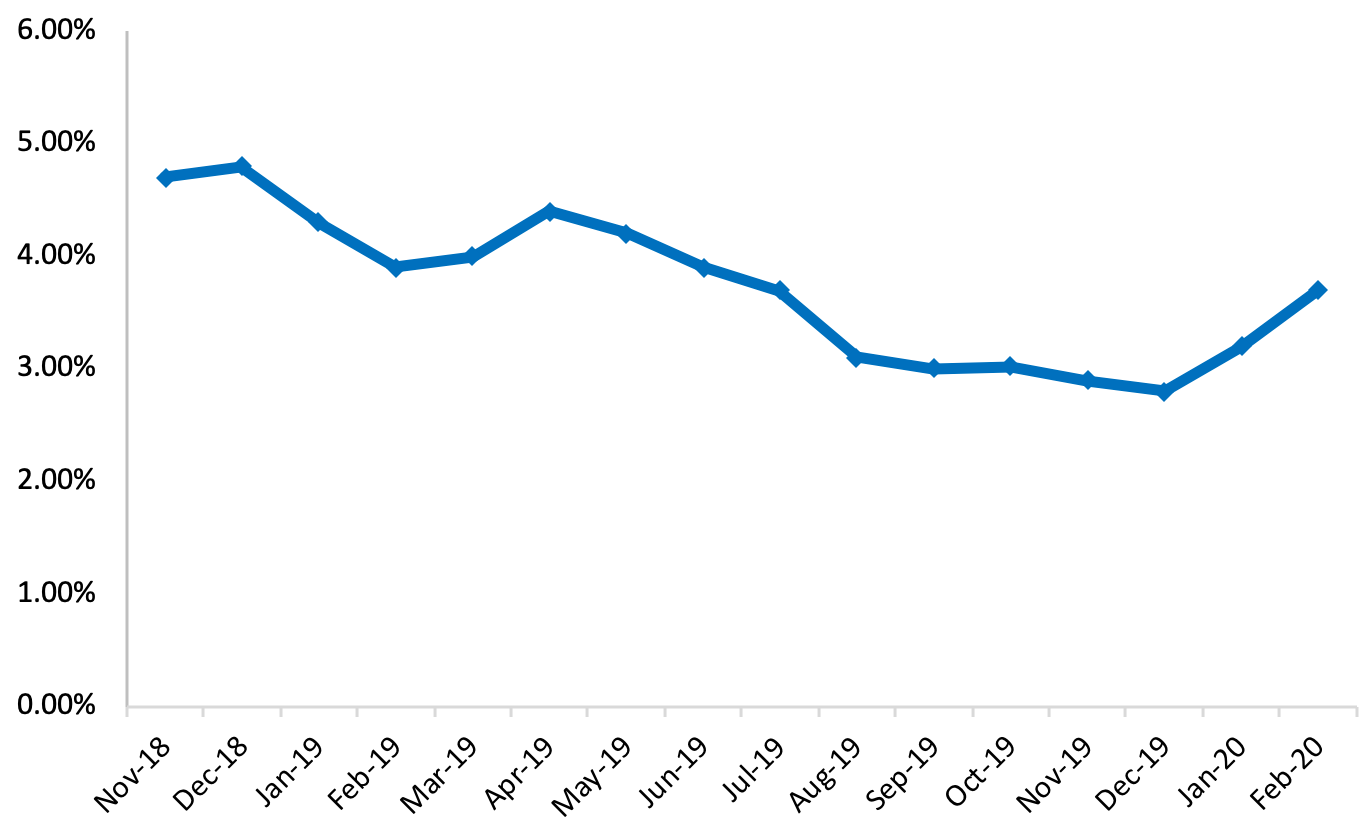
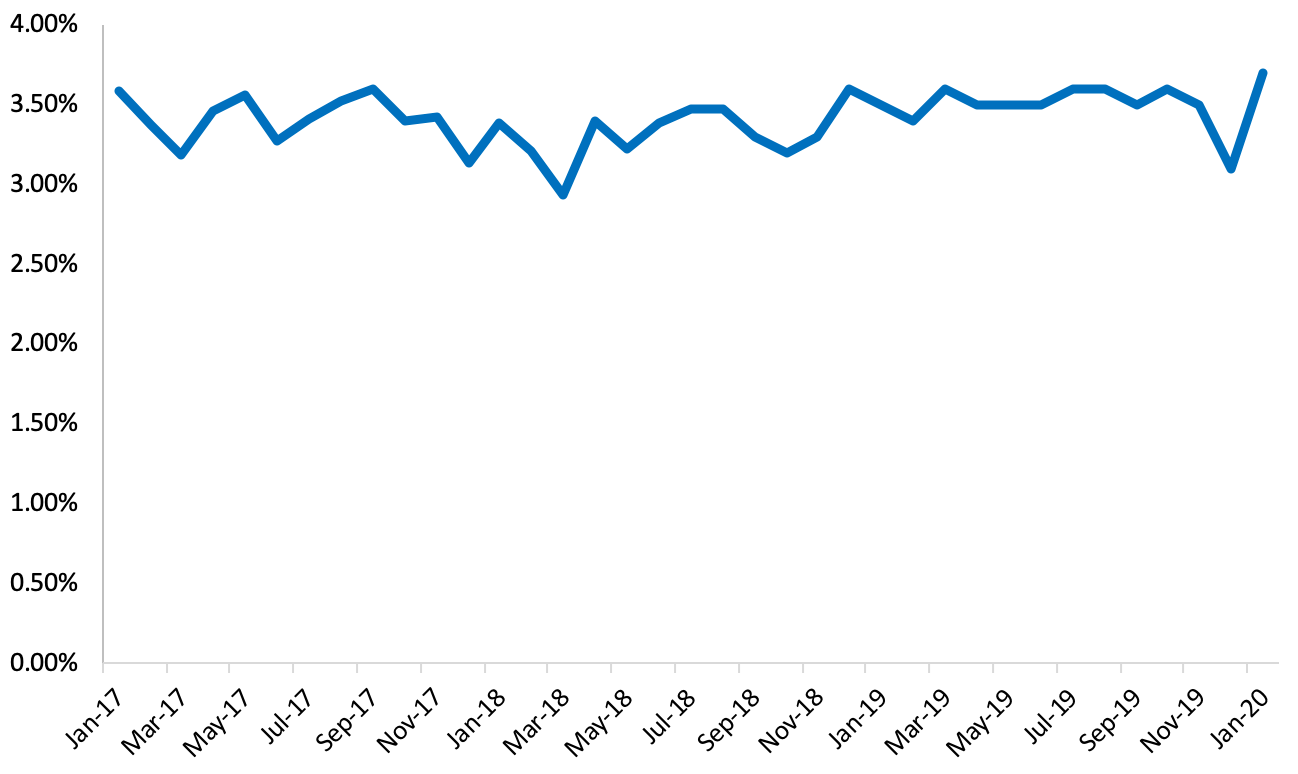
    Unemployment: On 27 February Mexico’s national statistics institute (Inegi) released its latest figures for unemployment, which show that the unemployment rate increased to 3.8% in January 2020, up from 3.6% in January 2019. In seasonally adjusted terms, the unemployment rate increased from 3.2% in December 2019 to 3.7% in January 2020.

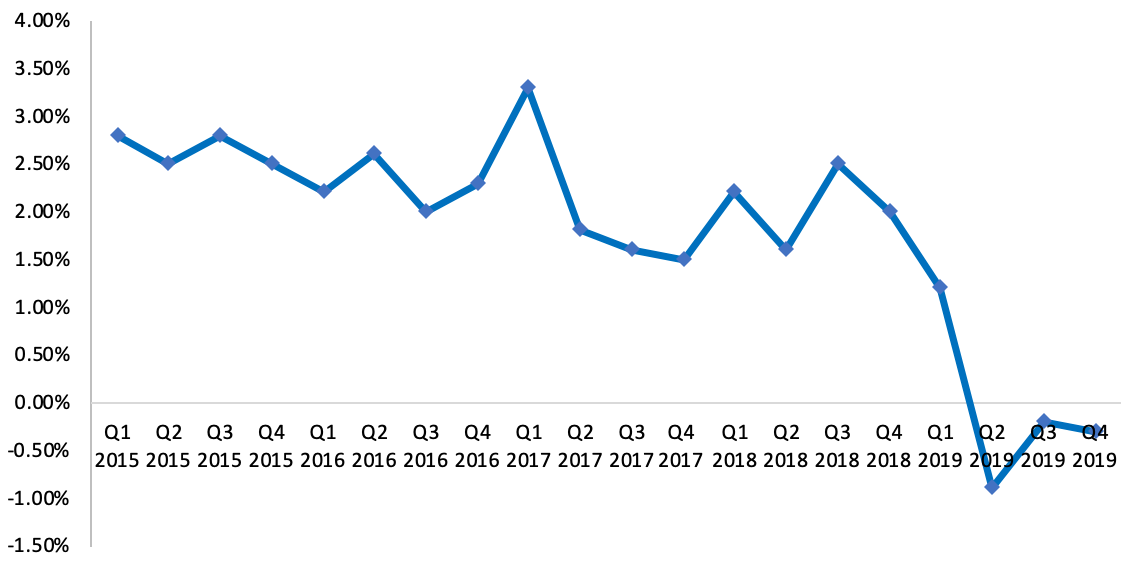
    Banxico growth forecast: On 26 February Mexico’s central bank (Banxico) released its latest quarterly report (October-December 2019) which forecasts GDP growth of between 0.5%-1.5% for 2020, down from its previous estimate of 0.8%-1.8%. It cites as grounds for this revision, the domestic economic slowdown observed in the fourth quarter of 2019 (which contracted 0.4% year-on-year), as well as uncertainty due to global factors such as the impact of the coronavirus (Covid-19) pandemic. The latest forecast follows the release of figures from Mexico’s national statistics institute (Inegi) which confirm that Mexico’s GDP contracted by 0.1% in 2019, compared with 2.1% growth in 2018.

    Agricultural trade: On 22 February Mexico’s rural development & agriculture ministry (Sader) released new figures which show US-Mexico agricultural trade was up 6% in 2019 to reach US$50.3bn. According to the Sader figures, Mexico’s agricultural exports to the US totalled US$31bn while imports totalled US$19.2bn, leaving Mexico with a trade surplus of US$19.2bn. Mexico’s main exports were: beer (US$3.06bn), avocados (US$2.45bn), tomatoes (US$1.98bn), tequila (US$1.82bn), and strawberries and blueberries (US$1.32bn).

    Microsoft investment: On 20 February Mexico’s President Andrés Manuel López Obrador and representatives from US multinational technology company, Microsoft, announced that Microsoft will invest US$1bn in Mexico over the next five years, with the aim of expanding the development of digital technology in the country and improving access to it.

    Mexico: GDP Growth
    Percentage variation (year-on-year)

    Mexico: Unemployment Rate
    Econimically active population

    Mexico: Inflation Rate
    Percentage variation (year-on-year)

  • TRACKING TRENDS

    LatinNews 22 October 2020 Hits: 3519

    PERU | Economic recovery continues. Peru’s GDP contracted by 9.82% in August 2020 year-on-year as a result of the coronavirus (Covid-19) pandemic, according to figures released by the national statistics institute (Inei) on 15 October. However, Economy Minister María Antonieta Alva responded to the figures positively, tweeting on 15 October that, “for the first time since the pandemic began, we registered a single-digit drop [in GDP growth]”. She pointed to the fact that the August figure compares with contractions of 15.7% in March, 39.9% in April, 32.7% in May, 18.1% in June, and 11.71% in July.

    According to the latest Inei figures, the biggest year-on-year contractions in August were in the sectors of hospitality & restaurants (-60.95%); transport, storage & postal services (-27.93%); business services (-18.58%); and manufacturing (-12.09%), while mining & hydrocarbons contracted by 11.18% compared with August 2019. However, there was growth in the areas of finance & insurance (19.74%); and telecommunications (5.13%).


    ECUADOR | Unemployment slows. Unemployment in Ecuador was 6.6% in September, according to figures published on 15 October by the national statistics institute (Inec). While higher than the 4.9% unemployment rate registered in 2019, the September 2020 figure is still an improvement on the 13.3% registered during the May-June period. According to Inec, 522,620 people were unemployed in September, down from over 1m at the peak of the pandemic. The same figures also show that underemployment was 23.4% in September, an increase on the 19.7% registered in September 2019 but an improvement on the 34.5% registered in May/June 2020.

    The improvement in the unemployment rate is attributed to the reopening in May of the economy which had been shut down to stop the spread of the virus. Labour Minister Andrés Isch also attributed the recovery in jobs to the government’s ‘humanitarian support law’, an emergency measure enacted in June which allowed employers to renegotiate workers’ contracts, although unions continue to condemn this as a violation of labour rights. On 19 October Isch tweeted that the new law had saved over 73,000 jobs since it went into effect and had helped to create 185,000 new formal work contracts.

  • Mounting concern over urban crime

    Lewis Harrison 14 October 2022 Hits: 430

    Colombia’s President Gustavo Petro has made significant early efforts to achieve peace with the country’s guerrilla groups since he took office on 7 August. But with a string of grisly killings sparking nationwide concern over urban crime, is Petro taking a political gamble by prioritising peace in the countryside over insecurity in Colombia’s largely guerrilla-free cities? In the absence of a national counter-crime strategy from the new government, some municipal authorities are taking matters into their own hands.

    President Petro frequently attacks his predecessor, Iván Duque (2018-2022), for the previous government’s seemingly lukewarm feelings about the 2016 peace agreement with the Fuerzas Armadas Revolucionarias de Colombia (Farc) guerrilla group. Duque certainly slow-walked the implementation of key pillars of the peace accords, and openly criticised central tenets of the agreement. Yet, as Duque was always keen to point out in the final stretch of his presidency, homicides dropped sharply in 2020, falling to their lowest level since 1974. Admittedly, these rebounded hard once restrictions imposed during the coronavirus (Covid-19) pandemic had been lifted. Nevertheless, the selective touting of statistics saw the Duque administration leave office claiming to have delivered a turnaround in urban security, however ephemeral that might have been.

    In contrast, Petro is now presiding over a population that appears increasingly concerned over violent crime, little of which seems to be connected to the armed groups with which his government is seeking peace – currently the Ejército de Liberación Nacional (ELN) guerrilla group and dissident Farc factions. A string of high-profile mass killings and shootouts in recent months has only heightened perceptions of insecurity that were already sky high before Petro took office (one study, published in late July by the pollster Bogotá Cómo Vamos, found that 88% of residents felt unsafe in the capital).

    Incidents that have particularly captured the media’s attention include the massacre of four members of the same family in their home in Landázuri municipality, Santander department, on 11 September; the discovery of four bodies in a vehicle in Bogotá on 19 August; a two-hour roaming shootout between a criminal group and police in the western port city of Buenaventura (Valle del Cauca) on 31 August; and the massacre of six people outside a pool hall in the northern city of Barranquilla (Atlántico) on 12 September. In the Landázuri incident, three suspected killers were subsequently lynched by the victims’ neighbours.

    Such incidents pose a direct challenge to Petro’s plans for ‘total peace’ – wide-ranging settlements not only with guerrilla groups, but also with major drug trafficking organisations (DTOs) including Colombia’s largest, the Clan del Golfo. Whilst the ELN, and to a lesser extent the Farc dissidents, remain at least rhetorically grounded in the notion of revolutionary struggle, and might therefore be drawn into political dialogue, the DTOs and smaller urban gangs remain purely criminal enterprises. As Fernando Rojas Parra, professor of public policy at Bogotá’s Universidad del Rosario, noted on 12 September, rising urban violence “is an entirely criminal and economic matter… the problem is much deeper than they [the government] want to believe.”

    The risk for Petro is that he is seen to be putting all his eggs in the ‘total peace’ basket, while failing to come up with a detailed strategy to tackle urban crime. The lofty goal of striking peace deals with all of Colombia’s main armed groups appears perhaps implausibly ambitious – agreements might be reached with some of these organisations, but Colombian history shows that when one armed group demobilises, another quickly takes its place. Furthermore, much urban crime is not perpetrated by national DTOs, but by localised youth gangs that operate on a vastly smaller scale than the groups Petro has targeted for dialogue. If he appears to ignore common criminals in his pursuit of talks with the more established armed groups based in the countryside, Petro may quickly find himself losing support from the broad coalition of voters who voted him into power – many of whom are urban with no personal experience of Colombia’s armed conflict, but with a very real perception of insecurity in the city.

    Bogotá taskforce

    In the capital, municipal authorities are pursuing their own strategy against the mounting crime wave. Following the discovery of four bagged and dismembered bodies on 6 September, which brought to 23 the number of corpses found to have been disposed of in this way since March, Bogotá’s mayor Claudia López announced the creation of a new anti-crime taskforce, the ‘Grupo contra el Multicrimen’. This, she said, would be formed of 34 criminal investigators, ten intelligence specialists, and ten counterintelligence specialists. Working alongside this taskforce will be two special teams from the attorney general’s office, which will focus on money laundering in the capital.

    López said that security forces believe the dismembered victims were killed by the Venezuelan DTO Tren de Aragua, which has been gaining an increasingly transnational presence in Latin America [SSR-22-07]. López expressed hope that the restoration of diplomatic relations between Colombia and Venezuela on 29 August might lead to cooperation against the DTO from the Venezuelan authorities. “The Tren de Aragua is a Venezuelan criminal structure directed by the so-called ‘Niño Guerrero’ and ‘Giovany’,” she said. “I urge the Colombian ambassador in Venezuela [Armando Benedetti] and the Venezuelan ambassador in Colombia [Félix Plasencia] to ensure that these two criminals are effectively isolated as soon as possible.”

    Regional consultations

    Petro announced on 14 September that the government would carry out citizen consultations in 48 towns, cities and rural areas around the country, from which it will draw up a national development plan based on the goal of ‘total peace’. He promised that cabinet ministers would “begin to travel the country, going where governments have never been, opening our ears to all sectors – from the poorest citizens, to the regional authorities, to businesspeople.” Petro added that “transforming Colombia into a country of total peace isn’t a task restricted to government or a select few… all citizens must play an active role in the construction of a different country.”

    Iván Márquez still alive

    On 15 September Colombia’s peace commissioner, Danilo Rueda, said that Luciano Marín Arango (‘Iván Márquez’), a commander of the dissident Farc faction ‘Segunda Marquetalia’ whose suspected death was reported in July, is alive and seeking peace talks with the government. Márquez’s suspected death was reported in July by national daily El Tiempo, which, citing anonymous intelligence sources, stated that he had been killed by a rival guerrilla group in Venezuela. Rueda said that Márquez is “alive and sick – recovering, from what we’ve been told.” He said that Segunda Marquetalia had contacted the government regarding possible peace talks, and that “we can confirm that he [Márquez] is among those who have sent messages and that there is a group of them [dissidents] who are taking a direct interest in these exploratory dialogues.”

  • Fentanyl and the US-China-Mexico triangle

    Patrick de Courcy 08 September 2023 Hits: 3964

    In the early stages of the opioids crisis the roles of the three main countries – the US, China, and Mexico - appeared relatively clear. The US was the main consumer country, with strong demand from users and addicts, but also with a government motivated to prevent the flood of fentanyl coming across its borders and fuelling its public health crisis. China was the main producer country, with a massive chemical and pharmaceutical industry churning out not only fentanyl but also the precursor chemicals and pre-precursor chemicals used in its manufacture, as well as in the manufacture of analogues.

    Mexico, or more precisely, Mexico’s main drug-trafficking cartels, was left to find a role for itself in the new emerging market. Some pure fentanyl was being sent directly from China to the US, often in the form of small packages sent through the post. An early role was for Mexico to import fentanyl from China and use its own northern cross-border trafficking routes to get the product into the US. Perhaps more significantly, the Mexican cartels also began cutting heroin and cocaine with fentanyl, and thereby maximising their profits from selling the adulterated versions of the drug into the US. That also included building clandestine synthetic opioid laboratories and hiring expert chemical ‘cooks’ with the right experience and qualifications to manage the labs.

    By all accounts May 2019 was a key turning point in the triangular relationship. Up to and immediately after that point, the Chinese government had responded relatively positively to US requests for cooperation to limit the flow of fentanyl. The US had invoked the UN Single Convention on Narcotic Drugs of 1961, which provides for agreements to ‘schedule’ or list harmful drugs for international regulatory controls. In 2017 UN member states had already agreed to list two fentanyl precursors, later followed by three further precursors. Effective from May 2019, China applied corresponding domestic controls.

    A report by the US Congressional Research Service says that as a result of bilateral discussions with China in this period, four major successes were achieved. First, China agreed to list all fentanyl-related substances. According to testimony by Kemp Chester of the White House Office of National Drug Control Policy (ONDCP), as a result “the direct shipment of fentanyl and fentanyl related substances from China to the United States went down to almost zero”. Second, Chinese courts in Hebei and Shanghai for the first-time sentenced defendants for trafficking fentanyl (according to some accounts this was assisted by US-provided intelligence). Third, and also according to ONDCP, seizures of fentanyl precursor and pre-precursor chemicals in China reached “consistently high” numbers. And finally, in fourth place, the Beijing government approved a US request to allow the Drug Enforcement Administration (DEA) to open additional offices in the country (it already had a presence in Beijing, Shanghai, Guangzhou, and Hong Kong).

    Fentanyl flow to the United States 2019

    Source: DEA

    However, as diplomatic tensions between Washington and Beijing resumed, the progress that had been achieved on fentanyl went into reverse. An initial trigger point came in May 2020 when Washington listed an institute based in the Xinjiang autonomous region and controlled by China’s ministry of public security, which it said was “implicated in human rights violations and abuses”. The US imposed export controls on the institute. A statement by the Chinese embassy in Washington said the listing “greatly affected China’s goodwill to help the US in fighting drugs”. Then, in August 2022, China reacted angrily to then-House Speaker Nancy Pelosi’s visit to Taiwan, announcing the formal suspension of cooperation in five areas, one of which was counter-narcotics. Since then, China has not scheduled any newly available fentanyl precursors. It has also dismissed the idea of introducing ‘know your customer’ protocols for drugs-exporting companies, an idea suggested by the US.  

    The weakening of US-China cooperation has in effect created new opportunities for non-state and criminal actors in all three countries. In testimony to a House of Representatives subcommittee in March this year, Brookings senior fellow Vanda Felbab-Brown outlined the way the fentanyl market is now operating. She saw the likelihood of China “meaningfully” intensifying its drug cooperation with the US as low. In the new situation, China continues to block direct fentanyl exports to the US, but in effect turns a blind eye to large flows of precursor chemicals being shipped to Mexico. Mexico has, as a result, become the main source of fentanyl entering the US. Felbab-Brown said: “Instead of finished fentanyl being shipped directly to the United States, most smuggling to the US now takes place via Mexico. Mexican criminal groups source fentanyl, fentanyl precursors, and increasingly, pre-precursors from China, and then traffic finished fentanyl from Mexico to the United States. Scheduling of fentanyl and its precursors in China is not sufficient to stem fentanyl flows to the United States.”

  • BRAZIL: Decline of the PSDB in São Paulo

    Abbi Dicker 11 April 2024 Hits: 3199

    The centre-right Partido da Social Democracia Brasileira (PSDB) was once a political powerhouse in Brazil’s largest city, São Paulo. However, all the PSDB’s councillors in the São Paulo city council have broken ranks with the party. Meanwhile, the party confirmed the membership of TV presenter José Luiz Datena, who has been floated as a potential running mate for Tabata Amaral, a federal deputy affiliated with the centre-left Partido Socialista Brasileiro (PSB), who is currently polling in third place ahead of the São Paulo mayoral election this October.

    Candidates of the PSDB won the past two mayoral elections. João Doria won the 2016 election and stepped down in 2018 to run for São Paulo state governor. Then-deputy mayor Bruno Covas took up the reins, as Doria won the gubernatorial race. Covas ran as the PSDB’s candidate in the 2020 mayoral race and defeated Guilherme Boulos, of the left-wing Partido Socialismo e Liberdade (PSOL), in the second-round runoff. Covas’ untimely death from cancer in May 2021 left the mayorship to his deputy, Ricardo Nunes, of the centre-right Movimento Democrático Brasileiro (MDB).

    However, ahead of the 2024 election, the alliance between the PSDB and MDB has reportedly broken down. National daily Folha de São Paulo reported that the PSDB’s local leadership in the city convened on 22 March and voted to break ties with Nunes, refusing to back his re-election bid, largely due to the MDB mayor having shifted closer to Brazil’s far-right former president Jair Bolsonaro (2019-2023).

    Of the 11 local party grandees who voted on 22 March, Folha reported that nine voted to break ties and only two voted to support Nunes’ campaign. The PSDB’s city councillors, however, were largely aligned with the party’s factions advocating for maintaining the alliance with Nunes. The party previously held eight of the 55 seats in São Paulo’s city council, but 5 April marked the deadline by which city councillors running for re-election in October must confirm their party affiliation. All eight PSDB councillors decided to defect to other parties, such as Nunes’ MDB, the Partido Social Democrático (PSD), Podemos (Pode), and Bolsonaro’s Partido Liberal (PL). One of the city council’s vice presidents, João Jorge, who has just left the PSDB and is due to join the MDB, was cited by Folha as saying that the “PSDB has no path, no project”.

    Having confirmed the end of its alliance with Nunes and the MDB, the PSDB’s local leadership has yet to officially endorse a mayoral candidate. The former powerhouse of the Brazilian centre-right is highly unlikely to support Boulos, who is running for mayor again and has the backing of the PSDB’s former arch-rival, the left-wing Partido dos Trabalhadores (PT). Media reports suggest that the PSDB is now at a crossroads and must decide whether to field its own candidate, who would join the race much later than current frontrunners Boulos and Nunes, or join forces with the PSB and sweep up centrist votes on Amaral’s ticket.

    Speculation about the PSDB’s future in São Paulo intensified on 4 April, during a ceremony to welcome Datena as a party member. Journalists questioned the TV presenter, formerly affiliated with the PSB, about his political ambitions, asking whether he would run for mayor. Sitting next to Amaral at the ceremony, Datena said: “my intent is to always be by Tabata’s side… Now I am in a party which is holding talks with [the party] which was my party.” The leader of the PSDB’s São Paulo branch, José Aníbal, was also present at the ceremony, but he did not give the press any clear indication of the progress of the PSDB and PSB’s talks. 

    Lula in Pernambuco

    From 4-5 April Brazil’s President Lula da Silva (PT) was in his native state of Pernambuco, where the state government is led by the PSDB’s Raquel Lyra, to launch public works financed by federal government funds. On 5 April Lula went to the state capital Recife and met the city’s mayor João Campos (PSB). The PT has not fielded a candidate of its own in Recife and is reportedly considering backing the re-election bid of the PSB's Campos.

  • CHILE: Will she, or won’t she?

    Anna Grace 15 August 2024 Hits: 2129

    Chile is beginning to focus not just on the next elections – municipal and regional polls due in October – but on the ones after that too (presidential and congressional polls due in November 2025). An early question mark has popped up: will twice former president Michelle Bachelet (2006-2010; 2014-2018) seek to compete for a third term in 2026-2030?

    Michelle Bachelet seems to be popping up all over the place. Last month she was at a lunch for leaders of left-wing parties. She has opened a health centre named in her honour. Her comings and goings are closely covered in the press and they are proving deeply irritating to the right-wing opposition. Her old adversary Evelyn Matthei, the mayor of Providencia, said that the public appearances were a festival of “bad taste inaugurations” and questioned whether public money was being improperly spent on public electioneering.

    Far-right leader José Antonio Kast also felt moved to comment, saying “Michelle Bachelet should take responsibility for the multiple disasters caused by her government”. He went on to argue that Chile’s left-wing parties are proving incapable of finding new leaders and therefore have to rely on an old one, who was last elected a decade ago.

    Polling numbers explain the high level of interest. A survey by Cadem released on 11 August showed that if the presidential elections were to be held today, Matthei is in first place with 21% support, followed by a tie between Kast and Bachelet with 11% each.

    With the elections more than a year away much could change, but the numbers are nevertheless quite favourable to the former president. Notably none of the left-wing leaders associated with the current administration of President Gabriel Boric get beyond single-digit support levels (Boric is constitutionally barred from running for a second consecutive term).

    In an eventual second-round run off next year between Matthei and Bachelet, the gap between the two would be a narrow four percentage points in Matthei’s favour. Bachelet has of course defeated Matthei once before, in the 2013 presidential race. Now, Bachelet also has a 61% positive image score, her highest in the last decade. In short, she may be the left’s best card to play next year.

    Yes, but will she run? The official answer seems to be ‘no’, but that could eventually translate to ‘maybe’. In a speech on women and politics she made at the Universidad Adolfo Ibáñez on 12 August, Bachelet said she would like to see new faces coming into politics, commenting “I think it is a shortcoming of democracy if we always get the same names coming back in politics”. She also said there was no need to rush into decisions, noting that one year before the last presidential race the name of Boric, the eventual winner, “didn’t exist”.  Bachelet enthusiasts noted, however, that she didn’t entirely close the door on running for a third term.

    Bachelet

    Bachelet enthusiasts point out that the former leftist head of state, who also served as the United Nations High Commissioner for Human Rights between 2018 and 2022, has other options than running for president again, with suggestions circulating that she might be a candidate for the role of UN Secretary General.

  • TRACKING TRENDS

    Abbi Dicker 07 November 2024 Hits: 1026

    MEXICO | Aeroméxico agrees salary increase with pilots’ union. On 2 November Mexico’s umbrella pilots’ union Asociación Sindical de Pilotos Aviadores de México (Aspa) announced that it had reached an agreement with the country’s flagship airline Aeroméxico. In a statement, Aspa stated that Aeroméxico pilots had voted by 876 votes in favour to 477 against to accept the deal from the airline, which equates to a 20% pay increase between benefits and direct salary raises and will be applied retroactively from 1 October. The contractual agreement will remain in effect until September 2026 while the salary agreement will be revised in 2025.

    Aeroméxico had been in negotiations with Aspa over pay and benefits since September. The union had rejected previous deals proposed by the airline and threatened strike action at the beginning of October. However, on 8 October Aspa announced that Aeroméxico had presented a proposal to raise salaries directly by 7.5% and by a further 12.5% via benefits. This proposal, which was ultimately accepted by union-affiliated pilots on 2 November, succeeded in halting the planned strike action.


    MEXICO | Unemployment rate remains stable. Mexico’s national statistics institute (Inegi) published new figures on 1 November showing that the unemployment rate of the economically active population - those aged 15 or over who are either employed or seeking employment - was 2.9% in September, equating to 1.8m people. This was an increase of 38,000 compared to September 2023, when the unemployment rate also stood at 2.9% of the economically active population. In seasonally adjusted monthly terms, the unemployment rate remained the same as compared with August. The underemployment rate also remained unchanged in yearly terms in September but increased by 0.1 percentage points in monthly terms.

  • EL SALVADOR: Public financing of political parties scrapped

    Sarah Sheldon 25 March 2025 Hits: 1918

    On 12 February El Salvador’s 60-member unicameral legislature, which is controlled by President Nayib Bukele’s Nuevas Ideas (NI), approved a change removing Art. 210 of the constitution which recognises state campaign funding for political parties. This has drawn criticism from civil society groups amid concerns that it jeopardises the independence of political parties. It is among the first amendments to the constitution approved since the previous month when congress gave final approval to a reform eliminating the requirement that constitutional changes must be approved by two successive legislatures [WR-24-17].

    The change removing Art. 210 approved on 12 February leaves political parties entirely dependent on private finance. Previously, public funding, known as ‘deuda política’ (political debt), was determined by the number of votes the party won in the previous elections. The decision to remove this was slammed by rights activists such as Eduardo Escobar, the executive director of local NGO Acción Ciudadana (AC), who said that Art. 210 created “a certain independence” which would be jeopardised if parties are entirely reliant on private finance.

    A 12 February AC statement warns that the change will affect political pluralism, describing it as a further measure aimed at “consolidating and maintaining a hegemonic or dominant party system”. This is a reference to the control exerted by Bukele’s NI which won 54 seats in the downsized legislature in 2024, having strengthened its presence since winning an unprecedented two-thirds legislative majority in the previous 2021 vote. That election dealt a major blow to the left-wing Frente Farabundo Martí para la Liberación Nacional (FMLN) and right-wing Alianza Republicana Nacionalista (Arena), whose longstanding political duopoly was ended by Bukele’s 2019 election win.

    The amendment eliminating public finance for political parties comes amid more general concerns regarding the transparency of campaign finance. On 13 December 2024, AC published a report which assessed the financial transparency of nine political parties for 2023. The AC report found that four of the parties had a low level of financial transparency: NI; FMLN, which now has no legislative seats; Gran Alianza por la Unidad Nacional (Gana), also with no seats); and Nuestro Tiempo (NT – no seats). The parties with higher levels of financial transparency according to AC were: Arena (two seats); Democracia Salvadoreña (DS – no seats); Partido de Concertación Nacional (PCN – two seats); Partido Demócrata Cristiano (PDC – one); and Vamos (one).

    Lack of transparency

    According to the Acción Ciudadana (AC) report, Bukele’s NI party did not provide AC with financial information on its expenses or income in 2023, nor did it make this information publicly available. The report also highlights that since its establishment in 2018, NI has not provided any information on its expenses. AC warns that a lack of transparency can conceal illegal funding and misuse of public funds.

    Constitutional changes

    The changes removing Art. 210 were among the first following the legislature’s ratification on 29 January of amendments to El Salvador’s 1983 constitution which annul the requirement that constitutional changes must be approved by two successive legislatures. Prior to the changes, approved constitutional changes required approval by a simple majority in one legislature and ratification by a two-thirds majority in the next. With the changes, constitutional reforms can now be passed with just the vote of three-quarters of legislators.

    These changes to the process of amending the constitution have drawn alarm from rights groups such as international NGO Amnesty International (AI). On 7 February AI warned that “by removing the requirement for constitutional amendments to be approved by two separate legislative assemblies, the ruling party guarantees a fast-track path to constitutional change without due deliberation processes or public participation”. It adds that “in a context where the independence of the judiciary and the right to a fair trial have been systematically eroded, this measure could pave the way for the implementation of reforms that further undermine… human rights.” 

  • MEXICO: Drought levels hit rock bottom

    Abbi Dicker 05 March 2026 Hits: 1276

    On 2 February Mexico’s national water commission (Conagua) announced the lowest levels of drought recorded in the country for six years. According to its latest drought monitor report, published on 15 February, just 6.9% of Mexican territory was classified as experiencing drought – up from 6.6% at the end of January but down from 7.4% a month earlier, which had been the lowest figure since January 2020, when coverage stood at 7.2%.

    The data mark a dramatic reversal from the severe drought that had gripped the country for the past few years. At the peak of the crisis, on 31 May 2024, Conagua reported that 76% of Mexico was experiencing moderate to severe drought. In the run-up to the June 2024 national elections, water scarcity surged up the political agenda, with warnings of a potential ‘Day Zero’ for Mexico City (CDMX) dominating headlines, as the city and surrounding metropolitan area of 22m people faced the prospect of running dry [SSR-24-05].

    Conagua attributes the turnaround to a “very active” rainy season beginning in the second half of 2025 and continuing into this year. Abnormally high levels of precipitation – including several tropical storms and cyclones – fell across central, eastern, and southern Mexico, replenishing reservoirs and easing pressure on the capital’s strained water system. The intense downpours are attributable to the cyclical La Niña meteorological phenomenon, which is known to exacerbate extreme weather conditions – though not itself reducible to climate change.

    CDMX’s Cutzamala reservoir system, which had fallen to a critical 27.5% capacity during the 2024 crisis, is now reported by Conagua to be 97% full. Yet the relief has brought new challenges. The capital and its surrounding metropolitan area are struggling to absorb the sudden increased rainfall, with severe flooding disrupting businesses, damaging homes, and accelerating long-term land subsidence. In October rains caused widespread destruction and claimed the lives of dozens in central and eastern Mexico, disproportionately affecting indigenous people and other vulnerable communities, according to an investigation by World Weather Attribution, an academic collaboration studying the influence of climate change on extreme weather events.

    Last year’s active rainy season unfolded against rising tensions with the US over Mexico’s obligations under the 1944 Water Treaty, which governs the sharing of the Colorado, Tijuana, and Rio Grande (or Río Bravo in Mexico) rivers. In April 2025, US President Donald Trump threatened to impose tariffs if Mexico failed to deliver on its water debts under the treaty. He repeated these threats in December. Sheinbaum replied that Mexico had been complying with the treaty to the extent that water availability allowed, citing the sustained period of drought.

    On 3 February Mexico’s environment ministry (Semarnat) announced that both governments had agreed on a “technical plan” to ensure minimum annual water deliveries in line with treaty provisions. Under the agreement, Mexico will commit to delivering 350,000 acre-feet of water per year to the US while agreeing to repay its outstanding volumes accrued over the last five-year cycle. Semarnat acknowledged the agreement as an important milestone towards building “greater predictability and shared responsibility in the face of drought impacts”. Indeed, while the current outlook offers relief, Mexico must be prepared both to ensure domestic supply and to meet treaty obligations ahead of the next inevitable dry spell.

    Rains

    Torrential rain caused severe flooding and landslides in 110 municipalities in Veracruz, Hidalgo, Puebla, Querétaro, and San Luis Potosí states from 6-9 October. At least 80 people were killed as a result of the rainfall and ensuing flooding. President Sheinbaum said that some 100,000 homes had been affected by the rains.

  • GUATEMALA: First ever prison census

    Sarah Sheldon 20 April 2026 Hits: 215

    On 10 February Guatemala’s interior ministry (Mingob) announced that it had completed its first ever census of its prison system. The move is in line with efforts by the left-of-centre government led by President Bernardo Arévalo to address the prison crisis. This was most recently exposed in January with a wave of gang violence and prison riots which left at least 11 police (PNC) officials dead, compelling the Arévalo government to declare a 30-day state of siege [SSR-26-02].

    The plan to carry out the census was first announced in October 2025, among other measures, following the escape of 20 members of the Barrio 18 (M-18) gang, one of the country’s two main gangs, from high security prison Fraijanes II on the outskirts of Guatemala City. The October jailbreak, which followed a series of prison riots in July and August involving inmates from M-18 and the country’s other main gang, Mara Salvatrucha (MS-13), forced the departure of interior minister Francisco Jiménez (2024-2025), two deputy security ministers, and the director of the prison service, Ludin Godínez, among others [SSR-25-12].

    According to Mingob, the census unveiled on 10 February produced a “solid and reliable database on the identity of 23,837 incarcerated individuals” – a figure which included “2,545 active terrorists” from M-18 and MS-13. The country’s deputy security minister, Estuardo Roberto Solórzano, was cited by state news agency Agencia Guatemalteca de Noticias (AGN) in an 11 March report as describing it as “a key step forward in strengthening prison intelligence and security measures within prison facilities.”

    The census is part of wider plans to modernise Guatemala’s prisons. During a summons before the 160-member unicameral legislature on 20 February, Interior Minister Marco Antonio Villeda explained that the country’s 24 prisons are designed to hold just 6,000 people, but currently hold around 23,000 inmates. Meanwhile on 2 March President Arévalo revealed plans to begin constructing a new maximum-security prison in Morales municipality, Izabal department. He also highlighted plans to build a new prison in Masagua municipality, Escuintla department, with the media reporting that the new prisons would have the capacity to house 2,000 and 3,000 prisoners respectively, as part of a push to tackle prison overcrowding.

    Equipment

    Among the equipment that Guatemala plans to purchase from the US, following the apparent lifting of the ban on acquiring US military equipment, Defence Minister Henry Sáenz highlighted Colt 5.56 M4 rifles, adding that the country is also considering the purchase of aircraft, ammunition, and specialised equipment for night operations. He put the figure available for these purchases at some Q400m (US$52m).

    Strengthening ties with the US

    On 9 March Guatemala’s Defence Minister Henry Sáenz announced Guatemala would now be able to buy weaponry and military equipment from the US. He said that this represents an effective lifting of the prohibition on acquiring US military equipment imposed on Guatemala in 1978 by the government of former US president Jimmy Carter (1977-1981).

    The ban had been imposed due to human rights violations committed during the civil war (1960-1996) by Guatemala’s armed forces, which were subsequently found by a United Nations commission for historical clarification (CEH) to have committed 93% of all human rights violations during this period along with other state agents.

    Describing the US decision as “historic”. Sáenz was cited by AGN in a 9 March report as saying that it was the fruit of “trust and strategic cooperation” between the two countries, which will permit purchases to be made under the “government to government” modality. He claimed that it reflected efforts by the Arévalo administration to tackle drug trafficking and other transnational threats.

    In a 10 March report, however, Salvadorean investigative outlet El Faro questioned the extent to which these restrictions had been in place, pointing out that from 2018-2021 the US donated equipment to Guatemala despite “reports of misuse including intimidation of US embassy staff”.

    Among other examples, it states that in 2022 the US administration under former president Joe Biden (2021-2025) used a Defence Department programme to “skirt State Department military aid restrictions on Guatemala”, allowing the donation of 95 vehicles to the Guatemalan army to support border security efforts, valued at US$4.4m according to an October 2022 statement by US-based lobby group Washington Office on Latin America (Wola).

    Sáenz’s announcement comes amid other signs of strong bilateral ties, largely due to Arévalo’s concerted efforts to appease Trump in areas such as migration [SSR-25-03], while its decision announced on 10 February to end participation in the Cuban doctors programme, which provides essential revenue to Havana [WR-26-08], was also no doubt looked upon favourably by Washington, which is applying unprecedented pressure on Cuba.

    Along with El Salvador, Ecuador and Argentina, Guatemala, which is also modernising its port infrastructure with US cooperation [EB-25-06], was included in a list of countries for which Trump said reciprocal tariffs would be removed [WR-26-06], although this is since subject to uncertainty following a 20 February US supreme court ruling which invalidated part of his comprehensive tariff framework.

  • ARGENTINA: Con nuevas fuerzas, Fernández realiza cambios económicos

    LatinNews 07 November 2011 Hits: 108

    Su impresionante victoria de reelección el 23 de octubre, ha dado a la Presidenta Cristina Fernández abundante capital político y espacio para maniobrar; y ella está maniobrando. A tan solo cuatro días de su victoria, Fernández sorprendió con la introducción de controles estrictos sobre el mercado de divisas en un intento de mantener estable la tasa de cambio del dólar/peso, como también poner freno a los crecientemente preocupantes niveles de fuga de capitales [IL-11-38]. Esas medidas fueron seguidas poco después por el anuncio que sectores “claramente rentables” de la economía (bancos, compañías aseguradoras y de telecomunicaciones, los negocios del juego y las industrias extractivas) ya no se beneficiarían de las tasas fuertemente subsidiadas de la energía (ver más abajo).

    Fernández ha hecho una apuesta y esta es una grande: si sus políticas fracasan, ella arriesga mucho más que solamente enfriar la economía –la razón alegada por la que ella no se concentra en frenar la inflación– y podría conducir a su congelamiento en general. Pero es muy pronto para decir si ella tendrá éxito en mantener el crecimiento económico y la estabilidad, pero es claro que, al menos, las últimas medidas han elevado la incertidumbre. Los ciudadanos privados temen que el gobierno pueda verse forzado a permitir una depreciación mucho más rápida del peso que la baja de 7% que ha registrado contra el dólar hasta ahora en este año, mientras la inflación de dos dígitos continúa dañando a los fabricantes y exportadores.

    La primera medida anunciada fue que todos los exportadores de petróleo y minerales deben vender sus ingresos por exportación en dólares en el mercado local. Al forzar a las industrias extractivas a mantener sus dólares en Argentina, el gobierno estaba tratando de aliviar la presión que el banco central (BCRA) estaba enfrentando en relación a la creciente demanda por dólares, que le ha forzado a continuar vendiendo sus reservas de dólares para mantener la estabilidad de la tasa de cambio; sin embargo, el anuncio alimentó aún más demanda, y el gobierno se vio obligado a imponer controles estrictos, anunciando que todas las compras de moneda extranjera deberán someterse a un nuevo escrutinio y recibir la autorización de la agencia fiscal (Afip) antes que puedan seguir adelante.

    En el primer día de operaciones bajo las nuevas regulaciones (31 de octubre) el BCRA fue forzado a vender US$100m de sus reservas, incluso aunque la mayoría de los bancos y casas de cambio hicieron poco o nada de negocios minoristas. El cierre virtual del usualmente animado mercado de cambio interno de Buenos Aires no tiene precedentes desde el corralito –el paquete de medidas introducido por 90 días (inicialmente), por el ex ministro de economía Domingo Cavallo durante la presidencia de Fernando de la Rúa (1999-2001), que eventualmente hizo caer al gobierno y condujo al fin del experimento de la convertibilidad, cuando el peso estaba fijado al dólar. El gobierno alegó que el cierre había sido el resultado de fallas en el programa de las computadoras y la incertidumbre de los empleados de las casas de cambio sobre cómo proceder con el nuevo sistema que, para ser justos, era esperado puesto que ellos no tuvieron casi tiempo para prepararse. Esos problemas significan que las actividades de propiedad inmobiliaria y las industrias automotrices, en las cuales la vasta mayoría de las transacciones tienen lugar en dólares, llegaron a parar.

    Para el cierre de las operaciones el lunes, el gobierno había sido forzado a reconocer esa deficiencia y emitió una nueva regulación, por medio de la cual las personas que tratan de completar la compra de una propiedad inmueble que involucra una hipoteca (en pesos y emitida por un banco local) tendrían luz verde para la compra de dólares a fin de pagar al vendedor y firmar sus escrituras de títulos. Sin embargo, solamente 2% de todas las transacciones involucra el uso de alguna forma de hipoteca financiada y la ‘medida excepcional’  debe expirar el 17 de noviembre. El consenso en el negocio de las propiedades inmuebles es que las nuevas medidas tendrán un efecto de enfriamiento en la demanda pues aquellos potenciales compradores que pueden tener ya los dólares para completar las transacciones, ahora es probable que guarden sus dólares y esperen a ver qué ocurre con la tasa de cambio.

    La oposición política alega que las medidas de control del mercado de cambios minorista estimularán el mercado negro, que no existía hace seis meses y ahora está ofreciendo dólares por Arg$4,70. El más sofisticado (en su mayoría mayorista) llamado canje de acciones solventes (conocido como triangulación contra cable o contado con liquidez), que involucra arbitraje en valores que pueden adquirirse en Argentina y vender internacionalmente, avanzó contra el gobierno, elevándose a Arg$5,15/US$ el 31 de octubre, de Arg$4,89/US$, el 28 de octubre. Tanto que el 2 de noviembre, la agencia de pensiones (Anses), el más grande inversionista institucional del país, vendió bonos en el mercado local para hacer menos atractivo el canje de acciones solventes, con un movimiento total  alcanzando la excepcionalmente alta cifra de Arg$1,1bn (alrededor de 80% del volumen total comercializado). Eso, sin embargo, bajó la tasa de canje de las acciones solventes a Arg4,8/US$1, pero no está claro si la Anses podría seguir realizando similares intervenciones por un periodo sustentable de tiempo.


    • La industria del turismo de Uruguay pide la pesificación

    En respuesta a las medidas tomadas por Argentina, la industria del turismo de Uruguay ha pedido formalmente al Presidente José Mujica que considere la posibilidad de usar el peso argentino para el pago de todos los servicios y los costos de renta en los principales sitios turísticos de Uruguay. “A la luz de la situación de control del mercado de cambio, tenemos que ser ingeniosos. Podemos cobrar todo en pesos argentinos, y acá convertirlos a dólares o a pesos uruguayos sin que nadie pierda [negocios]”, dijo Juan Bistiancic, el presidente de la cámara de propiedad inmobiliaria de Maldonado. El único problema es que en algunas casas de cambio uruguaya el peso está en Arg$4,8/US$1, en oposición a la tasa de cambio de Arg$4,27/US$1 en Argentina.

    • Se eleva el superávit comercial de Brasil

    El superávit comercial de Brasil en los primeros 10 meses de 2011 fue de US$25,4bn, elevándose en un masivo 74,8% anual sobre igual periodo de 2010. Las exportaciones totales fueron valuadas en US$212,14bn, subiendo 29,3%, mientras que las importaciones llegaron a US$186,7bn, subiendo 25%. Las reservas internacionales del banco central sumaban US$353bn para el 28 de octubre.

    Diciendo adiós a los subsidios

    En una conferencia de prensa el 2 de noviembre, el ministro de economía y vicepresidente electo, Amado Boudou, junto con su par de planeamiento federal, Julio de Vido, anunció que el gobierno ya no subsidiará los gastos de energía (gas, agua y electricidad) de sectores “claramente rentables”. Con esa decisión, el gobierno está tratando de enviar un mensaje de reducción fiscal.

    Boudou declaró “el inicio de una nueva etapa, de la personalización de los subsidios. Nadie puede recibir un subsidio que no necesita”. Por tanto, la eliminación de los subsidios al sector corporativo es probable que sea la punta del iceberg. Un nuevo ‘comité conjunto de economía y planificación’ ha sido encargado de revisar la capacidad de otros sectores corporativos y consumidores residenciales privados para absorber los subsidios removidos.

    El gobierno calcula que el fin de los subsidios a sectores “rentables” generará ahorros de Arg$600m (US$141,51m) en 2012, a grandes rasgos 1% de los Arg$51,69bn (US$12,19bn) gastados en subsidios en los primeros nueve meses de 2011 y alre3dedor del 0,8% de los Arg$72,27bn presupuestados para subsidios en 2012.