EASTERN CARIBBEAN: Preparing for the worst
The United Nations (UN) International Organisation for Migration (IOM) convened a conference in Dominica from 4-6 October at which its report on Migration, Environment, Disasters and Climate Change Data in the Eastern Caribbean was presented and debated. The purpose of the conference was to discuss improvements in the way data is gathered in order to help decision-making and planning for climate resilience in the six independent member states of the Organisation of Eastern Caribbean States (OECS) – Antigua & Barbuda, Dominica, Grenada, St Kitts & Nevis, St Lucia, and St Vincent & the Grenadines. The conference also heard why this is of such pressing importance; how current arrangements for free movement can be improved; and why the international community needs to be more flexible in the way it allocates assistance to the vulnerable small island states (SIDS) of the Caribbean.
The central message of the IOM’s report is that the Eastern Caribbean has been facing a changing climatic regime for two to three decades and now faces “an increased frequency and intensity of extreme climate events and related disasters”. As an example of the dire consequences of these trends, the report points out that during the 2017 hurricane season, when the region was affected by hurricanes Irma, Harvey, and Maria, approximately 3m people across 16 countries in the Caribbean and US were displaced. Similar effects were produced by Hurricane Dorian in August and September 2019, with the displacement of 464,000 people. Hurricane Dorian in 2020 led to the displacement of nearly 10,000 people in The Bahamas.
Dominica is cited as one of the countries that took the brunt of Hurricane Maria in September 2017. As a result, about 80% of the population was displaced, with the loss of 30 lives and damage amounting to 176% of GDP.
The paper notes that while the nature of the relationship between climate and environmental change, disasters, and human mobility “remains a highly debated topic among academics and policy circles”, it is undeniable that climate change impacts on SIDS across the Caribbean “could potentially accentuate the displacement and forced movement of people in the region”. There are also significant natural hazards in the region that exist regardless of climate change, as exemplified by the recent eruption of La Soufrière volcano.
It is the movement of people as a result of such disasters that was the main focus of the conference, and the IOM paper acknowledges that OECS member states recognise that effective migration governance “can contribute to sustainable socioeconomic development and climate change adaptation”. Five out of six of the OECS’s independent state members (the odd one out being Antigua & Barbuda) voted, for instance, for the 2018 UN Global Compact for Safe, Orderly, and Regular Migration.
In her address to the conference, the Regional Director of IOM, Michele Klein Solomon, said that it was important to remember how advanced the Eastern Caribbean region already was in terms of free movement of people. She said: “The Eastern Caribbean Economic Union provides OECS citizens the right to move and settle in any other participating islands. This protocol offers a much-needed solution for persons who must leave their countries due to the impacts of hurricanes or other hazards.” Without this free movement, she argued, the cross-border evacuations that happened during the 2017 hurricane season, or during the eruption of La Soufrière volcano, would have been much more difficult.
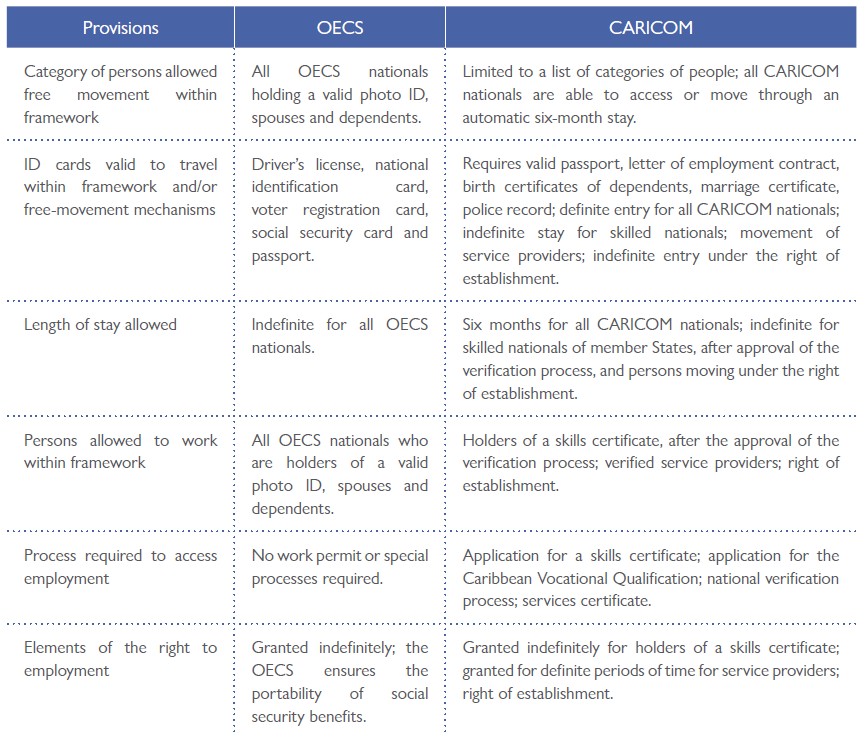
The position, however, is not quite so encouraging when looking at the wider Caribbean. The Caribbean Community (Caricom), through the Caricom Single Market and Economy (CSME), allows for the free movement of skilled and professional persons but not for general free movement. Nor does the CSME include specific provisions for disaster displacement. In effect, the IOM report notes, “the free-movement regime developed under the CSME is focused on addressing skilled labour migration and economic integration, with limited consideration or reference to environmental migration or disaster displacement”. However, in the wake of Hurricane Maria, certain requirements were waived for displaced Dominicans.
Table 1 below shows the difference in free-movement requirements between the OECS and Caricom.
Table 1: Free Movement within Eastern Caribbean States
Source: International Organization for Migration
Keith Mitchell, the prime minister of Grenada and OECS chairman, used his address to the conference to reiterate the need to base assistance to vulnerable states on something other than GDP per capita income. He said: “For all our countries, the experiences of environmental hazards are the same. Significant loss in GDP, decimation of our agriculture and tourism sectors, loss of precious lives, significant displacement of people, and decades of economic development gains lost in just one major disaster.” For this reason, he added, “we continue to advocate for the incorporation of a multi-dimensional Vulnerability Index”. In order to enable countries in the region to “build back better” following environmental shocks such as major hurricanes, financial institutions will need to give consideration to the extreme vulnerability of SIDS to these types of shock.