Brazil is slowly emerging from its worst recession on record. Domestic economy activity grew by a fledgling 0.2% in the three months up to June. While this figure may seem small, economists broadly read this as a positive result, showing that political turbulence from a series of government corruption scandals did not derail the economic recovery.
Brazil’s GDP has inched up for the second consecutive quarter. The second-quarter growth was driven by increased consumer spending thanks to favourable inflation and interest rates and improvements to the local labour market. The inflation rate fell to 2.46% in the last 12 months to August, its lowest level in the last 18 years, helping to stimulate consumption. This in turn has led the central bank (BCB) to start lowering its benchmark interest rates in support of increased economic activity (see sidebar).
However, despite improvements to GDP and inflation figures, Brazil is still struggling to control its gaping fiscal deficit. The deficit is currently equivalent to 9% of GDP, thanks to a fall in tax revenues from the recent recession and increased expenditure on the country’s costly pensions system. As a result of these budgetary imbalances, the federal government has been forced to loosen its fiscal deficit targets for 2017 and 2018. The targets for both years have been increased to R$159bn (US$50.2bn), up from R$139bn for 2017, and to R$129bn (US$40,7bn) in 2018. “For investors, this is a negative sign, showing that the government did not clean up the house,” Alex Agostini, chief economist at credit agency Austin Ratings, told local news site G1.
Brazil desperately needs to rein in the fiscal deficit to recover its prised investment grade rating, which it lost at the height of the economic recession in 2015, under the government led by the impeached former president Dilma Rousseff (2011-2016). To correct this, the administration led by President Michel Temer is coming up with new ways to raise revenue and cut costs. These include: levying a new tax on exclusive investment funds projected to raise an additional R$6bn (US$19.4bn); withdrawing exemption on payroll tax, projected to raise an additional R$4bn (US$1.2bn); scaling down a programme to help exporters projected to produce R$2.6bn (US$843m) in savings; increasing retired public sector contributions from 11% to 14% to generate a R$1.9bn (US$616m) in savings; and a freeze on civil servants’ salaries, producing R$1.2bn (US$389m) in savings. However, analysts have described these as “one-off” measures that fail to address structural problems in Brazil’s fiscal setup.
But the Temer government has also proposed more hard-hitting structural changes to lower the deficit. Chief among these is a bill capping pensions, which is currently being debated in congress, but which faces stiff opposition. If it does not go through, Brazil’s social security spending is scheduled to skyrocket from its current level of 43% of GDP, before interest, to 68% of GDP by 2024 according to Banco Santander. However, by far the government’s most ambitious plan to raise revenue is a large-scale privatisation initiative. On 23 August, the government announced it would sell the assets of 57 state-owned companies including airports, high-power electricity lines, railways, and port terminals. Also for sale are the lottery division of state-run bank Caixa Económica Federal and the Casa de Moeda do Brasil mint.
Two days before, the government announced it would sell its 41% stake in electricity firm Centrais Elétricas Brasileiras (Electrobrás). Shares in Electrobrás jumped by almost 50% on the news. The privatisation of Electrobrás has been welcomed by investors as a sign that the centre-right Partido do Movimento Democrático Brasileiro (PMDB) government led by Temer is committed to pro-market policies; in contrast to the interventionist policies pursued under Rousseff. Mainstream media hailed the sale of the Electobrás stake (due for completion in 2018) as the most important privatisation since the 1990s when the government sold off iron ore mining company Vale do Rio Doce and aircraft manufacturer Embraer. However, on studying the fine print, the sale becomes less attractive. For example, Electrobrás has a controlling stake in the Itaipú hydroelectric dam, which Brazil shares with Paraguay, but Itaipú will not be privatised, which could cause legal complications further down the line.
Nevertheless, the privatisation drive, which was unveiled just before President Temer jetted off to China to attend and international summit (see box), has peaked international attention. Brazil’s ambassador to China, Marcos Caramuru, said he believes that Chinese companies will be particularly interested in the privatisation of the electricity sector, highways, railways, and ports. Meanwhile in another investment-friendly move, the Temer government is continuing to open up the country’s oil and gas sector to private participation. Brazil will hold another round of oil and gas tenders this month (September). In October, Brazil’s national petroleum agency (ANP), the sector’s regulator, is due to start public consultations to renew concessions awarded before 2013.
New development project financing initiatives are also on the cards. Temer is looking to change the role of Brazil’s national development bank (Bndes), used as a source of cheap credit for government-backed sectors under Rousseff. Another bill currently being debated in congress seeks to change the interest rates offered by Bndes so they are more in line with the BCB’s benchmark interest rate, the Selic. Moreover, other state-run banks such as Banco do Brasil (BB) are being encouraged to offer alternative credit lines for major infrastructure development projects. All this means Bndes is to become a less dominant lender than it once was.
Temer defends economic reforms at Brics summit
From 2-5 September, President Temer visited China, where he attended the ninth summit of the Brazil, Russia, India, China, and South Africa (Brics) grouping of emerging economies and made an official visit to his Chinese counterpart, Xi Jinping. In recent years, Brazil has not shone brightly among the Brics, which collectively failed to grow as fast as expected since the term was coined by Jim O’Neill in 2001. The Brics countries were collectively supposed to revolutionise the global economy. But by O’Neill’s concession their performance was disappointing. O’Neill has largely attributed this to poor GDP results from Brazil and Russia, whose economies were blighted by the end of the commodities super-cycle, dragging the rest of the bloc down with them. However, during the summit, President Temer insisted that Brazil’s economy had now turned a corner. Since the country’s GDP is growing again, Brazil is living a “moment of optimism”, Temer told delegates at a Brics business forum held on 3 September. Brazil is looking to “modernise the economy” to foster a more business-friendly environment, Temer continued. “In today’s world there is no room for improvisation. Whoever wants to prosper must do their homework and anticipate the future. In Brazil, we have carried out reforms to put our public accounts in order,” Temer said. Temer was referring to the labour reform (sanctioned in June), the introduction on a cap on public spending (promulgated last year) and his government’s pension reform proposal that is currently before congress. Temer also noted that his administration is seeking to implement other measures to ensure Brazil is a more competitive place to do business. This includes an initiative to simplify taxation in a country notorious for its headache-inducing bureaucracy. “We want entrepreneurs to spend more time on production and job creation and less time filling in forms,” he said.
-
Brazil slashes interest rates
On 6 September, the BCB cut its benchmark Selic interest rate by one percentage point for the fourth month in a row, bringing the rate to 8.25%. The decision was in line with market expectations. In a statement, the BCB indicated that it would now start to reduce the pace of its monetary easing policy.
-
Rio de Janeiro settles debts with gov’t
Brazil’s federal finance minister, Henrique Meirelles, has approved a debt reduction plan for Rio de Janeiro state to repay the federal government. Under the new plan, Rio de Janeiro state must pay back R$29.6bn (US$9.5bn) in annual instalments to the federal government until 2020, down from R$63bn (US$20.2bn). “Rio finds itself in a state of insolvency, with growing and unsustainable deficits,” Meirelles said, justifying the new plan. However, he added that the new agreement was not a blank check and the state must “rigorously” follow belt-tightening measures to “rebalance their finances”.

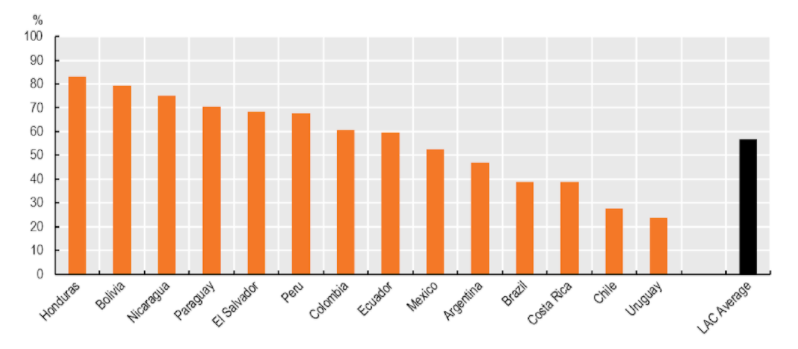 Source: OECD