Over two million Venezuelans have now abandoned their country, on latest estimates by the UN Refugee Agency (UNHCR). This is one of the largest mass migrations in the Western Hemisphere, with the only comparable migrant flows dating to war-torn Central American nations in the 1980s.
Speaking in Lima on 11 October, UNHCR’s High Commissioner, Filippo Grandi, called on the international community to provide assistance to countries like Colombia and Peru, which are absorbing the brunt of the arrivals. “Clearly, I think governments in the region and we, the humanitarian community, must step up our preparations for more [migrants]. Unfortunately, it’s not going to stop.”
Days later in Bogotá (on 16 October), the UN’s newly-appointed special representative for Venezuelan refugees and migrants, Eduardo Stein, likewise called for a more concerted regional and international response to the exodus of people fleeing the economic crisis in Venezuela. Stein, a former vice president of Guatemala, represents a joint platform between the UN Refugee Agency (UNHCR) and the International Organization for Migration (IOM). He describes his role as “fundamentally humanitarian”.
Stein praised Colombia for its welcoming attitude. The country is now host to one million Venezuelans, on official estimates, with the government issuing special temporary stay permits (PEPs) allowing migrants to work legally and access social services (including free schooling and healthcare). Well over 400,000 Venezuelans have been provide with these permits to date.
Contrasting Colombia’s reaction with that of European countries to the Syrian crisis, Colombia’s President Ivan Duque praised his country as “fraternal and ready to look for solutions”. Duque in late October was headed on an official trip to Europe, during which he was scheduled to meet his French peer, Emmanuel Macron, Pope Francis, and European Union (EU) officials to call for more assistance to address the Venezuelan migrant situation.
Speaking at the Colombian embassy on 18 October, Duque’s new presidential counsellor on human rights, Professor Francisco Barbosa (a respected academic), emphasised the increasing difficulties being faced by Colombia in trying to absorb the Venezuelan inflow and said the Duque government viewed the Venezuelan situation as one of its biggest challenges for its single four-year term, which began in August.
The UNHCR calculates that 4,000 Venezuelans are crossing the border into Colombia every day – some stay, many others are en route to Ecuador, Peru, and other countries. There are also thousands of crossings by Venezuelans who come across for food and basic supplies and then return home, often daily.
Barbosa suggested that on current inflows – which are not expected to ease given the critical situation in Venezuela – there would be 2 million (very vulnerable) Venezuelan migrants in Colombia by 2021.
Pointing out that this is more than the 1m Syrian refugees accepted in 2015-2017 by Germany – one of the wealthiest, best resourced and well organised countries in the world – Barbosa put the current estimated cost of the Venezuelan migrant crisis to Colombia at US$10bn, a very considerable sum that the country can ill afford at a time when it is already struggling to finance (and organise) implementation of its peace accords.
Furthermore, Barbosa emphasised, it is an unfortunate reality that while Colombia is trying its best to absorb the inflow, and has no intention of closing its border, the Venezuelan migration wave is imperilling not only social stability in parts of the country, but also the peace accords, with many desperate migrants being recruited (including forcibly) by left-wing guerrillas and criminal gangs – including drug gangs – who are now also using the vacuum inside Venezuela to recruit, train and, increasingly, to operate.
There are strong signs, for instance, that left-wing Colombian guerrilla group Ejército de Liberacion Nacional (ELN), which has long based training camps in remote areas in Venezuelan border areas, has extended criminal activities across Venezuela, most notably including involvement in the proliferating – and very violent – illegal gold mining business in Bolívar state.
Barbosa also noted that despite the best efforts of Colombian authorities and the UN, it is a sad fact that thousands of vulnerable Venezuelan children in border areas lack proper care – including schooling – and are living on the streets, where they too are at high risk of recruitment by unscrupulous criminal actors, including sex traffickers.
UNHCR data confirm this, reporting in July that a mass registration of Venezuelans irregularly present in Colombia had concluded, with 442,462 individuals registered. Key results included the fact that 98.8% lacked access to healthcare and only 48.7% of children were enrolled in schools.
In its latest situation update, the UNHCR reported that there were 2.65m Venezuelans living outside their country as of September 2018, of which over 1.9m have left since 2015. Some 70% of these (1.85m) are in South American countries.
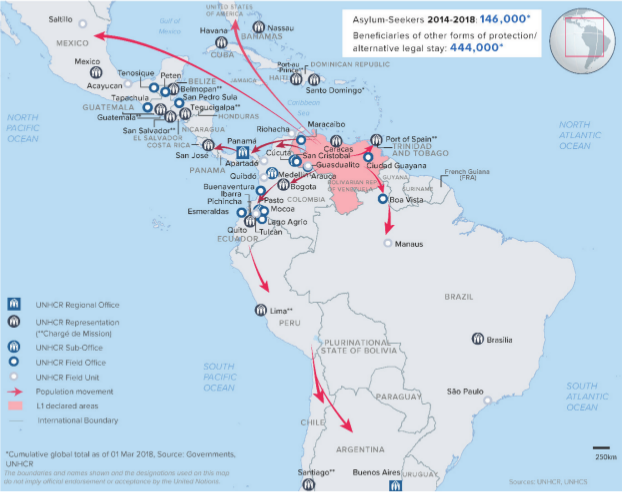
Source: UNHCR
However, the true figure is likely to be higher, as most data sources do not account for Venezuelans with irregular status. Venezuelans without a regular status in their host countries are particularly exposed to violence, discrimination, trafficking, and other forms of exploitation and abuse, the agency noted, emphasising that latest profiling and tracking activities had shown “a worrying increase” in the vulnerability of Venezuelan refugees and migrants, “affecting in particular children and women on the move”.
In line with this migration wave, over 966,000 applications for temporary or permanent visas or other regularisation mechanisms have been filed by Venezuelan nationals between 2015 and September 2018 (in countries including Colombia, Peru and Ecuador). Furthermore, some 346,500 asylum claims were lodged by Venezuelan nationals between 2014 and 2018, with Peru leading as the main country of asylum, with 133,400 claims.
Venezuela’s response – denial, paranoia
The government led by President Nicolás Maduro refuses to recognise that there might be a humanitarian crisis in Venezuela, and refuses to permit any international assistance into the country, seeing in it an external plot to intervene. Maduro recently said of Duque that while “he looks like a cherub…he is a devil who hates Venezuela and is conspiring on a daily basis against our country”.
On 18 October – after several weeks of escalating rhetoric – Ecuador expelled Venezuela’s ambassador, calling the Maduro administration “corrupt, murderous and lying”. The ambassador, Carol Josefina Delgado, was given 72 hours to leave the country. This is a very marked shift between the two counties, formerly close allies under presidents Hugo Chávez (1999-2013) and Rafael Correa (2007-2017).
The spat began when Ecuador’s President Lenín Moreno in his UN General Assembly speech on 25 September said that Ecuador was receiving over 6,000 Venezuelan migrants a day, and that “children are arriving with measles, diphtheria and polio.”
Venezuela’s communications minister, Jorge Rodríguez, on 17 October accused Moreno of “lying”, saying it would take “140 busloads a day for seven years” for Ecuador to accumulate the number of Venezuelan migrants it claims to have received. Rodríguez said he “couldn’t believe that someone could be such a liar, even at the podium of the United Nations.”
Ecuador’s foreign ministry replied that it “would not tolerate the disrespect of our authorities” but added that, “even so, Ecuador, faithful to its democratic and humanitarian principles, will keep offering assistance to Venezuelans citizens who enter the country”.
The communications secretariat, led by Andrés Michelena, was far less diplomatic, retorting that Rodriguez’s statements were proof that the “corrupt, murderous and lying socialism of the 21st century is still alive in Venezuela and producing the most massive migration in [Venezuela’s] history”.
The statement added that over 1 million Venezuelans have now passed through Ecuador, with 300,000 currently living there, including 60,000 in Quito.
