
All Categories

Subcategories

  • Peru: A change in the captain, not the course

    LatinNews 30 September 2014 Hits: 559

    The mid-September resignation of Luis Miguel Castilla as Peru’s economy & finance minister, and his replacement by Alonso Segura Vasi, is unlikely to result in major changes to the country’s longstanding orthodox economic policy stance. Segura’s main challenge is to counter the economic slowdown and make sure that the gains to date – including a sharp reduction in poverty rates – are not eroded before the next scheduled general election in 2016.

    Luis Miguel Castilla who formally stepped down for ‘personal reasons’, had overseen the successful management of Peru’s economy since 2011 and had been the longest serving cabinet minister (and was seen by many as being the most influential.

    Castilla was replaced by Alonso Segura Vasi, the top economic adviser at the economy & finance ministry (MEF), and a former official of the International Monetary Fund (IMF). Segura had collaborated closely with Castilla since his arrival at the MEF in 2013. Segura is unlikely to make major changes to economic policy in the short- or medium-term. Whether or not Castilla – who publicly applauded Segura’s appointment – exerts an influence from outside cabinet remains to be seen. Either way, orthodox economic policies appear likely to prevail.

    Segura is now tasked with implementation of the latest economic stimulus package seeking to boost investment and private sector economic activity. As chart 1 shows, overall growth has slowed markedly in recent months, with the year-on-year increase in real GDP slipping from 5.1% in Q1 14 to 1.7% in Q2. Partly, this has been the result of a deceleration in government consumption growth, which went from a pacey 9.8% to 4.9% year-on-year. Because of a slippage in the prices of major export commodities (particularly copper), exports were 5.1% lower than they were in Q2 13. This has weighed both on government spending and also on corporate investment, which was down 2.6% in Q2 14 over the corresponding year-earlier period.

    Chart 1: Peru's economy: key metrics
    Year-on-year growth (%) in real terms
    1Q14 2Q14
    GDP 5.1 1.7
    Private consumption 5.1 4.2
    Public consumption 9.8 4.9
    Gross domestic investment -0.5 -2.6
    Exports 3.0 -5.1
    Imports -0.7 -2.1
    Production 0.3 1.2

    Rate (%)
    Unemployment 5.6 6.1
    Growth in nominal salaries (urban) 0.0 1.8
    Growth in nominal wages (urban) -2.1 4.0
    CPI inflation 3.3 2.7
    PPI inflation 1.2 0.6
    Source: BCRP

    Most other metrics are reasonably favourable. Overall output has still been rising, led by the services sector. Inflation has come down. The main index of consumer prices (CPI) slipped from 3.3% in Q1 14 to 2.7% in Q2. For the producer price index (PPI), the corresponding figures were 1.2% and 0.6%. However, the unemployment rate has risen slightly, and urban salary earners have suffered a fall in real incomes. This, along with general antipathy towards the political class over another spate of corruption scandals, has contributed to a renewed decline in the popularity of President Ollanta Humala. In the latest (September) poll commissioned by the national daily El Comercio, the president’s approval rating had dropped four percentage points to 25%, reversing an upwards trend evident through July and August. Castilla’s approval rating, moreover, had dropped five percentage points to 20%, the lowest of any cabinet minister.

    Chart 2: Real growth year-on-year (%), January-July 2014

    Graph

    Source: BCRP

    The latest figures published by the Banco Central de Reserva del Perú (BCRP, central bank) indicate that the economy would have been a lot weaker but for the growth in the services sector and, in particular, in financial services and insurance. As chart 2 shows, the economy posted overall real annual growth of 3.0% in the first seven months of this year. Primary sectors (including agriculture & fisheries and minerals & energy) have been stagnant, as has the manufacturing sector. However output in the services and commerce sectors (wholesale and retail trade) rose by 4.7% and 6.0% year-on-year respectively. This matters, because the two combined account for about half of the entire economy. Manufacturing (including utilities) is the next largest sector, generating about 17% of output. Chart 3 provides the details.

    Chart 3: Components of Peru's GDP (%), 2013

    Graph

    Source: BCRP

    Consumption is being boosted by the growth in financial services – from a fairly low level of development. As chart 4 shows, total lending to Peru’s private sector grew by 12.7% over the year to August 2014. Lending to companies and to individuals rose by similar amounts. Within corporate lending, credits to large and medium-sized entities have grown by 15.4% and 19.75 respectively. The main area of weakness has been in lending to small and micro-businesses. The low availability of credit for the smallest (i.e. one-person or family) enterprises almost certainly has contributed to the adverse assessment by many Peruvians of the economy’s current performance.

    Chart 4: Year-on-year growth in credit to private sector (%), August 2014
    Loans to companies 12.9
    Corporates and large companies 15.4
    Medium-sized enterprises 19.7
    Small businesses 1.7
    Loans to individuals 12.4
    Consumer loans 11.8
    Car loans 7.6
    Credit cards 11.5
    Mortgage 13.2
    TOTAL 12.7
    Source: BCRP

    There is plenty that the government can do to boost demand, even if prices of commodity exports remain soft (whether because of stagnation in China’s manufacturing sector or some other reason). The IMF estimates that government revenues and spending will be broadly balanced this year, at around 21% of GDP each. It expects that general government net debt will fall to 3.2% this year, from 3.5% of GDP in 2013. The current account deficit is also falling relative to GDP. At a forecast 4.8% for 2014, it is at a level that is manageable for a country set to achieve nominal growth of 5%-6%.

    Financial market participants have been relaxed about Peru’s situation. In a country with overall GDP of about US$217bn, foreign reserves amount to around US$65bn and have been broadly unchanged since the beginning of 2013 (prior to which they had been growing quite steadily). The currency has weakened slightly against the US dollar through Q3 14, but only from PEN2.80/US$ to PEN2.86/US$. The BCRP has stabilised the rate by selling foreign currency. Over the last year, yield spreads on Peruvian debt have fallen by 26 basis points (bps) to 156. Across Latin America as a whole, spreads have remained basically unchanged at 393bps. As chart 5 illustrates, local currency interest rates are low and have been falling. US dollar interest rates within Peru reflect the extremely low levels currently prevailing globally. Encouragingly, local banks and customers increasingly are looking to deal in the local currency. Whereas credit in Soles rose 19.2% in the year to August, credit in US dollars increased by just 3.9%, according to the BCRP.

    Chart 5: Local currency interest rates (%) Jun-Sep 2014

    Graph

    Source: BCRP

    Key Points
    US$/PEN has moved from about 2.80 to 2.86 through Q314 - in spite of net sales of forex by BCRP.
    Net foreign reserves have remained broadly unchanged at about US$65bn.
    EMBIG Peru spreads down 26 bps to 156bps over year to 16 Septempber.
    EMBIG Latam spreads down 3 bps to 393bps.
    Copper price slips from nearly 400c/lb to 313c/lb since January 12.

    In short, with Segura as economy minister, official policies will remain orthodox and expansionary. And fortunately for the unpopular Humala government, there is room for an expansionary stance. In fact Castilla had been criticised for being too slow to react to the soft external scenario despite having fiscal tools at his disposal. In coming months, we expect greater government spending and new initiatives to promote lending – especially to small and micro-enterprises. A further round of stimulus measures will be pro-business, with tax incentives and cuts to bureaucracy. In the event that the global economy is weaker through Q4 14 than most commentators are expecting, the Peruvian government is well placed to cushion the impact. In terms of its economic management, the country’s captain may have changed, but the course has not.
  • TRACKING TRENDS

    LatinNews 03 May 2018 Hits: 1464

    BOLIVIA-PERU | Improving ties. Peru’s President Martín Vizcarra met his long-serving Bolivian peer Evo Morales in the border town of Desaguadero on 28 April to discuss deepening energy, trade, security, and environmental cooperation. Representatives of Peru’s energy and mines ministry and Bolivia’s hydrocarbons ministry will meet in Lima in mid May to discuss energy integration. This will prepare the way for a binational cabinet meeting in September in Cobija, the capital of Bolivia’s north-western department of Pando.

    Vizcarra said that bilateral integration was of “historic [importance] but must translate into concrete projects”. The lack of such projects was, incidentally, one of the reasons given by Peru, along with five other countries in the region, to suspend its membership of the Union of South American Nations (Unasur) last week, two days after Morales assumed the pro tempore presidency of the bloc [WR-18-16]. The two heads of state discussed Unasur. They agreed that their respective foreign ministries would seek a consensus to find a solution to the problem.

    VENEZUELA | Not one but two cryptocurrencies. Venezuela’s President Nicolás Maduro announced the launch on 26 April of the country’s second cryptocurrency. While the first, released earlier this year, is backed by oil, the second is backed by gold.

    The ‘petro oro’ token will not be purely digital but physically exist. Gold coins will be issued, weighing 10 grams, 20 grams, 50 grams, or one kilogram. They will be contained within a “sealed and classified” card, complete with the signature of the Great Liberator Simón Bolívar. “You will be able to invest in bolívars, in cryptocurrency, or convertible gold; you will be able to buy it and the investment will be solid,” Maduro said.

  • TRACKING TRENDS

    LatinNews 26 November 2020 Hits: 3378

    PERU | Bond boost for Sagasti government. Despite the political instability that has afflicted Peru, especially in recent weeks, the impact of the coronavirus (Covid-19) pandemic and the associated heavy economic contraction, Peru has succeeded in placing three bonds totalling US$4bn in international markets, one of them for as long as 100 years, while also maintaining its foreign currency ratings.

    The economy & finance minister, Waldo Mendoza, said the successful bond emissions constituted a vote of confidence in Francisco Sagasti as interim president and ratified “confidence in the Peruvian economy’s fundamentals” and the solidity of its financial institutions, as well as being “a reflection of consistent macro-economic policies of more than 30 years”. The 100-year bond is the longest-term bond that Peru has ever issued, with the previous longest just 40 years.

    Mendoza also celebrated the fact that Peru was the only country in the region to maintain its foreign currency ratings and stable outlook. The international ratings agency Standard and Poor’s said on 23 November that, in spite of the significant deterioration in economic activity in Peru in 2020, it predicted that the economy would bounce back strongly and grow by as much as 10% in 2021, 5.3% in 2022, and 4.2% in 2023.

  • ECONOMIC HIGHLIGHTS

    LatinNews 18 June 2021 Hits: 3839


    COSTA RICA | Unemployment continues to decrease. On 3 June Costa Rica’s national statistics institute (Inec) released new figures which show that the national unemployment rate for the February-April 2021 rolling quarter was 17.5%. This is an improvement on the 18.7% unemployment rate registered for the January-March 2021 rolling quarter. However, this is an increase of 1.6 percentage points on the unemployment rate in the same period the previous year – a rise which reflects the continued impact of the coronavirus (Covid-19) pandemic on Costa Rica’s economy which shrank 4.2% in 2020. The figures for the February-April 2021 quarter show that unemployment is higher among women (23.8%) than men (12.9%).

    DOMINICAN REPUBLIC | Central bank welcomes ‘extraordinary growth’. On 26 May the Dominican Republic’s central bank (BCRD) revealed preliminary figures which show that the country’s monthly indicator of economic activity (Imae) registered an unprecedented 47.1% year-on-year increase in April, the third month of positive year-on-year economic activity growth since the start of the coronavirus (Covid-19) pandemic in March 2020. Sectors driving growth were construction (566.9% increase); hotels, bars & restaurants (140.7%); free trade zones (82.6%); and mining (60.6%). Reporting the figures BCRD governor, Héctor Valdez Albizu, said that the US multinational investment bank & financial services holding company, Bank of America, had raised its GDP forecast for the country from 7.9% to 10%. The Dominican Republic’s GDP contracted 6.7% in 2020 as a result of the pandemic.

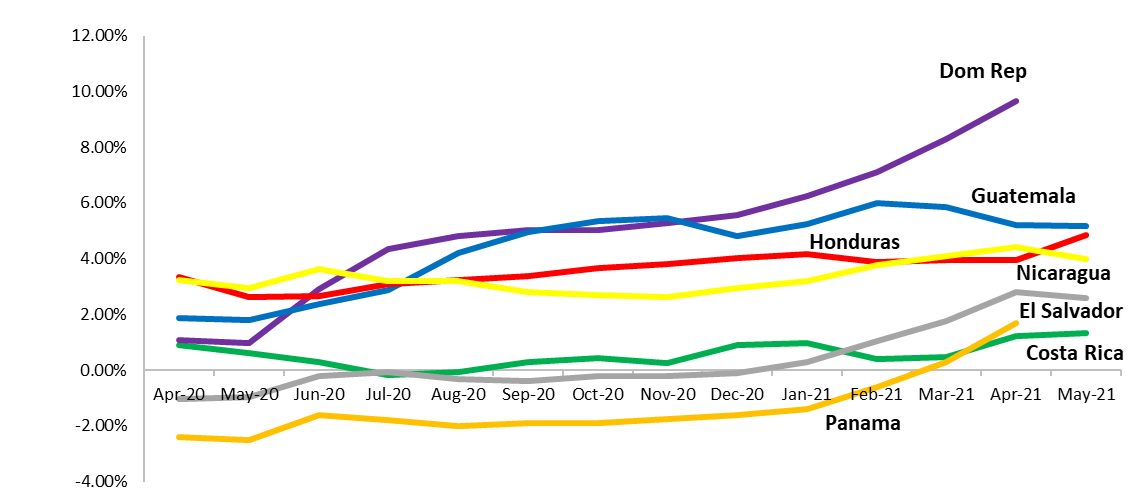
    Central America & Caribbean:​ Inflation
    Monthly year-on-year figures

    Central America & Caribbean, selected countries: GDP growth (%)
    Quarterly figures are year-on-year growth
    GDP  2020* 2021 forecast** Q1 2020 Q2 2020 Q3 2020 Q4 2020
    Costa Rica -4.2 3.0 0.1 -7.4 -6.4 -5
    Dominican Republic -6.7 5.0 0.0 -16.9 -7.2 -2.9
    El Salvador -7.9 3.5 0.8 -19.2 -10.2 -2.3
    Guatemala -1.5 3.5 1.2 -8.9 -1.4 3.0
    Honduras -9.0 4.5 -1.5 -18.5 -7.9 -7.6
    Nicaragua -2 1.3 1.8 -7.9 -2.5 -1.9
    Panama -17.9 5.5 0.4 -38.4 -23.6 -10.9
    *From local central banks **Forecasts from the United Nations Economic Commission for Latin America & Caribbean December 2020
    Quarterly growth based on figures from the local central banks


  • COSTA RICA/PANAMA: First moves in extending marine biosphere reserves

    Sarah Sheldon 25 January 2022 Hits: 1427

    Late last year Costa Rica and Panama joined Colombia and Ecuador in signing an agreement to discuss extending the Eastern Tropical Pacific Marine Corridor (CMAR) to make an interconnected protected area.

    Signed on 3 November at the United Nations Climate Change Conference (COP26) which took place in Glasgow, Scotland, the agreement would result in a fishing-free corridor spanning over 500,000km2 by joining together existing marine protected areas. It would cover a hugely important migratory route for species such as sharks and sea turtles between the islands of Coco in Costa Rica, in the north, to the Galápagos in Ecuador in the south, covering the Colombian islands of Malpelo and Coiba in Panama. The area is also home to 160 endemic and migratory endangered species. 

    The UN Educational, Scientific and Cultural Organisation (Unesco) highlights that the Eastern Tropical Pacific is currently home to five Unesco Natural World Heritage sites: Cocos Island National Park (Costa Rica); the Galápagos National Park and Marine Reserve (Ecuador); the Malpelo Flora and Fauna Sanctuary and Gorgona National Natural Park (Colombia); and Coiba National Park (Panama). In recent years scientific studies have shown that this area constitutes one single ecosystem, according to the office of Costa Rica’s President Carlos Alvarado. “We aren’t protecting any old ecosystem,” said Alvarado in a statement published 9 November. “It is one of the most valuable ecosystems in the world.” The statement also underlined how these migratory corridors provide services to both the ecosystem and the communities of the region. The plan will strengthen existing marine protection areas (MPAs) in each nation and start a process to extend the MPAs to make one large marine biosphere reserve.

    Work on the initiative started in 2004, when the four countries created the CMAR in a joint declaration with the stated aim of protecting the islands. Authorities have worked together on the sustainable management of marine resources, which are threatened by illegal fishing, as well as conservation, responsible tourism and surveillance of protected areas. This latest deal marks the start of a new dialogue between the four nations, and the move is part of global efforts to protect 30% of the world’s oceans and terrestrial resources by 2030 under the so-called 30x30 initiative.

    The move was hailed by the World Wildlife Fund (WWF), which said it believes that the governments will be able to make the reserve a reality if they work “hand in hand” with communities and industries in the Eastern Tropical Pacific. This includes those who target waters around both Coco and Coiba island in illegal fishing operations, and authorities in Costa Rica and Panama respectively will have to come up with creative solutions to this problem if they are to truly protect these ecosystems.

    • Agreement to extend the CMAR

    Panama’s President Laurentino Cortizo hailed the agreement to extend the CMAR. “We have heard lots of speeches about climate change, lots of agreements, the majority of which are not met,” he said. “This is a powerful message, an action, and that’s what the country and the world needs.”

  • Brazil follows a different road

    Patrick de Courcy 11 May 2022 Hits: 1586

    In some ways the contrast between Brazil and El Salvador could not be greater. Brazil's population is nearly 33 times larger than El Salvador's, and the value of its economic activity is 55 times greater. Despite this, there are important similarities (among them high levels of informal and unbanked workers). In the specific areas of cryptocurrency and fintech, there are also interesting contrasts. To put it bluntly El Salvador has done little to change traditional banking or payments systems, but, as we have seen, has championed a radical and high-risk shift to crypto. Brazil, on the other hand, has approached crypto in a highly cautious manner, while being much more radical about fintech.

    One sign of the rapid transformation of Brazilian banking has been the meteoric rise of Nubank, a fintech which launched a highly successful IPO on the New York stock exchange (NYSE) in December 2021, raising US$2.6bn in new capital and valuing the company at around US$48bn. Founded as recently as 2013, from an almost standing start, Nubank has rapidly grown to become Latin America’s highest-value financial company. The IPO was the fifth largest in the US in 2021. The resulting valuation turns Nubank into Brazil’s third largest listed company, behind oil giant Petrobras and mining conglomerate Vale. Nubank has also soared ahead of two of its natural rivals, the country’s biggest traditional banks, Itaú and Bradesco. According to company sources the IPO was up to eight times oversubscribed.

    Nubank offered its first credit card in 2014. The company’s basic concept is to provide zero-charge credit cards and digital accounts, with a simple customer-friendly and online-only presence. Now operating in Brazil, Mexico, and Colombia, it is an alternative to the traditional, bureaucratic, and high cost/ high interest rate banks, which must cope with managing many physical branches. One of the Nubank founders, chief executive David Vélez, has described the company’s pioneering story so far as follows: “First they ignore you, then they laugh at you, then they fight you, then you win”. Vélez, a Colombian executive, first saw an opportunity when he moved to Brazil and found that opening a bank account there was a bureaucratic nightmare. He thought an online neo-bank could do much better. Accordingly, Nubank began recruiting consumers dissatisfied with traditional banks. It now has 48m customers.

    Japan-based Softbank Group, one of Nubank’s institutional investors, says that over the next five years the customer base could reach 150m taking combined revenues up to US$300bn. Nubank is well positioned to benefit from the growing continent-wide digitalisation of payment systems. The nearly two years of the Covid-19 pandemic may have helped accelerate online banking and strengthened the business model. Goldman Sachs analysts say, “The company has shown good historical asset quality trends, given its extensive use of artificial intelligence, data analytics and behavioural science.”

    Nubank’s business model allows for revenue growth through cross-selling. At present the average customer uses just one or two company products, a number that could expand to six or seven over time. The company now offers credit cards, deposit accounts, personal loans, insurance, and investment products. It also offers incentives and discounts in association with major e-commerce companies. It conducts research to present a friendly, simple, and 'low friction' user experience. According to the prospectus, Nubank receives an average of 269 complaints per million customers: the industry average is 1,420 per million.

    Public sector innovation: the Pix story

    What the Brazilian experience shows is that there is ample scope to introduce a more efficient, nationwide electronic payments system and to sharply reduce transaction charges without necessarily having to rely on an El Salvador-style shift into crypto as legal tender. In fact, while Nubank is an example of how it can be done by the private sector within a single bank, Pix is an example of how it can be done nationwide as a piece of public sector-led innovation.

    Pix was launched in November 2020. It is a payments system that allows fast, largely free, smartphone-based transfers from bank accounts or digital wallets. It has grown rapidly. By October 2021 it was estimated that BRL500bn (US$92bn) worth of payments had been made through the app, around 30 times more than handled by its nearest rival electronic payments platform. About nine out of every ten bank transfers are now made through Pix. In its first year, the user base has more than doubled to 104m people, representing 62% of the country’s adult population, according to the BCB. About 6bn transactions were made in the platform’s first year in operation. Brazil now registers more instant transfer transactions than the US.

    Pix came into being as the Covid-19 pandemic forced more people to work from home and transact business remotely. It was also helped by a surge in the gig economy, with more start-ups of self-employed contractors and small businesses. Now, Pix payments are widely accepted in bars, by public utilities, in restaurants, and on e-commerce sites. Brazil-based journalists say even some street-sellers and beggars are ready to receive money via Pix. “Send me a Pix” has entered the language as shorthand for requesting a payment.

    The idea for Pix came from central bank president Roberto Campos Neto, who hired Carlos Eduardo Brandt, a private sector bank executive, to implement the system. The initial brief from Campos Neto was to create a more competitive alternative to existing payments systems including cash, bank transfers, credit/debit cards, ATMs, and the boleto (a cash voucher payment system widely used across Brazil). Enthusiasts say Pix offers 24x7 availability, virtually instant transactions, convenience, versatility, and safety. By offering a close-to-zero transaction cost it aims to encourage greater efficiency across the Brazilian economy. For those making payments Pix is free; companies receiving money pay a small transaction charge. By using Pix to reduce the country’s reliance on cash, the BCB seeks to reduce financial crime and corruption. One interesting by-product attributed to Pix is that in the first ten months of 2021 cash in circulation dropped by 10.5% or BRL40bn (US$7.1bn). Because of the combined effect of the pandemic and the growth of electronic payments, in 2020 as a whole, the use of cash at points of sale dropped by 25%.

    To make payment through the platform, users need to have downloaded the app and to know the payee’s Pix alias or key, which can be an ID number, mobile phone number, e-mail, randomly generated alpha-numeric string, or QR code. Individuals are allowed to create up to five keys for each account they own, while companies can create up to 20 keys. The instant payments system (SPI) within Pix works so that money sent to a Pix key is transferred immediately into the payee’s underlying bank account which can be a current, savings, or pre-payment account.

    Pix has been praised as a way to increase financial inclusion and reach the unbanked, estimated to be roughly 30% of the Brazilian population. However, it is not yet clear whether this will be achieved. Pix users still need to have a bank account, and opening a bank account remains a complex procedure, difficult for the poor and those without regular employment or income. Liliana Rojas-Suárez, Latin American director at the Washington-based Centre for Global Development, says achieving financial inclusion is a complex task that goes beyond the payments system itself and includes the need to overcome regulatory obstacles and low levels of trust in the financial system.

    Like other payments systems, Pix is also not immune to risks of fraud and cyber-crime. Criminal groups have been quick to learn how they can manipulate the system to their advantage. They have for example updated their approach to ‘express kidnappings’. Before the spread of e-payments the gangs were known for kidnapping a victim and, under the threat of violence, taking him or her to different ATMs to withdraw and hand over cash, up to the daily credit or debit card limit. Under the modified version of express kidnappings ATMs are no longer involved: the victims are simply seized in a variety of locations and forced to make large Pix ransom payments. In an attempt to mitigate this risk, the BCB has introduced a night-time upper limit of BRL1,000 (US$177) on payment values, since most express kidnappings happen in the evening. Pix accounts are traceable, but the criminals are thought to use identity theft, opening accounts in other people’s names to transfer ransom funds.

    Data theft is also a growing issue. In January 2022 a data breach at Acesso, a large and high-profile online bank, led to the exposure of the personal data of 160,000 customers who use the Pix system, the central bank (BCB) reported. Information leaked included customers’ usernames, taxpayer IDs, and other banking information, but passwords and bank balances were not compromised. This was the second major data leak involving Pix. In September 2021, data from 400,000 customers at Banese, a bank in the north-eastern state of Sergipe, was exposed, in what the bank said was a phishing attack against Pix by online criminals.  

    At a time when Pix is spreading rapidly, there have also been fears that it might face other threats, such as a restriction of service due to industrial relations problems. The issue came up in April 2022 amid strike action in defence of a wage claim by employees at BCB, the central bank. While Pix continued operating, unions halted work on various new Pix projects and functionalities, including automatic debit payments. Union representatives also said that, during the strike, out-of-hours Pix support would be reduced.

    According to a report by Brazilian fintech EBANX, e-commerce in countries like Brazil and Mexico is likely to grow steadily at around 30% per annum, in part because of the growth of e-wallets and instant payment systems like Pix. EBANX says the average order value of products purchased via Pix is 35% higher than those purchased via credit cards or the boleto. The report estimated that Brazilian instant payments, now dominated by Pix, would total US$9.5bn in 2021, about 6% of all digital commerce volume, putting it ahead of debit and credit cards. João Del Valle, EBANX ceo, says: “The rise of real-time payments such as Pix and digital wallets is transforming Latin America’s relationship with digital commerce and creating a race in terms of better shopping experiences, expanded payment options, and even impacting logistical prowess and financial innovation.”

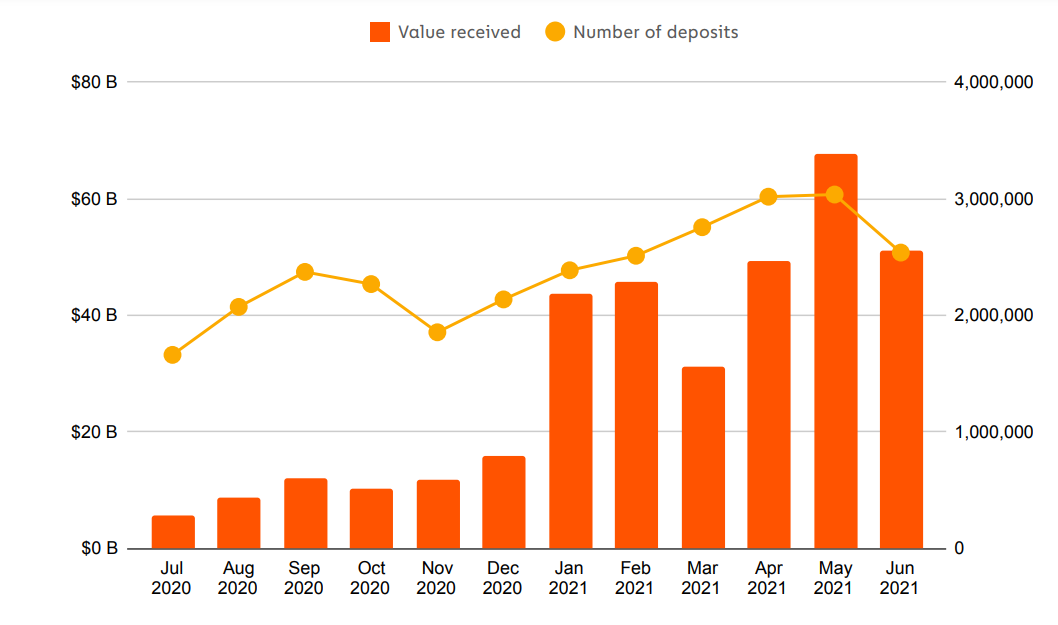
    Cryptocurrency value received and transfers to Latin America
    July 2020 – June 2021

    Source: Chainalysis

    Caution on the crypto front

    Brazil's approach has been to welcome cryptocurrencies but to do so in a phased and cautious manner. Contrasting with El Salvador, Brazil has not tied itself to Bitcoin which is after all just one particular and notoriously volatile cryptocurrency. Regulations approved in 2018 allowed investment funds to deal in cryptocurrencies. In 2021, crypto exchange-traded funds (ETFs) were launched. Top exchanges now include Mercado Bitcoin (part funded by Softbank), Binance, and Coinbase. Singapore-based Crypto.com is also opening in Brazil.

    Facing rising inflation Brazilian investors have shown a preference for stablecoins, or cryptocurrencies which are pegged in various ways to other asset classes (such as the US dollar) to reduce volatility. In the first eleven months of last year trading in stablecoins on Brazilian exchanges totalled US$11.4bn, about three times the amount in 2020. There is another strong incentive to use stablecoins - under current Brazilian regulations purchasing them is tax-free, unlike the purchase of US dollars, which attracts IOF, the financial transactions tax which ranges between 1% and 6.4%. According to a Central Bank (Banco Central do Brasil - BCB) estimate in August last year Brazilians held US$50bn in crypto, compared to US$16bn held in US stocks. It has also been estimated that Brazil has as many as 3.1m crypto traders registered with the exchanges.

    Separately, the Brazilian authorities are also working on a potential Central Bank Digital Currency (CBDC). Unlike the decentralised anonymity of Bitcoin, a CBDC by definition is controlled by the Central Bank which will have the power to establish operating parameters and protections against money laundering and the funding of terrorism (AML/CFT) measures). In March this year the BCB said it had selected nine CBDC pilot projects from 47 proposals. The successful bidders include lending platform Aave, Brazilian cryptocurrency exchange Mercado Bitcoin, bank federation Febraban, German payments company Gieseck + Devrient, and traditional Brazilian banks such as Santander and Itaú. Depending on the progress of lessons learned from these pilots, a CBDC could be launched in 2024.

    Separately, on 24 February this year, a Senate committee approved a new bill to regulate the cryptocurrency market. It defines crypto assets as “digital representations of value that can be traded or transferred electronically and used for payment or investment purposes”. It also seeks to define the role of crypto exchanges and service providers. Tax incentives are offered to crypto mining when powered by renewable energy. According to bill sponsor Senator Irajá Abreu “the intention of the project is to curb or restrict illegal practices such as money laundering, tax evasion and many other crimes. There is a market which is licit, and legal, which represents the vast majority, but there are exceptions.” Under the current text of the bill the government must choose whether the market will be regulated by BCB or CVM, the securities and exchange commission. Irajá envisages regulation leading to crypto payments eventually being accepted in Brazilian supermarkets, shops, and car dealerships. Brokers say the bill, which will eventually be debated in the lower house, will face the challenge of achieving the right level of regulation: too-heavy rules will increase bureaucracy and admin costs; too light will increase risks of fraud.

  • ECUADOR: Crack in the foundations

    Patrick de Courcy 31 March 2023 Hits: 4462

    Ecuador’s booming cocaine trade is leading to ever-rising seizures of the drug by the authorities, to the extent that the country is becoming something of a pioneer in what to do with impounded cocaine.

    The interior ministry tweeted on 19 February that “Ecuador is a pioneer in the process of destroying illegal substances via the encapsulation method” – a reference to the process of mixing cocaine with cement, sand and water to then be poured as concrete in construction projects. Whilst the government emphasises that this is more time-efficient and environmentally friendly than incinerating the cocaine, the very fact that new methods are being developed to destroy seized drugs underlines Ecuador’s rapid rise in the global cocaine smuggling network. As was noted in a Deutsche Welle article that the interior ministry shared with its tweet, “Ecuador has seized so much cocaine that it can’t store it anymore.”

    According to Pablo Ramírez, the director of counter-narcotics in the national police, the authorities seized 201 tonnes (t) of drugs in 2022 – down slightly on the record 210t that were seized in 2021, but significantly higher than the 128t that was seized in 2020 and the 82t seized in 2019. Of the 2022 haul, Ramírez said that 77t were seized in ports, around which some of the most vicious fighting for control of drug trafficking routes has taken place [SSR-22-12]. This was up by 42% on the amount seized in ports in 2021. He added that a further 90t of chemical precursors used in the manufacture of cocaine were seized, and that 301t of drugs or chemical inputs were destroyed, surpassing the amount destroyed from 2019 through 2021.

    In an effort to choke the flood of cocaine from southwestern Colombia down to Ecuador’s ports, President Guillermo Lasso has stepped up cooperation with his Colombian counterpart, President Gustavo Petro. Following a meeting between the two presidents in the Ecuadorean border city of Tulcán on 31 January, Petro said that he and Lasso had agreed to implement “a much more aggressive policy of drugs seizures”. Since that meeting, joint security operations along the border have been significantly expanded.

    The respective commanders of the Ecuadorean and Colombian armed forces, Nelson Proaño Rodríguez and Helder Fernán Giraldo Bonilla, met in Tulcán on 15 March to discuss the results of the first month of intensified cooperation. They highlighted the destruction of drug labs in the northwest of Ecuador’s Carchi province; a crackdown on the smuggling of chemicals used to process cocaine; and the destruction of coca crops and rebel camps on the Colombian side of the border.

    The cocaine busts keep on coming. On 26 February the commander of Ecuador’s national police, Fausto Salinas, announced the discovery of 8.8t of cocaine hidden in a container of bananas that was about to be sent from Guayaquil port to Antwerp, Belgium. This haul, which Salinas said had a street value in Europe of US$330m, represented a small part of a growing flow of cocaine from Ecuador to Belgium. The day after the bust in Guayaquil, Ecuador’s Interior Minister Juan Zapata and his Belgian counterpart, Annelies Verlinden, signed a memorandum of understanding to bolster cooperation in the fight against transnational organised crime. This came after 110t of cocaine were seized in Antwerp’s port in 2022, making it the leading port for cocaine seizures in Europe, according to the European Union’s Monitoring Centre for Drugs and Drug Addiction (EMCDDA).

    Cocaine seizures across Latin America

    On 8 March the specialist website Insight Crime published a roundup of cocaine seizures across Latin America in 2022, which stated that the largest quantity of cocaine was seized in Colombia, followed by Ecuador, Panama, Brazil, and Peru.

  • RASTREANDO TENDENCIAS

    LatinNews 03 October 2011 Hits: 474

    COLOMBIA | Se elevan el crecimiento y la inversión. La economía se ha expandido en 5,2% año en año en el segundo trimestre de 2011, de acuerdo con el departamento nacional de estadísticas (Dane). El crecimiento del PIB fue conducido por el sector minero (10,3%), el comercio (7,2%), transporte y comunicaciones (7,1%) y el sector financiero (6,1%).

    Las inversiones extranjeras en el sector energía-minero en Colombia treparon a US$9,76bn en los primeros ocho meses del año, subiendo 51% sobre igual periodo en 2010, sobrepasando la meta del gobierno para todo el año, anunció el Presidente Juan Manuel Santos. Quien dijo que a esa tasa, el record de US$10,60bn de inversión extranjera en el sector, establecido en 2008, sería eclipsado este año. Santos hablaba durante la toma de juramento del nuevo ministro de energía y minas, Mauricio Cárdenas, quien reemplazó a Carlos Rodado Noriega, ahora embajador en Argentina. Anteriormente ministro de desarrollo económico y de transportación, y director de planeamiento nacional, Cárdenas sirvió más recientemente como director de la iniciativa latinoamericana en la Brookings Institution en Washington.

    PERU | Nuevo impuesto minero. El congreso ha aprobado un paquete de leyes sobre impuestos a la minería discutido con compañías extranjeras en semanas recientes por la administración del Presidente Ollanta Humala. Este es un gran estímulo para Humala, no solamente porque remueve incertidumbres que podrían haber disuadido la inversión en el sector minero sino también porque él obtuvo el apoyo de dos tercios de los diputados en el congreso de 130 bancas.

    El gobierno anticipa que la toma fiscal del sector minero se incrementará en unos NS$3bn (US$1,1bn) por año durante los próximos cinco años bajo el nuevo régimen impositivo. Este ingreso extra será destinado a las políticas anti-pobreza y al mejoramiento de la infraestructura nacional.

    El deseo del gobierno de presentar una cifra concreta es entendible pero es de alguna manera engañosa. Sólo puede ser realmente una proyección de los royalties acordados con las compañías mineras extranjeras que estará basada sobre las ganancias operativas que, por supuesto, variarán.

  • CHILE: Fear of crime on the rise

    LatinNews 24 October 2019 Hits: 3980

    Comparatively speaking Chile is seen as one of the safer countries in Latin America with low rates of crime and homicide. The recent outbreak of violence comes just days after the release of a victimisation survey which questions this, suggesting citizen security is becoming a hot political issue.

    There are usually two ways of tracking crime. Police data gives a picture of reported crime. Victimisation surveys, on the other hand, give a better sense of total crime, both reported and unreported. The latest victimisation survey conducted by the Paz Ciudadana foundation showed a sharp increase. The victimisation index, which measures the proportion of households where one or more family members have been victims of crime in the last six months, has jumped by 4.2 percentage points since last year to reach 40.6%, its highest level in the last five years. The result means that two out of five households have been victims of crime in the last half year.

    Survey results show crime is highest in the capital Santiago (45% of households said they had been victims) compared with the rest of the country (33.5%). Theft, which is most likely to happen in public places, has remained broadly constant. Thefts with the use of violence have dropped marginally but are reported by 26% of households.

    Households reporting a “high” fear of crime have almost doubled from 10.4% last year to 19.6% now. The proportion of households who, having suffered theft, reported it to the police, fell from 61.3% last year to 49.4% this year. This may reflect falling confidence in law enforcement. Indeed, the proportion of households describing the performance of the Carabineros military police as “unsatisfactory” rose from 43.1% to 53.5%.

    The political implications of rising fear of crime are hard to predict but could be far-reaching. One possibility, depending on the stance that political leaders choose to take, is that there will be more demands for hard-line policing and potentially an increase in anti-immigrant sentiment. Earlier this month the government announced that it was conducting sweeps for illegal immigrants in Santiago and three northern cities. In the Plaza de Armas in Central Santiago, members of the Policía de Investigaciones (PDI) were stopping “foreign looking” passers-by and asking them to provide residence papers.

    Deputy interior minister Rodrigo Ubilla said the sweeps, also underway in Arica, Iquique, and Antofagasta, were designed to check the papers and status of immigrants. Some 65,000 had already been spot-checked, with something like 8% found not to have the correct residence permits. Those unable to produce papers are arrested.

    Last year 1,520 illegal immigrants were expelled from the country, many of whom had criminal records. According to government data, there are 1.25m immigrants in the country, of whom 288,000 are Venezuelans, 224,000 are Peruvians, and 179,000 are Haitians. The authorities estimate that around 85,000 immigrants do not have proper residence papers. The treatment of immigrants, and allegations of a supposed link to rising criminality remains a sensitive political subject in Chile.

    Also this month, the supreme court upheld appeal court rulings preventing municipalities from expelling immigrants without due process. Lobby group Fundación Epicentro says Chile’s immigration policies “permanently create undocumented immigrants”.

    Dictatorship conviction

    A colonel in General Augusto Pinochet’s notorious intelligence agency (Dina), Cristián Labbé, has been sentenced to three years in jail for human rights abuses committed during the dictatorship (1973-1990). Labbé, who served as mayor of the wealthy Santiago suburb of Providencia from 1996 to 2012 for the right-wing Unión Demócrata Independiente (UDI), was found guilty of torturing a political prisoner, Harry Cohen Vera, after he was arrested and imprisoned in Panguipulli in the southern region of Los Ríos, in November 1973.

  • URUGUAY: Ministers face grilling over pandemic

    LatinNews 08 July 2021 Hits: 4234

    Uruguay’s senate grilled cabinet ministers this week on the government’s response to the coronavirus (Covid-19) pandemic. The political opposition has accused the centre-right Partido Nacional (PN, Blancos) government led by President Luis Alberto Lacalle Pou of failing to adopt appropriate measures to mitigate the public health and economic impact of the pandemic.

    The opposition’s accusations were pointed enough for senators to agree to summon Health Minister Daniel Salinas and Economy & Finance Minister Azucena Arbeleche to appear before them on 6 July to answer questions about the public health and economic policy actions taken by the government in the face of the pandemic.

    The cabinet ministers were asked 76 questions prepared by Senator Daniel Olesker of the left-wing Frente Amplio (FA), the main opposition coalition. While Salinas and Arbeleche answered all the questions, their answers did not fully convince the opposition. Olesker’s questions centred on whether implementing stricter restrictions on movement could have reduced the number of preventable deaths, and whether additional government spending could have prevented some job losses and households from falling into poverty.

    The Lacalle Pou administration has refused to impose strict lockdown measures saying that it is loath to curtail civil liberties and has instead appealed for individual responsibility to follow sanitary protocols to stop the spread of the virus. Moreover, while it has offered financial assistance for businesses and households it has stopped short of rolling out universal economic support programmes, such as an ‘emergency income’, as demanded by trade unions and the FA.

    The measures adopted by the government were staunchly defended by Salinas and Arbeleche. However, they both admitted that more could have been done, while noting that this would carry more costs for the country. Arbeleche said that while the government could have undertaken more emergency spending it would have had to incur large debts to fund it. More controversially, Salinas admitted that broader restrictions would have reduced the Covid-19 death toll but argued that this would have produced a negative social and economic impact.

    • Controversy over preventable deaths

    Senator Olesker asked Health Minister Salinas if he agreed that imposing restrictions on the public could have reduced the number of preventable deaths due to Covid-19, claiming that by some estimates these could have been reduced by 50%. Salinas responded by saying that what constitutes a ‘preventable death’ is subjective and that there can be a wide discrepancy in calculations. But the minister admitted that more restrictions “could have reduced the Covid-19 morality rate by 15%”. However, Salinas argued that additional restrictions would have been harmful for the domestic economy and the general population’s welfare. Following the questioning, Olesker said in a press conference that Salinas had confirmed that “more restrictions could have prevented deaths”.

    Following the questioning, a vote of confidence in the ministers was passed by the senate. But the FA has said that the answers provided show that the government could have done more, and that it is up to the public to decide if its actions have been acceptable.

  • MEXICO: Finance Minister confirms interest in cryptocurrencies

    Patrick de Courcy 20 April 2022 Hits: 2417

    During Mexico’s 85th annual banking convention, which kicked off in Acapulco city (Guerrero State) on 24 March, Finance Minister Rogelio Ramírez de la O confirmed that the country’s financial authorities were working on the development of a Central Bank Digital Currency (CBDC), which was first disclosed by Banxico’s deputy governor, Jonathan Heath, at the end of 2021.

    Unlike the decentralised anonymity of cryptocurrencies such as bitcoin, CBDCs are by definition controlled by the central bank, which has the power to establish operating parameters and protections against illicit use. At the convention, Ramírez de la O stated that the administration of President Andrés Manuel López Obrador and Banxico agreed that making progress in financial digitalisation would broaden the reach of Mexico’s banking system and improve financial inclusion.

    There are also other players looking into making cryptocurrencies legal tender in the country, such as Senator Indira Kempis, from the leftist opposition party Movimiento Ciudadano (MC). Kempis is expected to introduce a proposal to the senate later this year, with the objective of using cryptocurrency to boost financial inclusion.

    • Lowering financial access barriers

    One of the attractions of a CBDC is that it can be used to include those who are excluded from the formal financial system and lack access to traditional banking services. It also offers a low-cost payments system and may also be used for making secure payments to large groups of the population, including those currently without bank accounts (for example, as part of the emergency transfers used during the Covid-19 pandemic).

    On 16 February, US-based cryptocurrency exchange company Coinbase Global announced it was launching a pilot programme to allow cryptocurrency recipients in Mexico to cash out their funds in pesos. The scheme was designed to allow those living in the US to send remittances to Mexico in cryptocurrency, which Coinbase said would allows them to avoid sender fees and other “challenges” of traditional currency transfers.

    Despite these developments, however, the widespread adoption of digital currencies in Mexico will not take place overnight. Crucially, existing regulation remains a barrier for the expansion of cryptocurrencies because the law to regulate institutions of financial technology, known as the fintech law, does not allow banks and other financial institutions to offer digital currencies to the public. Entities that are outside of the financial system may offer these instruments as long as they have been registered with the federal tax administration service (SAT) and they operate under anti-money laundering legislation.

  • BRAZIL: Rate-cut cycle begins

    Abbi Dicker 19 March 2026 Hits: 1839

    After holding the benchmark interest rate (Selic) at 15.0% since July last year, the central bank (BCB) decided on 18 March to lower the rate by 25 basis points. High interest rates had hindered Brazil’s economic activity in 2025, and economists had long expected that the 2026 would see the Selic come down, but the BCB is also likely to remain cautious over persistent inflation risks, especially due to the volatility in oil prices.

    The BCB’s monetary policy committee (Copom) has brought the Selic down to 14.75%, making its first interest rate cut since May 2024. The Copom had already indicated in January that it would lower the Selic in March, so media coverage in recent months had mainly focused on how big a cut would be made. Ultimately, the committee seems to have opted for a more modest reduction of 25 basis points, rather than 50 points, as some reports had previously speculated.

    In the past few weeks, there had even been some doubts as to whether a rate cut would happen at all, due to the impact of the ongoing conflict in the Middle East. The Copom statement released on 18 March to announce the rate cut made frequent mention of inflation risks posed by the conflict’s “effects on the global supply chain and commodity prices”, and the committee did not signal when or if it might make another rate cut in the near future. “In the current scenario, marked by heightened uncertainty, the Committee reaffirms serenity and cautiousness in the conduct of monetary policy, so that future steps of interest rate calibration could incorporate new information about the depth and extent of the conflict in the Middle East,” the statement reads.

    Government response

    Brazil’s executive government led by President Luiz Inácio Lula da Silva has also expressed concern over oil prices. On 13 March the government’s economic policy secretariat (SPE) released a report which estimated that the average price of crude oil in 2026 could be US$73.09 per barrel, which is a higher projection than the SPE’s previous estimate of US$65.97 per barrel. The SPE expects that a surge in global oil prices this year could result in an increase of 0.14 percentage points to Brazil’s consumer inflation.

    On 12 March Lula implemented measures aimed at mitigating the impact of oil price increases on Brazilian consumers. To keep domestic fuel prices down, he signed a decree to reduce the PIS/Cofins consumption tax rate on diesel to zero, as well as signing another piece of legislation to subsidise diesel producers and importers. According to a government press release, Lula’s two measures will lower diesel prices in Brazil by R$0.64 (US$0.12) per litre.

    Economic forecasts

    Despite the recent concern over fuel prices in Brazil, annual inflation is still expected to close the year within the target range of 3.0% +/-1.5. The SPE’s latest forecasts show an annual inflation projection of 3.74% for 2026, while the latest Copom figures show a forecast of 3.9%.

    Private sector economists appear to be the most pessimistic. The latest edition of Focus bulletin published on 16 March by the BCB, a weekly survey of private sector analysts, showed an average forecast of 4.10%. This latest inflation forecast marks an increase from the 3.91% projection featured in the previous week’s bulletin. Currently, Brazil’s annual inflation rate for the 12 months through February 2026 stands at 3.81%, according to figures released on 12 March by the national statistics institute (Ibge).

    Resilience in services

    The Copom statement released on 18 March listed several inflationary risks. Aside from the conflict in the Middle East and its effects on fuel prices, another concern was the “stronger-than-expected resilience of services inflation due to a more positive output gap”. Indeed, the latest figures released by the Ibge have suggested that Brazil’s services sector is showing signs of recovery after a period of stagnation in the latter months of 2025. In January, the sector posted a monthly growth rate of 0.3% in the volume of services provided, while the accumulated annual volume of services provided in the 12 months through January 2026 was up 3.0% compared with the preceding 12-month period.

  • EL SALVADOR: AI telemedicine programme expands to cover chronic illnesses

    Sarah Sheldon 26 May 2026 Hits: 196

    On 14 April, President Nayib Bukele announced the expansion of the DoctorSV AI-assisted telemedicine service, with the second phase focusing on diagnosing and treating chronic illnesses.

    DoctorSV provides free, 24-hour care as part of the Salvadorean public health system, with patients using an app to describe their symptoms before US tech giant Google’s Gemini AI helps a doctor provide a diagnosis and next steps, such as a prescription or a referral for tests.

    The service was initially launched in November 2025 in conjunction with Google and the Latin American development bank (CAF), which has reportedly provided a US$75m loan to fund this second phase, and is also backed by the Pan-American Health Organisation (Paho). According to a report by prestigious medical journal The Lancet, the expanded programme has capacity to cover the whole country and can handle up to 30,000 calls per day. 

    It aims to aid in the diagnosis and treatment of chronic diseases such as diabetes, hypertension and kidney disease, which currently affect around three million of El Salvador’s 6.4m people, according to the government. Better diagnosis and treatment would help to reduce the burden of these diseases by getting patients the care they need before their condition deteriorates, and the AI system aims to do so while freeing up health system capacity for more clinically complex cases.

    DoctorSV is part of Bukele’s wider efforts to advance digitalisation and technological adoption in a bid to close development gaps. For example, he announced a partnership with AI firm xAI to use its chatbot Grok in the public education system in December [EB-26-01], and he has proposed using AI to improve access to the judicial system.

    However DoctorSV stands out due to the fact that it has significant backing from international organisations, which plan to carry out a scientific trial to assess system performance this year. If the programme is implemented according to the design laid out in The Lancet, with continuous training for clinicians and sufficient data protection measures, it could have a positive impact for patients seeking diagnosis and treatment for minor ailments and chronic conditions by speeding up the process.

    It could also benefit the economy by reducing the number of working hours lost traveling to health centres and waiting in line, and more effective triaging should free up capacity in the health system.

    The rollout of the initiative has, however, been criticised by Coordinadora Nacional para la Defensa de la Salud del Pueblo Salvadoreño (Conades), a coalition of some 50 organisations representing unions, health care professionals, and academics, which launched in October 2025 in defence of the public health care system. Conades warns that it takes place amid a major reduction of health personnel and in-person services. A report by Salvadorean newspaper Diario Colatino, published in January 2026, cites Conades as saying that 7,700 health workers were laid off last year, and questioning DoctorSV’s capacity to guarantee comprehensive medical attention.

    If DoctorSV is used to replace existing capacity rather than augment it, the impact of the programme will be vastly reduced. In a piece published on 30 April, investigative Salvadorean media outlet El Faro cites 2024 data as showing that El Salvador has the second-highest mortality rate from chronic kidney disease in Latin America. While the disease is the leading cause of death for people aged 40-59, the country only has one nephrologist per 853 people, according to data from the health ministry and Salvadorean Association of Nephrology and Hypertension cited by El Faro. The health system already cannot keep up with demand for treatment for kidney disease, so newly diagnosed patients are also likely to struggle to access adequate care.

    There are also significant concerns around the long-term sustainability of the programme. First, the second phase is being financed by a CAF loan rather than the national budget, and the government is under pressure to cut public spending as part of a financing agreement with the International Monetary Fund (IMF). Second, DoctorSV is part of a seven-year agreement that the Bukele government signed with Google in 2023 in the areas of digital government, healthcare, and education, raising doubts as to what will happen once the contract ends. As a result, DoctorSV appears to be vulnerable to both fiscal pressures and political risks, with Google potentially able to withdraw from El Salvador and take all of the accumulated system data with it at the end of the contract term.

    Take-up

    A social media post by El Salvador’s presidency outlining the launch of the second phase of the rollout of DoctorSV cites Guy Nae, the director of Google Cloud for the public sector in Latin America, as saying 1.1m Salvadoreans enrolled in stage one, while 1.5m consultations were conducted. It adds that 400 establishments, such as pharmacies, are affiliated with the scheme and responding to demand, while the effectiveness (accuracy in diagnosis and treatment) stands at 93%.

  • POINTERS

    LatinNews 06 September 2011 Hits: 626

    BOLIVIA | Court hands down sentences for ‘genocide’. Five former high-ranking military officers and two former ministers have been convicted by the supreme court of ‘genocide in the modality of a bloody massacre’, for their part in the repression of protests in the ‘Black October’ of 2003, in which 64 people were killed and 500 were injured. The sentences varied according to the degree of responsibility the court deemed each of the accused had borne. The former commander of the armed forces, General Roberto Claros Flores, and the commander of the army, General Juan Veliz Herrera, were given 15 years and six months; a former air force commander, General Oswaldo Quiroga, and a navy commander, Admiral Luis Aranda, 11 years; the former chief of the armed forces’ general staff, General Gonzalo Rocabado Mercado, 10 years; and the former ministers Adalberto Kuajara (labour) and Erick Reyes Villa (sustainable development), three years.

    The government of President Evo Morales intends to use these convictions as additional arguments to request the extradition of other former officials accused of responsibility for ‘Black October’: former president Gonzalo Sánchez de Lozada and his defence minister, Carlos Sánchez Berzaín (both in the US); former presidential advisers Jorge Torres, Mirtha Quevedo and Javier Tórrez (in Peru) and Hugo Carvajal (in Spain).

    In the figure of ‘genocide in the modality of a bloody massacre’, peculiar to Bolivian legislation, ‘genocide’ does not mean the same as in the most widely accepted definition, which is ‘acts committed with intent to destroy, in whole or in part, a national, ethnical, racial or religious group, as such’. Evo Morales has himself been accused of ‘genocide’ before Bolivia’s supreme court and the World Court, for his alleged responsibility in the 2008 killing of 13 people in Pando.

    BOLIVIA | Crackdown on suspected Sendero Luminoso members. The investigation into the connections of a Sendero Luminoso (SL) member, Ulser Pillpa Paytan (‘Camarada Johnny’), last June on charges of drug trafficking, led to the 1 August arrest of four other Peruvians suspected of being SL members engaged in a recruitment drive in Bolivia (they were caught distributing leaflets hostile to the government of Evo Morales). Expulsion orders were issued against three of them, while the fourth had his status as a political refugee cancelled and was given 90 days to find another country willing to take him in.

    PERU | SL marauders in Choquequirao. Headlines in the Peruvian media on 17 August proclaimed that a group of tourists had been attacked by a group of SL fighters as they trekked towards Choquequirao, Cusco, an archaeological site that has been dubbed ‘the second Macchu Picchu’. Local police sources confirmed that a group of US and German tourists had been intercepted by an SL unit and relieved of their money and some ‘articles’, but had not been mistreated (which was confirmed by one member of the party). The police said that SL frequently conducts patrols in and around Choquequirao (an area SL had occupied at the height of the insurgency in the 1980s). The marauders were a well-armed group of nine, who boasted that they were part of a ‘column’ of 30 that had killed five soldiers in the VRAE region at the time of the recent presidential elections.

    VENEZUELA | More Russian weaponry. On 17 August the Venezuelan military took delivery of a batch of Russian BTR-80 tanks, ZU-23 anti-aircraft missiles and portable mortars. On the occasion President Hugo Chávez announced that his government was seeking from Russia a loan of US$4bn, ‘a good part of which will be used to go on equipping ourselves, enhancing our combat and defence capabilities.’ Last April the Russian arms export firm Rosoboronexport said that over the past five years Venezuela has spent some US$11bn on acquisitions of Russian defence materials.

  • URUGUAY: Feeling more than OK

    LatinNews 30 March 2012 Hits: 1812

    The Instituto Nacional de Estadística (INE) reported that average wages had risen 6.3%, year-on-year in January, a record for the month. Private sector wages rose 4.6%, which was 50% higher than their rate of increase in January 2011, but the average public sector wage jumped 9.4%. In 2011 consumer price inflation was 8.6%.

    To some extent the increase in the private sector in January is understated because some industries increase wages twice a year and others stagger their increases over the first quarter. Construction and private schools are two examples of phased wage increases. The construction industry traditionally increases wages in March and October while private education increases its salaries in February and August.

    In the services sector average wages went up by between 7% and 8.5%. In real (i.e. discounting inflation) terms, such increases are about 2% a year because most wages had also been increased in the second half of 2011. Traditionally, however, the January wage increase is the most important of the year. Industries that had used the central bank’s forecast for 2011 inflation, which was around 5% at the start of 2011, have collective agreements which automatically increase wages by three percentage points above the previous year’s inflation rate each January.

    The bottom line, according to local economists, is that for most employees, whether public or private, real wages will increase by about 4% over the course of 2012. Employers will pay up because the labour market is tight. This means that domestic consumption is likely to remain strong. The big question is whether domestic demand will remain strong enough for companies, especially service providers, to pass on their rising costs to their market.

  • PERU: Judicial clash over death squad

    LatinNews 27 September 2012 Hits: 2991

    A triumph for human rights or a setback for Peru’s national sovereignty? Those were the two most polarised reactions to a resolution issued by the Inter-American Court of Human Rights (CorteIDH) this week ordering the annulment of a ruling by Peru’s penal chamber of the supreme court to reduce the length of the sentences for members of the Colina death squad who were involved in massacres in the 1990s during the authoritarian government of Alberto Fujimori (1990-2000).

    The CorteIDH ordered Peru back in 2001 to investigate massacres perpetrated by Colina on the grounds that they constituted crimes against humanity by the State. The five-strong penal court, led by Javier Villa Stein, ruled last July that the resulting convictions against Colina members, and, for instance, Vladimiro Montesinos, Fujimori’s intelligence chief who created Colina, be reduced from 25 to 20 years because the killings did not constitute crimes against humanity but were simple murders. This ruling, which meant that some Colina members could soon be eligible for parole, was savaged by Peru’s prime minister, Juan Jiménez Mayor, as “shameful” and a “dark new episode in Peruvian justice” [WR-12-29].

    The CorteIDH decision this week to overrule the penal court (see sidebar) triggered criticism from a range of justices, not least Villa Stein. They accused the CorteIDH of trampling on Peru’s judicial sovereignty. President Ollanta Humala, who was critical of the penal court’s ruling in July, gave a measured response. He said he could understand the concerns of those shrilly decrying the loss of the country’s sovereignty, but that Peru had signed up to the CorteIDH and must comply with its rulings. The alternative, he said, was to leave.

    • Ruling

    The CorteIDH resolution stated that the ruling by the penal chamber of the supreme court was “incompatible” with Peru’s ratification of the Inter-American Convention on Human Rights. In its resolution the CorteIDH stated that “If the causes that could lead to impunity are not remedied through the available internal mechanisms […], it would be a breach of the orders of this Court.” It gave Peru until 20 January 2013 to annul the penal court’s ruling, or face a resolution from the CorteIDH revoking it.

  • TRACKING TRENDS

    LatinNews 01 May 2014 Hits: 1920

    ARGENTINA | Fernández rolls over provinces’ debts. On 28 April President Cristina Fernández announced a rescheduling of Ar$45bn (US$5.6bn) owed to the central government by provincial authorities over the past four years. In return, Fernández is demanding that provinces apply the ‘Precios Cuidados’ (a prize freeze on basic goods) locally, and fix the price of basic services, particularly electricity.

    The government made a similar offer in December, but the provinces’ finances have continued to deteriorate following pressure to increase wages, particularly from police forces, prompting some governors to consider issuing bonds before the announcement. Provinces that do not owe money to the federal government, such as San Luis and Santa Fe (both held by the opposition), have complained that they are being discriminated against, and are seeking some form of equivalent financial help.

    ARGENTINA-BRAZIL | New automotive deal. Argentine government officials revealed on 29 April that the Argentine and Brazilian governments had reached a new deal covering the bilateral automobile trade, which is key to the manufacturing sectors of both Brazil and Argentina.

    In a bid to overcome the market asymmetries that set apart the two Southern Common Market (Mercosur) partners and avoid a major trade dispute, in late 2012 Argentina and Brazil signed a common auto trade pact (PAC) to regulate the trade balance so that it is not completely unfavourable to Argentina. The PAC is due to expire in June, with trade once again becoming unrestricted thereafter, something that Argentina, in particular, would like to avoid.

    Despite the restrictions, the bilateral trade balance in the auto sector continues to be massively in Brazil’s favour. Last year the auto trade balance was US$3.1bn in Brazil’s favour, as Argentina exported 13,300 fewer units to its neighbour than in the previous year. This substantial fall in exports to Argentina’s main automobile export market has severely affected local manufacturers, which in recent months have been forced to halt production and even announce plans to dismiss workers temporarily.

    Against this backdrop Argentine and Brazilian government officials began analysing the possibility of signing a new deal when a delegation led by Brazil’s industry, development & foreign trade minister, Mauro Borges, visited Buenos Aires on 22 April. These initial negotiations were positive and led to an Argentine delegation headed by Economy Minister Axel Kicillof and Industry Minister Débora Giorgi travelling to Brasília a week later for a follow up meeting. After that meeting, government officials accompanying the ministers told Argentina’s national news agency, Télam, that the two sides had reached an agreement in principle to extend the current PAC until mid 2015 as well as additional measures that would help to “equilibrate” the auto trade imbalance in the longer term.

    The Argentine government officials did not provide further details, pointing out that the specifics of the deal are to be thrashed out during another meeting scheduled to take place in Brasília next week. However, they did reveal that Brazil had agreed to allow more Argentine auto parts to enter its domestic market in exchange for Argentina allowing more Brazilian automobiles to enter its market. In addition, the Brazilian government is also said to have offered a US$2bn credit line through the state-controlled Banco do Brasil for consumers on both sides of the border looking to buy vehicles in a bid to stimulate demand.

    • Astori lures Brazilian exporters to Uruguay

    On 29 April Uruguay’s Vice-President Danilo Astori called on Brazilian entrepreneurs to exploit the advantages that his country offers as a “platform” to access other markets with which Uruguay has free trade agreements (FTAs), such as Mexico. Speaking at a conference in São Paulo, Astori said that Brazilian businesses should take into consideration the fact that, unlike Brazil, which failed to conclude the FTA negotiations with Mexico launched in 2000, Uruguay signed an FTA with Mexico back in 2003. “The FTA with Mexico is of great importance for Brazilian businesses, Mexico is an important market,” Astori said before inviting Brazilian business leaders to “take advantage of the favourable and secure [investment and trade] scenario that Uruguay has been trying to build in the past few years”.

  • ECUADOR: Correa muestra su lado pragmático

    LatinNews 25 July 2014 Hits: 565

    El Presidente de Ecuador, Rafael Correa, llegó la semana pasada a dos acuerdos significativos con un político al cual él acusó el pasado febrero de representar a los derechistas empecinados en desestabilizar su gobierno. La reunión de dos horas de Correa con el nuevo alcalde opositor de Quito, Mauricio Rodas, quien derrotó al alcalde en funciones, Augusto Barrera, de la gobernante Alianza País (AP), en las elecciones del pasado febrero, produjo acuerdos en el área de transporte relacionados con los sistemas de metro y trolebús.

    Correa y Rodas prometieron mantener abiertos los canales de comunicación, y el constructivo diálogo sugiere que, más allá de la retórica, Correa es capaz de trabajar con adversarios políticos. Esto ha sido demostrado estar más allá de la capacidad de algunos miembros de izquierda radicalizada en la región. El fallecido expresidente de Venezuela, Hugo Chávez (1999-2013), por ejemplo, despojó al alcalde electo (de la oposición) del Gran Caracas, Antonio Ledezma, de todo poder en abril del 2009, mediante la designación de una presidente del Distrito Capital, Jacqueline Farías, asignándole el 90% de los recursos que hubiera recibido Ledezma.

    El Presidente Correa confirmó a Rodas que su gobierno proveería US$750m para el metro. La reunión tuvo lugar después de que cuatro consorcios presentaron ofertas para la fase dos del proyecto para construir 13 de las 15 estaciones y completar las tareas de cavar los túneles para extender la trayectoria, y Correa y Rodas prometieron evaluarlas y discutirlas.

    Cuatro multilaterales –el Banco Mundial (BM), el Banco Europeo de Inversiones (EIB, siglas en inglés), el Banco de Desarrollo de América Latina (CAF) y el Banco Interamericano de Desarrollo (BID)– han firmado acuerdos para proveer financiación por alrededor de los US$900m para el proyecto, pero esto aún podría dejar un faltante de US$700m, basados en las ofertas presentadas para la fase dos.

    El sistema del metro de 23kms está programado para su terminación en el 2016. Transportará a 400.000 personas por día, reduciendo los notorios atascos en el tráfico en la capital, mejorando la calidad del aire, y ahorrando unas estimadas 120m de horas de productividad por año permitiendo a los pasajeros cruzar Quito en sólo 34 minutos, y no en el tiempo promedio actual de unas dos horas.

    Correa también le dijo a Rodas que US$15m se harían disponibles por el Banco Estatal de Ecuador (Bede) para renovar el sistema eléctrico del trolebús. Rodas había criticado ferozmente a su predecesor por el pobre mantenimiento del sistema y por no ser capaz de atraer oferentes a la licitación pública para 40 nuevos trolebuses, lo que derivó en que fondos tuvieron que ser devueltos al Bede. Rodas declaró que el sistema del transporte público de la capital estaba en un estado de emergencia el 30 de junio. Él afirmó que el 58% de los 235 trolebuses en Quito estaba en un mal estado de reparación, y que el 25% estaba fuera de funcionamiento.

    Rodas dijo que bajo sus planeadas mejoras, las paradas de buses serían totalmente mejoradas, con la provisión de servicio de Internet gratis y pantalla de información digital actualizando el tiempo de llegada de los buses. También dijo que se tomarían medidas rigurosas (sin especificar) para impedir que las compañías privadas utilicen las líneas exclusivas de tránsito rápido usadas para los buses eléctricos, y que 100 oficiales de la policía metropolitanos serían asignados en las áreas consideradas de ‘alto riesgo’ para mejorar la seguridad y frenar el robo.

    • Ecuador logra un acuerdo comercial con la UE

    El 17 de Julio los negociadores de Ecuador y de la Unión Europea (UE) finalizaron un acuerdo para que Ecuador se adhiera al existente Acuerdo de Asociación de la UE con Colombia y Perú. La UE es el mayor mercado para las exportaciones no-petroleras de Ecuador. El comercio UE-Ecuador tuvo un valor de €4,9mm (US$6,6mm) en el 2013, según cifras oficiales de la UE con las exportaciones de Ecuador totalizando €2,5mm (US$3,4mm), dándole al país andino un pequeño superávit. El sector exportador de Ecuador estima que las exportaciones existentes a la UE podrían elevarse por US$500m bajo el nuevo acuerdo. Sin embargo, el acuerdo aún requiere la ratificación de los parlamentos de cada de los estados miembro de la UE, por lo tanto, se espera que entre en plena vigencia en la segunda mitad del 2016.


  • COLOMBIA: Se extiende el pesimismo acerca de las conversaciones de paz

    LatinNews 08 May 2015 Hits: 639

    Incluso aunque el gobierno colombiano y las guerrillas de las Fuerzas Armadas Revolucionarias de Colombia (Farc) acordaron que continúen las negociaciones de paz después del ataque de la guerrilla del 14 de abril que cobró la vida de 11 soldados y –más llamativamente– que la delegación militar del gobierno, encabezada por el jefe estado mayor conjunto, el General Javier Flórez Aristizábal, reanudará las conversaciones sobre ‘poner freno a la escalada del conflicto’ con sus contrapartes de las Farc en La Habana, el episodio ha producido un impacto adverso sobre la opinión pública. Una mayoría de colombianos ahora no cree que un acuerdo de paz será firmado entre los equipos negociadores de la paz del gobierno y de las Farc en Cuba.

    Un sondeo conducido por Cifras y Conceptos para Radio Caracol y Red + Noticias, publicado el 30 de abril, mostró que con relación al mes anterior, el número de entrevistados que eran optimistas acerca del resultado de las negociaciones de paz, cayó del 46% al 32%, mientras que aquellos quienes eran pesimistas crecieron del 48% al 56%.

    El cambio de humor es aun más ilustrado por el hallazgo de que la proporción de aquellos que creen que la mejor manera de poner fin al conflicto es a través de la negociación política con las Farc ha caído del 43% al 28%. El único desarrollo que mantiene el equilibrio es que no hubo un incremento en el número de quienes creen que sería mejor derrotar a las Farc en el campo de batalla. Estos cayeron levemente, del 23% al 22%.

    Los ítems que podrían afectar el resultado político de las conversaciones, incluso si son exitosas, incluyen:

    • el 55% de los entrevistados están en contra de otorgar poderes especiales al Presidente Juan  Manuel Santos para firmar un acuerdo de paz.
    • el 57% dice que cualquier acuerdo de paz deberá ser aprobado por un referéndum.
    • el 38% quiere que la aprobación provenga de una asamblea constituyente.
    • el 62% está en contra de permitir que el liderazgo de las Farc compita por puestos electorales.
    • el 32% está a favor de poner un límite de ocho años de prisión para guerrilleros que opten por desmovilizarse (como fue establecido para los grupos paramilitares de Colombia).
    • el 26% está a favor de alternativas de prisión para guerrilleros desmovilizados.

    El campo de batalla, el gobierno pudo obtener algunas ganancias la semana pasada. El 1 de mayo, el comandante de la fuerza Omega del ejército, el General Luis Fernando Navarro, anunció que unas de las más vitales unidades de las Farc, el 27mo ‘Frente’ (F27), que opera en el departamento central de Meta, ha sido “irreversiblemente debilitado”. El F27, también conocido como el ‘Frente Isaías Pardo Leal’, se cree que ha sido responsable de la obtención de fondos para el Bloque Este de las Farc del tráfico de cocaína base y la extorsión.

    Durante el año y medio pasado, se estima que la fuerza del F27 se contrajo de 229 guerrilleros a menos de 95. Han sido capturados 47 guerrilleros y otros 45 han optado por la desmovilización. El General Navarro afirmó que esto ha impedido que el F27 lleve adelante planes elaborados por el secretariado de las Farc, el comité de dirección del grupo guerrillero, tales como promover “movilizaciones masivas” coaccionando a los habitantes locales para que tomen parte en las “marchas campesinas”.

    • Cese al fuego bilateral

    La Izquierda de Colombia y las organizaciones sociales que conforman el Frente Amplio por la Paz, difundieron un informe esta semana pidiendo al gobierno y a las Fuerzas Armadas Revolucionarias de Colombia (Farc) que acuerden un cese al fuego bilateral. Hace tiempo que las Farc insisten en un cese al fuego bilateral, pero el gobierno se resiste por temor a que las guerrillas utilicen el respiro logrado para reagruparse militarmente. Días antes, el Presidente Juan Manuel Santos dijo que era improbable que un cese al fuego bilateral ocurra durante las negociaciones de paz debido a las “complejas” condiciones, pero que esto podría tener lugar después de que las conversaciones concluyan.

  • Jamaica: Sticking with the program

    LatinNews 21 March 2016 Hits: 2261

    The newly-elected Jamaica Labour Party (JLP) government under Prime Minister Andrew Holness may find it hard to meet its pledge to create about 200,000 new jobs over the next five-to-seven years. In the meantime, the government will continue to follow the economic reform program that was agreed with the IMF as a part of the four-year Extended Fund Facility initiated in May 2013.

    The latest (October) review of the country’s labour force, published by the Statistical Institute of Jamaica (SIJ) at the end of January, contained good news. The total labour force came to just under 1.33m, or 1.1% more than one year previously. The male labour force grew by 0.9% to 723,100, while the female labour force increased by 1.5% to 602,100. The number of employed men rose by 1.6% to 655,700, while the number of employed women increased by 2.6% to 490,900. In terms of occupations, the biggest growth (of 4.6% to 262,100) was in the number of people classified by the SIJ as ‘professionals, senior officials and technicians.’ The growth of employment is being driven by the services sector. The number of people working in hotels and restaurants increased by 13,700 (or 16.8%), while the number of people working in real estate and business activities grew by 10,000 (or 15.5%).

    This means that the overall unemployment rate fell by 0.7 percentage points (pp) to 13.5%. For men, the rate dropped by 0.6pp to 9.9%; for women, by 0.9pp to 18.5%. Over the year to the end of October, the unemployment rate for youths aged 14-24 years dropped by 3.3pp to 32.7%.

    Collectively, these numbers mean that the labour market is developing broadly in the way desired by the new government, which achieved a very slim victory over the People’s National Party (PNP) of former Prime Minister Portia Simpson-Miller in the general election of 25 February 2016. The JLP campaigned on an ambitious pledge generate new jobs over the next half decade or so. According to its election manifesto, the JLP is looking to create 10,000 jobs from urban renewal in Kingston; 30,000-40,000 in Business Process Outsourcing (BPO); 15,000-25,000 in the construction of transport infrastructure; a similar number – after completion of the projects – in logistics and tourism; 20,000 in manufacturing and agribusiness; 30,000 from further expansion of the hotel industry; 20,000 from new small businesses; 50,000 in the development of the Sun Coast (from Port Royal to Morant Point) and another 30,000 permanent jobs on the Sun Coast in maintenance, housekeeping, landscaping and management services. Crucially, these jobs should be suitable for the young and relatively unskilled, where unemployment rates are still very high.

    The JLP’s job creation target may be difficult to attain, however. A government that won office by 32 seats in the House of Representatives to 31 seats will be vulnerable to attack in the event of any deterioration in the local labour market – even if it is only temporary.

    Nevertheless, the program is not impossible – and particularly as other trends are favourable. For instance, Jamaica has been a major beneficiary of the slump in the global price of oil. According to the SIJ, the merchandise trade deficit for the first 11 months of 2015 was US$3.15bn, or 12.2% less than in the previous corresponding period. Thanks mainly to a reduction in the bill for imports of fuel (and food), imports for the period were US$4.6bn, or 12.9% lower than in the first 11 months of 2014. Merchandise exports from January to November last year were US$1.15bn, or 14.8% lower than in the previous corresponding period. Consumer price inflation was -0.4% in the month of January and +3.7% over the preceding 12 months.

    Late last year, we highlighted that Jamaica’s economy was at an early stage of a virtuous circle of stronger growth, lower inflation and reduced financial risk. In November 2015, the IMF was sufficiently pleased with the fiscal discipline being implemented by the PNP administration and other reforms (such as the new Banking Services Act, the broadening of the mandate of the Bank of Jamaica – the central bank – in relation to financial stability and changes to the operation of the country’s money markets) that it lowered the target for the government’s primary surplus to 7.25% of GDP for the current (March 2016) fiscal year and to 7.0% for the next fiscal year.

    Prime Minister Andrew Holness and his new economy team remain committed to the reform program. On 4 March 2016, the IMF confirmed that the new government would pursue the primary surplus target of 7.0% of GDP in the coming fiscal year and introduce tax reforms to boost efficiency and equity. In order to enable the government to focus on setting up a new administration, the IMF will combine the 11th and 12th reviews under the program: these will take place in May.