All Categories

Subcategories

  • PERU: Opposition moves to impeach Castillo

    Patrick de Courcy 02 December 2021 Hits: 3414

    Three right-wing opposition parties presented a motion of impeachment against Peru’s President Pedro Castillo on 25 November, after gaining enough signatures to make the motion eligible for debate in Peru’s congress. For now, Castillo does not appear to be in immediate danger – 52 votes would be needed to trigger an impeachment trial, and 87 deputies would then need to vote against the president in order to remove him from office. That currently seems unlikely. However, the 29 November announcement of preliminary investigations into Castillo by the comptroller general and attorney general’s office into alleged backroom deals over infrastructure projects may incite further legislative rebellion.

    The impeachment motion came as little surprise. Calls for President Castillo’s removal from office have come thick and fast over his scandal-plagued first four months in the presidency, and it was practically inevitable that these would eventually materialise into a formal request for his impeachment. The motion, which was made possible after gaining 28 signatures from the right-wing Fuerza Popular (FP; Fujimoristas) and Avanza País (AP), and the far-right Renovación Popular (RP), charges Castillo with the broad offence of moral incapacity – the same justification used for the impeachment of former president Martín Vizcarra (2018-2020).

    It bases this accusation on a wide range of offences, including alleged illegal campaign financing on behalf of Castillo [WR-21-32], the appointment of cabinet ministers allegedly connected to the Maoist guerrilla group Sendero Luminoso (SL) [WR-21-39], and apparent influence peddling in the military [WR-21-46]. More vaguely, it also accuses Castillo of “weakening democracy” by improving relations with President Nicolás Maduro’s government in Venezuela, and of weakening the struggle against misogynistic violence by appointing cabinet ministers accused of domestic abuse.

    As things stand, Castillo is not on the ropes just yet. He appeared unconcerned on 25 November, stating that he “is not worried about the political noise because the people have chosen me, not the mafias or the corrupt”. The three parties that supported the impeachment motion have 43 deputies between them – the support of a further nine deputies could trigger an impeachment trial, but there is little sign so far that the requisite 87 deputies could then be found to convict Castillo.

    That could change depending on the trajectory of two preliminary investigations that were opened into Castillo by the comptroller general and attorney general’s office on 29 November. These follow reports of a series of unofficial meetings between Castillo, government ministers, and business representatives at Castillo’s private address in Lima, which were not noted in the official presidential registry. Footage broadcast by América Televisión shows that one of the attendees was Karelim López Arredondo, a consultant for the Puente Tarata III consortium, which on 19 October won a US$255.9m state contract to deliver infrastructure projects in the San Martín region.

    The comptroller general’s office said it is now “examining the contracts or funding awarded…by the transport and communications ministry to a company linked to suspected influence peddling”. The attorney general’s office, meanwhile, has requested further information from the Castillo administration on the meetings. This could bode ill for the president, who can scarcely afford a corruption scandal at a time when the right is campaigning for more moderate deputies to join the impeachment drive.

    Bruno Pacheco

    The attorney general’s office announced on 1 December that Pedro Castillo’s former presidential secretary, Bruno Pacheco, who resigned on 19 November, is under preliminary investigation in relation to alleged illicit enrichment. Pacheco, who stood down after being accused of influence trafficking in the military [WR-21-46], was subsequently found by investigators to have stashed US$20,000 in his bathroom in the presidential palace. The attorney general’s office also reported discrepancies in Pacheco’s accounts, with his income as presidential secretary being greater than his official salary, and it is investigating a further US$20,000 cash deposit made by his chauffeur in August. Any proof of corruption in Castillo’s inner circle could hinder his efforts to prevent an impeachment trial.
  • ECUADOR: Government acts on prisons

    Patrick de Courcy 24 March 2022 Hits: 4444

    Responding to widespread criticism, General Pablo Ramírez, the head of Ecuador’s national prisons service (SNM), announced on 18 March that 1,400 new prison officers would be deployed by November of this year.

    According to General Ramírez, the new prison officers, along with prison directors and guides, will undergo specialised prior training at a dedicated academy. His announcement came only a day after the Inter American Commission on Human Rights (IACHR) called on the government led by President Guillermo Lasso to regain control of its prisons. The call was based on an IACHR fact-finding mission to Ecuador in December 2021, which analysed the causes of the wave of prison violence which last year left a shocking death toll of 316 prisoners.

    The IACHR report is a devastating critique of the country’s prison service. It says that prison gangs, not the authorities, essentially control the country’s prisons. Gang leaders demand payment for cells, beds, and prison services used by non-gang members. The IACHR says the lack of control means that the gangs are free to bring drugs and weaponry into the prisons, creating an environment of “unprecedented violence and corruption”.

    The presence of firearms was a major factor in the high death count from last year’s prison riots. One of the report’s main recommendations is that the number of prison officers and guards should be rapidly increased to improve security. It also highlights the effect of two decades of neglect of the prison system, coupled with structural failings including prison over-population, a preference for long and harsh prison sentences, excessive use of pre-trial or preventive detention, and obstacles to parole or reduction of sentences.

    One of the main problems identified by the mission was the large number of pre-trial detainees. It calculated that on 29 November last year Ecuador’s prison population totalled 36,599, of which 39%, or four out of every 10 prisoners, were held pending trial and sentencing. This created a bottleneck and contributed to overcrowding.

    The IACHR said the most extreme example of overcrowding was the prison in the coastal province of Guayas, with over 7,000 detainees and some of last year’s worst instances of violence. It added that prison conditions failed to meet minimum levels compatible with human dignity and adequate respect for human rights. There was a shortage of clean water. Prison infrastructure, food, and medical attention were also considered inadequate.

    Particularly significant was the absence of meaningful programmes to encourage released prisoners to rehabilitate and re-insert themselves into society as law-abiding citizens. The report found that only about half the prison population received any kind of preparation for reinsertion into society after release. As a result, recidivism remained dramatically high. The IACHR report said that eight out of every 10 prisoners released return to criminal activity.

    While improving the state of Ecuador’s prisons will be a major challenge, there are signs that the Lasso administration is serious about meaningful reform. In February the government published what it described as “the first public policy on social rehabilitation in Ecuador emphasising the promotion of human rights for detainees”. It said that it had agreed to provide an extra US$27m to fund 300 actions across 12 pillars.

    Reducing overcrowding

    President Lasso also signed a decree aimed at releasing 5,000 prisoners accused of minor crimes, as a first step towards reducing prison overcrowding.

  • ECONOMIC HIGHLIGHTS

    Patrick de Courcy 20 April 2022 Hits: 2587

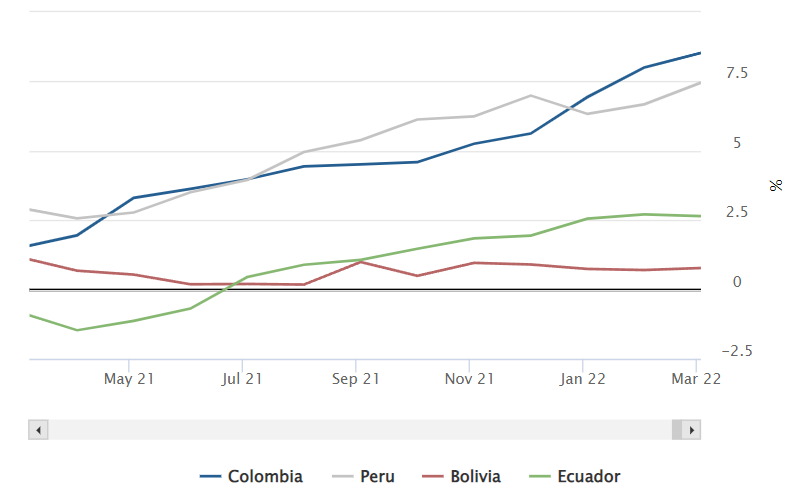
    PERU | Minimum wage hike. President Pedro Castillo signed a decree on 3 April raising the monthly minimum wage by 10.2% to PEN1,025 (US$281.59). This was the first increase in the minimum wage since March 2018, when former president Pedro Pablo Kuczynski (2016-2018) raised it by 9.4%. The new minimum wage will come into effect on 1 May. The decision has been criticised both by trade unions, who argue that the increase is insufficient given the level of inflation since the previous raise, and by business associations, which say they were not consulted on the wage hike. According to the latest inflation figures, released by the national statistics institute (Inei) on 1 April, monthly inflation in March was 1.50%, bringing annual inflation to 7.45%.

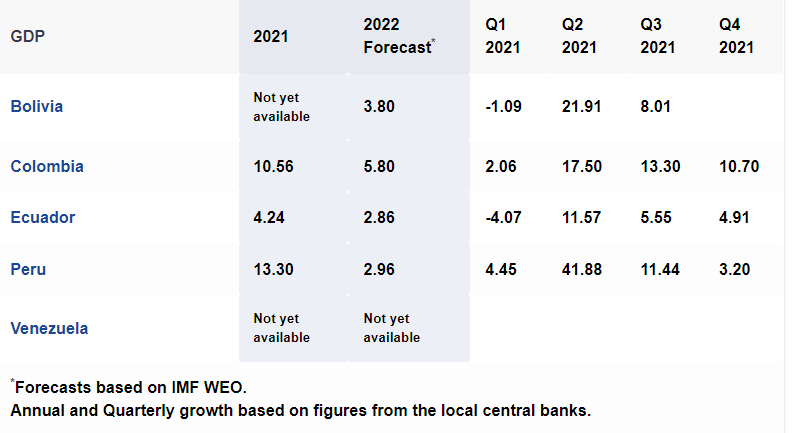
    ECUADOR | Decent but could be better. The director of Ecuador’s central bank, Guillermo Abellán, announced on 31 March that the country’s economy expanded by 4.2% in 2021, surpassing the projected annual growth figure of 3.55%. Household consumption grew by 10.2% in 2021 on the previous year. However, the construction sector, which makes up 58% of total national investment, declined by 6.6%, the third consecutive year of contraction. Abellán announced an increase in the 2022 GDP growth forecast from 2.55% to 2.8%, but he cautioned that more private investment was necessary to drive growth. Abellán said that GDP growth could reach as much as 4.04% in 2022 with greater local and foreign investment. “We cannot postpone this if we want to reach higher levels of growth, create employment, and combat poverty,” Abellán said. Exports totalled US$19.45bn in 2021, contracting by 0.1% on the previous year, due to a decline in coffee, banana, cacao, and oil sales, which were affected by pipeline damage in late 2021. But non-oil exports, such as shrimp, fish, cut flowers, and mining surged to record levels. Imports increased by 13.2% year-on-year to US$20.64bn.

    Andean countries: inflation rate
    Percentage variation (year-on-year)

    Andean countries: GDP growth (%)
    Quarterly figures are year-on-year growth

  • REGION: Brazil and Uruguay push for lower tariffs in Mercosur

    Patrick de Courcy 13 July 2022 Hits: 2060

    The Southern Common Market (Mercosur), the four-country trade pact formed by Argentina, Brazil, Paraguay, and Uruguay, has been somewhat deadlocked in recent years, but it is nevertheless showing some early signs of possible revival.

    The diplomatic tension between the left-wing and more protectionist government in Argentina on the one hand, and the more right-leaning pro-free trade administrations in Brazil, Paraguay, and Uruguay on the other, has been one of Mercosur’s big problems. Another has been the failure to finalise 20-plus years of negotiations on a free trade agreement (FTA) with the European Union (EU). Various EU members continue to demand assurances on environmental protection (particularly from Brazil) before ratifying the deal, which remains a relatively low priority for them.

    There are nevertheless some small signs of progress. In June the Brazilian and Uruguayan foreign ministers said they had agreed a joint position in favour of reducing Mercosur’s common external tariff (CET) and allowing member countries greater flexibility to negotiate trade agreements with third parties (Uruguay for example continues to pursue an FTA with China). The two ministers said they had also reached bilateral agreements on free trade zones and transport infrastructure.

    Separately, there has been welcome news that trade is beginning to revive. Total Mercosur trade reached US$598bn last year, the highest level since 2014. Exports to countries outside Mercosur rose to US$339bn, up by 26% relative to the pre-pandemic year of 2019. On the same basis rest-of-world imports were 18% above 2019 levels.

    There are some further signs of possible change. The combination of the pandemic and the war in Ukraine is leading some economists to talk of “de-globalisation” coupled with a new move towards regional integration. The possibility of a victory for left-wing former president Luiz Inácio Lula da Silva (2003-2011) in Brazil’s October elections could also trigger some fresh thinking. Aloízio Mercadante, a close adviser to Lula (and former minister), has said that if the former president wins another term he will prioritise the regional integration agenda. Progress in the next Mercosur summit (due on 21 July in the Paraguayan capital Asunción) is likely to be modest, but the pace of change could pick up in 2023.  

  • VENEZUELA: Giordani’s fantastical budget

    LatinNews 06 November 2012 Hits: 1984

    “Alice in Wonderland stuff”, was the succinct reaction of the director of the consultancy firm Econométrica and economics professor of the Universidad Central de Venezuela, Ángel García, to the 2013 budget presented to the national assembly in mid November by the planning and finance minister, Jorge Giordani, an avowed Marxist. Giordani himself described the budget as helping to “realise (Venezuela’s) transition to a socialist country”.

    García accused the authorities of inhabiting “a parallel world with no relation to reality”. The fact is, however, that the budget presentation has, for some time now, been an annual exercise in futility which attracts increasingly less press attention because it is based upon a set of figures and assumptions that even the government of President Hugo Chávez does not actually believe – principally an average oil price of half the actual oil price.

    The government claims that setting the bar low for the average oil price is a cautionary estimate because oil prices are notoriously volatile, especially in uncertain times. While this is true, setting the bar so low is disingenuous. In practice it serves the purpose of allowing the government to siphon off the excess revenue into various opaque development funds which it can then administer as it sees fit, for instance, for social or infrastructure projects. As such, calculating actual government revenues and expenditure from the budget is impossible.

    Still, Giordani’s budget presentation remains intriguing in order to try and gauge exactly where the government’s priorities might lie. The budget Giordani presented for 2013 is 33% bigger, at BF396bn (US$92.19bn), than the initial budget for this year, albeit this was significantly augmented. The budget is predicated on an average oil price of US$55 per barrel (up US$5 on this year’s budget). The average price of a barrel of oil in the year to date is US$105.

    Oil revenue only accounts for BF83.18bn (US$19.3bn), 21% of the budget, while 55% of the budget will be funded by non-oil revenue, BF217.7bn (US$50.64bn). Giordani said this would come primarily from a projected tax take of BF205.47bn (US$47.78bn). For this to be met, the tax agency Seniat will, according to official figures, need to increase the tax take by 32% next year compared with this year’s projected figure. This leaves some US$22bn, which Giordani said would be funded out of total projected debt of US$27.1bn.

    Giordani set an ambitious inflation target of between 14% and 16%, about half the rate of recent years, and predicted economic growth of 6% in 2013. He made no mention of any planned devaluation: the exchange rate is currently fixed at BF4.3 to the US$. One of the principal lines of attack pursued by Chávez against the opposition presidential candidate, Henrique Capriles Radonski, in the recent election campaign, was that Capriles planned to implement a series of painful shock economic policies, which Chávez dubbed the paquetazo.

    It is difficult to see how the Chávez administration can avoid some sort of paquetazo itself. This is most likely to entail a sharp devaluation to close a yawning fiscal deficit of 15%. Giordani made no mention of this, but if it were to occur it would lead to a serious cut in purchasing power, and consequently economic activity, making 6% GDP growth unattainable. GDP growth for the first half of this year was 5.6%, although this was driven by a tide of government spending to sweep Chávez back to power.

    Social investment for the next year, which includes health, education, housing, public services, and social security, accounts for 37.7% of the budget, slightly down on the 40% in the 2012 budget but up from BF115bn to BF147bn in absolute terms. This will, of course, be much higher in practice as the government dips into the off-budget national development fund Fonden and other funds.

    One of the most intriguing figures produced by Giordani was the 49.1% increase in funding for grassroots projects such as communal councils this year, BF4.47bn (US$1.04bn) so far, compared with last year. The opposition has expressed concern that the government is intent on centralising power through non-elected communal councils while undercutting the power of elected mayors and governors. The speed with which it proceeds with this project could hinge on the outcome of the regional elections on 16 December and municipal elections next April.

  • RASTREANDO TENDENCIAS

    LatinNews 29 May 2015 Hits: 511

    VENEZUELA | Merentes niega rumores de dolarización. El presidente del Banco Central de Venezuela (BCV), Nelson Merentes, ha desechado la “campaña de rumores” acerca de la dolarización, que en la semana pasada se habían intensificado juntamente con el continuado deslizamiento en la tasa de cambio en el mercado negro, que en un punto llegó a más de BF400/US$1 para después volver a alrededor de BF366/US$1. La tasa de cambio oficial de libre flotación, el Simadi, cerró en BF199,9/US$1 el 25 de mayo, de acuerdo a los últimos datos del BCV.

    Merentes no negó que el BCV estaba celebrando reuniones con las autoridades del sector financiero público y privado acerca de cambios potenciales en el sistema de la tasa de cambio del país, que está crecientemente distorsionada en medio de la continuada escasez del dólar de EU, fuertemente exacerbada por la política monetaria expansionista del BCV. Mientras que las reservas internacionales se han hundido ahora a solamente US$17mm, la amplia provisión monetaria M2 continúa creciendo a una tasa alucinante conduciendo la inflación a través del techo.

    El Diputado Jesús Faría, del gobernante Partido Socialista Unido de Venezuela (PSUV), quien ocupa un sitio en el comité de finanzas del congreso, dijo que los rumores de dolarización eran parte de la ‘guerra económica’ que se desarrolla contra el país por las fuerzas internacionales de la Derecha. “Nunca nos volveremos un apéndice de la economía norteamericana”, Faría le dijo a Globovisión.

    Sin embargo, Faría reconoció que las discusiones estaban en marcha acerca de la simplificación del existente sistema de tres niveles, con vista a moverlo a dos tasas de cambio, una fija y otra libre, por ejemplo.

    Los rumores de dolarización, que han estado retumbando desde abril, realmente despegaron después de que Ford Venezuela a principios de mayo, dijera que había llegado a un acuerdo con el gobierno de Caracas para vender parte de sus acciones en dólares, con el fin de paliar la escasez de dólares, que habían obligado a la empresa a paralizar la producción por falta de piezas importadas.


  • Region: Interest rates: the only way is up?

    LatinNews 18 November 2015 Hits: 2176

    Peru did it on 10 September. Chile did it on 15 October. Colombia did it for a second month running on 30 October. Neither Mexico nor Brazil have done it – not yet, anyway. Most analysts now expect the US Federal Reserve to do it in December. Are Central Banks across the region all hiking their benchmark interest rates and ushering in a new era of tighter monetary policy?

    Peru’s central bank – Banco Central de Reserva del Peru (BCRP) – caught the markets by surprise on 10 September with a 25bps rise in its key interest rate to 3.50%. The aim was to squeeze out excess inflation. The BCRP has a 1.0%-3.0% target range for inflation, and the actual rate has been running higher – at 3.90% in the 12 months to September. The bank said, however, that the high inflation rate reflected a series of one-off factors including a seasonal peak in food prices and the effect of the El Niño weather pattern. The interest rate was left unchanged in October, and analysts have been suggesting that there won’t be any further upward moves until the end of 2015 or early 2016.

    Chile’s Central bank increased its reference interest rate by 25bps to 3.25% on 15 October. In a statement it made clear that the decision was taken to tackle persistent above-target inflation. The bank is trying to keep inflation in a 2.0%-4.0% range. In September, however, 12-month retail inflation in the country was 4.6%. The bank warned that “additional adjustments” to monetary policy are likely – code for signalling another rise in the base rate may be on the way. But analysts believe Chile is likely to see no more than a short tightening cycle, as the depreciation of the Chilean peso (seen as an important factor driving retail prices) is now stabilising and the economic recovery remains relatively weak.

    The Colombian central bank surprised most analysts (and President Juan Manuel Santos) with a 50bps rise in its key rate to 5.25%, announced on 30 October. This was the second monthly tightening move, bigger than the 25bps increase most of the market had been expecting. Here, the main motivation appears to have been the fear that the economy could be moderately overheating. Twelve-month inflation to September was above the Colombian target of 2.0%-4.0% at 5.35%, attributed by the bank to the depreciation of the Colombian peso and the consequent increase in the price of imported raw materials. The bank also edged up its 2015 GDP growth forecast to 3.0% (up from 2.8% previously). President Santos made it clear that he thought the bank had overreacted. “I thought it was exaggerated, and I told the finance minister that 50 basis points rather than 25 is too much, it risks applying the brakes on the economy too sharply” the president said, although he took care to say he respected the central bank’s independence.

    The Brazilian central bank, in contrast, held interest rates steady in October. Because of persistent inflation and in part to offset loose fiscal policy, Brazil’s Selic rate stands at a nine-year high of 14.25%. Among the world’s top ten economies, Brazil has the highest benchmark interest rate. The dilemma facing Copom, the bank’s monetary policy committee, is that with the economy in recession both the government and much of the private sector would like to see the Selic rate come down. But high domestic inflation and global conditions point in the opposite direction, towards further tightening. Copom’s October statement did not rule out an eventual upwards move, although it did say the Selic rate would remain stable for a time. Analysts say Copom is hoping that the recession (GDP could drop by as much as 3% this year according to consensus opinion) will eventually reduce the rate of inflation. However, there are as yet few signs of that happening with retail prices up by 9.77% in the 12 months to mid-October. Nominally, Copom’s target is to reduce inflation to 4.5% by the end of 2016. The danger for Brazil appears to be one of prolonged stagflation.

    There was no movement either in Mexico, where the central bank – Banco de México (Banxico) – has left interest rates untouched at 3.0% for 17 consecutive months. While the Mexican peso has also undergone significant depreciation against the US dollar this year, inflation has remained at record low levels – 2.5% in the 12 months to September, comfortably at the low end of the 2.0%-4.0% target range. In addition Mexican economic growth has remained sluggish. The country benefits from its close trade and manufacturing links with the US. While much of South America is exposed to the negative effects of the expected interest rate normalisation in the United States, Mexico (and arguably much of Central America) is supported by the recovery in the US economy that is seen as the benign precursor to the eventual tightening of the US Federal Reserve’s prime interest rate.

    While, as this short account shows, each country’s situation is somewhat different, there are some broad themes and shared dilemmas. One is that the fall in commodity export prices – a negative shock to the terms of trade – has triggered significant depreciation of Latin America’s mainly floating currencies. In the year to 9 November the Brazilian real has depreciated by 43% against the US dollar, while the Colombian peso has fallen 23.1%, the Chilean peso 15.8%, the Mexican peso 13.7% and the Peruvian Nuevo Sol by 11.2%. Weaker currencies are seen as helping Latin America adjust and reduce current account deficits, but they have some unwanted side effects. One is that weaker currencies may cause an inflationary pass-through that may of itself prompt a need for domestic interest rate hikes. However, it seems the pass-through effect varies in intensity by country, and has been greatest in Chile and Colombia, and less strong in Brazil and Peru. With imports representing only 15% of GDP the pass-though effect in Brazil is small: inflation there is more of a local, rather than an imported problem. A previously existing pass-through effect in Mexico appears to have gone into reverse this year, with both the peso and the inflation rate falling together.

    A second overriding question is whether the much-expected tightening of US interest rates will push Latin America more deeply into recession. According to research by three IMF economists1 the effects of a US Fed rates increase should be manageable, although long-term interest rates will rise. The authors comment: “Countries with flexible exchange rates and credible monetary and fiscal frameworks should be able to continue providing support by keeping short rates low where needed”. The paper also asks whether Latin American interest rate movements tend to follow the US (what it calls a “spillover effect”) or whether they move in step because they are reacting to similar conditions in the global economy. Its conclusion was that domestic macroeconomic conditions are the predominant factor, but that spillover effects are “significant and relatively large” in Mexico and Peru.

    Most analysts argue that a return to the commodity price boom or to expansive global credit is not around the corner. At a recent seminar organised by the Brookings Institute in Washington another IMF official, Robert Rennhack of the Western Hemisphere department, insisted that “the change in the external global environment is permanent” meaning that Latin America “will have to adapt”. Rennhack went on to say that Peru, Chile, Mexico, and Colombia, all growing at over 2% this year, were in a better situation to do so than Venezuela (where the IMF is forecasting that GDP will slump by 10% amid a three-digit inflation rate), Argentina (where an economic adjustment would be required in 2016), and Brazil (where the “complicated political situation” had pushed the economy into recession).


    [1] Carlos Cáceres, Yan Carriere-Swallow and Betrand Gruss

  • Costa Rica: Future of tax reform bill remains uncertain

    LatinNews 02 November 2018 Hits: 451

    October has seen a number of important developments related to long-running government efforts to push through a tax reform bill, aimed at reversing a recent widening of the fiscal deficit and a steady increase in already-high levels of public debt.

    Previous governments have tried and failed to secure support for a reform that would structurally strengthen Costa Rica’s public finances. Hopes for the current government’s efforts have been somewhat higher: the ‘Ley de Fortalecimiento de las Finanzas Públicas’ (law to strengthen the public finances) has undergone extensive debate and modifications and was finally submitted to the legislature on 1 October. The proposals centre around efforts to replace the existing sales tax with a value-added tax (VAT); the suggested rate (13%) would be unchanged, but the new VAT would be levied on a much wider range of goods and services. Despite weeks of social unrest, with thousands of protesters taking to the streets in opposition to the bill, the tax reform was approved by the Legislative Assembly in a first vote on 5 October, with 35 out of 57 congressmen voting in support of the bill. Given that the Legislative Assembly is highly fragmented, with the ruling Partido Acción Ciudadana (PAC) in a minority position with only 10 seats, the government had to build cross-party support with a number of other political parties in order to secure approval of the bill.

    A spanner in the works

    However, a judicial ruling on 16 October threw a spanner in the works; the Plenary Court rejected the bill in its current form, on the basis that four points affect the independence and operations of the country’s judiciary. These do not affect the main tax proposals, but instead relate to other proposed measures. The Court requested that the Legislative Assembly amend these points, in order to eliminate the Planning Ministry’s oversight of public employment in the judiciary; eliminate the Civil Service review of judges’ job performance; amend proposals that would cut funding for witness protection schemes; and eliminate salary modifications for judicial posts. The Court stated that if the Legislative Assembly complies with this request and makes the changes, it would approve the bill, enabling it to return to the Legislative Assembly for a second congressional vote, in which it would only need a simple majority to proceed. If the changes are not made, the bill can still progress, but the government would need to secure a two-thirds majority (which it did not have in the first vote).

    It remains unclear which path the government will take. It is not out of the question that the government will be able to secure a two-thirds majority, which would probably be quicker than amending the bill, but there would still be risks to the bill at a later stage, as the Constitutional Court would need to sign off on the legislation at the final stage. The bill is by no means dead in the water, but there are heightened risks to its eventual approval. Reflecting this, on 18 October international credit ratings agency Moody’s Investors Service placed Costa Rica on review for a downgrade, citing the continued worsening of fiscal and government debt indicators, evidence of increased funding pressures, as well as reservations about the government’s ability to implement effective fiscal consolidation. Moody’s specifically referred to the tax reform bill as an “uphill battle”, despite an acknowledgement of the government’s continued efforts.

  • TRACKING TRENDS

    LatinNews 14 November 2019 Hits: 3626

    BRAZIL | Oil ‘mega-tender’ disappoints. High expectations had surrounded the so-called ‘mega-auction’ of offshore oil concessions held by Brazil’s national oil agency (ANP) on 6 November, forecast to see over a dozen international oil companies bid and bring in R$106.6bn (US$25.5bn) in signing bonuses. The reality was somewhat disappointing, with only seven of the 14 companies registered to bid attending the auction, and only two of the four blocks receiving offers at the minimum signing fee.

    • Lack of interest

    General uncertainty surrounding investments in both Brazil and large-scale oil developments could have played a role in the low levels of interest. The high signature bonuses and complex production-sharing rules also appeared to put off some of the major energy groups (some, such as the UK’s BP Energy, had said in advance that they did not plan to participate), as well as the priority that automatically goes to Petrobras bids.

    A consortium made up of Brazil’s state-owned oil company Petrobras (90%) and Chinese state firms CNOOC (5%) and CNODC (5%) acquired the exploration rights for the Búzios field, the largest on offer, while Petrobras made a lone bid for the rights to the Itapu field. Despite frustrated expectations, these concessions still brought the Brazilian government a record R$69.96bn (US$16.8bn) in signing fees. However, this mega-tender was followed by further disappointing results in a more conventional auction the following day. The sixth pre-salt bidding round, held on 7 November, saw only one of the five so-called ‘pre-salt’ deep-water blocks awarded to a Petrobras-CNODC consortium for R$5.05bn.

    The Brazilian government has sought to minimise the disappointment of these auctions, particularly the lack of international interest in the 6 November mega-tender. The minister for mines & energy, Bento Albuquerque, said he was “satisfied” with the outcome of the mega-tender, which delivered the biggest signing fee ever, and ANP director Décio Oddone emphasised that it was still the biggest such auction in terms of the volume of oil involved. Various industry experts have, however, slammed the event as a total flop.

  • CHILE: Good guys or bad guys?

    Patrick de Courcy 30 March 2023 Hits: 4252

    Chile’s lower chamber of congress has approved a bill, designed to strengthen the military and civilian police forces, respectively known as Carabineros and Policía de Investigaciones (PDI). Public opinion has clearly swung round to supporting the police. However, only three years ago the men and women in uniform were being accused of brutality and human rights violations.

    The so-called Nain-Retamal bill was approved by an overwhelming majority of 106 votes with 24 against and 13 abstentions. This reflected an earlier breakthrough when the left-wing government led by President Gabriel Boric reached an agreement with right-wing opposition parties in congress to fast-track wide-ranging security legislation over the next 90 days.

    The bill in question is an amalgamation of two earlier drafts and is named after Eugenio Nain and Carlos Retamal, policemen killed on duty, respectively in October 2020 and October 2022. Pro-police public feeling has been running high after the deaths of two further Carabineros officers in March, at the hands of criminal groups: Carabineros Corporal Alex Salazar died when run over by a car on 12 March in an incident in Concepción, the capital of the southern region of Biobío; Sergeant Rita Olivares was shot dead in Quilpué, in the region of Valparaíso, on 25 March. At a press conference on 27 March, Boric said that it was important for the Carabineros to know they had popular support, and that “criminals will be pursued with inclemency and within the law, because this cannot continue to happen, and we will stop it”.

    The government has decided to respond to public opinion with a raft of new legislation. Among other things, the Nain-Retamal bill gives police greater powers to stop and search immigrants and to detain them if they don’t have an identity card. Other bills in preparation cover a harder line on issues such as kidnapping, carrying arms, extortion, sicariato (the use of paid killers), and illegal migration.

    However, there are also concerns that in the heat of the moment congress may end up rubber-stamping a dangerous reduction in civil liberties. The large majority in favour of the Nain-Retamal bill in the lower chamber may conceal divisions within the government coalition that will come to the fore when it gets to the senate. At issue is the concept of ‘privileged legitimate defence’, which replaces current legal wording requiring police to respond proportionately to any threat. Instead, the new text grants police officers an initial presumption of innocence in the use of firearms, which troubles civil rights activists. It clearly also troubles members of the pro-government coalition, some of whom voted in favour of the bill on the understanding that the controversial clause would be amended in the upper chamber.                

    In public relations terms the Carabineros have had a patchy history; for some Chileans they remain the ‘bad guys’ while for others they are heroes. The force has in the past been accused of police brutality and corruption. In the violent Estallido Social of 2019-2020 (street demonstrations which left a toll of over 30 dead and many blinded by tear gas), the Carabineros was accused by the United Nations and civil liberty groups of violating human rights. Coincidentally the human rights NGO Amnesty International said on 28 March that promises of post-social explosion police reform made by the incumbent government have so far come to nothing. 

    At the moment public opinion is strongly in support of the police. Evelyn Matthei, the mayor of Providencia, a district in the capital Santiago, supported the ‘privileged legitimate defence’ approach. Matthei, a member of the right-wing opposition Unión Demócrata Independiente (UDI), said “if there is an issue a case can be made in the courts but we have to give the benefit of the doubt to the Carabineros, not to the drug dealers”. According to national pollster Cadem, Matthei is currently Chile’s most popular politician with a 70% approval rating. The same poll shows 86% of respondents favour giving the Carabineros greater powers, while 82% support the policy of Rodolfo Carter, another UDI mayor, of the Santiago district of La Florida, who has used bulldozers to demolish so-called narco-houses, private homes that have been taken over by drug dealers and addicts. 

    Use of force

    Members of Chile’s ruling coalition have also been backing a bill which includes similar provisions on the legitimate use of force (known as Reglas de Uso de Fuerza - RUF). Consolidating these proposals may prove difficult for the government, however, since there are differences between the two pro-government coalitions, Apruebo Dignidad on the left, and Socialismo Democrático, on the centre-left. Apruebo Dignidad deputies have reservations over any wholesale expansion of police use of force.

  • TRACKING TRENDS

    Patrick de Courcy 24 April 2025 Hits: 1553

    ARGENTINA | Strong growth. Argentina’s economy grew by 5.7% year-on-year in February, according to the national statistics institute (Indec) on 22 April. Financial intermediation expanded by 30.2% year-on-year in February and fishing by 28.3%, while mining also grew by 5%. More celebrated by the government led by President Javier Milei, as the 5.7% growth was against a low base of comparison, was the 0.8% month-on-month growth from January.

    In its World Economic Outlook (WEO) published on 22 April, the International Monetary Fund (IMF) forecast that Argentina would post 5.5% GDP growth in 2025 – the highest in the region – following contractions of 1.6% in 2023 and 1.7% in 2024, and an increase from January’s forecast of 5% growth. This is more than twice the projected regional average of 2%, making the region the slowest growing one in the world, and well ahead of forecasts for the other big economies in the region: Brazil (2%, revised down from 2.2%), Mexico (-0.3%, down from 1.4%), Chile (2%), Colombia (2.4%), and Peru (2.8%).


    CHILE | Hydropower plant attacked. A dozen hooded and armed assailants set fire to 45 trucks and five pieces of earth-moving machinery in an arson attack on a Chinese-owned hydropower plant at Rulcahue, in Chile’s southern region of Bío Bío, on 20 April. Security Minister Luis Cordero said the attack on the 90MW project, which is now 20% complete, had “a terrorist nature”. President Gabriel Boric said on the social media platform X that the attack “deserves our complete condemnation”, adding that “we will continue to work tirelessly to eradicate all forms of violence”.

    The Chinese embassy in Santiago condemned the attack and asked the government to carry out an “exhaustive investigation”, as well as step up security measures in the area.

  • TRACKING TRENDS

    LatinNews 22 November 2012 Hits: 2596

    BRAZIL | Trade deficit raises eyebrows. Brazil posted its worst weekly trade deficit in 15 years in the third week of November, according to latest (19 November) results from the ministry of development, industry and external trade (MDIC).

    At the weekend in Cádiz, Spain, President Dilma Rousseff again warned Europe and the rest of the developed world about the dangers of too much austerity. The Brazilian government has already written off 2012; the latest private sector consensus forecast compiled by the central bank is for growth of just 1.5% this year. However, the Rousseff administration is confident that Brazil has touched bottom and is already recovering, not least thanks to an array of official stimulus measures, and Rousseff pointed out to her European hosts that Brazil is very fortunate in having plenty of further economic policy levers at its disposal. Officials at the MDIC are also touting a Chinese recovery next year. Though Brazil’s external sector is not its only lifeline (it accounts for less than 15% of GDP), it provides an important cash stimulus to the big domestic consumer market.

    On an accumulated year-to-date (ytd) basis, total exports were valued at US$213.8bn through to mid-November, down 5.3% year-on-year, with ytd imports worth US$196.5bn, down 1.2% year-on-year. The resulting trade surplus (US$17.3bn) was down 35.2% over the same 2011 period. The trade deficit of US$952m registered in the third week of November was the worst such deficit since 1998, when the MDIC first began compiling weekly trade stats. The previous worst result was the final week of August 2008 (US$840m), in the midst of the global financial meltdown.

    The Real slipped to a new low of R$2.09/US$ this week, prompting fresh speculation that the central bank is acting in tacit support of exports.

    • Barbosa takes over supreme court

    Brazil has its first-ever black supreme court president, after Judge Joaquim Barbosa took over at the helm. Barbosa has become something of a local celebrity for his harsh sentencing in the recent mensalão trial. President Dilma Rousseff this week touted additional measures for Black Brazilians, noting that social inequality in Brazil is found “in race, because it is black; in gender, because it affects women above all; and in age, because children are victims”. She added that a state policy of exclusion continued even after the abolition of slavery in 1888. Brazil was the last country to abolish slavery.

  • PANAMÁ: Y así comienza...

    LatinNews 05 September 2014 Hits: 1006

    La legislatura unicameral de Panamá, de 71 bancas, recientemente aprobó una resolución pidiendo a la Corte Suprema de Justicia (CSJ) que remueva a la contralora general, Gioconda Torres de Bianchini, una estrecha aliada del ex presidente Ricardo Martinelli (2009-2014). La movida contra Torres, cuyo periodo de cuatro años debe terminar en diciembre, sigue a su reciente aparición ante la legislatura donde ella fue convocada para testificar en relación a varias preocupaciones sobre corrupción que rodean a la administración anterior. Aparte de ilustrar que el acuerdo legislativo entre el Partido Panameñista (PPA) del Presidente Juan Carlos Varela, y el opositor Partido Revolucionario Democrático (PRD) [IL-14-26] parece estar dando resultados, el avance contra Torres muestra que Varela intenta cumplir con la ya familiar promesa que hacen los presidentes al asumir el poder en Panamá –la de frenar la corrupción oficial.

    Las preocupaciones internacionales que rodean a los supuestos casos de corrupción relacionados con el anterior gobierno de Martinelli, surgieron en informes como el Informe de Competitividad Global 2013-2014 del Foro Económico Mundial (WEF, siglas en inglés), el cual aunque que es positivo acerca de Panamá sobre otros aspectos, señaló que el país enfrenta desafíos importantes en términos del “fortalecimiento del funcionamiento de sus instituciones, en el combate a la corrupción y el delito [...] y la independencia del sistema judicial”. El último informe (diciembre del 2013) de la ONG, Transparencia Internacional (TI), también señala que Panamá registró la mayor caída que cualquiera de sus vecinos centroamericanos en su índice de corrupción en el 2013, cayendo 19 lugares, para terminar en el puesto102do, con 35 puntos, cayendo del 83ro en el 2012.

    El 19 y 20 de agosto, Torres, quien sirvió como auditora de la compañía Importadora Ricamar de Martinelli por 15 años, antes de asumir su actual puesto, fue llamada a testificar ante el congreso. Uno de los principales casos sobre el cual ella fue interrogada fue el que involucraba los contratos adjudicados en el 2010 a Finmeccanica, el conglomerado aeroespacial y de defensa conducido por el Estado italiano, para la compra de radares, helicópteros, y servicios de cartografía digitales. El caso había causado un bochorno mayor a la administración de Martinelli después del arresto en abril del 2012 de Valter Lavitola, un ex consejero del ex primer ministro italiano caído en desgracia, Silvio Berlusconi [IL-12-16].

    Lavitola, quien actualmente está siendo enjuiciado en Italia en relación a varios cargos, ha sido acusado de actuar como intermediario para la entrega de sobornos de compañías italianas a gobiernos en América Latina, incluido Panamá. Tanto la prensa panameña como la italiana sugirieron que los contratos fueron inflados y que Lavitola, quien se decía que cumplía el rol de “componedor-operador” en las conversaciones, recibía los sobornos, parte de los cuales iban en coimas a funcionarios locales –incluyendo Martinelli. Cinco días antes de la primera aparición de Torres ante el congreso, una fiscal anticorrupción, Lorena Coronel, anunció que la investigación sobre el caso sería reabierta.

    Siguiendo a la movida contra Torres, cuya renuncia es también exigida por grupos de la sociedad civil como la Alianza Ciudadana Pro Justicia, el caso ahora pasa a los magistrados de la CSJ, cinco de los cuales fueron nombrados por Martinelli. Mientras que aún está por verse si la corte cumplirá con la resolución de la legislatura, es probable que el potencial choque entre las diferentes ramas del gobierno someta la independencia de varias instituciones a mayor escrutinio.

    También ha habido varios otros signos de la intención del Presidente Varela de enfrentar la alegada conducta ilegal que prevaleció bajo su predecesor. El 13 de agosto, el Tribunal Electoral (TE) comenzó a investigar a 47 entidades públicas (de un total de 82) por alegadas violaciones de las leyes contra la excesiva publicidad electoral antes de las elecciones generales de mayo. Entre estas instituciones, están incluidas la Asamblea Nacional, la alcaldía de Ciudad de Panamá, nueve ministerios, y la policía nacional entre otras, aunque desde entonces 11 de estas entidades han sido exoneradas.

    Por otro lado, el 14 de agosto, Varela revocó todos los 355 perdones presidenciales emitidos por Martinelli a varios funcionarios en los días finales de su mandato en junio, sobre la base de que los mismos habían sido emitidos por una “autoridad no competente” (ellos fueron co-firmados apresuradamente por la ministra de trabajo, Alma Cortés, en vez del ministro del interior, Jorge Ricardo Fábrega). Varela también señaló que los  perdones habían sido emitidos para individuos quienes aún no habían sido condenados por ningún delito y pidió al fiscal general que investigue a aquellos responsables de emitir los perdones.

    Investigarán el Programa de Ayuda Nacional

    Aparte de la investigación del caso Finmeccanica, la fiscal anticorrupción Lorena Coronel, también ha anunciado una investigación en el Programa de Ayuda Nacional (PAN), un fondo del gobierno usado para varias iniciativas dirigidas a mejorar la mitigación de desastres, nutrición, y vivienda, entre otras cosas,

    La investigación está en línea con una queja presentada ante la oficina del fiscal general por el legislador nacional del PPA, José Luis Varela (hermano del Presidente), involucrando supuestos delitos relacionados con la administración pública por parte de Rafael Guardia, quien sirvió como presidente del PAN bajo el ex presidente Ricardo Martinelli (2009-2014).

    De acuerdo con informes de la prensa local, la investigación cubrirá varios contratos otorgados a compañías y la supuesta malversación de fondos públicos del PAN. Los contratos cuestionados incluyen a compañías vinculadas con Heriberto Vega, un ex candidato a legislador por el Cambio Democrático (CD) de Martinelli.

    Los críticos desde hace tiempo han sugerido que los fondos del Estado del PAN han sido usados para atraer a desertores de otros partidos.

    • Una promesa electoral clave

    El Presidente Juan Carlos Varela citó el 24 de agosto cifras del ministerio de economía & finanzas (MEF) que muestran que el precio de la Canasta Básica Familiar de Alimentos (CBFA) en julio del 2014 fue de US$318,48 –una caída del 7,7% con relación a junio del 2014. En un comunicado de prensa, el MEF afirma que esta fue la caída más significativa en los últimos 10 años. El primer acto del Presidente Varela al sumir el poder el 1 de julio fue anunciar controles de precios temporales de ‘emergencia’ sobre 22 productos básicos a fin de reducir la inflación. Mientras que la inflación fue del 3,4% en el 2013, cayendo del 5,7% en el 2012, los altos precios de los alimentos fueron una de las principales preocupaciones de los votantes.

    • Membresía partidaria

    Como un signo más de los factores menos que ideológicos que determinan las afiliaciones a los partidos políticos, el éxodo de los partidos derrotados en las elecciones de mayo continúa. De acuerdo con el informe más reciente del Tribunal Electoral (TE), el número total de miembros de Cambio Democrático (CD) fue de 422.617 en julio, cayendo de 458.502 en abril, el mes antes de las elecciones, mientras que el Partido Revolucionario Democrático (PRD) se redujo a 452.677 cayendo de 458.282 en abril. El Partido Panameñista (PPA) de Varela, sin embargo vio su número elevarse –de 216.338 en abril, a 221.386 en julio.

  • PARAGUAY: Cartes accused of trying to wipe out Left

    LatinNews 17 September 2015 Hits: 579

    Paraguay’s left-wing opposition Frente Guasú (FG) is accusing the government led by President Horacio Cartes of authoritarianism, alerting regional institutions that he is trying to expunge the party. The accusation follows an alleged diatribe by Cartes directed at FG Deputy Ramón Duarte at a private party last week. Duarte broke down in tears while addressing the lower chamber of congress on 14 September alleging that Cartes had accused him of being “a murderer and kidnapper, and helping to cover up the [guerrilla group] Ejército del Pueblo Paraguayo [EPP]”.

    Duarte was invited to the private birthday party of the president of the lower chamber, Hugo Velázquez, along with other members of the opposition, which was held in the house of Deputy Julio Javier Ríos of the ruling Asociación Nacional Republicana-Partido Colorado (ANR-PC). Part way through the evening, a bilious Cartes allegedly ordered that the music be switched off and launched into a tirade against the dissident wing of his own party, singling out various senators. He also allegedly accused FG of seeking to destabilise his government, adding that it would have to “disappear” - a very emotive word in Latin America.

    FG subsequently issued a statement cataloguing repeated attacks by the government, claiming that Cartes had spoken of the need to “eliminate” members of the party, including a founder member, former president Fernando Lugo (2008-2012). Some ANR-PC deputies have come out in defence of Cartes, although his criticism of the dissident wing will have served to heighten internal tension.

    “The expression voiced by Horacio Cartes and his coterie is a direct threat to democracy, pluralism, diversity of political expression, democrats, an insult to the public, and the most explicit sign of a profound crisis of legitimacy,” the FG statement read. It also alleged that “a massive fraud” was being prepared for municipal elections in November with FG “systematically excluded from the electoral process, and the co-option of all the superior court of electoral justice [TSJE] by the two-party system [the ANR-PC and the Partido Liberal Radical Auténtico], in this way stripping the guarantees for a democratic and transparent election”.

    Ejército del Pueblo Paraguayo
    It is not the first time that FG has been linked to the EPP, which Cartes promised to defeat when he took office in 2013. Velázquez himself claimed on 11 September that FG had links to the EPP. The EPP remains active, although Paraguay’s joint military and police task force (FTC) last week delivered several blows against the Agrupación Campesina Armada (ACA), a tiny EPP splinter group, according to the interior ministry.

    On 6 September the FTC arrested two teenagers believed to be members of the ACA while they were riding on a motorbike in the district of Yby Yaú in the north-eastern department of Concepción. They had apparently appeared in videos and photographs of alleged ACA members.

    The following day the FTC found both ACA and EPP uniforms in an abandoned Toyota pick-up in Horqueta, Concepción, prompting the authorities to conclude that the two groups had reunited after the ACA broke away last September. The alleged ACA logistics chief, Daniel Rivarola Areco, and presumed owner of the pick-up, was arrested a day later.

    • ACA and EPP

    The ACA, formed by brothers Albino and Alfredo Jara Larrea, has been progressively weakened; the former was killed by the FTC last January. Both the ACA and the EPP are believed to have been recruiting, although between them they are only thought to have 30 to 40 dedicated members. Several human rights organisations in Paraguay have accused the Cartes administration of not doing enough to prevent the recruitment of minors in poor areas of the country to the ACA. They insist that these minors should be recognised as victims and special programmes rolled out to protect them.

  • TRACKING TRENDS

    LatinNews 15 March 2018 Hits: 1382

    BRAZIL | US tariffs. The Brazilian government has expressed concern after US President Donald Trump signed a decree to apply a 25% tariff on steel imports and 10% on aluminium to protect national security. In a joint statement issued on 8 March, Foreign Minister Aloysio Nunes and Trade Minister Marcos Jorge said this would damage Brazilian exports and negatively impact bilateral trade, which has mostly favoured the US over the last 10 years, besides having a negative impact on commercial and investment relations.

    Brazil argues that its exports do not threaten US national interests because the metallurgical industries in both countries are complementary. Firstly, 80% of Brazilian steel exports are semi-finished products and are later processed by metalworkers in the US. Secondly, Brazil is the largest importer of US metallurgical coal, which is used to boost steel production in the US.

    Moreover, Brazil argues that the tariffs are incompatible with the obligations of the US as a member of the World Trade Organization (WTO) and do not align with the security agreements contained in the General Agreement on Tariffs and Trade 1994 (GATT 1994).

    The Brazilian government said it would favour dialogue and partnership to find a solution, but would not hesitate to take action to preserve its rights and interests.

    BRAZIL | Starbucks. Starbucks has signed an agreement with SouthRock Capital, which is headquartered in the city of São Paulo, allowing the private equity firm to develop and operate branches of the US-based coffee company in Brazil. At the time of going to print, the value of the deal had not been disclosed.

    Under the agreement, SouthRock Capital has agreed to pay Starbucks’ licencing fee. With this change, the 17 countries where Starbucks operates in Latin America and the Caribbean will all become fully licenced rather than directly managed. Starbucks is currently expanding in the region and is due to open more coffee shops in Uruguay later this year.

  • CARIBBEAN POINTERS

    LatinNews 12 July 2018 Hits: 442

    *** IMF URGES NEW BARBADOS GOVERNMENT TO FACE REALITY. Almost exactly a month after its landslide victory in the 7 May general election, in which it won all 30 seats, the Barbados Labour Party (BLP) government led by Prime Minister Mia Mottley hosted a sobering visit from the International Monetary Fund (IMF). An IMF team visited Barbados from 5-7 June to hold discussions with the new government on its economic policies and on possible IMF support.

    At the end of the visit, the IMF issued a statement warning that Barbados “is in a precarious economic situation” and that central government debt is “unsustainable”. The IMF warned: “The fiscal deficit has decreased over the last few years but remains large, at about 4% of GDP in FY2017/18.” It noted that the Central Bank of Barbados (CBB) had reported an economic contraction of 0.7% in the first quarter of 2018 compared with the same period last year. And it stated that “substantial fiscal consolidation is needed to place debt on a clear downward trajectory”.

    The IMF is recommending a debt restructuring, and it says that since tax and revenues are “relatively high”, the adjustment effort “should focus on the expenditure side, including by improving the efficiency and effectiveness of public services, containing wags, and reforming government pensions”.

    The statement went on to urge a reduction in government transfers to state-owned enterprises (SOEs) “by reviewing user fees, exploring options for mergers and privatisation, and by providing stronger oversight”.

    On 11 June, the government duly presented to parliament an “Economic Recovery and Transformation Plan”. Amongst other measures, the prime minister announced plans to introduce a hotel room tax of US$2.50 per night for B Class properties and apartments, US$5.50 for A Class properties, and US$10 for luxury resorts. Other measures included, from 1 October, an Airline Travel and Tourism Development Tax of US$35 for passengers travelling within the Caribbean Community (Caricom) and US$70 for those flying outside Caricom. VAT on accommodation is to increase from 7.5% to 15% from 1 January 2020.

    *** IMF GIVES POSITIVE SIGNALS TO JAMAICA. On 15 June, the IMF issued a statement following a staff visit to Jamaica from 11-15 June. The statement welcomed “the authorities’ initiative to further entrench fiscal sustainability”, and it noted approvingly that “economic progress is reflected in high employment levels, an 11-year low unemployment rate, and significantly lower poverty rate”.

    The statement also welcomed the fact that the central government primary surplus of 7.7% of GDP for FY2017/18 exceeded the budget target by 0.7 percentage points of GDP. But, it added, it was now “important to use the window of the 4-year wage agreement to overhaul the public sector’s compensation structure”.

    As of end-March 2018, public debt was said to be 104% of GDP, down from 145% five years ago.

    *** MORE GOOD NEWS FOR GUYANA ON OIL. In June, ExxonMobil announced its eighth oil find in Guyana’s territorial waters (at the Longtail-1 well). With the size of this discovery still to be quantified, the company is estimating that the total reserves from its first seven wells in the Stabroek Block amount to “more than” 3.7bn recoverable oil-equivalent barrels. It is thought that Longtail-1 could be its biggest discovery yet in Guyanese waters.

  • ECONOMIC HIGHLIGHTS

    Patrick de Courcy 12 November 2021 Hits: 2055

    BRAZIL | Economic outlook dims. Private bank Itaú Unibanco released a macro-scenario update on 25 October in which it revised down its 2022 GDP forecast for Brazil. Itaú now expects Brazil to suffer a recession next year, projecting -0.5% growth, down from an earlier forecast of 0.5%. GDP is expected to grow 5% this year. Amongst other things, Itaú cites rising inflation and accompanying monetary policy decisions as explanations for its negative 2022 forecast. Brazil’s 12-month consumer price index stood at 10.25% in September, with inflation expected to keep rising, and two days after Itaú released its forecast update, the central bank (BCB) enacted a 150 basis-point hike to the benchmark interest rate, the Selic, bringing it to 7.75%. Itaú expects the Selic to rise to 11.25% by the start of 2022. The bank is the first financial institution to predict a recession for Brazil next year, but concerns are growing as to the pace of the country’s economic recovery, as the government is showing signs of abandoning all fiscal rigour ahead of the October 2022 presidential elections in which President Jair Bolsonaro is expected to seek a second term.

    REGION | Mercosur tariff reduction more likely. On 8 October, the Brazilian and Argentine foreign ministries released a joint statement saying the two sides had agreed to a 10% reduction in the common external tariff (CET) imposed by the Southern Common Market (Mercosur) trade bloc to which Argentina and Brazil belong, along with Paraguay and Uruguay. A reduction in the CET – which is high, averaging 14% – has long been resisted by Argentina, while Brazil argues it is necessary to improve Mercosur and member states’ competitiveness. The issue was expected to be discussed amongst all members at the next heads of state summit, due in December; but on 5 November Brazil unilaterally announced a 10% reduction on the import tariff of 87% of its imported goods, invoking a provision which allows Mercosur members to take measures to protect people’s lives and health. Brazil said it hoped its temporary tariff reduction, due to remain in place until 31 December 2022, would become permanent, noting it was in line with the mooted CET reduction it had verbally agreed with Argentina. 

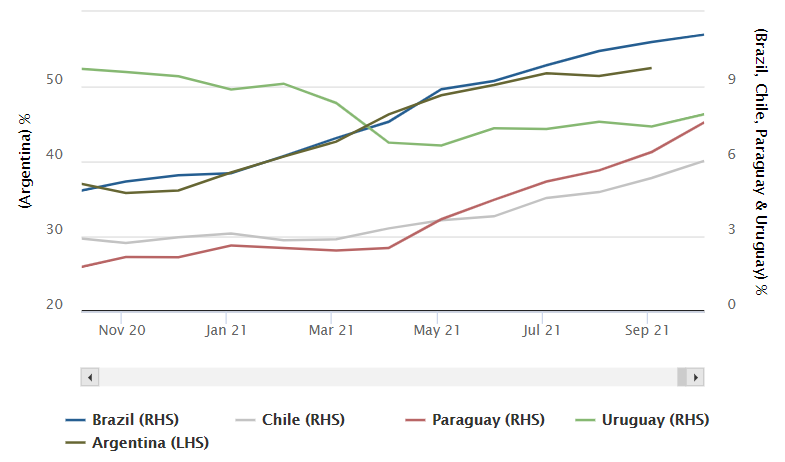
    Brazil & Southern Cone: Inflation Rate
    Percentage variation (year-on-year)

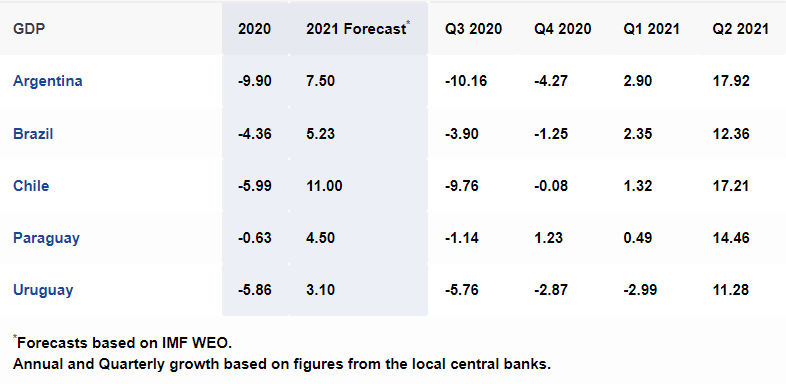
    Brazil & Southern Cone: GDP Growth (%)
    Quarterly figures are year-on-year growth

  • ECUADOR: ‘Metástasis’ investigation begins to show results

    Abbi Dicker 18 July 2024 Hits: 2063

    The first sentence was handed down in Ecuador’s massive ‘Metástasis’ corruption investigation on 15 July. The investigation is targeting the infiltration of the country’s institutions by criminal gangs, and its launch in December last year is widely viewed to have been a key factor in the unprecedented criminal uprising which took place the following month [WR-24-01].

    The Metástasis probe was launched following the discovery of mobile phones belonging to the drug kingpin Leandro Norero, who was murdered in prison in October 2022 and is believed to have acted as an intermediary between Ecuador’s Los Lobos gang and the Mexican drug trafficking organisation Cártel Jalisco Nueva Generación (CJNG). Prosecutors say that the phones reveal Norero’s extensive contacts within the police, judiciary, and the legislature. So far, 52 people have been charged in relation to the investigation, including Wilman Terán, who was president of Ecuador’s judicial council in 2023.

    Attorney General Diana Salazar has said that the investigation, which she has described as the largest corruption probe in Ecuadorean history, was directly responsible for the nationwide uprising by gangs at the start of the year. She has also claimed that it made her the target of a foiled assassination plot by Los Lobos – the same gang accused of assassinating the anti-corruption presidential candidate Fernando Villavicencio in August 2023 [WR-23-32].

    The supreme court has authorised the express sentencing of a number of defendants who pleaded guilty to their crimes, with the first sentence handed down on 15 July to a police officer, Gabriel García. García was sentenced to three years and four months in prison for leaking information about a police investigation into Norero. A further 10 defendants are due to face rapid sentencing hearings in the coming weeks, including two judges – Ángel Lindao, who ordered that property seized from Norero be returned to him, and Emerson Curipallo, who ordered the release of alleged hitmen accused of working for Norero.

  • TRACKING TRENDS

    Abbi Dicker 15 January 2026 Hits: 806

    BRAZIL | Services sector declines in monthly terms. The national statistics institute (Ibge) released new figures on 13 January which showed that the volume of services provided in November 2025 decreased by 0.1% compared to October. Meanwhile, in year-on-year terms, the total services volume was up 2.5% compared to November 2024, while the accumulated services volume in the 12 months until November 2025 was up 2.7% on the preceding 12-month period. Of the five categories of services measured by the Ibge, two registered monthly drops in volume – transport and postal services (-1.4%) and information and communications services (-0.7%). 

    BRAZIL | Gov’t seeks mining cooperation with Saudi Arabia. Brazil’s ministry of mining and energy signed a memorandum of understanding (MoU) on 13 January pledging to boost bilateral cooperation on mining with Saudi Arabia. Brazil’s mining and energy minister, Alexandre Silveira, signed the deal during a visit to Riyadh. The MoU will be valid for five years and proposes technical cooperation such as the exchange of specialists and technology and joint technical training programmes, as well as more private sector investment. The previous day, before the MoU was signed, Silveira said that he had also requested the support of Saudi Arabia’s public investment fund (PIF) on projects to map Brazil’s potential, especially to map its reserves of critical minerals.

  • In Brief - Paraguay

    LatinNews 11 January 2013 Hits: 1558

    POLITICS | PLRA loses control of Central. On 9 January Paraguay’s Central Department legislature announced that Magno Duarte from the Unión Nacional de Ciudadanos Eticos (Unace) had been elected by the body as the new governor. He replaces Carlos Amarilla from the nationally ruling Partido Liberal Radical Auténtico (PLRA) who quit in order to run for national congress in the 23 April general elections. The loss of Central, which surrounds the capital, Asunción, is a blow for the PLRA, as it being the most populated department, it is an important source of votes. Duarte defeated the PLRA candidate, Juan Carlos Arévalos, after obtaining the votes of Unace local congressmen, as well as those of the also opposition Asociación Nacional Republicana- Partido Colorado (ANR-PC). Some within the PLRA consider the electoral defeat a warning of what may happen in the 23 April vote amidst concerns that Unace and the ANR-PC could forge an electoral alliance in the run-up to the vote.