
All Categories

Subcategories

  • CHILE: Muñoz sugiere la unión Mercosur-Alianza del Pacífico

    LatinNews 21 March 2014 Hits: 429

    El experimentado nuevo canciller de Chile, Heraldo Muñoz, ha dado a conocer la nueva dirección de la política exterior de su país, incluyendo una llamativa propuesta para fusionar el alicaído Mercado Común del Sur (Mercosur) y la floreciente Alianza del Pacífico.

    El primer viaje al extranjero de la Presidenta Michelle Bachelet será a Argentina y Brasil. Muñoz alegó en un artículo escrito para el diario español, El País, el 13 de marzo, que Chile priorizaría sus relaciones con la región, “especialmente América del Sur”, y que su objetivo en política exterior era “convergencia en la diversidad” que, dice él, “combina el realismo con la voluntad política de avanzar hacia una región más integrada y autónoma”.

    Durante una conferencia organizada el 12 de marzo por la Comisión Económica para América Latina y el Caribe de la ONU (Cepal), Bachelet dijo que Chile había “perdido presencia regional” bajo su predecesor Sebastián Piñera (2010-2014). Muñoz desarrolló esto en su artículo en El País, alegando que Chile emprendería un cambio en la política exterior alejándose de la política de “privilegiar las relaciones económicas –que permanecerán importantes para el país– hacia una perspectiva integral que otorgue un peso similar a las dimensiones políticas, sociales, y culturales de nuestros lazos”.

    Muñoz dijo que Chile no tendría “sesgo ideológico”. Bachelet difiere notoriamente de Piñera en su respuesta a las protestas desarrolladas en Venezuela. “Nosotros nunca aceptaremos que alguien, persona, o país, provoque a través de mecanismos violentos el derrocamiento de un presidente electo legítimamente”, Bachelet dijo en una entrevista con el diario nacional, El Mercurio, el 16 de marzo. Chile, Muñoz alegó, quiere “construir puentes por encima y por debajo de las diferencias ideológicas o subregionales”, agregando que “los proyectos subregionales podrían construir bloques para una integración latinoamericana mayor y más inclusiva”.

    Muñoz también alegó que los movimientos de integración en América Latina y el Caribe han proliferado “para detrimento de su influencia en un mundo organizado en bloques regionales”, y que ellos “carecen de convergencia y coordinación”. Él dijo que Chile fortalecería su presencia en los distintos mecanismos de integración de la región (los críticos podrían alegar que Chile está dispuesto a ingresar a todos los clubes de integración sin estar realmente totalmente comprometido con ninguno de ellos, habiendo sido un miembro asociado del Mercosur desde 1996, y un miembro asociado de la Comunidad Andina [CAN] desde el 2006 después de haber sido un miembro pleno del original Pacto Andino durante 1969-1976).

    Muñoz siguió para proponer que “nosotros deberíamos discutir la posibilidad de una convergencia de la Alianza del Pacífico y el Mercosur”, sugiriendo la aplicación “del concepto de la Unión Europea (UE) de ‘diferentes velocidades’, lo que permitiría a algunos países […] avanzar más rápidamente que otros en el proceso de integración”. Teniendo en cuenta las enormes dificultades que el Mercosur está experimentando para consolidar una integración de bona fide, esas ‘velocidades’ podrían en verdad ser muy diferentes.

    Debe ser un punto discutible si el gran diseño de Muñoz termina saliendo de la mesa de diseño, o si Múñoz se convertirá en el último de una larga línea de diplomáticos pasados y presentes, que se remontan hasta Simón Bolívar, quienes han soñado con un movimiento de integración global en la región. Por otro lado, ¿no es esto precisamente lo que la Comunidad de Estados Latinoamericanos y del Caribe (Celac) pretende ser?
  • Region: US oil output to hit a record high in 2018 on shale boom

    LatinNews 12 January 2018 Hits: 1657

    As we went to press on 9 January, the US Energy Information Administration (EIA) issued its latest short-term energy outlook, in which it projected that US crude oil production would average 10.3m b/d in 2018, the highest annual average production in US history, surpassing the previous record of 9.6m b/d set in 1970. It also forecast US production to increase to an average of 10.8m b/d in 2019 and to surpass 11m b/d by end 2019. This will be to the chagrin of OPEC and Russia, who are looking to curb production and reduce competition from US oil and gas.

    Global oil demand is also recovering strongly, which should be good news for Latin American producers like Mexico, Brazil, and Ecuador, as well as Venezuela. The EIA lifted its projection for world oil demand in 2018 to roughly 100m b/d, while it increased its 2019 forecast to 101.76m b/d.

    The price of US oil, in the form of the West Texas Intermediate (WTI) barrel, was trading at US$62.96/b, the highest since December 2014, while Brent crude was fetching close to US$69/b.

    Prices remained steady as markets calculated that output gains from US shale would not surpass the 1.8m b/d in production cuts agreed to by OPEC (in support of a global price floor). However, should prices breach the threshold of US$70/b, there would be a strong risk that the OPEC agreement would not hold, as members big and small – from cartel giants Saudi Arabia and Iran to smaller African states – might look to take advantage of prices above the OPEC target of US$60-US$65/b. Neither does OPEC want to see any further incentive for US shale producers to continue ramping up their output.

  • TRACKING TRENDS

    LatinNews 21 May 2020 Hits: 3829

    ARGENTINA | Inflation continues to trend down but remains high. The consumer price index rose by 45.6% year-on-year in April, Argentina’s national statistics institute (Indec) reported on 14 May. Despite being high, the April yearly inflation rate is lower than the 48.4% recorded in March and continues the downward trend that has been observed since January. The Indec report notes that the month-on-month variation in the inflation rate fell from 3.3% in March to 1.5% in April, the lowest monthly rate since November 2017.

    While the latest inflation data is positive, some economists have warned that there could be a sharp increase in prices in the second half of the year on the back of the major currency issue programme adopted by the central bank (BCRA) as a means to provide liquidity to the domestic economy during the Covid-19 emergency and as the government tries to resolve the country’s debt crisis by striking a deal with bondholders to restructure its onerous foreign debt.

    The consensus among economists polled by BCRA is that the 2020 inflation rate will come in at 44.4%. But some local economic consultancies forecast that this figure could rise to as much as 60% if BCRA continues to print money and domestic demand starts returning to normal in the second half of the year. Argentina’s year-end inflation rate reached 53.8% last year, the highest rate since 1991.

  • VENEZUELA: OHCHR visits amid fears for NGOs

    Patrick de Courcy 02 February 2023 Hits: 4766

    The United Nations High Commissioner for Human Rights, Volker Türk, arrived in Venezuela for a two-day visit on 26 January, landing in Caracas at a time when human rights under President Nicolás Maduro’s administration are once again under the spotlight. Venezuelan NGOs have warned that they face an existential threat from a government bill that would ban them from taking part in nebulously defined ‘political’ or ‘destabilising’ activities and require them to submit to extensive financial audits.

    Türk, who said at the start of his visit that he was visiting Venezuela for “solidarity, dialogue and action”, did secure some concrete results from the trip, renewing a 2019 memorandum of understanding between the Maduro administration and the UN Office of the High Commissioner for Human Rights (OHCHR), and securing a two-year extension of the OHCHR’s mandate in Venezuela.

    The government’s willingness to comply with the MoU or assist the OHCHR in its Venezuela investigations remains highly doubtful, however. These concerns were raised during Türk’s meetings with civil society organisations, which have voiced serious alarm at the NGO bill.

    That bill, which was approved in its first reading in the national assembly on 24 January and will require a second vote of approval before it can be signed into law, was described by the chair of the UN’s Independent International Fact-Finding Mission on Venezuela (FFMV), Marta Valiñas, as “a point of no return in the closure of the civic and democratic space in Venezuela”.

    Among other things, the bill would ban NGOs from carrying out “political” activities or “promoting or permitting actions which threaten national stability and state institutions”, raising fears that organisations which criticise human rights violations or corruption could be shuttered. NGOs would also face heightened financial scrutiny, being required to register with the government and submit to extensive audits.

    Those requirements were slammed by FFMV member Francisco Cox as being “so onerous that, in practice, [they] would grant the state a quasi-permanent power to suppress” NGOs. The overriding fear in civil society is that Maduro intends to replicate the extreme crackdown on NGOs that has been undertaken by President Daniel Ortega’s government in Nicaragua over the past year using similar legislation to the Venezuelan bill [WR-21-36].

    Türk addressed these and other concerns in his final remarks before leaving the country, saying that he had discussed “our observations and concerns from a human rights perspective regarding the proposed law that regulates NGOs”. Türk reiterated longstanding accusations of serious human rights violations in Venezuela, saying that victims and human rights campaigners had told him of extrajudicial executions, torture, and sexual abuse by the security forces, and expressed concern over arbitrary arrests and lengthy pre-trial detentions. He also noted that the OHCHR had been denied access to detention facilities run by the military, which hold many of those detainees widely regarded as political prisoners.

    UN visit

    Volker Türk also said that in his conversations with the authorities, including Maduro and leading figures in the government and judiciary, he “raised issues relating to civic space, conditions of detention and judicial delays, among others, encouraging them to take meaningful steps towards reforming the justice and security sectors, and to take the lead in building trust with victims and civil society organisations”.

    CPJ condemns ‘intimidation’ of journalists

    The Committee to Protect Journalists (CPJ), a US-based press freedom lobby, voiced concern on 27 January over the authorities’ “intimidation” of journalists at the Venezuelan daily El Nacional. The paper’s news editor, José Gregorio Meza, and its human resources manager, Virginia Nuñez, were arrested on 25 January and questioned in relation to an article alleging that President Maduro’s son, Nicolás Maduro Guerra, is connected to two Venezuelans sanctioned by the US Department of the Treasury in 2020 for their alleged involvement in illegal mining.

    Three other El Nacional journalists have been summoned for questioning by the attorney general’s office in relation to the article. The CPJ’s programme director, Carlos Martínez de la Serna, highlighted that this is the latest in a string of hostile acts against El Nacional by the authorities [WR-22-06], and he urged the government to allow journalists to operate without intimidation.

  • BARBADOS: Movement on debt-for-climate

    Patrick de Courcy 21 May 2024 Hits: 2590

    Efforts by Barbados Prime Minister Mia Mottley to negotiate a trail-blazing debt-for-climate swap are advancing.

    Speaking at the United Nations Financing for Development Forum in New York in April, European Investment Bank (EIB) president Nadia Calviño said she had been in conversation with Mottley over “the first ever debt-for-climate swap” which, with support from the European Investment Bank (EIB) and the Inter-American Development Bank (IDB) would allocate savings on interest payments to be used for investment in climate resilience. In Barbados’ case, these would be earmarked for water re-use and treatment which would “reinforce the resilience of the country without increasing debt levels”.

    Details of the proposed swap were first released last November. Under its terms Barbados will raise US$295m through a sustainability-linked bond, with the EIB and IDB each putting up US$150m in collateral. Interest rate savings from the deal are to fund the South Coast Sewage Treatment Plant (US$108m), reducing shortages and improving wastewater systems.

    The deal, if confirmed, will boost Mottley’s campaign for financial relief for Small Island Developing States (SIDS). She has argued that financial support for climate change mitigation is crowding out funding for poverty alleviation and economic development meaning that “we may save the planet and lose the people”.  

    UN official in agreement

    United Nations Deputy Secretary-General Amina Mohammed agreed with Barbados’ Prime Minister Mia Mottley saying that the climate agenda and the development agenda were both “in crisis” and in need of a new approach.

  • PANAMA: First climate change migrants

    Sarah Sheldon 23 July 2024 Hits: 745

    At the end of May, Panama’s President Laurentino Cortizo handed the keys to 300 new homes to over 1,300 indigenous Guna people who are being resettled from Gardí Sugdub, an island in the San Blas Archipelago off the country’s northern coast, to the newly built settlement of Nuevo Cartí in the Guna Yala comarca (indigenous administrative region), on the mainland. The families, who have been resettled due to rising sea levels, are considered Panama’s first group of climate change migrants.

    At an event on 29 May, President Cortizo said that the new homes, which had been built on 14 hectares of land with an investment of US$12.2m, would accommodate 1,351 people from the island which has been home to Guna indigenous people for over 100 years. He said that the project had been tendered in 2018 but was abandoned under the previous government led by former president Juan Carlos Varela (2014-2019), before being reprised in September 2020 under his government, and finalised this year.

    The move comes almost a year after concern was raised by indigenous leaders and human rights groups over the Panamanian government’s ability to protect the island community from climate change. In July 2023, the US-based NGO Human Rights Watch (HRW) published a report identifying “ongoing government delays” as posing a serious threat to the rights of Panama’s Guna people and urged the government to provide immediate support to the residents of Gardí Sugdub to aid them in their relocation to the mainland.

    The HRW report cites a January 2023 environment ministry (Miambiente) report which states that the sea level of Panama’s Caribbean coast is predicted to rise by 0.27m by 2050, even under an optimistic emissions scenario of the United Nations Intergovernmental Panel on Climate Change (IPCC)’s latest Assessment Report. HRW adds that islands in Panama’s Guna Yala archipelago “are among the areas where the report projects the most severe impacts”.

    Approximately 300 metres long and 125 metres wide, the island of Gardí Sugdub has been particularly vulnerable to the effects of rising sea levels as its highest point stands at only one metre above sea level. HRW notes that the idea of relocating residents of Gardí Sugdub date back to the 1990s, when community leaders first saw reports of a projected sea level rise. It adds that in 2010, the island community came to a “reluctant acceptance” of the need to relocate to a safer site on Panama’s mainland as a last resort while seven years later, Panama’s housing ministry agreed to construct 300 new homes on a plot of land already owned by the Guna people, with technical support from the Inter-American Development Bank.

    A global issue

    A 29 May update by NGO Human Rights Watch notes that around the world, an estimated 400 communities have already completed or are undertaking planned relocation due to natural hazards, many of which are intensified by climate change.

    Other communities to follow

    Gardí Sugdub is not the only community requiring relocation due to the adverse effects of climate change. Estimates cited by HRW suggest that at least 38 other islands in Guna Yala will require relocation to the mainland in upcoming decades due to rising sea levels and extreme weather events.

    A 26 June report by the Associated Press (AP) cites Steven Paton, a researcher for the Smithsonian Tropical Research Institute in Panama, as saying that with the rise in sea levels “sooner or later the Gunas are going to have to abandon all of the islands, almost surely by the end of the century or earlier”.

    AP referenced a recent study by Miambiente’s climate change directorate which estimates that by 2050, Panama will lose about 2.01% of its coastal territory to rising sea levels. It cited Ligia Castro, Miambiente’s climate change director, as estimating that it will cost about US$1.2bn to “relocate the 38,000 or so inhabitants who will face rising sea levels in the short- and medium-term”.

  • The AMLO story: (partly) reassuring business

    Patrick de Courcy 04 November 2024 Hits: 604

    When he took office in late 2018 many in the business community were nervous and anxious about AMLO’s plans for the economy. The new president had, after all, a reputation as a left-wing populist firebrand. He was coming to office after at least three decades of centre-right administrations that had focused on fiscal tightening at the expense of the working classes and the poor. Business groups feared a lurch to the left, perhaps with recklessly expansionist tax and spend policies, nationalisations, and claims that private sector elites were deeply mired in corruption and cronyism.

    But what Mexico received in the six years of AMLO’s administration was something much more nuanced. Unexpectedly the new administration announced a programme of “republican austerity” restraining and re-allocating spending. The public sector deficit was limited to 3.9% of GDP in 2023 (however a subsequent surge in spending related to the 2024 elections is expected to have widened this year’s deficit to almost 6% of GDP). Fiscal controls were kept in place despite the extra demands placed on the economy by the Covid-19 pandemic in 2020-2021. The government respected the independence of Banxico, the central bank, which tightened interest rates to squeeze out inflation. The peso gained strength for much of AMLO’s term.

    In December 2023 in its regular Clause IV report on the economy the IMF reflected the general sense of business optimism, stating that “the Mexican economy is in the midst of a broad-based expansion. Growth is expected to be led by robust private consumption and investment, with notable strength in services and construction sector, and in auto production. The unemployment rate has fallen to 2.7 percent. Proactive monetary policy and a decline in global commodity prices are facilitating disinflation.” The upbeat report predicted however that growth would slow in 2024 with capacity constraints and tight monetary policy offsetting the election-related fiscal stimulus.

    If AMLO’s sexenio – his six-year term in office – was less traumatic than initially feared for the business community, there were also genuine reasons for concern. The new populist president intervened directly in business matters, presented himself as an opponent of an entrenched private sector establishment, and attacked some entrepreneurs while praising others. AMLO also criticised the country’s system of democratic checks and balances, creating uncertainty over the rule of law in business.

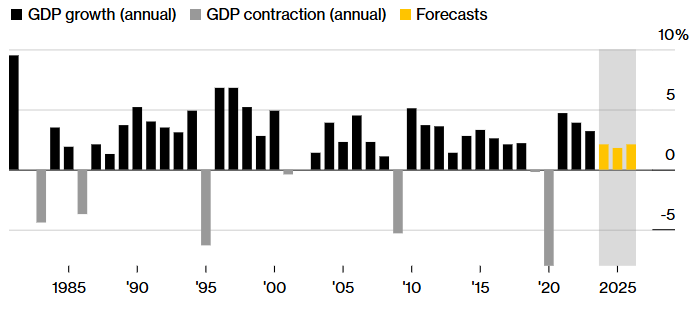
    Most importantly, AMLO was unable to break the cycle of low economic growth that had bedevilled his neo-liberal predecessors. In the three decades before he took office in 2018 annual GDP growth averaged only 2.0%-2.5%. During the election campaign the new president promised to push that up to 4%. In fact, the six-year 2018-2024 average is now expected to be of the order of only 0.7% (admittedly, the Covid-19 pandemic played a big part in such a low number). The new president cancelled a much-needed new Mexico City airport project (started by his predecessor) claiming without substantiation that it was corrupt and replacing it with a less flexible expansion of two existing airports. AMLO redirected resources to fund his own prestige projects such as a new refinery at Dos Bocas and the Mayan tourist train, despite concerns of overspending and poor value for money. In addition, the armed forces were given a much larger economic role, frequently without competitive tendering, which involved them directly in everything from building bridges to running ports and banks.

    Mexico’s economy seen slowing for third and fourth years
    Post-pandemic cooling may extend through 2025 before 2026 uptick

    Source: National Statistics agency, Bloomberg
    Note: Forecasts via median estimates of economists surveyed by Bloomberg News

  • TRACKING TRENDS

    Abbi Dicker 01 May 2025 Hits: 2023

    BRAZIL | Government posts monthly surplus. According to figures released by the national treasury on 29 April, the government posted a primary surplus of R$1.096bn (US$194m) in March. This contrasts with the deficit of R$1.02bn registered in the same month last year.

    The government’s net revenue in March this year totalled R$174.73bn, up 0.8% in real terms from March last year, while expenditure stood at R$173.64bn, down 0.5 year-on-year in real terms.

  • TRACKING TRENDS

    LatinNews 03 November 2011 Hits: 691

    BRAZIL | Blame the Real? Latest economic data releases again suggest that Brazil’s productive sector is coming off the boil, and fast. The leading indicator of domestic manufacturing output, the industrial production index, fell more than expected in September, shrinking 2% month-on-month over August and 1.6% year-on-year over September 2010. The moving quarterly average was -0.6%, and industrial output has now shrunk for the last two quarters, according to the national statistics institute (Ibge). The latest result came on the back of an 11% month-on-month decline in the automotive sector, which accounts for a full 11% of the overall index. That was the worst result for the car sector since December 2008, when Brazil slumped, prompting the Lula government to take emergency remedial stimulus measures. The auto sector has a knock on effect on the rest of the productive sector, due its linkages with things like the steel, glass, plastics and paint sectors, among others.

    With the manufacturing sector clearly struggling, GDP forecasts have been slashed to about 3% for 2011. Sales of cars and light vehicles fell 10% month-on-month in October, on preliminary figures. Yet the press is full of daily updates about the rush by foreign auto manufacturers to set up shop in Brazil. In part, that rush is driven by tough new regulations on local content rules, but it is mainly because Brazil’s saving grace is its huge domestic consumer market – which is set to remain robust into 2012 on the back of falling interest rates, steady credit growth and firm wages and employment.

    The central bank reported the fastest credit growth to date this year in September (19.6% year-on-year, led by mortgage lending of 45.3%). Despite the weaker Real and signs of an uptick in price indices in October, the latest consensus inflation expectations compiled by the central bank were steady, albeit at the top end of the target range (6.5%) for 2011, easing to 6% in 2012. All things considered, Brazil, which next year will overtake the UK to become the world’s sixth largest economy, should manage a lucky soft landing. God is Brazilian, as they say.

    Trade surplus soars.

    Brazil’s accumulated trade surplus in the first 10 months of 2011 was US$25.4bn, up a whopping 74.8% annually over the same period of 2010. Total exports were valued at US$212.14bn, up 29.3%, while imports came to US$186.7bn, up 25%. International reserves at the central bank amounted to US$353bn on 28 October.

  • COSTA RICA: Corruption allegations snowball

    LatinNews 06 June 2012 Hits: 1886

    May could have been a great month for President Laura Chinchilla after her ruling Partido Liberación Nacional (PLN) retook control of the national assembly (AL)'s directorate at the start of the month [RC-12-05]. However, after losing several members of her administration, including one minister, to corruption in April [RC-12-04], the President also lost her justice and transport & planning ministers, Hernando París and Francisco Jiménez - the latter forced out over another corruption scandal – in May. With 11 of Chinchilla’s 23 ministers having left the cabinet since she took office two years ago (May 2010), the instability at the top is unlikely to do much for her popularity – which, at 26%, is the lowest of any Latin American president according to a recent Mitofsky poll.

    Corruption allegations, however, have sprung up at all levels and in all institutions. The office of the attorney general warned in late May that it simply doesn't have enough resources to handle the upsurge in corruption investigations. In fact, there are only six prosecutors who specialise in this type of investigation. Amongst them, they are reviewing 189 cases deemed “complex”, giving each of them an average of 32 cases to handle. “It is very worrying that the lack of human and material resources may be detrimental at some point for some of the investigations”, Juan Carlos Cubillo, the associate prosecutor for probity, transparency and anti-corruption, told the local media. Similarly, the president of the supreme court of justice (CSJ), Luis Paulino Mora, said: “I hope that when discussing the 2013 budget, the economy ministry and the national assembly allow us to grow at a more comfortable pace to meet the needs highlighted by the public ministry and others, of equal or greater importance, in other parts of the judicial system”.

    Cubillo's and Mora's statements are particularly worrying because they coincided with accusations levied by Otto Guevara, who announced in May that he wants to be the 2014 presidential candidate of the opposition Movimiento Libertario (ML) for a fourth election running. Guevara's 2009 electoral campaign has been under the magnifying glass for some time and authorities believe that the campaign defrauded public coffers by claiming the reimbursement of some training courses that were never taken. The campaign is also under investigation for securing loans in a dubious manner. In late May, Guevara gave a press conference criticising a police raid on the offices of the party, which he said was politically motivated, adding that “the abuses” allegedly committed by the attorney general's office against ML constituted “corruption”.

    Attorney General Jorge Chavarría responded that his office “respects, in all accusations, the principles of objectivity, transparency and legality” and denied all accusations of persecution. Guevara's rebuttal was simple: if the attorney general fails to investigate similar accusations of illicit activities committed by the PLN during its campaign with the same speed and media exposure it has investigated the ML, then the investigation has been politicised.

    Temporary political respite

    On 21 May five national assembly members of the Partido Acción Ciudadana (PAC) announced their departure from the opposition alliance, formally ending the bloc’s power in the legislature. The bloc’s collapse appeared imminent after the Partido Accesibilidad Sin Exclusión (Pase) quit and crossed the floor to join PLN so as to re-take control of the AL's directorate in the 1 May election. However, the weakened opposition still rejected the president's call for a “political truce” in the AL during 2012. Instead, the leaders of the various opposition parties publicly expressed their disappointment at the president's failure to mention minorities during her state of the nation address and warned that, since they are out of congressional leadership, they will have more time on their hands to monitor the PLN's activities.

    • New Costa Rica-Mexico connection

    In late May the president of the Mexican economy airline Interjet, Miguel Alemán Magnani, announced that his company had requested the necessary permits from the Costa Rican ministry of transport to open a weekly air link between San José and Mexico City. The A320 flight would allow the transport of 150 passengers each way and would constitute the second route of Interjet to the sub-region – it currently has a weekly flight with the same aircraft specifications to Guatemala City. Interjet is Mexico's second largest airline, but is its only economy one.

  • TRACKING TRENDS

    LatinNews 22 September 2016 Hits: 648

    COLOMBIA-BOLIVIA | Falling foreign investment. On 19 September Colombia’s central bank (Banrep) reported that net foreign investment received by the country in August was US$1.91bn, 23.4% lower than in the same month last year. The main reason for this fall was a 24.7% decline in foreign investment portfolios, even though there was a year-on-year 22.2% increase in foreign direct investment (FDI). This means that the level of divestment (foreign investors pulling money out of the country) was higher than the level of foreign investment inflows despite the level of FDI coming into the country being higher than last year.

    Banrep did not provide a specific explanation of why this was the case but its data suggests that it may be related to the fall in international oil and mineral prices. The Banrep data show that investments in the oil and mining sector fell by 27.5% year-on-year in August to US$329.8m. In contrast, foreign investment in other sectors more than doubled to US$543.3m in the same period.

    The August result seems to confirm a wider trend. From January to August, net foreign investment in Colombia shrank by 19.7%, to US$9.1bn from US$11.36bn in the same period in 2015. Investment in oil and mining fell by almost half, to US$3.16bn in the first eight months of the year, while investments in other sectors increased by 49.3% to US$3.01bn. This was the result of falling net investment in every month except March, when inflows into public debt and shares pushed the balance into positive.

    This constant fall in FDI in Colombia expands the large deficit in the current account, which is one of the country’s most important economic vulnerabilities. But Colombia is not the only Andean country that is experiencing a fall in foreign investment as a result of lower hydrocarbon and mineral prices. A report by Bolivia’s central bank (BCB), also released on 19 September, showed that net FDI fell by 73% in Bolivia in the first quarter of the year. This represented a significant reduction from US$272.2m in the first quarter of 2015 to US$72.8m in the same period of 2016.

    As in Colombia the fall in FDI in Bolivia was also the result of divestment, to the tune of US$155m in the quarter as investment inflows into the oil and mining sectors were comparatively lower than last year. Investment in the hydrocarbon sector, which accounts for 55% of all FDI into Bolivia, fell from US$209.m to US$131m. Meanwhile investment in the mining sector fell by 84% from US$32.1m to US$5.1m. There was also a fall in FDI in the industrial sector but there were minor increases in other sectors such as trade, transport and communications. If this trend continues, this would be the third consecutive year of decreasing FDI in Bolivia.

    PERU | Searching for infrastructure project partners. On 19 September Peru’s President Pedro Pablo Kuczynski revealed that BlackRock Inc, the world’s largest asset management firm, is interested in financing infrastructure projects in Peru. Kuczynski’s announcement came after he met BlackRock’s CEO, Larry Fink, in New York City, where Kucyznski travelled to attend the United Nations General Assembly.

    Kuczynski did not specify exactly what type of projects BlackRock was interested in but he recently said that Peru has a US$69bn deficit in infrastructure, principally in the transport, energy, education and potable water sectors, so there are plenty of opportunities available.

    BlackRock established an infrastructure unit in 2011 and in recent years this has focused on expanding in Latin America, where it now owns US$752bn in assets.

    Kuczynski, who has said that one of his government’s objectives is to reduce Peru’s infrastructure deficit by half by the end of his term in 2021, said that he would also seek to speak to other potential investors while in the US to present them with opportunities to invest in Peru’s infrastructure projects. Prior to his arrival in the US, Kuczynski made an official visit to China, where he met President Xi Jinping and local business leaders to promote economic and investment opportunities in Peru. He also visited the mayor of Shanghai, Yang Xiong and the Shanghai port facilities. Meanwhile, China’s largest railway company expressed an interest in financing a US$1.5bn railway project running 450km from the coastal port of Barranca in Lima region to Ica, capital of the eponymous southern region.

    • Peru launches ‘SAT-1’

    On 15 September Peru’s defence minister confirmed the successful launch into orbit of the ‘SAT-1’ sub-metre observation satellite. The US$168.6m satellite, which launched from the Kourou space centre in French Guiana, is capable of taking pictures of an area less than a metre in size and also identifying objects less than a metre in size, and will allow Peru’s defence ministry to monitor the entire national territory closely for the first time. Defence Minister Mariano González said that the satellite, “the most powerful in the region”, would be used for national security, disaster prevention, urban planning, and monitoring agricultural crops, both legal and illegal, among other things.

  • ECUADOR: Moreno retains lead as rivals vie for second

    LatinNews 26 January 2017 Hits: 2600

    With just over three weeks to go until Ecuador stages general elections, Lenín Moreno, the presidential candidate for the ruling Alianza País (AP), retains a significant, but very far from decisive, lead in all of the main opinion polls. Moreno enjoys an advantage of just over 10 percentage points over his nearest rival. If Moreno preserved this 10-point lead, his margin of victory would be sufficient to win in the first round on 19 February but only if he were to surpass the 40% threshold. Failing that he would have to win 50% of the vote, which looks beyond him, or contest a second round on 2 April, which could be much more problematic.

    A survey of 2,120 eligible voters carried out by Cedatos between 12 and 22 January gave Moreno 34.3% followed by Guillermo Lasso, the candidate for the centre-right Movimiento Creo (Creando Oportunidades), on 22.9%, Cynthia Viteri, of the traditional Partido Social Cristiana (PSC), on 11.4%, and Paco Moncayo, of the left-wing coalition Acuerdo por el Cambio, on 8%. The pick of the rest, Abdalá ‘Dalo’ Bucaram, the third son of exiled former president Abdalá Bucaram (1996-1997), of Fuerza Ecuador, trailed on 4.3%, with the remaining three candidates – Iván Espinel, Patricio Zuquilanda and Washington Pesántez – totalling 2.5% between them.

    The changes from the previous Cedatos poll a month earlier were all within the 2.8% margin of error of the poll, with Moreno, for instance, down by nearly one percentage point, and Lasso and Viteri up by half a percentage point. The most noteworthy change was to the number of undecided voters, falling from 47% to 39%, although this remains very high.

    A survey by Market, conducted in all 24 provinces between 18 and 20 January with 9,120 respondents, produced broadly similar findings. Market gave Moreno 28.2% support, but stressed that with 15.9% of voters promising to cast blank or void ballots, this would give him some 32.5% of the valid vote. Moreno still held an advantage of just over 10 percentage points from his nearest rival, in this case Viteri on 18.0%. Lasso came third with 16.6% and Moncayo fourth on 13.2%, with Bucaram on 4.8%, and the rest on 3.4% between them. Market said that the number of undecided voters had fallen to 37.8% from 46% in December.

    Market found that Viteri is strongest in Guayas, in large part because of the support of the long-serving mayor of Guayaquil, Jaime Nebot, but she is also growing in the provinces of Los Ríos and El Oro, while lagging the other candidates elsewhere. In an attempt to to boost her support outside of the country’s largest urban areas, Viteri visited Azogues, the small capital of the province of Cañar, on 22 January, and Esmeraldas, the coastal city and capital of the eponymous north-western province, a day later (see sidebar).

    Lasso repeated his proposal to create 1m jobs in his four-year term during rallies in several cantons in Los Ríos. Lasso said he would investigate “white elephants” of the Correa administration, above all the Refinería del Pacífico, which he claimed had wasted US$1.5bn over five years and had absolutely nothing to show for it. “If we hadn’t wasted that money we would not have had to place US$1bn worth of bonds last week on international markets [at 10% interest] and US$1.7bn last month,” Lasso said.

    Despite trading barbs, Viteri and Lasso, would most likely seal an alliance in the run-off against Moreno, who was out on the campaign trail in Quito at the weekend. Moncayo, who represents the radical Left which is hostile to the government led by President Rafael Correa, would be unlikely to back Moreno.

    • Domestic violence

    In addition to tabling a housing proposal, Cynthia Viteri promoted a series of innovative ideas to crack down on domestic violence in Ecuador while campaigning at the weekend. These include an ‘anti-panic button’, which could be pressed on an application on mobile phones by any woman or child victim of household violence to call specialised police; specialised judges to deal with femicide and psychological violence; and the creation of refuges where abused women could find shelter with their children.

  • TRACKING TRENDS

    LatinNews 11 May 2017 Hits: 2036

    COLOMBIA | Favourable economic outlook. On 9 May, during the swearing-in ceremony of Griselda Janeth Restrepo as his new labour minister, President Juan Manuel Santos highlighted the constant growth of Colombia’s domestic economy as a source of optimism for the country. Santos said that despite the adverse effects of a fall in international oil prices and the ‘El Niño’ climatic phenomenon on the domestic economy, this has continued to grow and create jobs, while helping to reduce poverty.

    Santos’s remarks come after the International Monetary Fund (IMF), on 4 May, released the report of its executive board’s latest Article IV consultation with Colombia, in which it praised the country’s “remarkably smooth adjustment to a combination of internal and external shocks”. The IMF also highlighted the favourable outlook for Colombia’s economy, with medium-term growth expected to be driven by its diversification away from oil production.

    Evidence of this was provided by Colombia’s national cocoa growers’ federation (Fedecacao). On 5 May Fedecacao reported that national cocoa production increased by 29% year-on-year to reach a new 10-year record of 14,672 tonnes (t) in the first quarter. Fedecacao president, Eduard Baquero López, said that the increase in cocoa production answered to the improvement in crop yields obtained thanks to the cocoa develop programme implemented by Fedecacao and the agriculture & rural development ministry aimed at developing cocoa plants better suited to growing in local conditions.

    The growth of cocoa production is also positive for Colombia’s ongoing peace process given that it has long been identified by the authorities as a good substitute crop for growers of illegal coca, as the price of cocoa in international markets is high (currently trading at US$3,100 per tonne). Indeed, the Santos government is heavily promoting the adoption of cocoa in coca growing areas of the country that were long controlled by the Fuerzas Armadas Revolucionarias de Colombia (Farc) but from which the Farc has withdrawn after signing a peace deal last year. The Santos government recognises that promoting Colombia’s rural economic development is critical to the success of the peace process and the country’s future economic development.

  • COLOMBIA: Farc disarmament postponed

    LatinNews 01 June 2017 Hits: 544

    The government led by President Juan Manuel Santos accepted a request this week from the Fuerzas Armadas Revolucionarias de Colombia (Farc) to extend the deadline for the completion of the disarmament process by 20 days to 20 June. It also prolonged the legal status of the 26 disarmament, demobilisation and reintegration (DDR) camps [ZVTNs in the Spanish acronym], where 6,934 Farc guerrillas are gathered, for two more months until 1 August. “It is a small thing to end 53 years of confrontation and fratricidal violence,” Santos said in a televised message to the country. But Santos will be well aware that the revised deadlines will need to be met if public support for the peace process is not to be eroded.

    It is no great surprise that the 180-day timeframe for the completion of the disarmament process should have been missed. There have been significant delays to the process, principally the completion of the 26 DDR camps to hold demobilising guerrillas, and the government’s failure to provide containers to store Farc weapons (two of the DDRs still lack the requisite containers now). But President Santos sought to reassure the public during his televised address that the peace process was irreversible and that appreciable strides had been taken towards its completion despite the brief hold-up.

    Santos said the United Nations (UN) would certify all of the Farc weapons by 1 August, and, separately, locate and destroy, with Farc assistance, nearly 900 caches of explosives by 31 August. Santos said that extending the legal status of the DDRs would allow the government to convert them into ‘territorial spaces for training and reincorporation’ to pave the way for the demobilised guerrillas to enter civilian life, and work in the local community.

    Santos also announced the creation of an elite police force, whose first task will be coordinating a pilot project in the Pacific port cities of Buenaventura (where there have been serious anti-government protests in recent weeks denouncing state abandonment) and Tumaco to dismantle illegal armed groups that have filled the vacuum left by the Farc; as well as a special investigation unit of the prosecutor general’s office dedicated to investigating and prosecuting neo-paramilitary groups. Both of these new units, he said, would be up and running before 15 June.

    Combating neo-paramilitary groups is one of the principal demands of the Farc leadership which fears, in accordance with precedent, that they will massacre demobilised guerrillas. On 31 May the head of the counter-narcotics police, General José Ángel Mendoza Guzmán, re-launched ‘Operation Agamemnon’ in the Urabá region of the north-western department of Antioquia. First launched in February 2015, the operation’s chief aim was to capture the top leaders of Colombia’s most powerful neo-paramilitary group, Clan del Golfo. Mendoza, who offered a Col$3bn (US$1.1m) from the Colombian government (in addition to US$5m from the US government) for information leading to the capture of the Clan del Golfo’s maximum leader, ‘Otoniel’ (Dairo Antonio Úsuga David), and his chief lieutenants, asserted that the group was “cornered” and in its “death throes”.

    It is far from clear that such confidence is justified. Otoniel has evaded capture for over two years, and there is growing evidence that the Clan del Golfo, which has a presence in 22 of Colombia’s 32 departments, is expanding into areas vacated by the Farc. The defence minister, Luis Carlos Villegas, also revealed in late May that at least 10 police officers had been killed by Clan del Golfo as Otoniel countered Operation Agamemnon with Plan Pistola, targeting the police.

    Chocó accord struck but other departments rebel

    The government has reached an agreement with the northwesternmost department of Chocó to deliver on major investment in infrastructure and health services, ending a two-and-a-half week ‘civic strike’. The government promised to surface the road linking the departmental capital Quibdó with nearby cities; construct three hospitals; and to recognise the gold-rich municipality of Belén de Bajirá as part of Chocó rather than neighbouring Antioquia. The Comité Cívico por la Salvación y la Dignidad del Chocó called the strike after accusing the government of fulfilling only 5% of what was agreed after a previous strike in August last year.

    No sooner had the government dealt with protests in Chocó, however, than other departments were up in arms. The governors of the departments of Magdalena, Bolívar, César and Atlántico declared a ‘Caribbean rebellion’, after holding a mini-summit on 30 May, in order to try and force the Santos administration to heed its demands for funds to mitigate the effects of severe flooding. The mini-summit took place in the Magdalena municipality of El Banco, and was chaired by the governor of Magdalena, Rosa Cotes, amid the imminent risk of the River Magdalena bursting its banks.

     “We are desperate,” the governor of Bolívar, Dumek Turbay Paz, said. “We present [project proposals to the government] and they return them; we correct them and they return them again.” The governors are demanding that a state of economic, social and ecological emergency be declared in their four departments.

    • Interior minister resigns

    As the peace process drags on it will get closer and closer to general elections in May 2018. Campaign season is already approaching. Just last week, the interior minister, Juan Fernando Cristo, tendered his resignation so that he would be legally entitled to run for president for the Partido Liberal (PL). The deputy interior minister, Guillermo Rivera, steps up to the top job. Santos said that Rivera was the first minister in Colombia’s history from the southern department of Putumayo “and this is of huge significance because it is one of the departments that has suffered most from the armed conflict”.

    • Peace council

    President Santos has signed a decree creating a national council for peace, reconciliation and co-existence, which is designed to entrench the peace accords. The council will be presided over by the presidents of the executive and legislative branches as well as representatives of civil society.

  • CHILE: Piñera sparks first tensions with opposition

    LatinNews 22 March 2018 Hits: 1220

    President Sebastián Piñera’s conciliatory rhetoric upon taking office for a second term earlier this month [WR-18-10] looks short-lived. Last week his interior minister, Andrés Chadwick, announced that the new right-of-centre Chile Vamos coalition government was ditching a draft constitutional proposal, put forward by Piñera’s predecessor, Michelle Bachelet (2006-2010; 2014-2018), days before she left office.

    Along with free education and fiscal reform, constitutional reform – to update the magna carta which dates back to the military dictatorship led by General Augusto Pinochet (1973-1990) – had been one of Bachelet’s three chief electoral pledges in 2013. On 5 March, in a television address to the nation, Bachelet finally unveiled her new draft constitution, the fruit of a participative process which began in October 2015. She said the new document “establishes the inviolability of human dignity and the respect and protection of human rights”, which includes free education for all and the right to strike. She said this corrects “a tremendous omission of the current text”.

    Bachelet also noted that the proposed new constitution “takes care of a historic debt – constitutional recognition of indigenous people”, and highlighted efforts to address “severe defects” with regard to the role of state institutions. For example, it would remove the super majority needed to pass some laws and establish a better balance between the executive and legislative branches.

    If intended to secure constitutional reform as part of her legacy, Bachelet’s move would seem to have failed, despite speculation that President Piñera’s lack of a majority in the bicameral legislature would leave him more open to negotiating with the opposition Nueva Mayoría (NM) coalition. In his 2017 manifesto, Piñera had notably ruled out introducing a new constitution, calling instead for improvements. On 15 March, Chadwick said unequivocally that the initiative would not be promoted by the Piñera administration but instead it would consider updating some aspects of the constitution.

    This met with derision from the NM, some members of which had criticised Bachelet’s decision to wait until the final days of her mandate to table her proposal. A national deputy for the NM’s Partido Socialista (PS), Leonardo Soto, a member of the lower chamber’s constitutional committee, complained that the new government’s decision to shelve the bill was a “betrayal” of its promise to build bridges with different political groups, declaring that the “honeymoon with the opposition” was over.

    New Carabineros head

    One of President Piñera’s initial acts upon taking office on 11 March was to name a new director of the Carabineros militarised police after Bruno Villalobos resigned on 12 March. Appointed for a four-year term in 2015, Villalobos had long faced calls to step down – both over the major tax fraud scandal which broke last year, as well as the more recent botched ‘Operación Huracán’ case. This involved claims that the Carabineros tampered with evidence from an operation carried out last year in the southern region of La Araucanía in which eight indigenous Mapuche leaders were arrested.

    On 14 March, Piñera named Hermes Soto Isla, a former head of the Carabineros in the Santiago metropolitan area and the Bío Bío and Antofagasta regions, as Villalobos’s replacement. He also pledged to modernise the Carabineros and the investigative police (PDI), focusing in particular on improving the way in which police forces gather and use intelligence – a reference to the shortcomings exposed by ‘Operación Huracán’.

    • Cadem poll

    A survey by local pollster Cadem, published on 12 March, found that 82% of respondents agreed with President Michelle Bachelet’s proposal to draft a new constitution. However, 63% disapproved of her decision to send it to congress just before the end of her second term.

  • VENEZUELA: Dissidents begin to return home

    Abbi Dicker 28 May 2026 Hits: 1131

    In the past week, two high-profile Venezuelan dissidents have returned to their country – Lester Toledo, a founding member of the opposition party Voluntad Popular (VP) and former deputy in the Zulia state legislature (2012-2016), and Rocío San Miguel, the president of the NGO Control Ciudadano. Their reception by the Venezuelan authorities will be closely watched by exiled opposition leader María Corina Machado, who has vowed to return despite being the subject of multiple criminal investigations.

    Toledo, who fled Venezuela in 2016 after being charged with terrorism offences and was granted asylum by Spain, landed in Caracas on 21 May. He was greeted by Freddy Superlano, VP’s national coordinator who was imprisoned for 18 months from July 2024 before being released as part of the amnesty process for political prisoners which has been underway since late January. In a video posted on social media before his arrival in Venezuela, Toledo said that he was returning “to seek justice”. He insisted, however, that “I’m not going to Venezuela looking for war…to foment violence…or to try and destabilise [the country]”.

    San Miguel, who was detained from February 2024 until January this year on charges including terrorism, has also returned to Venezuela from Spain, where she has resided since her release from prison, according to a statement released on 27 May by her brother and spokesperson, José Manuel San Miguel. The statement said that she is returning to cooperate with the judicial proceedings against her and to be reunited with her family, “in the expectation that the legal situation can be resolved definitively and in line with the law”. The statement added that she remains subject to restrictions imposed by the Venezuelan authorities, including a ban on giving media interviews.

    The potential legal perils faced by San Miguel and Toledo reflect one of the central shortcomings of the January amnesty law – namely, that while political prisoners might be released from prison, the legal proceedings against them will not necessarily be annulled. The opposition has previously warned that the law does not provide any long-term security for those it benefits and does not provide a safe route for dissidents to return from exile.

    San Miguel is doubtless hoping that Washington’s heavy influence over President Delcy Rodríguez’s government will prevent the politicised judiciary from returning a guilty verdict in her high-profile case. She is taking a huge risk, however. Another director of a leading NGO, Javier Tarazona of Fundaredes, was released from his pre-trial detention of nearly four years in February, only to be informed the following month that his amnesty appeal had been denied. Tarazona remains at liberty for now but, like San Miguel, he remains in ongoing legal jeopardy.

    The return of two well-known political dissidents will raise hopes in the opposition that Machado will soon return from her own exile, despite the fact that she remains the subject of investigations for a long list of alleged crimes including supporting foreign military action against Venezuela. Machado has said repeatedly that she intends to return to Venezuela in the near term, although she was reportedly urged not to do so during a 6 March meeting with US President Donald Trump. Given her proven capacity to draw massive crowds at pro-democracy rallies, Machado’s return from exile could electrify the opposition movement and pose a massive headache for the Rodríguez administration, which has not laid out any plans for a transition.

    Government restructuring

    President Rodríguez announced on 26 May that there would be a “restructuring and re-engineering of government”, with a plan to be drawn up within the next 90 days by the education minister and vice president of social and territorial socialism, Héctor Rodríguez (no relation). Without going into detail, she spoke of a Venezuela “that is being reborn while keeping its identity…a Venezuela that is seeking its own path for the happiness of its people”. She also announced that Economy and Finance Minister Anabel Pereira will take on an additional role as presidential commissioner for government efficiency.

  • BRAZIL: Why is there so much investment in Brazil’s car industry?

    LatinNews 20 October 2011 Hits: 554

    International vehicle manufacturers are almost falling over themselves to invest in Brazil. The latest executive to announce major projects was Carlos Ghosn, the president of Nissan-Renault. After meeting President Dilma Rousseff on 1 October, Ghnosn confirmed that Renault would expand its plant in Brazil while Nissan would build its first plant in the country.

    Renault’s existing plant is at Curitiba, in the southern state of Paraná, while Nissan will build at Resende, in Rio de Janeiro. Ghosn hinted that both companies were interested in developing new technologies in Brazil. He specifically mentioned electric vehicles.

    Aloizio Mercadante, the science and technology minister, who attended the meeting between Ghosn and Rousseff, said that the president had instructed him to produce a feasibility study for the introduction of electric vehicles to Brazil. Renault is one of the world leaders in electric vehicle technology.

    Brazil is now the world’s fourth biggest national vehicle market, after the US, China and Japan. It is particularly attractive to international auto companies because a majority of the vehicles sold in Brazil use flex-fuel engines, which were first developed by Brazilian companies. Brazil remains a world leader in this technology, which allows engines to run efficiently on a mix of ethanol and petrol or diesel.

    Renault-Nissan believes that it has plenty of room for growth in Brazil since its market share is only 6.5%, compared with its 10% share of the global vehicle market. Ghosn, now a nationalised Frenchman but born in Brazil, said the group aimed to double its share of the Brazilian market to 13% by 2016, when he expects that between 4.5m and 5.0m new vehicles will be sold in Brazil. He hopes to reach this target by driving Renault’s market share up to 8%, from 5.5% currently, and Nissan’s to 5%, from the current 1%.

    The expansion of the Renault plant will take production up from 220,000 units a year to 330,000/yr, while the new Nissan plant should be able to produce 200,000 vehicles a year.

    This direct investment by Nissan has bleak implications for Mexico, which is currently the main source of Nissan vehicles sold in Brazil.

    The Rousseff government’s decision to raise the tax on industrial product (IPI) on vehicles to 30% has caused controversy. To avoid the new taxes (which effectively act as an import tariff), vehicles have to have a 65% local, or Mercosur, component. Japan has suggested the measure is in contravention of World Trade Organisation rules.

    The measure has also upset BMW, a German luxury vehicle manufacturer, which has been considering building a plant in Brazil. At the beginning of October, the German business daily newspaper, Handelsblatt, reported that BMW had already chosen São Paulo as the site for it first Latin American plant. In mid-October, however, the local press reported that BMW was lobbying the trade and development minister, Fernando Pimentel, to re-evaluate the IPI increase or else BMW would take its investment to China, India or Russia. BMW sells about 10,000 vehicles a year in Brazil. Globally, it sells 1.6m vehicles a year.

    Brazil says that its local component rules are much looser than either China or India where 90% of a new car sold has to be locally sourced.

    Total new vehicle sales in Brazil are likely to be about 3.6m in 2011, up from 3.51m in 2010.

  • HONDURAS: Getting cooperation back on track

    LatinNews 21 August 2014 Hits: 1519

    Since taking office in January President Juan Orlando Hernández has had some testy words for the US, the country’s main ally, most recently over the child migrant crisis. The US in turn has looked slightly askance at some of Hernández’s bold new security initiatives, including a new shoot-down law and the installation of radars acquired from Israel in a bid to make defence policy “independent” (i.e. of the US). After a definite cooling, perhaps a deliberate attempt by Hernández to put the country on a more even footing with its chief taskmaster, efforts now appear underway to start afresh.

    In early August Hernández visited US Southern Command (Southcom) HQ in Florida to discuss security cooperation. According to a Southcom press release, Hernández, accompanied by a delegation including his defence and security ministers, Samuel Reyes and Arturo Corrales respectively, met the head of Southcom, General John F. Kelly, plus representatives of other agencies including the US State Department and US Agency for International Development (USAID). Kelly has recently been tacitly critical of Honduran anti-drugs policy. “The Honduran delegation took part in a dialogue focused on how U.S. security assistance can help Central American nations strengthen their security capacity, disrupt transnational organized crime and improve citizen security”, the statement noted, adding that the “leaders ... also explored ways to achieve the mutual security cooperation goals President Barack Obama and President Juan Hernandez, along with the Presidents of Guatemala and El Salvador, discussed [on] July 25 in Washington. President Hernandez received firm commitments to collaborate in finding solutions for his country, and for the region, from U.S. representatives at the table.”

    Two days later in Tegucigalpa, the associate administrator at USAID, Mark Feierstein, praised the Honduran government’s progress on citizen security. “We are sufficiently satisfied with the progress we’ve seen. We have noticed a decrease in violence in the country during the last months,” he said at a press conference. Feierstein, who was visiting USAID-sponsored projects, said the fight against crime was a “long-term battle” and the main challenge to economic development in Honduras. He declared that the US “recognizes a shared responsibility in combating this scourge [violence], but we also acknowledge that we are not the main actors, the main actors are the Hondurans, but we’re here to carry on with our support”. Julie Torres, the US embassy chargé d’affaires, echoed Feierstein.

    • Los Valles designated

    On 20 August the US Department of the Treasury’s Office of Foreign Assets Control (OFAC) said it stood with the Honduran authorities in their efforts to combat drug trafficking and expressed its thanks for ongoing cooperation. The OFAC made its comments in a statement announcing the designation of the ‘Los Valles’ drug trafficking organization in Honduras and the Honduran national Miguel Arnulfo Valle Valle as “significant foreign narcotics traffickers pursuant to the Kingpin Act”. Also sanctioned were Luis Alonso and José Reynerio Valle Valle, who “materially assist and act for and on behalf of their brother”, in addition to four Honduran businesses tied to the gang.

    The OFAC described Los Valles as “one of the most prolific Central American narcotics trafficking organizations…responsible for the distribution of tens of thousands of kilograms of cocaine per month directly into the United States”. It said that the brothers (who run their criminal organisation as “a close-knit family business”) “employ a combination of brutal violence and public corruption in order to keep a stronghold on their base of operations in Copan”.

    Ahead of the designation, Honduran authorities seized local assets including over 40 properties belonging to Los Valles. Their sister, Digna Valle Valle, was arrested in the US in July on federal drug charges. End box

    • Immigration information deal

    On 19 August the US Immigration and Customs Enforcement (ICE) Principal Deputy Assistant Director, Thomas Winkowski, and the director general of the Honduran national police, Ramón Antonio Sabillón, signed a memorandum of cooperation “to enhance the ability to share information on immigration and criminal history records concerning Honduran nationals being repatriated from the United States to Honduras”. Meanwhile in McAllen, Texas, the Honduran foreign minister, Mireya Agüero, began a three-day US tour to outline the government’s policy response to the child migrant crisis, including new measures against human trafficking, information campaigns to deter families from allowing young children and teens from attempting the perilous journey north, and social re-integration, education and work programs to help returning migrants settle back into local communities.

  • ARGENTINA: Tough times for the automotive sector

    LatinNews 30 January 2015 Hits: 2493

    It was a particularly challenging year for Argentina’s automobile assembly plants in 2014, for many years considered to lie at the heart of the country’s manufacturing sector.

    According to the Asociación de Concesionarios de la República Argentina (Acara), the lobby group representing the country’s retail vehicle sales outlets, only 683,485 cars were sold in 2014, a steep 28% fall on 2013 and the lowest level registered in the country since 2010. December sales were the worst of the year, at 29,167 units, a fall of 42% on year-earlier levels.

    The decline in sales can be attributed to a variety of different factors. One is that the general macroeconomic health of the economy was poor in 2014. While final data is awaited, most analysts believe that real GDP was either flat or negative in 2014. Full year output is estimated to have dropped by 1.5%, according to the World Bank. But there were also a number of industry-specific factors. Following the maxi-devaluation in January 2014, the government slapped extra taxes on high-end cars. If that was a problem for demand, there have also been hold-ups on the supply side. During the year the government deployed a whole series of measures to try and preserve its scarce foreign currency reserves. Among others, it imposed a US$100m ceiling on monthly imports of components by the local automobile industry. Given that Argentine auto-assembly plants are quite closely integrated with the Brazilian industry, this caused major production bottlenecks.

    At the same time, in an effort to boost demand, the government also launched subsidised car-buying programmes, known as Procreauto I and II. The problem, say some analysts, is that the poorly coordinated combination of measures limiting production on the one hand, and boosting demand on the other, had contradictory but ultimately negative effects. Many car sales outlets found that when they had customers ready to buy, they did not have the cars to sell them. The government, for its part, accused the outlets of deliberately holding back vehicles to force increases in prices.

    Acara president Abel Bomrad recognises, however, that the Procreauto programme did make a positive contribution: without it, things would have been worse. Of the mass-market manufacturers, the biggest losers were Renault (sales fell by 62.5% over the year), Citroen (down 60%) and Peugeot (down 49.5%), all hard hit because their ranges include more high-end, and therefore more highly taxed, models. Luxury cars sales were almost wiped out: Audi’s sales were down 85%, while BMW’s fell 81%. This year, cars worth over ARS241,500 (US$28,041 at the official exchange rate) now carry a 50% tax rate.

    Dante Sica of a local consultancy, abeceb.com, says he expects car sales in 2015 to be of the order of 630,000 units (representing another annual contraction, of 7.8%). This being an election year, many expect that a new Procreauto financing plan will be launched. Lorenzo Sigaut, of the Ecolatina consultancy, says sales will still be held back by the scarcity of foreign currency. “Buying cars implies using up dollars and the government doesn’t have many” he says. Sigaut adds that it is hard to see a liberalisation of automobile component imports “when we are expecting lower dollar revenues from commodity exports, a doubling of foreign debt maturities, and no net change in foreign currency reserve levels”.

  • TRACKING TRENDS

    LatinNews 14 May 2015 Hits: 6788

    PANAMA | Diamond Exchange. The Panama Diamond Exchange (PDE), Latin America’s first ever diamond bourse, has formally begun operations. The PDE opened following a US$200m investment in the construction of the World Jewellery Hub (WJH) in Panama City, which will house the new diamond bourse and act as a jewellery Free Trade Zone (FTZ).
    The opening of the WJH was attended by President Juan Carlos Varela, who said that it would mark a “turning point” in the global jewellery trade. According to a PDE statement, the WJH will increase Panama’s GDP by 3% and create 3,000 direct and indirect jobs. The PDE is expected to help the US$8bn fine jewellery retail business in Latin America grow to more than US$10bn by 2017.