All Categories

Subcategories

  • TRACKING TRENDS

    Abbi Dicker 06 February 2025 Hits: 2675

    ARGENTINA | Preparing for lifting currency controls. The government led by President Javier Milei reduced the crawling peg - the devaluation of the peso - from 2% to 1% per month on 3 February. In conjunction with tough austerity measures and public spending cuts, the crawling peg has played a key role in reducing inflation in Argentina, which registered a monthly rate of 2.7% in December.

    The decision to halve the rate of monthly devaluation was taken with inflation forecast to continue to fall and as the government seeks to reach a new agreement with the International Monetary Fund (IMF) to obtain a loan of some US$11bn in order to boost international reserves with a view to lifting currency controls. The IMF sent a team to Buenos Aires last week to advance negotiations towards a new deal.

    On 3 February Milei gave a date for the first time for the country to end currency controls. Milei said that they would be lifted by no later than 1 January 2026 but that it could be sooner if his government could strike a deal with the IMF. He was adamant, however, that Argentina could go it alone if necessary, it would just take longer. “Our policy is firmness on the fiscal front, non-negotiation of the zero deficit, and maintaining a tough monetary policy,” he said. “If after that we have financial sources to accelerate [our plans] they will be welcome,” he added.


    BRAZIL | Drop in unemployment. The national statistics institute (Ibge) released the annual figures for unemployment in 2024 on 31 January. The Ibge reported that the country’s jobless rate in the fourth quarter of last year stood at 6.2%, down from 6.4% in the third quarter, but up slightly from 6.1% registered in the rolling quarter of September-November 2024.

    The average unemployment rate throughout 2024 came to 6.6%, the lowest annual figure on record. This also marks a decrease from the average rate of 7.8% registered for 2023. The country’s total unemployed population closed last year at 7.4m people, down 13.2% on the previous year, while the number of employed people reached a record 103.3m, up 26% from 2023.


    BRAZIL | Petrobras raises diesel prices. The state-controlled oil company Petrobras has announced that, starting on 1 February, the average price of its diesel for fuel distributors will rise to R$3.72 (US$0.64) per litre, an increase of R$0.22 per litre. In a press release, the oil giant stated that this is the first diesel price hike since October 2023.

    Reports in the national press last week suggested that the CEO of Petrobras, Magda Chambriard, met President Luiz Inácio Lula da Silva on 27 January to inform him of the need to raise diesel prices. The national fuel importers association (Abicom) warned on 14 January that Petrobras’ average diesel prices were 24% below the import parity pricing. Even with this latest price hike, Abicom stated on 4 February that Petrobras’ diesel prices were 9% lower than the average price for imported diesel.

  • PERU: Boluarte entangled in new scandal

    Abbi Dicker 27 February 2025 Hits: 4034

    Peru’s President Dina Boluarte was summoned by the attorney general, Delia Espinoza, this week to give evidence in an investigation into serious food poisoning suffered by children enrolled in the Qali Warma food programme. Barely a month goes by without Boluarte being caught up in another investigation. This time she is being investigated for alleged improper conduct in her capacity as development and social inclusion minister under former president Pedro Castillo (2021-2022) in signing contracts to favour the sole food supplier for the Qali Warma programme, Frigoinca.

    President Boluarte spent five hours in the attorney general’s office in relation to the Qali Warma food scandal. The questions she faced centred around contracts she signed with Frigoinca, in particular one for PEN$4.7m (US$1.27m) for meat products. Investigations by local media in November 2024, after 16 children fell ill in the southern region of Puno, suggested that some of the food distributed to schools contained mouldy chicken and horse meat instead of beef, as well as other products unfit for human consumption. The majority of the products were sent to schools in rural areas of the country.

    Soon afterwards, on 25 December, the owner of FrigoInca, Nilo Burga Malca, was found dead, suspected murdered, in a Lima hotel. The police raided the home of Fredy Hinojosa, the presidential spokesperson, in connection with a kickback and bribery scheme within the Qali Warma programme. Hinojosa was head of the programme from July 2021 to November 2022 when the development and social inclusion ministry was presided over by Boluarte. The government has now ditched the Qali Warma scheme, replacing it with another initiative entitled Wasi Mikuna, and Boluarte appointed Leslie Urteaga earlier this month to replace Julio Demartini at the development and social inclusion ministry [WR-25-05], although critics argue that he is a scapegoat.

  • ECONOMIC HIGHLIGHTS

    Abbi Dicker 23 January 2026 Hits: 1490

    ARGENTINA | US swap line repaid. The central bank (BCRA) announced on 9 January that it has repaid the US$20bn currency swap line that Argentina secured with the US in October. In a statement, the BCRA said the swap line, which helped to prop up Argentina’s economy ahead of key mid-term elections, was paid off in December. In a post on social media, US Secretary of the Treasury Scott Bessent stated that Argentina had “quickly and fully repaid its limited draw on the swap facility with the United States, such that the Exchange Stabilization Fund currently does not hold any pesos”. He said this reflected Argentina’s “strengthened financial position” and that the agreement had worked as intended: “to stabilize Argentina in its crisis moment of acute, short-term, and urgent illiquidity pressure on both exchange rate and financial stability”. Bessent added that Argentina was “a strong American ally” and that “a strong and stable Argentina that helps anchor a prosperous Western Hemisphere is in our clear best interest”. He praised President Javier Milei and noted that Argentina had successfully re-accessed financial markets and made “encouraging changes” to its monetary and exchange rate policy framework.

    BRAZIL | Record international tourism in 2025. The tourism ministry has released new figures on 6 January that 9.2m international tourists visited Brazil in 2025, which is an annual record. It marks a 37.1% increase compared to 2024 and easily surpasses the government’s forecast of 6.9m international visitors for 2025. A total of 3.4m Argentine nationals and 801,921 Chileans visited Brazil last year. Tourists from the US totalled 759,637, while there were 1.3m tourists from European countries such as France, Portugal, Germany, Italy, Spain, and the UK. The top three states for international tourist arrivals were São Paulo with 2.8m visitors, Rio de Janeiro with 2.2m, and Rio Grande do Sul with 1.5m.


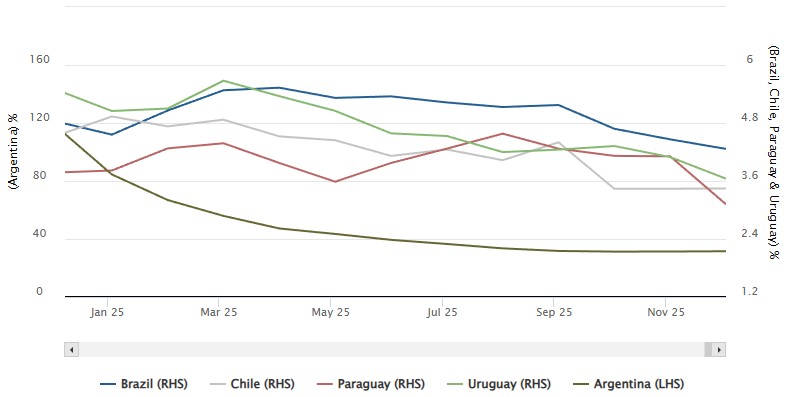
    Brazil & Southern Cone: inflation rate
    Percentage variation (year-on-year)

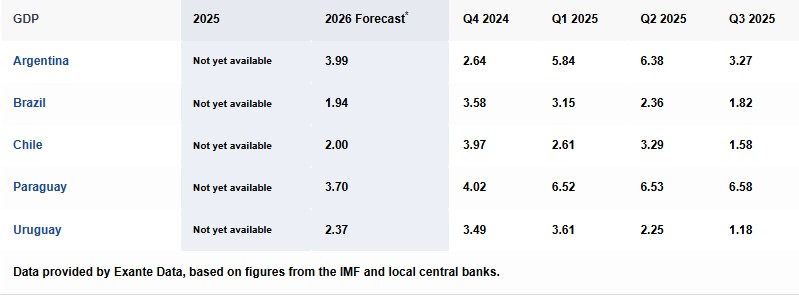
    Brazil & Southern Cone: GDP growth (%)
    Quarterly figures are year-on-year growth

  • TRACKING TRENDS

    LatinNews 04 April 2012 Hits: 3299

    ECUADOR | Growth record. The economy grew by 7.8% in 2011. The national press, which is largely hostile to the government, clearly found it difficult to report this news, providing scant coverage of what was the most impressive economic expansion since President Rafael Correa took office in 2007. It focused on the fact that the GDP growth figure was beneath the official estimate of 9% for the year, and followed years of modest growth (0.4% in 2009 and 3.6% in 2010). Higher oil prices and increased production helped the oil sector grow by 4.2% year-on-year, bouncing back from a 2.7% contraction in 2010.

    PERU | Gas pipeline. President Ollanta Humala inaugurated a 1,000-km gas pipeline in the southern town of Quillabamba last week. Humala said the US$3bn pipeline, which will transport natural gas from the huge Camisea gas field in Cusco to the southern region of Arequipa, constituted the most important infrastructure project in the last century in Peru. One of Humala’s electoral promises was to reduce the cost of domestic gas, arguing that previous governments had prioritised exporting gas from Camisea. The pipeline, which will be constructed by the Kuntur-Odebrecht consortium from April, will send natural gas from the Camisea reserve to a petrochemical complex on the Pacific coast to be constructed by Brazil’s energy giant Petrobras. Humala said the project would provide 40,000 jobs, and could generate 2% of GDP growth. On 3 April, the government struck a deal with the Camisea consortium ensuring natural gas from Lot 88, the largest bloc, is used exclusively to supply the domestic market and not for exports.

  • URUGUAY: La oposición lanza ataques al gobierno sobre Guantánamo

    LatinNews 03 October 2014 Hits: 440

    La oposición política uruguaya lanzó una nueva línea de ataque sobre la coalición gobernante de izquierda del Frente Amplio (FA) esta semana, antes de las elecciones generales que se realizarán en poco más de tres semanas. La oposición criticó la decisión unilateral del Presidente José Mujica de ofrecer recibir a seis detenidos del campo de prisioneros de EU en Guantánamo, Cuba; y busca una clarificación del candidato del FA, el ex presidente Tabaré Vázquez (2005-2010), sobre su posición sobre la materia. El ataque está diseñado para explotar las fricciones dentro del FA sobre la propuesta de Mujica acerca de Guantánamo así como también exponer, una vez más, el mal récord de transparencia y rendición de cuentas de la administración del FA.

    Tanto Luis Lacalle Pou, el candidato presidencial del opositor Partido Nacional (PN, Blancos), como Pedro Bordaberry, el candidato del también opositor Partido Colorado (PC), criticaron al presidente Mujica por su oferta relacionada con Guantánamo. El 25 de septiembre, Lacalle Pou dijo que mientras que no hay problema en que Uruguay acepte a familias de refugiados sirios, él estaba “totalmente opuesto” a la idea de traer a prisioneros de Guantánamo, quienes deberían ir a EU; Bordaberry, por su lado, comentó que “tenemos suficientes problemas propios sin tener que importar los problemas de otros”, agregando que “hay otras prioridades, no Guantánamo”.

    El compañero de fórmula de Lacalle Pou, Jorge Larrañaga, fue aún más lejos cuatro días más tarde. Larrañaga dijo que el público tiene el derecho de saber qué sentía Vázquez respecto “a un pacto del que nadie sabe nada acerca del mismo”. Y dijo que mientras el Partido Comunista (PCU), parte del FA, había criticado el “pacto Yankee”, Vázquez ha respondido con “silencio, silencio, y más silencio”.

    Mujica, quien formalmente propuso la idea a su par de EU, Barack Obama, durante una visita a la Casa Blanca el 12 de mayo, en un intento por acelerar el cierre del campo que él describió como una “vergüenza de la humanidad”, respondió oblicuamente a los comentarios de Lacalle Pou diciendo que él debería concentrarse en su campaña pues no había sido “invitado aún a esta fiesta” (en otras palabras Lacalle Pou aún no es el presidente por lo tanto el tema no le concierne). Esto no cortó el hielo con Larrañaga, quien dijo que Vázquez necesitaba explicar al público donde se ubicaba él personalmente sobre el tema, y qué podría pasar con los prisioneros una vez que Uruguay los admita.

    Más intrigantemente, la embajadora de EU en Uruguay, Julissa Reynoso, respondió a Lacalle Pou comentando que EU había concretado un acuerdo con el gobierno de Uruguay y no con un partido político. Ella dijo que el gobierno de EU había disfrutado de “una históricamente positiva relación con el partido de Lacalle Pou” antes de agregar, quizá con leve insinuación de una amenaza, que “la idea es continuar teniendo este tipo de relación en el futuro”. De todos modos, Reynoso agregó que sería preferible si los prisioneros sean recibidos por Uruguay antes de que se inicie el nuevo mandato presidencial el  próximo marzo. Y ella concluyó diciendo que EU veía la aceptación de los prisioneros como “un gesto extremadamente humanitario”.

    *La última encuesta de opinión sugiere que mientras que el apoyo por el FA se ha incrementado levemente, no ha sido a expensas del apoyo por la oposición y no será suficiente para ganar en la primera ronda (algo que la coalición gobernante ha aceptado con reluctancia) o para asegurar una mayoría en la cámara baja del congreso y en el senado. Esto pone potencialmente al pequeño Partido Independiente (PI) de Pablo Mieres, quien tiene el 3% de las intenciones de voto, en la envidiable posición de ser capaz de proveerle al eventual ganador con votos decisivos en el congreso. Esto no ha pasado desapercibido para Mieres. La semana pasada, él hizo una oferta de aliar al PI con cualquier candidato que llegue a la segunda ronda en noviembre, a cambio de que éste adopte algunas de las propuestas clave de su campaña electoral, como la reforma de las compañías del Estado e incorporar a Uruguay en el bloque comercial de la Alianza del Pacífico, actualmente compuesto por México, Colombia, Perú, y Chile.

    • Luz verde para Lorenzo

    La corte electoral de Uruguay ha dictaminado que el ex ministro de economía, Fernando Lorenzo (2010-2013), esta habilitado para competir en las elecciones legislativas del mes próximo. La candidatura de Lorenzo había sido cuestionada por el Senador Ope Pasquet, del opositor Partido Colorado (PC), sobre la base de que Lorenzo aún está bajo investigación por su participación en el manejo de la quiebra de la aerolínea nacional, Pluna.

  • Mixed news from Jamaica

    LatinNews 20 December 2016 Hits: 367

    Crime in Jamaica is reported to be trending downwards, with a 20.2% decline in the Category One crime rate for January-September 2016 over the same period last year, that is from 218 crimes to 174. However, murders were up by 2.7%, reaching a rate of 34.8 per 100,000 population. The other unwelcome news from Jamaica was an Amnesty International report on extrajudicial killings.

    Amnesty International issued its report Waiting in Vain. Jamaica: Unlawful police killings and relatives’ long struggle for justice on 23 November. The report sets out to examine what it calls “a persistent pattern of unlawful killings by members of the Jamaican Constabulary Force” and the impact of these killings on the families of those who have been killed.

    Amnesty says that 92 people were killed by the police between January and October 2016, but whilst this is bad it is not as bad as the over 200 such killings recorded in each of the years between 2005 and 2013. Despite the halving of deaths at the hands of the police, Amnesty still claims that “long-standing and well-documented unlawful practices by the police continue”. After fatal shootings, the report says, “police tamper with the crime scene and leave victims to ‘bleed out’”.

    The report notes that allegations continue to be heard of extrajudicial executions, by on- and off-duty law enforcement officers, being used as an alternative to arrest. It is also noted that the Independent Commission of Investigations (Indecom) has identified one police officer who has been implicated in 22 police shootings. Amnesty says: “Information gathered for this report points to a strong likelihood of the existence of individual police officers or even units tasked with carrying out extrajudicial executions on the orders of some governmental authorities or with its complicity or acquiescence.”

    Amnesty argues that “impunity for the killing of young men from marginalised communities has become normalised in Jamaica”.

    As well as being concerned about the crime of extrajudicial killings, Amnesty is also concerned about the relatives of those killed in this way. It says: “The impact of killings by police on whole families is profound and, given that many heads of households in Jamaica are women, the burden of pursuing justice often falls to the mothers, sisters, aunts and wives of victims.”

    Amnesty International says that only two police officers have been convicted of murder since 2000 although law enforcement officials have killed over 3,000 people in that period.

    The police point out that mounting operations in the country’s marginalised garrison communities is dangerous, and that 27 on-duty police officers were killed between 2005 and 2015 in such operations. Critics respond by saying that 2,359 people were killed by the police in the same period. Amnesty says: “Use of lethal force by police officers resulting in some of these deaths may have complied with international standards. But, in many cases, the findings of Jamaicans for Justice and Amnesty International suggest that the killings may amount to extrajudicial executions.”

    The fall in the number of killings by the police is attributed to the work of Indecom and the investigations it has launched. However, Amnesty warns that the state has still failed to reform the JCF “or to create a system that ensure accountability”.

  • TRACKING TRENDS

    LatinNews 14 December 2017 Hits: 385

    REGION | Mercosur-EU deal remains elusive. On 12 December representatives from the Southern Common Market (Mercosur) said that the bloc’s negotiating team had failed to conclude a bilateral trade agreement with the European Union (EU) in the latest round of talks in Argentina. Both of the negotiating teams had previously expressed hopes that they would be able to conclude the negotiations, which have been ongoing since 1999, in the latest round of talks which took place on the sidelines of the XI World Trade Organization (WTO) annual ministerial meeting held in Buenos Aires between 10 and 13 December.

    Uruguay’s foreign minister, Rodolfo Nin Novoa, revealed that the two sides had been unable to finalise a deal after the EU failed to present an improved offer on the terms of trade for beef and ethanol, as had been agreed by the two sides. Concerns about the impact that more liberalised trade with Mercosur’s agricultural powerhouses would have on the EU’s agricultural sector have been a persistent sticking point in the negotiations.

    URUGUAY | Raising production costs. Uruguay’s deputy economy & finance minister, Pablo Ferreri, announced last week that the government has decided to increase utility tariffs and allow increases in fuel prices from January 2018. Ferreri said that the government has agreed to increase water tariffs and telephone rates by 6.5%; electricity tariffs by 3.2%; and fuel prices by as much as 9.8%. The announcement came despite the fact that earlier in the month the Confederación de Cámaras Empresariales del Uruguay (CCE) business sector lobby called on the government to reduce electricity tariffs by 10% and fuel prices by 30% to improve the country’s competitiveness and in support of job creation.

    Ferreri said that after analysing the economic scenario the government had decided to increase the tariffs and fuel prices by around half of the real inflation rate (which is running at around 6.5%) as part of its bid to reduce the fiscal deficit. Opposition senators called for the economy & finance and the industry, energy & mining ministers to appear before congress to explain the rationale behind the “exorbitant” increases.

  • TRACKING TRENDS

    LatinNews 08 November 2018 Hits: 531

    PARAGUAY | Taiwan completes donation. The Taiwanese ambassador to Paraguay, Diego Lin Chou, delivered a US$3.9m cheque from Taiwan to the Paraguayan government on 1 November. The money makes up part of the last tranche of a total of US$71m in aid destined for the construction of 4,500 social houses, that was first announced back in 2013.

    At an event attended by Paraguay’s President Mario Abdo Benítez, Ambassador Lin Chou revealed that Taiwan will make another donation of US$10m to the programme known as ‘Che Tapyi’. More than 1,000 of the 3,770 houses built to date have been given to indigenous communities around Paraguay.

    The new donations come shortly after Abdo Benítez conducted an official visit to Taiwan in early October to strengthen bilateral ties after Taiwan’s President Tsai Ing-wen attended his inauguration ceremony back in August. Paraguay is the last remaining country in South America that recognises Taiwan as an independent nation, with the rest of Paraguay’s neighbours choosing to maintain diplomatic relations with mainland China, and it is thought that it is high on the list of Beijing’s targets in Latin America and the Caribbean after El Salvador and the Dominican Republic recently switched allegiance.

    CHILE | Belt and Road Initiative gains another member. On 2 November Chile’s foreign minister, Roberto Ampuero, signed a new memorandum of understanding enlisting the country in China’s ‘One Belt, One Road’ global economic development strategy. This ambitious soft diplomacy initiative is an attempt by China to develop deeper trade and economic ties with countries around the world in a bid to spread its influence, while promoting global economic development.

    Ampuero, who is currently on an official visit in China, said that the deal provides a new element to an integral bilateral relationship between Chile and China, although no details on the deal were provided. China is Chile’s largest trade partner and the two countries share an interest in maintaining multilateralism and free markets, according to Ampuero. Trade between the two nations is worth US$35bn, or just over 26% of Chile’s total external trade, and the Chilean capital of Santiago will host the Asia-Pacific Economic Cooperation (Apec) conference next year.

  • GUATEMALA: Positive economic assessments, but problems on the ground

    Sarah Sheldon 19 July 2022 Hits: 962

    On 7 June the International Monetary Fund (IMF) published a statement on the “favourable” outlook for Guatemala’s economy, the latest in a string of positive assessments from influential bodies that belie the difficult economic situation for many in the country.

    The IMF hailed the economy’s “remarkable resilience” during the coronavirus (Covid-19) pandemic while recognising that “social indicators likely deteriorated during the pandemic and longstanding infrastructure and social gaps remain.” Nonetheless, it projects GDP growth of 4% in 2022 before stabilising at its pre-pandemic potential rate of 3.5% in 2023.

    “Risks to growth remain tilted to the downside,” according to the statement, which cites a highly uncertain external outlook. “Elevated and volatile commodity prices introduce additional uncertainty and could accelerate global inflationary pressures and slowdown external demand,” it says. “Social discontent could be triggered by rising food and energy prices affecting the most vulnerable.” The Guatemalan government should consider reimplementing social measures used in the early stages of the pandemic if economic conditions worsen, says the IMF, which also highlights that “accelerating efforts to address long-standing social gaps is crucial while maintaining fiscal sustainability”.

    This assessment was followed by an update from international credit ratings agency Moody’s on 15 June, which boosted Guatemala’s outlook from negative to stable. The agency cited Guatemala’s “demonstrated ability to cope with the pandemic shock with a minimal impact to its overall credit profile,” due to a strong economic recovery and conservative fiscal policies which limited the increase in debt. Moody’s gave Guatemala a Ba1 long-term issuer rating which, it says, “reflects the balance between the country's track record of conservative fiscal management and resiliency to domestic and external shocks and credit pressures derived from low per-capita income and weak institutions, evidenced by low overall government effectiveness and rule of law scores”.

    And on 26 April, another international credit ratings agency, Fitch Ratings, revised the country’s rating outlook from stable to positive, citing “structural improvements in tax collection”; current account surpluses that have increased international reserves; and a record of macroeconomic stability. On the other hand, Fitch pointed out that governance and human development indicators are a weakness, as is a low revenue-to-GDP ratio and political gridlock, which makes dealing with these issues more difficult.

    The overall picture from these three assessments is fairly positive, which is slightly unexpected given recent developments in Guatemala. On 16 June President Alejandro Giammattei presented a ‘national emergency plan’, amounting to Q6.74bn (US$872m), as part of the government’s attempt to mitigate the economic impact of Russia’s invasion of Ukraine. The multi-pronged plan contains fiscal, social, monetary, and credit elements, as well as prioritising international cooperation projects in the short and medium term to maximise investment and job creation. While presenting the programme, President Giammattei said that a “crisis committee” had drawn up the plan, which would protect the country’s most vulnerable sectors of society.

    The president of the central bank (Banguat), Sergio Recinos, who will be the coordinator of the crisis committee, said that while the country had shown resilience in dealing with international shocks such as the coronavirus pandemic, the war in Ukraine was causing high inflation (5.82% in May) due to an “exorbitant increase in fuel and food costs”.

    Among other things, the plan will widen food donation programmes for around 300,000 families, remove quotas on tariff-free imports of basic grains, and subsidise propane gas, diesel, and petrol until at least August. There will also be Q2.88bn assigned to social protection policies; Q540m on sectoral policies; Q450m on food security; and Q90m on a ‘social tariff’ to keep electricity prices down until the end of the year.

    However, the allocation of Q3.19bn for infrastructure projects, the largest single pot of funding, has caused controversy due to concerns over transparency. The infrastructure spending was approved by congress in March in the face of significant opposition, as previous large projects have been affected by corruption.

    While this emergency package may go some way to helping shelter Guatemalans from the worst economic fallout from the Russian invasion of Ukraine, it will not fix long-term issues with the economy flagged by the IMF, Moody’s, and Fitch. In order to do so, the IMF recommends a series of measures including reforms that “focus on increasing budget flexibility, bolstering the cost-effectiveness of procurement, improving the coverage and quality of public services, and rationalizing tax incentives and exemptions”.

    Other suggested measures include multi-annual budget planning, instead of annual budgets that are used at present, as well as formalising an explicit fiscal anchor, which is a fiscal or budget rule that guides all spending decisions. The IMF also recommends improving the judiciary and legislative environment to encourage foreign investment, which is an area in which Giammattei’s government has come in for considerable international criticism as prominent public prosecutors have been forced into exile.

    In addition, it is worth pointing out that one major reason for Guatemala’s relative economic success is the contribution of remittances sent home by migrants, which were worth the equivalent of 18% of GDP last year, according to Moody’s. This contribution looks set to increase this year, with data from January-March 2022 showing an increase of 25% in the value of remittances compared to the same period in 2021.

    The fact that so many people continue to leave the country in search of a better life is not indicative of an economy that is working for most Guatemalans, despite the largely positive macroeconomic assessments from financial institutions. President Giammattei may be able to use these latest ratings to point to sound macroeconomic management, but that will do little to assuage those whose living conditions have worsened in recent years and desperately need answers to their problems.

  • ARGENTINA: Milei wants bonfire of dead leaves

    Abbi Dicker 17 October 2024 Hits: 1260

    When Argentina’s President Javier Milei appointed Federico Sturzenegger to head a new ministry for deregulation and transformation of the state in July he set him the primary task of drafting a bill to strike down a series of laws considered to be “useless, obsolete, or restrictive of freedom” that serve as “impediments” to the economic system. The resulting ‘Ley de Hojarascas’ bill, drawn up by Sturzenegger, was presented to congress on 11 October. Sturzenegger said it would eliminate over 70 pieces of legislation.

    Some of the ‘dead leaves’ swept up in the ‘Ley de Hojarascas’ go back the best part of a century. Sturzenegger said he had gathered together laws approved under no fewer than 16 former presidents, under democracies and military dictatorships: José Uriburu (1930-1932); Agustín Justo (1932-1938); Edelmiro Farrell (1944-1946); Juan Domingo Perón (1946-1955; 1973-1974); Arturo Frondizi (1958-1962); Arturo Illía (1963-1966); Juan Carlos Onganía (1966-1970); Alejandro Agustín Lanusse (1971-1973); Héctor Cámpora (1973); Raúl Lastiri (1973); Isabel Perón (1974-1976); Jorge Rafael Videla (1976-1981); Reynaldo Bignone (1982-1983); Raúl Alfonsín (1983-1989); Néstor Kirchner (2003-2007); and Cristina Fernández (2007-2015).

    Sturzenegger said the starting point was that “not everything permitted in the national constitution requires specific laws…which can become obstacles to the personal development of the people and the country as a whole”. One of the laws, for instance, gives the government powers to prevent meetings between private citizens, while another allows it to force companies to relocate.

    Sturzenegger said that some laws had been “substituted or replaced by later laws or superseded by technology, the advance of knowledge, economic developments, or the passage of time”, while others amounted to “useless bureaucracy that increases or generates costs”, adding that anything that restricted individual freedom, or created red tape had been gathered up for the bonfire. “The more laws, the worse off society is. In Hell, there will be nothing but law,” Sturzenegger said, citing the late US law professor Grant Gilmore to justify the extensive cull.

    Sturzenegger, a former president of the Argentine central bank (BCRA) and architect of much of President Milei’s sweeping Ley de Bases omnibus economic reform bill which was finally approved in June this year, is also working to downsize the state, in particular slimming down public employment numbers and eliminating ñoquis (Argentine slang for political appointees who are on the government payroll but do not actually work).

    The presidential spokesman, Manuel Adorni, revealed on 11 October that some 40,000 public sector employees whose temporary employment contracts expire in December will be subject to examinations in order to assess their “knowledge and competency” to stay in the post, as well as making a sworn statement of assets and obtaining a certificate of “psycho-physical” aptitude.

    Adorni said that effective from January all new public sector hires will have to meet the same requirements, which were laid out in the Ley de Bases. Rodolfo Aguiar, the leader of the public sector union Asociación de Trabajadores del Estado (ATE), responded angrily, saying it was absurd that people working for 10, 15, or 20 years should now be examined to determine their suitability. 

    Changing the divorce law

    The Milei administration also sent a bill to congress this week to make it easier to obtain a divorce. The principal objective of the bill is to do away with the requirement for hiring lawyers provided that both parties to the divorce are content to go ahead with it. Instead, it would be possible to file for divorce at the civil registrar’s office.

    Milei to meet Lula at G20 summit

    President Javier Milei will meet his Brazilian peer Luiz Inácio Lula da Silva for the first time since taking office last December during the G20 leaders’ summit being hosted by Brazil in late November. Argentina’s foreign ministry confirmed Milei’s attendance at the summit, which is scheduled for 18-19 November in Rio de Janeiro.
    Milei’s attendance was in some doubt after he opted to skip the Southern Common Market (Mercosur) leaders’ summit in the Paraguayan capital Asunción in July, heightening the insult by instead taking part in the Conservative Political Action Conference (CPAC) Brasil 2024 in Balneário Camboriú in the southern state of Santa Catarina alongside Lula’s far-right predecessor Jair Bolsonaro (2019-2013).

    Milei excoriated the left during his appearance at the CPAC. While he did not mention Lula by name at the CPAC, Milei did describe him as “corrupt” and “a communist” during his election campaign, when he also criticised “socialism” as the root of all evil.

    Lula is not the only head of state from whom Milei can expect a cool reception in Rio de Janeiro. China’s President Xi Jinping will also be present. Milei said he would “make no deals with communists” in Brazil or China during his campaign.

  • VENEZUELA: Gearing up for more elections

    Abbi Dicker 01 May 2025 Hits: 3817

    The official campaign for Venezuela’s regional and congressional elections began on 29 April. The national electoral council (CNE), which, along with the legislature and judiciary, is tightly controlled by the government led by President Nicolás Maduro, called on all political parties to promote a “harmonious and constructive campaign, respectful of the law and regulations”. The elections are due on 25 May.

    Jorge Rodríguez, the president of the national assembly and leading light in the ruling Partido Socialista Unido de Venezuela (PSUV), called on voters to “repudiate…extremists and fascists” as well as all forms of violence. The polls, Rodríguez said, would allow the “recuperation and consolidation of the national dialogue”.

    These will be unusual elections. The main opposition grouping, the Plataforma Unitaria Democrática (PUD), has decided to boycott them. It contends that if it won a landslide victory in the July 2024 presidential race and yet its candidate was denied the right to take office (the CNE is still refusing to publish a breakdown of electoral results) what is the point of participating. Since it is not fielding candidates, one measure of PUD strength will therefore be the abstention rate.

    A second opposition front has emerged, which will participate in the elections. Its main members are two-time presidential candidate Henrique Capriles Radonski and former student leader and deputy (2016-2018) Juan Requesens. Both can claim genuine opposition credentials: Capriles has been banned from public office for the last eight years, while Requesens spent five years in prison (2018-2023) accused of involvement in an attempt to kill Maduro. Both have used moderate language in the current campaign insisting that they seek the restoration of democracy through dialogue.

    Inevitably there is tension between the two main opposition fronts. Capriles has been expelled from his party, Primero Justicia (PJ), for his decision to take part in the polls, where he is standing as a candidate for national deputy [WR-25-15] in defiance of the PUD boycott. Capriles maintains that previous opposition electoral boycotts did nothing to advance its cause.

    The CNE has conveniently lifted the ban on Capriles holding elected office, something it maintained that it was powerless to do for the popular opposition figurehead María Corina Machado when she was seen as a direct threat to Maduro in last year’s presidential elections; the case went to the supreme court (TSJ), which duly upheld her disqualification from standing.

    The CNE facilitated Capriles’ registration with an ‘umbrella’ electoral ticket, Unión y Cambio that also includes another party, Un Nuevo Tiempo (UNT). In short, the government believes it can extract maximum advantage by dividing the opposition down the middle and is keen to try and confer some credibility on the elections.

    The PSUV ruling coalition is expected to use a combination of genuine voting results, media manipulation, and outright electoral fraud to get the results it wants. The party has spoken of winning all 24 state governorships (at present it controls 19, with four in the hands of the opposition and one due to be set up in the ‘state of Guayana Esequibo’, in Guyana’s Essequibo region over which Venezuela has a longstanding territorial claim). The party also aspires to increase its presence in the national assembly, where it currently controls 256 out of 277 seats.

    Poverty rate falls but still high

    Most Venezuelan voters are unlikely to be inspired by elections that will make no meaningful difference to their lives. Around 3.4m Venezuelan households were living in conditions of extreme poverty last year, according to the annual ‘conditions of life’ survey, known as Encuesta de Condiciones de Vida (Encovi) and conducted by Venezuela’s private Universidad Católica Andrés Bello (UCAB). Although this figure is high, the results did show a reduction of 600,000 households relative to 2023.

    The survey also found that 56.5% of households were living in ‘multidimensional poverty’, a measure which takes into account income but also other factors, such as access to services, education, housing, and employment. This percentage was also lower than 2023, by 2.4 percentage points.

    Maduro accuses US of kidnapping toddler

    President Maduro accused the US on 29 April of “kidnapping” a two-year old Venezuelan girl. The US Department of Homeland Security (DHS) said that the girl had been separated from her parents, both of whom had criminal records, and both of whom had been deported (the destination was not confirmed but was reportedly to El Salvador). The girl was being placed in foster care in the US.  

    Speaking during his weekly TV programme, Maduro said, “This is a crime whichever way you see it, taking a two-year-old girl away from a migrant mother just because she is a migrant and a Venezuelan.” The Venezuelan foreign ministry issued a formal note denouncing “the abduction by US authorities of the young Venezuelan, Maikelys Antonella Espinoza Bernal, aged two”. The DHS statement said her father was a “lieutenant” in the Tren de Aragua organised crime group, while her mother was involved in “recruiting young women for drug smuggling and prostitution”.

  • ARGENTINA: Contaminated fentanyl leaves death trail

    Patrick de Courcy 14 August 2025 Hits: 3291

    Fentanyl, a synthetic opioid up to 100 times more powerful than morphine, has left a trail of death from overdoses across the US. Could a similar public health danger be emerging in Argentina?

    According to federal judge Ernesto Kreplak, up to 76 people have now died this year from using a contaminated batch of fentanyl (identified as Lot 31202) as a painkiller, although other estimates put the death toll higher. “We are organising our work around assuming the number of victims is much higher” he has said. The problem was first detected in April and May this year when the Hospital Italiano in La Plata (in Buenos Aires province) reported nine fentanyl-linked deaths. Investigations revealed that contaminated batches of the opioid, consisting of around 150,000 vials, had been dispatched to medical centres around the country. Produced by HLB Pharma, a local pharmaceutical company, and its laboratory, Laboratorio Ramallo, they were found to contain two dangerous bacteria, Klebsiella pneumoniae and Ralstonia pickettii. 

    Anmat, the Argentine food and drug regulator, ordered health centres not to use the infected batch and HLP Pharma to cease production pending investigation. A court case was initiated under Judge Kreplak. The judge told journalists that tracing the contaminated vials has been a difficult investigation, but that he believes that around 45,000 vials of the contaminated opioid had been administered to patients, meaning the real death toll could go much higher.

    Federal Court Number 3 in La Plata, under Judge Kreplak, has now named a total of 24 people, including Ariel García Furfaro, the presumed owner of HLB Pharma, along with pharmacists, managers, and directors who are being investigated on various counts. One of these is a separate case where the company is accused of falsifying an import permit for opioid precursors. In the chamber of deputies Silvana Giudici (Propuesta Republicana – PRO) has been calling for the formation of a commission of enquiry.

    US comparison

    While fentanyl consumption in the US is much more prevalent than in Argentina, the risk of expansion in the latter country is still significant. A recently published annual report by the US Drug Enforcement Administration (DEA) says that Argentina’s ten free-trade zones and the special customs regime in Tierra del Fuego make it comparatively easy to bring cash and precursor chemicals into the country. It states, “Argentina’s vulnerabilities in terms of money laundering and the financing of terrorism derive from contraband, narco-trafficking, public corruption, and tax evasion and are aggravated by insufficient supervision of financial activity, real estate transactions and gambling.”

  • PERU: Castilla presenta un audaz pero equilibrado presupuesto

    LatinNews 22 September 2011 Hits: 589

    “El crecimiento con inclusión social no es un cliché sino una política de estado.” Ese fue el mensaje del ministro de economía y finanzas de Perú, Luis Miguel Castilla, la semana pasada después de presentar detalles del borrador de la propuesta de presupuesto que pide un sustancial incremento en el gasto en programas sociales, como también para los sectores de la educación y la salud, mientras preserva un fondo para tiempos difíciles, en caso que la declinación económica global impacte al país. La agencia de ratings de crédito Standard & Poor’s otorgó su aprobación a Castilla y a la administración del Presidente Ollanta Humala, elevando en una escala el rating de crédito de Perú.

    El presupuesto 2012 de Castilla, de NS$95,54bn (US$34,99bn), que aún debe ser presentado oficialmente al congreso, es 8% más elevado que el presupuesto de este año (5% en términos reales). El enfatiza el hecho que 25% del presupuesto se dedicará a la salud y la educación: NS$15,25bn (US$5,59bn), un 16% de incremento sobre el presupuesto de 2011, y NS$8,66bn (US$3,17bn) para la salud, un 11,5% de incremento. Humala alardeó que la escala del incremento en fondos para la educación no ha sido vista “en los últimos 30 o 40 años”.

    Castilla dijo que al gasto social en el presupuesto 2012 llegaría a un total de NS$13bn (US$4,77bn), con NS$1,43bn (US$523m) asignados a los cinco principales programas de bienestar social del gobierno: alivio de la pobreza, pensiones para ciudadanos de más de 65 años (ver más abajo), subsidios de apoyo a los niños y becas para estudiantes. Humala enfatizó la importancia de combatir la corrupción, afirmando que 40% de los recursos para programas sociales se pierden por el camino.

    Castilla dijo que el concepto de “crecimiento con inclusión social” sería impuesto radicalmente, pero coherentemente, en vez de tímidamente y poco a poco. Dijo que el gobierno produciría dentro de poco “combos”:  paquetes de inversión que incluyen, por ejemplo, mejoramiento de la infraestructura de transporte rural, extensión de la red eléctrica, mejora de los servicios sanitarios y de las clínicas médicas, en todos los cuales los inversionistas privados podrían tomar parte. Sin embargo, dejó en claro que el gobierno ha mantenido lo suficiente en reservas, para el caso que el ambiente externo se torne particularmente adverso. Dijo que el presupuesto ha reservado NS$8,49bn (US$3,12bn) como fondo de contingencia para medidas de estímulos en caso que la crisis económica global impacte de manera significativa a Perú.

    Castilla también expresó su satisfacción porque Standard & Poor’s haya reconocido los esfuerzos del gobierno. S&P elevó a Perú a BBB, el segundo más bajo grado de inversión, de BBB- y ubicó a Perú con un panorama estable. “Esperamos la continuidad de la amplia política fiscal y monetaria bajo el nuevo gobierno del Presidente de Perú, Ollanta Humala apoyará la flexibilidad de una fuerte política económica y el crecimiento,” expresó la agencia en una declaración la semana pasada.

    El congreso respalda a Humala
    Días antes, el 25 de agosto, el primer ministro de Perú, Salomón Lerner Ghitis, presentó su plan de gobierno al gobierno. El conciliador y mesurado discurso, lleno de cifras, objetivos y entusiasmo, obtuvo el apoyo de 90 legisladores, con 33 abstenciones, de la Fujimorista Fuerza 2011. “El país necesita un shock de confianza y hoy, en términos generales contribuimos con [esto],” dijo Juan Carlos Eguren, un diputado de la centro-derecha Alianza por el Gran Cambio. Ese fue un notable aplauso, el una vez candidato presidencial del partido, Pedro Pablo Kuczynski, un ex ministro de economía, había retratado a Humala como una carga negativa durante la campaña electoral. El hecho que ahora está apoyando cautamente a Humala es una prueba de sus esfuerzos por preservar la estabilidad en orden para presidir sobre un cambio social, radical, pero gradual.

    Lerner hizo todo lo posible para enfatizar el compromiso del gobierno en preservar la estabilidad macroeconómica a fin de realizar su deseo de crecimiento con inclusión social. El estableció la ambiciosa, pero no irreal meta de Perú creciendo más rápidamente durante los próximos cinco años que cualquier otro país en la región. El dijo que era “vital” mantener un crecimiento de al menos 6% por año a fin de continuar superando la pobreza. La economía creció en 6,6% en el segundo trimestre y 7,6% en el primer semestre. La administración Humala espera reducir la pobreza  de su actual nivel de 31% a 20% durante los próximos cinco años y la indigencia de 9,8% a 5%, explicó el ministro de la producción, Kurt Burneo, en una entrevista con el diario El Comercio la semana pasada. En cifras absolutas 9,2m de peruanos viven en la pobreza y 2,9m en la pobreza extrema, informó el instituto nacional de estadísticas (Inei). Burneo dijo que el logro más destacado del gobierno del ex presidente Alan García fue “dejar la política macroeconómica en piloto automático”.

    Un logro importante del gobierno
    Lerner también pudo proveer algunos detalles del acuerdo del gobierno con las compañías mineras que operan en Perú, un logro importante pues remueve cualquier incertidumbre sobre la cuestión justo al inicio del mandato de Humala. Lerner dijo que ambas partes habían  acordado que un nuevo royalty reunirá unos US$1,1bn adicionales por año durante cinco años. Esa cifra no es tan firme como fue presentada. Sólo puede ser una proyección pues los royalties estarán basados sobre las ganancias de operación. Los detalles exactos de los royalties aún están siendo negociados, con las compañías mineras proponiendo que los proyectos sin acuerdos de estabilidad impositiva paguen tasas de entre 2% y 14% de sus ganancias de operaciones, mientras los proyectos con acuerdos  pagarían entre 1% y 7%.

    • Detalles

    El primer ministro Lerner reveló detalles de los programas insignias del gobierno. Dijo que ‘Pensión 65’ se extendería a todo Huancavelica, Ayacucho, Apurímac y Puno (todos son departamentos donde el Presidente Humala tiene fuerte respaldo) y parte de Lima y Callao para finales de año. Cuzco, Huánuco y el resto de Lima y El Callao, se beneficiarán del mismo en 2012; y el resto de las regiones en 2013. El dijo que NS$250 (US$92) por mes se proveería “por hogar” para personas indigentes de más de 65 años que no posean una pensión.

    • Drogas

    El primer ministro Lerner dijo que Perú sería el anfitrión de una cumbre presidencial en la primera mitad de 2012, para discutir el combate al tráfico de drogas “basado en la responsabilidad conjunta de países productores y consumidores.” Dijo que el gobierno estaba diseñando un nuevo programa antinarcóticos, que fortalecerá la inteligencia policial y construirá estaciones móviles de inspección para reprimir el contrabando de precursores químicos para procesar drogas. “Seremos inflexibles en el control de los precursores químicos y el combate a las bandas de traficantes de drogas,” dijo Lerner. “No legalizaremos ninguna droga o cultivo ilícito y erradicaremos y no permitiremos que se extienda el cultivo ilegal,” agregó.

  • Risk pointers

    LatinNews 23 November 2011 Hits: 260

    *** Egyptian Muslim Brotherhood “model of success” for Jordan.  The secretary-general of the Egyptian Muslim Brotherhood, Mahmud Husayn Ahmad, visited Amman in Jordan on 19 November for a conference on ‘Islamists and Governance’. 

    On the eve of elections in Egypt that the MB is set to win (if they are held), Ahmad told his Jordanian audience: “We hope that this will finally be our first time to take part in free and fair elections and this historical moment will also be shared in Jordan.”  He urged the Jordanian MB to adopt a similar platform to its Egyptian counterpart, namely combating corruption, alleviating poverty, pushing for political reform, and the raising of public freedoms.  Ahmad said: “By addressing the basic demands of the people – Muslims and non-Muslims alike – the Jordanian Islamist movement can be successful in any future elections.”

    Ahmad also urged the Jordanian MB to reach out to other political forces such as the tribes, women’s organizations, and youth movements.  Jordan’s Islamist movement, the political arm of which is the Islamic Action Front, has said that it will only participate in upcoming municipal and parliamentary elections if its demands for reform, including constitutional amendments, are met.  It has recently moved back from dialogue with the authorities in favour of popular action on the streets.  The IAF and the MB have called for a public sit-in in front of the prime minister’s office on 28 November to demand the release of political prisoners.

    *** Threat from Caucasus jihadists to Turkey.  Dokka Umarov, leader of the jihadist Caucasus Emirate in southern Russia, issued a warning in a video clip posted on YouTube on 20 November.  In the clip, Umarov begins by saying: “I want to appeal to the people of Turkey, to my brothers, to Turkish Muslims, to Turkish special forces, officials, President Gul, and Prime Minister Recep Erdogan.”  He thanks Turkey for providing sanctuary to exiled jihadist rebels from the Caucasus, but then he says that many are being killed in Turkey by Russian agents (“killers, slaves”) and that “we know that they are being killed because of the connivance of your current leadership, your special services”.  He said that, judging by the ease with which these agents operated in Turkey, “the Russians have effectively taken Istanbul away from you”.  Finally he warned that if Turkey did not take measures against these Russian agents: “We ourselves will take the necessary measures.  Let there be no doubt about this.”

    *** Rise in Russian extremist crime.  According to Russia’s Deputy Prosecutor-General Viktor Grin, terrorist crime is up 14% so far in 2011.  The number of extremist crimes in the country has risen threefold over the last five years.  Extremist crimes fall into two main categories: actions by religious and separatist organizations and the activities of Russian nationalists.

  • Risk pointers

    LatinNews 19 December 2012 Hits: 516

    *** Muslim extremists in Russia.  According to Aleksey Grishin, president of the Religion and Society centre, Islamist extremism is on the rise on Russia, partly as a consequence of influences from Central Asia.  Speaking on 17 December, he said: “Russian Islam is in a catastrophic situation today.  It has been attacked by extremists.  Over the last three years, 32 key figures have been killed, many of them Tatars...Immigration flows are bringing in a huge number of elements, movements, sects not traditional for the Russian Federation, for Russian Muslims.”

    Grishin added: “Those pushed out of Central Asia by strict laws of Central Asian republics, these people are escaping to us.  Local officials in Uzbekistan and Kazakhstan tell me that ‘in fact they are hiding in Russia’.  But what are they doing in Russia?  They go to mosques and start seizing mosques of traditional Russian Muslims.”

    *** Netanyahu still on target for re-election.  The latest opinion polls suggest that the right-religious bloc is on target to win 64 of the Knesset’s 129 seats in the 22 January election, giving a majority of eight seats over the centre-left bloc.  Likud-Beiteinu’s share would be 37 seats, with Labour on 17, Yesh Atid on 11, and Hatnuah on 10.  Meretz is expected to win four seats and Kadima just two.

    *** Warning on Iran from former Israeli air force chief.  The Iranian nuclear question has faded a bit from the public discourse in recent weeks, but last Wednesday (12 December), former Israel Air Force commander Maj-Gen Ido Nehushtan warned the Jerusalem Post Diplomatic Conference in Herzliya that Iran is continuing to make progress on its nuclear programme.

    He warned that “time is working only for one side...the Iranian side.  As time goes by it becomes less and less possible to stop this programme.  The Iranians are masters of negotiations.  They invented the game of chess.  They know how to do the business.  Time is working on their side.”

    The former air force commander also dismissed any idea that a nuclear Iran could be contained.  He recalled the Cuban missile crisis of 1962 and said: “Can you manage a crisis like this vis-a-vis a radical Islamic regime?  This is a hot area, not built for cold wars.”

    Turning to the Arab Spring, Nehushtan argued that “what started as an earthquake coming from youngsters became a big winner of political Islam”.  Overall, he said, the region is “less stable, more inflammable, and more religious”.  Solutions, he said, “are very difficult to come by”.

  • RASTREANDO TENDENCIAS

    LatinNews 09 January 2015 Hits: 1028

    ECUADOR | Una vez más en falta con la CAN. El 6 de enero el secretariado general del bloque comercial de la Comunidad Andina de Naciones (CAN) emitió un comunicado afirmando que Ecuador no puede decidir unilateralmente introducir cualquier medida económica de salvaguarda contra las importaciones de los miembros asociados de la CAN, Colombia y Perú, a fin de proteger su mercado interno.

    El comunicado vino en respuesta al anuncio del gobierno liderado por el Presidente Rafael Correa a fines de diciembre introduciendo medidas económicas temporarias de salvaguarda contra productos de Perú y Colombia debido a la súbita devaluación de sus monedas nacionales. Alegando que la dolarizada economía interna de Ecuador es vulnerable a la volatilidad en el valor de la moneda de sus socios comerciales vecinos, el gobierno ecuatoriano dijo que había decidido introducir un arancel del 7% a las importaciones peruanas, y un arancel del 21% a las importaciones de Colombia, efectivo desde el 5 de enero.

    La decisión fue rechazada inmediatamente  por los gobiernos de Perú y Colombia, y ambos enviaron notas formales de protesta al secretariado general de la CAN. El ministerio de comercio exterior & turismo de Perú (Mincetur) dijo que aunque las directrices de la CAN le permiten a un Estado miembro pedir permiso al secretariado general para implementar salvaguardas económicas temporales cuando ha cambios que alteran de manera significativa los términos comerciales normales, introducir tales medidas sin consultas previas va en contra de los principios de la CAN.

    La declaración del Mincetur dice que la decisión del gobierno ecuatoriano era “contraria al espíritu de diálogo […] y a la reingeniería del proceso andino de integración subregional” que es perseguido por todos los Estados miembros de la CAN. Igualmente, el ministerio de comercio, industria & turismo (MCIT) de Colombia rechazó enfáticamente las “sorpresivas e inconsultas” medidas adoptadas por Ecuador, que “no se adhieren a los procedimientos establecidos en el marco de la CAN, que gobiernan el comercio entre los dos países”.

    Por su parte, el secretariado general de la CAN fue claro en que el Art. 98 de los acuerdos de Cartagena de Indias de 1969 que dieron nacimiento a la CAN estipulan que ningún Estado miembro puede adoptar medidas económicas de salvaguarda hasta que el secretariado general emita una decisión sobre la materia. El secretariado general agregó que ahora analizará la cuestión y que espera emitir una resolución en los próximos 30 días.

    Esta es la segunda vez que medidas temporales adoptadas por el gobierno ecuatoriano para proteger su mercado interno de lo que considera que es una competencia desleal han sido descartadas por la CAN. En junio del 2014, el secretariado general de la CAN dictaminó que algunas restricciones a las importaciones introducidas por el gobierno de Correa sobre productos de otros países miembros de la CAN entorpecían el comercio dentro del bloque [IL-14-24], y le pidió a Ecuador que las remueva o afronte potenciales sanciones.

    COLOMBIA | Nuevo salario mínimo. El 30 de diciembre del 2014 el gobierno de Colombia emitió un decreto estableciendo el salario mínimo nacional en Col$644.350 (US$264,54) al mes, un incremento de 4,6%, efectivo desde el 1 de enero. El decreto fue el resultado final de semanas de intensas negociaciones tripartitas entre el gobierno, los sindicatos, y los grupos empresariales, tales como la Asociación Nacional de Industriales (Andi) y del Consejo Gremial Nacional (CGN); y representa una concesión al sector empresarial a expensas de los sindicatos.

    Luego del decisivo apoyo que el gobierno recibió recientemente del sector privado para la aprobación de la reforma fiscal [IL-14-50], el gobierno liderado por el Presidente Juan Manuel Santos estaba bajo presión para ofrecer concesiones al sector en esta materia. Por lo tanto, el incremento acordado en el salario mínimo está más cerca de la propuesta del 4,5% que presentaron los lobbies empresariales, que al de no menos del 5% de incremento sugerido por los sindicatos. El presidente de Andi, Bruce Mac Master, dijo que él estaba “satisfecho” con el acuerdo alcanzado con el gobierno, pues este aseguraría los objetivos clave de promover el crecimiento económico, al mismo tiempo que incrementar el poder adquisitivo de los trabajadores.

    Pero estos sentimientos no son totalmente compartidos por los líderes sindicales, con el presidente de la Central Unitaria de Trabajadores (CUT), Luis Alejandro Pedraza, quejándose de que menor de lo esperado incremento impedirá a los trabajadores significativamente mejorar su economía, señalando que la mayor parte del incremento acordad será consumido por la inflación, pronosticada oficialmente en un 3% para el 2015. El hecho de que el 5 de enero el departamento nacional de estadísticas de Colombia (Dane) reveló que la inflación de final de año del 2014 fue del 3,66%, o 1,72 puntos porcentuales más elevada que la registrada en el 2013 y más alta que el pronóstico del 3,5%, le da mayor peso al argumento de Pedraza.

    • Bolivia cuenta con un sólido crecimiento en el 2015

    El 4 de enero el ministro de economía & finanzas de Bolivia, Luis Arce, predijo un crecimiento real del PIB del 5,9% para este año, por encima del saludable 5,5% esperado para el 2014. Arce dijo que su visión de la economía boliviana era “muy optimista” y que sus proyecciones estaban basadas en las expectativas de que los sectores clave del país de minería e hidrocarburos continuarán con sus sólidos desempeños; y sobre los planes del gobierno de invertir US$6,17mm este año, US$4,5mm más que en el 2014. Sin embargo, Arce también fue cauteloso en señalar que la persistente caída en los precios internacionales del petróleo observada desde finales del año pasado, podrían afectar el desempeño económico de Bolivia, y que el potencial impacto sería constantemente analizado por su ministerio durante los próximos 12 meses.

  • BRAZIL: An extraordinary democratic normality

    LatinNews 10 December 2015 Hits: 1285

    The leaking of a remarkable letter from Vice-President Michel Temer to President Dilma Rousseff detailing a long list of grievances from their working relationship has put new strain on the coalition between the Partido dos Trabalhadores (PT) and the Partido do Movimento Democrático Brasileiro (PMDB). If Rousseff is to survive the impeachment process she will need the support of at least some of the PMDB. Temer was thought to belong to a loyal faction of the fractious party, but the letter throws into question just how many of the PMDB’s deputies will support Rousseff.

    Tension between Temer and Rousseff has been brewing steadily. Over the weekend, Rousseff called for Temer to endorse her mandate publicly in the wake of the resignation of Eliseu Padilha, the civil aviation minister and a close ally of Temer. None was forthcoming. Then on 7 December, Temer’s letter was leaked to the press. It is unclear how it became public. Temer reportedly expressed “surprise” and “irritation”, but his spokesperson swiftly confirmed its authenticity.

    In the three-page letter, Temer itemised 11 different grievances from his five-year stint as Rousseff’s deputy. In particular, he lamented the fact he was considered a “decorative” vice-president, excluded from various key decision-making meetings, and accused of betrayal when he sought to use his influence to reach across the political spectrum to ensure the passage of government legislation. “I have always worked to keep the unity of the PMDB supporting your government, using the political prestige that I have within the party,” he wrote. “This was not enough to win your trust.”

    Rousseff has yet to respond to Temer’s letter, but her advisers let it be known that they considered it an act of betrayal. Over the course of 8 December, various political parties attempted to spin the letter in different ways, with Aécio Neves, from the opposition Partido da Social Democracia Brasileira (PSDB), arguing it represented the complete lack of confidence Temer had in Rousseff’s competency; while Renan Calheiros, the president of the federal senate, also from the PMDB, claimed it was merely a private letter, born of personal frustration, with no wider significance.

    Finally, the following day, Temer spoke directly to the press. He insisted that the letter did not mean that the PMDB was about to withdraw from the government. In his first public comments since the impeachment proceedings began, Temer said the country was passing through “an extraordinary democratic normality”. Notably, however, he did not condemn the voting session in the federal lower chamber of congress to decide the composition of the special impeachment commission.

    Cunha commission

    Meanwhile, Eduardo Cunha (PMDB), the speaker of the lower chamber and the man who initiated impeachment proceedings, managed to delay, for the fifth time, the start of the ethics committee’s investigation into allegations he lied to congress on 7 December.

    At some point, however, the committee will have to come to a conclusion about whether to pursue the charges against Cunha. Though he still retains powerful allies, most analysts expect that the charges against him are so serious, and the evidence so compelling, that he will at some point be forced to step aside as speaker, possibly in order to avoid being expelled from congress altogether (see sidebar).

    • Cunha

    As an extremely canny politician, the speaker of the federal lower chamber Eduardo Cunha is unlikely to step aside before ensuring that his successor is an ally: one likely choice is Jarbas Vasconcelos, a PMDB federal deputy for Pernambuco. A recent Datafolha poll found that 81% of those interviewed believe Cunha should be expelled from congress.

  • TRACKING TRENDS

    LatinNews 20 April 2017 Hits: 1450

    BOLIVIA | Booming growth. On 12 April Bolivia’s central bank (BCB) predicted that the country’s economy would grow by 4.7% this year. If fulfilled, the BCB’s 2017 growth forecast would make Bolivia the fastest growing economy in South America for the second year running, having posted GDP growth of 4.3% in 2016 on official figures. Meanwhile the BCB’s 2017 inflation forecast is that this will fall to around 5%, one of the lowest and more stable inflation rates in the region.

    COLOMBIA | Sugar price deal. Colombia’s finance minister, Mauricio Cárdenas, announced last week that the fiscal policy council (Confis) had approved a proposal made by the local sugar-cane growers’ association (Asocaña) to reduce the national tax on imported sugar by five percentage points to 10%.

    The deal was arrived at after negotiations between Asocaña, the national executive, and Confis aimed at reducing the price of the staple food, which has been driving up the consumer price index (IPC). Since last year the government had been trying to convince Asocaña to agree to a reduction in the import tax as a way of easing the inflationary pressures on the IPC. But Asocaña was reluctant to agree to this, pointing out that the import tax is key to protecting domestic sugar-cane producers.

    However, in the end the growers accepted a reduction in the import tax after recognising that it would have an immediate impact on the domestic price of sugar. In a statement, Cárdenas said that “Reducing protectionism is good for consumers”, adding that the deal would force the down the price of sugar in the domestic market.

    COLOMBIA | Green vehicles import quota. Colombia’s finance minister, Mauricio Cárdenas, announced last week that the fiscal policy council (Confis) has approved plans to increase the import of electric and hybrid motor vehicles this year.

    In a statement Cárdenas said that Confis had approved the plans to allow the import of up to 46,000 such vehicles this year and to set a reduced 5% value-added tax (VAT) rate for their purchase (down from the normal 35% VAT levied on the sale of personal vehicles).

    Cárdenas said that the initiative was part of the government’s efforts to improve air quality in Colombia. “We have taken a giant step towards improving the quality of air in the country and the fulfilment of international commitments to reduce CO2 emissions,” Cárdenas said.

    Cárdenas added that Confis also approved the possibility of importing equipment for charging the batteries of electric and hybrid cars more rapidly, tariff free.

    Cárdenas’s announcement comes after Colombia’s second city of Medellín was forced to declare an environmental emergency on 25 March and impose restrictions on the circulation of motor vehicles after air pollution reached alarming levels.

    PERU | Works for taxes. On 18 April Peru’s prime minister, Fernando Zavala, said that the government hopes to attract PEN1bn (US$303m) of investment to public works reconstruction projects in areas affected by the recent heavy flooding via its ‘works for taxes’ scheme.

    The scheme offers significant tax breaks to any private firms that carry out public infrastructure works in the northern and central areas of the country affected by the floods and landslides resulting from the heavy rains produced by the ‘El Niño Costero’ climatic phenomenon since December 2016 [WR-17-13]. Noting that the scheme is now fully operational, Zavala said that the idea is for “the private sector to work in some big projects for the benefit of the country”. Adding that he expected that the reconstruction works may take up to three years, Zavala said that while this will start this year, it will be in 2018 that “a lot of projects will be executed”.

    • Integrational abyss

    Regional integration as it stands is “a path to the abyss”, Ecuador’s coordinating minister for knowledge and human talent, Andrés Arauz, said during a conference in the Bolivian capital of La Paz this week entitled ‘Towards diversification of the productive matrix for Bolivia and Ecuador’. Arauz said that current integration models encouraged competition between countries to attract foreign capital rather than cooperation. He said the word ‘integration’ needed to be “reappropriated” and a new pact struck across the region on minimum social, fiscal and labour conditions in trade.

  • TRACKING TRENDS

    LatinNews 10 May 2018 Hits: 711

    REGION | Trade relations between Latin America and US. On 30 April US President Donald Trump announced he was extending negotiations with Mexico, Canada, and the European Union (EU) over aluminium and steel tariffs. He has taken a 30-day window to decide in the name of “national security”, until which time temporary tariff-exemptions will remain in place.

    Trump has delayed his decision on tariffs for imports from Mexico and Canada as the three nations undergo continuous talks to renegotiate the North American Free Trade Agreement (Nafta). Regarding the exemption of Argentina, Brazil (and Australia) to aluminium and steel tariffs, Trump declared that agreements had been reached “in principle”, and that their exports would remain duty-free indefinitely.

  • BRAZIL: Lower house plugs holes in tax reform

    Abbi Dicker 17 January 2025 Hits: 4708

    It took the Brazilian congress a full year since the approval of an historic tax reform before passing the first of several necessary regulations. At stake was nothing less than the monumental task of deciding what industries are to be taxed at what rates, which can become a question of survival for a business.

    There was hardly an industry group that wasn’t involved in intense lobbying in Brasília over the past year to impress on legislators the importance of one activity or another. There were countless iterations of the new regulations, including one that saw guns as harmless, and therefore tax exempt, but essential medicines as potentially harmful and therefore taxable. In the end, the chamber of deputies cut back on many of the tributary distortions granted in the senate, although many granting unfair benefits remained.

    The tax reform, as approved by constitutional amendment in December 2023, aims to simplify Brazil’s byzantine tax system, streamlining five levies into two value-added taxes (VATs): the contribution on goods and services (CBS), levied at a federal level, and the tax on goods and services (IBS), levied by states and municipalities.

    The supplementary bill PLP 68/24 approved on 17 December deals with the rules and regulations for the CBS and IBS taxes, including the classification of goods and services into various tax brackets. A second bylaw, PLP 108/24, is to regulate the transition period and the operation of the IBS management committee, which is made up of representatives from state, municipal, and federal authorities to collect, oversee, and distribute the new IBS tax.

    New tax rules

    In the final version of the new bylaws, deputies reintroduced a selective tax (IS) on soft drinks, rejecting a senate proposal to exempt them. The so-called ‘imposto do pecado’, or sin tax, is applied to goods deemed unhealthy or environmentally harmful. This will include alcoholic beverages, cigarettes, and polluting vehicles. Salmon and tuna fish will also be subject to the sin tax, but not beef – in other words, sushi will get more expensive while churrasco stays cheap!

    Other changes introduced by the chamber of deputies included removing cookies, crackers, and mineral water from the basket of basic foods that enjoy a tax reduction; removing basic sanitation, such as wastewater treatment, from the preferential tax bracket (deputies argued that there already existed a tax benefit on water bills through a cashback mechanism granted to low-income earners); and re-establishing an 8.5% tax rate on SAFs, football clubs that are run as companies under a 2021 law. Senators had proposed a 5% rate. The chamber of deputies stuck to its original plan for a full tax exemption on a list of 383 essential drugs.

    Other peculiarities include tax exemptions for certain professions such as accountants, economists, and business managers, and a ‘tax-free’ shopping plan for foreign tourists, who will be exempt from paying CBS and IBS. A cashback mechanism will give low-income earners an automatic refund of at least 20% on the CBS and IBS; that raises the question of how abuse will be prevented if, for example, a qualifying person buys a car for a consumer who doesn’t qualify.

    Meanwhile accounting departments throughout the country are beginning to fret. If they are to have enough time to implement the first stages of the tax reform by January 2026, when the first invoices for IBS and CBS must be issued, legislators must vote on all the remaining laws and regulations – to establish how the system actually operates – early this year.

    Manaus Zona Franca

    The approved version of the bylaw extends benefits of the tax-free zone of Manaus to the Refinaria da Amazônia (Ream), the only oil refinery in the northern part of the country. The proposal was hashed out by two senators from the region to help prevent the refinery from shutting down. But the industry lobby, the Instituto Brasileiro de Petróleo e Gás (IBP), argues the move will create market distortions and called on President Luiz Inácio Lula da Silva to veto that part of the bill.