All Categories

Subcategories

  • ARGENTINA: Cambiando las reglas del espionaje

    LatinNews 17 July 2015 Hits: 527

    El gobierno argentino ha establecido nuevas normas que regulan sus servicios de inteligencia en la estela dejada por la muerte en extrañas circunstancias del fiscal federal, Alberto Nisman. Las nuevas normas otorgan mayor autoridad al poder ejecutivo para hacer frente al terrorismo, los delitos cibernéticos y delitos económicos.

    En marzo de este año, la Secretaría de Inteligencia (SI) fue reemplazada por la Agencia Federal de Inteligencia (AFI). El principal enfoque de la AFI son las amenazas terroristas; actos contra el orden constitucional; delitos cibernéticos y el crimen organizado, incluidos delitos económicos y financieros. Algunos de sus poderes previos, como la grabación de conversaciones telefónicas ahora han sido otorgados al ministerio público.

    Oscar Parrili, el secretario de la AFI, dijo que la nueva organización resolvería un “viejo déficit democrático de 30 años”. Él insistió en que desde ahora, las actividades de los servicios de inteligencia de Argentina serían llevados adelante con la plena autorización del Estado, y que no habría iniciativas independientes llevadas a cabo por agentes individuales.

    Nisman, el fiscal público quien acusó a la Presidenta Cristina Fernández de “encubrimiento” de la participación de Irán en el atentado del centro de la comunidad judía (Amia) en Buenos Aires en 1994, basó gran parte de su evidencia en materiales reunidos por Antonio Stiuso, el poderoso ex jefe de la SI.

    • Delitos económicos

    La competencia de la Agencia Federal de Inteligencia (AFI) cubre los delitos económicos. Dentro de la doctrina de la nueva agencia, de 408 páginas, se explica que esto significa que tendrá la autoridad para espiar a bancos, firmas financieras, y otras compañías a fin de impedir corridas sobre los depósitos bancarios y prácticas especulativas que podrían “afectar la economía o la estabilidad del mercado”. Oscar Parrili intentó arrojar luz sobre cómo funcionará esto en la práctica. Él dijo que los agentes no irían “a las calles o lugares donde se compran o venden dólares” para descubrir el comercio ilegal de moneda, sino que analizarán los datos y otras informaciones e informarán a las autoridades.


  • TRACKING TRENDS

    LatinNews 20 October 2016 Hits: 561

    URUGUAY | Strengthening commercial ties with China. On 18 October Uruguay’s President Tabaré Vázquez and China’s President Xi Jinping, oversaw the signing of 16 bilateral cooperation agreements in the areas of education, culture, defence, tourism, sports, agriculture, forestry, information technology and communications. In addition, the two leaders also agreed to start negotiating a bilateral free trade agreement (FTA) in 2018.

    The signing of the agreements and announcement of the FTA negotiations came during Vázquez’s current 12-day visit to China, where he is looking to shore up economic relations and attract Chinese investment to Uruguay in order to help boost its flagging domestic economy.

    Uruguay’s economy & finance minister, Danilo Astori, who formed part of the delegation that accompanied Vázquez to China, said that the new agreements and the prospect of a future FTA should encourage Chinese investors to come to Uruguay. Indeed after signing a bilateral investment promotion agreement with his Chinese counterpart, Astori said that he had also held meetings with Chinese entrepreneurs who expressed an interest in investing in Uruguay. Astori added that the Vázquez government would especially like to attract Chinese investment to road and rail infrastructure in Uruguay, as well as port services.

    Meanwhile, in another apparent bid to attract Chinese investment into Uruguay, on 17 October the Uruguayan government issued a decree offering new temporary tax incentives for major civil construction projects. An official statement said that these benefits included the exemption from taxes on the import of equipment, machinery, and materials for civil construction work projects provided that these do not threaten domestic industry. In addition such projects will also be exempt from paying corporate income tax (Irae) depending on the level of investment, with projects valued between US$15m and US$25m eligible to claim tax deductions for up to 20% of their value; projects valued between US$25m and US$35m eligible to claim tax deductions of up to 25% of their value; and projects valued above US$35m being eligible to claim deductions of up to 30%. The statement said that these benefits would only apply to projects presented by December 2017 and slated to be completed by 2019.

    ARGENTINA-CHILE | Bilateral agreements come into effect. On 17 October several government ministers from Chile and Argentina met in Santiago de Chile to announce the launch of a number of new bilateral agreements in double taxation and tax evasion. The finance ministers from both countries announced that the deals would now come into effect on 1 January 2017 following their ratification by the respective national legislatures.

    The event was also used by the government officials to announce the launch of the ‘Agua Negra’ binational tunnel project, which will link Chile’s Coquimbo Region to Argentina’s San Juan province via two parallel 13.9km tunnels cutting through the Andes. The officials said that the US$1.41bn project will be financed by the Inter-American Development Bank (IDB).

    BRAZIL | Petrobras sells refinery in Japan. Brazil’s cash-strapped state-owned oil company, Petrobras, has announced the sale of its Nansei Seikyu refinery in Japan. The buyer is a private Japanese firm, Taiyo Oil Company, which has agreed to pay US$129.2m for the refinery with a capacity to refine 100,000 barrels of crude oil per day. A Petrobras statement said that the operation is part of its 2015-2016 divestment plan, which aims to reduce non-strategic assets to the tune of US$13.7bn.

    • Argentine inflation

    On 13 October Argentina’s national statistics institute (Indec) reported that inflation in September reached 1.1%. An Indec report said that inflation was driven by an increase in the price of food and drink (0.79%) and clothing (0.39%). In contrast, the price of housing and basic services fell (-0.55%) on the month. The inflation rate has remained low due to the decision of the supreme court to declare null the increases in gas tariffs decreed by the government in April. The September inflation figures were hailed by the president of the central bank (BCRA), Federico Sturzenegger, who said that the accumulated inflation for the year is below 20%, and that the government is close to achieving its inflation goals for 2016.

  • Low investment causes deterioration of Brazil’s roads

    LatinNews 17 October 2018 Hits: 370

    Brazil’s roads are getting worse. At least half the roads in the country will be in bad condition by 2025, according to a recent study by the Fundação Dom Cabral. A separate study by Brazil’s national department of transport and infrastructure (Dnit) found that 59% of federal highways are currently in a good condition, but that number has fallen almost 10 percentage points in comparison with the same study in 2017. In a statement accompanying the report, Dnit said that “the decline coincides with the drop in resources destined for highway infrastructure”.

    Brazil has over 1.7m kilometres of roads, but just a little over 12% of those roads are paved, according to the national transport confederation (CNT). A total of 65% of all the cargo in Latin America’s largest economy travels by road, and the highway network is the principal transport system for 95% of passengers. Yet still Brazil trails significantly behind other countries of its size in terms of the percentage of its paved roads, such as China and the US, as well as other Latin American nations, like Argentina, Mexico, and Colombia.

    The Dnit study of federal highways – the main roads used by freight lorries – found that 18% are in an ‘OK’ state; 10% in a ‘bad’ state, and 13% are in a ‘terrible’ state. The Distrito Federal, the area surrounding the capital Brasília, came top in the survey, with over 87% of its roads in a good condition, while the Amazonian state of Acre came last: only 25.8% of its federal highways are deemed ‘good’. The south-eastern state of Espírito Santo and the north-eastern state of Sergipe also performed poorly.

    Dnit uses a condition of maintenance index to determine the quality of roads, observing the quality of the asphalt, the height of vegetation, drainage, and signage to offer standardised criteria. The Dnit study is the main tool the federal transport ministry uses to assess where to direct resources for building, paving, and maintaing the country’s highway network. In the statement released with the study, Dnit spelt out the numbers behind the decline in road quality. “Over the past four years, the average budget of the transport ministry for the road network fell 28%, from R$9.66bn [US$2.59bn] between 2011-2014 to R$6.97bn [US$1.87bn] between 2015 to 2018.”

    While the Dnit survey offers a snapshot of the current state of Brazil’s roads, the Fundação Dom Cabral looked forward to what needs to be done to ensure the network does not deteriorate further. Without further investment, Brazil stands to lose over US$51m in increased transportation costs over the next seven years. The report’s authors recommended that Brazil consider expanding its rail network, rebuild its main highways, and create a north-south connection between its main ports by 2025.

    These solutions would save Brazil US$2.9m a year, according to Ramon Víctor César, one of the Fundação Dom Cabral report authors. “In the last 10 years, Brazil has spent 2.2% of its GDP on infrastructure, which means that we are spending badly on maintaining previously installed infrastructure and very, very badly on new infrastructure,” César says. “We should be spending between 4.5% to 5% to guarantee a good standard,” he adds.

    Pointing to the widespread impact of Brazil’s lorry drivers’ strike in May, César said that Brazil continues to depend significantly on its highway network for cargo. Over the past decade, the number of motor vehicles in Brazil has grown by 102%, while the number of paved federal highways has grown by just 11%, according to the CNT.

    The World Economic Forum (WEF) currently ranks Brazil at 103rd in a list of 137 countries analysed for the quality of their highway infrastructure, behind Chile, Ecuador, Uruguay, and Argentina. In its ranking system, scored 1 for ‘extremely underdeveloped’ to 7 for ‘extensive and efficient’ Brazil notches up a lowly 3.1. Given the desperate state of Brazil’s public finances, however, it is not clear where the incoming government will find the money for an upgrade of the road network.

  • The airlift problem

    LatinNews 01 December 2020 Hits: 711

    The modern tourism industry – or at least the industry as configured before the pandemic – has come to rely critically on airlift. In other words, the industry thrives when competitively priced airlines are available to get the tourists to where they want to go and back again, as quickly and as efficiently as possible. Without that critical airlink, many tourist destinations are simply unable to function. There are of course exceptions with tourists opting to staycation (holiday at home) which often involves using other means of transport – such as roads, rail, ferries, and cruise ships. But air travel has become an essential part of the international tourism equation. What the pandemic has shown is that medical protocols to help fight the virus, such as rigorous social distancing, are hard to observe on a long-haul flight. The initial suggestions that were made included leaving empty seats aboard an aircraft, for example by blocking off the middle row, so that passengers can fly in a more socially distanced manner. However, in most cases this has meant that load factors (the percentage of occupied seats on a flight) drop to unprofitable levels. The industry has focused on other measures to try and make travel safe, such the use of much more intensive cleaning and disinfecting procedures, contactless documentation and ticketing, and the adoption of airport testing for the coronavirus.

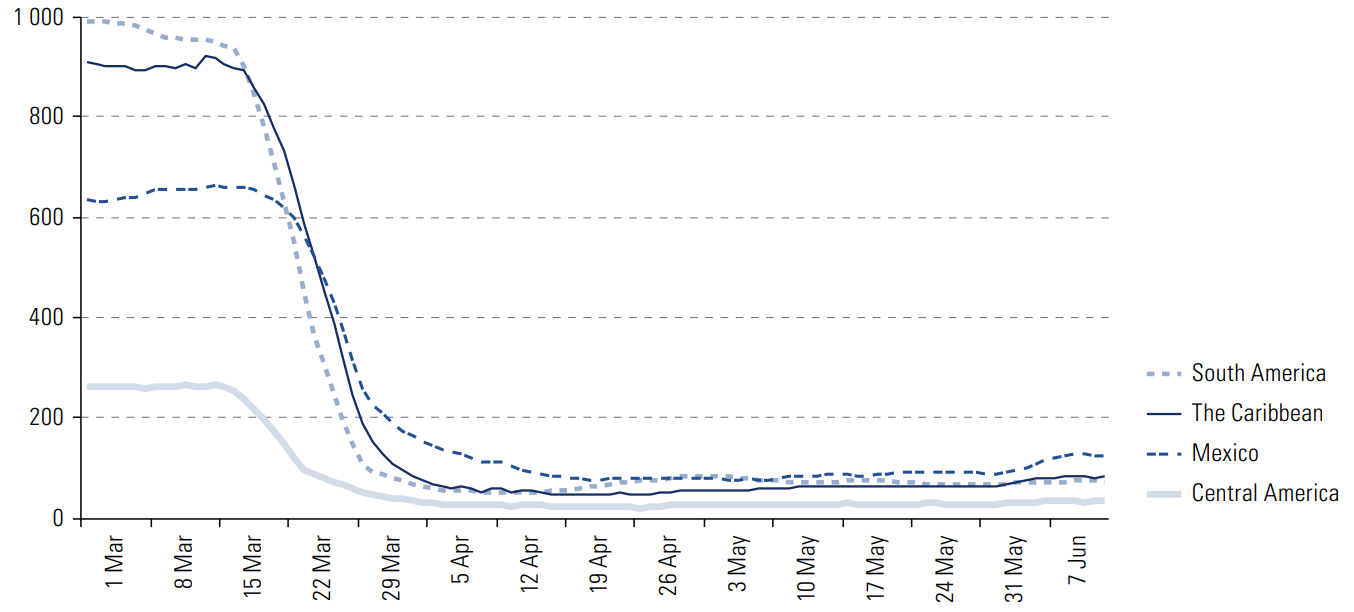
    The pandemic also showed that shutting down air travel is much easier done than restarting it. The initial lockdown in March-April saw the number of daily international flights drop drastically as governments closed borders and initiated travel bans. However, given the complex, patchwork way in which quarantines began to be eased or tightened as the speed of contagion ebbed and flowed, getting aeroplanes back in the air has turned out to be a much more time-consuming process. Governments have tried to manage shifting lists of safe or unsafe destinations based on changing data on virus prevalence in different countries. Some have tried to set up safe travel ‘corridors’ or ‘bubbles’. Airlines have had to restart or stop services at short notice, increasing their costs at a time of financial crisis.

    Latin America and the Caribbean (selected subregions): daily flight departures, 1 March–12 June 2020
    Source: Economic Commission for Latin America and the Caribbean (ECLAC)

    How the airline industry will emerge from the pandemic is still open to debate and depends in no small degree on the evolution of the battle against coronavirus over the next 1-2 years as well as on timelines for new vaccines and track and trace procedures. One estimate is that in the decade before the pandemic an air travel boom created an international network of 47,756 commercial air routes, of which more than half were concentrated in the US, Western Europe, and Northeast Asia, but that in the first six months of the pandemic, a lethal combination of border closures, lockdowns, and a generalised loss of public confidence in travel health safety led to the rapid loss of one-third of that total. In the week starting 2 November the number of routes had shrunk to 33,416 according to OAG Aviation World Wide. An early estimate from the International Air Transport Association (IATA) was that because of the Covid-19 crisis airlines around the world would have combined losses of US$314bn in 2020, US$18bn of which would hit Latin American carriers.

    Clearly, how the air travel industry recovers will be of enormous importance for the future of tourism. The more extreme scenarios range from an unlikely complete return to business as usual to a perhaps also unlikely permanent decline. One suggestion between those extremes is that future business and holiday trips will cost more, require more airport stopovers, involve longer journey times, and incorporate more alternative modes of transport. According to Subhas Menon, director general of the Association of Asia Pacific Airlines, “It will take a good four or five years for connectivity to return to the same level we saw at the end of 2019; some of these routes may never be put back.”  

    Peter Cerda, an International Air Transport Association (IATA) executive in the Americas region, expects many regional airlines to emerge from the pandemic operating fewer routes. He estimates it will take until 2023 for domestic routes to recover, and to 2024 for the international ones to do so. The recovery will start with short-haul flights as travellers prioritise visiting family and friends. Long-haul business and holiday travel will take longer to become profitable again. Stephen Trent, a researcher at Citi, says the recovery will be stronger for Mexico, Central America, and Colombia, because they are within short-haul distance from the United States. Long haul flights to South American destinations will be slower to come back.    

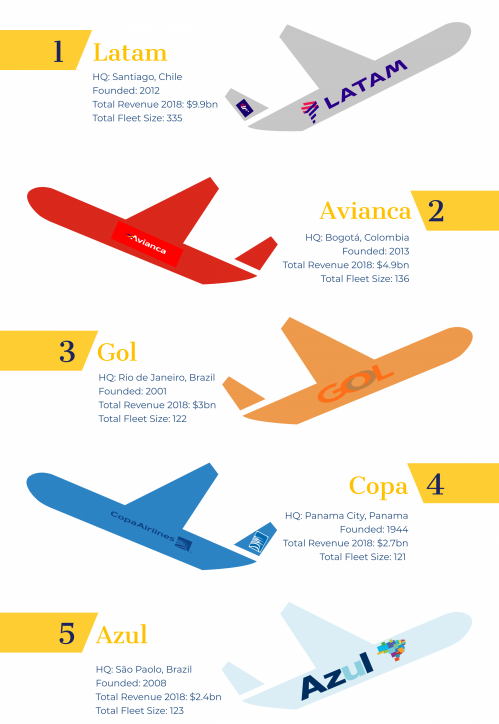
    The crisis had a particularly big effect on major airlines operating in Latin America. In March research by JP Morgan suggested that in a scenario in which all flights remained grounded the region’s two largest carriers, Latam Airlines and Avianca, would have only three to four months before running out of cash. As it turned out these were indeed the first to file for bankruptcy and were followed by Aeromexico. Ecuador’s TAME and Caribbean carrier Liat also went out of business. Among other carriers the report suggested the most exposed were two Brazil-based carriers, Gol (five months) and Azul (six months). Panama-based Copa, widely seen as one of the financially strongest airlines in the region, would have ten months.

    Latam, which had been created in 2012 as a merger between Chile’s LAN and Brazil’s TAM, shut down its operations during the lockdown phase of the pandemic and sought Chapter 11 bankruptcy protection in US courts. It also announced significant job losses and the permanent closure of its Argentina-based subsidiary. In early November the company said that in the third quarter of 2020 it had registered US$573m in losses. Revenue was down by 80.8% on year-earlier levels. Chief executive Roberto Alvo said the fall showed the deep impact of Covid-19 on demand for air travel, but that sufficient financial reserves were in place to help it weather the storm. These totalled US$3.3bn, of which US$866m was cash in hand and US$2.45bn was available through the Chapter 11 rescue plan approved by the US court.

    Latin America’s Major Carriers
    Source: SEC, Latam, Avianca, Gol, Copa, Azul

    Alvo said the company’s priorities were to continue restructuring its operations as outlined in the rescue plan, to strengthen its alliance with the US carrier Delta, and to push ahead with a long-term plan to digitalise its operations. The company had earlier announced a further increase in its flights after the reduction to near-zero in the second quarter. Before the pandemic Latam had a fleet of 332 aircraft that were operating 1,400 flights a day to destinations in 26 countries. By June 2020 operations had been slashed to only 5% of capacity, shrinking to 39 domestic services in Brazil, 13 in Chile, and to four international flights. By November 2020, having first restored more domestic flights, Latam was moving gradually to re-open regular connections between Peru, Brazil, and Ecuador. At that point it was estimated that the airline was operating at 33% of its total capacity.

    Colombia-based Avianca, which also operates regional hubs in El Salvador, Ecuador, and Peru sought bankruptcy protection in the US in May 2020 and laid off significant numbers of its employees. In the third quarter of 2020 it reported a loss of US$283.5m, compared with a loss of US$40.1m in the year-earlier period. Total revenues fell by 83% to US$206.9m. Before the pandemic struck, the company operated a fleet of 158 aircraft serving 76 destinations in 27 countries. In September, as it began re-opening its routes, Avianca said it had achieved a seat occupancy rate of 66.7%. In October a US court approved the company’s financial rescue plan, totalling US$2bn. A month earlier the Colombian government offered US$570m in loans to help bail out the airline, but this was challenged in court on fair competition grounds and ultimately abandoned. The company’s rescue package has therefore been put in place by private investors.

    Brazilian carrier Gol Linhas Aereas, the region’s third largest carrier, estimates that as a result of the pandemic it lost around US$1.5bn in overall sales. The biggest hit came in the second quarter. At that point the airline operated only 57 flights a day, or about 9% of its total capacity. By the end of the third quarter, this had increased to 271 flights per day, or 40% of capacity. It hoped to raise that further to 490 flights per day, or 65% of capacity by the end of 2020. In the third quarter it reported a loss of US$300m, with operating revenues falling by 73.7% on year-earlier levels. The company nevertheless managed to maintain good load factors on the planes it was operating, with around 80% of all seats occupied, the highest among Brazilian carriers. Worries over Gol’s ability to survive the pandemic were heightened by reports that it would struggle to repay a US$300m loan due at the end of August. However, as part of a refinancing agreement with Delta of the US, it was able to make the repayment. The company said that as a result it had no significant debt maturities to repay until 2024.   

    As often happens during a downturn, there may be some winners – companies that despite the crisis are able to adapt and gain market share. Those that may benefit during this crisis include a new wave of budget carriers that have less debt and lower fixed costs. One of the potential winners is Mexico-based Volaris which already, before the outbreak of the pandemic, had overtaken Aeroméxico as the biggest passenger carrier in the country. Volaris operates entirely with leased aircraft. Its cost per available seat mile, a measure of efficiency, is roughly one sixth of Aeromexico or Panama-based Copa Airlines (the latter is nevertheless seen as having comparatively healthy finances).

    In one optimistic scenario, the road to recovery might begin with domestic routes and smaller aircraft. The Economist has pointed out that, because of Colombia’s difficult geography, to get from Bogota to Cali takes almost 10 hours by road but only one hour by air. Making that route profitable and sustainable should not be too difficult. Some of the region’s low-cost carriers (LCCs) are upbeat about the current turbulence. Estuardo Ortiz, chief executive of Chile’s JetSMART, recently said: “We are not considering filing for bankruptcy at the moment. The fundamentals of JetSMART in its ultra-low-cost structure are still valid. We are still focused on long term sustainability and with our growth projection for 2026.” Colombian LCC Viva Air says it expects initially big price discounts as carriers try to entice customers back into the air. However, most analysts expect fares to ultimately end up higher than they were before the pandemic.

    Travel, health, and red tape: As international travel is re-opened, Latin American countries have introduced a range of different health and documentation requirements. These vary in strictness. Uruguay, which still limits international travel, and which is regarded as one of the more successful countries in its efforts to control the virus, requires arriving travellers to complete an online health declaration. They must also produce evidence of a negative PCR test taken at least 72 hours before travelling. Visitors are required to quarantine for seven days, and to take an additional Covid-19 test on the fifth day after arrival, or in its absence, to extend the quarantine period for another seven days. Quarantine and test costs are paid by the foreign traveller.

    With some variations a similar approach has been taken by Chile. The country also requires proof that each visitor has a health insurance policy that covers coronavirus-related issues. Visitors to Chile must have tested negative for Covid-19 through a PCR test taken less than 72 hours before travelling. However, unlike Uruguay, under rules taking effect from 7 December, and with the exception of travellers from high risk countries, the negative PCR test will make 14-day quarantine unnecessary. Chile uses the World Health Organisation (WHO) definition of high-risk countries which, significantly, includes the US. The net result is that for the immediate future US tourists arriving in Chile will need to quarantine for two weeks, a requirement which makes coming for a 1-2 weeklong holiday impractical.

    At the other extreme a group of countries have very light touch requirements. Brazil for example, only requires evidence that visitors have insurance policies covering Covid-19. Mexico, which traditionally attracts very large numbers of short-stay US tourists, does not impose any quarantine requirements on international visitors. A decision in Colombia to lift the PCR test requirement has proven controversial. The government says it will instead rely on a form of self-certification where passengers must answer a health questionnaire and confirm they have no symptoms such as fever or breathing difficulties. They must also agree to take part in a tracking exercise conducted by their insurance companies or by the national health tracking centre (Centro de Contacto Nacional de Rastreo – CCNR).

    José Ricardo Coelho of lobby group Asociación Latinoamericana de Transporte Aéreo (LATA) says quarantine requirements in effect “kill the demand” for air travel and tourism. He cites a survey of recent airline passengers commissioned by LATA which showed that 86% felt that the travel chain they were using (including not just the flight but connecting travel between airports and their homes or destinations) was safe.

  • The wild card: Politics

    Patrick de Courcy 03 August 2021 Hits: 1728

    So far, the discussion has made little mention of politics, a critical omission. In a hypothetically politics-free society losing and regaining fiscal space would be a largely technical matter, with the population passively accepting the necessary changes in taxation levels, standards of living, and public services needed to edge the fiscal cycle onto a more sustainable path. The reality of course is that there is no such thing as a politics-free society and political considerations in the LAC region have had, and will continue to have, a vast impact on fiscal management. For a start, there is the question of timing. Latin American governments are usually elected for terms of between four and six years. Among those with four-year presidents are Argentina, Chile, Colombia, and Brazil, while the five-year group includes Peru and Panama. At the other end of the spectrum lies Mexico, whose president serves a six-year term. Those periods in power are also sub-divided by various types of mid-term congressional, municipal, and regional elections, during which the balance of power and political complexion of the government may change. Presidents usually try to engineer an economic feel-good factor and avoid any form of austerity or belt tightening for at least a year ahead of elections, which immediately restricts the nature of the reforms that can be considered.

    In addition, politicians with a one- or two-year time horizon (until the next election) are likely to be wary of investing time, energy, and political capital on long-term structural reforms – critical issues like education quality, pensions, or labour productivity. In these areas, success may take ten years or more to measure and assess, running across more than one presidency. Populist politicians, present in many countries over the last few decades, tend to promote simplified and electorally popular short-term solutions. In effect, it may be in their narrow electoral interest to postpone tackling the more difficult and intractable issues, simply opting to kick the ball forward and let someone else deal with them. Politics can introduce a kind of tyranny of the short term. The long timescales required by fiscal management on the one hand, and the short ones dictated by political imperatives on the other, do not fit together comfortably: there is often intense friction between them.

    To this must be added the fact that, since at least the 1960s (more than half a century) the whole notion of fiscal adjustment has become politically toxic. The widespread popular perception in Latin America is that fiscal adjustment is a euphemism for savage spending cuts and inequality-intensifying austerity. Governments with widening fiscal deficits and debt repayment difficulties have been forced to turn to the IMF which is perceived to have offered funds in exchange for a standard and harsh recipe of sharp reductions in public expenditure, privatisations, wage controls, higher public utility tariffs, and a host of other measures seen as disproportionately affecting the poor and perpetuating and intensifying an unequal distribution of income. Although in recent years the IMF has argued the case for inclusive growth and ‘pro-poor’ adjustment policies, large sectors of the political centre and left in LAC remain deeply distrustful of its policy recommendations. It is as if the IMF brand has become inseparably connected with regressive austerity.

  • CARIBBEAN POINTERS

    Patrick de Courcy 18 February 2022 Hits: 3111

    *** BAHAMAS TARGETING FISCAL DEFICIT. The Bahamas, in its recently published Mid-Term Debt Management Strategy report, has set out an aggressive plan to attack the fiscal deficit. The report says: “As set out in the 2021 FSR [Fiscal Strategy Report], the government is targeting an overall fiscal deficit of US$415.2m or 3.3% of GDP for FY2022/23, improving to US$263.7m in FY2023/24 and achieving near balance in FY2024/25, with the overall deficit narrowing to US$67.9m or 0.5 percent of GDP.” The Bahamian dollar is pegged 1-for-1 with the US dollar.

    However, the report recognises the high risk that external shocks could knock the plan off course, including natural disasters, a slowdown in global economic growth, a setback in tourism performance, and failure to implement fiscal and economic policy reforms. The government is projecting GDP growth this fiscal year of 6.9%, falling to 5.8% in FY2022/23 and further to 2.6% in FY2024/25.


    *** BARBADOS LOOKING FOR REBOUND. According to the Central Bank of Barbados, the economy grew by just 1.4% in 2021. Speaking on 26 January bank governor Cleviston Haynes said that “the continued depressing effect of Covid-19 on the tourism sector and on private sector investment tempered the extent of the recovery”. The overall decline in tourism arrivals for 2021 was 26%, and total arrivals were only 20% of 2019 levels.

    There was a late improvement in tourism, and in the final quarter of 2021, tourist arrivals reached 47% of the corresponding pre-pandemic level of 2019. However, on 1 February the chief executive of the Barbados Hotel and Tourism Association (BHTA), Rudy Grant, warned that a full recovery in tourism “may still be two or three years away”. He added that “the projection is for a reasonably well-performing winter with occupancies for the months of January, February, March, and April 2022 projected at 66%, 62%, 65%, and 45% respectively.”

    With regard to debt, at end-2021 the public debt ratio was equivalent to 136.3% of GDP, just 0.3 percentage points lower than at the end of 2020.


    *** CDB PROJECTS 9.1% GROWTH FOR REGION. On 1 February, the Caribbean Development Bank (CDB) projected growth of 9.1% in 2022 for its 19 Borrowing Member Countries (BMC). However, this figure is greatly boosted by projected growth of 47.5% for Guyana. The average growth rate for commodity-exporting members (Guyana, Suriname, and Trinidad & Tobago) will be 17.5%, that for service-exporting countries a much more modest 4.8%.

    In 2021, the CDB estimates that BMC economies grew by 3%, with the commodity-exporting economies growing by 2.7% and the service-exporting economies growing by 3.2%. According to the CDB, the growth in service-exporting economies “reflected an almost 10% increase in tourist arrivals between January and September 2021 relative to the same period in 2020”. However, it added that “despite the significant resurgence in regional tourism, arrival numbers for the January to September period were still 65% below those of the same period in 2019”. Among the commodity-exporting countries, the average growth rate of 2.7% was driven by Guyana’s advance of 19.9%. Both Suriname and Trinidad & Tobago suffered contractions.

    The CDB’s 19 BMCs and their projected growth rates for 2022 are: Anguilla (7.1%), Antigua & Barbuda (5.0%), Barbados (7.6%), Belize (6.5%), British Virgin Islands (4.0%), Cayman Islands (5.0%), Dominica (3.8%), Grenada (4.5%), Guyana (47.5%), Haiti (0.3%), Jamaica (4.3%), Montserrat (4.5%), St Kitts & Nevis (6.4%), St Lucia (8.1%), St Vincent & the Grenadines (4.0%), Suriname (1.8%), The Bahamas (6.3%), Trinidad & Tobago (5.4%), and the Turks & Caicos Islands (4.8%).

  • ARGENTINA: Health scare erupts over contaminated fentanyl

    Abbi Dicker 05 September 2025 Hits: 2485

    Authorities are investigating the cause of a contaminated batch of medical fentanyl, which as of late August, is estimated to have resulted in nearly a hundred deaths this year. The federal judge overseeing the case, Ernesto Kreplak, has said that the batch had been circulating widely, raising concerns that the death toll from this potential failure in sanitary checks could be even higher.

    The case in Argentina has also raised alarm at the World Health Organization (WHO), which released a medical product alert on 29 August warning of the fatal outbreak of bacterial infections linked to a contaminated batch with over 150,000 vials of fentanyl which is believed to contain drug-resistant strains of two bacteria, Klebsiella pneumoniae and Ralstonia pickettii.

    Argentina’s food and drug regulator (Anmat) already identified the contamination earlier this year and issued an alert in May for the batch in question, which was produced by Argentine pharmaceutical company HLB Pharma. Anmat also issued an order on 13 May to prohibit the use, distribution, and marketing of all HLB Pharma products on the market in Argentina.

    However, the WHO alert warns that “substandard products” manufactured by HLB Pharma and its laboratory, Laboratorio Ramallo, the facility which produced the compromised batch, may still be in circulation. Argentine factchecking website Chequeado reported that, as of 6 August, 64,003 vials from the contaminated batch had been recovered by authorities, but 42,502 doses had already been administered to patients in hospitals around the country.

    The first deaths in April linked to the contaminated painkillers were in Hospital Italiano, in the city of La Plata, Buenos Aires province. As of 31 August, authorities believe the death toll to be at least 96. Following the initial reported deaths in Hospital Italiano, Anmat submitted the case to the Third Federal Court of La Plata, where Kreplak was appointed to oversee the investigation in May.

    Over three months after the case was filed, Kreplak issued an order on 20 August an order to arrest suspects allegedly involved in the production of the contaminated fentanyl, including Ariel García Furfaro, the owner of HLB Pharma and the Ramallo lab. On 12 August García Furfaro gave an interview to daily newspaper La Nación in which he sought to deny that the opioids produced by his company had anything to do with the reported deaths and claimed that, if the vials were contaminated, someone must have planted the bacteria.

    On 29 May a legislator affiliated with the right-of-centre Propuesta Republicana (PRO), Silvana Giudici, filed a motion for the lower chamber of congress to launch an inquiry into the causes of the contamination. Other lawmakers have since submitted similar requests for congress to investigate, and on 26 August a lower house committee began reviewing the various petitions, although at the time of writing no inquiry has been opened.

    A congressional inquiry could be a chance to seize control of the narrative regarding who should be blamed for possible negligence that could have led to this public health crisis. On 14 August President Javier Milei weighed in on the issue and sought to blame the left-wing ‘Kirchnerismo’ movement, a faction of the opposition Peronist movement, claiming that García Furfaro has connections to Kirchnerista politicians.

    Government accuses judge

    On 15 August the presidential press office stated on social media that there might be a conflict of interest in the judicial case involving the contaminated fentanyl. According to the government, the presiding judge of the investigation, Ernesto Kreplak, is the brother of Nicolás Kreplak, the health secretary of the Buenos Aires provincial government led by Peronist governor Axel Kicillof, which the Milei administration claims is a major customer of HLB Pharma, the company that produced the contaminated batch. The claims of a familial conflict of interest on the part of the judge were also mentioned by President Milei at a rally in La Plata on 14 August. 

  • ECUADOR: Regional elections stir up controversy

    Patrick de Courcy 20 August 2026 Hits: 285

    Local and regional elections will be held in Ecuador on 29 November, 11 weeks earlier than planned. Amid growing concern about a series of judicial rulings which are hindering the participation of the left-wing opposition, Ecuadorean political analyst Santiago Basabe told Spanish newspaper El País on 17 August that the elections will be “the most opaque since the return to democracy” in 1979.

    The elections will involve the election of 23 provincial governors (prefects), as well as numerous mayors and municipal councillor seats. Voters will also be choosing the seven members of the Consejo de Participación Ciudadana y Control Social (CPCCS) a body which has significant hiring powers to appoint public officials. The vote was originally due to be held in February 2027, but the national electoral council (CNE) brought the date forward by nearly three months following a request from the government, which said it was seeking to avoid disruption caused by the El Niño weather pattern. The main opposition party, the left-wing Revolución Ciudadana (RC), argues however that the change of date is aimed at ensuring it cannot participate.

    RC was handed a nine-month suspension in March this year, just weeks before the CNE announced the new electoral timeline. The party’s suspension, ordered by a judge on the electoral disputes tribunal (TCE), came amid an investigation into whether it received illegal donations from Venezuela during the 2023 presidential election. To get around the ban, RC sought to field its candidates with the Amigo party. However, on 17 July another TCE judge suspended Amigo, reportedly because the party is under investigation for alleged money laundering.

    That is not the only difficulty. At least six opposition mayors have been arrested since August 2025, including high-profile figures such as Aquiles Álvarez of Guayaquil. Alfredo Serrano, president of conservative opposition party Partido Social Cristiano (PSC), was cited in the media on 20 August as saying that some prospective candidates have withdrawn for fear of reprisals. César Febres Cordero, a political analyst, told El País that “the message candidates are receiving is that if they confront the government, they are likely to face tax audits, financial controls, or later investigations”.

  • ARGENTINA: Losing friends and alienating people

    LatinNews 22 August 2013 Hits: 1827

    In the latest move to antagonise its neighbours, the Argentine government has given the Chilean airline LAN 10 days to vacate its hanger at Buenos Aires’ Aeroparque Metropolitano Jorge Newbery airport. The airline and leading Chilean politicians have strongly protested the decision; the Chilean government has expressed its concern. The foreign minister, Alfredo Moreno, will raise the issue at a pre-scheduled meeting with his Argentine counterpart, Héctor Timerman, in Santiago on Friday.

    New regulations governing the Aeroparque came into effect on 1 August. Aircraft with fewer than 30 seats were ordered to cede use of the metropolitan airport’s facilities to state-owned airlines, scheduled airlines and ramp service companies. LAN Argentina had previously indicated that it did not consider itself an operator of smaller aircraft and therefore should not be obliged to vacate its hanger. On 21 August the national airport regulator (ORSNA) gave the airline 10 days to leave.

    LAN Argentina’s head of corporate affairs, Agustín Agraz, said the company would take the matter to the courts. “Who takes our hanger takes our heart,” he said. “LAN has 3,000 employees with 14 destinations across Argentina. [...] The LAN operation is not viable without the hanger [...] We will have to stop doing domestic flights.” LAN controls around 30% of the country’s domestic market, flying 2.5m passengers a year.

    The motive for the decision appears explicitly political. Forcing LAN from the hanger would benefit the state-owned airline Aerolíneas Argentinas. The president of Aerolíneas Argentinas is Mariano Recalde, a member of the Kirchnerista youth wing La Cámpora, who promised to return the company to profit by 2013. Last year the company lost US$980m. The head of ORSNA, Gustavo Lipovich, is a former director of Aeropuertos Argentina 2000, a company which works closely with the influential deputy economy minister, Axel Kicillof. Kicillof is on record as saying the airline should have a monopoly on flights to and from the airport.

    On 20 August Kicillof, Lipovich and the deputy labour minister, Naomi Rial, met representatives of LAN workers, who expressed their concern about potential job losses, and argued that the airline had not been notified in a timely manner about the eviction.

    ORSNA’s order follows other pressures against the company. Back in May, LAN Argentina was embroiled in a dispute with the Aeroparque services company Intercargo. The state-owned company cancelled all of its services to LAN alleging a debt and demanding a review of its contract. The dispute ended when LAN ceded to its demands. This time the company appears in no mood to do so. The CEO of LAN, Ignacio Cueto, announced that he would be travelling to Argentina to appeal the decision. “This will be a political problem,” he told the Chilean daily, La Tercera.

    At the meeting in Santiago on 23 August, Moreno will direct the complaints of the airline to Timerman, at the specific request of Chile’s President Sebastián Piñera. Piñera was a director of LAN when it first moved into Argentina. Since then, LAN has merged with the Brazilian airline TAM to form the Latam group, so the ORSNA order will irritate both Chile and Brazil. Latam Group’s shares fell over 6% in trading on the Santiago stockmarket on 21 August.

    • Electoral uncertainty

    Less than three weeks ahead of the primaries to determine the candidates for October’s legislative elections, two thirds of voters are unsure how to vote, according to a survey by Ipsos published in El Cronista. Sixty-four percent of voters said they knew “little or nothing” about the Open Simultaneous and Obligatory Primaries (PASO) on 11 August.

  • RASTREANDO TENDENCIAS

    LatinNews 26 June 2015 Hits: 526

    CHILE | Bachelet promulga la nueva ley sobre inversión extranjera. La Presidenta Michelle Bachelet convirtió en ley el 16 de junio un nuevo régimen regulador para la inversión extranjera en Chile. La nueva ley, que reemplaza el Acta de Inversión Extranjera de 1974, proveerá “un marco legal más moderno” permitiendo al país adoptar un rol proactivo para atraer inversionistas, dijo Bachelet durante una ceremonia para marcar la promulgación de la ley en el palacio presidencial de La Moneda. “Es una ley que no sólo establece las condiciones para los inversionistas extranjeros, sino que también incluye la creación de una estrategia nacional para promover la inversión extranjera directa (IED) […] Por primera vez en la historia, Chile tendrá una política nacional de inversión capaz de encajar con el resto de nuestra política económica, y de proveer el desarrollo sustentable”, dijo Bachelet.

    La ley implica la creación de un comité de ministros para la promoción de la inversión extranjera, que asesorará a la Presidenta con relación a la política de inversión extranjera. También involucra el establecimiento de una agencia de promoción de la inversión extranjera que implementará la política para atraer la inversión extranjera y también coordinar los esfuerzos de los gobiernos regionales del país para hacer lo mismo, siguiendo el consejo lanzado por la Organización para la Cooperación y el Desarrollo Económico (OCDE). La nueva ley, que entrará en vigencia en el 2016, garantiza a los inversionistas extranjeros el acceso a los mercados de divisas y a la libre remesa de capital y ganancias. Pero los actuales inversionistas extranjeros en Chile tendrán la opción de mantener los contratos firmados bajo los términos de la legislación de 1974, a fin de asegurar derechos y obligaciones que hayan adquirido; el cual también estará disponible para los nuevos inversionistas por un periodo máximo de cuatro años, con una tasa fiscal fija total del 44,45%.

    “Este nuevo marco legal e institucional es una verdadera oportunidad para Chile, para atraer mejores proyectos que traerán mayor productividad, mayor innovación y mayor diversificación, más sustentabilidad, y mejor cooperación entre el Estado, las comunidades, y las empresas”, dijo Bachelet. Ella enfatizó que, “la posición de Chile como una economía seria, abierta al mundo, que es administrada responsablemente y que sirve como vínculo entre el Pacífico y América Latina”, como rasgos atractivos para las compañías extranjeras que buscan hacer inversiones. “Somos una país cuya economía tiene sus puertas abiertas y que recibe cálidamente a las empresas extranjeras que contribuyen con sus conocimientos, tecnologías, e ideas para el desarrollo de nuestra nación”, dijo ella.

    La Comisión Económica para América Latina y el Caribe (Cepal) de la ONU difundió un informe en mayo de este año mostrando que Chile permanece como el tercer país latinoamericano más popular para los inversionistas extranjeros, detrás de Brasil y México. De acuerdo con cifras publicadas por el banco central de Chile, el país recibió US$111,27mm en  IED entre el 2010 y el 2014. La IED en el 2014 fue de US$23,30mm, un 15% más que el año anterior, pero debajo de los US$28,54mm invertidos en el 2012. La IED está concentrada en el sector minero, que absorbió el 44,9% del total entre el 2009 y el 2013; durante este  mismo periodo, EU fue el mayor inversionista, con el 16,7% de la IED total.

    • Marco institucional para las inversiones

    “Finalmente, Chile está actualizado ya que la ley aprobada es la clase de marco institucional que incentivará y promoverá mejor y mayor inversión extranjera en nuestro país. Lo hemos hecho porque, como gobierno, creemos firmemente que la inversión extranjera hace una gran contribución para nuestro desarrollo y para la generación de riqueza en Chile”. La Presidenta de Chile, Michelle Bachelet.

  • POINTERS

    LatinNews 18 November 2016 Hits: 390

    GUATEMALA | Semi-submersibles. On 13 October deputy minister for anti-drugs efforts Oscar Dávila Mejicanos announced that a semi-submersible had been seized in Ixtapa municipality, Escuintla department, by the general department of anti-drugs information and analysis (Subdirección General de Análisis e Información Antinarcótica, SGAIA). Dávila said that the vessel had similar characteristics to a submarine and had the capacity to transport up to 2,000 kilos of drugs.

    This is the second seizure of a semi-submersible after the first ever found in the country was seized on 23 September. The vessel, which was under construction, was found in Chiquimulilla municipality, Santa Rosa department with the capacity to transport up to 100,000 kilos of drugs.

    Dávila told reporters that the semi-submersible was an unprecedented means of smuggling drugs in Guatemala, illustrating the expertise and organisation of smuggling rings. He added that the individuals involved in the construction of the vessel were of Colombian and Nicaraguan origin and that so far over 10.2 tonnes (t) of cocaine had been seized this year along with US$7.39m in cash.

    According to the latest (March 2016) US State Department’s International Narcotics Control Strategy Report (INCSR) during the first nine months of 2015, total interdiction statistics from Guatemala’s counter-narcotics police, defence ministry’s counter narcotics naval unit and other US-assisted specialised units reported total seizures at 7.25t of cocaine and 25 kilograms (kg) of heroin, in line with 2014 seizures.

    The same report notes that, in addition, counter-narcotics units seized over US$4.4m in bulk US cash and approximately US$3m in local currency. The police also seized 575t of precursor chemicals, largely consisting of inbound shipping containers at the seaports.

    JAMAICA | Marijuana for guns. In late October, the deputy assistant secretary for Western Hemisphere Affairs in the US State Department, Juan Gonzalez, told a Caribbean Basin Security Initiative (CBSI) dialogue that marijuana is increasingly being used as currency to buy guns.

    This is a point that has been taken up by opponents of the legalisation of marijuana. Policy in Jamaica, one of the most important countries in this respect, is currently under review. Under the 2015 Dangerous Drugs (Amendment) Act, tickets are issued for possession of less than two ounces of marijuana or for smoking the drug. The tickets give the recipient 30 days to pay a fine of J$500 (US$3.85). Community service is awarded for failure to pay the fine, or in rare cases an additional fine of J$2,000 ($15.40).

    Jamaica’s National Security Ministry has recently completed a draft of a drug prevention and control master plan for 2016-2020 which is being reviewed internally before circulation to interested parties for comments.

    The chief technical director at the National Security Ministry, Karen Clarke Davis, says: “The previous plans dealt with supply control. This plan takes into consideration demand control. It is a multidisciplinary approach seeking to coordinate shares responsiveness to bring about a decrease in the supply and availability of illegal drugs.”

    The 2016 Drug Prevalence Survey, funded by OAS’s Inter-American Drug Abuse Control Commission, found that 70% of the Jamaican population has easy access to marijuana.

    TRINIDAD & TOBAGO | Pessimistic view on policing from PM. Dr Keith Rowley, prime minister of Trinidad & Tobago, warned on 30 October that “billions of dollars spent on outfitting and equipping our police over the past 20 years” had achieved very little. He blamed the failures on leadership, saying there is “too much confusion, dysfunctionality, and outright failure at the many layers at the top to expect the best from the middle and the base”.

    In a notably pessimistic vein, Rowley told the annual convention of the ruling People’s National Movement (PNM): “It is too long for us to reap the benefits of our investments. I am convinced that the solution goes beyond the wealth of resources placed at the disposal of our law enforcement officers…. There also seems to be a continuous stream of…citizens for whom death and destruction is an ordinary day’s work…. [There is] a deadly minority who choose crime as a way of life to the extent that there are criminals walking among us for whom their idea of a job or putting down a work is the snuffing out the lives of the next hapless victim for a fee.”

    However, the prime minister’s proposed solution, more social policing, sounded weak.  He said “the most up-to-date trend is to seek to prevent crime through mutually trustworthy relationships between the citizenry and the police…. We intend to embrace it more convincingly as we go forward.”

    As of the end of October, Trinidad had suffered 379 murders this year compared with 355 over the same period in 2015.

    BELIZE | Murder count soars. At the beginning of November, Belize’s chief executive officer at the Ministry of Home Affairs, George Lovell, confirmed that there had been more murders already in 2016 than in the whole of 2015, with 120 murders recorded so far in 2016 as against 119 for the whole of 2015. The 2015 figure was down 2% on 2014. About one third of murders this year have been committed in the Belize City area.

  • ECONOMIC HIGHLIGHTS

    LatinNews 21 April 2021 Hits: 1632

    BOLIVIA | ‘Wealth tax’ exceeds expectations. On 1 April Bolivia’s President Luis Arce announced that Bolivia’s new ‘wealth tax’ (IGF) had “exceeded our expectations” by adding Bs159.3m (US$23.1m) to the treasury since its introduction in December 2020. Known as the ‘great fortunes tax’, the levy is applied to those with assets in excess of Bs30m. President Arce tweeted that 182 Bolivians had been found to have fortunes of this size, which he said corresponded to 0.001% of the population. Adding that he was “reactivating” the tax redistribution policy of the previous government led by Evo Morales (2006-2019), Arce said that “with this measure, the richest will contribute towards improving the quality of life of those most in need”. The income from the tax exceeded the predicted haul of Bs100m by 59.4%, according to the economy ministry.

    VENEZUELA | Seeking to attract investment. On 17 March Venezuela’s deputy minister for the development of special economic zones (ZEEs), Juan Arias, presented a legislative bill on ZEEs before the national assembly’s economy, finance & economic development committee. The bill aims to attract national and international investment and activate the productive and export sectors. The bill is part of the 2021 national legislative agenda which comprises 35 legislative initiatives declared to be a priority for the nation. Arias said the ZEE bill was the fruit of nearly two years of labour by the ministry and over 30 months of work with the management councils of the six ZEEs already created in the country - in the states of Cojedes, Falcón, Lara, Miranda, and Táchira - as well as mayoralties, government institutions, business associations and academic experts.

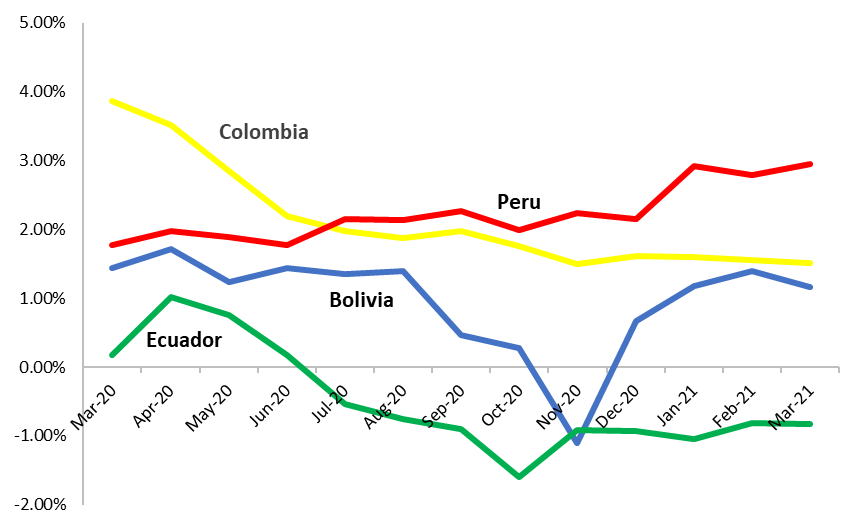
    Andean Countries: Inflation
    Monthly year-on-year figures

    Andean Countries: GDP growth (%)
    Quarterly figures are year-on-year growth
    GDP  2020 forecast* 2021 forecast* Q1 2020 Q2 2020 Q3 2020 Q4 2020
    Bolivia -8.0 5.1 0.6 -21.7 Not yet available Not yet available 
    Colombia -7.0 5.0 1.2 -15.8 -9 -3.6
    Ecuador -9.0 1.0 -2.4 -12.4 -8.8 Not yet available 
    Peru -12.9 9.0 -3.4 -30.2 -9.4 -1.7
    Venezuela -30.0 -7.0 No data No data No data No data
    *Figures from the United Nations Economic Commission for Latin America & Caribbean Dec 2020
    Quarterly growth based on figures from the local central banks


  • TRACKING TRENDS

    LatinNews 03 June 2021 Hits: 3783

    BOLIVIA | Exports picking up. The Cámera Nacional de Exportadores de Bolivia (Caneb), a chamber representing Bolivian exporters, released figures on 25 May showing that exports significantly increased in the first four months of 2021 compared to the same period in 2020. Exports from January-April totalled 34.2%, representing a year-on-year increase of 34.2%, according to a Caneb press release, which stated that “the export sector is optimistic about the speed of the recovery of exports in the first four months of 2021…In Caneb’s opinion, the observed growth will enable the recovery of a key economic sector that was hit very hard by the pandemic.”

    According to Caneb’s president, Danilo Velasco, the rise in exports has brought in an additional US$781m, leading to a foreign currency surplus of US$453m, which he said would “undoubtably” help reduce a trend of declining foreign currency reserves. Velasco also highlighted that “the value of exports is rising much higher than the volume of exports, which means that we’re exporting at a greater value per unit compared to the same period last year”.

  • PARAGUAY-BRAZIL: Unrelenting wave of violence on the border

    Patrick de Courcy 07 January 2022 Hits: 3133

    Paraguay’s land border with Brazil, a traditionally lawless area rife with organised crime, is suffering from an ongoing spate of bloody violence. In 2021 well over 100 people lost their lives in execution-style attacks on both sides of the border.

    One of the most recent days of carnage was 19 December 2021, when a total of five people were killed in separate attacks: four were shot in three separate attacks in Ponta Porã, on the Brazilian side of the border in the state of Mato Grosso do Sul. The fifth was killed on the Paraguayan side of the border, in Pedro Juan Caballero, Amambay department.  

    This was the twin cities’ bloodiest day since 9 October, when four young people were gunned down on their way out of a nightclub in Pedro Juan Caballero. The victims of the quadruple murder included Haylee Acevedo Yunes, the 21-year-old daughter of the governor of Amambay department, and Osmar Álvarez Grance ‘Bebeto’, 29, a local criminal who was believed to be the target of the attack. That same week, a Ponta Porã city councillor and a Pedro Juan Caballero policeman were also killed.

    Overall, in early November, Paraguayan daily ABC Color reported that 22 people had been killed on both sides of the border in the previous month and a half. Most of these murders were carried out by hit men riding past on motorbikes, although in some cases the victims’ bodies were discovered after they had been reported missing. Some of the murders appeared to be ‘signed’, with the killers leaving notes signed off as the ‘Justicieros de la Frontiera’ (Frontier Vigilantes), for example.   

    Drug-related violence?

    These execution-style murders are largely believed to be drugs-related, although there does also seem to be a spiral of revenge killings. ‘Bebeto’, the presumed target of the 9 October quadruple homicide, allegedly had ties to drug trafficking. Following the wave of murders on 19 December, the public security secretary for Mato Grosso do Sul, Antonio Carlos Videira, said the crimes were probably related to previous killings. “It’s more like revenge by some groups than actions from criminal organisations”, he said, adding “However, there is no doubt that the crimes may be related to drug trafficking and other crimes, but this will only be clarified after the conclusion of the investigations”. Most of the murders of the last few months remain unresolved.

    The border between Paraguay and Brazil is notoriously porous, and this is particularly true for the Pedro Juan Caballero-Ponta Porã section of the frontier: the two cities sit side-by-side with no geographical features separating them, such as the rivers which divide other main border crossings between the two countries. Ponta Porã is therefore a key entrance point to Brazil for drugs, namely cocaine produced in Bolivia and marijuana cultivated in Paraguay. From Ponta Porã, the drugs are then sent all over Brazil, where they are sold on the domestic market or trafficked internationally, primarily to Europe.

    Different Brazilian factions have fought for control of these drug routes, and smaller local drug gangs also operate in the region, but it is Brazil’s Primeiro Comando da Capital (PCC) drug trafficking organisation (DTO) that currently dominates. Public security experts note that the current violence plaguing the Paraguayan-Brazilian border has been a regular feature since 2016, when local drug kingpin Jorge Rafaat Toumani, known as the ‘king of cocaine’, was killed on the orders of the PCC.

  • CARIBBEAN POINTERS

    Sarah Sheldon 25 April 2022 Hits: 1071

    *** GUYANA EMPHASISES DIVERSIFICATION. The good news on oil continues to flow. On 4 April, US oil giant ExxonMobil announced that it had made a final investment decision for the Yellowtail development, its fourth and largest in the prolific Stabroek Block. It is expected to deliver 250,000 barrels of oil per day from 2025. ExxonMobil has now discovered over 10bn oil-equivalent barrels in its offshore Guyana operations.

    The previous week, at the Annual General Meeting of the Guyana Manufacturing and Services Association (GMSA), there was great emphasis on the need for Guyana to diversify its economy in order to maximise the benefit of these oil discoveries, with a particular emphasis on agriculture. On 29 March, Vickram Bharrat, the minister of natural resources, told the conference: “As a government, we are committed to ensuring that we develop our non-oil sectors like forestry, mining, and agriculture which will play a major role as we move forward as a country, and as we finally realise our potential as the breadbasket of the Caribbean.” He acknowledged that it would be a mistake to focus only on oil and gas, and he emphasised that the government “is seeking to address the biggest issue of power generation”. He said the gas-to-energy project “will address that issue”.

    Much the same message was given by US ambassador to Guyana, Sarah-Ann Lynch, with some added advice on how Guyana could best achieve this. She said: “Economic diversification is absolutely critical to achieving prosperity for all. Just as Guyana’s high tide enables bigger ships to come to port, economic diversification can be a high tide that lifts all sectors and all people of Guyana.” She, too, emphasised that lower-cost and more reliable electricity “must be available to manufacturers”. And she added that “land leases or permits must be available to agricultural investors, and reliable and high-quality infrastructure must be built including roads, bridges, and ports”. Tender processes needed to be modernised, she said.

    *** DEBT STILL INCREASING IN SURINAME. On 28 March, the International Monetary Fund (IMF) reported on its first review of the extended arrangement under Suriname’s Extended Fund Facility (EFF). It expects growth of 1.8% in 2022, with inflation at 25.8%, still high but down from 60.6% in 2021. On the fiscal side, the primary balance is expected to be 1.7% of GDP by the end of the year, but central government debt is still rising, from 125.3% of GDP in 2021 to an expected 132.2% of GDP in 2022.

    *** JAMAICA’S DEBT ON DOWNWARD PATH. According to Finance Minister Nigel Clarke, speaking in the budget debate in early March, Jamaica’s debt-to-GDP ratio is now down to 96%, from 110% in March 2021. This is nearly back to the 94% level recorded in March 2020 at the beginning of the coronavirus (Covid-19) crisis.

  • ECONOMIC HIGHLIGHTS

    Abbi Dicker 16 April 2026 Hits: 753

    BOLIVIA | Head of state hydrocarbon company fired. On 30 March Bolivia’s President Rodrigo Paz replaced Yussef Akly, the president of state hydrocarbon company Yacimientos Petrolíferos Fiscales Bolivianos (YPFB) who had run the company since Paz took office in November 2025. Akly was replaced by Claudia Cronenbold, who has worked for over two decades at Brazil’s state oil company Petrobras, including as corporate manager in Bolivia since 2018 and corporate director in Colombia from 2009-2011. She was also general manager of YPFB’s pipeline company Transierra from 2011-2014, and chairwoman of the Bolivian hydrocarbon lobby Cámara Boliviana de Hidrocarburos y Energía from 2014-2020. “The country needs technical leadership and commitment,” Energy Minister Mauricio Medinaceli said at Cronenbold’s swearing-in ceremony. Her predecessor, Akly, had come under intense pressure over a fuel contamination scandal which has forced the government to negotiate with transport unions seeking compensation for engine damage.

    PERU | New mining and energy minister. On 23 March Peru’s President José María Balcázar appointed Waldir Ayasta as his new energy and mining minister. Ayasta’s predecessor Ángelo Alfaro resigned on 22 March after a woman told Peruvian television channel Willax that he had sexually assaulted her in 2000 when she was 16 years old. Ayasta previously served as deputy electricity minister in 2025 and was in charge of the rural electrification programme from 2024-2025. A statement from the mining and energy ministry (Minem) said that he will focus on “driving new investments to strengthen the mining and energy sectors and continue reducing inequalities in access to energy”. His appointment comes as Minem announced yesterday that mining exports surged by 27.2% in 2025 to total US$62.85bn. The growth in exports was led by gold and copper, with Minem highlighting high international prices, strong global demand, gold’s role as a refuge for investors, and high prices for other metals used in manufacturing. Mining products accounted for 61.7% of Peru’s total exports in 2025.

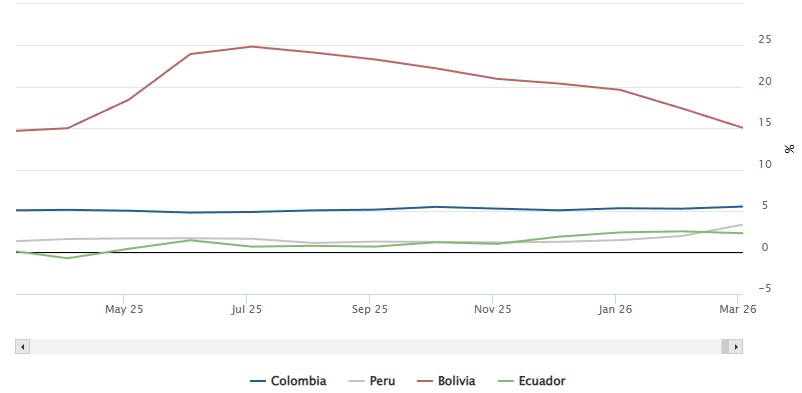
    Andean countries: inflation rate
    Percentage variation (year-on-year)

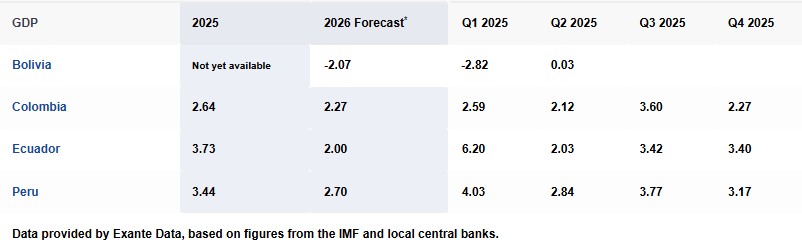
    Andean countries: GDP growth (%)
    Quarterly figures are year-on-year growth

  • TRACKING TRENDS

    LatinNews 06 June 2013 Hits: 2018

    GUATEMALA | Firming up ties with Mexico. Mexico’s President Enrique Peña Nieto has paid his first official state visit to Guatemala City where he met his Guatemalan peer Otto Pérez Molina. During Peña Nieto’s visit, which took place on 31 May, the two leaders, who both declare boosting bilateral ties to be a priority, agreed to establish four working groups to monitor customs infrastructure & border areas; energy; social programmes and security.

    A Guatemalan delegation headed up by Economy Minister Sergio de la Torre visited Mexico at the end of February, with the aim of boosting trade and investment. On figures from Guatemala’s central bank (Banguat), bilateral trade totalled US$2.46bn in 2012, with the balance significantly weighted in Mexico’s favour - Mexican exports to Guatemala accounted for US$1.91bn of the total. According to Banguat, Mexico is the source of 11% of Guatemala’s imports, second only to the US (38%), while it is Guatemala’s fourth largest export market, taking 5% of total exports, after the US (40%); El Salvador (11%) and Honduras (8%).

  • TRACKING TRENDS

    LatinNews 11 May 2017 Hits: 2166

    PARAGUAY-ARGENTINA | Yacyretá debt. On 4 May, Paraguay’s President Horacio Cartes and his Argentine peer Mauricio Macri signed a new memorandum of understanding (MOU) setting Paraguay’s historic debt with Argentina over the construction of the Yacyretá bi-national hydroelectric dam at US$3.8bn.

    The MOU seeks to end the 30-year bilateral dispute over the size of Paraguay’s debt owed to Argentina for the building of the shared dam on the Paraná River that separates the two countries. Argentina has long claimed that the debt owed to it by Paraguay for the various loans that Argentina took out to build the dam in 1973 stood at around US$17bn. But Paraguay has always contested this figure and claims by Argentina that it was the only country that incurred economic costs during the building of the dam. While Argentina did secure all the financing for the project, most of the land flooded by the dam was Paraguayan territory, and Paraguay maintains that this resulted in significant economic losses for the country. Paraguay has also long argued that the unused share of its electricity produced at Yacyretá, which is equally divided by the two countries as per the Yacyretá bilateral treaty, under which it must be sold to Argentina at below market prices, should have been considered as payment towards the debt.

    Given that Paraguay has ceded over half of its Yacyretá electricity share to Argentina since the dam began operations, Paraguay maintains that the outstanding debt is substantially lower than that claimed by Argentina, if not nil. The two countries have been unable to solve the dispute for decades but given the political affinity between Cartes and Macri, it was expected that the two would strike a deal. The terms of this deal are contained in the MOU signed by the two presidents in the Paraguayan city of Ayolas, Misiones department, where the Yacyretá dam is located.

    The MOU sets Paraguay’s consensus debt (which is to be paid by 2028) after recognising that the economic benefits reaped by Argentina from Yacyretá electricity over the years helped to pay for its cost, and even states that Argentina should pay US$1bn in compensation to Paraguay for the loss of its flooded territory. The MOU was hailed by Cartes and Macri as a victory for bilateral relations that could become “an instrument for the economic development of both countries”. But not everyone in Paraguay is happy with the terms of the MOU. Pointing to the various studies conducted in Paraguay over the years that show that it has more than paid off the historic debt if the electricity transfers are taken as payment, opposition legislators have said that the MOU only “harms the national interest”, and called for it to be analysed by congress.

    • A second dam

    The memorandum of understanding (MOU) signed by Presidents Macri and Cartes establishes that both Argentina and Paraguay agree to build a new US$16bn hydroelectric dam on the ‘Aña Cua’ branch of the Paraná River, which Argentina has long pushed for but Paraguay has resisted amid concerns that this would result in it losing more territory.

  • What have the new populists done about corruption?

    LatinNews 12 June 2020 Hits: 919

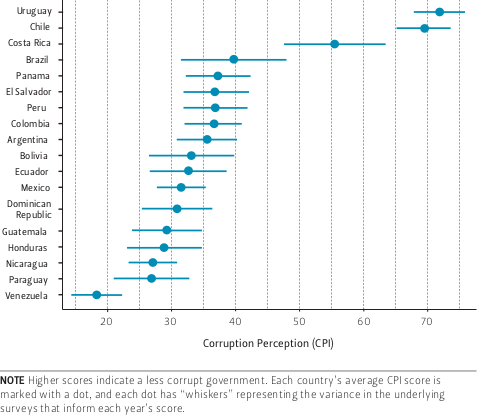
    Corruption remains a widespread problem throughout Latin America. In the last few years, no less than 11 presidents and former presidents in the region have been forced from office, jailed, or are under investigation for corruption. Analysis of the Corruption Perceptions Index (CPI), a survey-based measurement developed by Transparency International (TI), confirms that the region’s perceived level of corruption is relatively high when compared to other parts of the world. The index expressed on a range from zero (representing maximum corruption) to 100 (representing maximum integrity in government). Average results in 2012-2018 show that Latin American countries are among the most burdened by corruption in the world and have made no perceived progress in recent years.

    Perceived Corruption Across Latin American Countries (2012-2018)

    Source: Transparency International

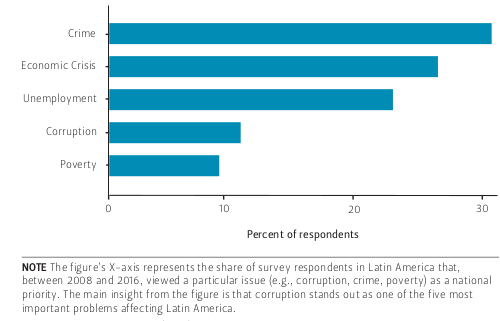
    In 2008-2016 corruption was widely seen as one of the top issues of public concern, with approximately 8% of respondents in Latin America surveys identifying it as their country’s number one problem. This put it in fourth place behind crime, the economic crisis, and unemployment. Off the record, many politicians have described corruption as ‘grease’ or ‘oil’, in other words a lubricant that eases the running of the wheels of government. Academics on the other hand, describe it as ‘sand’ - a material which has the contrary effect, slowing down and damaging the wheels of government. A report on Latin American corruption by the Houston-based Baker Institute stresses that corruption leads to lower levels of economic welfare and lower inflows of foreign direct investment.

    The reality is that, like crime, corruption is a complex, multi-causal phenomenon and therefore a combination of measures is required to combat it. Among those are the promotion of transparency, identifying the beneficial powers of shell companies, eliminating barriers to extradition, strengthening prosecutors, strengthening the independence of the judiciary, introducing plea bargaining, changing government procurement policies, encouraging whistle-blowers and using new technology (for example electronic payments can be easier to audit than cash transfers).

    In the case of Mexico and Brazil, corruption became embedded in the political system. The Lava Jato case in Brazil - a system of rigged construction contracts built around state oil company Petrobras - also included kick-back payments to politicians. Brazil’s ‘presidential coalitionism’ depends on binding together lots of small parties into a ruling coalition. The ‘glue’ holding the coalition together has often been a network of patronage, nepotism, and corrupt payments. In Mexico corrupt payments of different types have often been highly functional to the management of the political system. Only a few countries (among them Uruguay and Costa Rica) appear to have successfully broken the links between politics and patronage.

    A typical approach by populist politicians is to attribute all corruption to political enemies and to claim it can a) be quickly ended by vanquishing those enemies and also that it can b) be kept at bay purely because of the high levels of personal integrity of the populist leader. This approach means that populists largely avoid any discussions of the structural or institutional causes of corruption.

    Corruption as a major public concern

    Source: AmericasBarometer (2016)

    In Brazil a backlash against corruption was a major factor in Jair Bolsonaro’s victory in the October 2018 elections. The elections were preceded by the arrest of his main political opponent, former left-wing president Luiz Inacio Lula da Silva (2003-2010), on Lava-Jato related corruption charges. Lula had been intending to run for the presidency again in 2018, with the polls suggesting he would be successful. His arrest and disqualification as a presidential candidate were therefore key factors in Bolsonaro’s electoral success. In the new president’s rhetoric, the cause of Brazilian corruption has been presented as a political conspiracy by left wingers, such as Lula’s Partido dos Trablalhadores (PT) and communists, along with centrists and members of a self-serving liberal establishment. This politicisation of corruption also has the convenient effect of providing an explanation for alleged wrongdoing by Bolsonaro himself and his immediate family – the claim being that the multiple investigations of electoral fraud, possible money-laundering, and impeachable offences are no more than politically motivated conspiracies by his political opponents.

    Blaming the establishment

    The initial experience of Amlo in Mexico is not dissimilar. As a left-wing nationalist the Mexican president has consistently attributed corruption not to institutional or judicial weaknesses in the Mexican system, but to the activities of his establishment political opponents, described as centre-right ‘neo-liberals’. As in the case of Brazil, his electoral victory was partly based on an evidence-based backlash – corruption had undoubtedly been high under previous centre-right Mexican governments, just as it was high under previous centre-left Brazilian governments.

    But looking forward Amlo’s message seemed to be that corruption would now fall simply because he, personally, was not corrupt. In addition, the president’s version of direct democracy - the use of consultas to decide major investment projects - opened up multiple opportunities for abuse of power. One of the more notorious consultas was on the partly built US$13bn New Mexico City airport at Texcoco, which had been a major prestige project backed by the previous government. As a candidate Amlo had insisted there had been significant corruption in the project, although he did not substantiate these claims. He proposed an alternative approach - building a two-airport solution (using the existing airport and converting a military airport in Santa Lucía). The choice was put to a referendum in October 2018, in a poll organised by a local NGO. The (more costly) Santa Lucía alternative was duly victorious, with 69.9% support against 29.2% - but only 1.2% of the registered electorate actually voted, raising serious questions about the legitimacy of the consultation.

    Opposition parties said the consultation should have been managed by Congress and national electoral bodies. In other cases involving Amlo’s pet projects such as the Tren Maya (a tourist railway through southern Mexico) and the proposed Dos Bocas refinery, the consultas have been used to rush through approvals at the expense of prior consultation with indigenous communities or competitive bidding. While the president has not personally been accused of any wrongdoing, the idea that corruption has ceased with his mere arrival in the presidential palace is not sustainable. Some senior officials in his administration have been accused of wrongdoing. In a recent case the son of Manuel Bartlett, the head of the federal electricity commission (CFE) and a close associate of the president, was accused of selling 20 ventilators to IMSS, the state social security agency, at excessive prices. Bartlett senior is also accused owning 23 undeclared properties and of being linked to dubious real estate deals.

  • VENEZUELA: Opposition moots trust fund for seized foreign assets

    Patrick de Courcy 16 September 2021 Hits: 4006

    The 6 September announcement by Colombia’s business regulator (SSC) that it will begin overseeing operations at Venezuelan state-owned fertiliser producer Monómeros Colombo Venezolanos has triggered a furious response from President Nicolás Maduro’s government. Opposition leader Juan Guaidó – who Colombia recognises as Venezuela’s president – appointed the executive board of Colombia-based Monómeros in 2019. The SSC’s move to secure control over the financially struggling company has fuelled the Maduro administration’s claims that the opposition is orchestrating a heist of Venezuela’s foreign assets. In an attempt to defuse these concerns, the opposition is now considering placing Venezuela’s frozen assets in a trust fund, but faces stiff opposition from the government.

    The SSC’s intervention in Monómeros, which is based in the Colombian city of Barranquilla (Atlántico department), came after the company entered severe financial difficulties due to difficulties obtaining credit from Colombian banks. Carmen Elisa Hernández, who resigned as the chairwoman of Monómeros on 12 September, said that the financial woes had been compounded by Maduro’s demands for control of the company, which prompted suppliers of inputs to cease selling to Monómeros on credit. With Monómeros acting as a vital supplier of fertilisers to Colombia’s agricultural sector, the SSC appears to have taken the view that it is too big to fail.

    Whilst the SSC’s oversight of Monómeros does not amount to a nationalisation, it lends weight to Maduro’s claims that the opposition’s control of Venezuela’s foreign assets is a ruse to line the pockets of its international allies. On 14 September, Attorney General Tarek William Saab announced an investigation into Guaidó for crimes including asset theft, treason, and conspiracy.

    To counter these allegations, which threaten to overshadow the next round of dialogue between the government and opposition in Mexico, leading opposition figure Julio Borges mooted the possibility of moving Venezuela’s frozen foreign assets into a trust. This, he said on 13 September, would “depoliticise” the issue by transferring assets that “should never have been managed by the opposition” to the temporary control of a multilateral organisation, such as “the World Bank or the IDB [Inter-American Development Bank].” Guaidó later insisted that the country’s assets will continue to be “protected” from Maduro, but said that the opposition is now studying the potential of a trust to “improve this process”.

    Bachelet urges lifting of sanctions

    On 13 September, the United Nations High Commissioner for Human Rights, Michelle Bachelet, called for sectorial sanctions on Venezuela to be lifted, arguing that these have exacerbated humanitarian and social crises caused by the coronavirus (Covid-19) pandemic. Presenting a report on the human rights situation in Venezuela, Bachelet urged the release of all those “arbitrarily detained” under the Maduro administration, and said that her office has made recommendations to improve conditions at pre-trial detention facilities. Bachelet did not call for a lifting of the personal sanctions that target a number of high-ranking figures in Venezuela’s government.