The coronavirus (Covid-19) pandemic has brough uncertainty and economic recession to Brazil, but the country’s start-ups appear to be bucking the trend, looking positive and thriving. Current performance shows the sector is growing strongly, with venture capital investment in 2020 set to exceed what was achieved in 2019.
Between January and September this year venture capital investment in Brazilian start-up companies totalled US$2.2bn according to a report by Distrito, a consultancy. This is close to the US$2.3bn achieved for 2019 as a whole. “We are close to the total raised last year, and due to the speed of the current recovery we have a chance of exceeding it, despite the economic crisis”, Distrito’s Gustavo Araujo told Spanish newswire EFE in October. In September alone venture capital investments in Brazilian start-ups totalled US$843m, up by 65% on the US$510m achieved in the same month last year and eight times the US$94m achieved in September 2018. “Starting in September we are experiencing a V-shaped recovery,” Araujo says, noting that while creating major economic difficulties, Covid-19 also presented opportunities for tech-based companies mainly in digital banking, e-commerce, online deliveries and tele-medicine.
Distrito’s report shows majority control of around 100 start-ups was acquired by investors in the first nine months of this year. The total number of investment deals in the sector was 322, a new record. “It is as if the start-up ecosystem is side-stepping Brazil’s economic crisis” says Gilberto Sarfati, a professor at the Fundação Getúlio Vargas (FGV) higher education institute, adding that “digitalisation was in any case going to be important on the medium term, but the crisis has accelerated the process”.
Before the onset of the pandemic, it had been expected that growth in the start-up sector would slow a little this year, after a surge in 2019. Renato Valente, a partner in Iporanga Ventures, says he initially expected 2020 would be a good, but not record-breaking year. In fact, when the pandemic first began to hit the Brazilian economy in March, investment in start-ups fell by a massive 85% on year-earlier levels. At the time worried venture capital groups emphasised the need for start-ups to concentrate on surviving the crisis rather than on launching any big new funding rounds. But in only a few months things turned around. By June, the sector was growing again.
-
Softbank 2019 investments
Last year saw big investments by Japan’s Softbank in Brazilian start-ups such as QuintoAndar (real estate management), Gympass (a fitness app), and Loggi (logistics-as-a-service). Outside of Brazil, Softbank ran into difficulties with its investments in WeWork and Uber, so there was a general sense that it, and perhaps other investors, might pull in its horns a little in 2020. According to Valente from Iporanga Ventures, “Softbank distorted the market a little” last year.
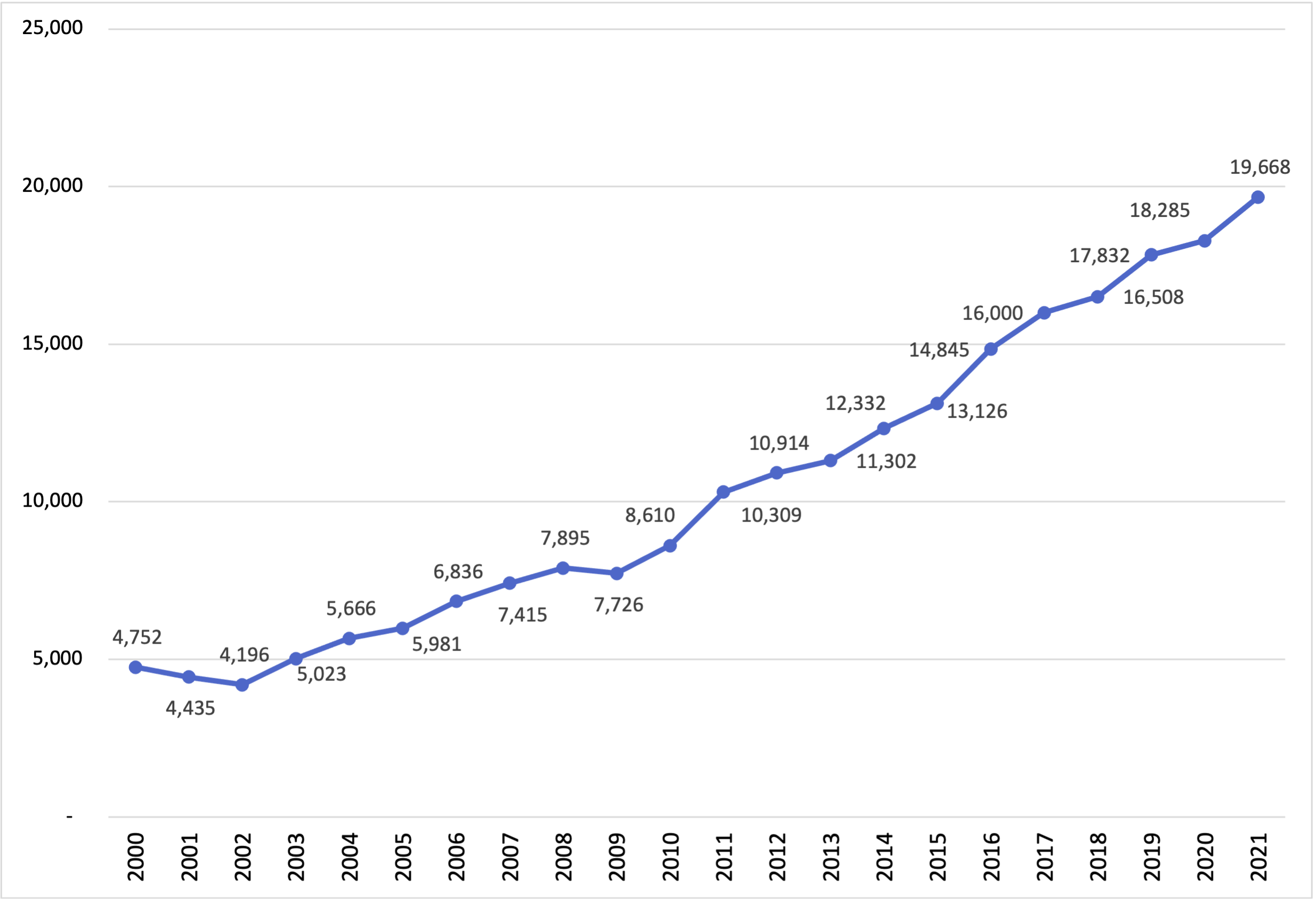
Growing capital investments in Brazilian start-ups
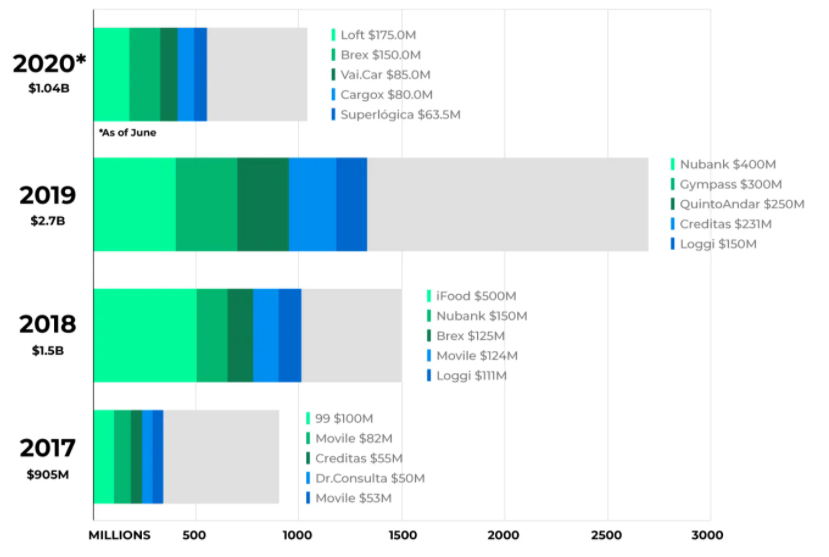
Source: World Economic Forum/Contxto
Three factors have helped. First, interest rates remain at record low levels in Brazil providing competitively priced finance. Second, as mentioned, the pandemic has accelerated the digitalisation of the economy, creating big new opportunities in e-commerce and door-to-door delivery platforms. Third, the need for social distancing and remote working has led traditional companies to realise they must go digital. “The real economy is suffering” says Valente, “forcing everyone to look for better profit margins by cutting costs. This is an opportunity for companies to try and do more with less – and they are turning to technology to try and achieve that”.
José Muritiba, president of Abstartups, the Brazilian association of start-ups, says growth is particularly strong in educational technology (edtech), e-commerce, and health tech. Another important growth area has been banking, where fintech companies are making important gains. Muritiba argues that the start-up “DNA” includes the ability to survive in adverse conditions, and because of that, these companies have been able to respond to the pandemic in a more confident and assertive way.
Brazil has an estimated 13,300 start-ups and is the home of 12 ‘unicorns’ – start-up companies that have grown to achieve a total market value of over US$1bn. In many ways Brazil is the clear regional leader in start-up ecosystems. It is home to over half of Latin America’s 21 unicorns (there are six in Argentina and one each in Uruguay, Colombia, and Mexico). The fact that Brazil is the region’s largest economy, has relatively high internet and mobile phone penetration, and has some world class tech-oriented universities, particularly in the states of São Paulo and Minas Gerais, also helps.
Two Brazilian start-ups have reached unicorn status this year, bringing the total in the country to 12, by one estimate. One of two is Loft, a company which offers users the ability to buy, renovate, and re-sell residential property within a four-month window. The other is Vtex, a B2B company which helps traditional bricks and mortar retailers to transition to an online operation. Rafael Forte, executive president of Vtex, says “in our sector the pandemic accelerated development by at least a year. People knew we might become a unicorn, but without the virus, we would have only achieved that in 2021 or 2022”.
Governments have sought to support the sector. In 2018 the government launched a ‘digital transformation strategy’ which aimed to standardise federal initiatives supporting start-ups. This October the current government submitted a start-ups bill to congress. The text defines a start-up as a formally established and tax-paying company with a history of up to six years since foundation and up to R$16m (US$2.8m) in revenues. The legislation aims to create a more secure legal environment for both start-ups and their investors (‘angel’ investors will not be allowed to become partners in start-ups and will not be held responsible for company debts). New rules will also make it easier for start-ups to be awarded public sector contracts.
The government has also announced three new fast track routes for patent applications. Start-ups will be able to register patents more quickly if they can show some aspects of the proposed patent subject matter are already “available in the market”, have been submitted by companies meeting the definition of a start-up, or have at least partly been public sector funded.
There are also efforts to widen the geographic spread of start-ups and to make them more socially accessible to underprivileged groups. While São Paulo state is widely recognised as Brazil’s major tech-hub, a number of new ventures have been set up in the poorer Northeast region of the country.
The Porto Digital business and technology park in Recife, Pernambuco state, has been supporting community-based digital start-ups. There are also efforts to create what has been described as a “black Silicon Valley” in Salvador, Bahia state. Afro-Brazilians, who represent roughly half the population, account for only 5% of the management of Brazil’s top 500 companies. The Vale do Dendé accelerator in Salvador is supporting 80 start-ups including TrazFavela (delivery services to favelas) and AfroSaúde, a heath tech company which employs black healthcare professionals to help prevent the spread of the coronavirus in poor neighbourhoods.