All Categories

Subcategories

  • REGION: Governments act to soften blow of rising fuel prices

    Sarah Sheldon 25 April 2022 Hits: 1061

    Rising oil prices due to Russia’s invasion of Ukraine are causing problems throughout Central America, and most governments have taken action to take some of the financial hit.

    In Guatemala, for example, drivers took to the streets in protest after the prices of diesel and gasoline were respectively 33% and 30% above the averages of the last five years in January 2022, according to Famine Early Warning Systems Network (Fews Net). In response, on 15 March the 160-member unicameral congress approved subsidies of Q5 (US$0.65) per gallon of diesel and Q2.50 per gallon of regular gasoline for two months. The subsidy is in effect from 5 April and run for 60 days, according to a statement published on 4 April by the energy & mining ministry.

    In El Salvador, President Nayib Bukele announced 11 measures aimed at reducing the impact of the increase in energy prices at the beginning of March. These include the suspension of two fuel-related taxes – the Fondo de Estabilización para el Fomento Económico (FEFE) and the Contribución al Transporte (CONTRANS) – initially for three months, which he said would cost the state US$11.52m and US$13.04m respectively.

    Then on 22 March the legislative assembly suspended value added tax (VAT) of 13% on petrol and diesel for 15 days to try and mitigate the impact of higher fuel prices, which are driving up inflation and reducing the purchasing power of the poor. The reduction approved is partial - meaning that the temporary rates will oscillate between 1.75% and 5% depending on the fuel. VAT on premium gasoline will be cut to 4.75%, while for regular gasoline and diesel it will be reduced to 5% and 1.75% respectively.

    In Panama, the government committed US$6m to subsidise fuel costs for public transport in order to head off increases in ticket prices, according to an announcement from transport authorities published on 25 March. The move follows a US$3m subsidy agreed in December 2021. In Honduras, President Xiomara Castro introduced fuel subsidies at the start of February, announcing a L10 (US$0.4) per gallon subsidy at the pumps for the rest of the year. From 15 March the government will also cover 50% of price increases to diesel. In Nicaragua, the government announced two measures on 25 March - a price freeze for liquified petroleum gas (LPG), which is used for cooking, and a commitment to absorb 70% of price increases for petrol and diesel. This follows two weeks of price freezes for all fuels.

    In Costa Rica, however, measures to combat price rises are still being debated. On 30 March the legislative assembly approved a proposal that would freeze price rises for one year, cut current prices by ₡100 (US$0.15) per litre and cut taxes on buses and taxis, but the bill needs to be examined by the executive branch and other official bodies. The situation is complicated by the presidential election of 3 April, won by Rodrigo Chaves, who will take office on 8 May.

    Economies in the region are still attempting to recover from the impacts of the coronavirus (Covid-19) pandemic, and high fuel prices are making that an even more difficult task than before. However, groups most affected by fuel prices, such as taxi drivers and hauliers, are able to carry out disruptive protests if they feel their needs aren’t being met. Confronted with continued high prices, governments face a delicate balancing act in attempting to head off social unrest due to increased living costs without spending too much shielding consumers.

    • Fuel price freeze in El Salvador

    On 5 April El Salvador’s legislative assembly approved an initiative proposed by the Bukele executive which freezes fuel prices for April and May. Citing the local think tank Centro de Investigaciones, Estudios Sociales y Económicos de Centroamérica (CIESCA), President Bukele boasted that El Salvador has the lowest hydrocarbons prices in Central America with regular gasoline costing US$4.15 per gallon compared with US$5.20 per gallon in Costa Rica, US$5.21 in Nicaragua, US$5.23 in Honduras, and US$5.25 in Guatemala.

  • JAMAICA: Strong growth in second quarter

    Sarah Sheldon 20 September 2022 Hits: 567

    Jamaica’s economic activity grew by 5.7% in the second quarter, led by tourism and the service sector, according to the Planning Institute of Jamaica (PIOJ), a government office.

    On 18 August PIOJ director general Wayne Henry said that Jamaica’s GDP grew by 5.7% in the second quarter (April-June) with services gaining 7.7%, offsetting a weaker goods sector, which suffered 0.4% contraction.

    Henry said the recovery was mainly shaped by the end of coronavirus (Covid-19) restrictions. The re-opening of tourism played a large part. The hotels and restaurant sector surged by 55.4% year on year. Tourist arrivals in April and May (data for June was not available) totalled 339,310, up by 110% on the comparable period last year. Increased activity at the country’s main airports boosted growth in transport, storage, and communications value added to 10%. There were also gains in wholesale and retail trade, repair and installation of machinery, electricity, and water supply, and in the finance and insurance sector.

    By contrast, goods production was mixed. Mining & quarrying activity dropped 60.6%, largely because of a decline in alumina production. Construction contracted by 4.2% as government spending on civil engineering projects, including the Southern Coastal Highway project (SCHIP), dropped. However state-owned companies reported increased capital spending on power generation and distribution, and on port infrastructure. Second quarter growth in agriculture was 12.6%, but manufacturing disappointed, with growth of only 2.8% compared to the same quarter last year.

    Henry said that the short-term outlook remains positive. GDP is calculated to have grown by 6.1% in January-June this year, which because of base effects will ease down to 2%-3% in the third quarter (July - September). For the 2022-23 fiscal year (the 12 months to end-March 2023) the authorities are now predicting 3%-5% growth. Henry commented “It should be noted, however that the economy is not expected to attain pre-Covid GDP levels until fiscal year 2023/24”.

    Tourism minister Edmund Bartlett welcomed the PIOJ report saying that it underlined “the fact that the tourism industry is driving Jamaica’s post Covid-19 economic recovery”. He highlighted “the resilience of the sector, which is rebounding steadily”.

    Separately, the Jamaica Tourist Board reported the average length of stay by tourists has returned to the 2019 level of 7.9 nights. Average spend per visiting tourist has increased from US$168 per night in 2019 to US$182 per person, per night. In the year to date (January-July) 1.714m tourists had visited the island, up by 139.4% on the previous year. Bartlett said: “We remain optimistic that our performance figures will return to 2019 pre-Covid record levels by 2023.”

  • COLOMBIA: El remedio puede ser peor que la enfermedad

    LatinNews 22 October 2012 Hits: 697

    En mayo de este año el senador nacional Eduardo Carlos Merlano rehusó a someterse a la prueba de alcoholemia cuando fue parado por la policía de tránsito en Barranquilla, la capital del departamento colombiano de Atlántico. Su negativa le costó el puesto al comandante de la policía metropolitana, el General Óscar Pérez Cárdenas, en cuestión de días luego del episodio. Pocos meses más tarde, el mismo Merlano fue sancionado por la oficina del fiscal general, que lo removió del cargo y le prohibió ocupar un cargo electo por 10 años. Su remoción de la cámara alta del congreso significa que el Partido de la U (PU) lo debe reemplazar con el candidato que llegó en segundo lugar durante las elecciones del 2010, lo que inadvertidamente ha creado otro potencial escándalo: el ‘remedio’ podría ser peor que la ‘enfermedad’ original.

    El escándalo Merlano surgió cuando un video grabado con un teléfono móvil a tempranas horas del 13 de mayo fue difundido por la prensa. En el mismo, Merlano rehusaba a someterse a la prueba de alcoholemia cuando fue detenido por la policía en un punto de control en la carretera, preguntándole a los policías, “¿Ustedes no saben quién soy yo?” y afirmando que un senador nacional no puede ser sometido a esos controles Luego, hizo varias llamadas telefónicas y dejó el punto de control sin haber mostrado una licencia de conducir válida. El senador renovó su licencia pocos días después del incidente, el 16 de mayo.

    Eduardo Merlano es el hijo de Jairo Merlano, un ex senador del PU sentenciado a ocho años y tres meses en prisión por la corte suprema de justicia, en agosto del 2011, por sus vínculos con los paramilitares de las (ahora desaparecidas) Autodefensas Unidas de Colombia (AUC). La reemplazante de Merlano se espera que sea Astrid Sánchez Montes de Oca, miembro de una de las más influyentes familias en la política de Chocó desde mediados de los años ’70. Astrid es la hermana del ex legislador Odin Sánchez Montes de Oca, quien fue sentenciado a nueve años de prisión por sus lazos con las AUC, y del ex gobernador de Chocó, Patrocinio Sánchez Montes de Oca, quien actualmente está siendo investigado por cometer irregularidades cuando era el alcalde de Quibdó.

    De acuerdo con el diario local, El Tiempo, el PU quiere evitar otro embarazoso episodio y pedirá a Sánchez Montes de Oca que no asuma su banca debido a las cuestiones éticas que rodean a sus miembros de familia cercanos, que podrían empañar su propia capacidad de realizar sus deberes apropiadamente. No hay ningún impedimento legal para que Montes de Oca asuma la banca de Merlano –ella es elegible por el número de votos que recibió en el 2010– pero el partido desea evitar la avalancha de críticas similares a las que recibió Merlano cuando se negó someterse a la prueba de alcoholemia –aunque su padre no había sido condenado en el 2010, en momentos en que el escándalo irrumpió la prensa colombiana alegó que “la manzana no ha caído muy lejos del árbol”, lo que evidenciaba la negativa del senador a respetar la autoridad y someterse a la ley, igual que su padre antes que él.

    Se retrasan las conversaciones de paz en Oslo

    Una combinación de mal tiempo y el agregado a último minuto de una representante de las Fuerzas Armadas Revolucionarias de Colombia (Farc) resultó en el retraso del lanzamiento de los diálogos de paz con el gobierno del Presidente Juan Manuel Santos en Oslo, Noruega. Las Farc han incluido como una de sus negociadores a ‘Alexandra’ o ‘Eileen’ (Tanja Nijmeijer), una mujer holandesa quien se unió voluntariamente a las Farc después de completar sus estudios en una universidad de Holanda y ha estado durante más de una década en sus filas. Pero el traslado de Nijmeijer es más complejo que el de otros líderes de la guerrilla y no está claro si ella pudo viajar a Oslo antes de que las dos partes se reunieran por primera vez el 17 de octubre.

    • La guerrillera holandesa

    Tanja Nijmeijer obtuvo notoriedad cuando en una entrevista radial en el 2003, ella dijo que no había sido secuestrada por las Farc, sino que se había unido a su causa voluntariamente; justo cuatro años más tarde después de un ataque con bombas, el ejército colombiano descubrió un diario en el que ella ya no aparecía totalmente convencida de los manejos internos de las Farc y la manera en la cual las mujeres y combatientes de menor rango eran tratados por sus propios comandantes. Los archivos incautados por las fuerzas armadas de Colombia después del ataque en el 2008 en Ecuador, en el cual ‘Raúl Reyes’ (Luis Devía Silva) fue muerto, mostraban que la publicación del diario de Nijmeijer había sido tomado muy mal por sus propios camaradas, quienes exigían que ella sea sometida a un juicio por la guerrilla, que podría haberla condenado a la muerte. Sin embargo, Reyes creía que la mujer holandesa podría ser más valiosa viva, ayudando a mejorar la imagen de las Farc en el exterior, que siendo ejecutada por violar los códigos de conducta de la guerrilla.

  • RASTREANDO TENDENCIAS

    LatinNews 25 February 2013 Hits: 791

    BOLIVIA | Otra nacionalización más. El 18 de febrero el Presidente de Bolivia, Evo Morales, ordenó la nacionalización del principal operador de aeropuertos del país, Servicios de Aeropuertos Bolivianos (Sabsa), expropiándola de las firmas españolas Abertis y Aena. Esta es la tercera vez en los últimos 10 meses que el gobierno de Morales ha nacionalizado compañías controladas por capital español. A diferencia de otras expropiaciones, el último incidente no fue tomado tan levemente por el gobierno de España, que ha advertido a Bolivia que luego del acto “hostil”, “repensaría las relaciones bilaterales”.

    La amenaza de una toma de control de Sabsa había estado latente desde el año pasado, cuando el gobierno de Morales anunció que estaba evaluando las inversiones del consorcio español en Sabsa, preocupado de que este no estaba cumpliendo las metas establecidas. El gobierno de Morales dio a las firmas una oportunidad de presentar nuevos planes de inversión a fin de evitar una posible toma de control. Abertis y Aena presentaron un plan de inversión de US$36m el 2 de febrero, pero este fue considerado insuficiente por el gobierno boliviano. Al anunciar su decisión, Morales dijo que Sabsa había presentado un plan de inversión de US$26,9m para el periodo 2006-2011, sin embargo, sólo US$5,8m en realidad fue invertido durante este periodo de cinco años.

    Las firmas españolas han aceptado la decisión, pero rechazaron la afirmación de que ellas habían sub-invertido en Sabsa. El hecho de que después de la toma de control el ministro de obras públicas de Bolivia, Vladimir Sánchez, dijo que el gobierno invertiría US$19m durante los próximos tres años en Sabsa, menos que la oferta final del consorcio español, podría ayudar en su caso. De hecho Francisco Reynés, el CEO de Abertis, que poseía una participación mayoritaria del 60% en Sabsa, dijo que la firma buscaría una compensación de US$90m del gobierno boliviano; y que estaba estudiando la posibilidad de tomar una acción legal internacional.

    El gobierno de Morales aún debe arreglar los pagos compensatorios a las otras firmas españolas que han sido afectadas por la reciente racha de nacionalizaciones, sin embargo, ahora está bajo creciente presión internacional para hacerlo. El gobierno de España ya ha convocado a su embajador en Bolivia en protesta y el canciller de España, José García-Margallo, advirtió a Bolivia que España es uno de los pocos países en la Unión Europea (UE) que consistentemente ha defendido la “generosa cooperación” que recibe Bolivia de la UE. De acuerdo con cifras de la UE, US$314m fueron sido asignados como ayuda para Bolivia para el periodo 2007-2013. Mientras tanto John Clancy, el comisionado de comercio de la UE, ha demandado a Bolivia que ofrezca una compensación “rápida” y “apropiada” a Abertis y Aena.

    COLOMBIA | Destacando la necesidad de incrementar esfuerzos de exploración de petróleo. Actualmente, Colombia tiene reservas petroleras probadas para cubrir sus niveles de producción solamente por los próximos ocho años, de acuerdo con cálculos oficiales, reveló el ministro de finanzas, Mauricio Cárdenas, el 19 de febrero.

    El gobierno colombiano liderado por el Presidente Juan Manuel Santos ha establecido una meta de producción para la firma petrolera controlada por el estado, Ecopetrol, de 1m de barriles por día (bpd) en un esfuerzo para promocionar más actividad en el lucrativo y de rápida expansión sector de hidrocarburos del país. Sin embargo, Cárdenas dijo que si el gobierno quería mantener tal tasa de producción, hay una “urgente necesidad” de promover más esfuerzos exploratorios a fin de hallar nuevas reservas.

    Cárdenas señaló que además del hecho de que el descubrimiento y explotación de nuevos depósitos de hidrocarburos ha sido lento, el sector en Colombia también ha tenido que hacer frente al hecho de que los grupos insurgentes de Colombia han continuado con su práctica de atacar la infraestructura de la industria petrolera. Según Cárdenas, sólo en el último año los ataques al oleoducto Limón-Coveñas en el nordeste de Colombia, provocaron la pérdida aproximada de 10.000 bpd.

    Pese a esto, Cárdenas se mostró optimista acerca de las perspectivas del sector, indicando que la situación de seguridad ha mejorado en el último par de meses y que no se ha informado de ningún ataque a la infraestructura desde el pasado septiembre. Además, Cárdenas dijo que aunque hallar nuevos depósitos es un desafío, la industria petrolera de Colombia y en particular Ecopetrol estaban listos para asumirlo. Cárdenas indicó que los resultados financieros del año pasado para Ecopetrol, cuya cotización de acciones momentáneamente superó al de la gigante petrolera estatal de Brasil-Petrobrás- el año pasado, fue “buena ante los ojos de cualquier analista”.

    Aunque Cárdenas admitió que hallar nuevos depósitos con gran potencial de producción como el yacimiento de Limón o el depósito de Cusiana, el más grande de Colombia, es “muy difícil”, él dijo que “a fin de incrementar las reservas tenemos que explorar y para explorar tenemos que invertir”.

    • Perú: con pronóstico positivo

    El 18 de febrero el ministro de economía y finanzas de Perú, Luis Miguel Castilla, reveló que los pronósticos económicos del gobierno peruano para el año son de un crecimiento económico del 6,3%, con la inflación manteniéndose dentro del rango meta del 2%. Castilla señaló que los pronósticos descansan sobre la asunción de que el desempeño económico permanecerá constante pues el crecimiento del año pasado fue del 6,3%. De hecho Castilla dijo que el pronóstico era más bien conservador y que  “hay chance de que se revise hacia arriba”. Sólo cuatro días antes, el Fondo Monetario Internacional (FMI) elogió el “impresionante” crecimiento de Perú, diciendo que había sido capaz de mantener una tasa promedio de crecimiento anual del 6% en los últimos tres años, sin ningún signo de recalentamiento. El FMI dijo que espera que Perú reporte una tasa de crecimiento del 6,3% en el 2013 (como en el 2012) y que, más notablemente, la inflación caerá debajo del 2%.

  • PARAGUAY: Zacarías Irún clan forced out of CDE

    LatinNews 14 February 2019 Hits: 5211

    The political crisis that has engulfed Ciudad del Este (CDE), Paraguay’s second city, following the launch of an intervention by the national government due to allegations of gross corruption and mismanagement by the municipal authorities [WR-18-45] has reached a major turning point. Following a two-month intervention and audit of the CDE municipal administration, the national congress has taken the unprecedented decision to dismiss the elected mayor, Sandra McLeod. This could help to resolve the crisis in CDE but there are concerns that the it could create more problems for the government led by President Mario Abdo Benítez, as it has served to further deepen the internal divisions within the ruling Asociación Nacional Republicana-Partido Colorado (ANR-PC) party.

    After a 60-day intervention, the care-taker CDE mayor, Carolina Llanes, and the comptroller general’s office submitted the final report on the findings of the respective audits that they carried out on the CDE administration to the national chamber of deputies in early February. On 7 February the chamber of deputies held an extraordinary session to analyse the reports. Following a heated five-hour debate in which the deputies from the Honor Colorado ANR-PC faction (Cartistas), which remain loyal to former president Horacio Cartes (2013-2018), clashed with their colleagues from the Colorado Añetete ANR-PC faction (Abdistas) that answers to President Abdo Benítez, the remaining deputies – after the Cartistas walked out of the session – unanimously voted to dismiss the Cartista McLeod.

    The Cartistas, had argued that the intervention and the allegations raised against McLeod, the wife of Senator Javier Zacarías Irún, a close ally of Cartes, were part of a plot by her in-party rivals to try to oust her from office and gain control of CDE. They also accused the Abdo Benítez government of persecuting its political detractors. However, the Abdista and the opposition deputies agreed that the auditors had gathered sufficient evidence of suspected embezzlement of public funds in the McLeod administration (to the tune of some US$23m) to warrant her dismissal so that she can be prosecuted by the judiciary and that administrative order could be returned to CDE. The chamber of deputies then duly informed the supreme electoral tribunal (TSJE) of its decision, so that it can now organise a by-election in CDE to elect McLeod’s successor (which must be held within 90 days).

    Zacarías Irún and his family have controlled CDE, and Alto Paraná department of which it is the capital, for the past 18 years. There have long been allegations of corruption but the political influence and near complete control of the local institutions exerted by Zacarías Irún and his extended family known as the ‘Zacarías Irún clan’ (which includes national deputy Justo Zacarías Irún, Javier’s brother and a former Alto Paraná governor) had allowed them to escape prosecution. Yet this has changed in the current political scenario in the ANR-PC marked by a clear division between Cartistas and Abdistas and their apparently relentless struggle for control of the party.

    Pointedly, in another clear sign that the tide has now turned on the Zacarías Irún clan, on the same day that deputies voted in favour of dismissing McLeod, in another extraordinary session, senators voted in favour of stripping Senator Zacarías Irún of his immunity from prosecution so that he can face the illicit enrichment, money laundering and illicit association charges levelled against him and linked to the CDE intervention. Much like in the chamber of deputies the vote of Abdista senators were critical in ensuring that Zacarías Irún’s immunity was lifted. Senator Zacarías Irún is now expected to join his wife in dock to contend with the various corruption, money laundering, illicit enrichment, and illicit association charges presented against them.

    Nevertheless, denoting that the struggle for control of CDE is far from over, there have been various political manoeuvres in the CDE municipal council by the competing political forces to try to secure control of the seat. In a first move, Cartista CDE councillors staged an extraordinary session on 4 February in which they had accepted McLeod’s resignation and appointed Councillor Celso ‘Kelembu’ Miranda, a McLeod ally, as interim mayor. However, Abdista and opposition CDE councillors have said that the session in which Miranda was appointed interim mayor was illegal. Instead the Abdista and opposition councillors called an extraordinary council session on 12 February in which they elected Councillor Perla Rodríguez as interim mayor until the holding of the by-election.

    Intriguingly, Rodríguez is a Cartista politician and until recently a McLeod ally. However, following the intervention of the municipal administration, Rodríguez turned on McLeod and became a vocal critic of her and the suspected corruption of the Zacarías Irún clan. The fact that Rodríguez is still considered to be loyal to Cartes means that she is seen as a more a ‘neutral’ figure who has the backing of the Cartistas, the Abdistas and even other opposition groups, even if this is conditional on Rodríguez maintaining her neutrality.

    Meanwhile the main political forces are already looking for candidates with which to contest the by-election. Sensing an opportunity, five members of the main national opposition Partido Liberal Radical Auténtico (PLRA) have already put their name forward to be the party’s mayoral candidate. Vice President Hugo Velázquez, an Abdista who has been tasked by President Abdo Benítez with leading an ANR-PC party commission, has controversially nominated Deputy Ulises Quintana to be the ANR-PC’s consensus mayoral candidate. But it is unlikely that the proposal of fielding a consensus candidate will be accepted by the Cartistas and there is some speculation that the CDE by-election could drive a further wedge between Cartistas and Abdistas that could precipitate a rift in the ANR-PC that could completely undermine the Abdo Benítez administration by denying it a majority in the national congress.

    • Quintana

    The nomination of Deputy Quintana is highly controversial given that he has taken a leave of absence to fight off drug trafficking accusations presented against him. In fact, Quintana is currently under arrest at the Viñas Cue military prison awaiting trial for his suspected links to a drug trafficking organisation based in CDE and led by Reinaldo Javier ‘Cucho’ Cabaña, who was himself arrested in September 2018. Pointedly, Velázquez said that Quintana’s candidacy would be contingent on “him proving his innocence first”.

  • HONDURAS: The IMF is still a bogeyman in Latin America

    LatinNews 13 June 2019 Hits: 727

    The role of the International Monetary Fund (IMF) has been a key focus of the latest violent protests against the Honduran government led by President Juan Orlando Hernández, with claims that the IMF is demanding cuts to education and health budgets and pushing forward with a privatisation agenda. In Ecuador, Honduras and Argentina, anti-government protests this year have all strongly denounced the IMF, underlining the continued depth of feeling against the Washington-based multilateral lender, almost 40 years of the ‘lost decade’ of the 1980s, when IMF adjustment programs were adopted all across Latin America – to very mixed results.

    On 6 May, the IMF announced that it had reached a staff-level agreement with the Honduran government on a 24-month blended Stand-By Arrangement (SBA) and Standby Credit Facility (SCF) for US$311m. The conservative Partido Nacional (PN)government led by President Hernández intends to treat the arrangement as precautionary, meaning that it will not draw down the funds. This approach also means that the Tegucigalpa government will not be formally bound by macro-economic targets set with the IMF.

    At a time of intense public protests against the Hernández administration – initially sparked by the government’s plans for reforms of the education and health sectors that the Left perceived as a route to backdoor privatisation – the government is in no position to sell additional fiscal reforms to Honduran citizens. While the government has now dropped (and congress has archived) its contentious reform proposals the street demonstrations have continued across the country, morphing into a more generalised protest against the country’s US-allied but heavily discredited political leadership. According to the local press, some 70 protests took place between 29 and 30 May alone – in the capital Tegucigalpa as well as the industrial hub San Pedro Sula (the capital of Cortés department) and other departments such as Comayagua, Yoro, Choluteca, and Francisco Morazán among others.

    Indeed, it has emerged that President Hernández himself had been the subject of investigations by the US Drug Enforcement Administration (DEA) from 2013. (The president’s brother, Antonio Hernández Alvarado was arrested in 2018 on charges of drug trafficking and weapons offences.) The strong public perception in Honduras that political corruption remains entrenched, at severe costs to ordinary citizens in terms of lost public services, has further fuelled the protest movement.

    As such, the IMF statement avoided all mention of fiscal targets, instead focusing on measures within the new program “to strengthen governance and improve the business climate to foster sustainable and inclusive economic growth”. It also noted that the economic program supported by the Fund aimed to maintain macroeconomic stability through reforms to secure the sustainability of the public electricity company (ENEE) – which is heavily indebted in part due to public corruption – and to allow more space for investment and social spending while safeguarding fiscal sustainability.

    An IMF mission (led by Esteban Vesperoni) visited Tegucigalpa and San Pedro Sula on 22 April-6 May to carry out the annual Article IV consultation and hold talks with authorities on an economic program that could be supported by the Fund.

    Upon conclusion of the mission Vesperoni commented on the current economic conditions in the country, noting continued moderate growth and broad stability in the main macroeconomic indicators. The benign and optimistic scenario painted by Vesperoni appears somewhat at odds with the demands of the anti-government protestors, who claim that socio-economic conditions on the ground for the vast majority of Honduran citizens have continued to deteriorate, while violent insecurity remains as bad as ever.

    The reality on the ground is that around 60% of Hondurans remain in conditions of poverty, with limited life opportunities, high unemployment and next to no social security net. For example, while the official rate of unemployment is reported at no more than 6% by the national statistics institute (INE), youth unemployment is at least double the official rate. Moreover, underemployment was put at 63% in 2018, up from 56% in 2017, according to a report released in early 2019 by the social security secretariat (STSS). That equated to just over 2.7m people in perilous employment conditions.

    Gangs, organised crime and drug traffickers easily recruit this pool of labour and thus effectively control much of the country, which is awash with weapons. Violence against women and girls is endemic. Security force corruption also remains a major issue. These dire and very dangerous social and economic conditions are what drive thousands of vulnerable Hondurans to make the perilous journey north up through Central America and Mexico to the southern US border as illegal migrants.

    Yet, according to Vesperoni, “macroeconomic conditions in Honduras remained stable in 2018. GDP growth slowed from the buoyant performance in 2017 to 3.75%, due to weaker terms of trade, but remained close to potential, supported by private consumption amid strong growth in remittances”.

    “Inflation is stable around the centre of the central bank´s 4% +/-1% target band”, he continued. “Owing to lower coffee prices and higher oil prices, the current account widened to 4.25% of GDP; but stayed close to its historical average. Despite a higher than expected deficit in the electricity company (ENEE), the nonfinancial public sector (NFPS) posted a deficit of 0.9 percent of GDP, in line with the target in the Fiscal Responsibility Law (FRL). The financial system is stable, liquid, and well capitalized, with NPLs at historic lows…Amid lower global growth and still weak terms of trade, growth in 2019 is expected to moderate slightly to around 3.5%, still close to potential”. To make inroads against poverty, however, Honduras needs to be growing at around 5% a year, and on a consistent basis, according to private economists.

    Vesperoni, nonetheless, appeared confident that “policies in the economic program targeting an increase in productivity will sustain the macroeconomic performance in coming years and gradually create fiscal space for much-needed public investment and social spending”. As such, he continues, “a key objective of the economic program is to maintain macroeconomic stability, while enacting economic and institutional reforms to foster inclusive growth. Policies will build on previous achievements to strengthen the policy and institutional framework”.

    In the sole reference to fiscal targeting, the Fund economist notes that “adherence to the Fiscal Responsibility Law (FPL) will be coupled with reforms aimed at creating fiscal space to reduce the infrastructure gap and increase social spending, including on important gender programs. The program will preserve previous revenue mobilization efforts, implement the electricity sector framework law, and put the financial situation of the public electricity company (ENEE) on a sustainable path”.

    Finally, “priority has also been given to enhancing governance, including through measures to increase transparency. These reforms will aim at improving the macroeconomic policy framework, increasing the quality of public spending, and strengthening the rule of law. These reforms are fundamental to improving the business environment and fostering growth”, he concludes.

    Nevertheless, despite the Fund’s attempt to soften its message, the public perception is that any relationship with the IMF implies adjustment, austerity and privatisation.

    On 4 June, as the protests continued, the finance minister, Rocío Tábora, insisted that it was “totally false” that the IMF was demanding cuts to social spending on health and education. Tábora strongly rebuffed allegations to that effect made on a television program by the president of the Honduran doctors’ organisation

    Colegio Médico Hondureño (CMH), Suyapa Figueroa. In reference to the government efforts to negotiate with the health and education unions, Tábora noted, “there is a basic principle in any dialogue, and that is not to lie, it is totally false that cuts in health and education are a requisite for the IMF agreement”, she stated.

    “I want to say to Doctor Suyapa that it is false that the accord to the IMF implies a reduction in social spending, I can ratify as a member of the economic cabinet, and I was there in there in the negotiations with the IMF, that it is totally false”, she stressed.

    The minister went on to note that, by contrast, the program is focused on improving the quality of budget control so as to better focus it on health, education, social investment, and spending on women’s empowerment programs. She added that she was happy to open up the budget to public scrutiny and invited Figueroa to go into the new government transparency portal to see for herself full details of the health and education budget plans. The government’s sole ambition, she insisted, was to guarantee free, high quality health and education for everyone.

    Meanwhile, the private sector has warned that the protests will have a damaging economic effect that will further undermine the efforts to deliver equitable growth and sustain public services.

    Organisations such as Fundación para la Inversión y Desarrollo de Exportaciones (Fide) have expressed concern about the impact of the strikes on the economy and investment. The president of the Tegucigalpa chamber of commerce and industry (CCIT), Guy de Pierrefeu, put the cost of economic losses as a result of the strikes at “over HL1.5bn (US$61m) a day”. He said that it was unlikely, as a result. that GDP growth projections for this year – put at between 3.3%-3.7% by the central bank (BCH) – will be met.

    The IMF, for its part, is projecting real annual GDP growth of 3.4% in 2019. In its latest release, the BCR on 17 May reported a 2.9% accumulated rise in the monthly index of economic activity (Índice Mensual de Actividad Económica, IMAE) for the first quarter of 2019 (January-March), similar to the 3% reported in the year-earlier period.

    Without giving precise data, the BCH said the result rested on growth in financial services, post & telecommunications and retailing. These sectors were followed by manufacturing (meaning textiles and the maquila sector), electricity & water and private construction, largely for commercial purposes (i.e. not residential). Finally, the agricultural sector grew on the back of export products including palm oil and fruits and vegetables (bananas, melons etc).

    This points to the fact that Honduran economic growth rests largely on its longstanding trade & investment relationship with the US, its main partner. Much of this business is concentrated in the hands of the country’s small, US-facing business elite, plus US companies and investors operating on the ground. Average citizens, however, feel that they benefit little.

    • Protests

    This frustration was expressed in the protests, with attacks on the US embassy and on Dole, the US fruit company long established in the country. Palm oil plantations have also long been the target of popular ire.

  • TRACKING TRENDS

    Patrick de Courcy 10 March 2022 Hits: 3598

    BRAZIL | Economy recoups pandemic losses in 2021. Brazil’s national statistics institute (Ibge) released the 2021 GDP growth figures on 4 March, showing that the Brazilian economy grew by 4.6% last year. Following on from a 3.9% contraction in 2020 (on revised figures), Brazil has recovered the losses incurred during the first year of the coronavirus (Covid-19) pandemic.

    The industrial and services sectors grew 4.5% and 4.7%, respectively, while the agricultural sector contracted 0.2% last year. However, the agricultural sector underpinned GDP’s 0.5% quarterly growth in the fourth quarter, expanding 5.8% in the final quarter of the year compared with the third quarter.

    Consumption showed signs of solid recovery after the hit from the Covid-19 restrictions: household consumption grew 3.6% year-on-year in 2021, while government spending increased 2.0%. Most notable was the expansion in investment, with gross fixed capital formation (GFCF) jumping 17.2% last year.

    Brazil’s economy was worth R$8.7trn (US$1.7trn) in 2021, the Ibge said, with GDP per capita rising 3.9% in real terms to R$40,688. Brazil’s purchasing power parity (PPP) GDP per capita fell below 2012 levels in 2020, according to the World Bank.   

  • COSTA RICA: Medical devices drive strong increase in value of exports

    Sarah Sheldon 27 February 2024 Hits: 1402

    Goods exports from Costa Rica were worth a total US$18.24bn in 2023, according to the country’s official export promotion agency (Procomer), a 15.5% increase on the previous year, with the medical devices sector continuing its strong recent growth.

    This figure is the second highest increase in the last five years, Procomer said in a statement published 23 January, with growth driven by medical devices and agriculture. The country’s largest exports were medical devices (US$7.6bn), bananas (US$1.18bn), and pineapples (US$1.15bn), it said. Medical devices made up 42% of total exports and increased in value by 28% compared to 2022. As for agriculture, the sector contributed 18% of total goods exports, an 11% increase compared to the previous year. Laura López, general manager of Procomer, hailed the diversification of exports, which she said contributed 40.5% of Costa Rica’s GDP.

    In recent years the country has had great success in developing its medical devices industry, which became its largest export in 2017, and there looks to be further growth to come following a raft of recent investments. In May 2023, US firm Tekni-Plex Healthcare, announced the expansion of its production facility in Cartago province. Then in August 2023, US company Intricon announced that it would open its first plant in Costa Rica, the company’s only facility in Latin America, with the start of operations earmarked for late 2024. It will be the first plant in Costa Rica where medical devices containing microelectronics, biosensors, and electromagnetic navigation (EMN) sensors are developed and manufactured. The 3,250m2 facility also has capacity to expand to more than 14,000m2. 

    In September 2023, Johnson & Johnson MedTech, the medical device business of US multinational pharmaceutical and medical technologies firm Johnson & Johnson, announced that it would construct a 19,000m2 manufacturing facility in Grecia municipality, Alajuela province. Creating 3,000 jobs over three years, this is the largest investment J&J MedTech has ever made outside the US, according to Procomer. That same month, US medical devices manufacturing firm Boston Scientific announced that it would hire 1,200 people for a new plant in Cartago province. Already the largest employer in Costa Rica’s medical devices sector, the firm is planning further expansion.

    Another firm, Inari Medical of the US, one of the world’s largest medical device manufacturers, announced its own new investment in November 2023, revealing plans for a manufacturing facility in Tacares municipality, Alajuela province, employing up to 600 people, which will be the company’s first plant in Latin America. And most recently US firm Solesis, which owns Secant Group, Polyzen, Charter Medical, and SanaVita Medical, announced plans for a new manufacturing plant in the Greenpark Free Trade Zone near San José. Operations are scheduled to begin in spring 2025, the company said in a statement published 1 February. 

    Industry executives have hailed Costa Rica as a gateway to the region, given its strategic location between North and South America. For one firm, Roche Pharma, which is headquartered in Switzerland, the country acts as a distribution centre for 24 Latin American markets. Executives also cite Costa Rica’s free trade zones, reinvestment incentives, and the work of CINDE, the government agency tasked with attracting foreign investment, as well as a stable political situation and strategic free trade agreements.

    • Trade fair

    CINDE participated in a major trade fair which took place from 6-7 February in California, US, for the life sciences industry – an event which brings together more than 1,500 companies and 14,000 executives with links to the industry. A CINDE statement announcing its participation in the trade fair, dated 1 February, notes that Costa Rica is the second largest Latin American exporter of medical devices, hosting over 14 of the world’s top 30 original equipment manufacturers.

    The country has benefited from a trend towards nearshoring, as multinational firms look to shorten supply chains and move production closer to major markets in North America. Doug King, CEO of Riverpoint Medical, a US firm that employs 140 people in Costa Rica, also cited the country’s human capital. “Costa Rica offers a winning formula to support our growth as an organization by combining a desirable geography, incredible and talented people and a strong education system that caters to the medical device industry,” said King.

    The medical devices sector is a bright spot for Costa Rica and looks set for continued growth. However there are growing concerns about the impact of growing insecurity, with the number of homicides skyrocketing in the last few years to a new record in 2023. While the killings are linked to drug trafficking, a security crisis could impact Costa Rica’s reputation as a safe haven and worsen the business climate.

    Tool for growth

    Costa Rica’s foreign trade minister, Manuel Tovar, said that international trade “is a tool for economic growth, bringing down the cost of living, stimulating investment, and as a result, generating jobs.”

  • TRACKING TRENDS

    LatinNews 09 February 2012 Hits: 1066

    ECUADOR | Oil deals. “The biggest foreign investment in the history of Ecuador’s oil sector.” That is how the minister for non-renewable natural resources, Wilson Pástor, described an accord struck with the French-US company Schlumberger and Argentina’s Tecpetrol to invest nearly US$1.7bn to boost combined production in Ecuador’s two main oil fields - Shushufindi and Libertador – from 59,000 barrels per day (bpd) to between 70,000 and 90,000bpd over the next two years.

        Schlumberger will invest US$1.29bn in Shushufindi; Tecpetrol, US$384.5m in Libertador. The oil fields, which Pástor called Ecuador’s “crown jewels”, are located in the northern Amazon jungle.

        Pástor was keen to talk up the scale of the investment as proof that the Correa administration can still attract foreign investors, other than China, despite the 2008 ‘selective default’, and that private energy companies would not be prepared to migrate to service contracts.

        Pástor, who signed the accords along with the president of the state energy company Petroecuador, said that foreign investment was needed to reverse a dramatic decline in production. He said that in 1992 production at Shushufindi alone stood at 110,000bpd and that it was now just 43,600bpd.

    PERU | Export diversification. Peru will promote exports to Latin America in the face of an anticipated reduction in exports to developed countries in 2012, the foreign trade and tourism minister, José Luis Silva, said this week. Peru’s exports increased by 28% in 2011 to a record US$45.73bn compared with the previous year, but Silva said it was vulnerable to the slowdown in the European Union. Currently, 40% of Peru’s exports go to Latin American countries. Silva said he expected exports to the region to jump by 16% this year (twice its projection for export growth as a whole) as Peru sought to export more aggressively to Latin America. The export of primary commodities still makes up 78% of Peru’s total exports (and mining alone 60%).

  • RASTREANDO TENDENCIAS

    LatinNews 21 March 2014 Hits: 790

    CHILE | BCCH continúa recortando las tasas de interés. El 13 de marzo el banco central de Chile (BCCH) anunció que después de su reunión de política monetaria ha decidido recortar su Tasa de Política Monetaria (TPM) por 25 puntos básicos al 4%. Esta es la cuarta vez que el banco ha recortado sus tasas de interés desde enero del 2012, en un intento por estimular la economía interna. En una declaración, el BCCH expresó que la decisión responde al hecho de que “las principales economías del mundo continúan exhibiendo signos de una débil recuperación [económica], mientras que los pronósticos de crecimiento para las economías emergentes, especialmente aquellas de América Latina han retrocedido”; y que la economía interna “ha continuado perdiendo dinamismo […] con la demanda interna y la actividad económica creciendo menos de lo que se había pronosticado previamente”.

    La economía de Chile ha estado experimentando una gradual desaceleración desde el segundo trimestre del 2013. Como un resultado de esto, de acuerdo con las últimas cifras del BCCH la economía de Chile creció el año pasado un 4%, la tasa más baja desde el 2009, cuando el país fue severamente afectado por la crisis económica global y mucho menos que el 5,6%  registrado en el 2012. Problemáticamente, un día antes del anuncio sobre la TPM del BCCH, la sucursal local del Banco Santander publicó un informe que señala que a pesar de la política monetaria expansionista del BCCH, el banco espera que la actividad económica continuará declinando en los primeros dos trimestres del 2014. Consecuentemente, Santander pronostica que el crecimiento económico de Chile para este año será de entre el 3,3% y el 3,7%, por debajo del promedio del 4,5% observado en la última década, lo que debería ser una causa de preocupación para el nuevo gobierno de la Presidenta Michelle Bachelet.

    • Electrofácil ingresa al LSE

    El 18 de marzo presidente ejecutivo (CEO) de la empresa minorista de artículos electrónicos paraguaya Electrofácil, Luis Saguier Blanco, anunció que el 4 de marzo la firma comenzó a operar en la London Stock Exchange (LSE) como parte de Latin South Holdings PLC. Electrofácil se convierte así en la primera firma de propiedad paraguaya en ser registrada en el LSE. De acuerdo con Saguier, las acciones en la firma, que han sido valorada en US$35m, comenzaron a operar en £0,32. Saguier dijo que el hecho de operar en el LSE es “un significativo logro no sólo para Electrofácil, sino para el empresariado paraguayo pues abre el camino para otras firmas locales que también quieran tener una presencia internacional”.

  • Region: Corporate Radar

    LatinNews 12 January 2018 Hits: 1596

    Coca-Cola move in Chile

    In partnership with local bottling companies Coca-Cola of Chile has announced a US$80m agreement to buy the fruit, ice cream, vegetable and foodstuff businesses owned by Inversiones Siemel and marketed under the Guallarauco brand. A consortium of four companies including Embotelladora Andina, Embonor, Coca-Cola del Valle New Ventures and Coca-Cola de Chile are leading the proposed takeover. Andina, one of the largest bottling plants in South America, will end up with a 35% stake in the new businesses.

    Chinese challenge Uber

    Chinese ride sharing company Didi Chuxing was reported in January to have completed a takeover of app 99, Brazil’s main rival to Uber, for US$600m. The takeover came just a year after Didi had first bought a minority stake of around 30% in app 99 for a reported US$100m. Analysts said the move suggests that Latin America may become the next big battlefield between US-based Uber and China-based Didi, currently the world’s two largest ride-sharing companies. The US company has a dominant market position in Mexico, suggesting that Didi may have deliberately chosen the bigger but more fluid market of Brazil as its best entry-point into the region. Originally called 99Taxis, app 99 was launched in 2012 and initially positioned itself to work with existing taxi drivers and unions. In 2016 App 99 was the market leader, followed by EasyTaxi, with Uber in third place. In August 2016 the company launched 99Pop, a service operated by private drivers (similar to the Uber model). Uber, meanwhile, has been suffering some difficulties in Brazil, with a slightly lop-sided performance: it has been more successful recruiting drivers than recruiting passengers. Uber has also suffered allegations of sexual misconduct by some drivers, leading to adverse press coverage.

    Alcatel sees Colombian opportunity

    France-based Alcatel has announced its intention to become market leader in the supply of mobile handsets in Colombia in 2018, an ambition that will require it to challenge the likes of Apple, Samsung, and Huawei. Recent research shows that 49% of the Colombian population has 2G handsets, with 39% on 3G and 15% on 4G. Alcatel will target the 49% 2G segment to ‘modernise’ its handsets, selling devices priced at below 700,000 pesos (US$230). The price threshold is significant because any device sold below that point is exempt from VAT at 19%. The company will aim to optimise the capabilities of these cheaper handsets, including a powerful camera and a two-day battery life. However, the battle at this end of the market also promises to be intense, with home-grown manufacturer Kalley announcing it is launching a new phone priced at 300,000 pesos (US$99).

  • ECONOMIC HIGHLIGHTS

    Patrick de Courcy 21 May 2024 Hits: 2343

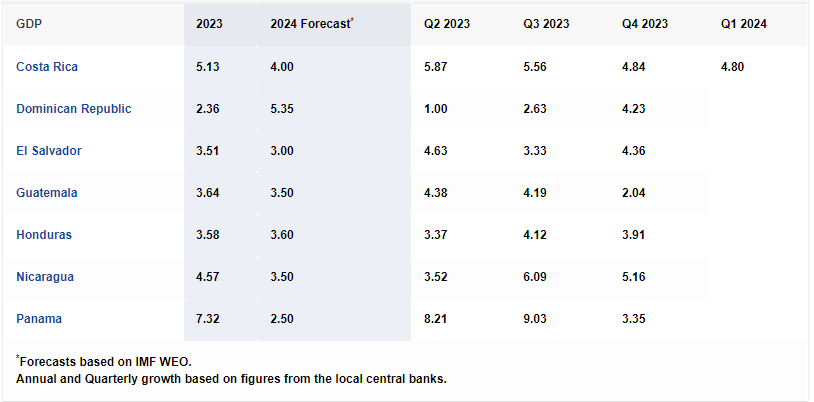
    NICARAGUA | Remittances up. On 26 April, Nicaragua’s central bank (BCN) released new figures which show remittances to the country in the first quarter of 2024 totalled US$1.14bn, up 11.8% on the same period in 2023. The main source countries were the US, which accounted for 81.6% of remittances sent, followed by Costa Rica (7.9%), Spain (6.1%), Panama (1.1%), and Canada (0.7%). As regards destinations for remittances, 26.7% of the total was sent to Managua department followed by the departments of Matagalpa (10.2%) and Chinandega (9.1%). Nicaragua posted a new record of US$4.66bn in remittances in 2023, up 44.5% on the US$3.22bn recorded in 2022, according to figures released by the central bank on 6 February. The surge has been driven by the rapid increase in Nicaraguan emigrants who have left the country due to the crackdown on dissent by the government led by President Daniel Ortega which began in 2018. A report released by the International Monetary Fund (IMF) in January 2024 estimated that remittances would contribute around 28% of GDP in 2023, double the contribution that they made in 2021.

    PANAMA | Optimistic on tourism. On 2 April Fernando Fondevila, the CEO and general director of the Panama tourism promotion fund (Promtur), a grouping of tourism businesses, said that the country is expecting some 2.9m visitors in 2024 (which includes tourists as well as those who stay at least a night or several hours in the country). This would be up from 2.5m visitors in 2023. He was widely cited by the local media as expressing hopes that the 2.9m figure would translate into some US$1.8bn in spending in 2024, up from earnings from tourism of US$1.7bn in 2023.

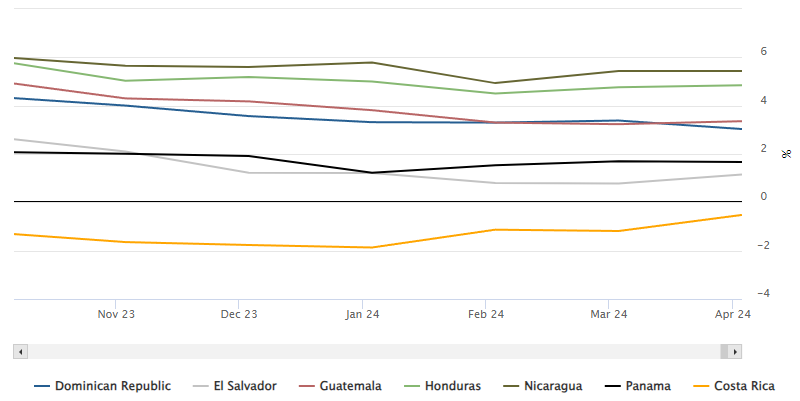
    Central America & Caribbean: inflation rate
    Percentage variation (year-on-year)

    Central America & Caribbean: GDP growth (%)
    Quarterly figures are year-on-year growth

  • GUATEMALA: Seeking to attract investment in the face of logistics crisis

    Sarah Sheldon 23 July 2024 Hits: 713

    Poor infrastructure is affecting the movement of goods and having a knock-on effect on economic activity, and President Bernardo Arévalo has launched a national foreign investment strategy to address longstanding issues.

    While Guatemala’s infrastructure deficit is a long-term concern, the situation has come to a head recently. There are problems affecting the state-run Puerto Quetzal port, in Escuintla department on the Pacific coast, the privately-operated APM container terminal at the port; and a key highway linking Guatemala City to the Pacific, which has been closed due to a massive sinkhole. “These three situations need immediate action to avoid national and international trade from shutting down,” Guatemala’s exporters’ association (Agexport) said in a statement published 15 June. It lamented this triple crisis, which it said “could have very negative consequences for growth.” 

    According to Agexport, there was a queue of 25 ships waiting to unload at Puerto Quetzal, which can take up to 12 days, while operations at the APM terminal are threatened by a legal dispute surrounding its contract. If container operations cease, containers would not be able to leave Guatemala for the west coast of the US, South America, or Asia, according to Agexport. 

    The association also highlighted the fact that the sinkhole on the Palín-Escuintla highway has affected the movement of goods from the Pacific ports to the rest of the country, as well as terrestrial borders with Mexico, El Salvador, and Honduras. According to Agexport, 22,000 heavy goods vehicles use the route every day. The highway was a toll road operated and maintained by Mexican firm Grupo Marhnos from 1998-2023, when its contract ran out and was not renewed. This meant that maintenance was the responsibility of the Guatemalan state, a move which sparked concern among trade organisations at the time due to worries over a lack of funding and technical capacity.

    And on 25 June authorities shut the Libramiento de Chimaltenango bypass in the centre of the country after heavy rains caused landslides. The project, which was opened in 2019 to great fanfare, has suffered a series of closures due to poor construction quality linked to corruption. Its four lanes cover just 14.5km but cost Q528.6m (US$68.1m), becoming an emblem of the endemic corruption that President Arévalo has promised to root out.

    Fixing such a multifaceted problem will not be easy, particularly after years of graft and neglect have led to serious shortfalls, but Arévalo has said that infrastructure will be a priority for his government. In February, the president took part in a logistics forum organised by the private sector lobby Cámara de Industria de Guatemala (CIG), where he highlighted how better infrastructure is critical to his manifesto promises to create the conditions for economic and social development in the country. He has also spoken of the importance of connecting areas outside urban centres, for example by improving rural secondary roads, in order to benefit the whole country.

    In the short-term, Arévalo has to deal with the legal case over the APM container terminal. The case dates back to 2017 and focuses on whether an operating concession covering 60% of container traffic currently held by APM Terminals, a Netherlands-based subsidiary of Danish shipping company Maersk, was improperly awarded. A court has ordered that the concession be revoked. The government will have to decide whether to renegotiate terms with APM or to stage a new licensing round. 

    In a sign of the seriousness of the issue, Arévalo cancelled a planned trip to Europe to deal with the crisis at the port. And on 18 June he said that the problems at the port were linked with corruption, and that the facility had become “a site of conflict between political actors who are looking for easy money”. 

    In the long-term, Arévalo has recognised the need to attract foreign direct investment (FDI) to deal with the infrastructure deficit, and his government launched a new FDI strategy on 13 June. It aims to attract US$2.7bn in investment for a portfolio of 54 proposed projects in sectors such as infrastructure, manufacturing, and agribusiness. 

    The aim is to attract high-impact investments that improve competitiveness and generate well-paid jobs, thanks to improved coordination between public and private sectors, according to the strategy document. 

    FDI inflows have been increasing since 2020, when Guatemala received US$934.9m in FDI, with US$1.65bn expected this year and US$1.85bn forecast in 2025. However, this is far lower than regional peers such as Costa Rica, and much more is needed in order to boost development.

    The aim is to “integrate Guatemala into global supply chains, taking advantage of nearshoring and global commitments to environmental sustainability,” reads the plan. Benefits of more investment include more formal jobs, better pay, increased tax collection, and reduced push factors for migration, said Arévalo in a statement announcing the new strategy. 

    President Arévalo also linked his anti-corruption drive to investment, acknowledging that greater transparency and a better business environment are more likely to attract investors. The president made the same connection between corruption and investment at an event in March, where he invited a group of assembled US investors to work with him in putting Guatemala on a path to growth.

    However, President Arévalo’s ability to enact the change that he promised has been hamstrung due to the continued presence of Attorney General María Consuelo Porras, who he has been attempting to remove from her post due to her links with the so-called ‘pacto de corruptos’ network of institutional corruption. Arévalo has said that Porras has delayed investigations into different corruption cases, but he has been unable to remove her due to legal obstacles. And with Porras still in post, Arévalo’s ability to act is limited and his credibility as an anti-corruption crusader is undermined.

    Arévalo has also seemingly prioritised social spending over infrastructure and is currently facing a battle to secure congressional approval for a bill to increase the 2024 public sector budget by Q14.45bn (US$1.85bn) which is required to fund his electoral promises to help the poor and strengthen social programmes. 

    His strategy appears to be to use public-private partnerships (PPPs) to improve infrastructure without significantly ramping up public spending. This model is not new in Guatemala. For example, a PPP for the Escuintla-Puerto Quetzal highway was approved three years ago and on 21 June the infrastructure ministry gave the green light for construction to begin. This should go some way to improving connectivity on the key route once it is complete.

    Arévalo has also said that a planned Guatemala City metro line and operations at the capital’s La Aurora International Airport will also both be run by PPPs.

    Cooperation with Mexico

    President Arévalo has also stepped up cooperation with the Mexican government with the aim of attracting investment to benefit from the nearshoring trend through new rail links between the two nations. While these new connections will be expensive and take a long time to build, even if technical and financial challenges can be overcome, this increased engagement is another signal that Arévalo is keen to align Guatemala with Mexico and the US, rather than betting on investment from China, as many Central American neighbours have done in recent years.

  • AMLO made significant gains in poverty reduction

    Patrick de Courcy 04 November 2024 Hits: 682

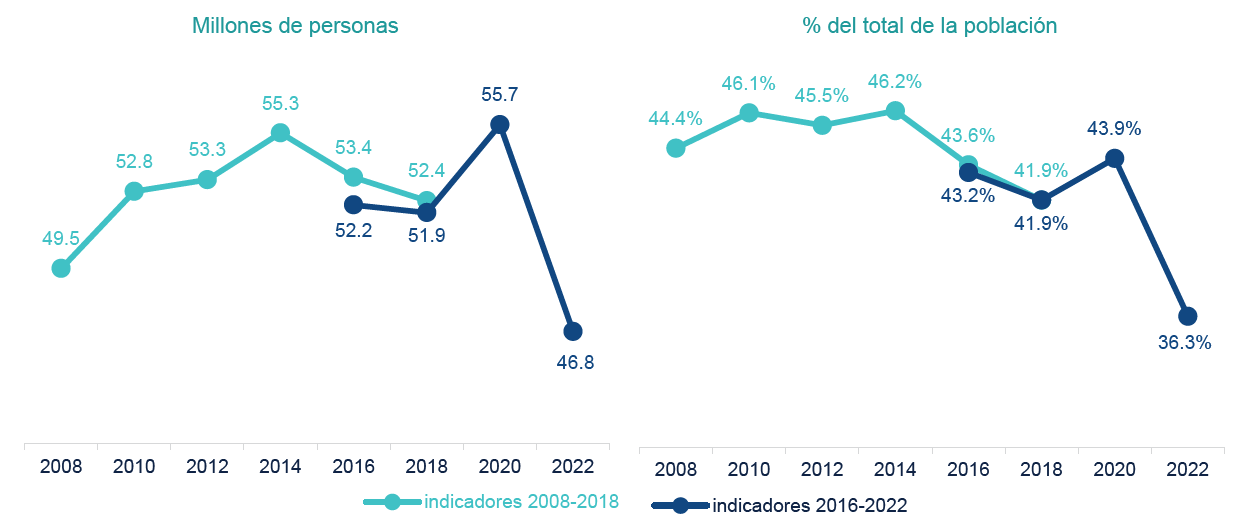
    AMLO took office in 2018 proclaiming “for the good of all, first the poor”. Up to a point, he did in fact deliver what could be called pro-poor policies. The government funded but autonomous Consejo Nacional de Evalucación de la Política de Desarrollo Social (CONEVAL) which carries out household incomes surveys every two years, has reported that the population in ‘multi-dimensional poverty’ has dropped from 51.9m (41.9% of the total) to 46.8m (36.3% of the total) between 2018 and 2022. The period covers the first four or AMLO’s six years in office. CONEVAL uses the concept of multi-dimensional poverty to take into account factors such as access to education and health, as well as a financial measure of poverty.

    Population in poverty in Mexico, 2008-2022

    Source: BBVA Research based on Coneval data

    CONEVAL also found however that the proportion of the population experiencing extreme poverty edged up from 7.0% to 7.1% over the same period. Because of population growth the total number of people in extreme poverty jumped up from 8.7m to 9.1m. The 2022 survey also found those lacking adequate access to health services more than doubled to 39.1%; those lacking access to education rose to 19.4%. Worsening access to health may have been caused by disruption linked to the Covid-19 pandemic. Persistent geographic inequality was also a continuing feature, with the southern states of Chiapas, Guerrero, Oaxaca, Puebla, and Tlaxcala having the highest poverty rates.

    A number of factors may help explain these results. Economic growth played only a small part in poverty reduction (as we have seen GDP growth was low in this period). Much more important was the role of higher-than-inflation annual increases in the minimum wage (which was more than doubled in nominal terms during AMLO’s time in office). Also helpful for poverty reduction has been the government’s massive increase in universal state pensions. Remittances sent home by expatriate Mexican workers, mainly in the US, also nearly doubled from US$33.5m in 2018 to US$60bn in 2023.

    The incoming AMLO government terminated a long-running, targeted conditional cash transfer (CCT) programme known as Prospera. The aim of this was to reduce poverty by offering cash payments to households that sent their children to school or for check-ups at medical clinics. Similar programmes have been highly successful elsewhere in Latin America. But the AMLO government dismissed Prospera as clientelist, bureaucratic, and vulnerable to systematic corruption. Instead, the government switched to programmes that are not means tested. It launched a big increase in state pensions, an apprenticeship programme called Youth Building the Future, and a further programme called Sembrando Vida which pays farmers to plant and maintain trees.

    According to Manuel Martínez, a researcher at science and technology agency Conacyt, AMLO’s policies have improved conditions for many poor households, but not for the very poor. He believes the growth in extreme poverty is in part due to the end of the Prospera programme. The fact that many of those in extreme poverty work in the informal labour market also means they do not benefit directly from the higher minimum wage.

    Looking forward, Sheinbaum has formally committed herself to continue-with the higher-than-inflation increases in the minimum wage. Legislation has been approved making if obligatory for the government to announce an annual minimum wage increase in real terms. Given the low starting point for minimum wage levels (currently they stand at 16,777 pesos or US$865 a month) she will have some headroom to keep these year-on-year increases going, but the new law restricts her room to manoeuvre at a time when the government’s fiscal deficit is already a case for concern. Martínez warns that pension spending is a bigger problem: “In the short term, it’s a time bomb because it is going to generate problems because it isn’t fiscally sustainable” he told news agency Associated Press (AP). 

  • REGION: MercadoLibre defies weak regional economies

    Abbi Dicker 20 March 2025 Hits: 4021

    Latin America’s largest company is not one of the big Brazilian names like Petrobras or Itaú Unibanco, nor Mexico’s América Móvil. It is online retailer MercadoLibre, at least as measured by market capitalisation. While the region’s economy plods along at around 2%, MercadoLibre boosted its revenue by 38% to US$21bn last year. Net profit in the fourth quarter alone was up by a jaw-dropping 287% to US$640m.

    The e-retailer that emerged out of a garage in Buenos Aires in 1999 and now covers 18 countries with 84,000 employees originally built its business model on eBay. But in an industry that is quickly evolving and where competitors like Amazon.com have been taking market share, MercadoLibre has been branching out and cutting costs by controlling more of the value chain, from storage to transportation and financing. On the back of its own warehouses, it runs its own courier service and in Brazil operates its own fleet of planes.

    There have also been large-scale investments that improved logistics and transportation and enhanced customer loyalty. Last year MercadoLibre opened 10 new fulfilment centres and expanded its free shipping offering.

    More than retail

    But MercadoLibre today is far more than just an online retailer. Its fintech business, known as MercadoPago, accounts for 41% of the firm’s net revenue. That includes online payments services similar to Paypal or Venmo, as well as consumer credit services.

    As an example, the firm issued nearly six million new credit cards last year alone. MercadoPago’s credit portfolio reached US$6.6bn in Q4 last year, up 74% on a year earlier, with credit cards making the biggest contribution to growth.

    In Argentina sales bounced back surprisingly well after President Javier Milei’s radical chainsaw reforms had eroded purchasing power and slowed sales growth earlier in the year. Falling inflation and a more stable currency helped pave the way for new loans to consumers and merchants. MercadoLibre’s credit portfolio there grew fourfold in 2024. “Obviously, with lower interest rates, people are taking on more risk,” Chief Financial Officer Martin de los Santos said on an investor call. “We are very optimistic about what’s going on in Argentina.”

    But management cautioned that growth in Brazil, its biggest market, could be slowing as interest rates there are expected to continue to rise. That would affect not only demand for goods but also for financial services. 

    Indeed, there’s no shortage of potential downsides. Stout competition among fintech players could result in lower-than-expected growth or in smaller interest margins for MercadoPago’s credit products, investment research firm Morningstar said in a 28 February report. “Global e-commerce is intensely competitive, marked by low barriers to entry, readily available price comparisons for standardized products, and constant jockeying for differentiation,” the report read.

    Argentina’s economic history is perhaps one of the most volatile on the planet. Just like last year’s improvements boosted MercadoLibre’s bottom line, renewed currency weakness or a rebound in inflation would weigh on the company’s fortunes – not dissimilar to what happened to MercadoPago’s main rival in the Latin American fintech space, Brazilian neobank Nubank.  

    • Nubank’s changing fortunes

    After becoming Latin America’s most valuable financial institution by market worth last year [EB-24-08], Nubank’s results were then heavily impacted by the 21% depreciation of the Brazilian real in 2024. Fourth quarter income fell short of expectations and the bank’s shares crashed by nearly 20% on 21 February. How Nubank weathers the challenges in Brazil will be closely watched by MercadoLibre. After all, the objective of the Montevideo-based merchant is to become the largest digital bank in Latin America, meaning it would have to displace Nubank from its leadership position.

  • ECONOMIC OVERVIEW: NICARAGUA

    LatinNews 06 June 2012 Hits: 3047

    IMF visit: A delegation from the International Monetary Fund (IMF) paid a visit to Nicaragua between 2 and 11 May to discuss the 2012 Article IV. In its final mission statement, the IMF was positive on the management of the economy by the Frente Sandinista de Liberación Nacional (FSLN) government of President Daniel Ortega. It noted that, “helped by high export prices, large concessional and foreign direct investment flows, and broadly appropriate macroeconomic policies, the economy has averaged growth rates in excess of 4.5 percent during 2010-11”. As regards future priorities, the IMF underlined that “higher economic growth is essential to reduce poverty rates significantly over the medium-term. In this regard, measures to further strengthen institutions, reduce labour market informality, and enhance the effectiveness of public spending while reducing budget rigidities will be key…In addition, reforming the pension system is necessary for inter-generational fairness and long-term fiscal sustainability, and a more equitable tax system would also generate resources for needed infrastructure investment and social spending.”

    The visit nonetheless drew protests on 23 May from thousands of students in the capital and other parts of the country against the IMF’s supposed interest in modifying the 6% of the annual budget that goes to universities as per a constitutional requirement. The protests were the first held in recent years in favour of the universities’ traditional demand that the 6% assignation stipulated under the Constitution be ring-fenced. Yet, organised by unions affiliated with the FSLN, many dismissed the unrest as a show staged by the Ortega government (see sidebar), particularly given that the IMF’s reported proposal to reassign part of the 6% to primary and secondary education did not even feature in its final mission statement; as part of the left-wing regional integration movement Alianza Bolivariana para los Pueblos de Nuestra América (Alba), Ortega has traditionally railed against the IMF as a target of his anti-neoliberal rhetoric. Despite this, relations remain strong; following the IMF’s completion in October 2011 of the seventh and final review of Nicaragua’s economic performance under its three-year Extended Credit Facility (ECF) arrangement, the government announced plans to seek a new deal with the multilateral [RC-12-01].

    • Anti-IMF protests

    Critics of the Frente Sandinista de Liberación Nacional (FSLN) government of President Daniel Ortega also pointed to the fact that, during the supposed anti-IMF protests, the student organisations were calling for progressive tax reform and social security reforms as evidence that the demonstrations were a “charade” staged by the Ortega government. The two reforms are in line with the demands of the IMF, with whom the FSLN administration is seeking a new deal.

  • BOLIVIA: Morales reshuffles his cabinet

    LatinNews 26 January 2017 Hits: 2646

    As has been customary since the Movimiento al Socialismo (MAS) government came to power in 2006, President Evo Morales marked his electoral anniversary with a cabinet reshuffle. Two of the 10 changes announced on 23 January stood out – his replacements of MAS heavyweights, Foreign Minister David Choquehuanca and Minister for the Presidency Juan Ramón Quintana. Along with Economy Minister Luis Arce, Choquehuanca had kept his position from the 2006 administration, while Quintana is widely considered Morales’ chief political operator. Both replacements have been linked to Morales’ intention to seek a fourth consecutive term in 2019 – a prospect which remains controversial [WR-16-50] given that, in February 2016, the public voted in a popular referendum against reforming the 2009 constitution to allow him to do so.

    The local media is reporting that the departures of Quintana and Choquehuanca in particular owe to efforts to strengthen the MAS political project at a grassroots level ahead of 2019. Morales remains popular. The latest opinion poll published by Equipos Mori on 22 January gave him a 58% approval rating but the same survey also showed that just 34% of respondents agreed with him standing for re-election once again. As regards their replacements, the new foreign minister is Fernando Huanacuni, a former director of ceremonial practices at the foreign ministry (2008-2014) who like his predecessor and Morales is an indigenous Aymara. Quintana’s replacement is René Martínez, the director of the office set up to defend Bolivia’s rights to the Silala water system against Chile – a dispute currently before the International Court of Justice (ICJ) at The Hague. Unlike Quintana, Martínez is widely considered a conciliatory figure.

    Morales also announced eight other ministerial changes. Following the troubles surrounding the environment & water ministry stemming from the current shortages of drinking water amid Bolivia’s worst drought in 25 years [WR-16-47], Morales promoted deputy water & environment minister Carlos Ortuño to head up the portfolio. Ortuño replaces Alexandra Moreira who stepped down on 18 January, hours before she was due to face questioning in the national congress over the issue. Other changes include the appointments of the former attorney general (2014-2017) Héctor Arce, who served as MAS president of the national lower chamber (2010-2012), as the new justice minister; Héctor Hinojosa, a former leader of the main umbrella union, Central Obrera Boliviana (COB), and deputy labour minister, to head up the labour portfolio, replacing Gonzalo Trigoso; Mariana Prado, the head of the cabinet of the vice-presidency, as planning development minister replacing René Orellana; Eugenio Rojas, the former MAS leader in the senate (2014-2015) and deputy minister for productive development (January-September 2015) to head up the portfolio; Gisela López, the director of state TV channel Bolivia TV as communications minister; and Vilma Alanoca, a former MAS councillor from El Alto, as culture minister.

    Meanwhile Morales’ decision to opt for continuity in key portfolios such as the economy, hydrocarbons, mining, public works, defence, and interior – where Luis Arce, Luis Alberto Sánchez, César Navarro, Milton Claros, Reymi Ferreira, and Carlos Romero keep their jobs – reflects overall success in these sectors. As regards the economy for example – the strength of which is crucial to Morales’ flagship poverty reduction policies – a December 2016 report by the Economic Commission for Latin America and the Caribbean (Eclac) notes that Bolivia’s GDP “expanded by 4.0% in 2016, one of the highest rates in the region”. Meanwhile, in his balance sheet, Morales highlighted that in 2015 the extreme poverty rate in Bolivia’s urban and rural areas was 9.3% and 33.3% respectively, down from 24.3% and 62.9% in 2005. He also claimed that the general poverty rate was 38.6% in 2015, down from 60.6% in 2005.

    • Restructuring

    As part of the ministerial changes, President Morales named Rafael Alarcón, a former general manager (2008-2011) of the national electricity company (Ende), to head up the newly created energy portfolio – indicative of the importance his government places on the sector. Morales also announced as part of cost-saving measures, the elimination of the transparency & anti-corruption ministry with its responsibilities to be taken over by the justice ministry, while the ministry for autonomy will be absorbed by the ministry for the presidency.

  • TRACKING TRENDS

    LatinNews 01 June 2017 Hits: 607

    BOLIVIA | Lithium plant tender. The Bolivian government has launched a second public tender for the contract to build a new lithium carbonate processing plant at the Salar de Uyuni salt flats in the Potosí department, which has the world’s largest lithium reserves.

    The announcement of the launch of the second tender comes after the first tender process carried out last year was abandoned after none of the bids submitted were found to be acceptable. Energy Minister Rafael Alarcón has explained that many of the bids in the first tender, in which 26 companies participated, had several errors which led to the tender being declared invalid.

    Companies had until 25 May to participate in the second tender process. The contract is valued at US$900m and encompasses solely the right to build the plant, as by law the Bolivian state has the exclusive control of extracting lithium in the country.

    The industrialisation of lithium has been a long-term project of the government led by President Evo Morales. Alarcón stressed that exploiting and industrialising lithium with total state control would contribute to the country’s development while retaining sovereignty. Currently Bolivia has a pilot lithium processing plant in the Salar de Uyuni, with a low level of production but which has allowed the country to confirm that the extraction of lithium is valid, Alarcón said.

    COLOMBIA | New electricity substation. Empresas Públicas de Medellín (EPM), a Colombian state-owned utilities firm, has announced the conclusion of the construction of the Nueva Esperanza electricity substation located in the municipality of Soacha in the central Cundinamarca department.

    The Nueva Esperanza substation is considered to be key to plans to improve and expand electricity provision to 12m users in central and eastern Colombia by linking two of the country’s main electricity generation systems.

    According to an EPM statement the project, a joint venture with private electricity provider Codensa, involved the reconfiguration of four existing transmission lines and the construction of two new ones to link the Nueva Esperanza substations to the Bogotá and Cundinamarca electricity grids. The statement said that after a four-year process the Nueva Esperanza substation will come on-stream in June.

  • ECUADOR: Correa secures over US$7bn from China

    LatinNews 30 January 2015 Hits: 2468

    Ecuador secured an impressive US$7.5bn in new lending from China in early January.

    Celebrating the deal, Ecuador’s President Rafael Correa, who travelled to Beijing in early January with a delegation including his finance minister Fausto Herrero and 16 other cabinet ministers, said that Ecuador’s relations with China were “an example for Latin America because their interest in investing in Ecuador shows that we have been efficient”.  Even if Correa’s comment had no intent, it almost seemed like a sideways glance at the Venezuelan government, and indeed it was notable that President Nicolás Maduro did not seem to get such concrete financial commitments from his trip to China, immediately after the Ecuadorean delegation.

    Notably, the main tranche of the new lending, a US$5.29bn Eximbank loan, comes on very favourable terms - at a 2% interest rate over a 30-year term.  By way of comparison, Ecuador’s US$2bn sovereign bond issue in June 2014, the first since the Correa-instructed default on US$3.2bn in bonds in December 2008, carried a coupon of 7.95%.

    Eximbank also signed off on a U$250m commercial loan in support of Ecuador’s state-sponsored scheme to encourage consumers to switch from gas to electric induction ovens, while a US$1.5bn loan from the China Development Bank – again for strategic infrastructure projects – appears to correspond to 15% of a US$10bn Chinese credit line for the Community of Latin American and Caribbean States (Celac) due to be finalised this week at a China-Celac ministerial forum. Finally, the Bank of China agreed to US$480m for schools and infrastructure.

    Separately, Ecuador is also awaiting disbursement of US$3.6bn in funding for the various hydro-electric plants being built in the country, which are due to come on stream from 2016 and are key to Correa’s plans to slash domestic energy prices and free up oil for export.

    Although the exact disbursement details of the new loans are not yet available, these funds will go some way towards Correa’s pledge to ring-fence strategic investment despite the sharp impact on government finances of the downturn in oil prices. In contrast to Venezuela, dollarised Ecuador (it adopted the US currency in 2000 after a banking crisis), is unable to devalue and so has to rely on fiscal measures, the latest of which included a 4% cut in the 2015 budget to just under US$35bn. While Ecuador will suffer in 2015, it is in a better position than Venezuela. The central bank reported real GDP growth of 3.4% year-on-year and 1.1% quarter-on-quarter in the third quarter, and while this marks a continuing slowdown, it is in stark contrast to three consecutive quarterly contractions in Venezuela to Q3 last year.

    Correa’s protectionist attitude upsets his neighbours

    Ecuador is struggling not only with lower oil prices but also with a strong US dollar, which damages its external competitiveness. The trade ministers of Ecuador and Colombia, Francisco Rivadeneira and Cecilia Álvarez-Correa respectively, met in Quito on 14 January in a bid to resolve a row over Ecuador’s unilateral imposition of new import safeguards on its Andean Community (CAN) trade partners.

    On 5 January Ecuador imposed a temporary levy of 21% on imports from Colombia and a 7% duty on imports from Peru by way of remedial action for currency devaluations. In a statement, the external trade ministry said the measure was in response to the depreciation of the Colombian and Peruvian currencies against the US dollar, and was designed to restore trade competitiveness.

    The statement noted that the Colombian peso had depreciated by 25% against the dollar in the second half of 2014, to Col$2.34:US$1, while Peru’s nuevo sol had weakened by 5.4% in the same period, to PEN2.79:US$1. A stronger US dollar makes Ecuador’s exports less competitive, while imports become cheaper (and import demand rises, as Ecuadoreans’ purchasing power increases).

    In reaction to immediate complaints by Colombia and Peru about the unilateral measure, which they said they had not been consulted about in advance, the CAN’s general secretariat (SCCA in the Spanish acronym) insisted that it should fall to the CAN to determine whether “normal conditions of competition” had been altered to an extent that justified remedial measures. The SGCA said it would review the situation from 6 January. In a tart response, Ecuador replied that it had in fact sent the case to the CAN as an emergency matter on 24 December, and had proceeded to impose the measure after the CAN failed to respond within a statutory seven-day period (which, of course, happened to coincide with the Christmas holidays).

    Rivadeneira and Álvarez-Correa admitted that the talks were difficult but said the two sides were looking for a ‘win-win’ solution. Rivadeneira said Ecuador was proposing to cut its safeguards on Colombian goods to 17.4%, and to exclude certain categories of raw materials, intermediate inputs and consumer goods. He admitted that Colombia was pushing for the tariff to be slashed to 7%. However, both ministers were keen to stress that talks were fluid, with concern on both sides to come to a mutually acceptable resolution.

    Following similar talks with Peru’s external trade minister Magaly Silva, on 27 January Ecuador’s external trade committee, Comité de Comercio Exterior (Comex), which sits under the trade ministry, announced the exclusion of 160 items from the tariff list. Luis Alberto Salvador, vice president of Guayaquil’s chamber of industries, said that the Comex decision would avoid additional costs for local manufacturers, who complain that the government’s import substitution policies – ostensibly designed to help develop a domestic industrial base  - has sometimes hurt rather than helped them.

    • Ecuador-CAN trade

    According to Ecuador’s central bank, Ecuador registered a trade deficit with Colombia of US$968.1m in January-October 2014, on exports of US$784.3m and imports of US$1.8bn. However, that deficit was actually lower than in the same period of 2013 (US$1.1bn), reflecting lower imports from Colombia last year (exports rose slightly). In the same period, Ecuador ran a trade surplus of US$583.5m with Peru, on exports of US$1.4bn and imports of US$807.3m. However, that surplus was down by 19% year on year, on lower exports to Peru (imports also fell).

    Ecuador insists that its trade policies seek to maintain adequate domestic dollar liquidity. The latest row follows earlier disputes, including Quito’s imposition of new labelling rules on imports a year ago. The country registered a moderate trade surplus of US$148.2m in the first 10 months of 2014, a turnaround from a deficit of US$1.2bn in the same year-earlier period, on exports of US$22bn and imports of US$21.9bn. Despite these relatively positive trade figures, with the US dollar continuing to strengthen and oil prices yet to find a price floor, the Correa administration is likely to continue to rely upon protectionist measures, risking continued spats with its next-door neighbours.

    • Funds

    Finance Minister Herrero noted that some of the U$1.5bn from the Celac loan could be put towards the Quito metro. The new opposition mayor of Quito, Mauricio Rodas, who took office in May 2014, has been stuck in a major political row with the Correa government over funding for the metro project. Ahead of the 2017 general election in which both Correa and Rodas likely will face off each against each other, delivery of the project in the capital is in the electoral interest of both men.

    • Correa – eight years and going strong

    President Correa marked eight years in office on 14 January. Correa celebrated the achievements made in education in particular and said that the government’s focus now is on developing human talent, science, technology and innovation in the country. He insisted that he would not allow “the past to return”, even if that meant staying on in office beyond 2017 (pending approval of a constitutional reform to allow for indefinite election). Ecuador was recently voted the best country in the world to retire to by InternationalLiving.com, getting 92.7 of a maximum 100 points for its warm climate, friendly people, affordable living costs and generous government retiree discounts for things like utilities, health care, public transport and airfares, among others.

  • RASTREANDO TENDENCIAS

    LatinNews 17 July 2015 Hits: 505

    BRASIL | Crece el desempleo. Uno de los pocos puntos brillantes del gobierno liderado por la Presidenta de Brasil, Dilma Rousseff, durante el año pasado ha sido el persistentemente elevado nivel del empleo, a pesar de los signos de advertencia de otros indicadores económicos. Ahora, el desempleo está creciendo: subiendo a un 6,7% en mayo. Muchos economistas creen que continuará subiendo durante los próximos dos años. Un recientemente anunciado esquema  del gobierno para alentar a las industrias de manufacturas a reducir sus horas de trabajo y salarios antes de recortar empleos, el ‘Plano de Proteção de Emprego’, parece haber tenido poco impacto hasta ahora.

    BRASIL | Petrobrás recorta su plan de inversión 2015-2019. La compañía petrolera de estatal de Brasil, Petrobrás, ha anunciado que ha decidido reducir por  un 37% su plan de inversión de US$220,6mm para el periodo 2015-2019.

    En una declaración a la bolsa de valores de São Paulo (Bovespa), Petrobrás, que aún está en problemas para superar el gran escándalo de corrupción descubierto en la firma, dijo que ahora tenía planes para invertir US$130,3mm durante ese periodo.

    De acuerdo con la declaración de Petrobrás, el plan de inversiones tendrá como prioridad los proyectos de exploración y producción de petróleo, para lo cual han sido asignados US$108,6mm.

    CHILE | Ingresos de la Copa América. El 6 de julio la ministra de deportes de Chile, Natalia Riffo, dijo que de acuerdo con cálculos preliminares de la Cámara Nacional de Comercio (CNC), el torneo regional de fútbol, la Copa América, del cual Chile fue anfitrión entre el 11 de junio y el 4 de julio, ha producido entre US$55m y US$88m en ingresos para el país. De acuerdo con Riffo este fue, en su mayor parte, el resultado de los más de 200.000 aficionados del fútbol de toda América Latina que visitaron el país durante el torneo. Sin embargo, Riffo admitió que el gobierno había gastado unos US$83m para mejorar los estadios en las ciudades de Antofagasta, La Serena, Viña del Mar, y Concepción, antes del torneo. Riffo agregó que el gobierno ahora “se asegurará de que estos estadios sean utilizados intensivamente y que permanezcan accesibles para las comunidades [locales]”.