All Categories

Subcategories

  • CHILE: Políticos envueltos en escándalo de financiamiento de campaña

    LatinNews 24 October 2014 Hits: 514

    La Presidenta de Chile, Michelle Bachelet, ha enfáticamente rechazado cualquier financiamiento ilegal de su campaña de reelección en el 2013. Los comentarios públicos de Bachelet, la semana pasada, siguieron a varios días de acusaciones de políticos, sobre todo de la Derecha, avergonzados por los escandalosos alegatos de contribuciones de campaña ilegales realizadas por el banco de inversión, Penta. La administración de Bachelet está prometiendo una nueva ley para volver más transparentes los financiamientos de las campañas electorales. Mientras el congreso y el poder judicial lanzaron investigaciones paralelas y superpuestas, el episodio sólo ha reforzado la percepción del público de que los políticos son poco fiables, mentirosos y que actúan en su propio interés.

    El ‘Pentagate’, como ha sido rápidamente bautizado, se materializó a fines de septiembre, cuando la recientemente creada Fiscalía de Alta Complejidad [IL-14-39] comenzó a investigar a Penta por evasión fiscal. Un ex ejecutivo de Penta, Hugo Bravo, quien está peleando un caso por despido ilegal, reveló que el grupo bancario había financiado campañas electorales, especialmente de políticos de la conservadora Unión Democrática Independiente (UDI), pero también del ex ministro de finanzas de Bachelet, Andrés Velasco (2006-2010), quien compitió como independiente en las últimas elecciones. Supuestamente, Penta financió estas campañas con dinero de transacciones de empresas fantasmas para lo cual presentó facturas falsas a fin de reducir sus ingresos imponibles y así evadir la ley electoral sobre financiación de campañas.

    La agencia fiscal de Chile, el Servicio de Impuestos Internos (SII), presentó un pedido legal para investigar el supuesto financiamiento irregular de campañas electorales por parte de Penta, el 8 de octubre. La cámara baja del congreso acordó formar un comité investigador para el caso Penta, y otro para estudiar el sistema de financiamiento de campañas políticas por completo. Entonces, el 31 de octubre, el Partido Socialista (PS), parte de la coalición gobernante Nueva Mayoría, presentó cargos de soborno agravado y falta de probidad administrativa ante una corte en Santiago contra funcionarios públicos implicados en el ‘Pentagate’ (ver abajo).

    La UDI inmediatamente acusó al gobierno de buscar influir, a través del PS de Bachelet, los procedimientos legales; políticos de otros partidos de la Nueva Mayoría también expresaron su malestar, alegando que la investigación judicial debía seguir su curso sin ninguna participación política. La UDI, bajo presión después de los comentarios de Bravo, exigió que varios ministros del gabinete, quienes participaron en la campaña de Bachelet aparezcan ante el comité investigador del congreso para enfrentar preguntas acerca de las fuentes de financiamiento, incluyendo al jefe del gabinete, Rodrigo Peñailillo; la ministra del trabajo, Javiera Blanco; el vocero del gobierno, Álvaro Elizalde; y el ministro de finanzas, Alberto Arenas.

    Bachelet rechazó la ofensiva de la UDI, afirmando que su gobierno “no interviene de ninguna manera [en la investigación judicial] por cualquier objetivo político”, y que la oficina del fiscal público tendría autonomía total. Ella también insistió que “Todas las contribuciones a mi campaña fueron aprobadas por Servel [las autoridad electoral]”, agregando que “no les puedo decir quien me dio contribuciones anónimas porque no lo sé, pero en mi campaña no hubo ni un solo peso ilegal”.

    El mismo hecho de que las compañías privadas pueden hacer contribuciones anónimas en Chile, sin embargo, plantea preocupaciones acerca de la transparencia y es probable que sea abordado.  Elizalde ha prometido enviar al congreso en los próximos días una ley “que regule más estrictamente no sólo las campañas, sino también toda la actividad política”. La secretaria general de la presidencia, Ximena Rincón, dijo el 18 de octubre en una entrevista con el diario nacional, El Mercurio, que volver ilegal las contribuciones anónimas sería uno de los principales aspectos del proyecto de ley enviado al congreso. De una manera nada ingenua, Rincón negó que el planeado proyecto de ley tuviera alguna relación con el caso Penta.

    • Opinión dividida

    El presidente del Partido Socialista (PS), el diputado Osvaldo Andrade, justificó la presentación de una querella en el caso Penta, sobre la base de que “instituciones serias” (léase congreso) deben involucrarse en el proceso legal en vez de quedar “mirando desde lejos”. Pero el líder del bloque del senado del más centrista miembro de la Nueva Mayoría, el Partido Demócrata  Cristiano (PDC), Jorge Pizarro, cuestionó el sentido de la querella, alegando que manteniendo las investigaciones judicial y política separadas por entero confería una mayor credibilidad a todo el proceso. El hecho de que la Nueva Mayoría no se ha unido para explotar el desconcierto de la UDI, sugiere que podría haber alguna inquietud acerca del financiamiento de campaña dentro de la coalición gobernante, especialmente sabiendo que Andrés Velasco, el ex ministro de finanzas de la Presidenta Bachelet (quien en realidad compitió como independiente) también ha sido involucrado en el escándalo.
  • CUBA: Hundreds of Cuban migrants still in limbo

    LatinNews 19 April 2017 Hits: 796

    Significantly fewer Cuban rafters (‘balseros’) are being picked up by the US coast guard since the US ended its exceptional migration policy for Cuba in January.

    According to the US coastguard Commandant, Admiral Paul Zukunft, the number of Cuban migrants trying to cross the Florida straits in a bid to reach US shores has fallen dramatically in the three months since former US president Barack Obama (2009-2017) ended the so-called ‘wet-foot/dry foot’ policy - whereby irregular Cuban migrants arriving on US soil were given permanent leave to remain, but those found at sea were returned to Cuba or a third country.

    According to Zukunft, since the policy (officially, the Cuban Adjustment Act of 1965/1995) was ended with immediate effect on 12 January, the US coast guard has intercepted about 100 hundred Cubans at sea, compared to some 5,500 in all of Fiscal Year 2016 (October-April). Immediately following the historic move by the US and Cuba to restore political relations in December 2014, there was a surge in irregular Cuban migrants trying to make it to the US, as they (correctly) anticipated the end of the wet-foot/dry-foot policy. According to the US Customs and Border Patrol agency, the number of Cubans arriving at US border entry points in FY 2016 was almost 55,000, up from 40,115 in FY 2015. The 5,500 Cubans intercepted at sea was up from 4,473 in FY 2015. Prior to that, numbers had been in decline, averaging about 2,500 interceptions at sea a year.

    Zukunft said the decision by former President Obama had put an end to dangerous situations, for both migrants and coast guard officers. “I am talking about self-mutilation, self-inflicted firearms wounds, very desperate actions to get evacuated to a US hospital, so as to be declared a ‘dry foot’ and later freed”, he stated. “We had cases when they threatened to drown a baby if we tried to intercept them…It was also putting our people at risk”, he added.

    The admiral noted that manpower and resources including boats and planes were now being put to use instead against maritime drug trafficking, claiming that the coast guard had managed to intercept 580 drug shipments that previously would have gone undetected. “Perhaps we can close that window a bit more”, he suggested. However, Zukunft warned of a potential increase in maritime drug trafficking in the Caribbean if the new US government led by President Donald Trump goes ahead with its planned ‘wall’ on the US-Mexico border.

    Obama in January simultaneously ended the Cuban Medical Professional Parole programme (CMPP), which gave Cuban medical staff, and their immediate families (spouses and children), automatic ‘parole’ into the US. Cuba deeply resented this programme, complaining that it encouraged its highly-trained medical workers to abandon foreign postings.

    Much like those irregular Cuban migrants stranded at the Mexico-US border since 12 January (anywhere between 500-1,000, including women and young babies, are still camped out in Nuevo Laredo), Cuban doctors and other medical workers who have abandoned foreign postings now remain stranded in some Latin American countries. Around 180 are currently living in limbo in Bogotá, Colombia, having abandoned medical missions in Venezuela. Some had applied for the CMPP prior to 12 January, others had not. The US has committed to taking those who had applied before the policy change, but the process appears to be moving very slowly. Meanwhile, they are not permitted to work in their host country and so are existing in difficult conditions.

    • Cuban medical workers

    Like the failed Cuban migrants stuck at the Mexican-US border, Cuban medical workers may apply for political asylum and/or leave to remain in their host countries. So far, most have declined to do so. Some are still desperately hoping that the Trump administration might make an exception for them – the influential Cuban-American lobby is working on their behalf. To date, Mexico and Colombia have been patient. Eventually however, these Cubans will be expected to either regularise their status, or look to migrate elsewhere. Ultimately, like some of their compatriots before them, they could face deportation.

  • ECONOMIC HIGHLIGHTS

    Patrick de Courcy 11 August 2023 Hits: 2555

    NICARAGUA | Central bank claims drop in foreign debt. In July, Nicaragua’s central bank (BCN) released new figures which show total foreign debt (public and private) for the first quarter of 2023 at US$14.83bn, of which 55.4% corresponded to public sector debt and 44.6% to private sector debt. It said that total foreign debt was down by US$78.8m compared with the same quarter in 2022. According to the BCN, this was mainly explained by a US$172.8m drop in foreign private sector debt which was counteracted by a US$93.3m rise in public sector foreign debt. Nicaragua’s total foreign debt (public and private) reached US$14.90bn in 2022, up 2.0% (US$296.8m) on 2021.

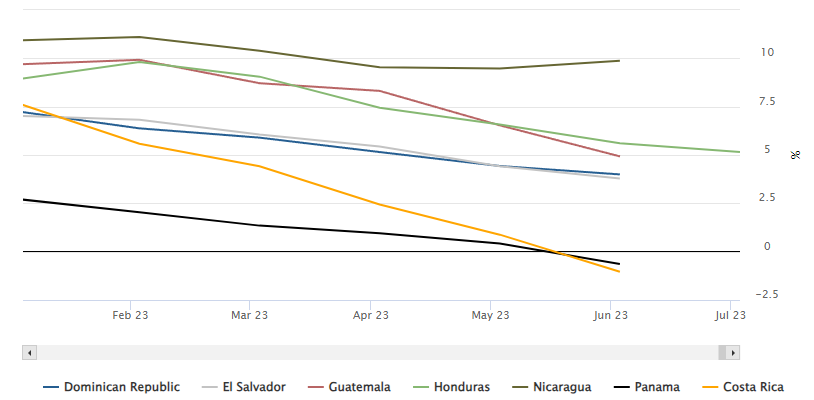
    DOMINICAN REPUBLIC | Inflation returns to target range. In July the Dominican Republic’s central bank (BCRD) released new figures showing monthly inflation was 0.22% in June, bringing the year-on-year rate to 4.00% – the lowest annual rate registered since July 2020. This brings inflation within the 4.0% +/- 1 target range established by the authorities and follows -0.20% monthly inflation in May when the year-on-year rate was 5.51%.

    HONDURAS | Exports down. In July, Honduras’s central bank (BCH) released new figures showing exports totalled US$5.01bn in the first five months of 2023, down 4.3% year-on-year - a drop explained by fewer exports of maquila goods which were down 11.2% to total US$2.16bn. Meanwhile imports totalled US$7.91bn, down 6.1% on the same period in 2022. This leaves a trade deficit of US$2.89bn, 9.1% less than in the same period in 2022. Honduras’s main trading partner remains the US, which received 50.3% of exports (US$2.52bn) (including clothing, vehicle wiring harnesses, bananas, coffee, and melons) and accounted for 39.5% of Honduras’s imports which include fuel, textiles, machinery, electrical equipment, and corn.

    Central America & Caribbean: inflation rate
    Percentage variation (year-on-year)

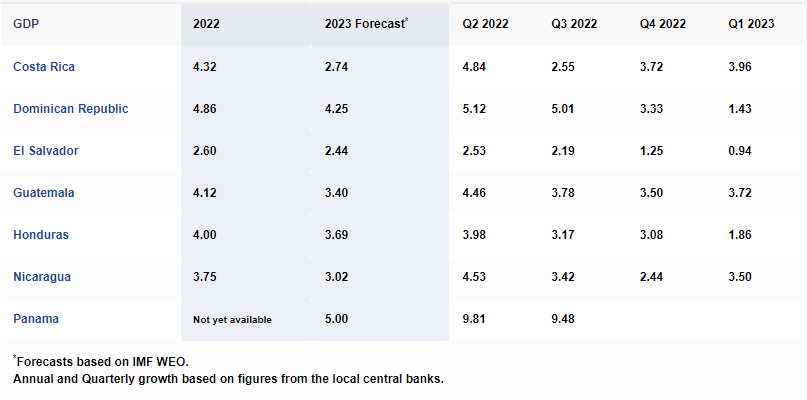
    Central America & Caribbean: GDP growth (%)
    Quarterly figures are year-on-year growth

  • ECONOMIC HIGHLIGHTS

    Abbi Dicker 17 October 2025 Hits: 890

    PARAGUAY | Fitch revises up Paraguay’s outlook. On 6 October international credit ratings agency Fitch affirmed Paraguay’s Long-Term Foreign Currency Issuer Default Rating (IDR) at ‘BB+’ and revised the Rating Outlook to Positive from Stable. In a statement, Fitch said that its decision “reflects Paraguay’s strong growth performance”, forecasting growth of 4.8% in 2025, up from 4.2% in 2024, as well as growth of 4.3% in 2026 and 4% in 2027. It also highlights a “robust investment pipeline”, noting “large-scale investment projects” totalling 16% of projected 2025 GDP across various sectors, and low fiscal deficits. It highlighted the government’s fiscal consolidation plan, which projects a 1.9% of GDP deficit this year and a return to the 1.5% deficit limit next year. Other factors behind Fitch’s upgrade include an expected decline in the public debt burden to 35% of GDP in 2025, down from 37.8% in 2024, and “structural increases to the still low revenue base”.

    CHILE | Boric presents final budget proposal. President Gabriel Boric presented the final budget proposal of his administration on 30 September, outlining a modest spending increase of 1.7%, which he said was in line with his government’s fiscal deficit target of 1.1%. Boric’s 2026 budget proposal focuses on areas such as healthcare, for which he has proposed a budget increase of Cl$900bn (US$935.2m), a rise of over 30% since the start of his government in March 2022. Other areas to see a proposed budget increase are housing, pensions, and public security. Boric stated the housing budget would rise over 37% during his presidency with the latest increase, noting that his government was on track to meet its target of building over 260,000 new homes by the end of his term. He proposed increasing the minimum monthly pension, Pensión Garantizada Universal (PGU), to Cl$250,000 for those over 75 next year, up from Cl$224,004, while the public security budget is set to have increased by 16.7% since the start of his term.

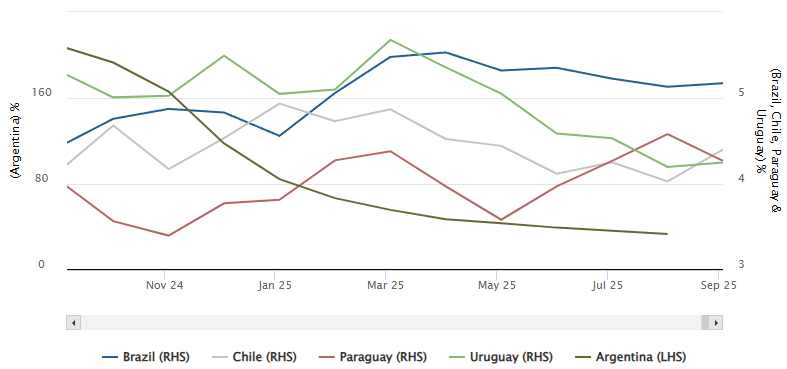
    Brazil & Southern Cone: inflation rate
    Percentage variation (year-on-year)

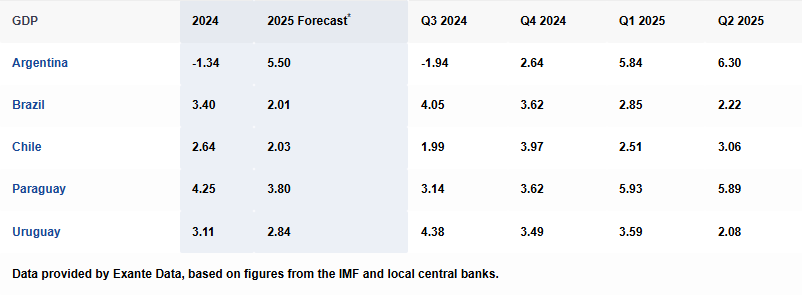
    Brazil & Southern Cone: GDP growth (%)
    Quarterly figures are year-on-year growth

  • VENEZUELA: Government threatens opposition with loss of nationality

    Abbi Dicker 06 November 2025 Hits: 941

    The Venezuelan government is threatening to withdraw nationality from opposition leaders who support US military action. President Nicolás Maduro said last week that he was consulting the pliant supreme court (TSJ) on whether Venezuelan citizenship can be withdrawn from those who “sell out the country… supporting the invasion of a foreign imperialist army”.

    In a television appearance Maduro suggested that Article 130 of the constitution could provide a mechanism for doing so, since it says that citizens have an obligation to “honour and defend the motherland”. But critics point out that Article 35 specifically states that Venezuelans by birth cannot have their nationality withdrawn; naturalised citizens, on the other hand, can lose their nationality, but only by a court order. However, given that the Maduro regime has packed the TSJ with loyalists, it is likely that a way will be found to withdraw citizenship.

    The government appears to have started the process by focusing on opposition leader Leopoldo López, a prominent member of the opposition who has been in exile in Madrid since 2020. Vice President Delcy Rodríguez said the government wanted to withdraw his nationality because he had “requested an invasion”, promoted the economic blockade of the country, and “called for the mass murder of Venezuelans in complicity with foreign enemy governments”.   

    López retorted that “Maduro wants to withdraw my citizenship for saying and thinking what all Venezuelans want: freedom”. Voluntad Popular (VP), López’s party, said that by withdrawing citizenship the government was “following the repressive model of the Cuban and Nicaraguan dictatorships”. It is possible that after a trial with López, the denial of citizenship might be extended to the main opposition leader (and recent Nobel Peace Prize winner) María Corina Machado, who remains based in Venezuela.      

  • TRACKING TRENDS

    Abbi Dicker 16 April 2026 Hits: 1155

    BRAZIL | Coffee exports down year-on-year. The national council of coffee exporters (Cecafé) reported on 13 April that exports totalled 3.04m sacks of coffee (one sack = 60kg) in March. This marks an increase compared with the 2.63m sacks exported in February, but a decrease compared with the 3.3m sacks in March last year.

    Regarding coffee varieties, arabica exports totalled 2.29m sacks, down 19.0% year-on-year, while monthly robusta exports stood at 368,131 sacks, up 164.8%. Regarding export destinations, Brazil’s top coffee export market in March this year was Germany, with 405,239 sacks, followed by Italy on 316,243 sacks and the US on 280,619 sacks. Exports to Germany and the US were down 5.48% and 53.43% respectively compared with March 2025, while exports to Italy were up 18.64%.

  • RASTREANDO TENDENCIAS

    LatinNews 11 April 2014 Hits: 969

    PERÚ | Ajustando hacia abajo el pronóstico de crecimiento. El 6 de abril banco central de Perú (BCRP) difundió su última encuesta mensual de economistas locales, que halló que el consenso en el pronóstico de crecimiento económico para todo el año había sido reducido  levemente del 5,6% registrado en marzo al 5,4%.

    Después de permanecer estable durante los primeros tres meses del año, las predicciones de los analistas locales ahora se alejan de los pronósticos oficiales del 6% y se acercan al 5% como resultado para fines de año para la economía interna en el 2013. La tasa de crecimiento del año pasado fue la más baja para Perú en los últimos cuatro años, en medio de una menor demanda global para las exportaciones minerales clave del país junto con una caída en los niveles de consumo interno.

    Las proyecciones del BCRP y del ministerio de finanzas de Perú estaban basadas en la asunción de que la demanda global de minerales, en particular el cobre, se elevaría de nuevo este año para alimentar la demanda interna una vez más. Sin embargo, la demanda internacional del cobre y otros productos mineros ha permanecido relativamente baja este año a medida que el crecimiento en China continúa siendo más débil de lo esperado. Problemáticamente para el gobierno peruano, los analistas locales también revisaron hacia abajo su pronóstico de crecimiento para el 2015, del 5,5% al 5,4%, lo que sugiere que la expectativa general es que la demanda global para las exportaciones peruanas continuará siendo débil hasta bien entrado el próximo año. En cuanto a la inflación, los analistas también han elevado ligeramente el pronóstico para este año, del 2,6% al 2,8%. Que el nuevo pronóstico de inflación también está muy cercano a la parte más elevada del rango meta de inflación del BCRP del 1% - 3% será también causa de preocupación para los funcionarios del gobierno.

    VENEZUELA | Considerando mayor liberalización del mercado de monedas. El 3 de abril el presidente de la comisión de finanzas de la asamblea nacional de Venezuela, Ricardo Sanguino, reveló que el gobierno del Presidente Nicolás Maduro estaba “estudiando” la posibilidad de adoptar un mecanismo de cambio de divisas más flexible. Durante los últimos 11 años, el gobierno venezolano ha impuesto estrictos controles sobre el mercado local de divisas a fin de apuntalar el Bolívar Fuerte, y estimular la economía interna. Pero esto ha resultado en la escasez de moneda extranjera (lo que a su vez ha conducido a la escasez de algunos bienes de consumo básicos) e invariablemente elevando los niveles de inflación que han impactado seriamente sobre la economía interna.

    Actualmente Venezuela opera con un sistema de cambio de divisas de tres niveles controlado estrechamente por el gobierno. La tasa de cambio en el principal mercado de divisas (Cencoex), que está abierto para quienes buscan importar bienes esenciales, está establecida en BF6,3/US$1; mientras que la tasa en el mercado secundario (Sicad), abierto a quienes buscan importar bienes considerados no-esenciales, está establecida en BF11/US$1. Pero estos dos mercados no han sido capaces de satisfacer la demanda por dólares de EU y el mes pasado el gobierno introdujo un mercado secundario alternativo (Sicad2) en el cual las partes interesadas tienen permitido hacer ofertas (con los bancos locales actuando como operadores) por un monto predeterminado de dólares ofrecidos por el banco central. Aún así, tal parece que incluso el último mecanismo de cambio de divisas no ha tenido éxito en saciar la demanda de dólares de EU y en estabilizar el Bolívar Fuerte (la tasa del Sicad2 ha estado rondando alrededor de BF50/US$1 desde que el mecanismo fue lanzado el 24 de marzo).

    Es contra este telón de fondo que en una entrevista con el diario local, El Mundo, Sanguino dijo que el gobierno ahora estaba considerando avanzar hacia un “mercado abierto y sin ningún tipo de cambio fijo en el mediano y largo plazo”. Sanguino no proveyó los detalles completos, pero dijo que “estamos estudiando la adopción de un sistema [de cambio de divisas] flotante  con bandas establecidas […] a fin de tener una tasa de cambio más flexible del Bolívar/dólar”. Proveyendo peso agregado a los comentarios de Sanguino, el gobierno publicó el 7 de abril en la gaceta oficial las directrices para permitir a las casas de cambio el acceso a Sicad2.

    Las casas de cambio fueron prohibidas el acceso a los mercados de divisas oficiales en el 2010, por el fallecido ex presidente Hugo Chávez (1999-2013), quien las acusó de estar especulando con la tasa de cambio. Sin embargo, al lanzar del Sicad2 el mes pasado, el gobierno dijo que  permitiría a las casas de cambio el acceso al nuevo mecanismo a fin de incrementar la disponibilidad de dólares de EU para la población en general. La declaración publicada en la gaceta oficial dice que las casas de cambio han sido “autorizadas a participar en el mercado secundario alternativo de cambio de moneda […] como intermediarios especializados en operaciones minoristas de cambio de monedas”. Y agrega que al vender divisas al público en general ellas deben ofrecer una tasa de cambio que sea un 0,25% menor que la tasa del Sicad2, que desde ahora será publicada diariamente por el banco central.

    • Cementando su presencia

    La compañía de cementos colombiana, Cementos Argos, ha anunciado la compra de los bienes de la de la gigante cementera multinacional Francesa Lafarge y de la Suiza Holcim en la Guayana Francesa por €50m (US$69m) para consolidar su presencia en el Caribe. Cementos Argos obtuvo el 100% de la compañía, Ciments Guyanais, propiedad de Lafarge y Holcim, así como también un puerto localizado en Dégrad des Cannes, cerca de la capital de Guayana Francesa, Cayena. “Esta adquisición en la Guayana Francesa complementa armónicamente nuestra red de activos en la región, especialmente por su cercanía con la molienda en Suriname y las terminales de cemento en las Antillas”, el presidente de Cementos Argos, Jorge Mario Velásquez, dijo.

  • ECONOMIC HIGHLIGHTS

    Patrick de Courcy 21 May 2024 Hits: 2520

    ECUADOR | Noboa gets ball rolling on Yasuní oil ban. Ecuador’s President Daniel Noboa issued a decree on 9 May establishing a committee tasked with ending oil drilling in the Yasuní national park, as was approved by voters in a referendum in August last year. In February this year, Noboa had suggested that he would seek to delay implementing the ban, expressing concern over its impact on the government’s finances. Yesterday’s decree orders the creation of a five-member committee, which will include representatives from the energy ministry, environment ministry, economy ministry, and women’s & human rights ministry, as well as state oil company Petroecuador. The committee is tasked with “complying with the popular will regarding the progressive and ordered winding down of all activity related to oil extraction” in the Ishpingo, Tambococha, and Tiputini (ITT) oilfields, also known as Block 43. The decree does not provide a timeframe for ending oil drilling in the area.

    COLOMBIA | La Niña incoming. On 16 May Colombia’s Environment Minister Susana Muhamad urged the country’s departmental and municipal authorities to accelerate their preparations for the La Niña climate phenomenon. Saying that there is a 70% chance that La Niña will arrive in July, Muhamad warned that the country’s Caribbean, Pacific, and Andean highland regions may face record rainfall in the coming weeks, while the Amazonian and Orinoquía regions are facing drought. She said that 613 municipalities had been highlighted as facing landslide risks due to the rain, with 267 of those placed on red alert. Muhamad also noted that Colombia’s hurricane season will begin in early June and could run until November.

    PERU | Interest rates down. On 9 May Peru’s central bank (BCRP) lowered its benchmark interest rate by 25 basis points to 5.75%. The BCRP noted that monthly inflation in April was -0.05%, bringing the annual inflation rate to 2.4% – down from 3.0% in March. This is within the bank’s 1%-3% target range. The BCRP maintained its 12-month inflation forecast at 2.6%.

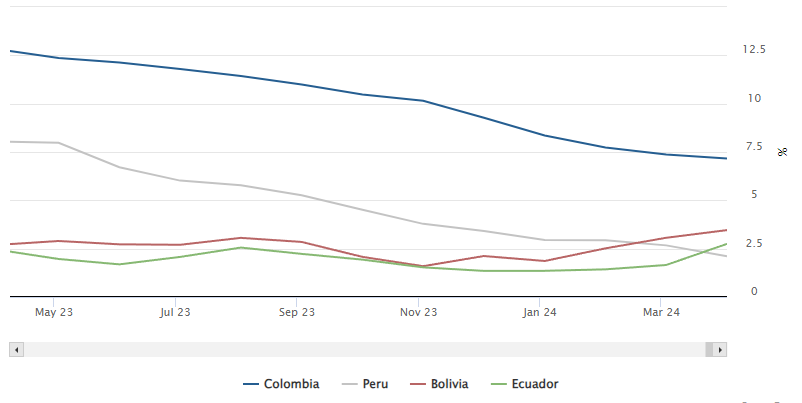
    Andean countries: inflation rate
    Percentage variation (year-on-year)

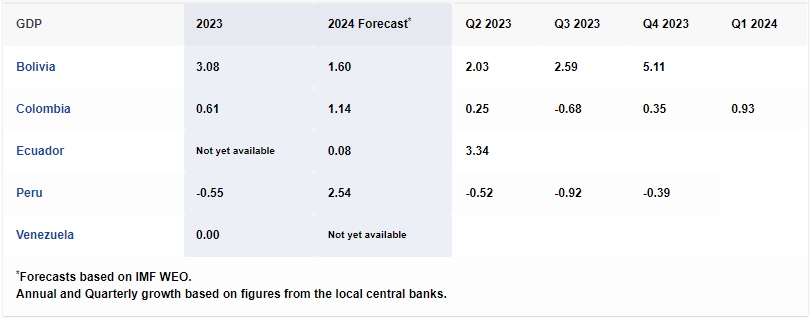
    Andean countries: GDP growth (%)
    Quarterly figures are year-on-year growth

  • CUBA: No early end to power cuts

    Abbi Dicker 23 May 2025 Hits: 4115

    In an extended interview with Granma, Cuba’s state-controlled newspaper, published in late March, Energy and Mines Minister Vicente de la O Levy explained what is being done to restore power supply across the island. He was careful not to promise any quick solutions.

    The power cuts seem relentless. There were major power outages in February, March, October, and December last year. This year stoppages have continued. On 1 and 2 May, for example up to half the population had no electricity, with an overall demand-supply gap of 1,400MW. These cuts were caused because various of the country’s eight ageing thermoelectric generators had to be taken out of service for emergency repairs and because of fuel shortages.

    The energy minister’s comments are unlikely to have instilled confidence. He said the recovery of the power grid (SEN) was “on schedule” and that a “positive outcome of everything planned…will soon be seen”. Critics say this is typical of official rhetoric, long on intentions but short on specifics.

    The minister did say, however, that the government is committed to increasing the share of renewable energy in electricity generation to 24% by 2030.  Various new solar parks are reportedly close to completion, as repairs to the thermoelectric generators progress. The minister said this did not mean an end to the power cuts. He described the situation as “a gradual, costly, investment-intensive process for which we can see light at the end of the tunnel”.

    De la O Levy made it clear the crisis could drag on. Or even worsen. In normal times, to maintain the SEN in operation, he pointed out that annual investments of US$250m-US$350m are required.  As he put it “if you don’t provide those resources for a year you can’t recover them; and it has been more than a year”. Fuel oil supplies, which must be imported, and paid for in scarce US dollars, are also uncertain although there are efforts to boost domestic production (Cuba produces around 40,000 bpd, or one third of its consumption).  

    Cuba inflation

    On 12 May Cuba’s national statistics office (Onei) released new figures showing monthly inflation in April was 0.40%, bringing the annual rate to 18.57%. This compares with monthly inflation in March of 1.22%, when the annual rate was 20.62%. The country closed 2024 with an inflation rate of 24.88%.

  • RASTREANDO TENDENCIAS

    LatinNews 27 February 2012 Hits: 875

    ARGENTINA | Crecimiento del PIB. En el 2011 el PIB de Argentina creció un 8,8%, año en año, manteniendo el promedio de crecimiento anual de casi 9% desde el 2003, informó el instituto nacional de estadísticas (Indec). Sin embargo, la actividad económica está mostrando claros signos de desaceleración en medio de la incertidumbre global, afirmó el Indec, pues el crecimiento del PIB en diciembre fue de solamente de 5,5%. El crecimiento del PIB fue de

  • TRACKING TRENDS

    LatinNews 28 November 2013 Hits: 575

    PERU| Peru’s economy slows. On November 26 the outgoing president of Peru’s central bank (BCRP), Julio Velarde Flores (see sidebar), described the strategy that the BCRP will pursue in coming months as falling between that of neutral and aggressive. Velarde’s comments come amid Peru’s continued economic slowdown, with GDP growth of 5.5% forecast for year end, down from 6.3% registered in 2012. Peru’s economic slowdown has been mainly attributed to external factors, such as a fall in metal prices in international markets and shrinking demand for raw material consumption in the US and China. Mining exports, which account for 60% of Peru’s exports, have contracted by 2.08% this year on official data while the local construction sector has also experienced a slowdown this year for the first time in two years. This suggests that not only is less money being pumped into the Peruvian economy but also that investor confidence may be on the wane. On the bright side, the slowdown is keeping inflation levels in check. Velarde pointed out that November’s monthly inflation rate will be -0.2% and projects a year-end rate of 3% - within the BCRP target range of 1%-3%.

    VENEZUELA | Rosneft investment. On 21 November Venezuela’s state oil company, Petróleos de Venezuela (Pdvsa), announced that Russia’s state oil firm Rosfneft had agreed to invest US$65bn in the Orinoco oil belt over the next ten years. According to a Pdvsa statement, the deal was struck during the inaugural Russian-Venezuela oil congress which took place on Venezuela’s Margarita Island on 21-24 November. A press release by Rosneft President Igor Sechi, who attended the congress, underlined that the investment was the company’s most important project for the near future. Meanwhile Venezuela’s oil minister and Pdvsa president, Rafael Ramírez said that the plan was for the two firms to work together on a multi-purpose joint venture that will include a range of related activities such as deep-sea drilling, crude upgrading, engineering and construction, and other oil services. With estimated reserves of 297bn barrels, the Orinoco belt is the world’s largest crude deposit. Venezuela currently produces around 3m oil barrels per day, 2.5m of which are primarily exported to the US and China.

    • New BCRP president

    Peru’s congress has revealed the shortlist of candidates to replace Julio Velarde Flores at the head of the BCRP. Velarde's four-year term ends next year.  During a 26 November press conference, national deputy Ferdy Otárola, who heads the congressional committee in charge of selecting the new BCRP president, said three candidates had been shortlisted: Drago Kisic, Gustavo Yamada, and Francisco Gonzales García. Of the three, Gonzales’s nomination has proven the most controversial, with the Acción Popular Frente Amplio congressional bloc warning that his appointment would go against the longstanding commitment to having a non-partisan BCRP president. Gonzales served as agriculture minister in Alejandro Toledo’s second administration (2001-2006). The committee is expected to announce its choice before the congress breaks for the festive season on 15 December.

  • VENEZUELA: López marks three years in jail

    LatinNews 23 February 2017 Hits: 671

    In September 2015, having spent 18 months in pre-trial detention, the opposition politician Leopoldo López was sentenced to almost 14 years in prison on charges of incitement to violence during fatal anti-government protests in early 2014. The supreme court (TSJ) rejected a final appeal and upheld his sentence last week.

    The TSJ issued its final decision just 24 hours after an intervention by US President Donald Trump, who tweeted a demand for the immediate release of López, and, to some astonishment in Venezuela, posted a photo of himself in the White House with Vice President Mike Pence, the Florida Republican Senator Marco Rubio, and Lilian Tintori, López’s activist wife.

    The deputy spokesperson for the US State Department, Mark Toner, followed up on Trump’s statement 72 hours later, issuing a broader call for the release of all those in prison in Venezuela for their political beliefs. Noting the TSJ ruling in the López case, the State Department asserted that “the Venezuelan government continues to arrest and imprison citizens from across Venezuelan society for their political beliefs”. “Currently, more than 100 such individuals are in prison”, it stated, mentioning López, the Caracas mayor Antonio Ledezma, now two years under house arrest, Daniel Ceballos, the former mayor of San Cristóbal (capital of the western border state of Táchira), now two years in jail, plus “many other students, activists, journalists, and peaceful protestors”. The statement continued: “The United States reiterates its dismay and concern about these arrests, and other actions taken by the Venezuelan government to criminalize dissent and deny its citizens the benefits of democracy. We call for the immediate release of all prisoners of conscience, respect for the rule of law, the freedom of the press, the separation of constitutional powers within the government, and the restoration of a democratic process that reflects the will of the Venezuelan people.”

    The State Department communication capped a week of unexpectedly intense US pressure on Venezuela, which started with the US Treasury Department’s designation of Vice President Tarek El Aissami as a drugs kingpin; was followed by a fresh scandal over the alleged sale of Venezuelan passports and fake IDs to potentially criminal elements and/or Islamic extremists; continued with Trump’s provocative appearance with Tintori; and ended with Toner clarifying that the US expected the release of all political prisoners.

    There is an expectation of a sharp shift in US-Venezuela policy under Trump. To date, however, the pronouncements on Venezuela have largely echoed those of President Barack Obama (2009-2017). Obama regularly called for the release of López and other activists. A string of Venezuelan officials were sanctioned under Obama, with the case against El Aissami put together under his administration (the designation apparently held back in late 2016 to facilitate Vatican mediation in Venezuela). Obama also sought to engage in bilateral dialogue with the Maduro administration, albeit these efforts tended to be scuppered by Venezuela’s own actions.

    Curiously, Maduro in his latest weekly TV show (Los Domingos con Maduro) again seemed to try to ingratiate himself with Trump, warning the US President that he was in danger of being duped by US elites and their powerful lobby groups. Maduro played on Trump’s ego. “President Donald Trump…they are imposing on you all the failed and illegal policies of the Obama and Bush era,” he declared. To that end, Maduro added, certain interests are “paying million dollar sums in corridors and offices” across Washington (see sidebar).

    • Radical Islam

    Seasoned Venezuelan observers have urged some caution around the latest ‘noise’ in the US about Venezuela, including its alleged links to radical Islamic groups, which has come both from Capitol Hill and media sources. These commentators make the point that certain vested interests are not above exaggerating (and even putting out fake news) about the radical Islamist ‘threat’ in Venezuela (and elsewhere in Latin America) to get President Donald Trump’s attention. Tales of Islamic fundamentalism in Latin America have long circulated in conservative right-wing US circles, but actual evidence has always been scant.

  • CARIBBEAN POINTERS

    LatinNews 08 November 2018 Hits: 366

    *** BAHAMAS APPROVES DISNEY DEVELOPMENT. On 19 October, the government of The Bahamas gave approval to a US$400m cruise port development at Lighthouse Point in South Eleuthera proposed by Disney Cruise Lines.

    On making the decision, the government issued a statement saying: “The government of The Bahamas having taken into consideration the views of the majority of the people of Central and South Eleuthera is satisfied that it has made the best decision in the interest of the Bahamian people, and sustainable future for the people of Central and South Eleuthera, and the economic development of the country.”

    As the government statement indicated, there does seem to be public support for the project. A nationwide poll by Public Domain which surveyed 994 respondents found 66% of those who had heard of the project were in favour. Another poll, this time of 217 Eleuthera residents, found that 72% of those who had heard about the project were in favour.

    Despite these findings, however, there has been strong opposition to the project from a group called the Lighthouse Point Partners (LPP), a group which includes the Leon Levy Foundation, the Bahamas National Trust, and the Island School. LPP issued a statement saying: “Whereas our proposal would have created jobs immediately upon the acquisition of the property, Disney’s proposal will not have any meaningful impact on the employment of persons in South Eleuthera until at least 2023. Even on the construction of Disney’s quarter of a billion-dollar pier, there is every indication those funds will be spent with a US firm with Bahamian contractors receiving little to nothing.”

    The government says that the development will create 150 jobs and entrepreneurial opportunities. Disney is also to convey 190 acres out of 700 acres of land to the government for conservation and a national park.

    *** BARBADOS BEGINS LAYING OFF PUBLIC-SECTOR WORKERS. On 22 October, the government of Barbados announced that it was beginning the process of restructuring the public service and that at least 1,500 workers would be laid off in the next few weeks. According to the head of the civil service, Dr Louis Woodroffe, the workers would come from the Ministry of Transport, Works and Maintenance, and from the Post Office Department.

    Woodroffe said: “Every effort is being made to ensure that there is a smooth process according to established principle of last in first out, and that these officers who have made a valuable contribution to the public service and Barbados are treated fairly.”

    Not all is gloom, however. A week before Prime Minister Mia Mottley announced various infrastructure and private construction projects that she said would help boost the economy, including US$50m to be invested in road rehabilitation. This money is coming from the Caribbean Development Bank, the Inter-American Development Bank, and the Latin American Development Bank.

    Significant private projects mentioned by the prime minister included the Beaches hotel project in St Peter, the construction of a senior-citizens village at Boarded Hall and an associated oncology and cardiovascular clinic nearby, the opening of the 1,500-student Ross University in January, and a proposal for a new boarding school for 800 overseas students.

  • Andean Region

    LatinNews 21 November 2019 Hits: 374

    The Andean region consists of Peru, Colombia, Ecuador, Bolivia, and Venezuela. Each nation, with the exception of Venezuela, is a member of the Comunidad Andina (CAN), a free trade organisation that promotes regional integration. 

    While the development of digital commerce varies widely between each country, in May 2019 the CAN agreed to work together on a number of objectives, including the digital transformation of member states. Bolivia has a relatively small ecommerce market and it is growing slowly, with airline tickets the most common purchase. The market is restricted by low rates of bank account penetration (42%) and credit card penetration (6%), according to the US Department of Commerce’s International Trade Administration. However, the situation is evolving fast thanks to an emerging middle class. Ecuador also has a small but developing ecommerce market, with apps Rappi, Glovo, and Uber all present in the country.

    With a population of 49m Colombia is the most populous Andean nation, and it has proven something of a trailblazer in ecommerce. It ranks fourth in Latin America for the size of its ecommerce market, which contributes 1.5% of the country’s GDP, according to the Colombian Ecommerce Chamber (CCCE). Eight out of 10 Colombians say they use the internet every day, and ecommerce sales reached US$6bn in 2018 with forecasts suggesting a further 20% growth by 2021. The number of visits to ecommerce sites grew 33% in 2018 compared with the previous year, and the CCCE predicts double-digit growth in 2019 too. Colombia is also the birthplace of Rappi, a delivery service that now operates in eight Latin American countries.

    For Marcos Pueyrredon, Colombia has “an interesting market and an ecosystem that has shown it can develop in order to compete on a global level”, while Peru is “the new star of Latin American ecommerce, with great growth and potential”. Pueyrredon picks Peru as an emerging power in ecommerce after more established players Brazil, Argentina, Colombia, Mexico, and Chile.

    Peru

    Details based on indicators above:

    Income: US$5,970 GNI per capita

    EGDI: 0.6461 (77 of 193)

    IIE: 56 of 100

    LPI: 2.69 (83 of 160)

    DB: 68.83 (68 of 190)

    Peru is a nation of around 33m people, with approximately 11m concentrated in the capital city of Lima. The metropolis provides a great environment for ecommerce, but the rest of the country presents challenges as the population is dispersed over a large area.

    The nation has struggled with a sluggish economy, but increased growth rates in the past 15 years have turned that around. In the past two or three years the digital economy has taken off, according to Mariano Nejamkis, General Manager of the digital business unit at Grupo El Comercio, but it is still dealing with low rates of bank use and limited technical infrastructure.

    Despite these challenges, in July 2019 the Lima Chamber of Commerce (CCL) reported that ecommerce sales would reach US$2.8bn for the year, with half of those orders made in Lima and 30% from mobile devices. Residual worries over online payments meant 55% of purchases were made using credit or debit cards, while women (54.4%) made more online purchases than men (45.6%). Of a total 6m Peruvian consumers buying online, 25-34-year-olds (43.6%) made the greatest proportion of purchases, followed by 18-24-year-olds (22.8%) and 35-44-year-olds (20.6%).

    Peru has the lowest internet penetration in the region with 56%, according to a March 2019 report from GFK Perú. However, this represents a 13% increase from the year before. PricewaterhouseCoopers (PwC) estimates that internet penetration will increase 5.2% annually to 2023, driven by increasing adoption of smartphones. 4G coverage is expanding, according to PwC, but 3G remains dominant. The firm recommends that Peru work on introducing 5G coverage, although it predicts that it will take until 2021 to arrive in the country.

    According to the Cámara Peruana de Comercio Electrónico (Capece), Peruvian consumers are looking for better buying experiences online, and industry players are responding. For example, the CCL launched PLazaclick.pe, a new marketplace that focuses on national sellers, while Grupo El Comercio has introduced a payment system called PagoEfectivo. It allows non-bank account holders to make use of ecommerce by sending them a unique code they can pay with at 50,000 points around the country. According to Nejamkis, PagoEfectivo is growing at 50%-60% a year.

    Grupo El Comercio is also behind a platform called Lumingo, which focuses on small and medium-sized online businesses. In July 2019 the platform won the ‘Ecommerce award Peru 2019’ for best retailer, just 14 months after it was founded. It has grown fast, now offering 60,000 products compared with 7,000 at launch, and aims to process 70,000-75,000 orders in 2019 compared with 15,000 last year. There are also plans to develop a mobile app.

    Ecommerce will be the most popular purchasing channel in Peru by 2020, according to Capece, after growing 198% from 2016-2018. It is this rapid growth which makes for such excitement over Peru’s potential. One driver of this growth has been the government, which has implemented a raft of policies aimed at increasing digitalisation. For example, an online payment taskforce, E-Gob Peru, was created to develop electronic systems for tax payments, normalising the idea of digital platforms. In addition to government policy, lower taxes and the development of better digital security tools have also contributed to the explosion in the Peruvian ecommerce market. While it started from a small base, the country’s growth rate in ecommerce is impressive, and looks set to continue thanks to a youthful population (55% of people are aged 30 or under) and an annual 10% increase in the number of internet users.

  • US sanctions

    Patrick de Courcy 12 August 2024 Hits: 1133

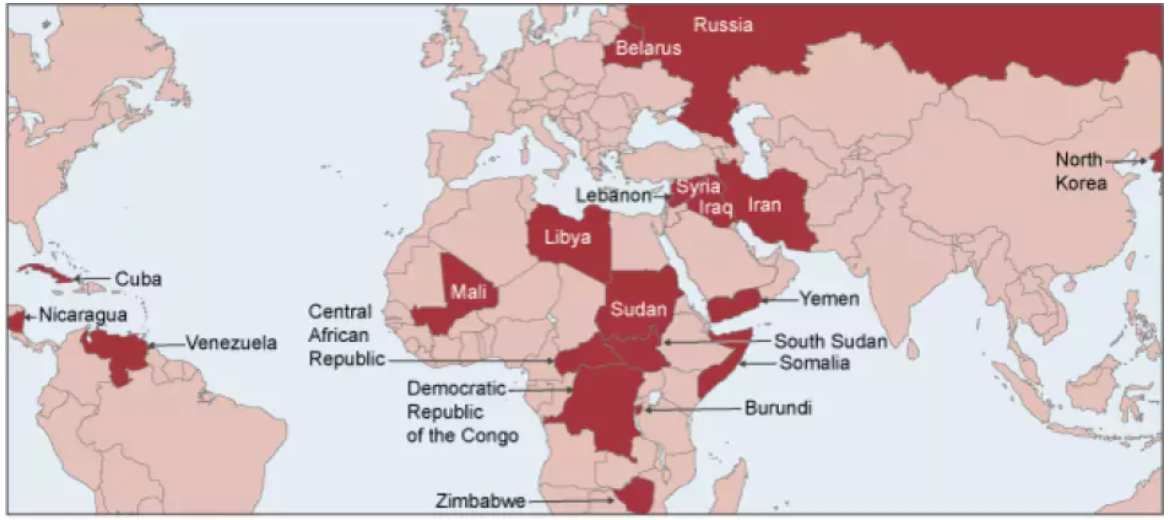
    The United States has applied more economic sanctions than any other country or trading bloc in the world. This year, 2024, it has comprehensive sanctions in force targeting Cuba, North Korea, Iran, Russia, and Syria, alongside more than a dozen programmes targeting individuals and other entitles, including some targeting criminal behaviour such as drugs trafficking.

    A decision to create a new set of economic sanctions can be taken by the president or by congress. A president can start the process by issuing an executive order (EO) declaring an emergency in response to an “unusual and extraordinary threat”, such as in one example, “the actions and policies of the Government of the Russian Federation with respect to Ukraine” (EO13661). This gives the president powers to regulate commerce for one year (unless extended or terminated by a joint resolution of congress). Over 50 such states of emergency have been declared since 1976 with over 30 currently in place.  Congress in turn can pass legislation imposing new sanctions or modifying or terminating existing ones.

    Country-Based and Country-Related U.S. Sanctions Programs as of July 2019

    Source: GAO presentation of Department of the Treasury and Department of State

    There have been some conflicts over sanctions in the US between the executive and legislative powers. For example, in 2017 congress imposed sanctions on Russia for its alleged interference in the 2016 US presidential election. President Trump (who was arguably favoured by such intervention) ended up reluctantly signing the bill because congress had sufficient legislative backing to override any presidential veto.

    US sanctions are administered by the Office of Foreign Assets Control (OFAC), which is part of the Treasury Department. OFAC regularly adds or deletes individuals, companies, and groups to its blacklist of around 12,000 “specially designated nationals” (SDNs). Other US government departments are often involved, such as those of State, Commerce, Homeland Security, and Justice. The Secretary of State has powers to designate a group as a “foreign terrorist organisation” or to designate a country a “state sponsor of terrorism”, and such designations also have implications for sanctions. State and local authorities can be involved: the state and city of New York plays an important role in these procedures largely because of its role as a global financial centre.

    US legislation also includes what can be called subject-matter sanctions. One example is the Foreign Narcotics Kingpin Designation Act, approved by congress in 1999. It aims to prevent access to the US financial system and bans all trade and transactions between traffickers and US companies or individuals. The bill includes a mechanism by which individuals or groups can be designated as “significant foreign narcotics traffickers”. Its origins go back to the mid-1990s when President Bill Clinton (1993-2001) was primarily seeking to target the activities of the Colombia-based Cali Cartel.

    Significantly, every US president since Clinton, whether Democratic or Republican, has invoked the Kingpin Act on various occasions. During the presidency of Barack Obama (2009-2017), in June 2016, for example, OFAC issued a “finding of violation” against BBVA USA, the subsidiary of Spanish bank BBVA, for maintaining the accounts of two individuals on the SDN list, accused of being money-launderers for Mexican drug cartel leader Rafael Caro Quintero. In early 2020 the US authorities arrested Jessica Johanna Oseguerra, a dual nationality Mexican-US citizen who is also the daughter of Nemesio Oseguerra Cervantes, leader of Mexico’s powerful Cartel Jalisco Nueva Generación (CJNG). She faced criminal charges under the Kingpin Act, as the owner of six businesses designated for providing support to narcotics trafficking operations by the CJNG. Jessica pleaded guilty and in March 2021 was sentenced to 30 months in prison.

    Also significant in this context is the Global Magnitsky Human Rights Accountability Act, approved by congress is 2012. This legislation is named after Russian tax lawyer Sergei Magnitsky, who died in a Moscow prison in 2009 after being persecuted and maltreated for his role in investigating a reported US$230m fraud involving Russian tax officials. The act allows the US government to sanction foreign government officials worldwide who are human rights offenders, including powers to freeze any assets they may have under US jurisdiction and ban them from visiting the US.

    An example of the operation of the Magnitsky Act in practice came in January 2023 when OFAC invoked it to sanction Horacio Manuel Cartes, the former president of Paraguay (2013-2018), and Hugo Adalberto Velasquez Moreno who served as vice-president in a subsequent administration (2018-2023). OFAC said both men had been designated for “their involvement in the rampant corruption that undermines democratic institutions in Paraguay”. Also listed were companies owned or controlled by Cartes, including Tabacos USA Inc, Bebidas USA Inc, Dominicana Acquisition SA, and Frigorífico Chajha SAE. The sanctions were under the authority of Executive Order 13818 which implements the Global Magnitsky Act. Cartes remains active in Paraguayan politics.

  • URUGUAY: Military should strive for peace

    LatinNews 08 November 2012 Hits: 397

    Uruguay’s defence minister, Eleuterio Fernández Huidobro, delivered a speech at the tenth biennial conference of defence ministers of the Americas (CDMA), held in Punta Del Este, Uruguay on 8 -11 October, which it is fair to say stood out as somewhat different from previous speeches delivered at the CDMA by defence ministers of host nations. It was certainly not quite what they might have expected to hear.

    Fernández Huidobro quoted Albert Einstein (“the fourth world war will be fought with stone clubs” and “Only two things are infinite, the universe and human stupidity, and I’m not sure about the former”); Domingo Faustino Sarmiento, who after fleeing from civil war in Argentina in the early 19th century wrote on a rock, “Barbarians! Ideas cannot be killed”, to which the Uruguayan philosopher Vaz Ferreira added some years later, “but neither can bad ones”; and Gabriel García Márquez, at length.

    “In Macondo (in One Hundred Years of Solitude) they hang a sign on the cow: ‘This is the cow’. Today we are living in Macondo, much more than we suspect,” Fernández Huidobro argued. “To growth and development we need to put up explanatory signs since today what we call growth is a disaster foretold and what we call development is a myth since it is impossible that all the inhabitants in the world can have the same levels of consumerism and waste that we are given as a model.”

    He went on: “If all the countries in the world grew in this way, the planet would collapse irremediably. It is not for everyone. This model forcefully excludes. It is for some. Mathematically it is like this. Even GDP, as a yardstick, is a highly contaminated fraud. It measures contradictory things… In particular it does not measure human happiness. Or environmental damage. It is like the handsaw which cuts the branch upon which we are sitting, sawing with enthusiasm. The other problem we have with mathematics is the formula of compound interest. This mind-blowing weapon of mass destruction, also of exponential growth which the banks manipulate and upon which the ramshackle monetary system and current system of global finance is based.”

    Fernández Huidobro then argued that “the population crisis, the drinking water crisis, energy crisis and food crisis are the four new horsemen of the Apocalypse”. He talked about the vast amount of money squandered on military spending which could solve many of these problems, before finally getting to the point of his message to those gathered in Punta del Este: “the material limits of countries (means that) there should be no other objective than peace. There can be nothing more desirable from our work than peace. It cannot be anything but peace. Unequivocally it must be about peace. National, regional, hemispheric and world peace…”

    While delivering the inaugural speech at the CDMA, President José Mujica similarly stressed that “we have to stage meetings between defence ministers to concern ourselves with peace… The greatest war is against inequality and poverty”. He added that he had “never imagined”, as a former Tupamaro guerrilla (just like Fernández Huidobro), to be addressing a regional conference of defence ministers but that he was honoured to do so.

    Peace has long been the primary concern of Uruguay’s armed forces. Uruguay is the largest contributor of peacekeepers in the hemisphere and one of the largest per-capita contributors in the world. The armed forces also play a key role in disaster relief. US Defense Secretary Leon Panetta spoke at length at the CDMA about the important role of the armed forces across the hemisphere in disaster relief (see sidebar).

    Military cooperation in the South Atlantic

    Argentina, Brazil and Uruguay participated in the biennial Atlasur maritime exercise with South Africa from 25 September to 10 October. The aim of the naval exercise is to improve the combined maritime doctrine in the South Atlantic and develop a partnership with South African military forces.

    The ninth Atlasur joint training exercise was hosted by South Africa. In addition to classic naval exercises it included a focus on Special Forces tactics as well as anti-submarine warfare exercises, anti-aircraft firing exercises and Vertical replenishment, or VERTREP, a method of supply of seaborne vessels by helicopter.

    The Argentine and Brazilian corvettes, ‘Spiro’ and ‘Barroso’ respectively, participated with the frigate ‘ROU 01 Uruguay’ and a frigate and a submarine from South Africa. Atlasur VIII took place in Argentine maritime waters back in 2010.

    “Brazil sees Atlasur as one of the most important international joint exercises between the four navies,” Brazil’s defence and naval attaché, Captain Paulo Cesar Demby Corrêa, observed. “Each exercise improves a little bit more of our inter-operability and our professional skills from all four navies involved,” Corrêa said (see sidebar).

    The Atlasur exercises have been carried out every two years since 1993. In the first year they started off as joint naval exercises between Argentina and South Africa, but in 1995 Brazil and Uruguay also took part. ‘ROU 01 Uruguay’ was welcomed into port in Montevideo by the naval top brass and defence minister Fernández Huidobro on 20 October. Fernández Huidobro repeated the same message he gave at the CDMA in Punta del Este: “these exercises”, he said, “should be carried out with the overarching goal of seeking peace”.

    • Disaster relief

    US Defense Secretary Leon Panetta called for the approval of a new plan to set up a database to allow nations to coordinate their responses to disasters and organise humanitarian relief efforts more effectively. “Western Hemisphere nations worked together to provide much-needed help, but we lacked a mechanism to collaborate in real-time and focus our efforts where they were needed most,” he said, in allusion to criticism of the disaster response to the devastating earthquake in Haiti in January 2010. The CDMA agreed to allow data sharing to improve coordination of military support to disaster relief.

    • Special Forces

    The Special Forces training exercise during Atlasur IX involved a scenario on the Cape Peninsula in which a royal prince was kidnapped and taken to a ship anchored offshore. A rescue mission was then staged. “This inter-operability in the fast rope exercises, the snipers, the procedures, the helicopter approach, all these tactical procedures are very important for this Special Forces team because it is not easy to carry out or conduct an exercise like this at sea,” Brazil’s Captain Paulo Cesar Demby Corrêa said.

  • ARGENTINA: Disturbios en Tucumán dan una oportunidad a la oposición

    LatinNews 28 August 2015 Hits: 314

    En una conferencia de prensa conjunta del 26 de agosto los principales candidatos presidenciales de la oposición política en la Argentina exigieron “transparencia” para las elecciones generales del 25 de octubre. Durante el fin de semana (22-23 de agosto), las elecciones en la provincia norteña de Tucumán fueron estropeadas por las acusaciones de fraude y demostraciones que fueron reprimidas violentamente. Para enfatizar su posición, los candidatos opositores fueron acompañados en el escenario por José Cano, el candidato a gobernador de Tucumán de la Unión Cívica Radical (UCR), quien perdió la votación del domingo ante Juan Manzur, del Frente para la Victoria (FPV, Kirchneristas), la facción gobernante del Partido Justicialista (PJ, Peronistas).

    Tucumán es el sexto mayor distrito electoral de Argentina; desde 1999 ha sido gobernada por el PJ. Los resultados preliminares de la contienda del 23 de agosto sugerían que Manzur venció a Cano por al menos 14 puntos porcentuales, una victoria más estrecha de lo previsto. Sin embargo, los resultados se vieron empañados por acusaciones generalizadas de fraude.

    Se sabe que al menos 42 urnas con votos fueron quemadas, de un total de 3.000 en toda la provincia. El recuento provisional también excluyó un número sustancial de los votos en la capital provincial, San Miguel de Tucumán, un bastión de la oposición. Curiosamente, la oposición perdió a pesar de arrasar en cuatro ciudades principales de Tucumán. Las autoridades electorales locales descartaron celebrar elecciones de nuevo.

    Las imágenes de las urnas quemadas pronto se volvieron virales, provocando demostraciones. Alrededor de 10.000 personas salieron a las calles de la capital provincial el 24 de agosto, lo que produjo una severa represión de la policía local. Secuencias mostradas por la TV de la policía usando gas lacrimógeno, spray de pimienta, y balas de goma para contener las protestas indignaron a muchos argentinos a través del país. Fueron hospitalizadas 22 personas. La noche siguiente unas estimadas 30.000 personas marcharon en Tucumán, aunque en la segunda noche, la policía adoptó un enfoque más tolerante.

    El oficial de policía a cargo en la noche del 24 de agosto, ha sido acusado por el fiscal público por heridas, abuso de autoridad, y por no cumplir con su deber. José Alperovich, el gobernador kirchnerista de línea dura, a quien se responsabiliza del accionar de la policía, condenó los “excesos” de las fuerzas de seguridad.

    Daniel Scioli, el candidato presidencial del FPV, viajó a Tucumán para felicitar a Manzur. Él lamentó las acciones de la policía, pero culpó directamente a la oposición. “Entiendo que Mauricio Macri [el candidato presidencial del opositor de centro-derecha Propuesta Republicana (PRO)] esté haciendo campaña, pero él no debería haber motivado a los residentes de Tucumán para que salgan a las calles porque terminamos en situaciones como las que hemos visto ayer”, dijo Scioli.

    En la secuela inmediata al malestar, otras figuras del gobierno acusaron a la oposición de estar buscando usar los incidentes del domingo para socavar la credibilidad de las elecciones de octubre. Aníbal Fernández, el jefe de gabinete del gobierno federal, afirmó que la oposición estaba intentando montar “un plan orquestado fuera de nuestro país con saboteadores pagados en nuestro país”. Él desechó la cuestión de las urnas de votos quemadas, alegando que los responsables ya habían sido arrestados.

    Hablando el 26 de agosto, Cano explicó las varias irregularidades observadas durante las elecciones del domingo. “Dos de nuestros candidatos fueron atacados, bolsas de alimentos fueron entregadas [a votantes que apoyaban a Manzur] y hubo una movilización de votantes, que está expresamente prohibida por la ley, y el gobierno provincial no hizo nada para frenarla”, dijo Cano.

    Macri tomó el micrófono poco después, declarando que el evento estaba siendo realizado “en solidaridad con el pueblo de Tucumán”. Pidiendo la implementación del voto electrónico en todo el país en octubre, Macri dijo, “tenemos que garantizar la transparencia, no solamente sobre lo que ocurrió en Tucumán, sino en las elecciones que llegarán en unas pocas semanas”.

    • Scioli

    Sin que haya serios disturbios, o un significativo deterioro de las perspectivas económicas de Argentina, la oposición se verá en dificultades para derrotar al candidato presidencial del gobierno, Daniel Scioli. Con 8,3 puntos porcentuales de ventaja sobre Mauricio Macri, en las recientes primarias, Scioli sólo necesita que este margen se incremente a más de 10 puntos porcentuales para ganar en la primera ronda. Pero si no lo logra, la segunda ronda podría ser muy apretada.

  • Region: Corporate Radar

    LatinNews 09 October 2017 Hits: 587

    Oil companies amend Argentine labour contracts: CGP (part of Corporación América), Roch, and ENAP Sipetrol Argentina, three private sector oil companies operating in the state of Santa Cruz, have signed an agreement with the three main oil workers’ unions to introduce more flexible labour contracts. It follows a similar agreement in Neuquén province earlier this year and is part of a government-supported plan to improve competitiveness and protect employment levels. Since 2010, Argentina has been a net energy importer; the government of President Mauricio Macri wants to encourage private companies to boost domestic energy production.

    Chilean bank profits up: Chilean bank profitability rose by 7.12% in the first eight months of the year, reflecting higher interest income and lower operating costs, the banking regulator Superintendencia de Bancos e Instituciones Financieras (SBIF) reported. Total profits in the period were US$2.45bn. Santander Chile, the largest bank in the country by asset value, also led the ranking by profits, with US$611m, followed in second place by Banco de Chile with US$610m. The growth of year-on-year bank lending slowed to 2.85% in August, reflecting a combined slowdown in the three main credit categories: consumer lending, mortgage lending and corporate lending.

    Avianca dispute goes to arbitration: After a week-long strike by the majority of pilots employed by Colombia-based airline Avianca, on 29 September Colombia’s labour minister Griselda Restrepo said she was imposing an obligatory arbitration process. Avianca and the pilot’s union, Asociación Colombiana de Aviadores Civiles (ACDAC), are required to each nominate one representative to a three-person arbitration panel, and to choose the third by consensus. If the two sides cannot agree on the choice of the third panel member, one will be chosen at random from a short-list compiled by the Supreme Court. It was not immediately clear whether normal services would resume pending the arbitration order, or whether the ACDAC members would continue with their strike action. A total of around 700 of the airline’s 1,300 pilots have been on strike, forcing cancellation of roughly half of Avianca’s scheduled flights.

    Ternium announces Mexico and Colombia investments: Latin American steel group Ternium says it is investing in a new hot rolling mill at its Pesquería plant in Mexico, along with a new reinforced steel bar facility in northern Colombia. The company said the new hot rolling mill in Mexico would upgrade and modernise the country’s steel capacity and replace high-value steel imports. With a total investment of US$1.1bn, the plant will have annual capacity of 3.7m tonnes and come on-stream in the second half of 2020.

    “The Colombia-based steel bar facility will enable us to expand our market share in the dynamic construction sector by offering an alternative to imports” said Ternium CEO, Daniel Novegil. The company is investing US$90m in the plant, taking overall reinforced bar capacity to 720,000 tonnes as of the second half of 2019. Ternium was formed in 2005 by the merger of Siderar of Argentina, Sidor of Venezuela and Hylsa of Mexico. It is the leading Latin American steel company, operating plants in Argentina, Mexico, Guatemala, Colombia and the US.

  • REGION: Angry islands

    Sarah Sheldon 12 December 2022 Hits: 182

    The big and controversial issue at the United Nations Climate Change Conference (COP27) in Sharm el-Sheikh, Egypt, was “loss and damage” - the idea that wealthy, high polluting countries should pay into a fund to compensate poorer countries who are suffering the adverse impacts of the climate change their pollution has caused. Thanks in part to the voices of Caribbean leaders, an 11th hour agreement to make voluntary contributions to such a fund was eventually reached, providing a silver lining to an otherwise gloomy summit.  

    Big powers like the US were initially against the concept of climate-related loss and damage, which could tie them into significant financial commitments. They have preferred looser, more voluntary schemes. The Group of Seven (G7), an informal grouping of advanced economies for example, supports a plan known as ‘Global Shield’ which will provide pre-arranged subsidised insurance and disaster protection to poorer countries. It would expand some existing arrangements such as the Caribbean Catastrophe Risk Insurance Facility CCRIF), which helps limit the financial impact of natural hazard events on Caribbean and Central American governments by providing short-term liquidity when required. But environmental campaigners say such schemes should be in addition to, rather than instead of, loss and damage.

    Prime minister of Antigua & Barbuda, Gaston Browne, spoke passionately about climate change impacts on small island states. He rejected the idea that his island home might have to be abandoned because of rising sea levels, turning its population of some 98,000 into “climate refugees”.

    He said funding should come not only from the US and Europe but also from other “major polluters” such as India and China. Browne noted that because of drought, the country now must rely on energy intensive reverse osmosis for its drinking water, making local agriculture virtually impossible and forcing it to import 90% of its food. In his view climate diplomacy to address these problems is progressing too slowly, and Antigua and other poor island states may have to turn to international courts in an attempt to seek redress.

    COP27 also saw the emergence of Prime Minister Mia Mottley of Barbados as a major voice making the case for the victims of climate change. Channelling the 1970s Jamaican super-group Bob Marley and the Wailers, she asked “who will get up and stand up for the rights of our people?” At COP26 in Glasgow last year she said rising temperatures were a “dreaded death sentence” for island states. This year at the Summit of the Americas in Los Angeles, she said such countries are trapped in a vicious cycle of debt, rising borrowing costs, and inaccessible green technology.

    Mottley helped shape the Bridgetown Initiative, a wide-ranging report which calls for major reforms to the Bretton Woods international financial system so as to mobilise some US$1trn of lending to tackle climate change and achieve the United Nations (UN)’ sustainable development goals. One of her advisors on the report, Avinash Persaud, has insisted on the need to be “stark about the fact that 40% of the world is burning and drowning, and those with the greatest capacity to do something are not doing something”. Some go as far as suggesting Mottley could be a candidate for the role of UN Secretary General in 2026, potentially the first woman the hold the role. Whether that happens or not, she is likely to continue highlighting the case for climate change funding in the Caribbean and beyond.      

  • Risk pointers

    LatinNews 28 November 2012 Hits: 500

    *** Warning of North Korean missile launch.  Military sources in South Korea have been quoted locally as saying that North Korea is likely to launch a long-range missile in the next two months.  The intelligence is based on US satellite images showing increased activity at a North Korean missile site.  A senior South Korean military official was quoted as saying: “[The South Korean military] is judging that there is a high possibility of [North Korea] firing off the missile between December and January of next year.”  In April, it is thought that North Korea botched a long-range missile test.

    On 27 November, South Korea’s Defence Minister Kim Kwan-jin told a meeting of senior military officers and officials: “After the power transition [North Korean leader] Kim Jong-un will continue to strengthen his grip on power and maintain his hard-line stance on the South.”

    *** Indian caution on China.  India’s Union Minister Farooq Abdullah was quoted on 26 November as saying that while India is extending the hand of friendship to China on the one hand, on the other it remained cautious about Chinese intentions.

    Explaining to a gathering of students why India is deploying another division to the disputed Kashmir region of Ladakh, he said: “I want to tell you that in one place we are befriending China but we have also learnt a lesson from China and that is why we remain cautious as well.”

    He added: “We had one full division there and now we are putting another division there because we have threat from China and I don’t say that outside but I am telling you because you are Indians.”

    Abdullah also said that while China was pursuing huge infrastructure projects on the border with Arunachal Pradesh, India was “still thinking”.

    *** Israeli threat to Hamas.  Speaking on 22 November, Israel’s Foreign Minister Avigdor Lieberman said that despite the ceasefire in Gaza, Israel would “eventually need to overthrow the Hamas regime” in Gaza.

    Separately, Iran has made much of Israel’s agreement to a ceasefire in Gaza, presenting it as a defeat for Israel.  More importantly, it does seem to have taken this as further evidence that Israel does not have the appetite to attack Iran’s nuclear facilities.  Iran’s navy commander Rear Admiral Habibollah Sayyari said that the war proved that the “Zionist regime is a paper tiger”.