At the macro-economic level the Venezuelan economy has since 2013 suffered a series of major and closely inter-related problems. An understanding of how they have developed and how they might be solved is important for any forward-looking recovery plan. We have identified six interlocking problems that will need to be addressed. They are hyperinflation, foreign debt, the collapse of the productive sector, poverty, emigration, and the Covid-19 pandemic. Brief comments on each are made in the following section of this report. A general comment covering all of them, and in fact applicable to almost all of this report, is that Venezuelan economic data is unreliable and published only intermittingly. In many cases data series only cover developments up to 3-4 years ago.
Hyperinflation
Broadly speaking hyperinflation occurs when prices for goods and services rise at over 50% per month. Since 2013 Venezuela has had one of the world’s highest inflation rates. The government seldom publishes inflation data, although the opposition-led legislature (Asamblea Nacional – AN) compiles its own index. In its World Economic Outlook report for April 2020 the International Monetary Fund (IMF) published estimates of inflation running up to 2019, as well as forecasts for 2020 and 2021. These show that end of period (eop) consumer prices rose by 56.1% in 2013 increasing further to 274.3% in 2016 and to 862.6% in 2017. In 2018 true hyperinflation began, with prices rising by 130,060% in that year. In 2019 the IMF measured a reduction to 9,585%, but it was still predicting an incredible 15 million % inflation rate for both 2020 and 2021.
The explanation for Venezuelan hyperinflation is relatively simple. The Venezuelan government consistently spends much more money than it is able to raise from exports or through taxes, and it therefore runs a massive fiscal deficit. Estimates for the size of that deficit run up to nearly 30% of GDP in both 2018 and 2019. The government has also manipulated multi-tier exchange rates to ration scarce foreign currency, which has inevitably caused distortions and created a black market. In essence, the Central Bank has simply printed money to try and cover domestic and currency deficits, thereby fuelling an intense cycle of price rises and relentless currency depreciation. When inflation is so high there are leads and lags in the rates of price increase experienced for different goods and services. This, coupled with rationing, encourages short term speculation, known in Venezuela as bachaqueo. It is reputed to be practiced by a large proportion of the population as an economic survival technique.
In reality both government and opposition know that hyperinflation has destroyed the national currency, the Bolívar Soberano. The government has experimented inconclusively with a crypto currency, the Petro, but in 2018-2020 it implicitly accepted a growing dollarisation of the economy. Many opposition recovery plans are also based on the idea of dollarisation or the creation of some kind of strong new currency.
Foreign debt
In simple terms there are two overriding problems connected with Venezuela’s foreign debt. First, it is not clear how much the country actually owes, since the government has been opaque about its borrowing and used funding from a number of sources (including China) without revealing the exact amount involved, the repayment terms, or the interest rates agreed. Second, the country’s capacity to service its foreign debt is also unclear, given the rapid contraction in the economy and uncertainty over future foreign currency revenues from oil exports. Venezuela obviously struggles to service its debt and is considered by western ratings agencies to have fallen into technical default on a number of loans.
According to investment bank Torino Capital, at the end of 2019 Venezuela’s debt was in excess of US$135bn. Of that total some US$13bn was owed to China, with US$3bn owed to Russia. In addition, foreign investors held around US$24bn of sovereign bonds and a further US$28bn of state oil company (PDVSA) corporate bonds. Moises Rendón and Gerver Torres, Venezuela experts at the US-based think tank Centre for Strategic & International Studies (CSIS), have estimated that Venezuela’s current foreign debt is higher, in the range of US$170bn-US$200bn, distributed among sovereign bond holders, bilateral lenders, and other creditors. They say that if the real size of domestic GDP, bearing in mind recent years of drastic shrinkage, is around US$60bn, this would suggest that the true debt-to-GDP ratio is around 300%, way above the most heavily indebted Latin American borrowers (most of which have debt ratios of under 100%). Looking further afield Japan is notorious for its heavy debt burden, which stood at 200.6% in 2019, but that is still significantly below that of Venezuela.
In theory foreign loans and other capital inflows invested in a developing economy are designed to increase its productive capacity and, over the long term, generate new hard currency revenue streams which are sufficient to repay the capital and interest on the debt as well as leaving a surplus for reinvestment. However, Torres makes the point that most of the money that flowed in promptly “disappeared” through corruption and mismanagement, meaning the country’s capacity to repay remains extremely weak. The legal situation is also complicated because some as-yet unpaid creditors have initiated legal action to seize Venezuelan overseas assets (such as US-based PDVSA refining subsidiary CITGO) to offset their losses.
Poverty
As has been mentioned previously, in the early years of chavismo windfall export revenues received at times of high international oil prices were used to redistribute income and boost the government’s popularity among the poor. When the PSUV first took office, the population living under the poverty line stood at 43%. Despite a setback during 2003 and 2004 the government was able to reduce poverty down to a point where it affected something like 26%-29% of the total population in a six-year period from 2007-2013. This was a comparative high point in its performance. However, here too 2014/2015 stands out as a negative turning point in Venezuela’s fortunes. According to household survey census data the proportion of the population living in poverty in those years began to surge upwards reaching 87% by 2017. Everything suggests that poverty will have increased further in 2018-2020.
Population under Poverty Line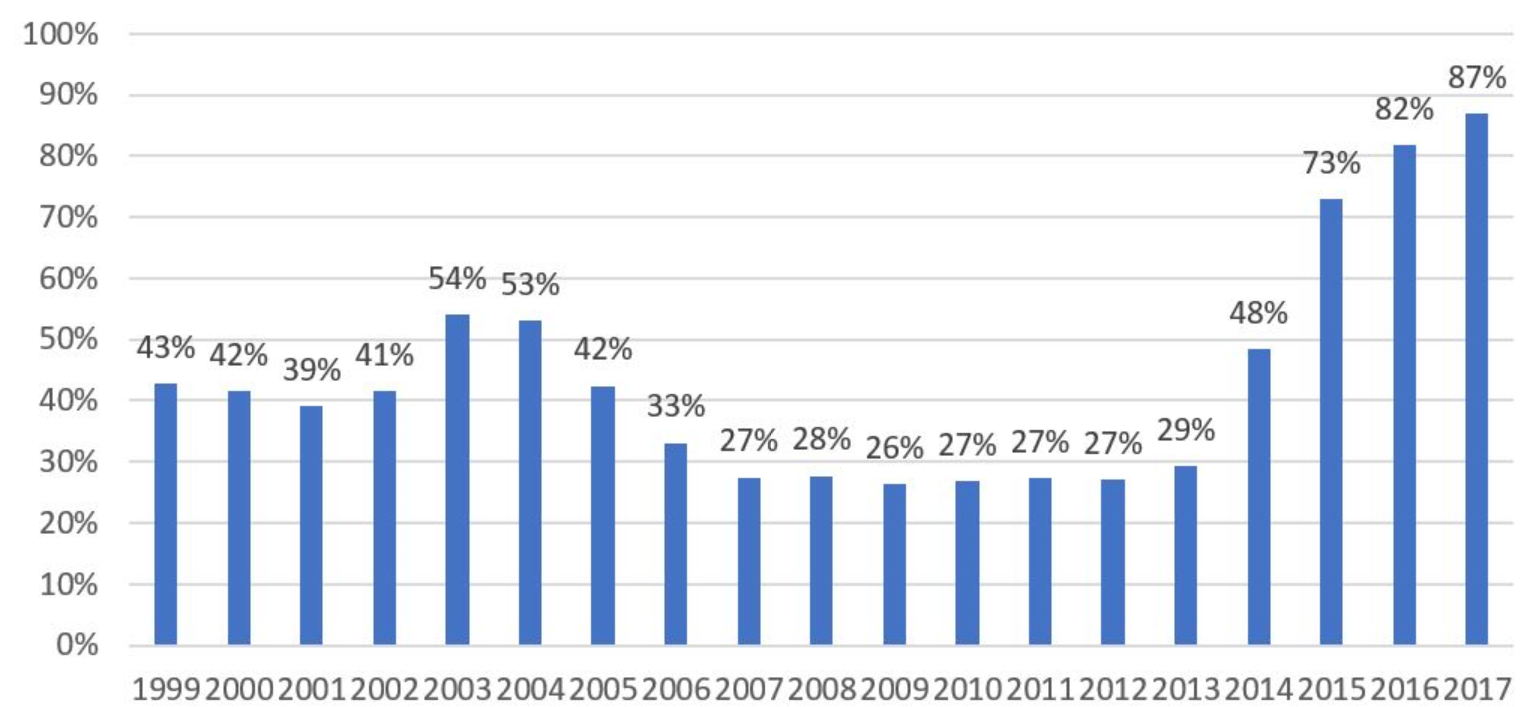
Source: CSIS
Other data confirms the dramatic drop in Venezuela’s standard of living. Given the dramatic depreciation of the Bolívar Soberano, Venezuela’s monthly minimum salary now stands at around US$6, compared to US$407 in Chile, US$294 in Brazil, US$60 in Haiti, and US$9 in Cuba.
The productive sector
Reporting on Venezuela often overlooks, or otherwise takes as understood, the sharp contraction of the country’s non-oil sector. In the 1990s Venezuela had well-developed mining (including bauxite/aluminium, iron ore, and cement), manufacturing (including auto-assembly and equipment plants), agriculture and food processing, construction, real estate, and tourism sectors. While not self-sufficient in agriculture, food exports included rice, maize, fish, tropical fruit, coffee, pork, and beef. In the 1990s Venezuela produced around 70% of the food it consumed, relying on imports for the remaining 30%. That ratio has now almost completely flipped around, so only 30% of food is produced locally and 70% is imported.
This non-oil sector has suffered accelerated deterioration for a number of reasons. One is that the business environment has been lethal. Private sector companies have been squeezed by an uncompetitive currency, sharp drops in demand caused by volatility in the oil sector, and, for much of the last 20 years, price controls that have made it difficult, if not impossible, to operate profitably.
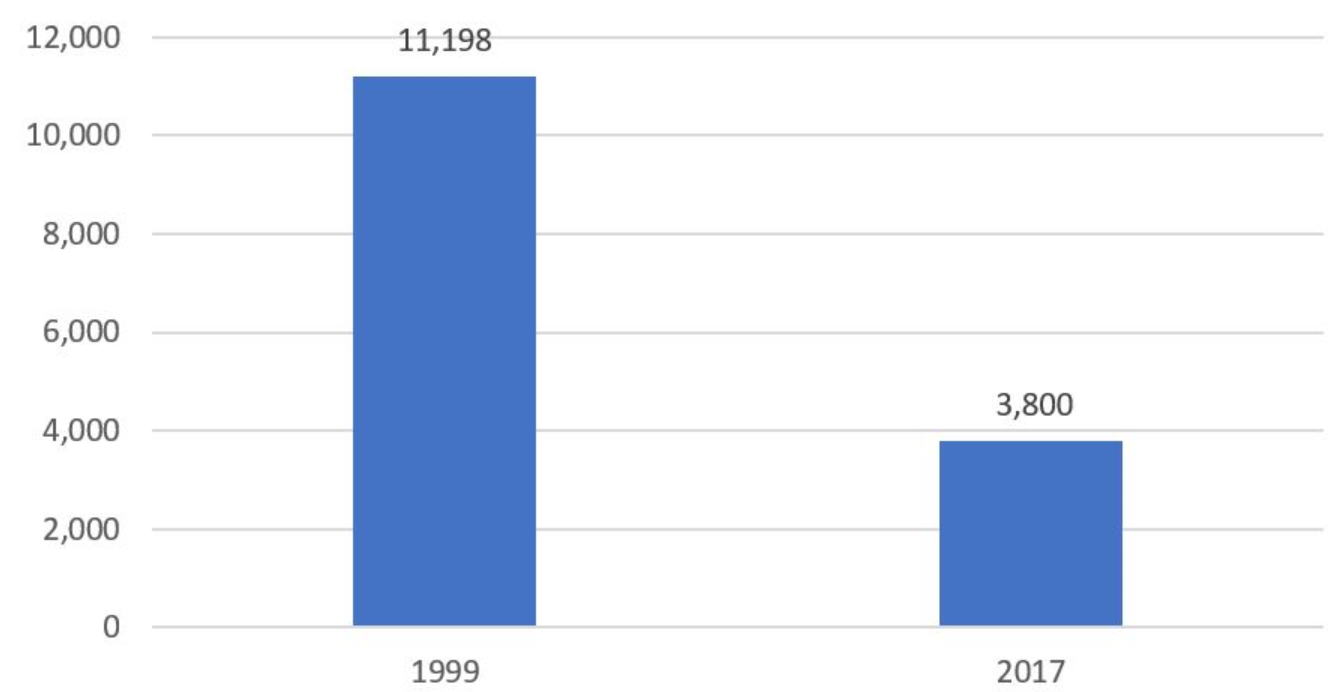
The government responded to economic difficulties by blaming the private sector on ideological grounds, often expropriating privately owned companies in leading economic sectors. Among companies expropriated or nationalised were ConocoPhillips and Exxon Mobil (oil), Sidor/Ternium (Venezuela’s largest steel producer), Cargill (food processing), Fertinitro (fertilisers), Vestey Foods (meat packing), Banco de Venezuela/Banco Federal (finance), Gold Reserve (gold mining), CANTV (telecoms), AES Corp (power), and Los Roques (a tourism resort). In most cases nationalisation led to falling production due to corruption, a failure to invest, and the introduction of politically appointed managers completely lacking in appropriate industry experience. One sign of the destruction of the private sector is that the number of industrial companies has fallen by two-thirds in 1999-2017.
Industrial Companies in Venezuela
Source: Conindustria and Reporte 1
Migration
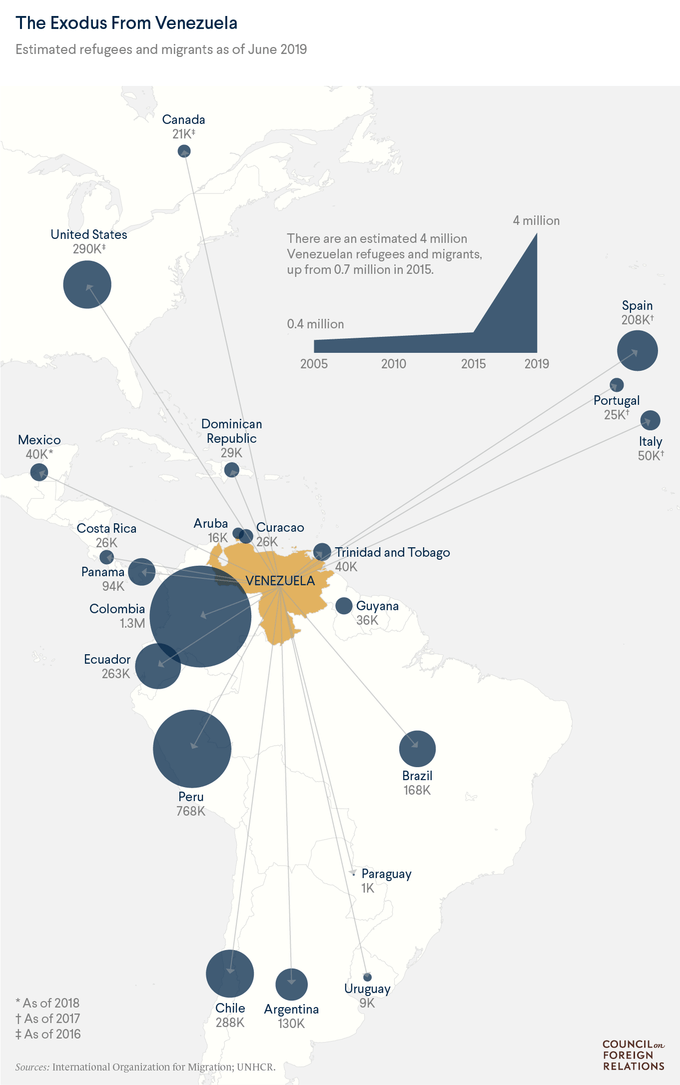
A combination of political repression, rising unemployment, and falling standards of living came together to cause a mass exodus of Venezuelans which was particularly acute in the years after 2015. Estimates have varied over time, but by 2019/2020 it was thought that somewhere between 4m and 5m people had left the country, representing as much as 14%-17% of the total population. Roughly eight out of 10 emigrants stay in Latin America, with the principal destinations being Colombia, Peru, Ecuador, the United States, Chile, and Brazil. The outward flow was partially reversed with the advent of the Covid-19 pandemic in March 2020. This was because many Venezuelans who had left to find a new life in neighbouring countries were affected by lockdown and quarantine measures in their destination countries and lost their formal or informal employment there. As a result, they had no option but to return home, facing a hostile reaction from the authorities (the government argued that returnees needed to go into enforced isolation to reduce risks of coronavirus infection).
The sheer scale of the exodus is highly relevant for any economic recovery plan. At one level migration has a medium-term stabilising effect, as newly expatriated Venezuelans find jobs in their destination countries and begin sending remittances back home. In that sense Venezuela may be transitioning towards the economic model of low-income, high unemployment seen in Central American countries, such as Honduras and El Salvador, where dollar remittances sent home from expatriate workers can represent over 10% of GDP. However, in the longer term the exodus represents a deeply damaging loss of skilled workers and economic potential. Any future Venezuelan government is likely to seek economic and social incentives to encourage at least part of the diaspora to return.