All Categories

Subcategories

  • PARAGUAY: Lugo is finally forced to dismiss Indert head

    LatinNews 18 May 2012 Hits: 1114

    The land and rural development institute (Indert) has been at the very centre of the controversial land ownership disputes that have plagued Paraguay in recent years. The Indert and indeed its now defunct predecessor, the Stroessner-era rural welfare institute (IBR), have a long history of incompetence and an equally damming reputation for being corrupt. In the past two years, the Indert’s shortcomings have been vividly exposed as President Fernando Lugo’s administration has struggled to push forth its proposed agrarian reform.

    Since replacing the IBR in 2003, the Indert has been in charge of quantifying ‘idle’ or ‘surplus’ state lands and to re-distribute these to landless farmers. However it is criticised for not doing enough to address the heavy concentration of land ownership and in fact has been blamed for promoting it for political means (various cases of the Indert showing favouritism toward the government political allies and their relatives have surfaced over the years). When President Lugo came to power in 2010 he promised a comprehensive agrarian reform and called on the Indert to work exclusively to this end. However President Lugo’s term has been marked by serious land disputes between self-proclaimed landless farmers and wealthy landowners, as the promised agrarian reform failed to materialise. To make matters worse, to date most attempts by the Indert to acquire land for redistribution have been plagued by corruption allegations. As result little has been achieved. The most notorious example of this was the Inder’s attempt (in 2010) to purchase lands in San Pedro from a Brazilian settler, Ulises Rodrigues Teixeira.

    On 28 February last a frustrated Lugo finally ordered an intervention in the Indert. The Presidential legal advisor, Emilio Camacho, was designated as the official intervenor and the Indert president, Marciano Barreto, was temporarily suspended pending Camacho’s interventions. Barreto had only assumed the post in April 2011, when he replaced Eugenio Alonso Massare, who was criticised by landless farmers for continuously blocking the purchase of the Teixeira lands. In contrast Barreto was recommended for the post by Sixto Pereira, a close aide of President Lugo and largely identified with the landless farmer movement.

    Within weeks Camacho revealed that had found evidence of serious administrative irregularities pointing to internal corruption, including the creation of “phantom settlements and the unauthorised sale of state lands”. Yet Lugo appeared very reluctant to dismiss Barreto, prompting speculation that in reality Barreto was doing Lugo’s bidding at the Indert. Landowners perceive the Lugo government as sympathetic to the often violent landless farmers and accuse the Indert of taking a biased approach in land dispute cases.

    However, the political pressure on Barreto mounted on 11 April when the opposition Partido Patria Querida (PPQ) pressed charges against him for authorising the irregular sale of state owned lands. PPQ deputies Carlos Soler and Sebastián Acha presented a formal complaint before the economic crimes investigation unit alleging that Barreto had personally authorised the sale of state lands in the department of Alto Paraguay for a value of Gs.36m (US$8,096) when in reality they were valued at US$3.5m. As the case gained momentum and with Camacho’s report due imminently, t Lugo finally took the decision to formally sack Barreto on 9 May. Upon his dismissal Barreto was very critical of the president and accused him of no longer being in charge of the government. Barreto blamed his dismissal on the fact that powerful politicians like the presidential secretary, Miguel Angel López Perito, want to use the Indert for future political campaigns.

    • Landless farmers push for Teixeira purchase again

    On 14 May, to commemorate Paraguay’s independence celebrations, members of the Liga Nacional de Carperos (LNC) organised a march in Santa Rosa del Aguaray, San Pedro, and announced that they would give the government 15 days to purchase 7,800 hectares of lands belonging to Ulises Rodrigues Teixeira near Paso Kurusú, San Pedro. The LNG leader, Eulalio López, complained that a year after the government had announced the purchase of the lands “absolutely nothing has been done and our colleagues are ready to go to war if necessary”. López added that LNC members around the country were on alert and “if the government or congress blocks the purchase again we will take over the lands, as we have in Ñacunday”.
  • TRACKING TRENDS

    LatinNews 28 August 2014 Hits: 2132

    PERU | Growth forecast cut again. On 20 August Peru’s central bank (BCRP) announced it was cutting its growth forecast for the year from 4.4% to 4%. This is the second time that the BCRP has cut its growth forecast rate this year after previously having done so in April. The decision confirms that the slowdown in domestic economic activity in Peru this year continues despite the economic stimulus packages designed to boost domestic investment levels implemented by the government led by President Ollanta Humala and the BCRP’s adoption of an expansionary monetary policy.

    The announcement of the revision was made by the BCRP’s general manager, Renzo Rossini, who explained that it came after the bank’s data showed that year-on-year economic growth for June had been just 0.3%, the lowest monthly growth rate recorded by the Peruvian economy in almost five years. According to Rossini the weak result came amid a continued drop in mining and manufacturing sector production levels, in line with a trend that has been observed since the start of the year.

    Peru’s GDP increased by 5.1% in the first quarter of the year but by a much lower 1.7% in the second according to the latest official figures. However, Rossini said that the BCRP believes that the fall in activity had reached a trough and that it would now start to pick up with growth of 3.4% projected for the third quarter and 5.6% for the fourth. Indeed Rossini said that the BCRP expects that the economy will fully recover next year, for which it continues to forecast a growth rate of over 6%, on the back of increased government spending as per the economic stimulus package and the coming on stream of a series of new mining projects.

    In the meantime Rossini said that the BCRP would continue pursuing its expansionary monetary policy for “as long as inflation permits”, pointing out that the accumulated rate of inflation is currently running at around 3%, the top end of the BCRP’s target range (1%-3%).

    COLOMBIA | Positive coal outlook. On 25 August Colombia’s national association of financial institutions (Anif) released a study providing a positive outlook of the future of Colombia’s coal industry. Colombia is the world’s fourth largest coal producer and the country has seen its coal exports rise in recent years on the back of a stable global demand for the mineral. However, the sudden increase in global natural gas supplies resulting from the development and spread of hydraulic fracturing or ‘fracking’ techniques used to extract shale gas had led many analysts to believe that demand for coal would begin to fall in international markets, to the detriment of Colombia’s coal industry.

    The Anif study has found that despite a substantial drop in coal exports to the US, which in 2009 bought 25% of all Colombian coal exports, global demand for coal has remained strong thanks to an increase in demand for the mineral primarily in Europe. According to the study, despite the European Union’s provisions calling for a 20% reduction in fossil fuel emissions by 2020, coal consumption (mainly for energy generation) has increased by almost 50% in some European countries and this has helped to compensate for the fall in demand in the US.

    The study points out that demand for coal in the Netherlands has increased by 22% since 2008, with that country now becoming the main export market for Colombian coal, accounting for 23% of all exports. Meanwhile there has also been a significant increase in exports to the United Kingdom (28%), Turkey (31%) and Israel (25%) over the period.

    In addition, the study also highlights that the fall in demand from China has partly been made up by an increase in demand from India and Africa. The study concludes that all of this suggests that there is room for Colombia’s coal exports to continue to increase in the short term to the benefit of the country.

    The release of the Anif study came just five days after Colombia’s national mining agency (ANM) revealed that national coal production reached 47.3m tonnes (t) in the first half of the year, a 14% increase over the 40.5m t produced during the same period last year.

    According to ANM data, 90.9% of Colombia’s coal production is currently exported, providing further evidence that international demand for Colombian coal remains strong and that it will continue to drive the industry for the foreseeable future.

    • Ecuador celebrates recognition

    On 21 August Ecuador’s finance minister, Fausto Herrera, celebrated the fact that ratings agency Standard & Poor (S&P) had decided to upgrade Ecuador’s credit rating and that a recent report by the International Monetary Fund (IMF) praised the country’s economic development over the last decade as “confirmation that Ecuador has a healthy and sustainable economic management”. S&P upgraded Ecuador’s credit rating from B to B+ on 20 August citing the country’s increased fiscal flexibility, a solid liquidity position and an improvement in investment environment. Meanwhile in a report released last week, the IMF highlighted that “Ecuador has achieved important economic and social progress in the past decade, which has led to an average economic growth of 4.5% and a gradual reduction in inflation to around 3%”.

  • Pew report confirms net loss of Mexican migrants from US

    LatinNews 26 November 2015 Hits: 19

    A new report by the US's respected Pew Research Center has confirmed that more Mexicans are leaving the US than moving there. From 2009 to 2014 around 1m Mexicans returned to Mexico, while only 870,000 crossed into the US, meaning a net loss of 140,000 Mexican nationals. While it has been known for some time that Mexico-US migration was at net zero, this latest review confirms a net loss. The Pew Center has also produced supporting research to show that illegal migration from Mexico to the US, notoriously difficult to measure, is also down by about 1m since 2007, although Mexicans still make up about half of unauthorised immigrants (49% in 2014). The news is unlikely to satisfy conservative right-wing US Republican presidential contenders seeking the GOP nomination on tough anti-immigration platforms, including opposition to President Barack Obama’s proposed ‘path to naturalisation’ for the estimated 11m illegal migrants currently living and working in the US.

    According to the report, more Mexican immigrants have returned to Mexico from the US than have migrated there since the end of the recent recession, while the overall flow of Mexican immigrants between the two countries is at its lowest since the 1990s, mostly due to a drop in the number of Mexican immigrants going to the US. “From 2009 to 2014, 1 million Mexicans and their families (including US-born children) left the US for Mexico, according to data from the 2014 Mexican national survey of demographic dynamics (ENADID). US census data for the same period show an estimated 870,000 Mexican nationals left Mexico to go to the US, a smaller number than the flow of families from the US to Mexico”, the Pew Center’s Ana González-Barrera points out.

    While the reasons for the decline include the slow recovery in the US economy after the 2008 financial crisis and stricter US border controls, it is also the case that Mexico's birth rate has been falling consistently for a couple of decades, even as its domestic economy has been expanding, meaning that the country no longer has such a big excess labour problem (although it is still not creating enough of the kinds of jobs needed to meet the demand of the more educated new entrants coming onto the market these days).

    Family reunification, however, is the number one reason for the diaspora's return. The report notes that “a majority of the 1 million who left the US for Mexico between 2009 and 2014, left of their own accord, according to the Mexican government’s ENADID survey data. The Mexican survey also showed that six in ten (61%) return migrants – those who reported they had been living in the US five years earlier but as of 2014 were back in Mexico – cited family reunification as the main reason for their return. By comparison, 14% of Mexico’s return migrants said the reason for their return was deportation from the US”.

    A fall in illegal migration an even bigger factor

    While figures for authorised migration are relatively straightforward to compile and difficult to contest, the figures for illegal migration are what most interest US Republicans.

    A 20 November updated fact sheet released by the Pew Center strongly suggests that illegal migration to the US by Mexicans is also in steady decline. And, in fact, it posits that the overall decline in the number of Mexican immigrants residing in the US (legal and illegal) has been mostly due to a drop of more than 1m unauthorised immigrants from Mexico, from a peak of 6.9m in 2007 to an estimated 5.6m in 2014. The fact sheet notes the following:

    1. The number of Mexican immigrants living in the US illegally has declined. In 2014, 5.6m unauthorised migrants from Mexico lived in the US, down by about 1m since 2007. Despite the drop, Mexicans still make up about half of unauthorised immigrants (49% in 2014). At the same time, unauthorised immigration overall has levelled off in recent years.
    2. More non-Mexicans than Mexicans were apprehended at US borders in 2014, the first time on record this has happened. In fiscal year 2014, 229,178 Mexicans were apprehended, a sharp drop from a peak of 1.6m apprehended in 2000. The decline in apprehensions reflects the decrease in the number of unauthorised Mexican immigrants coming to the US, the Pew Center suggests.
    3. Even as border apprehensions dropped, deportations of Mexican immigrants reached a record high in 2013 of 314,094, up from 169,031 in 2005. This is due, in part, to a policy shift dating back to 2005 that increased the chances of being deported following apprehension in the border region, instead of just being sent back without a removal order.
    4. Mexican unauthorised immigrants are more likely than unauthorised immigrants overall to work in the construction industry and less likely to work in services. Among Mexican unauthorised immigrants aged 16 and older that were employed in 2012, 19% worked in construction and 13% worked in a wide range of businesses like legal services, landscaping, and car washes. By comparison, among unauthorised immigrant workers overall, 16% worked in construction and 22% in services.
    5. Unauthorised immigrants from Mexico make up at least 75% of the total unauthorised immigrant population in 10 states: New Mexico (89%), Arizona (84%), Idaho (83%), Wyoming (82%), Colorado (78%), Oklahoma (76%), Wisconsin (76%), Kansas (75%), Oregon (75%) and Texas (75%). Among these states, half saw a decline in the unauthorised immigrant population from 2009 to 2012. Among all states, California saw the largest decline in the number of unauthorised immigrants (90,000) during this period. California is home to 1.6m unauthorised immigrants from Mexico, the most anywhere in the US.

    Mexicans more inclined to stay at home

    González-Barrera also notes that Mexicans are no longer so enamoured of life in the US. While almost half (48%) of the adults surveyed in Mexico said they thought life was better in the US, more people are now of the opinion that life north of the border is not that much better. A full third (33%) of the respondents in Mexico said that those who move to the US lead a life that is equivalent to that in Mexico – a share 10 percentage points higher than in 2007.

    Nonetheless the lure is still there. When asked about their willingness to migrate to the US, 35% said they would move there if they had the opportunity and means to do so, including 20% who would do so without authorisation. In 2009, a third said they would be willing to migrate to the US, with 18% saying that they would do so without authorisation. As the US economy recovers, there will still be a pull north for many, mostly low-skilled, migrants from Mexico and Central America.

    Certainly, US conservatives argue this point. They point to US data suggesting that over 1m illegal migrants from the sub-region have crossed over in recent times. A 17 August article in the Conservative Review complained that from July 2014 through to June 2015 there was a 740,000 net increase in Mexican migration (of which 449,000 arrived in the first six months of 2015 alone, it claims); along with a 460,000 increase in net migration from Central America. The author, Daniel Horowitz, cited figures from the Center for Immigration Studies (CIS). Horowitz has responded scathingly to the latest (November) Pew Center report, accusing it of deliberately obfuscating the US political debate by using older, lagging, data.

    • “Mexico is the largest birth country among the US foreign-born population – 28% of all US immigrants came from there in 2013.”
    • “According to one indicator, US border apprehensions of Mexicans have fallen sharply, to just 230,000 in fiscal year 2014 – a level not seen since 1971. At the same time, increased enforcement in the US has led to an increase in the number of Mexican immigrants who have been deported from the US since 2005” – Pew Center.
  • TRACKING TRENDS

    LatinNews 22 December 2016 Hits: 2258

    ECUADOR | Trade agreement approved with EU. Ecuador has finally sealed a trade deal with the European Union (EU). President Rafael Correa ratified the association agreement with the EU on 20 December, just days before existing preferential tariffs with the EU (applicable to about 60% of its exports to the EU) were due to expire for good, having been rolled over for the duration of the negotiating period between Brussels and Quito. Ecuador could not afford not to seal a deal with the EU. Failure to do so would have seen Colombia, for instance, displace Ecuador as the biggest supplier of bananas to the EU. Other Ecuadorean exporters are expecting to benefit from the improved access to EU markets that the trade deal will provide, particularly those selling products such as shrimps, cut flowers, cacao, coffee, nuts and other fruit.

  • ECONOMIC HIGHLIGHTS

    Patrick de Courcy 22 March 2024 Hits: 2083

    PANAMA | Bonds placed on international markets. On 22 February Panama’s government led by President Laurentino Cortizo issued three bonds on the international market for a total of US$3.1bn. One, for US$1.1bn, has a yield of 7.50% and is due to expire in 2031, another, for US$1.25bn, has an 8.00% yield and is due to expire in 2038, while the other, for US$750m, has a 7.875% yield and is due to expire in 2057. The government received offers for over US$19bn and said that the funds raised would finance state investment and paying off debt.

    HONDURAS | EU and Honduras sign forest protection agreement. On 13 March the European Union (EU) and Honduran government signed a €23.4m (US$25.6m) financing agreement to protect the forest sector known as ‘AVA y más allá – Alianza Forestal y Negocios Verdes’ (AVA and beyond – forest alliance and green business). According to a Honduran government statement, the latest agreement seeks to contribute to the fulfilment of the Voluntary Partnership Agreement on Forest Law Enforcement, Governance and Trade (VPA-FLEGT), a timber trade agreement signed by Honduras and the EU which took effect on 1 September 2022 which seeks to address illegal logging and associated trade, promoting green businesses. According to the government, the forest alliance with the EU will work towards reaching the government’s goal of restoring 1.3m hectares of forest and promoting an environment suitable for creating and developing small and medium-sized businesses in the forestry sector. It adds that the agreement is expected to “reduce the rate of deforestation in Honduras” and “stimulate trade and investment, to create an impact in terms of employment and livelihoods, in a socially just and ecologically rational manner”.

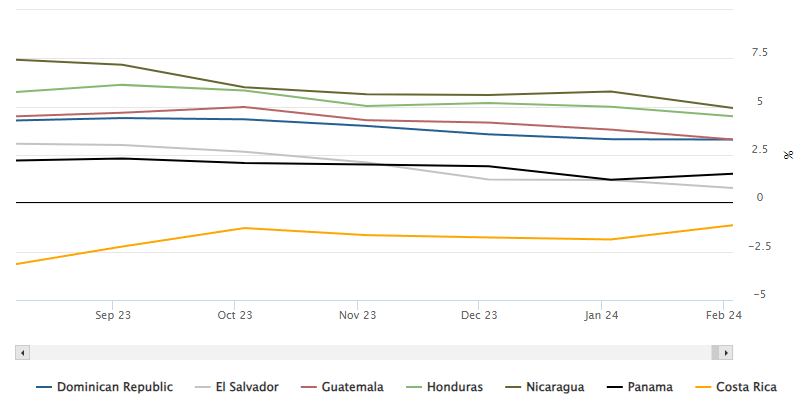
    Central America & Caribbean: inflation rate
    Percentage variation (year-on-year)

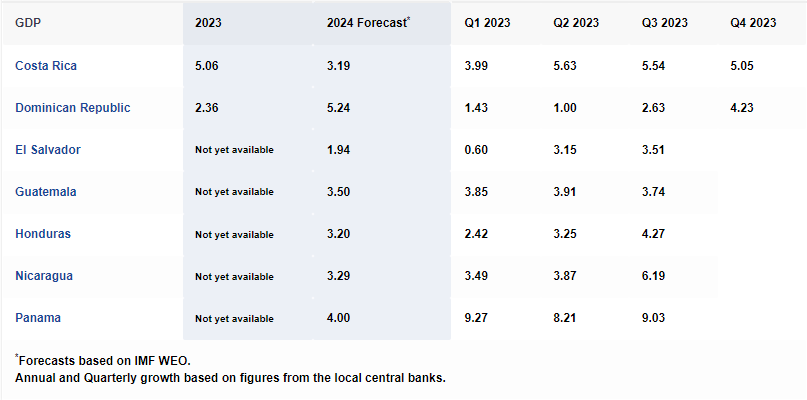
    Central America & Caribbean: GDP growth (%)
    Quarterly figures are year-on-year growth


  • GUATEMALA: Approved budget increases social spending

    Sarah Sheldon 21 January 2025 Hits: 2182

    A 2025 budget which prioritises spending on health, education, and infrastructure projects was published in the official gazette on 9 December after being approved by lawmakers 27 November.

    Worth a total Q148.5bn (US$19.25bn), up 27.1% on the 2024 budget in effect, the 2025 budget includes higher assignations for the health, education, infrastructure, and security ministries, in line with policy priorities for President Bernardo Arévalo. Under the new budget, which expects GDP growth to come in at 3.7% in 2025, up from 3.5% for 2024 forecast by the central bank (Banguat), the education ministry will be assigned Q25.6bn (17.3% of the total), up from Q22.5bn in 2024, while health will receive Q15.2bn (10.2% of the total), up from Q12.0bn in 2024.

    The government is aiming to improve services for marginalised populations, and Arévalo called the budget “solid and balanced.” For instance, increased spending in the health sector will allow for the construction of more clinics, hospitals, and health centres, as well as more medicines. The idea is to boost development, improving living conditions for the population as well as strengthening democracy and transparency, he added. In a post on social media platform X on 6 December, Arévalo said “no one will be able to stop progress”. The budget’s approval was not certain given that the legislature is largely aligned with the ‘pacto de corruptos’ network of institutional corruption that opposes Arévalo, an anti-corruption reformist.

    Guatemalan think tank Instituto Centroamericano de Estudios Fiscales (Icefi) said that the budget prioritises social spending and demonstrates an effort to link spending to the government’s strategic priorities. In a statement published on 9 December, Icefi underlined efforts to make it easier to monitor budget execution as well as the quality of investment as measured by its impact on beneficiaries and other indicators. Icefi also highlighted that the budget contains measures designed to improve transparency and accountability which should help to improve efficiency and control of government entities, such as the regular and timely publishing of data on institutional websites which will be important tools for monitoring.

    The 2025 budget also corrects the underestimation of tax receipts which Icefi says has been a feature of budgets since 2021. This underestimation was one reason for the increase to the 2024 budget, which was approved in August at a high political cost, said Icefi. The think tank recommends that the government increase the tax burden in order to secure financing for increased spending on health, education, and security, while maintaining fiscal sustainability. The 2025 budget proposal expects tax take to come in at 11.7% of GDP, in line with forecasts projected by Icefi and the tax authority (SAT) for 2024.

    Ensuring that increased social spending can be sustainably funded through taxes may prove difficult for Arévalo given the highly organised opposition that any proposal to increase taxes will likely face from business leaders and economic elites. And the budget itself could face legal issues with Guatemala’s constitutional court (CC), much of which is aligned with the ‘pacto de corruptos’ and which has previously delivered unfavourable rulings to the president, not least in his ongoing power struggle with discredited attorney general María Consuelo Porras [SSR-24-06]. On 10 December, lawmaker Bequer Chocooj of Cabal party submitted legal papers to the court, alleging the budget was illegal and unconstitutional, claiming that the 2025 initiative includes reduced allocations to municipalities, among other objections.

    Competition law

    On 6 December President Bernardo Arévalo signed a competition law approved by congress the previous month that seeks to guarantee transparent markets and tackle monopolies and corrupt business practices. The legislation, submitted by the Arévalo government, establishes an autonomous competition superintendency which will investigate and sanction anticompetitive practices. The economy minister, Gabriela García, stated that “the competition law is a milestone for the nation, as it promotes the development of a more competitive economic environment, generating great opportunities for opening markets, strengthening institutions, attracting foreign investment, and increasing business productivity”.

  • Washington plays catch up

    Abbi Dicker 14 May 2026 Hits: 1241

    According to a report by law firm White & Case the US government, responding to the challenge from China, has channelled more than US$1bn into Latin American REE and critical mineral projects since the start of 2025. The money has been earmarked for lithium, copper, and rare earths, and is designed to strengthen supply chains and defence priorities. Key destinations for this funding support include Brazil and Argentina.

    Since the start of Donald Trump’s second term in office in January 2025 the US has been more pro-active and open about its intent to gain preferential access to REE across Latin America. Projects in both Brazil and Argentina have attracted direct financial support via loans, equity stakes, and offtake agreements (the latter based on using future output to raise capital). Transition Security Project, a UK-US research project, says the Pentagon has been stockpiling critical minerals for use in military equipment, and has earmarked “several billions” to invest in additional projects.

    There have been a number of recent deals. The InterAmerican Development Bank (IDB) has lent US$100m to back a US$2.5bn lithium project in Argentina, while the US Development Finance Corporation (DFC) was reported to be considering a US$465m contribution to expand Serra Verde’s mining operations in the Brazilian state of Goiás. (Serra Verde was subsequently acquired by a US rival). These loans are being made within a changing policy environment. Washington is now seeking to align Latin American supply chains with US strategic interests, ensuring that production enters friendly supply chains, in other words those that support US manufacturing and defence requirements. The US has also applied new conditions in loans and financing agreements to ensure alignment. DFC for example, provides loan guarantees and equity investment, turning to private partners for technical and operational expertise. Projects typically attract 30% public funding, 50% private investment, and 20% host country contribution.

    In the new context, corporate behaviour in the mining sector is beginning to change as efforts continue to align with Trump policies and secure long term supply contracts. However, most Latin American countries feel it is unwise to align exclusively with the US and to shut the door on China; the reality is that they will need to negotiate continuously with both superpowers and walk something of a tight rope to balance both their interests. Political risk considerations – always present in mining – are being expanded to cover regulatory issues, merger controls, and wider geopolitical tensions.

    Rebecca Campbell, global head of mining at lawyers White & Case, commented to business news site BNAmericas that “From a global perspective, over the last four to six years there has been a growing perception of structural change in various critical minerals. Initially, the narrative was centred on the energy transition, but it has evolved to include energy security, economic security, and defence supply chains. More recently, this awareness has accelerated, particularly with the renewed focus of the US government on securing critical mineral supply chains. This has driven both political support and financing, which is now having a tangible impact on Latin America.”

  • TRACKING TRENDS

    Patrick de Courcy 13 April 2023 Hits: 3111

    BOLIVIA | Arce discusses import substitution with business leaders. Bolivia’s President Luis Arce met with the board of the business lobby Confederación de Empresarios Privados de Bolivia (CEPB) on 10 April and announced that his government will work more closely with the private sector to boost import substitution. Arce tweeted that the government and the CEPB had “agreed to work together to continue driving the economy forwards” and said that “we explained our strategic plan for industrialisation with import substitutions”. That goal was enshrined in the government’s 2021-2025 national development plan, which proposes “creating new industries for strategic products aimed at substituting imports, allowing us to reduce our dependence on external production” and promotes “the transformation of raw materials and inputs to generate productive value chains”. 

    The government has recently stepped up its rhetoric on import substitution amid a shortage of US dollars which threatened to unleash a currency crisis last month [WR-23-11]. Demand for dollars remains extremely high, and the central bank continues to sell the hard currency to citizens in an effort to quell demand.

    Amid continued opacity from the central bank regarding the extent of its dollar reserves, it is unclear how long the monetary authority will be able to keep diminishing its stack of dollars. Bolivia has already resorted to its special drawing rights (SDR) arrangement with the International Monetary Fund (IMF), exchanging SDRs for US$300m in March. Whilst the government has insisted that the boliviano will remain pegged at its fixed exchange rate of B$6.96/US$1, dollars are being exchanged for upwards of B$7.20 on the growing black market.

    COLOMBIA | Inflation rises. Colombia’s national statistics department (Dane) released the latest consumer price index on 5 April, which put monthly inflation in March at 1.05%, down from 1.66% in February. This brought annual inflation to 13.34%, which was up from 13.28% in February. Inflation in March was predominantly driven by monthly price increases for housing, water, electricity, gas and other fuels (+1.01%), goods & services (+1.62%), and household goods (+1.47%). This was the tenth consecutive month in which annual inflation was over 10%, and it now stands at its highest level since March 1999.

    The latest increase followed the central bank’s decision on 30 March to raise the benchmark interest rate by 25 basis points to 13%. In a statement announcing that decision, the central bank highlighted signs that “the inflation rate is approaching its ceiling”, citing a decline in annual food inflation between December and February and more positive forecasts from economic analysts. It emphasised that monetary policy decisions will continue to be focussed on bringing inflation toward the 3.0% target.

    COLOMBIA | Another bad month for coffee producers. Colombia’s national federation of coffee growers (FNC) announced on 12 April that coffee production in March totalled 799,000 sacks (1 sack = 60kg), representing a 13% decrease on the same month last year. Coffee exports in March amounted to 906,000 sacks, representing a 19% year-on-year decrease. In the first three months of 2023, production was down by 1% compared with the same period last year, totalling 2.69m sacks. The latest figures marked the continuation of a difficult period for the Colombian coffee sector, which has been struggling with the prolonged impact of the La Niña weather phenomenon. Despite a brief rally in February, when production increased by 10%, production during the last coffee harvest (October 2022-February 2023) was down by 9% year-on-year.

    PERU | Copper production up in Peru. On 11 April Peru’s mining and energy ministry (Minem) released new figures showing that copper production in February totalled 192,334 tonnes (t), representing an 11.6% increase on February 2022. Over the first two months of 2023, copper production amounted to 390,955t, representing an increase of 5.2% compared with the same period last year. Arequipa region remains the primary source of copper in Peru, accounting for 19.2% of production in February, followed by Áncash (16.7%) and Moquegua (15.6%). Minem stated that the latest production figures have consolidated Peru’s status as the world’s second-largest copper producer.

    Bolivia claims rise in tax haul

    On 27 March Zenón Mamani, a deputy finance minister in Bolivia, said that the country’s tax take totalled B$58.67bn (US$8.49bn) in 2022, up 20% on 2021. He said that this following a 15% annual increase the previous year, claiming that the economy was being “reactivated” following the coronavirus (Covid-19) pandemic and what he described as the “bad economic management” of the Jeanine Áñez administration (2019-2020).

  • TRACKING TRENDS

    LatinNews 01 March 2012 Hits: 2286

    ARGENTINA | Buenos Aires boycotts UK goods. On 29 February the Argentine state news agency Telam reported that Industry Minister Débora Giorgi had asked several Argentine companies to substitute imports from the UK with alternative supplies, effectively amounting to a boycott. Although the move is in line with the restrictive import policies being implemented by the government of President Cristina Fernández for the better part of two years now, it clearly has political implications, amidst the recent increase in diplomatic tensions over the Falklands/Malvinas archipelago.
        According to the industry ministry, the new measures are designed to halt the continued deterioration in Argentina’s trade surplus with the UK. Notably, however, the ministry also said that Argentina also wants to favour relations with “those who respect the territorial integrity of the country, its sovereign claims and the resources that belong to it”. According to Argentina’s national statistics’ institute (Indec), Argentina’s imports from the UK were valued at a mere US$664.2m in 2011, constituting barely 0.9% of its total imports. Its exports to the UK were valued at US$779.5m.

    BRAZIL | Evangelicals go fishing. The senator and high-profile evangelical bishop Marcello Crivella, of the Partido Republicano Brasileiro (PRB), was appointed the new fisheries minister this week. As Crivella himself admitted, he knows absolutely nothing about fishing, although the evangelical churches in Brazil are very good at reeling in the faithful at election time. The minister for institutional relations, Ideli Salvattti, denied that the appointment was a sop to the evangelicals in order to secure their support in São Paulo ahead of October’s municipal elections. Crivella’s promotion, she said, was a tribute to the former vice-president and PRB member, José Alencar, who served under Lula da Silva (2003-2010) and died after a lengthy battle with cancer in late March 2011.

    BRAZIL | Slow visa approvals for Haitians. Brazil approved 30% of its new visa quota for Haitians in the first month of its new system. On 10 January Brazil’s National Council for Refugees (Conare) moved to class Haitians as economic migrants, after deciding that Haitian nationals do not face persecution in their home country for political, racial or religious motives. Under new rules introduced on 18 January, Haitians seeking to move to Brazil must apply for a visa at the Brazilian embassy in Port-au-Prince. The embassy will issue 100 such permits a month. Successful applicants will be allowed to live and work legally in Brazil for five years. To 23 February, only 30 visas had been approved.
        The Brazilian ambassador, Igor Kipman, noted that many applicants did not have the correct documentation. Candidates must supply an up-to-date passport, proof of residency in Haiti and a written testament of their “good character and background”. The application costs US$200. One visa per family is permitted. Kipman admitted to some early teething problems with the bureaucratic process but denied that the cost was a deterrent. He pointed out that Haitians typically paid people-traffickers (coyotes) several thousand dollars to smuggle them illegally into Brazil.

    BRAZIL | Not your typical aging middle class consumer. According to a new study by the São Paulo Federation of Retailers (FécomercioSP), Brazil’s new middle class will account for fully 40% of the accumulated growth it forecasts for the Brazilian economy by 2020. Despite its rather dry title, “The evolution of the middle class and its impact on retailing”, the study throws up some interesting insights into Brazil’s rapidly changing distribution of wealth to the middle. For instance, by 2015 the value of total consumption by the new lower middle income C-class, which already accounts for over 50% of the population, will match that of the higher income A and B classes combined.
         By 2020 total family consumption in Brazil will reach an estimated R$3.53 trillion (US$2.05trn), or the equivalent of 65% of total forecast GDP in 2020.  With the economically active population set to rise 10% to 145m by 2020, Brazil will rank among the top five global economies. But, unlike Western economies, where the consumer market is both saturated and stagnant, Brazil’s consumption boom is only just getting under way. FécomercioSP also flags up for retailers the importance of the country’s aging population. Of a total population of 207m in 2020, some 26m Brazilians will be over the age of 60, up from 18m in 2011.

    • Argentine protectionism

    Paraguay is adding its voice to that of Uruguay in protesting against Argentine trade protectionism. Paraguayan customs officials say they have information that Argentina is planning to implement a single entry/exit point for trade with Paraguay, at the border town of Clorinda, in early March. Paraguay’s exports to Argentina were valued at US$1.27bn in 2010, the equivalent of 27.8% of its total exports.

  • NICARAGUA/COSTA RICA: Ortega stirs the waters

    LatinNews 07 August 2013 Hits: 1236

    At the end of last month the International Court of Justice (ICJ) at The Hague informed both Costa Rica and Nicaragua that it would not modify provisional measures stipulated in a March 2011 ruling on the San Juan River area – the focus of a bilateral territorial dispute currently before the court [RC-11-03]. The announcement, in response to efforts by both countries to seek further measures against each other, comes as Nicaragua’s alleged attempts to offer oil exploration and exploitation contracts in waters which extend beyond its own territory are threatening to spark new hostilities not only with Costa Rica, but also Colombia, which also recently had a case against Nicaragua before the ICJ.

    The ICJ statement, issued on 25 July, was in response to a complaint by Costa Rica that the Nicaraguan government of President Daniel Ortega had sent and maintained “thereon”… “large numbers of persons” to the disputed area who undertook activities affecting “that territory and its ecology”. It was also in response to a complaint filed by Nicaragua in relation to the contentious 160km Juan Rafael Mora Porras road that Costa Rica is seeking to build parallel to the San Juan River, which Nicaragua maintains will affect the ecological stability of the area.

    While the ICJ’s decision might end one potential dispute, an official complaint presented by Costa Rica’s foreign minister, Enrique Castillo, on 22 July could open another. The administration of President Laura Chinchilla, which in 2011 announced a three-year moratorium on oil exploration, claims that Nicaragua is seeking to encroach upon 18 blocs in the Pacific Ocean and 55 in the Caribbean that extend into Costa Rican territorial waters. Costa Rica’s complaint followed reports in the Nicaragua media on 14 July that the Ortega government had begun talks with Spanish energy company, Repsol, over an exploration and exploitation contract in the Caribbean Sea, with plans to drill an exploratory well some 190km off the port city of El Bluff, in Bluefields Bay. This came on the heels of the announcement the previous month by the Ortega government that US consortium, Noble Energy, would begin drilling Nicaragua’s first exploration oil well this month near the town of Puerto Cabezas, on the northern side of the Caribbean coast. Under contracts signed in 2008 with MKJ Exploraciones Internacionales, an affiliate of Noble Energy, the company received the concession to explore, develop and produce hydrocarbons in the areas known as Isabel (114km from Puerto Cabezas) and Tyra (139km from El Bluff).

    Nicaragua’s ambitions vis-à-vis oil exploration and exploitation have also attracted the concern of the Colombian government of President Juan Manuel Santos, which having already raised alarm about the Ortega government’s perceived ‘expansionist aims’ (see sidebar), on 31 July also sent a formal note of protest to the Nicaraguan government, accusing it of offering concessions that fall inside Colombian maritime territory. This follows the ICJ ruling last November on a 122-year old maritime and territorial dispute which was broadly considered to favour Nicaragua [RC-12-12]. The note from the Colombian foreign ministry complains that “a significant number of the blocs offered are located within Colombian areas, including Quitasueño [reef formation] and its adjacent areas…as well as within the United Nations Educational, Scientific and Cultural Organization (Unesco) -recognised Seaflower Biosphere Reserve”. In late 2012 President Ortega notably promised President Santos that he would not permit oil exploration to take place in Nicaragua’s newly acquired territory marked as protected areas.

    While Ortega’s response has been to dismiss both complaints, insisting that Chinchilla has been “poorly advised” and that all of the concessions are within Nicaraguan territory, the Chinchilla government is clearly taking no chances. On 25 July, Chinchilla announced the handover of 40 four-wheel drive vehicles to bolster the northern border. She said that currently 194 police officers receive instruction and training to carry out operations on the border; and specifically alluded to the tensions with Nicaragua, stating that this was in line with her government’s efforts to “protect Costa Rica’s sovereign rights”. Other measures aimed at bolstering national security include the inauguration of a coast guard station in Cuajiniquil, a small fishing village in Santa Cruz, Guanacaste region, which will allow better maritime control; as well as plans to construct a security “station” at Coyote, Nandayure and to procure a new boat worth US$300,000 to be used in different operations.

    • Tensions likely to rise in electoral year

    Costa Rica’s President Laura Chinchilla is unlikely to ignore any provocation from her Nicaraguan counterpart given the prospect of the 2 February general elections. The line-up of main presidential contenders was finally revealed last month. On 20 July the main opposition centre-left Partido Acción Ciudadana (PAC) chose academic and former diplomat, Luis Guillermo Solís, as its candidate in unprecedented primaries – the last of the main parties to name its candidate. Solís will face former San José mayor, Johnny Araya (1998-2001, 2003-2013), of the ruling centrist Partido Liberación Nacional (PLN), which announced his candidacy back in January 2013, as well as Rodolfo Hernández, the former director of the national children’s hospital, who won the primaries held by the centre-right Partido Unidad Socialcristiana (PUSC) in May. Meanwhile last month Otto Guevara, the president of the right-wing Movimiento Libertario (ML) confirmed that he would be making a fourth bid for the presidency, having previously stood in 2002, 2006 and 2010. The latest voter intention poll by Borge y Asociados, published in national daily Diario Extra on 5 August, gave Araya 52.4% of voting intention, far ahead of Hernández, who is on 23.2%. Guevara is in third place on 9.7%, followed by Solís on 8.2%. The poll interviewed 1,200 people across the country between 16-30 July, and had a 3% margin of error. The deadline to register candidates is 18 October.

    • March 2011 ruling

     Among various provisions, the March 2011 ruling by the International Court of Justice (ICJ) at The Hague on the Costa Rica-Nicaragua territorial dispute ordered both sides to withdraw military and police officials from the San Juan River area. It also stipulated that in certain specific circumstances, Costa Rica could dispatch civilian personnel to the area, charged with the protection of the environment.

    • Colombian concerns

    During his Independence Day address to the nation on 20 July, Colombia’s President Juan Manuel Santos said that Colombia would react to any further “expansionist” demands or actions by the Nicaraguan government of President Daniel Ortega. Santos’ remarks were motivated by Ortega’s announcement the previous month that the Nicaraguan government had presented the United Nations Commission on the Limits of the Continental Shelf (CLCS) with information regarding a supposed continental platform belonging to Nicaragua which extends beyond its designated 200 nautical miles off the coast maritime border.

  • Colombia: Hopes for peace and prosperity

    LatinNews 01 July 2016 Hits: 2729

    The 23 June signature of a definitive bilateral ceasefire agreement between the government led by President Juan Manuel Santos and the Fuerzas Armadas Revolucionarias de Colombia (Farc), the main left-wing guerrilla insurgency in the country, holds out the promise of an end to over half a century of internal conflict, prompting expectations of a ‘peace dividend’ for the economy.

    Like other Latin American economies, Colombia has been adjusting to the sharp fall in global energy and mineral prices since 2013. However, both the central bank (BanRep) and the IMF expect the economy to have a soft landing – and in the context of growth that is reasonably high in regional terms. Real annual GDP growth was 4.4% in 2014, slipping to an estimated 3.1% in 2015. In the minutes of its latest monetary policy meeting on 22 June, BanRep was expecting overall growth in 2016 of between 1.5% and 3.2%, with 2.5% the most likely outcome. A little more optimistically, the finance ministry expects real annual GDP growth of 3% this year, rising to 3.5% in 2017. Amid the fall in oil and mineral export revenues, the current account deficit was US$3.38bn (5.6% of GDP) in the first quarter of 2016; this was lower than forecast and indeed the lowest since early 2014.

    The main current imbalance is inflation. Headline consumer price inflation and core inflation hit 8.2% and 6.3% respectively in the year to May. Private economists project inflation of 4.4% and 3.7% in 2016 and 2017, respectively. BanRep’s inflation target is 3.0% +/- 1.0%. BanRep sees the currently elevated inflation, however, as a ‘transitory’ problem, because of the impact of the sharp fall last year in the peso against the US dollar and higher food prices resulting from the recent El Niño phenomenon. Nevertheless, BanRep increased its key interest rate by 0.25% to 7.50% in late June. It had already lifted the rate by 0.50% in late April and by 0.25% in May.

    The IMF shares BanRep’s view that the economy is on track for a soft landing, and in its latest Article 4 consultation the Fund highlighted other strengths, including fiscal discipline, given that the government has achieved its target for the structural deficit – thanks to the tax reforms approved in late 2014 and expenditure cuts. The deficit is expected to reach 3.9% in 2016, and the government’s target for 2017 is 3.3% of GDP, falling to 2.7% by 2018. Meanwhile, overall public debt is expected to stabilise at around 50% of GDP this year.

    Notably, the Colombian government does not expect to receive any income from oil royalties this year, according to a mid-year fiscal report published by the finance ministry on 14 June. Instead the ministry calculates that the government will have to refund a total of Col$800bn (US$268m, or 0.1% of GDP) in taxes to oil sector firms that have been operating at a loss because of the low international oil prices.

    Domestic oil production this year is set to fall below the daily average of 1m barrels registered in 2015, with average output projected to dip to 921,000bpd in 2016 and 913,000bpd in 2017. Finance Minister Mauricio Cárdenas has admitted that the government does not expect dividends from the state-run oil firm, Ecopetrol, in 2017, which will oblige additional fiscal adjustments next year. According to Cárdenas, these will involve budget cuts to the tune of Col$6bn in order to ensure the targeted 2.7% of GDP deficit in 2018.

    The IMF also highlighted the soundness of Colombia’s financial system. Total credit to the private sector rose by 14.7% in 2014 and by 15.5% in 2015. The Fund expects credit growth to slow to 9.2% this year. Foreign Direct Investment (FDI) inflows into Colombia have held up well outside of the minerals and energy sector. Significant deals over the last year or so have included investments in retail (by Chile’s Cencosud, Falabella and Parque Arauco groups, hotels (through the acquisition of Hoteles Royal by Spain’s NH), manufacturing (by Spain’s Cementos Molins and General Motors of the US), and infrastructure (by the Danish port operator APM Terminals).

    Moreover, Colombia’s own multinational groups have the scale and sophistication to undertake major cross-border investments of their own. Examples include the regional expansion by the insurance arm of Grupo Sura, Empresas Públicas de Medellín’s purchase of the Chilean utility Aguas de Antofagasta, and the retail Grupo Éxito’s purchase of businesses in Brazil and Argentina.

    In short, the ceasefire comes at a time that economic activity is well below the cyclical peak, but where the overall business environment is improving. Colombia for some time now has already been looked upon as an attractive market opportunity, even in the absence of a definitive ceasefire between the government and rebel groups (note: a smaller radical leftist guerrilla group, Ejército de Liberación Nacional, has tentatively agreed to peace negotiations, but has yet to come to the table, amid suspected internal splits between dominant militant hardliners and a smaller moderate wing).

    Strategic mining areas ruling a setback

    On 9 June Colombia’s Constitutional Court (CC) ruled unconstitutional three resolutions designating over 20m hectares of Colombian territory ‘strategic mining areas’ (SMAs, in the Spanish acronym). The SMAs comprised 516 lots rich in mineral resources, covering some 20% of the national territory, which the government expected to auction off as exploration and development concessions to interested companies. However, many of these areas were located on territories belonging to Indigenous Peoples and Afro-Colombian communities and/or in areas of important biodiversity and fragile eco systems (in the regions of Amazonia, Chocó, Orinoquía and Colombian Massif)

    The CC effectively ruled that the demarcation of the SMAs required the Free, Prior, and Informed Consent (FPIC) of the affected communities, who would be directly affected. Because the government had violated this right to FPIC, which is enshrined in the 1991 Constitution, the three resolutions were considered to be invalid. Notably, the CC ruling carried what is know as ‘an inter comunis effect’, meaning that the protections extend not only to the 16 communities that were the plantiffs in the case, but also to populations deemed to be in a similar situation in the country.

    According to a 14 June English- and Spanish-language statement issued by lawyers acting on behalf of the plaintiffs (a local NGO, Tierra Digna, in conjunction with 16 Community Councils and the Interethnic Solidarity Forum of Chocó, the ruling “is a substantial step in the democratisation of decision-making regarding the body of laws governing the territories, in that it recognises the necessary and fundamental input that indigenous and Afro-Colombian communities should have, as key actors in the formation of public policy in general, and in this case mining policy in particular”.

    The statement went to stress that the verdict “also represents an opportunity for the government to design mechanisms by which to consult and strengthen the participation of these populations in the adoption of decisions regarding mining policy, in order to avoid the emergence of further socio-environmental conflicts caused by arbitrary actions taken by the government. It is our belief that this ruling comes at the right time for the State to incorporate not only this holding, but several decisions that the Constitutional Court has released recently regarding mining. These rulings provide an opportunity for the government to reform its mining policy to ensure that it embodies constitutional principles and respects fundamental rights, including the rights to participation, to a healthy environment, to water, to cultural diversity, and to food. Only in this way will we be able to construct peace and development for all”.

  • REGION: Development plan aims to improve connections with southern Mexico

    LatinNews 19 July 2021 Hits: 1512

    On 10 June Alicia Bárcena, the head of the United Nations Economic Commission for Latin America and the Caribbean (Eclac) emphasised the organisation’s commitment to the Comprehensive Development Plan for northern Central America and southern Mexico.

    The governments of Mexico, Honduras, Guatemala, and El Salvador commissioned Eclac to produce the plan in December 2018. It has since won support from numerous foreign governments and international organisations despite some doubts over how its lofty goals will be achieved.

    The main focus of the plan is to create jobs and economic opportunities in areas that see high levels of migration, namely northern Central America and nine states in south and south-eastern Mexico, Bárcena noted. There are four main pillars: economic development, social well-being, environmental sustainability and comprehensive management of the migration cycle. “Eclac has contributed to addressing the structural causes of migration: the problem of unemployment, inequality, the effects of natural disasters, violence, and family reunification”, Bárcena said. 

    The migration pillar has been met with criticism in some quarters that argue that this should not form part of an economic development plan. But even the other pillars have also been criticised. On 10 June Bárcena confirmed that 114 projects will be implemented over the next five years, “the costs of which have already been calculated”. In December 2020 those costs were announced as US$45bn. Certain projects are already underway, including the ‘Sembrando Vida’ (‘sowing life’) programme that pays people to plant and care for trees, which started in Mexico and will be extended to El Salvador, Guatemala, and Honduras.

    Infrastructure proposals include improvements in road connections between Guatemala and Mexico, such as connecting the city of Flores, in Guatemala’s Petén department, with Tenosique, a town in Mexico’s Tabasco state; and significant investment in the road networks in Guatemala, El Salvador, and Honduras. Better roads in rural areas will improve access to markets and reduce inequality, according to Eclac. There are also plans for a 710km railway linking Ciudad Hidalgo in Mexico’s Chiapas state, to El Salvador’s La Libertad department, as well as a further 225km of branch lines.

    The Atlantic Council, a US-based NGO, was among the organisations that hailed the plan in 2019, citing the impact of increased connectivity in boosting trade as well as governance and access to public services including public security. In April, the executive director of the United Nations Children’s Emergency Fund (Unicef), Henrietta Fore, reiterated the organisation’s support for the plan, calling it an “important opportunity to build needed infrastructure, spur economic activity, and address the root causes of migration”.

    While the headline figure may sound impressive, it is important to put the US$45bn into perspective. By way of comparison, the ‘Tren Maya’ train project, a planned 1,525km inter-city railway in south-east Mexico, alone is expected to cost US$6.5bn-US$7bn. Infrastructure is expensive, which is one reason for the poor state of the region’s transport networks in the first place. Starting from such a low base means the level of investment required to make a significant difference to people on the ground is likely to be far higher than US$45bn.

  • ECONOMIC HIGHLIGHTS

    Patrick de Courcy 20 May 2022 Hits: 1599

    ARGENTINA | Economy minister claims IMF deal on track. After a meeting with International Monetary Fund (IMF) managing director, Kristalina Georgieva, on 22 April, Argentina’s economy minister, Martin Guzmán, said that the government’s debt restructuring deal with the Fund is on track. Despite concerns with Argentina’s runaway inflation, which surged 6.7% in March, bringing the 12-month figure to 55.1%, Guzmán spoke of “good progress” in fiscal areas – Argentina closed Q1 with a fiscal deficit of Ar$192.74bn (US$1.64bn), which the government says is within the target set in the IMF deal. “Our international reserves have grown, with the economic programme in line with planned. The economy continues growing firmly, creating jobs,” Guzmán was reported as saying after the meeting. Figures released on 21 April showed that Argentina’s economy grew 9.1% year-on-year in February, and 1.8% compared with the previous month.   

    PARAGUAY | Exports still down, but trade deficit shrinks. Paraguay’s central bank released the April 2022 trade figures on 11 May, which show that the country’s exports have continued to fall compared with last year – reflecting the impact of a prolonged drought on the agricultural sector. Exports totalled US$4.28bn in April, a 0.2% decrease compared with the value of exports in April 2021. (This was an improvement on March exports, which were down 3.4% year-on-year to US$2.99bn.) Exports of soya grains, which account for almost a quarter of Paraguay’s sales abroad, fell by 35.1% year-on-year in April. Imports continued to surge, totalling US$4.56bn, a 24.5% increase on the imports recorded in April 2021. Overall, Paraguay posted a US$281.3m trade deficit this April. While this compares with a US$635.9m trade surplus in April last year, it represents an improvement on March results, when the balance of exports and imports produced a US$450.7m deficit.  

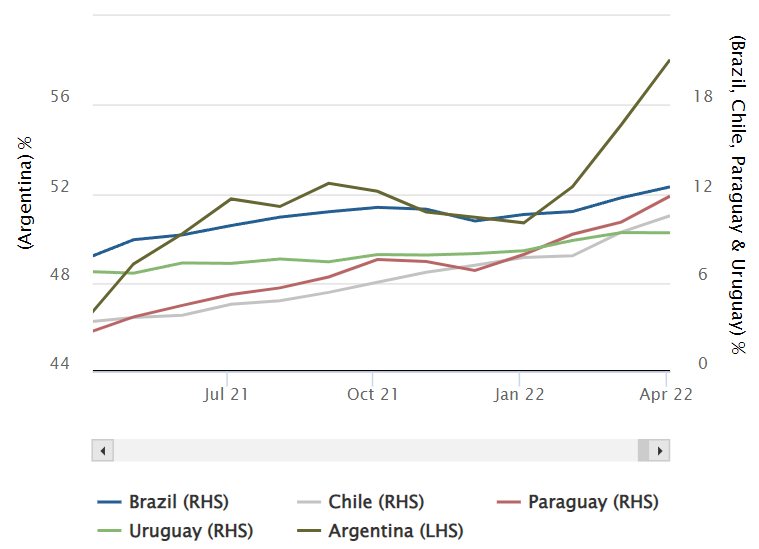
    Brazil & Southern Cone: inflation rate
    Percentage variation (year-on-year)

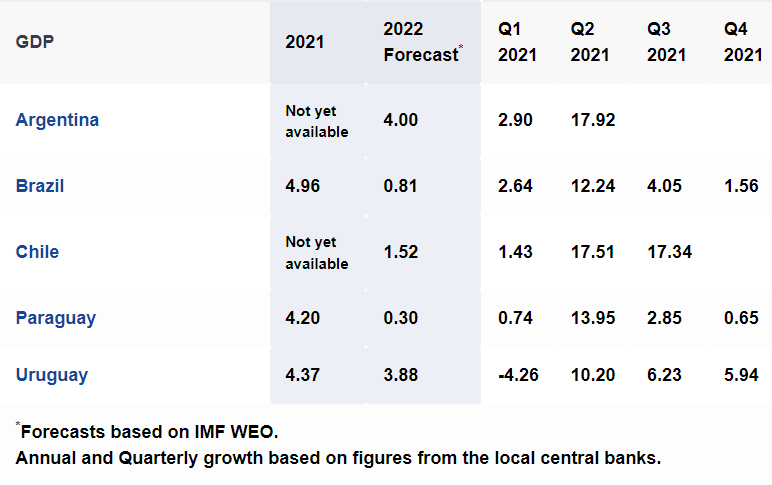
    Brazil & Southern Cone: GDP growth (%)
    Quarterly figures are year-on-year growth

  • HAITI: IMF could offer route to wider funding

    Abbi Dicker 13 November 2025 Hits: 591

    Amid Haiti’s continuing political and security crisis, the International Monetary Fund (IMF) has issued what it calls an “encouraging” review of its staff-monitored programme (SMP) conducted with the country’s authorities.

    SMPs are informal agreements between the IMF and member governments to monitor economic performance and “build a track record of policy implementation” that could eventually pave the way for a more formal IMF programme and funding. The latest review was conducted in October as a “virtual mission”. It acknowledges that things are bad. In its words “economic conditions in Haiti remain fragile amid persistent domestic and external shocks and rising uncertainty”. It notes the economy is now contracting for the seventh consecutive year. Inflation is high by Caribbean standards, at 32%. The banking system is fragile with non-performing loans at 13%.

    And yet there are what could be called bright spots in the gloom. Remittances sent home by expatriate Haitian workers have been increasing because of the security crisis and worries over US President Donald Trump’s migration policies. Because of these inflows, Haiti can expect a “moderate surplus” on the current account this year. The exchange rate has been stable. Gross international reserves are “adequate” at US$3.1bn (equivalent to seven months of imports). Although “constrained” by security challenges and limited policy space, the fiscal position this year is “broadly balanced”. Monetary financing of the fiscal deficit has been kept at zero. Public debt as a proportion of GDP is only 12.4%, the lowest ratio in Latin America and the Caribbean. The review notes that, looking ahead, there are major downside risks, including an intensification of gang warfare, and disruption from abrupt changes in migration and trade policies. However, it also suggests that if the political crisis is stabilised there may be some foundations for recovery and economic reform.

  • Guatemala: No clear frontrunner

    LatinNews 07 January 2019 Hits: 2349

    Date: June 2019. If a presidential candidate fails to win 50% +1 of the votes, a second-round run-off will take place, most likely in August.

    Type: Presidential, legislative (all 158 seats in the unicameral legislature), municipal (333 mayoral seats in 22 departments).

    Main presidential contenders: So far declared are: Sandra Torres (Unidad Nacional de la Esperanza [UNE]); Alejandro Giammattei (Partido Vamos); Zury Ríos (Valor); Fredy Cabrera (Todos); Mauricio Radford (Fuerza). Other newly created parties, such as the centre-left Movimiento Semilla and the peasant-led Movimiento para la Liberación de los Pueblos (MLP), have yet to declare their candidates.

    Guatemala’s political class remains badly discredited due to the various corruption scandals to have emerged in recent years. A well-known comedian and political neophyte, President Jimmy Morales won the 2015 election on the ticket of the Frente de Convergencia Nacional (FCN-Nación) (set up in 2004 by members of the military veterans’ association [Avemilgua]) on the back of his pledge “Not corrupt, not a thief”. President Morales, who defeated former First Lady Sandra Torres (UNE) by 67.44%-32.56% in the run-off, had capitalised on widespread anger over public corruption after President Otto Pérez Molina and his vice president Roxana Baldetti (Partido Patriota [PP], 2012-2015) were forced to quit over a corruption scandal uncovered by the attorney general’s office (AG) and United Nations (UN)-backed anti-impunity commission in Guatemala (Cicig).

    Since taking office however, Morales’s pledge to combat corruption has rung hollow. Following three calls by Cicig for him to be investigated over illegal campaign finance, in August 2018 President Morales said he would not extend Cicig’s mandate when it expires in 2019. Cicig began operating in the country in 2007. President Morales has since refused to allow Cicig’s director Iván Velásquez (who, along with Cicig, enjoys unprecedented levels of support) back in the country after he left for a meeting in the US in September. As well as the accusation of illegal campaign financing, Cicig has also been involved in efforts to prosecute President Morales’ brother and son, respectively Samuel and José Manuel Morales, for corruption.

    A crowded electoral race

    With 26 parties vying for the 2019 June general elections, Guatemala’s party system remains highly fragmented. Many of the new acronyms on the list of registered political parties that can put forward candidates for the 2019 elections are not as new as they seem as a number of parties dissolved by the electoral authorities (TSE) have simply recycled candidates and morphed into ‘new’ organisations with different names. Six parties are currently being dissolved by the TSE for engaging in illicit campaign funding: the ruling FCN-Nación, Encuentro por Guatemala (EG), Compromiso, Renovación y Orden (CREO), Visión con Valores (Viva), Unión del Cambio Nacional (UCN), and Partido de Avanzada Nacional (PAN). Four other parties have already been dissolved for breaking the law: Gran Alianza Nacional (Gana), PP, Libertad Democrática Renovada (Líder), the main opposition party during the 2011 elections, and Corazón Nueva Nación (CNN).

    With the TSE due to formally call the election this month, as yet there have been no pre-electoral surveys for either the presidential or legislative contests. The 158-member unicameral legislature is one of the country’s least-trusted institutions, with political parties considered little more than vehicles for clientelism and private business interests.

    • Dubious behaviour

    One example of recent congress behaviour which has attracted criticism was the approval in October 2018 of changes to the criminal code which, among other things, absolve political parties’ general secretaries of criminal responsibility for illegal electoral campaign funds received by their parties.

    Of the candidates formally declared, the most well-known is Torres. Under the Colom administration, Torres became popular in rural areas after she led a number of social welfare programmes such as the conditional cash transfer programme Mi Familia Progresa. However, the success of many of these programmes was overshadowed by corruption allegations. Colom and several of his cabinet members face trial on corruption charges. In 2013, Torres’ sister, Gloria, one of the UNE’s founders, was also arrested and charged with fraud. Other well-known contenders include Alejandro Giammattei, a former head of the prison service under the Oscar Berger administration (Gana, 2004-2008), running for his political outfit Partido Vamos. Giammattei, who in May 2011 was acquitted of involvement in a criminal ring inside the interior ministry and police, has previously run three times for the presidency for different political parties (in 2007, 2011, 2015). Also well-known is Zury Ríos, the daughter of the late dictator Efraín Ríos Montt [1982-1983]) who was found guilty of genocide and crimes against humanity in 2013 but whose sentence was annulled on a technicality. A far-right politician, Ríos served as a congresswoman for 16 years.

    Of the new parties, one name touted as a possible candidate is former attorney general (AG) Thelma Aldana (2014-2018), who has been credited with significant progress with regard to addressing impunity – not least the landmark case which saw Pérez Molina resign. There has been some speculation that she might run with the new centre-left Movimiento Semilla, which has cultivated good relationships with foreign diplomatic missions as well as the grassroots social organisations that led the 2015 anti-corruption protests that forced out Pérez Molina. If Aldana – who became hugely popular as Cicig’s most important ally – did decide to run as its candidate, the party could suddenly become one of the main contenders in the electoral race.

  • JAMAICA: Is this a Caribbean success story?

    Sarah Sheldon 21 March 2023 Hits: 1128

    Jamaica has reaped praise for its macro-economic management in the latest Article IV consultation report written by the International Monetary Fund (IMF) and published on 8 February.

    Article IV reports are written by teams of IMF economists after visiting a country and meeting the top economic officials; they are considered a bill of health on economic management. The latest of these reports referring to Jamaica is full of measured praise. The IMF says the country has been “nimble” in its response to major challenges: the coronavirus (Covid-19) pandemic, the war in Ukraine, and tighter global financial conditions. Despite these setbacks it said the government had got Jamaica back on a strong recovery path. Tourist flight arrivals had rebounded to pre-pandemic levels, and 2022 economic growth was expected at 4% (subsequent government data put this higher at 5.9%).

    Inflation had ticked upwards in 2022 but was expected to ease back this year. High commodity prices had widened the current account deficit, but foreign currency reserves remained “healthy”, and the financial system was deemed to be “well capitalised and liquid”. The response to the upward surge in international food and fuel prices had been to allow for full “pass though” to the domestic economy while providing support for the poor within the existing fiscal position. Overall, the mix of fiscal and monetary policies had “struck the right balance in responding to shocks, protecting the vulnerable, countering inflationary pressures, and further securing debt sustainability”.  

    The IMF Executive Board assessment praised the policy of post-pandemic gradual fiscal tightening, coupled with “data-dependent monetary tightening”. However, it did argue that within existing financial parameters Jamaica should be identifying resources for extra investment in climate-resilient infrastructure, health, security, and education. There was also a call for strengthened tax and customs administration, as well as for an improved AML/CFT (Anti-Money Laundering/Combating the Financing of Terrorism) framework.

    Commenting on the report, the Financial Times Alphaville column said, “this is as close as the IMF comes to standing ovation”. The government is likely to be particularly pleased by the reduction in the debt-to-GDP ratio which a decade ago was at a highly dangerous 147%. According to the latest data from the finance ministry the ratio will have fallen to 79.7% by the end of this fiscal year (end-March 2023) and to 74.2% by the 2023-24 fiscal year. The Bank of Jamaica (BOJ) has said it expects growth to continue, propelled by tourism, agriculture, and the resumption of production at the Jamalco alumina plant. BOJ governor Richard Byles said on 21 February that the pace of growth would nevertheless ease as activity levels among Jamaica’s main trading partners “normalised” after the pandemic. Annual inflation fell from 9.4% in December to 8.1% in January and was now being estimated to fall to a 4.0%-6.0% target range by the end of this year. 

  • ECONOMIC HIGHLIGHTS

    Patrick de Courcy 19 June 2025 Hits: 1994

    COLOMBIA | Ecopetrol president investigated. Colombia’s inspector general’s office opened a disciplinary investigation into Ricardo Roa, the president of state oil company Ecopetrol, on 4 June. The investigation relates to a possible conflict of interest concerning Roa’s purchase, before he became Ecopetrol’s president, of an apartment from the Colombian firm Princeton International Holdings, whose legal representative at the time was Serafino Iacono, a Venezuelan oil and mining investor. The inspector general’s office said that this could constitute “a conflict of interest, given [subsequent] actions and decisions taken by [Ecopetrol] while conducting its regular business which would involve the interests of firms, businesses or societies that have direct or indirect links” with Iacono. The inspector general’s office said that it had asked Ecopetrol to clarify whether Roa declared any conflicts of interest upon being appointed as the company’s president in April 2023, and whether his declaration has been periodically updated since then. A close ally of President Gustavo Petro, Roa has previously been accused of involvement in corruption regarding a solar power contract and of illegal campaign financing during Petro’s 2022 election campaign, in which Roa played a leading role.

    PERU | Interest rate held. Peru’s central bank (BCRP) held its benchmark interest rate at 4.50% in its latest monetary policy meeting on 12 June, after lowering it by 25 basis points at its previous meeting in May. In a statement explaining the decision, the BCRP noted that annual inflation in May was 1.7%, unchanged from April and within the bank’s target range of 1-3%. Whilst the BCRP noted the potential impact of global trade tensions on inflation, it maintained its year-end inflation forecast at 2.3%. Meanwhile, the BCRP highlighted a “slight deterioration” in economic activity indicators in May, although it said that Peru remains on a positive trajectory.

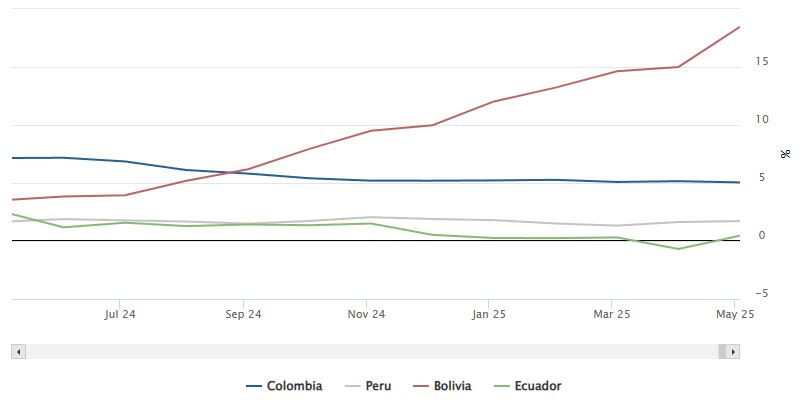
    Andean countries: inflation rate
    Percentage variation (year-on-year)

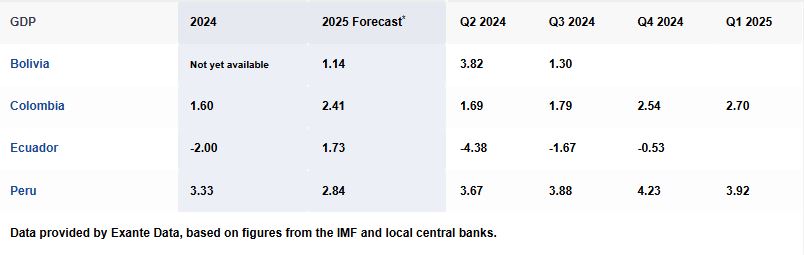
    Andean countries: GDP growth (%)
    Quarterly figures are year-on-year growth

  • TRACKING TRENDS

    LatinNews 13 August 2015 Hits: 1974

    REGION | FAO warns of drought’s impact

    On 11 August the Food and Agriculture Organization (FAO) of the United Nations urged all Central American governments to adopt measures to minimise the negative effects of the current drought in the sub-region on food security. The dry spell produced by this year’s ‘El Niño’ climatic phenomenon is producing an acute drought in Central America’s so-called ‘Dry Corridor’, which extends across the Pacific coasts of Guatemala, El Salvador, Honduras, Nicaragua, Costa Rica and Panama. So much so that international experts believe that this drought may even surpass the record dry spell recorded in the area last year, which at 45 days between July and August was the longest and driest in half a century.

    In a statement the coordinator of the FAO’s sub-regional office for Mesoamerica, Ignacio Rivera, said that the lack of rain this year was contributing to the “continuous deterioration of living conditions” for over 1m families that live in this area and are predominantly dedicated to subsistence farming. Pointing out that the drought and its accompanying increase in food prices have exacerbated the food insecurity situation in an area that has an undernourishment rate of 15%, almost double Latin America’s average of 7.9%, Rivera said that Central American countries should adopt measures involving the strengthening of infrastructure, the improvement of early warning systems, the use of natural resources and the adaptation of national productive systems to the climatic change.

    “The malnutrition and poverty levels, along with the recurrent climatological threats make the ‘Dry Corridor’ one of the areas in the world with the highest food security risk,” Rivera said. “It is indispensable that the [‘Dry Corridor’] countries and the international community prioritise their resources to face up to the consequences that the insufficient and irregular precipitation in the Central American countries produces,” he added.

  • BOLIVIA: Morales upsets private sector

    LatinNews 31 August 2017 Hits: 1814

    The Movimiento al Socialismo (MAS) government led by President Evo Morales has decreed a reduction in industrial gas subsidies for the first time in nearly two decades. The move is sparking anger from the private sector which is warning that it could impact on foreign investment. These warnings come as a recent report by the Economic Commission for Latin America & the Caribbean (Eclac) shows that foreign direct investment (FDI) in Bolivia is at a 10-year low and the latest official figures point to slowing growth.

    On 17 August, the MAS government announced reductions in industrial gas subsidies of between 9.76% and 48%, claiming these were the first such reductions in 19 years. The government is trumpeting its decision as a social measure which will generate an additional US$20m annually for the state to invest in improving access to gas for households and exploration to boost the sector. Hydrocarbons Minister Luis Alberto Sánchez was also quick to maintain that the changes would not adversely affect the domestic economy, telling reporters that only 1,092 companies will be affected – or 0.1% of consumers in the country (which has 1.05m consumers). He added that for the businesses worst affected, the price of gas would rise from US$1.70 per 1,000 cubic feet (mcf) to US$2.50 per mcf.

    As well as seeking to highlight the limited impact (see sidebar), government officials like Sánchez sought to assuage private sector concerns by highlighting that gas prices in Bolivia are still “comfortably the lowest” in the region, compared with Argentina (US$7.75 per mcf), Chile (US$9.67 per mcf), and Brazil (US$11.61 per mcf).

    However, this has failed to convince, with private sector organisations such as Confederación de Empresarios Privados de Bolivia (CEPB), Cámara de Industria, Comercio, Servicios y Turismo de Santa Cruz (Cainco), and Cámara Nacional de Industrias (CNI) all expressing outrage at the move and announcing plans to take legal action.

    These organisations also warn that the changes could damage juridical certainty which, in turn, could affect FDI inflows to Bolivia which the Eclac report released this month showed had fallen by 26% in 2016 to US$410m, the lowest level since 2007. While noting this decline, the Eclac report pointed out that despite the slowdown in investment in extractive industries, the country’s mineral wealth continues to attract foreign capital. It notes that oil and gas exploration and development plans announced by a consortium comprising Spain’s Repsol SA and Dutch-British Shell was the largest project announced in 2016 – US$500m for the next five years. This was followed by the construction of a steel plant by the Chinese company Sinosteel Corporation, with a planned investment of US$450m, a project which is currently in the final stage of the approval process required by the Export-Import Bank of China (EximBank) to provide financing.

    Slowing growth

    The private sector’s complaints about the impact on foreign investment come as Economy Minister Mario Guillén revealed this month that GDP growth was just 3.34% year-on-year in the first quarter of 2017 – far short of the government’s annual growth target of 4.7% for 2017. Figures from the economy ministry show that while demand grew by 7.2% between January and March, the overall GDP growth figure was dragged down by a 14.1% decline in the hydrocarbons sector – and in particular by reduced demand from Bolivia’s key trade partner Brazil. However, Guillén expressed confidence that the 4.7% target would be achieved, noting that this demand from Brazil had returned to normal in July and August.

    • Reduction in subsidies

    Gary Medrano, the director of the national hydrocarbons agency (ANH), told reporters that the 48% reduction in industrial gas subsidies would only impact nine “megacompanies”. He explained that the changes would be applied on four different levels – aside from the nine companies to see a 48% reduction, the second segment, comprising 32 companies, would see their subsidies reduced by 40.47%, 831 companies would see a 23.59% reduction, and in the fourth segment, 220 companies would see a 9.76% reduction.

  • TRACKING TRENDS

    Abbi Dicker 02 May 2024 Hits: 2476

    BRAZIL | Job creation rises. The labour ministry has released its latest job creation figures on 30 April, which showed a net 244,315 new jobs were created in March, bringing the total net job creation for the first quarter to 719,033 new jobs. The figure for March 2024 marks an increase from the net 194,372 jobs created in the same month last year. Four of the five sectors measured registered a net increase in jobs in March this year, with the greatest increase in the services sector (148,722 new jobs). The only sector to register a net loss was agriculture, with 6,457 net jobs lost in March. From January-March, all five sectors saw net increases.


    BRAZIL | Petrobras production increases year-on-year. The state-controlled oil company Petrobras released its oil and gas production figures for the first quarter on 29 April. Total quarterly production came to 2.78m barrels of oil equivalent per day (boepd). This marks a 3.7% increase from the first quarter of 2023 but a 5.4% decrease from the final quarter last year.

    In a press release, the company stated that, compared with the final quarter, oil and gas production was hindered by more stoppages for maintenance works, as well as by the natural decline of mature deposits. Petrobras attributed the year-on-year rise in production to a ramp up in operations in five offshore processing facilities (Almirante Barroso, P-71, Anna Nery, Anita Garibaldi, and Sepetiba), as well as the start of production in 19 new wells in the Campos and Santos basins, near Brazil’s south-eastern coast.

    On 26 April the oil giant also announced that it has begun the bidding process for contractors to set up four new oil rigs in onshore deposits in the states of Bahia and Amazonas. On 29 April Petrobras sought to highlight plans to boost renewable energy production, announcing that it has signed a memorandum of understanding to study the feasibility of a new offshore wind project in the north-eastern state of Rio Grande do Norte.