All Categories

Subcategories

  • TRACKING TRENDS

    Abbi Dicker 04 July 2024 Hits: 2044

    BRAZIL | Government plans spending cuts. The finance minister, Fernando Haddad, announced on 3 July that the government was willing to reduce its expenditure for 2025 by R$25.9bn (US$4.7bn). The decision came after a meeting with President Luiz Inácio Lula da Silva in which they discussed the concerns from the markets about the Lula administration’s fiscal situation. The government is expected to announce later this month exactly which ministries and departments will have their budgets lowered.

    The willingness to cut spending marks a shift in Lula and Haddad’s fiscal policy, as the government had previously sought to balance the books by raising more tax revenue. However, the government’s efforts to end tax breaks had faced resistance in congress in recent months, and the country’s persistently high interest rates have posed a challenge to Lula’s spend-to-grow approach to stimulating the economy. The president of the central bank (BCB), Roberto Campos Neto, has also made frequent statements in the media urging fiscal restraint. Rising tensions between the hawkish BCB chief and the Lula government have also impacted investor confidence in Brazil, which Haddad is seeking to redress.


    BRAZIL | Drop in net job creation. On 27 June the labour ministry released the job creation figures for May, which showed a net 131,811 new jobs created in the formal sector. This marks a decrease from the net 239,201 new jobs in April and from the 155,704 jobs May 2023. The month of May also registered the lowest net job creation in the first five months of 2024.

    All sectors registered a net increase in jobs in May this year. The services sector saw the highest job creation, with a net 69,309 jobs created in May, followed by agriculture (+19,386 jobs) and construction (+18,149). Job creation figures were positive in every state, except the southern state of Rio Grande do Sul, which was devastated by severe flooding. This caused a net 22,180 jobs lost in the state in May.


  • TRACKING TRENDS

    LatinNews 07 February 2013 Hits: 1226

    BRAZIL-ARGENTINA | Eliminating wheat import tariffs. On 5 February the Brazilian government announced that it was temporarily removing the 10% tariffs slapped on wheat imports from outside the Southern Common Market (Mercosur). This is the latest in a bout of measures adopted by the government of President Dilma Rousseff as a way of keeping a lid on inflation. Brazil’s development, industry and foreign trade ministry (MDIC) explained that the decision to suspend tariffs from 1 April to 31 July answered to the fact that there has been a drop in wheat production in Brazil as well as in Argentina from where Brazil sources a large proportion of its wheat. MDIC explained that by eliminating the tariffs, the government was hoping to ease some of the inflationary pressures as the current scarcity had caused prices of the staple crop to shoot up.

    According to the Brazilian wheat industry association, Abitrigo, which cites data from Brazil’s geographic and statistics institute (Ibge), local production has been affected by the adverse climate in the south of the country resulting in a 23% fall in overall wheat production from 5.69m tonnes (t) to 4.37m t. Meanwhile Abitrigo pointed out that the drop in production in Argentina had caused the price of wheat imports from the neighbouring country to jump from US$245.68/t at the start of 2012 to US$330.85/t by December. Abitrigo explained that this price increase has had an important impact in the Brazilian market as 76.9% of Brazil’s wheat imports come from Argentina. Last year these amounted to 5.06 t, worth US$1.4bn.

    Argentina’s agriculture ministry has pointed out that while the country produced 13.8m t during the 2011/2012 harvest, it expected that the 2012/2013 harvest will be 11.5m t, 16.6% lower. According to the ministry, this is mainly due to climatic issues and the fact that the planted area for wheat has been reduced by 20% to 3.7m hectares this year. Argentine producers have pointed out that many have moved away from wheat into other crops due to the difficulties they had in selling their produce for a profit in the domestic market as a result of measures put in place by Argentina to control its domestic wheat prices.

    REGION | Mercosur-Canada FTA. On 5 February Uruguay’s foreign minister, Luis Almagro, announced that during its pro-tempore presidency of the Southern Common Market (Mercosur), Uruguay intends to negotiate a free trade agreement (FTA) with Canada. Almagro made the announcement after signing a new tax information exchange agreement with Canada’s Ambassador to Uruguay, Claire Poulin. According to Almagro, the signing of the new agreement was part of Uruguay’s wider plans to begin negotiations of a Mercosur-Canada FTA.

    Poulin pointed out that after his visit to Argentina last year Canada’s international trade minister, Edward Fast, had indicated that deepening ties with fast growing economies such as those of Mercosur was a key element in the Canadian government’s long-term economic policy. According to figures presented by Poulin, bilateral trade between Mercosur and Canada totalled C$9.7bn (US$9.73bn) in 2011. This might provide sufficient incentive for Mercosur members (Argentina, Brazil, Paraguay, Uruguay and Venezuela) to consider the possibility of seeking an FTA with Canada. However, such negotiations with Mercosur have been notoriously difficult and the fact that Venezuela has now joined the group while Paraguay remains suspended from it, will only add to the complications. Indeed, how much progress can be made before Uruguay passes the pro-tempore presidency to Venezuela by mid-2013 remains to be seen.

    PARAGUAY | Iron deposit discovery. On 31 January US-Chilean mining firm, Darmatal, announced that it had made a discovery of an important iron deposit in Paraguay’s northern Boquerón department close to the Bolivian border. Darmatal spokesman Carlos Parra explained that the company had come to Paraguay to prospect for oil in the wake of last November’s discovery of oil in Paraguay’s Chaco region [WR-12-47], armed with preliminary studies conducted by US oil firm, Pennzoil, in the 1970s. However, Parra said that drilling into the ground they stumbled across iron, not oil.

    Darmatal believes that the “world class” deposit may produce between 5-10m tonnes of iron a year and has already expressed to the Paraguayan government its interest in exploiting it. According to Parra, the firm would be looking to make a US$2.5m investment. Parra added that the company does not rule out the possibility of finding other minerals such as copper and nickel.

    Paraguay’s mining production is currently negligible and the mining & energy ministry has confirmed that Darmatal has already applied for a new license to conduct further exploration efforts in the area.

    • Chile growth outpaces spending

    The central government’s total spending in 2012 was US$58bn, 4.7% more than in 2011 and lower than the growth rate posted by the Chilean economy of 5.5%. The figures were presented by Chile’s budget director, Rossana Costa, who said that this was the second year in a row that public spending in Chile had been lower than economic growth, allowing the country to maintain a very solid fiscal position. Costa pointed out that the result allowed the government to reduce its overall fiscal deficit to 0.6% last year thanks to lower spending and higher tax revenues, which increased by 4.8%. Yet the fact that the central government once again failed to use its entire budget allocation (97.6% of all funds were used) despite the various social demands may open it to criticism.

  • COSTA RICA: Moody’s downgrade kicks Solís into action

    LatinNews 07 October 2014 Hits: 1250

    Days after bemoaning the “unimaginable” disorder he had inherited on entering office, Costa Rica’s President Luis Guillermo Solís found his task yet more complicated. Moody’s Investors Services, an international credit ratings agency, downgraded Costa Rica’s sovereign bond rating on 17 September. The decision appears to have spurred the president into action. Whereas tax reform had once been promised in the second half of his mandate, Solís said that he would send a bill to congress by the end of this year.

    Moody’s decision

    The downgrade, from investment-grade Ba1 to a speculative-grade Baa 3, was based on Costa Rica’s persistently high fiscal deficit, which is expected to reach 5.8% of GDP this year. Solís had long anticipated such a scenario, and had made bringing down the deficit the subject of his first speech as president back in May. But he did not escape censure from the ratings agency. “The new Solis administration has indicated it will only gradually introduce fiscal consolidation. […] As a consequence of inaction, we expect the current large fiscal deficits and increasing debt burden are likely to continue for the next few years,” it noted.

    Costa Rica’s debt-to-GDP ratio is expected to rise to 40% this year. In response, Solís announced that he would send two tax bills to congress in order to boost the treasury’s coffers. The details of one of the proposals, involving the taxation of Costa Ricans’ foreign income, has yet to be spelt out. The other, the conversion of the country’s 13% sales tax, which the president describes as “regressive”, into a value-added tax, should boost the government’s revenue by C$300bn (US$555m) a year. On 19 September, the president, a former political scientist, began the process of negotiating with congress’s nine different parties in an attempt to draft the law.

    One of Moody’s concerns is just how complicated that negotiation process is likely to prove. Its report also noted “the government’s weak position in congress has delayed approval of legislation because of the need to forge ad-hoc alliances”. Solís’s Partido Acción Ciudadana (PAC) has just 13 seats in the 57-seat unicameral congress.

    Open for business

    In several media interviews he gave while in New York for the United Nations (UN) General Assembly, Solís sought to minimize the downgrade and instead promote the benefits of Costa Rica’s economy, including its relatively well-educated workforce, to foreign investors. Over the past year, a number of high-profile companies have announced plans to leave the country. HanesBrand, the textile manufacturer, plans to relocate to Vietnam. Intel, the microchip manufacturer, has also shifted some of its operations to the Far East, but it is keeping an engineering and design centre in Costa Rica.

    The Central American country has ambitions to join the Organisation for Economic Co-operation and Development (OECD). Should it succeed, it would become only the third Latin American country, after Mexico and Chile, to be accepted into the club (Colombia is also in talks). Speaking to the Financial Times, Solís made his case for membership. “We’re a responsible state, we pay our bills, take things seriously, uphold the rule of law,” he said. The president emphasized the “very stern austerity programme” his government was embarking on, and warned that Costa Rica’s finances could be seriously harmed if the US decided to raise interest rates too quickly over the next year.

    The private sector at home has been grumbling about Solís’s economic policies. The Unión Costarricense de Cámaras y Asociaciones del Sector Empresarial Privado (UCCAEP), a business lobbying group, has clashed with Solís over his national employment and production strategy, which aims to create over 200,000 jobs over the next four years. The lobby’s major concern is that the government is prioritizing social impact over economic competitiveness. In an effort to reach out to UCCAEP, on 19 September, Solís announced the creation of a new presidential competitivity and innovation council which would include members of the lobbying organization. In a rare flash of good news for the new president, he was able to announce on 22 September that Accenture, the US consulting firm, would expand its operations in Costa Rica, creating 300 new jobs.

    On 29 September, the president announced plans to cut the 2015 draft budget by 2.8%. The finance minister, Helio Fallas, claimed the savings of C$221bn (US$409m) could be achieved by postponing the payment of public debt and cutting spending in state institutions by reducing staff overtime and expenses. That move prompted opposition from the Left. Public sector unions are planning to hold a major demonstration on 20 October to urge congress not to cut salary bonuses from Costa Rica’s budget.

    In a document circulated by Asociación Nacional de Empleados Públicos y Privados (ANEP), the union argues that wage bonuses are lawful and cannot be eliminated. ANEP claims that it is the country’s business sector which “concentrates wealth, dodges taxes and is pushing to maintain an unfair Costa Rican tax structure.”

    Despite protests, attorney general re-elected

    A group of protesters in downtown San José, which included two congressmen from the ruling PAC, failed to halt the re-election of Jorge Chavarría Guzmán as Costa Rica’s attorney general on 6 October. With 16 votes in favour and six against, the supreme court elected Chavarría to serve a second four-year term. Earlier this year, Chavarría had ruled himself out of contention, but changed his mind following a campaign by public prosecutors for his re-election.

    Much of the opposition to Chavarría is due to his alleged failure to prosecute public officials linked to various scandals from the administration of former president Laura Chinchilla (2010-2014), who stepped down earlier this year. Franklin Vargas, a PAC legislator, told reporters that there was no reason for Chavarría to be re-elected. “It is in no way possible to maintain in office [an attorney general] who has been so complacent in the face of the corruption in our politics,” he said. “A change is needed in the judicial branch after the last two governments, which were some of the most corrupt in the history of our country.” One of the protesters’ main demands was for the court to act over the allegedly fraudulent use of US$38m of public emergency funds for a badly made road running parallel to the border with Nicaragua.

    • Chinese visit

    A delegation of Chinese officials from the Chinese Development Bank and the ministry of trade visited San José on 22 September to discuss further cooperation and assistance with Beijing. Among the Costa Rican officials present at the talks were representatives from the foreign, finance, agriculture, health and public security ministries. President Solís is planning a trip to China in January 2015.

  • DOMINICAN REPUBLIC: Closing the year with a flourish

    LatinNews 14 January 2015 Hits: 1558

    The Dominican government led by President Danilo Medina had much to celebrate in this New Year. Last year proved to be a very good one for the Medina government politically, with the President successfully avoiding being dragged into major controversies, allowing him to retain record high approval ratings. As it turns out, the year was also very good in economic terms, with the year-end figures from the central bank (BCRD) showing that real GDP growth in 2014 was 7.1%, reportedly the highest growth rate in Latin America.

    BCRD president, Héctor Valdez Albizu, presented the year-end economic results in a press conference on 8 January. Valdez said that 2014 had been a very positive year for the Dominican Republic (DR)’s economy with all sectors closing the year with positive growth figures. According to the BCRD’s preliminary figures presented by Valdez, the construction sector grew by 11.4%; tourism, by 9.6%, while other sectors such as financial services (8.6%); agriculture (5.2%); manufacturing (5%) and retail (4.7%) presented lower but still positive growth rates.

    These positive results were further boosted by the significant 20.9% rise in activity in the mining sector, which has experienced a revival after the Medina government renegotiated the terms of the concession of the Pueblo Viejo gold and silver mine in 2013 [RC-13-05]. Pueblo Viejo is the DR’s largest gold mine and now that production there has resumed, the Dominican economy is starting to see the benefits.

    Valdez said that based on BCRD calculations, GDP growth in 2014 would easily exceed the 6.2% forecast set by private economists (which was already higher than the 4% average growth reported in the last 5 years), making the DR the region’s fastest growing economy in 2014. Highlighting that the consensus growth forecast for Latin America in 2014 is just 1.1%, Valdez went on to say that the DR’s impressive figures were not only the result of the favourable conditions of the domestic economy but stemmed from deft management by the Medina administration.

    Indeed Valdez phoned President Medina during the press conference to share with him the good news. Valdez told Medina that thanks to his government’s efforts to restore fiscal stability and to promote and attract investment, foreign direct investment (FDI) inflows soared by 12.4% in 2014 to US$2.23bn, US$247.1m more than in 2013. Further highlighting the government’s exemplary economic management Valdez pointed out that the fiscal deficit had dropped from 6% of GDP in 2012 to 3.1% in 2014. As regards inflation, the preliminary year-end BCRD figure of 1.58% for 2014 was the lowest for the last 30 years and the second lowest in the region, behind dollarised El Salvador (0.5%).

    Valdez also highlighted the impact of these positive indicators on formal job creation, with last year’s unemployment rate dropping a full percentage point to 6%. He added that the BCRD estimates that in the last two years 235,600 new jobs have been created, meaning that the government is set to “comfortably” achieve its goal of creating 400,000 new jobs by the end of Medina’s term in 2016. President Medina was quick to hail these results, as testament to his government’s commitment to promoting economic development. To conclude Valdez said that the economic prospects for 2015 were also very positive with GDP growth projected to come in at 5%-5.5% and further fiscal savings expected thanks to falling oil prices. “If we manage it well...it will be the year in which the economy really takes off!”, Valdez said.

    • Strengthening ties with Puerto Rico

    On 13 January the Dominican Republic (DR)’s President Danilo Medina paid a State visit to Puerto Rico (PR), marking an historic precedent. While President Medina is not the first Dominican President to visit neighbouring PR, he is set to become the first to sign bilateral cooperation agreements with the US territory government. Last September PR governor, Alejandro García Padilla, visited the DR during which he and Medina agreed to ink multiple bilateral cooperation agreements in the areas of trade, investment promotion, education and security. Since then the two governments have said that the terms of nine accords have been agreed, spanning trade, higher education, security and natural resource management.

  • PRI holds its nose and dives in

    LatinNews 08 January 2016 Hits: 3

    Manlio Fabio Beltrones, the president of Mexico’s ruling Partido Revolucionario Institucional (PRI), in late December 2015 admitted that a debate on the full legalisation of marijuana in Mexico is now “inevitable”.

    In the wake of the landmark November 2015 ruling by Mexico’s supreme court (SCJN) opening the door for legalisation of the narcotic, the debate has moved to centre stage in the country, with the main political parties and civil-society organisations setting out their positions. The topic is a sensitive one for the PRI; the party traditionally has been wary of legalisation, not least out of concern about the potential repercussions on the ‘war on drugs’ in the country. President Enrique Peña Nieto admits that he personally is opposed to legalisation. Yet with the legal basis now set by the judiciary, the Left and pro-legalisation advocates appear determined to pursue the matter.

    Addressing the leadership of the PRI’s youth wing, Beltrones admitted that a national debate on the issue was inevitable. Following the SCJN ruling and subsequent moves by advocacy groups to seek full legalisation via the courts, along with renewed attempts by the leftist opposition Partido de la Revolución Democrática (PRD) to legalise marijuana in its Mexico City stronghold, Peña Nieto has already called for a debate in congress with a view to reaching a common position by April this year.

    Although the PRI has yet to adopt a definitive stance, Beltrones said that the party was prepared to participate in a national debate to provide “clarity”. He added that a PRI online poll of party members had found a majorityis in favour of legalisation of marijuana for medicinal purposes, but not for recreational use. On that basis, Beltrones suggested, the PRI would likely take a position in support of legalisation for medicinal purposes, but would not accept full legalisation.

    Mexico City leads the way

    The archbishop of Mexico City, Cardinal Norberto Rivera, has thrown his weight behind a proposal by the capital’s mayor, Miguel Angel Mancera, to legalize marijuana for medicinal use. Mancera, in mid-December 2015, was keen to stress that his proposal to reform the city’s public health law was solely aimed at allowing patients to avail themselves legally of marijuana’s medicinal benefits. His proposal would amend two articles of the existing legislation, and Mancera said that it was designed to allow patients access to remedies already legal in other countries. He argued that it made no sense to allow morphine-based medicines but to prohibit marijuana-based medicines.

    Cardinal Rivera was the first high-profile figure to express an opinion on Mancera’s motion, and he came out firmly in favour of the legalisation of marijuana for medicinal use. “The Church has never had a problem with recommending the use of all elements from nature that help to dignify and improve the health and wellbeing of the people”, Rivera said. He recollected that marijuana was often used for pain relief when he was a child. Rivera said it was important, however, that experts advise on the best manner in which to proceed.

    He also stressed that the Church was opposed to the recreational use of drugs and stated that the full legalisation of marijuana would not be enough to end organised crime “which includes other criminal activities like kidnapping and other more profitable crimes”.

  • TRACKING TRENDS

    LatinNews 24 November 2011 Hits: 1771

    BRAZIL | Unemployment at record low. The official rate of unemployment in the six major urban areas was just 5.8% in October, down from 6% in September (and 6.1% in October 2010), according to the national statistics institute (Ibge). It was the lowest rate for the month since October 2002. Brazil has nigh on full employment, with a total occupied population of 22.68m. The number of unemployed fell a sharp 4.5% month-on-month between September and October to a new low of 1.39m.

    There was also a 4.1% year-on-year decline in unemployment. Some 11.1m people now work in the private sector, up 7.4% year-on-year over October 2010. The average wage was R$1,613/month (US$854/mth). Real wages have been eroded since August because of a weaker Real and stubbornly high inflation.  Earlier in the year (June-July) wages were averaging US$1,000/mth. The minimum wage will rise about 7% in real terms in 2012, potentially putting pressure on overall wages.

    CHILE | Mining slumps. The economy grew by 4.8% in the third quarter of 2011, but by only 0.6% on the second quarter of this year. The mining sector contracted heavily by 6.5% as a result of a two-week strike in the copper mine Escondida and unusual rain in the perennially dry Atacama desert.

    GDP growth was driven by a 9.4% year-on-year jump in consumer demand and a buoyant fisheries sector, which expanded by 59.4% in the third quarter versus a year earlier as it bounces back from the devastating infectious salmon anaemia (ISA) virus.

  • Peru: The 2017 investor darling

    LatinNews 27 October 2016 Hits: 3250

    With the fastest growing economy in the region, and the new business-friendly government hoping to kick-start a US$70bn infrastructure portfolio next year, Peru is positioning itself as among the most attractive investment opportunities in Latin America.

    The main index on Lima’s stock exchange has gone up by 9% since Pedro Pablo Kuczynski was elected by the slimmest of margins in a run off against the right-wing Keiko Fujimori on 5 June. As Kuczynski promised in his campaign, the veteran economist and international financier and his team of talented technocrats have hit the ground running, including winning approval in the Fujimorista-controlled congress for temporary legislative powers to introduce new economic and structural reforms, and doing and saying all the right things to boost investor confidence. Kuczynski also made China his first big foreign trip, in search of investment in Peru’s sizeable and diverse infrastructure needs. According to Jaime Reusche of the ratings agency Moody’s Investor Service, “confidence is flying, and that should help drive growth, particularly in investment”.

    Taking advantage of this positive sentiment, the government in late September issued over US$3bn in long-term local currency bonds on the international market, an impressive first foray on global capital markets. In detail, the sovereign placed PEN 10.3bn (US$3.1bn) in Sol-denominated 2028 global bonds, with a yield of 6.375%, reflecting Peru’s investment-grade status.

    In exchange, the treasury retired dollar-denominated bonds expiring in 2019, 2025, 2033 and 2037. Demand for the swap was strong at over PEN 24bn (US$7.3bn). The economy and finance ministry (MEF) noted that Peru’s public-sector debt previously was held mostly in foreign currency, with 55%, or US$24.5bn, foreign currency-denominated; and 45% held in local currency (PEN 68.1bn, or US$20.1bn). The latest debt swap issue, it noted, would reduce the foreign currency proportion to about 50%. This not only reduces external risk for Peru at a time of continued volatility on international markets (over Brexit and other factors), it also serves to boost liquidity on the local capital market, which should help to stimulate investment. Notably, the 2017 budget contemplates additional debt to the tune of US$2.5bn, most likely also for issue in local currency.

    The Kuczynski government also plans some reforms to the local capital market, which, like some of its peers in the Andean region, could benefit from some deepening. While full details of these reforms are not expected until late this year or early 2017, the aim is the same – to boost domestic liquidity and investment. One of the suggested proposals, for example, is to allow foreign investors to purchase Peruvian treasury bonds (treasury bonds typically considered a safe investment).

    These reforms will complement the government’s proposed tax reforms, which among other things aim to gradually reduce the rate of Value Added Tax from 18% to 15% and streamline corporate income and dividends tax in support of private-sector-led investment. Despite the surge in copper volume output, global commodity prices are still low and so overall fiscal revenues remain under some pressure. In this context, the government argues that the growth stimulus in Peru needs to be diversified and shifted more definitively to the private sector. To this end, there are also plans to incentivise credit for small businesses, streamline bureaucracy and cut red tape, especially for infrastructure projects. Kuczynski’s overall ambition is to lift real GDP growth over 5% a year, starting from 2018.

    • The Sol was trading at PEN 3.35/US$ on 25 October.
  • ECONOMIC OVERVIEW: NICARAGUA

    LatinNews 29 October 2014 Hits: 1105

    Foreign cooperation: Direct foreign cooperation to Nicaragua reached US$528m in the first semester of 2014, according to the latest (October 2014) report by the Nicaraguan central bank. Of the US$528m total, US$417m were loans and US$111m were donations. Over 65% of the money was directed to the private sector, with the rest going to the public sector.  Despite a drop in cooperation, Venezuela remains the main donor, stumping up US$248.8m during that period including foreign direct investment. Most of the money, US$236.4m, came from Pdvsa, Venezuela’s state oil company. The total marks a 20.8% decrease in Venezuelan cooperation on the same period of 2013, which the central bank attributed to the impact of falling oil prices.

    Other significant donors in Nicaragua include: the Central American Bank for Economic Integration (CABEI) (US$86.9m); Inter-American Development Bank (IDB) (US$43.4m); International Development Association (IDA/World Bank) (US$28.9m); the European Union (US$21.8m); International Finance Corporation (IFC/World Bank) (US$20.0m); US (US$19.2m); and Switzerland (US$8.2m). These international flows represent the third largest external resources for Nicaragua (4.5% of total GDP), after exports of goods and services (12.3% GDP) and remittances (4.7% GDP).

  • Region: Corporate Radar

    LatinNews 25 August 2016 Hits: 474

    América Móvil feels the squeeze: Mexico-based telecoms giant América Móvil reported a 45% fall in second quarter profits to MXN7.7bn (US$442m), reflecting a worsening performance in its home market, where it has been facing tighter competition and regulations under the Mexican government’s recent structural reform of the telecommunications sector. Profits were down by just under 44% in the first half of 2016; the company share price, listed on the NYSE, was down by 39% on year-earlier levels. The telecoms reform has obliged América Móvil to share its infrastructure (such as cell towers) and give smaller companies access to its network at regulated interconnection rates. Carlos Slim, the businessman who controls América Móvil and is regularly listed as one of the world’s richest men, told the New York Times that the reform had delivered a degree of regulatory clarity that all businessmen appreciated, but he was critical of the way his company had been targeted. Slim acknowledged that profits were down, attributing the fall to increased competition from the US-owned AT&T, and currency volatility across Latin America.

    Aerolíneas cutting costs, not routes: Isela Costantini, the new head of the state-owned airline, Aerolíneas Argentinas, said that the company’s current strategy is to cut costs, not routes. Costantini, a former head of General Motors in Argentina, was appointed to head Aerolíneas at the beginning of this year by the new centre-right government led by President Mauricio Macri, taking over a heavily loss-making company with a troubled history of past privatisations and re-nationalisations. She said she knew, on taking the job, that the company would be a “black box”: what she found inside it was a deficit of around US$1bn; she had been most surprised by the failure of the previous authorities: “there was no management, no objectives, no business plan, not even a proper route plan”, she said. Costantini added that the approach now would not be just to cut loss-making routes or activities. “We are saying let’s maximise the use of our aircraft, let’s use them to fly more than they are flying now, let’s improve productivity, let’s carry more cargo, let’s change the planes around” she said, adding that the aim was to boost the company’s credibility.

  • TRACKING TRENDS

    LatinNews 23 May 2019 Hits: 1747

    ARGENTINA | Offshore oil and gas explorations. On 17 May the energy ministry gave the go-ahead for oil and gas exploration of three basins divided into 18 blocks off the coast of Argentina, in the country’s first international offshore public tender process. Exploration permits have been awarded to a total of 13 companies – YPF, Equinor, Tecpetrol, Qatar Petroleum, ExxonMobil, Total, Pluspetrol, Wintershall, British Petroleum, Shell, Tullow, Mitsui, and ENI – who will invest a total of US$724m. Company officials were welcomed to a meeting with President Mauricio Macri to mark the occasion.

    The three basins together comprise 225,000km2 of the ocean’s surface. Individually, they are the Southern basin (14,200 km2 and 100m deep), Falklands West (86,400 km2 and between 100m and 600m deep) and Argentina North (100,200 km2 and with deep waters of between 200m and 1300m, and 1200m and 4000m).

    Over the months of June to August the specific lots will be distributed according to the highest bidder. Exploration rights in the deeper lots will be 13 years, and 11 years for blocks closer to the coast. Exploration activities will include the drilling of at least two wells. During the given period, companies can request a production licence of 35 years.

    CHILE | GDP growth lags. On 20 May Chile’s central bank (BCCh) released new figures which show that GDP grew by 1.6% in the first quarter of 2019, compared with the same period in 2018. This was less than economists were forecasting. According to the BCCh figures, mining output was down 3.6% compared with the first quarter of 2018 due to decreased copper production, while agriculture & forestry output was down 1.2%, among other things. Sectors that experienced growth were construction, trade, and transport, increasing by 2.8%, 2.6%, and 4.2% respectively compared with the same period of 2018. Additionally, the report states that domestic demand grew by 2.8% in the same period.

  • Mexico re-opens too soon

    LatinNews 31 March 2021 Hits: 1757

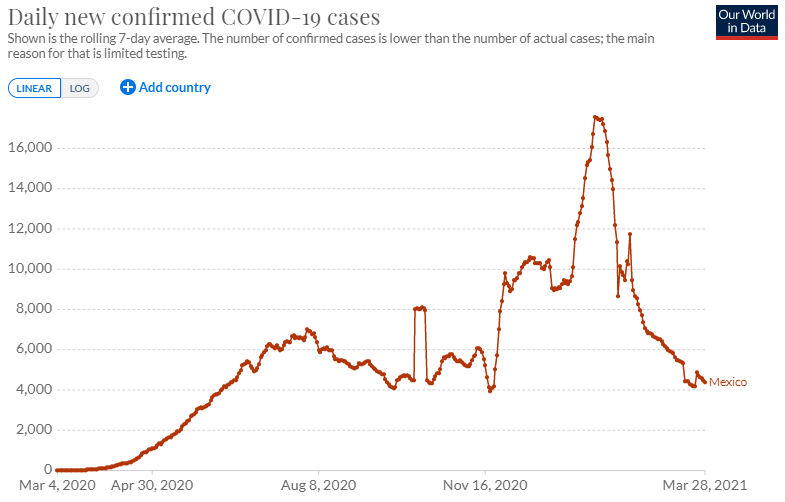
    The first known Covid-19 case was detected in Mexico on 28 February 2020: the carrier was a locally based Italian citizen who had recently returned from a European trip. As in other Latin American countries the virus spread very rapidly in the first months of the outbreak. Just over a year later the country had reported over 2m cumulative cases and 190,000 fatalities. This death rate was the third largest in the world, behind the United States and Brazil.

    The immediate response from President Andrés Manuel López Obrador (Amlo), a left-wing populist, was very similar to that of President Bolsonaro in Brazil, a right-wing populist. Ideology aside, Amlo’s first instincts, just like Bolsonaro’s, were to minimise the impact of the virus, passing it off as no more than a type of flu, and to refuse to set an example by changing his own behaviour, for example by observing social distancing or by wearing a mask. At one of his early press conferences on the pandemic, the Mexican president proclaimed: “There are those who say that because of the coronavirus you should not hug. But you must hug, nothing will happen.”

    In fact, in the initial months the president continued to travel around the country using economy class on domestic flights (part of his trademark routine of presenting himself as an austere ‘man of the people’). He also shook hands and embraced supporters at rallies. Like Bolsonaro, although albeit it at a later date (January 2021), Amlo himself contracted the virus, having to self-isolate for a period. So too did a number of ministers, but this did not change his thinking. Like his Brazilian counterpart, or indeed like President Donald Trump in the US (2017-2021), Amlo railed against the economic costs of shutdowns and quarantine measures, most of which were left to the state authorities to administer. Between March and May 2020, a national ‘safe distance’ policy urged citizens to avoid close contacts, as well as closing down schools and nonessential activities. A fully national lockdown was, however, never enforced.

    The pandemic’s first wave peaked around June 2020, triggering a rapid removal of restrictions and an opening up of the economy known as the ‘new normal’. The government introduced a ‘traffic light’ system allowing different levels of restriction on a state-by-state basis. With the benefit of hindsight, however, it is clear that the relaxation was too early and went too far. The R rate (reproduction rate) rose in various cities across the country throughout the second half of the year and into the first quarter of 2021, although it later eased back by February/March. In December, Mexico City re-imposed tighter restrictions, which began to be relaxed again in February. 

    Mexico consistently underestimated the severity of the crisis. In April 2020, as the first wave of quarantine measures came into effect, the deputy health minister said the maximum death toll from the disease was likely to be about 8,000, around 23 times lower than the toll of fatalities that was reached after the first year. Mexico entered the pandemic already in economic recession, and the damage to activity levels was extreme. Unlike Brazil, Mexico implemented only very limited levels of fiscal stimulus, offered modest emergency help for the poor, and did not provide financial help for companies to run furlough schemes or other employment-protecting measures. Partly as result, the economy contracted by 8.2% in 2020, roughly double the downturn experienced in Brazil, as well as double the contraction in the United States, Mexico’s main economic partner and strategic neighbour.

    A vaccination campaign was launched in December 2020 but got off to a slow start given some delays in vaccine supply. Mexico signed a range of agreements for the Sputnik V, AstraZeneca, Pfizer, and CanSino vaccines. However, delays in delivering the Russian-made Sputnik V doses meant that immunisation of health workers, one of the first priority groups, had to be paused, and immunisations for those aged 60-plus did not start until February. Mexico has been acquiring vaccines directly but also through the WHO-supported Covax programme. In a speech to the UN, Amlo criticised rich countries for putting themselves at the top of the queue for vaccines, while not doing enough to support immunisation for poorer countries.  

    Mexico Cumulative Cases Cumulative Deaths Deaths per million
    15 March 2021 2.16mn 194,710 1,508

  • ECONOMIC HIGHLIGHTS

    Abbi Dicker 19 January 2024 Hits: 2144

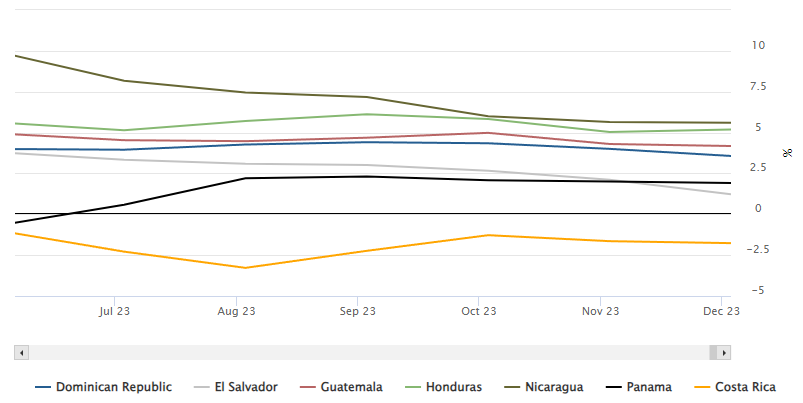
    NICARAGUA | New FTA with China takes effect. On 1 January a new free trade agreement (FTA) between Nicaragua and China took effect. Nicaragua’s minister of development, industry & trade (MIFIC), Jesús Bermúdez, said that under the new FTA Nicaragua has the capacity to quintuple exports to China within five years, from US$200m currently to US$1bn within that period. He said that China’s exports to Nicaragua are worth some US$1.3bn currently, an amount which he said could rise to US$2bn within ten years. The two countries established relations in late 2021 following Nicaragua’s severing of ties with Taiwan and signed the FTA in August 2023. China is currently Nicaragua’s third biggest export market after the US and Central America and its third biggest source of imports after the US and Central America.

    PANAMA | 2024 budget approved. On 28 December Panama’s national assembly approved the state budget for 2024 for US$30.69bn. This is down from the government’s initial proposal of US$32.75bn, a reduction which the economy & finance ministry (MEF) says takes into account the “events of last October and November which had a negative effect on economic growth”. This is a reference to the disruption caused by the national protests over the new contract for the major copper mine Cobre Panamá which the supreme court ultimately struck down at the end of November [EB-23-12]. According to the MEF, the reduction will be distributed across central government (which sees a reduction of US$780.6m), decentralised entities (US$362.0m), public companies (US$149.5m), and financial intermediaries (US$772.0m). The fiscal deficit for 2024 is estimated to come in at 2% of GDP. Panama’s deputy economy minister, Carlos González, said that projected revenue for 2024 would not be affected by the closure of the mine which contributes some 5% of Panama’s GDP.

    Central America & Caribbean: inflation rate
    Percentage variation (year-on-year)

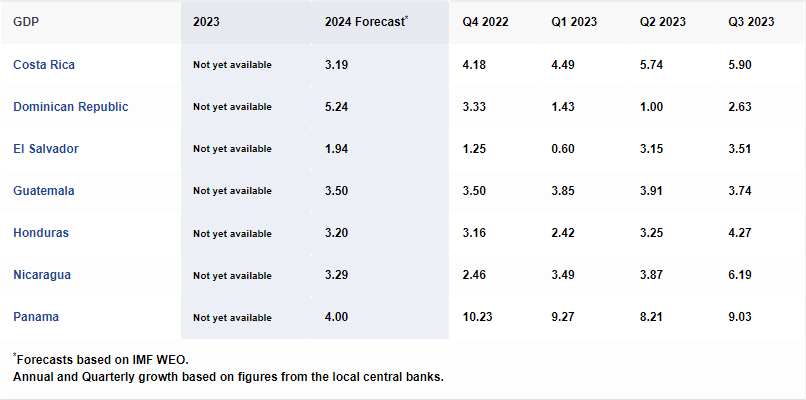
    Central America & Caribbean: GDP growth (%)
    Quarterly figures are year-on-year growth


  • RASTREANDO TENDENCIAS

    LatinNews 23 September 2011 Hits: 502

    ARGENTINA | Impuesto a filmes extranjeros. La industria cinematográfica de Argentina, de la que se puede decir que es la más desarrollada en América Latina, es altamente dependiente del mercado interno y el financiamiento del instituto nacional del cine y artes visuales (Incaa), que recibe un porcentaje del precio de cada boleto vendido en los cines para financiar proyectos hechos en el país. Esta semana, el Incaa anunció que aplicará un impuesto a las películas extranjeras que se exhiben en el país para incentivar el consumo de filmes producidos en el país. La tasa máxima se aplicará a películas exhibidas en más de 161 pantallas simultáneamente y será el equivalente al precio minorista de 12.000 entradas, en líneas generales, aproximadamente Arg$400.000 (US$95.000) a los precios actuales de los boletos.

    BRASIL | Honduras emite orden de compra a Embraer. El 3 de setiembre, el jefe de las fuerzas armadas hondureñas, General René Arnoldo Osorio Canales, anunció la compra de cuatro aviones ligeros de ataque SuperTucano EMB-314 de Embraer, de Brasil, a un costo total de US$40m (US$10m cada uno). El dijo que los aviones turbo-propulsados estarán equipados con ametralladoras, artillería, equipos de visión nocturna y sistema de radar. Serán usados en operaciones contra el tráfico de drogas en Honduras. La orden será financiada a través de un controversial nuevo impuesto de seguridad recientemente aprobado por el congreso de Honduras. Se espera que la fecha de entrega sea entre 2013 y 2014. Honduras había comprado 12 Embraer-312 Tucanos, el predecesor del Super Tucano, en 1984, pero desde entonces el modelo ha sido retirado. Honduras estuvo originalmente en busca de repuestos muy difíciles de encontrar, pero Embraer en cambio le vendió el nuevo modelo.

    URUGUAY | Escándalo afecta a Minustah. Esta semana, el Presidente José Mujica emitió un pedido de disculpas al Presidente de Haití, Michel Martelly, por la supuesta violación de un haitiano, perpetrada por marines uruguayos que sirven en la Misión de Estabilización en Haití (Minustah). El supuesto hecho ha provocado la indignación interna e internacional. El jefe brasileño de Minustah, General Mayor Luiz Eduardo Ramos Pereira, también ha emitido una declaración condenando “vehementemente” el acto. Sin embargo, el secretario general de la ONU, Ban Ki-Moon, ha permanecido en silencio. Los ministros de defensa y cancilleres de los países de América Latina que contribuyeron con tropas a Minustah están reunidos en Montevideo para analizar la situación en Haití, y el ministro de defensa de Brasil, Celso Amorim, ha reiterado la determinación de de Brasil de reducir su presencia en Haití.

  • ARGENTINA: La corte suprema critica al gobierno por las pensiones

    LatinNews 09 May 2014 Hits: 717

    Enfurecida por el número de demandas por el pago de pensiones, que está obstruyendo el poder judicial federal, la corte suprema de la Argentina ordenó, el 6 de mayo, al gobierno a que pague el dinero que le adeuda a los demandantes que tuvieron éxito. También anuló la ley de reforma de las pensiones de 1955, que requiere que todas las apelaciones sobre resoluciones de pensiones sean referidas a la corte federal de apelaciones de seguridad social en Buenos Aires. Esta corte fue creada durante la presidencia de Carlos Menem (1989-1999): sus críticos alegan que su principal objetivo es retrasar los procedimientos iniciados por los pensionistas.

    De acuerdo con la resolución de la corte suprema, la ley de reforma de la pensión ha conducido al “colapso” de las cortes, impactando directamente a los pensionistas, “uno de los grupos vulnerables definidos en la constitución”. Los datos de las cortes de apelaciones de la seguridad social federal muestran que para junio del 2013 había 279.856 casos siendo analizados por las cortes de primera instancia, y 187,076 casos siendo examinados por cortes de segunda instancia. Con todos los juicios a ser escuchados en salas de tribunales de Buenos Aires, muchos querellantes que vienen de más lejos se han quejado de una falta de acceso a la justicia.

    Desde ahora en adelante, las apelaciones serán tratadas por una corte federal en la provincia en la cual fue hecha la resolución de primera instancia. La corte suprema también ha urgido al congreso a que cree nuevos tribunales con jurisdicción en cuestiones de seguridad social, y al gobierno a que tome  las medidas necesarias para asegurar que sus agencias cumplan con las decisiones de la corte

    Diego Bossio, el presidente de la Administración Nacional de la Seguridad Social (Anses), dijo después de la resolución que durante los últimos meses la agencia había pagado Ar$ 1,71mm (US$213m, a la tasa de cambio oficial). “Solamente el 5% de los pensionistas demandan al Estado porque no están contentos con sus pensiones”, Bossio dijo. “Para el 2016, no habrá ninguna demanda presentada contra el Estado”.

    La Presidenta Cristina Fernández nacionalizó las pensiones privadas de Argentina en el 2008; desde entonces, la Anses ha estado siendo usada para financiar proyectos populares tales como hogares para aquellos de bajos ingresos, infraestructuras y beneficios para familias pobres. Los ingresos en la cartera de inversión de la Anses han sido consistentemente menores que la tasa de inflación estimada de la Argentina. Hay una extendida sospecha de que el retraso en la resolución de los juicios con relación al pago de sumas atrasadas de pensiones es una táctica deliberada, diseñada para reducir la responsabilidad de pago del Estado, elevando la posibilidad de que los demandantes fallezcan antes del día de pago.

    Secretaría de cultura elevada a rango ministerial

    Un nuevo decreto entró en vigencia el 7 de mayo, elevando la posición de la secretaría de cultura a rango ministerial. La nueva ministra será Teresa Parodi, una cantante y compositora, quien encabezaba el Espacio Cultural Nuestros Hijos, parte de la fundación Madres de Plaza de Mayo. El boletín oficial en el cual fue difundido el decreto, expresó que el cambio era necesario, “dada la importancia que la cultura representa como un medio de desarrollo y cohesión social, [y] su rol de fortalecimiento de la diversidad cultural y la integración de las minorías”.

    Un sondeo analizando el consumo cultural de Argentina fue difundido para coincidir con el decreto. De acuerdo con el primer sondeo nacional de consumo cultural y ambiente digital, el 98% de los argentinos miran la televisión por un promedio de 2,5 horas diarias. La radio permanece popular: el 86% son escuchas regulares, con un promedio de 3,5 horas por día. Los argentinos leen más que cualquier otro latinoamericano. Sesenta por ciento lee un periódico al menos una vez por semana; el promedio de los argentinos lee poco menos de tres libros por año.

    Sesenta y cinco por ciento usa Internet diariamente; el 60% tiene conexión de Internet en la casa. Facebook es el sitio web más visitado; el 55% de los usuarios de Internet tienen un perfil en el sitio de la red social. Facebook inauguró una oficina en Buenos Aires esta semana, provocando un incómodo encuentro entre la Presidenta Cristina Fernández y el alcalde opositor de la ciudad, Mauricio Macri, ambos son entusiastas usuarios de los medios sociales. En un discurso para marcar su apertura, Fernández confesó que ella escribe sus mensajes a mano, y luego alguien los pone en el sitio web.


    • La salida de Repsol

    Repsol vendió sus acciones restantes en la compañía petrolera estatal, YPF, el 5 de mayo. La compañía petrolera de España poseía aproximadamente el 12% de YPF. Con las acciones con un valor de aproximadamente US$28, Repsol debería recolectar alrededor de US$1,3mm. La venta se produjo después de que Repsol acordó antes en este año poner fin al conflicto legal con Argentina que comenzó en el 2012 luego que el gobierno expropió una participación mayoritaria en YPF.

  • CHILE: Bachelet amends tax reform

    LatinNews 04 February 2016 Hits: 726

    President Michelle Bachelet this week promulgated a law simplifying her landmark tax reform passed in 2014 aimed at raising annual government revenues equivalent to 3% of GDP in order to fund health and education reforms. While Bachelet trumpeted the changes as part of efforts to improve implementation of the tax reform, which raised the corporate tax rate and ended some tax exemptions, her centre-left Nueva Mayoría coalition government continues to struggle vis-à-vis a slowing economy stemming in part from the ongoing slump in international commodity prices.

    President Bachelet had announced plans last year to draft the new bill simplifying tax assessment particularly for small and medium sized enterprises (SMEs) in line with demands from the business sector [WR-15-33]. Sent down to the bicameral legislature on 15 December 2015, the bill was approved by the senate on 26 January and the chamber of deputies the following day. Having previously underlined that “this isn’t a reform within the reform, it is just the culmination of a process”, Finance Minister Rodrigo Valdés said at the signing of the new law on 1 February that this “simplification leaves us with a tax system fully implementable for the next few years”.

    Back in November 2015, at a World Bank (WB) seminar which included a presentation on Chile’s 2014 tax reform, a finance ministry press release cited Finance Undersecretary Alejandro Micco as outlining the main points of the simplification bill as follows: it maintains “the two tax regimes: the semi-integrated system and the attributed income system. However, companies with complex corporate structures may only choose the semi-integrated system”. The press release notes that “companies whose partners are individuals who reside in Chile may choose between the attributed income and semi-integrated systems”, and cites Micco as saying “that some adjustments will be made to simplify the tax records that taxpayers must keep and more specifically define some aspects of [value added tax] VAT application in real estate matters.”

    The WB and Bachelet government have been quick to point to the positive impact of the tax reform (see sidebar) and also, on 1 February, Valdés said that, as a result of a higher-than-expected tax take, the fiscal deficit was 2.2% of GDP in 2015, less than the 3.3% forecast. However the government continues to struggle in the face of the continued slump in commodity prices amid ongoing uncertainty about the level of demand from China. On 14 January Mining Minister Aurora Williams and the executive vice president of Chile’s national copper commission (Cochilco), Sergio Hernández, announced that Cochilco forecast the price of copper – Chile’s main export – to average US$2.15 a pound this year, down US$0.35 on Cochilco’s September 2015 forecast. Meanwhile for 2017, it is forecasting the average price of copper to rise to US$2.2 a pound.

    According to the latest Cochilco figures, Chile’s copper exports were valued at US$37.96bn in 2014, accounting for half (49.5%) of Chile’s total exports. This was down from the US$39.73bn exported in 2013 (51.4% of total exports), the US$41.78bn (53.4%) exported in 2012, and the US$43.61bn in 2011 (53.6%). The impact of all this on growth forecasts was suggested in a report released by Chile’s central bank (BCCh) on 12 January; experts consulted cut their GDP growth forecast for 2016 to 2.1%, down from their 2.2% December 2015 estimate, and 2.8% for 2017, down from 3.0%. Another BCCh report, released on 5 January, showed that Chile’s monthly economic activity index (Imacec), which incorporates around 91% of the goods and services included in the country’s GDP measure, rose by just 1.8% year-on-year in November 2015, with the rolling 12-month growth rate at 1.5%.

    • The impact of tax reform

    A World Bank study “Chile: Distributive Effects of the 2014 Tax Reform” was presented at a seminar in November 2015. According to a press release by Chile’s finance ministry, the WB study indicates that “the Tax Reform has a positive impact on income distribution and sharply improves the fairness of the tax system”, because “the effects are strongly concentrated in the upper end of the income distribution curve and are reflected in a substantial increase in the effective income tax burden for the highest percentile in this distribution.” The report also maintains that the highest-earning percentile “will pay 93% of the increased tax revenue collected because of the changes to income tax.” Of the total collected, “73% comes from increased taxes paid by the wealthiest 0.1%.”

  • TRACKING TRENDS

    Abbi Dicker 05 September 2024 Hits: 1811

    BOLIVIA | International reserves. Bolivia’s central bank (BCB) reported on 2 September that Bolivia’s net international reserves (RIN) totalled US$1.9bn as of the end of August, up by US$196m on the amount registered at the end of 2023.

    At the end of April, international credit ratings agency Moody’s downgraded Bolivia’s ratings to Caa3 from Caa1, warning that external liquidity pressures had reached “critical levels”, driven by “a material decline in foreign-exchange reserves that heightens sovereign credit risks, threatening a balance of payments crisis”. Moody’s noted that as of end-December 2023 Bolivia’s RIN (including gold) had fallen to US$1.7bn from about US$3.0bn in May 2023, even after the approval of a new law authorising the BCB to begin selling a portion of its gold reserves [WR-23-21]. Bolivia was also downgraded by Fitch in February and Standard & Poor’s in November 2023.


    PERU | Record investment in PPPs. Peru’s investment promotion agency (Proinversión) announced on 2 September that in the first eight months of 2024, it had awarded 12 public private partnership projects (PPPs), worth US$6.08bn, aimed at improving Peru’s port, rail, road, and electricity infrastructure, among other things.

    Proinversión said that this is the highest amount in a decade and reflects improved investor confidence in projects financed through PPPs. It said that the US$6.08bn represents 76% of the portfolio that the government is seeking to award in 2024, which is estimated at some US$8bn.            

    In particular the agency highlighted six projects worth US$1.01bn awarded in August which will benefit over 5.2m residents. This includes a US$565m project to modernise the Huancayo-Huancavelica ‘Tren Macho’ railway, which was awarded to the consortium, Consorcio Concesionaria Ferroviaria del Centro, comprising Ecuadorean firms Construcción y Administración SA and Hidalgo e Hidalgo SA, and Argentina’s Benito Roggio Transportes SA. According to the government the emblematic 128.7km rail project will benefit 1.2m residents in Junín and Huancavelica provinces.

  • GUYANA: IMF gives government election boost

    LatinNews 19 July 2011 Hits: 445

    Guyana must go to the polls before the end of the year, and the politicking has been going on in earnest for some months.  The release at the end of June of the IMF’s latest – broadly satisfactory – report on Guyana will have given the ruling People’s Progressive Party-Civic (PPP/C) a boost.

    On the face of it, the PPP/C has three disadvantages.  It has been in power for 19 years, outgoing President Bharrat Jagdeo is barred from standing again, and the opposition parties have united into A Partnership for National Unity (APNU) behind the presidential candidacy of David Granger of the People’s National Congress Reform (PNCR). On the other hand, the PPP/C has numbers on its side.  It is supported principally by Guyanese of East Indian extraction, who make up 43.5% of the population against Afro-Guayanese 30.2% (16.7% are mixed race, 9.1% Amerindian, and 0.5% Other, according to the 2002 census).

    Without actually alluding to the racial factor, Jagdeo made this point about numbers on 8 July in response to the founding to the APNU.  He said that in a country such as Guyana with a proportional representation electoral system, election results are all about numbers – and that the component parts of the APNU only mustered something like 36% of the vote in the last election while the PPP/C was close to 55%.

    Jagdeo also once again played up concerns about Granger’s past.  Previously Jagdeo has accused Granger of being involved in the stealing of ballot boxes during “the era of oppression”.  On 8 July, he said: “Granger is running as the presidential candidate [for the APNU] so his record doesn’t disappear because he changes the form of the organization.  Granger still has his record to answer for...Lots of bad things happened [when he was in the military].” According to Jagdeo, Granger “wasn’t a regular soldier, he was someone sent from the office of the president to get the army to move in a particular direction and you know what that direction was, to subvert the constitution and the laws...”

    The PNCR immediately fired back at the PPP/C and its presidential candidate Donald Ramotar, saying on 9 July: “Donald Ramotar and the PPP/C must give account to the Guyanese people as to why friends of the government seem to have abundant wealth, while citizens’ paycheques finish before the 10th day of the month.  They must answer for the steel bars on every window and door and our citizens’ added stress of living in a crime-ridden society.”

    The problem with this riposte is twofold.  First, the government has accused the PNCR of having “a very close link with criminal gangs” and of ramping up the crime wave in an attempt to undermine the government.  Secondly, on the economic front, there is the fact that Guyana registered a fifth consecutive year of robust growth in 2010 (3.4%), as the IMF confirmed in its June report.  There were some concerns in the report, for instance about inflation which picked up to 4.4% from 3.7% in 2009; about the external current account deficit (11.4% in 2010 from 8.8% in 2009); and a fiscal deficit of 4.3% of GDP against a budget of 3.2% and a 2009 figure of 3.4%.  Nevertheless, the IMF says that growth levels should stay “above the long-run trend of 3%, to around 5% over the medium term” – partly due to the government’s Low Carbon Development Strategy (LCDS) and private sector investments in gold, oil, and gas sectors.  The IMF’s growth projections for 2011 and 2012 are, respectively, 4.8% and 6.0%.

  • Region: Corporate Radar

    LatinNews 23 November 2016 Hits: 41506

    Tough at the top in Brazil. According to a report by the Bloomberg news agency, the Brazilian recession is taking its toll on chief executives. At least 40 of the CEOs of 110 Brazil-based companies with assets of US$1bn or more have been replaced over the last two years, the report said. “Periods of crisis tend to drive up the exits of C-levels. This was intensified this year by a series of events in which you have a serious conflict between the interest of the company and the ones of shareholders and boards”, said Adeopato Volpi Netto, head of capital markets at Eleven Financial Research.

    In October, Roberto Oliveira de Lima resigned abruptly as CEO of the beauty products company Natura Cosméticos after earnings missed analysts’ forecasts. Amos Genish of Telefónica Brasil has said he is stepping down for personal reasons at the end of this year. Bayardo Gontijo stepped down from Oi, the telecoms company in bankruptcy protection, after disagreements over how to reduce its heavy debt load. Education supplier Estacio Participaçoes has had no less than five different CEOs this year as part of a battle for control of the company. Itaú Unibanco, Brazil’s largest bank, has announced that Candido Bracher will take over from Roberto Setubal as chief executive in April 2017. Aerospace group Embraer said in June that CEO Frederico Curado was stepping down for personal reasons: less than two months later, its shares slumped after announcing a surprise second quarter loss and the fact that it was under investigation under the US Foreign Corrupt Practices Act. In October, Embraer announced that it was paying a US$205m fine to the US authorities to settle the investigation.

    Chinese investment in Mexico. The first major foreign investment in Mexico after the US elections has a significant Chinese component. On 16 November, the government led by President Enrique Peña Nieto announced that the 20-year contract to build and operate a wholesale mobile communications network, which eventually could be worth up to US$7bn, had been awarded to the only bidder: the Atlán consortium. This is led by a Spanish telecoms businessman Eugenio Galdón, an infrastructure fund managed by Morgan Stanley, and the China-Mexico Fund, managed by a unit of the World Bank.

    The China-Mexico Fund is the second largest shareholder in the venture with a 23.36% stake, after Morgan Stanley with 33.38%. The network was conceived as part of Mexico’s 2014 telecoms reforms, designed to reduce market dominance by América Móvil and promote greater competition and more competitive interconnection charges.

    The deal is considered something of a risky investment however, given some uncertainty over telecoms demand in future years, and the requirement to offer low-cost service in isolated rural areas of the country. Rivada, a US-based company that was disqualified from the bidding on the grounds that it failed to provide financial guarantees by a 20 October deadline, has said it plans a legal appeal.

    Mexico postpones oil and gas auction results. Mexico’s oil and gas regulator, the Comisión Nacional de Hidrocarburos (CNH), has approved a government proposal to delay the results of the second phase of the Round Two auctions of oil and gas exploration and production (E&P) contracts. The announcement will be pushed forward from 5 April to 12 July next year. This will allow the 12 E&P contracts to be announced on the same day as a further 14, which are due in the third phase of Round Two.

    Contracts from these two phases are mainly for onshore gas prospects in the Burgos basin, in Tampico-Misantla, Veracruz, and in the southeast basin, in Tabasco and Chiapas. The auctions are part of the government’s policy to attract investment for international oil companies to help it reverse falling oil and gas output from mature fields.

    The results of an earlier phase of E&P auctions are due to be announced on 5 December – these involve deep water blocks in the Gulf of Mexico close to the US border, as well as a call by state-owned oil company Pemex for partners to help it develop the deepwater Trión block.

    Viacom makes Argentina move. US media company Viacom has agreed to buy Televisión Federal (known as Telefe), Argentina’s largest TV network, for a cash payment of US$345m. The seller is Spain’s Telefónica, which has been following a programme of asset sales to reduce its levels of debt. Significantly, the deal will make Viacom the first US company to operate a free-to-air TV network in Argentina in almost 50 years. Apart from the main network, Viacom is also acquiring eight Telefe provincial networks, an international pay-TV channel, online platforms, and, importantly, 12 production studios and some 33,000 hours of existing Spanish-language content.

    According to media specialist Martín Becerra, “If it is true that they want to create a production centre for all of Latin America, this would be a very good place to do that. Telefe has a very significant archive of content, but what Viacom is really buying is the production capacity”.

    The deal may be followed by other US companies, as both Turner (a division of Time Warner) and Fox (owned by News Corporation) are reported in talks to buy Fútbol para Todos (FTP), a state-owned sports programme which holds football match broadcasting rights.

  • CARIBBEAN POINTERS

    LatinNews 13 March 2019 Hits: 2175

    *** CARICOM AND OAS STILL AT ODDS. The leaders of the Caribbean Community (Caricom) have been at odds with the Secretary-General of the Organisation of American States (OAS) over the latter’s hard-line stance on Venezuela. In January, Trinidad & Tobago’s Foreign Affairs Minister Dennis Moses went as far as to accuse OAS Secretary-General Luis Almagro of adopting an “intemperate stance”. At the beginning of February, Almagro again infuriated many Caricom members with remarks about Dominica’s next general election, scheduled for December 2019.

    In a tweet on 7 February, Almagro wrote: “Today I met with Former [Dominican] Ambassador to UN, Crispin Gregoire, who expressed his concern that the upcoming elections in Dominica are not free and fair. He also requested OAS official assistance to help ensure a level playing field.”

    In his defence, Almagro said that he was only repeating Gregoire’s view and not endorsing it, but this didn’t stop the criticism. The chairman of Caricom, St Kitts & Nevis Prime Minister Timothy Harris, issued a statement on 21 February saying that the organisation was “deeply concerned” about Almagro’s statements which, he said, “are outside the bounds of his remit as the Head of an international organisation”.

    The statement went on to say that Almagro’s tweet of 7 February “associating himself with a suggestion that Dominica will not conduct free and fair…elections is the latest manifestation of his inappropriate behaviour”. Almagro was unrepentant, saying in a 23 February statement that “Dominica is the country with the lowest rate of implementation (below 10%) of the recommendations of OAS Electoral Observer Missions.”

    *** BAHAMAS BAHA MAR COMPLEX SHOWING 90% OCCUPANCY. In late February, the head of the massive Baha Mar tourism development in The Bahamas said that occupancy at the resort was running at over 90% and that this was expected to continue into March. He said that the occupancy figures were “beyond the company’s expectations.

    This year will be the first year in which all the troubled resort’s facilities will be open, and more facilities are planned such as a new water park.

    *** ST VINCENT & THE GRENADINES (SVG) ‘RECOVERING’. In its latest review of the SVG economy, the International Monetary Fund (IMF) reported the growth outlook to be “positive”, with growth of around 2.3% forecast for 2019 from 0.7% in 2017 and 2% in 2018.

    In its statement following the latest Article IV Consultation, the IMF noted: “Following the opening of a new airport…tourist arrivals have recovered, boosting tourism-related services (such as hotels, restaurants, and retail)”. Another boost to the economy has come from the increased demand from Dominica for reconstruction materials since the September 2017 Hurricane Maria. Inflation is around 2%-3%.

    Upside potential was seen to come from potentially stronger tourism receipts, investor interest, and “the successful completion of the geothermal power plant”.

    On the downside, the IMF said: “External risks include weaker-than-expected global growth, tighter global financial conditions, and higher oil prices…Domestic risks include more severe and frequent natural disasters, the loss of correspondent banking relationships, and materialisation of financial sector risks.”

  • Creating a second meat and food giant

    Ira Lee 23 October 2025 Hits: 364

    With the approval of Marfrig’s merger with fellow meatpacker BRF, Brazil now has two players among the world’s top five meat processing giants. On 5 September Brazil’s antitrust regulator (Cade) authorised the merger that had been first announced in May without any restrictions. The newly created company, MBRF, which is expected to have annual revenues of around R$152bn (US$28.5bn), began trading on the B3 stock exchange in São Paulo on 23 September.  

    Back in 2019, Marfrig and BRF had discussed a merger but abandoned the talks over disagreements on governance. Marfrig then began acquiring BRF shares until it gained control of more than 50%, but what followed was a merger rather than an acquisition. While Marfrig has gained the shares of BRF it had not previously owned, BRF shareholders also gained Marfrig shares. Following the share swap, the companies became one entity, MBRF. With Marfrig specialising more in beef and BRF focused mostly on poultry and pork meat, the merger is seen as complementary and is expected to generate synergies of around R$1bn per year. Redundant sales, distribution, and logistics operations are to generate the bulk of the savings, with potential tax benefits providing an additional boost to the bottom line.

    While MBRF is still less than half the size of the global industry leader, the Brazilian meatpacker JBS, it has now equalled or surpassed the likes of China’s WH Group and US multinational Cargill and is encroaching on the world’s second largest meat processing company, US producer Tyson Foods. The food brands Sadia and Perdigão, which were both subsidiaries of BRF, are household names in Brazil, having supplied generations throughout the country with a range of products from bacon to frozen lasagne. Other notable subsidiaries in MBRF’s portfolio include Plusfood from the Netherlands, owned by Perdigão, and US meat brand National Beef, owned by Marfrig.  

    As the world’s largest beef exporting country, it may be no surprise that Brazil boasts two of the largest companies in the industry, but it is also not a given. The country is the world’s largest exporter of coffee and the second largest of iron ore, but its steel companies are dwarfed by global competitors and there is not really a globally known Brazilian coffee brand.

    The idea of creating competitive Brazilian multinationals through generous financial support surged during the first two terms of President Luiz Inácio Lula da Silva (2003-2011) with his policy of ‘Campeões Nacionais’ (National Champions). Like JBS, Marfrig and BRF had received government aid, and the state development bank (BNDES) as well as the pension funds of state-run companies Petrobras (Petros) and Banco do Brasil (Previ) until recently still had significant stakes. Previ sold its stake in BRF in July this year.

    Concerns over potential conflict of interest

    As part of its objective to achieve food security for Saudi Arabia and seek returns in emerging companies, a subsidiary of the Public Investment Fund (PIF) of Saudi Arabia, Salic, owned a stake in BRF as well as in rival meatpacker Minerva. Cade requested more information from Salic, flagging up a potential conflict of interest due to its stake in the competitors. To facilitate Marfrig’s merger with BRF, Salic sold its 11% direct stake in BRF and then purchased derivatives equivalent to the shares it sold, allowing the company to maintain an economic interest in MBRF.