All Categories

Subcategories

  • POINTERS

    Sarah Sheldon 22 January 2024 Hits: 1372

    *** SOME PROGRESS AT COP28. The 39-member Alliance of Small Island States (AOSIS), of which 16 are Caribbean states, was founded in 1990 and has been advocating for the establishment of a Loss and Damages Fund since the inception of the Conference of the Parties (COP) in 1995. The latest COP gathering, COP28, did at last produce such a fund, but it was an achievement that AOSIS chairman Toeolesulusulu Cedric Schuster described as “a relief” rather than a win.

    As host of COP28, the United Arab Emirates pledged US$100m to the fund, with the EU providing US$145m. Contributions from the UK, US, and Japan, among others, bring the total fund to over US$400m so far. But Schuster sees this as just the start, saying: “It’s not enough. We need at least about US$100m a year to really address the loss and damage issue.” The prime minister of The Bahamas, Philip Davis, added: “We cannot be silenced by commitments and pledges. We want them to commit, pledge, and write the cheque.”


    *** GUYANA’S GOOD FORTUNE CONTINUES. In early December, the International Monetary Fund (IMF) concluded its latest Article IV Consultation with Guyana and issued a glowing report that noted: “The Guyanese economy continues to experience record growth, supported by the government’s modernisation plans and unparalleled oil and gas sector expansion…Overall real GDP growth is projected to grow 38.4 percent in 2023 and on average of 20 percent per year during 2024-28.”

    Downside risks identified by the IMF include “inflationary pressures and the appreciation of the real exchange rate beyond the level implied by a balanced expansion of the economy”. However, it believes these threats are containable, and it says that “Staff assess the 2023 policy mix to be appropriate, with fiscal policy increasing public investment to address the large development needs, and broad money growing in line with non-oil GDP”.


    *** IMF RECOMMENDS MORE SUPPORT FOR SURINAME. The International Monetary Fund (IMF) has concluded the fourth review of Suriname’s 36-month Extended Fund Facility (EFF) approved in December 2021, and the review team has recommended to the IMF board that it approve an increase in IMF support to Suriname of US$63m and an extension of the programme to March 2025. This would raise the IMF’s support for Suriname to around US$650m. The review concluded that “program performance has been strong and all performance criteria for this review were met”.

    The review added that the Suriname authorities’ efforts to stabilise the economy “are bearing fruit”. Growth is expected to come in at around 2% for 2023, and inflation is projected to fall to below 20% by the end of 2024. However, the IMF warns, “the authorities face important near-term risks, including policy implementation challenges stemming from a more challenging socio-political climate and capacity constraints”.

    Regarding the threat of unrest, the IMF says: “The fragile economic recovery and rising social tensions call for a more measured pace of fiscal consolidation in 2024. Staff and the authorities agreed to reduce the 2024 primary balance target from 3.5 to 2.7 percent of GDP. The 3.5 percent of GDP primary balance target, which underpins debt sustainability, will now be reached in 2025.”

    On debt, the IMF commends the “excellent progress” on restructuring, with the finalisation of the debt exchange with private bond holders. The participation rate is over 96%. Agreements with remaining official creditors are close to conclusion, and the IMF reports that the government “has also made progress in clearing domestic arrears and restructuring domestic debt”.

  • VENEZUELA: ICC to open office in Caracas

    Patrick de Courcy 07 April 2022 Hits: 4233

    The International Criminal Court (ICC) in The Hague announced on 31 March that it will open an office in Caracas, from where it will base its investigation into alleged crimes against humanity under President Nicolás Maduro [WR-21-44].

    The ICC’s chief prosecutor, Karim Khan, announced the opening of a local office at the conclusion of his first official visit to Venezuela since the court’s November announcement of a full investigation into alleged extrajudicial executions and arbitrary detentions. In a statement, Khan expressed gratitude for the “straightforward and productive discussions” he has had with Maduro on the issue. He noted that: “the government of Venezuela remains of the view that the conditions for an investigation have not been met. I therefore consider it to their great credit that they have committed to strengthen cooperation with my office in order that we can get to the truth.”

    Khan also revealed other “tangible steps” in the ICC’s cooperation with the Maduro administration. These include an “agreement on regular and structured technical-level engagements” between the ICC and the government, and “the nomination of legal and operational focal points to facilitate effective responses to requests… pursuant to the exercise of my independent mandate.”

    Despite Khan’s expression of gratitude to Maduro for cooperating with the ICC’s investigation, it remains highly doubtful that the ICC will secure any high-level prosecutions. With the ICC lacking its own enforcement powers, it will be almost entirely dependent on cooperation from the Venezuelan authorities. Given that the Maduro administration continues to deny the need for an ICC probe, there is so far little reason to believe that it would incriminate any human rights abusers, much less hand them over to the ICC.

    Nevertheless, Venezuelan opposition leader Juan Guaidó welcomed the opening of the ICC office as a “step forward,” saying that “after years of effort and sacrifice, the ICC will scrutinise the dictatorship more closely than ever.” Rafael Uzcátegui, the director of the local human rights NGO Provea, said that the ICC’s presence “demonstrates once again that the Venezuelan state doesn’t have the will or the capacity to build its own mechanisms for investigation and justice,” but nonetheless praised the announcement as an “achievement” for those who “have testified despite the threats” of retribution.

  • Latin America is buying Chinese electric

    Abbi Dicker 11 July 2025 Hits: 2060

    Available statistics point to strong sales of Chinese EVs in Latin America. According to market research company Rho Motion global sales of electric (EV) and plug-in hybrid vehicles rose by 24% in May this year compared to the same month in 2024, to reach 1.6m units. Demand was led by China itself with a slower rate of expansion in North America. Chinese manufacturers such as BYD were beginning to focus more intensely on emerging markets. Rho Motion said the picture was complicated by import tariffs, with the US applying a 25% charge, forcing many non-US companies to reconsider their sales projections for this year. Sales in China were up by 24%, those in Europe grew 36.2%, and those in the rest of the world, including Latin America, were up by 38%.

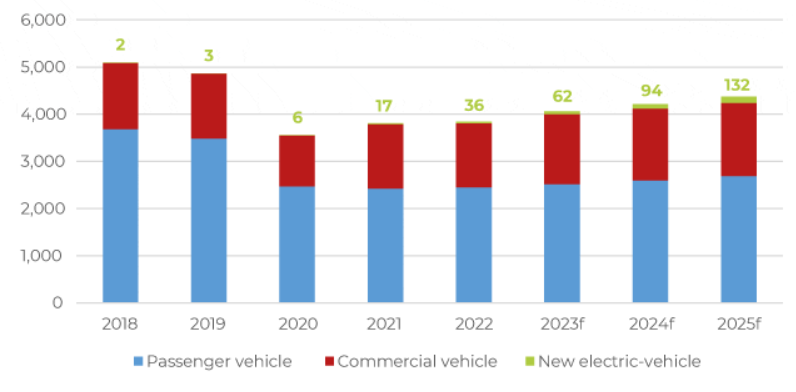
    New units (in thousands) registered per year in the four largest markets: Brazil, Mexico, Argentina and Colombia

    Source: Americas Market Intelligence

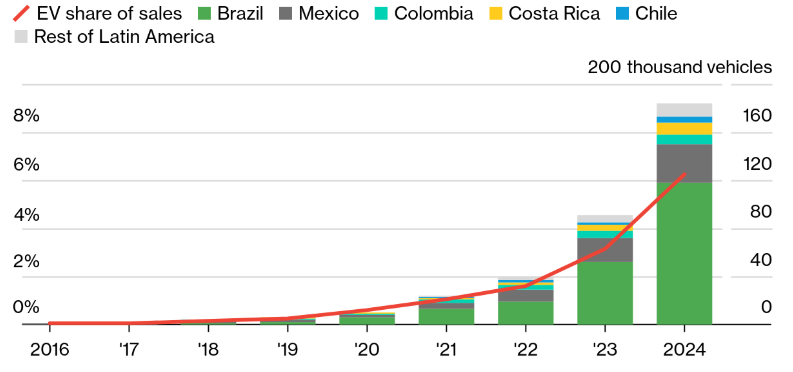
    It is estimated that Latin American EV sales in 2024 will have totalled close to 200,000, a very small number compared to the nearly 12m sold last year in China. Yet from this very low base, growth is now being described as “explosive”. Chinese EV sales are booming in Brazil, the largest car market in Latin America by the size of domestic sales. Last year EV sales more than doubled to 125,000 units, representing a 6% market share. EV adoption had earlier been slow because of high prices – significantly higher than for internal combustion powered vehicles. Yet the boom in volume manufacturing in China itself has introduced a new generation of more economical EV models. The EV share of total sales in Latin America has jumped from 2% in 2022 to 6% in 2024. Chinese EV sales in the region are concentrated in Brazil, Mexico, Colombia, Costa Rica, and Chile, in that order.

    Latin America passenger EV sales and EV share of new passenger vehicle sale

    Note: EVs here include battery electric (BEVs) and plug in hybrid vehicles (PHEVs)

    Source: BloombergNEF

  • VENEZUELA: Another boom-bust scenario?

    LatinNews 05 December 2012 Hits: 547

    “Venezuela has entered a phase of stable and sustainable growth”, boasted Finance Minister Jorge Giordani upon presentiation the latest GDP results. Giordani noted that following third quarter GDP  growth of 5.2% year-on-year, the government had already beaten its 5.0% growth target for the year.  He also emphasised falling inflation, which has come down steadily this year. Many private analysts, however, argue that the current growth, which rests on a major increase in public spending this election year (and a surge in imports to meet domestic demand), is both ephemeral and unsustainable and may collapse in 2013.  There is also mounting speculation that the government will have to devalue again in support of the budget position.

    Venezuela has registered eighth consecutive quarters of growth, noted the central bank. The latest result was driven by the non-oil sector, which traditionally accounts for about 75% of GDP. It rose 5.4% in the third quarter, driven by a construction  boom.  Output in construction sector was up 12.6%, on the back of the government’s public housing scheme, which was massively ramped up this election year. Manufacturing was up 3.0%, with communications up 6.9% and government services up 5.35%. In contrast, the oil sector, which is still struggling to boost output and is worth about 25% of GDP, rose just 1.1%.

    On 14 November the national assembly (AN) approved six additional public expenditure credits worth BF1.57bn (US$0.37bn). To date this (election) year, the AN has approved BF153.8bn (US$35.76bn) in additional spending above and beyond budgeted expenditure, 11% more than in 2011. The fiscal strains are starting to show, prompting speculation about an imminent devaluation, which is usually par for the course after an election. Further evidencing the squeeze on government coffers, Finance Minister Jorge Giordani has also been touting the need for tax reform. According to latest figures from the Organization for Economic Cooperation and Development (OECD), Venezuela’s tax take is one of the lowest in the region, at just 11.6% in 2011, beneath the regional average of 19.4% and well below its South American neighbours like Argentina (33.5%) and Brazil (36%).

    The Bolívar Fuerte is now trading at a new low of BF14.0/US$ on the black market, well below the official set rate of BF4.2/US$. The fiscal deficit is estimated at about 15% of GDP, shockingly high for a petro state. Despite an average oil price of US$104/b to date this year, the high-spending Chávez government can’t seem to make ends meet.

    Giordani denies that a devaluation is in the offing. However on 22 November, the central bank president, Nelson Merentes, refused to comment on the mounting rumours of devaluation, insisting that “these are not themes that are discussed publically, but between the executive and the bank”. Earlier, Merentes had been forced to deny on national TV that the central bank’s official mechanisms for the supply of US dollars, the Cadivi and the Sitme, which supply dollars at the official rate of BF4.2/US$ and BF5.3 respectively, were “paralysed”. The demand for dollars always rises this time of year in Venezuela but a sudden supply shortage in recent weeks has fuelled speculation that the central bank is hoarding greenbacks ahead of a devaluation, typically announced over the New Year period when people are on holidays.

    With municipal elections due in April or May 2013, the government may try to delay the pain of devaluation until the second half of 2013, for political reasons.  Another reason to avoid anything to destabilise the economy is the continued uncertainty over Presiden Hugo Chávez’s recovery from cancer.  On 27 November he returned to Cuba suddenly, officially for further after-care treatment, potentially only returning in the New Year for his 10 January inauguration for a  new six year term (2013-2019).

    • Tax reform

    The national assembly’s finance commission,  led by Ricardo Sanguino, is examining potential tax reforms to boost revenues from the non-oil sector. Reforms mooted in the last government plan (2007-2013) included the re-ordering of VAT (IVA) and income tax (ISLR), along with new duties on luxury items. Sanguino stresses that any reforms must first be debated and approved by the country’s ‘communal’ powers, making any changes unlikely until 2014.

  • RASTREANDO TENDENCIAS

    LatinNews 24 July 2015 Hits: 868

    PERÚ | Proceso de licitación del ‘Lote 192’. El proceso de licitación por los derechos de explotación del yacimiento petrolífero ‘Lote 192’, localizado en la norteña región amazónica peruana de Loreto  culminará el 23 de julio. El ‘Lote 192’ es el mayor yacimiento petrolífero activo de Perú, produciendo 12.000 barriles de petróleo por día (bpd), equivalente a un quinto de la producción nacional de petróleo de Perú. En los últimos 15 años ha sido operado por la firma argentina, Pluspetrol, pero su contrato de explotación por 15 años está llegando a su fin y el gobierno liderado por el Presidente Ollanta Humala lanzó un proceso de licitación pública a comienzos de este año, esperando otorgar un nuevo contrato de explotación por 30 años.

    Pero en meses recientes, las comunidades indígenas locales que viven cerca del ‘Lote 192’ han montado protestas quejándose de que la extracción de petróleo en el sitio ha producido la contaminación de las fuentes locales de agua y producido un severo daño medioambiental en las áreas que lo rodean, y están pidiendo que se ponga fin a la explotación petrolera en el sitio. Aunque tres firmas (Pluspetrol, Pacific Rubiales de Canadá, y la Anglo-Francesa, Perenco) han expresado su interés en presentar ofertas para asegurar un nuevo contrato de  explotación, el mes pasado el gobierno de Humala anunció que un nuevo contrato sería otorgado solamente si puede llegarse a un acuerdo con las cerca de 40 comunidades indígenas que afirman haber sido afectadas por la extracción de petróleo en el ‘Lote 192’. El gobierno ha estado tratando de alcanzar un acuerdo con las comunidades indígenas desde ese entonces. Pero esto ha resultado difícil.

    De acuerdo con el ministerio de cultura (Minem), las comunidades indígenas están exigiendo el establecimiento de un fondo fiduciario de US$1mm que será utilizado para financiar proyectos de desarrollo medioambiental y social en el área antes de aprobar la continuada explotación en el sitio. Sin embargo, el gobierno ha dicho que no cree que será posible reunir estos fondos con las firmas interesadas  en la explotación del ‘Lote 192’. El impasse es problemático para el gobierno de Humala que está interesado en incrementar la producción nacional de petróleo, que ha sufrido una caída en picada, de 120.000 bpd en los años ’70 a los 60.000 bpd hoy, como parte de sus esfuerzos para estimular la economía interna.

    De acuerdo con las últimas cifras de crecimiento económico difundidas por el Instituto Nacional de Estadística e Informática de Perú (Inei) el 15 de julio, el PIB del país creció por un moderado 2,14% en los primeros cinco años del año. Esto fue menor que las predicciones del mercado, que rondaban alrededor del 2,5%, y sugiere que la recuperación de la economía interna aún es tentativa.

    Por otro lado, en un esfuerzo por defender su caso para asegurar el nuevo contrato de explotación de petróleo, Pluspetrol dijo el 13 de julio que sus actividades de extracción de petróleo en Loreto le habían dejado US$118,5m en royalties al Estado Peruano en los primeros seis meses del año. La compañía agregó que desde que comenzó sus operaciones en Loreto, ha generado unos US$1mm en royalties para el Estado.

    BOLIVIA | Fitch eleva el rating de la deuda soberana. La agencia internacional de ratings, Fitch, anunció el 15 de julio que estaba elevando su rating de la deuda soberana de Bolivia por una escala, de ‘BB-’a ‘BB’ con un panorama ‘estable’. La declaración de Fitch dice que la decisión fue el resultado de una mejoría en la sostenibilidad de la “producción de hidrocarburos de Bolivia, la mayor fuente de exportaciones, ingresos fiscales, e inversión interna”. Fitch expresa que “las robustas protecciones a shocks externos de Bolivia y su amplia política fiscal le otorgan a su economía una mejor posición para absorber impactos adversos y adoptar políticas anti-cíclicas que las de otros [países] exportadores de materias primas en la categoría ‘BB’”.

    Fitch también señala que el “promedio de crecimiento económico de cinco años subió al 5,4% en el 2014, excediendo la media ‘BB’ del 4,1% [y] Fitch pronostica que la actividad económica mantendría el ritmo en un promedio del 4,4% en el 2015-2017, conducida por una robusta inversión pública en proyectos de diversificación e industrialización y facilita las condiciones de liquidez interna”.

    Después de la elevación de grado de Fitch, el ministro de finanzas de Bolivia, Luis Arce, dijo que el país emitiría hasta US$1mm en bonos internacionales este año, para estimular aún más el gasto público. Bolivia retornó a los mercados de deuda internacionales recién en octubre del 2012, cuando ubicó US$500m en bonos en los mercados internacionales por primera vez en más de un siglo. Esto fue seguido por otra emisión similar de bonos de US$500m, hecha por Bolivia en agosto del 2013.

    • Silk & Co. aterriza en Colombia

    El 15 de julio el banco de inversiones registrado en Irlanda, Silk & Co, anunció que había formalmente iniciado sus operaciones en Colombia, marcando su entrada a América Latina. En una declaración el jefe ejecutivo (CEO) de Silk & Co., Roy Ellis, dijo que los negocios de la firma en América Latina se concentrarán en el asesoramiento financiero, ofrecer financiamiento para proyectos de desarrollo de infraestructura y administración de la inversión extranjera. Explicando la selección de Colombia por parte de la firma como su centro de operaciones en América Latina, Ellis dijo que esto se debía a la percepción de seguridad y estables condiciones económicas que los inversionistas internacionales tienen actualmente del país Andino.


  • PERU: Slowly changing tack on coronavirus

    LatinNews 28 May 2020 Hits: 3788

    Peru’s President Martín Vizcarra, known for his early and rigorous application of lockdown measures to fight the coronavirus (Covid-19) pandemic, has announced faster-than-expected measures to re-open the economy. He made the announcement in a televised speech broadcast on 22 May. However, Vizcarra confirmed the fifth extension of the national state of emergency and lockdown, which will now remain in force until at least the end of June, by which point it will have been in place for in excess of three and a half months.

    President Vizcarra is facing a dilemma that is now common to many countries. Despite some initial signs of success after a two-month lockdown, he is under pressure to re-open the economy at a time when the infection curve has not really been flattened: on the contrary, it is still tracking upwards.

    Peru’s quarantine measures have been among the most rigorous in Latin America. Citizens must shelter at home. They are only allowed out on the street to buy food or medicines. A night-time curfew is in force. Only essential economic activities are permitted. Local and international air travel has been shut down and the frontiers are closed.

    This week’s announcement, however, begins to relax the controls, by allowing a resumption of online commerce for clothing and footwear, white goods, and school and office stationary and supplies; technical and professional services, laundry services; barbershops; and professional football, although matches will only be played in empty stadiums for the time being. “We have made mistakes… but we have had the courage to acknowledge this and correct them,” Vizcarra said. “We must move to a new coexistence, which allows us as a society to be more caring, more responsible, disciplined, respectful of the minimum standards of behaviour so as not to harm the people we love the most,” he added.

    Challenges

    Various reasons may explain why Peru has so far been unable to flatten the curve, despite popular support for the government’s policy (as measured by opinion polls). One is that, despite government aid, for lack of alternatives informal workers and poor households have continued trying to earn a living on the streets, thereby creating conditions for the disease to spread. In many areas street food markets have kept operating, a major potential source of contagion. A sample survey of the Lima wholesale fruit market indicated that 80% of traders tested positive for the virus.

    The mechanics of making aid payments to poor households have also been somewhat self-defeating, as they have led to long, closely packed queues of claimants in which social distancing rules were not observed. Many of the urban poor, unable to earn a living because of the lockdown, opted to walk long distances to get back home to rural villages, also creating opportunities for the disease to spread. 

    On the plus side, the Peruvian lockdown does seem to have avoided a spike of cases pushing up in excess of public health treatment capacity in most of the country. The exception has been the Peruvian Amazon where hospitals have been unable to cope with a surge in cases. For the country as a whole, however, the government took effective emergency measures to increase the number of intensive care units (ICUs) from only a few hundred to over 1,000 in two months.

    The upcoming struggle

    Even though the Vizcarra administration can claim to have responded quickly to the threat of the disease the reality is that the battle is far from over. While officially recorded Covid-19 deaths in Peru stood at 3,983 as of 27 May, the increase of the death rate compared with historical averages is running at double that number, at around 8,000.  

  • URUGUAY: Industrial slowdown points to looming danger

    LatinNews 12 June 2012 Hits: 673

    Uruguay is not armoured. Its economy is small and highly open, meaning that it rises and falls in line with external trends and is very vulnerable to negative exogenous shocks. Local policymakers fear that the sliding industrial activity figures are a precursor of worse to come. If policymakers do not act quickly, employment could begin to suffer and with it the domestic consumption boom that has shielded some local manufacturers from the worst of the global economic crisis.

    In the first quarter of 2012, growth in the manufacturing industry (excluding oil refining) slowed to 2.4%, according to the national institute of statistics (INE), the second consecutive quarter of declining growth. In large part this is related to economic developments in Uruguay's larger neighbours (and its main export markets), Brazil and Argentina. In Brazil, the devaluation of the Real against the US dollar since April has made some Brazilian-made goods more competitive at home, luring Brazilian consumers away from (previously cheaper) Uruguayan imports.

    In Argentina, the problems stem from a different source: the Argentine government's restrictions on imports and the imposition of tighter currency controls. Those Uruguayan industries that depend most on the Argentine (and Brazilian) export markets were the most affected. These industries account for nearly a quarter (23%) of Uruguay's manufacturing sector and include chemicals, paper, textiles, car parts, cooking oils, medicines and plastics. Overall, these sectors grew just 1.2% in the first quarter. Conversely, those industries geared towards domestic demand grew 4.5%.

    Thanks to the still robust domestic market, the picture is not yet entirely gloomy, though it is worth noting that Industry Minister Roberto Kreimerman is relatively cautious about the industrial sector in 2012, projecting growth of just 3%, which is also the forecast of the national chamber of industries.

    Meat: Although Uruguay’s meat exports to important markets including the European Union (EU) and Russia have fallen on the back of weaker demand, Uruguayan meat is still rising in value terms, trading at an average of US$3,858/tonne (t) in the first quarter of 2012. According to the national meat institute (Inac), to 20 April 2012 exports to the EU and Russia shrank by 10.4% in each case. Conversely, exports to other markets have been on the rise, helping to balance out the situation. Sales to Israel rose 72.9% to 20 April, while business with the US (+33.9%) and Canada (+6.3%) was also up. At the regional level, higher sales were driven by Argentina (+31.9%) and Chile (+23.1%). Demand from Brazil, however, fell 11% during the period.

    Real estate: According to official figures compiled by the national tax directorate (DGI), tax revenues from the sale of properties shrank 0.7% year-on-year in the first quarter of 2012 to UR$320m, down from UR$322m in the same period of 2011. However, by number of transactions the decrease was much more significant at 16.9%, meaning that fewer properties, but of higher value, were traded. According to Gabriel Conde, the president of the Uruguayan chamber of real estate, the slowdown is in part the result “of the Argentine measures restricting the exit of foreign currencies, as well as progress on the treaty for the exchange of information [on tax and assets], which made some investors take caution”.

    • Like citizens, businesses also report a rise in crime

    In late May Uruguay's national chamber of commerce and services (CNCS) published the results of its fourth annual 'Victimisation Survey (2011-2012)', which included responses from 73 companies nationwide. According to 85% of respondents, crime has increased in recent years, with 87% of all the companies surveyed putting in place new security measures, at an average annual cost of US$15,427. Most (52%) installed alarm systems with built-in police response systems (30%) or CCTV cameras (22%). The average loss for companies that reported thefts during the period was US$9,745.

  • COSTA RICA: Fiscal problems worsen

    LatinNews 17 November 2020 Hits: 602

    Costa Rica was already facing mounting fiscal problems, and the coronavirus (Covid-19) pandemic has worsened the situation.

    Costa Rica’s GDP will contract by 5% in 2020 due to the impact of the pandemic, according to the country’s central bank (BCCR), which also forecasts that central government debt will reach 70% of GDP and the fiscal deficit 9% of GDP. The BCCR’s latest monthly economic activity index (Imae) for August 2020 showed a 7.7% decrease year-on-year, and on 9 October the national statistics institute (Inec) released new figures which show the national unemployment rate stood at 23.2% in the June-August 2020 rolling quarter. This represents an increase of 11.8 percentage points on the same period in 2019. 

    While shocks to economic activity and the unemployment rate can be attributed to the impact of the pandemic, Costa Rica’s fiscal problems are longstanding. Indeed, the country passed a fiscal reform in 2018 aimed at relieving these fiscal pressures. In response President Carlos Alvarado made a number of proposals to cut the debt ratio and fiscal deficit and announced plans to begin negotiations with the International Monetary Fund (IMF) over a US$1.75bn three-year financial assistance programme.

    The proposals, which the government claimed would reduce public debt by six percentage points, included public spending cuts and various temporary tax rises. These included an increase in taxes on individuals at higher income levels (earning over ¢840,000 [US$1,405] a month); a 0.25% increase in taxes on property; a new 0.3% levy on financial transactions for two years, falling to 0.2% for the following two years; and new taxes for business. Other proposed measures included selling the stated-owned liquor factory, Fábrica Nacional de Licores (Fanal), and the state’s share in the Banco Internacional de Costa Rica (Bicsa). These plans would allow for a fiscal adjustment of 24.02% of GDP in four years and reduce the debt-to-GDP ratio to 50% by 2034, according to an analysis by the Guatemala-based economic think-tank Instituto Centroamericano de Estudios Fiscales (Icefi) released on 1 October.

    But the plans - or rather the mention of proposed tax increases - sparked widespread protests that forced President Alvarado to withdraw the proposals and launch a national dialogue to work out what comes next. His options are limited, however. The Alvarado administration is hamstrung by a weak presence in the legislative assembly, where the ruling centre-left Partido Acción Ciudadana (PAC) holds just 10 of the 57 seats, and opposition parties have ruled out supporting any tax increases. One alternative could be to remove tax breaks, which Icefi says could represent a minimum of 2.2% of GDP. Icefi also called for tougher measures on tax evasion. 

    Another avenue open to the government is to cut public spending, and the 2021 budget proposal includes a ¢368bn reduction in spending compared with the 2020 budget - equivalent to 1.02% of GDP. It is also pledging to introduce further cuts of ¢150bn in public spending in January 2021. However, Icefi warns against spending cuts during a time of crisis and has called on the government to reconsider proposed sales of assets such as Fanal, arguing that it would bring in cash in the short-term but reduce long-term capacity to create revenue. One thing the institute does recommend is a plan to restructure the public debt, which is currently very expensive.  With opposition figures unwilling to budge on tax increases and Alvarado lacking the legislative seats to push measures through, it appears the country is at something of an impasse.

    •  IMF help

    At the end of August, President Carlos Alvarado hailed the legislature’s approval of a US$504m loan in emergency financial assistance from the International Monetary Fund (IMF) under its Rapid Financing Instrument (RFI), to support coronavirus-related health spending. According to the IMF, these funds will help Costa Rica meet the urgent balance of payments needs stemming from the pandemic. According to Alvarado, the loan will allow Costa Rica to save some US$50,000 on a daily basis, by exchanging expensive debt for cheaper debt, while US$50m will go on strengthening the national social security institute (CCSS).

  • HAITI: Elections long overdue

    Patrick de Courcy 14 January 2022 Hits: 2271

    Date: By end 2022.

    Type: Presidential, legislative, and municipal elections.

    Main contenders: Parti Haïtien Têt Kalé (PHTK), of assassinated former president Jovenel Moïse (2017-2022); Fusion des sociaux-démocrates; Inité; Secteur Démocratique et Populaire National; Ayiti An Aksyon (AAA); Fanmi Lavalas (FL), of former president Jean-Bertrand Aristide (1991; 1994-1996; 2001-2004); Organisation du Peuple en Lute (OPL), an FL splinter group; Fusion des sociaux-démocrates; among many others.

    Uncertainty surrounds staging of elections

    Haiti has been mired in political and constitutional crises since 2021, a situation exacerbated by the assassination of President Jovenel Moïse (2017-2021) in July 2021. An agricultural businessman and political novice, Moïse took office in February 2017, marking a return to constitutional order after Haiti had been without an elected president from February 2016 to February 2017 due to delayed elections. However, political gridlock ensued, resulting in the failure to hold legislative elections in October 2019. The terms of the 119-member chamber of deputies and two-thirds of the 30-member senate expired in January 2020 without newly elected officials to take their places, leaving Haiti without a functioning legislature, and Moïse ruling by decree.

    The crisis intensified in February 2021 when the opposition maintained that Moïse’s term expired. They argued that his five-year term began on 7 February 2016 when his predecessor Michel Martelly (PHTK, 2011-2016) stepped down and so began calling for a transition government, rejecting Moïse’s pledge to hold elections that year. However, Moïse received international backing in the dispute over term limits, provided elections were staged as soon as possible. These were duly organised for September.

    The country was plunged into further crisis in July, however, with Moïse’s assassination for which so far no-one has been held accountable. Prime Minister Ariel Henry, a cabinet minister under Martelly who Moïse had named as his seventh prime minister days before his murder, has taken office. On 11 September he reached an agreement with over 150 political parties and civil society organisations, including former opposition and ruling coalition groups, on the governance arrangements for the period leading up to elections, to be organised no later than the end of 2022. The agreement provides for a Prime Minister-led executive branch, a reconstituted cabinet and a new provisional electoral council (CEP), as well as a constituent assembly to finalise a draft constitution to be submitted to referendum for “ratification” (another source of controversy).

    CEP

    A further source of complaint for the opposition was the composition of the nine-member CEP which Moïse appointed in September 2020. The CEP was controversial due to the fact that it did not include representatives of key sectors such as the Episcopal Conference and universities (as stipulated by the constitution). Another complaint was the fact that one of its objectives was to organise a referendum on a new constitution which legal experts and human rights groups argue is illegal as the current 1987 magna carta drawn up after the fall of the Duvalier dynastic dictatorship (1957-1986) prohibits the use of a referendum to modify it.

    Security crisis

    Moïse’s assassination would seem the ultimate manifestation of the security crisis facing the country even before his death, indicating a key priority for Henry’s successor. Kidnappings continue to surge and high-profile crimes remain unpunished. A report by local human rights group Centre d’Analyse et de Recherche Réseau International en Droits de l’Homme (CARDH) tallied 1,002 kidnapping cases in Haiti as of 27 December, up on the 796 reported in 2020. According to another report by CARDH, Haiti now has the highest per capita kidnapping rate in the world.

    Since Moïse’s murder, the power and influence exerted by gangs – and in particular the G9 An Fanmi e Alye alliance of gangs led by former police officer turned gang leader Jimmy Chérizier - has become ever apparent. For example, in November 2021 gangs’ blockading of fuel supplies over demands for Henry to resign saw the country grind to a halt. The high-profile kidnapping of 17 North American missionaries in October also illustrated the brazen impunity with which they operate.

  • The prison business model

    Abbi Dicker 11 September 2025 Hits: 1224

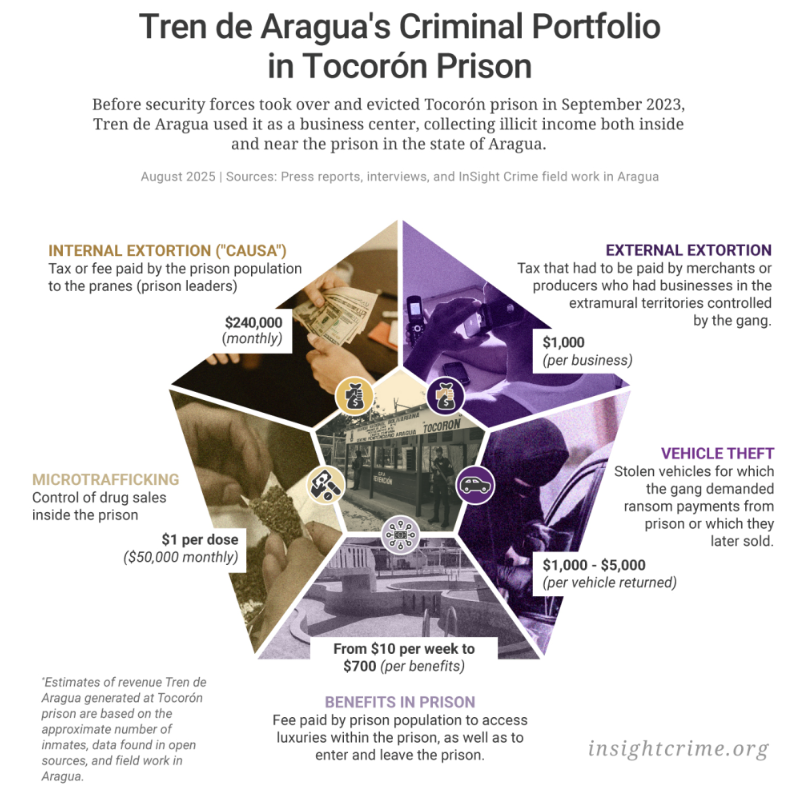
    The Casa Grande was part of a sophisticated and ruthlessly pursued business model. At its centre was the weekly payment to the cause that every prisoner must make. There are no official figures on prison occupancy rates. However, the prison was built with a capacity to hold 5,000 inmates, and there were reports of up to 10,000 being held there. This means that TdA was receiving an annual income of between US$3.9m and US$7.8m from its prison population, which went towards paying its operating costs. It also explains why gang leaders wanted to maximise the prison population (and sometimes refused to release those who were coming to the end of their sentences).

    There have been many additional illicit revenue-earning activities. Extortion payments (sometimes called vacunas or vaccinations), were often laundered through a local charity, Fundación Somos el Barrio JK. Some local companies were allowed to make their extortion payments in kind, delivering truckloads of food and drink to the prison. Companies that refused to pay for their protection faced the threat of violence. In 2019 the Puig biscuit factory was destroyed in an arson attack for that reason. In 2022 local businesses told journalists off the record that they all had to pay. TdA members also operated WhatsApp-based phishing scams and used bogus Facebook Marketplace car sale offers to attract and rob unsuspecting victims.

    Tocorón prison also became a hub for weapon sales. It offered a wide range of pistols, grenades, and assault rifles, many being models used by FANB, the Venezuelan armed forces. They include AR-15s and AK-103 Kalashnikovs. The AK-103 is the main weapon used by the Venezuelan military and the suggestion is that officers have sold consignments of them to criminal gangs. Demand for weaponry is particularly strong in nearby Bolívar state where rival syndicates vie for control of gold mining operations. Weapons are also provided across the border to Brazil, where criminal groups such as Primeiro Comando da Capital (PCC) are a major force. The economics of the gun trade are compelling. High end assault rifles are sold for US$5,000 each in Venezuela, but on the Brazilian market they are worth up to USS$20,000.

    Other criminally controlled businesses include car theft, scrap metal contraband, people trafficking, kidnapping for ransom, retail drug sales, wholesale drug trafficking, contract killings, and illegal mining. While it is hard to find credible estimates, it seems reasonable to deduce that the TdA’s total annual income is running in the hundreds of millions of US dollars.

    It is also clear that the Tren moved quickly to take advantage of mass immigration flows that began after 2014. At first the main direction was away from Venezuela to countries elsewhere in South America, particularly Colombia, Ecuador, Peru, and Chile. However, as a result of the Covid-19 pandemic of 2020/2021, many Venezuelan expatriates lost their jobs in those countries and were forced to return home. The Tren rapidly created a new business, escorting impoverished Venezuelan migrants through the network of pathways or informal border crossings connecting Venezuela and Colombia, and known as trochas. They catered to migrants lacking travel documents. Venezuelans unable to pay the crossing fee were required to carry drugs or other contraband in exchange for eventually being allowed to get across.

    Later the cross-border operation became more sophisticated. The TdA created its own ‘travel agency’ offering travel packages for a fee. Typical of such arrangements, according to media reports, was the case of Camilo, a Venezuelan living in Peru, who because of the Covid-19 pandemic wanted to return home. He paid US$800 for a package deal, travelling by bus in a group, back through Ecuador and Colombia to Venezuela. The group was organised and accompanied by a woman ‘tour guide’ who arranged tickets, hotels, and meals. Nobody asked to see travel documents at any point (Camilo had none). At Cúcuta, the last stop before the Venezuelan border, the guide told them they would have to make a final US$2 payment “to the Tren de Aragua” for permission to cross the border. 

    People and sex-trafficking is another important business for the TdA. Members of the organisation recruit young Venezuelan women, usually aged just over 18 but often younger. They are offered the chance to work as escorts or prostitutes, earning money to pay back the Tren for its investment in them (mainly inflated travel costs), on the promise that once the debt has been paid off, they will be free agents. But the moment the women arrive in the country of destination the TdA breaks its promises, seizes their passports, effectively keeping the women as prisoners, and forcing them to work as prostitutes for little or zero pay. Sex trafficking is also linked to the use of the women as honey traps for extortion purposes.

    Within the Tren de Aragua’s structure, running prostitution operations is divided up by geographical markets (plazas) and placed under the control of luceros de la alta who report directly to the gang leadership in Tocorón. According to calculations by Colombian prosecutors, the plaza in Kennedy, a suburb of Bogotá, was generating around US$635,000 a month for the Tren de Aragua. The Tren is also credited with muscling in on prostitution in Chile, forcing previously independent sex workers to pay an informal operating licence.  

  • COSTA RICA: Chinchilla receives biggest setback of her mandate

    LatinNews 11 April 2012 Hits: 3144

    If a tax evasion scandal served as the fiscal reform’s coffin, the constitutional court’s ruling that declared the process “unconstitutional” became its tombstone. Since taking office in May 2010, President Laura Chinchilla’s top legislative goal has been to secure the approval of a fiscal reform in order to arrest the country’s soaring deficit. However, after 18 months of negotiations in the national assembly (AL), which allowed the bill to receive its first debate approval – which has effectively been rendered void by the constitutional court – the law came under attack as its main proponent and defender took centre stage in a tax evasion media exposé. The scandal forced the minister of finance, Fernando Herrero, his wife and top political advisor to President Chinchilla, Flor Isabel Rodríguez, and the head of the tax authority, Francisco Villalobos, to submit their resignations within hours of each other.

    The alleged evasion was first reported by the national daily La Nación. This newspaper has already cost President Chinchilla other ministers, not least her first minister of public security, José María Tijerino Pacheco, who quit amid influence trafficking allegations. If La Nación’s initial report is anything to go by, other members of the administration could also be forced to step down. According to the daily, a dozen ministers in Chinchilla’s cabinet have been paying lower property tax than they should be. Losing three political collaborators in a 24-hour period clearly poses a challenge for the president, who wasn’t even in the country when the scandal broke and had to announce the resignation of her tax man from the landing strip as she returned from New York.

    Herrero’s role as the face of the recent fiscal reform promoted by the Chinchilla administration put him in a particularly vulnerable position. Even as he endorsed tax increases and stricter controls to raise an additional US$600m per year to address the soaring fiscal deficit (which should come in at 5% of GDP in 2012), he was manipulating the system. “He [Herrero] presents his resignation because he feels that the moment has come in which the efforts that we have been putting forward for a fiscal reform and also for fighting evasion, which have been very brave, could be undermined”, President Chinchilla said in an interview with La Nación just hours after her minister had left office. But this was only the beginning.

    While the local pRess lambasted the tax agency for opening an investigation into the tax return filed by a company jointly owned by Herrero and Rodríguez only after the press had reportedly found irregularities, Villalobos stole the following day’s headlines by having to quit himself. The head of the tax authority had been listed as a “doubtful debtor” since 2008 - Villalobos was included in this list in relation to his failure to pay capital gains tax in 2008.

    However the government’s stumble became a fall when the IV chamber of the supreme court, generally known as the constitutional court, ruled on 10 April that the reform was “unconstitutional”. The court’s ruling was based on procedural mistakes and “substantial” errors. The first relates to a decision to extend the special period in which the 2,500 motions submitted against the reform had to be discussed, without securing the approval of the national assembly’s plenary; the second problem relates to the deputies’ failure to make public the 53 motions that were approved, and therefore changed the contents of the reform by lowering the taxes to be paid by certain sectors, before voting on the final document. According to the court, the assembly’s failure to communicate considerable changes to the bill constituted a “substantial error”. It is highly unlikely that the ruling Partido Liberación Nacional (PLN) will be able to rescue the bill because it would have to go back to the committee stage and all motions would have to be debated again before another (first) vote can take place.

    • The Church to pay up?

    After a series of meetings with Holy See representatives in relation to the fiscal reform negotiations, Costa Rican authorities had secured the agreement to levy income tax on Catholic Church priests in the country. Talks also yielded the agreement that clerics would make social security contributions – currently priests have access to the state’s healthcare service but are not eligible to receive state pensions. These proposals, as well as the possibility of declaring Costa Rica a lay nation in which the Roman Catholic faith would no longer be the official religion, form part of the agenda that President Laura Chinchilla will discuss with Pope Benedict XVI during a scheduled visit to the Holy See in May. Chinchilla and the Pope are expected to sign a new concordat.

  • RASTREANDO TENDENCIAS

    LatinNews 30 October 2012 Hits: 477

    CURAÇAO | Nuevo gobierno. La coalición gobernante recobró una mayoría en las elecciones legislativas del 19 de octubre. Las elecciones fueron provocadas por la renuncia del Primer Ministro, Gerrit Schotte, después que la coalición gobernante compuesta de su Movementu Futuro Kòrsou (MFK), Pueblo Soberano (PS) y Partido Movishon Antia Nobo (MAN) perdió su mayoría [IL-12-38]. La coalición permaneció intacta, aunque esta vez liderada por el PS, que recibió la mayor parte de los votos. Con más de 87.000 de los 104.000 votantes que participaron –la más grande participación en la historia reciente– la coalición ganó 12 de las 21 bancas, una más que en las elecciones previas del 2010. De estas, el PS, que es liderado por el izquierdista Helmin Wiels, obtuvo cinco bancas; El MFK de Schotte, también obtuvo cinco bancas; y el MAN llegó en quinto lugar con dos bancas. El gran perdedor fue el conservador Partido Alternativa Real (PAR), de la ex primera ministra Emily de Jongh-Elhage (2006-2010), que vio su presencia legislativa encogerse de ocho a sólo cuatro bancas.

    El PS está presionando por la autonomía total para Curaçao, que en octubre del 2010 se convirtió en un país autónomo dentro del Reino de Holanda, después de un referéndum popular. El gobierno de la isla tiene autonomía total sobre todos los asuntos de estado, con excepción de la defensa y las relaciones exteriores, mientras que su corte suprema permanece en Holanda. El PS, que está pidiendo convocar otro referéndum popular sobre la autonomía total, podría verse en dificultades, dada la carencia de apoyo entre sus socios en la coalición.

    • Ciudades modelos

    El 18 de octubre, la corte suprema de justicia (CSJ) de Honduras, de 15 miembros, dictaminó inconstitucional un decreto legislativo estableciendo ‘Regiones Especiales de Desarrollo’ (RED) o ‘ciudades modelos’. El dictamen votado 13-2, siguió a la decisión dos semanas antes de la cámara constitucional (por 4-1) que la ley era inconstitucional. Debido a que la decisión  no fue unánime, sin embargo, todo el pleno de la CSJ tiene que votar sobre el mismo [IL-12-40]. El dictamen de la corte, que fue en respuesta a más de 50 apelacione4s, halló que el decreto, que fue aprobado por el congreso en enero del 2011, debilitaría los preceptos constitucionales relacionados con la soberanía, la forma de gobierno, y el territorio.

  • REGION: “Exceptionally strong” growth in remittances, says new report

    Sarah Sheldon 23 May 2022 Hits: 978

    The value of remittances grew by an average of 27.5% for four Central American countries in 2021, according to a recent report by US-based think tank Inter-American Dialogue.

    El Salvador, Guatemala, Honduras, and Nicaragua averaged a higher rate of growth than the Latin America and the Caribbean (LAC) average of 26%. The report’s authors characterised LAC growth as “exceptionally strong,” outstripping growth in the rest of the world, and Guatemala recorded the strongest growth rate of the four Central American countries analysed.

    Total remittances of US$15.3bn to Guatemala in 2021 represent a 35% increase compared to the previous year. Honduras registered the second highest growth, with total remittances of US$7.4bn and a growth rate of 32%, followed by El Salvador (US$7.52bn; 27%) and Nicaragua (US$2.15bn; 16%). This means Central America is a significant contributor to the LAC total of US$134.4bn in remittances. The report found that 90% of migrants from Guatemala, Honduras, and El Salvador were based in the US compared to 43% of Nicaraguans. 

    Contributing factors include a strong economic recovery from the coronavirus (Covid-19) pandemic in the US, where the vast majority of Central American migrants are based; continued migration from the subregion; and migrants’ response to natural disasters at home, according to the report. In 2021 an estimated 1m Central Americans left their home countries, with almost 900,000 attempting to reach the US, said the report.

    However south-south migration is also important, particularly in the case of Nicaraguans, many of whom have moved to neighbouring Costa Rica rather than the US. The report estimates that just over 400,000 Nicaraguans live in Costa Rica, including minors. The value of remittances from Costa Rica did not increase significantly in 2021 due to a challenging economic situation, but some 100,000 more Nicaraguans made the journey to Costa Rica due to the worsening political crisis at home, said the report.    

    The growth in the value of remittances proved a major relief for Central American economies, which have struggled to recover from the impacts of the Covid-19 pandemic. Most countries saw remittances as a share of national income go up in 2021, according to the report.

    According to the International Monetary Fund (IMF) projections, remittances accounted for 26.1% of El Salvador’s GDP in 2021, compared to 23.7% in Honduras, 17.8% in Guatemala and 13.4% in Nicaragua. The significance of remittances to regional economies ties them ever closer to the US in terms of both Washington’s economic performance and migration policies.

    Another point of interest is the change in methods used to send remittances, with migrants increasingly preferring digital transactions. However, the use of cryptocurrencies to send money home has not taken off as much as predicted in some quarters. El Salvador’s President Nayib Bukele cited commission-free remittances as a major positive for the country’s adoption of bitcoin as legal tender in September 2021, but only 7% of respondents to a survey carried out that month had attempted to send remittances in bitcoin. All of them reported a negative experience,

    The Inter-American Dialogue report predicts “modest growth” for remittances in 2022, but the latest figures show significant growth in the first months of the year. Data from Guatemala’s central bank reveals a 25.5% increase in the value of remittances sent to Guatemala from January-March compared to the same period last year, while Honduras recorded a 22% increase for the period. El Salvador recorded a 10.31% increase for the first two months of this year compared to the same period last year, and remittances to Nicaragua for January increased 22.5% on the same month in 2021.

    These early signs point to the continued importance of remittances to regional economies. In the last 20 years they have accounted for an average of 9% of GDP and were worth more than 2.6 times as much as foreign direct investment inflows, according to a June 2021 report from the Central American development bank BCIE. But while the payments provide a valuable lifeline for families, regional governments need to do more to provide adequate living conditions rather than relying on migrants to prop up their struggling economies.

  • CHILE: Concertación reacts as students continue to protest

    LatinNews 19 September 2011 Hits: 1063

    The four months of protests by school and university students in Chile are finally starting to reshape the political arrangements which have been in place for the past 20 years. The first sign that the neat parcelling-up of political power between the Left and the Right could not last, came in the 2009 presidential election campaign when Marco Enríquez Ominami, a dissident socialist deputy, challenged Eduardo Frei Ruiz-Tagle, a former president, for the right to take-on the rightwing candidate, Sebastián Piñera in the decisive second round of the presidential elections. Enríquez Ominami failed, but his challenge has eventually forced the four parties of the Concertación, the left-of-centre alliance which ruled Chile from 1990 to 2010, to rethink the Concertación’s role. Given the imploding opinion poll ratings of the President Piñera, how the Concertación decides to reform itself will have major implications.

    The Concertación is not the only organisation mulling over political reform. On 6 September President Piñera sent a bill to congress that would allow voters to choose between a range of candidates in primary elections. Such a change would weaken the political parties’ grip on power. One reason why Enríquez Ominami did so well in 2009 was that Frei was virtually imposed as the Concertación’s candidate, without a proper primary election, as part of a political deal between the parties in the Concertación.

    At a 12 September summit meeting, the leaders of the four parties that make up the Concertación set themselves a deadline of 5 October to reform the alliance. Ignacio Walker, the Partido Demócrata Cristiano (PDC) senator who serves as national spokesman for the Concertación, said that all four parties agree that the Concertación is no longer working, and that voters do not view it as the natural government-in-waiting. The Concertación has been performing even worse in opinion polls than President Piñera and his right-of-centre government.

    The PDC sits at the centre of the Chilean political spectrum and is not keen on the Concertacíon shifting to the Left which is, effectively, where the second biggest party in the Concertación, the Partido por la Democracía (PPD), wants to take the Concertación. Essentially, the PPD wants to bring the Partido Comunista de Chile into the Concertación.

    One reason for this is purely tactical. The communists have been prominent in the student demonstrations, which have widespread (75%, according to recent opinion polls) public support.  On 12 September Camila Vallejo, the university students’ leader and herself a prominent communist, again attempted to set the agenda for negotiations with the government over education reforms. She said that the students will only restart dialogue if the government meets four conditions: it must stop pushing its education reform proposals though congress: it must agree to negotiate with the students in public (either on TV or Twitcam); it must postpone the end of the first half of the academic year and finally; it must promise to end public support for universities which operate as for-profit institutions.

    The PPD’s president, Carolina Tohá, wants to rebrand the Concertación as a broader based Convergencia Opositora. The implication of such a name is that as the presidential elections in 2013/4 draw nearer, each of the political parties in the Convergencia would become freer on policy issues.

    Currently the PDC has 19 deputies and nine senators and the PPD has 18 deputies and four senators.

    • Students reject government

    On 8 September school and university students and their teachers rejected the government’s third set of reform proposals.  The first group to reject further negotiations were the teachers, who were followed by the students after 10 hours of debate at a meeting in Talca.

  • US-China competition exacerbated by suspicion - Stratint Review, 21 February 2008

    LatinNews 06 September 2011 Hits: 4

    One of Stratint’s sister publications – AsiaInt North Asia Review – reviewed this month an article on China-US relations published by Foreign Affairs, the journal of the Council on Foreign Relations. The central thesis of the article - “The Rise of China and the Future of the West” - is that while the US on its own looks vulnerable to increasing Chinese power, the West as a whole is not – and the secret to dealing with China, according to Professor G John Ikenberry of Princeton University, is to give China every incentive for integrating with Western-created and Western-dominated trans-global institutions. The review of this article in the February issue of AsiaInt North Asia Review was sceptical about this proposition. This week, China’s reaction to President George Bush’s five-nation Africa tour provides a small but nonetheless telling illustration of why such scepticism is justified.

    Ikenberry’s thesis starts with the uncontroversial proposition that periods of “wrenching hegemonic transition” are acutely dangerous. However, he argues, this time there are two major mitigating factors that should prevent the kind of conflict that has defined earlier such transitions. The first is the fact that nuclear weapons have made war between great powers unlikely, all but eliminating “the major tool that rising powers have used to overturn international systems defended by declining hegemonic states”. The second is that while the US’s “unipolar moment” will end, China only has the advantage if the struggle is between China and the US alone. “If”, Ikenberry argues, “the defining struggle is between China and a revived Western system, the West will triumph.”

    Western power
    Ikenberry provides figures to support this contention. China currently has a GDP measured in a purchasing-power-parity basis of US$9tr against the US’s US$12tr. By 2020, China will have a US$30tr to US$28tr advantage, and by 2030 this advantage will be US$63tr against the US’s US$49tr. The OECD as a whole, however, will still considerably outrank China even by 2030, when its combined GDP will be US$105tr. As for defence expenditure, by 2030 China (on US$238bn) will still be spending less than 30% of the US on its own (US$808bn) and only 17% of the OECD’s combined figure (US$1,398bn).

    We will not go into the question as to whether nuclear weapons really have made war between great powers a thing of the past (the great British historian AJP Taylor became a member of the Campaign for Nuclear Disarmament because of his conclusion that statesmen are too prone to making errors, even catastrophic errors such as those that led to World War I). It is Ikenberry’s second point that we are interested in this week.

    Ikenberry argues the US needs to understand that its most powerful strategic weapon is the ability to decide what sort of international order will be in place “to receive” China. The first thing the US must do, the professor argues, is “re-establish itself as the foremost supporter of the global system of governance that underpins the Western order”. And he concludes that while the US can’t thwart China’s rise, it can “help to ensure that China’s power is exercised within the rules and institutions that the United States and its partners have crafted over the last century…The United States’ global position may be weakening, but the international system the United States leads can remain the dominant order of the twenty-first century.”

    US self-interest
    This may be an idealistic vision, but it is not in our view a realistic one. One major reason for this assessment is that the US remains reluctant to subject itself to the rules that it wrote for lesser powers. Evidence for this ranges from its opposition to subjecting its citizens to international jurisdiction to its continuing determination to define its own interests and to act upon them, using military force if necessary, with or without international sanction. Secondly, there is little sign that the US is willing to give a rising China any but the barest elbow room, as the debate over China’s military power exemplifies. Former defence secretary Donald Rumsfeld and others have argued that China has no need to increase its military capabilities because it is threatened by no one. There is no acceptance that seeking to match military power to economic power could be a legitimate development for a power such as China.

    The hearings in front of the US-China Economic and Security Review Commission, which Stratint tracks closely, including the latest hearings on “The Implications of Sovereign Wealth Fund Investments for National Security”, amply demonstrate the US’s underlying suspicion of China and its determination not to cede relative power without a struggle.

    Even if China’s internal political development were to make it a suitable candidate for full embracing by a Western system in which democracy and the rule of law are fundamental (and there is no sign of that yet), the US’s resistance to China’s rise is as natural as China’s desire to match its military power to its growing economic power. There is an inevitability about both that Ikenberry’s idealism cannot override.

    Bush in Africa
    The small illustration of this that caught our eye this week was China’s reaction to President Bush’s trip to Africa. Bush’s trip took him to five countries: Benin, Tanzania, Rwanda, Ghana, and Liberia, and the portrayal of the trip was that the five countries had been chosen to showcase a different Africa from poverty-stricken and conflict-prone Africa that dominates the world’s media. All five are now relatively stable countries whose presidents have democratic credentials, and White House national security adviser Stephen Hadley described them as “the kinds of government that we want to partner with”. The trip was also used to highlight US projects that support hospitals, schools, and anti-Aids and anti-malaria initiatives.

    The subliminal message was that the US is a better partner for Africa than China, and this message was hardly concealed at all when Bush came to speak about Darfur while in Rwanda. Before leaving for Africa, the president had called for a greater international military effort to end what he referred to as “genocide”. Speaking on 19 February while in Rwanda, he warned countries which are reluctant to impose sanctions on Sudanese leaders that “human suffering ought to pre-empt commercial interests”. No one doubted that he was referring to China, which has invested £8bn in Sudan’s oil industry.

    China’s suspicions
    But China also has a wary view of the US’s interests in Africa. The official Xinhua news agency identified “two major characteristics” of Bush’s visit. The first was that four out of the five countries visited are coastal, and according to Xinhua the US is concentrating on “developing relations with coastal countries to facilitate going in and out of the continent”. Secondly, the news agency said, “the countries to be visited are either on important strategic locations or countries with war-ridden regions”, which, Xinhua said, showed that the US “is trying to seek opportunities from the war-ridden regions to get involved in African affairs”.

    Xinhua concluded: “The United States has a strong interest in Africa because, in the final analysis, it wants to consider its strategic interests…Now more than 10% of US oil imports come from Africa…[and] Africa will account for one-fourth of its total oil imports in 2015. Bush’s Africa tour signifies a new effort of the United States entering Africa…”

    Even if one would not want to go as far as Ikenberry with his new-world-order style vision, few would argue that a US-China relationship in which competition is mitigated by cooperation would be preferable to one in which competition is exacerbated by suspicion. But for the moment the latter is clearly the more likely evolution than the latter.

  • CUBA: When Google came visiting

    LatinNews 16 July 2014 Hits: 2876

    It popped up as an intriguing story on 14ymedio.com, the website set up by the Cuban dissident blogger Yoani Sánchez, who reported that a delegation from Google, led by CEO Eric Schmidt, was visiting Cuba to meet officials and independent activists, and to promote an “open and free internet”. By re-tweeting a comment by Sánchez on the visit, Schmidt indirectly confirmed it was going ahead.

    Cuba stops well short of offering free Internet access. It has one of the lowest Internet penetration rates in Latin America. It is estimated that only 2.6m of the island’s 11.2m inhabitants have some form of web access, but that is mainly through government centres, foreign companies, and tourist hotels. Those who do have access are restricted to government-approved sites. Access speeds are painfully slow. 14ymedio.com, billed as the first independent digital newspaper in Cuba, has been blocked various times by the authorities, which often suggest that Sánchez is a fifth-columnist in the pay of the US government.

    The Google delegation, which included Jared Cohen, Brett Perlmutter and Dan Keyserling, stayed in the country for two days and visited the Universidad de Ciencias Informáticas (UCI), which was set up in 2008 and has 5,000 students. 14y medio.com said the visitors were encouraged by Cuba’s IT potential, despite the fact that the country is being held back by limited connectivity. For many years, the government blamed the US trade embargo for Cuba’s limited access to the web. However since the arrival of a fibre-optic link from Venezuela in 2011, the island has at least the technical potential for full access.

    Schmidt has visited a number of authoritarian countries to promote free Internet access, including North Korea in January 2013. In an interview with the Wall Street Journal last year, he said Cuba was top of the list of countries he wanted to visit. The Cuban authorities made no initial comment on the visit, but the official newspaper Granma followed it up, noting that Cuba cannot access many of Google’s online services because of the US trade embargo. In his own blog, Schmidt described the embargo as flying in the face of common sense. Separately, Roberto Veiga, who runs another independent website, Cuba Posible, said he expected the Havana government to allow greater web access because the development needs of the country required it.

    Schmidt says embargo counter to US interests

    Schmidt wrote that the half-century old US embargo and the State Department’s refusal to remove Cuba from its list of states that support terrorism “defy reason”. “There are dozens of countries we call our allies and we are free to travel to, that present much worse threats and concerns to the US”.

    He stressed that the embargo has allowed Chinese IT firms to make inroads in Cuba. “The blockade makes absolutely no sense to US interests: if you wish the country to modernize the best way to do this is to empower the citizens with smart phones (there are almost none today) and encourage freedom of expression and put information tools into the hands of Cubans directly. The result of the blockade is that Asian infrastructure will become much harder to displace.”

    Visiting Cuba a couple of weeks later, Russia’s President Vladimir Putin announced that Russia planned to install a ground station for its GLONASS satellite navigation system in Cuba, as part of a February 2013 bilateral agreement on space cooperation. Putin said the stations would give Cuba access to services and satellite communications technologies not available to it under the US embargo.

    • Google Ideas

    Schmidt officially was in Cuba with Google Ideas, which describes itself as “a think/do tank that explores how technology can enable people to confront threats in the face of conflict, instability or repression”.  Jared Cohen, the director of Google Ideas, is a former US State department staffer.

  • REGION: Guatemala and Honduras lagging regional peers in education

    Sarah Sheldon 17 October 2022 Hits: 542

    Guatemalan and Honduran children attend school for significantly less time than the regional average, according to a recent report from the United Nations Development Programme (UNDP).

    Both Guatemala’s President Alejandro Giammattei and Honduras’ President Xiomara Castro addressed the power of education during appearances at the UN General Summit (UNGA) on 19-20 September. Giammattei told attendees that education systems should prepare students for a rapidly changing world, and he underlined the efforts of his government to provide food for students during the coronavirus (Covid-19) pandemic.

    However, according to the UNDP Human Development Report (HDR), published 8 September, in 2021 a child of school entrance age in Honduras could expect to receive 10.1 years of schooling, the lowest in the region, with Guatemala second lowest on 10.6 years. This compares with Nicaragua (12.6 years), El Salvador (12.7), Panama (13.1), and Costa Rica (16.5).

    Guatemala and Honduras also struggle in terms of life expectancy at birth, recording scores of 69.2 years and 70.1 years respectively. El Salvador is next with 70.7 years, followed by Nicaragua (73.8), Panama (76.2), and Costa Rica (77.0). The two nations are also bottom of the regional ranking in terms of the Human Development Index (HDI). Honduras placed 138 in the world, with Guatemala second worst at 133 in the world. Nicaragua (129) and El Salvador (124) fared slightly better, while Panama (67) and Costa Rica (57) performed strongly.

    Interestingly, there is some divergence between Honduras and Guatemala when it comes to gross national income per capita. Honduras is bottom of the regional ranking with US$5,298, followed by Nicaragua (US$5,625) and El Salvador (US$8,296). On this score Guatemala does better, with US$8,723 per capita, followed by perennial strong performers Costa Rica (US$19,974) and Panama (US$26,957). This suggests that while Honduras’ struggles to improve HDI performance are linked to low levels of economic development, Guatemala, with its GNI per capita of US$8,723, should be ranked higher than 133 in the world for HDI. For example, Nicaraguan children can expect to receive 12.6 years of schooling, 2.0 years more than their peers in Guatemala, despite the country recording GNI per capita of just US$5,625. 

    UNDP figures show that this is an historic problem, given the huge disparity in average years of schooling received by adults in Guatemala (5.7 years) compared to Honduras and Nicaragua (both 7.1 years), but President Giammattei needs to do more than pay lip service to the transformative power of education and dedicate more resources to the sector.

  • TRACKING TRENDS

    Patrick de Courcy 09 February 2023 Hits: 3314

    BRAZIL | Eletrobras privatisation. On 7 February President Luiz Inácio Lula da Silva took aim at last year’s privatisation of Eletrobras, the state-owned electricity company, describing it as “banditry” and “irrational”. The privatisation was completed near the end of the right-wing administration of Jair Bolsonaro (2019-2023) in June last year for a total value of US$6.9bn.

    “What I can say is that it was an erratic process. It was a leonine process against the interests of the Brazilian people. It was a privatisation against the country,” Lula said, while speaking at a breakfast offered to left-wing and independent media outlets. He added that he had asked the federal attorney general’s office (AGU) to look into the clauses in the privatisation package he described as “leonine” [a partnership in which one side receives all the profits while the other is saddled with the liabilities arising out of the agreement as a stated provision in it].

    Lula said that his administration had been left with a 40% shareholding in Eletrobras (down from 72% previously), but under the terms of the contract is restricted to only 10% representation at board level.

    As for the new government’s intentions, Lula discarded any immediate attempt to buy back shares so as to regain control of the company, commenting only that “if we manage to make the economy grow and things go well, and we can buy more shares, we will”. Lula said that if the government now wants to buy more shares, the contract requires it to pay three times market value as part of a ‘poison pill’ defence to discourage future governments from attempting to buy back control.

    Eletrobras accounts for one-third of total electricity generation in Brazil and owns around half of the country’s transmission lines.

    Lula’s longstanding opposition to privatisations is well known. On taking office in January, he signed a pledge committing the government not to privatise key state-owned companies including oil and gas producer Petrobras, state banks such as Caixa Económica Federal, and Correios, the postal service.

  • PANAMA: Concerns over spending

    LatinNews 05 December 2012 Hits: 450

    The Panamanian association of business executives (Apede) has raised concerns about the projected fiscal deficit in the record-breaking 2013 budget. Promulgated on 18 October, the US$16.3bn plan is up nearly 13% in annual terms.

    The Apede statement, issued in November, adds to growing concerns about excessive spending by the administration led President Ricardo Martinelli.

    Apede noted that the deficit in 2013 could top US$1.1bn (or 2.8% of GDP) – approaching the revised limit set down under the law of fiscal responsibility (now 2.9%, up from 2% previously). Panama’s public debt was US$13.8m as of end-June 2012, up from US$12.5bn in 2011, US$11bn in 2010 and US$10.8bn in 2009; the year President Martinelli took office.

    The statement triggered an angry response from Economy Minister Frank De Lima, who called on the private sector lobby to “set aside the political posturing”. The Martinelli government tried failed to sell off state lands in the Colón Free Trade Zone (FTZ) in October [RC-12-11] and shares in the energy and telecoms sectors in June [EB-12-6/7].

    FTA with US takes effect

    Panama’s Trade Promotion Agreement (TPA) with the US, signed by former US President George W. Bush in June 2007 and ratified by Panama’s congress the same year, finally took effect on 31 October. The trade agreement, which was held up by the US Congress on concerns about labour protection and tax transparency, will allow 100% of Panama’s industrial and fisheries products, in addition to textiles and artisanal items, to enter the US tariff-free. Approximately 86% of US consumer and industrial goods, such as automobiles and electrical equipment, will enter Panama tariff-free.

    Upbeat on Panama

    After a visit to Panama to conduct its annual Article IV consultation, the IMF recommended “the need to keep fiscal deficits below the revised Social and Fiscal Responsibility Law (SFRL) ceilings” and “a more neutral fiscal stance”.

    Given that Panama’s real GDP growth has averaged around 9% in the last five years – the highest in Latin America - the IMF remained positive, noting that “Panama’s growth performance continues to exceed expectations, buoyed by the Panama Canal expansion and large public infrastructure projects”. The fund described the near-term outlook as “favourable” with growth possibly exceeding 9.5% in 2012 and average inflation of 5.5-6.0% in 2012-13.

  • ECONOMIC OVERVIEW: NICARAGUA

    LatinNews 14 May 2014 Hits: 2591

    Foreign cooperation:

    According to the latest report by Nicaragua’s central bank, released in April 2014, direct foreign cooperation to Nicaragua reached US$1.29bn in 2013 (equivalent to 11.5% of GDP), a 5.4% drop in absolute terms compared to 2012. Of the total, 60.1% went to the private sector and the rest to the public sector. The main overall donors were: Venezuela (US$559.1m- although the bank also includes an additional US$95.1m in foreign direct investment[FDI], bringing the total to US$654.2m); the Inter-American Development Bank (US$168.2m); the Central American bank for economic integration (US$152.1m); the World Bank (US$70.3m); the European Union (US$49.5m); Russia (US$35.1m) and the US (US$32.2m). The local media was quick to trumpet the 10.2% drop in aid from Venezuela, which controversially remains out of the State budget and is mostly petrol cooperation channelled through Albanisa, the bi-national oil company set up in 2007, 51% owned by Venezuela’s state oil firm, Pdvsa, and the remainder by Nicaragua’s Petronic. Yet upon closer inspection, most of the drop was due to a reduction in FDI which was down from US$173.0m in 2012. According to the central bank report, US$558.5m of Venezuela’s cooperation comprises loans from Pdvsa of which 62% went to social productive projects like energy subsidies (US$133.7m), while US$65.3m went to the so-called “solidarity bonus”- a monthly cash stipend of N$750 (US$27.5) which benefits more than 150,000 public sector workers on a monthly income of less than N$5,500 (US$202). The opposition has long complained that President Daniel Ortega has used these hand-outs to buy support for his Frente Sandinista de Liberación Nacional (FSLN) government.

    Inflation: According to the most recent (6 May) report by Nicaragua’s central bank, monthly inflation in April reached 0.44%, down from the 0.64% registered in the same month the previous year. This brings the accumulated rate to 1.83% (compared with 2.58% in April 2013) and the year-on-year rate to 4.90% (compared with 6.34% in 2013). Nicaragua closed 2013 with a 5.54% inflation rate.