CUBA: Why the crackdown?
|

|
More than two months after legislative elections were held on 1 March, and after deputies were meant to take up their seats in the 84-seat legislative assembly on 1 May, the supreme electoral tribunal (TSE) finally concluded the most protracted electoral process on record in El Salvador. Ironically, the final composition of the assembly for the next three years is almost identical to the previous three-year term, except that the one additional deputy won by the opposition bloc controlled by the right-wing Alianza Republicana Nacionalista (Arena) means that it will be able to stymie legislative reforms pursued by the government of President Salvador Sánchez Cerén of the ruling left-wing Frente Farabundo Martí para la Liberación Nacional (FMLN).
President Sánchez Cerén had expressed his concern about a “power vacuum” after only 60 deputies in the 84-seat legislative assembly were sworn-in on 1 May as ordained by the constitution. This after the constitutional chamber of the supreme court (CSJ) ordered the TSE to reopen the ballot boxes for the legislative elections in the department of San Salvador, which was responsible for supplying the missing 24 deputies, due to alleged irregularities.
Sánchez Cerén warned that the upshot of the recount could be “instability”, while the (FMLN) president of the legislative assembly, Sigfrido Reyes, muttered darkly of “a technical coup d’état” by the CSJ, which had suspended the swearing-in of the deputies until the recount was completed. This strong rhetoric had less to do with the recount itself (from which the FMLN could only have gained if the recount produced a slightly different result) and more to do with the constitutional chamber’s perceived cavalier approach to institutional matters in the eyes of the political parties which have made it clear in the past just how much they resent its interference in legislative issues. The introduction of cross-party voting, enforced by the CSJ, for instance, has been blamed by many politicians for the tardy count after these elections.
In the event, the 24 deputies elected in San Salvador were each able to take up their seats by 12 May with no changes resulting from the recount in terms of the deputies elected to office. There was, however, an increased vote count. This was a strange anomaly: as many as 21,000 votes declared void in the original count were found to be valid and added to the overall tally. Overall though the balance of power in the legislative assembly lies with Arena, complicating governance for Sánchez Cerén.
Perhaps serving notice of his determination to stand up to the new-look legislative assembly should it oppose his government’s initiatives, Sánchez Cerén on 8 May vetoed a decree approved on 9 April by the assembly. This decree would have established that the number of councillors represented on the 262 municipalities be proportional to the number of votes obtained (see sidebar). The vetoed decree had been approved by the legislative assembly with the votes of Arena deputies and the centre-right Gran Alianza por la Unidad Nacional (Gana).
The danger of opposing Arena – an inveterate rival with which the FMLN will need to reach compromises - and Gana - often an ally of the FMLN – is that they might make life difficult for Sánchez Cerén when it comes to issues which are going to be absolutely crucial for his government if it is to achieve anything. Foremost among these is public security, which has deteriorated sharply. Unless the government can reduce violence, and weaken organised crime, it will struggle to attract the investment which the country desperately needs to try and revitalise a stagnant economy (see next article).
The vetoed decree would have allowed councillors to be assigned proportionally after municipal elections. In El Salvador the party that wins municipal elections returns the mayor and a number of councillors greater than the proportion of votes obtained. Under the new decree, councillors would have been assigned in accordance with the percentage of the vote obtained by individual parties. This would have allowed minority parties greater municipal representation.
Some 15 years after the last talks failed, Cuba finally has reconciled its debt with the Paris Club, another key step in the island’s gradual economic rehabilitation and reintegration into the global financial economy.
The Communist Havana government led by President Raúl Castro and the Paris Club have settled on the value of Cuba’s pending debt to the group of 19 wealthy creditor nations (Australia, Austria, Belgium, Britain, Canada, Denmark, Finland, France, Germany, Ireland, Italy, Japan, The Netherlands, Norway, Russia, Spain, Sweden, Switzerland and the US), diplomats have told international media. The two parties reportedly agreed that Cuba owes US$15bn, a figure that includes principal, service charges, interest and penalties, according to Reuters. Agreement on the amount will now allow the two sides to begin talks on a settlement deal, which likely could include significant debt forgiveness for Cuba.
The Cuban government stopped servicing its Paris Club debt in 1987, having renegotiated its debt payments for 1982-86 the previous year. The failure to meet its payments meant that the Paris Club officially considered Cuba to be in default. The last negotiations, back in 2000-2001, broke off without a result.
The Paris Club reported that Cuba owed its members US$35bn at the close of 2012, rising to US$37bn in late 2013. In late 2013, there were signs of tentative efforts again, with a Paris Club delegation reportedly travelling to Havana for exploratory talks. At the same time, Russia suddenly announced that it had reached a deal with Cuba to forgive some US$29bn of Cuba’s Soviet Era debts, of which about US$20bn was Paris Club debt. (Under the deal, Russia agreed to forgive US$20bn plus interest, while Cuba reportedly would pay US$3.2bn over 10 years in settlement of the remaining 10%). Observers suggested that the unilateral move by Russia rankled with other Paris Club members. In any case, in April 2014, Reuters reported that talks between Havana and the Paris Club were beginning again.
Bruno Bézard, the director general of the French government’s treasury, and ex officio chairman of the Paris Club, went to Havana in March to expedite the talks. Ahead of that trip he suggested that Cuba’s remaining debt with the Paris Club amounted to US$15-US$16bn (i.e. after the bilateral settlement deal with Russia). Of this, about one third is owed to France. As such, debt forgiveness may have been on the agenda when France’s President François Hollande visited Cuba in May.
Since 2011, Cuba has restructured its debt with Mexico, Russia, Japan (commercial creditors) and China (its accumulated debt with China is estimated at some US$6bn), getting big write-downs (in some cases of up to 90%) and reworking its payment schedules. Should the new Paris Club negotiations result in additional restructuring (and potentially further significant write-downs), this would further improve Cuba’s external balance - reportedly, it is now running a trade and current account surplus - and help its reintegration into international capital markets.
It would also go a long way towards clearing Cuba’s slate as it prepares for a tricky currency reform process that will require more financial and monetary transparency and confidence in its international reserves position. Cuba’s total foreign debt (active and passive), while not regularly reported by the central bank, is estimated at about US$26bn by external economists. Its international reserve position is not publicised, purportedly for national security reasons.
On 29 May the US State Department announced that Cuba officially had been removed from its list of countries that sponsor international terrorism, clearing another obstacle on the path to the formal restoration of diplomatic relations. Following a fourth round of high level talks, the US Assistant Secretary of State for Western Hemisphere Affairs, Roberta Jacobson, and her Cuban counterpart, Josefina Vidal (the director of North American affairs at the Cuban foreign ministry), signalled that while a deal was not quite there yet, final details could be ironed out by their respective delegates. (Jacobson shortly after was promoted to become the US ambassador to Mexico). US legislators opposed to the rapprochement vowed to block White House ambitions to appoint an ambassador to Cuba, which would be a hugely symbolic moment.
The IOCs
In recent years rising concerns over climate change have caused a number of international oil companies to re-think their strategies. Some are in the process of redefining themselves as energy companies, rather than specifically as oil and gas producers. Such redefinitions reflect efforts by IOCs to diversify into renewable energies such as wind and solar. While some consider this as no more than a re-branding exercise for public relations purposes (otherwise known as ‘greenwash’), other industry analysts see it as a legitimate and potentially effective strategy. It raises the question of whether the IOCs, with their existing resources and know-how, might actually play a powerful role in the energy transition. Some of the offshore expertise running oil and gas platforms can, for example, be transferred to the running and maintaining of arrays of offshore wind generating turbines. There is also a further, connected question: will the transition happen faster or slower at a time of oil industry bust? Will Latin American oil companies consider a similar diversification strategy?
A number of IOCs have recently made clean energy commitments. In December 2019 Spain-based Repsol said it was aiming to achieve net zero carbon emissions for most of its products and operations by 2050, at an expected cost of US$5.3bn. It intended to use various technologies to achieve that end, including carbon capture and storage (CCS). This was followed in February 2020 by BP, which said that it intended to offset all carbon emissions from the fossil fuels it produces by 2050. It too made a commitment to boost investment in non-oil and gas operations. Another European rival, Royal Dutch Shell, said in April 2020 that it was targeting net zero operations by 2050, with plans to lower the carbon footprint of its products by approximately 30% by 2035, up from 20% previously.
This was to be achieved by selling more products with lower carbon intensity, including renewable power, biofuels, and hydrogen. Like Repsol, Shell also proposes to develop CCS technology. Shell is reported to have been spending US$1bn-2bn a year on various diversification strategies including acquiring equity stakes in various renewable energy start-ups, including Sonnen (battery storage), Limejump (virtual power plant management), and Nordsol (biogas from waste). Shell is also involved the NortH2 offshore wind-to green hydrogen project which envisages harnessing up to 10 GW of renewable energy capacity for commercial-scale green hydrogen production.
French IOC Total appears to have identified solar energy as a key diversification opportunity. It says it intends to derive 20% of its revenues from low carbon businesses by 2040. Total has a controlling stake in solar developer Sunpower and an estimated 3 GW of renewable energy assets under development. The French oil and gas company has in addition bought a 50% stake in a 2.1 GW portfolio of solar plants operated by the Adani group in India, as well as taking an interest in projects in Qatar and Spain. This buying spree has made Total one of the world’s biggest solar operators.
Among the European oil majors Norway’s Equinor (formerly known as Statoil) has been one of the most aggressive in diversifying its operations. In February 2020 it pledged to run CO2 neutral operations by 2030. It aimed to increase renewable capacity to 16 GW by 2035. Chief executive Eldar Saetre said value creation from oil and gas would remain high, although physical production would fall, and renewables would create “significant” growth opportunities. Equinor’s main diversification play has been into offshore wind generation. The company has over 5 GW in offshore wind projects under development, including the Hywind Tampen floating wind farm in Norway, the Empire Wind project off the east coast of the US, and Dogger Bank in the UK. Equinor is also involved in solar projects in Brazil and Argentina.
US-owned IOCs seem to have adopted a rather different strategy. There has been little investment in renewable energy. According to David Doherty, an analyst at BloombergNEF, most US oil companies seek to diversify into areas that are seen as protecting their core business. That means investing heavily into downstream operations in the Gulf Coast. The US majors are particularly interested in acquiring electric vehicle (EV) charging start-ups, with the aim of maintaining the profitability of their petrol station distribution networks and managing the coming transition from internal combustion to electric-powered vehicles. Another factor has been that to-date US companies have faced less shareholder and regulatory pressure to adopt cleaner energy than their European counterparts. However, that could change if the Democratic Party contender, Senator Joe Biden, were to defeat the incumbent Donald Trump in the November presidential election. Although in a somewhat toned-down form, Biden supports a version of the ‘Green New Deal’ which would increase taxes on fossil fuels, stop oil and gas drilling on federal land, and plough money into expanding EV charge points and developing rail links. Doherty has said that a Democratic win in November could force US oil companies to rethink their approach. It would, as he put it, “put the fear into any Conoco or Exxon executive”.
Petrobras
Before the outbreak of Covid-19, Petrobras strategy under Roberto Castello Branco, the chief executive appointed last year by the new government of President Jair Bolsonaro, had been to refocus on core upstream exploration and production, divesting a range of non-core assets. Total Petrobras asset sales last year are estimated at US$16.3bn. In March Petrobras said it would be selling its distribution assets in Colombia, including 124 petrol stations there. Other planned divestments originally planned for this year (but likely to be postponed because of the crisis) include selling eight of its 13 refineries as well as its stake in petrochemicals giant Braskem. Petrobras has also reached an agreement to reduce its direct gas purchases from Bolivia’s YPFB, as part of a commitment to deregulate the gas market. The company has announced plans to sell gas subsidiary Gaspetro and to divest its 10% stake in the NTS gas pipeline.
In line with the government’s promise to shrink the size of the Brazilian state, in February it was announced that BNDES, the state-owned development bank, had sold its equity stake in Petrobras for BRL22bn (US$5.2bn). The sale, at a small discount to market prices, was seen as giving Petrobras shares a little more upside during the course of this year. But the company cannot escape the global crisis. No less than 65% of Petrobras crude oil exports go to the Chinese market, where demand plummeted due to Covid-19 shut-downs.
A concern expressed by some analysts is that unlike other oil majors Petrobras is not preparing a move out of fossil fuels and into renewable and alternative energies. In January the company said it was selling its stake in a wind farm in northern Brazil. Presenting the financial results, Castello Branco criticised companies like BP and its goal of achieving net zero-carbon emissions in its operations by 2050. He argued that long term targets were unrealistic joking “I could announce various goals for 2050, such as that I could be a billionaire”.
Officially, the company says that over the next two years it will focus on becoming more competitive in its core crude oil business before turning to research “renewable energy competencies, focusing on wind and solar energy in Brazil”. While this may reflect the climate change scepticism of the current government, analysts question the wisdom of deliberately lagging behind in the search for green alternatives. Sergio Barros, an environmental professor at the Fluminense Federal University, told the Financial Times “getting out of businesses like bio-fuels suggests you are not paying attention to what lies in store for the environment. Focusing on oil is not a forward-looking strategy.”
Pemex
Pemex, Mexico’s state oil company, has had to face intensely conflicting pressures in 2019 and 2020. The company is heavily indebted and over-reliant on its output from mature fields with dwindling production levels. Under the previous government it had a mandate to boost output though partnerships with the international oil companies (IOCs) that might access the capital resources necessary to develop new unconventional and deep-water fields. Under the Amlo government, on the other hand, it has been expected to take a leading role in the production turn around virtually on its own.
Something had to give. In April 2020 it did: two ratings agencies cut Pemex debt to junk status, making it the world’s largest ‘fallen angel’, the description given to companies which fall from investment grade to junk status. Moody’s Investor Services reduced the company from investment grade (Baa3) to junk (Ba2). Fitch, which had already downgraded Pemex, did so again, bringing it down from BB to BB-. Fitch said its latest cut reflected “continued depreciation” of the company’s credit standing, and “limited flexibility” to survive the developing downturn in the oil and gas industry. It argued that Pemex was unable to generate sufficient cash flow to cover current costs of production. Moody’s meanwhile argued that the outlook on both Pemex and Mexican sovereign debt (which preserved investment grade) was negative. It linked the two, arguing that “continued deterioration in Pemex’s financial and operational standing is eroding the sovereign’s fiscal strength, which is already pressured by lower revenue growth due to a weaker economy”.
The fact that two separate agencies downgraded the oil company to junk status was particularly significant since some investment funds are forced to divest company bonds when that happens. Initial estimates were that Pemex bonds could be hit by as much as US$7bn-US$10bn in forced selling. Pemex bond prices had in any case been falling since early March. By mid-April Pemex bonds maturing in 2027 had fallen by almost 30%, to trade at 77% of face value.
YPF
Perhaps more so than other NOCs in Latin America, Argentina’s YPF has made a serious attempt to diversify into renewables. In 2018 the company set up a power sector subsidiary, YPF Luz, and drew up a strategic plan to invest US$2bn in its operations with the aim of becoming the third largest power utility in the country
YPF Luz has developed the Manantiales Behr wind farm, installed in an oil field area 50kms out of Comodoro Rivadavia in the province of Chubut. The wind farm has 30 turbines with a total of 99 MW capacity. In 2019 Manantiales generated 526 GWh, equivalent to 7% of total renewable energy generation in the country. Under an agreement with Toyota, energy from the Manantiales wind farm and from a second facility currently under construction, the 122 MW Los Teros wind farm in Azul, Buenos Aires province, is being used to power the auto company’s assembly plant in Zárate, also in Buenos Aires province. YPF Luz in addition has raised US$150m in bank loans to develop the Cañadón León wind farm in Santa Cruz province. The project is a joint venture with Norway’s Equinor.
YPF Luz was set up during the Mauricio Macri government (2015-2019), which was particularly enthusiastic about the country’s market-based renewable energy potential. The subsidiary developed a range of renewable, gas-fired, and co-generation power plant projects. Financial results, however, were mixed. Measured in Argentine pesos profits dropped from ARS165bn in 2018 to ARS87bn in 2019. Measured in US dollars, sales rose in 2019 to US$331m. However, this was partly the result of accounting changes and currency volatility. The company’s debt surged by 54% as the result of bond issuance (Obligaciones Negociables – ON) totalling US$500m. For 2020 the company envisaged capital expenditure of US$911m, to increase generating capacity by 637 MW, of which nearly half would be renewable energy. However, these plans were announced before the outbreak of the Covid-19 pandemic and the associated slump in international oil prices.
The Macri administration had encouraged renewables through the RenovAR programme which included awarding power purchase agreements (PPAs) through regular auction rounds. The target was for 8% of electricity supply to be from renewable sources by 2018. The target was not met, but the proportion did increase significantly, from 2% in 2015 to around 7% in 2019. However, there is uncertainty over the position of the new administration of President Alberto Fernández, which took office in December 2019. As it grapples with a health and financial crisis (including a pending foreign debt default) it has announced that there will be no more renewable energy auctions for the immediately foreseeable future. While the aim is to honour existing contracts, their funding arrangements are likely to be disrupted by the country’s debt reprofiling. As part of the change in government YPF now has a new head, Guillermo Nielsen, who took over from the previous chief executive, Miguel Gutiérrez. The initial indications are that Nielsen is likely to make shale oil and gas central to company strategy, giving less emphasis to renewables.
According to the United Nations (UN)’ Economic Commission for Latin America and the Caribbean (Eclac), growth in the Caribbean sub region will be muted this year.
In its most recent (16 December) update, Eclac expects GDP growth in the Caribbean to be only 1.8% in 2026, down from an estimated 1.9% in 2025 (for purposes of comparison the number excludes oil-boom Guyana which is expected to grow by over 20%). The sub-region will be affected by softer tourism demand, high import costs, volatility in the construction sector and recurring climate shocks.
Among the worst performing economies in the Caribbean are Cuba and Haiti, both currently in crisis mode, marked by an energy collapse in Cuba, violent gangs in Haiti, and extreme political uncertainty in both. Eclac expects Cuba’s GDP to have fallen by 1.5% in 2025 and to be at a standstill this year (+0.1%). Haiti’s GDP is expected to have contracted by 2.3% in 2025 and to fall again this year by 1.2%. Among those at the other end of the spectrum is the Dominican Republic which has a stable democracy, a diversified economy, and market-friendly policies. An Article IV consultation with the International Monetary Fund (IMF) last November concluded that the Dominican Republic’s growth would pick up this year based on “strong economic fundamentals…and policy space to respond should risks materialise”. Eclac expects growth of 2.9% last year rising to 3.6% in 2026.
Other Caribbean countries
Guyana’s oil boom put the country on course for a whopping 24% GDP growth this year. Suriname, where oil investment is beginning to pick up pace, will grow by 3.4% this year. Among other important island economies are Trinidad and Tobago (+ 0.9% growth in 2026), Jamaica (+ 1.4%), and Barbados (+2.1%) .
“We all want to know what happened to Fabián Gutiérrez, who killed him, [and] the motives…but to insinuate that the government could be involved is a really miserable attitude that is hard to understand”. This was the response by Argentina’s President Alberto Fernández to calls by the political opposition for any potential links between the murder and Vice President Cristina Fernández to be cleared up. The case is a politically sensitive issue that may lead to a breakdown in the relations between the ruling party and the opposition in the federal congress, threatening to undermine the sense of political and national unity that President Fernández himself said is needed to overcome Argentina’s problems.
Gutiérrez was Cristina Fernández’s personal secretary when she was president (2007-2015). His body was found half buried in the city of El Calafate, in Argentina’s southern province of Santa Cruz, on 4 July after he was reported missing by his family. The Santa Cruz authorities said they were working on the hypothesis that he was beaten and stabbed to death by a group of robbers. Four suspects have been arrested in the case and the investigating judge, Carlos Navarte, said he had no reason to believe there were any political motives.
However, as soon as news of the murder broke the main opposition coalition, Juntos por el Cambio (JxC), issued a statement expressing concerns that the crime could be linked to the ongoing corruption investigations in which Cristina has been implicated. Gutiérrez, who succeeded in amassing a fortune while working for Cristina, was himself being investigated for money laundering and provided evidence to prosecutors investigating the so-called ‘Cuadernos’ case in which she stands accused of receiving bribes from business leaders in exchange for awarding state contracts during her presidency (Gutiérrez agreed to collaborate with prosecutors in this case after striking a plea bargain, and reportedly implicated Cristina in an elaborate corruption ring).
Fabián Gutiérrez was a Santa Cruz businessman when he met Cristina Fernández’s late husband and former president Néstor Kirchner (2003-2007) and began working as his personal secretary. Following Kirchner’s death in 2007, Cristina Fernández kept him in the role. Gutiérrez went on to amass a fortune worth millions of US dollars, including real estate (houses and hotels), luxury cars, and three yachts. He was prosecuted but acquitted of illicit enrichment in 2011, but he was accused of money laundering in 2017 and the investigating judge has frozen Ar$900m (US$12.6m) of his assets suspected of being the proceeds of money laundering.
Taking into consideration this and the fact that Santa Cruz is governed by Cristina’s sister-in-law, Alicia Kirchner, JxC called for federal prosecutors to take on the case to ensure an impartial investigation. “The provincial judiciary is trying to install, without any proof, the hypothesis of the motive for the murder. It is worthwhile highlighting that the judge, prosecutor, and police respond to the entrenched political power in Santa Cruz,” the Jxc statement read. It added that the federal authorities must ensure “no relatives of [Cristina] are involved”.
President Fernández immediately jumped to his vice president’s defence. In a 4 July radio interview, he described the statement as an attempt to sow political discord. “That the presidents of three parties…can sign such a document is truly wicked,” he said. Cristina is president of the federal senate and the insinuations made in the Jxc statement have been condemned by legislators from all factions of the ruling Partido Justicialista (PJ, Peronists) and even some in the opposition, for damaging democratic dialogue in congress.
Debt renegotiations
One of the big problems faced by Argentina requiring national unity is resolving its debt crisis. The Fernández government has been trying to strike a deal to restructure US$66bn of sovereign debt held by foreign bondholders since April. But negotiations have been difficult, and it has been unable to persuade enough bondholders (75%) to accept its formal offer to secure a global deal. The government presented yet another improved offer on 5 July, but reaching the 75% threshold may not be possible. Economy Minister Martín Guzmán admitted for the first time on 7 July that the government is now considering securing only a partial deal with bondholders that accept the offer before it expires on 4 August, in the hope that others can be swayed down the line.
In mid-April, the International Monetary Fund (IMF) published its latest overview of the Western Hemisphere economies and warned that “growth remains tepid” in most Caribbean countries and that reducing high public debt levels remains the “key challenge in much of the Caribbean”.
In the tourism-dependent economies, growth in 2013 averaged 0.75%, a slight improvement on the zero growth experienced in 2012, and their external positions remain “very weak” with current account deficits averaging 17% of GDP.
Another source of concern for the IMF is the future of Venezuela’s Petrocaribe initiative, which represents between 4% and 7% of GDP in countries such as Guyana, Haiti, Jamaica, and most of the Eastern Caribbean Currency Union (ECCU). A sudden interruption in the Petrocaribe arrangement, or an abrupt change in the conditions, “would create significant balance of payment problems” for the recipient countries. Alternative sources of financing would need to be found.
Public debt levels remain particularly high in the tourism-dependent economies, averaging 92.3% of GDP in 2013, and the governments of (in particular) Antigua (92.2%), Barbados (92.0%), Belize (75.5%), Grenada (115%), and St Lucia (79.8%) “face considerable financing challenges”. Jamaica remains the most indebted of the Caribbean economies, with public sector gross debt of 138.9% of GDP in 2013. The other point highlighted by the IMF is that “financial sector issues” in the ECCU are a source of concern because of the stresses on indigenous banks.
Boosting potential growth remains the biggest challenge, with a particular need to address structural weaknesses such as high energy and labour costs. Slow growth, of course, adds to the difficulties of maintaining fiscal consolidation.
Growth projections for the English-speaking Caribbean for 2014 and 2015 are, respectively: Antigua & Barbuda 1.6% and 1.9%; The Bahamas 2.3% and 2.8%; Barbados -1.2% and 0.9%; Belize 2.5% and 2.5%; Dominica 1.7% and 1.7%; Grenada 1.1% and 1.2%; Guyana 4.3% and 4.0%; Jamaica 1.3% and 1.7%; St Kitts & Nevis 2.7% and 3.0%; St Lucia 0.3% and 1.0%; St Vincent & the Grenadines 2.3% and 2.9%; Trinidad & Tobago 2.2% and 2.2%.
First it was known as the ‘Messi’ dollar. The Argentine footballer’s number 10 shirt became the slang term for the black-market rate for the dollar, as it rose above ten pesos. When it broke the threshold of 14 pesos to the dollar, Argentines joked the currency was now the ‘Dolár Mascherano’. On 17 September, the peso traded at over 15 to the dollar. Now it’s the ‘Dolár Demichelis’.
On the streets of Buenos Aires, gendarmes have been out in force this week, in an attempt to suppress the illegal trade. While trading volumes in the city’s ‘caves’, the traditional money-changing venues, appear rather thin, deals are now mostly being agreed over the telephone. The currency’s fall follows a statement by the central bank, in which it admitted that its stockpile of foreign reserves had declined by US$184m on 15 September. The government now has just US$28.2bn in the bank. The fear is that the government could run out of dollars to pay its creditors and its import bill.
Axel Kicillof, the economy minister, said that there is no economic reason why the peso should be trading at such a rate. Instead, he hinted that other forces were behind its drop in value. “Nothing is coincidental,” he said. “The rise in the ‘blue’ dollar [as the black market rate is also known], the vulture funds, the words of the United States embassy.” Argentina’s foreign ministry is currently engaged in a furious dispute with the US interim ambassador, Kevin Sullivan, after he questioned the value of Argentina raising its debt stand-off at the United Nations General Assembly.
Speaking to the financial news website Cronista.com, Francisco Mendonça, the director of the Grupo Hecke, said, “With the dollar over Arg$15, confidence in the economy has been completely lost, and as always happens, everyone tries to go back to the dollar.” With the official rate at Arg$8.3 to the dollar, the spread between the two exchange rates is over 80%, but Mendonça argued all the market cared about was converting to the US currency, “the flight to quality”. All the while, he said, “the government has been left without the monetary policy tools to tackle this.”
Almost all forex analysts expect a second devaluation imminently, but the question is whether it can be handled as smoothly as the first, in January this year. In the wildly optimistic projections for the 2015 budget, which Kicillof presented to congress last week, he predicted a rate of Arg$9.45 to the dollar. Siobhan Morden, the head of Latin America fixed income at Jefferies Group LLC in New York, predicts a devaluation will happen after Christmas to avoid making imports more expensive before the holiday shopping period.
Contrary to most national and international observers, Kicillof’s budget expects growth of 0.5% this year, with retail inflation of 21.3%. Next year the official growth forecast is 2.8% with inflation falling to 14.5%. “Argentina is heading towards a very solid medium and long-term scenario,” Jorge Capitanich, the cabinet chief, declared following the presentation of the budget. As a result, the budget includes “no major tax rises or budget cuts” in 2015.
The government has a long track record of spectacular optimism over its forecasts, and it seems these latest statistics are no exception. The inflation statistics compiled by opposition-sympathising economists claim the rate for the last 12 months is just over 40%. Congress is due to vote on the budget in early October, but already several opposition politicians have attacked the credibility of Kicillof’s figures. Fausto Spotorno, an economist at Orlando Ferreres y Asociados, described Kicillof’s numbers as “improbable”, noting that “soya prices are falling, employment is down, inflation is rising and eating into real wages… and then we have the default, which increases the cost of borrowing”. A Bloomberg survey of 22 economists gave a consensus forecast of a 1% contraction in real annual GDP this year.
Luis Barrionuevo, one of the leaders of the anti-government Confederación General del Trabajo (CGT), has predicted social upheaval in December, traditionally a month of political unrest in Argentina. As one of the organisers of the past two general strikes, it is not clear whether his prediction is clear-sighted analysis or a threat. Quizzed over his comments, Barrionuevo said President Fernández herself had forecast that if inflation were “really running at 25%, the country would explode”.
ECUADOR | Racing to boost oil output in the face of falling prices. Ecuador’s oil production averaged a new record of 560,600 barrels per day (b/d) in August, according to latest data from the hydrocarbons secretariat. Under the draft 2015 budget recently announced by Finance Minister Fausto Herrera, daily output is pencilled in at 580,000 barrels by end-2014. However, there was a 1.5% dip in production in September to an average 539,900 b/d, putting output back at year-earlier levels. Of this, the state-owned Petroamazonas produced an average of 424,690 b/d, while foreign and private operators extracted an average of 115,200 b/d.
With oil prices falling steadily (and Ecuador accumulating oil-backed debt with China), there is a strong need to boost production volumes. The government led by President Rafael Correa is largely dependent on oil export revenues to fund its social development policies and also its large infrastructure investment projects in the country. This expenditure, in turn, pumps up domestic economic activity.
Petroamazonas expects to add just 25m new barrels to proven reserves this year, down from 75m in 2013. However, from mid 2016 onwards the company aims to start commercial production from the Ishpingo-Tambococha-Tiputini reserve, located in the environs of the Yasuní national park, which holds almost 1bn barrels of crude. Although President Correa’s August 2013 executive decision to develop the ITT reserve remains very controversial (costing him indigenous votes in particular), the timing of the ITT windfall is fortuitous for him ahead of his expected to bid for a fourth consecutive term in 2017.
Efforts are also being made to develop other reserves. In late August, the government said that it was in tentative talks with China National Petroleum Corporation (CNPC) to develop the country’s largest unexploited conventional oilfield, Pungarayacu, which has estimated reserves of 4.5bn-13bn barrels of heavy tar deposits.
Recent efforts to develop Pungarayacu have failed and the government is now renegotiating the existing Specific Services Contract for the field, held by the Canadian company Ivanhoe Energy, so as to facilitate a new development consortium potentially led by CNPC (in which Ivanhoe insists it will continue to participate).
Elsewhere, the private operator Agip (owned by Italy’s Eni) in late September announced a fairly sizeable new discovery in the eastern Andean region estimated at about 300bn barrels, while Spain’s Repsol and other Chinese subsidiaries also remain active in the same area.
The largest foreign operator in Ecuador, Brazil’s state oil giant Petrobras, refused the revised contract terms being offered by the Correa government in 2011 (giving the State a higher share of revenues) and left the country, with its assets transferred back to Petroamazonas.
REGION | All but Venezuela. While the International Monetary Fund (IMF) has cut its regional forecast for Latin America in its latest Autumn outlook, the Andean region overall is set to hold its own, led by Bolivia, latterly the multilateral’s ‘star pupil’ and for which the Fund in fact has raised its 2014 real annual GDP forecast to 5.2%, up from 5.0% in April. After a result of 6.8% growth last year, this is strong vindication for the ‘equitable growth’ macroeconomic policies being implemented by the left-wing government, thanks to which President Evo Morales is expected to sweep to victory anew in this weekend’s general election.
The IMF is also still relatively bullish on Colombia and Ecuador, projecting growth of 4.8% and 4% respectively for this year, and equivalent rates next year. In Peru however, it now expects this year’s slowdown to dip to 3.6%, down sharply from its previous 5%-plus forecast, albeit this is tempered by a decent rebound to 5.1% next year.
Not so Venezuela, however, where the Fund calculates a sharp annual contraction of 3% this year, followed by a further 1% decline next year, a grim forecast that the Caracas government will likely dismiss as a ‘conspiracy’.
The IMF projects Venezuela’s average inflation at 64.3% this year and 62.9% next year. This is the highest in the world, followed by the likes of Sudan, Argentina, Belarus, Iran, Syria and Ukraine, on comparisons of available 2014 data.
PERU/BOLIVIA| CAN ruling. On 20 July, the Andean Community’s Justice Tribunal (TJCAN) ruled in favour of Peru on the lawsuit it filed against Bolivia over the higher petrol prices charged to Peruvian cargo and transport vehicles in Bolivia. The Bolivian government has long implemented differentiated prices at petrol stations for domestically registered and foreign vehicles, with the latter not benefiting from the government’s fuel subsidy. In its lawsuit, the Peruvian government argued that the price differential increased the costs of Peruvian transport firms that move across both countries, undermining their competitiveness compared to Bolivian transport firms, and that this violated the Andean Community’s (CAN) principles of non-discrimination between member countries and free competition. In its final ruling the TJCAN agreed with Peru and said that Bolivia’s conduct “violates the Andean Community’s legal system”. The tribunal has given Bolivia 90 days to adopt corrective measures. The ruling was hailed by Peru’s foreign trade & tourism ministry (Mincetur), which in a statement said that it marked another victory for Peru, noting that earlier this month the TJCAN had also ruled in its favour in a similar lawsuit filed against Ecuador.
BOLIVIA| Reporting even higher lithium resources. Bolivia’s President Luis Arce claimed on 20 July that the amount of the country’s estimated lithium resources had increased from 21m tonnes to 23m tonnes. Bolivia was already believed to have the world’s largest lithium resources but in a public event Arce revealed that following a survey of the country’s salt flats, the state-owned lithium mining firm (YLB) now estimates that these are even higher than previously thought. Arce added that Bolivia now needs to take full advantage of its position of having the world’s largest lithium deposits and “intelligently” exploit this resource.
Almost a year exactly after unveiling his ambitious energy reform proposals, on 11 August Mexico’s President Enrique Peña Nieto was able to sign them into effect: a total of 21 new or amended laws were promulgated on that day. Just two days later, he was announcing the results of the ‘Round Zero’ allocation of oil and gas rights, and outlining plans for ‘Round One’ due to be held next year.
The president is in a hurry, and it is not hard to see why. Petróleos Mexicanos (Pemex), the state oil company, is on a downward trend. Its oil production has dropped steadily in the last decade, from a peak of 3.38m barrels per day (bpd) in 2014, to 2.52m bpd last year and an expected 2.44m bpd this year, as some of its bigger fields become depleted. Constantly squeezed for tax revenue by a cash hungry government, Pemex is now making a loss and simply can’t afford the more capital-intensive development of deep-sea deposits in the Gulf of Mexico and non-conventional onshore resources such as shale oil and gas. A high-cost, low-profit energy sector seems to be holding the rest of the economy back: GDP growth has been disappointingly sluggish. High electricity costs blunt the competitive edge of Mexican manufacturing. Politically, Peña Nieto desperately needs to inject some dynamism into the economy and get some concrete results to show the electorate before his term in office runs out in 2018.
Step in Round Zero and Round One. Although Pemex loses its monopoly status under the reforms, the government intends it to remain the major player. So in Round Zero it was given an exclusive prior chance to keep its best oil and gas fields. The regulator (Comisión Nacional de Hidrocarburos [CNH]) gave the company almost everything it asked for in terms of proven and probable reserves (83% of the total), but awarded a much smaller proportion of prospective resources (21% of the total, less than the 31% it had requested). The energy ministry says that what Pemex was given will allow it to have a production ‘floor’ of around 2.5m bpd for the next two decades. By associating directly with foreign companies on some projects it may deliver more. But is hoped that the big boost to output will come from Round One, to be held next year, when international oil companies will be able to bid for some of the remaining 17% of proven and probable resources, and some of the 79% of prospective resources (including potentially significant deep sea and non conventional fields). The government is hoping that opening up the sector will trigger a major inflow of investment. Deputy Finance Minister Miguel Messmacher says he expects total hydrocarbons investments to double from around US$30bn a year now to US$60bn by 2018.
Will it work? Speaking to Latin American Economy & Business, the Mexican energy specialist David Shields (who edits Energía a Debate) thinks it is possible, but warns that the plan is extremely ambitious and that the timeline is very tight. The plan to start Round One early next year (and to complete it by September 2015) is challenging. CNH is short of trained staff. Detailed geological survey and scientific data is “dispersed and heterogeneous” and not in a consistent format. There are worries about transparency and corruption. “It is not just the government, the companies need time too,” he says. “A company might need to get a semi-submersible rig into the Gulf of Mexico, a giant piece of equipment that might be in use in Norway right now. These kinds of things need to be planned well in advance and managed as major projects”. In his view, the problem is that the information needed for a company to decide whether to bid for Round One, and whether it will stand a reasonable chance of making a commercial return, is not yet available and will only emerge gradually. The CNH, however, will open prior consultations with potential bidders, “which is standard procedure on a number of Mexican tenders”. Another specialist, George Baker of Mexico Energy Intelligence, said he had detected a degree of “wait and see” among the big Houston-based energy companies. On the other hand, he noted one big plus point: “The Mexican side of the Gulf of Mexico is the largest unexplored petroleum province on the planet, perhaps outside the North Pole”.
CHILE | Some optimism on the economy. On 3 February, Chile’s central bank (BCCh) published the results for the monthly economic activity index (Imacec) for December 2019, used as a proxy measure for GDP growth. Economic activity in December expanded 1.1% year-on-year and 3.5% compared with November 2019, a surprisingly positive result following the Imacec’s 3.4% and 3.3% year-on-year contractions in October and November, respectively, as a result of the country’s ongoing social protests.
The December Imacec was celebrated by President Sebastián Piñera’s government as a sign of the Chilean economy’s resilience. Economy Minister Lucas Palacios noted that the 1.1% expansion was in line with predictions made on 31 January, but still superseded original expectations.
Recently released unemployment figures were also less negative than anticipated. According to the national statistics institute (INE), the unemployment rate rose just 0.3 percentage points in the final quarter of 2019 compared with the last three months of 2018, to 7%. The unemployment rate actually fell 0.1% percentage points in October-December 2019 compared with the previous rolling quarter, September-November.
A report by the Universidad de Chile’s socio-economic research centre Centro de Microdatos (CDM) found a higher unemployment rate of 8.8% in greater Santiago for December 2019, the highest figure in three years and above the 7.7% average recorded over the last decade. The CDM’s director, Fabián Duarte, told Spanish newswire EFE that this was clearly a consequence of the social unrest, but that at least unemployment in the capital had not entered double digits.
BRAZIL | New inflation targeting system. The Conselho Monetário Nacional (CMN), an economic decision-making group chaired by government ministers and the president of the central bank (BCB), met on 29 June and agreed to adopt a new inflation targeting system which would take effect from 2025.
Under the current system, inflation targets are fixed and calendar-based. The CMN confirmed that the annual target for 2023 would be 3.25% +/-1.5%, and annual targets for 2024 and 2025 would be 3%. But the CMN decided that the inflation targets after 2025 would be a continuous target of 3%, not subject to a fixed annual deadline.
BRAZIL | Increased trade surplus in June. Brazil posted a trade surplus of US$10.59bn in June, up 19.1% on the surplus registered in May, according to the latest figures released by the ministry of industry and commerce (MDIC) on the country’s trade balance on 3 July.
The value of exports in June came to US$30.09bn, down 8.1% from May, although a monthly increase of 6.7% was registered for the trade volume. The value of imports came to US$19.50bn, down 18.2% from May. The MDIC also updated its forecast for the 2023 annual trade balance, predicting a trade surplus of US$85bn. Annual exports are forecast to reach US$330bn, which would be 1.2% lower than 2022, while imports are forecast to be US$245bn.
BRAZIL | Brazilian airline Azul files for bankruptcy. Brazilian airline Azul filed for Chapter 11 bankruptcy protection in the US on 28 May. According to a company statement, Azul has begun a voluntary restructuring process in the US which includes a commitment of US$1.6bn in financing and the elimination of US$2bn of debt. With this latest filing, all three of the dominant players in the Brazil’s aviation sector have filed for Chapter 11 since 2020. In addition to Azul’s filing, the Chile-based airline LATAM was forced into Chapter 11 in 2020 and exited bankruptcy in 2022. Meanwhile, Brazilian airline Gol filed for Chapter 11 in January last year and exited bankruptcy on 6 June this year. In recent months, Azul has also been negotiating a potential merger with Gol, but the bankruptcy filing could impact those talks.
ARGENTINA | Central bank unveils measures to boost foreign reserves. Argentina’s central bank (BCRA) announced on 9 June a slew of new measures aimed at boosting its international currency reserves. The BCRA stated that the finance secretariat had announced that local currency bonds can now be purchased in US dollars, with a monthly limit of US$1bn, while the minimum time requirements for foreign investors to have remained in Argentina before buying Argentine bonds will be eliminated. The BCRA also held a dollar repurchase (repo) auction with international banks on 11 June, boosting its reserves by US$2bn. This follows a US$1bn repo deal in December 2024. Additional measures include an offering of Bopreal Series 4 bonds to companies with external obligations related to debts or dividends prior to 2025, and commercial debts dated prior to 12 December 2023; the phasing out of LeFi bonds, which were introduced last year to replace the short-term liquidity notes known as Leliqs, once they mature in July; and adjustments to reserve requirements policy to reduce distortions and strengthen monetary control.
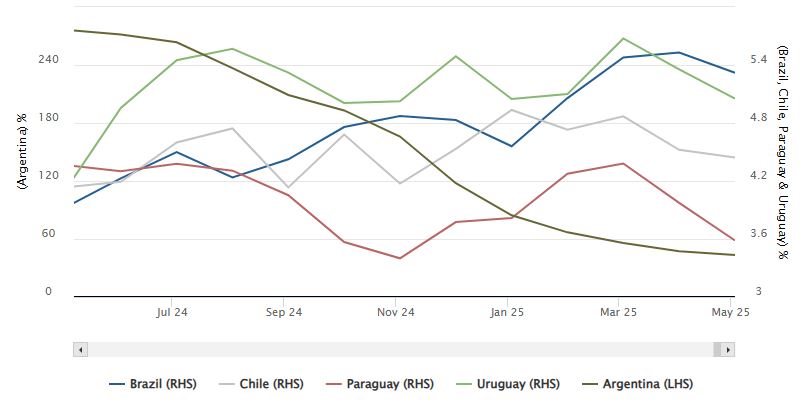
Brazil & Southern Cone: inflation rate
Percentage variation (year-on-year)
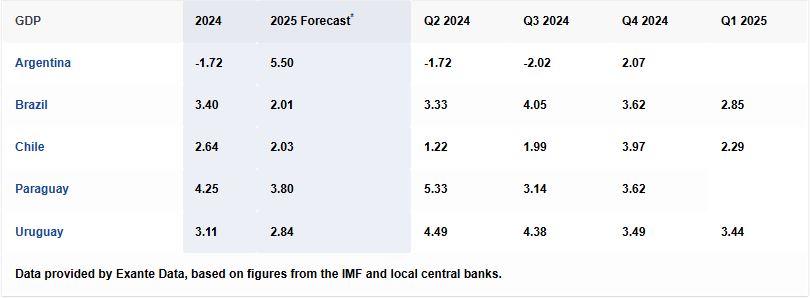
Brazil & Southern Cone: GDP growth (%)
Quarterly figures are year-on-year growth
BRASIL | El desempleo en una caída record. La tasa oficial de desempleo en las seis más grandes áreas urbanas fue de sólo 5,8% en octubre, cayendo de 6% en setiembre (y 6,1% en octubre de 2010), de acuerdo con el instituto nacional de estadísticas (Ibge). Fue la tasa más baja para el mes, desde octubre de 2002. Brasil está cerca del pleno empleo, con un total de población ocupada de 22,68m. El número de desempleados cayó un agudo 4,5% mes en mes entre setiembre y octubre a una nueva baja de 1,39m.
Hubo también una declinación de 4,1% año en año en el desempleo. Unos 11,1m de personas trabajan ahora en el sector privado, subiendo 7,4% año en año sobre octubre de 2010. El promedio del salario fue de R$1.613/mes (US$854/mes) Los salarios reales fueron erosionados desde agosto debido a un Real más débil y a una tenazmente alta inflación. Antes en este año, (junio-julio) los salarios promediaban US$1.000/mes. El salario mínimo se elevará en alrededor de 7% en términos reales en 2012, poniendo presión potencialmente sobre los salarios en general.
CHILE | Contracción en la minería. La economía creció en 4,8% en el tercer trimestre de 2011, pero solamente 0,6% en el segundo trimestre de este año. El sector minero se contrajo fuertemente en 6,5%, como resultado de una huelga de dos semanas en la mina de cobre La Escondida y una inusual lluvia en el perennemente seco desierto de Atacama.
El crecimiento del PIB fue conducido por un salto de 9,4% año en año en la demanda del consumidor y un sector pesquero en alza, que se expandió en 59,4% en el tercer trimestre contra un año antes, al recuperarse de un devastador virus de anemia infecciosa del salmón (ISA).
Russia is once again supplying Havana with sizeable quantities of oil, harking back to the days, last century, when the former Soviet Union supplied Cuba with all its fuel needs. The terms of the supply agreement are unclear – Russia itself is in little position to be giving away oil.
According to a 3 May statement by Russia’s state oil company Rosneft, it has signed an agreement with Cuba’s state-run Cubametals to supply 250,000 tonnes (t) of oil and diesel fuel. An oil tanker, the Maersk Erin, carrying 249,000 barrels of refined products was due in Matanzas on 10 May, with others to follow, the Russian company said. No further details have been forthcoming, but there has been much head-scratching over the particulars. While the government led by President Vladimir Putin might welcome the political opportunity to cause ripples across the Florida Straits, Russia itself is hardly in a position to make charitable donations to its former prize Caribbean client. Jorge R Piñon, director of the Latin America and Caribbean Energy Program at The University of Texas at Austin, has estimated the value of the deal at about US$105m, for about 1.87m barrels of oil. In the period 2010-2015, Russia reported just US$11.3m in oil product sales to Cuba.
Putin is allied with both the communist regime led by President Raúl Castro and Venezuela’s radical left-wing socialist government led by President Nicolás Maduro. Venezuela’s state oil company Pdvsa and Russia’s Rosneft are, in turn, strategic operating partners. In late 2016, Rosneft took a 49.9% stake in Pdvsa’s US subsidiary Citgo, as the cash-strapped Pdvsa desperately sought to raise financing. There is some speculation, therefore, that this latest deal is some sort of ‘triangular’ arrangement between Caracas, Havana, and Moscow.
Cuba’s fuel need is about 140,000 barrels per day (b/d) of oil/oil products, plus 22,000 b/d of diesel. It produces about 50,000 b/d itself. In October 2000, Havana and Caracas (then led by the two late leaders Fidel Castro [1959-2008] and Hugo Chávez [1999-2013]), inked a strategic cooperation agreement, updated in 2004, whereby Venezuela effectively replaced Russia as Cuba’s main fuel supplier. At its peak, Venezuela was providing Cuba with about 100,000 b/d. Payment was largely to be in the form of Cuban technical support and expertise for Chávez’s new social welfare programs (‘missions’), including medical staff (and, rumour had it, Cuban military expertise). All was well for over a decade, but neither Venezuela, nor Cuba it would seem, ever considered the risk of an oil shock. Given Cuba’s harsh ‘special period’ in the 1990s (after the sudden loss of the Soviet subvention), locking in a critical dependency on one supplier all over again seemed particularly ill advised.
While President Maduro, who some critics believe is closely directed by Havana, has been very insistent that Venezuela will maintain its commitment to Cuba no matter what, oil industry experts calculate that Pdvsa’s shipments have fallen by as much as 40% since oil prices plummeted in 2014, to about 87,000b/d in 2016 and 55,000 b/d now. President Castro himself admitted to Venezuela-related difficulties in July 2016, announcing budget cuts and an energy savings drive (including electricity rationing in the state sector).
Cuba’s main Cienfuegos refinery – upgraded and remodelled by Pdvsa to process Venezuela’s heavy crude oil – has also been idling since mid-2016, another signal that it has not been receiving the same quantities of oil as before. This latterly appears to have changed somewhat, after gasoline shortages in both Havana and Caracas appear to have prompted Pdvsa to resume deliveries of some fuel.
According to oil analysts cited by Reuters, since last year Pdsva has been minimising shipment of its lighter grade crudes to Cuba (and its other Caribbean oil clients), apparently hanging onto it for its own use. Venezuelan’s heavy, tarry crude has to be mixed with lighter oil for export. The fact that Pdsva appears to have been hoarding its light crude supply (in recent years imported from places like Angola), suggests two things. First, that it is running short of light oil imports and, secondly, that it is using what it does have to keep up its (declining) oil exports to its regular, cash-paying customers (the most important, ironically, being the US). And even though Pdvsa reportedly increased shipments of refined products/reconstituted oil to Cuba instead, in an effort to partially compensate, the gasoline shortages (in both countries) suggest that Pdvsa is simply failing to produce and/or deliver enough fuel either in Havana or even at home in Caracas. In March, the Cuban authorities limited the sale of premium-grade gasoline exclusively to the tourist sector. Days earlier, there were gasoline shortages in Caracas, creating fury in a country where fuel is like water to consumers (and retails for less than bottled water).
Citing oil traders and shipping experts, Reuters suggested that Pdvsa resumed exports of light crude to Cuba in late March, after an eight-month pause. Traders estimate that it dispatched 1.39m barrels of light Mesa 30 crude, as well as a 596,000-barrels of reconstituted crude, possibly indicative of plans to restart the Cienfuegos refinery. Cuba used to sell – on the open market – some of the oil processed at Cienfuegos, giving it a useful source of foreign exchange. Since 2014, however, Cuba’s earnings from this side-line in oil exports have fallen by 97%, on United Nations (UN) estimates, from US$500m to just US$15.4m last year.
Piñon points out that Havana has also been getting oil from Angola and Algeria, clearly seeking to diversify its sources. How Cuba is paying for these supplies is unclear. Typically, its trading partners expect it to pay in cash. Piñon estimates that Cuba would need about US$2bn a year to source its oil needs on the open market. Yet along with oil sales, Cuba’s main exports have also tumbled, meaning reduced levels of foreign earnings to pay for imports (albeit its tourist earnings are proving a lifesaver). Professor Carmelo Mesa Lagos, a veteran Cuba expert, estimates that total export earnings fell by 47% in 2015. The economy fell into recession last year for the first time since the Special Period and, with the exception of tourism, remains subdued this year.
Russian gold to restore the Capitolio
A Russian state company is holding a tender for the restoration of the famous gold cupula in the Capitolio building, originally built to house Cuba’s parliament, according to Russian news site Sputnik. The Capitolio, one of Havana’s best known landmarks, has been undergoing restoration since 2013, when President Raúl Castro announced plans for the building to once again host the legislature (national assembly). After the 1959 Cuban Revolution, Fidel Castro disbanded and abolished parliament. In the subsequent decades, the Capitolio fell into disrepair. For a time, it housed the ministry of science, technology and the environment, and it was also a public museum and library. Raúl Castro’s plan to restore the building to its original function came as something of a surprise, given its pre-Revolutionary symbolism. The cost of the works has been estimated at about US$60m.
Goszagransobstvennost, identified as a state company under management of the Russian presidency, will oversee the Cupola tender, Sputnik reports. The winner will be announced in early June, with a work plan due by August. Russia will assume the total cost of the restoration, for which budget funds to the tune of US$354,000 have been set aside, under an intergovernmental agreement.
The Capitolio was completed in 1929 by a US construction firm and with US bank funding. Its architects, Raúl Otero and Eugenio Rayneri, took inspiration from the US congress and St Peter’s Basilica in Rome. Sixty types of marble were used. The top of the Capitolio’s dome (92m) is slightly higher than the US congress building. The cupola, imported from the US, was the third highest in the world at the time of its completion.
Cuba is still trying to promote its offshore oil sector, with no success. The US Geological Survey in 2004 estimated that Cuba should have undiscovered and technically recoverable reserves of 4.6bn of crude oil, 9.8trn cubic feet of natural gas, and 90m of natural gas liquids. Yet no-one has managed to find viable deposits. Russia’s Zarubezhneft and Spain’s Repsol are among the many firms that have drilled in Cuba’s portion of the Gulf of Mexico but, so far, no commercially viable finds have been made. Cuba’s state oil company CUPET is currently looking for bidders and technology partners for the North Belt, a 200km-long offshore area east of Havana, divided into 45 blocks. Onshore production is improving. Australia’s Melbana Energy in February revised up its estimates for onshore reserves in its Block 9 to 612m barrels, almost double earlier estimates.
Grazia Giammarinaro, the UN special rapporteur on trafficking in persons, was in Cuba on 10-14 April, marking the first visit by a UN human rights investigator in a decade. Giammarinaro said she hoped her visit would be “a stepping point for a more intense and fruitful dialogue with the whole human rights system”. Cuban dissidents were cautious. “It is notable they are not inviting special rapporteurs who look into torture, penitentiary systems, freedom of expression, the functioning of electoral systems, etc.”, stated Elizardo Sánchez, head of the illegal but tolerated Cuban Commission for Human Rights and National Reconciliation.
BRAZIL | Quarterly rise in Vale’s iron ore production. The Brazilian mining company Vale released its third quarter production results on 17 October. The mining giant produced 86.24m tonnes (t) of iron ore in Q3 2023. This marks a 9.5% increase from the 78.74m t produced in the previous quarter, although this figure is also down 3.9% compared with the 89.7m t produced in Q3 2022.
The accumulated iron ore production figure for January-September 2023 came to 231.76m t, up 2.1% from the 226.94m t produced in the first nine months of last year.
In its report, the company attributed the Q3 year-on-year decline to lower production rates in the Paraopeba mining complex, in the south-eastern state of Minas Gerais, and in the Serra Norte complex, in the northern state of Pará.
BRAZIL | Embraer begins negotiations with Czech Republic. The Brazilian aircraft manufacturer Embraer announced on 17 October that it has begun negotiations to sell two military transport aircraft to the Czech Republic. The Czech military is considering the C-390 Millenium aircraft, a medium-sized aircraft suitable for a range of missions. Embraer’s C-390 Millenium is already used by the air forces of Portugal, Hungary, the Netherlands, and Austria. The potential sale to the Czech air force marks further efforts by Embraer to supply members of the North Atlantic Treaty Organization (Nato).
|
The bad news keeps accumulating and President Laura Chinchilla seems unable to reverse the trend that costs her approval ratings several percentage points in public opinion surveys month after month. In the latest Unimer poll, conducted between 5 and 11 July, the index of trust in the government (ICG) fell for the seventh month running, closing at its lowest historic point since the index’s creation in 2003.
The ICG measures levels of trust in the government in relation to corruption, its ability to resolve pressing problems and more general perceptions of the president’s and the cabinet’s performance. It is calculated on a scale from 1 to 5, with the former indicating total distrust and the latter absolute trust. In July, it posted at an embarrassing 0.871, making the Chinchilla government the one with the highest perception of corruption and administrative ineptitude since records began. In fact, the perception that the government is corrupt rose from 60% in April to 75% in July, partly as the result of several corruption scandals [RC-12-05], including one involving a cabinet member [RC-12-04].
The overall government performance reflects a similar drop in the president’s own image, with 53% of the 1,200 respondents saying her work is “bad” or “very bad” and only 13% rating her performance as “good” or “very good”. Making matters worse for the president, when all economic worries are grouped together (i.e. unemployment, increasing cost of living and the general state of the economy), the latest Unimer poll shows that the economy is now the chief concern for Costa Ricans (35%), overtaking security (27%), which has traditionally topped the survey during Chinchilla’s government. (It is worth noting, however, that in the June 2011 poll, security concerns topped the list with 49% and the improvement in this indicator came despite the direct involvement of a Costa Rican national in the leadership of a drug trafficking organisation [RC-12-07].)
In macroeconomic terms, however, the Costa Rican economy is doing very well with the central bank (BCCR) raising its annual GDP growth forecast for 2012 to 5.5%, from 4% previously. (The BCCR has yet to release GDP figures for June.) Similarly, inflation is expected to come in at the targeted 5% (+/-1%) - consumer prices rose 4.6% in June from a year earlier, according to the latest figures by the national statistics institute (Inec).
In the first six months of the year, the export of goods grew 10.9% when compared with the same period of 2011, reaching a record US$5.85bn. Undoubtedly, the export of Intel microchips lead the way, with a 43.4% rise when compared with the same period a year earlier, posting at a total of US$1.15bn. The export of services also posted impressive growth of 15.1%, bringing in a total of US$1.59bn. This performance has put Costa Rica on track to surpassing its target of US$15bn in total exports by year end.
Thus for the first time in several decades, Costa Rica is poised to show real GDP growth that exceeds its inflation rate, which should be music to the president’s ears and result in some improvement in the polls over coming months. But perceptions are not as straight forward as indicators and as unemployment worries increase, the government’s grades may continue to worsen.
According to the Inec, unemployment in the first half of 2012 reached 10.4%, posting a significant increase when compared with the 9.6% recorded during the same period of 2011 - but showing a slight improvement when compared with the 10.9% posted in the last quarter of 2011. According to Minister of Planning Roberto Gallardo, 150,000 jobs have been created over the past year, but an increasing number of people are searching for work and job supply simply cannot keep up with demand.
In late July, the negotiating teams of Costa Rica and Colombia met for the first round of talks towards the establishment of a bilateral Free Trade Agreement (FTA) in northern Bogotá. While the meeting was intended to set up the legal framework for negotiations, the leaders of the two negotiating teams, Javier Humberto Gamboa Benavides for Colombia and Fernando Ocampo for Costa Rica, have hinted that four controversial agricultural products (coffee, sugar, flowers and bananas) will be left out of the deal and only incorporated at a future date.
The UN’s Economic Commission for Latin America and the Caribbean (Eclac) in August published its latest economic outlook for the region, cutting back its 2018 GDP growth forecast to 1.5%, down from the 2.2% it had pencilled in last April.
Eclac says growth next year will be led by domestic demand and a small increase in investment; it will happen in an international context marked by uncertainty and volatility. Among the risks are the possibility of a global trade war, increased capital outflows from emerging economies, currency depreciation, and “a global economic expansion that is tending to lose momentum”. Overall regional growth will nevertheless remain positive despite big variations between countries. The South American economies will be rather sluggish, with growth of 1.2%. The Caribbean will do a little better with expansion of 1.7%, while the Central American economies will push ahead more smartly with 3.4% growth. The Dominican Republic will be the fastest growing country in the region with a 5.4% increase in GDP, followed by Panama (5.2%), Paraguay (4.4%) and Bolivia (4.3%).

For the region as a whole tax collection will remain steady at around 17.8% of GDP (almost a one percentage point increase on 2017). Inflation (excluding hyperinflationary Venezuela) will average 6.5% (up from an estimated 5.3% for 2017). Unemployment will stop rising, and stabilise at around 9.2%. Eclac executive secretary Alicia Bárcena said governments should seek to encourage recovery without resorting to excessive fiscal stimulus; one way of achieving that would be to increase regional integration initiatives. Eclac’s ‘Economic Survey of Latin America and the Caribbean 2018’ which contains these predictions also analyses investment performance, noting that gross fixed capital formation rose from 18.5% to 20.2% of GDP between 1995 and 2017. There was encouraging growth of investment in machinery and equipment, which rose from 4.7% of GDP from 1995-2003 to 8.1% from 2010-2016, seen as particularly positive because “it allows for incorporating greater technological content and laying the foundations for improving productivity and sustaining growth”.