All Categories

Subcategories

  • ECONOMIC OVERVIEW: HONDURAS

    LatinNews 26 October 2011 Hits: 607

    The central bank reported that exports of basic manufacturing assembly goods rose 12% year-on-year in the first half of 2011 to reach a value of US$1.70bn.  Sales of textiles, which account for about 87% of manufacturing exports, rose 10.4% to US$1.47bn. The result was driven by strong growth (28%) in exports of electrical parts and transport equipment, mainly thanks to demand from the US car company General Motors, which sources parts from Honduran suppliers.  Honduras still posted an overall trade deficit of US$1.13bn in the first half of 2011. That was down slightly on the US$1.23bn deficit registered in the same period of 2010, thanks to higher prices for commodity goods like coffee, bananas and palm oil. The gradual, managed depreciation of the Lempira by the central bank (via daily auctions) should help Honduran exporters without impinging too much on inflation.  The lempira was trading at HNL19.01/US$ on 26 October.

  • ARGENTINA: El peso se hunde rápidamente

    LatinNews 19 September 2014 Hits: 565

    Primero fue conocido como el dólar ‘Messi’. El número 10 de la camiseta del futbolista argentino se convirtió en el término usado en la jerga popular para la tasa del dólar en el mercado negro, cuando ésta se elevó por encima de los diez pesos. Cuando rompió el umbral de los 14 pesos por dólar, los argentinos bromeaban diciendo que ahora era el ‘Dólar Mascherano’. El 17 de septiembre, el peso se comerciaba por encima de 15 por dólar. Ahora es el ‘Dólar Demichelis’.

    En las calles de Buenos Aires, los gendarmes se han desplegado esta semana, en un intento por suprimir el comercio ilegal del dólar. Mientras que los volúmenes de comercialización de la divisa en las ‘cuevas’ de la ciudad, los escenarios tradicionales de cambio de dinero, parecen ahora bastante escasos, los acuerdos ahora se hacen a través del teléfono. La moneda cayó luego de una declaración del banco central (BCRA), en la cual admitió que su stock de reservas de moneda extranjera había caída unos US$184m el 15 de septiembre. El gobierno ahora tiene en el banco sólo US$28,2mm. El temor es que el gobierno podría quedarse sin dólares para pagar a sus acreedores y sus facturas de importaciones.

    Axel Kicillof, el ministro de economía, dijo que no hay razón económica para que el peso se cambie a tal tasa. En cambio, él insinuó que otras fuerzas estaban detrás de la caída del valor del peso. “Nada es coincidencia”, Kicillof dijo, “la subida del dólar ‘blue’ [como se conoce también la tasa del mercado negro], los fondos buitres, las palabras de la embajada de EU

    ”. El canciller de Argentina está actualmente enzarzado en una furiosa disputa con el embajador interino de EU, Kevin Sullivan, después de éste haya cuestionado la decisión de Argentina de plantear su punto muerto con las cortes de EU sobre la deuda durante la Asamblea General de la ONU.

    Hablando con el sitio web de noticias financieras, Cronista.com, Francisco Mendonça, el director del Grupo Hecke, dijo, “Con el dólar por encima de los Ar$15, la confianza en la economía se ha perdido completamente, y como siempre ocurre, todos tratan de volver al dólar”. Con la tasa oficial en Ar$8,3/US$1, la diferencia entre las dos tasas de cambio es de más del 80%, pero Mendonça alega que lo único que le importa al mercado es conseguir dólares de  EU, “la huidas hacia la calidad”. Mientras Tanto, él dijo, “el gobierno se ha quedado sin herramientas de política monetaria para frenar esto”.

    Casi todos los analistas de los mercados de divisas esperan una inminentemente segunda devaluación, pero la pregunta es si puede ser manejada tan suavemente como la primera, en enero de este año. En las proyecciones exageradamente optimistas del presupuesto para el 2015, que Kicillof presentó al congreso la semana pasada, él predijo una tasa de cambio de Ar$9,45/US$1. Siobhan Morden, la directora de ingresos fijos de América Latina del Jefferies Group LLC en Nueva York, predice que habrá una devaluación después de la Navidad, para evitar hacer las importaciones más costosas antes del periodo de compras del feriado.

    A diferencia de la mayoría de los observadores nacionales e internacionales, el presupuesto de Kicillof espera un crecimiento del 0,5% este año, con una inflación del 21,3%. Para el año próximo el pronóstico oficial de crecimiento es del 2,8% con la inflación cayendo al 14,5%. “Argentina se está dirigiendo hacia un escenario muy sólido de mediano y largo plazo,” declaró Jorge Capitanich, el jefe de gabinete, después de la presentación del presupuesto. Como resultado, el presupuesto no incluye “aumentos de impuestos o recortes presupuestarios” en el 2015.

    El gobierno tiene un largo historial de espectacular optimismo sobre sus pronósticos y, al parecer, estas últimas estadísticas no son la excepción. Las estadísticas de la inflación compiladas por economistas simpatizantes con la oposición afirman que la tasa para los últimos 12 meses es de más del 40%. El congreso debe votar sobre el presupuesto a principios de octubre, pero ya varios políticos de la oposición han atacado la credibilidad de las cifras de Kicillof. Fausto Spotorno, un economista en Orlando Ferreres y Asociados, describe los números de Kicillof como “improbables”, señalando que los precios de la soja están cayendo, el empleo está bajando, la inflación se eleva y carcome los salarios reales […] y después tenemos el default, que incrementa el costo de pedir prestado”. Un sondeo de Bloomberg de 22 economistas da un pronóstico de consenso de una contracción de 1% en el PIB real anual este año.

    • Problemas en diciembre

    Luis Barrionuevo, uno de los líderes de la Confederación General del Trabajo (CGT) anti-gobierno, ha predicho trastornos sociales en diciembre, tradicionalmente un mes de malestar social en la Argentina. Como uno de los organizadores de las dos huelgas generales pasadas, no está claro si su predicción es un perspicaz análisis o una amenaza. Preguntado sobre sus comentarios, Barrionuevo dijo que la misma Presidenta Cristina Fernández había pronosticado que si la inflación estuviera “realmente en un 25%, el país explotaría”.

  • TRACKING TRENDS

    LatinNews 30 November 2017 Hits: 843

    BRAZIL | Brazil registers record trade surplus. Brazil recorded a trade surplus of US$2.93bn in November, according to data released by the industry and trade ministry (MDIC). This brings Brazil’s accumulated trade surplus for the first 11 months of the year to a record US$61.39bn. That is already bigger than the entire trade surplus for last year (US$47.7bn), which was itself the largest since financial records began in 1989.

    For the whole of this year, the MDIC expects Brazil to post a trade surplus of between US$65bn and US$70bn. A survey of financial analysts from Brazil’s central bank (BCB) estimates that the trade surplus will reach US$65.5bn for 2017.

    BRAZIL | Groupon announces merger with Peixe Urbano. On 27 November, discount vouchers site Groupon LATAM, owned by investment fund Mountain Nazca, announced it would acquire competitor Peixe Urbano, which operates in Brazil and is owned by Chinese online search giant Baidu. The value of the acquisition is not yet known and the deal is still pending approval from Brazil’s competition authority, Cade.

    In a statement, representatives from Groupon and Peixe Urbano said that their operations would not be affected by the merger and consumers would eventually benefit from greater consumer choice. “It’s the sum of two giants. We have joined the leadership from Groupon Brazil in the beauty and local travel market with the expertise of Peixe Urbano in gastronomy and entertainment. At the end of the day, it is the consumer who benefits from getting the best of both worlds,” the president of Groupon Brazil, Félix Lulion, said.

    For its part, Peixe Urbano can offer the addition of a ‘buy now’ button, which works better for spontaneous Brazilian consumers than the traditional discount voucher model where users may have to wait six months before the offer is valid. “The use of immediate vouchers corresponds to 90% of restaurant booking requests using the Peixe Urbano platform,” Alex Tabor, co-founder and chief executive of Peixe Urbano, said.

    URUGUAY | Electricity exports. On 26 November the Administración del Mercado Eléctrico (Adme), the official entity in charge of administrating Uruguay’s electricity market, released new data which shows that the country has exported some US$93m worth of electricity to Argentina and Brazil from January to November this year.

    The value of Uruguay’s electricity exports this year is 42 times higher than that registered in the comparable period last year. The Adme data shows that the increase in electricity exports was driven by higher sales to Brazil, where 945,500 megawatt hours (MWh) have been transferred in the spot market at prices ranging from US$70 per MWh to US$150 per MWh starting from May. This increase in sales to Brazil offset the 18% year-on-year fall in electricity transfers to Argentina so far in 2017, which currently stands at 541,800MWh.

    The positive electricity export figures for the first nine months of the year have led Adme to forecast that Uruguay will export a record US$120m worth of electricity to its neighbours this year. Adme expects that transfers to Brazil will continue in the same vein into December given the low level of rain registered in south-eastern Brazil, which means that the electricity generation capacity of Brazil’s hydroelectric plants remains limited, while demand for electricity in Brazil is expected to remain strong into 2018.

  • ECONOMIC HIGHLIGHTS

    LatinNews 19 June 2020 Hits: 1335

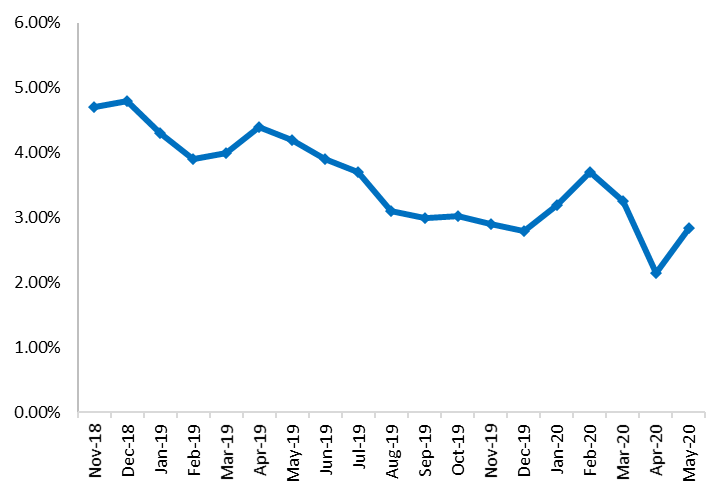
    Interest rate cut: On 14 May the governing committee of Mexico’s central bank (Banxico) decided to cut the benchmark interest rate by 50 basis points to 5.5%, in a further effort to address the economic fallout of the coronavirus (Covid-19) pandemic. In a statement, Banxico justified the decision on the basis of the shock in financial markets; the “unprecedented” revision of its domestic economic outlook, “which incorporates a significant fall in economic activity” in the first quarter of 2020; and inflation, citing a drop in annual inflation between March and April from 3.25% to 2.15%, which was influenced significantly by a fall in oil prices. This marks Banxico’s third such interest rate cut since February 2020.

    Trade deficit: On 25 May Mexico’s national statistics institute (Inegi) released trade balance figures, according to which the country registered a US$3bn trade deficit in April, a decrease from the US$1.5bn trade surplus registered in April 2019. Exports in April 2020 totalled US$23.4bn while imports reached a total of US$26.5bn. Compared with April 2019, exports fell by 40.9% overall, with a 39.4% decrease in exports excluding oil, and a 66.4% decrease in oil exports. Non-oil exports to the US specifically fell by 40.7%. Imports in April fell by 30.5% year-on-year, with a decrease of 27.6% in imports excluding oil, and a 53% decrease in oil imports. 

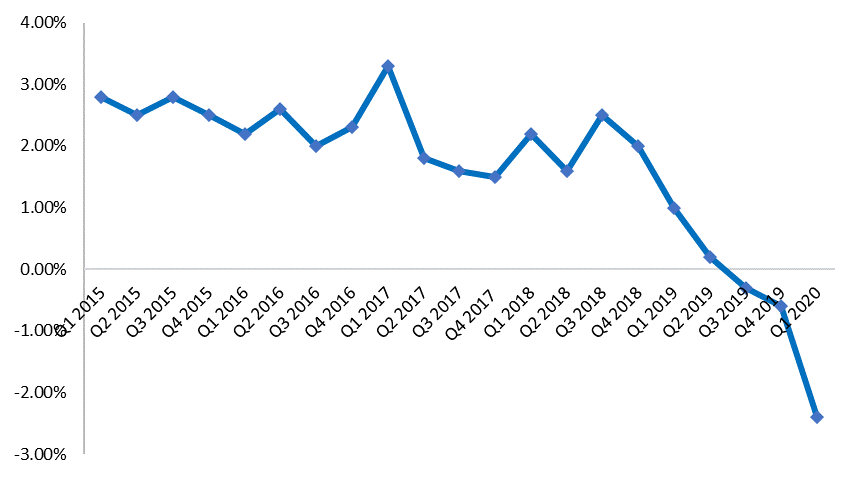
    GDP: On 26 May Mexico’s national statistics institute (Inegi) released new figures which show that the country’s GDP contracted by 1.4% in the first quarter of 2020 compared with the same period in 2019, according to original (non-seasonally adjusted) figures. While this represents the biggest quarterly slump since the last quarter of 2009, the contraction is less than the 1.6% decrease predicted by Inegi on 30 April. The figures show that primary economic activities were up by 8.3% in the first quarter, while secondary activities contracted by 2.9%, and tertiary activities by 0.7%. Inegi also revised the 2019 annual GDP growth figure from -0.1% to -0.3%, and released data which showed that economic activity fell 2.3% year-on-year in March, in non-seasonally adjusted terms.

    Mexico: GDP Growth
    Percentage variation (year-on-year)

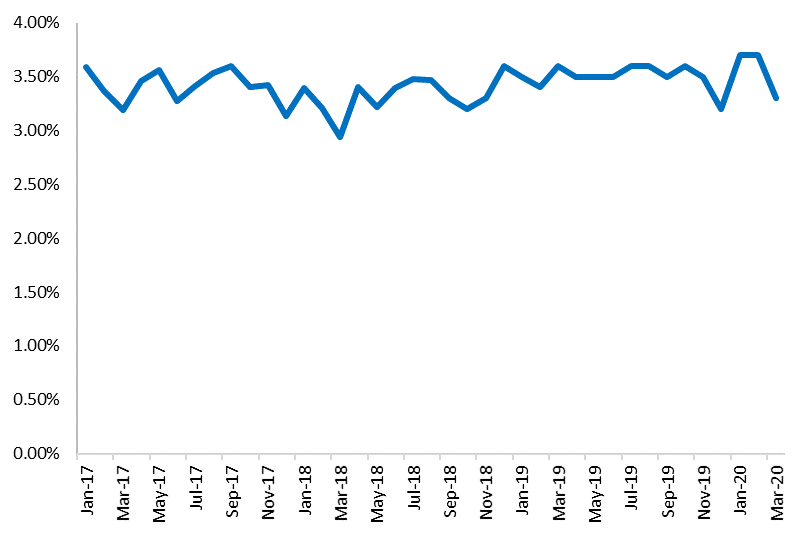
    Mexico: Unemployment Rate
    Econimically active population

    Mexico: Inflation Rate
    Percentage variation (year-on-year)

  • EL SALVADOR: Bitcoin gambit off to a rocky start

    Sarah Sheldon 15 December 2021 Hits: 404

    In November El Salvador hosted a series of bitcoin events, building on its adoption of the cryptocurrency as legal tender in September, a move which has sparked protests at home and alarm among international observers.

    Bitcoin became legal tender in El Salvador on 7 September, which means businesses are required to accept the cryptocurrency as payment alongside the US dollar. In order to facilitate this, President Nayib Bukele’s government set up a US$150m bitcoin fund as well as an electronic wallet dubbed Chivo. The fund has been used to pay for a US$30 bonus for every Salvadorean citizen who downloads the wallet, in a bid to promote both use of bitcoin and Chivo. In addition, Bukele said 200 Chivo ATMs have been built around the country, allowing users to convert bitcoin into dollars.

    On 7 September the cryptocurrency plunged in value by as much as 17%, to US$43,119, before recovering to trade 10% lower that day. This volatility is one of the reasons the move has been criticised. In response to the dip, Bukele announced that the government, which had already bought 400 bitcoins, would purchase a further 150. Bukele later increased the country’s total holding to 1,120 bitcoins, sparking criticism from opposition lawmakers who accused him of exposing the country to the extreme volatility of cryptocurrency. However, Bukele has promised to use profits from the trades to build El Salvador’s first public veterinary hospital, as well as 20 schools. The president also says the move will allow Salvadoreans living abroad to send remittances home without paying the hefty commissions demanded by existing money transfer services.

    The Chivo wallet has been adopted by large companies such as US retail coffee giant Starbucks and US fast food chain McDonald’s, while Mexican budget airline Volaris has also said that it will accept payment in bitcoin. However, the wallet has had a troubled start to life. On its first day Chivo crashed and had to be taken offline for a few hours due to network capacity issues, and it has since been struck by reports of identity fraud. In response, Bukele has proposed tougher prison sentences for cryptocurrency-related cybercrimes. In addition, a feature of the wallet which froze the bitcoin-dollar exchange rate for one minute had to be disabled on 25 October after it emerged that traders were using it to make illegal profits by comparing the rate with other exchanges then deciding whether to buy or sell. The practice, known as scalping, is not illegal in and of itself, but doing so with a frozen rate constitutes a kind of fraud, tweeted Chivo.

    Crypto experts also questioned whether Chivo is even connected to the blockchain, the system that underpins bitcoin transactions. Transactions are possible between Chivo wallets, but not from Chivo to another kind of crypto wallet, which goes against the philosophy of interoperability that underpins bitcoin. In addition, the app has raised privacy concerns as it asks for access to a user’s microphone and contacts list, which are not features necessary for a wallet to function, Salvadorean economist Ricardo Castaneda told British newspaper The Guardian in an article published 7 September. “Bitcoin might be a distraction but given the decision to push ahead with the plan despite popular opposition and the advice of experts, it could also be an important pillar of Bukele’s political project,” said Castaneda, referring to claims of growing authoritarianism from the president. Castaneda also cited concerns that the time and money invested in the bitcoin project would have been better spent elsewhere, such as in health or education. “Even those Salvadoreans who don’t use bitcoin will pay the price of this experiment,” he said.

    A series of protests against the Bukele government also cited concerns over the president’s governing style and the move to make bitcoin legal tender. More than 1,000 people turned out to protest in San Salvador on 7 September, while a survey by LPG Datos for national daily La Prensa Gráfica, published on 1 September, revealed that 65% of 1,506 respondents disapproved of the use of bitcoin as legal currency. Contrary to the disapproval suggested by this survey, Vice President Félix Ulloa told Politico magazine that some 3m Salvadoreans have set up a bitcoin account in an article published 10 November. The country has a population of 6.5m, and only 30% of adults have a bank account, according to Politico. This means Ulloa’s claim should be treated with caution, especially given claims of widespread identity fraud. There is also a possibility that some users may have immediately withdrawn the US$30 bonus and never used the Chivo wallet again.

    Despite criticism at home and abroad, the Bukele government shows no signs of rowing back on its bitcoin experiment. The country hosted Bitcoin Week starting 17 November, and economy minister María Luisa Hayem underlined the government’s commitment to the project. “We are very proud to have adopted bitcoin,” said Hayem, who hailed improved access to payments and services in the country. “We are also seeing a lot of interest from investors, not only in technology, but also in the tourism and real estate sectors; this will be a source of employment,” she added. The government is working to attract investors by guaranteeing that there will be no capital gains taxes on bitcoin profits as well as allowing immediate permanent residency for investors, and it hopes to become a global centre for bitcoin mining after China cracked down on the practice.

    Ulloa told Politico that one Swiss investor is interested in moving 13-15,000 mining machines to El Salvador, and investors from Asia, South America, and Russia have also been in touch. One reason China has cracked down on mining is the huge amount of energy required, which it says imperils efforts to cut greenhouse gas emissions, but Bukele proposes heading off those concerns by using clean geothermal energy from the country’s volcanoes. On 20 November, Bukele announced plans to build a bitcoin city in the La Unión region in the south-east of the country, which will use energy from the Conchagua volcano to power bitcoin mining.

    However, there are concerns that attracting crypto miners and investors may come at the price of a deal with the International Monetary Fund (IMF), which is in talks over a US$1.3bn financial arrangement. Prior to its implementation the IMF said the bitcoin law “raises a number of macroeconomic, financial, and legal issues that require very careful analysis,” but it emphasised that talks over the financial arrangement were ongoing. Salvadorean government officials insist that it won’t be an impediment to a deal with the IMF, and on 22 October the organisation’s Western Hemisphere Department acting director, Nigel Chalk, said the IMF continued to cooperate with El Salvador on bitcoin. Representatives from both sides met for annual meetings on 18 November, but an IMF spokesman said that a support programme was not being discussed at present.

    The stakes are high for El Salvador, which needs to cover holes in its national budget. Public debt will reach about 85% of GDP by the end of the year, according to the IMF, up 14 percentage points of GDP since the start of the pandemic. Failed negotiations could be hugely costly, according to the Central American institute of fiscal studies (Icefi), a regional thinktank, which believes the lack of a deal “could generate a crisis of confidence with respect to El Salvador’s sovereign debt”. However, it appears that Bukele is planning to use US$1bn in so-called “bitcoin bonds” to raise funds from outside the traditional financial system, with US$500m spent on more bitcoin and US$500m destined for “building out energy and bitcoin mining infrastructure in the region.” While bitcoin fans hail Bukele as a visionary, others worry he is leading his country down a hugely risky path.

  • TRACKING TRENDS

    Patrick de Courcy 03 February 2022 Hits: 3599

    BRAZIL | Government hails job creation. Brazil’s labour ministry published the latest figures from the national employment registry (Novo Caged) on 31 January, which show that over 2.7m jobs were created in Brazil’s formal sector last year. This is a “positive and historic” number, according to the government. Labour Minister Onyx Lorenzoni highlighted the programmes implemented by the government to protect jobs during the coronavirus (Covid-19) pandemic as well as efforts to improve Brazil’s business environment as underpinning the positive job creation in the formal sector.

    Despite this, unemployment remains high in Brazil. Annual figures for 2021 are not yet available, but the latest data from the national statistics institute (Ibge), released on 28 January, showed that the unemployment rate stood at 11.6% in the rolling quarter ending in November 2021, with a total of 12.4m people looking for work.


    BRAZIL | Petrobras sells 22 concessions in Potiguar cluster. Brazil’s state-owned oil company Petrobras confirmed on 31 January that it had concluded the sale of the totality of its stake in 22 concessions in the Potiguar Basin in the north-eastern state of Rio Grande do Norte to 3R Potiguar, a subsidiary of Rio de Janeiro-based oil & gas company 3R Petroleum Óleo e Gás. The sale, which includes the concession of onshore and shallow-water oil fields as well as the infrastructure for processing, refining, logistics, storage, transport, and outflow of oil and natural gas, was concluded for US$1.38bn.  

    Petrobras has said that the sale is in line with its strategy to focus its production efforts on its deep-water and ultra-deep water assets where, according to a company statement, “it has shown a great competitive edge over the years, producing better quality oil and with lower greenhouse gas emissions”.

  • HONDURAS: Value of goods exports falls year-on-year

    Sarah Sheldon 25 March 2024 Hits: 1055

    Goods exports were worth a total US$11.35bn in 2023, US$898.7m or 7.3% less than the previous year, according to figures from the country’s central bank (BCH).

    This was driven mainly by a 12% fall in the value of exported manufactured textile products. which the BCH says is linked to reduced demand for textile products on the global market. The bank says that the US received 64.7% of textile product exports in 2023, the majority of which were pieces of clothing, and cites figures which reveal that total US imports of clothing fell by 22.4% last year. These products, known as maquila, were worth US$5.40bn in 2023, almost half of the country’s total exports. 

    Overall, the value of exports of manufactured goods saw a 4.4% year-on-year decrease in 2023, despite the fact that export volumes increased. This is due to the fact that prices of coffee, palm oil, and prawns were lower than in 2022. For example, coffee exports were worth US$1.39bn, which is US$12.4m less than the previous year, due to the fact that the average coffee price was 16.6% lower year-on-year. It’s a similar story with palm oil. Total exports were worth US$506.9m, which is US$145.7m less than in 2022, due to the fact that average prices fell 27.2% after reaching levels higher than the historical average in 2022.

    On the other hand, electrical parts, particularly those used in vehicle manufacturing, increased in value by US$190.5m to US$1.38bn for the year. This is due to strong auto sales in the US, which saw a record US$578m spent on new vehicles last year, according to the BCH. In addition, exports of agricultural products were worth US$992.9m, 3.9% more than in 2022. This is largely explained by a 7% increase in the value of banana exports, which reached US$684.9m last year.

    As for the destination of exports, the US is the largest trading partner. Honduras exported US$5.82bn in products to the US in 2023, primarily clothing, automotive wiring components, bananas, coffee, and precious metals, according to the BCH. In the other direction, Honduras imported goods worth US$6.68bn from the US, with products including fuel, textiles, machinery, and electrical equipment standing out. Overall, Honduras imported goods worth US$19.33bn in 2023, a 6.6% decrease year-on-year, making for a trade deficit of US$7.98bn.

    A fall in the value of exports will be a concern for President Xiomara Castro, who faces a complicated economic outlook. Despite the fact that the BCH recently revealed that economic growth reached 3.8% in 2023, exceeding forecasts, this represents a slowdown from the 4.2% growth recorded in 2022.

    The 2024 budget, which was approved in mid-January, is up from the L392.52bn budget approved for 2023, but it does not provide for increased taxation. This means that extra spending will have to be financed using debt, worsening an already precarious fiscal position. Castro argues that this could be fixed by approving the Ley de Justicia Tributaria tax reform, which would remove tax exemptions and increase collection, but the prospects of it passing congress are dim as her leftist Partido Libertad y Refundación (Libre) party does not hold a majority. 

    Castro will hope that a free trade agreement with China, which officials say will be completed by June, will provide a boost to the export sector, but similar deals signed by other Central American nations have had a limited impact on the value of exports to Beijing. Castro will also have to deal with heightened uncertainty in the run up to elections in November 2025, which will likely discourage foreign investment. All of this leaves Honduras concerningly reliant on remittances, which made up 26.8% of GDP in 2022 according to the World Bank, and Castro is short on options to improve the situation.

    Minimum wage increases

    Last month the Castro government announced an agreement with the private sector and unions to increase the minimum wage between 5.50% and 7% for 2024 and 2025 – an agreement retroactive as of the start of the year. The extent of the increase depends on the size of the company: those with 50 employees or less will see increases of 5.50% in 2024 and 2025; those of 51-150 workers will see increases of 6.50%; and those with 151 workers or more will see increases of 7.00% in 2024 and 2025. As regards the maquila (export processing) sector, the increase will be of 6.5% in 2024, 7.5% in 2025, and 8% in 2026. The same agreement stipulates that if the inflation rate for 2024 is higher than the increase for the minimum wage earmarked for 2025, the latter should be adjusted accordingly.

    Exiting the ICSID

    Last month the Honduran government announced it was leaving the World Bank (WB)’s International Centre for Settlement of Investment Disputes (ICSID). The government’s decision follows an ICSID dispute with Honduras Próspera, one of the so-called employment and economic development zones (Zedes), the legislative framework for which was revoked by the Castro government in 2022. Citing legal uncertainty over the zone, Honduras Próspera alleged that President Castro’s partial repeal of the Zede framework law was a barrier to past investments and future prospects – filing a claim against the government for US$10.8bn in damages in December 2022. Honduras’s exit from the ICSID will take effect six months after the receipt of the written notice, falling on 25 August 2024.

    Regulator bans cryptocurrency trading

    Last month the national commission of banks and insurance (CNBS) published a resolution which bans the financial system from trading cryptocurrencies or other virtual assets with “immediate effect”.

    The CNBS resolution cites the risk of fraud and money laundering and prohibits those institutions under its authority to “maintain, invest, intermediate or trade in cyptocurrencies, crypto-assets, virtual currencies, tokens, or any similar virtual assets not issued or authorized by the central bank”.

    Crypto trading platforms do operate in Honduras, although crypto assets are not regulated by Honduran law.

    The regulator highlights that these platforms cannot be controlled by Honduran law because they operate in multiple jurisdictions. This means they are at risk of “lending themselves to activities of fraud, money laundering and terrorist financing”, and that users invest using these platforms at their own risk.

    While Honduras is taking a stricter approach to crypto assets than neighbouring El Salvador, which adopted bitcoin as legal tender, there have been isolated attempts to encourage the use of cryptocurrency. For example, 60 local businesses in the self-declared Bitcoin Valley, an initiative which launched in Santa Lucia, a tourist town near the capital Tegucigalpa, started accepting payments in bitcoin in August 2022.

  • TRACKING TRENDS

    Abbi Dicker 13 February 2025 Hits: 2479

    BRAZIL | Inflation slows in January. The national statistics institute (Ibge) released its latest inflation figures on 11 February, which showed that monthly inflation in January came to 0.16%, while the annual inflation rate stood at 4.56%. In December 2024, monthly inflation was 0.52% and annual inflation closed the year at 4.83%. In a press release, the Ibge highlighted that this latest monthly inflation figure is the lowest on record for the month of January since 1994, the year Brazil adopted the real as its currency as part of a wider series of measures to tame hyperinflation.

    Of the nine categories of products and services measured by the Ibge, three categories registered a monthly decrease in prices. The greatest monthly deflation was seen in the housing category (-3.08%). This was mainly driven by a significant monthly drop in household electricity bills, which saw a 14.2% decrease from December to January.


    BRAZIL | Industrial groups concerned over US tariffs. The national industrial associations for steel and aluminium producers, the Instituto Aço Brasil (IAB) and the Associação Brasileira do Alumínio (Abal) released statements on 11 February criticising the decision announced the previous day by US President Donald Trump to raise tariffs on steel and aluminium to 25%.

    The US is the top export destination for Brazilian steel, with nearly half of Brazil’s total steel exports shipped to the US. Brazilian aluminium producers are less dependent on the US market than steel producers, as only around 13.5% of Brazil’s aluminium exports are shipped to the US.

  • TRACKING TRENDS

    Abbi Dicker 06 March 2025 Hits: 2452

    BRAZIL | Current account deficit widens year-on-year. On 27 February Brazil’s central bank (BCB) released the balance of payments figures for January 2025, which showed a current account deficit of US$8.7bn. This marks a smaller deficit than the US$9bn deficit registered for December 2024 but nearly double the deficit of US$4.4bn from January 2024.

    The trade balance of goods in January this year showed a monthly surplus of US$1.2bn, down from the surpluses of US$4.3bn in December and US$5.6bn in January last year. Foreign direct investment (FDI) totalled US$6.5bn in January, up from US$2.8bn in December but down from US$9.1bn in January 2024.


    CHILE | Rise in economic activity. Chile’s central bank (BCCh) released its latest monthly index of economic activity (Imacec) on 3 March, showing a 2.5% year-on-year increase in activity for January 2025. This marks the fourth consecutive month of growth. This latest positive Imacec result was mainly driven by trade, up 8.4% in yearly terms and 3.4% in monthly terms, and manufacturing, up 7.4% year-on-year and 2.2% in monthly terms. Mining was the only category that saw a decline in economic activity, down 0.3% compared with January 2024 and 6.1% compared with December.

  • BARBADOS: Moody’s highlights long-term challenges

    LatinNews 11 April 2012 Hits: 2276

    The Barbados economy is described as “stable” by the Central Bank of Barbados. However, a note issued by the international ratings agency, Moody’s on 26 March highlights the challenges for growth.

    Barbados has suffered from five years of low growth or recession. Its last good year was 2006, when GDP grew by 5.7%. Since then it grew by 1.7% in 2007 and just 0.1% in 2008 before contracting by 3.7% in 2009. The return to growth in 2010 (0.2%) and 2011 (est. 0.5%) has been anaemic. Moody’s points to significant positives such as high institutional strength and “medium economic strength”, but it worries about low government financial strength. It is concerned that the country’s relatively high GDP per capita (US$19,200) is offset by low growth rates and a small sized economy (US$4.3bn) that relies excessively on tourism and international business services.

    As Moody’s points out, “even during a period of very favourable global conditions from 2004 to 2007, Barbados real GDP growth averaged just 3%-4%”. It also points out that both the island’s main sources of revenue are likely to experience low growth for the foreseeable future.

    There is a feeling that the island’s relative prosperity is making the government reluctant to enact the changes necessary to provide for faster growth. There are also worries about indebtedness. Persistently large fiscal deficits are being fed by a high level of entitlements and subsidies for loss-making state-owned enterprises. The Moody’s note says: “Moody’s has increasing concerns about the capacity of the domestic financial market to continue to absorb high levels of government debt, particularly in the light of the growing external deficit and lower domestic savings.”

    It is possible that this concern is heightened by the apparent insouciance of the central bank, which argues that the fiscal strategy of achieving a balanced budget by 2016/17 is sustainable because: 1) the cost of servicing external debt will absorb less than 10% of foreign exchange earnings for the rest of the decade; 2) there is no need to refinance major borrowing on the international financial markets until 2021; 3) the annual interest cost of the total debt, domestic and foreign, is manageable at 22% of government revenues; and 4) maturing domestic debt may be refinanced without difficulty because there remains excessive liquidity in the economy. The overall ratio of government debt to GDP is 47.3%, down from 51.1% in 2010. However, the current account deficit was 8% of GDP in 2011, up from 6.1% in 2010.

    Moody’s local and foreign-currency bonds rating for Barbados is Baa3, but the outlook is negative despite acknowledging that the worst of the economic deterioration is over and deficits should continue to decrease slowly in line with the government’s declared policy. However, the agency says, deficits “will remain large for the next few years unless the government takes more drastic action than currently expected”. The negative outlook also reflects that “pressures on Barbados’ fixed exchange rate could result due to an anticipated rise in the current account deficit”.

  • RASTREANDO TENDENCIAS

    LatinNews 10 October 2014 Hits: 696

    ECUADOR | Carrera para aumentar la producción de petróleo ante caída de precios. La producción de petróleo de Ecuador ha promediado un nuevo récord de 560.000 barriles por día (bpd) en agosto, de acuerdo con los últimos datos de la secretaría de hidrocarburos. Bajo el proyecto de presupuesto para el 2015, anunciado recientemente por el ministro de finanzas, Fausto Herrera, la producción diaria ha sido establecida en 580.000 bpd para fines del 2014. Sin embargo, hubo una declinación de 1,5% en la producción en septiembre, a un promedio de 539.900 bpd, ubicando la producción de nuevo a los niveles de comienzos de año. De esta cantidad, la compañía petrolera del estado, Petroamazonas, produjo un promedio de 424.690 bpd, mientras que las compañías extranjeras y las operadoras privadas extrajeron un promedio de 115.200 bpd.

    Con los precios del petróleo cayendo a un ritmo constante (y Ecuador acumulando deuda respaldada por el petróleo con China), existe una gran necesidad de estimular los volúmenes de producción. El gobierno liderado por el Presidente Rafael Correa es dependiente en gran medida de los ingresos generados por la exportación de petróleo para financiar sus políticas de desarrollo social y también sus grandes proyectos de inversión en infraestructura en el país. Estos gastos, a su vez, bombean la actividad económica interna. Petroamazonas espera agregar solamente 25m de nuevos barriles de reservas probadas este año, cayendo de 75m en el 2013. Sin embargo, desde mediados del 2016 en adelante, la compañía apunta a iniciar la producción comercial desde la reserva Ishpingo-Tambococha-Tiputni (ITT), localizada en las inmediaciones del parque nacional Yasuní, que contiene casi 1mm de petróleo crudo. Aunque la decisión ejecutiva del Presidente Correa, en agosto del 2013 para desarrollar la reserva del ITT continúa siendo muy controvertida (costándole los votos indígenas en particular), la oportunidad de las ganancias imprevistas de ITT es fortuita para él teniendo en cuenta su expectativa de lograr un cuarto periodo consecutivo en el poder, en el 2017.

    También se están haciendo esfuerzos para desarrollar otras reservas. A fines de agosto, el gobierno dijo que estaba en conversaciones tentativas con China National Petroleum Corporation (CNPC) para desarrollar el más grande yacimiento convencional inexplorado de petróleo, Pungarayacu, con reservas estimadas en 4,5mm – 13mm de barriles de petróleo pesado de alquitrán. Los recientes esfuerzos para desarrollar Pungarayacu han fracasado y el gobierno ahora está renegociando el existente Contrato de Servicios Específicos para el yacimiento, con la compañía canadiense Ivanhoe Energy, para facilitar que un nuevo consorcio de desarrollo potencialmente encabezado por CNPC (en el cual Ivanhoe insiste en que continuará participando).

    En otras partes, el operador privado Agip (de propiedad de Eni de Italia) anunció a fines de septiembre un bastante considerable nuevo descubrimiento en la región este de los Andes, estimado en unos 300mm de barriles, mientras que Repsol de España y otras subsidiarias chinas también permanecen activas en la misma área. El más grande operador extranjero en Ecuador, el gigante petrolero de Brasil, Petrobrás, rehusó los términos de los contratos revisados que fueron ofrecidos por el gobierno de Correa en el 2011 (otorgando al estado una más alta porción de los ingresos), y dejó el país, con sus activos transferidos a Petroamazonas.

    REGION | Todos, excepto Venezuela. Mientras que el Fondo Monetario Internacional (FMI) ha recortado su pronóstico regional para América Latina en su último panorama de otoño, la región andina en general tendrá su propio pronóstico, liderada por Bolivia, en los últimos tiempos ‘el alumno estrella’ de la multilateral y por el cual el Fondo de hecho ha elevado sus pronóstico del 2014 de crecimiento anual real del PIB de 5,0% en abril, a 5,2% ahora. Luego de un resultado de 6,8% el año pasado, esta es una fuerte reivindicación para las políticas macroeconómicas de ‘crecimiento equitativo’ que están siendo implementadas por el gobierno de izquierda, gracias a lo cual el Presidente Evo Morales espera obtener de nuevo una victoria en su elección general del fin de semana. El FMI también se ha mostrado relativamente optimista sobre Colombia y Ecuador, proyectando un crecimiento de 4,8% y 4% respectivamente para este año, y tasas equivalentes para el año próximo. Sin embargo, en Perú, ahora espera que llegue al 3,6%, cayendo agudamente de su previo pronóstico de 5% o más, aunque esto es atemperado por un rebote a 5,1% el año próximo.

    Sin embargo, las cosas no son así para Venezuela, donde el Fondo calcula una aguda contracción anual de 3% este año, seguido de 1% más de declinación el año próximo, un pronóstico sombrío que el gobierno de Caracas probablemente descartará como producto de una ‘conspiración’.

    • La inflación según el FMI

    El FMI proyecta la inflación promedio de Venezuela en 64,3% este año y 62,9% el año próximo. Estas proyecciones son las más elevadas en el mundo, seguidas por Sudán, Argentina, Bielorrusia, Irán, Siria, y Ucrania, según comparaciones de datos disponibles en el 2014.

  • POINTERS

    LatinNews 25 July 2018 Hits: 487

    JAMAICA | St James state of emergency extended. On 17 July, the Jamaican government extended the state of emergency in St James for an additional 90 days until the end of October. All 52 members present in the House of Representatives for the vote supported the extension.

    Prime Minister Andrew Holness backed the move by reporting that between 1 January and 7 July there has been a 67% reduction in murders in St James over the same period last year. There were 51 murders recorded. The state of emergency was first introduced on 18 January after St James recorded 336 murders in 2018.

    The prime minister added that the effect of the state of emergency in St James could be having a wider, national, impact. He revealed that the average daily murder rate nationally has fallen from 4.65 to 3.44. However, the leader of the opposition, Peter Phillips, added a note of caution. He pointed out that up to 30 June some 2,729 people had been detained under the emergency provisions, but that only 20 gang leaders had been charged.

    The prime minister also admitted that the number of firearms seized, at 46, was disappointing and not significant compared with the number of guns thought to be still on the streets.

    The House of Representatives also gave approval to the extension for 60 days of the zones of special operations in Denham Town, West Kingston, and North St Catherine.

    CARICOM | New agreement on dependents. At the early July Caricom Heads of Government summit in Montego Bay, Jamaica, six countries signed up to a new Protocol on Contingent Rights enabling spouses and children to join people working in the region outside of their country of origin. The six countries which signed the protocol are: Jamaica, Barbados, St Lucia, Grenada, Suriname, and Haiti.

  • TRACKING TRENDS

    LatinNews 22 July 2011 Hits: 1603

    BRAZIL | Falling like flies. The corruption scandal bedeviling the federal transport ministry and related public agencies has exploded in the past week, with 16 officials  removed at the behest of a furious President Dilma Rousseff, who has apparently ordered a total cleanup (‘limpeza total’) in response to the crisis. The clearance will not be limited to the transport ministry it seems, with rumours that the president is also on the warpath against other ministries including the cities’ ministry (run by the allied Partido Progresista) and the labour ministry (run by the allied Partido Democrático Trabalhista). The president’s spring clean has raised hackles in the ruling coalition, not least due to her decision to appoint replacements of her own making, but presidential advisors insist there are “no concerns about governability”.  The same advisors deny that the president is primarily motivated by a concern with her public image and her poll ratings. However, it is notable that Rousseff has seen fit to remove a minister and several senior officials on the apparent basis of press allegations – and prior to any judicial actions. Critics of Rousseff contend that her reaction to crises in her first six months in office amounts to nothing more than ‘crisis management’ and does not correspond to any genuine interest in reforming Brazil’s intensely clientelistic system. They also warn that her efforts may indeed seriously risk governability in the 15-party ruling coalition. Rousseff’s predecessor and mentor, Lula da Silva (2003-2010), came out in her defence this week, saying that Rousseff had acted “correctly” and that she has “the capacity to lead in this and in all situations”. He forecast another four years for his protégé beyond 2014.  Either way, Lula will probably be waiting in the wings.

    BRAZIL | "A bullet through the train". The build-operate concession tender for the long planned bullet train from Rio de Janeiro to São Paulo drew no bidders on 11 July, forcing the Rousseff government to revise the terms. It has now decided to break up the auction into two parts, and will first offer an operating license, followed by a separate tender for the construction work, which is expected to cost some R$35bn (US$22bn). The new auctions are provisionally scheduled for February 2012, assuming that the new proposal is available by October. The train will link Rio de Janeiro with São Paulo, a distance of 513km, with another branch to Campinas, about 100kms north of São Paulo. The government wants it ready for the start of the Olympic Games in 2016.
     Congress has already approved R$20bn in funding from the national development bank (Bndes) for the project and the government is reluctant to commit any more, but it may have to stump up in order get the project off the ground. Interested companies included South Korea's Hyundai Heavy Industries Co, Samsung SDS Co Ltd and a Brazilian construction group, CR Almeida, but they all apparently baulked at the bureaucratic hurdles involved. Transport analysts also say that the Rio de Janeiro-São Paulo route is well served by cheap airlines, casting doubt on the commercial viability of Brazil’s first high speed rail link. Critics of the Rousseff government say that the project is a massive white elephant. It’s worth noting that sceptics have said the same of other high speed rail links in Europe, only to be proven wrong. Examples include the very successful Madrid-Barcelona bullet train, and the Eurostar linking London and Paris, which is now doing well after a shaky start. Brazil’s first bullet train is projected to handle 22m passengers in its first year, rising to 100m a year by 2033.

    ARGENTINA | Beefing up China. This week, the government of China announced it will allow Argentine premium beef to enter its market; since China is sidelining US, Russian and EU beef imports in favor of Argentina, the latter is expected to make China a priority destination for its sought after meat. China imports some 40,000 tonnes (t) of beef per year, out of the 300,000 t consumed in the country; at present Uruguay, Australia, New Zealand and Brazil are the only countries allowed to export beef to China. The import of Argentine citric fruits, including oranges, grape fruits and tangerines, has also been approved by Chinese authorities.

  • Latin America & the EU: Converging…or not

    LatinNews 03 July 2015 Hits: 3071

    The latest EU-CELAC summit delivered few concrete measures to strengthen ties between the two regions.

    The biannual heads of state summit between the European Union (EU) and the Community of Latin American and Caribbean States (CELAC, established in late 2011 and grouping all countries in the Americas bar the US and Canada) took place in Brussels on 10-11 June. Two additional high level meetings were held on the sidelines of the summit: one between the EU and the CARIFORUM grouping of 16 Caribbean states; and the other between the EU and the Sistema de la Integración Centroamericana (SICA) grouping of eight countries. The theme of the Summit was ‘Shaping our common future: working together for prosperous, cohesive and sustainable societies for our citizens’. Its agenda covered 10 areas, including: science, research, innovation and technology; sustainable development and related themes; regional integration; migration; education and employment to promote social cohesion; the global drug problem; gender; investments and entrepreneurship; higher education; and questions of security.

    To coincide with the Summit, Alicia Bárcena, the Secretary-General of the United Nations’ Economic Commission for Latin America and the Caribbean (ECLAC) published an opinion-editorial in which described the event as ‘a positive sign of the shared will to bolster bridges and consolidate ties that have profound roots in our past and significant possibilities for the future’. In May, ECLAC had published, in conjunction with the EU and German Cooperation, a comprehensive report that compared the two blocs and which looked at the linkages between them1.

    Two very different blocs

    A key message from the report is that the differences between the two economic blocs are very substantial. [1] A major global trend since 2000 has been the rapid growth of emerging markets in general (and those of the Asia-Pacific in particular). Over the 13 years to 2013, the share of global GDP accounted for by Latin America and the Caribbean remained broadly steady at 8-9%. By contrast, the EU’s share of the world economy slipped from 24% to 17%. In spite of the latest slowing of growth, and the early signs of a recovery in the EU, Latin America and the Caribbean remains the faster growing of the two blocs. This is also reflected in the general fall in youth unemployment and the rise of carbon dioxide emissions – the reverses of the trends in the EU. The sluggish economic performance of the EU is reflected in migration patterns. In 2010, some 70% of all the people who left their home countries in search of work went to the USA. Another 15% went to other countries in the Latin America and the Caribbean. Only around 12% of the migrants went to destinations in the EU: some two thirds of this group moved to Spain.

    Thanks mainly to slippage in the prices of oil, gas, iron ore and other commodity exports, the aggregate current account of Latin America and the Caribbean has moved from near balance in 2007 to 2.5% of GDP in 2013. By contrast, the EU has been running a current account surplus. Meanwhile, past economic trends and government priorities mean that many metrics that relate to public finances are quite different across the two blocs. Government revenues are typically around 20% of GDP in Latin America and the Caribbean, or less than half by that measure of those in the EU. In 2013, governments in both blocs were running fiscal deficits of around 3% of GDP. However, gross public sector debt in Latin America and the Caribbean was 50% of GDP, or a little over half of the ratio in the EU.

    In spite of good progress over the last 10 years or so in many countries in reducing absolute poverty, Latin America and the Caribbean remains a poorer and more unequal part of the world than the EU. In purchasing power parity terms, per capita GDP in Latin America and the Caribbean rose from US$8,900 in 2000 to US$14,900 in 2013. In the EU, incomes by this measure increased from US$23,500 to US$34,700. In absolute terms, the income gap has widened over time. In Latin America and the Caribbean, the Gini index – a widely used measure of income (in) equality – improved a little, falling from 54.2% to 52.3%. Across the EU, though, the Gini index remained broadly unchanged at 30%. The well known economic problems of Greece and other countries in southern Europe following the Global Financial Crisis of 2008 caused relative poverty (measured by the number of households whose incomes were 60% of the median or below) to increase to just over 20%. In Latin America and the Caribbean, the number remained broadly constant at 20-30%. Latin America and the Caribbean lags the EU by a considerable distance in terms of social protection spending, the numbers of workers who are covered by formal social security/ pensions systems, the number of retirees who are actually receiving a pension, the number of years in education of people aged 25 and the number of adolescents outside national education systems.

    One feature that the two blocs have in common is that neither has become more productive relative to the US. ECLAC notes that Latin America’s productivity has fairly consistently remained about one seventh of that of the US. That of the EU, by contrast, has slipped gradually from around 80% of that of the US to just over 70% through the 20 years to 2013. This has partly been the result of the weak growth (or worse) of the EU’s member states since the global financial crisis. ECLAC also argues that the slippage in the EU’s productivity has been ‘attributable to the inability of its economies to assume a leading role in the new technological paradigms that have revolutionised production systems’.

    Chart 1: Two regions compared

    Latin America/Caribbean European Union
    Share of world GDP, 2000-2013 Steady at 8-9% Falling from 24% to 17%
    Growth over five periods (%)* 4.6; -1.3; 5.2; 2.2; 2.7 2.4; -4.4; 1.9; 0.4; 1.9
    Inflation in 2014 Median regional rate of 3.9% Deflation in 10 countries
    Regional current account balance From balance in 2007 to deficit of 2.5% in 2013 From balance in 2010 to surplus of 1.5% of GDP in 2013
    Fiscal revenue, regional average - 2013 20% of GDP 45% of GDP
    Fiscal deficit, regional average - 2013 2.9% of GDP 3.2% of GDP
    Gross public debt, regional average - 2013 50% of GDP 85% of GDP
    Investment rate, regional average - 2013 20% of GDP versus 42% of GDP in developing Asia 18% of GDP
    Per Capita GDP US$ PPP, 2000 and 2013 US$8,900 and US$14,900 US$23,500 and US$34,700
    Productivity relative to USA, 1991-2013 Broadly constant at about 15% Gradual decline to 70%
    Gini Index of inequality 2006-2013 Down from 54.2% to 52.3% Stable at about 30%
    Relative poverty 2005-2013** Broadly constant at 29-30% Rising slightly to just over 20%
    Social protection spending, 2003-2012 Rising very slightly to 6.2% of GDP Rising from 25% to 29.1% of GDP
    Number of workers covered by social security/pensions Around 47% in 2010 Around 92% in 2010
    Number of retirement age people receiving a pension Around 52% in 2010 Around 93% in 2010
    Average years of education, people aged 25+ 8.3 years in 2008-12 11.8 years in 2008-12
    Number of adolescents outside education system Down from 15.2% in 2000 to 10.8% in 2012 Down from 3.7% in 2000 to 3.1% in 2012
    Youth unemployment in 2013 14.6%, down from 17.6% in 2005 26.1%, up from 17.2% in 2005
    Main destinations for emigrants from Latin America/Carib., 2010 Other regional countries 15% (and USA 70%) Spain 8% (and other EU countries 4%)
    Carbon dioxide emissions, 1990-2011 Rising Falling
    Environmental taxes, % GDP- 2012 Around 1.3% Around 2.6%

    *2003-08; 2009; 2010-11; 2012-14; 2015-17
    **17 Latin American countries, versus Greece, Italy, Portugal and Spain. Rate shows number with incomes below 60% of the median.
    Source: ECLAC/EU, The European Union and Latin America and the Caribbean in the new economic and social context, May 2015

    Limited trade and FDI linkages

    Since 2000, absolute volumes of trade in goods between the EU and Latin America and the Caribbean have increased by nearly 200%. However, from the point of view of the countries in the latter bloc, the EU’s relative importance has remained broadly unchanged, according to ECLAC. In 2000, the EU was the destination for 12% of exports from Latin America and the Caribbean, and the source of 14% of the imports. In 2014, the corresponding figures were 11.1% and 13.6%. Over the same period, China’s share of regional exports rose from 1% to 9%, while its share of imports to Latin America and the Caribbean increased from 2% to 16%. In essence, China has displaced the EU as the second-most important trading partner of Latin America and the Caribbean. Although its relative importance as a trading partner has declined since 2000, the US is still the destination for over 40% of exports from the region and is the source of over 30% of imports.

    Trade patterns across Latin America and the Caribbean are not homogeneous. Half of the goods exports from the region to the EU in 2013 came from the Mercosur countries (overwhelmingly Brazil). Mercosur countries accounted for nearly half of the goods imported to the region from the EU for. Mexico accounted for over one quarter of Latin America and the Caribbean’s imports of goods from the EU. ECLAC notes that the EU accounted for 20% or more of goods exports from four countries in 2013 – Cuba, Guyana, Panama and Honduras. Conversely, the figure was in single digits for eight countries in the region – Dominican Republic, Nicaragua, Bolivia, Guatemala, Barbados, Mexico, El Salvador and Venezuela. In 2013, the EU was the source of 21% of the goods imports of Brazil and Cuba. The corresponding figure was in single digits for the Dominican Republic, Paraguay, Costa Rica, Guatemala, El Salvador, Jamaica, Nicaragua and Honduras.

    From the point of view of the EU, the importance of Latin America and the Caribbean as a trading partner has grown slightly since 2008, according to ECLAC. In 2013, the majority of goods exports from and imports to EU member states – 60.5% and 58.1% respectively – were within that bloc. The figures for services exports and imports within the EU were quite similar, at 55.2% and 59.7% respectively. In 2013, Latin America and the Caribbean accounted or 2.7% of goods exports and 2.4% of goods imports of the EU. In 2012, the last year for which ECLAC had data, Latin America and the Caribbean accounted for 3.7% of both the services exports and the services imports of the EU. China is a bigger goods trading partner for the EU, accounting for 3.3% of exports and 7.2% of imports in 2013, than Latin America and the Caribbean. However, that region is more important than China as a services trading partner.

    As the introduction to the ECLAC/EU report noted, the impact on trade patterns of the weakness in the Euro against the US dollar and (to a slightly lesser degree) the currencies of Latin America and the Caribbean over the last 18 months or so remains to be seen. Further, free trade negotiations between the EU and the US (under the proposed Transatlantic Trade and Investment Partnership, TTIP), and the imminent entry into force of an EU-Canada free trade agreement (FTA) may present some exporters in Latin America and the Caribbean with challenges. Since early 2014, Argentina, Brazil, Uruguay and Venezuela have been classified by the World Bank as Upper Middle Income Economies for the third consecutive year. This means that their exports to the EU are no longer beneficiaries of the EU’s Generalised System of Preferences (GSP) and instead are subject to Most Favoured Nation (MFN) tariffs, which can be very high (particularly for farm products).

    As ECLAC notes, ‘between the imminent entry into force of the FTA between the EU and Canada, ant the loss of GSP advantages and the prospect of successful negotiations for a TTIP, the countries in the region without a trade agreement with the EU are in a tough situation. These include Argentina, Brazil and Uruguay, which export mainly agricultural products to the EU. These countries will have more competition from Canada and the USA, two countries that are among the top agricultural exporters in the world and [which] compete directly with the members of Mercosur on products such as meat, grains, dairy and wine’. ECLAC observed that the TTIP could be very problematic for some exporters in Latin America and the Caribbean if it were to impose new restrictions or technical standards in relation to bio fuels, genetically modified (GM) crops or the use of hormones in livestock.

    Top exports to European Union (2013)

    First Second Third Fourth Fifth Sub-total
    Argentina Soya oil cake Copper ore/conc. Biodiesel Meat Shrimps

    35.3 8.0 4.6 4.5 3.9 56.3
    Bolivia Zinc ore/conc. Oil Silver ore/conc. Brazil nuts Ethyl Alcohol

    19.7 15.7 14.6 9.8 6.9 66.7
    Brazil Soya oil cake Iron ore/conc. Soya beans Coffee Drill. Platforms

    9.7 9.2 5.7 5.1 4.8 34.5
    Chile Refined copper Copper ore/conc. Wine Wood pulp Copper

    28.5 15.8 4.8 4.6 3.9 57.6
    Colombia Bituminous coal Oil Coffee Bananas Ferronickel

    3.0 36.2 6.1 8.6 1.7 55.6
    Costa Rica Integrated circuits Pineapples Bananas Coffee Needles, canulae

    19.8 19.6 17.7 4.9 4.6 66.6
    Dom. Republic Plantains Cocoa beans Pharma. Bananas Rum

    13.3 12.6 9.1 8.6 7.6 51.2
    Ecuador Bananas Tuna Prawns Oil Shrimps

    20.8 18.7 13.9 9.4 6.3 69.1
    El Salvador Coffee Tuna Light oils Cane molasses Honey

    35.1 33.3 5.6 3.7 2.6 80.3
    Guatemala Coffee Ethyl Alcohol Palm Oil Other commod. Tobacco

    20.6 18.3 11.6 8.2 5.3 64.0
    Honduras Coffee Palm oil Prawns Lobster Zinc ore/conc.

    69.6 9.9 7.0 2.2 2.2 90.9
    Mexico Oil Large vehicles Smaller  vehicles IT equipment Phone handsets

    33.8 6.9 4.2 3.5 3.0 51.4
    Nicaragua Coffee Shrimps Peanuts Cane sugar Lobster

    30.1 25.3 9.5 8.0 4.6 77.5
    Panama Bananas Pineapples Shrimps Watermelons Palm oil

    40.5 15.6 8.3 7.6 5.8 77.8
    Paraguay Soya beans Soya oil cake Grain Soya oil Charcoal

    68.6 13.9 6.0 2.4 1.7 92.6
    Peru Copper ore/conc. Gold LNG Copper Coffee

    22.8 8.9 8.0 6.9 6.3 52.9
    Uruguay Meat Soya beans Frozen meat Wood chips Wool

    20.1 13.6 12.8 6.6 5.6 58.7
    Venezuela Oil Iron Acyclic alcohol Bitumen etc Coal etc.

    80.4 3.9 3.7 2.2 1.7 91.9
    Caribbean Comm. Gas Oil Acyclic alcohol Cane sugar Gold

    23.2 22.6 6.4 5.9 5.7 63.8

    Source: ECLAC/EU, The European Union and Latin America and the Caribbean in the new economic and social context, May 2015

    An FTA between EU and Mercosur, on the cards for 15 years now, is still under negotiation. Ecuador in 2014 signed a deal to adhere to the existing EU-Andean FTA (or Association Agreement) with Colombia and Peru. FTAs are in place between the EU and the CARIFORUM group of 16 countries and between the EU and Central America. The EU also has FTAs in place with Chile and Mexico. Finally, the EU is negotiating a bilateral Political Dialogue and Cooperation Agreement with Cuba, due to conclude by end 2015.

    Commodities dominate the mix of goods exported from Latin America and the Caribbean to the EU [2]. Brazil is the main exception, in that soya beans, soya oil cake, iron ore/concentrate and coffee account for about 30% of goods exported to the EU. For the other countries, the five largest product categories generally account for well over half of the exports of goods to the EU – and those categories are generally commodities. Crude oil accounts for over 80% of the goods exports from Venezuela to the EU.

    Inwards foreign direct investment (FDI) to Latin America and the Caribbean has not been growing. Flows were US$183bn in 2012, US$190bn in 2013 and US$150bn in 2014, according to ECLAC2. Because cross-border investments are often made through offshore financial centres, it can be difficult to identify source countries. The EU appeared to be sources of half of inwards FDI to Brazil, 45% to Mexico and 43% to Colombia in 2014. The corresponding figures were lower for Ecuador (23%), Central America (14%) and, especially, the Dominican Republic (6%). FDI flows from Latin America and the Caribbean to the EU have been trending upwards, but are relatively small. They were between US$4bn and US$8bn annually for most years from 2004 to 2010. They rose to around US$12bn in 2011 and US$14bn in 2012, notes ECLAC.

    Changes from Brussels

    In short, a fair but uncharitable assessment of the links between Latin America and the Caribbean and the EU would emphasise the profound differences between the two blocs. It would also highlight the trade links that are not growing in relative terms (from the point of view of Latin America and the Caribbean) or minor (from the point of view of the EU) and that are dominated by the supply of raw materials to the EU. This is at a time when actual and potential FTAs between the EU and Canada and the EU and the US may disadvantage exporters of agricultural products who are based in the Mercosur countries. Further, the weakness of the Euro could well have an adverse impact on exports from Latin America and the Caribbean to the EU. Meanwhile, FDI into Latin America and the Caribbean has been falling, and FDI from the region to the EU remains relatively small.

    Given these challenges, the concrete changes that were announced in Brussels as a result of the EU-CELAC Summit and the two high level meetings appear fairly small [3]. Over the long-term, researchers in Latin America and the Caribbean should benefit from the ability to apply for funds from the EU Horizon 2020 program. Allocations of EU funds have been set aside for various projects and investments in Latin America and the Caribbean, both in the coming year and over the medium term. The sums are small in the context of the existing relations between the two blocs. EU governments have welcomed efforts by governments in the Caribbean to strengthen ties to the EU’s Outermost Regions and Overseas Countries and Territories located nearby. EU governments have also welcomed progress in the negotiations between the Colombian government and the Fuerzas Armadas Revolucionarias de Colombia (FARC, the country’s main insurgent group) and the improvement in relations between Cuba and the US. Rules governing visas for citizens from many of the countries in the Eastern Caribbean who wish to travel to the EU have been eased.

    Selected items of EU-CELAC Summit
    and other meetings, Brussels, 11 June 2015

    EU- CARIFORUM* High Level Meeting
    9 points, of which:
    No.3. Allocation of €346mn to regional co-operation (€102mn), climate change (€62mn), crime/security (€44mn) and additional funding of Caribbean Investment Facility (€135mn)
    No.4. Signing of bilateral visa liberalisation agreements between the EU and Dominica, Grenada, St Lucia, St Vincent & the Grenadines and Trinidad & Tobago.
    No.5. Recognition of efforts made by CARIFORUM countries to integrate EU Caribbean Outermost Regions and Overseas Countries and Territories

    EU- Sistema de la Integración Centroamericana** High Level Meeting
    7 points of which:
    No.6. Allocation of €120mn in EU funds for regional integration over 2014-2020 and allocation of €15mn in EU funds for fighting coffee rust.

    EU-CELAC*** Summit 2015
    77 points, of which:
    No.17. Welcome progress made in peace talks between FARC and the Colombian government.
    No.19. Welcome move towards re-establishment of diplomatic relations between USA and Cuba.
    No.58. Confirms that European Investment Bank has capacity for €2.3bn in investments in Latin America and the Caribbean in 2014-2020.
    No.61. Notes that researchers from Latin America and the Caribbean will be able to apply for funding from the EU Horizon 2020 research program's €80bn budget for 2013-2020.
    No.75. Recognises progress towards: ratification/implementation of EU-Colombia-Peru FTA; trade provisions of EU-Central America Association Agreement; moves towards inclusion of Ecuador in EU-Colombia-Peru FTA; signature of EU-Colombia and EU-Chile Framwork Partnership Agreements on participation in EU crisis operations; CARIFORUM visa liberalisation, as noted above; and move towards short-stay visa waiver arrangements between EU-Colombia and EU-Peru.

    *Antigua & Barbuda, Bahamas, Barbados, Belize, Cuba, Dominica, Dom. Republic, Grenada, Guyana, Haiti, Jamaica, Suriname, St Lucia, St Kitts & Nevis, St Vincent & the Grenadines, and Trinidad & Tobago
    **Belize, Costa Rica, Dom. Republic, El Salvador, Guatemala, Honduras, Nicaragua, and Panama.
    ***All countries in the Americas bar the USA and Canada.

    Source: EU-CELAC Brussels Declaration, official communiqués and press releases

    [1] ECLAC, the EU and German Cooperation, The European Union and Latin America and the Caribbean in the new economic and social context, May 2015.

    [2] ECLAC, Foreign Direct Investment in Latin America and the Caribbean 2015, May 2015.

  • ECONOMY: OECD urges fiscal adjustment

    LatinNews 11 November 2015 Hits: 283

    Speaking at a recent seminar hosted by the influential Federation of Industries of São Paulo  (Fiesp), the secretary general of the Organisation of Economic Co-operation and Development, Angel Gurría, urged the Brazilian government led by President Dilma Rousseff to continue apace with the current fiscal adjustment, warning that because of the country’s structurally high interest rates, its debt burden was becoming onerous, at 9% of GDP already.

    Gurría, addressing the seminar entitled ‘A positive agenda for Brazil’, said that progress towards fiscal adjustment also was fundamental for investor confidence in Brazil, which would be key to restoring economic growth. Gurría made the point that in the absence of fiscal surpluses, the Brazilian government is obliged to emit debt at rates that are among the highest in the world. In Mexico, for example, interest rates are at 2.7% currently; in Brazil the benchmark Selic rate is at 14.25%. This circle – whereby the economy is stagnant and the government is forced to rely on expensive debt – “is very dangerous”, Gurría stressed, as it raises overall country risk. He recommended that the government make very clear its commitment to fiscal reform, to a process that would allow for the gradual stabilisation of public finances and debt. That would generate market confidence and allow for a gradual reduction in both interest rates and risk premiums.

    “Brazil is at a decisive moment”, he continued, with in play the social gains made over the past decade (when 25m people exited poverty and incomes of the poorest 10% rose three times faster than those of the wealthiest 10%).

    Turning to his audience, Gurría argued that it was incumbent upon the local private sector to support the federal government’s fiscal adjustment efforts. The Fiesp and other private sector associations have long been critical of the ruling Partido dos Trabalhadores (PT) and are especially harsh on the Rousseff government. “In the same way that Brazil is a key partner of the OECD, it is essential for the private sector to be a partner of the federal government”, he stressed, making the point that while overall productivity in Brazil grew by about 12% in the past decade, “the industrial sector declined”.

    While the Fiesp would argue that this is the fault of PT government policies, Gurría hinted at Brazilian manufacturing’s traditional inward-looking and somewhat isolationist attitude. Even today, Brazilian exports, for example, make up no more than 12% of GDP. He lamented Brazil’s isolation from global production chains. “At the moment, among the 40 countries whose economies are monitored by the OECD, Brazil is the least integrated in global value chains. This shows that the country could be failing to win in external trade”, he said.

    As with many countries, he continued, Brazil is still facing the challenge of how to stimulate investment, and with public finances under pressure, the private sector has to assume the lead role. Gurría also stressed, however, that the Brazilian government needs to facilitate those investments by simplifying bureaucracy, improving legal security and improving the country’s infrastructure.

    Deficit target adjusted again

    In an announcement that surprised few, on 27 October the Rousseff government  revised down its primary fiscal target - the budget balance before interest payments. The government now expects a primary fiscal deficit of 0.85% of GDP, or R$51bn (US$13.3bn), in 2015. Most analysts suggest that this may be optimistic, as it relies on at least R$11bn in revenue from the sale of concessions for 29 hydroelectric power stations in an auction due on 25 November. Given the many legal obstacles faced by companies currently operating hydroelectric plants in Brazil, particularly in the Amazon, this may be ambitious.

    On 23 October, the federal tax agency announced that tax revenues were R$95bn (US$24m) in September, down 4.1% year-on-year over September 2014. In the first nine months in 2015, tax collection was R$901bn, down -3.7% on the first nine months of 2014 and the lowest result since 2010. The deficit could also grow if the government decides to pay debt it owes to state-controlled lenders before the end of the year.

    In her blog for O Globo, the respected economics commentator, Miriam Leitão, argued that the current deficit was the result of the government’s long-term failure to withdraw the stimulus measures put in place during the financial crisis of 2008. While acknowledging that these measures were necessary at the time, Leitão said that they should have been reversed in 2010, at the start of Rousseff’s first term. Instead, the Rousseff government continued to spend, and continued to select certain industries to subsidise, most notably Brazil’s automobile industry.

    The increase in the minimum wage, which is linked to pension payments, has also led to a significant increase in government expenditure. The central bank has come in for strong criticism from noted economists for its failure over the years to draw attention to the rising levels of state spending. The government’s attempts to correct its course are now attracting flak from both Right and Left in the federal congress, with the political crisis in Brasília only deepening the gloom around Brazil’s economic prospects.

    Fitch downgrade – priced in

    The international ratings agency Fitch downgraded Brazil’s sovereign credit rating from BBB to BBB- with a negative outlook on 15 October, one notch above junk. With the decision already priced in, the stock market and the Real barely registered the change. Standard & Poor’s (S&P) has already stripped Brazil of its hard-earned investment grade; if either Moody’s or Fitch follow suit, the country faces a severe risk of capital flight as many international funds will be under a legal obligation to ditch Brazilian investments. In early October, Moody’s indicated that it did not plan an imminent downgrade of Brazil. But the government is worried by the fact that all of Brazil’s economic indicators are at the same level of other countries rated as junk by Moody’s.

    In the note accompanying the decision, Fitch cited Brazil’s rising levels of public debt, increased challenges to fiscal consolidation and the impact of the recession on government finances. The negative outlook “reflects Fitch’s view that economic and fiscal underperformance is likely to persist while political uncertainty could continue weighing on broader confidence, delay a turnaround in investment and growth and increase risks for the medium-term fiscal consolidation needed for debt stabilisation”.

    The day after the Fitch decision, S&P published a report stating that Brazil has more companies at risk of a credit downgrade than any other emerging market. Of the 134 potential downgrades for emerging market firms, 28 are Brazilian.

  • TRACKING TRENDS

    LatinNews 27 April 2017 Hits: 582

    COLOMBIA | Economy on an upward curve. The director of the Colombian central bank, Juan Pablo Zárate, revealed in an interview on 20 April that he expected the economy to maintain its solid recovery after a poor performance in 2016. Inflation and low growth has been a major worry throughout the year, in addition to a substantial fiscal deficit. However, Zárate was keen to point out the progress that has been made in addressing these concerns, demonstrating that prudent monetary policy had reined in surging inflation and expected it to decrease to 4% by the end of 2017. Mid-2016 had seen inflation rise as high as 9%, however the central bank responded by increasing interest rates and, as inflation has fallen away, the bank has subsequently implemented a gradual reduction in the interest rate, currently at 7%. Zárate indicated that this trend would continue until inflation reaches its target rate of 3%, whereupon the central bank would continue to decrease the interest rate to around 1.5%, in line with International Monetary Fund (IMF) recommendations.

    Similarly, the fiscal deficit, expected to be less than 4% of GDP at the end of the year, has also decreased rapidly due to a significant tax reform which increased the value added tax (VAT) rate and expanded the tax base. GDP growth had stalled last year but is expected to bounce back strongly, with the IMF projecting it to increase to 2.6% in 2017 and 3.5% in 2018. Zárate explained that, in part due to the lowering of interest rates and tax reform incentives, there would be a considerable increase in investment over the next few years. In addition to increased economic growth, the gradual reduction in interest rates should help tackle the high unemployment rate in the country, at 11.7% in January.

    PERU | Copper keeps Peru growing. On 20 April Peru’s national statistics institute (Inei) announced that national copper production increased by more than 5.9% in February over the same month in 2016. On a regional breakdown, Apurímac displayed the highest increase in growth, at 225.2%, due to the coming on stream of the new major ‘Las Bambas’ mine. The mine is operated by the Chinese-Australian MMG Limited consortium and produced 73,644 fine metric tonnes (FMT) of copper in February.

    • Peruvian copper boom

    Peru is currently enjoying a copper boom as commodity prices have begun to increase again in line with growing demand from China. Energy and Mines Minister Gonzalo Tamayo attributed the expansion of mining projects in Peru to the favourable international environment and Peru’s increasingly lucrative trade relationship with China. Copper exports currently account for 51.3% of Peru’s overall mining exports, and are up almost 70% from the same month last year.

  • ECUADOR: Conaie lets Lasso sweat as it deliberates over dialogue

    Patrick de Courcy 04 November 2021 Hits: 3780

    Ecuador’s President Guillermo Lasso has been left in limbo by the country’s powerful indigenous organisation, the Confederación de Nacionalidades Indígenas del Ecuador (Conaie). Since staging large anti-government demonstrations from 26-27 October, Conaie has been ambiguous about whether it plans to bring further unrest to the streets. Lasso has invited representatives from Conaie to negotiations on 10 November, but for the time being the indigenous movement appears happy to make Lasso wait while it ponders his offer.

    The two days of mass demonstrations last week were followed by a tense calm in Ecuador, with the protests failing to extract any further concessions from the government. The unrest came despite President Lasso already having frozen rising fuel prices – a major departure from his neoliberal comfort zone that reflected both his diminished authority and Conaie’s ability to drive the agenda [WR-21-43]. The indigenous movement is now complaining that fuel prices were fixed at too high a rate, and it has left the threat of further mass protests hanging over the government.

    On 27 October, Lasso invited Conaie’s leaders to meet him on 10 November to discuss their concerns once he has returned from a diplomatic trip to Europe. Conaie president Leonidas Iza said that the organisation would respond to Lasso’s offer at the conclusion of a five-day public holiday on 3 November. When that date came, however, Conaie’s leaders said they were still pondering whether to accept the dialogue proposal or resume protests.

    For now, it seems, Conaie is content to keep the government on tenterhooks. Keeping Lasso waiting may be a strategy to force further concessions if the organisation does agree to meet him next week. In the meantime, it serves as a reminder of Conaie’s ability to steer his agenda.

    Plans for transnational marine conservation area

    On 2 November, President Lasso, alongside his Colombian counterpart Iván Duque, Panama’s Laurentino Cortizo, and Costa Rica’s Carlos Alvarado, announced plans to create a 500,000km² marine conservation area in the Eastern Tropical Pacific Marine Corridor (CMAR). The area would prohibit industrial fishing in one of the most biodiverse stretches of ocean in the world, which has come under increasing pressure from foreign fishing fleets [WR-20-33]. The plan would significantly expand protections around Ecuador’s Galápagos islands, Costa Rica’s Cocos Island, and areas off the Colombian and Panamanian mainland. Lasso has argued that the plan should be financed by debt relief, in exchange for the countries’ protection of marine biodiversity.

  • PANAMA: Martinelli on the defensive

    LatinNews 02 May 2012 Hits: 2469

    President Ricardo Martinelli is facing one of the biggest scandals to hit his government since taking office in July 2009. Last month he was forced to publicly deny receiving bribes in exchange for the promise of construction contracts following allegations that came to light with the arrest (in Rome) of a former aide to the disgraced former Italian prime minister, Silvio Berlusconi (1994-1995; 2001-2006; 2008-2011). With the full impact of the scandal yet to emerge and Martinelli’s popularity already having been dealt a blow as a result of his recent attempt to back-track on a promise not to liberalise the mining sector [RC-12-03], the case has raised some uncomfortable questions for the President – himself of Italian heritage - whose dealings with Italy have long attracted media attention.

    The scandal broke with the 16 April arrest of Valter Lavitola, who had been on the run for months. The Italian authorities wanted him in relation to various charges, which include acting as a middleman for the delivery of bribes by an Italian company to governments in Latin America, including Panama. Court documents cited by the international press suggest that Lavitola offered cash and goods worth €28m (US$36.6m) to Martinelli and other officials in exchange for a €176m (US$230m) contract to build prisons. Both the Panamanian and Italian media report that Martinelli, his cousin Francisco and the Panama City mayor, Roxana Méndez (a close Martinelli ally), among others, received suitcases stashed with cash.

    Martinelli’s insistence that the Italian authorities clarify the allegations – which Lavitola himself has come out and denied – has done little to dampen the media frenzy, particularly given that Martinelli’s ties to Lavitola have already attracted attention on various occasions. In a statement issued in response to the allegations, the President did not attempt to deny these links, underlining Lavitola’s importance to key bilateral accords such as the double taxation treaty signed last year. The relationship between the two men had previously come under the media glare in September last year when it emerged that, during a spell in Latin America as part of efforts to evade the Italian authorities, Lavitola had been given the use of an official car and allocated bodyguards. Vice-President Juan Carlos Varela (with whom the President has strained relations following the break-up of the ruling alliance between Martinellis’ Cambio Democrático and Varela’s Partido Panameñista [RC-11-10]) also revealed that, during his stint as foreign minister, Martinelli asked Varela on three occasions to name Lavitola as Panama’s honorary consul in Rome. Another aspect of the Martinelli government’s dealings with Lavitola that attracted media attention last year, but which he failed to address in his initial clarifying response, concerned contracts awarded to Italy’s Selex, a subsidiary of Finmeccanica, the Italian state-run aerospace and defence conglomerate, for the purchase of radar installations, helicopters and digital mapping services. Both the Panamanian and Italian press suggest that the contracts were inflated and that Lavitola, who reportedly played a “fixer” role in the talks, received kickbacks, some of which went on bribes to local officials. The case had already threatened a possible scandal for Martinelli late last year, after the CEOs of both Selex and Finmeccanica were forced to step down over corruption allegations.

    With Planning Minister José Domingo Arias acknowledged that Panama is suffering “tremendous damage” as a result of the bribery allegations, the scandal once again illustrates that, despite Martinelli’s insistence prior to taking office that tackling corruption would be a priority, his administration has failed to distinguish itself from its predecessors. This is also suggested by the latest Corruption Perceptions Index compiled by the international NGO Transparency International (TI), released on 1 December 2011, which showed Panama scored just 3.3 out of 10 in 2011, down from 3.6 in 2010 and 3.4 the previous year.

    It is, however, worth noting that while a March poll by Dichter & Neira revealed that that 79.2% of respondents perceive the government to operate with little or no transparency, only 1.7% of those polled named general corruption as their main worry. Also worth pointing out is the fact that various scandals have broken during the course of Martinelli’s mandate, involving key members of his entourage, who ultimately appeared to have little long-term impact. Examples include Guiseppe Bonissi, Martinelli’s choice of attorney general, who was forced to resign in December 2010, less than a year into his 10-year term, amid concerns raised by the US Drug Enforcement Administration (DEA) regarding possible links to drug traffickers [RC-11-01]. Another case was that of Tourism Minister Salomón Shamah, the chief strategist in Martinelli’s 2009 electoral campaign, who US embassy cables released by WikiLeaks accused of having alleged ties to drug traffickers and to a convicted Colombian financier, David Murcia Guzmán. The release of the cables in June 2011 caused Martinelli to float the possibility of replacing Shamah, but the minister has since remained in his post.

    Railing against the press

    Martinelli further complicated the situation for himself in relation to the latest scandal by verbally attacking a journalist in the press conference he gave to refute the allegations – the latest illustration of his testy relations with much of the media. In a response to a question from a radio journalist, Hugo Famania, Martinelli refused to answer the question, reportedly saying instead to Famania, a recovering substance addict, “I hope you never fall back into the scourge of drugs”. His remarks sparked outrage from the main journalist organisations which called a march in protest, forcing Martinelli to issue an apology in response. The incident follows the President’s 2 January address to the nation in which he delivered a scathing attack on the owners of media outlets that have been critical of his government [RC-12-01].  Bar the group Epasa, which controls the national dailies El Panamá-América and La Crítica, the national media is largely critical of the Martinelli government.

    • Ties with Lavitola

    In his initial 11-point response to the bribery allegations, President Ricardo Martinelli traced his relationship with Valter Lavitola back to September 2009 following his first official visit to Italy. During the trip, the Italian company Ital Tecno – then representative of Svemark – began talks with Panama’s interior & justice minister, José Raúl Mulino, about the possibility of constructing prisons in Colón, David and La Chorrera. According to the statement, both former Italian Prime Minister Silvio Berlusconi and Lavitola visited Panama in June 2010 to sign a memorandum of understanding (MOU), but the Panamanian government later opted not to go ahead with the project.

    • Popularity

    The Lavitola scandal broke just as Martinelli’s popularity, which hit an all time low in February amid his attempt at back-tracking over a promise not to liberalise the mining sector [RC-12-03], was beginning to recover. A Dichter & Neira poll, published on 18 April, put his rating at 46%, an increase on the 33% registered in February. The February result saw him tied with Chile’s President Sebastián Piñera as the second most unpopular president in the Americas, above Costa Rica’s Laura Chinchilla (26%), according to a Mitofsky poll.

  • PANAMA: Off the grey list

    LatinNews 09 March 2016 Hits: 802

    “A triumph for the country” is how President Juan Carlos Varela is describing the decision by the Paris-based Financial Action Task Force on Money Laundering (FATF) to remove Panama from its ‘grey list’ of countries it regards as having inadequate provisions in place to combat money laundering and the financing of terrorism. Announced on 19 February, the decision is a step forward for the Partido Panameñista (PPA)-led El Pueblo Primero (EPP) coalition government in its efforts to improve Panama’s image abroad. However, it comes amid other transparency-related challenges for the country’s institutions.

    According to a presidential press release, FATF recognized Panama’s adherence to a joint-plan for improving its financial system at a plenary session in October 2015 and later reached the decision that Panama does now meet standards on information-sharing, tax compliance, and reporting suspicious transactions, at a meeting which took place in Paris between 12 and 14 January 2016.

    Panama was included in the ‘grey list’ in June 2014, the month before Varela took over from President Ricardo Martinelli (Cambio Democrático, 2009-2014), at which point the government made a high-level political commitment to work with the FATF and the Financial Action Task Force of Latin America (GAFILAT) to improve financial transparency. The plan called for provisions – subsequently addressed in an April 2015 law (Ley 23) – which would adequately criminalise money laundering and terrorist financing; establish and apply a legal framework for freezing terrorist assets; establish an effective and functioning financial intelligence unit; create suspicious transaction reporting mechanisms for all financial institutions; and launch due diligence mechanisms to encourage transparency.

    Other transparency concerns

    While President Varela was quick to hail the FATF’s decision, it comes amid corruption concerns regarding other sectors – most notably the judiciary.

    Last month in an interview with a local TV station, TVN, the head of international anti-corruption NGO Transparency International, Peru’s José Ugaz, called for the nine-member supreme court (CSJ) to resign en masse. While the selection late last year of two new CSJ justices who took up their posts for 2016-2025 terms on 4 January, had initially been well-received by civil society groups such as Alianza Ciudadana Pro Justicia (ACPJ) [RC-16-01], the re-election at the start of the year of José Ayú Prado, as its president for the 2016-2017 period attracted widespread criticism and has since triggered a row within the CSJ. A former attorney general (2011-2013) and ally of Martinelli, Ayú Prado’s appointment was slammed by ACPJ and other civil society groups given that a string of complaints have been filed against him before the national legislature’s credentials committee. The crisis in the CSJ then escalated further on 14 January, when a CSJ magistrate Harry Díaz, who Ayú Prado defeated to win the CSJ presidency, made a number of allegations against both his colleagues and Martinelli, whom he accused of interfering in the court during his mandate.

    The allegations, which Díaz made in an interview with local media Telemetro and have since led the CSJ magistrates to file a series of legal complaints against each other before the congressional credentials committee, included claims that Martinelli had put pressure on him to pick another CSJ magistrate, Luis Ramón Fábrega, as the CSJ’s vice-president. The local press also cited Díaz as saying that a former CSJ president, Alejandro Moncada Luna (2012-2014), who last year was sentenced to five years in jail for falsifying documents and illicit enrichment, had told him that “regarding Fábrega, there was proof of paedophilia”.

    • Transparency International

    In the most recent corruption perceptions index (CPI) by international anti-corruption NGO Transparency International (TI), released on 26 January 2016, Panama came 72nd out of 167 countries (second only to Costa Rica [40] in Central America and tying with El Salvador), with a score of 39 (where 0 is highly corrupt and 100 very clean). This was up from 37 in 2014.