All Categories

Subcategories

  • POLITICS: São Paulo follows Rio’s lead on crack

    LatinNews 24 January 2013 Hits: 2767

    Crack cocaine usage has surged in Brazil over the past six years, with a recent study by the Universidade Federal de São Paulo putting the nationwide figure of users at over a million. A new programme in the state of São Paulo represents an attempt at a radical solution. On 21 January, city officials in began rounding up crack addicts from the street and forcing them to seek treatment.

    Under referral from the Centre for Alcohol, Tobacco and Other Drugs (Cratod), a division of the state health ministry, the scheme mandates voluntary, involuntary or compulsory rehabilitation treatment. Under the involuntary rules, an addict’s relatives can phone a hotline to ask for their relative to be admitted. A Cratod team, comprising a judge, a prosecutor and a member of Brazil’s bar association (OAB), then decide on admission. Under the compulsory scheme, a doctor must determine whether the addict should be forcibly admitted.

    The programme got off to a confused start, with some of the judges involved being unclear about the rules surrounding the process. At the time of going to press (two days into the scheme), no applications for compulsory detention had been submitted. There were 51 voluntary and involuntary applications. The state’s health officials say they have 700 beds available at clinics across the city; a further 1,100 will be available next year.

    State Governor Geraldo Alckmin, of the opposition Partido da Social Democracia Brasileira (PSDB), is the driving force behind the programme, which is opposed by the mayor of São Paulo, Fernando Haddad, of the ruling Partido dos Trabalhadores (PT). Speaking on 21 January, Alckmin insisted that drug addiction was a public health problem that required answers from the state. Haddad said he would respect the legislation but stated that he believed compulsory admissions were a step too far.

    Rio de Janeiro has a similar system in place, but at the moment its implementation is limited to minors. The controversial nature of the intervention was underlined earlier this month when a 10 year-old boy was run over and killed by a car while running away from a drug sweep by police and social workers.

    In February, congress is to due vote on a bill that toughens penalties for drug trafficking and calls for forced treatment for crack addicts all over the country.

    • Racism in Brazil

    The first black elected to chair the Tribunal Superior do Trabalho (TST), the country’s top labour court, Carlos Alberto Reis Paula, gave a newspaper interview on 20 January in which he describe Brazil as “racist and discriminatory”. The interview was published a day after a poll showing that only 8.9% of congressional deputies is black. Well over half of the Brazilian population is black. Of the 26 mayors who took office at the beginning of 2013, only one is black.

  • EL SALVADOR: A weightier issue than the gang truce

    LatinNews 13 February 2013 Hits: 1121

    The truce between El Salvador’s mara street gangs might be the national issue attracting most interest at home and abroad right now but there is an issue that is at once more complex and potentially more serious that nobody wants to discuss. With just over one year until presidential elections on 16 March 2014, the two main candidates, Salvador Sánchez Cerén of the left-wing Frente Farabundo Martí para la Liberación Nacional (FMLN), and Norman Quijano of the right-wing Alianza Republicana Nacionalista (Arena), are happy to expatiate on most issues, but there is an elephant in the room – dollarisation.

    Last January marked the twelfth anniversary since El Salvador opted to replace the colón with the US dollar and the issue remains as controversial today as it was then. The president of the central bank, Carlos Acevedo, is a fierce advocate of de-dollarising. Acevedo famously marked the tenth anniversary of the adoption of the greenback by comparing El Salvador’s economy to the Titanic: “The ship is sinking, but the music is still playing, people are still drinking champagne and eating caviar: perhaps we haven’t grasped the fact that the catastrophe is upon us,” he said back then. The iceberg that punctured the fatal holes, in Acevedo’s view, was dollarisation.

    Acevedo opted for a far more prosaic metaphor to mark the twelfth anniversary, but his lament remained the same. He said dollarisation was “a sack of unfulfilled promises.” The promises he alludes to are low interest levels; low inflation; increased foreign investment; higher growth; and the protection of the economy from external volatility. Acevedo argues, buttressed by “the accumulation of 12 years of empirical evidence”, that dollarisation has failed to deliver: GDP has fallen; the trade deficit has widened; inflation has risen; and El Salvador remains as susceptible to external shocks as ever.

    The bald statistics bear him out. Between 1990 and 1999, the decade before dollarisation, the economy grew by an average of 5% a year; in the following decade, 2001-2010, the decade afterwards, the economy grew by an average of just 2%. The years since then have actually been below this: 1.4% in 2010 and 2011, the lowest rate of growth in the region, and estimated growth of 1.2% in 2012.

    At the start of the last decade inflation was just over 2%; since then, Acevedo says, it has averaged 3.8% and hit 5.1% in 2011. Far from shielding the economy from global economic downturns, he argued, dollarisation had made it more vulnerable: after the 2008 downturn, the economy contracted by 3% in 2009. Interest rates, he said had fallen from 14% to 8% within 18 months of dollarisation but, he argued, LIBOR also fell by much the same from 6.5% to 1.5% over the same period.

    Making dollarisation the scapegoat for all of El Salvador’s ills is, of course, invidious. For one thing, there is insecurity which has played a big part in deterring investment: after a comparatively low-key decade after the end of the 12 year civil war in 1992, for instance, an increase in violent crime coincided with the adoption of the US dollar, as mara gangs became more involved with the drug trade.

    Between a rock and a hard place

    Reversing dollarisation would be far from a pain-free exercise. Acevedo, in fairness, did not attempt to conceal this fact. Indeed, he argued that the reluctance of the presidential candidates to countenance de-dollarising was precisely because it would be tantamount to committing political hara-kiri; he said the upshot would probably resemble events in Argentina after the 2001 default – “a traumatic period with social, macroeconomic and political costs”. The big fear would be that Salvadoreans would make a run on the banks, withdrawing US dollars before they were converted to colones or an alternative currency.

    Acevedo said there would be “two or three years of crisis, but in the long-term we would be better off”. All the potential benefits would consequently be felt by the following government: the electoral system, he implied, conspires against politicians having a vision for what is best for the country, or at least taking the long view.

    It is no surprise that Quijano would oppose de-dollarising – he recently said it would be “the worst thing we could do” – but Sánchez Cerén is a more interesting case. The FMLN was virulently opposed to dollarisation and has long been in favour of restoring the colón. Sánchez Cerén is not talking about resurrecting the colón from central bank vaults or dusting off money-printing machines now though. Last December he said “We are not thinking of de-dollarising at the moment, because I don’t think the country is ready for it.” The FMLN party hierarchy has echoed these words.

    Acevedo has argued, however, that the next presidential candidate might ultimately have no choice in the matter. If the low growth rate persists, he argues, the state of the public finances could become a time bomb, not least because the government cannot provide the necessary stimulus measures because of its lack of control over monetary policy. He told the national daily Contrapunto that “the next government will be forced to consider the possibility of de-dollarisation to allow for a monetary policy that provides greater flexibility of public finance, and so it will be able to return to printing money and adjusting interest rates to stimulate the economy.”

    • Gang truce

    The first four municipalities to enlist in the second stage of the mara gang truce, under which ‘sanctuary’ municipalities free of crime are created, have now been named. The four municipalities to embrace the initiative so far are Santa Tecla, the capital of the department of La Libertad; Quezaltepeque, another municipality in La Libertad; Ilopango, in the department of San Salvador; and Sonsonate, the capital of the eponymous department in western El Salvador. The mayors of three of the municipalities hail from the right-wing opposition party Alianza Republicana Nacionalista (Arena).

  • Region: ECLAC highlights femicide issue

    LatinNews 16 December 2015 Hits: 24

    The Economic Commission for Latin America and the Caribbean (ECLAC) has highlighted the issue of ‘femicide’ – the murder of women purely because of their gender – by pointing out that there were at least 1,678 such deaths in 2014.

    Femicide is clearly a major social and political issue in the region, but also an economic one. According to ECLAC, there were 1,678 such deaths across 14 Latin American and three Caribbean countries last year. The real number is almost certainly higher because some countries were not covered and because many deaths are not reported nor specifically classified as cases of gender violence. ECLAC executive secretary Alicia Bárcena said 20 countries in the region currently have laws defining femicide as a crime, but only eight of them allocate specific public funding to combat it.

    Speaking on the international day for the elimination of violence against women (25 November), Bárcena called on countries in the region to improve data collection on femicides and to launch adequately funded prevention and reparation programmes. She said gender violence "must be faced comprehensively by States, taking into account the factors of economic, social, and cultural inequality that play out in society and in the power relations between men and women".

    The lack of data means it is difficult to assess the true extent of the problem. However, according to a 2012 report by an independent Geneva-based research project called the Small Arms Survey, more than half of the 25 countries with the world’s highest femicide rates were in Latin America. The report estimated that 66,000 women had been victims of femicide in 2004-2009. A separate report by the Latin American Social Sciences Institute (FLACSO) said that murder rates of women (due to all causes, not just femicide) were in 2013 highest in Brazil, and that black women there suffered a higher murder rate than lighter-skinned women. That report said that after Brazil the female homicide rate was highest in El Salvador (8.9 murders for every 100,000 women), Colombia (6.3), and Guatemala (6.2).

    It is clear that gender violence has an economic cost, whether it be in the extreme cases of murder or across a range of other behaviours including non-lethal violence or sexual harassment on the street. ECLAC describes harassment on the streets or on public transport as “one of the most minimised and naturalised forms of violence against women”. It notes that Peru approved a law against street harassment in March, while Chile, Argentina, and Uruguay are also considering legislation. A small number of countries have launched specific laws against gender violence. Bolivia did so in 2012. In Colombia a law against gender violence came into force in July, which also made femicide a crime carrying jail sentences of 20 to 41 years.

    In Argentina there were major demonstrations last June following the murder of a pregnant 14-year old girl, part of a campaign known as #NiUnaMenos (‘not one less’). At the other end of Latin America, in July the governor of Estado de Mexico declared 11 municipalities there to be on “gender alert”, an administrative move that allows issues of gender-based violence to be given higher priority. Eruviel Ávila, the governor, said “the alert will allow us to strengthen public policy in favour of women and obtain additional resources”. Mexican government statistics suggest that the female murder rate rose sharply between 2007 and 2013, reaching 4.4 per hundred thousand women – double the global average.

  • Region: Corporate Radar

    LatinNews 08 February 2017 Hits: 17515

    United Airlines to buy into Avianca: Avianca Holdings (which operates in Colombia, Peru, Ecuador and the Caribbean) and Avianca Brasil say they are discussing a merger, which would also bring in United Airlines of the US as minority partner. Two brothers, Germán and José Efromovich, hold the controlling stakes respectively in Avianca Holdings and Avianca Brasil. Avianca Holdings carried 29.5m passengers in 2016, reporting US$1.1bn in net revenue and US$102.1m in net profit in Q316. Avianca Brazil is the fourth largest Brazilian carrier, reporting H116 revenue of BRL1.4bn (US$448m) and a loss of BRL142.5m (US$45.6m) in the same half year period. United Airlines said it was talking with both Avianca Holdings and Avianca Brasil to “expand commercial and equity partnerships”.

    Chinese mining companies pile into Peru: According to the Peruvian minister of energy and mines, Chinese companies have commitments to invest US$10.2bn in seven mining projects in the country, mainly in copper. China is the single largest investor in planned Peruvian mining operations, with 21.7% of total future projects. The main new Chinese projects are in Pampa del Pongo (Arequipa), Galeno (Cajamarca), Don Javier (Arequipa), Explotación de Relaves (Ica) and Río Blanco (Piura). There are also expansion projects at Toromocho (Junín) and Marcona (Ica). The ministry said the figures excluded the US$10bn Las Bambas project, in which China MinMetals has an equity stake, and which is already in production. Companies from Canada are the second largest investors with US$8.8bn in new projects, followed by those from the US (US$6.1bn) and UK (US$6bn).

    Colombian retailers unhappy over VAT: The Federación Nacional de Comerciantes (Fenalco), which represents Colombia’s main retailers, says that January sales have been impacted by an increase in VAT, which has increased = to 19% (from 16%), as part of the government’s fiscal reforms. Fenalco’s president, Guillermo Botero, says that sales have fallen. He also expects inflation to rise, calculating an increase of about 0.9% in January, above the government target of 0.7%. He also cites a 7% increase in fuel prices, which will feed through to the price of consumer goods. Analysts say that consumers are already switching to lower cost items in supermarkets, such as own-brand goods. Retailers targeting this sector of the market, such as D1 and Justo & Bueno, are reported to be gaining market share, especially in food lines like rice, cooking oil, and prepared meats. Increased taxes on alcoholic drinks are also in play, with consumption of imported wines and whiskies expected to fall. Retailers of footwear, clothing, and personal hygiene products are also reporting weakness in sales. Botero says that the VAT increase has taken COP9bn (US$3.6bn) out of the pockets of Colombian consumers.

  • ECONOMIC HIGHLIGHTS

    LatinNews 16 March 2021 Hits: 1651

    CHILE | Ramping up pandemic aid. President Sebastián Piñera’s government has expanded economic relief programmes in the context of the coronavirus (Covid-19) pandemic, as the virus remains rife in Chile despite a successful vaccination programme (see p.11). On 11 March, Piñera announced a package of benefits for middle-class Chileans (earning up to Cl$2m [US$2,800] per month) whose income has been affected by the pandemic. It consists of a voucher worth between Cl$400,000 and Cl$600,000; a zero-interest ‘solidarity loan’ to make up for lost income; and a new rent subsidy. Four days earlier, on 7 March, Piñera had announced the extension and expansion of employment protection measures until June. These include the extension of the employment protection law, which allows companies to furlough employees and for these to receive unemployment benefits, and the expansion of a programme through which the government subsidises salaries to encourage the return to work of furloughed employees and the creation of new jobs. This adds to a support plan for the tourism & creative industries sector announced on 15 February, which includes Cl$55bn worth of subsidies.

    PARAGUAY | IMF praises government but warns of risks. On 4 March, the International Monetary Fund (IMF) Executive Board released its conclusions of its 2020 Article IV Consultation with Paraguay, in which it commended the “swift and forceful government action [which] helped contain the health, social and economic impacts of the [coronavirus] crisis”. After 0% growth in 2019, the IMF expects Paraguay’s GDP to have contracted by 0.9% in 2020 and to rebound by 4% in 2021. The increase in fiscal deficit to respond to the pandemic was “appropriate”, but it should be reduced going forward, the IMF said (the fiscal deficit stands at 6.5% of GDP for 2020, while public debt jumped to 35% of GDP, up almost 10 percentage points on 2019). The IMF noted that “downside risks remain substantial”, from both a worsening of the pandemic and weather shocks.

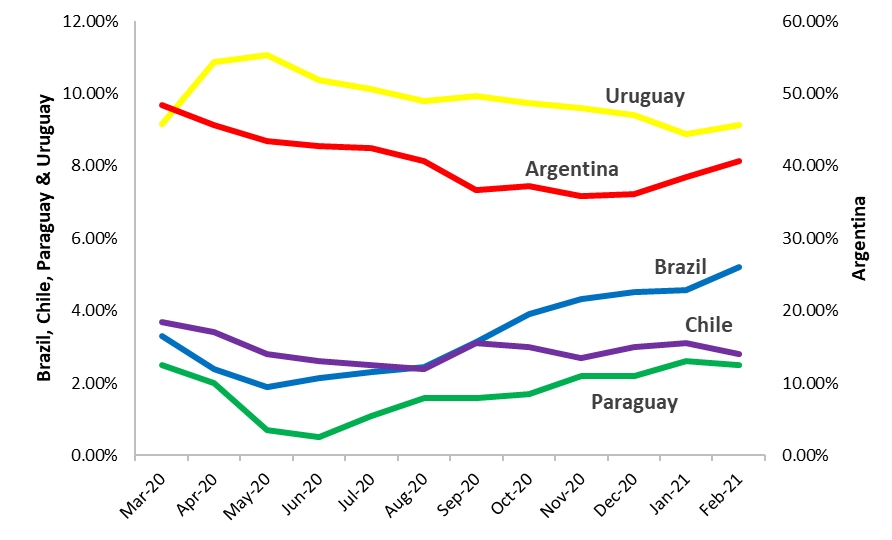
    Brazil & Southern Cone: Inflation
    Monthly year-on-year figures

    Brazil & Southern Cone: GDP growth (%)
    Quarterly figures are year-on-year growth
    Country 2020 forecast * 2021 forecast *  Q1 2020 Q2 2020 Q3 2020 Q4 2020
    Argentina -10.5 4.9 -5.4 -19.1 -10.2 not yet available
    Brazil -5.3 3.2 0.9 -11.4 -3.9 -1.1
    Chile -6.0 5.0 0.4 -14.1 -9.1 not yet available
    Paraguay -1.6 3.5 3.5 -6.5 -1.2 not yet available
    Uruguay -4.5 4.0 -1.4 -10.6 -5.9 not yet available
    *Figures from the United Nations Economic Commission for Latin America & Caribbean Dec 2020
    Quarterly growth based on figures from the local central banks


  • COSTA RICA: Costa Rica places first in foreign direct investment index

    Sarah Sheldon 15 October 2021 Hits: 1099

    In August fDi Intelligence magazine, a service provided by the UK-based Financial Times, ranked Costa Rica top of its Greenfield Performance Index for foreign direct investment (FDI) inflows.

    This means Costa Rica is the top performer in attracting greenfield FDI (when foreign direct investors set up new operations of their own abroad) when adjusted for the size of its economy, receiving a score of 11.4 on the index published on 16 August. (A score of 1.0 indicates that a country’s share of global inward greenfield FDI in 2020 matches its relative share of global GDP while a score greater than this indicates a larger share and a score of less than 1 indicates a smaller share). This means that Costa Rica is attracting 11 times the amount of greenfield FDI that might be expected given the size of its economy, said the magazine. The index “uses a methodology devised by United Nations Conference on Trade and Development (Unctad) for overall FDI, and applies it to only greenfield FDI, excluding mergers and acquisitions, intra-company loans and other forms of cross-border investment,” it continues.

    One of the smallest countries in Latin America, Costa Rica attracted 96 greenfield FDI projects in 2020, according to the magazine. This figure represents a 7.7% decrease compared to 2019, but it’s still the second-best year since data started to be gathered in 2003, according to fDi Intelligence methodology. Even more remarkable is the fact that greenfield FDI projects globally fell by around 33% in 2020, said the magazine. In addition, it is worth noting that Costa Rica is the only country from Latin America and the Caribbean in the global top ten, with Panama the second-highest ranked country in the region with a score of 3.30.

    While Costa Rica was mainly exporting agricultural commodities a few decades ago, in 2020 some 60% of inward FDI projects came from the software and IT, medical devices, and business service sectors, said the magazine. One major project emphasised by fDi Intelligence is a US$600m investment from chipmaker Intel to restart assembly and testing operations following a seven-year break.

    Commenting on the ranking, Jorge Sequeira, managing director at Costa Rica’s investment promotion agency Agencia Costarricense de Promoción de Inversiones (Cinde), cited country’s “proven track record and excellent human talent offering,” as well as the work of his team. “Costa Rica's resilience, in the face of a global health crisis, has proven a determining factor in driving our goods and services exports: goods have a projected growth of 27%, as of July 2021, led by medical devices and significant increases in both the electronics and metalworking industries, which show a 41% and 63% increase, respectively, over 2020,” added Sequeira.

    This resilience stands in sharp contrast to the global drop in FDI of 35% in 2020, according to a report published by the United Nations (UN) Economic Commission for Latin America and the Caribbean (Eclac) in August. In addition, Latin America and the Caribbean received 34.7% less FDI than in 2019, the lowest amount since 2010, said Eclac. The Central American subregion saw inward investment slashed by 89%, or US$10.4bn, according to Eclac figures, which do include mergers and acquisitions. Services and manufacturing remain the two leading sectors, and the US accounts for 50% of investments in Central America. While FDI announcements for the subregion fell 23% in number and 27% in value terms, sectors related to the health industry, particularly medical devices, and renewable energy saw increases in value of 68% and 5% respectively. This may be attributable to the need for equipment to deal with the coronavirus (Covid-19) pandemic and the growing interest in green energy among countries striving to meet climate goals.

    Costa Rica received a total US$2.1bn in FDI inflows in 2020, according to Eclac figures, the largest in the subregion. By Eclac’s measure, which is different to that used by fDi Intelligence, this is a 23% decrease from 2019 and the country’s worst year in the last decade. Manufacturing is Costa Rica’s largest sector with 66% of the total, and the US contributed 68% of investments. A quarter of the 101 announcements are in the pharmaceutical and medical devices sector, and the country has become a major player in the medical devices area, accounting for 100% of announcements in Central America for the period 2017-2020. Another quarter of announcements for Costa Rica were in the information and communications technology sector. “Costa Rica is pursuing an investment attraction strategy that prioritizes three areas: knowledge-intensive services, smart manufacturing in life sciences, and health and wellbeing, which are precisely the areas referenced by the project announcements,” said Eclac.

    Two key mergers were announced in Costa Rica in 2020. The first is the purchase of Isthmus Software, a Costa Rican firm, by US software developer 3 Pillar Global, which stands to gain access to the Costa Rican market, a portfolio of strategic clients, and a 200-member team. The second is Swedish firm Assa Abloy, manufacturer of door-opening solutions, and its acquisition of Olimpia Hardware Inc, which has operated in the glass, aluminium, and PVC sector for more than 20 years.

    The country continues to court further investment, with President Carlos Alvarado meeting with business leaders at an event organised by the Americas Society/Council of the Americas (AS/COA) on 21 September. Alvarado said his country had intensified its efforts to guarantee good investment conditions during the pandemic. “Our resilient human capital, our commitment to a green economy, the favourable investment and business climate we offer, the  Organisation for Economic Co-operation and Development (OECD) membership, the sanitary actions we are taking to increase the number of tourists coming to the country during the pandemic, and the promotion of initiatives to sustain the regional economy affected by Covid-19 are important ways in which Costa Rica is working to offer competitive conditions,” said Alvarado (see sidebar).

    •  Example for Central America

    Costa Rica continues to provide an example for its Central American neighbours in terms of attracting FDI. The reasons for its success are complex, but both President Alvarado and Cinde chief Sequeira made a point of citing the country’s human capital and track record in providing a stable business environment. Other countries in the subregion will have to undertake significant reforms to boost the education systems and strengthen institutions if they are to emulate the Costa Rican example, or investors will continue to fly into San José.

    •  Vaccination programme

    AS/COA President Susan Segal hailed Costa Rica for its strong vaccination programme, which she said is fundamental for the tourism sector. According to Our World in Data, as of 20 September 39% of Costa Rica’s population had been fully vaccinated.

  • RASTREANDO TENDENCIAS

    LatinNews 23 July 2012 Hits: 539

    BRASIL | El congreso en receso. El congreso aprobó la Ley de Directrices del Proyecto de Presupuesto para 2013 (LDO) el martes, permitiendo al congreso entrar en un receso de dos semanas, desde el 18 de julio al 1 de agosto. Las negociaciones cayeron después que la oposición rehusó aceptar una propuesta del gobierno para permitir normas más flexibles de licitación para el gigante petrolero estatal Petrobrás, una propuesta fuertemente criticada por el Tribunal de Contas da União (TCU). La propuesta, aunque antes recibió el visto bueno por el comité conjunto del presupuesto, fue excluida de la versión final aprobada del LDO. El presidente del congreso, Marco Maia del gobernante Partido dos Trabalhadores, también logró convencer a la oposición con la promesa del ejecutivo para liberar algunos fondos adicionales especiales antes de las elecciones municipales programadas para octubre.

    El LDO establece el superávit general primario en 3,1% del PIB, o R$155,9 mil millones (mm) (US$77,2mm), y el tesoro difundió esta semana un informe en el cual promete retener esa meta de superávit hasta el 2015. Sin embargo, la ley da al gobierno la opción de reducir el superávit nominal hasta R$45,2mm, o 0,9% del PIB, principalmente para inversiones a través del esquema nacional de infraestructura conocido como el Programa de Aceleración del Crecimiento (PAC).

    Los otros parámetros macroeconómicos incluyen un crecimiento real anual del PIB de 4,5% en el 2012 y 5,5% en el 2013, ambos pronósticos son más optimistas que el consenso del sector privado, junto con una inflación de 4,5% este año y 4,7% el año próximo. El salario mínimo se fija con un crecimiento de 7,35% a R$667,75 mensual en el 2013, de R$622 este año. Antes del receso, el congreso también votó sancionar las Medidas Provisionales 563 y 564 del ejecutivo, que extienden los incentivos fiscales y de créditos bajo el plan ‘Brasil Maior’ de la Presidenta Dilma Rousseff, que apunta a fortalecer la productividad industrial y la competitividad.

    El congreso aún debe discutir un nuevo marco regulador para dividir entre estados productores de petróleo y estados no productores los nuevos royalties generados del vasto sector offshore ‘pre-salino’ de petróleo. Con las elecciones municipales fijadas para octubre, ni el congreso ni el ejecutivo tiene mucho interés en tratar este tópico complejo y políticamente sensible, que se ha dejado de lado por cerca de dos años. Sin embargo, con el dinero ya atado y sobre-extendido Petrobrás no puede celebrar ninguna ronda de subastas para el sector offshore hasta que un nuevo marco de royalties esté en vigencia. Petrobrás esperaba celebrar las subastas a fines de este año. El gobierno Rousseff admite ahora que el nuevo marco probablemente no se discutirá hasta el 2013.

  • REGION: 25x25 not quite there yet

    Sarah Sheldon 17 November 2025 Hits: 188

    It is now almost five years since the Caribbean Community (Caricom) endorsed the ‘Vision 25 by 2025’ programme (also known as 25x25): a commitment to reduce the region’s large food import bill by 25% by the year 2025. Has it succeeded?

    Caricom Assistant Secretary-General Wendell Samuel, attending the Caribbean Week of Agriculture in St Kitts and Nevis at the end of September, was upbeat. He stressed that food and nutrition security is not “optional”. He called the original target-setting “a bold move” adding “I am pleased to let you know that the programme has borne fruit and is continuing to provide us with green vegetables and fresh meat”. Samuel went on to list examples of regional cooperation in food production and trade including a US$100m Regional Agriculture loan fund, and expanded soya and maize storage facilities, as well as investment in greenhouse technology and cold storage infrastructure.

    Despite this it is still somewhat unclear how much real progress has been made. According to one Caricom report the reduction in the total food import bill since 2018 is of the order of 12%, about half the target but still significant. Caricom has also said that 82% of targets for selected commodities have been met, but the position relative to all food imports is not fully known. While measurements are likely to remain patchy, the target does appear to be driving more self-reliance and efficiency in food production and trade.

    Food security initiative 25x25 extended

    In February 2025, Caricom announced that it was extending the food security initiative 25x25 until 2030.

  • GUATEMALA: Raising rates

    LatinNews 27 October 2011 Hits: 1057

    At the end of September the central bank increased benchmark interest rates by half a percentage point to 5.5%. Rates are still not higher than inflation.

    The central bank justified its decision by arguing that there was no certainty that the drop in food and fuel prices in September would continue into October, given the 4% growth of the world economy it was expecting in 2011 and 2012,

    The monetary policy committee also argued that the domestic economy seemed to be growing strongly, especially foreign trade, tax collection, and bank credit to the private sector. It said that there were clear signs that underlying inflation was rising.

    The monetary policy committee added that inflationary expectations were continuing to rise and this development required the monetary policy committee to act by tightening monetary policy. The committee implied that given the inflationary pressures caused by higher fuel and food prices, there was clearly a limit to the effectiveness of monetary policy actions.

    The central bank made it clear, however, that it would not hesitate to tighten monetary policy again if inflationary expectations remained high.

    Inflation: The consumer price index fell slightly (0.07%) in September, bringing the overall annual index to 5.78%

  • TRACKING TRENDS

    LatinNews 06 December 2012 Hits: 817

    VENEZUELA | Seven new agreements with France. Venezuela’s communications ministry announced last week that Venezuela and France had signed seven new “complementarity and integration” agreements during a high-level bilateral meeting held in Caracas. According to an official statement, the meeting was led by Venezuela’s Science and Technology Minister, Ricardo Menéndez, and France’s minister of social economy, Benoit Hamon, who signed “cooperation, research & innovation and exchange agreements in the industrial, social, mining, science and tourism areas”. Following the meeting, Menéndez and Hamon inaugurated a new car mechanic training centre of French car-marker, Renault, in Los Teques, the Miranda state capital. At the inauguration, Menéndez said that the signing of the agreements opens the possibility that Renault “could soon build a new plant in Venezuela to produce parts and assemble some of its models”. He added that this could also open the way for other French firms that have “expressed their intention to come and establish themselves in Venezuela”.

        According to the local press, the main of objective of Hamon’s visit was to ensure the continued participation of French railroad firms in the plans to modernise the Caracas metro as well as in other cities. The visit came as a result of a formal invitation made by the government of President Hugo Chávez to the new socialist government of President François Hollande. According to the French foreign ministry, Hamon’s visit to Venezuela is the first official visit made by a representative of the Hollande government since May’s elections in France.

        The French foreign trade minister, Nicole Bricq, visited Ecuador on 4 and 5 December to strengthen economic ties between the two countries. Bricq, who was accompanied by a delegation of French businessmen, met Vice-president Lenín Moreno in an effort to increase bilateral trade which totalled just US$282m, according to Ecuador’s central bank, in the first 10 months of the year. Ecuador enjoyed a bilateral trade surplus of US$83m over this period.

        Bricq signed an agreement under which the French government will lend Ecuador 97m euros (US$127m) for the construction of a 20km tramway in the city of Cuenca by 2015. The US$232m tram project is being carried out by a consortium comprising French firms Alstom, CIM-TSO and INEO.

  • TRACKING TRENDS

    LatinNews 19 December 2019 Hits: 1541

    BRAZIL | Congress approves 2020 budget with R$2bn electoral fund. On 17 December, the mixed budget committee (CMO) in Brazil’s federal congress presented its revised version of the 2020 budget, which was approved by federal deputies and senators later that day. The approved text outlines a R$3.397tn (US$905bn) budget for the federal government next year and establishes a primary deficit target of R$124.1bn (US$30.6bn).

    The budget’s rapporteur in the CMO, Domingos Neto, noted that dialogue between the executive and party leaders in congress had allowed for the rapid approval of the budget in the plenary. Although changes were introduced by congress, such as the redistribution of budgets amongst ministries, some key government demands were met. Notably, congress voted to maintain the budget for the so-called electoral fund at R$2bn.

    The electoral fund, public money distributed to political parties since corporate campaign donations are now illegal in Brazil, had proved a contentious point. The R$2bn sum was put forward by the executive in amendments tabled in late November to the original budget proposal but, in early December, 13 political parties had pushed for an increase of the electoral fund’s budget to R$3.8bn. Neto eventually discarded this from his final report, reportedly under pressure from the executive which said that President Jair Bolsonaro would veto such a hike.

    The R$2bn electoral fund is an increase from the R$1.7bn fund parties received in 2018 for the presidential elections and will be used to finance campaigns for the October 2020 municipal elections.   

  • ARGENTINA-URUGUAY : Macri shares his first asado with Vázquez

    LatinNews 14 January 2016 Hits: 939

    Argentina’s President Mauricio Macri has been true to his word and visited his Uruguayan peer Tabaré Vázquez soon after assuming office last month. Macri’s short but “fruitful” visit on 7 January marked a significant turning point in the bilateral relationship, which had grown tense under successive Kirchnerista governments in Argentina. Macri and Vázquez successfully re-launched the bilateral relation by signing a series of new agreements.

    During his electoral campaign last year, Macri said that one of his future government’s foreign policy objectives would be to repair diplomatic relations with Uruguay following the emergence of a number of major bilateral controversies: a long-running dispute over Uruguay’s UPM pulp mill made it all the way to the International Court of Justice (ICJ) in 2010; and increasingly protectionist trade policies adopted by Argentina negatively affected Uruguay while contravening the founding principles of the Southern Common Market (Mercosur).

    After making his regional debut at the Mercosur heads of state summit in late December, Macri promised Vázquez that he would soon visit him in Uruguay to go over the bilateral agenda. Vázquez responded by saying that he would be happy to receive Macri and review the agenda over a traditional asado. Both men stuck to their word. Making his first official foreign visit since taking office, Macri flew to Uruguay’s presidential country retreat in Anchorena, Colonia department, to meet Vázquez (who received him with a barbecued lamb). Afterwards, the two men announced the signing of a number of new bilateral cooperation agreements related to the environment, energy and maritime transport.

    Upon assuming office, Macri did away with many of the import restrictions imposed by the Kirchnerista governments, as part of his efforts to ‘normalise’ Argentina’s economic policies. This included the repeal of a highly controversial decision in 2013 to ban the entry of any goods destined for Argentina previously passing through Uruguayan ports - a measure thought to have resulted in losses of some US$100m a year for Uruguay’s maritime transport industry. This opened the way for a re-engagement with Montevideo.

    Among the more salient deals signed by the two leaders were a bilateral environmental cooperation accord to build a joint new laboratory to monitor pollution levels in shared rivers, which should finally put an end to the UPM dispute; an agreement to develop a bilateral strategic maritime port development strategy, which aims to homogenise practices in ports on both sides of the River Plate to go with the lifting of Argentina’s ban on Uruguayan transhipments; a memorandum of understanding (MOU) to dredge the River Uruguay between the cities of Concepción (Argentina) and Paysandú (Uruguay); and another MOU to build two new international bridges across the River Uruguay.

    • LNG deal

    President Vázquez even revealed that he and President Macri had discussed and “practically concluded” an energy cooperation agreement under which Argentina would buy liquefied natural gas (LNG) produced at the new offshore regasification plant that the Uruguayan government plans to build off the port of Montevideo. The public-private project has been in the pipeline since 2013 but it was officially suspended in September last year amid concerns that it would be commercially unviable without access to markets beyond Uruguay.

  • Venezuela: Maduro government issues new bond

    LatinNews 11 January 2017 Hits: 749

    The details surrounding a new sovereign bond issuance of US$5bn in late December are murky. However, the development will ease concerns of an imminent debt default, ahead of a large scheduled repayment in April.

    Even though last October’s debt swap eased the government’s repayment schedule in 2017, a large repayment of just under US$3bn falls due in April, following repayments of around US$1bn in the first quarter of the year. Securing the funds to meet these payments may be tricky: the stock of international reserves stood at US$10.9bn in early January (down US$5.2bn from a year earlier), but much of this is held in gold, which is difficult to liquidate in large quantities at short notice. Against this backdrop, the government led by President Nicolás Maduro issued US$5bn in sovereign bonds on 29 December, helping to alleviate immediate concerns about a debt default.

    The sovereign issuance was the first since October 2011 and came as somewhat of a surprise to markets, as there had been little indication that the government was considering issuing bonds. Existing debt trades with extremely high yields, which would have made a new issuance prohibitively expensive, even assuming that there was demand for Venezuelan sovereign bonds. The government side-stepped these problems by reserving the issuance for the state-owned Banco de Venezuela, with the instruments not available on the open market. As a result, the government was free to set the coupon rate at a low level (6.5%) and fix a long-term maturity date (2036).

    However, the deal was very opaque. The government did not consult the National Assembly (which is controlled by the political opposition), or publish details in the Official Gazette, as is constitutionally required, with central bank officials also reportedly kept in the dark over the new bond. The deal appears to have been underwritten by a Chinese firm, Haitong Securities, raising questions about whether the deal was actually designed to provide the Venezuelan government with a new Chinese loan, with China requiring a bond issuance to underpin the new finance, given concerns about repayment capacity. This would seem to be a reasonable explanation, as it is relatively unlikely that a state-owned bank would have US$5bn lying around in spare cash.

    Notwithstanding the murkiness of the deal, the short-term impact on Venezuela will be positive. Even if the Chinese required a new bond to underwrite fresh financing (or the rolling over of an existing loan), the fact that China is showing signs of some flexibility will reduce the immediate risk of a default. Repayments falling due in the medium- to long-term will undoubtedly increase, but with the economy in such deep crisis, the government is unlikely to be overly concerned about this time-frame, focusing its efforts on 2017.

  • TRACKING TRENDS

    LatinNews 15 February 2018 Hits: 822

    BRAZIL | Blackouts. Roraima state governor Suely Campos has called on President Michel Temer to improve local electricity provision following a series of blackouts last month. Currently, Roraima is the only Brazilian state that is not connected to the national electricity grid (SIN). Instead, 50% of Roraima’s electricity comes from cash-strapped Venezuela under an agreement signed in 2001. This includes the Guri hydroelectric dam in Puerto Ordaz, located in Venezuela’s eastern state of Bolívar. The electricity is transmitted to Roraima through the Guri power line, which has been poorly maintained due to a lack of funds.

    To reduce reliance on Venezuelan energy, Suely wants to build a new power line called Tucuruí connecting Roraima to Manaus. Brazil’s energy regulator Aneel granted a consortium of companies including Alupar and Eletronorte permission to build the line in 2011. But work has not begun yet due to a dispute over building it on indigenous territories.

    PARAGUAY | Corredor granelero del norte. The Paraguayan government has announced the launch of a new regional logistics development programme dubbed ‘Corredor granelero del norte’.

    A statement from the public works & communications ministry (MOPC) explained that this initiative consists of promoting the use of the overland freight transport corridor linking the new riverine port in the city of Concepción in northern Paraguay with Brazil’s Mato Grosso do Sul state. This will allow grain and soya producers in Mato Grosso do Sul and northern Paraguay to transport their produce to Concepción from where it will be shipped overseas via the River Paraguay rather than relying on Brazilian Atlantic ports.

    The announcement was made after the Paraguayan government reached a deal with local lorry drivers who had been striking against the MOPC’s decision last month to authorise Brazilian long combination vehicles (LCV) to operate in Paraguay, as part of the plans to promote the overland transport corridor.

    The striking lorry drivers were opposed to having to face increased competition from their Brazilian counterparts but decided to drop their protest action after securing assurances from the Paraguayan government that Brazilian lorries will only be allowed to transport 50% of all cargo destined for the port in Concepción and after approving their call to increase local freight rates by 10%-15%. Following that announcement, the MOPC said that Brazilian LCVs will be allowed to circulate freely in the Corredor granelero del norte for the space of one year to see if the project can be successful.

  • ECONOMIC HIGHLIGHTS

    Abbi Dicker 16 October 2026 Hits: 265

    ARGENTINA | Carmaker Toyota boosts investment in Argentina. Economy Minister Luis Caputo announced on 30 September that Japanese car manufacturer Toyota will invest US$1.34bn under the Argentinian government’s large investment incentive scheme (Rigi). Writing on social media, Caputo hailed this as the “largest investment in the history of Argentina’s automotive sector”. He said it will fund a new electric vehicle (EV) production facility in Zárate, Buenos Aires province. National daily Clarín has described the inclusion of Toyota’s project in the Rigi scheme as surprising, given that the initiative has so far been mainly focused on incentivising investment in the energy and mining sectors rather than the automotive industry.

    PARAGUAY | Gov’t highlights new deals following US trip. The minister for trade and industry, Marco Riquelme, announced a deal on 29 September between Paraguay’s state-run oil company Petropar and US-based energy firm, Scorpion Oil & Gas, to explore for oil and gas in Paraguay. He announced the deal amid other efforts to attract investment to Paraguay following his recent visit to the US as part of a delegation to attend the United Nations General Assembly. Riquelme said that he showcased over 30 projects that will open the door to investment. As regards infrastructure and urban revitalisation, he highlighted the announcement of an events arena worth over US$700m in Asunción, which he described as an “opportunity to revitalise the capital, boost entertainment tourism, and create direct and indirect jobs in construction and services”. Riquelme also announced the launch of a new large-scale sustainable forestry platform with a US$200m investment through JP Morgan Natural Capital in partnership with Grupo Robinson, a Paraguayan business group; the arrival of US venture capital fund Plug and Play to Paraguay; as well as an alliance with UK-headquartered global social learning network and platform Apolitical to train over 100,000 public servants in artificial intelligence, aiming to reduce state bureaucracy.

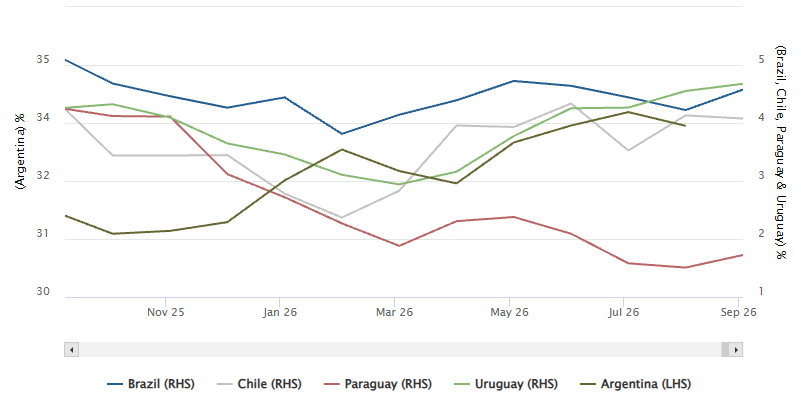
    Brazil & Southern Cone: inflation rate
    Percentage variation (year-on-year)

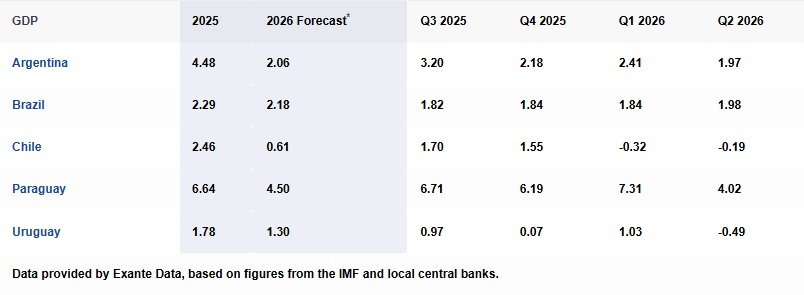
    Brazil & Southern Cone: GDP growth (%)
    Quarterly figures are year-on-year growth

  • DOMINICA: Difficult adjustment needed

    LatinNews 13 February 2013 Hits: 1175

    Dominica is an unusual member of the Eastern Caribbean Currency Union (ECCU) in that tourism is relatively less important to its economy, largely because it lacks sandy beaches, and agriculture remains proportionately more important. As a consequence it was less affected by the global financial crisis than many of its neighbours. Nevertheless, the authorities’ use of strong fiscal measures to boost growth has led to a deterioration of its overall debt position that the IMF is urging it to reverse.

    Following Article IV consultations in 2012, in January the IMF published a new Country Report on Dominica that urges “determined policy action” to reverse the upward trend in debt even though, the IMF admits, “conditions are not ideal for unwinding fiscal policy stimulus”.

    Dominica’s recent economic performance has deteriorated from the 7.9% growth recorded in 2008 through a shallow -1.3% recession in 2009 to anaemic growth of 1.2% in 2010, 1.0% in 2011, and an estimated 0.4% in 2012. Over the past 20 years, Dominica’s average annual GDP growth has been 2.3% compared with 3.5% for Caribbean and other non-Asian emerging markets.

    The IMF does not believe that this year’s budget targets are attainable. For Fiscal Year 2012, the government is budgeting a primary deficit of 0.3% of GDP. The IMF, however, believes the deficit is more likely to come in at 2.3% of GDP.

    Overall, debt is just over 70% of GDP, but if the primary deficit forecast remains in the 1.25%-2% range over the medium term, total debt could be heading towards 80% of GDP by 2020, which would be considerably worse than the ECCU target of 60%.

    The government, however, has expressed its intention of reaching a 2.4% of GDP primary surplus within three years, and this would enable it to meet the ECCU’s 60% target by 2020. In its favour, Dominica does have a reasonable track record in this regard. Following the 2001-2 debt crisis it implemented (under the auspices of the IMF) a major fiscal retrenchment that provided average primary surpluses of 4% of GDP from 2004-09. This enabled debt to be brought down from 100% of GDP in 2002 to 63% in 2010.

    The problem now is with the pace and nature of the adjustment. One of the measures the IMF is advocating is reversing the recent decision to maintain the public pension age at 60 and instead move it to 65. The government, for the moment, is sticking to its guns on this.

    The other area on which the government must concentrate is boosting competitiveness and private investment as the fiscal stimulus is withdrawn. According to the IMF, “reforms should aim at narrowing the infrastructure gap, facilitating the development of property markets, improving the business environment for the private sector, and easing access to finance”. One particular hope is for the development of geothermal electricity. A plant planned for 2013-15 should have the capacity to cover domestic energy consumption, with another to be built later intended to produce energy for export. Domestic energy costs are expected to fall by about 40%, with a commensurate boost to competitiveness.

  • TRACKING TRENDS

    Abbi Dicker 27 March 2025 Hits: 2239

    BRAZIL | Annual budget approved. Congress approved the 2025 budget legislation (PLOA) on 20 March, which set a total budget of R$5.87tn (US$1.02tn) for this year. The government must aim for zero deficit but will be allowed to register a primary deficit of R$31bn (0.25% of GDP).

    The federal budget is normally approved by the end of the previous year, but the 2025 PLOA was delayed due to several factors, including uncertainty over budgetary payments earmarked for legislators known as ‘emendas parlamentares’. In this year’s budget, a total of R$50bn has been allocated for emendas to fund local projects chosen by members of congress.

    To get this budget passed, the governing coalition had to negotiate and compromise on some of its proposed expenditure. For example, the Bolsa Família conditional cash transfer programme, one of the flagship social welfare initiatives of President Luiz Inácio Lula da Silva, has had its budget reduced by R$9bn, totalling R$160bn this year. The government’s Fármacia Popular medication subsidy programme has also had its budget trimmed; it has been allocated R$4.2bn, down R$1.2bn from last year. However, the government’s infrastructure investment initiative, the Programa de Aceleração do Crescimento (PAC), has had its budget increased to R$60bn, R$13.1bn higher than last year.


    BRAZIL | Petrobras registers rise in carbon capture. State-controlled oil company Petrobras reported on 25 March that it had captured and stored 14.2m tonnes (t) of carbon dioxide in its pre-salt reserves in the Santos basin, off Brazil’s south-eastern coast. This marks an increase from the 13m t of carbon dioxide stored in 2023.

    According to the company, 22 of Petrobras’ floating production, storage and offloading (FPSO) units in the Santos basin have the capability to capture and reinject carbon dioxide. The company’s director for sustainability and the energy transition, Maurício Tolmasquim, was cited as saying that Petrobras will begin operations in new offshore processing units this year, which will also have carbon capture capabilities, and the total volume of captured carbon dioxide in 2025 is expected to reach 80m t.

  • REGION: Good Infrastructure Investment Outlook

    LatinNews 24 April 2014 Hits: 3210

    The outlook for infrastructure investment in Latin America this year is, according to various reports, looking good. Optimism is based on the wide range of attractive opportunities, and the pressing need to begin to reduce the region’s longstanding infrastructure investment deficit, a key step in the struggle to improve productivity. However, the fact that something is needed doesn’t always mean it will happen: there are also a range of financial and managerial obstacles to overcome.

    An April 2014 report by the international ratings agency Standard & Poor’s (S&P) highlighted what it described as the “positive’ outlook for the region’s infrastructure sector this year, although it noted that activity remained highly dependent on government incentives and financial support. In Mexico, it singled out the upcoming tender for the US$3.1bn Mexico City–Querétaro passenger rail project, which is due to be made public in May, and forms part of the government’s multi-year US$314bn plan to develop highways, airports, ports and railways. In Brazil, S&P drew attention to the US$720bn worth of infrastructure investment required over various years under the second phase of the government’s growth acceleration programme (Programa de Aceleração do Crescimento 2 [PAC 2]), with an emphasis on power and transport, but it warns of “some slowdown in the second half of the year” after the end of the World Cup and in light of the October general election. S&P also highlights Colombia’s offer of nine highway tenders, valued at around US$5.64bn.

    An earlier report from BNamericas Intelligence, released in March, said that Peru and Colombia would lead infrastructure investment opportunities this year “given the huge deficit in highways, ports, airports, and railways coupled to market-friendly policies” (both countries, along with Chile and Mexico, are members of the outward-looking Pacific Alliance trade group). This report was based on a survey of project and engineering managers, who were asked to identify countries with the best opportunities. Peru led the list (identified by 50.8% as the most attractive), followed by Colombia (47.5%); with Mexico and Brazil in third and fourth places respectively. The report noted that Peru expects to attract investors this year with the US$5.6bn Lima Metro Line 2, a US$556m Cusco airport project and a US$103m Pisco port expansion proposal.

    The Top 10 Latin American Infrastructure Projects
    Rank Project Name Country Sponsor Project Stage Project Sector Project Value Project Score
    1 Aquatacama Pipeline Chile Vinci Feasibility Water & Wastewater US$15bn 70.41
    2 National Fibre Optic Dorsal Network Peru Proinversión Pre-investment studies ICT US$420m 70.41
    3 Inambari Dam and Transmission Line Peru-Brazil CAF Construction to start 2015 Electricity Generation US$2.37bn 66.66
    4 Bogotá Metro Colombia IDU Engineering Studies Underway Urban Mass Transit US$3.6bn 64.64
    5 Metro Line 3 Panama JICA Feasibility Study Urban Mass Transit US$2.8bn 63.31
    6 Malleco Wind Farm Chile Malleco SPA Feasibility Electricity Generation US$500m 61
    7 Metro de Quito – Phase 2 Ecuador Quito Metropolitan Government Bidding Urban Mass Transit US$1.5bn 59.81
    8 Drinking Water Supply Expansion and Improvement - Lima Peru Proinversión RFP – October 2014 Water & Wastewater US$400m 59.08
    9 Corredor Bogotá - Buenaventura Colombia DNP Bidding Highways and Bridges US$1.8bn 58.89
    10 Costanera Central Highway Chile Ministry of Public Works (MOP) Planned Highways and Bridges US$1.98bn 58.89
    Source: CG/LA Strategic Top 100 Latin American Infrastructure 2014 Report

    The Washington-based consultancy CG/LA Infrastructure in mid-April published its 2014 ‘Strategic Top 100 Latin American Projects’ report, which highlights and ranks what it says are the top 100 projects underway in the region in the next three to 18 months. Across 20 countries in the region, it says the total value of these projects is US$138.7bn, and that combined, they have the capacity to create employment for 2.1m people. Each project is scored on a weighted system according to its contribution to competitiveness (40%), with productivity, job creation, business creation, and environmental and carbon efficiency all given equal weights (10% each) and a separate country rating criteria also applied (20%). The results (see table) show projects in Peru, Colombia, Chile, Ecuador, and Panama all appearing in the top 10.

    This report notes that Latin America, along with Africa, spends less than any other region in the world on infrastructure investment, an amount equivalent to only 1.7% of GDP. The transport infrastructure deficit alone has been said to explain why retailers and manufacturers in Latin America have to hold on-site inventories about twice the size of those in the US. The report suggests that “most countries in Latin America need to increase their infrastructure investment by 250% within 5 years, and some countries, Argentina for instance, need to increase investment in the right infrastructure projects by 350%.”

    Glaucia Galp, a director of Fitch Ratings in Brazil, says most countries in the region need to close the infrastructure investment deficit because doing so “improves competitiveness and has a virtuous effect on growth, generating a positive impact on the sustainability of the economy.”

    While many agree on the need for a massive increase in infrastructure investment, there are significant obstacles in the way. Norman Anderson of CG/LA warns that “governments are notorious for developing wish lists of infrastructure projects without giving much thought to ‘why’ or ‘how’”. He adds that “funding is a major obstacle for the region, because it is not clear where the equity is going to come from”, and calls for government action to mitigate risks for institutional investors and equity partners.

    In Peru, Alejandro Olmeño, general manager of Norway’s SN Power, says that getting a hydroelectric project off the ground requires no less than 120 permits from government agencies, ministries, and local authorities. Others say it can take 75 months to take a project from the planning stages through to completion and operation.

  • TRACKING TRENDS

    Abbi Dicker 18 April 2024 Hits: 2634

    PERU | Growth up in annual terms. Peru’s economic output was up 2.85% in February 2024 compared with a year earlier, the national statistics institute (Inei) reported on 15 April. The year-on-year growth in February 2024 was mainly driven by mining and hydrocarbons (+15.94%).

    Other sectors to post growth included electricity, gas, and water (+8.09%), and construction (+6.41%). However, fishing registered a 31.26% contraction, while finance and insurance (-5.12%) and manufacturing (-4.68%) also registered year-on-year declines.

    According to the same Inei figures, accumulated growth over the first two months of 2024 was 2.10%. However, across the 12 months to February, it contracted 0.12%. The latest edition of the World Economic Outlook (WEO) of the International Monetary Fund (IMF) released on 16 April is forecasting that Peru’s economy will expand 2.5% in 2024, up from -0.6% in 2023.