All Categories

Subcategories

  • TRACKING TRENDS

    Patrick de Courcy 30 May 2024 Hits: 1278

    COLOMBIA | Investment agreement approved with Venezuela. Colombia’s lower chamber of congress approved a bill on 22 May to establish a regulatory framework for investments between Colombia and Venezuela, in line with an agreement signed in February 2023.

    Colombia’s minister for trade, industry & tourism, Germán Umaña Mendoza, said that the initiative, which must now be revised by the constitutional court, seeks to establish a legal framework which would facilitate and promote direct cross-border investment. He said that this will boost goods and services, and “stimulate sustainable development, productive diversification, formation of value chains and… job creation”. This is the latest sign of strengthening bilateral ties which have improved significantly since the left-wing President Gustavo Petro took office in August 2022.

  • TOURISM: Uruguay rolls out the welcome mat

    LatinNews 31 December 2012 Hits: 1625

    The tourism and sports minister, Lilian Kechichián, in December announced a new tourism promotion programme under which Uruguay will offer foreign visitors a 10.5% value added tax (VAT) rebate on debit and credit card purchases.

    The measures were first announced back in September, for implementation between 15 November 2012 and 30 March 2013, the peak summer season in the Southern Cone. However, the government was unable to find a business partner to help it set up and operate a series of rebate points at the country’s main ports and airports. Kechichián revealed that the authorities finally struck a deal with a Swedish shopping tourism company, Global Blue, which will operate the rebate system in exchange for an undisclosed percentage on each sale.

    Kechichián said that the rebate offer was another way to “pamper” tourists, so that they continue to  choose Uruguay. Last year 3.0m tourists visited Uruguay (pop. 3.3m), 58% of whom came from neighbouring Argentina.

    The head of Uruguay’s tax agency (DGI), Pablo Ferri, said the VAT rebate would cost the DGI US$10m in lost revenues. He added that “tourists will surely spend more, benefiting more sectors of the Uruguayan economy”.

  • PANAMA: Venezuela-Panamanian relations on ice

    LatinNews 13 March 2014 Hits: 3110

    This month the Venezuelan government led by President Nicolás Maduro severed relations with its Panamanian counterpart led by President Ricardo Martinelli. The decision was triggered by Panama’s recent efforts at the US-dominated Organization of American States (OAS) to hold a session at its Washington headquarters to discuss the internal political situation in Venezuela following deadly unrest which began last month. These efforts laid Martinelli open to accusations from Venezuela of interfering in Venezuela’s internal matters and being a lackey of the US. The rupture, which comes a decade after relations were last severed (under Maduro’s predecessor, the late Hugo Chávez, and former Panamanian president, Mireya Moscoso [Partido Panameñista, 1999-2004]), takes place as bilateral ties have come under increasing strain over the inability of Venezuelan companies to pay debts of some US$1.2bn to suppliers in Panama’s Colón Free Trade Zone (FTZ).

    Attributed by President Martinelli to Venezuela’s official foreign currency controls (which restrict the supply of US dollars available to Venezuelan companies for trading purposes), the debts had led Martinelli – who notably was one of the first regional leaders to recognise Maduro’s slim presidential victory in April last year - to pay a visit to Caracas the following July to seek a solution. The subsequent announcement of a technical bi-national commission to ensure the payment of the debts failed to produce any results.

    While Venezuela is not a leading destination for Panama’s exports, along with Colombia, it is a key market for re-exports through the FTZ. The latest report by Panama’s comptroller general’s office, released in June 2013 shows that while Panama’s GDP grew 7% in the first three months of 2013, compared with the same period in 2012, trade declined 2.2% due to “a 14.1% drop in Free Trade Zone activity as a result of the decline in re-exports to Panama’s main South American clients, Colombia and Venezuela”.

    The rupture in relations a decade earlier, in August 2004, had followed similar accusations by the Venezuelan government that Moscoso was acting on behalf of the White House; on that occasion the spat was triggered by a pardon issued by Moscoso for four Cubans nationals including Luis Posada Carriles, accused by Cuba and Venezuela of terrorism for the bombing of a Cubana airliner in 1976. Relations were normalised the following month after the Partido Revolucionario Democrático (PRD) government led by former president, Martín Torrijos (2004-2009), took office.

    • New foreign minister - The spat with Venezuela is the first major challenge for Francisco Álvarez De Soto, who recently took over as President Ricardo Martinelli’s fourth foreign minister. A lawyer, political economist and former deputy foreign minister (2009-2013), De Soto replaced Fernando Núñez Fábrega, who stepped down on 31 January. While Núñez Fábrega cited “personal reasons”, his departure followed various diplomatic gaffes- most recently his recommendation that Martinelli not attend the summit of the Community of Latin American & Caribbean States (Celac) held in Cuba on 28-29 January to show Panama’s displeasure with Havana’s refusal to reply to information requests regarding a shipment of Cuban weapons seized on a North Korean ship detained in the Panama Canal in July 2013. Panama and El Salvador were the only members of the 33-member bloc not represented by their heads of state at the Celac summit.
  • TRACKING TRENDS

    LatinNews 05 June 2014 Hits: 1053

    GUATEMALA | Central America’s largest solar park now open. On 28 May Guatemalan officials inaugurated a new US$14m solar energy farm with an installed capacity of 50 kilowatts (KW). The so-called ‘Sibo park’ is the largest installation of its kind in Central America, surpassing Costa Rica’s 10KW Miravalles solar park.

    Sibo is located near Estanzuela, in the eastern department of Zacapa. It is a joint venture between a local firm, Grupo Green, Spain’s Gran Solar and Swiss investment fund, Grupo Ecos. Sebastián García-Prendes, an engineer for Grupo Green, explained that the local topography and temperature levels (which regularly peak at over 30º C) were instrumental in deciding the plant’s location.

    Inaugurating the new plant, President Otto Pérez Molina said that the “historic” project will help Guatemala “move towards renewable energy” and that “with projects like this we are sure that the country’s economy will keep on growing in order to help many families that today live in poverty”. Pérez Molina also remarked on the swiftness with which the plant was constructed, in a “record” four months (January-April 2014).

    The plant is contracted to provide energy for the next 16 years to an energy distribution line managed by local firm, Energuate. It is calculated that the Sibo plant will supply energy to approximately 24,000 households. Back in April Dimas Carranza, a member of Energuate’s board, said that he believed that the energy produced by Sibo would provide a viable alternative to that produced using bunker fuel, due to the lower average price per unit.

  • PARAGUAY: ‘Blanket lists’ removed at long last

    LatinNews 30 May 2019 Hits: 1194

    After years of failed attempts to promote an electoral reform that eliminates the use of closed or ‘blanket lists’ (closed candidates lists) in legislative elections, the Paraguayan government led by President Mario Abdo Benítez has sanctioned a new law that does it. The introduction of the new law has been hailed as a positive step that should help to strengthen Paraguay’s democracy and make politicians and political parties more accountable to the electorate.

    The elimination of blanket lists has long been a demand of the political opposition and pro-democracy groups, which have consistently argued that the system allows for corrupt and unpopular politicians to win election (and re-election) by riding on the coattails of political parties. But the attempts to do away with this practice was resisted by the traditional Asociación Nacional Republicana-Partido Colorado (ANR-PC) party that has dominated Paraguayan politics for decades. The ANR-PC and other advocates of the use of blanket lists have historically maintained that they help to simplify and expedite the electoral process by giving voters a simple and clear choice at the ballot instead of overwhelming them with long lists of candidates.

    However, the attitude towards blank lists within the ANR-PC has slowly evolved over the years as result of the numerous cases of corrupt national legislators succeeding in securing re-election year after year by ‘hiding’ under their parties’ blanket lists. The public anger that this situation produced reached a peak under the previous ANR-PC government led by Horacio Cartes (2013-2018) when outraged members of the public first started staging public ‘escraches’ (individually targeted protests) against legislators accused of corruption who avoid prosecution due to their congressional immunity. This prompted President Abdo Benítez to adopt a clear anti-corruption stance during last year’s electoral campaign, which allowed him to retain the presidency for the ANR-PC.

    Against this backdrop and with more legislators accused of corruption being targeted by public protests, the prospects of passing new legislation eliminating blank lists became increasingly good. Advocates of scrapping blanket list took full advantage of this and presented a cross-party bill to this effect to congress in April. After various debates in both chambers of congress, a version of the bill was given final approval by the chamber of deputies 22 May after receiving support from the majority ANR-PC bench. The bill was then promulgated into law the following day by President Abdo Benítez. The new law bans the use of closed legislative candidates list and introduces an open list system in which voters can select their preferential candidate rather than being limited to voting for a particular party. The number of votes that each candidate receives within a party list will then determine their position on that list.

    The new law also introduces mandatory electronic voting in replacement of paper ballots. This was resisted by some in congress amid concerns that it could be confusing for some voters and that it could be easily manipulated by information-technology experts intent on influencing the electoral results. However, these concerns were dismissed by supporters of the law, who pointed to the fact that Brazil introduced electronic voting in 1996 and has not experienced any major issues to date. Following Abdo Benítez’s promulgation of the law it is now due to come into full effect for the 2020 municipal elections, provided the electronic voting machines and the necessary software can be acquired and rolled out across country by then.

    • OAS assistance

    Following the approval of the law that introduces open lists and electronic voting, Jaime Bestard, the president of Paraguay’s supreme electoral court (TSJE), announced that the Organization of American States (OAS) has offered its assistance to implement electronic voting in the country. In a statement, Bestard said that the offer had been made to him during a meeting he held in Washington DC with the head of the OAS’s Department for Electoral Cooperation and Observation Gerardo de Icaza. According to Bestard, his meeting with De Icaza was “extremely positive” and he said that he was confident that Paraguay could implement electronic voting by 2020 as planned.

  • ECONOMIC HIGHLIGHTS

    Patrick de Courcy 20 February 2026 Hits: 706

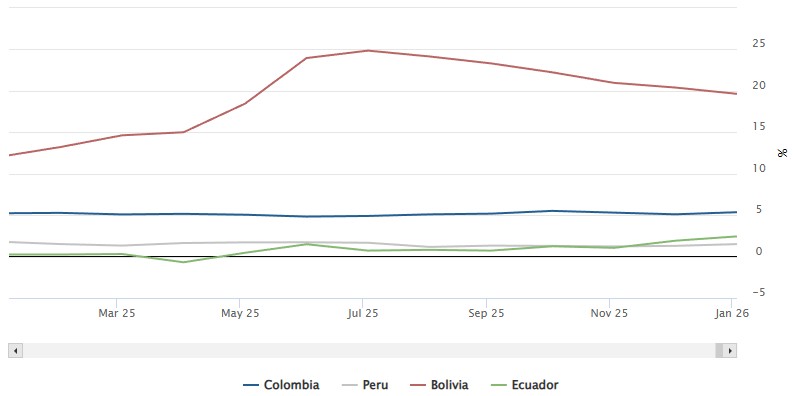
    COLOMBIA | Interest rate hiked. Colombia’s central bank (Banrep) raised its benchmark interest rate by 100 basis points to 10.25% on 30 January. This was the first increase to the rate since April 2023, and it comes after it had been held at 9.25% since April 2025. Banrep noted in a statement that annual inflation in 2025 was 5.1% – down from 5.2% in 2024, but above the target rate of 3%. The bank said that analysts’ median inflation forecast for 2026 had risen from 4.6% to 6.4%. Meanwhile, economic activity was strong in the final quarter of 2025, due to strong internal demand resulting from private and public spending, bringing total estimated growth last year to 2.9%, according to Banrep. The statement also noted “elevated” uncertainty about the external economic situation, highlighting “risks associated with an escalation of trade conflicts, US migration measures, geopolitical conflicts, and the perception of Colombia’s sovereign risk”.

    ECUADOR | Progress on UAE trade deal. On 4 February, Ecuador and the United Arab Emirates (UAE) concluded technical negotiations for a comprehensive economic partnership agreement (Cepa). The talks, which began in August 2025, covered 19 areas, including market access, rules of origin, services, intellectual property, and cooperation. According to a statement from Ecuador’s ministry of production, foreign trade and investment, the agreement would see 98% of Ecuadorean goods that were covered in the negotiations given preferential access to the Emirati market, with tariffs to be immediately eliminated for 75% of those products, including key exports such as shrimp, fresh roses, banana, frozen vegetables, and processed tuna. The statement noted that Ecuador’s exports to the UAE totalled US$1.37bn from 2020-2024, and it said that exports could rise to up to US$1bn a year by 2030 once the agreement comes into force.

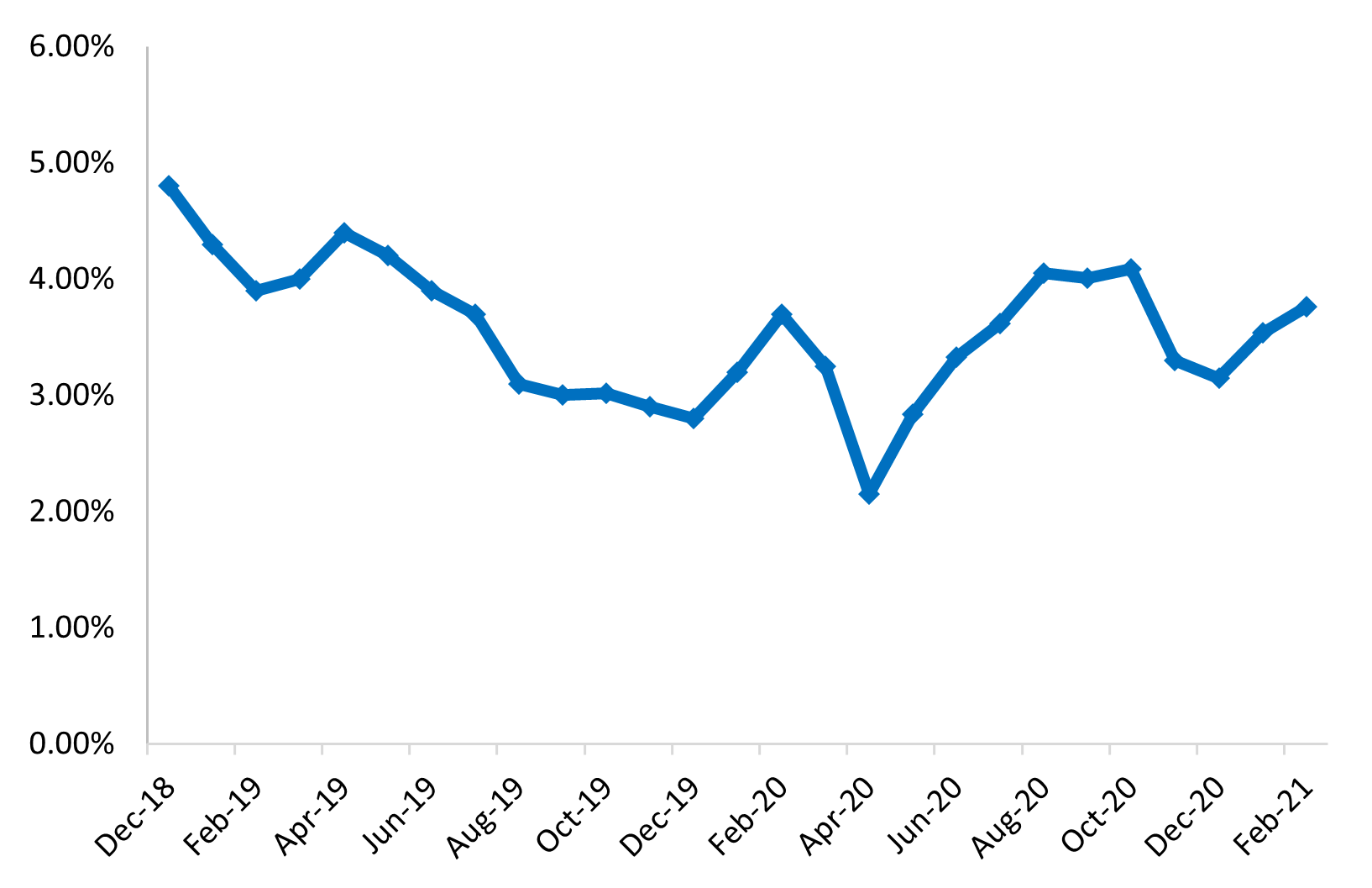
    Andean countries: inflation rate
    Percentage variation (year-on-year)

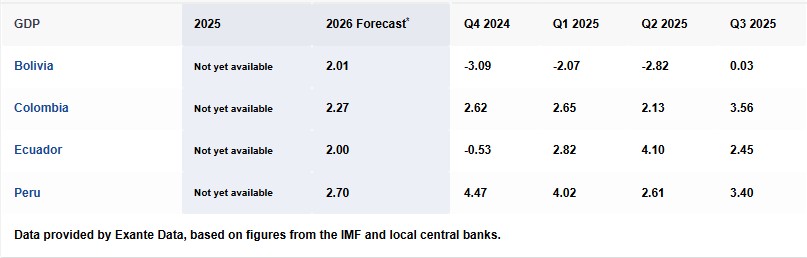
    Andean countries: GDP growth (%)
    Quarterly figures are year-on-year growth

  • RASTREANDO TENDENCIAS

    LatinNews 13 August 2012 Hits: 519

    BRASIL | Sector del biodiesel pronostica masiva inversión. La unión brasilera de biodiesel y bioquerosén (Ubrabio) y la asociación de productores de biodiesel brasilero (Aprobio) han dicho que ellos esperan que la industria del biodiesel en el país recibirá R$28mm (US$14mm) en inversiones para el 2020. En una conferencia de la industria en São Paulo, Ubrabio y Aprobio, las principales organizaciones de la industria del biodiesel, dijeron que ellos prevén un “vigoroso” crecimiento futuro en el sector que requerirá inversiones multimillonarias a fin de cubrir las necesidades del sector.

    Las organizaciones explicaron que actualmente el gobierno brasilero está en el proceso de definir el marco regulador para esta clase de biocombustibles con el objetivo de establecer un nuevo requerimiento de porcentaje obligatorio de biodiesel que debe mezclarse con el combustible diesel normal vendido en el país. Actualmente, el requerimiento porcentual es de 5%, como lo establece el plan nacional de producción y uso del biodiesel del 2004. El plan estipula que el requerimiento debe elevarse a 10% para el 2014 y a 20% para el 2020. Sin embargo, Ubrabio y Aprobio dicen que como Brasil ha logrado posicionarse como uno de los principales productores de biodiesel del mundo, produciendo 2,7mm de litros en el 2011, con un valor estimado de R$6,5mm (US$3,2mm), el gobierno ahora está analizando la posibilidad de elevar el requerimiento de porcentaje el año próximo a fin de agilizar el proceso de incremento.

    A fin de cumplir con las necesidades de biodiesel de Brasil, el sector necesita elevar su capacidad de producción en los años que vienen. Se estima que actualmente las 60 plantas productoras de biodiesel en Brasil representan solamente el 40% de la proyectada capacidad de producción de biodiesel de Brasil.

    ARGENTINA | Las cifras de turismo rumbo a establecer un nuevo record. De acuerdo con el instituto nacional de estadísticas (Indec) de Argentina, 189.375 turistas visitaron el país en junio, 17% más que en el mismo periodo del año pasado. En el 2011, un record de 2,7m de turistas visitaron Argentina, 1,7% más que en el 2010. Las últimas cifras sugieren que el país puede estar en curso de romper su record este año. El Indec señala algo importante: los visitantes gastaron US$235,3m en Argentina, en junio, 3% más que en el mismo mes del año pasado. En una declaración relacionada, el ministerio de turismo dijo que la llegada de visitantes extranjeros por aire en la primera mitad del año “ha igualado las exitosas cifras del mismo periodo en el 2011, cuando se registró un record de 1,3m de llegadas”, agregando que “un agudo incremento en las llegadas fue observado en junio”.

    CHILE | Déficit de mano de obra calificada en el sector minero. Los ejecutivos del sector minero en Chile se están volviendo crecientemente preocupados acerca de la falta de trabajadores calificados disponibles en el país para satisfacer las necesidades del sector en el corto plazo. De acuerdo con un reciente estudio conducido por la Universidad Andrés Bello, la industria minera pronostica que en el corto plazo habrá un déficit de 69.000 profesionales pues la demanda por profesionales en minería, geología, metalurgia e ingeniería excede por lejos la actual provisión en el mercado chileno. Según el estudio, la demanda de personal en algunas áreas específicas como geología es tan alta que la industria de manera creciente recurre a buscar personal calificado en el exterior. Sin embargo, los ejecutivos del sector alegan que depender de mano de obra extranjera calificada no será sostenible en el largo plazo, y que la industria debe invertir en el desarrollo de recursos humanos locales a fin de asegurar que exista una confiable fuente de mano de obra calificada. Como resultado, muchas compañías mineras están analizando no solamente en gastar más en programas de entrenamiento sino también en establecer alianzas con universidades locales a fin de mejorar la formación de profesionales y atraer talentos. Aún así, la necesidad inmediata de profesionales permanece alta ya que la industria espera continuar expandiéndose creando 23.000 empleos por año en los próximos 10 años, pues ya están en espera importantes proyectos mineros.

    PARAGUAY | Sube la recolección fiscal. De acuerdo con cifras extraídas de los datos del ministerio de finanzas del Paraguay, la recolección fiscal en general, en julio, fue de Gs. 1,46 trillones, 13,9% más que en el mismo mes del año pasado. El incremento en la recolección de parte del gobierno es sorprendente dado que la economía paraguaya está teniendo un mal año y aún está sufriendo los efectos de la severa sequía del año pasado, como también los decrecientes niveles del comercio con sus socios, debido a las barreras comerciales con sus grandes socios del Mercado Común del Sur (Mercosur), Brasil y Argentina. Aún así el ministerio de finanzas informó que hubo un incremento en la toma a todos los niveles conducido por un incremento del 19,6% en la dirección nacional de aduanas, DNA, que está a cargo de la recolección fiscal en los puertos de entrada del país. Por su lado, las recolecciones registradas por el directorio general de recolección fiscal fueron de Gs. 234m, un incremento del 18,5% sobre el mismo mes del año pasado. Incluso las recolecciones por la autoridad fiscal del estado, SET, también exhibieron un substancial incremento del 10,3% en julio de este año, comparado con el año anterior.

    • Estímulos brasileños

    El 4 de agosto, el banco de desarrollo de propiedad del estado (Bndes) anunció que estaba expandiendo su programa especial de crédito que apunta a estimular la economía popular, de R$450m (US$225m) a R$1mm (US$500m), un incremento del 122,2%. Una declaración del Bndes explica que “el programa de micro-crédito busca promover la economía popular ofreciendo fondos para actividades productivas a pequeña escala, promoviendo la creación de empleos y la inclusión social para complementar las políticas sociales y de desarrollo”. Los fondos del programa están destinados a organizaciones de interés público, pequeñas sociedades de crédito, empresas pequeñas y medianas, agencias de desarrollo y cooperativas de crédito. Hasta la fecha el programa ha desembolsado fondos a 73 organizaciones, de acuerdo con datos del Bndes.

  • ARGENTINA: Corruption allegations levelled at opposition

    LatinNews 10 September 2015 Hits: 2326

    Long beset by opposition accusations of corruption, the administration of President Cristina Fernández appears to be enjoying the chance to turn the tables and question the probity of the centre-right opposition Propuesta Republicana (PRO). The scandal is an unwelcome distraction for the PRO’s presidential candidate, Mauricio Macri, as he attempts to ensure he gathers enough votes to force the presidential election to a second round.

    According to a report in the newspaper Tiempo Argentina, La Usina, a production company owned by Fernando Niembro, a sports commentator and PRO candidate for the federal congress, received over Arg$21m (US$2.25m) in contracts for “audit services” from the PRO-led administration of the city of Buenos Aires. Kirchneristas claim that the company, which has no registered employees, was created purely to offer services to the Macri-led city government.

    In a political rally on 9 September, President Fernández said that Niembro had received “the golden choripán”, in reference to the typical Argentine hotdog handed out at campaign events. Carlos Zannini, the government’s technical and legal secretary now running for the vice-presidency, had made the exact same joke days earlier.

    In response to the jibes, Niembro said he had no intention of standing down from his candidacy, claiming that he was a victim of “political persecution”. To take some of the heat off, however, he pointed out that his business partner, Alberto Meza, had withdrawn his candidacy.

    But worryingly for the PRO, the criticism of the suspicious deal has not been limited to the government and its supporters. Margarita Stolbizer, the presidential candidate for the opposition Progresistas, said: “I ask myself how many other contracts like Niembro’s the city government has. I don’t think the business is of only 20 million pesos. I believe many other ‘Niembros’ have been awarded contracts.” Even some of Macri’s allies have now taken their distance from Niembro.

    • Joining the BRICS

    While now may not seem the most auspicious moment to join the club, on 9 September President Cristina Fernández called for the help of former Brazilian president Lula da Silva (2003-2011) in joining the BRICS. With Lula in Argentina to offer his support to the government-backed presidential candidate Daniel Scioli, Fernández publicly asked for his support to turn the BRICS into BRICSA: “That is our place and more emerging countries would then join the BRICSA,” she said.

  • TRACKING TRENDS

    LatinNews 10 March 2016 Hits: 3123

    BRAZIL | More Olympic Cuts. Rio de Janeiro’s Olympic Committee is to cut a further R$900m (US$228m) from its budget. Most of the cuts will come from changes to sporting venues, such as the spectator stands for the rowing. But the city is also scaling back its plans for the metro. A new extension due to connect the city’s southern zone with the western suburb of Barra da Tijuca, site of the main Olympic park, will only have two functioning stops, rather than the six originally planned. Pão de queijo, the traditional Brazilian cheese bread snacks, will also be served to visiting dignitaries rather than canapés.

    PARAGUAY | Growth forecast. The president of Paraguay’s central bank (BCP), Carlos Fernández Valdovinos, predicted on 3 March that the domestic economy would post real GDP growth of 3%-3.5% this year. This forecast is unchanged from that made last year by the BCP despite the fact that its own latest trade figures show a significant fall in exports in February. The BCP trade figures show that the value of the country’s exports fell by 13.9% to US$1.72bn in February on the back of a marked decrease in the level of agricultural exports, in particular soya, Paraguay’s main export commodity. There was a 17.1% fall in soya seed exports and a 27.3% fall in soya flour exports; exports of beef, Paraguay’s second main export, fell by 9.9%. Fernández said in a press conference that despite the increased global economic weakness marked by falling commodity prices and still weak economic activity in China and the US, Paraguay’s economy had shown itself to be resilient and capable of posting positive growth. This was supported by the International Monetary Fund (IMF) at the end of an annual country visit that concluded on 28 February. Hamid Faruqee, the head of the IMF mission, said that “In a context of a protracted regional [economic] slowdown, the Paraguayan economy remains relatively resilient, and we project growth of around 3% this year and the next, thanks to solid macroeconomic fundamentals, lower oil prices and vigorous activity in the construction sector”. The IMF’s latest forecast is lower than the 3.8% growth rate for 2016 it had predicted in October 2015. But Faruqee explained that this was because downside risks such as “the fall in agricultural commodities and the economic weaknesses of [Paraguay’s] trade partners, including the deep recession in Brazil”, had increased. Faruqee also said that the current “temporarily high” level of inflation observed in Paraguay, of around 3% in January, was due to volatility in food prices resulting from the fall in oil prices and the depreciation of the Guaraní against the US dollar. However, Faruqee said that the IMF expected that this would stay within the 4.5% target set by the BCP.

    • Argentina re-opens market to Uruguayan beef cattle

    On 3 March Argentina’s national food safety and quality service (Senasa) announced that it had agreed on a new set of bilateral protocols governing the import/export of live beef cattle from Uruguay. The authorities of Argentina, the world’s 11th largest beef exporter and Uruguay, the 8th largest beef exporter, began discussing the adoption of a common protocol in February after Argentina lifted the ban on beef cattle imports that had been imposed in recent years as part of an attempt to ensure higher prices for local beef producers. But with high beef prices in Argentina now contributing to overall inflation, the government has changed tack and decided to seek to import cattle from Uruguay for the first time since 1998.

  • ECONOMIC HIGHLIGHTS

    LatinNews 16 March 2021 Hits: 1689

    FDI slumps: On 18 February, Mexico’s economy ministry (SE) released preliminary figures on foreign direct investment (FDI) to the country in 2020, which show that FDI totalled US$29bn last year, an 11.7% drop on the amount received in 2019. The SE attributes this slump to the negative impact of the coronavirus (Covid-19) pandemic on investment flows globally and cites the World Investment Report published in January by the United Nations Conference on Trade and Development (UNCTAD), which estimates that global FDI flows were down 42% in 2020, compared with 2019. According to the SE, the manufacturing sector accounted for 40.6% of total FDI to Mexico in 2020, followed by the financial services & insurance sector, on 23.2%; transport, 9.8%; trade, 7.7%; mining, 4.6%; and mass media, 4.3%, with other sectors accounting for the remainder. As regards the main source countries, the US was the source of 39.1% of total FDI received, followed by Canada (14.5%), Spain (13.7%), Japan (4.2%), and Germany (3.5%).

    Tourism stays well below pre-pandemic levels: On 10 March, Mexico’s national statistics institute (Inegi) released its latest statistics on tourism, which show that Mexico received 49.3% fewer international tourists in January this year than in January 2020. Numbers of international arrivals for the month fell from 3.8m to 1.9m due to the coronavirus (Covid-19) pandemic. Arrivals via air saw the biggest hit, decreasing by 62.7% compared with the previous year. Mexico also saw its foreign exchange earnings through tourism plunge, with total spending from international tourists falling 59.1% from US$2.28bn in January 2020 to US$842m this January. Despite these negative year-on-year figures, they are an improvement on the early months of the pandemic last year, when international arrivals fell by around 75% in May and were still over 60% below 2019 figures in July and August. This suggests signs of a slow recovery, although it could be compromised by renewed travel restrictions in other countries and worries over new Covid-19 variants.

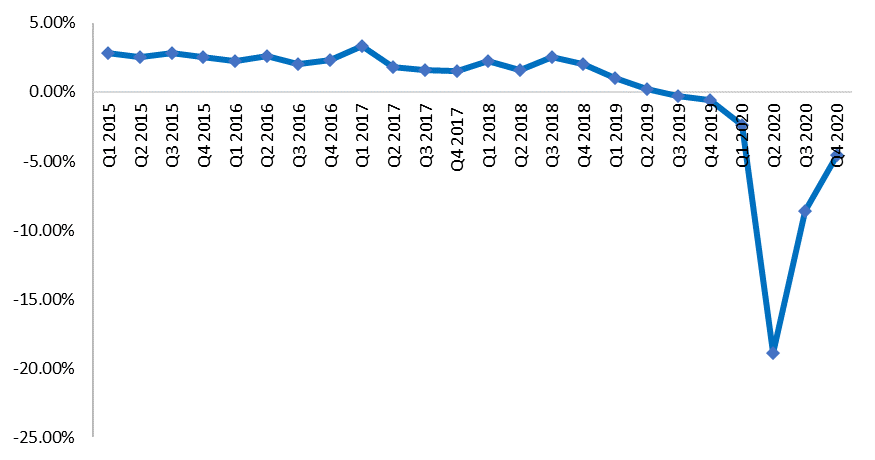
    Mexico: GDP Growth
    Percentage variation (year-on-year)

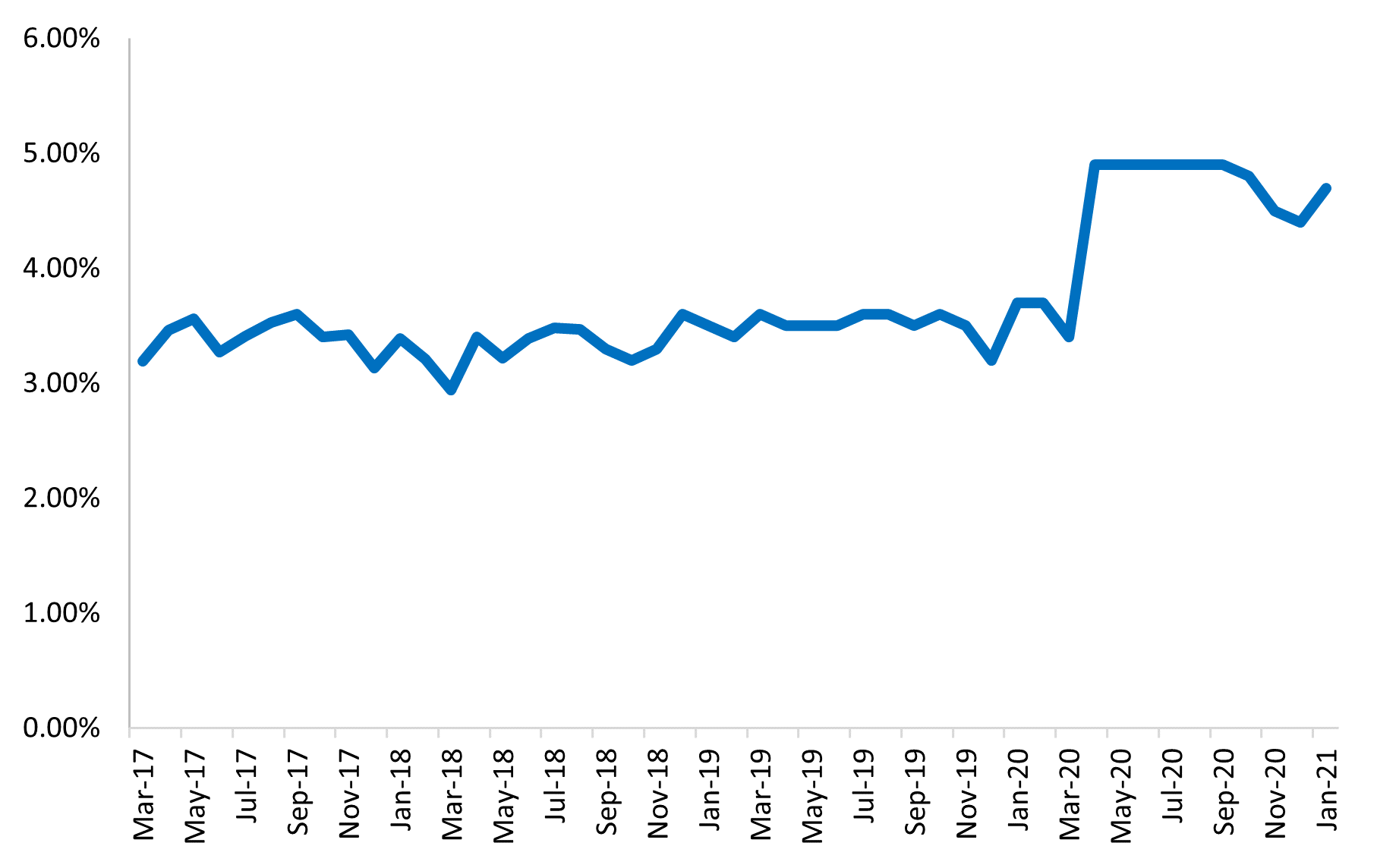
    Mexico: Unemployment Rate
    Econimically active population

    Mexico: Inflation Rate
    Percentage variation (year-on-year)

  • REGION: Costa Rica maintains position as largest receiver of FDI

    Sarah Sheldon 23 January 2023 Hits: 1499

    Foreign direct investment (FDI) rebounded throughout Central America in 2021 after a sharp decline in 2020, with Costa Rica the top performer according to the latest annual report from the United Nations’ Economic Commission for Latin America & the Caribbean (Eclac).

    The sub-region received a total of US$10.8bn in FDI in 2021, more than five times more than the previous year, which saw US$2.1bn in inflows, according to the latest Eclac report on FDI, published 29 November. The regional trend reflects that of Latin America and the Caribbean as a whole, which saw FDI increase 40.7% year-on-year to US$142.8bn, as well as a global increase of 64% year-on-year. 

    Costa Rica topped the list of Central American countries, vis-à-vis FDI inflows, attracting US$3.6bn in FDI in 2021, up from US$2.1bn in 2020. This represents a third of total inflows for Central America and is more than the country’s average yearly FDI received over the last decade. Since 2013 Costa Rica has seen increasing investment in its manufacturing sector, and the pattern held in 2021. Three-quarters of the country’s total FDI was destined for manufacturing, with services representing a quarter of the total. The US is the largest source of investment accounting for 79% of the total, followed by Colombia (6%) and Spain (2%). The country has seen announcements for new investments in technology-intensive industries such as medical devices and IT, which are priority areas for the Agencia Costarricense de Promoción de Inversiones (CINDE), the body responsible for attracting investment. Other priority areas include knowledge services, smart manufacturing, and health and wellbeing. One of the largest recent investments saw German firm Bayer invest US$200m in a new pharmaceutical plant, which is scheduled to start production in 2024.

    Guatemala vastly outperformed its 10-year average of US$1.16bn in FDI, receiving US$3.5bn in 2021. This was down to Luxembourg-headquartered  telecoms firm Milicom acquiring local operator Tigo Guatemala for US$2.2bn in cash, making Luxembourg the largest source of FDI for the year with 65% of the total. The next highest sources of FDI were Colombia (7%), Mexico (6%), Panama (5%), and the US (4%). However without the Tigo sale the country would have only marginally beaten its 10-year average in 2021.

    • Guatemala investments

    Other key investments in Guatemala according to the Eclac report include US electronics firm Intcomex opening a new distribution centre; a new production plant for Costa Rican food firm Cooperativa de Productores de Leche Dos Pinos; and a new plant for paper company GrandBay Paper and Care Products.

    The third best performer in the region is Panama, which saw US$1.35bn in FDI in 2021, 163% more than the previous year. One important project is Italian firm Enel Green Power committing to build the Madre Vieja solar plant, a 30.88MW facility that will cost US$43m. As for the rest of the region, Nicaragua received US$1.22bn in FDI in 2021, higher than its 10-year average, with Mexican firm Rotoplas announcing a US$56m investment in a production plant. Honduras has not yet recovered to levels of FDI registered prior to the coronavirus (Covid-19) pandemic, receiving just US$876m in 2021, which is equivalent to 76% of its 10-year average. New investments have been falling since 2017, and US investment plunged 70% from 2020-2021, now representing only 11% of the country’s total. Similarly, El Salvador has failed to recover to pre-pandemic levels of investment and received US$313m in 2021.

    Eclac executive secretary José Manuel Salazar-Xirinachs underlined the importance of FDI in a statement accompanying the new report. “In a region with generally low levels of investment, foreign direct investment is fundamental in designing a development model,” he said, referring to LAC as a whole. “The rolling crisis that the region is going through means we have to develop strategies to position LAC countries in the global investment environment,” added Salazar-Xirinachs. 

    Countries throughout the region would do well to try and emulate Costa Rica’s successful approach to attracting foreign investment, but it’s not an easy trick to pull off. Guatemala’s President Alejandro Giammattei has lauded the country’s performance in attracting investment, but without the huge Milicom acquisition of Tigo Guatemala, last year’s figure would have been barely higher than the 10-year average. And attracting investment can sometimes be at odds with domestic political priorities, as Honduras’ President Xiomara Castro found when investors reacted badly to her much needed energy reform plans [EB-22-10]. But as Salazar-Xirinachs recognised, tough economic conditions throughout the region mean that attracting FDI is more important than ever for Central America and LAC as a whole.

  • TRACKING TRENDS

    Abbi Dicker 12 September 2024 Hits: 1682

    BRAZIL | Government primary deficit down year-on-year. The national treasury reported on 6 September that the federal government registered a primary deficit of R$9.28bn (US$1.64bn) in July. This marks a 75.3% decrease compared with the R$35.92bn deficit in the same month last year.

    Total revenue in July this year came to R$221.48bn, while net revenue came to R$183.54bn, up 9.5% in real terms compared with July last year. Total expenditure came to R$192.83bn, down 6% year-on-year. The accumulated primary deficit in the first seven months of 2024 totalled R$77.86bn, down 5.2% compared with the same period in 2023.

    The yearly rise in revenue in July this year was mainly driven by higher revenue from taxes such as IPI tax on industrial goods (+91.6%), import tax (+45.9%), and the CSLL social contribution on net income (+20.3%).


    BRAZIL | Vehicle production rose in August. The national association of vehicle manufacturers (Anfavea) released its latest production figures on 5 September, showing that 259,613 vehicles were produced in Brazil in August. This marks a 5.2% increase compared with July and a 14.4% increase from August last year. The latest result is also the highest monthly production figure since October 2019. Domestic sales in August totalled 237,400 units, up 14.3% from the same month last year but down 1.6% compared with July.


    BRAZIL | Yearly increase in coffee exports. The national council of coffee exporters (Cecafé) reported on 10 September that Brazil’s coffee exports totalled 3.73m sacks of coffee (one sack = 60kg) in August. This marks a decrease compared with the 3.77m sacks exported in July but an increase from 3.71m sacks in August last year.

    The total export volume in July-August, the first two months of the 2024/25 harvest cycle, was also up 11.8% compared with the same months in the previous cycle. In a press release, Cecafé highlighted that the annual rise in exports came despite logistical problems in Brazil’s ports in July and August, which have caused delays and unexpected additional costs for storage.  

  • URUGUAY: Slippery eel still loose

    LatinNews 06 December 2012 Hits: 418

    Anyone listening to President José Mujica recently would know that the ideological affinity he shares with the more “progressive” leftists in Latin America, such as Venezuela’s President Hugo Chávez, does not stretch far into the field of policymaking. Mujica argued in November that the principal objective of his government was not to forge a Socialist State, nationalise strategic industries or carry out extensive land reform but, purely and simply, to stop inflation.

    It is not the first time that Mujica has said that controlling inflation is the main goal of his government. Two years ago he referred to inflation as “a slippery eel” and his government’s efforts to get a firm grip on it have not improved since.

    Inflation hit 8.6% in 2011. This exceeded the government’s annual target of 6% and was up on 6.9% in 2010. Inflation is now approaching double-digits, reaching 9.11% for the 12 months through October, well above the (perennially ambitious) official target. “We have to watch spending, especially superfluous spending, as much as possible,” Mujica said. “Why? Because stopping inflation is the main battle.”

    Mujica argues that one of the principal reasons for controlling inflation is because it erodes the purchasing power of the poor. “The country’s situation is not the same with 5% inflation as it is with 8% or 9%. The problem is 10%. If we cross the 10% barrier we will fall.”

    Double digit inflation would also be a big psychological blow and could lead to a dangerous shift in inflation perceptions. If the government does not take steps to bring inflation down towards target, investors may calculate that its real target is simply to avoid double-digit inflation. The current rate is one of the highest in Latin America; though much lower than in Argentina, where (unofficially), it is running at between 20% and 22%; or Venezuela, where despite a fall this year accumulated year to date inflation was 13.4% in the first 10 months.

    But 10% is more than just a psychological barrier. If inflation crosses into double digits it would lead to greater friction with trade unions, who would demand higher salary increases, and likely strike action. At the moment the agreement with the unions is that there is only one annual round of salary negotiations - as long as 12-month inflation remains at 10% or below.

    Uruguay’s umbrella trade union Plenario Intersindical-Convención Nacional de Trabajadores (PIT-CNT) staged a four-hour general strike on 22 November over salaries and social programmes for workers, as well as more generic demands like “more profound changes to build hope” and “to accelerate the country’s industrialisation and the distribution of wealth” and “limits on profits”. Some 1,000 workers marched in Montevideo.

    Mujica said there was little room for manoeuvre on the economic front. He said the unions would like to see salaries lifted by 20% but that anything more than 10% was not viable.

    Mujica faced down much bigger, more widespread, and stubbornly persistent strikes by numerous trade unions at the tail end of 2010, when he was also more combative, arguing that you could give “‘these people’ as much money as you like but it never will it be enough; this is an age-old illness of the Left the world over. It is the history of the German Left, which ended up opening the doors for Hitler.”

    • Bonds

    Uruguay sold US$853m in new long-term global bonds due 2045 on 19 November. This was a much lower amount than the government had anticipated, with the government saying that the historically low yield may have discouraged buyers. The yield on the deal was a record low 4.13%. The government had intended to issue up to US$2bn in the debt restructuring, and its minimum aggregate expectation for the deal was US$1bn. “Perhaps, considering the rates at which Uruguay can now access the market (since recovering its investment grade rating), some investors thought they could get a better rate elsewhere,” Economy Minister Fernando Lorenzo said.

  • URUGUAY: Mujica compelled to ring changes

    LatinNews 09 January 2014 Hits: 3300

    Cabinet changes have been few and far between since President José Mujica took office in March 2010, but last December saw two in a matter of days – and to key ministries. Mujica reluctantly accepted the resignation of his economy and finance minister, Fernando Lorenzo, on 21 December, in the immediate wake of the announcement that he will face an investigation by the supreme court into his role in the liquidation of the national air carrier, Pluna. He also appointed a new labour and social security minister after Eduardo Brenta left his position in order to run for a senate seat in general elections this October.

    The Pluna debacle has been a running sore for the Mujica administration, which the opposition will be doing its level best to highlight this electoral year. Since the government’s decision in June 2012 to assume full control of the ailing public-private company, there has been a series of judicial investigations into impropriety, mismanagement and even corruption.

    Lorenzo resigned shortly after giving testimony on his role to an organised crime judge, who charged him and the president of the state-owned Banco de la República Oriental del Uruguay (Brou) with “abuse of powers” for their direct involvement in the dubious acceptance of, and commitment to underwrite financially, a bid by a little-known Spanish-Argentine firm, Cosmo Líneas Aéreas, in October 2012 to purchase Pluna’s seven-strong fleet for US$137m. Cosmo promptly pulled out of the purchase, claiming it did not have enough capital. The supreme court, which has dealt the government some painful reverses over the last year, will hear the case.

    There was immediate local media speculation that the Pluna case had exposed the Achilles heel of Astorismo, the moderate economic policies pursued by the left-wing Frente Amplio (FA) coalition since it came to power in 2005 named after Danilo Astori, the incumbent Vice-President and economy minister under former president Tabaré Vázquez (2005-2010); and that a minister more attuned to the radical factions in the FA would now be appointed.

    Mujica immediately nipped this speculation in the bud. He accepted Lorenzo’s resignation but insisted he had “no doubts” about his “ethical integrity and commitment to the national interest”; he emphasised that the government would feel the loss of Lorenzo profoundly. Mujica was pointedly flanked by Astori when he announced Lorenzo’s resignation, and he allowed Astori a completely free rein in appointing his successor.

    Astori selected Mario Bergara to replace Lorenzo. Bergara, who has a doctorate in economics from the University of California, Berkeley, served as deputy economy minister under Astori between 2005 and 2008 before picking up the presidency of the central bank (BCU), a position he had held up until this appointment.

    Bergara said he anticipated facing “an enormous challenge” to maintain Lorenzo’s policy direction. His main challenge will be the perennial struggle of staving off double-digit inflation. Inflation was 8.51% for the 12 months to November, well above the 6% fixed by the authorities.

    José Bayardi, a former defence minister (2008-2009) replaces Eduardo Brenta as the new labour and social security minister. Brenta left his position in order to run for a senate seat at the head of the Vertiente Artiguista (VA) faction of the FA in general elections this October. Bayardi also hails from the VA, thus preserving the delicate balance of cabinet representation of different political factions within the FA.

    • Montevideo port ‘strangled’ by Argentina

    On 8 January Uruguay’s civil navigation centre released a report which claimed that as result of the recent cargo transhipment restrictions imposed by Argentina, maritime cargo traffic passing through the port of Montevideo fell by 43% year on year in the last two months of 2013. Commenting on the report, Mario Baubeta, the head of the civil navigation centre, said that the figures show that Argentina’s November decision to forbid shipments destined from being unloaded in Uruguayan ports was harming the Uruguayan economy. Pointing out that Uruguay’s maritime transport industry is “deeply concerned” by the matter, Baubeta called on the government to “quickly” negotiate a bilateral agreement with Argentina at the next Southern Common Market (Mercosur) summit scheduled to take place in Caracas on 31 January.


  • Region: Corporate Radar

    LatinNews 12 January 2017 Hits: 641

    Garza family trouble in Mexico: Uncertainty over US President-elect Donald Trump’s policies toward Mexico have had a big negative impact on Grupo Xignux, the Mexican industrial and agro-processing company controlled by two wings of the Garza family, considered one of the country’s most powerful business clans. Sales in the first nine months of 2016 were down by 7.1% to US$1.39bn. Over the same period, Ebitda slumped by nearly 26% to US$110.8m. According to analysts Signum Research, Xignux could be impacted by any renegotiation of the North American Free Trade Agreement (NAFTA). It is also carrying significant US dollar debt, and its margins are being squeezed as the Mexican peso depreciates against the US dollar. To some extent, this can be managed with currency hedges. “Dollar debt is an important issue now. Some companies have begun to change their sources of finance” says Luis Garinian of Grupo Bursátil Mexicano.

    Ford drops San Luis Potosí plant: In a move widely linked to the influence of incoming US President Donald Trump, Ford in early January announced that it was cancelling a plan to build a US$1.6bn automobile plant in San Luis Potosí, Mexico, and would instead invest US$700m in its facilities in Flat Rock, Michigan, to produce more electric and self-driving cars.: “We didn’t cut a deal with Trump. We did it for our business”, Chief Executive Mark Fields stressed. Officially, Ford says that its main business reason for the U-turn was that small car sales in the US have fallen recently (as low fuel prices and a recovering economy encourage US consumers switch back to their preferred larger vehicles).

    However, many analysts argued that the decision (Ford had been planning to transfer all production of the Ford Focus from Michigan to Mexico to save costs) had been at the very least influenced by Trump’s criticisms of the company (and its competitors in the sector) for transferring employment outside the US, as well as his threats to apply a 35% import tariff on cars and components made in Mexico (albeit the US president cannot directly levy taxes, in fact). US automotive workers earn an average of US$28 an hour, compared to the US$5.50 an hour earned by their Mexican counterparts. During the US presidential campaign, Ford disputed Trump’s claims that jobs had been lost to Mexico, pointing out that it currently employs 85,000 US workers, up by nearly 50% on 2011. In Mexico it employs 8,800.

    The news caused concern in Mexico, especially for the authorities in San Luis Potosí, a northern state where GDP has been growing at roughly double the national average and unemployment has fallen to 3%. It also caused concern further south in Honduras, where the local components industry had been hoping to benefit from Ford Escort-related orders for electrical wiring harnesses.

    The Mexican government also was worried that Trump’s renewed criticism of the Japanese car maker Toyota was intended to force a rethink of its plans to expand its facilities in Baja California, and to build a new US$1bn plant in Guanajuato to make components for the Corolla model sold in the US. Toyota is the third largest car seller in the US, after General Motors and Ford. Toyota, however, has reiterated its commitment to Mexico.

    Some industry specialists, while conceding the importance of the Trump factor, also argue that for manufacturers like Ford, their labour needs are changing, with an emerging emphasis on the skilled engineers and technologists needed for the next generation of self-driving and electric cars. These skilled workers, the argument goes, are more likely to be found in the US than in Mexico.

  • REGION: Working together to boost regional tourism

    Sarah Sheldon 21 March 2022 Hits: 1223

    Even those countries popular with tourists prior to the coronavirus (Covid-19) pandemic have struggled to recover visitor numbers as the pandemic has ebbed and flowed, but a number of regional initiatives are working to boost the industry.

    According to the United Nations World Tourism Organisation (UNWTO), international arrivals in the Americas region as a whole rose 17% in 2021 compared to 2020. However, they remained 63% below pre-pandemic levels, and experts surveyed by the organisation believe that international arrivals will only return to pre-pandemic levels by 2024. In January, the Washington Post reported that combined data from local tourism authorities in Belize, Costa Rica, El Salvador, and Guatemala for the first nine months of 2021 showed international arrivals were just 35% of what they were for the same period in 2019. For Guatemala specifically, data from the tourism institute (Inguat) shows total visitor numbers reached 666,000 in 2021, down from 2.56m in 2019. In Costa Rica, tourist arrivals for 2021 represented just 42.8% of the total registered in 2019.

    Given the importance of tourism to Central American economies, it is no surprise that authorities are doing their best to encourage visitors to return. Representatives gathered at the international tourism fair (Fitur) in Madrid in January and revealed plans to target Spain and Europe more widely as “priority” markets to reactivate the industry. Panama, the current president of the Central American Tourism Council, said it would promote conservation tourism and small-to-medium enterprises (SMEs) in the sector.

    For his part, Carlos Umaña, president of the federation of Central American chambers of tourism, said that private and public sectors are working together to develop a multi-destination offering in the region. For example, Panama has held talks with Costa Rica and the Dominican Republic about creating a new tourism route taking in the three countries. Some further takeaways from the event included the need for more infrastructure development, as well as a growing appreciation of the importance of local communities in developing the tourism industry.

    Panama will continue to work on sustainable tourism and events tourism, with many international business conventions taking place in the country, and it will also work to prioritise international shopping trips. Thanks to its strategic position between Central and South America, the country is well placed to receive visitors who want to take advantage of shopping opportunities. Nadkyi Duque, president of the Panamanian association of shopping centres (Apacecom), urged the government to prioritise reactivating tourism in order to boost the economy quickly. Panama City’s Tocumen airport is also working to finally open a second terminal after serious delays to its planned expansion programme.

    Both Costa Rica and Guatemala have inked agreements with the Spanish airline Iberia to promote their tourism offerings on flights. In January, Guatemala’s President Alejandro Giammattei highlighted internal tourism as a driver of growth, and also said he would change the rules governing cruise ships to increase the number of foreign visitors. Belizean airline Tropic Air has announced the start of flights from San Salvador to Belize City starting 11 February. El Salvador’s tourism authority has also agreed a deal with Colombian airline Avianca on 1 February for one of the company’s planes to carry branding for El Salvador and Surf City, the development targeting surf tourism on the country’s central coast. The plane will operate from Los Angeles, a key market for Salvadoran tourism.

    In addition, El Salvador announced on 1 February a further US$100m investment in infrastructure for Surf City, including water treatment plants and posts for the tourism police. The aim is to attract more international surf events, which brought 13,000 visitors and US$15m in income last year, according to President Nayib Bukele. On 8 February El Salvador also inaugurated a new terminal at Oscar Arnulfo Romero International Airport, southeast of the capital, San Salvador, which means the facility can handle wide-bodied planes, as well as boosting capacity to up to 5m passengers per year.

    According to the UNWTO, tourism will play an important role in the post-pandemic economic recovery. Tourism-dependent countries need to diversify their offering, for example by developing domestic and rural tourism to boost local economies, it said. The organisation also chose the Dominican Republic as the subject of its first set of country-specific tourism investment guidelines, launched 20 January, which were developed in collaboration with the country’s ministry of tourism and the national export and investment centre (Prodominicana).

    The aim is to attract more foreign direct investment in the sector, and the guidelines emphasise the country’s geographic location, economic stability, modern infrastructure, and solid legal framework as positives for investors. While the draw of these factors for investors comes as no surprise, the document could help tourism authorities in other Central American countries as inspiration for their own initiatives (see sidebar).

    • UNWTO document

    The UNWTO document showcases the potential of public-private collaboration and emphasises the importance of building new models centred on sustainability and innovation. Central American nations have an opportunity to rethink what kind of tourism they want to attract, and to put in place new strategies as global visitor numbers start to tick back up as the pandemic eases.

  • NICARAGUA: New investigation reveals cost of military loyalty

    Sarah Sheldon 22 June 2023 Hits: 746

    On 6 May Nicaraguan investigative media outlet Confidencial published the findings of an investigation into how President Daniel Ortega has secured the support of the military, which is essential to the continuance of his authoritarian government.

    According to Confidencial, which now operates from Costa Rica, where its director, Carlos Chamorro, is in exile, President Ortega has handed out a total of 435 plots of land since taking office in 2007, of which 42% went to the military. According to Confidencial, the 184 plots donated to the army comprise some 97 properties, totaling over 41m sq2 or 4,127 hectares. It notes that donations have been constant for 16 years and in 2018, the year in which social unrest erupted which led the Ortega government to begin its crackdown on dissent, 100% of the donated land went to the armed forces.

    Confidencial highlights other ways in which Ortega has ensured the military’s support. It claims that since 2007, the Ortega government has massively inflated the military budget, from C717m (US$19.6m) to over C3.46bn in 2023. According to Confidencial, the largest budget increases began in 2010, a year after Ortega appointed General Julio César Avilés as general commander of Nicaragua’s armed forces, who remains in the post today. Confidencial also underlines the significant growth in military personnel with the number of troops expanding from 10,553 in 2006, the year Ortega won the presidency, to 15,705 by 2023.

    Aside from these efforts to keep the military on board, an earlier report by the Inter-American Commission on Human Rights (IACHR) published in October 2021, analysing the concentration of power in Nicaragua, traced the transformation of the military under Ortega - from a professional and independent institution to one subordinated to the executive branch. As well as a 2007 presidential initiative, which sought to co-opt the military, the IACHR report lists various reforms to the military institution’s normative framework implemented in 2010, which significantly increased the role of the military in administering the State and provided for more direct coordination with the executive. Examples of these reforms included the national defence act, the borders legal regime act, and the democratic security act. These were followed by further reforms implemented in 2014 and 2015 such as a sovereign security law approved in December 2015, which created a “national system of sovereign security” to be coordinated by the president, with the military to serve as its executive secretary, and at the time fanned concerns about the military’s growing influence over state institutions.

    2007 presidential initiative

    The IACHR identifies as key to the transformation of the military, a 2007 presidential initiative (290) which aimed to subordinate the army to the executive branch, through a “co-optation strategy (...) based on: reiteration of the government rhetoric that constantly reminded the army and police of their political origins and former party ties; the expansion of military autonomy, enabling it to create companies and perform different types of economic activities; and the designation of officers, active or retired, to key public offices, such as social security, construction and diplomacy”.

    Sanctions

    Avilés and other military officials have featured among those sanctioned by the US government as part of efforts to pressure the Ortega government to improve the democracy and human rights situation in the country, particularly following the crackdown on its opponents which began in April 2018. In May 2020 Avilés was sanctioned on the grounds that the army has provided “support to the police and paramilitary gangs that carried out crimes against the Nicaraguan people, including attacks on protesters during the unrest that began in April 2018”. In January 2022 Major General Bayardo Ramón Rodríguez Ruiz, the chief of the general staff of the Nicaraguan army, was sanctioned. As of March 2023, the US Department of the Treasury had imposed asset blocking sanctions on 43 individuals and 11 entities, according to an April 2023 report by the US Congressional Research Service (CRS). The same report notes that additionally, the US State Department had imposed visa restrictions on over 800 Nicaraguan individuals and their family members.

  • TRACKING TRENDS

    LatinNews 08 April 2021 Hits: 4002

    BOLIVIA | ‘Great fortunes’ wealth tax exceeds expectations. Bolivia’s President Luis Arce announced on 1 April that the country’s new wealth tax (IGF) had “exceeded our expectations” by adding B$159.3m (US$23.1m) to the treasury since its introduction in December 2020. The levy, known as the ‘great fortunes tax’ is applied to those with assets in excess of B$30m. Arce tweeted that 182 Bolivians had been found to have fortunes of this size, which he said corresponded to 0.001% of the population. Adding that he was “reactivating” the tax redistribution policy of the government led by Evo Morales (2006-2019), Arce explained that “with this measure, the richest will contribute towards improving the quality of life of those most in need”.

    The income from the tax is a welcome surprise for the government, exceeding the predicted haul of B$100m by 59.4%, according to the economy ministry. A statement released by the ministry detailed that 51.9% of the total collected by the IGF came from La Paz department, followed by Santa Cruz (38.6%), Cochabamba (5.1%), Beni (2.9%), Potosí (0.9%), and Chuquisaca (0.5%). Government earnings from the wealth tax look set to increase after 30 April, once the registry of the richest Bolivians is expanded to encompass those living abroad with assets in Bolivia.


    ECUADOR | Remittances hit all-time high in 2020. Ecuador’s finance minister, Mauricio Pozo, announced on 1 April that the total value of remittances sent to Ecuador by migrants living abroad was the largest amount on record. This was despite the economic turmoil caused by the coronavirus (Covid-19) pandemic, which Pozo said had been expected to reduce remittances by as much as 40%. However, remittances instead increased by 3.2% year-on-year, amounting to a total of US$3.33bn, compared with US$3.23bn in 2019. Pozo highlighted that the US was the greatest source of remittances, accounting for US$2.02bn of the total amount, and that the US$3.33bn total accounted for “approximately 10% of bank deposits” in 2020.

    Speaking at a press conference, Pozo noted the importance of remittances during Ecuador’s “recovery period”, saying that money sent from abroad was vital to maintaining cash reserves in the dollarised nation. Ecuador began 2020 with a severe liquidity crisis that pushed the country towards defaulting on its external debt in April 2020 before it managed to strike a deal with the International Monetary Fund (IMF) last September to access US$6.5bn under the Extended Fund Facility (EFF).

  • TRACKING TRENDS

    Abbi Dicker 03 October 2024 Hits: 1596

    BRAZIL | Oil and gas production posts monthly increase. The federal oil and gas regulator (ANP) released its latest production figures on 1 October, which showed that the national production of oil and natural gas in August totalled 4.35m barrels of oil equivalent per day (boepd). Oil production came to 3.34m barrels of oil per day (bpd), up 3.4% from July but down 3.5% compared with August 2023. Natural gas production totalled 159.9m cubic metres per day (m3/d), up 5.6% in monthly terms and up 8.0% year-on-year. The oil field which saw the highest production figures in August was the Tupi field, in the Santos basin, near Brazil’s south-eastern coast, which registered 832,600 bpd and 43,190 m3/d.


    BRAZIL | Industry giants advance international deals. The state-controlled oil company Petrobras has announced that it will boost investment in offshore oil exploration near the coasts of African countries, while Brazil’s largest aircraft manufacturing company Embraer has signalled interest in boosting collaboration with Mexican partners. On 1 October Petrobras confirmed that it had acquired a 10% stake in a consortium to explore oil in the Deep Western Orange Basin (DWOB), an oil basin off the coast of South Africa. The project is operated by French oil firm TotalEnergies, which holds a 40% stake in the consortium. The director of exploration and production at Petrobras, Sylvia dos Anjos, has given several interviews to the press in recent weeks in which she highlighted the Brazilian oil giant is also in talks with other companies, including US firm Exxon Mobil and UK firm Shell, to collaborate on projects in other African countries, such as Namibia.

    Meanwhile, on 30 September executives from Embraer joined a Brazilian delegation to Mexico City and signed a memorandum of understanding with the Mexican aerospace industries federation (Femia) in which the Brazilian aircraft manufacturer agreed to boost collaboration on the development of military aircraft. Embraer is also reportedly engaged in talks with the Mexican air force for a deal to purchase units of Embraer’s C-390 transport aircraft and the ‘Super Tucano’ light attack aircraft.

  • NICARAGUA: Boosting ties with Russia

    LatinNews 17 April 2013 Hits: 8445

    A new Russian-built training centre for anti-drugs officials, recent joint drug seizures and the prospect of a bilateral free trade agreement (FTA). These are the latest signs of strengthening ties between Russia and Nicaragua in the key areas of security and trade. This cooperation, which has gathered pace since the ruling Frente Sandinista de Liberación Nacional (FSLN) government of President Daniel Ortega took office for a second time in 2007, was reaffirmed during a series of inter-governmental meetings held in Moscow in late January between high level representatives from both countries.

    On 6 April Colonel Orlando Palacios, Nicaragua’s army director of public relations, announced the seizure of 100 packages of cocaine following a joint operation with the Russian federal drugs control service (FSKN). The operation was carried out in the Caribbean waters assigned to Nicaragua by the 19 November 2012 ruling by the International Court of Justice (ICJ) at The Hague on the 122-year old maritime and territorial dispute with Colombia [RC-12-12]. The cocaine was found in a ‘go-fast’ boat abandoned by presumed Colombian drug traffickers, 30 nautical miles north-west of the keys, of Roncador and Quitasueño, and 136 nautical miles north east of the Miskito keys.

    The seizure, which served as a boost for the Ortega government given concerns expressed by its Colombian counterpart that drug trafficking could increase in the area once Colombia ceded control of the territory to Nicaragua, was in line with a bilateral security accord inked in February 2012. There have been other signs of this joint security cooperation which has prompted a response from the US (see box). On 22 March the FSKN began work on a new centre to train up Central America and Caribbean anti-drugs officials, which Nicaragua’s police chief, Aminta Granera, said would be ready within a year. Ten days earlier, FSKN director, Víctor Ivanov, announced that a joint Nicaragua-Russia operation had dismantled a Nicaragua-based drug trafficking ring believed to be moving cocaine to Europe and Russia, which triggered new concerns about Nicaragua’s role as a drugs transit country (see sidebar). Reporting on the operation, Nicaragua’s state mouthpiece, El 19 Digital, said that earlier that month, 63 raids had been carried out in Managua, Rivas, Masaya, Matagalpa and Chinandega departments. Headed up by a Mexican national, Martín Flores, believed to be a member of Los Zetas criminal organisation, the gang comprised Nicaraguans, Panamanians, Salvadoreans, Guatemalans and Hondurans. A total of 26 people were arrested and some firearms and vehicles seized, but no drugs were found.

    Other cooperation

    As well as security, trade also features high on the bilateral agenda. Following the 21-26 January visit to Moscow by a Nicaraguan delegation led by deputy foreign minister, Valdrack Jaentschke, and Ortega’s son, Laureano, in representation of ProNicaragua, the official investment and export promotion agency; the head of Nicaragua’s trade & industry ministry (Mific), Orlando Solórzano, announced various accords. These include the continuation of Russian shipments of wheat to Nicaragua, which first arrived in November 2011, aimed at improving nutrition and boosting the bread industry. Solórzano said that a further four Russian shipments of wheat, each of 25,000 tonnes (t), would arrive this year. He also said that the Russians had pledged 1,000 tractors and 1,000 mowers. Meanwhile, on 21 March Ortega announced that Russia had donated 130 public buses, bringing the total number to 485 since 2009.

    The most recent report on foreign cooperation by Nicaragua’s central bank, published in March 2013, revealed that Russia remained the biggest single foreign donor for Nicaragua’s public sector in 2012, accounting for US$37.4m (28.8%) of the US$130.1m in bilateral donations for the public sector. Yet there is room for improvement. Last October the two countries announced they were negotiating a trade agreement. Bilateral trade reached US$94.5m in the first ten months of 2012 on the latest figures from the Central American economic integration system (Sieca) – just over 1% of Nicaragua’s total US$8.7bn. This follows US$87.8m in 2011, up on the US$46.4m registered in 2010. Russia has also yet to feature as a significant source of foreign direct investment (FDI). The top five sources of FDI in the first half of 2012, on the latest figures from ProNicaragua were the US, Panama, Mexico, Switzerland and Venezuela, accounting for 73% of the total US$584m over the period.

    • US response

    At a graduation ceremony for English-language students in Managua on 24 March, the US ambassador to Nicaragua, Phyllis Powers expressed US hopes that the new security cooperation deal between Nicaragua and Russia would “complement” but not “replace” the US Drug Enforcement Administration (DEA) in its efforts to combat drug trafficking and organised crime in the country. While Washington has long raised concerns about the state of Nicaragua’s institutions, announcing in June that it would not renew its fiscal transparency waiver for Nicaragua amid democratic concerns about the controversial November 2011 general election [RC-12-09] security cooperation – particularly with Nicaragua’s navy, has remained strong.

    According to the latest (1 March 2013) US State Department’s International Narcotics Control Strategy Report (INCSR), Nicaraguan authorities seized 9.3 tonnes (t) of cocaine in 2012 (up from 8.8t in 2011), 986 kilograms (kg) of marijuana, 4 kg of crack, and 13 kg of heroin and reportedly neutralized 14 drug trafficking cells. The INCSR also noted Nicaraguan authorities seized US$13m in bulk currency and other assets in 2012 - up from US$5m the previous year.

    • Changing patterns?

    The latest (March 2013) US State Department’s International Narcotics Control Strategy Report (INCSR), notes that Nicaragua is a major transit route for cocaine flowing from South America to the US, as more than 80% of cocaine trafficked to the US in 2012 first transited through the Central American corridor. However, Nicaragua is not currently considered a major transit point for Europe. The recent dismantling of the Nicaragua-based drug trafficking ring by Russian and Nicaraguan authorities suggests that this could be changing.