All Categories

Subcategories

  • Region: Corporate Radar

    LatinNews 05 October 2016 Hits: 438

    América Móvil eyes Oi: Mexico-based telecoms giant América Móvil is considering a takeover bid for all or parts of Oi, its struggling competitor in Brazil. Oil filed for bankruptcy in June, with debts of BRL65.4bn (US$20bn). Daniel Hajj, chief executive at América Móvil, the company controlled by Mexican entrepreneur Carlos Slim, told the Brazilian business daily Valor, “we are open to considering all options…I am very interested in Brazilian market consolidation, but I don’t know how it will happen.”

    The comments come against a background of continued rumours of takeovers or realignments among Brazil’s four main operators, whose margins have been squeezed by two years of recession. One of the players, TIM Participações (controlled by Telecom Italia), began negotiations on a merger with Oi earlier this year, but talks have since cooled. Neither América Móvil nor the other main player, Telefónica of Spain, has ruled out merging with Oi. Any move would need regulatory approval. In a research note, Credite Suisse recently suggested that a full takeover of Oi by one if its rivals might be ruled out, as being anti-competitive, but suggested that partial takeovers of some of its assets could go ahead.

    Tough going for Latin corporates: A report by Fitch Ratings published in late August noted that times are tough for big corporates operating in Latin America due to a combination of sluggish growth, depressed commodity prices and significant political risk. According to Fitch director Jay Djemal, “Across Latin America, corporates face headwinds that are not expected to abate before year end. The only bright spots are Mexico and Peru – both countries are now expected to enjoy positive GDP growth that should support the corporate sector.” The report noted that short-term prospects in Argentina remained weak, with the economy shrinking because of higher utility rates and a weaker exchange rate. In Brazil, it observed that the recession continued to bite, with companies facing high political uncertainty, low commodity prices and tight financing conditions. Chile was experiencing the third consecutive year of sluggish growth because of low copper prices.

    Schlumberger back into Venezuela: Houston-based oil drilling and services company Schlumberger said it was one of three companies to win a US$3.2bn contract from Venezuelan state oil company PDVSA. The announcement was made just months after Schlumberger had closed some of its Venezuelan operations because of government payment delays. The other companies directly involved are Horizontal Well Drillers and Venezuela-based Y&V. International groups Halliburton and Baker Hughes are also to provide support. The new contract is to drill 480 Orinoco Belt wells, of which Schlumberger’s share is 80. The contract, described by PDVSA as “one of the world’s largest drilling projects” is designed to counter the rapid fall in Venezuelan oil output. Crude output was down 12% in the year to August, reaching 2.3mn barrels per day. The fall came against the background of the country’s deepening economic crisis. Many service companies working on contract to PDVSA say they are not being paid on time. PDVSA says the contract is linked to a US$7bn plan to restructure its debt. Byron Pope, an oil industry analyst, told the Wall Street Journal that Schlumberger was probably taking the long view on Venezuela. “They’ve made it clear to PDVSA that they are not going to work indefinitely if they don’t get paid” he said, adding “I think one of the ways they were effective in getting their message to PDVSA was in terms of starting to pull some resources and people out of the country.”

  • Segmenting Latin American consumer markets

    LatinNews 22 December 2017 Hits: 388

    International and locally based companies need to understand the changing Latin American middle classes to optimise their product development and marketing strategies. One recommendation is that they should base their approach on market segmentation by age groups. A retail consumer markets survey by Nielsen segments the adult Latin American consumer market into four main groups: the Millennials (aged 21-34 in 2017 and representing 33.8% of the total); Generation X (aged 35-49, representing 31.4% of the total); the baby boomers (aged 50-64 years, 21.8%); and the ‘silent generation’ (aged 65-plus, accounting for 13.0% of the total). Across these age groups, the study say there is a comparatively strong demand for premium products. Millennials are particularly interested in hair care; Generation X in oral care products; baby boomers in dairy products; and the ‘silent generation’ in both dairy products and body care items.

    Consumer preferences vary according to national characteristics and recent economic experience. Brazil has been marked by the deep recession of 2015 and 2016. A Nielsen analyst commented, “This recession is changing the type of consumption Brazilians are making in order to save money; however, they are more demanding than ever. Thirty-nine per cent of Brazilian families have a trendsetter housewife who is looking for innovations and the best products”. There are indications that the Brazilian recession triggered changes in lifestyles and spending patterns, in which some categories of products actually gained, rather than lost sales. One example: sales of alcoholic beverages rose by 8% in value during the recession year of 2016, attributed to the fact that many consumers stopped going out to restaurants and bars as much as they had in the past. Instead, more people went back to entertaining at home, which led to increased supermarket sales of beer and other alcoholic drinks. There were also signs that with lower purchasing power, some consumers were prepared to search out better value, ‘premium’ products.

    In Mexico, Nielsen detected changes in the role of women consumers. More are said to be questioning traditional roles focused around bringing up children. “With the influence of fast-paced lifestyles and modern technology, traditional housewives are becoming modern housewives with a focus on being practical, healthy, informed, and cost conscious,” the report commented. Millennial women are seen as leading consumer decision-making in over one-third of Mexican households; Generation X housewives are having to return to work to help the family budget. Despite tight budgets both generations of women are seen as being more prepared to buy premium products for their children. In Colombia there were also indications that parents are prioritising their spending on premium products for their children, but are more prepared to ‘trade down’ to lower-priced items for their own use. There are also signs that Colombian women, who traditionally favour locally made products, are becoming more open to exploring global brands and trends.

    A separate report by the Economist Intelligence Unit highlights the growth of the Latin American middle class in mega-cities, but also in the so-called ‘second tier’ cities. It forecasts that by 2030 the number of people in Latin America’s 122 largest cities earning over US$15,000 annually will have more than doubled to over 88m. The mega-cities are showing some signs of maturity: most growth and consumer concentration on the other hand, is expected to occur in the medium-sized cities which at present are starting from a lower base and are for the moment lagging behind in terms of infrastructure and service provision. This report sees the region as a whole on a moderate recovery path from 2017 onwards, although performance will vary from country to country. Despite a range of challenges, including corruption, weak public institutions, and poor quality public sector services, the report nevertheless highlights strong growth in the urbanised population and increased spending power indicating that there is “immense potential” in the both the region’s mature and in its emerging urban markets. By 2030 the region’s six mega-cities (Mexico City, São Paulo, Rio de Janeiro, Buenos Aires, Lima and Bogotá) are expected to add over 20.7m additional consumers.

    However, size is not the only important factor. A smaller city like Montevideo, the capital of Uruguay, will offer the highest concentration of inhabitants earning over US$15,000 a year (73.1% by 2030). Other cities with a high concentration of affluent inhabitants in 2030 will include Hermosillo in Mexico and San José, the capital of Costa Rica. The fastest growth rates for consumers earning over US$15,000 per annum will be found in Bolivian, Ecuadorean, and Peruvian cities. Among them will be Santa Cruz, Cochabamba, and La Paz in Bolivia, Guayaquil in Ecuador, and Chiclayo, Arequipa, and Trujillo in Peru.

  • Colombia: Focus on future policies

    LatinNews 09 March 2018 Hits: 793

    Four hopefuls are leading the race to become the next president of Colombia. Here we present a snapshot of some of their economic policies.

    The relative positions of the four front-runners are likely to ebb and flow in the opinion polls as the May election gets closer. According to one poll (by Centro Nacional de Consultoría) in late February, the left-wing former mayor of Bogotá Gustavo Petro was in the lead with 22% support, followed by the centre-left independent Sergio Fajardo with 16%. Iván Duque of the right-wing Centro Democrático was in third place with 15%, followed by centre-right former Vice President Germán Vargas Lleras, with 8%. The apparent electoral strength of the left is unusual in Colombia, where conservatives traditionally have done well, but the race is still wide open.

    While Duque and Vargas Lleras can be said to represent a continuation of broadly conservative and market friendly policies, much of the focus has been on the economic implications of a Petro presidency. Critics have claimed the former guerrilla will attack business, expropriate private property, and bring Venezuelan-style chaos to Colombia. Petro says he will do none of those things: the candidate points to his record as mayor of Bogotá (2014-2015) when the city’s debts were reduced and it retained its AAA credit rating from Fitch. Petro has tried to turn the tables over the fear of Venezuela. The problem, he says, is not that Colombia may go the way of Venezuela, but that the two countries are already too alike. They are both excessively dependent on high carbon extractive industries (oil and coal in the case of Colombia, oil alone in the case of Venezuela). This subjects them to the ‘Dutch disease’ – a lack of competitiveness and economic diversity. Petro says he will seek to diversify Colombia in a more environmentally-friendly direction, developing agriculture and manufacturing. One way of doing this will be to tax unused agricultural land. A number of analysts remain sceptical of how Petro would finance his ambitious plans to realign the Colombian economy.

    Fajardo, a mathematician and former mayor of Medellín (2004-2007) has said his priorities will be to tackle corruption and develop education. He promises social and economic policies based on “clear rules, open doors, and transparency”. Education spending will increase by at least 10% per annum; the candidate says he will steer a middle course between “savage capitalism” on the one hand and “radical state control” on the other. He promises to create 1.5m new jobs during his four-year term in office. To fund his proposals he says he will seek tax reform to reduce corporate tax rates (some of the highest in Latin America) and to widen the scope personal taxation. From a wealthy background, Fajardo says it is right that the rich should contribute proportionately more to raising tax revenue. He also claims that reducing corruption will help boost revenue, arguing, “Each peso we take from corruption will be a peso we can spend on education.”

    Vargas Lleras says that if he becomes president he will seek to boost the country’s annual growth rate to 5%, creating a total of 1.2m new formal jobs. He also promises tax reform that will be designed to increase the competitiveness of the Colombian private sector and reduce the corporate tax burden. Duque has concentrated much of his campaign on political issues, especially his party’s opposition to the peace settlement signed by the outgoing government with the Fuerzas Armadas Revolucionarias de Colombia (Farc) guerrillas. However, he has promised much greater austerity in public spending and a reduction in corporate tax rates to not more than 27%-28%, which he says is the OECD average. He has also spoken of diversifying exports, reforming state-owned enterprises, and developing capital markets. One eye-catching Duque proposal is to have six days a year when no VAT is charged on retail sales: this, he says, would allow shops to reduce inventory and consumers to benefit.

  • NICARAGUA: Coffee exports up 37%

    LatinNews 27 October 2011 Hits: 1090

    In the 2010/11 coffee year, which runs from 1 October to 30 September, the country’s coffee exports were up 36.6% on the previous coffee year at US$438m. Coffee is the country’s main export.

    The main reason for the surge in revenues was the rise in international coffee prices. In the 2010/11 coffee year, the average price of Nicaraguan (arabica) coffee was US$225 a quintal (100lb bag) up from US$150 in the previous coffee year.

    Prices should remain healthy for the first part of 2012 because the International  Coffee Organisation (ICO) is forecasting that the crop in 2011/12 will be 130m (60kg)  bags, down from 133m in 2010/11.

    The US, Venezuela and Germany are the country’s main markets.

    Inflation: In the 12 months to the end of September, consumer prices rose by 9.5%, even though monthly inflation in September was 0.24%.

  • HONDURAS: Anarchy in the PNH

    LatinNews 31 October 2012 Hits: 3036

    ‘El Tigre’ aka Police Chief Juan Carlos Bonilla, says he is facing mutiny in over his efforts to clean up the discredited national police force. The alleged mutineers, in turn, accuse him of a personal vendetta against senior predecessors that once accused him in a medical evaluation of requiring hospital care and psychotherapy. On 29 October 155 police officers asked the supreme court’s constitutional chamber to strike out, on constitutional grounds, Bonilla’s move to suspend them (with pay) for failing to pass a recent evaluation, which included polygraph and psychometric tests.

    In May the Honduran congress approved an emergency decree (89-2012) giving Bonilla special powers for six months to carry out a major purge of the police force. Since then, according to the daily El Heraldo, there have been 400 polygraph tests administered (with the help of the US), 145 of which were requested by the new directorate for the investigation and evaluation of police careers (DIECP), and the rest by other national police dependencies. Bonilla’s powers expire on 25 November next. To date, just 33 officers have been fired after failing the polygraph tests, though some 250 officers have been fired since the lid was lifted on massive corruption in the force in late 2011. Under the organic law of the national police, another 99 have been informed that their posts have been put at the disposition of the security secretariat for a one year period, likely paving the way for their permanent removal.

    Included on the list of 99, which found its way to the Honduran media in mid October, is Bonilla’s immediate predecessor, Ricardo Ramírez del Cid, as well as two other police chiefs, two generals and three high-ranking commissioners. Curiously, three of the people on the suspension list in 2004 signed evaluation reports for Bonilla and other officers seeking promotion, in which Bonilla was ranked last on the list of those eligible for promotion, on grounds of insufficient qualifications. The report also suggested that Bonilla suffered from extreme stress and needed medical help, including psychotherapy. These same officers now complain that Bonilla is promoting officers loyal to him beyond their ranks and is engaged in a personal vendetta against his former rivals. A retired police commissioner general, Santos Simeon Flores, told the Associated Press on 25 October, “This is what happens when politicians reach into police ranks and… bypass the hierarchy of career, seniority, experience and ability…this isn’t a cleanup, it’s a whim”.

    Bonilla, appointed by President Porfirio Lobo in May, was always a controversial choice. Soon after he took up the role, a decade old report re-appeared linking him to an alleged police death squad dating to 1998-2002. Bonilla was acquitted of murder charges relating to those allegations in 2004, with the verdict upheld by the supreme court in 2009. In August, however, the US state department admitted that it had put a stay on security cooperation funds for police units operating directly under Bonilla pending an investigation into his past.

    Bonilla was dismissive of the suspended officers’ recourse to the supreme court, noting that police reform was “a citizen initiative” taken up by congress. The author of the citizen initiative, Julieta Castellanos, the rector of the national autonomous university of Honduras, in late October publically identified four police officials that she holds responsible for allowing to flee four officers implicated in the murder a year ago (22 October 2011) of her 22- year old student son and his 24-year old friend. The chief suspect in the double homicide, Santos Padilla, turned himself in 25 October, after a private detective hired by Castellanos tracked him down to the Nicaragua border.

    The very next day, President Lobo received a set of police reform proposals from the five-person Commission for Public Security Reform (which began work in June). Lobo said he was “300% committed” to the proposals and warned that “nothing would detain” the police clean-up operation.

    • Primaries

    On 18 November Honduran political parties will hold national primaries to select candidates, including presidential, for the November 2014 general election. The Organization of American States (OAS) will monitor the elections. The ruling Partido Nacional (PN), the other main traditional Partido Liberal (PL) and Libertad y Refundación (Libre), the new party of the ousted former president Manuel Zelaya (2006-2009), will all take part. Each one is riven by internal factions, all competing to get their candidates selected. The president of the national congress, Juan Orlando Hernández, aims to win the PL’s presidential nomination, for which he has the support of President Porfirio Lobo but not necessarily the majority of the party. Zelaya’s wife, Xiomara Castro de Zelaya, is already the presumptive Libre candidate.

  • NICARAGUA: Ortega faces familiar complaints

    LatinNews 13 March 2014 Hits: 2609

    The Frente Sandinista de Liberación Nacional (FSLN) government led by President Daniel Ortega is facing familiar complaints following the 2 March regional elections which took place in the North Atlantic Autonomous Region (Raan) and South Atlantic Autonomous Region (Raas) on the impoverished indigenous Caribbean coast. The elections to select 45 councillors in each region produced a sweeping victory for the FSLN and prompted the local indigenous party, Yatama, a onetime FSLN ally, to allege fraud. As with similar complaints made by other opposition parties in relation to the November 2011 general elections and the November 2008 municipal elections, these allegations are unlikely to prosper given that President Ortega controls both the judiciary (CSJ) and the electoral authority (CSE).

    According to the final results, published on 4 March by the CSE, the FSLN maintained its stronghold on the Raan, taking 52% of the vote ahead of Yatama, which took 21%. In third place was the main national opposition, Partido Liberal Independiente (PLI) which took 19% of the vote. In the Raas, the FSLN took 48% of the vote followed by the considerably weakened Partido Liberal Constitucionalista (PLC) of former president, Arnoldo Alemán (1997-2002), which has traditionally dominated the Raas, but took only 19% of the vote. The PLI came third with 17% of the vote and Yatama, fourth with 7%. According to CSE president, Roberto Rivas, turnout was “47 or 48%” of the 301,662 people registered to vote. This was up from 40.54% in 2010 and 45.17% in 2006.

    With Rivas yet to confirm how this translates into councillor seats, the local media is reporting that in the Raan, the FSLN will have 28 seats (up from 22) while Yatama will have 11, four less than in 2010. In the Raas, the FSLN looks to have secured 30 seats (up from 19) while the PLC lost 14 seats, retaining just six. This gives the FSLN a 23-seat majority in both regions for the first time.

    As in other recent elections, the results have, however, been contested. On 3 March some 2,000 Yatama supporters took to the streets in Bilwi, Raan’s capital, protesting fraud and complaining about the widespread practice known as ‘ratón loco’ (crazy mouse) – whereby citizens are denied the right to vote, due to a lack of voting papers, which forces them to run around trying to find the correct voting booth until eventually, they give up and leave. Yatama’s complaints prompted an angry response from Rivas, who is threatening to strip the party of its legal recognition if it continues to make a fuss.

    • New defence minister - On 18 February Nicaragua’s President Daniel Ortega named Martha Ruiz Sevilla as his new defence minister, filling a post vacant since the left-wing Frente Sandinista de Liberación Nacional (FSLN) returned to power in 2007. Ruiz Sevilla – Nicaragua’s first ever female defence minister - had served as general secretary of the defence ministry since February 2013. President Ortega had previously said that he would name his defence minister once new amendments to the 1987 constitution granting both the executive and the military additional powers took effect – which they did on 11 February [RC-14-02].
  • TRACKING TRENDS

    LatinNews 10 September 2015 Hits: 2107

    CHILE | Central bank revises down growth estimate

    Chile’s economic activity grew by 2.5% in July compared with the same period of 2014, roughly in line with market expectations which predicted 2.4%. While July saw strong growth in value-added services and manufacturing, this was offset by a decline in the mineral extraction industry. The figures come from the monthly economic activity index (Imacec), which gathers around 91% of the goods and services included in the country’s GDP statistics.

    The Chilean economy is experiencing a slower-than-expected recovery, following its worst performance for five years in 2014, when it grew by 1.9%, weighed down by low levels of investment and domestic consumption. On 1 September the central bank lowered its GDP forecast for 2015 to 2.0-2.5% and raised its expectation for inflation, which is now predicted to end the year at 4.6%. Some analysts now expect the central bank to raise interest rates to counter inflation.

    PARAGUAY | Q2 disappoints

    The Paraguayan economy contracted by -1.2% in the second quarter of this year in comparison with the same quarter of 2014, due to slower growth in its key exports of electricity, soya and meat. Nevertheless, the central bank still expects the economy to grow by 4% this year. “We think that we will see a recovery in the second half of this year that will offset the fall,” Miguel Mora, the head of economic studies at the central bank, said.

    The decline in electricity production is due to climactic conditions; soya exports have fallen due to lower production and meat exports have been hit by the economic problems facing Russia. Total exports fell 8% in the second quarter, while imports also fell 7%, due to fewer purchases of machinery and other equipment by the agricultural sector. Strong performers in Q2 were manufacturing, up 8.7%; construction, up 4.8%; and services, up 3.6%.

  • HONDURAS: Bonilla gets his marching orders

    LatinNews 17 April 2013 Hits: 2943

    With the violence in Honduras remaining at endemic levels, the executive and congress are anxious to be seen to be doing something ahead of the scheduled November general election.

    Security Minister Pompeyo Bonilla will be replaced as of 1 May by Foreign Minister, Arturo Corrales, the presidential secretary Reinaldo Sánchez announced on 15 April. The ministerial changes coincide with moves by the unicameral national congress, controlled by President Porfirio Lobo’s ruling Partido Nacional (PN), to remove the attorney general, Luis Rubí, and the head of the new police purification directorate (DIECP), Eduardo Villanueva, for “deficiency” in their roles. The president of the congress and the PN’s official 2013 presidential candidate, Juan Orlando Hernández, has nominated a parliamentary commission to study proposals put forward by a committee of legislators that recommended that several top officials, including Rubí, be temporarily suspended or removed from their posts. 

    Bonilla will move to become President Porfirio Lobo’s new private secretary, replacing Sánchez. There was no word as to whether Corrales will cede his foreign ministry portfolio or whether he will double up with the two roles. Sánchez said that the move was designed to strengthen public security. Bonilla was appointed in September 2011, replacing Oscar Alvarez, who stepped down alleging a lack of economic support for the security ministry and intimating some pressure from the national police leadership over his efforts to clean up the force.

    Rubí has been in office since 2009 and has clashed fairly regularly with the Lobo government. He was also controversial for lending the institutional support of his office to the June 2009 coup d’état against the former president, Manuel Zelaya (2006-2009). The presidential candidate for the other traditional Partido Liberal (PL), Mauricio Villeda, warned that the removal of Rubí by congress would amount to another assault on democracy orchestrated by Hernández; just months after Hernández/congress removed five supreme courts justices after they objected to the government’s police reform efforts. Those effort are still not bearing much fruit, it seems. Some 230 of the 3,200 officers evaluated to date as part of the reform have failed part of their test, but just seven have been removed from their posts, Villanueva told the congress in testimony on 9 April. Yet the security ministry itself claims that 652 officers have been removed.

    On 10 April President Lobo said he would send down a special decree to congress to expedite the police clean-up process, and allow for “more direct actions”. Just over 10,400 people were murdered in Honduras in 2012, according to the national autonomous university’s observatory of violence, up 6.24% year-on-year. The homicide rate in 2012 was about 85.5 per 100,000 inhabitants, nearly 10 times the global average (8.8).

    • Ecuador and Honduras set to normalise ties

    President Porfirio Lobo will attend the 24 May investiture ceremony for Ecuador’s recently re-elected president Rafael Correa, marking the culmination of efforts to normalise relations between the two countries, which have been on ice since the June 2009 coup in Honduras. Of all the radical left-wing regional leaders, President Correa was one of the most vociferous in his condemnation of the coup and of the subsequent (scheduled) elections won by Lobo. Correa’s regional left-wing ally, Venezuela’s late president Hugo Chávez (1999-2013), was more pragmatic, negotiating along with his Colombian counterpart Juan Manuel Santos the May 2011 ‘Cartagena Agreement’ that allowed for the return from exile of the ousted Honduran president Manuel Zelaya, effectively drawing a line under the Honduran crisis. Ecuador is the last country in the region to restore ties with Honduras.


  • The oil rush

    LatinNews 12 November 2019 Hits: 287

    So how much oil is there? In August 2018, Wood Mackenzie wrote: “ExxonMobil’s exploration success in the last few years has established the Guyana basin as one of the world’s offshore hotspots – no other area has delivered as much conventional oil resource since 2015. And it shows little sign of slowing down…”

    Woodmac added: “We estimate the [4+billion barrels of oil equivalent (boe)] discovered [to date] accounts for 15% of all conventional crude found globally since 2015. The project economics are world class, with development returns above 30% and a full-life breakeven of US$40/bbl…With almost 20 targets left to chase and an exploration rate of 80% to date, the project will only get bigger.”

    Nothing seen in the succeeding year has changed this assessment. By May 2019, Morgan Stanley was putting Guyana’s gross recoverable oil resource at 6bn barrels, with the potential for a significantly higher figure. ExxonMobil has now made 13 discoveries in the Stabroek Block, and in August 2019 Tullow announced a significant new discovery in the Orinduik Block. It described the discovery as “substantial and high value” and said that it de-risked the block, indicating that the prolific discoveries made by Exxon in the Stabroek Block look set to be replicated in neighbouring areas.

    These discoveries have raised two huge questions for Guyana. The first is what its fair share of the spoils should be; the second is how to avoid the perils of the Dutch disease, that is the pitfalls of being rich in natural resources but little else.

    With regard to its share of the coming oil riches, on the face of it Guyana has little to complain about. Wood Mackenzie has estimated that, at peak production in 2027, the Liza Complex project alone will deliver US$8bn in taxes to Guyana, an astonishing figure when it is remembered that in 2017 the country’s total GDP was only $3.6bn. Lifetime revenues from Liza are estimated to be $215bn. Over the 30-year producing life of the project, Woodmac says this will amount to a GDP increase of $7.2bn a year, or $9,500 per capita.

    But politics being what it is, the question of ExxonMobil’s production sharing agreement (PSA) has become a matter of controversy, as have later agreements signed with other companies. And, inevitably, a) the controversies are being drawn into the election, and b) the general uncertainty has been affecting decision-making as was admitted by Finance Minister Winston Jordan on 16 August. The day before, on 15 August, opposition leader Bharrat Jagdeo warned that if elected the PPP/C would not approve the Frontera farm-in into the two CGX blocks, and he said that the PPP/C would repeal and replace the Natural Resource Fund Act “with another model that reflects some of the principles that we’ll outline in our manifesto, [namely] Santiago Principles on Transparency and Norwegian-type management, which places the management of the fund at a distance from the politicians”.

    In reference to Tullow Oil’s PSA, Jagdeo said: “The PPP will review any other contract which has benefits that exceed those of Exxon or are akin to those of Exxon in the future.”

    Another area where uncertainty is holding back readiness for first oil is in infrastructure development, which is lagging behind the rapidly developing needs, with some of the slack being picked up by neighbouring Trinidad.

    This uncertainty over contracts and the direction of development is certain to continue until after the general election, and likely for a while afterwards as well.

  • The Hispanic vote in 2020

    LatinNews 09 October 2020 Hits: 829

    In some ways an early insight into the Latin American policies of a future US president comes from his or her approach to winning votes within the US Hispanic community. US Hispanics are electorally important. The Hispanic population of the US was estimated at 60.6m in 2019, up from 9.6m in 1970 and from 50.7m in 2010. Hispanics now represent 18% of the US population, up from 5% in 1970 and from 16% in 2010. Hispanics are the second-fastest growing ethnic group in the US after Asian Americans.

    Four out of five of the Hispanic community are US citizens. Seven out of ten are now proficient English-speakers. By country of origin the biggest groups are Mexicans (36.9m or 62% of all Hispanics), followed by Puerto Ricans (5.7m or 9.7%), Cubans (2.4m or 4.0%), and Salvadoreans (2.3m or 3.9% of the total). Since 2010 the fastest growing Hispanic groups have been those of Venezuelan, Dominican Republic, and Honduran origin.

    Around 32m Hispanics are eligible to vote in the 2020 US elections, up from 27.3m in 2016. This represents 13% of the total number of eligible voters, making Hispanics the largest ethnic minority group in the electorate. Eligible Hispanic voters are concentrated in five states: California, Texas, Florida, New York, and Arizona. Their share of total eligible voters is highest in New Mexico (43%), California (30%), Texas (30%), Arizona (24%), and Florida (20%).

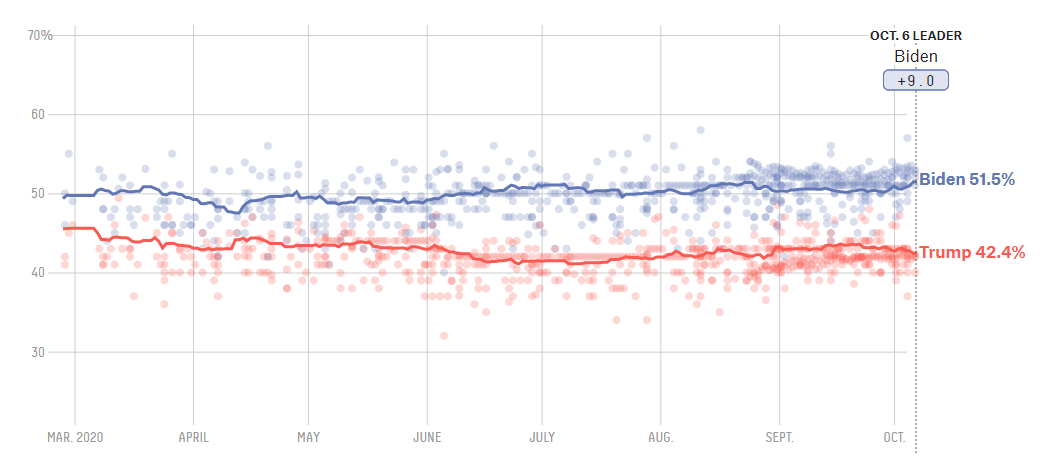
    At national level, opinion polls have shown a consistent advantage in voter intentions favouring the challenger, Joe Biden, over the incumbent Donald Trump. According to the FiveThirtyEight website which calculates a weighted average of polls, Biden was around eight percentage points ahead at the beginning of October on 50.9% versus 42.7% for Trump. However, because of the composition of the Electoral College (which tends to over-represent conservative rural areas) a Democratic candidate needs to be at least 5 percentage points ahead to be able to secure the presidency. The race therefore remained open.

    Who’s ahead in the national polls?

    Source: FiveThirtyEight

    The Hispanic community has traditionally leaned towards the Democratic Party in US elections, but support for Republican candidates has also been significant. Despite his anti-immigrant rhetoric, 28% of Hispanics voted for Trump in 2016, compared to 40% who voted for George W Bush in 2004. Current polls suggest that conservative Hispanic support for Trump remains significant in 2020, particularly in states like Florida and Texas.

    An additional way to look at the election is through the outcome in key swing states. The eight key swing states are Arizona, Florida, Georgia, Michigan, Minnesota, North Carolina, Pennsylvania, and Wisconsin. Hispanic voters are present in all, but particularly so in Arizona and Florida. As noted, Trump’s anti-Mexican rhetoric in the 2016 polls may have alienated Mexicans of Hispanic origin, but many of them were in traditional Democratic-voting states like California.

    This time around the Trump campaign is focusing on conservative Hispanic voters in Florida, many of whom are of Cuban and Venezuelan origin. While Florida as a whole is almost evenly divided between Democratic and Republican voters (Biden had a narrow 2.3 percentage point lead with 48.1% versus 45.8% for Trump according to FiveThirtyEight on 30 September), a September survey of Cuban Americans in the state showed a 68%-30% margin in favour of Trump. In office Trump has played to that conservative constituency, tightening economic sanctions on both Cuba and Venezuela.

  • HONDURAS: Lobo takes it out on the supreme court

    LatinNews 07 March 2012 Hits: 1884

     The executive and the legislature are scheming against the highest court in the land for its unwillingness to co-operate with the government led by President Porfirio Lobo.  Critics contend that the Lobo administration is leaning towards the creation of a parallel power in order to bypass supreme court decisions it does not like, and warn that this is an assault on the already weak state institutions in Honduras. Lobo, like his ousted predecessor Manuel Zelaya (2006-2009), has toyed with the idea of calling a constituent assembly for a broader constitutional overhaul, but with a general election looming in November 2013, it is probably too late for that.

    On 6 March the president of the unicameral congress, Juan Orlando Hernández of the ruling Partido Nacional (PN), announced that the legislature would set up a commission of jurists to analyse rulings handed down by the supreme court. The move by the PN’s would-be presidential candidate for 2013 comes exactly two weeks after President Lobo said that his office would create its own oversight commission for the same purpose - to examine whether the supreme court is acting within the bounds of the Honduran constitution.

    There is no doubt that the conservative supreme court is highly politicised, but Lobo and his administration are potentially erring in favour of political brinkmanship with the court. That attitude landed the former president Manuel Zelaya (2006-2009) in hot water with the court, which eventually ordered his removal (an order carried out by the military on 28 June 2009).

    Since he took office in two years ago (January 2010), Lobo has become increasingly peeved at the supreme court’s obstinate refusal to play ball with the executive and the PN-dominated legislature. Not only did the court refuse to go along with the Lobo-led – and internationally-mandated  – national reconciliation efforts in the wake of the June 2009 coup (it still maintains that Zelaya’s removal was legal), but it has also handed down consistently negative decisions on the government’s flagship initiatives, most notably: a proposed security tax; the legislative framework for Lobo’s novel model cities scheme; and latterly, a new law providing for the official recognition of the Evangelical Church.  In each case, the court has ruled the framework legislation unconstitutional.

    Like Zelaya, Lobo has precious little room for manoeuvre when it comes to institutional reform. The 1982 Constitution, written by a retreating military regime, is bound up so tightly in certain areas that it is almost impossible to revise. Yet it is unclear and open to interpretation in other areas.  With congress at his back, Lobo is certainly in a better political position than Zelaya ever was to challenge the court. He also draws on the findings of the Truth and National Reconciliation Commission that reported on the coup against Zelaya; it recommended the creation of a new constitutional court to remove constitutional matters from the supreme court’s remit altogether.  However (and again just like Zelaya), Lobo is nonetheless risking the country’s precarious institutional stability in seeking to tacitly undermine the highest court in the land. 

    What the constitution says:

    1.         Lobo and Hernández want the new oversight commissions to examine the constitutional validity of supreme court rulings. Hernández suggested on 6 March that congress could in fact debate such rulings. In fact under Articles 184, 185 and 316, the constitution is clear that constitutional matters are the exclusive remit of the supreme court and that once the court rules a bill or law unconstitutional the congress must comply by reading out the ruling in parliament and then publishing it in the official gazette without further ado. Nowhere does it allow the congress to challenge the ruling.

    2.         Lobo and Hernández also argue that congress has the power to sack supreme court magistrates. The constitution is a little unclear on this. On the one hand, under Article 205 (20) the congress is authorised to “approve or disapprove of the administrative conduct” of the executive and “the judicial power “.  Some coupsters used this Article to justify the removal of Zelaya, however to approve or disapprove of the administrative conduct is presumably just a first step in a longer evaluative process and not a tool in and of itself.

    3.         Under Article 313 (8), the supreme court is authorized to nominate and remove magistrates and judges on the basis of a proposal by the council for the judicial profession.  It is not explicitly stated whether this refers only to lower court judges (though that is the presumably the intended meaning). In theory, the executive and congress could amend the selection process for the 15-member supreme court. This itself, set out under Articles 311 and 312, is highly politicised and for years has been divvied up, effectively, between the two traditional parties, the PN and the Partido Liberal (PL).

     A local constitutional professor, Rigoberto Espinal  Irías, who advises the attorney general’s office (led by Luis Alberto Rubí, who, like the TSJ, has a conservative bent) told the daily El Heraldo on 7 March that the proposed oversight committees risked being “in open violation of the constitution”. 

    He said it was positive that the executive and legislature proposed such committees, but he recommended that they be used solely to take advice prior to submitting a bill.  “These studies should be undertaken with sufficient time in advance…so as to determine that any draft legislation submitted to congress is in harmony, first with the constitution and secondly with other laws”, he commented.

    • More cabinet changes

    Lobo has been implementing a piecemeal reshuffle since September 2011, when he removed three ministers, including his foreign affairs and security ministers. The changes reflect the president’s frustration with his government’s failure to deliver on almost every front. Finance Minister William Chong Wong resigned on 13 February, citing the pressures of his job and hinting that he could not meet the conflicting demands of the public for additional social spending and of the International Monetary Fund (IMF) to meet stringent fiscal targets as part of its loan agreement with Honduras. He was replaced by Hectór ‘Tito’ Guillermo Guillén, the head of the congressional budget commission.

      President Lobo also accepted the resignation of Francisco Zelaya, his industry and commerce minister, amid a scandal over 4,000 tonnes of illegally imported rice. José Adonis Lavaire replaced him.

      On 27 February Lobo swore in Marlon Oniel Escoto Valerio as the new education minister, possibly the most poisoned chalice in the cabinet. Escoto hails from the national agricultural university of Honduras at Catacamas, where, as rector, he suspended classes in the wake of the June 2009 coup so as to allow students to protest against the coup. Escoto admits to taking part in the protests and told journalists after he was sworn in that President Lobo “knows full well my positions”. Escoto replaces Alejandro Ventura, removed in January. Despite his labour union background, Ventura proved unable to resolve the longstanding pay and pension disputes between teachers’ unions and the cash-strapped government, resulting in strikes. Latterly, the teachers have also reacted tepidly to a new education reform law introduced by the Lobo government. Escoto said his first task would be to meet teachers to discuss their concerns over the new legislation. Ramón Arturo Escobar was appointed the new deputy agriculture minister, replacing Juan Angel Artica.

       Finally, Emil Mafhuz Hawit Medrano is the new managing director of the national electricity company (ENEE). He replaces Roberto Martínez, who resigned on 23 February amid a row over the shape of an emergency energy supply contract with a foreign company (Westport). 

    • No to the morning-after pill

    On 13 February the supreme court upheld an absolute ban on emergency contraception, thereby criminalising the sale, distribution and use of the morning-after pill. Under Honduran law, the provision of the morning-after pill  is considered the equivalent of an abortion and the punishment is the same, ranging from three to 10 years in prison. Women who seek an abortion face three to six years in prison. Under the latest decision, being found with an emergency contraceptive pill would be considered an abortion attempt. A ban on emergency contraception was first passed by congress in April 2009. President Manuel Zelaya vetoed the ban a month after it was passed –adding to his woes with the supreme court. The de facto government that replaced Zelaya after his removal in June 2009 re-instated the ban in October 2009.

    • Pre-primary campaigns get under way

    On 11 February Manuel Zelaya’s wife, Xiomara Castro, began her campaign to become the 2013 presidential candidate for Zelaya’s new party Libre. Castro is the only nominee for the spot after the five factions that make up Libre agreed to back her unanimously. Juan Orlando Hernández of the ruling Partido Nacional will launch his campaign in mid March. Hernández received President Lobo’s official backing in September 2011.

  • Region: UNICEF calls for an end to child poverty in LAC

    LatinNews 06 September 2017 Hits: 698

    There are 195m children in Latin America and the Caribbean (LAC), a high 31% of the population. In its latest annual overview of child poverty in the region, UNICEF notes that despite progress, four of every ten children are still considered poor from a human rights and multidimensional perspective, while one in six are considered ‘extremely poor’. In all, a staggering 70m children in the region are categorised as living in poverty.

    According to Marita Perceval, UNICEF’s regional director, Latin America and the Caribbean not only has the greatest global social inequality but is also marked by severe violence. The figures make for very grim reading. On UNICEF data, the region has the highest child and adolescent homicide rate worldwide, causing 25,000 deaths per year. One in every four child and adolescent homicides in the world takes place in Latin America and the Caribbean. Two out of three children under the age of 15 suffer physical or psychological violence at home.

    The situation of young women is particularly vulnerable. It is estimated that 1.1m adolescent women between the ages of 15-19 are victims of sexual abuse. Four of every 10 young women aged 15-19 have already experienced partner violence in their short lifetimes – and one of every four are married before the age of 18, which UNICEF describes as “a fundamental violation of human rights”. Early marriage “compromises a girl’s development by potentially resulting in early pregnancy and social isolation, interrupting her schooling, limiting her opportunities for pursuing a career, greater risk during pregnancy, etc. Also, married or cohabiting women before 18 years old are at increased risk of domestic violence," it notes.

    With 79% of the regional population living in urban areas, there is a crucial need for decent housing as a basic starting point in the battle against poverty. UNICEF notes that those most affected by poverty and in the most vulnerable situations are those living in so-called ‘peri-urban’ areas. These children and adolescents “become displaced, affecting their rights to health, education, protection and social participation”. Some 14m children and adolescents in the region are not attending school, for example, including 3.6m of primary school age, 2.8m of lower secondary school age and a high 7.6m of upper secondary school age.

    The report also makes the point that the negative impact of phenomena related to climate change is greater on children and adolescents. It estimates that “13.4m children and adolescents live in regions with high or extremely high risk of drought. 13.1 million live in areas at high risk of flooding”.

    On the positive side, UNICEF emphasises the “substantive progress” in the economic and social development of Latin America and the Caribbean in the past two decades. This progress, it notes, “has positively influenced the well-being of millions of children and their families”, with many more children able to exercise their rights. Nonetheless, progress has been uneven. The region is still one of the most unequal in the world, and “there are still many disadvantaged and excluded girls and boys, who continue to face barriers preventing them from accessing social services and protection”.

    UNICEF notes that by agreeing to the 2030 Agenda and the Sustainable Development Goals and to other international and sub-regional commitments, as well as the Convention on the Elimination of all Forms of Discrimination Against Women, it is the responsibility of all regional authorities to ensure universal access to such services. It urges governments at both the national and sub-national level “to continue strengthening policies and programmes and ensure an equity focus”. At the same time, it adds, “civil society, media, opinion leaders and businesses, among others, also need to take action to ensure that all children can exercise their rights”. Furthermore, it advises that “girls, boys and adolescents must be empowered to actively participate in policy formulation and decision making, as well as in the implementation and monitoring of policies”.

    Finally, the report calls for stronger efforts in the collection of disaggregated data to make informed decisions and formulate and implement inclusive policies and programmes.

    UNICEF calls for actions to ensure that all children can exercise their rights, so that all young girls and boys:

    • Can move out of the inter-generational cycle of multi-dimensional poverty; 
    • Can survive and not die from preventable causes; 
    • Are learning and benefit from quality education; and 
    • Are prevented from being a victim of any form of violence.

    Marita Perceval notes that “2030 not just another number. It is more than an agenda; it is an ethical horizon, a social challenge, an economic necessity, and an environmental imperative.”

    UNICEF

  • Colombia: Santos administration sends down its final budget

    LatinNews 10 November 2017 Hits: 288

    In mid-October, the Colombian legislature approved the 2018 budget – the last under the tenure of President Juan Manuel Santos, who will step down in August next year. Given that President Santos is constitutionally barred from seeking another term, the budget was not a pre-election package designed to boost spending ahead of a re-election bid. Instead, the budget rose only gradually (by just 1% in nominal terms, to COP236bn), with plans to cut expenditure in some areas, and reduce external debt.

    The Santos administration touted the budget as an “austere” package. With only moderate increases pencilled in for total revenue and expenditure, the finance ministry is hoping to reduce the fiscal deficit from the 3.6% of GDP expected in 2017 to 3.1% next year. This is essentially an attempt by the Colombian authorities to avoid being downgraded by the main sovereign credit rating agencies. Colombia has investment-grade status, but with Standard & Poor’s (S&P) rating it as BBB, and Moody’s Investors Service as Baa2 – both one notch away from the lowest investment-grade rung – the government remains fearful of the sovereign being returned to speculative-grade status, which would make financing more difficult to get, and costlier.

    Some fiscal slippage is likely

    The finance ministry’s efforts are praiseworthy, but many believe that the macroeconomic assumptions underpinning the budget package are too optimistic, which will result in some fiscal slippage and a consequent increase in the public debt stock.

    The budget is predicated on a real annual GDP growth forecast of 3%, which would mark a three-year high and is significantly above market expectations (as well as those of the central bank [Banrep] and the IMF), while end-2018 inflation is forecast at 3.5% (a level not seen since 2014).

    The authorities are seeking to boost growth, with Banrep cutting interest rates again by 25 basis points in late October in an effort to stimulate domestic demand, but it is unclear whether this will prove sufficient to lift overall GDP growth towards 3%.

    Based on this strong growth forecast, the Colombian authorities are expecting rapid growth in current revenue (14.1%), mainly on the back of double-digit rises in tax income. Given that most of the government’s recent tax reform measures took effect in early 2017, it is difficult to see where such rapid growth next year would come from. The measures included in the 2016 reform, which went into effect early this year, including an increase in the rate of value added tax rate (VAT) from 16% to 19%, the imposition of a 4% tax on mobile phone services, and the re-imposition of the ‘4 x 1,000’ tax on financial transactions, amongst other things. Even so, according to latest projections from Colombia’s tax authority (Dian), fiscal revenue this year will fall 15% below the Col$126.9trn target set out in the 2017 budget. According to the Dian, this is due to the continued slowdown in domestic economic activity this year.

    Meanwhile, on the expenditure side, the authorities are pencilling in some fairly large increases in current spending, including a 6.2% hike in transfers (mainly to finance pensions and healthcare shortfalls) and an 8% increase in wage costs (on the back of rising pressure for salary increases from public-sector workers).

    This also includes financing various post-conflict programmes such as the provision of public services and public security improvements in post conflict areas. Total allocated funding for post-conflict programmes was set at Col$2.4trn. Finance Minister Mauricio Cárdenas boasted noted that the education sector received the biggest budget allocation in the 2018 draft budget (Col$37trn), followed by defence (Col$31.6trn).

    In this context, the government is relying entirely on a massive 17.2% cut in capital spending to keep the overall expenditure bill under control. Given that many investment projects are already under way, it is unclear whether such a large cut is feasible; even if the authorities manage to reduce spending in this area by the budgeted amount, this would also hamper the country’s growth potential. Given that infrastructure has traditionally been a comparatively weak point of the country’s business environment, cutting capital spending is arguably not the best means of achieving fiscal consolidation.

    Authorities try to rein in debt

    A budget deficit of around 3% of GDP would involve financing needs of around COP30bn (US$10bn). Some of this has already been pre-financed, with US$900m raised in a bond issue in August, with the finance ministry also going to put US$980m paid in fines by telecoms companies towards the deficit.

    Cárdenas has stated that no international bond issuance is likely in 2018, in a bid to reduce external debt (which stands at around 40% of GDP), but with still-significant financing needs, domestic borrowing is instead likely to rise. With public debt still perilously close to the 50% of GDP mark (higher than the ‘BBB’ median of 42% of GDP, as Fitch Ratings noted in late October), Colombia is therefore likely to remain vulnerable to a credit ratings downgrade in the coming year.

  • Regional Free trade agreement with Mexico takes effect

    LatinNews 21 September 2012 Hits: 573

    On 1 September a new free trade agreement between Nicaragua, El Salvador, Honduras, Guatemala, Costa Rica and Mexico went into effect.

    It is expected that the agreement, signed in 2011, will allow Central America to better integrate its production chains with Mexico in order to generate economies of scale that will lead to increased efficiency and productivity in the new free trade area by reducing administrative and business costs. Previously Mexico had trade agreements in place with the five different countries separately and the new agreement will consolidate 98% of the rules governing trade between Mexico and its Central American trade partners, according to Mexico’s economy ministry. The new consolidated rules will go into immediate effect in Mexico, Nicaragua and El Salvador. It is expected that the same will happen in Honduras, Costa Rica and Guatemala once these three countries conclude the legal proceedings necessary for the agreement to take full effect.

    Trade between Mexico and its Central American partners has increased steadily since the signing of the first multilateral agreement (with Guatemala, Honduras and El Salvador) in 2001. Last year the total trade between the parties was US$8.15bn, which represents a fivefold increase over the last 10 years.  Breaking the figures down by different countries, and when trade agreements went into effect, it is clear to see the effect that the trade agreement has had on bilateral trade. Between 2000 and 2011 total bilateral trade between Mexico and Nicaragua increased by 349%, while in the same period the increase in trade between Mexico and Costa Rica was 461.2%. Salvadorean exports to Mexico in the same period increased by 450%, while Mexican exports to El Salvador increased by 117%.

    All this provides evidence that while Mexican exports to Central America have increased by a substantial 143% in the last decade, its Central American partners have also been able to take advantage of Mexico’s large domestic market of 110m people, which represents an important market for Central American businesses. Moreover, the signing of a trade agreement with Mexico has also resulted in a surge of Mexican investment in the sub-region. Central American countries are now the fourth largest recipients of Mexican investments in Latin America, receiving US$5.2bn in 2011. Mexican FDI to Costa Rica increased by 508% between 2000 and 2011. In Guatemala FDI from Mexico increased by 94% from 2009 to 2010, while in Honduras the increase was of 178% over the same period. Mexico has also remained as one of the top five FDI providers for El Salvador since 2010.

  • Ecuador: Deflation begins to weigh on economy

    LatinNews 06 July 2018 Hits: 1569

    At a time when many countries in the region are facing the prospect of a rise in inflation, as recent sharp local-currency depreciation feeds through to higher import prices and the knock-on effect of higher retail prices, Ecuador is experiencing deflation. The consumer price index registered a 0.18% month-on-month fall in May, following a 0.14% decline in April. In year-on-year terms, inflation has been negative since last September, but May’s result (-1%) was the lowest in this string of data.

    It is the prices of many goods, rather than services, that is driving the recent bout of deflation. Food and non-alcoholic beverages (which account for the largest share of the consumer price index, at 22.5%) fell by 3.2% year on year in May, following a 3.3% decline in April. Clothing prices fell by 4% year on year in both April and May, while housing goods & equipment fell by 1.6% and 1.4% respectively in these months. Alcoholic beverage prices rose very marginally in May (0.1% year on year) but followed several months of deflation previously. Services prices generally came in higher, although in most areas they still remained low by historical comparison. Utilities prices increased by 1.3% year on year in both April and May, while healthcare price inflation came in at 1.1% and 1.4% respectively. Hotels, cafés and restaurants (a proxy for tourism) registered annual inflation of 0.4% and 0.9% respectively in April and May.

    US dollar appreciation holds down import prices

    Deflation among goods-related sectors is explained by the appreciation of the US dollar so far this year, which has reduced import prices. This, in turn, is likely to have been passed onto the consumer via lower retail prices, particularly because underlying economic growth remains relatively weak (spurring retailers to cut prices in order to attract customers). Weak domestic demand is also likely to have been a factor behind the low inflation results in services-related areas of the consumer price index, also encouraging cuts in retail prices in an effort to boost interest. Given Ecuador’s status as a net oil exporter, the consumer price index has been less affected by rises in global oil prices than net oil importers; indeed, the transportation sub-sector of the consumer price index fell by 0.3% month on month in May, and by 0.6% year on year.

    The problem with deflation is that it can become a vicious circle, with the public delaying purchases because prices are falling, but then not only does weaker private consumption undermine GDP growth, but retailers often feel pressurised into further price cuts and employers cut wages, deepening the deflationary cycle. Japan is perhaps the classic example of a long-run, problematic cycle of deflation and extremely weak economic growth. Although there is little indication that deflation will take hold in Ecuador in the same way as it did in Japan, it is likely to hamper growth in domestic demand this year in Ecuador.

  • PANAMA: Varela marks one year anniversary in power

    LatinNews 08 July 2015 Hits: 2665

    President Juan Carlos Varela and his Partido Panameñista (PPA)-led El Pueblo Primero (EPP) coalition government marked its one year anniversary in office this month. Predictably President Varela’s balance sheet presented to congress on 1 July emphasised his government’s efforts to tackle corruption, which have made headlines for its investigations into the previous administration led by Ricardo Martinelli (2009-2014) – the most notable result of which is an unprecedented probe into the former president. Yet while corruption remains very much in the public eye, the most recent Dichter & Neira poll published on 16 June showed that security remains the chief public concern, despite the fact that the Varela government recently boasted a drop in homicides.

    The Dichter & Neira poll – which also gave Varela a respectable 63% approval rating – showed that only 36% of the 1,200 respondents believe that the problems of violence will improve with this government – as compared with 64% who said as much when Varela took office.

    On 23 June however the interior ministry issued a press release claiming that 235 homicides were registered between January-14 June, 74 cases less than those registered over the same period the previous year, according to the national system of criminal statistics (Siec). According to the Siec statistics, the provinces registering the highest homicide rates were: Panamá (127); Panamá Oeste (34); Chiriquí (21); Colón (20) and Coclé (11). In his balance sheet, Varela directly attributes the reduction in homicides to the impact of his government scheme, ‘Barrios Seguros’ (‘safe neighbourhoods’), which offers job training and an amnesty to gang members who surrender their weapons and cut their ties with organised crime.

    According to the 23 June interior ministry press release, 29 homicide cases have been linked to gang activity so far this year, down from 68 in 2014. The same report claims that 4,187 youths at risk had joined ‘Barrios Seguros’ and that if this progress continued, by the end of the year the country’s homicide rate could roughly equal the 9 per 100,000 inhabitants registered in neighbouring Costa Rica and Nicaragua – down from the current 15 per 100,000 reported for Panama. In March Nahaniel Murgas, the head of the Fiscalía Contra el Crimen Organizado (FCCO; office of the prosecutor for organised crime) reported that, after having disbanded 12 gangs in 2014, the current number of active gangs is estimated at 204. In April Attorney General (AG) Kenia Purcell announced the establishment of a special anti-gang office of the public prosecution service, to “ease the congestion” burdening the broader organised crime office.

    Other sources like the US State Department’s Overseas Security Advisory Council (OSAC) would appear to agree with the government’s claims regarding a drop in homicides albeit with some reservations. The most recent OSAC report (published in March) notes that “according to statistics derived from Panamanian National Police reporting (Policia Nacional de Panama – PNP), the homicide rate fell from 666 in 2013 to 519 in 2014”. Yet the same report suggests that “crime statistics reflected in PNP source documents may have been under-reported in 2014 due to the phased roll out of a new reporting system that may not have captured monthly reports from earlier in the year. It is estimated that actual crime rates may be 15-20 percent higher than reported. The Ministry of Public Security lists a total of 8,748 reported thefts in 2013. The 2014 number was not available at the time of this writing but may have increased. Both unofficial and anecdotal crime reporting indicate an upward trend despite significant PNP efforts at combatting crime”.

    End of PPA-PRD alliance?

    The same day that President Varela presented his balance sheet, the 71-member unicameral national legislature elected Rubén de León, a deputy for the opposition Partido Revolucionario Democrático (PRD), as its new president for 2015-2016, replacing Adolfo Valderrama of the PPA. De León, who received 39 votes, defeated his only other competitor, Crispiano Adames (PRD) who took 31. The transfer of the national assembly’s presidency to the PRD from the PPA was in line with a legislative pact sealed by the PPA (which has just 16 deputies) and the PRD (which has 26 deputies) when Varela assumed office. However, the election of De León – who received the backing of the PPA – was a victory for the dissident PRD faction. PRD party president, Benicio Robinson – who has since pronounced the PRD-PPA pact over – had backed Adames.

    • Drug seizures

    According to the most recent US State Department International Narcotics Control Strategy Report (INCSR), released in March, Panama reported seizing 35.1 tonnes (t) of cocaine in 2014, largely in cooperation with US law enforcement. This includes cocaine captured by Panamanian authorities, but does not include the 3.9t of cocaine seized by the US Coast Guard (USCG) in or near Panamanian territorial waters, or cocaine jettisoned by traffickers under pursuit and not recovered. The same report notes that Panama’s cocaine seizures fell by14% in 2014 on the previous year “in concert with a 54 percent decline in reported maritime incidents transiting in the vicinity of Panamanian territorial waters. The decline in maritime cases in the vicinity of Panama coincides with an overall decline in flow, first noted in 2013. This may reflect a shifting in traffickers’ routes away from littoral waters”.

  • The China factor

    LatinNews 30 April 2018 Hits: 662

    One potentially significant point is that as Latin America’s trade patterns have diversified, so freight transport flows and infrastructure are needing to adapt. Over the last two decades China (and Asia more generally) has emerged as one of the region’s major trading partners (China is now the LAC’s second-most important trade partner after the United States). This has meant that many Latin American economies that previously ‘looked north’ to the United States and northeast to Europe, are now also looking west to China and Asia.

    China has launched an ambitious transport and trade initiative known as One Belt, One Road (OBOR). Seen as Chinese President Xi Jinping’s signature policy, OBOR currently involves 70 countries in Eurasia, Africa, and the Middle East. Its aim is to invest in transport infrastructure, build China’s economy and international trade, use the country’s excess industrial capacity, and increase the security of its energy and food supplies. OBOR is now beginning to be rolled out to Latin America. Since 2000 LAC’s trade with China has been growing at a faster pace than its trade with the rest of the world. Key commodity exports to China include oil, iron and steel, copper, scrap aluminium, precious metals, and meat. Trade with China accounts for 25% of Chile’s total imports and exports. The comparable figures are 22% for Peru, 18% for Brazil, and 15% for Argentina. All these countries are primarily commodity exporters to China. Mexico, with a large manufacturing sector, is more of a competitor, and therefore has weaker direct trade links. Chinese investment and financing has also been growing in importance, and is concentrated in Brazil, Peru, and Argentina. Interestingly, however, Japan, not China, remains the main source of Asian foreign direct investment (FDI) flowing into the region.

  • The ‘office of hate’

    Patrick de Courcy 16 November 2023 Hits: 588

    Those who believe the Bolsonaro administration had an explicit commitment to use disinformation as a political tool point to a shadowy organisation known by its critics as ‘the office of hate’. This was, allegedly, an informal organisation formed by Eduardo Bolsonaro, political advisors, friendly bloggers, and wealthy businessmen, which ensured that political opponents or those seen as having betrayed the cause were singled out for online vilification. Former anti-corruption judge Sergio Moro, who resigned as security minister in 2020, was widely insulted across social media and accused of being a communist, a traitor, and a crook. When the health minister disagreed with the president’s anti-vaccination position on Covid-19, there was a proliferation of unsubstantiated online accusations that he was corrupt.

    Joice Hasselmann, a conservative congresswoman who had been close to the president but had a falling out with him, said that immediately afterward distorted images of her began to be published on social media, along with claims that she was corrupt, a prostitute, and “everything else you could imagine”. She added: “There were montages where my face was placed on the body of a pig and was surrounded by men in pornographic postures”.

    A report by Germany-based think-tank Digital Communication Research says that Bolsonaro and his followers built a network on Facebook, mixing hate speech with humour. The network was “coordinated unofficially by several cabinet staff members” and “articulated the official profiles of the Bolsonaro family to followers and sympathisers”, supported by a vast array of anonymous pages. It goes on to say that the structure was used “to blur boundaries between official and spurious discourses”, and to power a series of ‘flaming’ wars against political adversaries and reporters perceived as hostile to Bolsonaro’s interests.

    In December 2021, Brazil’s supreme court (Supremo Tribunal Federal – STF) said it would investigate comments made by President Bolsonaro who in a social media livestream had claimed that Covid-19 vaccinations could increase the chances of developing AIDS. The investigation was expected to include examination of the ‘office of hate’.

  • Milei on the defensive over top salaries

    Patrick de Courcy 27 March 2024 Hits: 1818

    Voters do not like hypocrisy among their elected leaders; Milei faced a big political setback in March when he made himself vulnerable to exactly that charge. As part of his campaign to eliminate the fiscal deficit the new president imposed country-wide austerity including public sector wage restraint. There have also been deep cuts in the real purchasing power of pensions and other state benefits. The president has frequently said “there is no money” in response to calls to stop the fall in living standards. Yet, despite this, it emerged that Milei’s own salary had been increased by 48% from just over 4m pesos (US$4,704) a month in January to 6m pesos (US$7,056) in February. Similar increases were paid to ministers and other top officials. Members of congress in turn benefited from a 30% increase. This came to light after members of the hard opposition from the Peronist movement obtained a copy of a presidential decree, signed by Milei, authorising the higher rates.  

    The president went quickly into damage limitation mode. He issued statements on social media saying that he had rescinded the decree and dismissed labour secretary Omar Yasín. In the president’s telling, the fault lay with former centre left president Cristina Fernández de Kirchner (2007-2015) who in 2010 signed a decree automatically increasing the salaries of senior officials to ensure they earned no less than those in more junior positions. Milei said his intention had been to increase the pay of junior officials, and this had led him inadvertently to trigger a corresponding raise for senior officials including himself. He had also rescinded the 2010 decree which he described as designed to “protect the wallets of the caste”. The president added “with each passing day we discover a new law which favours politicians and is prejudicial for the Argentine people…but these things are hidden unless you are an expert”.

    Despite his explanations Milei was unlikely to get off lightly from the incident. It emerged that he had in fact signed two contradictory decrees on top pay increases, in January and in February, one ruling them out and the other ruling them in. Fernández de Kirchner suggested Milei had not actually read the decree before signing it. Milei retorted that she should give up her own generous pension privileges. The controversy was expected to linger on for some time, possibly eroding the president’s approval rating. Christian Buttié of pollster CB Consultora told the Financial Times that “the government has almost no margin for this kind of error, which undermines its narrative over austerity”.

  • ECONOMIC OVERVIEW: EL SALVADOR

    LatinNews 02 December 2015 Hits: 298

    On 19 November, the credit rating agency Moody’s changed the outlook on El Salvador’s Ba3 rating from stable to negative. Moody’s justified its revision on the grounds of “the limited ability of the authorities to arrest the upward trend in government debt amid persistently high fiscal deficits and low economic growth”.

    Moody’s argued that debt ratios had “increased steadily since 2009 driven by persistent fiscal deficits of around 4% of GDP”. This presented the opposition with the opportunity to accuse the ruling left-wing Frente Farabundo Martí para la Liberación Nacional (FMLN), which took power that year, of profligacy.

    Moody’s reasoned that with GDP growth averaging just 1.9% over the last 10 years, the only way the fiscal deficit could be reduced would be through the implementation of “aggressive fiscal consolidation, or revenue enhancing measures”, something which is “particularly difficult” given the gridlock in the 84-seat legislative assembly.

    Moody’s predicted that the government would undertake a significant pension reform “in the next 3 to 6 months” in order to address the fact that “pension expenditures represent roughly half of the fiscal deficit and have increased debt by more than 10 percentage points since the system was privatized in 1998”.