All Categories

Subcategories

  • PANAMA: Martinelli sells off the remaining family jewels

    LatinNews 12 July 2012 Hits: 2249

    In June Panama’s right-wing President Ricardo Martinelli proposed two controversial new privatisation initiatives.

    One would allow the State to sell 24% of its remaining 49% stake in the former state-owned telecoms company, Instituto Nacional de Telecomunicaciones (Intel), now known as Cable & Wireless Panama. Cable & Wireless entered Panama in 1997, paying US$652m to acquire a 49% stake in Intel; another 2% is held by private investors. The president’s other proposal would modify a February 1997 law regulating the energy sector which would also allow the government to sell off its remaining shares in joint energy ventures.

    Both the energy and telecoms sectors were part privatised under the Partido Revolucionario Democrático (PRD) administration of Ernesto Pérez Balladares (1994-1999).

    Martinelli’s detractors accuse him of seeking to sell the government stake in a bid to raise funds for the 2014 election and both proposals have been so unpopular that they served to galvanise the main opposition parties, PRD and Partido Panameñista (PPA), together with the smaller Partido Popular (PP), to launch a new alliance – the so-called Frente por la Democracia – against Martinelli’s ruling Cambio Democrático (CD). After two days of demonstrations organised by the new Frente in the capital spilled over into violence in congress, Martinelli announced on 20 June that the executive’s proposed reforms would be subject to dialogue between the different stakeholders.

    Sovereign Fund: On 5 June President Martinelli sanctioned a law establishing a new sovereign fund. Future revenues for the fund will come in from the expansion of the Panama Canal.


    Martinelli said the fund would be established with an initial US$300m upon the completion of the US$5.2bn Canal expansion project (expected in 2014).  On official estimates, the fund would then grow by US$1.5bn per year. It would be tapped only during a recession or in response to a natural disaster. In 2011, Canal revenue reached US$3bn, a figure expected to double by 2025.

    • Panama postpones toll increases

    The Panama Canal Authority (ACP) announced on 27 June that it will delay increasing tolls on the Panama Canal, which were due to go into effect on 1 July. The decision follows complaints by the International Chamber of Shipping (ICS), along with Ecuador, Chile and Japan [EB-12-05]. In a statement, the ACP said “at the request of the industry, implementation of the new charges has been postponed from July 2012 to October 2012, giving the industry additional lead time before implementation of the new tolls as well as providing an additional three months before the second step of increase in 2013”. The statement adds that “the revised proposal eliminates the proposed container/break-bulk segment. Container/break-bulk vessels will continue to be classified as part of the segment known as other”.

  • Cuba-Venezuela: Trump considers sanctions on Cuban officials

    LatinNews 30 November 2018 Hits: 417

    Individual sanctions on some senior Venezuelan officials have been in place for several years, but there are indications that US President Donald Trump is considering extending these to certain Cuban officials, who the US government suspect of providing advice and support to the Venezuelan government.

    These moves form part of an overall hardening stance on the part of the US government towards the Cuban and Venezuelan regimes. Since taking office, President Trump has rolled back many of the measures passed by his predecessor, Barack Obama, that had led to a partial rapprochement with Cuba. Speculation about the end of economic sanctions against Cuba, which had risen sharply under Obama, has all but disappeared. In September, President Trump renewed the ‘Trade with the Enemy Act’, which forms the cornerstone of the Cuba embargo, for another year while in early November the United Nations (UN) voted overwhelmingly to condemn the Cuba embargo.

    “Troika of tyranny”

    The US National Security Advisor John Bolton has given evidence of the Trump administration’s hardening stance towards Cuba and Venezuela. In a speech in early November, Bolton spoke of a “troika of tyranny”, labelling these countries – in addition to Nicaragua – as the cause of “immense human suffering…enormous regional instability…and a sordid cradle of communism in the western hemisphere”. The National Security Advisor extended sanctions to a number of Cuban companies with suspected ties with the Cuban government and military, as well as firms engaging in gold exports from Venezuela.

    In addition, he indicated that the US government was considering whether to allow US citizens with outstanding property claims in Cuba (which relate to the seizure of property by the Cuban state shortly after Fidel Castro came to power in 1959) to sue foreign companies that have since invested in the Cuban property market. Although this would in practice prove extremely difficult, not to mention controversial, it is an indication of the US government’s tougher rhetoric. In this context, a further extension of sanctions to Cuban officials suspected of advising and supporting the Venezuelan government would come as little surprise, given the hardening of the US government’s tone.

    It remains doubtful whether any of these measures will have a significant impact on the longevity of either the Cuban or Venezuelan administrations. The sanctions on companies will limit both countries’ ability to trade internationally and secure inward investment – which will have a detrimental impact on both countries’ economies – while personal sanctions against individuals in both governments will hamper diplomatic ties. However, both the Cuban and Venezuelan governments have to date demonstrated an ability to withstand severe economic strain, as well as diplomatic isolation. As such, there is a sense that the latest moves by the US government are likely to prove primarily symbolic.

  • Brazil: the agribusiness powerhouse

    LatinNews 21 December 2018 Hits: 116

    Because of the size and fertility of its territory, its large population, and its big economy (one of the world’s top ten) Brazil can be described as the agri-business powerhouse of Latin America. The importance of the agribusiness sector is not always recognised, however. It can be argued, for example, that in the 2015-2016 recession, the sharpest recorded economic downturn in recent Brazilian history, agribusiness actually ‘saved’ the economy from an even worse crash, something which has not been fully recognised. In 2017, as Brazil began to slowly climb out of the recession, agribusiness had a record year, growing by 13%, the strongest expansion recorded in 21 years. Soya, with a 55.2% increase in crop yields, and maize production (with a 19.4% increase) led the way.

    Data on the size and structure of the Brazilian agribusiness sector is somewhat patchy but still impressive. In 2017 it accounted for around 23% of Brazilian GDP. In the same year, the first agricultural census conducted by IBGE, the national statistics institute, in 11 years showed that in the intervening period the area dedicated to agribusiness activities had expanded by 16.5m hectares, an area equivalent to the size of Portugal, Belgium, and Denmark combined. According to IBGE census coordinator Antonio Florido, Brazilian agricultural establishments now occupy 41% of national territory. Most of the expansion came from larger establishments. ‘Big agro’ – farms of 10,000 hectares or more – now account for 47.5% of the cultivated area, up from 45% in 2006. The census produced other indications of expansion and modernisation. For example, in the 2006-2017 period tractor sales grew by 50% to reach 1.23m units, while the number of mechanised harvesters rose by 49% to 173,000 machines.

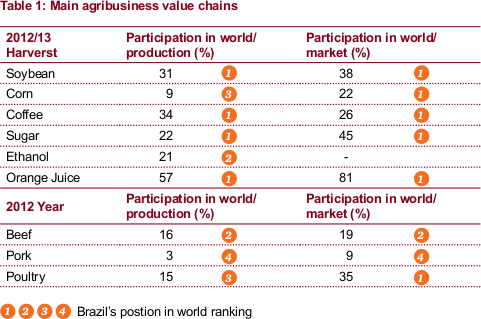
    One description of agribusiness in Brazil is that it supplies ‘the 4 Fs’ to the world: food, feed, (bio) fuel, and fibre. The country is the world’s largest producer and exporter of coffee, sugar, and orange juice, and is highly ranked in the production and export of soybean, maize, ethanol, pork, beef, and poultry chicken. As mentioned, agribusiness accounts for almost a quarter of GDP; it also represents one-third of total employment and a larger 40% share of exports.

    Brazil

    Source: PwC

    There are at least five major value-added production chains operating within the agri-business sector in Brazil. In first place, the sugar and ethanol value chain has been growing at an annual rate of around 6%. Roughly half of the country’s sugar cane output is used for producing refined sugar, while the other half goes into production of ethanol for energy. After hydrocarbons, sugar cane has become the second-largest source of energy in Brazil accounting for 16% of all energy consumed. In second place, the oilseed and grains complex performs a key role producing but also processing and adding value to a wide range of products based on soya, maize, rice, wheat, beans, and cottonseed. Production has been growing at around 8% per annum. Typically, this sector produces not just the raw materials but also processed foodstuffs such as cooking oils.

    In third place comes the coffee value added chain. While the scope for adding value may be a little more limited than in the oilseeds and grains complex, as we have seen, the development of speciality and organic coffee is creating new opportunities, especially in new markets such as China. The sector experiences both demand- and supply-side volatility and average growth rates have been more modest, at around 3% per annum. The fourth value chain – orange juice – has a high degree of linkage between essentially agricultural and more industrial and service sector activities (extracting juice from the oranges, and storing, refrigerating, transporting, and marketing it to international destinations). The sector is highly concentrated and organised. Juice processors have global operations and highly developed infrastructure. Finally, the fifth value added chain is the production and sale of animal protein – essentially beef, pork, and poultry. Brazil is a major international player in this sector. Total meat production rose 25% from 2008-2012. Average growth has been strongest in pork (8% per annum) followed by poultry (3%) and beef (2%). There are big contrasts in industry structure within this sector. Production of poultry and swine is highly organised, but the cattle (beef) sector suffers from still-high levels of informality and a lack of coordination of the value chain.

  • CHILE: Piñera eyes Canadian gas

    LatinNews 06 June 2013 Hits: 3208

    On an official visit to Canada in late May, Chile’s President Sebastián Piñera made it clear he had his eye on Canadian liquid natural gas (LNG) supplies.

    Piñera was primarily concerned to ensure a secure energy supply for mining operations in northern Chile. Companies operating there need to power heavy mining equipment as well as using energy in the desalination of water, also in short supply in the desert region. “We will need to import a lot of energy. Because we don’t have coal, and we don’t have oil”, Piñera told the daily Globe and Mail. He added that although Chile, because of its topography, has considerable hydroelectric potential, greater reliance on hydro is opposed by domestic and international environmental groups.

    While he was optimistic about the potential of other renewables such as solar, wave, and geothermal power, the president insisted that “we will still need natural gas”.  Various projects to pump LNG across Canada to ports in British Columbia also face environmental opposition, but if that cross-Canada connection were to be achieved, Piñera said that Chile would be “a natural customer, because we share the same ocean”.

    The Globe and other Canadian newspapers were struck by the high level of Chile’s economic development, noting that Chile is the first and so far only full Latin American member of the Organisation of Economic Co-operation and Development (OECD), and that it has been growing at around 6% per annum, compared to Canada’s 2%.

    There was broadly sympathetic coverage of the Chilean environmental regulator’s decision to sanction the Canadian mining group Barrick Gold for failing to meet its environmental protection commitments at the US$8.5bn Pascua-Lama gold and silver mine on the Chile-Argentine border. Barrick has been ordered by a Chilean court required to halt development, make environmental improvements worth some US$30m, and pay a US$16.4m fine – the highest environmental fine in Chile’s history.

    In his interview with the newspaper and in other statements, Piñera stressed the role that Canada could play in aiding further attempts by Chile to develop its economy and reduce poverty levels.  He pointed out that Canada is the third-largest foreign investor in the Chilean business sector and that trade between the two countries has quadrupled since a free trade agreement was signed in 1997. Chile needed more technology, knowledge and innovation capacity from Canada, he said.  After Canada, Piñera travelled onwards to the US to meet President Barack Obama.

  • ECONOMIC OVERVIEW: NICARAGUA

    LatinNews 01 September 2011 Hits: 2498

    IMF: The IMF has completed the sixth review of Nicaragua’s economic performance under its Extended Credit Facility (ECF) -formerly known as the Poverty Reduction and Growth Facility-, allowing an immediate disbursement of US$8.95m. The announcement follows a report released by the Ortega administration regarding Venezuelan cooperation the previous month [RC-11-04], one of requirements laid down by the Fund for the country program to continue. The IMF‘s executive board had approved a three-year ECF for about US$111m in October 2007, which was increased by about US$10m in September 2008 to allow Nicaragua to cope with the natural disasters of 2007. In November 2010, the IMF approved an extension of the arrangement to December 2011.

  • URUGUAY: Vázquez counteracts union protests

    LatinNews 10 December 2015 Hits: 10

    President Tabaré Vázquez will be hoping that the forthcoming holiday period and the congressional recess, which stretches from 15 December to 1 March, provides him with some respite after months of protests by trade unions have eroded his popularity. Vázquez has launched a counter-offensive, with an initiative called ‘Diálogo Social’, a fully participative programme designed to encourage wide-ranging debate and even to help draft future government policies to “drive the country’s future strategic development”.

    Uruguay’s umbrella trade union, Plenario Intersindical de Trabajadores-Convención Nacional de Trabajadores (PIT-CNT), staged a general strike on 12 November in protest against the government’s austerity-driven economic policies. The PIT-CNT is demanding salary increases and more public investment; the government is adamant that belt-tightening is essential at a time of domestic, regional, and global economic uncertainty.

    This was the fourth general strike by the PIT-CNT since President Vázquez took office on 1 March. Not since the left-wing Frente Amplio (FA) came to power in 2005, have there been so many strikes in such a short space of time. The latest strike principally affected the education and health sectors, with transport and retail continuing as normal.

    On this occasion, Vázquez had a response. He did not respond directly to the PIT-CNT’s demands but rather reached above the union, tabling a proposal for a “broad and participative debate” between civil society and the public sector covering any issues that would push Uruguay’s socio-economic development. In order to prevent this ‘Diálogo Social’ from being wishy-washy, Vázquez added structure by saying that the agenda would be defined before the first debate which, he said, would take place in April 2016.

    Vázquez said the ‘Diálogo Social’ would not bring “immediate and perfect solutions but tangible results”. He said that the trade unions would be invited to take part and make proposals between now and March but so too would chambers of commerce, universities, civil society groups, and even the media. Various forums will be held in March with specialists in distinct areas. Then the debates will be held in April and in the second half of 2016 the reports with the proposals from each dialogue table will be produced. Vázquez said these could lead to legislative initiatives, decrees and regulations.

    The PIT-CNT had no real choice but to welcome the news of the ‘Diálogo Social’. The president of the PIT-CNT, Fernando Pereira, said that “institutionalising a dialogue mechanism with other societal actors…is very important”. But it will be wary. Vázquez is trying to dilute the PIT-CNT’s influence; to involve more sectors of society in a debate about the country’s future rather than getting stuck in a polarised clash of ideas with the union.

    This is the unstated purpose of the ‘Diálogo Social’ - and it should grant Vázquez some breathing space. He will have been further buoyed by the decision by the primary-school teachers’ union, Federación Uruguaya de Magisterio-Trabajadores de Educación Primaria (Fum-Tep), on 28 November to strike a salary accord with the government. Teachers have been the driving force behind the strikes against his government. The Fum-Tep agreed to a real salary increase for its members of 3.53% a year over and above the variation in the consumer price index (CPI), which runs at an annual rate of not far off 10%. It also pledged not to carry out any further strike action over wages until April 2017.

    • Salaries

    Primary school teachers might have struck a salary accord with the government, but the secondary-school teachers’ union, Federación Nacional de Profesores de Enseñanza Secundaria (Fenapes), rejected the proposed accord during a general assembly on 28 November. The Fenapes will hold a congress, the union’s top decision-making body, between 10 and 13 December, in which this decision could be revised.

  • Conclusion

    Patrick de Courcy 02 November 2022 Hits: 614

    In conclusion, LAC countries are attempting to deal with a huge infrastructure gap caused by long-term underinvestment at a time of persistent low growth and worsening fiscal conditions.

    Despite these issues, progress in transportation includes a raft of metro systems designed to reduce reliance on private vehicles and thereby reduce traffic congestion, while railway systems are seeing renewed investment after decades of decline. Another key shift is the nascent attempt to decarbonise public transport using e-buses, in which countries such as Chile and Colombia have made particular progress.

    In logistics, there remain serious shortfalls in capacity at both airport and container ports. While Colombia’s US$1.8bn airport modernisation programme appears to be a move in the right direction, attempts to increase capacity in Mexico City using the new Felipe Ángeles International Airport have got off to a sticky start. In terms of container ports, a new facility at Posorja, Ecuador, is a significant development, and the planned megaport at Chancay, north of Lima, will rival the existing facility in Callao. Another interesting trend is international cooperation in constructing a bi-oceanic highway between Brazil and Chile, with both rail and road connections planned to connect the Atlantic and the Pacific. 

    In telecommunications there remain large divides between rural and urban populations, as well as between high- and low-income families. However one standout performer is Chile, which has better fibre optic broadband connectivity than the OECD average and already boasts national 5G mobile internet coverage. More generally, the 5G rollout has been complicated by wrangling over the involvement of Chinese firm Huawei as the sector became part of geopolitical manoeuvring between Beijing and Washington. Encouragingly, as a region LAC has been quick to adopt WiFi 6 standards, which should have benefits in terms of connection speeds and provides evidence of forward-thinking regulators.

    Access to water and sanitation services have improved in recent decades, but water stress is increasing throughout the region and the situation is forecast to worsen due to climate change. Many countries are diversifying their energy matrix and attempting to end an overreliance on hydropower, which is vulnerable to falling water levels due to climate change, but Mexico is a notable exception in this regard and is doubling down on fossil fuels. Under President Andrés Manuel López Obrador the country is also making big gambles on transformative megaprojects such as the Tren Maya, which are being pushed through by the president despite significant opposition.

    With such a huge amount of investment needed, it should come as no surprise that LAC countries have been receptive to China’s increased involvement in infrastructure projects in the region, both as part of the BRI and more widely. The US and its allies may now be attempting to counter this with the B3W initiative, but with serious fiscal constraints affecting government spending LAC nations need concrete support in order to be able to build back better.

  • Argentina: Warning lights flashing

    LatinNews 11 May 2018 Hits: 772

    As this issue went to press Argentina was putting together emergency financial support from the International Monetary Fund (IMF) after a run on the peso forced the Banco Central de la República Argentina (BCRA) to tighten interest rates, at the risk of derailing the government’s economic recovery programme.

    As recently as last March we were pointing out that in terms of its ongoing fiscal and current account deficits Argentina remained one of the region’s countries most exposed to external shocks. What seems to have happened in early May was only partly an external shock, but certainly a bout of negative market sentiment about the country’s economic numbers.

    The peso has been weakening against the US dollar for five months – losing around 18% of its value in the year-to-date. President Macri said on 8 May that in response to the run on the currency his government was seeking a flexible support line from the IMF. Bloomberg news agency said the credit line might be as much as US$30bn. In the preceding 10 days the BCRA raised its benchmark interest rate three times from 27.5% to reach 40%. The Buenos Aires stock exchange fell by 5.3% at its worst point on 8 May before recovering some of its losses. The peso stabilised on the same day at 22.48 to the US dollar. Treasury minister Nicolás Dujovne said “We’re looking for preventive financing for Argentina to bring stability to the market. We’ve begun talks with the IMF to have a preventive line of credit, bearing in mind that the IMF have given support to our gradual programme.”

    Alfredo Ramos of Goldman Sachs said the request for IMF help was a positive development since it increased BCRA leverage and its ability to anchor the currency. But although officials have stressed their continuing commitment to a gradualist economic adjustment programme, the crisis is clearly an important setback to their plans and credibility. The run on the peso came amid general wobbliness over global emerging markets, but was also strongly influenced by scepticism over the government’s fiscal adjustment programme, and the introduction of a new financial transactions tax for foreign residents that caused many investors to take refuge in US dollar assets.

    Since March the BCRA has sold around 10% of its total foreign currency reserves in an attempt to counter peso depreciation, but with little success. It then moved to a second line of defence – tightening interest rates (of course, if interest rates are kept high for any prolonged period of time they could force an unwanted slowdown in the level of economic activity). According to Miguel Kiguel of consultancy Econviews, “Going for an IMF credit line is the least costly option in terms of Argentina’s economic growth. It will help reduce country risk, and it will also allow access to credit for public-private partnerships.” While this is a positive assessment, critics note that Argentina’s current account deficit (5% of GDP) and high domestic inflation rate (around 24% per annum) are proving stubborn problems to treat.

  • Between the waves (3): economic weakness darkens the horizon

    Patrick de Courcy 29 June 2022 Hits: 1443

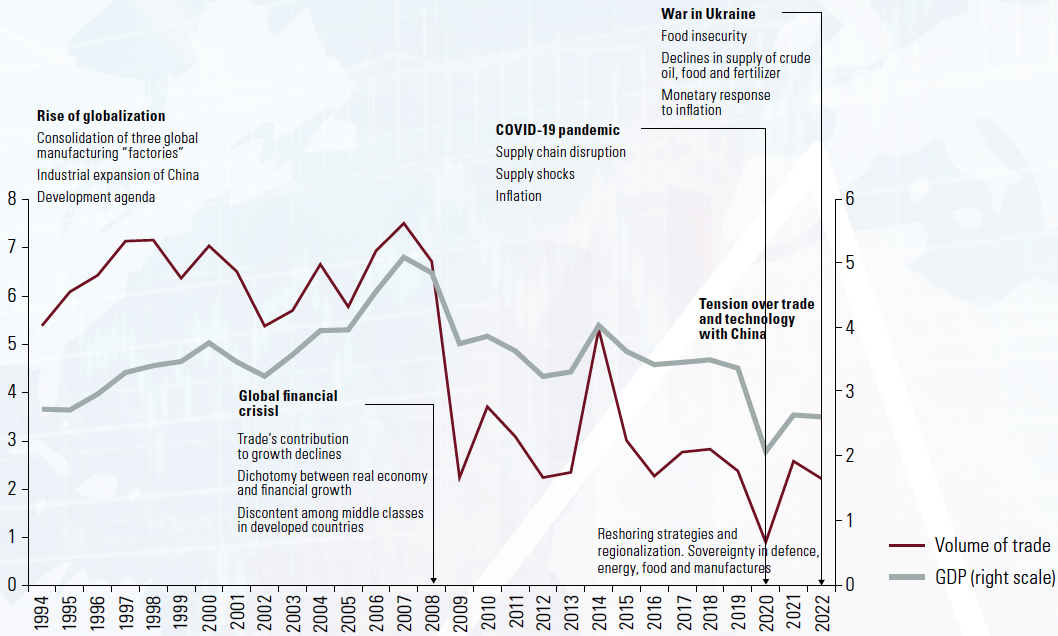
    The first wave of the pink tide was enabled by the extra revenues generated by the global commodity boom in the 2000s and the early 2010s. A repeat of that boom looks unlikely in the 2020s. On the contrary, in general terms the region's economic outlook is now more troubled, as countries struggle to respond to the negative shocks caused first by the pandemic, second by global economic tensions between the US and China, and third by the war in Ukraine. While some analysts see a positive side to the current difficulties, arguing that the absence of any easy economic solutions will increase the chances of genuine reforms being implemented to enhance competitiveness, the reality is that any current or future left-wing administrations face potentially daunting challenges.

    Global headwinds blow stronger
    Annual change in world GDP and volumes of international trade, 1994-2022 (Percentages and five-year moving averages)

    A study by the UN's Economic Commission for Latin America and the Caribbean (Eclac) published in June 2022 concludes that the changed international environment caused by the war in Ukraine will lead Latin America to experience economic deceleration, higher inflation, the slow and incomplete recovery of labour markets, and an increase in extreme poverty and food insecurity. It predicts that 7.8m people will join the 86.4m whose food security is already at risk. After achieving 6.3% growth in 2021, Eclac says growth will slow in 2022 to 1.8%.

    Most significantly, it predicts that the region will subsequently return to the average growth rate it experienced in 2014-2019, of only 0.3% per annum, which means that GDP per capita will be contracting. It is also worth noting that the base period used in the comparison, the five years to 2019, was politically turbulent with major street protests erupting in Chile, Ecuador, and Colombia, rising evidence of crime and corruption across the region, and presidents being impeached in two countries, Brazil and Peru. While history does not repeat itself, this does suggest dissatisfaction with insufficient economic growth will be a destabilising factor in the next five years, running to 2025.

    Accompanying the disappointing outlook for economic growth, there will be a rise in inflation (the region's average 12-month rate jumped from 6.6% at the end of 2021 to 8.1% by April 2022). Factoring in these elements of stagflation, Eclac concludes that the proportion of the population living in poverty will rise to 33.7% (1.6 percentage points above end-2021), while extreme poverty will rise to 14.9% (up by 1.1 points). The net effect of higher commodity prices, increased transportation costs, and international supply chain disruption caused by the Ukraine war will be negative. Eclac says pro-growth fiscal and monetary policies will be required, which will require steps “to reduce evasion, re-orient tax expenditures and bolster the progressiveness of the tax structure”. The UN body calls for extra measures to improve food and energy security, including more rapid development of renewable energy sources. It makes the wider point that the world is experiencing a “breakdown in globalisation” and a process of regionalisation. This has led to a new emphasis on sovereignty objectives in defence, energy, food, and key industrial sectors.

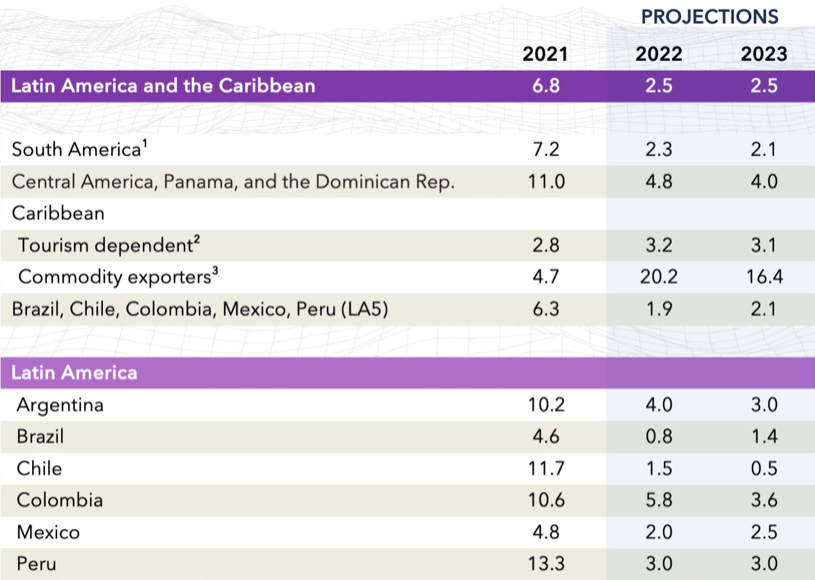
    Economic forecasts: Latin America and Caribbean
    Real GDP growth (percentage)

    Other multilateral financial institutions are broadly in line with Eclac's pessimistic projections. The World Bank expects regional growth to dip to 2.5% this year and to 1.9% in 2023 “reflecting tightening financial conditions, weakening external demand for growth, rapid inflation, and high policy uncertainty in some countries”. The IMF has predicted growth will slow from 6.8% in 2021 to 2.5% both in 2022 and in 2023. Interestingly the IMF has toned down its traditional neoliberal pro-fiscal austerity position to one which is more supportive of ‘pro-poor’ fiscal stimulus. In a recent blog the IMF said that “to ensure social cohesion and reduce the risk of social unrest, governments should provide targeted and temporary support to low income and vulnerable households, while allowing domestic prices to adjust to international prices”. It also defended what it called “inclusive consolidation” which would prioritise spending on social programmes, health, education, and public investment, while implementing tax reforms (including raising personal income tax) in a sustainable manner. 

  • Case study: updating Venezuela’s Bolivarian constitution

    Patrick de Courcy 11 April 2025 Hits: 2262

    The background

    From the 1960s through to the 1990s Venezuela was seen as a modern democratic country, abiding by the rule of law and relying on a relatively stable two-party political system, alternating between governments of the centre-left and the centre-right. However, that was not the whole picture. Over-reliant on oil production and exports, the country suffered from oil price volatility, corruption, and sharp economic booms and busts. In the 1990s a little-known army officer, Hugo Chávez, emerged as an “outsider” critic of the political system, leading an unsuccessful coup d’état. However, this was the birth of a political movement which backed him as its candidate in the 1998 elections. Chávez won with 56.2% of the vote, and was sworn in the following year, 1999.

    Re-elected on various occasions Chávez ruled until his death from cancer in 2013. Most analysts acknowledge that he was genuinely popular through much of his early time in office, although there was an unsuccessful coup against him in 2002 and his government was seen as manipulating the electoral process. Nicolás Maduro succeeded Chávez, inaugurating a period of catastrophic economic mismanagement and increasingly dictatorial political controls. In roughly the 10 years to 2024 the economy shrank by 75%, while an estimated eight million Venezuelans – about one quarter of the population – emigrated. Opposition political parties accuse Maduro of systematically rigging elections to favour the ruling party. Presidential elections were held in July 2024; Maduro was sworn in for another six-year term in January 2025, despite domestic and international criticism.

    What happened?

    The constitution of the Bolivarian Republic was approved in a referendum in 1999, as the 26th Constitution since the foundation of the Republic. The 350-article document – one of the world’s longest constitutions – was written by an elected constituent assembly, and was greatly influenced by the chavista movement, which at that point was riding a wave of public support. It declared Venezuela to be a federal, presidential, and constitutional republic. More than any of its predecessors, the existing constitution recognises and expands citizen rights. The text guarantees free education up to tertiary level, free health care, access to a clean environment, and affirms minority rights (and in particular those of Venezuela’s indigenous communities). The document also creates a unicameral legislature, replacing the old bicameral upper and lower house. The legislature loses some powers which go instead to the presidency. 

    The 1999 text is unusual since it makes no refence to impeachment trial as a method of removing a president who is determined to have been involved in various types of wrongdoing. Instead, a president can be removed from office by a citizens’ recall referendum, or by a decision of the supreme court. Another unusual feature is that the constitution recognises not three but five independent powers of state: the executive, legislative, judiciary, electoral and citizens’ powers (the latter known as “poder ciudadano”). The text lengthened the presidential term from five to six years and set a limit of two successive terms. However, under the terms of an amendment supported by a referendum in 2009, term limits were abolished.

    Looking forward

    Addressing the national assembly in February 2025, President Maduro announced plans for a constitutional referendum. It is expected that the vote will be held this year; Maduro has appointed a drafting committee which must finalise a new text within 90 days. The president said the new draft would deliver an “expansion and improvement of participatory democracy” and include a new level of government described as “social, communal and popular power”. It would also define a profile “for the society we want from a cultural and institutional point of view” and support a sustainable and more diversified economy. Around 80 articles of the 1999 constitution are to be re-written. There will likely be changes in the powers of governors and mayors. The president said Venezuela was the victim of “all forms of conspiracy” and the new constitution would provide “more draconian” punishments for wrongdoers.

    The constitutional drafting committee includes key member of the chavista power structure. Chaired by attorney general Tarek William Saab (who was involved in drafting the 1999 constitution), its members include the president’s wife Cilia Flores; the vice president, Delcy Rodríguez; the president of the national assembly, Jorge Rodríguez; the head of the national electoral council (CNE), Elvis Amoroso; and the defence minister, General Vladimir Padrino.

    Analysts are asking what the government is trying to achieve with this exercise. The 1999 constitution was the brainchild of Chávez and reflected the values of his “Bolivarian revolution”. It has been used by his political heirs to perpetuate the rule of the authoritarian left-wing Partido Socialista Unido de Venezuela (PSUV). In 2017, under Maduro, a constituent assembly was elected, but it never completed a redraft of the 1999 text, having been diverted to challenge the authority of the then opposition-dominated national assembly. 

    One hypothesis is that the government may be trying to claw back some degree of legitimacy. Last year the Venezuelan government’s image was in almost complete freefall because of its handling of the 28 July presidential elections. Across the region, these were seen as blatantly rigged to keep Maduro in power, despite the landslide of verified votes for opposition candidate Edmundo González Urrutia. By organising a succession of elections in 2025, including the legislative poll (due 27 April) and the constitutional referendum (likely to be held in the second half of 2025), the regime may be trying to “turn the page”, recovering some legitimacy while deflecting opposition demands for Maduro’s departure. Another hypothesis (not necessarily contradictory to the first) is that the new constitution represents the “Nicaraguanisation” of Venezuela, a reference to the way the Daniel Ortega dictatorship in that Central American country has systematically tightened its grip on all forms of opposition.

    New elections this year may also give the regime an opportunity to use a favoured tactic: stirring up disagreements between the opposition parties. As during previous unfree elections, the question is whether these parties should participate or not. The main opposition alliance, Plataforma Unitaria Democrática (PUD), remains adamantly against participation. The PUD’s undisputed leader, María Corina Machado, has set out the logic for abstention: “The elections were on 28 July. That day the people chose. The result must be respected. Until that happens, it is not right to participate in any kind of subsequent elections. Voting time and time again while the results are repeatedly ignored undermines the popular vote.”

  • Brazil: Pension reform ideas start to circulate

    LatinNews 25 January 2019 Hits: 1880

    The new government has begun to reveal its ideas for tackling the most pressing problem weighing on Brazil’s public finances: pension reform. Whether any of the proposals currently being mulled by the economic team will pass muster in congress is, of course, another matter. Three previous attempts to reform Brazil’s social security system, under the last three presidents, were abandoned amid opposition in the legislature.

    This time, things may be different. With Bolsonaro in Davos, vice president Hamilton Mourao, a former army general, gave an interview in which he acknowledged that it was likely that military personnel would have to work for longer to earn their pensions. At present they need 30 years of active service and that number is likely to rise to 35. Similarly, the widows of members of the armed forces look set to pay taxes on their pension income.

    Another idea currently under discussion is whether to increase civil servants pension contributions from 11% to 14%, though there has not been any firm decision taken yet. Bolsonaro himself is reportedly opposed to the idea, but given his self-confessed ignorance of economic matters and his willingness to backtrack, this may not be an insurmountable opposition.

    Notably, the increase in contributions could be done by a normal legislative bill or a so-called provisional measure. In both cases, to become law it would only require a simple majority in congress, rather than the three-fifths needed for a constitutional amendment.

    From January to November 2018 the pension deficit for the fund that pays the one million retirees of the public sector, including the armed forces, reached R$85.5bn. There are only 632,000 currently working people in Brazil’s public sector. Meanwhile, the deficit for Brazil’s non-public sector retired workforce is R$188.6bn, in a fund that pays to around 30 million beneficiaries.

    Inflation

    On 14 January, the Getulio Vargas Foundation (FGV) business school and think-tank published figures showing that in 2018 inflation for senior citizens was 4.75%, above the standard IPC-BR-Brazilian Consumer Price Index, which stood at 4.32%. Food and clothing prices were particularly important items for senior citizens.

    Similarly, on 15th January, the Institute for Applied Economic Research (Ipea) released data that showed that in December inflation of consumer prices for the poorest families in Brazil was 0.21% versus 0.09% for the more wealthy families. This was because of increases in the prices of basic items that poorer families consume.

    Amazon Warehouse Opens

    Retail giant Amazon opened its first distribution center in South America on 22 January. Locatated in Cajamar, 45 km outside of Sao Paulo, the 47,000m2 warehouse stocks over 120,000 different products, a number that is expected to grow along with demand.

    The world’s most valuable company has been in Brazil for six years, but it has offered a far narrower selection of goods than in most other countries. While the Cajamar warehouse is the first in South America, Amazon has 10 in India, 12 in China, and 18 in Europe. In the US, it has 18 warehouses in California alone. The company has not revealed exactly how many people are working at its new warehouse, although it says the number is in the 100s.

    A report for BTG Pactual suggest that the company will face stiff competition in Brazil from well-established players, like B2W and Magazine Luiza, which have invested heavily in improving their range of products and delivery services in recent years.

  • PANAMA: Bank assets grow

    LatinNews 26 January 2012 Hits: 721

    While the rest of the world’s banks are swallowing losses and shrinking their balance sheets, those in Panama’s banking centre are growing at a double digit rate. In 2011 the banks here reported a 14.6% growth in assets.

    At the end of November 2011 the banks reported assets of US$81.2bn up 14.6% on the end November 2010 figure. The Superintendencia de Bancos noted that the banks’ credit book had increased 16% while their securities portfolios were up by 13.4%.

    The banks reported net pre-tax profits of US$1.17bn for the first 11 months of 2011. This was 15% more than for the same period of 2010. The banks’ interest income was up 11% while their investment portfolios increased profits by 14%. Bank lending to the local private sector was up 15% at US$28.1bn. New loans accounted for US$18.1bn, up 23% on November 2010.

    There are 50 banks with general licences operating in the country’s banking centre and 28 with an international licence which restricts them to international business.

    • Central America: Comparisons 2011 GDP figures

                                    PPP GDP        Nominal          per cap

    Costa Rica                  US$50bn         US$40bn      US$11,000

    Panama                     US$45bn         US$30bn      US$12,600

    El Salvador                 US$45bn         US$22bn      US$7,500

    Guatemala                 US$25bn         US$46bn      US$5,000

    Honduras                   US$15bn         US$17bn      US$4,000 (IMF)

    Nicaragua                   US$17bn         US$7bn         US$3,000 (IMF)

    Belize                         US$3bn           US$1.4bn        US$9,500

    Source: LAEB

  • PANAMA: Confidence droops

    LatinNews 19 July 2011 Hits: 508

    Two years into President Ricardo Martinelli’s term there are signs that consumer confidence is beginning to wilt. An opinion poll by Unimer for La Prensa, a Panama City newspaper, published on 11 July, found that 43% of the 1,204 people surveyed thought that the economy was in a worse state in June 2011 than 12 months earlier.

    Admittedly, the level of economic confidence is still historically high at 56%, but it has been falling consistently in the past six months. In June 2010 60% of those polled by Unimer thought that their economic situation had improved or at least not deteriorated in the past year. This year only 56.2% said the same.

    Furthermore, only 20.9% said that they were sure that that their economic position would improve in the next 12 months. This was the lowest reading on this indicator since August 2009 when it stood at 50%.

    On the glass half-empty side, 36.7% said that things were either the same or worse than a year ago. What is interesting is that it is the young and richer Panamanians who think this: Unimer said that the bulk of those who thought that they were doing no better than a year ago earned between US$1,500 and US$2,999 a month and were also aged between 25 and 34.

    Raúl Moreira, president of the Colegio de Economistas de Panamá, argued that rising food prices were probably the main reason for the deterioration in economic confidence. He said that inflation also seemed to be on the rise and that the quality of new jobs being created was deteriorating. He noted that the percentage of workers who believed that they were overqualified for the job they were currently doing rose from 11% to 14% in 2010.

    Canal: The administrator of the Panama Canal, Alberto Alemán Zubieta, forecasts that this year the Canal will beat its record for tonnage shipped through the Canal and tolls paid. He said that, the Canal Authority reckons that the tonnage for the current financial year which ends on 30 September 2011, will be between 15m t and 20m t ahead of the 320m t it had initially budgeted.
    The Canal’s previous record year was in 2007, before the global financial crisis, when it handled 312m t.
    Alemán said that he expected cargo levels to hold up in the final quarter of the financial year. This is bold, given that there is strong evidence that the US economy is not growing as well as it was six months ago.
    Alemán expects the Canal’s total income to come in above US$2bn, which is just ahead of the result for the last financial year.

    Banking centre: At the end of May the 92 banks operating in the International Banking Centre in Panama had assets of US$74bn, up 15% in a year. Domestic deposits were up by 9% at US$31bn while domestic credit was up by 15% at US$26bn. The figures for the state of the national banks as reported to the Instituto Nacional de Estadística y Censo showed that foreign banks and locals increased their deposits in Panamanian banks. This extra money was invested in loans and securities.

    Car sales: The gloomy Unimer survey of economic confidence does not chime with data for vehicle sales. These show vehicle sales up by 31%, year-on-year in the first four months of 2011 compared with the same period of 2010. In the first four months of 2011 vehicle sales came to 14,175 compared with 10, 851 in the first four months of 2010. Sales of luxury vehicles were up by 63%, year-on-year at 284 for the first four months of 2011.

    • Off the OECD grey list

    Panama has been removed from the Organization for Economic Co-operation and Development’s (OECD) grey list after signing a tax information exchange agreement (TIEA) with France. The deal brings Panama’s total of agreements to the critical twelve that meets the international standard.

  • Venezuela: Maduro’s new front – JP Morgan

    LatinNews 23 November 2016 Hits: 2830

    President Nicolás Maduro has threatened legal action against the US investment bank JP Morgan after the bank reported delays by the state oil company Petróleos de Venezuela (Pdvsa) in making external bond payments. Maduro, along with his energy minister and Pdvsa president, Eulogio del Pino, accused JP Morgan, along with the US based Citigroup and the US treasury, of participating in a conspiracy to topple Venezuela’s 17-year-old left-wing Revolution and re-assert direct or indirect US control over the country’s vast oil reserves.

    Maduro on 22 November accused JP Morgan of falsely reporting that Pdvsa was in default after the bank released a client note a day earlier reporting that Pdvsa had activated a (standard) 30-day grace period to complete some scheduled bond coupon payments.

    Some US$539m of coupon payments on Pdvsa bonds maturing in 2021, 2024, 2026, and 2035 were due in mid November, but according to Citigroup and Clearstream (acting as financial intermediaries) only US$135m was received, investment bank JP Morgan Chase said in its 21 November client note. JP Morgan said it believed that Pdvsa had delayed a US$404m payment, but added that it believed that the company would make full payment within the 30-day grace period. However, the bank suggested, “this highlights the cash difficulties and mismanagement of PDVSA with regards to its liabilities”.

    Later that day Pdvsa issued a statement denying the veracity of the JP Morgan note, saying it had “punctually” paid its obligations for the 2021, 2024, and 2026 letters and was also “in the process of executing interest payments” for its 2035 bonds. “In this way, PDVSA honours its commitment...ratifying the financial solidity of Venezuela’s main industry”, it noted, insisting that it was not in default. Del Pino also tweeted: “The information about a PDVSA default spread by the enemies of the fatherland is totally false”.

    The Venezuelan economic analyst Francisco Rodríguez (currently at Torino Capital in New York), meanwhile suggested that there might have been a technical glitch with the payment. He noted that Pdvsa payments were going “through accounts not conventionally used for these purposes” and that there had “recently been some Pdvsa management changes, all of which may have resulted in a delay”. The first part of that comment may have been a reference to the fact that in July Citi announced that it would no longer provide correspondent banking services to its Venezuelan clients (public and private), albeit it later agreed to continue to act for the Venezuelan government/central bank/Pdvsa until it could find a new provider, a process that appears to be taking time. “Our tentative conclusion is thus that the delay in payments likely reflects administrative and technical issues of the type that the 30-day grace period is designed to handle. We do not believe it reflects a change in the [Venezuelan] authorities’ willingness to service its international obligations”, Rodríguez observed.

    Whatever the facts, investor nerves were rattled, sending Pdvsa debt premiums (already ranked ‘distressed’ by the main ratings agencies) higher. Pdvsa has paid over US$2bn in debt obligations in the past two months. It also managed to swap US$2.8bn of 2016-2017 bonds for notes maturing in 2020, providing some relief to the cash-strapped company. But a spike in costs is the last thing it needs at this point.

    Maduro thus immediately saw a conspiracy. “JPMorgan’s attitude is of a criminal nature,” he declared, during his new weeknight salsa music program (La Hora de la Salsa), broadcast from the presidential palace (and which in fact runs for two hours). The president said that the government’s opponents at home and abroad were seeding false rumours that the country was on the verge of a debt default. He also suggested that Citi might deliberately have delayed processing of the coupon payments as part of this.

    Noting that he had asked Del Pino to look into legal options, Maduro noted that “the least JPMorgan can do is apologise to the Venezuelan people”. “I would tell the bondholders to call up Citibank and ask why they are delaying payment of money that is already in their accounts,” said Del Pino, likewise accusing Citi of taking part in “attacks” on Venezuela.

    The Maduro government has made patently clear that its main policy priority is to avoid default on Venezuela’s US$68bn in external bonds – and it has gone to extreme lengths this year to remain current on its obligations. The central bank (BCV) had US$10.9bn in international reserves as of 18 November. Despite Pdvsa’s latest bond swap, total combined debt obligations by the sovereign and Pdvsa for 2017 are still high, at US$8.1bn. Their joint debt service commitments to 2020 average US$8.7bn a year.

    Despite Venezuela’s willingness to pay its debt obligations, the main question is over its ability to do so. With international oil prices set to recover only moderately, swaps traders are still assigning a 51% probability to a Pdvsa default in the next 12 months.

    Black-market FX rate breaches 2,000/US$

    The (illegal) black market exchange rate had soared to over Bs2,300/US$ as of 22 November, according to websites that track it, most notably including DolarToday.com, which claims to base its daily information from the exchange rates reported from traders in Cucuta, on the Venezuela-Colombia border. The site, run out of the US, is a major bugbear of the Maduro government, which accuses it of being part of the economic and financial ‘war’ on Venezuela. An estimated US$15m changes hands on the black market every day, and the rate reported by DolarToday has a direct bearing on price setting by importers across the country, who use it as a reference – to the extent that the central bank has twice (unsuccessfully) filed suit against the site in US courts, a recent report in the Wall Street Journal noted.

    According to DolarToday, the black market rate has fallen by 44.8% in the past month and is now over three times the secondary official rate of Bs660/US$, which is used for imports of non-essential items (food and medicines come in at a special primary rate of Bs10/US$).

    This continuing depreciation not only reflects the severe shortage of dollars for import purposes, but more notably runaway local money supply, as the central bank prints Bolivares in unprecedented volumes in support of the government’s efforts to sustain domestic spending. According to the BCV’s own data, money supply rose by just over 14% in the month of October alone.

  • Is the plan enough?

    LatinNews 19 August 2020 Hits: 916

    This section includes some general comments about the viability of Plan País in particular, as of other, wider economic recovery plans for the country.

    The politics remain complex

    As described, Plan País was published in December 2019 at a time of relative confidence within the opposition coalition. Both the politics and the economics have moved on since then and not necessarily for the better. The opposition is now less confident and more prone to divisions over its strategy. The PSUV has for the moment regained the political upper hand. At the time of writing unfree congressional elections were expected in December, which the opposition was intending to boycott but which would nevertheless likely be used by the PSUV to regain control of the legislature. This would severely undermine the legitimacy of Guaidó’s parallel government and may also weaken confidence in its ability to implement a recovery plan. On the economic front the global Covid-19 crisis had once more worsened the outlook for the country, particularly by triggering a bust in global oil prices. The future of US economic sanctions, and indeed of the entire US position on Venezuela, has also become more uncertain as it now depends on the outcome of the US elections due in November 2020.

    As a result of the domestic political dynamic, the timing of an eventual transitional, post-Maduro government seemed to be slipping back. The likelihood that such a government might include, or even be dominated by elements from the PSUV has also increased. In any case, as argued by think tank International Crisis Group (ICG), “a stable transition requires a series of guarantees that would prevent the perpetuation of a winner-takes-all system and protect the political rights of the losing side”. This process might require some re-writing of the existing economic recovery plan, for example by pulling back on some of the more radical privatisation ideas. In ICG’s view, as part of doing a deal, a future government might need to commit to “a guarantee of public ownership of hydrocarbons and other natural resources in the sub-soil; guaranteed access to public health, education, and housing; and subsidies covering essentials such as goods and medicines to shield the most vulnerable.”

    The challenge may be bigger than anticipated

    Perhaps for understandable political reasons some members of the opposition have given the impression that opening up the Venezuelan economy will be relatively easy and yield relatively quick results. For example, in July 2020 Reinaldo Díaz, the representative of the Guaidó parallel government in Mexico, who was presenting a summary of Plan País, prefaced his remarks by declaring “Welcome to the fastest economic recovery plan of the 21st century” a claim which was, to say the least, alarmingly premature. Although not mentioned in the plan, Díaz said an updated aim was now to build a recovery fund “worth between US$80bn and US$100bn” which would be used to balance the fiscal accounts, strengthen the currency, and deal with the humanitarian crisis.

    There are significant reasons for caution. In April 2019 and May 2020 respectively, the opposition leadership supported a military coup and a small military incursion into Venezuela, both of which were ill-prepared and quickly stamped out by government forces. Independently of whether these actions were politically justifiable or not, the way they were implemented suggested poor judgement and planning within the opposition leadership. Transferred to the economic policy sphere a similar deficit of judgement and planning could send an intensely negative signal to investors and consumers, undermining confidence at a key time.

    While the situations are admittedly different in a number of respects, the US-led invasion of Iraq to topple the dictatorship of Sadam Hussein in 2003 notoriously underestimated the economic, political, financial, and security challenges facing the transitional administration. The Washington administration of the time lacked a clear plan for “the day after” not just on key security issues, but also on economic ones. It took eight years (2003-2011) for Iraqi oil production to recover from 1.3m bpd to 2.6m bpd.

    In Venezuela’s case security issues could also complicate the economic recovery. Corruption is widespread and has drastically weakened state oil company PDVSA, as well as many other institutions. Groups linked to the government and to the top levels of the armed forces have been associated with criminal activities including drug trafficking and illegal gold mining. Criminal gangs are known to control important areas of Caracas and other key cities. Homicide rates are some of the highest in Latin America.

    The Maduro government has various official and semi-official security forces and militias, including those known as “colectivos” which are heavily armed. It is conceivable that some of these forces will seek to undermine the economy under a future transitional government, in a manner not dissimilar to actions taken by former government supporters and members of the Ba’ath Socialist Party in Iraq. The need to contain these potentially destructive forces, offering some form of transitional justice process coupled with future job creation, is a political priority but will also have a potentially major impact on the economy. If they continue, corruption, high crime levels, and poor security could convince potential foreign investors to keep away from the country.

    Will the international community come up with the money?

    As we have seen, almost all recovery plans start out with the assumption that an international financial rescue package worth somewhere between US$50bn and US$100bn will be required – and forthcoming. In addition, it is also assumed that it will be possible to restructure and reschedule Venezuela’s large foreign debt. Given the country’s limited ability to earn foreign currency to service the debt, some form of debt write-down appears inevitable. In August 2020, Argentina concluded a renegotiation with its bond creditors that averaged a 45% write down on the face value of debt paper. Holders of Venezuelan bonds might expect a somewhat larger ‘haircut’. But many who bought Venezuelan bonds on a speculative basis in the first place can be expected to take legal action to minimise the write-down. If negotiations between the creditors and a new transitional government get bogged down, the country will continue suffering key currency shortages. In any case, debt renegotiation will increase the Venezuela rescue price tag faced by the international community.

    There is a significant risk that international funding for a post-Maduro recovery may fall short of what is needed. The Covid-19 crisis has triggered sharply increased fiscal deficits in countries all round the world, pushing up public debt as a proportion of GDP. Major fiscal stimulus measures have been taken in 2020, but as a recovery begins to unfold in 2021 and subsequent years efforts will be made to bring fiscal accounts and debt-to-GDP ratios back under control. In that context of narrowing fiscal space the ability and willingness of the developed countries and of Venezuela’s regional neighbours to fund its recovery will be constrained.

    Economic diversification needs to be addressed

    A striking feature of Plan País and the thinking about Venezuelan recovery is that by and large it is based on the hypothesis of a sustained recovery in international oil prices. While the plan acknowledges environmental concerns, the strategy is still mainly fossil fuel based. Admittedly, the world will continue depending on hydrocarbons for many decades yet, but the ‘energy transition’ – the move to greater use of renewable energy sources such as solar and wind power - questions the wisdom of a recovery plan that is overly-reliant on oil.

    Major international oil and gas companies are themselves beginning to diversify into non fossil-fuel energy alternatives. Many have announced plans to become carbon-neutral by 2050. Improvements in wind and solar-based electricity generation, including energy storage technologies such as industrial batteries and an emerging hydrogen economy, mean that energy demand is undergoing some fundamental changes. Subsidy-free wind and solar energy can now in certain circumstances be more competitive than fuel oil or coal. Companies and governments are having to acknowledge that some of their coal mines and oil wells may become ‘stranded assets’ – no longer commercially viable.

    In other words, an economic recovery plan also needs to help Venezuela move beyond the petroleum curse that has been such a major factor in the last 100 years of its economic development. The country needs a short- and medium-term economic recovery plan which is not inconsistent with the continuing, longer-term need to diversify and develop greater resilience. Arguably, the necessary investment in rebuilding Venezuela’s power grid will generate a better long-term rate of return if it includes an element of renewable energy.

  • Brazil: the trials and tribulations of coalition building

    Patrick de Courcy 06 July 2023 Hits: 2060

    The beginning of Lula’s third term in Brazil – his first six months in office in January-June 2023 - provides an interesting glimpse of the complexities of building and trying to maintain a pink-green ruling coalition. The returning president had a strong start. He promised to reverse his predecessor’s lack of concern for Amazon deforestation. Lula announced a 37-strong ministerial team (up from 23 under his predecessor). Signalling a change in approach as part of this restructuring, he created a new ministry for indigenous people, appointing Sonia Guajajara, an indigenous rights campaigner, as its new head. He also appointed the well-known climate change campaigner Marina Silva as the new environment minister. Lula and Silva have history. As a prominent green in a pink government, she had held the post before in an earlier Lula presidency but resigned after clashing with the president over the Belo Monte hydroelectric project, which he supported on developmentalist grounds, but she opposed, on environmental grounds. Her re-appointment was therefore interpreted as a sign that the new government would take environmental issues more seriously than it had done in the past.

    Also in January, the new government declared a health emergency in the main Amazon reserve occupied by the Yanomani people. This was in response to reports that more than half of that 27,000 strong indigenous community were suffering a cocktail of diseases caused by large-scale incursions of illegal gold miners known as garimpeiros. The impact on the Yanomami included mercury and water poisoning, malaria, and malnutrion. The president ordered the security forces to evict up to 20,000 garimpeiros who had invaded the Yanomami’s protected lands.  

    At this early stage however, potential tensions were already making themselves felt within the ruling coalition. One of the issues facing it was whether or not to authorise Petrobras, the state oil company, to drill 16 exploratory oil and gas wells in the Equatorial Margin Area near the mouth of the Amazon. An earlier request to do so had been turned down by Ibama, the environmental regulator, on the grounds that the state-owned company had failed to complete a wider environmental impact study, nor presented adequate measures to communicate with indigenous communities and coordinate with neighbouring countries to deal with any eventual oil spills or other forms of contamination.

    The offshore block in question is part of a long strip facing 2,200 kms of Brazil’s north Atlantic coastline, which is also close to Guyana, a country now enjoying an economic boom after an Exxon-led consortium made major deep-sea oil finds in 2015. Developing oil and gas exploration and production in the Equatorial Margin could offset falling output by the end of this decade in some of the country’s other fields such as Tupi and Búzios in the southeast. Mining minister Alexandre Silveira has described exploration in the region as a “passport to the future”.  Estimates suggest that the block could add some 1.1m barrels per day of output – highly significant since current production levels are around 3.1m barrels. Since the north-eastern states are among the poorest in Brazil, local politicians are also enthusiastic over the prospects for job creation in offshore support services, along with using royalty payments for public works.

    Against that, environmentalists point out that the wider area contains sensitive marine ecosystems, including mangroves, extended coral reefs, sea sponges, and unique and diverse fauna such as whales and dolphins which could be placed at risk. Some analysts say that an unregulated combination of onshore and offshore development could accelerate deforestation. Certainly, a decision to allow rapid fossil fuel development in the mouth of the Amazon would sit uncomfortably with the government’s pursuit of green credentials.

    While Marina Silva seems to have fended off drilling – for the moment at least – she has suffered some political difficulties with a senator from REDE, her own green party, defecting and saying he now supports drilling because of the investment and employment it could bring to his home state of Amapá. With further ecological impact studies likely, Lula has so far avoided coming down on either side of the debate. He has however always been upbeat about increasing domestic oil output and commented that he finds it “difficult to believe” that offshore drilling 500kms from the rainforest might contribute to deforestation. Some journalists believe there is still a possibility that Lula and Marina Silva could end up on opposite sides of the Equatorial Margin debate, just as they did years earlier on the Belo Monte debate.

    On other fronts, by May 2023 it looked as if the Lula administration might be facing a major pushback from supporters of the developmentalist school of thought. The problem is that the centre-left government lacks a majority in congress, which is controlled by often opportunist parties of the centre and far right. These parties and associated lobbies were able to deal the new government a series of blows. For example, they updated and passed a law known as the marco temporal which restricts indigenous land rights.

    Under the 1988 constitution ancestral land rights are recognised and governments are required to assess claims and designate indigenous reserves. To date some 487 reserves, covering 14% of national territory, have been so designated. A further 200 are in the pipeline. But the marco temporal subverts this by restricting the process only to lands that were physically occupied on 5 October 1988, the day the constitution was approved. This effectively excludes indigenous communities who say they had been evicted from their traditional lands during the 1964-85 military regime. The marco temporal also creates loopholes permitting mining, farming, and public infrastructure construction on indigenous reserves.

    In a second move, the opposition challenged a presidential decree creating his new 37-strong ministerial team and specifying the responsibilities and powers of each ministry. These decrees are known as medidas provisorias (MPs). They come into force immediately but are set to lapse automatically if not ratified by congress within 120 days. Under custom and practice, congress has almost always quickly approved a new president’s MP detailing how the executive power will function. But in this case opposition members of congress threatened to vote it down, demanding changes to the workings of the cabinet.

    As part of these changes, control of the rural land registry – a key unit in the battle to reduce deforestation – was taken away from the environment ministry and awarded instead to the ministry for management and innovation. Responsibility for indigenous land demarcation passed from the indigenous affairs ministry to the ministry of justice. Both the ministries that suffered a loss of jurisdiction are led by the greenest members of government (Marina Silva and Sonia Guajajara) so the move can be seen as designed to weaken policies to protect the environment as well as promoting tensions within the ministerial team. Silva said the weakening of her ministry was a “setback”. Guajajara admitted to feeling “a certain degree of frustration” with Lula’s response.        

    In short, the Lula government will face an ongoing challenge to manage a pink-green coalition where there are both internal differences over specific policy issues and external threats from opposition political parties. This will require a high degree of political skill, as well as a communications strategy that challenges established stereotypes. For example, it is often assumed that commercial farming and livestock ranching maximises export revenues and therefore must be protected from environmental regulation and restrictions which do nothing more than add on costs. This is certainly an argument used by farmers allied to bolsonarismo – the movement led by former president Jair Bolsonaro. Yet there are at least two major reasons to question this profit maximisation approach. The first is that consumer sentiment in Europe and other key export markets has been changing. Lobby groups have called for boycotts of supermarket sales of Brazilian products linked to deforestation. In the long term, therefore, it may be in the interest of agro-industrial exporters to promote a cleaner and greener image, with transparent rules of origin.

    The second factor is that if fears of a deforestation tipping point prove to be well-based, the deterioration of the Amazon will incur massive real-world financial losses. A rational commercial approach therefore would be to try and avoid them by investing in a campaign to stop deforestation. A World Bank report published in May 2023 attempted to quantify some of the losses that might be involved. It found that the degradation of the Amazon would jeopardise agricultural production, water supply, and the ability to generate hydroelectric energy. It estimated that the savannisation of the Amazon would cost the Brazilian economy US$184.1bn, or 9.7% of GDP, by 2050.    

  • HONDURAS: Hernández’s war

    LatinNews 29 October 2014 Hits: 1017

    President Juan Orlando Hernández on 23 October sanctioned a legislative decree introducing life imprisonment sentences for the assassination of members of the executive, the national congress and the judiciary, warning that anyone attacking “the operators of justice” would “pay with the denial of their freedom for the better part of their lives”.

    The move comes amid growing fears that many parts of the Honduran state, from local and regional authorities all the way up to government agencies, as well as the security forces and the judiciary have either been captured, or are severely threatened, by narco elements and organised crime. The extent of alleged corruption in the national police prompted a big push on police reform by the last government led by President Porfirio Lobo (2010-2014). Those efforts were severely hampered by resistance from within the force itself (and were also questioned by the supreme court) and the results to date appear mixed at best. The US-based NGO Human Rights Watch (HRW) notes that “the institutions responsible for providing public security continue to prove largely ineffective and remain marred by corruption and abuse, while efforts to reform them have made little progress”.

    The judiciary is another institution struggling to cope with the difficult security situation in the country. While the judiciary more often than not is tarred by critics as ineffective and corrupt - “Perpetrators of killings and other violent crimes are rarely brought to justice” - notes HRW, the reality is that there is not much by way of incentive for Honduran judges to stick their necks out in the name of the law. On 24 October the Asociación de Jueces por la Democracia y la de Fiscales de Honduras issued a statement calling on the authorities to clarify the assassinations of 84 judicial workers, including judges and lawyers, since 2010 (on figures from the state’s human rights commissioner). The group made the statement following the abduction and murder of a former justice of the peace and public defender, Iris Argueta, in Catacamas (Olancho) the previous day (23 October). Another two judges (named by the press as Marlen Banegas and Patricia Eufragio) were shot dead on 11 October in San Pedro Sula, for which four people have been detained, according to local media. Notwithstanding the president’s day-earlier decree, the statement called for preventative measures including stiffer sentences for crimes against judicial workers and a strengthening of criminal investigations.

    Fresh ink on IMF deal

    The government finally has inked a new agreement with the International Monetary Fund (IMF) that should give it access to upwards of US$200m in new financing as of 10 November, likely under a new Stand-By Arrangement (SBA). In a statement following its last country visit in September, the Fund said it had begun discussions on a three-year programme, aiming to “preserve macroeconomic stability in Honduras, while improving conditions for sustainable economic growth and supporting efforts to reduce poverty in a fiscally affordable manner.”

    Details are not yet available but President Hernández said the funds would go partly towards this year’s budget to help reduce an estimated fiscal deficit of 8% of GDP. According to the IMF’s latest World Economic Outlook (WEO), Honduras will post real annual GDP growth of 3.0% on average between 2015 and 2019, with average inflation easing from about 6% this year to 5% by 2019. Unemployment is pencilled in at 4.5% on average through to 2019.

    Ambitiously, the Fund has the fiscal deficit falling from 8.0% to 4.0% in the same period, with the current account deficit falling from 8.0% this year to 6.5% by 2019. In just four years, and without sustained US growth to kick-start Honduran exports, for instance, that is a tall order. Finally, total general government gross debt will hit 57.6% of GDP by 2019, however the country should have more access to external financing with an SBA in place.

    Narco mayors

    Marvin Ponce, an outspoken former left-wing deputy who is currently an adviser to President Juan Orlando Hernández, has been summoned by the Dirección de Lucha contra el Narcotráfico (DLCN) after he declared in an interview that there were “at least six narco mayors” (‘narco alcaldes’) within 100km of Tegucigalpa. Ponce suggested that at least 35 municipal workers in these areas had been linked to organised crime, and said he knew of eight mayors under investigation, along with “various deputies and seven businessmen who use their positions to launder money”. The DLCN said it would ask Ponce for evidence.

  • Peru’s perfect storm

    LatinNews 31 March 2021 Hits: 1676

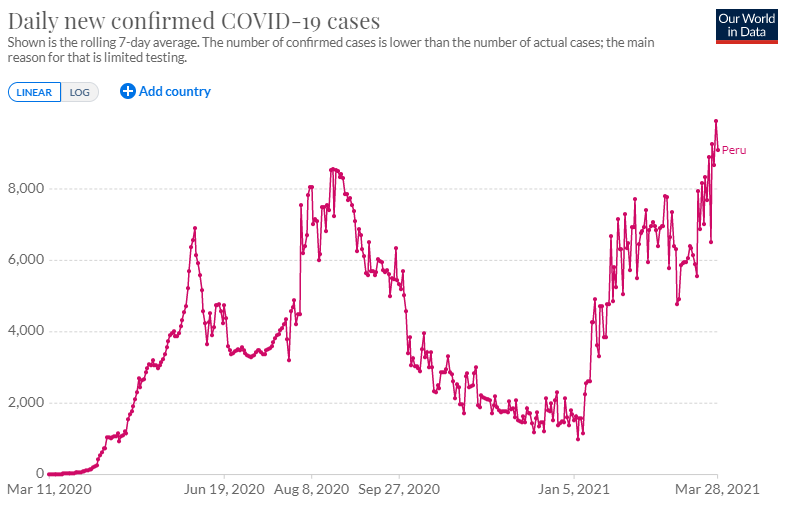
    Some analysts believe the first year of Covid-19 in Peru has also brought with it the most intense ‘perfect storm’ of problems experienced by the country in at least the last two decades. By the time the pandemic hit in March 2020 the country had already been dealing for several years with a long-running political, constitutional, and corruption crisis. In January new congressional elections had been held, raising hopes that a deadlock between the executive and legislative branches of government could be resolved. President Martin Vizcarra won early praise for the speed and decisiveness he showed after the first case was detected on 15 March, moving rapidly to impose a draconian quarantine regime. Although initially intended to last two weeks, this lockdown was repeatedly extended and ended up lasting three and a half months. To the government’s consternation, however, the lockdown triggered a dramatic economic collapse while failing to deliver the desired flattening of the curve of new Covid-19 cases and deaths.

    Almost half the economy ground to a halt (second quarter GDP fell by nearly 40%). For the year as a whole GDP slumped by 11.1%, the worst recession in three decades. Government attempts to offset these falls with counter-cyclical stimulus measures were significant (amounting to US$18.25bn worth of emergency payments and aid to companies) but ultimately ineffectual. The evidence suggests that this stimulus helped hold poverty in check but did not prevent the loss of 6m formal jobs at the peak of the first wave. It was also evident that the high level of informality in the labour market meant that many people were forced to keep on working to survive, and to do so in crowded street markets and shanty towns where living conditions meant quarantine and social distancing rules were regularly ignored.

    Peru experienced a major breakdown in its public health system. The country has one of the lowest numbers of ICU beds relative to population, and state-owned hospitals were soon swamped with many victims of the virus opting to stay at home, with their relatives desperately seeking to acquire oxygen for respirator machines. Demand for oxygen tripled, and the black-market price for oxygen cannisters soared.

    As the first wave began to recede the political crisis gathered pace. In one week in November the country had no less than three presidents. In that week Vizcarra was impeached, but the appointment of Manuel Merino, from a conservative opposition party, as an interim successor, triggered violent nationwide protests and forced congress to select Francisco Sagasti instead, who formed a transitional administration to cover the period running up to new elections in April 2021. Sagasti took office just as a second wave of infection began to gather pace, once more overrunning hospital capacity. The beginning of a vaccination campaign did not ease the political pressure on the new president, who was hit by the so-called ‘Vacunagate’ scandal, the revelation that around 100 government officials were secretly vaccinated ahead of the launch of the public immunisation programme (the beneficiaries included former President Vizcarra, former ministers, and members of their families).

    Peru Cumulative Cases Cumulative Deaths Deaths per million
    15 March 2021 1.4mn 48,841 1,475

  • ECONOMIC OVERVIEW: COSTA RICA

    LatinNews 02 September 2011 Hits: 1547

    GDP: On 19 July the Banco Central de Costa Rica (BCCR) raised its real annual GDP growth forecasts for 2011 and 2012. The 2011 forecast was lifted to 4.5%, from 4.3% previously, while the 2012 forecast rose to 4.7%, from 4.5% previously. In 2010 real annual GDP growth came in at 4.2%. Rodrigo Bolaños, the president of the BCCR, noted that economic growth had been a bit faster than the government had expected in the first five months of 2011, hitting 4.4%, thanks to a strong performance by the services sector.

    Oil extraction: On 1 August, his first day back in charge of the environment, energy and telecommunications ministry (Minaet) following last month’s cabinet reshuffle, René Castro announced that the Chinchilla administration had declared a three-year moratorium on oil extraction, but not exploration, in the country. The moratorium effectively ends the pressure being exerted on the government by the Mallon Oil Company, a subsidiary of Black Hills Exploration and Production Inc., and by local environmentalist groups. The first wanted the government to execute a long-delayed 20 year concession contract it had secured in 2000, to explore and start production of oil and gas deposits in the north of the country, before year’s end. Chinchilla’s lukewarm gestures, that she may grant the concession, had caused controversy with environmentalists, including former president Abel Pacheco (2002-2006) who publicly condemned the government’s plans. In reality the moratorium pushed the problem on to the next administration. Castro also said the government will begin the process necessary to freeze Mallon Oil’s operations and that it is ready to pay the company damages should the courts decide that compensation applies.

  • HAITI: Will elections finally take place?

    Patrick de Courcy 26 January 2026 Hits: 959

    Date: First round 30 August 2026, second round 6 December 2026.

    Type: Presidential, legislative (119-member lower chamber and 30-seat senate), and municipal elections.

    Main contenders: Parti Haïtien Tèt Kale (PHTK), of assassinated former president Jovenel Moïse (2017-2021); Inité; Secteur Démocratique et Populaire National; Fanmi Lavalas (FL), of former president Jean-Bertrand Aristide (1991; 1994-1996; 2001-2004); Organisation du Peuple en Lutte (OPL), an FL splinter group; Fusion des sociaux-démocrates; among many others.

    Haiti has been mired in political, security, and constitutional crises for years, a situation exacerbated by the assassination of former president Jovenel Moïse (2017-2021) in July 2021. Since then, gangs have capitalised on the power vacuum at the top and now control over 90% of Port-au-Prince, and much of the country. Elections have not taken place since 2016 and Haiti has lacked democratically elected legislative officials since January 2023, when the terms of its last remaining 10 senators expired.

    Staging the vote is widely considered necessary to ending the protracted political transition in Haiti, which is currently governed by a transitional presidential council (CPT). Set up in April 2024 after the previous interim prime minister, Ariel Henry (2021-2024), was ejected amid unprecedented gang attacks, the CPT is tasked both with restoring security to Haiti and steering it towards elections – neither of which it has so far delivered on. The CPT’s mandate is due to end on 7 February 2026 – at which point elections were meant to have been held and a new president and legislature elected. However, this has not occurred, raising questions about what will happen beyond 7 February.

    In a move hailed as a breakthrough of sorts, however, on 1 December 2025 the CPT adopted a long-awaited electoral law. This came two weeks after the provisional electoral council unveiled a new electoral calendar, according to which the first round of presidential and legislative elections will take place on 30 August 2026, and the second round on 6 December 2026.

    Major questions persist however, not least the question of whether minimum levels of security will have been restored by August. Despite the approval by the United Nations (UN) Security Council in 2025 of the new beefed-up Gang Suppression Force (GSF) to replace the under-resourced Kenyan-led Multinational Security Support Mission (MSS), the security situation remains dire. On 1 October Volker Türk, the UN High Commissioner for Human Rights, said that over 16,000 people have been killed in armed violence in Haiti since January 2022.