
All Categories
Subcategories
-
-
Region: Export growth strong but slowing
Latin America and the Caribbean (LAC) exports grew by 10.6% in the first quarter of this year, but there are signs that the pace of expansion is beginning to slow.
According to a report by the Inter-American Development Bank (IDB), Trade trend Estimates in Latin America and the Caribbean, 2018 edition, exports grew by 10.6% year-on-year in Q118, boosted by intra-regional and European Union demand. But the export recovery may be slowing – growth was a little bit down on the 11.9% rate registered in Q417. This is attributed to the fact that prices for a number of key commodities such as coffee, soya, sugar, and iron ore appear to have reached plateaux, and have flattened out or begun to fall. Export volumes continued to grow at around 4% led by Brazil, Mexico, Colombia, and Argentina.
Paolo Giordano, the report’s coordinator, commented, “After a long period of declining trade, the rise in export volumes is good news. However, the region must integrate and diversify more to be better prepared against volatility in commodity prices.” Export growth last year had been supported by rising demand from all of LAC’s main trading partners, but in the first quarter of this year shipments to China slowed down, while those to the EU accelerated. Within the LAC sub-regions, South American exports rose by 10.4% in Q118, after 14.9% growth in 2017 as a whole. Here, export levels are still around 25% below their historical peak reached in 2011. The recovery of commodity markets in 2017 began to dwindle towards the end of the year. In Q118 commodity prices remained volatile with some falling significantly. Exports increased to all partners but growth rates slowed for those going to the US, China, and the rest of Asia.
Prices of the main export products of Latin America and the Caribbean
(Index 2010 = 100, 2016–2018)
Source: IDB Integration and Trade Sector with data from Bloomberg.
In Mesoamerica (Central America plus Mexico) Q118 export growth was 10.8%. This reflected strong growth of Mexican exports (+11.5%) and a weaker performance by Central American exports (+4.8%). For this sub-region exports are now at an all-time peak. Mexican export growth has been largely due to increased demand from the US and, to a lesser extent, from the EU. Central American exports to the US continue to grow, but were doing so at a more moderate pace in early 2018. Caribbean exports grew by 5.3% in 2017, although they were marked by considerable volatility (strong growth in the first half of 2017, followed by contractions during most of the second half).
LAC imports grew by 14.3% in the first quarter, faster than the 9.6% average achieved in 2017. Import growth has consistently exceeded export growth throughout 2017 and early 2018.
-
Problem Number 5: Emigration
Emigration is both a symptom of the Northern Triangle’s deeply embedded socio-economic problems, and a causal factor. The combination of a lack of economic opportunity together with threats of criminal violence has forced nearly 10% of the roughly 30m-plus inhabitants of the three republics to emigrate in recent years, with the vast majority of them making their way up to the United States. The departure of such a large proportion of the population has to be seen as fundamentally negative for the long-term future of all three economies. Yet at the same time it has become to some extent self-sustaining. With or without legal status, significant expatriate communities in the US send money home to friends and family. These flows of remittances have become of critical importance to the three economies. In 2017 remittances received in El Salvador were US$5.1bn or the equivalent of 20.4% of GDP; in Guatemala they were US$8.45bn or 11.2% of GDP; and in Honduras they were US$4.32bn or 18.8% of GDP. The Northern Triangle economies have become highly dependent on these financial flows. Even the criminal organisations that in the first place force people to flee in fear of their lives have found a way to profit from emigration. The street gangs, or maras, are deeply involved in extortion, people smuggling and trafficking. They frequently charge a ‘tax’ to allow emigrants to pass through key points in the land journey across Mexico and into the US.
Emigration is a contentious issue in relations with the United States, the Northern Triangle’s main partner in terms of trade, investment and security. The immigrant or foreign-born share of the US population is currently 43m people, or 14% of the total. Of those, around 11m are believed to be undocumented. According to the 2010 US census, Central Americans living in the US totalled just under 4m. Data collected in 2015 showed 2.171m US residents were of Salvadorian origin, 1.377m were of Guatemalan origin, and 851,000, were of Honduran origin, adding up to a total of around 4.4m. Immigrants play a key role in parts of the US economy. Surveys have shown they make up 45% of domestic employees, 36% of workers in manufacturing, 33% of the agricultural labour force, and 32% of those in the hotels and accommodation sector.
There has been a fundamental change in the nature of Latin American migration to the United States. For many decades Mexican emigrants, who were primarily driven by economic factors, were the largest group among those coming. According to Jeffrey Passel, a demographer at Pew Research, up to 2010 migration numbers ebbed and flowed in synch with the US economy and unemployment rate. “When the US unemployment went down, migration went up. If the unemployment rate went up, migration went down,” he said. But after 2010, as Central Americans became more dominant (particularly those coming from the Northern Triangle) that relationship stopped. The Central Americans kept coming regardless of what happened to the US economy. For them, ‘push factors’ – the desire to escape poverty, violence and crime – appear to be more important than ‘pull factors’ – the employment opportunities north of the US border. In short, the Central Americans are much more like political refugees.
Giovanni Peri, an economist at the University of California, says people from the Northern Triangle are “younger, more vulnerable, and more similar to refugees” and hence more disposed to run the risk of getting caught and turned back. Children – those under the age of 18, accounted for 7% of all people stopped at the border in 2011, rising to 27% in 2017. Peri adds, “The very strict enforcement keeps away people who are mainly motivated by jobs, and selects only very desperate Central Americans, including many kids.” Research by another economist, Michael Clemens at the Centre for Global Development, suggests that Northern Triangle migration is driven by spikes in the murder rate in particular cities in those three countries.
Successive US governments have had a range of policy options open to them in response to the inflow of Central American migrants. Broadly speaking they have ranged from trying reduce ‘push’ factors at source (aid programmes designed to support economic development, poverty reduction, and new job creation within the Northern Triangle) through to enforcement measures such as building walls, tightening border security, and repressing crime and drug trafficking. While elements of both have co-existed, the arrival of Donald Trump as the new US President (January 2017) signalled a shift to tougher enforcement and tighter borders. The Trump administration inherited a programme known as at Alliance for Prosperity, whereby the US committed US$2.6bn in foreign assistance to the Northern Triangle from 2015-2018, with the three republics committing US$5.4bn of their own funds from 2016-2017 to a joint programme to tackle “the security, governance, and economic drivers of illegal immigration and illicit trafficking while increasing opportunities for US and other businesses”.
Writing for Lawfare, a website focused on US national security issues, Jacob Hofstetter has argued that both the Trump administration and the Obama administration before it provided aid to Northern Triangle countries with the aim of improving governance, citizen security, and economic prosperity – things which in the long term may help stem the flow of migrants. However, under Trump “the justification for these aid programmes has shifted from the rhetoric of nation building to that of strict migration enforcement”. Trump has even suggested aid levels (already somewhat reduced) could be cut back further if the desired fall in migrant numbers does not materialise in the short term. In May 2018 he said his administration might “work out something where every time someone comes from a certain country, we’re going to deduct a rather large amount of money from what we give them in aid”. Hofstetter suggests an excessive focus on short-term border control could be self-defeating. By cutting aid “the United States would face long-term irregular migration from the Northern Triangle, no matter how many ‘zero tolerance’ tactics the Trump administration deploys”.
-
Conclusion: two scenarios
One way to talk about Brazil over the next ten years is to articulate two different scenarios, setting out the case for a more successful outcome for the country on the one hand, versus a less successful one on the other.
Starting with the more pessimistic outlook, it can be argued that the next three governments will be unable to make significant progress to fix the six major problems we have enumerated here. In this gloomy view, perhaps the central problem will be a broken political system. The current multiparty system depends on corruption to function. Despite attempts at reform, in this scenario we suggest that politicians will be ultimately unable or unwilling to clean up their act. To be able to govern, president-elect Bolsonaro and his successors will have to continue with the system of “presidential coalitionism” along with all the corruption that implies. In line with other populist and nationalist leaders (such as Donald Trump in the US) he will talk about “draining the swamp” but in the end he and his immediate successors will make little real change.
Arguably, by putting in place an economic team committed to radical free market policies the new government may make headway towards correcting fiscal imbalances and reforming the pension system ahead of an expected financial ‘crunch point’ in the early 2020s. This will nevertheless be an extremely difficult task, since lobby groups that benefit from government spending will resist change, and since navigating reforms through the fragmented legislature will be challenging. Perhaps, however, the economy will recover the necessary growth rates to stabilise the country’s debt ratios. On the issue of crime, there is a real danger that hard-line rhetoric will actually increase levels of violence in the country and that a Philippines-style wave of extrajudicial killings will undermine the rule of law. In this negative scenario the next president may still retain popularity and votes despite a worsening security situation. His successors too may prove better at winning elections than at reforming the system.
One low-probability but still possible variant of the pessimistic scenario is that there will be some kind of institutional breakdown at some point in the next ten years. While the balance of probabilities is that Bolsonaro will, as he has promised, honour the constitution, some analysts believe his far-right credentials and repeated nostalgia for the former, undemocratic military regime, goes beyond electoral rhetoric and indicates a real authoritarian inclination. The exceptional level of political polarisation in the 2018 elections, the apparent collapse of the political centre, coupled with the continuing anger of the middle classes, could also point to authoritarian outcomes.
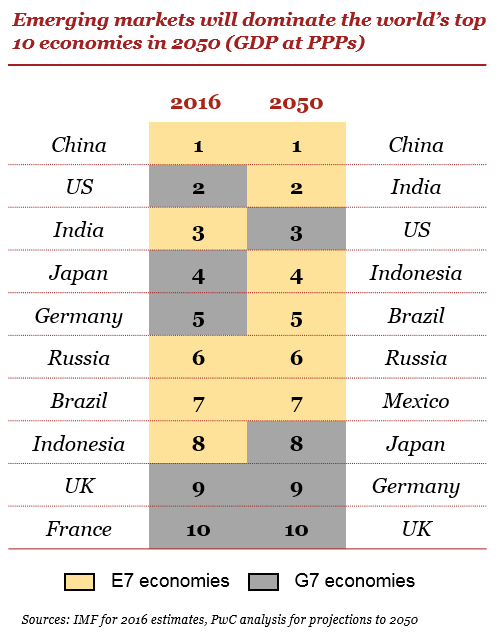
The ‘more successful’ 10-year future might be described as one in which, despite the problems, Brazil’s positive fundamentals continue to drive the country forward. The fundamentals include the fact that Brazil remains one of the top ten economies in the world, has a diversified set of business activities, enjoys the benefits of a growing middle class, and attracts major foreign investment inflows. IMF data show Brazil dropping from the seventh-largest economy in the world in 2016 to ninth position in 2018 (largely a reflection of the country’s slow emergence from the record recession of 2015-2016). But taking into account demographic and other trends, various analysts believe there is still scope for improvement in the global rankings. Consultancy PwC, for example, projects that by 2050 Brazil will have become the fifth-largest economy in the world, behind Indonesia and ahead of Russia and Mexico.
In the positive 10-year outlook, then, we envisage the next three elected governments make significant progress towards fixing the economy, but that they also make progress in some of the other areas. On the crime and security front a Bolsonaro government could actually increase the efficiency and coordination of law enforcement – and members of his team (such as his pick for justice minister, the anti-corruption judge Sergio Moro) have indicated their commitment to reforms that uphold the rule of law. In terms of developing the northeast, traditionally a region that has supported left-wing parties, a right-wing Bolsonaro administration might be motivated to launch serious new initiatives for vote-winning purposes with an eye on the 2022 elections. In this scenario too there is a possibility (but a low probability) of an abnormal institutional event: presidential impeachment if Bolsonaro overreaches and comes into conflict with Brazil’s system of constitutional checks and balances.
Inevitably, trying to look ahead 10 years into the future leads to some reflection on the swings of Latin America’s political pendulum. Among Brazil’s neighbours there are interesting examples of how governments of different political colours have, in some very specific areas, attained a degree of continuity. The right-wing Chilean military dictatorship of General Augusto Pinochet (1973-1990) imposed radical pro-market reforms in a violent and repressive manner – but a succession of subsequent, democratically-elected centre-left Chilean governments used at least some of those reforms to maintain economic growth in subsequent years. In Colombia, hard-line counter-insurgency tactics by right-wing President Alvaro Uribe (2002-2010) helped weaken the guerrillas and paved the way for a more centrist President Juan Manuel Santos (2010-2018) to negotiate a peace settlement. In Peru another right-wing president, Alberto Fujimori (1990-2000), is remembered for his authoritarianism, but also for defeating hyperinflation. How Brazilian governments will play out over the next decade is not known: but there is at least a possibility that governments of different colours might sequentially make progress in some of the six key areas we have discussed here.
-
ECONOMIC OVERVIEW: HONDURAS
President Lobo has partially defended the fusion of the defence and security portfolios on cost grounds. The 2012 budget is due before congress for final approval the week of 12-17 December. According to Deputy Guillermo Guillén of the ruling Partido Nacional, next year’s plan will come in at HNL144bn (approx. US$7.6bn), up from HNL133bn in 2011, with 80% funded via local sources and 20% from external sources, including donations. Guillén said that nearly all of the increased expenditure in 2012 is destined for teachers, with HNL1.1bn set aside for inflation-adjusted salary increases for the sector. Public sector salaries in Honduras are nearly equivalent to tax collection. Under the country’s stand-by program with the IMF, the government has committed to reducing budget deficit to 3.1% of GDP in 2011, from about 4.8% of GDP in 2010. The IMF expects real annual GDP growth of 3.5% in 2011. The index of economic activity compiled by the central bank rose 5.3% year-on-year in the first nine months of 2011, led by the financial sector (+15.9%).
-
Colombia
According to the Hincio Study, Colombia is one of the three countries leading efforts in Latin America to develop a hydrogen economy. Since the country’s national hydrogen strategy was launched in 2021, the new government of Gustavo Petro has redoubled already aggressive carbon reduction targets by freezing new licences for oil exploration and increasing taxes on hydrocarbons, although oil and mining make up nearly half of the country’s export revenues.
Even before that Colombia aimed for hydrogen to account for as much as 10% of the total energy demand by 2050. That’s the equivalent of an annual reduction of emissions of 38m tonnes of C02 compared to 2020. By 2030 the aim is to develop 1-3 GW of electrolysis capacity and 1.5-4 GW of renewable energy. The idea is to choose sites in regions with energy potential but close to consumers, so as to reduce the cost of transportation of the hydrogen.
Production costs for green hydrogen are estimated at US$1.7/kg in the best regions. In addition, the strategy calls for the production of at least 50,000 tonnes of blue hydrogen using the steam methane reforming process and CCUS. The bulk of Colombia’s renewable energy potential is in the Guajira, the far north-eastern peninsula that borders on the Atlantic Ocean and Venezuela, with an energy potential of 42 GW. There, net capacity factors for wind farms exceed 60%, while solar pilot projects show capacity factors in excess of 20%.
If the entire solar potential were to be tapped, production could reach 3.2m tonnes of green hydrogen, and 5.8m tonnes if offshore wind potential is taken into account. By comparison, the country’s estimated demand for hydrogen in 2050 is 1.6m-1.8m tonnes per year.
Already Colombia has some 13 gigawatts of renewable energy projects in the making, the largest of which will be La Loma, with more than 400,000 solar panels stretching over 437 hectares in the department of Cesar, just south of La Guajira. With an installed capacity of 187 megawatts, it will generate 420 GWh of renewable energy per year.
Blue hydrogen
Experts are still weighing the potential role of blue hydrogen, especially in the near future. Given Colombia’s large oil and mining industry and its accumulated expertise, CCUS could be one option to decarbonize specific industrial applications through blue hydrogen. “In the short term, blue hydrogen is the most favourable low-emissions option, especially if existing industrial infrastructures are taken advantage of,” the national hydrogen strategy states.
Hence, blue hydrogen could be the foundation to create and grow the hydrogen supply chain and market until green hydrogen is competitive and can take over. That could begin as early as 2030 as plants come on line in the most efficient production areas in the far north. Between 2030 and 2040 both types would coexist until green hydrogen will eventually become more competitive than blue, according to the white paper.
Carbon pricing
That assumes progressively rising carbon taxes or increasing costs of emissions certificates. If the cost of CO2 in Colombia were only USD 10/tonne in 2023 with annual growth of 5%, the competitiveness of blue hydrogen against grey would not occur until after 2045, part of the hydrogen strategy reads.
Congress approved a new carbon tax as part of a broader tax reform in November 2022 but it will only be incrementally applied starting in 2024 and its implications as a disincentive to fossil fuel usage aren’t fully clear yet. Also, the cost and time to install necessary infrastructure for CCUS needs to be carefully calculated and weighed in comparison to green hydrogen. “It is essential to invest with caution in order to avoid potentially stranded assets,” reads an IADB blog on the strategy. “After all, carbon capture technology is expensive and still at its earliest stages.”
As part of its strategy, Colombia also granted considerable financial incentives to attract investments in non-conventional sources of energy, in part through the Energy Transition Law, or Law 2099, from July 2021. Because green and blue hydrogen play a central role in that transition both will be granted the benefits of Law 1715 of 2014 for 30 years. Among the benefits are the exemption of import tariffs, a value-added tax break, accelerated depreciation, and the ability to deduct 50% of the investment from income taxes.
Noteworthy about the Colombia plan is that it foresees hydrogen advancing significantly in domestic industries such as oil refining, chemicals, and fertilisers, as well as in urban public transportation and cargo shipment by lorry. By 2030, taxis and delivery services are to operate a fleet of 1,500-2,000 hydrogen-fuelled light trucks and mini-buses with the help of public purchase incentives. By the end of the decade, at least 1,000-1,500 heavy vehicles are to transport people and goods. Hydrogen-filling stations will be established along motorways connecting the country’s major cities. As part of the national electric mobility plan, a large percentage of urban and inter-city buses is also expected to switch to hydrogen.
Colombia’s northern neighbour, Panama, has been mulling its own hydrogen strategy. Hydrogen production and consumption in Panama is currently very limited, and the country does not have the large renewable resources of some of its larger neighbours. Panama’s strategic location at the crossroads of major shipping routes does make it a global hub for maritime transport and a centre for regional trade.
As a result, the Panamanian government in January 2022 presented a roadmap that focuses primarily on creating a logistics and distribution centre for low-carbon hydrogen. The idea is to become a regional ‘fuel station’ for the maritime shipping industry. In other words, Panama may not produce green hydrogen, but it could refuel tankers criss-crossing the oceans as they pass through the canal.
-
PANAMA: Still booming
In September the economy produced 8.48% more than it did in September 2010, the government statistics agency reported.
Most areas of the services-based economy contributed to the strong performance, but public investment, port activity and consumer spending, led the way. The Canal’s US$5.25bn expansion is a key element in the economy’s sustained growth.
The government is hoping for another year of 10% GDP growth in 2011. The IMF estimates that the economy will grow by more than 8.5% in 2012.
Such strong growth is putting the government’s finances on a strong footing. In the first nine months of 2011, current income came to US$3.6bn which was 11.9% up on the same period of 2010.
Taxes, direct and indirect, brought in US$2.79bn which was 18% more than in 2010 but 4% less than had been budgeted. Non-tax revenues, such as royalties and profits from state companies came to US$745m, which was 1% up on 2010 but 13% more than had been budgeted.
The balance is made up of other income which was heavily down (52%) year-on-year at US$64m. This category was also 38% down on what had been budgeted.
Gold: In the first seven months of 2011 the country exported 1.59t of gold worth US$64.4m. This was 15% up in revenue terms on the same period of 2010.
-
Brazil – looking behind the bad press
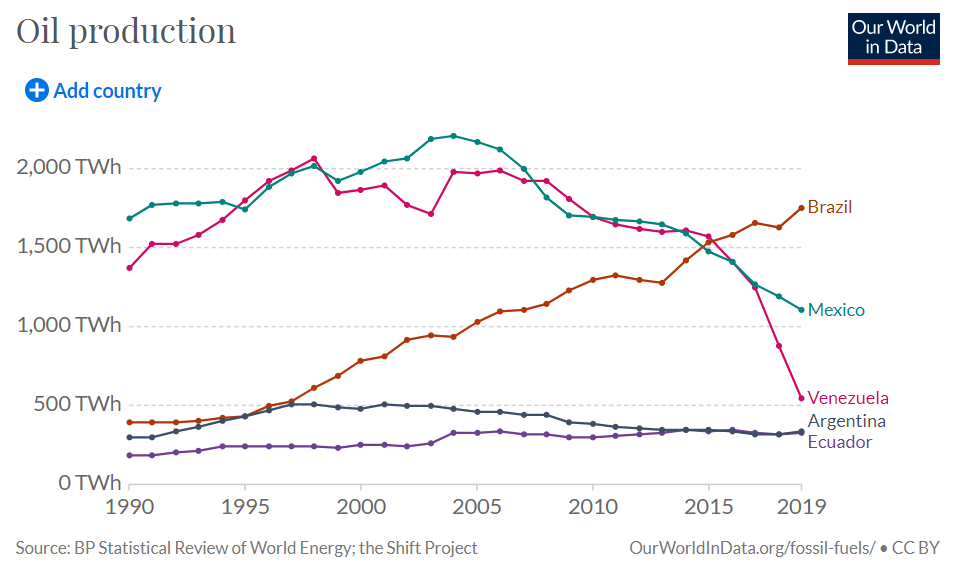
Brazil is widely seen as an environmental “bad boy” in the international press, some would say deservedly so, because of its current government’s refusal to take more active measures to try and halt or roll back deforestation in the Amazon. Deforestation is certainly a serious risk to any energy transition process, since it increases net CO2 emissions across all economic sectors. However, there are also a number of long-standing factors at work in Brazil which can be seen as positive for the energy transition, including the country’s abundance of hydro-electric energy, decades of experience in the production of biofuels (including the use of ethane from sugar cane), and, unlike Mexico, a broadly supportive policy towards other renewables such as wind and solar. As the largest economy and biggest oil producer in Latin America, Brazil is also able to capture significant economies of scale as it develops sustainable fuels.
While maintaining a right-wing nationalist opposition to what he sees as international meddling in the Amazon, President Jair Bolsonaro has moderated his rhetoric, partly for short-term political reasons as he adapts to the new Joe Biden administration in the United States, which places great importance on multilateral collaboration to limit climate change. In April this year, during a virtual summit of world leaders convened by Biden, Bolsonaro said Brazil would aim to achieve carbon neutrality by 2050, ten years earlier than previously planned. He also said his country would bring illegal deforestation in the Amazon to an end by 2030 (a commitment that is likely to move to the in-box of future presidents since Bolsonaro’s term in office has only 18 months left to run). Government officials suggested meeting the zero net carbon target by the middle of the century would require energy transition investments of around US$10bn a year. Preliminary discussions have been held on various schemes where international government and private sector entities might invest in green or carbon bonds, which would be used to conserve the Amazon rainforest and offset global emissions. However, progress is expected to be slow, since investors want to see reductions in deforestation before they commit their money, while Brazil seeks up-front payments.
The reality is that Brazil has already done significant groundwork on the energy transition. And the current or, more likely, future post-Bolsonaro governments may be able to pick up the pace of change. Responding to recent calls from the International Energy Agency (IEA) to halt new fossil fuel projects, energy and mines minister Bento Albuquerque said his country would not stop fossil fuel development, but he also said it still had “all the conditions” in place to become a net zero carbon economy by 2050, as well as becoming a future hydrogen exporter. Talking to journalists, Albuquerque said: “In Brazil we will keep on with our exploration and mainly production programme of our hydrocarbons reserves, and we will keep on in parallel with the expansion of our energy matrix, making it more and more clean and renewable”. The minister said the electricity grid would be “90% clean and renewable” by 2030, with hydro’s share falling to 49% (compared to 65% now) and with wind and solar between them rising to 25% (from 12% now).
Brazil was the world’s eighth-largest oil producer last year, according to US data, and is preparing a new auction of offshore exploration and production licences in the Sepia and Atapu blocks in December 2021. State owned Petrobras has reduced its overall debt levels and retrenched around its core upstream oil and gas activities. Unlike European IOCs it has not re-labelled itself as an ‘energy company’ or diversified into renewables. However, Eletrobras, the state-owned power company that is due to be privatised, has expressed interest in playing a key role in the energy transition.
The country is also positioning itself for the development of green hydrogen as an important new sustainable fuel. The country’s National Energy Plan 2050 describes green hydrogen as a “disruptive technology” that can change the energy market, and it cites green hydrogen fuel cells as a potentially key technology to decarbonise the transport sector. The state of Ceará has announced a US$5.4bn pilot project, in partnership with Enegix Energy of Australia, to create a green hydrogen hub in Pecém port, which will include an electrolysis plant. Also under consideration is a project in Porto do Açu, in the state of Rio de Janeiro, involving Eletrobras, Siemens, and research centre CEPEL to study the green hydrogen technology cycle from production to consumption.
-
Politics: what does the middle class want?
Establishing the political implications of the at-first rapid, then slower growth of the Latin American middle classes, including perhaps some backsliding into the ‘vulnerable’ category over the last two-three years, is not straightforward. The key issue is how that growth impacts on voter preferences and on the strength of democratic rule. Before discussing that issue directly however, it is worth considering two initial points. The first once more relates to developments in what has been happening to the middle classes in other parts of the world. The second relates to the complex but interesting interplay of actual and perceived class membership.
Put in its crudest form, one of the striking features of recent years is that middle class sectors in the developed world – and particularly in the United States and Europe – appear to be suffering a process of relative decline, while the middle classes in the emerging world are expanding. According to the US-based Pew Research Centre, in 2015 the middle classes in that country, which had been in a numerical majority for over four decades, became a minority again. There were more people in upper and lower income households (121.3m) than in middle class households (120.8m). In the period between 1970 and 2014 the number of those in the upper income brackets has increased by roughly the same percentage as the middle class has shrunk – by one-fifth. The middle class share of US aggregate household income dropped from 62% to 43% in that period.
Something similar has happened in Europe. According to the European Commission and the International Labour Organisation (ILO), the European middle classes expanded numerically very strongly in the 1980s and 1990s, but began to fall thereafter. The fall became particularly intense after the global economic crisis of 2008/2009. There is an intense debate over why this is happening in both the US and Europe, with factors such as globalisation, the decline in traditional manufacturing, a general loss in competitiveness, fiscal austerity, and tax and spend policies that are skewed in favour of upper income groups all being mentioned. Technological change and the increasing use of automation is also referenced. Politically, many argue that the decline in the middle classes and the breakdown in traditional blue-collar employment has fuelled a turn to the populist and anti-immigration right, marked for example by the election of Donald Trump as the president of the United States.
One perception is that globalisation has been kind to the middle classes in emerging economies, but harsh for the middle classes in the developed world. How this perception will in turn influence government positions on globalisation and protectionism is not immediately evident. These is clearly a lot at stake since pro-globalisation, pro-free trade policies have arguably been a key driver of emerging economy growth in recent decades. Economic growth in much of Latin America has benefited from globalisation – South American economies such as Brazil benefitted from booming raw material demand from China, while Central American economies and Mexico benefited from close integration into the US. Increased protectionism could have a serious impact on this process.
The second important point is that there can be quite a significant gap between actual class membership – using World Bank classification by income – and perceived membership. The regular annual public opinion survey across 18 countries in the region published by Chile-based think-tank Latinobarómetro at the end of October 2017[1] made this point. One subjective measure of economic wellbeing is to allow survey respondents to place themselves into four main categories: those who have enough income to get to the end of the month with ease and can make savings; those who have just about enough to cover their outgoings; those who are falling short by a small amount; and those who are falling short by a large amount and are in serious difficulty. Interestingly, in the 22 years that the annual surveys have been conducted, despite some fluctuations, the four groups have not changed radically in size. There has however been some improvement in perceived affluence. Those who consider themselves well off and can save have grown from 38% to 42%; those who describe themselves as being in serious difficulty have fallen from 36% to 31%.
Respondents were also asked to auto-define their social class, and given three options: to describe themselves as upper class, middle class, or lower class. For Latin America as a whole the largest group said they were lower class, but this proportion has dropped from 58% in 2013 down to 45% by 2017. The second-largest group defined themselves as middle class, rising from 36% to 42% between the same two dates. Those that described themselves as upper class rose from 4% in 2013 to 9% in 2017. Latinobarómetro points out that those who describe themselves as middle class are not always within the World Bank income group of US$10 to US$50 a day. In Bolivia 53% of the population says it is middle class, but according to the World Bank only 10% is actually earning enough to be in that category. Latinobarómetro explains this by saying a significant proportion of the Bolivian population now feels empowered and included; how they feel about social class is subjective and culturally relative. The importance of perceived social class is two-fold: on the one hand it affects broad patterns of consumption and influences consumer marketing strategies; on the other it may be critical in influencing political and voting preferences.
The broad picture presented by the 2017 Latinobarómetro public opinion survey is that, irrespective of the comparative growth of the middle classes, there remain serious concerns over the strength and performance of Latin American government institutions. The survey showed that across 18 countries in the region support for democracy has dipped to 53% of respondents, down from 61% in 2010. On average, only a third are happy with how democracy is working, three-quarters think decisions are taken mainly for the benefit of the rich and powerful, and 62% think there has been no progress in the battle against corruption. Marta Lagos, Latinobarómetro director, says “There is no indicator telling us that democracy is improving. It is doing badly in many countries in the region.” She adds that while in Venezuela democracy might be described as in a “terminal” state, elsewhere countries are suffering from what she calls “democratic diabetes” – an illness “that everyone is suffering from, nobody can see, and which, if not treated, is still a killer”.
A recently published USAID report, The Political Culture of Democracy in the Americas 2016/17, which also used Latinobarómetro survey data, draws four sobering conclusions for the region as a whole. First, support for democracy is lower in 2016/17 than it was in previous years; in fact within each country support appears to be lowest among the younger, the less educated, and the less wealthy. Second, a significant portion of the population (around 40%) would support a coup d’etat by the executive power, including the shutdown of the legislature, if that offered a way of reducing crime or corruption. Third, trust in political parties has slumped to the lowest level since the Latinobarómetro surveys started over 20 years ago. And fourth, partisan affiliation (party membership) fell by a substantial 10 percentage points in 2016/17 – an indication perhaps that political volatility might be on the increase.
It is possible to argue that the two largest countries, Brazil and Mexico, are suffering particularly acute versions of this general malaise. In a ranking of 29 western hemisphere countries including the US and Canada, support for democracy was highest in Uruguay (82.4%), followed by Canada (79.2%), Argentina (77.2%) and the US (73.0%). Brazil was down in 23rd position (52.4% support for democracy) with Mexico in 27th (49.4%). Likewise, when countries are ranked according to the proportion of the population that would support a coup, Brazil and Mexico appear quite high up the list. Out of 22 countries where the question was asked, Mexico was in fourth place in terms of the proportion of respondents who would support a coup in an environment of high levels of crime (47.5%) and fourth again for those who would do so in high levels of corruption (49.9%). Brazil was ranked ninth for those who would support a coup in the high crime scenario (37.4%), and tenth for those who would support one in the high corruption scenario (34.6%). Trust in elections was also particularly low in Mexico (only 26.2% of respondents) and Brazil (23.4%). Just under one in ten Brazilians said they trusted political parties (9%); Mexico scored only marginally better (13.8%). The average for Latin America was 15%.
Support for democracy trending down
% respondents expressing support for democracy in Mexico, Brazil, and Latin America
Source: Latinobarómetro
Various analysts have expressed the fear that the apparent weakening of democratic institutions in Latin America’s two largest countries could lead to a populist backlash. Writing in Foreign Policy in October, Robert Muggah and Brian Winter spoke of “a real risk of hard populist turns to the right and to the left that could radically change policies towards security, trade, the economy, and Latin America’s relationship with the world, including the United States”. While both Mexico and Brazil currently have centrist or centre-right governments and will enjoy positive, but modest economic growth from 2017-2018, they note various danger signals. These include pockets of high unemployment among 15-29 year olds (around 20m of them are unemployed in the region as a whole), low paying jobs which force people into the informal economy, and a very high incidence of crime in specific urban areas (Latin America has 43 of the 50 most murderous cities in the world). Crime has a deeply corrosive effect and tends to encourage voters to support hard-line law and order policies (despite evidence that these policies have had little positive effect).
Political parties are the least trusted
Percentage of Latin American respondents expressing trust in... Source: Latinobarómetro 2017
[1] Corporación Latinobarómetro, Informe 2017
-
Venezuela: Introducing the crypto-petro fantasy
If President Nicolás Maduro is to be believed, his embattled government has just pulled off a master-stroke by launching the Petro, a crypto currency, which in a couple of days attracted over US$1bn worth of investments and placed the country in the technological vanguard of the 21st century. Unsurprisingly, not everyone sees it that way.
The government launched the Petro on 20 February. Officials said there would be a phased issue of 100m virtual Petro coins, each backed by one barrel of oil from the Ayacucho block (where reserves are estimated at 5.34bn barrels). Orders for an initial tranche were being sold in the period running up to 19 March at a reference price of US$60 a barrel, implying the total issue will be valued at round US$6bn (although prices for later tranches may vary). Maduro claimed that buy orders for the Petro totalled US$735m in the first 20 hours after its launch, rising to over US$1bn after the first two days. He said the new currency would allow Venezuela to counter economic sanctions imposed by the United States, commenting that “today a crypto-currency has been born to defy Superman who has not been able, and will not be able, to control us”.
Few details of who have been buying the Petros were given, but Maduro said that 36% of purchases had been in US dollars, 15% in Euros, and 49% in other pre-existing crypto currencies such as Bitcoin and Ethereum. Before the launch, Carlos Vargas, Venezuela’s new crypto-currency superintendent, had said the government was targeting investors in Qatar, Turkey, the Middle East, Europe, and the United States.
There was certainly a wave of what could be called ‘Petro hype’. Government agencies including state oil company PDVSA were being authorised to accept payments in Petros and other crypto-currencies. Almost immediately after the launch the president said plans were in hand to launch a second crypto- currency, to be known as Petro Gold, which would be backed either by gold reserves in the Central Bank or by yet-to-be mined sub-surface gold deposits. Petro Gold would strengthen the Petro and enable Venezuela to fight back against the “economic war” waged against the country by the US government, as well as advancing the country’s “monetary sovereignty”.
There was also an announcement that Venezuela was opening its own crypto-currency school (based in Caracas and known as the Granja Laboratorio Petro School). Other countries are clearly interested in the Venezuelan experiment. Ahment Kenan Tanrikulu, a member of one of the political parties in Turkey’s ruling coalition, said he was recommending that the country launch its own crypto-currency, to be known as Turkcoin. “The world is advancing toward a new digital system,” he said, and Turkey “should create its own digital system and currency before it is too late”.
But it is fair to say many analysts see the Petro as, at best, just another sovereign debt vehicle and, at worst, as an outright con. Whether it actually is a crypto-currency at all is open to debate. Most crypto-currencies are traded via decentralised systems, using ‘open ledger’ blockchain technology based on transparent operating rules. The lack of a central authority is one of their attractions and one reason why a certain type of investor trusts them. In contrast, the Petro is very clearly controlled by the Venezuelan government, which has a notoriously poor financial record: the value of the existing Bolívar currency has been eroded by hyperinflation and the country is in partial default. There is little transparency about the operating platform (indeed official documents are contradictory – some say it will use Ethereum and others NEM as its technical platform); and the government is notoriously opaque about all economic data (it does not even publish data on the rate of inflation).
There are also question marks over the underlying link to oil or gold reserves. Sean Walsh, founder of a US based crypto-asset investment company, Redwood City Ventures, commented “Rather than buying a crypto currency based on gold, I’d just go and buy the gold. Gold is a physical thing that you want to be able to hold in your hands, because that’s the point.” Equally the “oil guarantee” underpinning the Petro is dubious, since each barrel is deep under the ground and very far from being monetised. In fact, developing the Ayacucho block will itself require billions of dollars and many years before the oil could begin to flow. Kenneth Rapoza, an analyst based in the US, noted that Maduro’s claims should be taken with caution, given that the president is also on record saying that the ghost of his late predecessor Hugo Chávez came to him in the form of a little bird. In an article for Bloomberg Matt Levine argued, “The Petro is not a currency, crypto or otherwise. But a way to raise hard currency externally now that Venezuela is cut off by sanctions from accessing the international debt market. So, the petro is just a way to hide new international debt behind a thin screen of blockchain.”
In Brazil, there have been reports that national development bank BNDES is considering launching its own crypto-currency later on this year. Carlos Costa, the bank’s chief of budget and planning, has been quoted saying “We will be the first development bank in the world to use blockchain technology.” Blockchain technology can be used with any currency or unit of measurement, and does not specifically require the launch of a crypto currency, but Thiago Aragão of Brasilia-based consultancy Arko Advice has confirmed that BNDES “wants to use crypto currency for transactions that involve payments to borrowers”.
Fintech on the rise
While there will be hits and misses, the Petro is not the only experiment under way in the field of crypto currencies and alternative payments systems in Latin America. The financial technology, or fintech, sector is expanding rapidly in a number of countries. Sometimes this happens amidst a crisis and meets a real need. Venezuelans struggling to survive hyperinflation and food shortages will not be helped by the Petro or the Petro Gold. But, according to Widereven Villegas, who washes around 30 cars a day in Caracas for the equivalent of 50 US cents a time, they do use all sorts of mobile phone-based payments systems. None of Villegas’ customers can pay cash, which is not surprising given that the maximum daily cash withdrawal from an ATM is now 10,000 Bolivars, around 4 US cents at the black market rate. “I accept transfers. I have Tpago, Vippo, and almost all the applications out there,” Villegas told Reuters news agency in February. Caracas-based Vippo says it has had a thirty-fold increase in registered users in the last year. Another application, Citywallet, started enabling online parking payments in Caracas, and has now spread to other areas and begun operating in Chile.
-
PANAMA: Slowing down slightly
In few countries in the world would a near-8% year-on-growth rate be viewed as disappointing. This is, however, the case here where in August the economy grew 7.9% year-on-year, according to official figures.
The disappointment is that in the second quarter the year-on-year growth rate was 11.4%. Over the first eight months of 2011 the economy has produced 9.07% more than in the same period of 2010. Transport, communications and construction and mining were among the main growth drivers.
The number of containers going through the Canal increased, as did the number of ships. Construction was also strong and so was entertainment, particularly gambling. The manufacturing sector was bolstered by a strong performance from the food industry.
Indeed, the only industry that has found the going hard this year is fishing. It is contracting largely because of decline in the export industry.
Despite the unsettled outlook for the economies of the US and the European Union, Panama's economy is still growing strongly and some analysts are forecasting 9% GDP growth for the full year.
Billions of dollars in infrastructure spending, including the Panama Canal’s US$5.2bn expansion and a US$1.8bn metro are driving growth in a dollarised economy which also enjoys strong foreign investment and consumer spending.
Inflation: Such strong growth is pumping up inflation. In the year to September consumer prices rose by 6.1%.This is almost double the 3.5% rate of inflation in 2010.
-
ECONOMIC OVERVIEW: NICARAGUA
Trade balance: According to a 21 February press release by Nicaragua’s central bank, Nicaragua’s exports totalled US$2.4bn in 2013, while imports reached US$5.6bn, leaving a trade deficit of US$2.8bn, US$77m more than in 2012.
Tourism: On 6 March Nicaragua’s export agency, Pro Nicaragua, reported that the tourism sector is expected to grow 6.5% in 2014, generating some US$440m in revenue. According to Pro Nicaragua, the national tourism board (Intur) has approved US$46m for tourism development projects in 2014, with plans to approve a total of US$100m in projects by year end. According to the same press release, these projects will generate around 1,580 jobs during the construction phase and more than 581 permanent jobs when the projects are completed.
Inflation: According to a 6 March press release by Nicaragua’s central bank, monthly inflation for February reached 0.66%, slightly higher than the 0.61% recorded in February 2013. This brings the accumulated 2014 rate to 1.39% (down from 1.80% for the first two months of 2013) and the year-on-year rate to 5.25%, lower than the 7.08% the reported at this point last year.
-
ECONOMIC OVERVIEW: HONDURAS
Inflation & unemployment: The index of consumer prices was 5.6% year-on-year in March and 2.1% on an accumulated basis in the first quarter. The official rate of urban area unemployment was 5.6% in 2012, an improvement on the 2011 figure of 6.8% in 2011. However that masks severe underemployment. The total number of unemployed Honduras is 1.8m, up from 1.1m when the current government took office in January 2010.
BG Group deal: On 9 April, environment & natural resources minister, Rigoberto Cuellar, announced the preliminary approval of a 10-year oil and gas contract with British Gas (BG) Group. The exploration and production contract covers a 35,000-km² tract off the Caribbean coast, near the border with Nicaragua. No investment figures or potential reserves for the project were disclosed. The deal must also be approved by congress and the attorney general’s office. If approved in full, the contract would be the first of its kind for Honduras, which has never reported commercial-scale oil and gas deposits. In October 2012 the vice-president and minister of the presidency, María Antonieta Guillén de Bográn, said that Norway’s Statoil and Spain’s Repsol had also expressed an interest in potential exploration in Honduran Caribbean waters. Currently Honduras relies heavily on fuel imports.
- Trade
Honduras’s merchandise exports, inclusive of the maquila sector, rose 1.7% year-on-year to reach US$7.9bn in 2012, according to latest central bank data. Imports rose by the same percentage to reach US$11.2bn, meaning a merchandise trade deficit of US$3.25bn. The current account deficit was US$1.74bn, or a sharp 9.5% of GDP in 2012, the bank said on 12 April. In the financial account, Foreign Direct Investment (FDI) was US$1.05bn in 2012. Net international reserves were US$3.0bn as of 15 April. Supportive of exports, the Lempira continues its gradual depreciation, trading at HNL20.21/US$ on 12 April.
-
Managing the wealth
In August 2018, the Guyana government produced a Green Paper on ‘Managing Petroleum Revenues and Establishment of a Fiscal Rule and a Sovereign Wealth Fund’. The details of what eventually emerges in law and in practice is, as we have explained above, subject to post-election revision, but the general direction of travel is clear. Guyana, at least under its current government, is determined to take the best advice and to establish a regime for dealing with the imminent stream of oil revenue that ensures it avoids the pitfalls that so many other countries have failed to avoid.
The preamble to the Green Paper notes that it is intended “to capture the key issues for consideration, including the mechanisms to ensure sustainable use of petroleum revenues to achieve a diversified and green economy, with a specific predisposition to avoid mismanagement of the national patrimony (i.e. ‘natural resource curse’).”
The paper also highlighted the dangers of the presource curse brought about by “elevated expectations which can, in turn, drive suboptimal behaviour”. For example, “governments can be pressured by constituents and political ambition to embark on risky borrowing on the back of overly optimistic revenue projections”. The example of Ghana was cited as a warning.
Work on legislation to create a sovereign wealth fund was started by the Ministry of Natural Resources in late 2016 with the assistance of the Commonwealth Secretariat (ComSec). A first aim was to produce a draft Natural Resource Fund Act (NRFA), a key component of which would be a fiscal rule which would outline the principles and requirements that will government the amount of money that can be withdrawn from the NRF in any given year.
The Green Paper begins by setting out the dangers that Guyana faces from over-dependence on petroleum revenues, which it lists as:
- unstable revenue and, by extension, unstable government spending;
- increased domestic demand resulting in increased inflation and significant exchange rate appreciation (Dutch Disease);
- unstable increases in consumption and unfair benefit-sharing between generations.
To mitigate these risks, the Green Paper states, “a fiscal rule is needed to ensure that public spending is delinked from the volatility of oil revenues and prudently invested to guarantee an equitable intergenerational distribution of wealth in perpetuity, ceteris paribus…”
The establishment of the NRF is seen as the best way of minimising the risks. “The establishment of such a fund would secure and build the financial wealth of future generations, even as current generations benefit from scaled up budgetary investments.”
More specifically, the paper claims, establishing the NRF “can help to protect Guyana against Dutch Disease by sterilising boom revenues and ensuring that export earnings from petroleum only enter the economy at a rate which the economy can absorb these additional revenues.”
Not surprisingly, Norway is cited as a good example to follow.
Under the proposals, petroleum revenues and excess revenues from mining and forestry will be deposited into the NRF from which withdrawals will be made based on a fiscal rule. The withdrawals will be deposited into a Consolidated Fund “to form part of the financing streams for the annual budget”.
With regard to the fiscal rule, the paper states that the intention is to recognise existing development gaps, both in terms of human capital and physical infrastructure “and the need to accommodate development spending via the National Budget”. As a consequence, the fiscal rule “envisages an initial frontloading of spending to address critical development gaps, in the earlier years, and subsequent progression to higher savings ratios in later years”.
-
Dominican Republic: IMF praises ‘dynamic’ DR
Despite a lot of political noise from the Odebrecht scandal, the Dominican economy continues to grow at a robust pace, buoyed in the past few years by low energy prices, strengthening labour markets, dynamic investment, and the US recovery, the IMF noted in its latest country report, released in mid-August.
Odebrecht investigation continues apace
As reported by LatinNews Daily, the last of the 14 defendants charged in relation to the bribery scheme run by the Brazilian engineering firm appeared before a local supreme court judge on 5 August, completing the first phase of the Odebrecht investigations in the DR.
In plea bargain testimony to Brazilian, US and Swiss officials, Odebrecht said it had paid out an estimated US$92m in bribes to Dominican officials between 2001 and 2014 in order to secure public works contracts. Payments were funnelled to officials under the successive governments led by Hipólito Mejía (Partido Revolucionario Dominicano [PRD], 2000-2004), Leonel Fernández (Partido de la Liberación Dominicana [PLD] 2004-2012) and the incumbent president Danilo Medina, first elected for the PLD in 2012 and re-elected in 2016.
The country’s attorney general, Jean Alain Rodríguez, in May had announced charges against the 14 for crimes including asset laundering, bribery, illicit enrichment, embezzlement and perversion of justice. Those facing trial include senior officials such as Temístocles Montás, the former industry & trade minister (and economy minister from 2010-2016); a former public works minister, Víctor Díaz Rúa (2007-2012); a senior member of the ruling Partido de la Liberación Dominicana (PLD) political committee, Radhamés Segura; and the president of the main opposition Partido Revolucionario Moderno (PRM), Andrés Bautista.
Of the 14 charged, only Víctor Díaz Rúa and a local businessman, Angel Rondón Rijo, were remanded in prison. Moreover, the lower chamber of congress refused to lift immunity from prosecution of PRM Deputy Alfredo Pacheco (among the 14 defendants), while the party ratified him as its spokesman. The senate, meanwhile, refused to lift immunity from two PLD senators, Julio César Valentín and Tommy Galán.
Supreme Court Judge Francisco Ortega on 5 August issued various coercive measures, including a travel ban and bail, against Bernardo Castellanos, who served as technical director of the state-run electricity generation firm, Empresa de Generación Hidroeléctrica Dominicana (Egehid), in 2000-2004. Castellanos, accused of taking bribes to award a contract to Odebrecht for construction of the Pinalito hydroelectric dam, in the north-western province of Santiago, was arrested on 2 August at the Aila international airport to the east of the capital, Santo Domingo, upon arrival on a flight from Panama, two months after an international arrest warrant was issued for him. In the second phase of the Odebrecht case, the attorney general’s office will widen its investigations, which Judge Ortega said must conclude within the next six months.
As in other Latin American countries, public anger at pervasive official corruption has reached new peaks in the wake of the Odebrecht scandal. On 20 August, hundreds took to the streets in the southern province of Peravia, calling for the cancellation of the contract awarded to Odebrecht for the Punta Catalina coal-fired electricity generation plant, and for the firm to be expelled from the country. The demonstration was called by the anti-corruption protest group Marcha Verde, which has led civil society activism calling for justice for the Odebrecht scandal. As well as calling for the Punta Catalina contract to be cancelled, Marcha Verde also demanded that local and provincial officials be investigated in relation to the contract, citing Senator Wilton Guerrero (PLD) and the mayors of the local municipalities of Baní and Catalina, Chacho Landestoy, and Juan (Caballón) Lugo respectively.
The Punta Catalina project was the only major public contract awarded to Odebrecht by the Medina administration (in 2013). The show of unrest illustrates broad public dissatisfaction with the findings of a report issued in July by a commission set up by Medina in January to review the tender process. The report found that the tender had “broadly adhered to the law” and said that Odebrecht’s winning bid had been “reasonable”. Marcha Verde slammed the report, on the grounds that the findings were based on a technical report commissioned to FTI Consulting, an international consultancy firm with links to Odebrecht.
Economic fall-out appears minimal to date
The IMF in its latest report said the economic outlook was “favourable”, with the pace of real GDP growth – which has averaged a robust 7% since 2014 – outperforming most emerging markets and all the economies in the Americas, buoyed by domestic demand.
Real GDP expanded by 6.6% year on year in 2016, with both consumption and investment easing in the second half as financing conditions tightened. Labour markets and social indicators are steadily improving, the Fund noted, with real wages starting to catch up to strong productivity growth in 2015-2016, after remaining stagnant for over a decade. Strong growth was accompanied by low inflation (as lower oil prices kept pressures at bay), with headline and core inflation averaging 1.75% in 2016, below the central banks’ inflation target range of 4% +/-1% for another year.
Lower oil prices, along with continued strong growth in tourism, and remittances, more than offset what the Fund described as ‘an underlying weakness in goods exports’, thereby allowing the current account deficit to narrow significantly, to an estimated 1.5% in 2016.
Meanwhile, the Fund noted that both fiscal and monetary policies tightened slightly in 2016, “providing a countercyclical offset to the positive output gap”. The fiscal position improved marginally despite increasing spending pressures, “as the authorities’ strong revenue administration effort begun to pay off”. The consolidated public sector posted a deficit of 4.3% of GDP in 2016, the Fund reported. This took public debt to an estimated 49.7% of GDP at year-end. Monetary policy was tightened in November 2016, having been on hold for over a year, with the policy interest rate increased from 5% to 5.5% to deter any inflationary pressures as global commodity prices began to unwind “against a backdrop of a positive output gap and robust credit growth” in the domestic market. The Fund noted that a “healthy” local financial sector remained “well poised to support growth”. Banking sector soundness indicators are strong, with healthy capitalisation, low asset impairment and strong provisioning, it noted.
Looking ahead, the Fund said it expected real GDP growth to moderate towards the potential rate of around 5% from 2017, with slightly higher fuel prices pushing inflation to target, and also widening the current account deficit moderately.
Risks around the baseline outlook were “balanced”. The Fund identified the key risks to the DR as: the uncertainty surrounding the economic and policy outlook for external trading partners, particularly the US; the outlook for global oil prices; higher than expected global interest rates; and potential US dollar appreciation.
- The Dominican peso closed at DOP47.3/US$ on 5 September, continuing a gradual depreciation from an average of DOP45-46/US$ in 2015-2016.
-
Honduras: IMF completes final review with praise for Hernández
The IMF has completed the final review of its three-year US$189m Stand-By Arrangement (SBA) with Honduras, conferring praise for the performance of the administration led by President Juan Orlando Hernández. Hernández to capitalise on the successful IMF rating as he heads into the final stages the end of his campaign for re-election on 26 November, which is expected to be successful. The Fund has indicated a willingness to discuss further arrangements with Honduras.
Following executive board discussion of the fifth and sixth reviews of the SBA, Tao Zhang, the IMF’s Acting Chair and Deputy Managing Director said that the authorities’ commitment to their reform agenda had remained strong during the program, which had successfully stabilised the economy, restored confidence, and paved the way for accelerating growth and reducing poverty. “The program is on track and reforms are progressing as expected”, he noted.
Zhang noted that the macroeconomic outlook is positive, with fiscal deficit is at historic low levels, international reserves are at historic highs, and inflation remains subdued. However, he emphasised the need for a continued effort to improve social indicators. Unemployment, he observer, “remains a challenge”, while poverty affects more than half of the population. “Tackling these problems will require significant efforts to improve the coverage of social programs and to ensure adequate fiscal revenues, including by rationalizing tax exemptions and strengthening tax enforcement”, he stressed.
Elsewhere, the Fund noted that Honduran authorities acknowledged the importance of modernising the monetary policy framework for macroeconomic stability, in support of which they have started the process to adopt inflation targeting. To this end, Honduras has introduced an interbank repo market and reduced the FX surrender requirements. “They recognize the need to continue with this process by amending the central bank law to give a clear mandate to achieve low and stable inflation”, Zhang observed.
Finally, Zhang underlined the point that structural reforms are critical to promote private investment and create jobs. “Continuing to pursue reforms in the electricity sector, improving the efficiency of public spending, reducing corruption, closing the infrastructure gap, and working together in alliance with the private sector are critical for a sustained economic expansion with marked poverty reduction”, the statement concluded.
The IMF projects real annual GDP growth of 4% this year, easing to 3.6% in 2018, with inflation easing down towards 4%. Helped by lower interest rates, private sector credit growth is running at almost 12%, underpinning a recovery in investment and economic activity. The current account deficit is steady at roughly 4% of GDP, down from a high of about 9% a few years back, as Honduran exports resume stronger growth in line with the recovery in the US, the country’s dominant trading partner. Imports have benefitted from lower oil prices since 2014, which went some way towards eroding the high current account deficit. Thanks to the better export result, the international reserves position has strengthened to almost US$5bn, or almost 5 months of imports.
And finally, the fiscal deficit position has also improved to about 1.2% of GDP now, from a record 7.5% when Hernández took office in January 2014. The debt to GDP ratio so higher as the government borrowed (from the IMF and others) as part of its efforts to stabilise the economy, but at 44% of GDP, the overall position is manageable.
In sum, the Honduran macro-economic picture is in good shape, and the challenge moving forward is to stabilise also the micro economy, plagued still by deeply entrenched poverty and lack of opportunity.
Hernández, of the conservative traditional Partido Nacional (PN) has set out a plan of government focused on seven strategic pillars, including the use of innovation for growth and job creation, access to credit, the development of Honduras as a regional logistical hub, investment in support of a fully bilingual public education system, and measures to boost investor confidence including reductions in red tape and improvements in government transparency. His rather rosy vision for a modern Honduras, however, remains starkly at odds with the daily reality for 60% of his 8m fellow Hondurans.
While polls suggest that Hernández is on course for victory against a splintered and weak opposition, political complications surround this year’s election. Hernández was only able to run because of a controversial April 2015 supreme court decision declaring inapplicable the constitutional ban on re-election. The political opposition still rejects that ruling and although it is taking part in the November ballot it says it will not accept the result if Hernández wins. Legal challenges thus are likely to ensue. While we do not believe that legal challenges will be successful, as the US, Mexico and other Latin American countries tacitly accepted the April 2015 supreme court decision, the process could result in civil unrest and a period of uncertainty and instability in the country.
Honduras, IMF Selected Economic Indicators Prel. Proj. 2012 2013 2014 2015 2016 2017 2018 (Annual percentage change unless otherwise indicated) National income and prices GDP at constant prices 4.1 2.8 3.1 3.6 3.6 4 3.6 GDP deflator 3.6 1.4 6.8 6.4 3.7 5.9 3.8 Consumer prices (eop) 5.4 4.9 5.8 2.4 3.3 4.5 4 Exchange rate (eop, depreciation -) Lempiras per U.S. dollar 1/ 20 20.7 21.6 22.4 23.5 23.5 … Real effective rate 2/ -1.7 0.3 3.8 1.8 -2.2 -1.5 … Money and credit Private sector credit 16.9 11.2 10.7 10.4 10.8 11.4 11.5 Broad money 6.6 8.4 13.2 8.4 13.1 9.6 8.5 Lending rate (eop, in percent) 16.7 16.9 15.9 14 14.3 14.2 … Deposit rate (eop, in percent) 11.4 11 10.4 8.8 8.2 8.4 … Nonfinancial public sector Primary balance (percent of GDP) -4.5 -7 -3.4 0.1 0.3 -0.1 0.1 Overall balance (percent of GDP) -4.4 -7.5 -3.9 -1 -0.5 -1.2 -1.2 Gross debt (percent of GDP) 32.4 41 41.3 41.2 42.5 43 44.1 Saving and investment Gross fixed capital formation (percent of GDP) 24.4 22.9 23 24.8 23.2 25.9 25.7 Gross national savings (percent of GDP) 15.8 13.4 16 19.3 19.4 21.8 21.4 External sector Gross international reserves (millions of dollars) 2,778 3,255 3,698 3,992 4,172 4,559 4,823 Gross international reserves (in months of imports) 3/ 3.3 3.8 4.3 4.8 4.5 4.7 4.8 Change in net international reserves (increase -) 367 -546 -264 -307 128 -311 -251 Current account balance (percent of GDP) -8.6 -9.6 -7 -5.5 -3.8 -4.1 -4.3 Exports f.o.b. 4.8 -6.6 4 0.9 -4.2 10.3 3.6 Imports f.o.b. 2.2 -3.7 1.2 0.1 -4.8 10.5 3.1 Sources: Central Bank of Honduras, Ministry of Finance, and IMF staff estimates and projections. 1/ 2017 data as of October 24, 2017. 2/ 2017 data as of June. 3/ Refers to the following year's imports of non-maquila and nonfactor services. -
Honduras: Big increase in 2018 budget, as Hernández bids for second term
Finance Minister Wilfredo Cerrato will send congress an expansive 2018 budget on 14 September, with a planned overall annual increase of up to 8%. The budget is clearly pre-electoral, with Cerrato emphasising increased funding for health and education, citizen security, road and electricity infrastructure and various social welfare programs.
According to Cerrato, the 2018 budget will be in the region of HNL247bn, or approximately US$10.6bn at the current exchange rate. The 2017 plan was approximately US$9.8bn, up from roughly US$8.8bn in 2016. Cerrato added that the government expected to generate a full 80% of budget revenues from taxes, with the rest from donations.
The Honduran economy has recovered in recent years, spurred by renewed demand from its main trade and investment partner, the US, and helped along also by low oil prices. Honduras, like its Central American neighbours, is heavily dependent on oil imports for much of its fuel and energy needs.
Improvements in internal security have also helped, as noted by the World Bank’s country representative, Giorgio Valentini, in late August, who said the defence and security strategies implemented by the current government were “vital factors” to economic growth in the country. Valentini was speaking at a ceremony to present a new Armed Forces report on the impact of security and defence on Honduran development.
Echoing Valentini, the deputy finance minister, Rocío Tábora, reported “very good” indicators from sectors such as agro industry, construction and manufacturing, noting also “important growth” in newer, non-traditional sectors. She claimed that the economy was on course for real annual GDP growth of 4% this year, up from 3.7% in 2016. She acknowledged, however, that growth needed to be some way higher, at around 7%-8%, so as to eliminate poverty in the country. According to the World Bank itself, poverty still affected over 66% of the population (of 8m) in 2016.
Nevertheless, “we are on the right road, this means confidence, security and justice, stability, low interest rates, [and] public and private investment”, she stated. The IMF is on board with all of this, praising the country for its continued economic strengthening, as well as advances in the security situation, at the conclusion of a recent staff mission visit in June. Honduras in December 2014 signed a three-year US$187m stand-by program with the IMF.
In a statement, the mission said the outlook for 2017 remained favourable, following estimated first quarter real GDP growth of 4-4.5% year on year, driven by “a steady expansion of private consumption” and strong export growth. Growth was also being driven by “scaled up public infrastructure investment and active monetary policy”, it observed. Meanwhile on the fiscal side, the non-financial public sector deficit was expected to increase to accommodate planned investment in infrastructure – but remaining below the 1.5% of GDP ceiling established in the Fiscal Responsibility Law. The mission encouraged the government to press forward with its current macroeconomic, financial and tax administration policies, noting that its discussions with the local authorities had been “productive”.
This will be music to the ears of President Juan Orlando Hernández, who appears on course to win a second term in office in the November general election. While his bid for re-election is not without some controversy, the US (and thus the IMF and key donors like the World Bank) appear to have accepted the April 2015 supreme court ruling lifting the ban on re-election, and therefore the prospect of Hernández remaining in power.
- Amid expanding economic activity and stronger business confidence, credit to the private sector was expected to grow by 10% in nominal terms, the IMF said after the June staff visit. Annual inflation through May edged up to 4.1%, on recovering domestic demand and slightly higher oil prices, but this remained within the central bank target band, and was consistent with Fund’s year-end projection of 4.75%.
-
Region: It’s slow: but it is still a recovery
September and October are the months in which international bodies such as the IMF and the Economic Commission for Latin America and the Caribbean (ECLAC) set out their new economic forecasts. This time, the message seems to be consistent: there is a recovery, but it is painfully slow.
The IMF says that after disappointing growth in the last few years, economic activity in Latin America and the Caribbean (LAC) remains on track to recover gradually in 2017-2018, as recessions in some of the larger countries like Brazil and Argentina come to an end.
It expects LAC as a whole, which suffered a GDP contraction of 0.9% in 2016, to expand by 1.2% in 2017 and by 1.9% in 2018. Domestic demand is recovering gradually, while the contribution to growth from net exports is falling, as higher demand pulls in increased imports. Inflation is moderating, allowing some scope for monetary stimulation. Fiscal imbalances continue. For next year, the IMF expects GDP growth of 1.5% in Brazil, 1.9% in Mexico, 2.5% in Argentina, and 2.8% in Colombia.
The exception to the recovery story will continue to be Venezuela, which the IMF says “remains in a full-blown economic, humanitarian, and political crisis, with no end in sight”. Venezuela’s GDP is projected to fall by 6% next year; in 2014-17 the IMF estimates the country suffered an accumulated 35% fall in its GDP.
The Fund stresses that for most economies this is the moment to pursue structural economic reforms. Priorities should include closing infrastructure gaps, investing in human capital, encouraging female labour force participation, reducing labour market informality, enhancing good governance, fighting corruption, and seeking trade and financial integration.
The ECLAC forecast for the region is for 1.2% GDP growth this year, the same as the IMF projection, but it sees a slightly stronger rebound next year, pencilling in overall regional growth of 2.2% in 2018. ECLAC notes that South America, which was particularly hard-hit by the commodities slump, is now picking up speed. Central American countries will grow by 3.5% on average next year, it estimates.
A separate survey of economists by Reuters suggests that for the first time in years, Brazil will grow more rapidly than Mexico in 2018. Economists said that single-digit interest rates in Brazil would help lift growth to 2.3% next year, finally bringing the 2014-2016 recession to an end. But with uncertainty over Nafta and the 2018 presidential elections, Mexican growth would be marginally slower at 2.2%.
-
The future of Latin America’s cities
How the transport revolution will affect Latin America’s cities – home to 80% of the total population – is perhaps one of the most important and yet, at the same time, one of the most hard-to-predict issues. What is clear is that the changes in transport will add to, and interact with, other significant changes that are already under way. One of these is that the regional population is beginning to age. The middle class is larger, birth rates have dropped, and life expectancy has increased. The profile of the population is changing with the median age pushing up, implying big changes in the allocation of resources. Demographic experts suggest that the population of some key cities will peak, and then start falling. The population of Mexico City, for example, is expected to peak around 2050 and then to begin contracting. There will be more elderly people than before, and the dependency ratio (those of working age as a proportion of the total population) will deteriorate.
Latin America's largest cities City Country 2014 Population (m) World Rank 2014 2030 Population (m) World Rank 2030 Mexico City Mexico 20.843 4 23.865 10 São Paulo Brazil 20.831 5 23.444 11 Buenos Aires Argentina 15.024 13 16.956 18 Rio de Janeiro Brazil 12.825 17 14.174 23 Lima Peru 9.722 30 12.221 30 Bogotá Colombia 9.558 33 11.915 32 Santiago Chile 6.472 51 7.122 64 Source: World Urbanisation Prospects, United Nations, 2014 What happens in cities is particularly important because at present they are home to the vast majority of LAC economic activity. The region has a number of ‘megacities’ – those with populations of 10m or more – where decades of expansion have begun to create diseconomies of scale – traffic congestion, pollution, and high crime rates among them. This has led some analysts to look towards smaller cities as the future drivers of growth and welfare. According to the Inter-American Development Bank (IDB) there are 645 ‘intermediate’ cities in the region with populations ranging between 100,000 and 2m that are home to over 200m people, or 35% of the region’s total population. Of these, one-third are said to be particularly dynamic in terms of economic growth. Some have speculated that the better quality of life offered in these ‘second tier’ cities, together with the growth of flexible and remote working, might lead them to attract professionals away from the megacities. Yet it is also possible that the transport revolution may help to reduce some of the problems in the megacities, and give them a new lease of life.
From a corporate perspective Justin Kintz of Uber has argued that Latin American cities could face a major transformation. He recently noted (April 2018) that Uber is carrying more passengers in Mexico City, São Paulo, and Rio de Janeiro than it does in New York or Los Angeles. He cited an International Transport Forum report outlining a vision for the future where every trip in a city is completed by a fleet of shared-use vehicles. As he put it “Congestion disappears and emissions are reduced by one-third. The cost of transportation becomes less than half of what it is today, and 95% less public space is required for parking – freeing up room for parks, broader sidewalks, bicycle lanes and other productive uses.” Kintz went on to suggest that capturing and realising that future vision would require smart infrastructure investment and continued innovation.
An important factor influencing the future pattern of urban development will be the emergence of ‘smart cities’. According to the IDB “an intelligent and sustainable city is one that innovates and uses ICT and other means to improve decision-making, operational efficiency, the delivery of urban services, and competitiveness”. Smart cities use a range of data capture and processing methods to manage services more efficiently. Medellín in Colombia has integrated public transport systems including aerial cable transport to make it easier for the poor to travel to work. In Mexico City sensors and cameras are being used to manage traffic and report accidents. Buenos Aires uses drainage sensors to manage and reduce the danger of floods. It is clear that these innovations, coupled with the introduction of EVs and AVs, can have a major cumulative effect.
The IESE business school at the University of Navarra in Spain has compiled a ‘Cities in Motion Index’ (CIMI) in an attempt to rank the world’s top “smart cities”. The index assesses each city across ten dimensions, including the economy, human capital, technology, the environment, international outreach, social cohesion, mobility and transportation, governance, urban planning, and public management. The 2017 index covers 180 cities worldwide. The world’s top three ‘smart cities’ are New York, London, and Paris, in that order. Only three Latin American cities – Buenos Aires, Santiago and Mexico City – make it into the top half of the ranking. The other 25 Latin American cities fall into the bottom half. IESE breaks down its scores into four separate categories. There are no Latin American cities in the ‘high-performing’ category – those with an index score of over 90. There are three in the ‘relatively high-performing category’ – those scoring between 60 and 90; there are 19 Latin American cities in the ‘average” category (scores between 45 and 60); and there are six in the low category (scores of under 45). The worst-performing Latin American city is Caracas, which is ranked 173rd out of the 180 cities worldwide.
A problem is posed by the fact that many Latin American countries have high levels of informality and low productivity rates, particularly in the services sector. According to International Labour Organisation (ILO) data from 2015, the non-agricultural informality rate for the region (the most relevant for urban areas) was 46.8%. This means that nearly half the work force in the average Latin American city is neither paying taxes nor receiving minimum standards of labour, health, and pension protection. Informality and unemployment tend to be particularly high for the young. It is conceivable that the expected positive effects of the transport revolution may be constrained by the ongoing problem of informality. The wider challenge is to make cities more inclusive. Just as there has been much discussion of a ‘digital divide’ where significant groups of people fail to get connected, so there might also be a ‘transport divide’ where only some are fully on board the new intelligent vehicles.
One characteristic of the larger Latin American cities is that they grew rapidly, horizontally, and in a largely unplanned manner – occupying a larger and larger surface area. Although mass migration from rural to urban areas has slowed down, urban sprawl is still a distinctive feature of many cities. Between 1990 and 2015 – a period of 25 years – the surface area of Mexico City more than doubled from 102,982 hectares (ha) to 214,867ha. In the same quarter of a century, the surface area of Buenos Aires rose by 46% to 196,446ha, while the metropolitan Santiago area expanded by 69.0% to 77,266ha. Population density is higher in the larger cities. In 2015, the average area per inhabitant in Mexico City was 119 square metres, compared with 140 in Buenos Aires and 118 in Santiago.
Even before the transport revolution is factored in, it is clear that Latin American cities face a major transport challenge. Part of it is to find the best, most sustainable and least polluting ways to handle millions of daily passenger trips to and from work and for a multitude of other purposes. This in turn leads to the question of how best to combine different forms of public and private transport. A number of cities are promoting cycling and newer systems such as cable cars. ‘Smart’ ITC-based systems have a significant contribution to make in the management of peaks and troughs in transport demand and in the way the different systems integrate. There is a growing interest, therefore, in what are known as intelligent traffic systems (ITS). Mexico City is an example of the scale of the problem at hand. Between 2000 and 2013, the city’s ‘motorisation index’ – the number of vehicles per 1,000 inhabitants – rose from 396 to 541. The total vehicle fleet in the city rose from 2.5m to 4.8m, thereby almost doubling. This, in turn, led to a sharp increase in traffic congestion, commuting times and carbon monoxide pollution. According to the think-tank Instituto Mexicano de la Competividad (IMCO), some 33m person-hours are lost every year because of the time it takes people to commute to work.
The wider metropolitan area of São Paulo is close to Mexico City as one of the most densely populated areas of the Western Hemisphere, with an estimated population of over 20m in 2014. It currently has a severe transport problem. According to a study by the Fundação Getúlio Vargas (FGV), a leading Brazilian think tank, losses from traffic congestion, long commuting times, and pollution could be the equivalent of as much as 9.4% of the city’s GDP. In early 2017, it was calculated that the number of vehicles circulating on the city’s streets was growing at an annual rate of roughly 9%, and getting close to 7m. Each day, it is estimated that about 3.8m vehicles are circulating on the city’s streets, many of them inching their way slowly through traffic jams. Veja, a weekly news magazine, recently took a car on an illustrative journey, from a hotel in the Jardins area of the city to Congonhas airport, a typical trip that might be taken by a business executive. It took an hour and 40 minutes to complete, with an average speed of only 8km an hour.
Seeking to dramatise the scale of rising car ownership, the World Bank has pointed out that, for every child born in Latin America, 2.5 new vehicles are registered. A study of four cities (Mexico City, Sao Paulo, Bogotá, and Lima) showed that for 28.1m city dwellers, commuting time averaged 88 minutes a day. Long commuting times are an important factor keeping down productivity levels. The Mexico City authorities therefore are investigating the possibility of using ITS to manage demand for road traffic.
It is still hard to envisage exactly how and over what time scale the advent of electric and autonomous vehicles will change Latin America’s cities. Paul Doherty of the Digit Group says the arrival of electric and autonomous vehicles will have a profound effect, starting from the fact that a lot of the space used to organise and manage the movements of existing vehicles will become redundant and available for other uses. The impact of driverless vehicles could, he claims, be as revolutionary for cities as the development of the elevator in the late 19th century, which paved the way for the construction of skyscrapers in city centres.
-
AMLO’s information wars by press conference
Mexico’s President Andrés Manuel López Obrador (AMLO), a left-wing populist, has also used what could be called disinformation techniques to keep the political opposition on the defensive. In his case the strategy is firmly anchored in the mañaneras - long weekday early morning press conferences which he uses to set the agenda and keep himself at the centre of the political debate. In theory at least the commitment to personally communicate government policy sits well with wider promises of openness and transparency. The president, with a down-to-earth style of speaking, has clearly remained well-connected with an important part of the electorate. Now approaching the final year in his six-year presidential term, AMLO continues to register 60%-plus approval ratings.
However, there is an alternative and much less benign view of the mañaneras-led communications strategy, which is that the press conferences are tightly choreographed and controlled, used principally for the telling of untruths. In various cases the president’s veracity has been questioned by journalists, including his assertion in 2023 that the synthetic drug fentanyl is not produced in Mexico (directly contradicting earlier government claims to have seized an illicit fentanyl production lab). AMLO is also notorious for using the catchphrase yo tengo otros datos (“I have other information”) when confronted with any embarrassing news stories or criticisms. In July 2021 for example, asked by a journalist to comment on his presidency becoming one of the most violent in Mexican history, with over 80,000 intentional homicides at that point, AMLO simply responded that he had “other information”, and that progress was being made.
Article 19, the freedom of information lobby group, decided to put the issue to a more formal test. In a report published in March 2023 it fact-checked a total of 34 statements made by AMLO at the mañaneras. It found that only two of them were verified by other publicly available information sources. Over a two-year period, it had submitted 84 information requests and 22 further clarification requests concerning the 34 statements made by the president around seven themes – corruption, the economy, the Covid-19 pandemic, autonomous government agencies, social programmes, and crime and security. The government had responded in various ways to the requests. In one case correct information was given, but relevant contextual information was withheld. In two cases there was what Article 19 considered to be a deliberate attempt to mislead. In the largest group of cases (20) it was simply not possible, using published sources, to conclude whether the statement was true or false. In nine cases the statements were false, directly contradicting other published information.
Article 19 concluded that the presidency was disseminating false information, creating a “profound negative effect” on collective freedom of expression, and violating citizens’ right to be properly informed. It also asserted that Mexico’s federal government was following “a strategy of disinformation within its social communications policy.”
Ironically, perhaps, AMLO then used a mañanera on 3 May to attack Article 19, saying that US funding for lobby groups critical of his government was a violation of Mexican sovereignty, and that he would take up the issue with Joe Biden. Article 19 in turn listed its long-standing concerns over threats to freedom of the press in the country, noting that since AMLO took office in December 2018 violence against journalists had increased by 85%, and that a total of 37 journalists had been murdered. In 2022 the lobby group recorded 696 attacks on the press, making it the most violent year since 2007.