
All Categories

Subcategories

  • REGION: Uncertainty piles on uncertainty

    Patrick de Courcy 20 May 2022 Hits: 1693

    All forecasts for the economies of the Caribbean have been overturned by the war in Ukraine, most particularly because of the effects on inflation, thus compounding the inherent uncertainties of the post-Covid recovery. The growth forecasts for almost every country in the Caribbean have been reduced since the beginning of the year. The table below shows the change in the forecasts from the International Monetary Fund’s (IMF’s) World Economic Outlook from October 2021 to April 2022. With very few exceptions, almost all have been marked down, even oil-rich Guyana (from 48.7% to 47.2%). The overall markdown for Latin America and the Caribbean is from 3.0% growth to 2.5%.

    Real GDP: Annual percentage change

    Country 2019 2020 2021 2022 (pre-war projection) 2022 (current projection)
    Latin America and the Caribbean 8.1 -7.0 6.8 3.0 2.5
    Antigua and Barbuda 4.9 -20.2 4.8 7.0 6.5
    The Bahamas 0.7 -14.5 5.6 8.0 6.0
    Barbados -1.3 -13.7 1.4 8.5 11.2
    Belize 2.0 -16.7 9.8 5.4 5.7
    Dominica 7.5 -11.0 3.7 7.9 6.8
    Grenada 0.7 -13.8 5.6 6.2 3.6
    Guyana 5.4 43.5 19.9 48.7 47.2
    Jamaica 1.0 -10.0 4.4 2.7 2.5
    St Kitts and Nevis 4.8 -14.0 -3.6 10.0 10.0
    St Lucia -0.1 -20.4 6.8 13.1 9.7
    St Vincent and the Grenadines 0.4 -5.3 -0.5 8.3 5.0
    Suriname 1.1 -15.9 -3.5 1.5 1.8
    Trinidad and Tobago -0.2 -7.4 -1.0 5.4 5.5

    Source: IMF World Economic Outlook

    For the IMF, the biggest threat from the Ukraine war comes from increased inflation, which is threatening the most vulnerable in society. As a consequence, governments are simultaneously tightening monetary policy while trying to implement measures to reduce the impact of rising prices on the vulnerable. Nor is that all, warns Ilan Goldfajn, IMF Director for Western Hemisphere Department. He warns: “There are other risks looming. A possible escalation of the war could eventually lead to global financial distress and tighter financial conditions for the region…”

    The IMF is expecting the tourism-dependent countries of the Caribbean to grow by 3.2% this year, falling to 3.1% in 2023. Commodity-exporting countries, such as Guyana, Suriname, and Trinidad and Tobago, are expected to grow by an average of 20.2% this year falling to 16.4% in 2023. But the average figure hides a big disparity between Guyana’s projected 2022 growth rate of 47.2% and Suriname’s 1.8%. Even Trinidad is relatively anaemic with just 5.5% growth forecast for 2022.

    Measures to ameliorate the effects of inflation have been taken, so far, by just under half of countries in the region, according to the IMF, “most on the tax side, with an estimated average fiscal cost equal to 0.3% of gross domestic product this year”.

    The IMF says that inflation will reach 5.7% in advanced economies in 2022 and 8.7% in emerging market and developing economies, “1.8 and 2.8 percentage points higher than projected in January”. It also warns that “conditions could significantly deteriorate” with worsening supply-demand imbalances and further increases in commodity prices.

    A cruel blow for Jamaica…

    One of the countries most at risk from the deteriorating world economic conditions is Jamaica. By 2012-13, its debt-to-GDP ratio had reached 149%, surpassed only by Japan and Greece. However, under an IMF-supported programme, the country’s debt-to-GDP ratio declined by about a third thanks to a primary fiscal surplus of about 7% per year on average from 2015-19. This put Jamaica on target for a debt-to-GDP ratio of 60% by 2026. Then, however, thanks to the pandemic Jamaica’s GDP contracted by about 10% in 2020, and the 60% debt target was slipped (with IMF acquiescence) from 2026 to 2028. The primary fiscal balance fell to 3.5% of GDP for FY2020-21. Thankfully, due to the continuing support of the IMF and Jamaica’s adherence to the Fiscal Responsibility Framework (FRF), albeit taking advantage of the FRF’s in-built flexibility for exceptional situations, credit-rating agencies and investors have remained supportive. This should stand it in good stead as economic conditions worsen once again, but there is no doubting that the renewed uncertainty is a cruel blow for Jamaica.

    …while Guyana rides its luck

    Meanwhile, Guyana continues to be a significant outlier when it comes to economic performance, and not just because of the oil and gas sector (where production is expected to average 275,000 barrels per day in 2022). The non-oil economy is also expected to register strong growth of 7.7% in 2022 on the back of rebounds in rice growing and gold mining. The rice sector is expected to grow by 25.1% in 2022 following a 20.5% contraction in 2021. Gold mining is expected to grow by 12.2% after a contraction of 14.8% in 2021. Construction, on the back of heavy investment, much of it related to the oil boom, is expected to expand by 10.5%.

    All this has enabled the government to take strong measures to ameliorate the effects of inflation on incomes. For instance, it has removed Value Added Tax (VAT) from water and electricity, it is continuing to raise pensions, and it has restored grants for school uniforms and the ‘Because We Care’ grant. In March, the government cut the tax on diesel and petrol to zero.

    Threat to Caribbean CBI programme

    Both the US and the European Union are threatening to penalise countries that operate Citizenship by Investment (CBI) programmes. In March, legislation was introduced in the US to restrict visas for countries with CBI programmes. The sponsors of the ‘No Travel for Traffickers Act’ explained their move by saying “these schemes require little vetting and are notoriously abused by human traffickers, international criminals, and corrupt oligarchs. Russia is one of the world’s worst offenders when it comes to using these golden passport schemes as a backdoor into other countries.” Likewise, the European Union is looking for countries with CBI programmes to phase them out within three years.

    This has prompted a strong response from the Caribbean. Sir Ronald Sanders, Antigua and Barbuda’s ambassador to the US, has written to members of the US House of Representatives saying that his country strongly opposes the abuse of CBI programmes and that “every person who applies for consideration under our Citizenship by Investment scheme is subject to several layers of intense investigation. These include, but are not limited to, a police report from their country of origin and their country of residence; clearance from Interpol that they are not wanted by any country in the world and are not fugitives from justice; and a full review of their financial background, companies, and businesses with which they have been associated by international due diligence companies.”
  • ECUADOR: Dark clouds over elections

    Patrick de Courcy 27 July 2023 Hits: 3240

    With the general elections of 20 August just three weeks away, Ecuador has had a terrible week with at least three crises running in parallel: one, a murderous prison uprising; two, violent attacks on politicians; and three, renewed concerns over threats to journalists.

    The worst crisis in terms of loss of life was a coordinated prison rebellion which erupted at six penitentiaries on 23 July and which over the next three days left 31 prisoners dead, 14 wounded, and 137 prison guards taken hostage. The hostages were eventually released by 26 July. The government declared a state of exception across the entire prison system, totalling 35 establishments. The deaths were concentrated in the Penitenciaría del Litoral in Guayaquil, the capital of Guayas province, which has been the site of Ecuador’s worst prison violence in recent years.

    The latest violence at the prison appears to have been driven by tensions between two rival criminal gangs, Los Tiguerones and Los Lobos – part of a wider gang war in the prison system which since 2020 has led to the murder of over 450 inmates, according to local media. The latest outbreak of violence again highlighted how President Guillermo Lasso’s repeated promises of stronger prison management have rung hollow.

    When the security forces were able to regain control of the prison, they found large stashes of weaponry including pistols, rifles, two Uzi machine guns, and even a grenade launcher, according to the national prisons authority (SNAI). There were also other items supposedly banned from the prison, including power tools, around 100 mobile phones, radio equipment, and thousands of dollars in cash. The Ecuadorean NGO Comité Permanente de Defensa por los Derechos Humanos (CDH) said the latest events showed the “obvious incapacity” of the prison service to control the prisons.

    Another major worry for President Lasso is the growing fear that the election campaign is turning violent. On 23 July, Agustín Intriago, mayor of the port city of Manta in Manabí province, was shot dead as he inspected local drainage works. A young female bystander was also killed in the attack. One of two suspects has been arrested. Intriago was a popular mayor (he was re-elected last February for Mejor Ciudad, a local political party, with 61% of the vote). Manta is a major port, often used by rival drug-trafficking organisations shipping Colombian cocaine out via the Pacific Ocean. The government responded by declaring a state of exception and curfew in the provinces of Manabí and Los Ríos, as well as in Durán canton in Guayas province.

    Seven days earlier, on 16 July, Rider Sánchez, a candidate for the national legislature for the centrist Actuemos coalition, was shot dead by four men in Quininde, Esmeraldas province. The interior ministry later said the aim of the attackers had been to steal his car and that they had no known political or personal links to their victim. Whether candidates are being singled out for their political allegiances, or whether they are simply victims of a general rise in criminality, there is a negative impact on both voter sentiment and democratic stability.

    In a third development, journalists Andersson Boscán and Mónica Velásquez, a husband-and-wife team from digital news site La Posta, said on 25 July that they were leaving the country after receiving death threats. Both had been involved in the investigation into corruption in state companies which led to a congressional attempt to impeach Lasso [WR-23-03], which in turn sparked Lasso’s decision in May to trigger the snap general elections that will be held in August.

    While stopping short of accusing the president directly, Boscán and Velásquez said responsibility for “what might happen” to them should rest with Lasso. They said they had been followed and were receiving threats with increasing frequency coming from “different armed gangs and persons linked to criminal activity”. They claimed there is “a total absence of guarantees for the exercise of journalism in Ecuador”. La Posta also accused Lasso of slandering its journalists through his previous description of them as “media terrorists” and by accusing them of money laundering.

    State of exception

    Under the state of exception, which will run for 60 days, a curfew has been imposed between 10pm and 5am across the entirety of Manabí and Los Ríos provinces and in Durán canton. Additional military and police have been deployed to these areas, the rights to freedom of assembly and freedom of movement have been suspended, and security personnel will not require a warrant to enter people’s homes. A separate state of exception across the national prison network will enable the security forces to work alongside prison guards to maintain order in penitentiaries.

  • PANAMA: Protests turn deadly as government backtracks

    Patrick de Courcy 09 November 2023 Hits: 3408

    There is little sign of the unrest which has rocked Panama in recent weeks abating. The protests, which turned deadly on 7 November after two demonstrators were shot dead by an angry motorist, are over demands for the repeal of the recently approved new contract between the government and Minera Panamá S.A. (MPSA), the subsidiary of Canadian mining company First Quantum Minerals (FQM), regarding the copper mine Cobre Panamá [WR-23-43].

    President Laurentino Cortizo, who has offered a referendum on the contract [WR-23-44], has urged an end to the unrest. He points to concessions such as the recent approval of a bill authorising the supreme court (CSJ) to rule on the contract’s constitutionality, and an indefinite moratorium on metal mining nationwide. However, the latter would not affect the contract in question and protesters, who warn of the mine’s environmental impacts among other complaints, are clear that the protests will continue until it has been revoked.

    In a move which backtracks on the suggestion that it might repeal the controversial contract [WR-23-44], on 3 November the 71-member unicameral legislature abnegated responsibility and approved a new legislative bill which authorises the CSJ to determine the contract’s constitutionality. It also establishes a moratorium on metal mining and orders the government to reject all current and future requests for metal mining permits and renewals. However, crucially, the approved bill stops short of the protesters’ key demand which is to revoke the updated contract for the Cobre Panamá mine, Panama’s biggest single private foreign investment, which represents some 4% of the country’s GDP and most of its export revenue.

    With FQM reporting on 3 November that production at the mine remains “uninterrupted”, albeit affected by the ongoing blockades, the backtracking by congress on the contract has led unions, such as Sindicato Único Nacional de Trabajadores de la Construcción y Similares (Suntracs), to announce plans to continue with the protest action, which began on 23 October and turned deadly this week.

    • Protesters killed

    On 7 November Panama’s attorney general’s office announced that authorities in Chame municipality, Oeste province, had launched an investigation into the killing of two protesters who were shot dead. The local and international media is reporting that a US motorist has been arrested in connection with the incident after he was filmed approaching the protesters before shooting them with his handgun. On 3 November the public security ministry (Minseg) reported that in 12 days of protests, 927 people had been arrested for vandalism and damage to property in the provinces of Panamá, Panamá Oeste, Veraguas and Chiriquí, while 39 police officers had been injured in clashes with protesters.

    Meanwhile, the blockades, which private sector leaders have said were causing daily losses of US$80m, continue to draw condemnation from business lobbies, such as Panama’s chamber of commerce (CCIAP), alarmed about the impact of the disruption and damage to the country’s image. In one sign of this, on 7 November international credit ratings agency Standard & Poor’s revised down the outlook on its long-term sovereign credit ratings on Panama from stable to negative. It cites the “risk of potential damage to investor confidence and to future private investment stemming from the ongoing controversy” over the revised contract.

    Departure from FATF grey list

    The continued unrest has overshadowed what the government has hailed as a “crucial milestone” in the country’s economic development: on 27 October the Financial Action Task Force (FATF) of the Organisation for Economic Co-operation and Development (OECD) announced that it was removing Panama from its ‘grey’ list of countries that are not doing enough to combat money laundering.

    Panama had been reinstated on the FATF grey list after “strategic deficiencies” were identified in June 2019 – the month before President Cortizo took office. Following the FATF’s decision to remove Panama from the list, a key objective of the Cortizo administration, Foreign Minister Janaina Tewaney listed as benefits: increased foreign investment and job creation; more accessible lines of credit; and improved international relations, among other things.

    It is, however, worth recalling that the country remains on the European Union (EU) list of non-cooperative jurisdictions for tax purposes.

  • MEXICO: Moreno defies legal challenge to seek re-election

    Abbi Dicker 25 July 2024 Hits: 2008

    The president of Mexico’s Partido Revolucionario Institucional (PRI), Alejandro ‘Alito’ Moreno, officially registered to run for re-election on 22 July. Four days earlier a member of the electoral tribunal (TEPJF) accepted a legal challenge to the reform of PRI party statutes allowing Moreno to seek re-election as president of the formerly dominant opposition party.

    Moreno will stand on a joint ticket with the secretary general of the PRI, Carolina Viggiano Austria. The current PRI president has called on the party to “close ranks” and show “cohesion and internal unity” in support of his re-election. “The PRI must evolve. The political, economic, and social situation requires a party that adapts to the current context in the country. Important changes are necessary for us to be competitive,” Moreno said.

    His opponents in the PRI agree, but they view the most ‘important change’ as Moreno’s departure. A group of over 260 PRI dissidents published an open letter recently criticising his leadership and pointing out that opposing consecutive re-election has been one of the PRI’s fundamental principles. They also argue that he presided over the party’s abject performance in the recent elections.

    TEPJF judge Reyes Rodríguez Mondragón said he would consider complaints over the PRI’s decision at a national congress on 7 July to reform party statutes to permit Moreno to stand for re-election. Three former PRI presidents allege that the modification of statute 178 contravenes electoral law. A further five complaints have been made citing different irregularities and will also be considered.

    The party leadership elections are due to take place on 11 August within the 600-strong national political council, in which Moreno enjoys majority support. Federal deputy Lorena Piñón, Moreno’s rival in 2019, registered to stand against him on 22 July.

    Morena the new PRI?

    Arturo Sarukhán, a political analyst and former Mexican ambassador to Washington (2007-2013), has argued that the ruling Morena is modelling itself as a single dominant party, copying the role played by the PRI in its heyday years, back in the 1960s and 1970s. He has suggested that there will be defections from the PRI to Morena.

  • EL SALVADOR: NGOs launch registry of disappeared

    Abbi Dicker 06 September 2024 Hits: 1908

    A group of Salvadorean human rights organisations have launched a registry of disappeared persons. The tool is intended to help families with relatives who have disappeared, an issue which has continued amid more general concerns regarding the ongoing state of exception declared in late March 2022 by the authoritarian President Nayib Bukele, to tackle gangs.

    The registry was launched on 21 August by the so-called working group for relatives of the disappeared in El Salvador (GTPD), whose members include Cristosal, Servicio Social Pasionista (SSPAS), the human rights institute (Idhuca) of Universidad Centroamericana (UCA), and Fundación de Estudios para la Aplicación del Derecho (Fespad), among others.

    A GTPD press release highlights that El Salvador has hitherto not had a single registry for disappeared persons that allows the standardisation of data reported by the national police (PNC), attorney general’s office (FGR), the country’s forensic institute, and other government institutions. It also says that the initiative seeks to be a virtual space to generate data in order to support the creation of public policies and prevention programmes, inter alia.

    The same press release lists data which suggests that between January and September 2023, the number of missing persons reported was up 9.9% on the same period in 2022. It notes that in its most recent report, the FGR reported 366 crimes of persons deprived of their liberty between 1 June 2023 and 31 May 2024, without providing any further details as to whether the victims had been found dead or alive. It references the most recent Fespad report on the situation of disappeared people in El Salvador between 2019-2022, which states that 6,443 reports of disappeared people had been registered, of which 37.20% have not been found.

    The GTPD statement also cites data from the human rights ombudsman which tallies 54 complaints of forced disappearances from January 2022 to December 2023 while reporting that rights groups have documented 327 complaints of forced disappearances since the state of exception began in March 2022.

    More general concerns

    In its statement, the GTPD is clear that with the application of the state of exception, the issue of disappearances remains as relevant as ever, adding to ongoing rights concerns surrounding the controversial policy. On 10 July Cristosal released a comprehensive report on the impact of the state of exception, entitled Silence Is Not An Option which states that between March 2022 and April 2024, the official number of arrests under the emergency measures was 79,211, with an estimated 12,704 people detained during the second year. Over the same period, Cristosal received 3,643 complaints of abuse or rights violations involving 3,789 people.

    The reported violations include widespread arbitrary detentions, home raids, mistreatment, and other abuses perpetrated by PNC and military personnel while 96.6% of the complaints cite arbitrary detentions as the primary concern. In 74.1% of reported violations, PNC officials are named as the main perpetrators. According to the same report, 261 adult detainees and four children are reported to have died in state custody between 2022 and 2024. Yet Cristosal estimates that the number of people who have died in prisons may be higher, given the paucity of official information.

    • Deaths in prisons

    In its report Silence Is Not An Option, Cristosal refers to forensic analysis which it commissioned which suggests that at least a third of the deaths (88) registered in prison could have been the result of a criminal act. It says that the causes of death were oedema, pneumonia, and shock (septic and hypovolemic, among others), although there were also a significant number of deaths due to asphyxia and trauma, in which an external agent was involved. According to the same report, at least 45 deceased persons contracted one or more diseases during their imprisonment. In these cases, the most frequent were respiratory diseases, kidney failure, and malnutrition.

    The Cristosal report is stark in its conclusion, citing “sufficient evidence that the state apparatus responsible for the application of the state of exception has caused serious and massive human rights violations on a scale not seen since the internal conflict.” It describes the state of emergency as an “unconstitutional measure that transgresses the human rights of the entire Salvadorean population” and “international human rights norms”.

    Warning that the Salvadorean executive, legislative and judicial branches, as well as the army and other security forces, are working “in complete agreement to sustain and normalise the ongoing system of repression” and “policy of social control and intimidation typical of totalitarian governments”, Cristosal concludes that it is “essential to consider the serious possibility that the state of exception has led to the commission of crimes against humanity by the Salvadorean state”.

    Drop in homicide rate

    In its 16 July report, US-based NGO Human Rights Watch (HRW) highlights that El Salvador’s historically high homicide rate, which reached 106 per 100,000 inhabitants in 2015, has dramatically dropped, according to official figures, to a record low of 2.4 homicides per 100,000 people in 2023. However, HRW notes that “a lack of transparency and reports of data manipulation make it harder to precisely assess the extent of the reduction”.

    Another report

    On 16 July, US-based NGO Human Rights Watch (HRW) released a report on human rights violations under the state of exception which focussed on children. According to the report, over 3,000 children have been arrested while more than 1,000 children have been convicted, with sentences of two to 12 years in prison, “often on such overly broad charges as unlawful association, and frequently on the basis of uncorroborated police testimony”.

    HRW warns that “many children have been doubly victimised by gang members who abused them and then by security forces who detained and mistreated them, with possible lifelong consequences”.

  • VENEZUELA: Public sector pays price for electricity shortages

    Abbi Dicker 16 April 2025 Hits: 3786

    Venezuela’s electricity ministry announced on 24 March that for a period of six weeks, public sector workers would have a reduced working day of 8am-12.30pm, with exceptions for those in essential roles. The same workers were also placed on a 1:1 ratio of working to non-working days, for the same timeframe. This is due to ongoing electricity shortages caused by low water levels at hydroelectric power stations.

    According to a 24 March report by the Venezuelan news outlet El Pitazo, the five reservoirs that supply hydroelectric plants in the country’s Andean region are all at or below minimum capacity. Whilst the government has blamed climate change for the low water levels, the opposition argues that the problem lies in years of corruption and neglect, resulting in the overuse of reservoirs and long-term underinvestment in infrastructure.

    That said, shifting weather patterns are undoubtedly playing a role. The same problem of drought impacting hydroelectricity generation has been seen across the northern Andes over the past year, with Colombia and particularly Ecuador grappling with serious electricity shortages [EB-24-10].

  • ECONOMIC HIGHLIGHTS

    Abbi Dicker 16 July 2026 Hits: 552

    BOLIVIA | Petrobras re-engages. On 8 July Bolivia’s hydrocarbons and energy minister, Marcelo Blanco, announced plans for collaboration with Brazil’s state oil company, Petrobras, which halted investments in Bolivia in 2006 following the nationalisation of the oil and gas sector under former president Evo Morales (2006-2019). Following a meeting with Petrobras’ president, Magda Chambriard, Blanco wrote on social media that “Petrobras is returning to Bolivia” and said that he and Chambriard had agreed “to launch technical negotiations and an open agenda that drives the development of our country”. Bolivia’s economy ministry said that the talks with Petrobras “pave the way for new projects, greater investment, and more opportunities for economic growth”. The following day, Blanco said that Petrobras will “collaborate with the restructuring” of Bolivia’s state oil company Yacimientos Petrolíferos Fiscales Bolivianos (YPFB), which President Rodrigo Paz has said needs serious reform.

    ECUADOR | FDI rises. On 5 July Ecuador’s central bank (BCE) announced that foreign direct investment (FDI) totalled US$431.50m in the first quarter of 2026. This was up by 85% from US$232.36m in the same period last year. In quarterly terms, FDI was down by 1.65% from US$438.75m in Q4 2025. The main sources of FDI in Q1 2026 were Singapore (US$105.14m), Peru (US$101.58m), and Panama (US$45.30m). The largest share of FDI went to the trade sector (US$149.40m), followed by agriculture, forestry, hunting, and fishing (US$101.84m), and manufacturing (US$90.72m).

    PERU | Growth in mining exports. On 1 July Peru’s mining and energy ministry (Minem) announced that mineral exports in the first quarter of 2026 totalled US$21.65bn, up 56.2% year-on-year. This, Minem said, was partly due to growing demand for minerals needed for the energy transition and for technological infrastructure. Mining exports accounted for 75.4% of Peru’s total exports during the first quarter of the year.

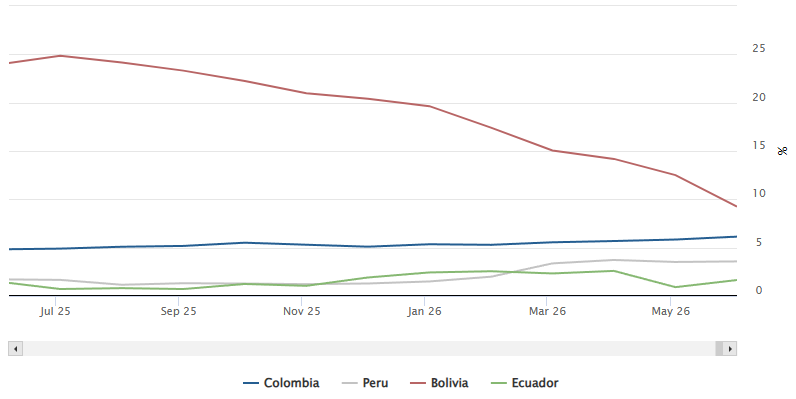
    Andean countries: inflation rate
    Percentage variation (year-on-year)

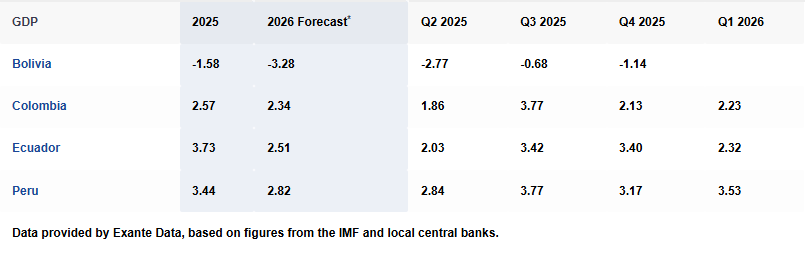
    Andean countries: GDP growth (%)
    Quarterly figures are year-on-year growth

  • In Brief – Bolivia, Colombia

    LatinNews 01 May 2012 Hits: 1227

    Bolivia | Investigation into Iranian ships claim. On 27 April the government of President Evo Morales announced it would investigate a complaint that its shipping registry has been used by Iranian vessels to sail under the Bolivian flag. The complaint was filed by an NGO, Avaaz, but Bolivia says it has not received any formal objection from either the US or the UN, according to Zoilo Roca Kikunaga, the director of Bolivia’s international shipping registry (RIBB).

    Colombia | First Erpac convictions. On 30 April the first two members of a "newly emerging" (Bacrim) neo-paramilitary group, Ejército Revolucionario Popular Antisubversivo de Colombia (Erpac), were sentenced to 9 years for the crime of “conspiracy”. The two had handed themselves over to the authorities in December 2011. Given their cooperation with the authorities, the pair had their sentences halved. In coming weeks the courts are expected to sentence another 180 regular Erpac members, while 19 former Erpac leaders also await sentencing.

    Colombia | Controversy over military garb for civilians. On 30 April President Juan Manuel Santos said the government has “very clear indications that the French journalist [Roméo Langlois] is in the hands of the Farc [Fuerzas Armadas Revolucionarias de Colombia]” and asked that the group abides by its promise to stop kidnapping civilians and releases him. In Colombia, the debate has centred on the fact that the journalist was wearing a military-issue bullet proof vest and helmet during the confrontation with the guerrilla, which put him at risk as he could not be easily identified as a civilian. Vice-President Angelino Garzón said yesterday that “the military are military, and those of us who are civilians, including members of government and journalists, should not be wearing military garb”. The Agencia de Noticias Nueva Colombia (Anncol), a pro-Farc internet news site, said in one article that Langlois was the “film director” hired by the government to record the raid and, in another, said that the authorities were responsible for his fate because they took him to the area. Anncol has yet to confirm or deny whether Langlois is a Farc captive.

    Colombia | Ban on the right to bear arms extended. On 30 April the army’s 13th brigade, whose jurisdiction extends over Bogotá, extended for another 90 days the ban on the right to bear arms in public places in the capital. The measure was first introduced in January. According to data compiled by the mayor’s office, homicides committed with a firearm have declined 27% since the ban was put in place. The local government is now seeking to limit the right to bear, or to purchase on the street, armas blancas (a generic term that encompasses all cutting objects, from knifes to nail clippers). In 2011, of the 2,632 murders committed in Bogotá, 1,016 involved the use of a gun and 551 that of an arma blanca.

  • POINTERS

    LatinNews 04 October 2012 Hits: 1890

    VENEZUELA | Warnings of ‘civil war’ risk. David de Lima, former governor of the state of Anzoátegui, said in late August that the opposition presidential candidate, Henrique Capriles Radonski, had a secret plan, supported by several opposition leaders, that if implemented would plunge the country into a civil war. He later qualified his remarks, saying, ‘Maybe not a civil war, but we would fall into another crisis — political, economic and social.’

    On 3 September President Hugo Chávez picked up de Lima’s original theme, claiming that the opposition has ‘a hidden neoliberal package [which] pretends to take us back to a Venezuela that can no longer resist that and would fall again into a nefarious scenario, a profound destabilisation [that] might even take us close to civil war.’ Chávez said that if Capriles were to win, he would scrap the dozens of social programmes that benefit the poor in areas such as housing, health and food. Capriles has said that he will retain the ‘social missions’ introduced by Chávez and ensure that they function better.

    This talk of ‘civil war’ has added to apprehension caused by statements of high-ranking military officers that the armed forces are ‘married’ to the Chávez ‘revolution’ and would not accept an opposition victory.

    COLOMBIA | More funds for defence. The peace talks may be getting under way, but the administration of President Juan Manuel Santos is already seeking more funds to increase the strength of the military and equip it with more up-to-date hardware. It has submitted to congress a draft defence budget for 2013 of US$14.4bn, which accounts for 14% of the total national budget and represents an increase of 13% on this year’s defence budget. The bulk of the funds will go on salaries for military personnel (about 450,000 at present, with a planned addition of 3,000 next year); US$1.6bn (11%) is allocated to investment.

    Among the acquisitions announced by the defence ministry are 10 new helicopters to enhance the counter-insurgency capabilities of the armed forces. President Santos has said that military actions against the guerrillas will continue as long as they remain up in arms. The government is already in the process of commissioning eight new battalions to protect the country’s oil and electricity infrastructure, which has recently come under increased guerrilla attacks. The specialised magazine Dinero reckons that damage to this infrastructure is causing losses of more than US$33m a year.

    Also envisaged is the strengthening of ‘the deterrent capabilities of the country through the implementation of a cyber-defence and cyber-security strategy, binational border security plans and the implementation of a strategy of cooperation with allied countries.’

    In relative economic terms, Colombia is the Latin American country with the biggest defence budget. According to the Stockholm Peace Research Institute (Sipri) since 2009 it has been spending between 3.5% and 3.7% of GDP.

    ECUADOR | Foreign NGOs barred. On 5 September the technical secretariat for international cooperation, Seteci, announced that permits to operate in Ecuador had been revoked for 26 NGOs for not fulfilling the requisites laid down in a decree issued in July last year by President Rafael Correa. Among these requisites are the prohibition of conducting political activities, proselytising, for-profit activities, or activities that ‘threaten the peace’. The affected NGOs were ostensibly engaged in initiatives in such areas as health, rural cooperation, assistance to the aged and pro-peace advocacy. Apart from the 26 that have been barred immediately from operating, Seteci has served notice on another 16 foreign NGOs that they must promptly sign new agreements with the Ecuadorean authorities.

  • PERU: Pyrrhic victory for Villarán

    LatinNews 21 March 2013 Hits: 1440

    Susana Villarán will remain mayor of Lima after narrowly edging a recall referendum against her on 17 March. Her triumph was tempered by a serious setback for her left-wing Fuerza Social (FS): 21 of the 39 Lima councillors were recalled, 19 of them from the FS. Voters appear to have decided to keep Villarán despite misgivings because of the dubious interests behind the recall referendum, but to punish her by stripping her of support in the council. The decisive factor behind her triumph was the support offered by Lourdes Flores, of the conservative Partido Popular Cristiano (PPC), who she defeated in the mayoral elections in October 2010. The decision by the Partido Aprista Peruano (PAP), far less popular than the PPC in Lima, to seek to replace Villarán also solidified support for her.

    Villarán’s narrow margin of victory (some 74,000 votes in 2.72m) mirrored her electoral triumph in 2010 over Flores (by just 36,000 votes) but the composition of this support was very different. This time PPC supporters, predominantly more affluent limeños rather than poorer residents, played a key role in her victory.

    Principles prevailed over party politics for Flores, although her support was also a deft political move, which leaves her and the PPC well-placed to benefit. Villarán embraced Flores in her victory celebrations (a PPC flag conspicuously fluttering behind) and she promised a broad-based government. If she loses 19 of her councillors she will have no choice but to build consensus, constraining her reform agenda: fresh elections will be held to replace recalled councillors within six months.

    Reforming recall referendums

    Mayor Villarán said that either the law establishing recall referendums would have to be revoked or subjected to profound reform to ensure it is not misused again in future. The central government appears to agree. The prime minister, Juan Jiménez Mayor, said it was necessary to ask how much the recall referendum really contributes to democracy and strengthening state institutions. He said he would have preferred to have invested the funds the State spent on the contest in Lima on social works, on water or sanitation.

  • Pointers

    LatinNews 11 April 2013 Hits: 2765

    PERU | Compulsory military service. The military high command announced on 22 March that if a recruitment drive to be held in April does not result in the necessary intake of new army personnel, it will resort to the new legislation approved last December, which provides for a compulsory draft by lottery of males aged 18-25. The legislation exempts parents and university students, and allows those who do not wish to enlist to get away with a fine of US$700. It establishes a starting salary for soldiers of US$100 a month,  rising to US$146 — considerably lower than the legal minimum salary of US$283. This has been criticised by the opposition as doubly discriminating against the poor, who can neither afford the fine nor a university education.

    Officials first said, off the record, that the conscripts would not be sent to the Vraem area, where the military are fighting a surviving unit of the Sendero Luminoso (SL) guerrillas. This was later amended, on the record, to confirm that they might be sent there, but not to the frontline.

    Service in the military had been completely voluntary in Peru since 1999 but the armed forces, roughly 100,000 strong, have complained about an annual deficit of 18,000 recruits. In South America, only Bolivia and Colombia still have obligatory military service.

    PERU | New élite police unit. On 21 March Interior Minister Wilfredo Pedraza announced the creation of a new specialised police intelligence group, to be name Génesis. It will be modelled on GEIN, the police intelligence group renowned for a series of successful counter-terrorist operations in the 1990s, including  the capture of Abimael Guzmán, the founder and leader of the Sendero Luminoso (SL) guerrillas.

    Génesis personnel will be drawn initially from Dirincri, the criminal investigations unit of the national police, which Pedraza commended for its ‘vast investigation and intelligence experience’.

    In addition to the new unit, the government will also assign more resources to Dirincri so as to also improve its ability to fight crime across the country. The interior ministry is also studying the implementation of an ‘incentive programme’ for police units that obtain results in breaking up criminal gangs.

    ECUADOR | Firefights with Colombian guerrillas. On 14 March General Jorge Peña, commander of the Ecuadorean army, announced that over the previous two months his forces had noticed a ‘much lower’ presence of  ‘illegal Colombian armed groups’ along the common border, where some 7,000 soldiers are deployed. Just under two weeks later, on 25 March, a patrol clashed with a small group of Colombian guerrillas in the Real Cuembí sector of the border province of Sucumbíos, after which they were able to locate three bases capable of housing up to 20 people. On 27 March another army patrol was engaged by a group of 15 to 20 guerrillas in the 18 de Noviembre sector, close to the San Miguel river. After a lengthy exchange of gunfire the guerrillas fled; there were no casualties. Reinforcements were despatched to both sites.

    BOLIVIA | Security emergency in Santa Cruz. In late February the government of Santa Cruz called on the national government to send 10,000 additional police forces to the region, because the current 6,500-strong force was proving unable to curb the actions of ‘organised crime’. Colonel  Alberto Aracena, chief of the national police, sent 500, as he put it ‘to banish foreign criminals from Bolivia who, complicit with locals, are causing anxiety, especially in Santa Cruz.’ This has been interpreted  as an oblique admission that the presence of foreign drug trafficking organisations was greater than the government has so far acknowledged.

  • China's India incursion explained

    LatinNews 01 May 2013 Hits: 706

    On 25 April, we sent out a Special Alert on the cross-border incursion by Chinese troops into Indian Ladakh.  We noted that India was seeking to downplay the incident in public, and that remains the case.  However, behind the scenes experts are highly perplexed by this development.

    It is now over two weeks since the initial Chinese incursion by 30 soldiers on 15 April into the Daulat Beg Oldi (DBO) area of Ladakh.  The Chinese troops are believed to have crossed 18km over the Line of Actual Control (LAC) into Indian territory, where they remain.

    What is so perplexing is that the incident has occurred just ahead of a planned visit to India by Premier Li Keqiang, and at a time when economic relations are burgeoning.  Bilateral trade amounted to only about $3bn as recently as 2000.  Now it is $80bn and heading towards $100bn by 2015.  Li’s visit to India will be his first overseas trip since becoming premier, which suggests how important relations with India are seen to be in Beijing.  China’s new president, Xi Jinping, has also indicated the importance of India, describing relations with India as “one of the most important for China”.

    On top of all that, China is engaged in serious confrontations with its neighbours in the East and South China Seas (particularly Japan and the Philippines); it is trying to counter the US’s pivot to Asia; and, only this week, it has seen renewed efforts by Japan to court Russia as a balance to China.  For all these reasons it is a strange moment to pick a fight with India.

    The most likely explanation is that the Chinese military is not entirely at one with the political echelon.  President Xi has emphasized the army’s need to defend China’s territorial integrity, but the army (or, at the very least, localized elements of it) may be taking up this challenge more enthusiastically than Xi contemplated.  It may also be responding to a recent reversal in Indian policy towards the border regions.  Until recently India has not built up the infrastructure along the border, but more recently it has been building roads and air bases in border regions.

    The question of the PLA’s hawkishness has come to the fore this week in another context, with the commander of the Chongqing garrison, General Zhu Heping, writing an article in the Guangming Daily on 29 April which warned about “Western cultural infiltration”.  Zhu is a former secretary to ex-chief of staff Zhong Wannian.  He warned, in the context of “cultural colonialism”, that “the young generation can easily lose its will to resist without knowing”.  He wrote: “Western hostile forces seize every opportunity to sneak attacks against us, and they are pressing harder and harder.”

    Zhu also warned against “depoliticisation of the armed forces”, and local sources have said the general’s article may well have been aimed more at heading off any attempt by Xi to rein in the military than at Western cultural imperialism.

    Meanwhile, back in India, the problem for China is that there are always elements in India willing to see the worst in Beijing.  Former defence minister Mulayam Singh Yadav, chief of the Samajwadi Party, told parliament that China is India’s “biggest enemy”.  Yadav said: “I have been raising this issue for the past eight years.  I had warned that that there will be a repeat of [the war of] 1962.  I even went and met the Prime Minister [Manmohan Singh] in his chamber, yet there was no response. Now, [External Affairs Minister] Salman Khursid is going to China.  To do what?  Beg before them?”  Yadav, whose party gives important external support to the government, accused the government of being “cowardly, incompetent, and good for nothing”.

    Despite Yadav’s urgings, however, the Indian government remains keen to play down the incident, with Defence Minister AK Antony saying that India “remains committed to a peaceful resolution of the situation through dialogue within the framework of agreements for maintaining peace and tranquillity.”

    NOTE: Japan’s Prime Minister Shinzo Abe has made the first official visit to Russia by a Japanese premier for 10 years.  He met with President Vladimir Putin on 29 April with the heavily trailed intention of “building personal trust with Putin” and pushing to restart talks for a peace treaty to formally end World War II hostilities and to resolve the dispute over the Russian-occupied Kurile Islands – taken from Japan at the end of the war.

  • Bolivian government to recover idle mining concessions

    LatinNews 19 September 2013 Hits: 1401

    Development: On 18 September Bolivia’s President Evo Morales promulgated a law permitting the State to seize inactive mining concessions from private companies without compensation.

    Significance: The law, first approved in June by the ruling Movimiento al Socialismo (MAS)-controlled legislature, is part of government efforts to boost the mining sector. Morales said it would enable the State to recover 70% of the 2,454 concessions currently in private hands. On government figures, there are a further 4,546 mining concessions being operated by collectives and the State, a lot of which are very small mines. The new legislation will concern private sector operators as it allows the State to recover concessions deemed idle or where there has been no investment: the wording does not specify a timeframe for either categorisation. In recent State takeovers in Bolivia — such as the February 2013 seizure of Bolivia’s main airport operator, Servicios de Aeropuertos Bolivianos (Sabsa), from two Spanish companies (Abertis and Aena) - Morales justified the seizures by alleging insufficient investment.

    Key points:

    • In January a report by the privately-run Bolivian institute of foreign trade (IBCE) flagged up a 7% year-on-year drop in mineral export volumes in 2012 to 1.2m tonnes (based on preliminary figures). In value terms, overall mining exports rose 8% in 2012, reflecting favourable commodity prices. Mining accounted for 32% of Bolivia’s total exports in 2012, down slightly on 2011 (37%) and 2010 (33%).
    • In July Vice-President Álvaro García Linera noted that back in 2001 the Bolivian State had accounted for 5% of all mining production in the country, with private medium-sized companies accounting for 60% and small companies and cooperatives for 35%. García Linera said that by end 2013 the State would account for 6% of production, medium-sized companies for 39% and small companies and cooperatives for 55%.
    • The efforts to seize State control over the sector comes as the state-owned Corporación Minera de Bolivia (Comibol) has come under considerable criticism for poor organisation and lack of investment. The company has had three presidents in less than a year. It’s incumbent head, Marcelino Quispe López, the former general manager of Bolivia’s main Huanuni tin mine, who took over as Comibol president on 27 August, replaced Edgar Hurtado Mollinedo, who was fired after just over two months. Hurtado in turn took over from Edgar Pinto, appointed in September 2012. In his January state of the nation address, President Morales alluded to this inefficiency, criticising the poor results at the Colquiri tin/zinc mine, nationalised in June 2012.
  • TRACKING TRENDS

    LatinNews 18 January 2018 Hits: 1578

    ARGENTINA | Inflation defies official forecasts. Argentina’s consumer price index rose to an annualised rate of 24.8% in 2017, overshooting the central bank’s top inflation target of 17%, the national statistics institute (Indec) reported last week.

    In December 2017, consumer prices rose by 3.1%, marking the biggest monthly increase in inflation in the year, due to a sharp increase in utility tariffs resulting from the decision by the government led by President Mauricio Macri to continue with its plans to remove government subsidies on these gradually.

    The year-end 2017 inflation figures represent a problem for the Macri government as they show that it still faces an uphill battle to bring inflation under control, after it peaked at around 40% on private sector estimates, under the previous administration led by former president Cristina Fernández (2007-2015). It also makes the government’s plans to continue rolling out its proposed economic reforms more difficult, as the persistently high inflation rate exacerbates the negative impact that these could have on the general population. This, in turn, makes public acceptance of the reforms more difficult to obtain. Failure to rein in inflation as Macri had promised also erodes public confidence in his government.

    BRAZIL | Downgrade. International credit ratings agency Standard and Poor’s (S&P) downgraded Brazil’s credit rating this week to ‘BB-’ from ‘BB’, with a ‘stable’ outlook. This leaves Brazil’s credit rating three notches below investment grade on a par with countries like Bangladesh, the Dominican Republic, and Macedonia.

    The downgrade comes after the government led by President Michel Temer failed to deliver on its promised pensions reform to reduce the fiscal deficit, which has hit a wall in congress. Further downgrades could follow if the government goes ahead with plans to bend the so-called ‘golden rule’, which could undermine its commitment to fiscal responsibility. The ‘golden rule’ stipulates that new debt cannot be issued by the government to finance current expenditures and should only be used for investment.

    BRAZIL | Yellow fever. The World Health Organization (WHO) has added São Paulo state to the list of at-risk areas for yellow fever. This means anyone visiting the area must be vaccinated first and is advised to take precautionary measures to avoid getting bitten by mosquitos. The decision comes after the WHO noted a surge in yellow fever cases last winter. Since December 2016, the WHO has registered over 777 human cases of yellow fever and 261 people have died.

    Brazil’s health ministry will distribute vaccines to all affected states. “We have the necessary stock to meet the needs of the Brazilian population. Today we have syringes to vaccinate 20m people and last week we asked the Pan-American Health Organisation (PAHO) for another 20m,” the acting health minister, Antônio Carlos Nardi, said.

    • Carnival

    Rio de Janeiro will host around 1.5m tourists for Carnival this February, according to the state tourism ministry Riotur, up 400,000 from 2017. Last year, local mayor Marcelo Crivella rained on the samba parade by pointing out that lavish public spending on Carnival was incompatible with the austerity measures prescribed by President Michel Temer. But this year, Crivella changed his tune and got more into the Carnival spirit by allowing private companies to sponsor the mega-event, increasing the total budget to R$3.5bn (US$1.08bn), up R$500m (US$154.8m) from last year. He opened an interview with news site G1 by singing “Whoever doesn’t like samba…isn’t a good mayor.”

  • Brazil’s economic team rattled by CPMF debate

    LatinNews 19 September 2019 Hits: 656

    The Brazilian government’s fiscal game plan requires it to achieve two things this year: pension and tax reform. The first is expected to clear congress by October. The second faces some difficulty, after President Jair Bolsonaro and economy minister Paulo Guedes disagreed over whether to bring back a version of CPMF, the unpopular financial transactions tax which was scrapped in 2007.

    While still not completely in the bag, Brazil’s pension reform bill is expected to clear the senate in October (it has already passed the two key lower house votes). The senate version of the bill is expected to deliver savings of R$876.7bn (US$214.6bn) over ten years, less than originally hoped, but still a significant contribution to correcting deep structural imbalances in the country’s fiscal accounts.

    From economy minister Guedes’ point of view, the next step – simplifying Brazil’s hyper-complex tax system – is critical to building business confidence and investment and laying the foundations for a more sustainable recovery.

    One of the problems has been that in response to revenue shortfalls, successive Brazilian governments have created a patchwork of new taxes, often levied on top of old taxes, creating a dense and hard-to-manage fiscal bureaucracy. Tellingly, the current reform will attempt to create one federal value added tax (VAT) by integrating no fewer than nine separate taxes: IPI, IOF, PIS/Pasep, COFINS, the salary-education tax, the CIDE-fuels tax, CSLL (federal), ICMS (state), and ISS (municipal).

    The idea is that a simpler tax structure will help improve Brazil’s ease of doing business. The economic team is also reported to be looking at ways of reducing reliance on payroll taxes (which they see as contributing to uncompetitive wage costs).

    However, a problem has emerged. Guedes wants to introduce a financial transaction tax while President Bolsonaro is deeply opposed to the idea. The tax would be modelled on the unpopular Contribuição Provisória sobre Movimentação Financeira (CPMF) tax which was levied from 1994-2007.

    Guedes has argued that a financial transaction tax is efficient and would allow the government to cut back the rate of other levies such as income taxes and the proposed VAT. However, he was forced to sack Marcos Cintra, the federal revenue service (Receita Federal) secretary, who was judged to be responsible for leaking details of the new tax, including the government’s intention to set it at 0.4% of all transactions (such as bank or cheque payments).

    Bolsonaro, in hospital recovering from a hernia operation, telephoned the economy minister to express his opposition, and tweeted that the tax would not be introduced. In the minister’s telling, “We were in the process of modelling a financial transaction tax, but the president was always against it and asked us not to.”

    CPMF was never popular. According to a survey conducted by Ibope in 2016, 73% of respondents were opposed to its reintroduction. Bolsonaro had expressed his opposition to the tax in the 2018 election campaign. Some critics also point out that it is a regressive tax, since it has a greater impact on the poor. On the other hand, Guedes argued that it is easy to collect and difficult to evade.

    Stronger second-quarter GDP growth

    Brazil’s GDP grew by 0.4% in Q2 on a quarter-on-quarter basis, somewhat above expectations, and contrasting with a 0.1% drop in Q1. In year-on-year terms GDP was up by 1.0% in Q2, from 0.5% in Q1. Economists said the data confirmed that the country is not slipping back into recession (a concern voiced during Q1). However, they added that the recovery, largely driven by an upturn in investment, remains disappointingly weak. Despite the difficulties over tax reform, economy minister Paulo Guedes remained relatively upbeat, telling foreign journalists that privatisations will reach US$20bn this year and increase further in 2020. The minister said economic reforms would lift growth to 2.5% next year.

  • BRAZIL: Coronavirus causes Carnival concerns

    LatinNews 06 February 2020 Hits: 3893

    With under three weeks to go before Shrove Tuesday on 25 February, Brazil has truly entered its pre-Carnival period, with the accompanying influx of tourists and countrywide street parties. This year’s festivities risk being overshadowed by some public health concerns, however, not least relating to the novel coronavirus outbreak in China.

    This year’s Carnival period is expected to generate some US$8bn in tourism-related revenue for Brazil, the highest figure since 2015 and a 1% real increase on last year, according to a report published on 3 February by the Confederação Nacional do Comércio de Bens, Serviços e Turismo (CNC). Over half of this will be concentrated in just three states, Rio de Janeiro, São Paulo, and Bahia.

    The timing of a global public health emergency, following the spread of the coronavirus outbreak from China, is therefore less than ideal for Brazil. After an online video appeal from Brazilians under lockdown in the Chinese city of Wuhan, the epicentre of the coronavirus outbreak, the government led by President Jair Bolsonaro announced on 2 February that it would be repatriating its citizens from Wuhan and the Hubei province. Congress fast-tracked legislation relating to the repatriation process and protective measures against coronavirus, and around 40 Brazilian nationals are now due to arrive from China on 8 February. They will be quarantined in the state of Goiás for 18 days.

    Nancy Bellei, an infectious disease specialist member of the non-profit Sociedade Brasileira de Infectologia (SBI), told French public radio station RFI on 3 February that she expects the virus will eventually arrive in Brazil, although she hoped this would happen after Carnival. “I think it will arrive…maybe before or during Carnival,” she said, citing the movement of large numbers of people during this period and some asymptomatic transmissions of the new virus. As of 5 February, Brazil’s health ministry had reported 11 suspicious cases under analysis in the country (down from 13 the previous day), with no confirmed diagnoses. It has nevertheless declared a public health emergency of national importance (Espin), to better implement prevention measures.

    For many, the concern is not so much that Carnival will precipitate the spread of the coronavirus to Brazil, but that misinformation about the outbreak will impact Carnival-related activities. The federal health ministry’s ‘fake news’ checking service states that the claim that “Carnival will leave the door open to the coronavirus” is false. On 3 February Alexandre Chieppe, a doctor, spoke to members of the public on behalf of Rio de Janeiro state’s health secretariat, reassuring them that taking part in Rio’s Carnival street parties will not increase their risk of contracting the virus. Authorities in the city and state are mapping out a coronavirus contingency plan though, according to the state news agency Agência Brasil.

    Other Carnival challenges

    The coronavirus is not the only threat to a successful Carnival. Public health authorities will also be on the alert for cases of measles and dengue, the outbreak of which has been particularly severe this summer in South America. In Rio city (expected to receive a total 1.9m tourists), drinking water shortages could also prove a challenge. After residents complained for weeks about the smell, colour and taste of their tap water, the state water company Companhia Estadual de Águas e Esgotos (Cedae) suspended water distribution for 14 hours on 3 February after detergent was found in the Guandu water treatment plant, the city’s main plant. The plant has since re-opened, but local authorities were forced to delay the start of the school year, due on 5 February, by a day as a result.

    Economic worries

    Beyond the public health threat, there are real concerns as to the likely impact of the coronavirus on Brazil’s economy, both globally and at a national level. Markets worldwide have been rattled by the outbreak, Brazil being no exception, and with China being Brazil’s largest trade partner, the country’s exports would be affected by reduced demand. President Bolsonaro said on 31 January that Brazil’s exports could fall by 3% because of the coronavirus. That same day, the economy ministry’s special trade secretary Marcos Troyjo sought to allay concerns, saying that Brazilian exporters have not yet been affected. 

  • PANAMA: Mixed messages on financial transparency

    Patrick de Courcy 04 May 2023 Hits: 5323

    Panama’s 71-member unicameral assembly last week shelved a proposed asset forfeiture bill (625). The move has been condemned by Security Minister Juan Pino and raises further doubts over the ability of the Partido Revolucionario Democrático (PRD) government led by President Laurentino Cortizo to make good its longstanding promise to tackle corruption – a pledge which has yet to be fulfilled. It comes soon after Cortizo asserted his government had been making “an enormous effort” to remove Panama from the grey list of countries that are not doing enough to combat money laundering, drawn up by the Financial Action Task Force (FATF) of the Organisation for Economic Cooperation and Development (OECD).

    On 27 April the president of the national assembly, the PRD’s Crispiano Adames, confirmed that the bill would be shelved due to insufficient quorum in the house for a second debate. First presented before congress in April 2021 following earlier versions unveiled in 2015 by former attorney general Kenia Porcell (2014-2020), and in 2014 by her predecessor Ana Belfón (2012-2014), the bill would establish legal tools to confiscate assets obtained through illegal activities, such as drug trafficking, corruption, and organised crime, and is widely considered key to tackling corruption.

    The defeat for the government comes less than two weeks after President Cortizo told the UK’s Financial Times (FT) that Panama expects to be removed soon from the FATF’s ‘grey list’. In an interview published on 16 April, Cortizo said that Panama was completing work on a beneficial registry of company ownership, one of the last outstanding tasks assigned by the FATF. “We are expecting to leave FATF [’s grey list] soon, we are expecting it this year…We have made an enormous effort. I have been personally following the team working on the issue,” Cortizo said. The FT cited a senior US embassy official as confirming that there was a “really good possibility” that Panama would leave the FATF grey list and it could happen before the end of 2023 if enough progress was made on uploading companies to the registry of beneficial ownership.

    Panama has faced major pressure in recent years to tackle transparency in its financial system following the April 2016 ‘Panama Papers’ scandal, when over 11m confidential documents were leaked from the offices of the now defunct Panama-based offshore law firm Mossack Fonseca [WR-16-13]. More immediately this pressure has come from the FATF which in February 2023 urged Panama to fully address remaining measures in its action plan as all timelines had expired in January 2021. Citing as strategic deficiencies the need to ensure “adequate verification, of up-to-date beneficial ownership information by obliged entities and timely access by competent authorities”, the FATF warns that if its action plan has not been completed by June 2023, Panama faces enhanced due diligence of transactions.

    No improvement in CPI score

    The latest Corruption Perceptions Index (CPI) drawn up by NGO Transparency International (TI), released on 31 January, notes that Panama’s 2022 score of 36 out of 100, which was unchanging on its 2021 score, is a decline of two points on the CPI since 2012. TI highlights that Panama’s inability to improve its score from 2021 reflects “poor institutional conditions to fight corruption and end impunity, particularly in cases of grand corruption”. It also noted the wave of protests which rocked the country between July and August 2022, sparked by the rise in living costs, which the NGO describes as “an organic response to public institutional corruption and unjustified growth of the government payroll”.

  • ARGENTINA: Opposition JxC picks up steam

    Patrick de Courcy 06 July 2023 Hits: 3119

    After a slow start to the electoral cycle, the right-of-centre Juntos por el Cambio (JxC) opposition coalition is starting to make an impression. The JxC is having some provincial-level electoral success against long-serving Peronist governors, which looks to have provided a boost in the national polls, underpinning its bid for the presidency. It also helps that the far-right anti-establishment outsider, Javier Milei, has fallen back in the polls amid a scandal to the benefit of the JxC.

    The latest electoral surveys are suggesting voters may be swinging back towards the political centre. A poll by Analogías indicated that the two main JxC opposition coalition pre-candidates going head-to-head in next month’s primary elections, Patricia Bullrich and Horacio Rodríguez Larreta, had a combined 32.7% support, followed by Sergio Massa, the economy minister who has now become the unity presidential candidate for the ruling Unión por la Patria (UP) left-of-centre Peronist coalition, on 28.3%, and the far-right libertarian Milei with 17.8%.

    After strong growth in the last six months Milei, whose radical campaign promises include dollarising the economy and closing down the central bank (BCRA), has begun to lose ground. Recent accusations of corruption, including claims that his La Libertad Avanza party has been selling candidatures for US$50,000 a time, may have been a factor. “We are seeing a steady, if gradual, trend towards this becoming a polarised race between the main two coalitions,” Marina Acosta, the director of Analogías, said.

    The JxC has also started to make its mark after a stuttering start to the electoral cycle, hampered by internal divisions. The opposition coalition ended two decades of Peronist rule in the north-western province of San Juan in gubernatorial elections on 2 July. Marcelo Orrego, a federal deputy representing San Juan, will serve as the next provincial governor for the Frente Unidos por San Juan, the local JxC political movement. Orrego topped the list of JxC candidates in the ‘provincial system of open democratic participation’, set up in September 2022 to replace primary elections, under which coalitions can field various candidates with the victor accumulating the sum total of votes cast for all of those on the same ticket. Orrego, a close ally of Rodríguez Larreta, the mayor of Buenos Aires, won 51% of the vote in this way to 44% for the Peronist coalition, whose candidates included Rubén Uñac, the brother of the incumbent governor Sergio Uñac, and long-serving former governor José Luis Gioja.

    Orrego’s victory followed the JxC’s triumph in the northern province of Chaco (albeit only in primary elections) against the incumbent governor Jorge Capitanich, one of the pre-eminent politicians in the Kirchnerista wing of the ruling Peronist coalition [WR-23-25], and a strong showing in the Córdoba gubernatorial elections. It would be a mistake to attach too much significance to the outcome of provincial elections on the national contest, but they are re-establishing the JxC’s credentials as the main challenger to Peronist rule.

    Bullrich, a hardline former security minister, spelt out her plans for the country on 29 June in a speech addressing JxC congressional candidates, governors, and mayors, in a hotel in the province of Buenos Aires. She promised to deliver “a profound change”, combatting drug trafficking and insecurity, improving education, and bringing down inflation.

    • Bullrich

    In a press conference, Patricia Bullrich argued that the JxC must be prepared to face the continued threat posed by Kirchnerismo. “We have before us a pragmatic Kirchnerismo, destroyed in terms of ideas, but not dead,” she claimed in reference to its support of Sergio Massa as presidential candidate. Bullrich insisted that there was “no problem of social peace” in Argentina, simply “an organised minority” that “threatens” the rest of society and that “we are going to confront”, in an allusion to Kirchnerismo, which she blames for social unrest such as the recent protests in the north-western province of Jujuy [WR-23-25].

    In principle, the centrist economic pragmatism favoured by the presidential frontrunners, Massa, Rodríguez Larreta, and Bullrich, will likely prolong the debt restructuring agreement with the International Monetary Fund (IMF) into 2024, but the economy remains fragile and the risks of a renewed currency crisis remain high. Economy ministry officials had been due to travel to Washington this week for face-to-face meetings with their IMF counterparts, but the visit has been postponed amid continuing disagreements on how to modify the existing programme. Although Massa remains committed to the deal, it is not clear yet who will replace him as economy minister when he starts to campaign in earnest for the presidency.

  • PARAGUAY-BRAZIL: US shoutout puts spotlight on Itaipú potential

    Patrick de Courcy 19 June 2025 Hits: 4069

    Intentionally or not, US Secretary of State Marco Rubio gave Paraguay a massive plug during his testimony before a US Senate Committee on Foreign Relations in May, advertising the country’s huge potential surplus electricity supplies from the Itaipú hydroelectric dam, that would be ideal to set up energy-intensive service providers for artificial intelligence (AI). The comment was also a stab at Brazil, which has been using that excess electricity for half a century and is in the midst of delicate negotiations with Paraguay to secure that supply in the future as well.

    “They were in a long-term deal with Brazil, where they sold them 50% of the energy being produced. That deal is now expired,” Rubio told the committee on 20 May. “They’re trying to figure out what to do with the 50% of electricity generated by hydropower that is no longer going to be going to Brazil…So someone, if they’re smart, is going to go down to Paraguay and open up an AI facility.”

    The contract, which established that both countries have rights over half of the energy produced by the jointly owned Itaipú, expired in 2023. Under that agreement Brazil had preferential rights to Paraguay’s excess energy. Since then, the two countries agreed on the rates Itaipú would charge in the future but not on how energy would and could be sold, terms that are set out in the so-called Annex C of the Itaipú Treaty.

    Suspended talks

    Just when there seemed to have been a breakthrough and Paraguay announced a 30 May deadline for a signing ceremony, the government of President Santiago Peña pulled out of the talks after media leaks revealed that Brazil’s intelligence agency (Abin) had spied on Paraguayan authorities from 2022-2023 to obtain information related to the very same revision of the Itaipú Treaty.

    But in the end, it is unlikely to come to an abrupt or even confrontational outcome, for several reasons. For one, installing AI terminals will require a minimum of infrastructure, such as transmission lines as well as data centres. That would provide the necessary transition period for Brazil to complete the development of alternative energy sources. Also, Paraguay and Brazil will have to renegotiate Annex C of the Itaipú Agreement either way. The power plant is jointly owned and, in practice, both sides need to agree what is done with the energy it produces.

    Brazil fired a shot on 30 May over Paraguay’s bow when Energy Minister Alexandre Silveira threatened to consider last year’s tariff agreement void if Asunción did not return to the negotiating table. That would be an unwelcome development as Peña was elected to office in part on pledges to negotiate higher rates that would fill government coffers and finance some of his priority spending plans. At home opposition legislators had called on Peña to complete the renegotiation of the treaty, saying he needed to fulfil his campaign promise. The espionage case put Paraguay in a stronger position to negotiate a better deal, they argued.

    While Rubio’s comments came out of the blue and may have annoyed Brazilian diplomats trying to get Asunción back to the negotiating table, his idea is nothing new. For some time, Paraguay has been working to attract investors to help develop a regional AI hub by touting clean energy, low inflation, and a competitive exchange rate, as well as legislation that favours foreign capital. Only days before Rubio’s comments, Peña met with big tech companies in San Francisco, including what the president called a “super productive” meeting with Nvidia, the premier producer of chips for AI.

    In fact, Rubio and Peña had been discussing cooperation between both countries on ICT infrastructure on several occasions, including a phone call in March during which Rubio also congratulated Paraguay for buying a US radar system to help combat drug trafficking. Perhaps Rubio’s shoutout was more of an appeal for US tech companies to get to Paraguay for clean and abundant energy before others do. After the US, Peña repeated his sales pitch to investors in Taiwan, Japan, Singapore, the United Arab Emirates, and India.

    Brazil alternatives

    If Paraguay were to suddenly stop selling Brazil excess energy, its neighbour to the north could have some difficulty in finding substitutes in the short term and may have to activate more expensive gas-fired thermal plants. But Brazilian authorities point out that the generous price increase agreed for Itaipú energy is very close to current market prices, so that the impact on consumers would not be that large. In the medium term, there are projects in the pipeline, such as increased renewable energy and gas production that could fuel thermoelectric plants and help offset any potential shortfalls from Paraguay.

  • TRACKING TRENDS

    LatinNews 23 September 2011 Hits: 2193

    BOLIVIA | Budget amendment. On 6 September the plenary of the Bolivian senate approved an amendment to the 2011 budget (PGE), ratifying earlier changes by the chamber of deputies. The vote added Bol$3.27bn (US$457.21m) to budget expenditure, a quarter of which will go towards public works, including US$40m for the roads administration (ABC) for the upkeep of the so-called vital road links network (RVF).

    COLOMBIA | DAS scandals mount. In its 17 September issue, the Colombian current affairs weekly Semana revealed that the entire database of Colombia’s intelligence services (DAS) is available for purchase on the black market. Semana claimed it was able to acquire tens of thousands of classified and secret DAS documents. The sensitivity of the information therein is such that it could result in the deaths of numerous agents and their informants, both in Colombia and in neighbouring countries.  One available database contains details of all 6,022 DAS employees.

    COLOMBIA | New ministers. This week President Juan Manuel Santos named Frank Pearl as the country’s new minister of environment and sustainable development. The appointment of Pearl, who previously served as the peace high commissioner under the Alvaro Uribe administration (2002-2010), was criticised by the ruling Partido de la U, which said Pearl had “failed” when in charge of the country’s re-integration programme. Senator Armando Benedetti said the appointment was “very surprising” since Pearl “has no clue about the environment”. Citing Pearl’s previous stints in the private sector, Benedetti suggested he might be biased “towards the interests of businessmen”. Pearl will have to stop illegal mining and address climate change as two of his main responsibilities in the newly created ministry. President Santos also named Mauricio Cardenas as his new minister of mines and energy, replacing the outgoing Carlos Rodado.