The oil price bust will force a re-appraisal of energy production, trading, and investment decisions right across the continent. In March, a month in which oil prices had roughly halved to around US$30 a barrel, Ruaraidh Montgomery, an analyst at oil research company Welligence, told Reuters news agency that “Latin America’s flowing production is over 7m barrels per day. At current prices, we estimate that half is non-economic, taking into account all costs, including transportation and taxes”. Most of the region’s production is composed of heavy crudes, which have experienced sharp demand and price falls. According to projections, global demand for heavy crudes will fall by 10% or more in 2020.
Although various different estimates are made, Reuters calculated that the average marginal or ‘lifting cost’ of a barrel of Latin American crude oil is US$13, excluding indirect costs and taxes, according to data provided by Ecopetrol in Colombia, Petroecuador in Ecuador, Pemex in Mexico, Petrobras in Brazil, and PDVSA in Venezuela. In the current climate many wells have become uneconomic. Welligence calculates that since the oil price slumped, the global oil industry has cut planned 2020 investment by 35% or US$40bn. In Latin America the cut to planned capital expenditure has been greater, at 43%. Areas most at risk include some high cost deep and shallow water wells in Brazil (but not the offshore pre-salt fields in the country, where lifting costs are particularly low, at around US$5.60 a barrel). The heavy crude oil sands in Venezuela and the shale oil and gas formations in Argentina are also high cost.
While lifting cost is at the margin, the more inclusive break-even cost is higher, and takes account of all the prior capital investment needed to develop a field. In a research note issued in April Swiss bank UBS commented that “Petrobras should have a slower development of its investment case, while Ecopetrol and YPF would struggle as they have a breakeven of US$30 per barrel and US$40 per barrel, respectively”. Ecopetrol said it was still covering its costs and was therefore not cutting back production. In April Venezuela’s President Nicolás Maduro confirmed that PDVSA, which claims its lifting costs are around US$11 a barrel, was selling its oil at below the cost of production. Among the state-owned oil companies, Mexico’s Pemex appears to be one of the most vulnerable. While lifting costs average US$16 a barrel according to company data, Fitch Ratings has calculated Pemex cannot cover operating and financial costs at below US$20 a barrel and has ‘full cycle costs’ as high as US$80 per barrel after taxes.
An assessment of Latin America’s response to the oil glut conducted by the trade publication Petroleum Economist confirms that roughly half the region’s 7m bpd production is currently uneconomic but notes that that does not mean the wells involved will be rapidly closed down. There can be good commercial and technical reasons to keep the oil flowing in the hope of an eventual price upturn, not least because shutting down wells is itself a complex and costly business that could damage reservoirs. Local currency operational losses are serious, but to some extent have been limited in US dollar terms, given the sharp depreciation of a number of Latin American currencies.
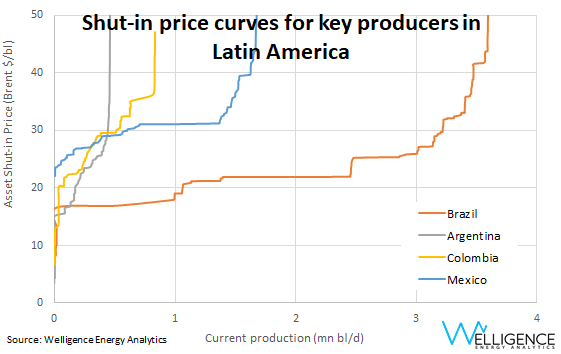
The shut-in price curve for Latin America shows that Argentina is worst-placed, while Brazil is best-placed, with Colombian and Mexico somewhere in the middle. Argentina is in some ways comparable to the US where shale oil production, which depends on drilling thousands of short-lifetime wells, has boomed during periods of high prices, but becomes uncompetitive when prices are low. Brazil’s good position reflects its pre-salt deep-water projects, which have very high capital costs, but once they come onstream become ‘cash generating machinesi with relatively low operating costs.
The IOCs
A number of international oil companies (IOCs), as well as independent local producers, have already announced cutbacks in capital expenditure (capex). Chief executive of US-based oil services provider Halliburton, Jeff Miller, has said he expects capital expenditure to be cut back most sharply in Africa and Latin America with double-digit percentage declines. Research company IHS Markit says up to US$65bn of planned oil and gas investment could be at risk with Brazil most likely to be impacted because of the high cost of developing the pre-salt offshore fields.
Italy’s ENI, with operations in Mexico, Venezuela, Ecuador, and Argentina, has announced a 25% or US$2bn capex reduction for 2020, attributed to “sharp decreases in commodity prices and the foreseeable constraints emerging from the Covid-19 pandemic”. The company operates the shallow-water Mitzón field in Mexico. Norway’s Equinor, with operations in Brazil, Argentina, and Venezuela, says it has reduced capex by 20% to US$8.5bn. ExxonMobil has cut capex by around 30% to US$23bn but intends to press ahead with major offshore development in Guyana. Royal Dutch Shell, a major player in Brazil, has cut capital spending by 20% to US$20bn. France’s Total, a significant natural gas producer in Argentina, has cut capex by 20%, while UK-based BP, with upstream operations in Mexico, Brazil, and Trinidad and Tobago, has reduced its capital spending by 20% to US$12bn.
There have also been cutbacks among the juniors - smaller independent companies - such as E&P Geopark, which operates in Colombia, Peru, Chile, Brazil, Ecuador, and Argentina, and which has slashed its work programme by 60-65% to US$70m-80m. Canada’s Gran Tierra Inc, active in Colombia and Ecuador, says it is closing non-profitable wells, and has reduced capital spending by more than half, to US$60m-80m. Another Canadian company, Frontera Energy, active in Colombia, Peru, Ecuador, and Guyana, has slashed capital spending by 60% to US$130-US$150m.
Crisis and energy transition opinions
“Hundreds of billions of dollars will be spent in the coming months to reflate declining economies. These investments could simply restore the high carbon and unequal economies of today. Or they could help drive low carbon development and protect against the threats that already exist.” Dr Andrew Steer, CEO World Resources Institute,
“The sharp decline in the oil market may well undermine clean energy transitions by reducing the impetus for energy efficiency policies. Without measures by governments, cheaper energy always leads consumers to use it less efficiently. It reduces the appeal of buying more efficient cars or retrofitting homes and offices to save energy. This would be very bad news, since improvements in energy efficiency, a vital element for reaching international climate goals, have already been weakening in recent years.” Fatih Birol, Executive Director, International Energy Agency.
“There will not be a fast recovery from these low prices. We are now seeing demand destruction, and we all know what comes after that: layoffs, production cuts, and investment postponement.” (Off the record) Latin American oil trader.
“As history demonstrates, innovation will thrive at this time of crisis, and this time may provide an opportunity to explore the use of renewable energy and take the leap into the next generation of technologies.” Ragnheiður Elín Árnadóttir, senior fellow, Global Energy Centre, Atlantic Council.
“It seems likely that the coronavirus-induced global economic downturn will cause carbon dioxide emissions to drop this year, the first time since the financial crisis of 2009, with one projection predicting an overall annual decline ranging from 0.3% to 1.2%…That it requires a global pandemic with thousands of deaths, rapidly increasing unemployment, and huge amounts of economic dislocation to reduce emissions by a relatively small amount should instead be one more wake-up call to the scale of the climate challenge and the complexity of solving it.” Randolph Bell, director, Global Energy Centre, Atlantic Council.
“Energy transitions are already underway in many countries. These transitions have become increasingly affordable because of forward-looking policy frameworks, ongoing innovations, and falling technology costs for renewables. Solar photovoltaic (PV) and wind power have become the cheapest sources of electricity in many markets, with other renewable power sources poised to reach cost parity within a few years. In the power sector, renewables have dominated new capacity additions and increasingly outpaced fossil fuels for the past seven years. Last year alone, renewables accounted for nearly three quarters of global power capacity additions.” Francesco La Camara, International Renewable Energy Alliance (IRENA) director general
“For their part oil majors that have recently made pledges to cut carbon emissions and diversify their businesses into renewables, electric mobility, and other low-carbon energy services may back away from the sector under balance sheet strain from low oil prices. One possible twist is that oil prices might remain volatile for several months, which could prompt energy majors to boost their investments in wind and solar projects that produce smaller but stable returns. Low interest rates could also help shore up the renewable energy market.” Julia Pyper, senior editor, Greentech Media; senior fellow, Global Energy Centre, Atlantic Council
Brazil
By April 2020 it was clear that falling energy demand, record low oil and gas prices, and pandemic-related financial turbulence were all delivering a serious blow to Brazil’s hydrocarbons sector. Despite that, the state-owned oil company Petrobras showed signs of resilience. Petrobras announced various emergency measures. Unsold oil stocks were mounting up, with chief executive Roberto Castello Branco saying: “We’ve had to contract ships to maintain stocks floating at sea until we find a buyer.” Output was reduced by around 200,000 barrels per day (bpd). Capital spending for the year was being slashed from US$12bn to US$8.5bn. Operating expenses were being cut by US$2bn, and staff costs by US$133m. In view of the crisis, industry regulator Agencia Nacional do Petroleo (ANP) suspended the country’s 17th oil and gas licensing round, which had been due to offer 128 blocks across five offshore basins.
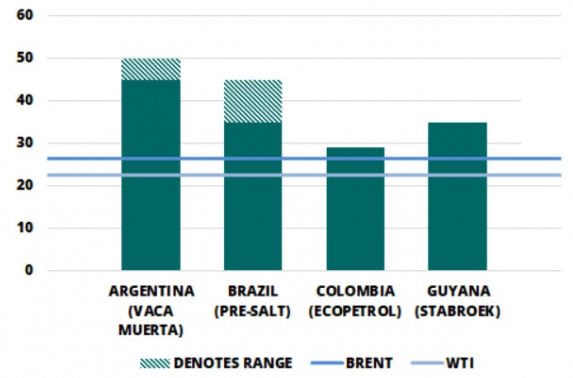
Average Production Breakeven Price (US$/BBL)
Source: Natural Gas World
After heavy losses in the years after 2015, Petrobras registered record profits of US$9.2bn in 2019. The company has been divesting non-core subsidiaries to focus on upstream production. Perhaps critically, the marginal or lifting cost of producing oil from the offshore pre-salt fields has been around US$7-8 a barrel, while estimates of the longer-term breakeven price range from US$21 to UDS$40/barrel. Analysts note that if international prices increase moderately from the lockdown lows of March 2020 to US$30/barrel by the end of this year, Petrobras will be able to find buyers, particularly in Asia, for its relatively low-cost light crudes extracted from the pre-salt fields. The company began cutting output at its higher cost fields first.
Vera De Brito, energy specialist at law firm Mayer Brown, noted that developing the pre-salt fields had been a costly and capital-intensive process. “Therefore”, she said, “the players involved are strong major oil and gas companies that will likely survive the downturn, as they have survived previous downturns. It is the smaller companies and oil and gas service providers that are more at risk. Cleveland Jones, an energy professor at the State University of Rio de Janeiro, agreed, pointing out that “large new projects will be economically viable again even if prices rebound only moderately”.
Mexico
In April, Mexico said it would cut oil production by 100,000 barrels per day (bpd) starting in May. The reduction was part of a 9.7m global production cut agreed by Opec+ producers and the US and is designed to end the price war that had broken out between Saudi Arabia and Russia. President Andrés Manuel López Obrador (Amlo) had refused requests from the other producers for Mexico to make a larger cut of up to 400,000 bpd, causing the global agreement to be delayed. To break the deadlock, US President Trump agreed to cut his country’s output by 250,000-300,000 bpd on Mexico’s behalf. Mexico’s foreign minister, Marcelo Ebrard, praised his colleague Energy Minister Rocio Nahle for “defending Mexico’s interests” in the negotiations. He said that it showed that Amlo’s strategy of energy nationalism was working.
Amlo’s refusal to back down was in line with his fossil-fuel-based energy nationalism. He used the result to underline his commitment to reversing 16 years of declining Mexican oil production. Current output is 1.7m bpd, down from 3.5m bpd in 2004. Amlo has promised to push production back up to 2.5m bpd by 2024, the end of his term in office. Mexico’s success in winning only a modest production cut means that the negative impact on exports and government revenues will be relatively limited. Domestically, the news that Trump had to make a concession on Mexico’s behalf was likely to boost Amlo’s popularity, given Trump’s well-known hard line on Mexico-related migration and border issues.
Despite the short-term benefits for Amlo, greatly reduced current global energy demand means that oil prices may not increase significantly in coming months, limiting any financial benefits for the country. In addition, Trump was expected to demand some quid pro quo concessions from Mexico in the near future. The US president had previously applied import tariffs on Mexican steel and could take other similar protectionist measures. In addition, Amlo will face considerable challenges in his attempt to boost oil production. State oil firm Pemex is one of the world’s most indebted oil companies. At the time of the announcement it was at risk of having its credit rating cut to junk status - something which became a reality later in April. Pemex is therefore unlikely to increase production enough to reach Amlo’s target. In addition, around 50% of Mexican oil output is unprofitable at oil prices of US$30 a barrel or lower. Meanwhile the president has nevertheless pushed on with his plan to build a US$8bn refinery at Dos Bocas in Tamaulipas, despite doubts over its commercial viability.
A large proportion of Mexico’s oil exports for this year have been hedged at US$49 a barrel, which will cushion government finances for now. In March, the private sector proposed up to US$92bn in energy projects in 2020-2024, but this would require Amlo to accept more market-friendly policies. The government was reportedly about to launch a more modest US$13.5bn energy plan. The government hopes that some of the investment for this will come from the private sector. However, unless Amlo relaxes his hostility to greater private involvement, major private commitments are unlikely to be forthcoming. The worsening overall economic picture means that Amlo may eventually be forced to take a more pragmatic line and accept more private sector involvement (an approach favoured by presidential chief of staff Alfonso Romo). This would possibly allow for a limited rejuvenation of the industry, although the lengthy investment timescales mean that significantly increased production would nonetheless still be unlikely for several years.
Argentina
There is a long-standing narrative that Argentina will be saved from its economic travails by the development of the Vaca Muerta shale oil and gas fields in Patagonia. Vaca Muerta has frequently been seen as a game changer. It is one of the world’s largest shale deposits. Only 4% of its surface area is currently being developed. Under the previous government’s National Energy Plan, Vaca Muerta was expected to drive a new oil and gas export surge, generating US$37bn worth of annual sales by 2027 and overtaking agricultural exports as the country’s main source of hard currency. In early March, President Alberto Fernández told congress that “hydrocarbons will be a lever for the productive development of our country”. The IMF has suggested that developing Vaca Muerta could help reduce the country’s foreign debt burden. And yet, in the current global economic crisis, Vaca Muerta seems to have relatively little to offer a government in desperate need of a lifeline.
The combination of the Covid-19 lockdown and depressed international oil and gas prices is in fact proving lethal for Argentina’s oil and gas sector. Daniel González, chief executive at state-owned oil company YPF, has said that petrol sales have slumped by 70% because of the lockdown. With storage tanks at refineries rapidly filling up, YPF said it was shutting down 50% of its production at the 40,000 barrels per day Loma Campana field in Vaca Muerta, which it operates jointly with Chevron. Other companies including Shell, ExxonMobil, Pan American Energy, and Vista Oil and Gas have also announced production cutbacks.
A key problem is that the commercial break-even point for Vaca Muerta shale oil production is around US$45-50 a barrel, at a time when the crisis and the Russia-Saudi price war has brought the international oil price down to a low point of US$20-30. A recovery is possible, but most forecasts do not see the average oil price for 2020 climbing up much past US$40, and many see it remaining below that.
The government has used various mechanisms to subsidise shale production. The energy secretary for Neuquén province has called for a minimum support price for locally produced shale oil (known as the barril criollo) of US$50. But with the country on the verge of defaulting on its foreign debt it is hard to see how the federal government could afford such a commitment. Some relief has been offered by limiting crude and fuel imports through a system of “non-automatic licences”. The oil industry has had spectacular busts before, which are eventually corrected as higher-cost producers are driven out of the market. But at a time when the oil majors are cutting their capital expenditure programmes and Argentina is seen as a high-risk jurisdiction, it is hard to see anyone willing to make an increased commitment to Vaca Muerta. Renewable energy projects (such as wind and solar) have also been hit by the crisis, but at current prices they are looking competitive in terms of return on investment and attractive because they offer environmental benefits.