
All Categories

Subcategories

  • BRASIL: Alto juez cuestiona la imparcialidad del procurador general

    LatinNews 04 September 2015 Hits: 336

    La imparcialidad del recientemente re-designado procurador general de Brasil, Rodrigo Janot, ha sido puesta en duda por el juez de la corte suprema, Gilmar Mendes, después de que los dos chocaron sobre las exigencias del tribunal electoral (TSE) de investigar los probables delitos que habrían sido cometidos por la Presidenta Dilma Rousseff durante la campaña electoral para su reelección el año pasado.

    Janot fue designado de nuevo para su cargo, responsable de supervisar los procedimientos contra los políticos sospechados de corrupción, luego de un épico examen cruzado que duró 10 horas en el congreso federal, el 26 de agosto. Al ser interrogado, Janot negó vehementemente las acusaciones lanzadas por la oposición y el presidente de la cámara baja federal, Eduardo Cunha, de que él había llegado a un acuerdo con el gobierno para no ser muy duro con el izquierdista partido gobernante, el Partido dos Trabalhadores (PT), y proteger de paso a la Presidenta Rousseff en momentos en que la investigación en marcha sobre la corrupción en la compañía petrolera estatal, Petrobrás, se extiende a altas figuras del partido y otros legisladores, incluido el mismo Cunha.

    Hablando con la revista de interés general, Veja, el 31 de agosto, Mendes, un miembro de la corte suprema de Brasil que preside el TSE, declaró que “él [Janot] no debería actuar como un abogado para el PT” y “no debe seguir una interpretación jurídica sólo para proteger a la Presidenta”.

    La entrevista siguió a la publicación en el diario, O Estado de São Paulo, el 25 de agosto, de un fallo emitido por Janot, en el cual el procurador general descarta como “inconveniente” un pedido hecho por Mendes para que se investigue si la compañía gráfica, VTBP, que fue empleada por Rousseff durante su campaña de reelección, recibió dinero malversado de Petrobrás.

    Curiosamente, Janot emitió le comunico su fallo al TSE el 13 de agosto, una semana después de que Rousseff diera luz verde para su redesignación. En el fallo, Janot afirma que “no es de interés a la sociedad que las controversias sobre las elecciones continúen perpetuamente”. Y siguió diciendo que “a los que fueron electos, se les debe permitir disfrutar de las prerrogativas de sus posiciones, y los perdedores deben reconocer su situación y prepararse para la próxima elección”. De acuerdo con Janot, la fecha para investigar delitos electorales ya ha expirado.

    Mendes, por su lado, objetó esto diciendo que “aun así, existe la posibilidad de que otros delitos [civiles] se hayan cometido, tales como el lavado de dinero”, los cuales no caducan bajo la ley brasilera. “Si hay una indicación de que otros delitos fueron cometidos y que están conectados a los delitos electorales el papel del procurador general es actuar”, declaró Mendes. A continuación, pasó a decir que “si él [Janot] quiere dar su opinión en contra de la investigación [del TSE], debería dar sus razones. Si no ve irregularidades en la forma en que se pagó a la empresa gráfica, él debe decirlo. Pero no es su función decir cuáles son los límites de la corte electoral”.

    Mendes aprobó las cuentas de campaña de Rousseff en diciembre del año pasado, como requiere la legislación electoral de Brasil, aunque con reservas y planteó sus dudas a los cuerpos relevantes del gobierno y jurídicos, incluida la policía federal y el defensor financiero del pueblo. Cuando la policía federal dejó al descubierto la extensión de la corrupción en Petrobrás, VTPB fue una de las compañías acusadas de servir como pantalla para canalizar los fondos ilegales. De acuerdo con el tribunal electoral, ahora existen claras indicaciones de que VTPB recibió R$26,8m (US$7,3m) del PT, de los cuales R$23m (US$6,25m) estaban relacionados con trabajos supuestamente realizados para la campaña de Rousseff.

    Pese a las críticas de Janot, el TSE está examinando otros casos contra la campaña de reelección de Rousseff, con cinco de los siete jueces del TSE votando la semana pasada a favor de continuar analizando la evidencia presentada por la oposición. El último caso se refiere a una compañía de marketing, Mascote Flag, la cual estaba registrada a nombre de Ángela María do Nascimento, una empleada doméstica. De acuerdo con los documentos presentados a la corte, la compañía había pagado R$1,6m (US$435.000) para establecer puestos callejeros para promover a Rousseff. “Ni siquiera puedo imaginar cuánto dinero es eso”, declaró Nascimento a la prensa, afirmando que apenas recibió R$2.000 (US$545) por su trabajo.

    • Dirceu testificará ante el congreso

    José Dirceu, el ex mano derecha del ex presidente Lula da Silva (2003-2011), fue convocado para testificar en el congreso federal después de haber sido implicado en el escándalo de corrupción en la compañía petrolera estatal, Petrobrás. Dirceu, quien cayó en desgracia y cumplió una sentencia en prisión luego de ser sentenciado por ser el cerebro del esquema del mensalão, en el cual algunos legisladores recibieron dinero malversado de compañías estatales para apoyar a la administración de Lula en el congreso, ahora está siendo acusado de recibir unos R$8m (US$2,2m) de compañías de construcción para garantizar que estas obtendrían sobre-valorados contratos con Petrobrás, a través de su compañía consultora, JD Consultoria, mientras estaba en prisión.
  • Chile’s public sector back on strike

    LatinNews 26 November 2015 Hits: 15

    Development: On 25 November Marcelo Díaz, the spokesperson for the Chilean government led by President Michelle Bachelet, said that the government did not have the resources to meet the demand put forward by Mesa del Sector Público (MSP), an organisation that comprises 15 leading unions, regarding public sector salary increases.

    Significance: Díaz was responding to a 48-hour strike called by MSP – which includes the national association of public sector employees (Anef) and the umbrella trade union (CUT) – which began yesterday after the eighth round of talks between the MSP and the government over their salary demands broke down on 23 November. The centre-left Nueva Mayoría coalition government is offering an inflation-matching 4.1% salary increase (up from its initial offer of 3.5%), while the MSP is now calling for a 5% increase (down from its original demand of 8%). With the CUT claiming “thousands” of workers across the country adhered to the strike yesterday (while failing to provide concrete figures), the conflict is further bad news for the Bachelet government, whose approval ratings have yet to recover from the official corruption scandals implicating both the business and political sectors alike and a slowing domestic economy.

    • Yesterday Chile’s 38-member senate approved the Bachelet executive’s 4.1% salary increase proposal by 19 votes in favour and two against, with six abstentions. The proposal now goes to the 120-member lower chamber.
    • On 6 November Chile’s national statistics institute (INE) released a report which showed that the monthly inflation rate for October was 0.4%, bringing the accumulated rate for the year to 4.4% and the 12 month rate to 4.0%.
    • A report released the previous day by Chile’s central bank (BCCh), showed that the monthly economic activity index (Imacec), which incorporates around 91% of the goods and services included in the country’s GDP measure, rose by 2.6% year-on-year in September, with a rolling 12-month growth rate of 2.5%. Chile posted real annual GDP growth of 1.9% in 2014, on figures from the United Nations Economic Commission for Latin America & the Caribbean (Eclac). Eclac projects growth of 2.1% this year, improving marginally to 2.5% in 2016.
    • Worryingly for the government, the MSP has the backing of the civil registry workers’ union, Asociación Nacional de Funcionarios del Servicio de Registro Civil e Identificación (Anercich), which staged a strike from 29 September to 6 November also over salary-related demands. While the strike was called off after an agreement was reached, the show of support could spell further trouble for the government.

    Looking Ahead: The latest dispute is unlikely to do much for Bachelet’s miserable approval ratings, which were just showing slight signs of recovery. The latest monthly survey by pollster Adimark gave Bachelet a 29% approval rating in October, up from 25% in September and 24% in August.

  • COLOMBIA: Tax reform faces political obstacles

    LatinNews 27 October 2016 Hits: 703

    After months of speculation Colombia’s finance minister, Mauricio Cárdenas, has presented the government’s proposed tax reform to congress. Cárdenas maintained that the sharp fall in the international price of oil made the tax reform essential. The government led by President Juan Manuel Santos had held back the tax reform for months because it feared that it might lead to protest votes against the peace accord with the Fuerzas Armadas Revolucionarias de Colombia (Farc). But having lost the referendum on the peace accord anyway on 2 October the government has calculated that there is no sense in delaying matters further, especially with international rating agencies threatening to downgrade Colombia’s credit rating.

    Cárdenas said the proposed tax reform was designed to provide incentives for investment and create jobs but would require a sacrifice from all Colombians. Containing 311 articles, the proposed reform would entail an extensive overhaul of the tax system. “The time has come to rethink Colombia’s tax structure,” Cárdenas said. Distilled to essentials, it seeks to increase value added tax (VAT) from 16% to 19% and to lower the income tax threshold to Col$2.7bn (US$909) per month from Col$3.4bn, to bring more people into the tax net. There will also be a lower corporate tax rate of 32% from 2019 (with tougher prison sentences for evaders); a ‘monotax’ for small businesses; a special tax for businesses operating in conflict areas; higher tax rates on dividend payments worth more than Col$18bn annually; and a new ‘sin tax’ on sugary drinks and cigarettes.

    Under the proposed reform, VAT would jump to 19% in 2017, although congress might seek to modify the bill to make this more gradual. In order to lessen the burden of the VAT increase on low-income earners, some products in the basic basket of goods would be exempt from this increase, including medicines and food such as beef and chicken, eggs, school goods, and mineral water. Mobile phones under Col$650,000 would also be exempt.

    Cárdenas argued that reducing the corporate tax to a flat rate of 32% from 40% would encourage investment by companies and boost growth. The government proposes that tax evasion of greater than Col$5bn be punished by prison sentences of between four and nine years. Jail sentences were introduced in the last tax reform in December 2014 in an effort to combat corporate tax evasion, which Cárdenas had hoped would net Col$20 trillion between 2015 and 2018, but evidently he feels that this is not sufficing as a deterrent. Cárdenas also committed back then to phase out the ‘wealth tax’ by 2018. This impacts anyone with liquid assets worth more than Col$1bn (US$419,800), and stood at 1% in 2016. This has been a major bone of contention. Business leaders have argued that it deters investment.

    Cárdenas also argued that the monotax on small business would help to formalise the economy. He insisted that the monotax, which will see small businesses declare income for the first time, was designed not to increase the take tax but rather to allow small businesses access to the financial system, providing social security for employees. Cárdenas maintained that, overall, by “stimulating private investment and [providing] a source of job creation”, the tax reform proposal would create 168,000 new jobs and formalise 87,000 workers.

    The proposed reform would also introduce a ‘sin tax’ of Col$300 per litre on sugary drinks, projected to raise Col$1.4 trillion for the health budget. The price of a packet of cigarettes, meanwhile, will jump from Col$3,000 to Col$4,600.

    Cárdenas said that the reform would bolster the tax take by 0.8% of GDP in 2017 and 2.7% by 2022. He added that the tax reform would go hand-in-hand with an “austere” 2017 draft budget of US$77bn, up 5% year-on-year, approved last week. Cárdenas said it would help to plug a fiscal deficit, which has widened from 3% of GDP in 2015 to a projected 3.9% of GDP this year. He even confidently asserted that it would “allow us to keep investor confidence…we could raise our rating to triple B+”. International rating agencies are prudently awaiting the result of the upcoming congressional debate over the reform before passing judgement.

    Cárdenas sought to break the link which the right-wing Centro Democrático (CD) led by Senator Alvaro Uribe (president from 2002-2010) has made between tax increases and funding the Farc peace accord. Cárdenas said a tax reform would be required with or without the peace accord. None of this convinced the CD, which is bitterly opposed to the tax reform. CD senator Iván Duque described the proposed tax reform as “a very heavy blow and regressive for the economy” falling on “the least favoured classes and the middle class” by lifting VAT at a time when inflation is high and already eating into the minimum wage and purchasing power of the poor. Duque claimed it would create “incentives for informality”. He also argued that the example of Mexico, which introduced a similar ‘sin tax’ in an effort to reduce obesity, had not had the desired impact and had merely affected the profits of small businesses.

    The CD lacks sufficient presence in congress to block the proposed tax reform but there is no shortage of concern about it within the ruling Unidad Nacional (UN) coalition. This means that the reform’s approval will not be plain sailing, especially given that congress only has until 16 December to vote on it.

    • ‘Cuatro por mil’

    Finance Minister Mauricio Cárdenas said that the financial transaction tax, dubbed ‘cuatro por mil’ (because all customers pay four pesos for each 1,000-peso bank transaction) would be retained. This raises significant revenue, much of which the government says is channelled to campesino families in order to help bolster rural development.

  • Paraguay: Joining the regional medicinal marijuana bandwagon

    LatinNews 20 December 2017 Hits: 336

    Paraguay has become the latest country in Latin America to move towards the legalisation of the use of marijuana for medical purposes. This regulatory change in South America’s largest marijuana producer could have major repercussions across the region. This could potentially lead to the development of a regional medicinal marijuana industry, which could generate a sea change in the regulation of the narcotic.

    On 5 December Paraguay’s senate unanimously gave final approval to a bill creating the ‘national programme for the study and medical and scientific investigation of the use of the cannabis plant and its derivatives’ (Proincumec), following its approval by the chamber of deputies on 15 November. In essence, the bill provides a legal framework for the development of medical and scientific research on the potential medicinal uses of marijuana and its derivatives for the treatment of human diseases, and for the controlled production of cannabis. Indeed, one of the declared main objectives of the bill is to promote the establishment of a pharmaceutical marijuana industry that will be capable of guaranteeing the supply of cannabis-derivative medicines to the local market – mainly Cannabidiol hemp oil, which does not have any psychoactive effects but has been found to be effective when treating some conditions such as epilepsy – rather than having to rely on more expensive imported products.

    Should the Proincumec bill be sanctioned into law by President Horacio Cartes, Paraguay will join the growing ranks of Latin American countries that have legalised the medical use of marijuana – including Argentina, Uruguay, Colombia, Mexico, and Peru. This could lead to the development of a regional medicinal marijuana industry in which, due to its position as leading producer, Paraguay could play a major role. But this will represent a major change to the status quo given that marijuana consumption and production currently remains completely illegal in the country; and the authorities have been fighting the production of the narcotic in the country and the trafficking in neighbouring countries such as Brazil, the main market for (still illegal) Paraguayan marijuana, where marijuana also remains illegal.

    Pointedly, combating the trafficking of marijuana is one of the main issues (and sources of tension) in Paraguay’s relations with Brazil. In fact, the joint efforts to try to stop the trafficking of cannabis from Paraguay to Brazil across their land border is very much at the heart of bilateral relations. Indeed, on 27 November the Paraguayan and Brazilian governments reviewed the bilateral security cooperation and intelligence sharing efforts aimed at aiding the combat of transnational crime, including drug trafficking and organised crime in the area of shared border. The review was positive with both countries recognising that the two have come to a good understanding of how to tackle this issue.

    However, the legalisation of medicinal marijuana in Paraguay could drastically change this dynamic by providing marijuana producers in Paraguay with a legal market to which to sell their products. Should this market prove to be large enough – something which is starting to appear likely (see below) – then the way in which the authorities in Paraguay and Brazil tackle the transnational trafficking of marijuana would have to change. Significantly, the bill approved by Paraguay’s congress stipulates that the country’s national anti-drugs agency (Senad) should act as an audit body in charge of checking any cannabis production or processing to ensure that it adheres to the proposed legislation.

    This would radically change Senad’s mission, which currently consists of persecuting marijuana traffickers as well as destroying plantations and production labs. In a such a scenario, the Senad efforts would be focused on ensuring that all marijuana produced in Paraguay is destined for the legal market and not necessarily on cracking down on the illegal trafficking of cannabis to other countries, leaving this task to Paraguay’s security forces, which are now seen as lacking expertise in fighting drug trafficking compared with Senad’s specialised agents. This could prove to be source of concern for Brazil and some of Paraguay’s other regional neighbours to which Paraguayan marijuana is regularly trafficked.

    The emerging medicinal marijuana market

    The regional move towards the legalisation of medicinal marijuana suggests that the market for products such as Cannabidiol hemp oil could prove to be sizable. All the governments that have moved to legalise medicinal marijuana in Latin America have recognised this, leading them to include provisions in their respective legislations calling for the promotion of a domestic medicinal marijuana industry. However, those countries that are able to establish a domestic medicinal marijuana industry first would be in a better position than those that are slow to do so. The Uruguayan government, which in 2013 became the first to fully legalise marijuana in an attempt to completely control its production, distribution, and consumption in the country in a bid to undermine criminal organisations that currently profit from it, is seeking to expedite the establishment of a fully regulated medicinal marijuana industry. On 28 November, Uruguay’s cannabis regulation and control institute (Ircca), the official cannabis regulatory body, announced that it has started issuing licences to firms interested in producing medicinal marijuana for the domestic market. According to the Ircca, some 20 firms expressed an interest in obtaining a license to produce marijuana for medicinal purposes on an industrial scale, with nine firms been issued such a license. Meanwhile, one (unnamed) Swiss firm has received permission to start importing cannabis oil from Switzerland that is to be bottled and sold in Uruguay. But Uruguay is not the only country taking significant steps to exploit the emerging medicinal marijuana market. Colombia passed legislation legalising the use of medicinal marijuana in 2015, which allows local producers the opportunity to apply for production licences. As part of its efforts to promote this, on 5 December the Colombian government announced the launch of a new initiative aimed at training 150 small and medium-sized producers interested in securing licences for producing medicinal marijuana. This came after, after back in October, the government issued the first six licenses for producing medicinal marijuana in Colombia to local and foreign firms.

    • Senad in action

    On 29 November Paraguay’s anti-drugs agency (Senad) reported that its agents had discovered and raided a major drug trafficking base of operations in the municipality of San Pedro del Paraná, Itapúa department. A Senad statement said that agents had discovered a clandestine airstrip that operated in the area and from which light planes loaded with marijuana and cocaine regularly departed towards Argentina, Uruguay, and Chile. This led them to launch an operation in which they succeeded in seizing two planes, 912kg of marijuana, and US$500,000 in cash. One person was also arrested in the raid, although others managed to escape in two vehicles following a shootout.

  • Colombia: Modestly positive outlook for 2018

    LatinNews 13 February 2018 Hits: 776

    After a difficult 2017, with the economy estimated to have grown by around 1.5%, the outlook for the Colombian economy in this election year is modestly positive.

    Last year saw another year of below-par economic growth in Colombia. The country continued to suffer the tail end of the negative oil price shock of 2015-2016 and the knock-on effects of fiscal austerity, including an increase in the VAT rate at the beginning of the year. Fixed investment, which had contracted in 2016, managed only 0.3% growth in 2017. Consumer and business confidence was muted. While investor interest in Colombia continued, in December 2017 US ratings agency Standard & Poor’s cut the country’s rating to BBB-, down from BBB.

    This year, with legislative (March) and first-round presidential elections (May) due, the outlook is for modest improvement. International oil prices are now expected to rise by around 5% which, coupled with increased domestic production, should boost export earnings. Better global growth prospects will also play a part. Fixed investment will pick up pace, as the ‘fourth generation’ highway projects continue and capacity is renovated in response to rising activity in mining and manufacturing. Regional governments are also expected to step up capital spend against budget. There will still be an element of public sector fiscal austerity, but less so than in earlier years. The fiscal deficit peaked at 4% of GDP in 2016 and fell to an estimated 3.6% in 2017. This year the aim is to reduce that to 3.1%, meaning the squeeze will be less intense and the public sector will be able to play a more positive role in stimulating growth.

    Also supporting growth in private consumption in 2018 is the fact that inflation is due to come down (not least because the one-off VAT-related price increases of early 2017 are now beginning to drop out of the 12-month baseline of comparison). On 29 January the central bank cut its benchmark interest rate by 25bps to 4.5%, with some further reductions expected during the course of this year. Some analysts remain concerned about the construction sector, where signs of weakness in residential housing demand are continuing. But growth of 3%-plus is expected in agriculture, retail and wholesale trade, and in industry.

    Forecasts for the Colombian economy
      2014 2015 2016 2017e 2018f 2019f
    GDP % change 4.4 3.1 2 1.5 2 3
    Inflation year-on-year eop 2.9 5 7.5 4.3 3 2.7
    Exchange rate eop COP/US$ 2392 3,149 3001 2984 3000 2953
    Devaluation (% eop) 24.1 31.6 -4.7 -0.6 0.5 -1.6
    Central Bank benchmark interest rate 4.5 5.75 7.5 4.75 4 4
    Fiscal balance (% of GDP) -2.4 -2 -4 -3.6 -3.1 -2.5
    Current account balance (% of GDP) -5.2 -6.5 -4.4 -3.6 -3.2 -3.4
    Unemployment rate (%, eop) 9.3 9.8 9.8 10.6 11.2 11
    Source: BBVA Research

    A range of growth forecasts for this year now put GDP expansion at somewhere between 2.0% and 3.0%. The Central Bank and the finance ministry are projecting 2.7% growth, although Adolfo Meisel, an outgoing central bank director, recently said he thought growth might be a little lower, at 2.5%. Meisel said the bank had made its contribution to recovery by cutting interest rates (down 325bps since December 2016). He suggested there would now be a period of relative interest rate stability. The outlook for this election year assumes that there will be no major political surprises to unsettle the markets. Currently the three front-runners in the presidential race are Gustavo Petro (a centre-left candidate from the Partido Progresista), former Vice-president Germán Vargas Lleras (a centre-right figure from Cambio Radical), and the former mayor of Medellín Sergio Fajardo, running as an independent. Petro has spoken of increasing government spending, Lleras of cutting taxes, and Fajardo of lowering interest rates. Whoever wins, the markets appear to be expecting a degree of policy continuity and macro-economic stability.

  • TRACKING TRENDS

    LatinNews 21 February 2019 Hits: 6853

    COLOMBIA | Fiscal adjustment falls short. On 14 February Moody’s Investors Service warned that even the higher taxes that came into effect in January, as part of Colombia’s recent fiscal reform, are not enough to achieve the government’s fiscal deficit targets set for 2020-2022.

    Moody’s said that Colombia’s fiscal outlook remains challenging as the tax reform will help it to reach this year’s fiscal deficit reduction objectives but will fall short and will not be able to address the structural deficiencies in the country’s finances in the medium term unless a more comprehensive tax reform is conducted.

    The tax reform implemented by the government led by President Iván Duque has so far generated only half of the revenue predicted under the original plan, and Moody’s expects that tax revenues will decrease further until 2022 as tax cuts for the business sector come into effect.

    Mass migration from Venezuela and the eventual implementation of a peace deal with the Ejército de Liberación Nacional (ELN) guerrillas have also increased the challenge of reducing government spending in Colombia, according to Moody’s. A peace deal with the ELN is highly unlikely, however, as Duque decided to terminate negotiations with the guerrilla group, and issue international arrest warrants for its most senior leaders, shortly after it launched a lethal car bomb attack on a police training centre in Bogotá on 17 January.

    • Colombia ratings

    On 22 February 2018, Moody’s changed its outlook on the government’s ratings from ‘stable’ to ‘negative’ but confirmed Colombia’s issuer and senior unsecured ratings at ‘Baa2’. Other credit ratings agencies rate Colombia as ‘BBB’ (Fitch Ratings), the second lowest investment grade, or ‘BBB-’ (Standard & Poor’s).

    After an uncertain start to his presidency, much of which could be put down to his tax reform which was rejected by his own right-wing Centro Democrático (CD) and upset his own supporters, Duque’s approval rating has surged, according to a poll conducted by Invamer for Noticias Caracol, Blu Radio and Semana.

    In February Duque had a 42.7% approval rating, up by 15 percentage points on the 27.2% registered last November, Invamer said. The rise was attributed to his tough stance on the ELN and on the crisis in Venezuela. The poll found 54.9% approved of the government’s response to the ELN attack and 59.2% approved of its response to the Venezuela crisis.

    VENEZUELA | National assembly appoints new Pdvsa board. On 13 February, Venezuela’s opposition-controlled national assembly (AN) designated a new management board to control the country’s oil industry, including the state-owned oil company Pdvsa and its US subsidiary Citgo Petroleum Corporation (Citgo).

    The Pdvsa management board appointments comprise Simón Antúnez, Gustavo J Velazquez, Carlos José Paisa, Ricardo Prada, and David Smolanski. Luisa Palacios, Edgar Rincón, Oswaldo Nuñez, Fernando Vera, Elio Tortolero, and Andrés Padilla will be the board members of PDV Holding Inc, the company that owns Citgo.

    This measure is part of a larger offensive by the AN to assert its legitimacy and challenge that of the government led by Nicolás Maduro. Juan Guaidó, the opposition leader and self-proclaimed interim president, said the new management boards would protect Venezuela’s economic assets. In practice, however, Maduro’s military appointments remain in charge of the country’s oil industry.

  • BOLIVIA: Anger mounts over government response to fires

    LatinNews 19 September 2019 Hits: 3396

    With just over a month until the 20 October general elections, violence erupted last week in Santa Cruz, the capital of the eponymous province, amid clashes between supporters of President Evo Morales’ Movimiento Al Socialismo (MAS) and opposition groups, which left eight injured. The violence, which also resulted in at least 30 arrests and damage to two MAS campaign offices, reflects ongoing anger with Morales’ handling of the forest fires which have devastated the Chiquitania area in Santa Cruz. It comes as the government faces controversy ahead of the election after the electoral court (TSE) sought to bar publication of another poll suggesting that, for the first time since taking office in 2006, Morales could face a run-off.

    According to local press reports, the protesters in Santa Cruz were calling for the government to declare a national emergency in relation to the fires, to mobilise economic resources for areas affected which, as of 17 September, totalled over 2m hectares (ha) on the latest official reports (although local NGOs such as Fundación Amigos de la Naturaleza put the figure at over 2.9m ha). As well as opposition from indigenous groups such as international Pueblos Indígenas de la Cuenca Amazónica (Coica), the government’s refusal to declare a state of national emergency has also been condemned by the Santa Cruz private sector lobby Comité pro Santa Cruz, although on 15 August the regional government declared a state of emergency regardless.

    Protesters are also calling for President Morales to revoke the controversial 9 July decree authorising “controlled fires” in Santa Cruz and Beni departments as well as the law 741 passed in 2015 authorising clearance of up to 20 ha of land which the government has justified as part of efforts to boost agricultural production. These calls have been echoed by human rights groups like Amnesty International (AI): in an open letter dated 9 September, AI urged the government to suspend the decree and investigate the causes of the fire. It highlights that, on 30 August, Morales stated that the fires had been started intentionally “for political reasons” while the minister of the presidency asserted that “the fire is almost a natural child of agriculture” that is being exacerbated by high temperatures and strong winds associated with “global warming”.

    Indicative of the pressure on the government over its response, on 6 September Cliver Rocha was dismissed from his post as head of the national authority for the social audit and control of forests and lands (ABT) for failing to do more. The first official to be sacked over the fires, Rocha’s dismissal was in line with demands from organisations such as anarcho-feminist group Mujeres Creando. He has since been replaced with Omar Quiroga, an agronomy engineer.

    Controversy over polls

    Bolivian press organisations such have come out strongly against the decision to bar the publication of a poll by the La Paz-based Universidad Mayor de San Andrés (UMSA), that showed President Morales facing the prospect of a second round, on the grounds that it was invalid.

    • TSE’s objections

    The TSE said that prior to publishing the poll, UMSA should have addressed its technical and legal observations which reportedly included calls for the university to provide clarification regarding those who carried out and financed the survey as well as queries regarding some of the samples of surveys used.

    The poll, which interviewed 14,238 respondents, showed Morales on 31.1% of voting intentions followed by former president Carlos Mesa (2003-2005), of the opposition alliance Comunidad Ciudadana (CC) on 24.9%, and Oscar Ortiz of the Bolivia Dice No coalition on 8%. This again suggests the likelihood of a run-off which takes place if no candidate secures 50%+1 of the vote or 40% of the vote with a 10-percentage-point margin of victory over his nearest rival. A poll published at the start of the month by daily Página Siete also suggested that a run-off is likely and that, if it came to it, Mesa would win by 45%-38%.

  • ARGENTINA: Rallying regional support amid crunch IMF talks

    Patrick de Courcy 13 January 2022 Hits: 5188

    President Alberto Fernández has the regional leadership role he has coveted since his investiture in December 2019. On 7 January Argentina assumed the pro tempore presidency of the Community of Latin American and Caribbean States (Celac). It comes at a key time for Argentina. Fernández’s underwhelming performance domestically, which saw his ruling left-of-centre Frente de Todos (FdT) coalition lose its majority in congress in last November’s mid-term elections, could make him even more inclined to look outwards. Although his political weakness does not mark him out as the natural regional standard bearer for the progressive left, as he would like, leadership of Celac comes with some benefits: Argentina won firm support during the Celac meeting of regional foreign ministers held in Buenos Aires, for instance, for its increasingly pressing efforts to restructure its debt with the International Monetary Fund (IMF).

    Argentina won the unanimous support of Celac members to assume the mantle of pro tempore president of the body. It did not need to see off any rivals for the position but the country’s foreign minister, Santiago Cafiero, still celebrated the support obtained. Cafiero presented a 15-point plan for Argentina’s presidency, including, inter alia, a post-coronavirus regional economic recovery and regional health strategy; cooperation on disaster risk management; science, technology, and innovation for social inclusion; and coordinated extra-regional dialogue.

    President Fernández, in common with the progressive left across Latin America, is a passionate advocate of deeper regional integration. “We are part of a shared homeland that unites us, although many do their level best to divide us,” he said. But this quixotic dream of brotherly unity, which has persisted since Simón Bolívar tried and failed to bring together the new republics of Latin America at the Amphictyonic Congress in Panama in 1826, does not address the practical difficulties of greater integration. Fernández made the valid point that the plethora of overlapping trade blocs in Latin America has created “disintegration”, but the fact that they exist is testament to the size of the challenge as they can ebb and flow with political currents.

    Celac, which Fernández has championed as the means to achieve deeper regional integration, was the brainchild of Venezuela’s former president Hugo Chávez (1999-2013), set up in 2010 as a hemispheric body to rival the Organization of American States (OAS), without the domineering presence of the US. Its ideological roots go some way to explaining why Celac has never blossomed, and provided the excuse for Brazil’s right-wing president, Jair Bolsonaro, to withdraw his country from the body in 2020.

    Another reason was inadvertently highlighted by Fernández when he said that “Celac was conceived as a forum to benefit us, always with the aim of promoting consensus and plurality in the framework of democratic co-existence without any exclusions”. There were certainly no exclusions: the foreign ministers of Cuba, Nicaragua, and Venezuela, Bruno Rodríguez, Denis Moncada, and Félix Plasencia respectively, were all in attendance. But in the absence of democracy, “democratic co-existence” is challenging. Colombia’s foreign minister, Vice President Marta Lucía Ramírez, pointedly refrained from attending, sending her deputy, María Carmelina Londoño, in her stead. Londoño duly criticised the “silence” over human rights violations in “at least three countries” in the region.

    IMF backing

    Argentina’s political opposition has also expressed concern that the Fernández administration’s silence over these abuses could count against the country when it comes to its debt negotiations with the IMF, given the voting power of the US on the executive board. The Fernández administration, meanwhile, will be hoping that any potential diplomatic complications that the country encounters will be counterbalanced by the regional solidarity it receives. It was noteworthy that Celac came out in full support of Argentina’s debt restructuring efforts at what is a critical juncture.

    The Fernández administration only has until March to conclude a new agreement with the IMF, when significant capital repayments will fall due. Argentine bonds fell sharply on 6 January and country risk increased in the wake of critical comments by Fernández, his spokesperson Gabriela Cerruti, and his economy minister, Martín Guzmán, about IMF intransigence. With the spectre of default looming again, the markets responded resoundingly negatively to the comments: US dollar-denominated bonds fell by some 2% on average; country risk climbed up to 1,828 points.

    After meeting provincial governors with Guzmán on 5 January to discuss the progress of the IMF negotiations, Fernández said that his government was pushing for a deal entailing “the lightest burden on the Argentine people”, and it is insisting that “the word ‘adjustment’ is banished from discussions”. Guzmán criticised the IMF for favouring “a programme that in all probability will halt Argentina’s economic recovery and is essentially a programme of adjustment of real spending”. The following day, Cerruti urged the IMF to “adopt a more flexible position”.

    Politically it is unpalatable for the government to be seen to be accepting an ‘ajuste’, a toxic word in Argentina’s modern lexicon which is interpreted not as a means to reorder public finances but rather to impose harsh fiscal austerity. Not only would it play very badly with voters but there is also a vocal and powerful faction within the ruling FdT coalition led by Vice President Cristina Fernández that is viscerally opposed to it. Some of her supporters have already blamed the setback in last November’s congressional elections on the government being too weak in negotiations with the IMF. Ultimately, however, despite the noise, the government will most likely need to cede some ground to the IMF without giving the appearance of doing so.

    Opposition criticism

    Propuesta Republicana (PRO), part of the main opposition coalition Juntos por el Cambio, issued a statement arguing that pursuing the presidency of Celac should not mean turning a blind eye to “human rights abuses…in Cuba, Nicaragua, and Venezuela”. It also questioned “the concessions” which it maintained that the government “has made or could make in order to obtain votes and/or avoid vetoes in the face of clear abuses in the dictatorships in the aforementioned countries”.

    Offshore oil and gas

    Environmental activists led protests, dubbed an Atlanticazo, on 4 January in Mar del Plata and other cities, opposing a federal government decision to give the go-ahead for offshore oil and gas exploration. The focus is on three exploration blocks in areas of the Atlantic operated by Norway’s Equinor. The state oil company, Yacimientos Petrolíferos Fiscales (YPF), has a minority stake in some of these. YPF president Pablo González claims that CAN-100, which covers 15,000 km2, and is 300km out from Mar del Plata, could alone generate production of 200,000 barrels per day (similar to YPF’s total output), attract US$6bn worth of investment, and generate 22,000 jobs. It has been left to oil and gas industry lobby group IAPEG to make the case for exploration. In a press release, IAPEG said Argentina has a good safety record and that in Norway, and other developed countries, offshore drilling, fishing, and tourism have coexisted since the 1960s.

  • MEXICO: Aviation sector faces continued uncertainty

    Patrick de Courcy 16 June 2023 Hits: 3231

    More than 1,200 flights were disrupted between 19 and 22 May in and around Mexico City (CDMX) as a result of volcanic ash from Popocatépetl, an active volcano located in central Mexico. Given its current level of activity, further disruption is possible. The volcanic activity has compounded existing challenges for Mexico’s aviation sector, which on 25 May marked two years of having its air safety rating downgraded by the US Federal Aviation Administration (FAA) from Category 1 to Category 2, which applies to only around a dozen countries around the world [EB-21-06].

    The measure was taken because the FAA considered that Mexico’s federal civil aviation agency (Afac), did not have the “necessary requirements to oversee the country’s air carriers in accordance with minimum international safety standards”, which are set by the Intentional Civil Aviation Organisation (ICAO), the aviation arm of the United Nations (UN).

    As a result, for the last two years, Mexican carriers have not been allowed to add flights to and from the US or increase the size of the airplanes they use on existing routes. According to local press reports, while both Mexican and US airlines carried a similar number of international passengers before the coronavirus (Covid-19) pandemic, the gap has widened significantly, and currently US airlines have double the number of international users than Mexican carriers. According to Fernando Gómez Suárez, a local industry analyst, this is the main impact of the downgrade. As a result, he estimates that Mexican airlines have lost some M$250m (US$14.39m) during the las two years.

    Mexican airline Volaris made the biggest gains in terms of its share of the market in March as a result of the exit of Interjet, another local airline, followed by Viva Aerobus, which has also made gains as a result of Interjet ceasing operations [EB-23-03]. However, due to Category 2 restrictions, the three largest US companies - American Airlines, United Airlines, and Delta Airlines - now account for practically half of passengers between the US and Mexico.

    Another effect of the downgrade is that despite the fact that between the first quarter of 2021 and the same period of 2023, Mexican airlines added at least 99 new aircraft to their fleets, they were not allowed to fly them to the US due to the Category 2 restrictions. This has also affected operations in terms of efficient use of fuel.

    In addition to its impact on airlines, the loss of Category 1 has also affected airports, including the new Felipe Ángeles international airport (AIFA), which has failed to significantly ease congestion in CDMX as it only offers a small number of flights. There is only a single flight to the US, a flight to Houston, Texas, operated by flag carrier Aeroméxico, which was authorised in January after Mexico argued that it was not really a new route, as it used an existing time slot.  

    Additionally, the lack of transport infrastructure to connect the airport with CDMX’s Benito Juárez International Airport (AICM) has also limited its use and connectivity with other domestic destinations. An illustrative example is the case of Volaris. Out of 40 new domestic routes announced on 28 May, only two will operate from AIFA.

    • In-demand routes

    As a result of Mexico’s air safety downgrade, the US has also recovered the dominant position in terms of the most in-demand routes with Mexico. Seven of the 10 major routes in the first quarter of 2023 were to the US, mostly from Cancún, Quintana Roo state, which itself was a consequence of the resumption of leisure trips post Covid-19. According to industry analyst Gómez Suárez, recovering that market will be difficult because people have tried new airlines and may not be willing to give them up.

    On 2 June, the federal transport and communications ministry (SCT) reported that the FAA had finished its latest audit of Mexico’s aviation safety. Authorities therefore expect the recovery of Category 1 to take place towards the end of June or July. They say they are confident they have successfully addressed the issues that were highlighted in the FAA safety assessments.

    One of the factors that Mexican authorities have cited as central to that process is the new civil aviation law that came into force on 3 May. The new law includes all the responsibilities and obligations of the AFAC, which has been strengthened to supervise aeronautical operations, as well as the obligation of the concessionaries and permit holders to provide air transport services.

    The new law also establishes that the defence ministry (Sedena) will be responsible for the protection of the country’s air space, through the creation of the national centre for the vigilance and protection of airspace. The law also enables Sedena to operate a new state-owned airline, which the government expects will take the name and assets of the defunct Mexicana de Aviación, or Mexicana, carrier. 

    However, there are concerns about the impact that a state airline may have on the sector. The simultaneous operation of an airline and several airports – through the company Olmeca-Maya-Mexica, Sedena operates not only the AIFA, but also airports in Chetumal (Quintana Roo), Palenque (Chiapas) and Campeche (Campeche); Sedena will also operate the airport currently under construction in Tulum (Quintana Roo) that is expected to be inaugurated this year - could see preferential treatment of the state airline at the expense of other carriers.

    In addition, local press in April reported that the navy ministry (Semar) will establish its own firm, to be called Casiopea, to operate the AICM, as well as six other local airports where it is currently responsible for security. According to the airports and auxiliary services agency (ASA), which sits under the SCT, Semar will also offer overland transport between airports.

    The government claims that the involvement of the armed forces in the sector will improve security and reduce the cost of the services. However, specialists doubt their capabilities and commitment to ensure a level playing field for all.

  • TRACKING TRENDS

    Patrick de Courcy 27 July 2023 Hits: 2489

    CHILE | Gov’t open to negotiation over fiscal reform. On 20 July, Chile’s economy minister, Nicolás Grau, said that the government led by President Gabriel Boric was open to dialogue and was prepared to be “flexible” in negotiations over its fiscal reform proposals. Fiscal reform is crucial for financing President Boric’s government plan. However, a reform draft submitted by the government to congress earlier this year did not receive sufficient support from the legislature to advance, forcing the government back to the drawing board.

    Grau, who was accompanying Boric during an official visit to France, said the government was putting all its efforts into reaching an agreement over a fiscal reform and that it was flexible regarding what instruments could be used to achieve its objectives. However, Grau underlined that this flexibility is limited by two guiding principles: “that it has to deliver greater tax revenues to sustainably finance social spending, and that these revenues must principally come from those with higher incomes”.

    Grau justified the need for reform by noting that while Chile posted a fiscal surplus in 2022, the country had registered deficits in the previous 10 years. The minister also highlighted that more funding is needed to cover “a series of sensitive citizen demands” and that to responsibly finance this “we need more economic but also more fiscal revenue”.

    The government’s original fiscal reform draft included things such as the restructuring of income tax, the reduction of tax exemptions, and a new mining royalty. The government has been discussing a new proposal with various sectors for over two months and it plans to present its new reform proposals before the end of July. 

  • VENEZUELA: Tensions rise between authorities and illegal miners

    Patrick de Courcy 29 September 2023 Hits: 1566

    President Nicolás Maduro’s government has been waging a war on Venezuela’s illegal gold miners since August 2022. Whilst the motives for the crackdown are open to debate, illegal miners now appear to be pushing back. On 14 September Venezuela’s armed forces (FANB) announced that a patrol had been attacked by armed miners in the country’s sprawling Yapacana national park, and that two people had been killed and six wounded in the ensuing confrontation.

    The crackdown on illegal miners, which began in August 2022 when ‘Operation Roraima’ saw troops deployed to Bolívar state to tackle the organised crime groups which run illegal mines, has raised more questions than answers. Whilst the Maduro administration insists that the crackdown is being carried out in the name of environmental protection and human rights, it seems counterintuitive given the long-running and credible allegations that the government has benefitted financially from these criminal operations [SSR-23-01].

    • ELN

    Ongoing peace talks between the Colombian government and the Ejército de Liberación Nacional (ELN) guerrilla group, which gains much of its revenue from illegal mining in Venezuela, provide one possible explanation for the crackdown. If the ELN demobilises and moves out of the Venezuelan goldfields, a vacuum will open for other non-state actors to fill; by asserting the government’s control over the gold regions, Maduro may be looking to cement its presence in the gold regions and prevent the ELN’s mines from being taken over by criminal groups that could be less willing to share revenue with the government.

    Brief military updates on the crackdown have been disjointed and lacking in detail, and have not provided much information on the extent of resistance from miners. On 14 September, however, the FANB acknowledged that one of its anti-mining patrols had found itself in an armed confrontation with miners in Atabapo municipality in Amazonas state. According to the FANB statement around 400 troops had been deployed to the Yapacana national park to expel illegal miners and destroy their equipment when they were attacked by a group of miners with firearms and bladed weapons. In the ensuing confrontation, the FANB said that two people were killed and six injured, including three soldiers.

    The Venezuelan human rights NGO Un Mundo Sin Mordaza put this in a wider context of violent resistance by miners. The NGO stated that illegal miners are pushing back against the anti-mining operations with “unbridled violence, using firearms, Molotov cocktails and spears,” and published photographs of wounded and bloodied men who appear to be from mining communities, as well as pictures of burning huts and machinery.

    Yapacana national park, a renowned biodiversity hotspot, is a growing centre of illegal mining in Venezuela, according to the Peruvian environmental NGO Conservación Amazónica, which released a report on the issue in January. Using satellite imagery, the NGO found that over 750 hectares of rainforest had been cleared between 2021 and 2022 in one of the most active mining regions within the national park, and that there were approximately 4,100 mining camps and 3,800 pieces of machinery within the park during this period. This followed a previous report from Conservación Amazónica in June 2022 which stated that over 140,000 hectares of primary forest had been cleared across Venezuela between 2018 and 2022, much of this due to illegal mining.

    The government claims to have made significant headway in expelling miners from Yapacana. The FANB statement which addressed the armed clash claimed that over 12,000 illegal miners have now been expelled from the park. The crackdown looks set to continue, with Defence Minister Vladimir Padrino López saying on 14 September that illegal miners will be targeted “in all the national territory”. The FANB’s strategic commander, General Domingo Hernández Lárez, announced on 19 September that the third court of control in Caracas had authorised an investigation into ecocide and violence committed by miners in Yapacana, and said that the national park had been placed under “protective judicial measures”.

  • ECONOMIC HIGHLIGHTS

    Abbi Dicker 18 August 2024 Hits: 1833

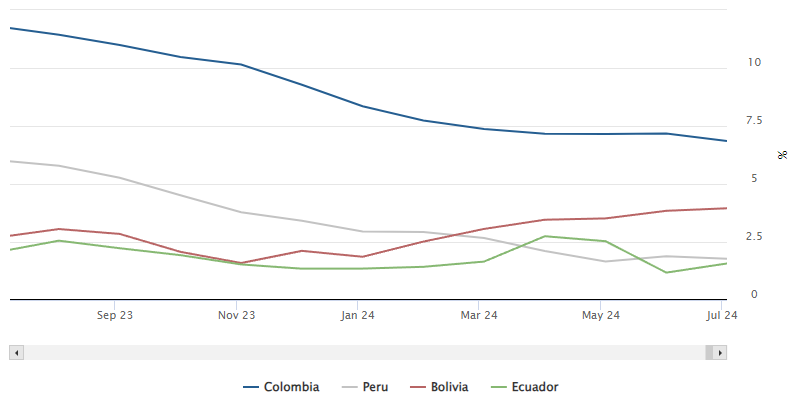
    PERU | Rate cut cycle resumed. On 8 August Peru’s central bank (BCRP) lowered its benchmark interest rate by 25 basis points to 5.50%, resuming a cycle of rate cuts that began in September 2023 but was paused in July. In a statement explaining the latest decision, the BCRP noted that monthly inflation in July was 0.24%, bringing the annual inflation rate to 2.1% – down from 2.3% in June, and within the bank’s target range of 1%-3%. The bank slightly lowered its 12-month inflation forecast to 2.49%, down from 2.53% in June and noted that “most indicators” are “on an optimistic trajectory for the third consecutive month”.

    VENEZUELA | Gas deal with Trinidad & Tobago. On 24 July the governments of Venezuela and Trinidad & Tobago signed an agreement which will enable Trinidad’s state-owned National Gas Company (NGC) to develop the Venezuelan side of the Manakin-Concuina natural gas field, which extends across the waters of both countries. The UK’s British Petroleum (BP) will be a partner in the project. Venezuela’s Oil Minister Pedro Tellechea, who is also the president of state oil company Petróleos de Venezuela (Pdvsa), wrote on social media that “Venezuela is heading into a virtuous future of economic prosperity based on our enormous energy potential”. NGC and the British multinational oil firm Shell had previously been granted a licence in December 2023 to develop Venezuela’s offshore Dragón natural gas fields.

    COLOMBIA | Tax revenue plummets. On 23 July Colombia’s comptroller general’s office issued a statement expressing “alarm” at a steep drop in tax revenue during the first six months of 2024. It noted that from January-June, the tax take was Col$126.63trn (US$31.52bn), which was down by 17% on the same period in 2023. This, the comptroller general’s office said, was a sharper drop than the 13% year-on-year fall that was recorded in the first six months of 2020, when Colombia went into lockdown during the coronavirus (Covid-19) pandemic. It said that in the first half of this year, the tax authority (Dian) has only collected 40% of the tax revenue that was forecast in the 2024 national budget. The statement blamed the tax shortfall on a drop in revenue from income tax and on the poor results of measures to reduce tax evasion.

    Andean countries: inflation rate
    Percentage variation (year-on-year)

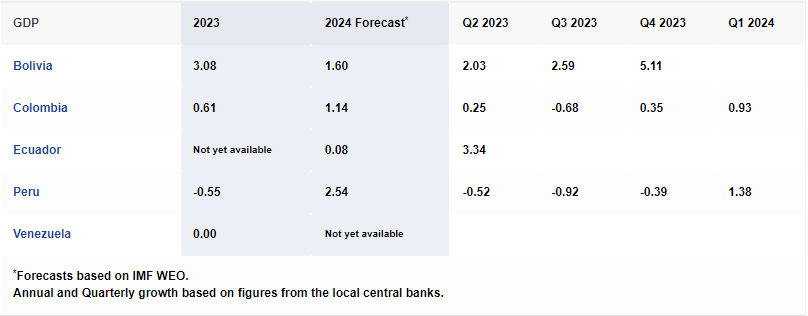
    Andean countries: GDP growth (%)
    Quarterly figures are year-on-year growth

  • ARGENTINA: Milei wants a higher birth rate

    Abbi Dicker 27 August 2026 Hits: 283

    One surprise item in President Javier Milei’s speech on 20 August before the annual conference in Buenos Aires of US think tank Americas Society/Council of the Americas (AS/COA), was a segment attacking both feminists and abortion for Argentina’s falling birth rate.

    In his closing address, President Milei said, “we are paying a very high price for the madness of those green handkerchiefs [a symbol used by feminist and pro-choice groups]”, and he warned that current birth rates in the country are below population replacement levels. Milei added “This obsession with killing children in their mothers’ wombs is costing us in terms of economic growth and social security funds…it is also costing us in human capital.”

    Abortion has been legal in Argentina since 2020, available for women who are up to 14 weeks pregnant (and later in cases of rape or on grounds of the mother’s health). Attending the World Economic Forum (WEF) in Davos in January 2024, Milei criticised what he called “the bloody agenda of abortion”. In February 2024 La Libertad Avanza (LLA), Milei’s far-right political party, tabled a motion to repeal the 2020 law, but it has not advanced through the legislature.

    According to the United Nations Population Fund (UNFPA), Argentina’s total fertility rate has fallen to 1.2 children per woman, one of the lowest in Latin America. This is significantly below the 2.1 rate needed to maintain a stable overall population. Experts say that contrary to Milei’s view, the falling fertility rate began well before abortion became legal. Luci Cavallero, of local feminist lobby group Ni Una Menos, told Spanish newswire EFE that “the government’s austerity programmes have created widespread unrest in society, a mental health crisis and a lack of predictability and hope for the future”. Other specialists say the latest data shows a fall in teenage pregnancies, which they describe as a positive development linked to public sex education and the availability of contraceptives. Argentina is not the only country worried about low birth rates: others include Cuba, Japan, China, South Korea, and Italy.

    • Reasons for fall in birth rate

    According to a study of “reproductive intentions” conducted by the United Nations Population Fund (UNFPA) and a local consultancy, Voices!, and published this month, 57% of respondents aged between 18-45 in Argentina say they have had fewer children than they would have wanted, citing as reasons the financial cost (79%), the lack of appropriate housing (78%), and a lack of time for child rearing (74%).

  • TRACKING TRENDS

    LatinNews 19 September 2011 Hits: 1836

    MEXICO| Fast & Furious. On Wednesday, Senator John McCain (R, AZ) called for Senate hearings into the controversial federal operation, Fast & Furious that allowed more than 2,000 high-powered weapons to flow into Mexico. At least one of these weapons, which were supposedly being monitored by US government agencies, was used to kill a US Border Patrol agent, Brian Terry, and several others have been recovered from other crime scenes. Altogether the US authorities are reckoned to have lost track of almost all the weapons in the sting operation. Fast & Furious began in 2009 under the direction of the Bureau of Alcohol, Tobacco, Firearms and Explosives. Terry was killed on 14 December 2010. The US government has also changed the jurisdiction of the investigation from Arizona, where most of the Fast & Furious operation took place, to San Diego, California. The Republicans hope that the congressional investigations will force Eric Holder, the Justice Secretary, to take responsibility for Fast & Furious’s failures (and its apparent cover-up) and resign.

  • Gov’t-cocalero tensions in Bolivia

    LatinNews 11 January 2012 Hits: 1117

    Development: On 8 January some 400 coca producers (cocaleros) in La Asunta, a municipality in the Yungas (La Paz region), Bolivia's traditional coca growing area, ejected members of the Fuerza de Tarea Conjunta (FTC), the joint task force responsible for coca eradication.

    Significance: The explusion of the FTC officials signals continued resistance to the government’s eradication efforts by one of the country’s two main coca growers groups. (The other is based in the Chapare, and is headed by President Evo Morales, himself a former cocalero). Progress on eradication is vital for the government to drum up support for its ‘coca sí, cocaína no’ policy, which the US opposes. Bolivia is currently trying to finalise a tripartite anti-drugs cooperation treaty with the US and Brazil.

    Key points:

    • The Asunta cocaleros accused the FTC of “excessive” eradication efforts and the Morales government of failing to uphold an agreement to implement development projects in the area.

    • Of the 20,000 hectares (ha) of coca cultivation tolerated by the government (which is above the official legal limit of 12,000ha), 12,000ha are grown in the Yungas and 7,000 in the Chapare. Coca cultivation in the Chapare became legal in 2004 under former president Carlos Mesa (2003-2005), under pressure from Morales.

    • The Chapare coca growers have proved more amenable to eradication. According to the latest (September 2011) United Nations Office on Drugs and Crime figures, of the 8,200ha of coca eradicated in Bolivia in 2010, 6,493ha were in the Chapare and only 1,330ha in the Yungas.

    • Last month, Felipe Cáceres, Bolivia’s deputy minister of social defence, who is responsible for anti-drugs efforts, boasted that in the first 11 months of 2011 the authorities had destroyed 10,051ha of illegal coca plantations, up from the total 8,200ha registered in 2010. The 2010 figure was up 29% on 2009 and was the highest figure for eradication since Morales took office. The highest overall figure to date was 15,353ha, recorded in 1999.

  • WEB: 'Netizens' under threat

    LatinNews 11 April 2012 Hits: 278

    On 13 March Reporters Without Borders released its 2012 Enemies of the Internet report, outlining what it considers to be the most egregious instances of, and countries responsible for, online censorship. Their scope extends to arrests or harassment of what it terms ‘netizens’ (internet citizens), online surveillance, website blocking and the adoption of repressive internet laws. The latest report updates the 2011 issue, and new information not only indicates some interesting trends, but also suggests there is discord ahead. The most significant point is that these tensions will not all be in oppressive states, but moderate western countries.

    This year Bahrain and Belarus joined the list of states the organisation considers to be enemies of the internet (see pointer). But while some countries were added and none removed, it was suggested that by next year at least one country could come off the list. The authors of the report state that Burma could be removed if planned reforms come in, and the recent elections suggest that for now, at least, progress is on track. However, Burma may be replaced by Thailand which has been coming down hard on what it perceives as lèse-majesté by imprisoning bloggers and filtering internet content.

    The timing of the report’s release was apt, as it coincided with reports that Iran is the chief suspect in a series of cyber attacks on the UK’s BBC and other networks, seemingly intended to prevent the broadcast of information critical to the regime that could be accessible within its borders.

    There is friction on the horizon in Europe. There are factions within the European Commission (EC) who favour a ‘right to digital oblivion’, under which people would have the right to have data relating to them and their online activity wiped. Were this to be enshrined in law it would place a heavy burden on internet service providers, but most importantly it would fly in the face of moves in some countries, most recently the UK, to cache data on all online activity so that it can be made available to the security services for counter-terrorism purposes. This suggested policy will be hotly debated in the UK, as will any moves to codify a ‘right to digital oblivion’ in the EC, but two are fundamentally incompatible. Should these policies both gain enough support it would signal a new split between the UK and the EC.

    Pointer:

    • Enemies of the internet (Alphabetically, not ranked)
      • Bahrain
      • Belarus
      • Burma
      • China
      • Cuba
      • Iran
      • North Korea
      • Saudi Arabia
      • Syria
      • Turkmenistan
      • Uzbekistan
      • Vietnam
  • TRACKING TRENDS

    LatinNews 18 July 2013 Hits: 937

    MEXICO | Negligible growth in household income. The average income of Mexican households (at constant prices) increased by only 1.5% between 2010 and 2012, Mexico’s national statistics institute (Inegi) revealed on 16 July. The underwhelming results show the low level of economic benefits that Mexico’s population has received in the last couple of years despite the fact that the domestic economy has experienced a robust recovery (increasing by 5.5%) in 2010 after suffering a sharp contraction in 2009 as a result of the global financial crisis.

        The country continued to post respectable growth rates of 4.0% and 4.9% respectively for the next two years. However, Inegi’s latest figures show that this has not been enough to really impact poverty levels in Mexico, showcasing the challenge faced by the government led by President Enrique Peña Nieto, who upon taking office promised to put poverty reduction very high on his list of priorities.

        According to Inegi the average income of Mexico’s 31.5m households last year was M$38,125 (US$3,001). Meanwhile average household expenses were M$33,746 (US$2,657), 0.4% higher than in 2010. Taking all of these figures Inegi has calculated that the Gini coefficient component that measures income inequality (where 0 is perfect equality and 1 perfect inequality) had increased from 0.435 to 0.440.

    MEXICO | Underwhelming result for latest Pemex tender. On 11 July Mexico’s state-owned oil firm, Pemex, announced that it had successfully awarded three of the six exploration and production concessions in its Chicontepec field that had been submitted for public tender.

        The fact that only half of the concessions on offer were awarded again highlights the lack of private sector interest in investing in Mexico’s oil sector under the current circumstances in which Pemex has a constitutionally sanctioned monopoly on oil production.

        After years of falling production at Pemex, minor energy sector reforms were introduced in 2008, which for the first time allowed private firms to act as Pemex partners, via contracts based on incentives, in a bid to boost production. However, the scheme has not proved very attractive for the private sector, with only a handful of firms entering into these contracts. In fact the apparent failure of the 2008 energy reform is what led President Enrique Peña Nieto to announce his plans to reform the sector further to open it up to increased private investment.

        Many in Mexico oppose further reform fearing it could result in the full privatisation of the sector. But the underwhelming results of the latest tender provide the Peña Nieto administration with more arguments to push through its reform plans.

        Chicontepec is a major on shore field located in Eastern Mexico believed to contain some 139bn barrels of oil equivalent (40% of Mexico’s proven, probable and possible [3p] reserves). However, production in the rocky formation has proved to be difficult and Pemex has only managed to extract relatively small amounts of oil (68,000 barrels per day) since its discovery in 1926. Thus the prospect of exploiting the Chicontepec field should under normal circumstances be very attractive to investors.

        While 16 national and foreign oil firms expressed an interest in the tender process, in the end only four bids were submitted – from the US’s Haliburton, Spain’s Repsol and local firms Petrolite de México and Operadora de Campos DWF. Halliburton, Petrolite and Operadora de Campos were the three firms that won 35-year concessions after Repsol pulled out at the last minute.

        Under the incentive-based contracts private firms are permitted to extract oil, which they must then sell to Pemex at a fixed price. The fact that they are not able to sell the extracted oil at more profitable prices in international markets is a big deterrent for prospective investors. The latest tender was the third of its kind since 2008. Less than 10 private firms have sought to place bids in all tenders combined.

        Unsurprisingly, Pemex’s exploration and production director, Carlos Morales, said that while he was satisfied with the results of the tender, Pemex would launch a new tender process in the “next two or three weeks”. “We hope to have more participation to extract those barrels of oil down there that we need so much up here,” Morales said.

    •  Interjet arrives in Colombia

    On 11 July Mexican low-cost airline, Interjet, the region’s second most profitable airline, announced that it had begun operating a new Mexico City-Bogotá daily direct flight. Bogotá has now become Interjet’s ninth international destination and its first in South America (the company currently offers flights from Mexico to the US and Central America). Interjet CEO José Luis Garza Alvarez said that the new service, which links the capitals of the two Pacific Alliance member countries, “will cater to all those travelling to Mexico and Colombia for business or pleasure”. Garza Alvarez added that “the Colombia-Mexico market is very important given that the two economies are becoming increasingly linked, there is a lot of business between the two and the trend is for this to increase”.  

  • ARGENTINA: Pacificación, al estilo argentino

    LatinNews 17 April 2014 Hits: 479

    Pocas ciudades ilustran mejor el problema de Argentina para contener los crecientes niveles criminalidad y el tráfico de drogas que la ciudad portuaria de Rosario, a unos 300kms al noroeste de Buenos Aires. Los homicidios se elevaron un 76% desde el 2012 al 2013 a medida que la pelea por el comercio de las drogas se intensifica. El año pasado, el jefe de la fuerza policial de la ciudad y su zar antidrogas, fueron arrestados por sus vínculos con traficantes. Tres linchamientos ejecutados por turbas de civiles, incluyendo uno que terminó en la muerte de un adolescente, han puesto a la ciudad en los focos de los medios de comunicación de nuevo en marzo de este año. El 9 de abril, en una masiva demostración de fuerza que tuvo muchas de las características del programa de pacificación que está siendo implementado por el gobierno brasilero en las favelas de Rio de Janeiro, unos 3.000 agentes de seguridad federales llevaron a cabo la mayor redada jamás vista contra los traficantes de drogas en la ciudad, que resultó en el arresto de 20 personas.

    Agentes de la policía federal Argentina, patrullas de frontera (gendarmería), guardacostas, y agentes de seguridad aeroportuaria lanzaron 89 redadas en los suburbios ubicados en la periferia de la ciudad de Rosario. La operación fue el resultado de varios meses de investigaciones judiciales llevadas a cabo por el ministerio de seguridad, y que apuntan a desmantelar a grupos de traficantes de drogas que operan desde cientos de pequeñas construcciones de ladrillos llamadas ‘bunkers’ donde se venden drogas. Según el viceministro de seguridad, Sergio Berni, el objetivo no era ubicar a traficantes de drogas o determinar la cantidad de drogas en circulación, sino ocupar el territorio. Alrededor de 2.000 oficiales, incluyendo 1.500 gendarmes y 500 oficiales de la guardia costera, permanecerán en la ciudad para ayudar a las fuerzas de seguridad locales. “Esto no termina acá”, Berni dijo. “Es solamente el comienzo”.

    La operación fue un raro ejemplo de estrecha cooperación entre el gobierno federal y la provincia de Santa Fe, gobernada por un Socialista. El gobernador de la provincia, Antonio Bonfatti, agradeció a la Presidenta Cristina Fernández y a Berni por sus trabajos, y en particular por la manera profesional en que se llevó a cabo la operación, sin que se hayan filtrado advertencias antes de las redadas. Berni y la ministra de seguridad, María Cecilia Rodríguez, recorrieron la ciudad el 14 de abril, y anunciaron que 500 oficiales más de la policía provincial serían trasladados a Rosario a principios de mayo, a fin de tomar el control de otros 10 vecindarios.

    Si las redadas seguirán el guion del programa de pacificación en Rio, el éxito inicial podría resultar difícil de sostener. La ocupación de Rosario por parte de un tan grande número de agentes federales es costosa y una vez que los traficantes hayan superado la sorpresa inicial del súbito interés del Estado en su territorio, es probable que ellos resurjan en otras partes. Juan Monteverde- líder del grupo opositor de izquierda de Santa Fe, Giros- dio la bienvenida a las medidas recientes, pero advirtió que usar solamente “la fuerza represiva del Estado” sería un error estratégico. “Debemos investigar el lavado de dinero y los otros delitos económicos que sostienen el tráfico de drogas”, dijo Monteverde.

    ¿Enfriamiento del gobierno sobre la reforma penal?

    Con la inseguridad dominando la lista de preocupaciones de los votantes argentinos, el gobierno parece crecientemente inseguro acerca de si empujar hacia delante sus planes de reforma del código penal. Aunque muchos coinciden, incluso en la oposición, en que las inconsistencias en el código necesitan ser reformadas, estando tan cerca de una elección podría ser muy controversial. Las recomendaciones, supervisadas por el juez de la corte suprema, Raúl Zaffaroni, han sido utilizadas por los políticos de la oposición (en particular, el diputado Sergio Massa del Frente Renovador, FR), por ser abiertamente indulgentes con los delincuentes, pues ellos verán eliminadas las sentencias de por vida y los castigos por reincidencia. Las reformas también podrían incluir delitos contra la humanidad; tortura “por omisión”; violación dentro del matrimonio; y delitos medioambientales, en el código penal argentino.

    Consciente del nerviosismo del gobierno sobre la cuestión, Patricia Bullrich, una diputada por la opositora Unión por Todos, y líder de la comisión del congreso sobre la ley penal, ha anunciado un debate sobre las reformas a partir del 22 de abril. Es probable que el debate de una prueba del apetito de la gente por la reforma y podría frustrar el entusiasmo del gobierno por enviar un borrador de la ley al congreso.

    • Capitanich niega su renuncia

    El 14 de abril los medios de comunicación de Argentina informaron que Jorge Capitanich, el ubicuo jefe de gabinete de la Presidenta Cristina Fernández, estaba renunciando después de desacuerdos con el movimiento juvenil Kirchnerista, La Cámpora. El 15 de abril, Capitanich negó la historia, calificándola  como parte de un sistemático intento de los medios de atacar al gobierno y “crear desconfianza en la sociedad argentina”.

  • PERU: Mendoza enters fray behind flagging Kuczynski

    LatinNews 02 June 2016 Hits: 2600

    Pedro Pablo Kuczynski received the unqualified support of Verónika Mendoza in the days approaching the second round of presidential elections on 5 June. Mendoza, the left-wing candidate he narrowly pipped to second place in April’s first round, said she would be casting her vote for Kuczynski despite marked policy differences, especially over the economy, because it was essential to avert the threat to Peru’s democracy that the election of his rival, Keiko Fujimori, would pose. Kuczynski thanked Mendoza, who participated in a massive ‘No a Keiko’ march in Lima on 31 May, for her support. Kuczynski’s much improved but still slightly underwhelming performance in the final presidential debate two days earlier suggests he will be unable to get there on his own steam.

    Mendoza would far rather have stayed out of the contest altogether but seeing Kuczynski faltering badly clearly felt compelled to set her differences aside and try to prop him up. “The dream of a more just country is threatened by Fujimorismo which stole billions from Peruvians,” Mendoza said, “killed those who thought differently to them, carried out forced sterilisations of thousands of women and bought congressmen…”

    Mendoza added: “Keiko is surrounded by people charged with corruption and links to drug-trafficking and doesn’t care. With what moral authority would she be able to combat organised crime and drug-trafficking? I don’t want my children to live in a country where corruption, drugs and violence thrive; where to lie, to steal and to kill is normal”.

    Mendoza’s endorsement might be sufficient to overturn the lead which Fujimori has established: the latest Ipsos poll showed Fujimori slightly extending her lead to six percentage points (53.1%-46.9%). Mendoza came first in seven regions in southern Peru in the first round with the backing of left-leaning voters and it is here where the largest percentage of undecided voters (some 15% nationally) resides.

    Kuczynski also helped his cause by meeting members of the influential left-wing teachers’ union, Sindicato Unitario de Trabajadores en la Educación del Perú (Sutep), signing a commitment to improve education and labour conditions for teachers.

    Mendoza took part in the three-hour ‘No a Keiko’ march in central Lima, organised by youth movements and trade unions, which attracted an estimated 100,000 people. Julio Guzmán, who had surged into second place in the first round presidential race before being excluded by the electoral authorities, also took part, and pledged his support for Kuczynski. Kuczynski himself opted against joining in the march.

    Presidential debate

    Kuczynski was better scripted in the final presidential debate although he still lacked spontaneity in the heat of battle. When Fujimori justified her 500-day absence from congress when she was deputy between 2006 and 2011, for instance, on maternity leave for her two children, he had little comeback. Mendoza, on the other hand, swiftly tweeted, “I also gave birth while serving in congress; two weeks later I went with my daughter to work. It’s outrageous that she’s using her condition as a wife and a mother”.

    After his lacklustre performance in the first presidential debate the previous week in the northern region of Piura, however, Kuczynski showed much more fire. He said that he wanted to be president in order “to defend freedom against the lethal threat to democracy” posed by Fujimori. “You have not changed. You are the same. I am convinced that freedom is in serious peril in Peru. It is essential to preserve it,” Kuczynski said reminding viewers of the debate that she had served as first lady under her father Alberto Fujimori (1990-2000), and once again pointing to the money-laundering scandal which compelled Keiko to replace Joaquín Ramírez, the secretary general of her party, Fuerza Popular (FP) last month [WR-16-20].

    Kuczynski was also more incisive. He said that when he had taken over the economy ministry under Alejandro Toledo (2001-2006), some eight months after Alberto Fujimori fled the country, “state coffers were empty and some of my predecessors were in jail. There was no growth or investment; in 2006 we bequeathed an economy growing at 8%”.

    While Keiko accused Kuczynski of serving big business and encouraging unequal distribution of wealth, he responded that poverty had stood at 54% under the Fujimori administration, while during his time as a cabinet minister it was reduced to 38% (and now stands at 23%). Kuczynski also argued that if even a fraction of the state funds embezzled during her father’s government had been ploughed into social investment it would have lifted many thousands more out of poverty.

    But while Kuczynski’s attacks were potent in substance, the style in which they were delivered often lacked conviction, and he will ultimately be reliant on Mendoza persuading undecided voters, and those determined to cast spoilt or blank ballots, to back him. “Freedom is imperilled, it is now or never, we have to block the path to dictatorship,” Kuczynski asserted. It would have been a compelling argument coming from Mendoza, or indeed Guzmán, but Keiko was able to respond by reminding Kuczynski that he had supported her campaign against Ollanta Humala in 2011. “From love to hate in just one campaign,” she said.

    • Debate

    Pedro Pablo Kuczynski said he was the experienced pilot the country needed to fly through severe turbulence. Keiko Fujimori countered that Peru needed someone to travel around the country on a day-to-day basis not to sit behind a desk, a reference to Kuczynski’s age (at 77, he is not far off twice her age, 41).

  • TRACKING TRENDS

    LatinNews 31 August 2017 Hits: 1684

    MEXICO | Rising household incomes. The average quarterly household income increased by 2% to M$46,521 (US$2,611) in 2016 compared with 2014, according to the latest instalment of the national household income and spending survey (Enigh) released on 28 August by the national statistics institute (Inegi). While the increase in average household incomes is positive, the Enigh also found that the average quarterly income of the wealthiest households is M$168,855 (US$9,476), or 21 times higher than that of low-income households, which stands at M$8,166 (US$458). This shows that the wealth inequality gap remains large and that the social programmes implemented by the government have not yet addressed this issue.

    Following the release of the 2016 Enigh, Mexico’s national social development policy council (Coneval), the official body tasked with evaluating the impact of government social policies, announced that it would release its 2016 national poverty figures in coming days. Coneval failed to release its poverty figures last year after accusing Inegi of unilaterally changing its household income measurement methodology, which Coneval argued made it impossible to compare the 2016 Inegi household income figures with the those produced under the previous methodology agreed on by both bodies in 2008. But since then and after a public spat, Inegi and Coneval agreed to create a new joint technical working group tasked with coming up with a way of comparing the data produced since 2008 with Inegi’s new household income measurement methodology, which would allow Coneval to continue evaluating the progression of poverty in Mexico adequately.

    • Average household incomes

    The Inegi survey, which was carried out between August and November 2016 and polled 81,000 households, also calculated the differences in average household incomes in urban and rural areas for the first time. Classifying as urban all those areas with over 2,500 inhabitants and those with less as rural, the latest Enigh instalment found that the average quarterly household income in urban areas is M$52,215 (US$2,930), double the M$26,000 (US$1,459) average observed in rural areas.