All Categories

Subcategories

  • TRINIDAD & TOBAGO: Trinidad suffers slump in FDI

    Sarah Sheldon 17 August 2021 Hits: 1215

    The 2021 World Investment Report from the United Nations Conference on Trade and Development (Unctad) makes bleak reading for the Caribbean and most particularly for Trinidad & Tobago.

    Overall, foreign direct investment (FDI) flows to Latin America and the Caribbean (LAC) were down 45% in 2020, to US$88bn. No other developing region suffered such a large decline. The decline for the Caribbean was slightly below the overall average, at 36%, bringing the sub-region’s FDI total down to US$2.5bn.

    The biggest decline in sub-regional FDI was felt in the Dominican Republic, where FDI contracted by 15%. Haiti was another casualty as civil unrest added to the constraints related to the coronavirus (Covid-19) pandemic. In Trinidad & Tobago, FDI turned negative, to -US$439m, with the severest impact in the energy industry which accounts for around half of the country’s FDI. Another country with negative FDI was Suriname, which saw an outflow of US$27m.

    Trinidad & Tobago’s woes were highlighted in late July when BPTT, a local subsidiary of British multinational oil and gas company, told the government to expect a shortfall in natural gas production of 15% in 2021 and over 10% a year until 2024. The confidential forecasts were revealed by locally based, Guardian Media.

    On 27 July international credit ratings agency Standard & Poor’s (S&P) changed its outlook for Trinidad & Tobago from ‘stable’ to ‘negative’ while reaffirming its rating at ‘BBB-’. The government tried to put a positive spin on this, with Finance Minister Colm Imbert saying maintaining the rating “validates” the government management of the economy. Imbert said: “[S&P] has kept the view that conservative and competent policy management, including large fiscal buffers, attested to the high shock absorption capacity of the country. The rating agency highlighted that unlike many commodity exporters, during the boom years Trinidad & Tobago saved excess fiscal revenues”.

    In its 27 July statement, S&P said: “The negative outlook incorporates the risks that poor economic performance and only modest GDP growth prospects prevent Trinidad & Tobago from recovering the economic resilience lost in recent years, as measured by GDP per capita”.

    It went on to say: “The negative outlook reflects our view that there is at least a one-in-three chance we would lower the ratings over the next 12-to-24 months”.

    Interestingly, however, given the BPTT report, it added: “We expect the decline in energy production to reverse of the next two years, and the economy to return to growth by next year. This uptick should significantly reduce the government fiscal deficit and eventually stabilise its net debt-to-GDP figures. However, it remains uncertain whether this improvement will be sufficient to bring per capita income back toward earlier levels, following five years of negative real GDP per capita growth, on a sustained basis”.

    Asked to comment by Guardian Media on the leaked production forecasts, BPTT said: “We do not comment on long-term forecasts because they include assumptions on exploration and appraisal activity, unsanctioned projects, and volumes from developments operated by others. These all carry a degree of uncertainty and are subject to change. Our goal remains to efficiently find and develop resources to satisfy our contractual obligations”.
  • PARAGUAY: Peña seeks closer ties with UK

    Abbi Dicker 17 July 2025 Hits: 3267

    Paraguay’s President Santiago Peña visited the UK this week to discuss deepening trade ties between the two countries and attracting investment, especially in energy transition initiatives.

    President Peña became the first Paraguayan head of state to meet a British monarch after being received by King Charles III at Windsor Castle. He also met members of the government and financial investors, including Astarte Capital Partners Forest Fund, which plans to double its US$350m investment in Paraguay, and the Hinduja Group. The Cámara Paraguaya de la Carne also arranged for a beef tasting session of premium cuts with the British beef industry.

    Peña also delivered the Canning Lecture during his visit to London for Canning House on 16 July. Peña highlighted Paraguay’s economic stability, with the fastest growth in Latin America, the lowest debt to GDP ratio in the region, a stable currency, and the award of investment grade status in July last year for the first time in the country’s history.

    Peña stressed, however, that Paraguay was not meeting its full potential. He focused on his government’s commitment to rectify that through improving infant nutrition and expanding school food programmes, which have improved attendance rates, and promoting education at all levels, particularly given that Paraguay has the youngest median age in the region at just 28. He also underlined his government’s efforts to provide more affordable housing.

    Energy transition, Peña said, is a key area for Paraguay to champion in the coming years and to attract foreign investment. Paraguay was also committed to sustainability laws to protect the country’s forests, Peña said, while flagging a recently approved legal framework for carbon credits, aiming to attract foreign investment, as providing “the perfect opportunity for companies to offset their carbon footprint”.

    Peña’s lecture naturally focused on all of the positive developments in Paraguay, which he said were often neglected in favour of focusing on a negative image of the country. But he did not seek to allay potential investor concerns by taking the opportunity to address that negative image and to explain what measures his government is taking, for instance, to confront corruption in the country.

    Beef

    Senator Patrick Kemper of the ruling Asociación Nacional Republicana-Partido Colorado (ANR-PC), defended President Peña’s 47th foreign visit in less than two years since he took office. Speaking in the senate, Kemper said Peña was unfairly criticised as he has been consistently opening markets to national products. In reference to the beef taster session in London, Kemper said Peña would “introduce the English people to Paraguayan beef”. Senator Yolanda Paredes of the opposition Cruzada Nacional (CN) responded caustically by saying that perhaps Peña could “present it here too because Paraguayans no longer have beef on their table as it is so expensive”. She also cast doubt on the figures released by the central bank (BCP) showing zero monthly inflation in June, claiming that beef prices had soared.

  • REGION: Caricom members struggling with the Trump challenge

    Sarah Sheldon 24 February 2026 Hits: 229

    Like much of the Western world, the countries of the Caribbean Community (Caricom) have been grappling with the challenge of how to deal with US President Donald Trump’s administration. The US capture of Venezuela’s former president Nicolás Maduro (2013-2016) on 3 January in particular has exacerbated the already existing difficulties that had been developing over the Trump administration’s tough policies on immigration and drug trafficking.

    Caricom responded to the seizure of Maduro and his wife by US troops with a statement from its Bureau of the Conference of Heads of Government, comprising Jamaica, St Kitts & Nevis, and St Lucia. It stated that Caricom “is firmly committed to the fundamental principles of international law and multilateralism enshrined in the UN Charter, including sovereignty and territorial integrity of States and respect for human dignity”. And it called for “peaceful dialogue through diplomatic channels to ensure Venezuela’s stability, good governance, democracy and prosperity for the people of Venezuela”.

    For some members of Caricom, this was too anodyne for their tastes. The views of those wanting a stronger response were reflected by Ralph Gonsalves, the former prime minister of St Vincent & the Grenadines who lost power in November 2025 after a 24-year domination [SSR-26-01]. He criticised the statement for having failed to state clearly that the US intervention was a breach of international law.

    Without going as far as Gonsalves would want, Prime Minister Dickon Mitchell of Grenada was one of those who let his disquiet about the US operation filter into his public statements. Speaking on 5 January, he said that Grenada’s position was that “diplomacy, dialogue, negotiation, and compromise” were the only way to achieve “sustainable, long-term resolution to differences”. And when asked what he thought about Trump’s comment that the US would “run” Venezuela, he said: “The only way a country can run another country…is if that territory belongs to that country or is a colony of that country.”

    It may have been a coincidence, but on the same day that Mitchell made his slightly critical remarks about the US intervention in Venezuela, the US Department of State upgraded its travel advisory for Grenada from Level 1 to ‘Level 2: Exercise Increased Caution’. Grenada had previously been considered one of the lower-risk destinations in the Caribbean. In an effort to retain friendly ties with Washington, Antigua & Barbuda, Dominica, St Kitts & Nevis, and St Lucia (all of which have been under pressure from the US over their Citizenship By Investment [CBI] programmes) have bowed to US pressure to accept rejected asylum seekers from the US who cannot return to their countries of origin. Guyana, which sees the US as its ultimate guarantor in its territorial dispute with Venezuela, has also been in talks with the US.

    Probably not coincidental was the reward Trinidad & Tobago received for its strong support of the US over Venezuela. When the US announced the suspension of the issuance of immigrant visas to applicants from 75 countries from 21 January, Trinidad & Tobago was exempted. Not so lucky were 11 of Caricom’s 15 members, namely Antigua & Barbuda, The Bahamas, Barbados, Belize, Dominica, Grenada, Haiti, Jamaica, St Kitts & Nevis, St Lucia, and St Vincent & the Grenadines.

    Trinidad seeks to be main US ally in Caribbean

    Trinidad & Tobago’s Prime Minister Kamla Persad-Bissessar has strongly aligned with the Trump administration, both on its policy of destroying alleged drug trafficking boats in the Caribbean and on the seizure of Maduro and his wife. At the same time, a rift has grown between Trinidad and its fellow Caricom members, with Persad-Bissessar calling Caricom an “unreliable partner”.

  • TRACKING TRENDS

    LatinNews 05 July 2012 Hits: 954

    CHILE-ARGENTINA | Double taxation agreement terminated. On 2 July the Chilean press reported that the Argentine authorities had notified their Chilean counterparts on 29 June that they will be terminating the current double taxation agreement which was signed by the two countries in 1976. The agreement, which covers taxes levied on capital, equity, and other benefits, includes a clause which allows any of the participating countries to terminate it any time between 1 January and 30 June every year so that the new rules may be applied starting the following year. This means that the agreement will no longer be in place on 1 January 2013.

    Chilean authorities expressed regret over the decision by Argentina. Chile’s ambassador to Argentina, Adolfo Zaldívar, said that in his opinion the decision would be “negative for Chilean investments and for promoting more integration between the two countries”. Zaldívar said he had said as much to the Argentine authorities and they had ignored him, arguing that they had already decided to “terminate all the double taxation agreements in place”.

    Zaldívar said that Argentina has already terminated its similar agreements with Switzerland, Austria and Spain due to their concerns about Argentine nationals using them for tax evasion. Chile’s foreign minister, Alfredo Moreno, also lamented Argentina’s decision, describing it as “bad news” for both countries. However, Moreno pointed out that Chile’s objective will now be to re-negotiate an updated double taxation agreement with Argentina.

    ARGENTINA | Tax take on the rise. According to data provided by Argentina’s tax authority, Afip, the country’s total tax take for June was US$12.93bn, 20.6% more than in the same period last year. The figure brings the accumulated tax take for the first six months of the year to US$69.96bn, 25% more than the same period last year. In 2011 Argentina’s tax take was a record US$540.13bn, a 31.8% increase on 2010 as the Afip began to impose stricter tax evasion controls and the government introduced new taxes and increased the rates on existing ones.

    The government’s 2012 budget forecasts a tax take of US$147.2bn, which now certainly looks within reach. However, far from being in a solid financial position, the Argentine government is still under financial stress to pay its debts in particular its foreign debt. Last week, on 26 June, the government ordered the central bank (BCRA) to transfer US$2.17bn of its foreign reserves to the national treasury in order for these funds to be used to service the debt that the country has with international financial organisations. The executive decree, signed by President Cristina Fernández, stated that the BCRA must “reassign the remaining resources from financial year 2011 for the cancellation of debt as part of a foreign debt reduction process”. Argentina has been using its “surplus foreign reserves” to make debt repayments since 2010 but in March congress passed a bill reforming BCRA regulations eliminating its obligation to keep enough foreign reserves to back the total amount of money in circulation in the country. This freed large chunks of BCRA’s foreign reserves to which the government now has access, and is increasingly using, to reinforce the country’s fragile finances.

    • Moody’s considers downgrading Paraguay

    On 27 June the ratings agency Moody’s announced that for the moment it was keeping Paraguay’s sovereign risk rating at B1 but it warned that it could be lowered if the political crisis derived from the impeachment of former president Fernando Lugo (2008-2012) worsens. According to Moody’s the “abrupt decision to impeach the President highlights the institutional weaknesses of the country and its high tendency to risky events”. It added that Paraguay’s B1 rating “captures these two factors”. However it also pointed out that as a result of the event, the country is now “vulnerable to external shocks” and that its rating may be downgraded if “socio-political unrest undermines governability” or if regional relations turn “in a way that economic growth and trade perspectives for the country deteriorate”.

  • TRACKING TRENDS

    LatinNews 28 May 2015 Hits: 837

    VENEZUELA | Merentes denies dollarisation rumours

    Venezuela’s central bank (BCV) president Nelson Merentes has dismissed the “campaign of rumours” about dollarisation, which in the past week have intensified alongside the continuing slide in the black market exchange rate, which at one point tipped over BF400/US$1 before coming back in to about BF366/US$1. The free-floating official FX rate, the Simadi, closed at BF199.9/US$1 on 25 May, according to latest BCV data.

    Merentes did not deny that the BCV is holding meetings with public and private financial sector authorities about potential changes to the country’s exchange rate system, which is increasingly distorted amid the ongoing dollar scarcity, heavily exacerbated by the BCV’s expansionary monetary policy. While international reserves have now dipped to US$17bn, the broad M2 money supply continues to grow at a mind-boggling rate, driving inflation through the roof.

    Deputy Jesús Faría, of the ruling Partido Socialista Unido de Venezuela (PSUV), who sits on the congressional finance committee, said the dollarisation rumours were part of the ‘economic war’ being waged against the country by international right-wing forces. “We will never become an appendix of the North American economy,” he told Globovisión.

    However, Faría acknowledged that discussions were underway about the simplification of the existing three-tiered system, with a view to moving to two FX rates, one fixed and one free, for example.

    The dollarisation rumours, which have been rumbling since April, really took off after Ford Venezuela in early May said it had reached agreement with the Caracas government to sell some of its stock in dollars, in order to alleviate the dollar shortages that had forced the company to paralyse production for want of imported parts.

  • PANAMA: Trade dispute rumbles on with Colombia

    LatinNews 15 March 2017 Hits: 733

    Panamanian and Colombian private sector representatives recently called on their respective governments, led by Presidents Juan Carlos Varela and Juan Manuel Santos, to resolve the bilateral trade dispute which has been ongoing since 2013. This stems from a tariff levied by President Santos on textiles, clothes, and shoes from Panama’s Colón Free Trade Zone (FTZ) which at the time he claimed was necessary to combat money laundering.

    The call by the private sector representatives from both countries on 22 February came 13 days after the World Trade Organization (WTO) revealed that the Varela government had requested US$210m in trade sanctions against Colombia. In June 2016, the WTO found that the tariffs imposed by Colombia were higher than allowed by WTO rules and were not necessary to combat money laundering. Issued in response to a complaint filed by Panama back in June 2013, the WTO ruling gave Colombia until January 2017 to make the adjustments. The dispute concerns a compound tariff first imposed by Colombia in January 2013 on imports of textiles, apparel, and footwear, consisting of a 10% ad valorem component and a specific component, which varies according to the import value and customs classification of the merchandise.

    In November 2016, Colombia adopted two decrees that affect the tariff and customs regime for the importation of textiles and footwear. However, a WTO press release dated 9 February notes that Panama’s latest complaint claims that far from bringing the measure into conformity with Colombia's WTO obligations, the changes perpetuate the nullification and impairment of benefits accruing to Panama directly or indirectly under the GATT 1994 – a reference to the General Agreement on Tariffs and Trade, a founding agreement of the WTO.

    The announcement by the WTO regarding Panama’s request for sanctions came the same day that Panama’s minister for trade & industry (Mici) Augusto Arosemena met his Colombian counterpart, María Claudia Lacouture, in the Colombian city of Cartagena de Indias, in order to discuss the trade dispute. The two agreed to implement an action plan that would lead to a solution of the dispute, promising to create and engage in a constant dialogue, in order to overcome difficulties and “strengthen the commercial relationship” between the two countries, as they have been “historically important partners”.

    Yet indicative of Panama’s less than conciliatory stance, on 22 February the executive’s cabinet council approved an increase on tariffs on various products such as coffee, wood, paper towels, and aluminium among other things from countries with which Panama does not have a free trade agreement (FTA) in place. The measures – which Areosemena said were in Panama’s best interests – will take effect as of 15 March 2017. Colombia and Panama signed an FTA in September 2013 but it has yet to be ratified by the legislatures.

    • Colón Free Trade Zone

    A report published by Panama’s national statistics institute (INEC) on 15 February revealed that total trade in the Colón Free Trade Zone reached US$19.66bn in 2016, down 9.6% on the previous year. This follows declines of 9.5% in 2015/2014, 12.4% in 2014/2013, and 10.2% in 2013/2012.

  • TRACKING TRENDS

    LatinNews 07 December 2017 Hits: 1119

    ARGENTINA | Industrial activity. Argentina’s national statistics institute (Indec) reported this week that industrial activity in the country increased by 4.4% in October compared with the same month last year. The increased activity registered in October also means that industrial activity in Argentina has now registered six consecutive months of positive growth, suggesting that the sector has fully recovered after Argentina fell into economic recession last year.

    The Indec figures show that there was increased activity in virtually all industrial sub-sectors led by the key automotive sector, which exhibited a 25.6% increase in activity, the tobacco sector (17%), and the non-metallic mining sector (16.5%). The only sub-sectors with negative levels of activity were the food industry sub-sector (-1.1%) and the oil refining sub-sector (-13.1%).

    In further positive news for Argentina’s industrial sector, local firm Cleanergy Renovables, announced on 6 December that it will be investing US$10m in the construction of two new biogas-powered electricity production plants in the province of Córdoba with an installed capacity of one Megawatt (MW) each, enough to supply electricity to 6,000 households. A company statement said that construction of the plants is set to begin in mid-2018 with a view to the plants coming on stream by 2019.

    BRAZIL | Mayor sentenced for corruption. A Brazilian judge has sentenced Lidiane Leite, former mayor for the Bom Jardim municipality in the north-eastern state of Maranhão, to over 14 years in prison, followed by six years of house arrest. The ruling is subject to appeal. Leite, nicknamed the ‘mayor of ostentation’, is accused of embezzling public funds. She allegedly siphoned off some R$15m (US$4.6m) from the education budget, while some school children in the poor municipality were left without meals.

    Leite’s behaviour began to attract attention after posting about her luxury lifestyle and well-kitted wardrobe on social media then hosting blow-out boat parties, all of which seemed incompatible with her modest state salary.

    Leite was elected mayor of Bom Jardim in 2012 for centre-right party Partido Republicano Brasileiro (PRB). She chose to run at the last minute instead of her former partner Humberto ‘Beto Rocha’ Dantas, who had been barred from re-running under Brazil’s ‘Clean Slate Law’. Once elected, Leite proceeded to nominate her erstwhile lover as municipal secretary for political affairs. Dantas has since been sentenced to over 17 years and nine months in prison followed by seven years of house arrest. He is a fugitive from justice.

    BRAZIL | Former minister pursued for corruption. Brazil’s attorney general’s office (PGR) has accused a former minister of government, Geddel Vieira Lima (May-November 2016), and his brother Lúcio Vieira Lima, a federal deputy for the ruling Partido do Movimento Democrático Brasileiro (PMDB), of money laundering and criminal association.

    Police began investigating the duo after finding their fingerprints on suitcases containing R$51m (US$15.72m) in cash in an apartment in Salvador in Bahia state. The origin of the money has not yet been confirmed, but prosecutors are investigating whether this may constitute bribes from the Brazilian engineering company Odebrecht, kickbacks from black-market dealer Lúcio Funaro, or illicit transfers from other PMDB politicians. “It seems implausible that someone would hide such an absurd quantity of money unless they wanted to conceal its existence,” read a report by the federal police.

    PARAGUAY | Growth up. Paraguay posted GDP growth of 3% year-on-year in the third quarter of the year, the central bank (BCP) reported this week. The third quarter result brings accumulated growth rate for the year to 3.8% and the BCP noted that this puts the country on course to reach (and potentially exceed) the bank’s year-end forecast of 4.2%. A BCP report noted that the third quarter growth rate marked a return to dynamism for the domestic economy which posted growth of just 1.1% in the second quarter after registering growth of 7.1% in the first quarter. The report attributes the pick-up in the third quarter to increased levels of activity in the key agricultural sector, which underperformed in the second quarter.

    The positive third quarter results led local analysts to increase their year-end growth forecasts to 4.5% from 4% previously. On the downside, the BCP conceded that year-end inflation is now set to come in above its target of 4% for the first time since 2011 after year-on-year inflation in November reached 4.6%.

    URUGUAY-ARGENTINA | Border investment. On 30 November the Uruguayan and Argentine governments announced plans to invest US$10m in their shared customs and border crossing control facilities. The announcement was made by the foreign ministers of both countries after they chaired a meeting of the bilateral border development commission (Codefro). They said that the two governments had agreed to invest, from 2019, US$6m to upgrade the control facilities at Fray Bentos in Uruguay’s Río Negro department and US$4m to upgrade the control facilities at Paysandú, the capital of Uruguay’s eponymous department. The ministers added that the improvements would triple the operational capacity at these two border crossings and help make the seamless movement of goods across the shared border “a reality”.

  • Region: Don’t spend more, spend better

    LatinNews 10 October 2018 Hits: 733

    Governments across Latin America and the Caribbean spend a lot of money, but there is significant waste and inefficiency in the way they do it. According to a new (September 2018) report, Better Spending for Better Lives: How Latin America and the Caribbean Can Do More With Less, by the Inter-American Development Bank (IDB), inefficiencies and fraud in procurement, civil service, and targeted transfers could be as large as US$220bn a year or 4.4% of GDP – enough to eliminate extreme poverty in the region.

    In the good times, government spending goes up, but it isn’t necessarily allocated to areas where it is most needed, or managed in the most efficient manner. In fact, the report says there are major variations in government spending across the region. Total public spending averages 29.7% of GDP, up by six percentage points since the early 2000s. However, it varies from 35% of GDP or above in Brazil and Argentina, down to 20% of GDP and below in the Dominican Republic and Guatemala. After the global financial crisis of 2007-2008 many Latin American counties rode a commodity windfall and raised their spending on things like public sector salaries and pensions. But the commodities boom has been over for a number of years now, and governments are finding it hard to cut back. Because spending is already skewed in various ways, simple across-the-board spending cuts are likely to be counterproductive.

    The report suggests real savings can be made, but argues that they must be carefully targeted, and take into account the need to correct existing distortions. One result of the cuts so far is that public investment, needed to support future growth, has been hit much more than current expenditure. While per-capita public investment has grown by more than 50% in every other region of the world, in Latin America it has edged up by only 5%, remaining in real terms at roughly the same level as in the 1980s. Another interesting distortion in the current pattern of spending is that it is heavily skewed to favour older members of the population. Latin American and Caribbean governments spend four times more on the elderly than on the young. Pension and health expenditure takes 35% of the public sector budget now, and because of a rapidly ageing population, could rise to an unsustainable 78% by 2065.

    Despite political rhetoric, government spending programmes actually do very little to redistribute income in favour of the poor. For 16 Latin American countries, direct taxes and cash transfers reduce inequality by an average of only 4.7%, compared with a reduction of 39% in a sample of developed economies. The report also says that better management of government funded infrastructure projects, which frequently overrun and come in over budget could save an amount equivalent to 1.2% of GDP or US$50bn. Better management of health budgets could extend life expectancy for four years. There is also evidence that Latin America’s approach to combating crime is inefficient in resource terms. Heavy spending on policing and incarceration takes security spending up to 5.4% of government budgets, compared with only 3.3% in OECD countries where crime is actually much lower. The IDB says spending would be more effective if police organisation and efficiency is improved, and if there is better management of crime prevention programmes, targeting high risk places, people, and behaviours.

    One of the most interesting comments in the report concerns the intangible elements that underpin budget decisions. One of these is that citizen levels of trust in government are low. The IDB notes “A lack of trust implies, among other things, that voters will prefer public policies that provide immediate benefits (such as transfers) over investing in education and infrastructure, whose benefits will not be perceived until many years later.” 

  • MEXICO: New data shows pandemic impact on informal economy

    Patrick de Courcy 21 January 2022 Hits: 3079

    On 16 December, Mexico’s national statistics institute (Inegi) released preliminary 2020 data regarding the informal economy, which comprises not only the informal sector – typically unregistered business that provide goods or services - but also other activities that may be part of the formal sector but which employ workers without legal labour benefits, such as agriculture, for example.

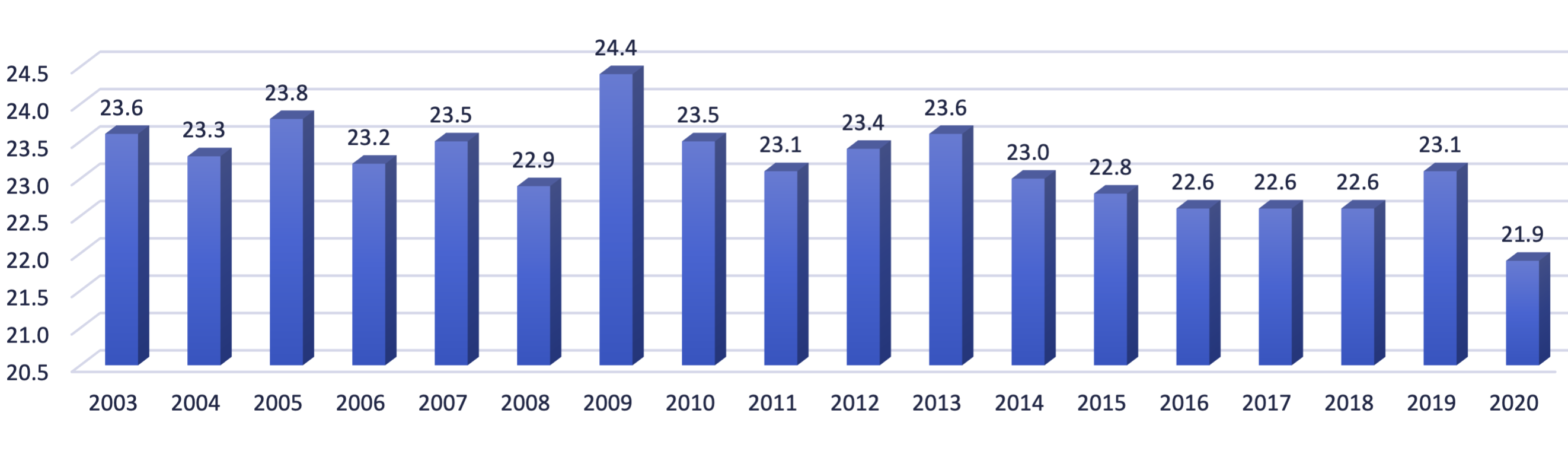
    Inegi found that the informal economy contributed to 21.9% of GDP in terms of value added, lower than the 23.1% share recorded in 2019 and the lowest share since records began in 2003. This was a direct result of the coronavirus (Covid-19) pandemic.

    Size of the informal economy 2003-2020
    % of Mexico’s GDP
    Source: Inegi
     

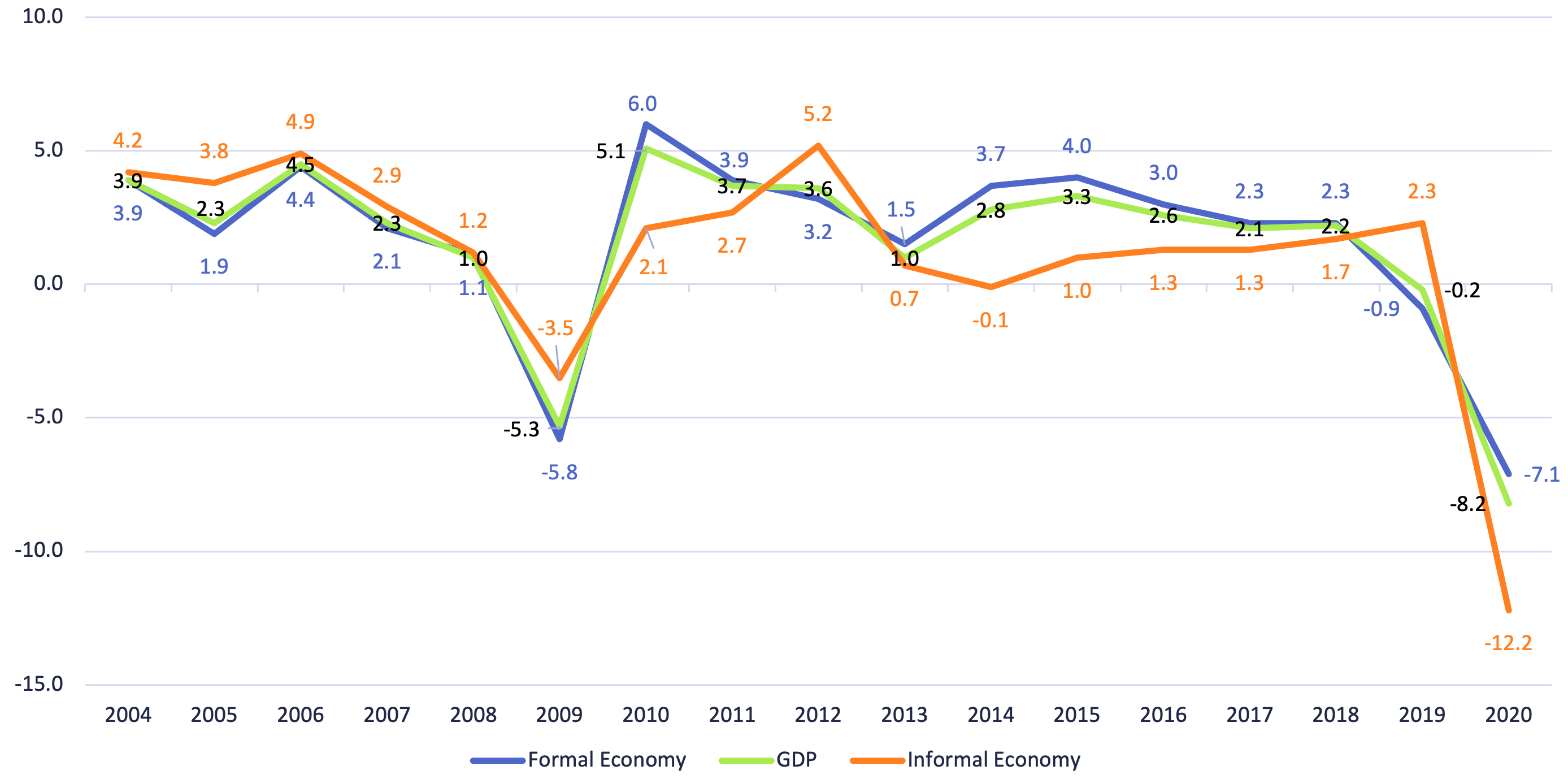
    While 78.1% of GDP in 2020 was produced by 44% of the formally employed population, the informal economy’s share of 21.9% of GDP was generated by 55.6% of the informal workforce. Around 11% of GDP corresponded to the informal sector, while a share of 10.9% was the product of informal workers who may be working within the formal sector but lack any employment benefits. These were the activities that were most severely affected by the impact of the Covid-19 pandemic. Relative to 2019, the population of those employed informally fell slightly from 56.5% to 55.6% in 2020, also due to the impact of lockdowns on the economy. The impact of the pandemic was most severe in the informal sector, when compared to the formal sector and the country’s overall GDP. The following graph shows that while national GDP contracted by -8.2% in 2020, the impact on the formal economy was slightly smaller at -7.1%. In contrast, the informal economy contracted by -12.2%.

    Formal and informal sectors of the economy and GDP growth
    Year-on-year variation in %
    Source: Inegi
     

    Inegi also found that the measures taken to limit the spread of the disease during 2020 affected specific activities differently. Informal retail activities (regardless of whether they were carried out within the formal or informal economy) continued to account for the largest share in 2020, and their share actually increased from 24.9% in 2019 to 26% in 2020. The second largest impact was recorded within construction; informal construction activities contracted from 15.6% of the total in 2019 to 14.6% in 2020. Within the informal sector, retail also remained the principal activity, and grew its share within the sector from 39.2% in 2019 to 40.5% in 2020. Similarly, construction reduced the size of its share from 27.8% in 2019 to 25.7% in 2020, having recorded the largest impact within the informal sector. Together they accounted from 67% of the whole informal economy in 2019, while they accounted for 66.2% in 2020. 

  • TRACKING TRENDS

    Patrick de Courcy 10 February 2022 Hits: 3663

    EL SALVADOR | Deepening China ties. President Nayib Bukele inaugurated the construction of the new national library of El Salvador on 3 February. Bukele said the project was being funded in its entirety by China to the tune of more than US$50m.

    The project has excited controversy because the old library was declared part of the country’s cultural patrimony in 2008. Bukele insisted that “we are not destroying cultural patrimony; we are destroying an uninhabitable building that was doing nothing to save our national patrimony, saving our youth and investing in education, knowledge, and learning”.

    China’s ambassador to El Salvador, Ou Jianhong, said that “the megaproject” would “strengthen ties of friendship” between the two countries. She added that it was “a strong and palpable sign of the results of [bilateral] cooperation”.

    Bukele has been keen to deepen ties with China since his authoritarian tendencies led to a sharp deterioration in relations with the US, although it was actually the left-wing opposition Frente Farabundo Martí para la Liberación Nacional (FMLN), the party he used to belong to and now vilifies, which severed ties with Taiwan in 2018 and switched El Salvador’s allegiance to China.

  • PANAMA: The fight to restore the forests

    Patrick de Courcy 29 July 2022 Hits: 2111

    Panama’s environment ministry (MiAmbiente) has launched a new initiative to incorporate various sectors into its reforestation efforts and meet its commitment outlined in the 2015 Paris Agreement on climate change to restore 50,000 hectares (ha) of forest by 2025 in line with carbon emissions reduction targets. This comes amid other claims by the Partido Revolucionario Democrático (PRD) government led by President Laurentino Cortizo that it is taking efforts to tackle deforestation seriously.

    According to a 9 June MiAmbiente statement, the initiative, dubbed ‘Club Nacional de Restauradores’, aims to introduce a certification stamp for reforestation work carried out by private companies, NGOs and other groups. The certification scheme is in line with Panama’s national forest restoration programme (PNRF) 2021-2025 which launched in 2021 and is committed to focus reforestation efforts.

    This follows various measures by the Cortizo government (which claims forest coverage increased by 3% in 2021, bringing the total national coverage to 68%), to stem forest losses and combat the resulting climate impacts as part of efforts to maintain Panama’s position as carbon negative. The country is currently one of three globally to claim that status, along with Bhutan and Suriname. In his 2019 manifesto, President Cortizo pledged to “prevent illegal logging” and in his first year in office, the legislature convened an investigating committee on illegal logging and deforestation in the Darién Gap, Darién province, to streamline protection efforts. In September 2019, two months after the Cortizo government took office, Environment Minister Milciades Concepción stated that between 2012 and August 2019, 20,784.5ha of forest had been lost in the Darién province alone. At the time he was cited by the media as saying that 90% of this loss was due to illegal logging, an issue which, according to specialist website Insight Crime, has been increasing thanks to a growing market in China for cocobolo, a tropical hard wood. In September 2019, MiAmbiente introduced an “electronic tracing system using chips to store origin information … of the forest product being transported” with the goal of improving forest management.

    • Illegal timber trade

    Despite a 2013 government resolution that only cocobolo that has fallen naturally can be exported, local media outlets have reported that Interpol and national police have repeatedly intercepted containers filled with cocobolo logs at Panama’s ports. National daily Crítica reported one such case in March 2022 where Panamanian police seized two containers at ports in the city of Colón, Colón province, which harbours the Atlantic opening of the Panama Canal, with US$700m of cocobolo wood destined for Shanghai, China.

    The forestry sector has also been included in other general initiatives such as a national carbon footprint government programme branded “Sustainable Panama: Reduce Your Footprint” launched in June 2020, the overall objective of which is to encourage public and private organisations to cut their carbon emissions - for example through energy efficiency programmes and the use of renewable energy resources such as wind or solar power – and to support them in doing so. As well as covering the forestry sector, the programme is designed to cover government ministries, the Panama Canal, organisations in the logistics, construction, agriculture, tourism and hospitality industries among others. More recently, in February 2022 Cortizo signed into law an initiative recognising the rights of nature and the obligations of the state to protect those rights.

    Yet local environmental groups and indigenous communities have voiced concerns over perceived contradictions in the government’s reforestation policies. During the COP26 climate change conference in Scotland in November 2021, a local NGO Fundación Panamá Sostenible (Pasos), accused the government of hypocrisy, pointing to metal mining contracts that it was continuing to negotiate, including one which “would destroy more than 13,000 hectares of forest” in the Mesoamerican Biological Corridor (MBC), a regional conservation programme established to protect endangered species, seas, forests and rivers and address issues of sustainable development.

  • ARGENTINA: Milei’s inflation war riles bankers and exporters

    Abbi Dicker 19 September 2025 Hits: 1486

    Argentina’s President Javier Milei made headlines during his 2023 election campaign by promising to shut down the central bank (BCRA) and eliminate the national currency in favour of the US dollar. Today he is fighting tooth and nail to defend the peso, and the central bank has become one of his main policy instruments in doing so. Milei’s underlying objective is to use the currency as an anchor for inflation, the dragon the president promised to slay. The issue could be the main driver that will shape the outcome of the mid-term congressional elections on 26 October.

    The weaker the peso, the more expensive imported items become, and the more costly it is to service Argentina’s dollar-denominated foreign debt. During the first year and a half of his term, Milei was relatively successful in containing peso depreciation and the resulting inflation. But in mid-June, roughly two months after lifting currency restrictions, the peso started falling sharply and nearly hit the bottom of the band within which authorities allow it to trade. Currently that band is between 1,000 and 1,400 pesos per US dollar.

    Defeats in congress that eroded fiscal discipline, growing opposition by governors, and friction within his own rank and file all raised doubts about Milei’s ability to stay the course of austerity that had underpinned the administration’s control of inflation.

    Investors lost appetite in peso-denominated government notes. At one point in August, the government managed to roll over only 61% of maturing peso debt. That essentially injected more pesos into the economy and helped fuel inflation. Indeed, consumer price increases accelerated starting in June and showed no sign of easing in August. All that has set off alarm bells for Milei. As a result, his economic team rolled out the heavy artillery to help defend the peso. “What did they expect? That I’d free up cash so they could attack the exchange rate? No way,” Milei said in a livestream late in July.

    The BCRA essentially twisted the arms of banks by raising the amount of reserves they are required to deposit. That forced them to buy government debt, which takes pesos out of circulation but also increases the cost and reduces the availability of loans for consumers. Banks are up in arms. They are losing money because of the whole operation, mostly because they receive lower returns on mandatory reserves. Just when they were expanding their credit portfolios to support economic growth, the government is forcing them to build up costly reserves.

    Opposition politicians picked up on the about-turn in government policy. “He said he would eliminate the central bank and today it is the central focus of economic policy,” the Peronist governor of Buenos Aires province, Axel Kicillof, told CNN Radio Argentina in late August. “Destroying everyone’s day-to-day economy, opening up imports, generating unemployment, and eliminating everybody’s rights isn’t the only way to cut inflation,” he added.

    While Kicillof’s contribution to taming inflation when he was economy minister from 2013 to 2015 is arguable, he does have a point. Milei’s current policy is not sustainable. The shortage of pesos is driving up the cost of credit for consumption and investment alike. If the political outlook does not improve by mid-October, Argentines can brace for a bout of inflation or a sharp economic slowdown regardless of the election outcome.

    Boost for Peronism

    On 7 September the Peronist Fuerza Patria alliance won a comfortable victory over President Milei’s La Libertad Avanza (LLA) in the elections for Buenos Aires provincial legislature. Fuerza Patria took 46.9% of the vote, while the LLA won 33.8%. This translated to Fuerza Patria winning 13 of the 23 seats up for grabs in the province’s senate and 21 of the 46 seats being contested in the lower chamber. Markets are likely to take fright at the prospect of a recovery of Peronism and what this could mean for the October mid-term elections in the national congress, and for Milei’s reform agenda in the second half of his term in office if the LLA and its allies are unable to make gains in congress.

  • CHILE: Concertación tries to make a move

    LatinNews 29 September 2011 Hits: 1079

    The four months of protests by school and university students in Chile are finally starting to reshape the political arrangements which have been in place for the past 20 years. The surprisingly strong performance of former President Michelle Bachelet in the Cerc opinion poll (see previous article) shows that she may be a viable presidential candidate in 2014. This is the first good news for the Concertación, which propelled Bachelet to the presidency in 2006, since its defeat in 2010.

    Bachelet’s respectable showing is probably not decisive enough to change the assumption among political commentators that the neat parcelling-up of political power between the Left and the Right in Chile will not last. The first evidence that this system could not last came in the 2009 presidential election campaign when Marco Enríquez Ominami, a dissident socialist deputy, challenged Eduardo Frei Ruiz-Tagle, a former president, for the right to take-on the right-wing candidate, Sebastián Piñera in the decisive second round of the presidential elections.

    Enríquez Ominami failed to get through to the second round, but his challenge forced the four parties of the Concertación, the left-of-centre alliance which ruled Chile from 1990 to 2010, to rethink the Concertación’s role. Given the imploding opinion poll ratings of the President Piñera, how the Concertación decides to reform itself will have major implications.

    The Concertación is not the only organisation mulling over political reform. On 6 September President Piñera sent a bill to congress that would allow voters to choose between a range of candidates in primary elections. Such a change would weaken the political parties’ grip on power. One reason why Enríquez Ominami did so well in 2009 was that Frei was virtually imposed as the Concertación’s candidate, without a proper primary election, as part of a political deal between the parties in the Concertación.

    At a 12 September summit meeting, the leaders of the four parties that make up the Concertación set themselves a deadline of 5 October to reform the alliance. Ignacio Walker, the Partido Demócrata Cristiano (PDC) senator who serves as national spokesman for the Concertación, said that all four parties agree that the Concertación is no longer working, and that voters do not view it as the natural government-in-waiting. The Concertación has been performing even worse in opinion polls than President Piñera and his right-of-centre government. Indeed in the latest Cerc poll on 27 September support for the Concertación was down to 11% and the rejection rate was 43%.

    The PDC sits at the centre of the Chilean political spectrum and is not keen on the Concertacíon shifting to the Left which is, effectively, where the second biggest party in the Concertación, the Partido por la Democracía (PPD), wants to take the Concertación. Essentially, the PPD wants to bring the Partido Comunista de Chile into the Concertación.

    One reason for this is purely tactical. The communists have been prominent in the student demonstrations, which have widespread public support. The most photogenic of the student leaders is Vallejo is a prominent communist.

    The PPD’s president, Carolina Tohá, wants to rebrand the Concertación as a broader based Convergencia Opositora. The implication of such a name is that as the presidential elections in 2013/4 draw nearer, each of the political parties in the Convergencia would become freer on policy issues.

  • TRACKING TRENDS

    LatinNews 08 March 2012 Hits: 2979

    ARGENTINA-URUGUAY | Marital problems. Uruguay’s President José Mujica is becoming more and more publicly disillusioned with the trading bloc Mercosur. Exports to Argentina fell almost by half in February year-on-year as a result of the restrictions imposed by Argentina on imports through a licensing scheme, Uruguay’s union of exporters reported. Exports fell by 47% from US$46.54m to US$24.85m. Mainly food and textile sectors were affected.

        Mujica, who has consistently stressed that exports are not the most important thing on the bilateral agenda – tourism and property being the top two priorities – stressed that this was nonetheless “very worrying”. Mujica is increasingly giving the impression of being in a loveless marriage doomed to continue while he entertains some extramarital infidelities in the form of trade accords with third countries. He recently argued that if its bigger partners were blatantly going to flout the rules of the very imperfect customs union, Uruguay would feel no compunction about striking bilateral trade accords with third countries rather than through Mercosur. Vice President Danilo Astori has long advocated this and it would be fully backed by the country’s opposition parties.

       The Uruguayan government praised the decision by Brazilian authorities to lift the barriers to textiles and automotive parts. Exports to Brazil fell back in February to US$117.81m from US$133.53m a year earlier, but Brazil remains by far the largest export market for Uruguay.

  • RASTREANDO TENDENCIAS

    LatinNews 19 December 2014 Hits: 394

    ECUADOR | Ifad echa una mano. El 15 de diciembre el Fondo Internacional para el Desarrollo Agrícola (Ifad, siglas en inglés) de la ONU, anunció que contribuiría con €25,73m (US$32m) a la promoción y desarrollo de empresas agrícolas competitivas y sustentables en Ecuador.

    Una declaración de la organización con sede en Roma expresó que ha reservado los fondos para ser desembolsados entre el 2015 y el 2018 para ayudar a Ecuador a diversificar su economía agrícola y superar su modelo agrícola centrado en la explotación de materias primas.

    La declaración explica que el objetivo de la estrategia nacional para Ecuador, aprobada por su junta de directores es proveer los necesarios recursos financieros, técnicos y de entrenamiento, para permitir que la producción interna y las exportaciones vayan más allá de las materias primas y obtengan mayor valor agregado.

    Jesús Quintana, el director del programa Ecuador del Ifad, dijo que además de ayudar a desarrollar un nuevo modelo económico agrícola, el establecimiento de nuevas compañías también promoverá “la inclusión social de grupos que han estado tradicionalmente marginados, tales como las mujeres, personas jóvenes y comunidades indígenas y afroecuatorianas.

    Todo esto está en línea con la estrategia nacional de erradicación de la pobreza presentda el 27 de noviembre por el gobierno liderado por el Presidente Rafael Correa. Al develar el plan, Ana María Larrea, la secretaria técnica para la erradicación de la pobreza, dijo que uno de los principales objetivos era incrementar la producción agrícola local elevando el acceso a la tierra, irrigación, crédito, tecnología, y mercados para productores de pequeña escala. Según Larrea, esto ayudaría a reducir los niveles nacionales de subempleo.

    Ifad, que ha estado trabajando en Ecuador desde 1978, ha proveído €177,7m (US$221m) de fondos para el país andino. La organización  actualmente está financiando tres proyectos, valuados en €86,83m (US$108m), que benefician a unas 25.000 familias.

    PERÚ | ¿Fin de la desaceleración? El 15 de diciembre el Instituto Nacional de Estadísticas de Perú (Inei) difundió sus últimas cifras de crecimiento económico que muestran que el PIB creció un 2,37% año en año en octubre, respaldado por un positivo crecimiento en la mayoría de los sectores económicos, incluyendo el sector clave de minería e hidrocarburos El resultado es alentador teniendo en cuenta la marcada desaceleración económica observada en Perú desde mediados del año pasado, y una contracción en el crecimiento en el tercer trimestre de este año, y será bienvenido por el gobierno liderado por el Presidente Ollanta Humala como un premio por su adopción de una serie de medidas de estímulos económicos.

    De acuerdo con el informe del Inei, la mayoría de los sectores económicos registraron crecimiento en octubre, con la sola excepción de los sectores de las manufacturas (-3,07%), la construcción (-3,18%), y la pesca (-9,7%). Aunque esto pudo haber dificultado el crecimiento general en el mes, que fue levemente menor que el 2,68% registrado en septiembre, el incremento del 3,75% en la actividad en el sector minero y de hidrocarburos, después de seis meses consecutivos de resultados negativos, es un signo muy positivo.

    El sector de la minería e hidrocarburos ha  tradicionalmente sido la fuerza conductora de la economía interna de Perú, y si el país pretende recobrar tasas de crecimiento de más del 5% en el mediano y largo plazo, la actividad en este sector  tendrá que avanzar en la dirección correcta. El retorno del sector al crecimiento fue conducido por la incrementada producción minera de materias primas metálicas, tales como el oro (8,90%), plomo (5,52%), hierro (4,58%) y zinc (0,67%).

    Los resultados de octubre llevan la tasa de crecimiento acumulado para los primeros 10 meses del año al 2,75% según las cifras del Inei. Esto es ligeramente mayor que el extremo menor del rango del pronóstico de crecimiento del banco central (BCRP) para el año, del 2,6% al 3%. Pero si el renovado dinamismo en el sector de la minería y los hidrocarburos continuara en el corto plazo es un punto discutible, y los menguantes precios globales de las materias también es algo problemático.

    Recientemente el gerente general del BCRP, Renzo Rossini, reveló que el banco había recortado su pronóstico de crecimiento para el año próximo del 5,5% predicho en octubre a 5,2% - 5,5%. Rossini atribuyó esta decisión al “aún tentativo” crecimiento en algunos sectores.

    VENEZUELA | Rating de riesgo. “Las compañías de rating de riesgo han puesto el riesgo país a prácticamente el más alto del mundo, más que países en guerra, o que sufren los estragos del Ébola”,  clamó el Presidente de Venezuela, Nicolás Maduro, el 8 de diciembre. Los rendimientos de los bonos venezolanos son, de hecho, los más altos entre los mercados emergentes, con márgenes comparables con los del Tesoro de EU, a unos 2.072 puntos básicos. Con un déficit fiscal estimado del 17% del PIB, la palabra ‘default’ es un rumor que circula. De acuerdo con un informe de Bloomberg, del 7 de diciembre, la operación de canje de crédito-default y datos de CMA sugieren un 73% de posibilidad de que Venezuela caiga en default de sus obligaciones de bonos en los próximos dos años.

    • Pdvsa y ONGC, en busca de préstamo conjunto

    El 16 de diciembre Reuters informó que dos fuentes de las firmas petrolera del estado, Petróleos de Venezuela (Pdvsa), y la compañía estatal de India, Oil and Natural Gas Corp. (ONGC), dijeron que las dos firmas están buscando un préstamo de US$1mm para invertir en su empresa conjunta en los yacimientos petrolíferos de San Cristóbal en la faja del Orinoco de Venezuela. La producción en los yacimientos de San Cristóbal recientemente ha caído de un pico de 40.000 barriles por día (bpd) a 30.000bpd. De acuerdo con las fuentes, las firmas han estado negociando el préstamo durante el año pasado y esto en parte incluye el pago de US$500m de dividendos de ONGC adeudados a la firma durante los últimos cinco años. De hecho, las fuentes afirman que las negociaciones están tan avanzadas que “podrían sellarse el próximo año”.

  • BRAZIL ECONOMY: Revenues down ahead of municipal polls

    LatinNews 20 January 2016 Hits: 749

    According to a recent report in the daily Folha de São Paulo, 38 of Brazil’s 50 most populous municipalities saw a drop in tax receipts in 2014-2015.

    Public finances in both states and municipalities are feeling the strain. Falling economic activity has led to a drop in municipalities’ main source of income: the Imposto Sobre Serviços (ISS), a tax paid by service providers. Similarly, states have lost out on income from the Imposto sobre Circulação de Mercadorias e Serviços (ICMS), a value-added tax on sales and services. But the federal government has also been blamed for cuts to the funding it gives to municipalities. On average, the federal government handed out 5.7% less in 2015 than 2014.

    Of the 50 municipalities surveyed by Folha, Salvador, home to 60m Brazilians, in the north-eastern state of Bahia, was the worst affected, with a 17.7% drop in tax revenues in 2015. Other cities badly affected include three in the state of Rio de Janeiro: Campo dos Goytacazes, Nova Iguaçu, and Belford Roxo. The city of Rio de Janeiro itself received 3.9% less in 2015, while the city of São Paulo’s tax take was down by 2.4%. With revenues down, investment in these cities has also taken a hit, down by 16% on average across the 50 municipalities.

    With the exception of Rio de Janeiro, which is preparing to host the Summer Olympic Games in August next, all the other Fifa World Cup 2014 host cities have seen falls in investment. In Natal, Rio Grande do Norte, for example, investment is down by 91%. “The indebtedness of the municipality was increased by the World Cup projects”, Dionísio Gomes, the comptroller of the city, told Folha. In 2015 the city made no new loans.

    In order to balance the books, municipal governments are looking to cut spending. In Manaus, Amazonas, nine schools are due to close, affecting 2,300 pupils. In Goiânia, Goiás, the municipal government is reducing its office hours as a way of cutting costs on energy and communications. Despite the cuts, however, individual salaries remain unaffected. Four municipalities have already been warned by the federal financial ombudsman that salaries are over the legally proscribed limit. Nova Iguaçu spends 60.8% of its income on personnel.

    Auto sector sales down by over a quarter in 2015

    The automotive industry  – long one of the key barometers of the Brazilian economy – is ailing. Latest data from Brazil’s national association of automotive manufacturers (Anfavea) reported a 26.6%  year-on-year fall in new registrations (ie new sales) in calendar 2015 to 2.57m units (comprising cars, buses and trucks), the weakest result since 2008.

    The figure would have been much worse but for year-end firesales across the industry in November and December. While many vehicles are assembled in Brazil, many of the parts are imported. The fall in the value of the Real has weighed down the industry, as has an increased tax burden and the high level of inflation. As a result, many vendors have been forced to put up prices, further depressing demand.

    According to Anfavea, carmakers have cut around 28,000 jobs in the past two years, despite the fact that the likes of BMW, Audi and Chery have started assembling vehicles in the country. Around 130,000 Brazilians are still employed by the sector, but many of them have seen their hours reduced as production lines are put on temporary hold. Germany’s Volkswagen Group remains the leading vehicle-seller in Brazil, followed by Toyota, General Motors (GM), Hyundai, then Ford.

    Marcos Munhoz, the vice-president of GM in Brazil, said that the last two years have been “challenging” for the industry. “We’ve been hit by an increase in costs, an increase in interest rates and taxes, as well as the slump in consumer confidence”, Munhoz told the daily Folha. Nevertheless, GM intends to maintain its R$13bn (US$3.2bn) investment plan in the country for the 2014-2019 period. Car sales are expected to continue their decline in 2016, falling by a further 5% year-on-year, according to the national federation of car dealers (Fenabrave).

    Protests over New Year’s bus ticket rises

    Bus fares in at least 18 Brazilian cities, including São Paulo and Rio de Janeiro, went up by over 10% in early January. On 8 January, led by the civil society organisation Movimento Passe Livre, thousands took to the streets in both cities in protest; in São Paulo there were minor clashes with the police. Days later there were further sizeable protests in São Paulo, prompting an aggressive crackdown by police and dozens of arrests.

    Fares have gone up in at least 18 major cities. In Rio, the increase was from R$3.40 (US$0.84) to R$3.80 (US$0.94), an above-inflation rise of over 11%. The cost of trains and boats in the city also rose significantly. In São Paulo, the increase was from R$3.50 to R$3.80. According to Movimento Passe Livre, cumulative inflation between 1994 and 2015 rose by 443%, while bus fares have risen by 985% during the same period.

    Whereas many of the major protests seen last year drew their numbers from the upper-middle classes, bus fares are an issue that directly affects the majority of Brazilians. An increase in bus fares in São Paulo was the spark that led to the unprecedented demonstrations across the country in 2013. Although a repeat of 2013 seems unlikely at this point, with the economy in recession for a second year, millions of Brazilians are feeling the pinch. For the government the main fear will be that the ranks of any demonstrations this year will be swelled by its working-class base. In 2015, many of the protesters were dismissively referred to as “coxinhas”, a nickname for the white elite; but if the “povão”, or masses, turn against the government it could be hard for President Rousseff to stay in office.

  • BRAZIL: Crunch time for pension reform

    LatinNews 04 May 2017 Hits: 717

    After months of back-room negotiations, concessions and threats, Brazil’s long-awaited pension overhaul finally faces its first legislative test. A special committee of the federal lower chamber of congress is expected to vote on the text of the bill imminently, with the government desperate to avoid any last-minute changes which might open the flood gates to others. Though the bill will pass the committee stage easily, it may prove harder for the government to secure victory on the floor of the lower house, where it needs three-fifths’ support to progress.

    Along with last year’s constitutional amendment to cap public spending, pension reform is the crucial piece of legislation of President Michel Temer’s administration. Both are designed to reassure investors that Brazil is finally putting its house in order by shoring up the country’s battered public finances. While that approach has proved successful in fuelling a stock market rally and a surge in the currency, if pension reform fails all that hard work will come undone. Brazil’s fragile economic recovery would experience a major shock.

    Concessions

    In late March, the newspaper O Estado de São Paulo published a tally of lawmakers’ voting intentions, showing that under 100 said they would vote in favour of the reform; the government needs at least 308. Since then, Finance Minister Henrique Meirelles has made numerous concessions, such as lowering the minimum retirement age for women and police officers.

    All of these changes have reduced the savings forecast by the pension reform. If passed as it currently stands, the government predicts savings of R$630bn (US$197.5bn) over the next 10 years. Meirelles has made it clear he would not support a reform that saves less than R$600bn. So far the committee is resisting calls from prison officers and other special-interest groups that are attempting to secure exceptions from the new minimum retirement age, but these groups will have more leverage when it comes to the vote on the floor.

    Along with the carrot approach, the government has also used the stick. On 2 May three civil service political appointees nominated by coalition legislators who voted against the government’s labour reform were relieved of their duties. Government allies have warned of further “measures” against dissenters. So far, this approach appears to be paying off. The Temer administration won comfortably the vote on labour reform last week, despite trenchant, well-organised opposition in the lower chamber.

    Indeed, given Temer’s own approval ratings hover around the 10% mark, and over seven out of 10 Brazilians oppose pension reform (according to a recent Datafolha survey), the government’s legislative support base appears to be defying political gravity. With elections just 18 months’ away, however, any significant delay to the pension reform could start to erode this congressional base. Legislators may become increasingly reluctant to jeopardise their careers with unpopular reforms, especially as the economy, at least as it is experienced by most voters, is unlikely to improve significantly in the short term.

    Still, most political consulting groups, including Eurasia and Control Risks, believe Temer has the support necessary to pass pension reform. Eurasia Group expects the bill to pass the lower chamber in June and the senate in September. As pension reform is a constitutional amendment, it will require three-fifths support in both houses in two separate votes.

    • Eike Batista released

    On 28 April, Supreme Court Judge Gilmar Mendes ordered the release from preventative detention of Eike Batista, the commodities and logistics magnate who was once Brazil’s richest man. Batista is being investigated over claims he paid over R$52m (US$16.5m) in bribes to Sergio Cabral, the jailed former governor of Rio de Janeiro. Batista is currently under house arrest, but he will have to pay a bond of R$52m within five working days to stay there.

  • VENEZUELA: Oil crash turns up the heat

    LatinNews 23 April 2020 Hits: 5945

    Plummeting global oil prices have added another layer of pressure to Venezuela’s political deadlock, as the economic drama of 20 April brought outspoken declarations from both Nicolás Maduro and Juan Guaidó, and was followed within 24 hours by disputed media reports of clandestine negotiations, hoping to secure an escape route from the country’s crisis.

    The price of Venezuelan crude had already fallen to US$13.03 per barrel on 17 April, driven by reduced demand due to the coronavirus (Covid-19) pandemic, but the unprecedented slump of benchmark US crude West Texas Intermediate (WTI) on 20 April, reaching -US$37.63 per barrel, prompted speculation that Venezuelan prices would follow suit when they are next updated on 24 April. Maduro was uncowed, insistent that his government had prepared for this eventuality, but Guaidó’s reaction to the news was revealing. The opposition leader described “the collapse of the oil market”, and he claimed that “Maduro is gone, we must rebuild our country now”.

    Oil revenue has always made up the lion’s share of Venezuela’s state finances, and the country’s dependence on this income has only increased under Bolivarian governments which promised economic diversification. Mismanagement of the oil industry, rampant corruption, plummeting production, and US sanctions have compounded the problem. While Guaidó’s attempts to build a popular movement against Maduro have delivered minimal success, financial siege has always seemed a more productive avenue. This latest development could finally undermine Maduro’s capacity to pay the salaries of military officials, whose loyalty is essential to the resilience of his government.

    The oil price crash was followed rapidly by another bombshell, as news agency Reuters reported that multiple sources had confirmed the existence of secret talks between allies of Maduro and Guaidó, motivated by concerns that both men’s stubborn resolve to maintain the political deadlock was putting more Venezuelan lives in danger. Guaidó denied any such talks were taking place, and he insisted that his proposal for a collaborative national emergency government, without Maduro, is the only solution to the stalemate. Reuters quoted an ally of Guaidó who claimed that the opposition is working to direct state funds, seized through US sanctions, towards the humanitarian effort.

    Guaidó has previously denied having any access to state finances in frozen bank accounts, which he says are under investigation for money laundering. However, the funds at his disposal have continued to swell, with his national assembly voting on 20 April to approve US$80m in emergency spending. Deputy Juan Pablo Guanipa said half of this would go towards Guaidó’s ‘Plan José María Vargas’ [WR-20-13], working to form an emergency government to facilitate the flow of aid and medical supplies into Venezuela to tackle the pandemic. Guanipa said that “we don’t have impressive quantities of resources, but we do have some that were frozen”.

    • Frozen accounts

    The Venezuelan central bank (BCV) condemned on 18 April the transfer of state funds held in a frozen US bank account to the US Federal Reserve, approved by Juan Guaidó’s national assembly, as “a vulgar dispossession of financial resources” and an act of “transnational organised crime”. A BCV statement accused the opposition of undermining Venezuela’s capacity to respond to the pandemic.

    Another avenue for Guaidó’s spending is a much-publicised project to provide each of the country’s medical workers with a US$100 monthly subsidy for the next three months. Announced on 16 April and approved five days later, Guaidó said the subsidy would protect healthcare workers from “persecution…so that they can protect Venezuelans and save lives”. This subsidy will undoubtedly be of benefit to its recipients, but it falls short of providing a meaningful solution to the chronic shortages of medical supplies in Venezuela’s hospitals, perhaps the greatest barrier to fighting the pandemic.

  • NICARAGUA: Ortega slams Colombia following ICJ ruling

    Sarah Sheldon 21 June 2022 Hits: 896

    Nicaraguan President Daniel Ortega has said that Colombia doesn’t want to accept an international ruling on maritime activity in disputed waters in order to “keep trafficking the drugs they take to Europe and the US”.

    Ortega made the comments on 5 May following the 21 April ruling by the International Court of Justice (ICJ) at The Hague, which ruled that Colombia must “immediately cease” its efforts to control maritime activity in disputed waters off the Colombian archipelago of San Andrés and Providencia. The ICJ ruled that the waters are part of Nicaragua’s exclusive economic zone (EEZ), although its decision does not change the map of either country’s territory.

    Speaking at an official event in Managua, Ortega said that Colombia is “the world’s biggest producer of drugs,” and “that’s the best business that the Colombian government has.” Colombia is a “narco-state”, said Ortega, and hailed what he said were successful anti-trafficking efforts by Nicaraguan security forces. Colombian President Iván Duque responded to Ortega on 5 May, vowing to continue to defend his country’s sovereignty and calling his Nicaraguan counterpart a dictator.

    Some analysts such as Wilder Alejandro Sánchez of US-based consultancy Second Floor Strategies, consider the verdict represents a “defeat for Colombia”, as he outlined to US state-owned radio broadcaster Voice of America on 22 April, because it says the country violated Nicaragua’s sovereignty. “This will affect Colombia’s international image negatively as Nicaragua can obviously now say that even an international court agrees that Colombia has violated Nicaraguan maritime sovereignty,” he said.

    The latest ICJ verdict follows a previous ruling in November 2012 which saw Colombia maintain sovereignty over the archipelago, but lose some 75,000km2 of sea to Nicaragua [SSR-12-11]. Colombia rejected that ruling, however and the latest ICJ case relates to Colombia’s violation of those new territorial boundaries. Since 2012 both countries have filed complaints about the other alleging rule breaking in the area. Despite the latest ruling it appears that the dispute will rumble on, as fishermen based in the archipelago will not want to stop fishing in areas that they have traditionally been able to use.

  • ECONOMIC HIGHLIGHTS

    Patrick de Courcy 14 July 2023 Hits: 1515

    MEXICO | Remittances continue upwards trend. On 3 July, Mexico’s central bank (Banxico) announced that remittances to Mexico totalled US$5.69bn, a 10.7% increase year-on-year. In the first five months of 2023, remittances totalled US$24.67bn, a 10.3% increase on the US$22.37bn received in the same period of the previous year. Remittances are currently on track to surpass the record US$58.49bn received last year.

    MEXICO | Trade deficit drops year-on-year. On 27 June, Mexico’s national statistics institute (Inegi) released new figures showing that the country registered a trade deficit of US$74m in May 2023, compared to a deficit of US$2.26bn in May 2022. In the first five months of 2023, the trade balance presented a deficit of US$6.38bn, with only March registering a trade surplus. In May, exports totalled US$52.86bn, which represented a 5.8% increase year-on-year. Imports in May 2023 totalled US$52.94bn, up 1.4% on May 2022.

    MEXICO | Economic activity up in April. On 26 June, Mexico’s national statistics institute (Inegi) released the latest figures for its monthly global indicator of economic activity (IGAE) which show economic activity grew by 0.8% in April 2023 compared to the previous month. In year-on-year terms, the IGAE rose 3.3% in real terms.

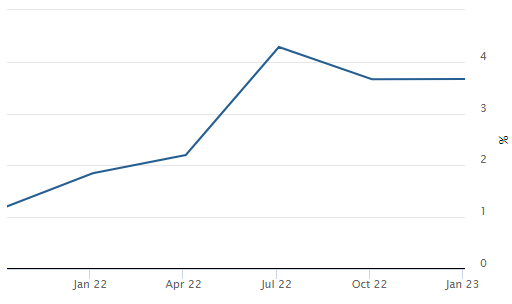
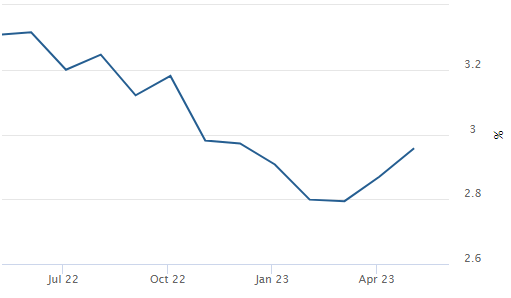
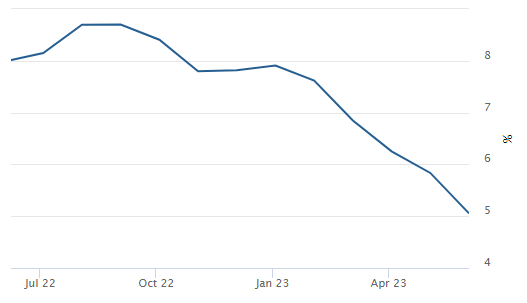
    MEXICO | Banxico holds interest rates again. On 22 June, Mexico’s central bank (Banxico) announced that it was holding its benchmark interest rate at 11.25% for the second consecutive occasion. The announcement came as Mexico’s national statistics institute (Inegi) released the latest figures for the consumer price index (INPC), showing that prices rose by 0.02% in the first two weeks of June as compared to the previous two weeks. This brings annual inflation to 5.18%.

    Mexico: GDP growth
    Percentage variation (year-on-year)

    Mexico: unemployment rate
    Economically active population

    Mexico: inflation rate
    Percentage variation (year-on-year)