All Categories

Subcategories

  • EASTERN CARIBBEAN: Latest forecasts show effects of hurricane season

    LatinNews 06 December 2017 Hits: 191

    The latest forecasts from the Eastern Caribbean Central Bank (ECCB) show the effects of hurricanes Irma and Maria on growth prospects for 2017. Not surprisingly, there have been sharp downward revisions for Anguilla, Antigua & Barbuda, Dominica.

    The ECCB forecasts cover Anguilla, Antigua & Barbuda, Dominica, Grenada, Montserrat, St Kitts & Nevis (SKN), St Lucia, and St Vincent & the Grenadines (SVG). The overall average growth rate for 2016 was 2.57%, with Antigua leading the pack on 5.36% and SVG bringing up the rear on 0.82%. The latest estimate for 2017 is for an overall average of 1.52%. The biggest faller is Dominica, which has seen growth collapse from 2.7% in 2016 to an estimated contraction of -6.22% in 2017. Anguilla is expected to contract by -3.54% (down from growth of 2.47% in 2016). Antigua will see a marked slowdown, to 3.11% from 5.36% in 2016, but not outright recession. SVG, however, is expected to dip into recession with a contraction this year of -0.70%. Two others to slow markedly in 2017 will be Montserrat, down to 0.59% growth from 1.34%, and SKN, down to 1.93% from 3.15%. Two countries, however, will buck the trend and show advances in 2017. Grenada is expected to post growth of 3.35%, up from 2.0% in 2016, and St Lucia is forecast to grow by 3.45%, up from 0.93%.

    Looking forward to 2018, there will be sharp rebounds in the worst hurricane-hit territories because of reconstruction. Thus, Dominica is expected to expand by 10.63% next year and by 7.59% in 2019. Anguilla will bounce back with growth of 5.93% in 2018 and 4.48% in 2019. And Antigua will see growth of 5.85% in 2018 and 4.23% in 2019. The average for the overall group is forecast to be 4.20% in 2018. Even SVG, which experienced below 1% growth in 2015 and 2016 and a small contraction in 2017, is expected to move into more positive territory with growth of 1.89% in 2018 and 1.92% in 2019.

    Not surprisingly, the devastating 2017 hurricane season has pushed the subject of debt relief back up the agenda. The United Nations (UN) Economic Commission for Latin America and the Caribbean (Eclac) has once again been pushing its debt-for-climate-adaptation swap initiative, first mooted in early 2016. Eclac inaugurated a debt-swap task force at a meeting in Trinidad in November. Eclac has been arguing that the high debt of many Caribbean countries was linked to the region’s vulnerability to extreme climatic events.

    It is clear that the linking of the debt issue to the climate change debate could prove to be effective politics. The aim is to focus first on multilateral debt with what has been termed “an aggressive advocacy strategy”.

    Following the 24 November meeting in Port of Spain, Eclac issued a statement saying: “It is an innovative strategy that involves harnessing concessionary flows to transform the debt of the region into a source of investment in resilience, while at the same time re-energising growth and promoting economic transformation in the economies of the sub-region, through investment in adaptation projects and green industries.”

    At a tourism summit at the end of November in St Lucia, Prime Minister Allen Chastanet added his weight to the debate, saying that while investment in resilience is essential, not least because it is now being demanded by insurers, “we are going to fight with the IMF to say that we cannot borrow that money to build the resilience, that money cannot be on top of the debt we already have.”

  • ECONOMIC HIGHLIGHTS

    Patrick de Courcy 21 January 2022 Hits: 2171

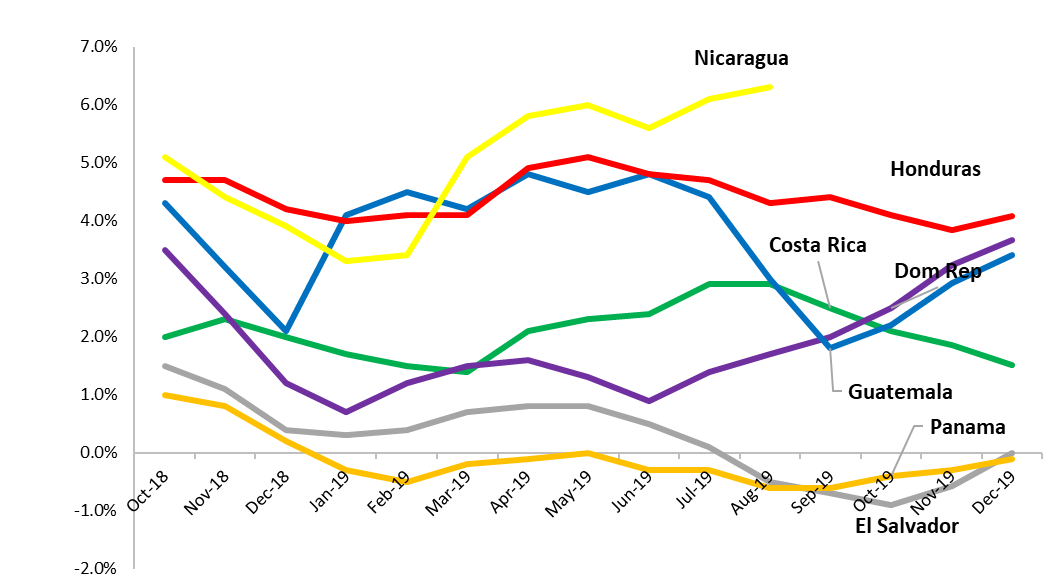
    EL SALVADOR | Remittances surge. On 16 December El Salvador’s central bank (BCR) released new figures which showed that remittances to El Salvador totalled US$6.77bn in the first 11 months of 2021, up 28.2% on the same period in 2020. Remittances from the US totalled US$6.43bn, accounting for 95.0% of the total, followed by Canada (US$63.7m) and Spain (US$25.9m).

    HONDURAS | 2022 budget approved. On 11 December Honduras’s legislature approved the government’s proposed 2022 state budget for L308bn (US$12.75bn), up from L288bn approved for 2021. Of the L308bn, L179bn will go on central government and L128bn for decentralised administration. Finance minister Luis Matta told reporters that the budget includes resources assigned for health, education, and public investment aimed at contributing to job generation, human development, and economic reactivation following the damage caused by the coronavirus (Covid-19) pandemic and impact of the storms Eta and Iota which made landfall in November 2020, all of which caused the economy to contract 9% in 2020.

    DOMINICAN REPUBLIC | First green bond issued. On 3 January Empresa Generadora de Electricidad Haina (EGE Haina), a Dominican mixed public-private company, announced it had raised US$20m in the first placement of green bonds in the Dominican Republic. The bonds will go towards financing the expansion of the Larimar I wind farm in Enriquillo municipality, Barahona province, which comprises 15 wind turbines with a generation capacity of 3.3 MW each. According to EGE Haina, demand was 15.27 times higher than the offer, which it said “indicates investors’ interest in these types of investments which promote the country’s sustainable development”.

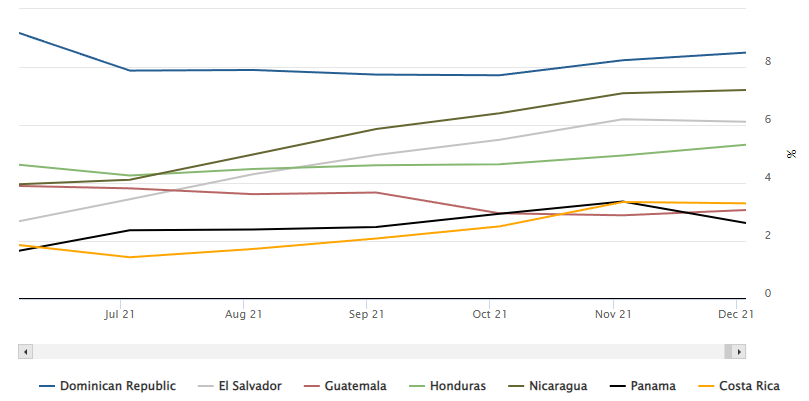
    Central America & Caribbean: inflation rate
    Percentage variation (year-on-year)

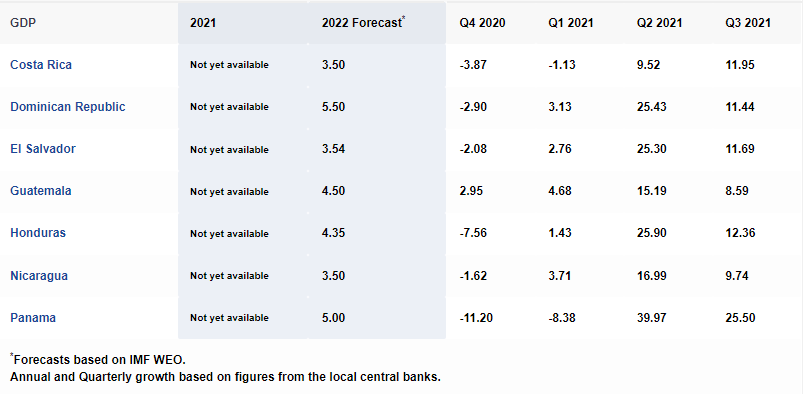
    Central America & Caribbean: GDP growth (%)
    Quarterly figures are year-on-year growth


  • MEXICO: Dispute with Vulcan Materials sours US trade relations

    Patrick de Courcy 20 April 2023 Hits: 4008

    Bilateral trade relations with the US came under stress during March. This was due to a dispute between the government and Vulcan Materials, an Alabama-based aggregates company whose operations in Quintana Roo state were shut down by the government in May 2022 on claims the company lacked the permits to quarry the materials and send them to the US.

    Disagreements between Vulcan and the government date from at least 2018 when the company initiated international arbitration proceedings before the World Bank’s International Centre for Settlement of Investment Disputes (ICSID). The company argued that it was being unfairly treated under the terms of the North America Free Trade Agreement (NAFTA), which was replaced by the current US-Mexico-Canada Agreement (USMCA) in 2020, over planning and environmental issues related to its limestone mining operations.

    The latest tensions emerged after Vulcan claimed that, in the early hours of 14 March, members of the army, state police, and federal investigators entered the premises of Calica, a port terminal owned by the company, which is located south of Playa del Carmen, in order to allow Mexican cement company Cemex to unload a shipment at the port. Although Vulcan had previously agreed to lease land and to provide handling services for Cemex at the site, this agreement expired in December 2022, and no new arrangement was agreed.

    In response, Cemex issued a press statement arguing that it had been granted permission by a local court to continue using the terminal while legal proceedings were ongoing. However, Vulcan claims that after the shipment was unloaded, law enforcement elements remained at the site with no indication of when they would leave, in clear violation of their property rights.

    Importantly, the dispute has become increasingly politicised. Not only has President Andrés Manuel López Obrador often accused the company of “ecocide”, but the incident prompted US legislators to write to Mexico’s ambassador to the US, Esteban Moctezuma, arguing that the use of the Calica terminal was illegal.

    Earlier in the year US legislators met with Mexican authorities in order to discuss what they called “increasing illegal aggression by the Mexican government towards Vulcan Materials”. This has fuelled demands from US Republican politicians against the López Obrador administration, claiming that rather than attack bona fide investors, it should be stepping up efforts against the flow of illegal drugs north of the border. Beyond playing into domestic politics in the US, the dispute will undoubtedly fuel investors’ concerns. Indeed, US Secretary of State Antony Blinken said that the case would have a dampening effect on future US investment in Mexico.

    It was not until 27 March that security forces withdrew from the port facility and a temporary agreement with Cemex was reached for the company to use Vulcan’s port terminal. However, the case has not been solved and will continue to add to trade tensions with the US over the government’s energy policies and plans to ban genetically modified corn.

    UN complaint

    In July 2022, Mexico’s Environment Minster María Luisa Albores filed a complaint before the United Nations (UN) about the negative environmental impact that Vulcan’s operations had in Quintana Roo state.

  • ECONOMIC HIGHLIGHTS

    Patrick de Courcy 14 July 2023 Hits: 1544

    ARGENTINA | Drought batters economy. Argentina’s first quarter GDP figures, released by the national statistics institute (Indec) on 21 June, showed modest growth, with the economy expanding 1.3% year-on-year and 0.7% compared to the previous quarter (below market expectations). This result reflects the impacts of an ongoing severe drought, with agriculture & livestock contracting 11.9% year-on-year (one of just three segments to see a negative performance). More recent economic activity figures, released by Indec on 30 June, show this trend continuing, with the April monthly index for economic activity (Emae) registering a 4.2% contraction year-on-year (and a -1.9% monthly variation), largely driven by a 36.8% contraction in agriculture & livestock. Trade is also impacted, with figures for May showing a US$1.15bn trade deficit, as exports sunk 24.8% year-on-year to US$6.2bn, while imports dropped a more modest 6.7% to US$7.36bn. Large drops in the sale of primary products (-37.2%) and manufactured goods of agricultural origin (-29%) – sectors impacted by the drought – help explain the sharp decline in exports.

    BRAZIL | Another trade surplus. Figures released by Brazil’s ministry of industry and commerce (MDIC) on 3 July show that the country recorded another trade surplus in June. Brazil posted a US$10.59bn surplus last month, up 19.1% on the surplus recorded in May, with exports totalling US$30.09bn and imports, US$19.5bn. The value of exports was actually down 8.1% from May, but trading volume was up 6.7% (while the value of imports was down 18.2%). This reflects a general scenario in which a higher volume of exports – notably agricultural commodities such as soy, amid a record harvest – and fewer imports are driving record trade surpluses for Brazil, despite lower commodity prices. Brazil recorded a US$45.5bn trade surplus for the first six months of the year, a 33% increase on last year and the highest surplus in the first half of a year since 1999.  

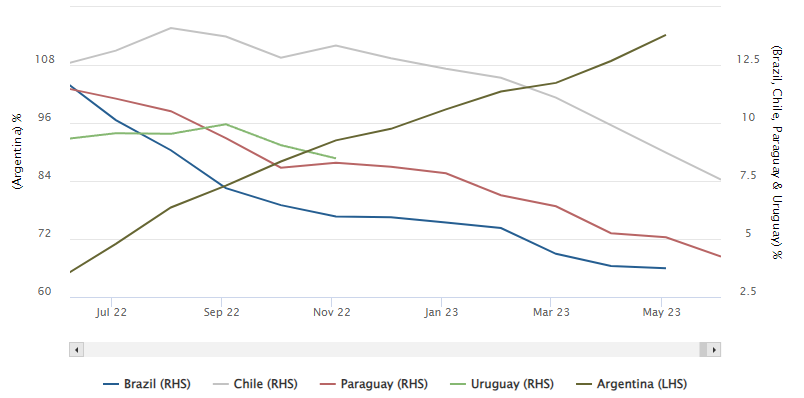
    Brazil & Southern Cone: inflation rate
    Percentage variation (year-on-year)

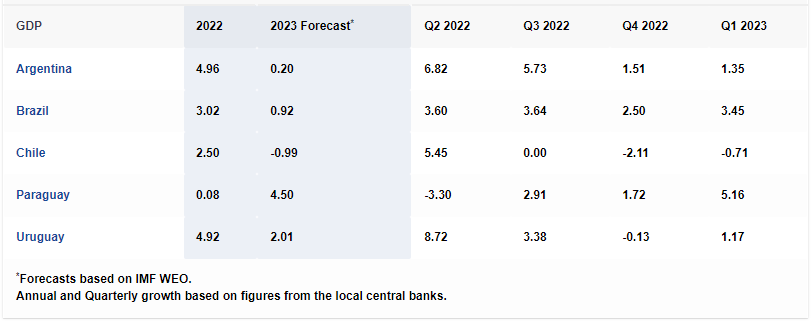
    Brazil & Southern Cone: GDP growth (%)
    Quarterly figures are year-on-year growth

  • ECONOMIC HIGHLIGHTS

    Abbi Dicker 11 December 2025 Hits: 422

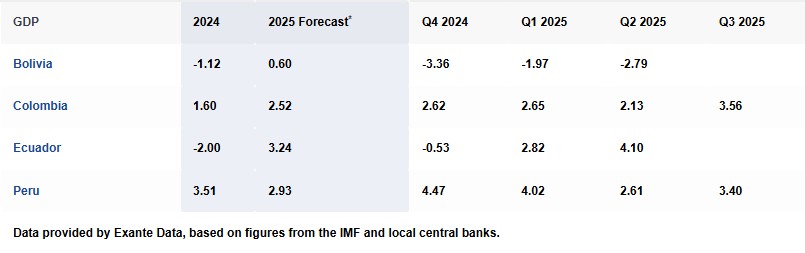
    BOLIVIA | Attempting to calm the parallel currency market. On 1 December Bolivia’s central bank (BCB) began publishing a daily reference exchange rate for the US dollar in an attempt to bring stability to the parallel foreign exchange market. The official exchange rate remains pegged at B$6.96/US$1 when selling bolivianos and B$6.86/US$1 when selling dollars, a rate which is widely viewed as overvalued and unsustainable given the shortages of dollars in Bolivia. The first ‘referential’ rate published by the BCB was B$9.32/US$1 for the sale of bolivianos and B$7.85/US$1 for the sale of dollars. The BCB said in a statement that this rate is calculated according to current rates in the wholesale currency exchange market. It noted that “in recent months, the lack of a reference for the value of the US dollar enabled the spread of different prices for US currency, often coming from non-verified sources such as virtual platforms, bureaux de change, free traders, and others”.

    VENEZUELA | Ready to sell gas to Colombia. Venezuela’s President Nicolás Maduro said on 20 November that the country is poised to begin exporting natural gas to Colombia, saying that “the first gas export to Colombia is ready, it’s at the border, awaiting a few technical elements so that Venezuela can begin selling gas to Colombia”. Colombia’s state oil company Ecopetrol announced in August 2024 that it planned to begin importing Venezuelan gas in 2025 in order to guarantee supply in Colombia, with the gas expected to flow through the Trans-Caribbean pipeline, also known as the Antonio Ricaurte pipeline.

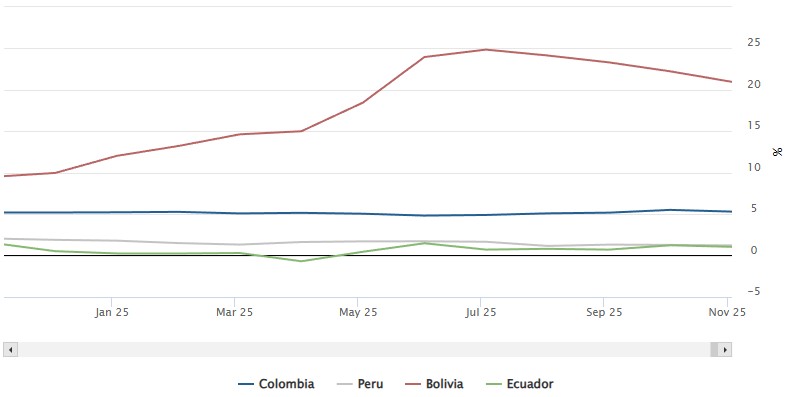
    Andean countries: inflation rate
    Percentage variation (year-on-year)

    Andean countries: GDP growth (%)
    Quarterly figures are year-on-year growth

  • ECONOMIC HIGHLIGHTS

    Abbi Dicker 14 August 2026 Hits: 266

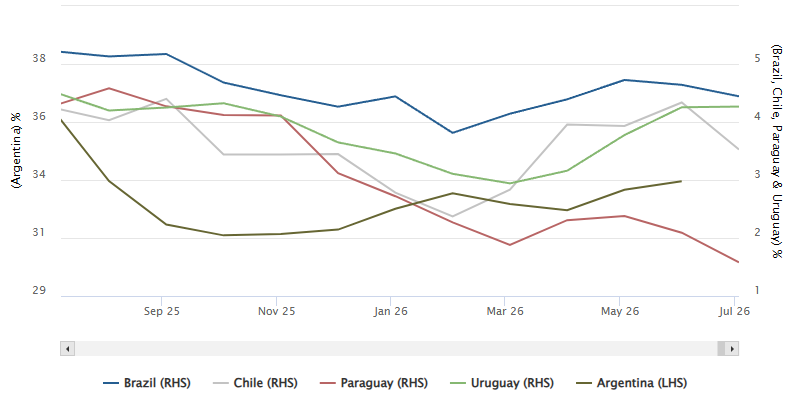
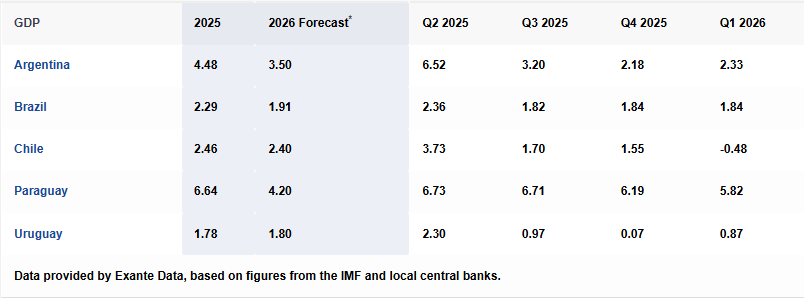
    BRAZIL | Petrobras posts record production. Brazil’s state-controlled oil company Petrobras released its oil and gas production figures for the second quarter on 28 July, showing a total of 3.34m barrels of oil equivalent per day (boepd). This marked a quarterly increase of 3.4% and a year-on-year increase of 14.1%, and it is a record figure for the company, Petrobras said. Oil production in Q2 totalled 2.69m barrels per day (bpd), up 4.1% in quarterly terms and a 15.7% increase year-on-year, while natural gas production totalled 619,000 boepd, up 1% compared to Q1 and up 13.7% compared to Q2 last year. In its latest quarterly report, the oil giant attributed the rise in production to factors such as increased operational efficiency in processing units, as well as the launch of operations in new production wells. Petrobras highlighted particularly strong results in the Búzios oil field, located in the Santos Basin, with average monthly oil production in Búzios surpassing 1m bpd in June for the first time.

    CHILE | Unemployment rate remains high. The national statistics institute (INE) released new figures on 31 July for unemployment in the second quarter of this year, which showed an unemployment rate of 9.4% in April-June 2026, equivalent to 980,270 people searching for work. This unemployment rate remains unchanged from the March-May rolling quarter but marks an increase from 9.1% in February-April and 8.9% in January-March. In year-on-year terms, this also represents an increase compared to 8.9% unemployment in April-June 2025. Chile’s total labour force, which stood at 10.38m people in April-June this year, increased by 1.5% over 12 months, while the total number of formally employed people, which stood at 9.4m people, increased by a slower rate of 0.9%. Chile’s informality rate stood at 27% in Q2 2026, which marked a one-percentage-point increase compared to April-June 2025 and was equal to the immediately preceding quarter.

    Brazil & Southern Cone: inflation rate
    Percentage variation (year-on-year)

    Brazil & Southern Cone: GDP growth (%)
    Quarterly figures are year-on-year growth

  • BRAZIL: Amazon deforestation and violence rise in tandem

    LatinNews 29 September 2011 Hits: 644

    On 21 September police in the remote Brazilian Amazon state of Pará arrested a third suspect over the murder on 24 May last of two well-known environmental activists, José Cláudio Ribeiro da Silva and his wife, Maria do Espírito Santo.

    José Cláudio Ribeiro was gunned down six months after he predicted his own death at an environmental conference, prompting international condemnation and fresh embarrassment for the Brazilian government. The government had loudly trumpeted a record fall in Amazon deforestation in late 2010, only to have to backtrack months later as illegal clearances surged in response to high global commodity prices and a perception of impunity among illegal loggers and cattle ranchers.

    Brazil’s Amazon Institute of People and the Environment (Imazon) estimates that deforestation levels rose a whopping 158% month-on-month (and 15% year-on-year) in August. Pará, which has long had lawless reputation, is the worst offending state. The official figures produced by the National Institute for Space Research (INPE) have indicated rising deforestation every month since April this year.

    Cláudio Ribeiro and his wife took a strong stance against illegal loggers, cattle ranchers and charcoal producers operating in Praia-Alta Piranheira, a remote Amazon settlement in Pará. On 18 September the police arrested José Rodrigues Moreira, the alleged intellectual author of the murders, and his brother Lindon Johnson Silva Rocha, who police believe carried out the executions. The third detainee was named as Alberto Lopes Teixeira do Nascimento.  The men had been hiding out in a jungle camp.

    Brazil’s senate is currently examining controversial reforms to the country’s forestry code, which dates back to 1946. The reforms, backed by agri-lobby groups, contemplate an amnesty for illegal logging up to 2008, allowing individual states to choose how (or if ) they enforce the recuperation of degraded forest areas and, in a bid to support small farmers, they also moot loosening up restrictions on land use. The government is at odds with congress over the bill and President Dilma Rousseff has threatened to veto the most contentious elements.

    Deforestation makes Brazil one of the world's top greenhouse gas emitters. At the UN General Assembly, President Rousseff reiterated Brazil’s commitment to reducing forest losses by 80% by 2020.

    Mozambique courts Brazilians

    The government of Mozambique has offered large areas of the country to Brazilian farmers to grow soya, maize and cotton.  Brazil has three advantages for Mozambique: the first is that both countries speak Portuguese; the second is that Brazil has successfully developed over the past 30 years the Cerrado (an area of the outer-Amazon basin), which Pacheco claims physically resembles land in Mozambique. The third reason is that Brazilians are more in tune with the rhythm of life in Mozambique than the Chinese who are also seeking agricultural land in Africa and Latin America. Mozambique has reportedly offered Brazil 60,000 km² of land in the north of the country for US$13 a hectare (0.01 km² per hectare) a year for a term of 50 years. The local government has stipulated that 90% of the labour employed in developing the land should be from Mozambique.

    Carlos Ernesto Augustín, the president of the Mato Grosso cotton growers’ association, says that Mozambiquean land is very similar to a lot of the interior of Brazil. He adds that another advantage the African country offers is a simpler system for environmental permits. Augustín said that it was now all but impossible to get permission to clear new land in Mato Grosso and thus open it up for agricultural development. However, developing northern Mozambique comes with its own constraints; due to poor infrastructure in the north of the country, any agribusiness would require an expansive long-term investment in infrastructure. Whilst the soil types are claimed to be similar, the climates are in fact quite different: Brazil has four seasons; Mozambique has two.  END BOX

    • Agri-business

    Brazil dispatched around 40 agribusiness owners to Mozambique in September to visit the northern regions of Niassa, Cabo Delgado, Nampula and Zambezia.

  • TRACKING TRENDS

    LatinNews 02 February 2012 Hits: 2433

    NICARAGUA | Femicide law. Congress approved a law on gender violence last week, which includes sanctions of up to 30 years imprisonment and, for the first time, includes as a crime, “femicide” – the intentional killing of women for being women. So far Costa Rica, Guatemala and El Salvador have approved legislation making femicide a crime. According to local NGOs 76 women were killed last year in Nicaragua, 13 less than in 2010 although the real figure is likely to be higher. While the new law was hailed by women’s rights organisations, it still falls far short of the main demand of such groups - repeal of the blanket ban on abortion, implemented in 2006, even when continuing pregnancy risks threaten the life or health of the mother, or when the pregnancy is the result of rape. Approval of the law – which was used by President Daniel Ortega’s Frente Sandinista de Liberación Nacional (FSLN) to win over the support of the Roman Catholic Church in the run-up to the 2006 election, remains a cause célèbre for local and international rights NGOs such as Amnesty International (AI).

  • PARAGUAY: Taming the Paseros

    LatinNews 12 December 2013 Hits: 2011

    In his determination to strengthen Paraguay’s domestic economy, President Horacio Cartes has turned his attention to the local contraband industry. While the government’s efforts have been applauded by the local private sector; they also have resulted in social unrest, with local paseros, small scale cross border peddlers, staging demonstrations.

    Smuggling across Paraguay’s highly porous borders became an important economic activity under the Alfredo Stroessner dictatorship (1954-1989), when it was widely tolerated by the regime and often even controlled by government officials, who used it to line their own pockets. This gave rise to a large and deeply entrenched informal economy based around the contraband goods trade in and out of Paraguay. The sector persists to this day. However, in recent years local entrepreneurs from the formal sector, ranging from electrical goods suppliers to small-scale agri producers, have complained about the negative impact of this still-large smuggled goods sector.

    Perhaps in a bid to finally put to rest the longstanding accusations that he himself managed to amass a sizable business fortune by smuggling large quantities of cigarettes to Brazil and Argentina, Cartes has moved to clamp down on the contraband sector.

    Picking on the little guy

    As the politically weakest group in the informal economy, the paseros were easy pickings for the first stage of the official crackdown. Through the newly-created inter-institutional ‘contraband prevention and repression unit’ (UIC in the Spanish acronym), on 28 November the government announced the launch of ‘Operation Hendy’, deploying extra customs officials, supported by armed forces contingents, to various border crossings to ensure the strict implementation of customs rules and regulations.

    For years, the repatriation of goods purchased abroad by individuals has been virtually unregulated. Under current rules, any goods purchased for personal consumption are exempt from any taxes (except for those included in a regularly updated list of restricted products that, for example, currently includes sugar, beef and poultry meat, eggs and cooking oil). The same goes for goods purchased for re-sale, as long as individuals do not attempt to bring in ‘large quantities’ - the exact definition of which is open to interpretation on any given day. One of the first objectives of Operation Hendy is to clarify these criteria.

    On 2 December, Deputy Trade Minister Pablo Cuevas, who heads up the UIC, announced that the government aimed to regularise imports by individuals in order to limit the impact on local businesses. Cuevas said the government was considering asking all those importing goods for re-sale to register, either as small importers or as micro enterprises, which would make them liable for taxes (of between 10%-15%). In addition, Cuevas proposed setting a limit of US$2,500 on the value of goods that these micro-enterprises can import in any one month.

    Unrest

    These proposals were rejected immediately by the paseros. Their main association, Federación de Trabajadores Comerciantes Fronterizos (Fetracomfro), stated that these small time importers were being used as scapegoats by the government, arguing that the authorities should focus instead on tackling large-scale smugglers and the ‘big fish’ that regularly flaunt the rules with the help of corrupt customs officials. There were remonstrations against the proposals across the country, but these were particularly loud in the South, where local residents complained that the proposed changes would kill off economic activity in those border areas where trade in cheap imported goods from Argentina fuels the local economy.

    In places like Nanawa, José Falcón (in Presidente Hayes department) and the port of Itá Enramada in the capital Asunción, protesting paseros succeeded in partially blockading border crossings and main roads. There were violent clashes on 3 and 4 December, as the police attempted to clear the blockades. In Itá Enramada, the protestors retaliated by launching a fire-bomb attack on the local police station. The violence prompted President Cartes to reach out to the paseros and he called for talks with Fetracomfro in a bid to find a concerted solution.

    Cuevas has been put in charge of the negotiations with the paseros. So far, he has struck a deal with protestors in Nanawa and also in José Falcón, where they were blockading the San Ignacio de Loyola international bridge linking Falcón port to the town of Clorinda in Argentina (see sidebar). These paseros have agreed to the creation of a registry of small importers and to the US$2,500 monthly import limit, as long as they are able to also bring in US$150 worth of imports for personal consumption a month. However, there are doubts as to whether the partial deal will be accepted by the rest of the protestors, many of whom say they object to having to pay taxes while larger importers still face lax import controls.

    Bi-national demo

    The San Ignacio de Loyola international bridge was blockaded by José Falcón paseros but also by merchants from the Argentine town of Clorinda, in Formosa province, who complained that they also would be affected by the measures proposed by the Cartes government. José Posse, spokesman for the Clorinda merchants’ association, complained that since the start of Operation Hendy business had plummeted, as the thousands of Paraguayans that cross the border on a daily basis to do their shopping appear to have been deterred. “Our products are all sitting on the shelves... fruits and vegetables are rotting”, Posse complained, warning that trucks carrying Argentine liquefied natural gas (LNG) would only be allowed across the bridge “if we permit it”.

    Security forces continue to be embarrassed in the North

    Even as the Cartes government called upon the armed forces to assist in its new crackdown on cross border smuggling, the military-led operation against the insurgent Ejército del Pueblo Paraguayo (EPP), launched earlier this year, shows no sign of progress.

    On the contrary, despite the fact that the so-called EPP area of influence, which comprises the departments of San Pedro, Concepción and Amambay, is being patrolled by a large military contingent, the EPP continues sporadic armed attacks against the security forces, with a spate of incidents attributed to the EPP in September and October. In one such attack, a local police chief was shot dead near Horqueta, Concepción, on 24 October.

    General Mario Restituto González, who is in charge of the operation against the EPP, said that troops would redouble their efforts in the area, admitting that the EPP appeared to be “routing” the security forces. On 8 December, the military reported that a group of soldiers had engaged in a shootout with armed EPP members in an operation in a rural area near Horqueta. According to an official statement, a military patrol discovered what it believed to be an EPP camp, but as officers prepared to raid the camp, the presumed criminals were alerted to their presence by dogs. In the ensuing shootout one soldier was shot dead while another is said to have been seriously wounded.

    The victim is the first member of the armed forces to be killed by presumed EPP members. None of the camp’s residents were officially reported arrested, wounded or killed.

    • Counter demo

    On 4 December agri producers and business leaders from the south-central Paraguarí department staged a demonstration in support of the Horacio Cartes government and its efforts to tackle smuggling. The demonstration was led by Paraguarí governor, Miguel Cuevas, who said that his department was one of the worst affected by the contraband of products like potatoes and onions from Argentina, leaving many local producers close to ruin, as they are unable to sell their products in a saturated market. “If President Cartes needs support, he has Paraguarí’s 50,000 [agricultural] producers on his side”, Cuevas declared, adding that the fight must also be against “the powers that run the smuggling”.

  • Corporate Radar

    LatinNews 07 October 2015 Hits: 4756

    Globant seeks to double sales

    Globant, the Argentina-based software development company that floated on the New York Stock Exchange in July 2014, is targeting very rapid growth. CEO Martín Migoya told the Reuters news agency that the company is aiming for 25% annual revenue growth, and hopes to double its current US$250m per annum turnover within the next four to five years. Sales last year were worth US$200m, and Migoya says he expects them to total US$249m this year. Migoya has always insisted that Globant relies on skilled and creative software specialists and a growing global network, and as such is not constrained by Argentina’s short-term financial and macroeconomic difficulties. In the Reuters interview, he said that Globant was relying on organic growth, although it did not rule out more acquisitions. Its last acquisition was in May, when it took over an India-based software producer, Clarice Technologies. Globant now employs a staff of 4,500 in nine countries and its client list includes Google, LinkedIn, JWT, and Coca-Cola.


    Telefónica – we can still grow in Brazil

    Spanish telecoms group Telefónica can still grow in Brazil despite the recession, company director José María Álvarez-Pallete stated at the end of August. Álvarez-Pallete noted that both the mobile brand Vivo and the recently acquired broadband player GVT had managed to increase market share in a difficult market. He added that the depreciation of the Brazilian Real had not neutralised Telefónica’s growth in Brazil, stressing that “although we don’t think the economy will help us, the trend of our business in the country will be positive”. Operationally, the company’s biggest challenge had been to stabilise the fixed line business in São Paulo; with this now largely achieved, Telefónica is in a position to grow nationally and reap the benefits of synergies between Vivo and GVT, Álvarez-Pallete emphasised.


    Moody’s says regional corporates paying bills more slowly

    As a result of slower growth across the region, and the recession in Brazil, Latin American companies are paying their bills more slowly, according to the ratings agency Moody’s Investors Service. Its calculation of late payments by speculative grade companies in the region rose to 4.2% in the 12 months to June 2015, up from 3.1% in the comparable year-earlier period. Eight of ten overdue payments monitored by Moody’s were happening in Brazil, where GDP slumped by 1.9% in Q215. By sector, they were concentrated in the industrial and construction sectors, and involved companies like OAS and Sare Holding. As of June, Moody’s rated 348 corporate debt securities across 21 Latin American countries. It said that in the year to June, it had issued more ratings downgrades than upgrades for those companies.

  • CHILE: Boric grappling to gain initiative

    Patrick de Courcy 14 April 2022 Hits: 2556

    Chile’s President Gabriel Boric completed one month in power on 11 April, acknowledging that it had been a rough ride so far. This can in no small part be attributed to mistakes made by his interior minister and cabinet chief, Izkia Siches. Siches accepted the mistakes and Boric insisted that his government would be upfront whenever this occurred rather than adopt a self-exculpatory approach like other governments.

    President Boric has stood by his beleaguered interior minister after an error-strewn start to her tenure. Siches had to be evacuated to safety by the police after gunshots sounded in the air during an improvised visit to the Temucuicui Mapuche community in Ercilla, in Malleco province, La Araucanía, on 14 March [WR-22-11]. And on 6 April, during a hearing by the lower chamber’s security committee on migration policy, she accused the previous government led by Sebastián Piñera (2018-2022) of covering up a specially chartered flight taking undocumented migrants from Chile back to Venezuela, which she said had been forced to turn back. Her predecessor, Rodrigo Delgado, vehemently denied the claims and Siches subsequently had to admit she had not got her facts straight and issued an apology.

    Siches’s mistakes might have put the government on the backfoot, but Boric himself has seemed far from sure-footed, with a lack of any clear plan or concrete policy initiatives during his first month in office. His flip-flopping on early pension withdrawals, to mitigate the economic impact of the coronavirus (Covid-19) pandemic, is a case in point. He supported pension withdrawals while in opposition before opposing them upon taking office, but he has now been forced to back a fourth withdrawal.

    A fourth 10% pension withdrawal bill failed to obtain congressional approval last December, but a fresh attempt is underway with a bill having reached committee stage in congress. The government reacted by tabling an alternative bill allowing early withdrawals of up to 10% but solely to repay household debts, mortgages, and child support, as well as for the purpose of strengthening unemployment insurance. This would also sit more comfortably with the government’s recently announced US$3.7bn economic recovery plan, designed to increase the minimum wage and to help economic sectors still struggling to emerge from the pandemic.

    Boric contended that a further unrestricted pension withdrawal would “deeply hurt the neediest” by fuelling inflation and eroding their savings. The government has become increasingly concerned over rising inflation and food prices. The 12-month inflation rate rose to as high as 9.4% in March with the central bank predicting that another unrestricted withdrawal might push it up to around 15% by mid-year.

    Water crisis

    The Boric administration is also under acute pressure to address Chile’s serious water crisis, raising the stakes in the case Chile has brought against Bolivia, which is finally playing out before the International Court of Justice (ICJ), over the status and use of the waters from the Silala river: Bolivia claims absolute sovereignty over the river; Chile claims that the river originates from groundwater springs near the shared border and is an international watercourse.

    The governor of the Santiago metropolitan region, Claudio Orrego, declared a four-tier alert system on 11 April to try and address 12 years of drought, experienced to varying degrees by regions across Chile. The top two levels, yellow and red, would result in reduced water pressure and water rationing respectively. Officials say that during a red alert and depending on river flow rates, local residents will have to live with rotating water supply cuts every 12, six, or four days. No area is to suffer cuts of longer than 24 hours. Water supply to schools, health centres, and key municipal buildings will be exempt from the cuts.

    At a press conference outlining the new system, Orrego said: “A city can’t live without water. And we are in an unprecedented situation in Santiago’s 491-year history, where we have to prepare for there not to be enough water for everyone who lives here.” If water rationing is required in the relatively near future, some of the wealthier eastern neighbourhoods of Santiago, such as Las Condes, Lo Barnechea, and Vitacura, which have high water consumption, could be most affected. These wealthier areas consume around 230 litres of water per day per person, compared to an average of 130-160 litres elsewhere.

    Mapuche conflict

    Interior Minister Siches appeared before the lower chamber of congress on 12 April to outline the government’s plans to address the longstanding Mapuche conflict in southern Chile. She said it was essential to stop “the spiral of violence” in the south but insisted that healing the “open wound” would only be possible through “an effort by the whole state and accords between all political forces”. She stressed that while committed to addressing the root causes of the conflict, the government would not ignore the present violence, however, and announced 34 armoured vehicles for the militarised police (Carabineros) and substantial investment in drones.  

    Water resources

    The ownership, use, and protection of water resources is under discussion in Chile’s constitutional convention (CC). Under the 1981 water code drafted during the military dictatorship, the ownership of water resources is highly privatised, with 80% of supply controlled by large farming, mining, and energy companies. 

  • TRACKING TRENDS

    Abbi Dicker 17 July 2025 Hits: 1711

    REGION | Remittances could soon fall. The Honduran central bank reported on 12 July that remittances sent back by expatriates living abroad totalled US$5.80bn for the first six months of the year, up by as much as 25.3% on the same period last year. Some 80% of total remittances were sent back by Honduran expatriates living in the US. Total remittances sent back to the Dominican Republic, meanwhile, increased by 11.2% over the same period to US$5.83bn, according to data released by the Dominican central bank on 13 July.

    The ever-expanding value of remittances, which will shortly be shown in data released by other central banks in the region, could soon fall. According to a study by the US think tank Center for Global Development (CGD) earlier this month, a new 1% tax on remittances sent by expatriates living in the US to their home countries contained within the ‘Big, Beautiful Bill’ approved by the US Congress and promulgated by President Donald Trump on 4 July could lead to a 1.6% drop in remittances. The government reduced the tax it had intended to apply to remittances in its initial proposal from 5% to 1%, but even the reduced rate will still have a significant impact on Mexico and Central American countries in particular when it takes effect on 1 January 2026.

    In absolute terms, Mexico will be the most-affected country in Latin America, losing an estimated US$1.55bn of remittances a year, followed by Guatemala (US$415m). But in relative terms, the most-affected country will be El Salvador, whose president, Nayib Bukele, is vying with Argentina’s head of state, Javier Milei, for the tag of Trump’s closest ally in the region. El Salvador, according to the CGD’s calculations, would lose US$198m a year, the equivalent of 0.62% of gross national income, followed by Honduras (US$175m, or 0.55%), and Jamaica (US$79.8m, or 0.42%).

  • Hydroelectricity; Nuclear; Shale gas

    LatinNews 18 April 2012 Hits: 2493

    Hydroelectricity: consumption

    m tonnes oil equivalent*


    Country

    2006

    2007

    2008

    2009

    2010

    Brazil

    78.9

    84.6

    83.6

    88.5

    89.6

    Venezuela

    18.5

    18.8

    19.6

    19.5

    17.4

    Argentina

    9.8

    8.5

    8.4

    9.2

    9.2

    Colombia

    9.7

    9.5

    10.4

    9.3

    9.1

    Mexico

    6.9

    6.1

    8.8

    6.0

    8.3

    Chile

    6.6

    5.2

    5.4

    5.6

    4.9

    Peru

    4.4

    4.4

    4.3

    4.5

    4.4

    Ecuador

    1.6

    2.0

    2.6

    2.1

    2.0

    Other

    18.5

    19.3

    19.4

    19.2

    20.7

    Total

    154.9

    158.5

    162.7

    163.9

    165.5

    *Ranked according to data for 2010.


    Hydroelectricity: potential

    GW & % developed*


    Country

    GW

    % developed

    Brazil

    144

    31

    Colombia

    93

    20

    Peru

    62

    13

    Venezuela

    28

    11

    Argentina

    44

    10

    Bolivia

    39

    9

    Chile

    26

    6

    Other

    116

    10

    Total

    552

    25

    *Ranked by % of potential developed.


    Source: PSR, based on Olade.


    Nuclear energy: consumption

    m tonnes oil equivalent*


    Country

    2006

    2007

    2008

    2009

    2010

    Mexico

    2.5

    2.4

    2.2

    2.4

    1.3

    Argentina

    1.7

    1.6

    1.6

    1.8

    1.6

    Brazil

    3.1

    2.8

    3.2

    2.9

    3.3

    Total

    7.3

    6.8

    7.0

    7.1

    6.2

    *Ranked according to data for 2010.


    Shale gas potential

    Tn cubic metres


    Country

    Proven gas reserves

    Technically recoverable shale gas reserves


    Argentina

    0.4

    22.0

    Mexico

    0.3

    19.0

    Venezuela

    5.0

    0.3


    Source: PSR, based on Nature.


  • CHILE: Bachelet in Africa

    LatinNews 14 August 2014 Hits: 1010

    In her most extensive tour abroad since taking office for a second time last March, President Michelle Bachelet has conducted a six-day visit to Africa, with stopovers in South Africa, Mozambique and Angola. While her agenda included issues like gender rights (Bachelet is a former head of UN Women), her trip was aimed at shoring up ties in the key areas of trade, energy and mining.

    Accompanied by her energy, mining and foreign ministers, Máximo Pacheco, Aurora Williams and Heraldo Muñoz respectively, President Bachelet began her visit on 8 August with a three-day stopover in South Africa, where she met President Jacob Zuma. According to a press release by South Africa’s ministry for international relations and cooperation, the two leaders discussed a range of topics, including gender equality and defence (the two acknowledged “significant scope for cooperation in exchanges of training opportunities”).

    Key areas up for discussion, however, given continued concerns regarding slowing growth in Chile were trade (South Africa is Chile’s largest trading partner in Africa), mining and energy. On figures from Chile’s central bank, South Africa accounted for just US$225.7m out of Chile’s total trade worth US$155.86bn in 2013 while Africa accounted for US$437.3m. A memorandum of understanding (MoU) to establish a joint bilateral trade and investment commission was inked in July 2012 and according to a joint statement by Bachelet and Zuma the first meeting of the commission will take place in Santiago “before end 2014 in order to finalise a short, medium and long term plan of action”.

    As regards energy the statement noted that Chile (which is seeking to address the prospect of an energy deficit [WR-14-20]) “has expressed an interest in South Africa’s Master Energy Plan” and that a dialogue between the relevant ministries “should be created to investigate ways to enhance cooperation in this regard”. In the area of mining the two called on the relevant authorities to finalise a proposed “bilateral agreement on cooperation in the field of Mineral Resources.”

    While Bachelet’s visit to Mozambique failed to produce concrete agreements, her stopover in Angola yielded the promise of oil imports. Pacheco told reporters that under an existing protocol, Chile plans to import US$300m of crude from Angola this year in three shipments, two of which have already arrived, with the third due to arrive by the end of September. He said that in 2015, imports of crude could increase to US$900m, making Angola the country’s biggest supplier of crude outside the Latin American continent.

    • New Codelco CEO

    The directorate of Chile’s state-owned copper mining company, Codelco, has named Nelson Pizarro Contador as its new CEO, replacing Thomas Keller, who was appointed in 2012 by President Bachelet’s predecessor, Sebastián Piñera (2010-2014) but was asked to step down on 5 June. Keller told reporters that his vision was not in line with the rest of the directorate, particularly regarding “investments that were not going to prove profitable for the Chilean public”.

    The appointment of Pizarro, who most recently held the post of executive president of the Minera Lumina Copper Chile company, a subsidiary of Japan’s Pan Pacific Copper, follows that of economist Oscar Landerretche who President Bachelet named to head up the Codelco board of directors last May. It comes at a key point amid efforts to overhaul the state mining company which has registered continued declines in production. On figures from the state copper commission Cochilco, Codelco produced 1.621m tonnes (t) of the total 5.776m (t) of copper in 2013, down from 1.646m t in 2012 and 1.735m t in 2011.

    On 23 July, Landerretche told the congressional mining committee that Codelco would seek to issue annual debt of around US$1.7bn to help it finance an ambitious investment plan for 2014-2018. Codelco estimates it needs to invest an average of US$4.5bn annually over the next 5 years to upgrade its aging deposits and counteract falling ore grades.

    • Spat with Venezuela averted

    On 7 August Felipe Cuevas, the youth leader of the Unión Demócrata Independiente (UDI), the senior partner in the opposition Alianza por Chile, was arrested in Caracas, threatening a spat between Venezuela and Chile. UDI president Ernesto Silva told reporters that Cuevas had been invited to Venezuela by the opposition. He met opposition leader María Corina Machado and attended the trial of another opposition figure, Leopoldo López. Chile’s ambassador to Venezuela, Pedro Ramírez, told reporters that Cuevas was arrested for taking photos in an unauthorised place and for not carrying identification. Following protests from Chilean officials and threats of diplomatic measures from the likes of Jorge Tarud, the head of Chile’s lower chamber foreign relations committee and a member of the ruling Nueva Mayoría’s Partido por la Democracia (PPD), Cuevas was freed the following day.

  • ECUADOR: Trimming the fat

    LatinNews 07 September 2017 Hits: 474

    On 7 September, just two days after he denied that an economic adjustment package, or ‘paquetazo’, was in the offing, President Lenín Moreno issued an executive decree imposing just that – but on the public sector exclusively.

    Executive decree no. 135, published by the communications secretariat (Secom), seeks to ‘reinforce austerity’ and ‘optimise expenditure’. Measures include immediate 10% salary cuts for senior public servants (as of 1 September), and the suspension of performance-based ‘efficiency’ bonuses for the 2017 and 2018 fiscal periods.

    The category of senior public servants includes ministers, deputy minsters and the heads of state bodies, as well as senior civil servants. According to Labour Minister Raúl Ledesma, the measure will apply to 7,242 public servants in all, generating savings of US$34m a year. Exempted from the pay cuts are managerial staff in the health and education sector, and the armed forces and national police.

    Relatedly, there will be a public sector hiring freeze, with vacancies across all state bodies to be eliminated. Ministries and other state bodies must review staff numbers, meaning possible job losses. Extra working hours will be capped at 30, and must be pre-authorised, while general living expenses, including for items like mobile phones, will also be rationalised.

    Other miscellaneous spending faces the chop, with tighter controls on foreign and internal trips (including a ban on first class airline tickets for all but cabinet ministers) and restrictions on the purchase and use of high-end vehicles like 4x4s. Advertising and communications budgets will be slashed, with the use of private venue hire for public events prohibited. Security details will also be reduced (this will fall to the interior ministry).

    Finally, the government plans to sell off a portfolio of state assets (including old colonial buildings, offices, land, and vehicles) with an estimated value of US$300m. The proceeds will go towards Moreno’s public housing scheme, ‘Casa para Todos’. In all, the new measures could generate an estimated US$400m in savings, state media reported, albeit Finance Minister Carlos de la Torre said the full saving would only be known towards the year-end.

    On the weekly ‘El Gobierno Informa’ on 1 September, Moreno was at pains to stress that he would not impose a ‘paquetazo’, stating that he would never take measures that risked affecting the poorest and most vulnerable. At the same time, he recognised that the economic situation was “complex”.

    This reluctance by Moreno to follow through on his earlier pledges to deal with the fiscal ‘mess’ he inherited from his predecessor, Rafael Correa (2007-2017), may also relate to the growing internal splits in the ruling left-wing Alianza País (AP) between Morenistas and Correístas. The latest blow was the departure of none other than Ricardo Patiño, an AP founding member and one of Correa’s most respected ministers. Patiño, with two other high-profile AP figures, Paulo Pabón and Virgilio Hernández, quit as advisers to Moreno in late August in protest at what Patiño said was the “unfair criticism” of the results of the ‘won decade’ under Correa.

    With Correa supporters agitating, Moreno is in a poor position to impose a politically difficult fiscal adjustment, and, in truth, he appears a lot less committed to it now than before his election. An adjustment now would only risk prolonging the country’s recession. Yet, at the same time, Moreno rejected the idea of “reckless indebtedness”, another apparent slight at Correa.

    Against this difficult backdrop, Moreno again mooted the idea of a ‘consulta’ – a national plebiscite – to gauge public support for a ‘menu’ of future economic measures. Arguably that might buy him some political breathing space. For the conservative opposition and the local business sector, however, difficult decisions need to be taken sooner rather than later if the economy is to get out of its current stagnation.

    • Lack of inflation points to economic stagnancy

    Inflation in August was a mere 0.01% month on month and 0.28% year on year. Accumulated year to date inflation was thus 0.20% for the first eight months. Ecuador is registering some of the lowest inflation rates since dollarisation (in 2000). This is not a good sign; rather, it is a strong indicator that domestic demand remains very weak. The newly-approved budget for the remainder of 2017 projects real GDP growth of just 0.4% this year; most private economists expect a contraction.

  • Economic Highlights

    LatinNews 24 January 2020 Hits: 1337

    HONDURAS | IMF completes reviews. Last month the International Monetary Fund (IMF) announced that it had completed the first reviews of Honduras’s performance under the economic programme supported by a two-year Stand-By Arrangement (SBA) and a two-year arrangement under the Standby Credit Facility (SCF). This programme was approved on 15 July 2019 for US$309.2m, the equivalent of 90% of Honduras’s quota at the IMF. The completion of the reviews enables the authorities to access resources in the total amount of about US$144.7m. According to the IMF, the Honduran authorities remain “fully committed to the economic programme supported by the IMF”. They have maintained “prudent macroeconomic policies—the fiscal position is in line with the fiscal responsibility law, inflation is within the central bank’s target band, and the current account deficit has narrowed despite adverse terms of trade—and have taken initial steps on structural reforms to promote sustained, inclusive growth”.

    HAITI | UN warns of food insecurity. Last month the United Nations Office for the Coordination of Humanitarian Affairs (OCHA) warned that deteriorating economic conditions in 2019 - including low economic growth rate, (the United Nations Economic Commission for Latin America & the Caribbean forecast just 0.5% growth in 2019), high inflation (in excess of 20% at the end of September) and an increase in the cost of basic food items, have had a negative impact on the humanitarian situation in Haiti. It warns that the number of Haitians facing food insecurity rose to 3.7m this year, up from 2.6m in 2018. OCHA expects the figure will reach 4.2m by March, with some 1.2m Haitians likely to experience “emergency levels” of food insecurity. 

    Central America & Caribbean:​ Inflation
    Monthly year-on-year figures

    Central America & Caribbean, selected countries: GDP growth (%)
    Quarterly figures are year-on-year growth
    GDP  end 2019* 2020 forecast* Q4 2018 Q1 2019 Q2 2019 Q3 2019
    Costa Rica 1.8 1.9 1.9 1.8 1.4 1.9
    Dominican Republic 4.8 4.7 6.6 5.7 3.7 Not yet available
    El Salvador 2.2 2.3 2.1 1.8 2.0 2.7
    Guatemala 3.3 3.2 3.5 3.0 3.5 4.0
    Honduras 2.9 2.9 4.8 3.5 1.9 2.4
    Nicaragua -5.3 -1.4 -7.7 Not yet available  Not yet available  Not yet available
    Panama 3.5 3.8 4.0 3.1 2.9 2.7
    *Figures from the United Nations Economic Commission for Latin America & Caribbean Dec 2019
    Quarterly growth based on figures from the local central banks
  • CHILE: Candidates jostling for position

    Patrick de Courcy 28 January 2025 Hits: 2854

    Date: 16 November 2025. If no presidential candidate secures an absolute majority of the valid votes, a run-off will be held on 14 December.  

    Election type: Presidential and legislative elections (23 senators and 155 deputies).

    Main contenders: Parties in the left-wing government alliance, currently consisting of the Frente Amplio (FA), produced from the merger of Convergencia Social (CS) and Revolución Democrática (RD) in July 2024; Socialismo Democrático (SD), the centre-left allied bloc comprised of the Partido Socialista (PS), Partido por la Democracia (PPD), Partido Radical, and Partido Liberal (PL); Partido Comunista de Chile (PCCh); Federación Regionalista Verde Social (FRVS); and Acción Humanista (AH). The opposition consisting of the right-of-centre Chile Vamos coalition, currently made up of Unión Demócrata Independiente (UDI), Renovación Nacional (RN), and Evópoli; the far-right Partido Republicano (PR); the conservative Partido Social Cristiano (PSC); and the far-right Partido Nacional Libertario (PNL), which is still being formed. Other parties to note are the centre-left Democracia Cristiana (DC) and the leftist Partido Progresista (PRO).

    Although Chile’s presidential elections are not due to take place until the end of this year, an idea of what the race may look like has already started to emerge, particularly in terms of candidates running for right-wing opposition parties. Candidates on the left of the spectrum running for parties in President Gabriel Boric’s ruling coalition or those allied to it have yet to come forward in similar numbers. There is a still a long way to go before the primaries in June and many on the left may hope that Boric’s government, beset by scandals in recent months, will see a boost in popularity before then to prevent their candidacies from being tainted by the current administration’s perceived failings.

    Beleaguered Boric

    Under Chile’s constitution, presidents are not eligible for immediate re-election. Even if he were able to run, the odds would not be looking good for President Boric, whose term in office has been marred by two failed attempts to rewrite Chile’s constitution, low economic growth, and rising concerns over public security. In recent months, his government has been hit by its mishandling of the rape allegations that emerged against former deputy interior minister Manuel Monsalve (2022-2024) in October; historical sexual harassment accusations against Boric himself; and a botched attempt to purchase the residence of former president Salvador Allende (1970-1973). All this has contributed to disapproval ratings of over 60% in January, according to a survey by local pollster Cadem released on 12 January.

    The unpopularity of the government has likely damaged the presidential ambitions of some key members of Boric’s team. Chief among these is the interior minister, Carolina Tohá, who is reportedly being urged to run for the presidency by members of her party, PPD. Tohá has not ruled out the possibility but is biding her time. Tohá’s approval ratings have plummeted due to the Monsalve case, with only 32% of respondents approving of her in a November Cadem poll - the worst rating of any government minister.

    Other potential candidates from the ruling alliance include twice former president Michelle Bachelet (2006-2010, 2014-2018) of the PS; Tomás Vodanovic (FA), who was re-elected mayor of Santiago’s Maipú commune by a landslide in October 2024; and Claudio Orrego, who won re-election as governor of the Metropolitan Region of Santiago (RM), Chile’s most populous, as an independent candidate in November. Bachelet is currently performing the best out of potential ruling alliance candidates in the polls, while Vodanovic and Orrego have proven their popularity in Santiago while distancing themselves from federal government failings. However, all three have so far ruled out running for the presidency. Vlado Mirosevic, a federal deputy for the Partido Liberal (PL), is the only candidate from parties in the ruling alliance to formally announce his candidacy so far.

    The question of which leftist parties will go head-to-head in primaries on 29 June also remains unknown. Alberto Undurraga, a federal deputy and leader of the centre-left DC, which is not part of the governing alliance, has informally expressed his intention to run and has reportedly stated he would be prepared to compete in primaries with the SD and the FA, but not with the PCCh. Such divisions risk splitting the leftist vote, potentially providing a boon for the right-wing opposition, which is already capitalising on the government’s woes.

    The opposition

    The race looks slightly clearer for the opposition. On 11 January the RN’s general council voted for Evelyn Matthei, the former mayor of Santiago’s Providencia commune, to be its presidential candidate. The UDI - Matthei’s own party and the senior partner in Chile Vamos – also confirmed Matthei as its pick a week later, paving the way for her to become the coalition’s candidate. The UDI’s Rodolfo Carter, former mayor of the Santiago Commune of La Florida, has also expressed his intentions to run for the presidency and to compete in primaries against Matthei.

    Matthei is currently leading opinion polls. The latest (12 January) poll released by Cadem showed Matthei on 23% of voter intentions, down 3% from its previous (December) survey. In all run-off scenarios tested by Cadem, Matthei triumphed, beating Bachelet by four percentage points, Tohá by 38, and Orrego by 18. A December survey by pollster Criteria similarly showed Matthei leading intentions on 27%, followed by Bachelet on 11%, while a November poll by Pulso Ciudadano put Matthei on 26%, ahead of Bachelet on 13%.

    The far-right

    Cadem’s most recent polls suggest that Matthei’s closest rivals may currently come from the far-right. José Antonio Kast, the PR leader who lost to Boric in the run-off in 2021, has confirmed he intends to run again. Cadem’s November and December polls showed him in second place behind Matthei, with 14% and 8% of the vote respectively. However, in the January survey, he had slipped into third, overtaken by federal deputy and YouTuber Johannes Kaiser, an estranged member of the PR. Kaiser has announced he is running for the PNL, a party he founded that is under construction. Kaiser has grown in popularity in Cadem’s polls in recent months, from 4% of intentions in November to 10% in January, second behind Matthei.

    Kaiser has said he is willing to compete in primaries with Chile Vamos although Kast is unlikely to do the same. The emergence of a new alternative on the far-right is likely to take votes away from Kast, who would be embarking on his third attempt at the presidency, particularly given the PR’s poor performance in October’s local and regional elections. Kaiser’s libertarian discourse is similar to that of Argentina’s far-right President Javier Milei, with an emphasis on downsizing the role of the state and promoting personal freedoms. His rhetoric also includes an emphasis on guaranteeing security and public order, which may well appeal to a society increasingly concerned by violent crime rates.

    Indeed, Boric’s government has moved to respond to concerns around insecurity, creating a new public security ministry, boosting spending, expanding the powers of police, clamping down on the border, and deploying more security personnel. The politicisation of public security is likely to reach new heights in the coming months as the topic looks set to be a key campaign issue.

    Other potential candidates

    Other potential candidates on the left include former president (1994-2000) Eduardo Frei and the former leader of the Partido Progresista Marco Enríquez-Ominami. Frei stated he is not planning on running, despite pressure from within the DC. Enríquez-Ominami, who would be embarking on his fifth attempt at the presidency, has not ruled out running, with reports that the Partido Radical is eyeing him up as a potential candidate.

    Local and regional elections

    Evelyn Matthei was vocal in celebrating the good performance by Chile Vamos in October’s local elections. The coalition won 122 of the country’s 345 communes (municipalities), including in the Santiago communes of Ñuñoa, a traditional stronghold of the left, and Santiago Centro, where changes in the political colour have traditionally been seen as an accurate indicator of who will win the next presidential elections. However, Boric’s left-wing coalition performed better in the second round of gubernatorial elections in November, notably clinching a win in RM. Matthei had pitched the RM race as the ultimate battle, with some analysts suggesting this took away somewhat from what she had gained by championing the municipal wins. 

  • GUYANA/VENEZUELA: New coastal incursion

    Sarah Sheldon 24 April 2025 Hits: 1854

    On 1 March a Venezuelan coastguard vessel entered Guyana’s exclusive economic zone (EEZ), approaching FPSO Prosperity, an oil rig operated by US firm ExxonMobil, and demanding information from its crew. This led to a new surge in diplomatic tension between the two countries over the oil-rich Essequibo region, which lies within Guyana’s internationally recognised waters but is claimed by Venezuela.

    Guyana’s government reacted by condemning the incursion and mobilising the air force, while reiterating its commitment to find a peaceful settlement to the longstanding dispute over the Essequibo, a 160,000km² area that Venezuela has historically claimed as its own. The Caracas government denied that the Venezuelan vessel had entered Guyana’s EEZ, alleging that the encounter took place in a “maritime zone pending delimitation in accordance with international law”.

    The incident has had various ramifications. Guyana’s President Irfaan Ali has briefed Caribbean Community (Caricom) members who have supported his country’s long-standing call for the Essequibo dispute to be adjudicated by the International Court of Justice (ICJ). In contrast, citing a 1966 agreement with the UK, which was then the colonial power in Guyana, Venezuela favours a renegotiation of the dispute.

    In the last few years Venezuela has made various aggressive attempts to assert sovereignty in the disputed area. Backed by a December 2023 referendum it declared the creation of a new Venezuelan state named Guayana Esequiba in the disputed area. Venezuela’s national electoral council (CNE) has announced plans to elect a governor and local deputies for the ‘state’ in Venezuela’s 25 May regional and municipal elections, despite the Essequibo remaining under full Guyanese control.

    President Ali says this is in direct contradiction to ICJ rulings asking the parties not to innovate. He also claims it violates the spirit of the Argyle Accords, reached in December 2023 between the two countries, in which they pledged to de-escalate tensions and avoid the use of force.

    One not insignificant factor in the rising tension is the presence of large oil and mineral resources in the Essequibo. However, a US think tank, the Center for Strategic and International Studies (CSIS), highlights other factors as well. One is that the claim to the Essequibo has cross-party support in Venezuela, and for an unpopular government helps create a “rally round the flag effect” among the armed forces and Maduro’s political base.

    Another is that it might provide a bargaining chip in Venezuela’s evolving relationship with the US, at a time when President Donald Trump is increasing pressure on Maduro by ratcheting up sanctions, deporting Venezuelans, and threatening tariffs on Venezuela’s remaining oil buyers.

  • COSTA RICA: Homicide figures remain near peak

    Sarah Sheldon 24 February 2026 Hits: 292

    There were 873 homicides in Costa Rica in 2025, down only slightly from 876 in 2024 and a peak of 905 in 2023, according to figures from the judicial investigation agency (OIJ), underlining the scale of the public security challenge facing the next government, which will be led by continuity candidate Laura Fernández following the 1 February elections.

    The latest figures, which were announced by the OIJ on 5 January, mean that the country recorded a homicide rate of 16.7 per 100,000 inhabitants in 2025, up from 16.6 in 2024. By province, San José registered the highest number of homicides last year with 293, 45 more than in 2024, followed by the coastal province of Limón (172 homicides, nine fewer than 2024), Puntarenas (130, -23) and Alajuela (102, -4). These figures translate into rates of 17.6 per 100,000 inhabitants for San José, 37.7 for Limón, 25.7 for Puntarenas, and 9.5 for Alajuela.

    Many killings are linked to conflicts between rival criminal organisations, which are increasingly competing for control of drug trafficking routes as Costa Rica has become a major transhipment country between the cocaine-producing nations of South America and the US and European markets. Security forces have struggled to face down these gangs, which have become more sophisticated and better resourced thanks to growing cooperation with international organised crime groups from Colombia, Mexico, Italy and the Balkans, according to a report posted on 14 January by Diálogo Américas, the news website of the US Southern Command (Southcom).

    At the same time, the killing of 36-year-old Chilean environmentalist Francisco Ojeda Garcés on 26 December has raised concerns about the impact of increasing violence on Costa Rica’s reputation among foreign travellers, and the country’s hugely important tourism industry. These concerns are reflected in the fact that Costa Rica ranked 58th out of 193 countries in the 2025 Global Organized Crime index, which is compiled by the Global Initiative Against Transnational Organized Crime, a Switzerland-based think tank, 14 places worse off than in 2024.

    President Rodrigo Chaves has adopted a hardline approach to security, introducing tougher penalties for various crimes and railing against judges that he says are too lenient on dangerous criminals. And in January, lawmakers approved a reform to the penal code to define contract killing as a distinct crime for the first time, with sentences of 20-40 years. Construction has also started on a new high-security prison in Alajuela, with the aim of easing overcrowding in the prison system and helping to combat the power of criminal gangs.

    Authorities have undertaken major operations against drug traffickers, including Operation Traición, which targeted a group they have dubbed the Cártel del Caribe Sur, in November. The gang operated mostly out of the Caribbean coastal province of Limón and boasted an armed branch as well as divisions dedicated to terrestrial and maritime logistics, money laundering, and legal, technology and security issues [SSR-25-12]. A few weeks later, authorities seized 4.4 tonnes of cocaine off the Pacific coast as part of a joint operation with the US. The 14 January Diálogo Americas report notes that Washington has also delivered two fixed scanners and two Puma drones to improve monitoring capacity at Costa Rican ports. Further international assistance has come from the European Union (EU), which is helping to train Costa Rican officials as part of the EU-funded Seaport Cooperation Project (Seacop).

    Challenges ahead

    Looking ahead, more international cooperation will be needed to halt the further expansion of organised criminal influence in Costa Rica. There is already mounting evidence that these gangs have succeeded in infiltrating public institutions, most notably with the arrest of former security minister Celso Gamboa (2014-2015) on drug trafficking charges last year [SSR-25-08], and the incoming government will have to take concerted action to prevent the consolidation of corruption networks that would make combatting crime and improving public security an even more difficult task.

  • CHILE: Senate throws out Grau impeachment

    Abbi Dicker 02 July 2026 Hits: 591

    An attempt to impeach Chile’s former finance minister Nicolás Grau has been thrown out by the senate in what some describe as possibly the most serious political defeat for President José Antonio Kast since he took office in March.

    Grau was finance minister from 2025-2026, during the left-wing administration of President Gabriel Boric. His legal problems appear to have come from an unlikely source: the dry public finance report (Informe de Finanzas Públicas – IFP) for the first quarter of this year.

    It fell to Jorge Quiroz, Grau’s successor at the finance ministry under far-right president José Antonio Kast, to present the data. Quiroz complained that Grau had left “inconsistencies”; by his calculation projected public service debt would be US$105bn higher than originally expected by 2030; in addition, the structural public sector deficit would be 3.7% of GDP, almost two percentage points higher than promised. Quiroz announced an internal enquiry into these discrepancies.

    Three broad strands of the right-wing coalition now running the country sought to table the constitutional accusation: the party on whose ticket Kast was elected, the Partido Republicano (PR); to its right, the more radical Partido Nacional Libertario (PNL); and to its left, a more traditional right-wing grouping in the shape of the Chile Vamos coalition.

    Many argued that Grau had not just got his numbers wrong but also that by doing so he was guilty of breaking the law. A majority of the lower chamber of congress agreed, voting 77-68 in favour of bringing constitutional charges against the former minister.

    Yet in the following days sentiment changed. In the upper chamber Grau faced potential trial on four separate constitutional charges. For each to proceed, a minimum of 26 supporting senatorial votes were necessary. When the votes came in, however, none of the supporting vote counts exceeded 16. On this issue the wind in the sails of the right-wing coalition seemed to have abruptly died.

    There are at least two explanations for why this happened. One, it became evident that the constitutional accusation was not really an appropriate response to a minister making incorrect economic forecasts. Senate President Paulina Nuñez from the traditional right-of-centre Renovación Nacional (RN) said the accusation was an “extreme tool” that should not be used to solve economic controversies: if over-used, it would erode democratic institutions.

    The second explanation is political. Local journalists say members of Kast’s PR and of the traditional Chile Vamos coalition were deeply worried about being outflanked by the extreme right in the shape of the PNL, the main party demanding action against Grau. They therefore joined the bandwagon against Grau in some haste, before realising that the constitutional accusation was ill-considered and unpopular.

    Polling agency Criteria found that 71% of respondents described the accusations as attention-grabbing while failing to tackle underlying problems. For Kast, the affair has a worrying aspect: mustering a fragmented right to support economic reform is going to be uphill work.

    Constitutional accusation

    Independent Senator Karim Bianchi argued that over-use of the constitutional accusation would turn it into “an instrument of political revanchism”. Juan Luis Ossa, an academic at think tank Centro de Estudios Públicos (CEP), agreed. “It is not a good idea to use it as an instrument of vengeance,” he commented.