All Categories

Subcategories

  • TRACKING TRENDS

    LatinNews 27 May 2021 Hits: 4124

    BRAZIL | Investment levels remain subdued. On 26 May, Brazil’s central bank (BCB) published its statistics on the external sector for the month of April, which show that foreign direct investment (FDI) to the country remains subdued. FDI to Brazil totalled US$3.5bn in April 2021; this is up from US$1.6bn in April 2020, when the coronavirus (Covid-19) pandemic prompted a global economic shutdown, but down from the US$6.9bn received in March 2021.

    In the 12 months to April, FDI totalled US$41.2bn or 2.8% of GDP, up from the US$39.3bn, or 2.71% of GDP, recorded in March. However, FDI flows remain well below year-earlier levels, when they totalled US$65.7bn, or 3.77% of GDP.

    Investment in fixed assets, such as construction or machinery, in Brazil is also on an overall trend of decline. Research by the Instituto Brasileiro de Economia at the Fundação Getúlio Vargas university (Ibre/FGV), published on 21 May, found that gross fixed capital formation (GFCF) has been falling for the past four decades in Brazil. This investment averaged 17.7% of GDP in the years 2011-2020, the lowest figure for a decade since the 1960s (when GFCF averaged 16.4%).

    Investment as a proportion of GDP actually increased last year, from 15.3% in 2019 to 16.4% of GDP in 2020, but researcher Juliana Trece explains that this is because investment shrank less than GDP last year (-0.8% compared with -4.1%). The Ibre/FGV’s report notes that this decline in GFCF, particularly in construction, must be reversed if Brazil is to see a robust economic recovery and tackle unemployment.       

    PARAGUAY | Government announces adjustment of minimum wage. Paraguay’s labour minister, Carla Bacigalupo, said on 19 May that the government is in discussions with the central bank (BCP), trade unions, and the business sector regarding the possible adjustment of the minimum wage this year.

    Last July, the government led by President Mario Abdo Benítez issued a decree which froze the minimum wage in 2020 at G$2.19m (US$326) due to the crisis caused by the coronavirus (Covid-19) pandemic. Bacigalupo confirmed that the freeze will not be maintained this year and the minimum wage will be increased, as established by law, in line with inflation, although the exact adjustment is still undecided. Paraguay’s inflation rate stood at 2.5% in the 12 months to April.

  • CHILE: Recent scars still hurting

    Patrick de Courcy 21 October 2021 Hits: 4297

    Chile commemorated the second anniversary of the country’s ‘social explosion’ on 19 October with a mixture of peaceful protests, violent clashes, and hope and worry for the future.

    The country’s upheaval began on 19 October 2019, initially as a student protest against increased Santiago Metro fares. It grew over the following months, leaving a total of 34 dead and hundreds injured, and it eventually forced political concessions such as the election of a constituent convention (CC) to write a new constitution.

    This week, on the second anniversary of the start of the street protests, there were peaceful demonstrations in Santiago, attended some 10,000 people, and other cities, but there were also renewed violent clashes in which two people died and 450 were arrested. The Carabineros militarised police said there were cases of arson, barricades, and attacks on police stations.

    The outgoing right-wing government of President Sebastián Piñera blamed the left for the latest violence, seeking to implicate two prominent candidates in next month’s presidential elections, Gabriel Boric and Yasna Provoste. The deputy interior minister said Boric had visited a man in prison who had been convicted for throwing Molotov cocktails in the earlier protests, while Provoste was singled out for supporting an amnesty bill for those who committed violent crimes. 

    The anniversary coincided with an important milestone in the work of the CC. The 155-seat CC concluded its discussion of its standing rules and began substantive drafting work through seven permanent commissions, covering areas such as fundamental rights, the political system, elections, and citizenship. The CC president, Elisa Loncón, said this marked the beginning of the first “diverse, equal, and horizontal” discussion of the country’s fundamental rules.

    Constituent convention

    Decisions in the constituent convention (CC) require a two-thirds majority or 103 votes. It is envisaged that the new draft constitution emerging from the CC will be put to a referendum for ratification. Meanwhile, the presidential and congressional election campaign continues in progress, running up to polling day on 21 November. A second presidential run-off ballot is likely on 19 December. The new president will take office on 11 March next year.

  • BRAZIL: Elite Rio police unit to wear body cameras

    Patrick de Courcy 11 January 2024 Hits: 3618

    The military police of Rio de Janeiro state have announced that its elite unit, Batalhão de Operações Policiais Especiais (Bope), will be required to wear cameras on their uniforms during operations from 8 January onwards. The policy has been regarded as a measure to reduce the risk of disproportionate and excessive use of force by the police, for which Bope has long been notorious during its raids of Rio’s favelas.

    In a supreme court (STF) ruling in December 2022, justice Edson Fachin ordered the government of Rio de Janeiro to present a timeline for the installation of police body cameras. The state government led by Cláudio Castro, affiliated with the right-wing Partido Liberal (PL), tried to challenge the ruling, arguing that the use of body cameras posed a threat to the safety of police officers. In June 2023, the STF upheld the order for cameras to be worn by all police units, including Bope and the special operations unit of Rio’s civil police, Coordenadoria de Recursos Especiais (Core).

    Core has not yet confirmed the date from when its officers will be required to wear body cameras. The commander of the Rio state military police, Luiz Henrique Marinho Pires, gave a press conference on 2 January in which he said that, by the end of the first half of 2024, not only Bope personnel, but all military police officers will be wearing body cameras. 

    According to news website G1, investigators from Core have been seeking to clarify the conditions surrounding the death of three men who were killed during a Bope operation on 27 December in the Complexo de Israel neighbourhood, in the northern zone of the state capital. The killings were initially listed in military police records as acts of self-defence.

    However, images have since emerged on social media which may suggest evidence of police brutality. The photos showed three individuals, believed to be the victims, and two of the men appear to have their hands tied behind their back, contradicting the military police claims that the Bope operatives killed the men in self-defence. G1 reports that the state military police will conduct an internal probe alongside Core’s investigations. 

    This incident in Complexo de Israel has raised further scrutiny on Bope’s conduct and fuelled the calls for accountability. On 3 January the state news agency Agência Brasil cited a sociologist from Universidade Federal Fluminense, in Rio de Janeiro state, as saying that the installation of body cameras has been long overdue, given that Fachin’s ruling in December 2022 set a deadline of 180 days for cameras to be used by all officers, not just by Bope.

    SP government opposes cameras

    National daily Folha de São Paulo reported on 10 January that the state government of São Paulo led by right-wing governor Tarcísio de Freitas has extended a contract for the procurement of police body cameras by only six months. On 2 January the governor gave a TV interview in which he said his administration would not cancel any body camera contracts but went on to question their effectiveness in public security. These comments come despite accusations of police brutality on the part of São Paulo’s military police during a high-profile operation carried out from late July to early September 2023.

  • In Brief - Bolivia, Colombia-Ecuador

    LatinNews 30 March 2012 Hits: 1440

    Bolivia | Morales signs US accord. On 29 March President Evo Morales promulgated the law establishing a new bilateral framework agreement with the US. The agreement was signed in November 2011 with the aim of restoring bilateral relations, which were severed in 2008. The move comes despite recent tensions over the local interception of a vehicle carrying US diplomatic plates.

    Bolivia | Gas dispute resolved. On 29 March, a US consultancy firm, Gaffney, Cline & Associates, presented a study according to which one of the three reservoirs in the Margarita gas field, which lies within the Chaco region in Tarija, is connected to the neighbouring department of Chuquisaca; which is therefore entitled to a share of royalties. The consultancy firm has until 19 April to determine the appropriate percentage share of the royalties for each region. The release of the study, which ends weeks of uncertainty was badly received in Tarija, where local politicians complained that it was biased. In the first two months of 2012 the treasury took in US$447m in gas royalties, according to the state oil company, Yacimientos Petrolíferos Fiscales Bolivianos (YPFB). Of this, US$76.1m went to Tarija, home to the country’s main gas fields, followed by Santa Cruz (US$21.9m), Cochabamba (US$6.4m) and Chuquisaca (US$3.7m).

    Colombia-Ecuador | Santos awaits Correa with open arms. On 29 March during a ceremony to decorate the Brazilian defence minister, Nelson Jobim, with the Order of San Carlos at the Colombian presidential palace, President Juan Manuel Santos said, “I want to reiterate to [President] Rafael Correa [of Ecuador] one more time that we are waiting for him with open arms. We hope he honours us with his presence at the [VI] summit [of the Americas, in Cartagena de Indias on 14 and 15 April]”. President Correa has postponed his decision on whether to attend the regional summit until 2 April. Santos said that the presence of everyone at the meeting is necessary, “so that this community of nations can discuss all the subjects before us”. Correa’s protest is over the non-inclusion of Cuba at the summit.

  • TRACKING TRENDS

    LatinNews 09 May 2013 Hits: 1581

    BRAZIL | Auto production picks up in April. On 7 May Brazil’s national vehicle manufacturers’ association (Anfavea) reported that 340,865 units had been produced in April, a 30.7% year-on-year increase and a 6.8% month-on-month increase.

        Brazil’s auto industry is the most important component of Brazil’s manufacturing sector and the figures will be encouraging to the government led by President Dilma Rousseff which has been trying to stimulate economic growth in the country by providing a series of tax and other incentives to the manufacturing sector for the past two years.

        Indeed, Anfavea’s figures suggest that the April result is part of a wider trend as the result means that accumulated vehicle production for the year in Brazil now stands at 1.17m units, 17% more than in the January-April period of 2012. 

        Commenting on the April result Anfavea president, Luiz Moan, said that “we have never sold so many vehicles in April”. He then attributed the strong result to the “launching of new models and the stimulus to production”. In particular, Moan pointed out that the sector was starting to see the benefits of the investment support programme (PSI) implemented by the government under which sector members were able to obtain loans at a 3% interest rate, almost half the country’s benchmark interest rate of 7.5%. According to Moan this allowed the sector to invest in the development of its production capacity which led to the 29.4% increase in the production of light vehicles in the first quarter of the year; a 56.5% increase in the production of heavy goods vehicles; and a 42.2% increase in the production of buses.

        All of this allowed for more sales of vehicles across the board both in Brazil, where they increased by 8.2% year-on-year in the first quarter, and more importantly abroad with exports increasing by 2.8%. This will be welcomed by the Rousseff government in particular given that the last official figures showed that Brazil’s trade balance in April registered a US$994m deficit, its worst result for the month since 1959. This as Brazilian exports totalled US$20.63bn, 4.1% lower in the same month in 2012. Meanwhile, Brazil’s imports on the month increased by 5.2% to US$21.62bn.   

    CHILE | New economy minister. On 7 May Chile’s President Sebastián Piñera named Félix de Vicente, the head of the foreign ministry’s export promotion agency, ProChile, as his new economy minister. De Vicente replaces Pablo Longueira, who stepped down on 29 April in order to compete in the 30 June presidential primaries for the Unión Democráta Independiente (UDI), the senior partner in the ruling Coalición por el Cambio coalition. Longueira’s departure was unexpected as it came only after the UDI’s first presidential pre-candidate, former mining and public works minister Laurence Golborne (2010-2012), decided to pull out amidst an emerging scandal involving him.

        Even though he will not be in charge of the economy ministry for long, as Piñera’s term ends in 2014, de Vicente will have some big shoes to fill as the economy has been one of the best performing areas under the Piñera government, and for most of the time Longueira has been at the helm of the economy ministry.

        Chile has posted average GDP growth of over 5% since Piñera took office in 2010 and the central bank’s forecast for the year is between 4.5% and 5.5%. However, de Vicente’s efforts to keep Chile’s economy humming may be helped by the fact that the country continues to attract high levels of foreign investment (FDI). According to the latest figures by the central bank released on the same day, FDI flows into Chile increased by 87.1% to US$9.11bn in the first quarter of the year. This means that this year Chile is well placed to break the record FDI inflow of US$60.3bn it set just last year.   

    PARAGUAY | Pacific Alliance. On 8 May Paraguay’s deputy foreign minister, Antonio Rivas, revealed that the country has formally submitted an application to join the Pacific Alliance trade bloc as an observer State, the first step to join the bloc formally. Rivas explained that the move was part of the country’s policy of “strengthening” its trade relations with partners outside of the Southern Common Market (Mercosur). Paraguay, a founding member of Mercosur, was suspended from the bloc following the impeachment of President Fernando Lugo (2008-2012); but the staging of general elections on 21 April opened the way for the country to seek to re-join the bloc. Nevertheless, this will involve delicate negotiations between Paraguay and its Mercosur partners which have raised concerns in Paraguay that the country’s return to the group may not be assured.

  • TRACKING TRENDS

    LatinNews 16 April 2015 Hits: 1035

    ARGENTINA | More strikes?

    Aníbal Fernández, Argentina’s cabinet chief, has said it would be “madness” to plan a further 36-hour strike, following the government’s refusal to raise the income tax threshold. A successful national strike on 31 March, led by the transport unions, paralysed large parts of Argentina.

    The trade unions are demanding that the income tax threshold should kick in at a higher level due to high levels of inflation in Argentina. “The only reason that collective wage bargaining agreements exist is because of this government,” Fernández stressed.

    BRAZIL | Corporate governance

    The São Paulo stock exchange, Bovespa, will hold public hearings from 22 April into a plan it presented earlier this month to strengthen corporate governance of state enterprises in Brazil, as a response to the massive corporate mismanagement at the State-oil company Petrobras.

    The public hearings will help elaborate a new framework that should be ready by 30 June. These hearings will focus on increased transparency, fine-tuning controls on boards and auditing committees, and the adoption of more transparent methods for selecting managers. It is worth noting, however, that adherence to these rules would be voluntary by State-owned firms.

    BRAZIL | Pro-government unions protest

    On 7 April around 2,500 trade unionists protested in Brasília over a congressional bill to liberalise the current law on outsourcing services. At present outsourcing is only permitted for so-called “part-services” or if it does not relate to a company’s “end function”. For example, a private university or publishing house, for instance, may outsource its cleaning and security jobs, but its teachers must be on the staff roster and in-house editors respectively.

    The law, which was approved by the federal lower chamber of congress the following day, will greatly extend the circumstances under which outsourcing may be permitted; the ruling left-wing Partido dos Trabalhadores (PT) voted against the changes but was defeated.

    Angry unions and their supporters took to the streets again on 15 April in 23 states across Brazil to express their anger over the legislation. Vicente Paulo da Silva, a PT congressman since 2003, said the passage of the outsourcing bill represented the “defeat of the left of the PT”.

    CHILE | Trade surplus

    Chile posted a trade surplus of US$3.12bn in the first quarter of 2015, the central bank announced last week. The figure compares favourably with the US$2.12bn trade surplus registered over the same period in 2014, but it should not mask the fact that overall trade is slowing down.

    Exports actually fell 7% year-on-year in the first quarter of this year, amounting to US$17.70bn in total, but they outstripped imports, which fell by 13.9% to US$14.58bn over the same period.

    In March, the trade surplus was US$999m as a result of exports of US$6.17bn and imports of US$5.17bn, but exports declined by 15.6% year-on-year, while imports fell by 6.8%.

    The main cause of the slump in exports was the fall in the price of copper, Chile’s most important export. Copper exports in March totalled US$2.86bn, down by more than 20% on March 2014.

    PARAGUAY | Exporting cattle

    Paraguay will begin sending Ecuador a total of 12,000 head of cattle from May onwards in order to boost the bovine population and improve the genetic stock in the Andean country, the Paraguayan agriculture & livestock (MAG) revealed this week.

    The first 1,000 cattle will be sent to Ecuador in May in four separate cargo planes. The remaining 11,000 cattle will be sent periodically over the course of the rest of the year. Paraguay will receive US$36m in total for the livestock, the MGAP announced.

    The Ecuadorean agriculture and livestock ministry said it had chosen Paraguay’s cattle because of the adaptability of its breeds to tropical and subtropical climates; the fact that they are free range and graze on grass in the Chaco region; that they are not treated with antibiotics or hormones; and that they produce high quality meat.

    • Paraguay beef exporting

    Paraguay has 14.6m head of cattle and is currently the sixth largest global beef exporter. The government led by President Horacio Cartes has set the objective of increasing this figure to 17.5m by 2018 and becoming the fifth largest beef exporter in the world.

  • TRACKING TRENDS

    LatinNews 17 March 2016 Hits: 2237

    COLOMBIA | 2015 Growth

    On 10 March Colombia’s national statistics institute (Dane) reported that the country’s GDP grew by 3.1% in 2015, slightly lower than the 3.2% forecast by the government but slightly higher than the 3% growth rate projected by the International Monetary Fund (IMF). The result may not be far off from official projections but it nonetheless represents a drop off from the 4.4% growth rate posted by Colombia in 2014; and shows that, as predicted, Colombia’s economic performance has been hampered by the sharp fall in international oil prices registered since mid-2014.

    Pointedly, the Dane report notes that, despite the lower growth, all nine sectors of the economy registered positive growth rates last year, with four of them - financial and insurance services (4.3%), retail, restaurants and hotels (4.1%), construction (3.9%), and agriculture, livestock and fisheries (3.3%) - posting above average growth rates for the year. Indeed, the Dane report notes that the dynamism of these four sectors (led by the agriculture, livestock and fisheries sector) drove the 3.3% quarterly GDP increase registered in the final quarter of last year compared to 2014. By contrast, the sectors that exhibited the lowest levels of growth last year were transport and communications (1.4%), manufacturing (1.2%) and the oil and mining sector, which registered negligible growth (0.6%).

    President Juan Manuel Santos celebrated last year’s economic performance. He said it provided “more reasons to maintain optimism” about Colombia’s economy. However, the consensus forecast by local analysts is that growth this year will not surpass 3%. The government’s forecast is for growth of at least 3%. The IMF is predicting 2.7% growth as a result of the persistently low international oil prices.

    PERU | Still slowing down

    On 15 March Peru’s national statistics institute (Inei) released its latest economic figures, which show that economic activity in the country increased by 3.41% year-on-year in January, below the consensus market expectations. A poll of local economists by Reuters had found that the consensus forecast was for a 4% increase in economic activity in the first month of the year. However, the Inei figures show that despite an encouraging 7.83% increase in activity in the key oil and mining sector, this was offset by contractions in the construction (-2.67%) and manufacturing (-3.94%) sectors.

    The increase in the oil and mining sector was driven by a strong 43.8% increase in copper mining, which made up for the 19.1% fall in natural gas production and the 18% fall in oil production. Meanwhile, the fall in activity in the construction sector was attributed to the 51.5% reduction in the execution of public works by the central government, and a 75.5% reduction in the execution of public works by regional governments. This as the government led by President Ollanta Humala starts to restrict its spending in response to the lower level of tax revenue resulting from the general slowdown in domestic economic activity registered since 2014.

    The Inei report highlighted the fact that the latest results mean that Peru’s economy has now accumulated 78 consecutive quarters of growth. While the next government to be elected in the upcoming 10 April general elections will be hoping to maintain this positive streak, it will also be under pressure to reproduce the faster annual growth rates of over 5%, consistently posted by Peru between 2002 and 2013.

    BOLIVIA | 2016 economic forecasts

    On 16 March Bolivia’s economy & finance ministry presented its economic forecasts for the year, which predict a real annual GDP growth rate of 5%, an annual inflation rate of 5.3% and a fiscal deficit of 6.1%. The report was presented by Economy & Finance Minister Luis Arce, who said that the forecast was produced in conjunction with the central bank (BCB) and reflected the government’s objective of maintaining healthy economic growth.

    According to Arce, the central government intends to invest US$6.39bn, noting that this will help to ensure that the state sector continues to be the main driving force of the Bolivian economy. Last year Bolivia’s GDP grew by 4.8%, making the country the fastest growing economy in South America for the third consecutive year. Should the official forecasts for this year be fulfilled, Bolivia could be on course to claim this title for a fourth consecutive year.

    • Peru gets Schengen access

    On 14 March Peru’s President Ollanta Humala signed the agreement between his government and the European Union (EU) that eliminates the visa requirements for all Peruvian nationals seeking to visit the Schengen Area. The signing of the agreement in the European Parliament in Brussels was overseen by Humala and the EU’s High Representative for Foreign Affairs and Security Policy, Federica Mogherini, and it means that from now on Peruvians will not require a visa to visit the 26 European countries that make up the Schengen area for a period of 90 days. Hailing the agreement, Humala said that it would allow Peruvians to go to Europe to “explore business opportunities, which could help us to adjust or improve our trade policies”.

  • Uruguay: Still decoupled?

    LatinNews 07 December 2017 Hits: 217

    Uruguay seems to have decoupled itself from the recent economic bad times in neighbouring Argentina and Brazil. With those two regional behemoths now on the mend, the small country is set to consolidate its moderate growth path. But the Montevideo government still faces a big fiscal challenge.

    In its monetary policy report published in November, the Uruguayan Central Bank (BCU) reported that third quarter external demand for Uruguayan exports was slightly stronger than expected, largely due to the recovery in Brazil. The external environment was described as slightly more auspicious than had been anticipated, despite some continuing points of uncertainty. Moderate economic growth is expected to continue, with underlying inflation within the target range. Year-on-year GDP growth was 2.8% in the second quarter. Annual inflation was 6% in September, within the 3%-7% target band.

    Speaking at a meeting of academic economists at the Facultad de Economía y Ciencias de Administración (FECA), Economy Minister Danilo Astori was relatively upbeat. He argued that in recent years Uruguay has been able to decouple itself from its immediate economic neighbourhood, which has been marked by the difficulties in Argentina and Brazil. Looking at all three economies in 2011-2017, Uruguay in that period achieved total GDP growth that was 16 percentage points ahead of its two large neighbours. Now, Astori noted, the smaller country was positioned to benefit from the expected consolidation of the recovery in Argentina, and from the initial signs of improvement in Brazil.

    Astori argued that an important feature of Uruguay’s decoupling success had been its ability, over the last 15 years, to diversify its export markets away from previous heavy reliance on its partners in the Southern Common Market (Mercosur, comprising also Argentina, Brazil, Uruguay and Paraguay) and towards important new markets such as China. In product terms, the country had also benefited by developing its ability to trade in services, particularly inward tourism and information and communication technologies (ICT). As a result, Uruguay was able to attract investment from many different countries. Bringing inflation down to the target band, after many years of over-shooting, was also important, he noted.

    But within this generally benign outlook, Astori recognised that his team was still struggling with some issues. He noted that public sector finances remained in ‘a state of tension’. In the 12 months to September 2017, the fiscal deficit was 3.6% of GDP, and bringing that down was the government’s single most important challenge, according to Astori. The official target is to reduce the deficit to 3.3% of GDP by the end of this year, and to 2.5% by 2019, the last full year of the current administration’s five-year term. Other challenges included pushing ahead with an ambitious US$12bn infrastructure investment programme.

    Meanwhile, a report by Spanish bank BBVA on the macroeconomic outlook for Uruguay in the second half of 2017 observed that a private consumption-led recovery is underway, with purchasing power boosted by falling inflation, despite some volatility in the index of consumer confidence. This improvement has not yet reduced unemployment, however, which remains relatively high at 7.5%-8.0%. There are also signs of an investment recovery, and of a reduction in the current account deficit as Uruguay reduces its energy dependence on imported oil and boosts tourism receipts (spending by inward-bound tourists reached a record US$1.8bn in the first nine months of this year).

    That said, the trade surplus is expected to narrow in 2018 as domestic growth and investment boosts import demand. BBVA says the government’s fiscal correction is heading in the right direction, albeit moving more slowly than hoped. It thinks the deficit will be cut to 3.5% this year and to 3.3% in 2018. BBVA expects end-year inflation of 6.3% in 2017. GDP growth is forecast at 3.2% in calendar 2017, and at 3.1% in 2018.

    Prospects for UPM2

    A key factor affecting Uruguay’s future medium term growth prospects is whether the Finnish pulp and paper company UPM goes ahead with plans to build a second major processing plant in the country. The proposal is to build the second plant close to the city of Paso de los Toros, which would boost both local employment and the regional economy.

    In early November, UPM and the Uruguayan government signed an investment agreement on the project, known as UPM2. The plant is expected to require direct investment of EUR2bn (US$2.32bn) and is part of the company’s strategy to focus more on pulp (where global demand for tissues and packaging board is growing) rather than on paper (where global demand is weakening). UPM says it will not make a final investment decision until 2019, and that the decision will be linked to progress on the Uruguayan government’s commitment to invest around US$1bn in developing rail, road, and port infrastructure to allow UPM2’s output to be shipped for export.

    Markku Jarvinen, an analyst at brokers Evli, said the project would probably start around 2021. With few similar investments announced at a global level, he suggested a tightening global market could lead to higher hardwood pulp prices in future.

  • Pipeline contract dispute could impact USMCA ratification

    LatinNews 19 July 2019 Hits: 1175

    In addition to the steel duties discussed in the previous article, separate developments related to a long-running pipeline construction project threaten to impact the ratification of the US-Mexico-Canada Agreement (USMCA). Mexico’s state-owned electricity firm, CFE, has clashed with several international energy companies, including a consortium led by Canadian firm TC Energy, over compensation payments. The dispute may go to international arbitration, with the Canadian ambassador to Mexico voicing concern that it may hamper the USMCA’s ratification.

    President Andrés Manuel López Obrador has long criticised previous governments for agreeing public tenders that gave, in his opinion, disproportionate benefits to private-sector firms who won stakes in particular projects. In this context, a dispute over contracts awarded to energy firms for the construction of natural gas pipelines has been brewing for some time, but has escalated in recent weeks. 

    The government is seeking to construct a number of new gas pipelines, as part of a broader strategy of increasing the share of natural gas imports that are transported by pipeline. Previous administrations awarded contracts for around a dozen new pipeline projects to various private-sector firms. The most prominent project is the construction of a 500-mile pipeline that transports natural gas both over-ground and underwater from the US state of Texas to the Mexican states of Veracruz and Tamaulipas, located on Mexico’s north-eastern coast.

    The project was awarded in 2015 and was expected to be completed by October 2018. Construction, however, over-ran, owing to technical and climatic problems that delayed project delivery. The pipeline is due to begin commercial operations imminently, but the Mexican government is frustrated that is contractually obliged to make payments this year given that the pipeline project has been delayed. 

    Government seeks compensation or a change to contract terms

    The issue came to a head in early July, when the Mexican authorities announced that they were seeking compensation of US$899m for payments made to firms related to natural gas pipeline projects. Aside from TC Energy, other companies involved include the US firm Sempra Energy and Mexican firms IEnova, Fermaca, and Grupo Carso.

    The government would like to renegotiate the terms of the agreements to make them “fairer”, but the private-sector firms are heavily resisting this drive, stating that the government should abide by their contractual terms. 

    With little sign of agreement, the CFE has filed requests for international arbitration with relation to seven pipeline construction projects. Six cases have been requested in the London Court for International Arbitration, with the other requested in the Paris Court for International Arbitration. The affected projects are Tuxpan-Tula (TC Energy); Tula-Villa de Reyes (TC Energy); Samalayuca-Sásabe (Carso); Guaymas-El Oro (IEnova); La Laguna-Aguascalientes (Fermaca); Villa de Reyes-Aguascalientes-Guadalajara (Fermaca); and Texas-Tuxpan (TC Energy/IEnova).

    Canada’s ambassador to Mexico, Pierre Alaire, criticised the CFE’s decision to take its dispute with TC Energy to international arbitration, stating that it raised questions over Mexico’s commitment to respect international contracts. This has raised concern in Mexico that the dispute could affect bilateral diplomatic relations and delay the ratification of the USMCA by Canada’s legislature, with the Consejo Coordinador Empresarial (CCE, a business lobby) issuing a statement to this effect.

    There are also domestic concerns about a negative impact on business confidence, which could feed through to weaker investment plans at a time when the domestic economy is already decelerating sharply.

  • BOLIVIA: Money laundering bill withdrawn following protests

    Patrick de Courcy 12 November 2021 Hits: 2174

    Bolivia’s minister of the presidency, María Nela Prada, announced on 14 October that the government would be withdrawing a bill designed to strengthen the powers of its financial investigations unit (UIF) to prevent money laundering. The bill had been passed by the chamber of deputies on 17 September but was withdrawn amid major protests before the senate could vote on it. Prada asserted that the bill had been designed to comply with the recommendations of the Financial Action Task Force of Latin America (Gafilat), whose stated aim is to combat money laundering and the financing of terrorism across the region. However, the opposition and many trade unions have slammed the abandoned legislation as an assault on privacy and individual freedoms that would have opened the door to politicised prosecutions.

    Widespread unease at the bill’s broad scope was intensified by an aggressive campaign by the opposition, resulting in major protests across Bolivia from 10-11 October. Blockades and strikes took place in the departments of Santa Cruz, Cochabamba, and La Paz, led by trade unions and business associations. Maintaining the pressure, unions in Cochabamba had scheduled a meeting for 15 October to decide on further strategies to force the government to back down. Perhaps the final straw that compelled the government to withdraw the bill was an announcement by the national confederation of Bolivian meatworkers (Contracabol), which stated on 14 October that if the legislation was not withdrawn within 72 hours they would begin an indefinite national strike, with the aim of generating a shortage of meat and driving up prices across the country.

    The main criticism of the bill was that it sought to excessively increase the powers of the UIF, the attorney general’s office, and the justice ministry, with some constitutional lawyers arguing that it would infringe upon the presumption of innocence by allowing for individual citizens and businesses to be investigated in response to any reported suspicions about the source of their funds. The opposition had warned of the risks of the law being abused, repeating long-held concerns of judicial politicisation under the ruling left-wing Movimiento al Socialismo (MAS).

    Business associations also voiced concern, with the private sector lobby Confederación de Empresarios Privados de Bolivia (CEPB) declaring that the proposed legislation would impair fundamental rights, including the rights to privacy, professional secrecy, freedom of the press, and the protection of personal data. Another potent point of controversy was the fact that the bill would prohibit journalists from refusing to reveal their sources if the UIF requested this information in relation to an investigation. As a result, several press unions also joined the protests against the legislation.

    In the statement announcing the withdrawal of the bill, the government acknowledged that although it still believed that the legislation was well-intentioned, it had failed to convince the population of its merits. Whilst the Arce administration has sought to cast the bill’s withdrawal as a democratic response to public opinion, the opposition has more convincingly claimed victory, portraying their supporters as the defenders of Bolivian citizens against an authoritarian MAS. Backing down in the face of protests may have resolved the immediate issue of unrest in the streets, but it has also shown Arce’s difficulties in pushing through the more controversial components of his legislative agenda – difficulties that were rarely felt by former president Evo Morales (MAS; 2006-2019).

  • Quantifying the carbon problem

    Patrick de Courcy 09 March 2023 Hits: 2463

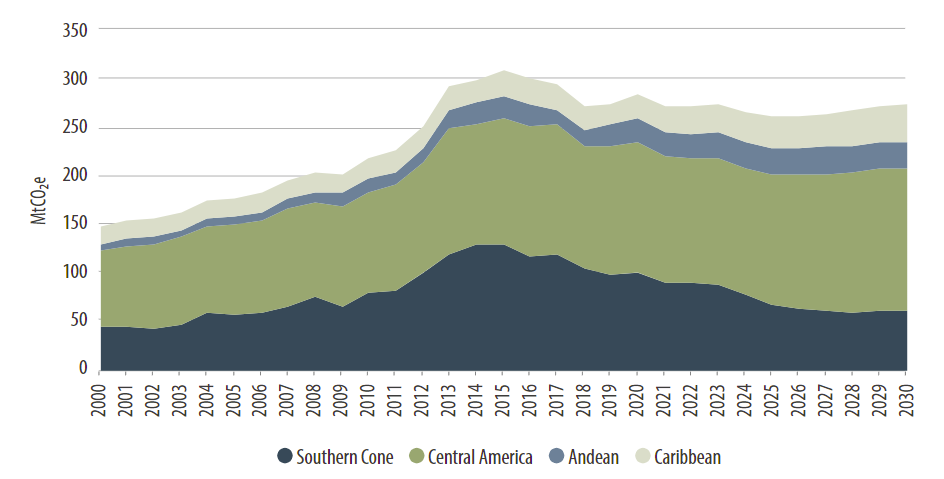
    How much further does Latin America and the Caribbean need to go to get on track and meet the Paris Agreements targets? According to an InterAmerican Development Bank (IDB) report published in August 2022, on current trends, by 2030, the region will emit a net annual surplus of 273 megatons of CO2 equivalent over and above the amount that it absorbs or sequesters. Looking at the electricity sector, regional demand dipped by around 2.9% in 2020 as a result of the Covid-19 pandemic. It then recovered and is expected to return to pre-pandemic levels in 2022-2024. For the rest of the decade, it is expected to grow by an annual average of 3.9%. However, the shift towards using cleaner energy is already underway. The IDB expects coal-fired generation to shrink at an annual rate of 5.4% in the period to 2030, which is described as “a great step towards sustainability”. Solar will grow by 10.4% a year, while wind power will be up by 9.1% per annum. The total cost of new clean energy investment required to 2030 is calculated at US$226bn, a number which may vary as prices change.

    Other factors are also important. They include improvements in energy efficiency and the expansion of electrification to cover larger geographic and economic sectors. General electrification of the transport sector offers particularly important scope for carbon reduction. It has been calculated that, in 2019, 39% of regional carbon emissions came from the transport sector. The report says that maximising these efficiency-and-coverage gains could end up reducing the 2030 excess carbon outcome by 20%. In other words, Latin America’s net annual emissions would fall from the 273 MtCO2 initially stated down to 218.9 MtCO2. It also suggests that under optimistic assumptions about the speed of replacement of fossil fuel burning vehicles, the ‘net carbon gap’ could be reduced further, down to 170 MtCO2 [this would be achieved if 53m electric vehicles (EVs) are on the road by 2030 – see below for more on EVs].

    Emissions trajectory (MtCO2e) until 2030 in the baseline scenario

    Source: La ruta energética de América Latina y el Caribe, BID

    An interesting fact is that there are large variations in both emissions and carbon intensity trajectories. Chile is one of the leaders in the move to cleaner energy. On current trends, by 2030 Chile will emit 82% less carbon per gigawatt hour (GWh) of electricity it generates, compared to ten years earlier in 2020. Other countries such as Argentina, Brazil, Paraguay, and Uruguay also have relatively low emission intensities. In some of these countries large scale hydroelectric generation helps reduce the carbon intensity of electricity. Mexico, which until recently has relied on thermal power plants burning fuel oil, has relatively high emissions but is on track to reduce them at least partly because of a shift to cleaner natural gas and renewables. Honduras stands out as a country which is going against the trend, with carbon intensity set to increase, not fall, in the years running up to 2030. No change is expected in the countries with the region’s highest MtCO2/GWh intensity from the Caribbean such as Haiti, Barbados, Bahamas, and Guyana.

    The green hydrogen opportunity

    Several Latin American countries are optimistic about the role green hydrogen may be able to play in the energy transmission. Green hydrogen is created by using electricity to power a process of electrolysis, splitting the hydrogen from oxygen atoms in seawater. The process is deemed to be green if the electricity used comes from renewable sources such as wind or solar power. Green hydrogen is emission-free. When produced by splitting natural gas, the resulting ‘blue hydrogen’ is a variant which still emits CO2 when burnt, albeit somewhat less than coal or oil. A major advantage is that green hydrogen can be used as a store of energy, as well as directly as a fuel. This helps deal with intermittency – the fact that wind and solar generation falls at times when the winds don’t blow, and the sun doesn’t shine. However, any switch to green hydrogen will require long term planning and major investment – for example the construction of green hydrogen compatible pipelines. 

    The World Economic Forum (WEF) has calculated that green hydrogen could account for up to 12% of global energy use by 2050, with production led by the more advanced economies such as China, the US, Japan, and the European Union. Green hydrogen could transform the energy balance in some countries in Latin America. Chile for example is currently a net energy importer, but it is conceivable that with its abundant offshore wind and its extensive Pacific coastline it could develop green hydrogen and become a net energy exporter in a decade or more. Countries like Chile, Ecuador, Costa Rica, Uruguay, and Colombia, among others, have begun to draft green hydrogen development plans.

    Green hydrogen is certainly pushing up the political agenda. At the North American Leaders’ Summit (NALS) held in January 2023 and attended by the presidents of the US and Mexico and the prime minister of Canada, there was a joint commitment to study the development of “a North American clean hydrogen market, including potential cooperation on research and development, safety codes and standards, cross-border hydrogen clusters, green freight corridors, and integrated maritime operations”.

  • MEXICO: Passenger rail services prioritised at expense of freight

    Patrick de Courcy 08 December 2023 Hits: 791

    Mexico’s President Andrés Manuel López Obrador published a decree in the official gazette (DOF) on 20 November to revive passenger rail services - which were stopped following the privatisation of the sector in 1995. The decree states that passenger services will now take priority over the freight services that currently dominate the country’s rail network.

    Declaring the provision of passenger rail services “a priority area for the nation’s development”, the decree calls for the creation of seven passenger train routes, which will use stations that were in operation prior to 1995. The routes will run between major ports, connect central Mexico and the capital Mexico City (CDMX) to the northern border area, and improve access to the Felipe Ángeles International Airport (AIFA) in Estado de México (Edomex).

    The decree also establishes that passenger services will be prioritised vis-à-vis cargo across the country. It calls on current cargo rail concession owners to present proposals to the federal transport ministry (SICT) on how they would provide these services, including the size of the investments they would make and construction times. If the companies decline or fail to provide their proposals by 15 January, the task will fall to the armed forces - which already oversee the Tran Maya tourist railway and trans-isthmus trainline - or to other third parties that may be interested in providing the service.

    According to Calidad Mexicana en Desarrollo Ferroviario, a local railway industry consultancy, the initial stage of the provision of passenger rail services will apply to 8,000km of tracks, which amounts to 35% of the country’s existing infrastructure. Given that it establishes that passenger transport will become the priority, freight operations will likely have to be reduced in frequency, which will be costly for the concessionaries.

    Furthermore, railway expert Juan Carlos Miranda of Mexico’s college of civil engineers has pointed out that the deadline to provide proposals is too short to enable the companies to do the necessary studies, which could lead to poor decision making and, ultimately, implementation.

    Crucially, passenger rail services are rarely profitable, and throughout the world they are subsidised. For this reason, Benjamin Aleman Castilla, the former head of the Mexico’s rail transport regulatory agency (ARTF), has said that existing concession owners – the local Grupo México Transportes (a subsidiary of conglomerate Grupo México that has two railway companies, Ferromex and Ferrosur) and the Canada-headquartered Canadian Pacific Kansas City (CPKC) - could seek public-private associations to provide passenger services. However, at a time when the government’s fiscal deficit is set to increase to the highest levels in decades, it is not clear from where resources for such partnerships would come.

    According to local press reports, Grupo México Transportes is assessing the impact of the measure and has yet to make its position public, while CPKC is carrying out a study alongside the government to assess the viability of passenger railway transport and has stated it is not concerned over the decision. Importantly, López Obrador’s likely successor, former CDMX mayor Claudia Sheinbaum, who will contest the 2 June 2024 presidential election for the ruling Movimiento Regeneración Nacional (Morena), has already included the establishment of the seven passenger rail routes in her campaign promises.

    Rail routes

    Some of the seven routes will run northwards such as the lines connecting Mexico City (CDMX) to Tamaulipas state and to Nogales in the US state of Arizona. Another will connect CDMX to the central state of Aguascalientes, with one more going from Aguascalientes to border city Ciudad Juárez in Chihuahua state. Another will go from CDMX to Coatzacoalcos, a port in the eastern state of Veracruz, while another will connect the Pacific port of Manzanillo in Colima to Irapuato, Guanajuato state. A final line will connect the Felipe Ángeles International Airport (AIFA) to Hidalgo state capital Pachuca.

  • TRACKING TRENDS

    Patrick de Courcy 30 April 2026 Hits: 532

    BRAZIL | Mid-month inflation accelerates. The national statistics institute (Ibge) released new figures on 28 April for its mid-month inflation index (Ipca-15), showing a monthly inflation rate of 0.89% for mid-April. This marks an acceleration compared with 0.44% in mid-March. The accumulated annual inflation rate for the 12 months through mid-April stood at 4.37%, up from 3.90% in the 12 months through mid-March.

    All nine categories of products and services measured by the Ibge posted a rise in monthly inflation, with the greatest price increases registered in food and drinks (+1.46%) and health and personal care (+0.93%). Despite this acceleration in inflation, the central bank’s monetary policy committee (Copom) has continued its cycle of interest rate cuts. In the latest Copom meeting which concluded on 29 April, the committee decided to lower the country’s interest rate (Selic) by 25 basis points, bringing the Selic down to 14.50%.


    CHILE | Interest rates held. Chile’s central bank (BCCh) announced on 28 April that it had unanimously voted to keep its benchmark interest rate at 4.5%. In a statement, the BCCh highlighted uncertainty over the impact of the war in the Middle East, with oil prices higher than those expected in its previous monetary policy report (IPoM) in March.

    Underlining that the Iran war had “unfolded more adversely than expected” in its March IPoM, raising “the probability of more negative results for inflation and global activity”, the BCCh’s report noted that annual inflation stood at 2.8% in March, above forecasts, while there was an annual and monthly contraction of 0.3% in the non-mining economic activity index (Imacec) in February, which it said was below forecasts.

    The decision to hold interest rates, which was in line with expectations of all analysts surveyed by Bloomberg, marks the third consecutive time the BCCh has opted to hold rates. Chile’s interest rate has been unchanged since December, when the bank cut it by 25 basis points. 

  • CHILE: Piñera addresses Chile’s energy problems

    LatinNews 17 October 2013 Hits: 1588

    President Sebastián Piñera has promulgated a new law requiring utilities to double their usage of non-conventional renewable energy (NCRE) from 10% to 20% by 2025. He said the law would diversify Chile’s energy matrix, reducing the barriers to this sort of technology, which would help reduce the risk of lack of supply, lower the costs of electricity and reduce the country’s dependence on imported fossil fuels. But is the target ambitious enough?

    President Piñera said that Chile’s “tremendous potential” for NCRE was being “transformed into reality” through multiple projects that had been authorised and promoted during his government. Accompanied by Mining Minister Hernán de Solminihac and Energy Minister Jorge Bunster, Piñera was speaking while inaugurating a 90 MW wind farm, Valle de los Vientos, near Calama (Region II) in northern Chile.

    Doubling NCRE usage sounds suitably ambitious but the 20% goal is not as impressive as it sounds. Back in 2008, the Universidad Santa Marí­a and Universidad de Chile carried out a technical study in which it predicted that wind, tidal, solar and geothermal energy could make up 40% of Chile’s energy matrix by 2025. Chile should be uniquely placed to take advantage of meteorological phenomena to satisfy its energy needs: geothermal energy from the volcanic spine in the south; solar energy from the hyper-arid Atacama desert, where the sun shines all year, in the north; and wind and tidal energy from the country’s immense coastline.

    Chile is making progress. It ranked second, behind Brazil, in ‘Climatescope 2013’, which scores 26 nations on their relative ability to foster low-carbon energy growth. Released this week by the Multilateral Investment Fund of the Inter-American development bank (IDB) and Bloomberg New Energy Finance, ‘Climatescope 2013’ said Chile’s investment in NCRE had more than quadrupled from US$500m in 2011 to US$2.1bn in 2012.

    Despite the importance of Chile diversifying its energy matrix to ensure sufficient supply and to drive development, the issue has barely been discussed in the current electoral campaign. Former president Michelle Bachelet (2006-2010) failed to provide any details on her energy plans in a recently released list of 50 pledges for her first 100 days in government [WR-13-40]. Her main rival Evelyn Matthei provided more details in her full electoral manifesto, although she still only devoted three of the 140-odd pages to energy and the environment, and even these come within a wider section centred on ways to boost competitiveness and economic growth.

    Matthei proposed a “complete and detailed package of measures” to “unshackle” investment in new electricity generation projects and to promote new renewable sources of energy, both conventional (such as large-scale hydroelectric complexes) and non-conventional (such as solar or geothermal), to “make the most of our natural and abundant energy sources”. She also said Chile could not rule out approving new generation plants using any form of energy, so long as they “meet tough regulations on emissions”, apparently paving the way for the approval of more thermoelectric power plants based on coal or natural gas, almost all of which has to be imported.

    In the section on the environment, Matthei pledged to strengthen Chile’s environmental evaluation service (SEA) and convince investors of its autonomy from central government. She blamed the “weakness” of existing arrangements for the blocking of several new energy projects which had previously met all environmental requirements.

    • Hydroelectric potential

    Because of its topography, Chile has considerable hydroelectric potential, although there has been serious domestic and international resistance to fulfilling this potential, notably in response to the HidroAysén project. This involves building five dams in Aysén (Region XI); three of them on the Río Baker and two on the Río Pascua. They would feed hydroelectric plants with a generating capacity of 2,750MW. During a recent visit to Coyhaique, the capital of Aysén, the presidential frontrunner, Michelle Bachelet, said that “as it stands HidroAysén is not viable”.

  • REGION: Is Central America turning Pentecostal?

    LatinNews 11 July 2018 Hits: 673

    Three decades ago anthropologist David Stoll shone the spotlight on the meteoric growth of evangelical Protestantism in Latin America with his provocatively titled book, Is Latin America Turning Protestant? Almost 30 years later, Latin America as a region has not turned Protestant in terms of most countries being majority Evangelico (the standard term for Protestant both in Spanish and Portuguese). However, in the ensuing three decades, Pentecostalism (the branch of charismatic Protestantism that accounts for 70% of all Latin American Evangelicos) has mushroomed to the point that eight countries are no longer majority Catholic, and one, Honduras, has become the region’s first in which Protestants outnumber Catholics (39% to 37%). And while Honduras is somewhat of a Latin American outlier at this point, the violence-plagued nation is well within the Central American norm in which the isthmus has become the first sub-region of Latin America to no longer be majority Catholic.

    Though the main focus here is Central America, the Pentecostal boom in the sub-region can only be understood as part of larger religious and political trends impacting the entire Latin American region. Since the early 1970s there have been five interrelated trends that have radically transformed the regional religious landscape. First is precipitous Catholic decline. Over the past five decades the Catholic population of Latin America has plummeted from 92% in 1970 to 59% in 2017. Barring a sudden reversal of this long-term trend, the region will probably no longer be majority Catholic by 2030. Brazil, home to the world’s largest Catholic population, is now only 55% Catholic, so it’s very likely that the South American giant will no longer be majority Catholic by 2025.

    Second, a good chunk of Latin Americans who have left the Catholic Church over the past five decades have converted to Pentecostalism. Over the past half-century, the Protestant population has nearly quintupled from 4% in 1970 to 19% in 2017. Since 70% of Protestants are specifically Pentecostal, belonging to such denominations as the Assemblies of God and Brazil’s Universal Church of the Kingdom of God, 13% of Latin Americans today adhere to the dynamic branch of Protestantism, which was born in the US in 1905-1906. The unprecedented success of Pentecostalism in competing for Latin American souls has resulted in the third interconnected trend, the pentecostalisation of Latin American Christianity. In order to compete with the dynamic Pentecostals, both mainline Protestants and the Catholic Church have been compelled to offer their own brand of charismatic worship in the region’s new free market of faith.

    In the Protestant camp, Presbyterians and Methodists, for example, have formed ‘renewed’ congregations in which worship focuses on the transformative role of the Holy Spirit. In a similar vein, the Catholic Charismatic Renewal, the Church’s own brand of Pentecostalism, which was only imported to Latin America from the US in the early 1970s by American priests, mostly Dominican and Jesuit, has become so popular that a majority of Brazilian and Guatemalan Catholics identify as Charismatics. Not all of those who have abandoned Catholicism have become Pentecostals.

    The fourth major trend on the Latin American religious landscape is the surging number of people, especially Millennials, who are opting for no religious affiliation whatsoever, the Religious Nones; most of them not atheists, rather young people who believe in the supernatural but don’t belong to any specific faith tradition. In 2014 US-based Pew Research Centre reported that 8% of Latin Americans were Religious Nones while the respected Chilean polling firm Latinobarómetro found that 17% claimed no religious affiliation in 2017. Chile, where Pope Francis recently experienced the most challenging national tour of his papacy, has rapidly become one of the most secularised nations in the region with a whopping 38% of Chileans reporting to be Religious Nones.

    That Latin Americans now have a wide array of options from which to choose in the relatively free market of faith leads to the final significant trend, the pluralisation of the regional religious landscape. Even though Latin America is still overwhelmingly Catholic and Protestant, by far the most Christian region on earth, Costa Ricans and Colombians, among others, now have a wide range of religious choice, which includes folk saints, such as Santa Muerte and Jesus Malverde, African Diasporic faiths, such as Santeria and Candomble, as well as opting for no religious practice at all.

    Turning to Central America, some of the five major trends are more pronounced than in the rest of Latin America while others are less. Most importantly the sub-region as whole has experienced the greatest Catholic decline and the fastest Pentecostal growth. Excluding Belize, which was not included in the Pew and Latinobarómetro surveys, Costa Rica and Panama are the only countries on the isthmus that are still majority Catholic, and barely at 57% and 55% respectively.

    At just 37%, Honduras has Latin America’s smallest Catholic population (Cuba’s is actually the smallest but wasn’t included in the two surveys) in Latin America, while Central America’s most populous nation, Guatemala is 43% Catholic and 41% Protestant. Interestingly there is a great degree of national variation in the percentage of Religious Nones. On the low end are Guatemala (13%), Costa Rica (15%), and Panama (16%). At high end are El Salvador (30%) and Nicaragua (25%). At 21% Honduras occupies the middle range of Religious Nones in Central America.

    In the Latin American political realm, and particularly in Central America, the Pentecostal boom has been one of the driving forces of a long-term shift toward the right. The comprehensive Pew survey shows how on major social issues, such as same-sex marriage, gay rights, and abortion, Latin American Protestants are significantly more conservative than both Catholics and Religious Nones. Guatemala was the Latin American trailblazer in Protestant political engagement in the early 1980s when General Efraín Rios Montt (1982-1983) became the world’s first Pentecostal head of state through a military coup in 1982.

    Declaring a Holy War on Guatemalan leftist guerrilla groups, Rios Montt, generously supported by US evangelical groups, slaughtered some 30,000 compatriots, mostly Mayans who had entire villages wiped off the face of the Guatemalan map. Rios Montt would sermonise every Sunday on national TV justifying his ethnocidal campaign as a defence of Western Christian civilization against the godless Marxist insurgency. Since then, Guatemala has had several Protestant presidents, including current head of state, former comedian Jimmy Morales, who was first to follow US President Donald Trump’s lead in recognising Jerusalem as the capital of Israel.

    To the south in Costa Rica, Pentecostal singer Fabricio Alvarado Muñoz, of the once tiny Protestant-based Partido Restauración Nacional (PRN), won the first round of presidential elections in early February on a platform opposing the recent ruling of the Inter-American Court of Human Rights telling Costa Rica to implement same-sex marriage.

    Alvarado Muñoz’s party also made huge gains, becoming the second-largest voting bloc in the 57-member unicameral legislature with 14 seats. While there is a large gap between Costa Rican Protestants and Catholics in opposition to same-sex unions, 78% and 57% respectively, the majority of citizens (61%) oppose it, even more so because the ruling was made by an international court and not a Costa Rican one.

    Alvarado Muñoz ultimately was defeated in the 1 April presidential second-round run-off by Carlos Alvarado Quesada of the centre-left Partido Acción Ciudadana (PAC). Yet the momentum behind Alvarado Muñoz, his party’s presence in the legislature along with the collapse of traditional two-party rule in Central America’s most stable nation, and majority opposition to gay marriage and sex education in the public schools suggest the strength of evangelical influence in the country albeit while insufficient yet to win an election.

  • PARAGUAY: Questions about electoral results resurface

    LatinNews 02 August 2018 Hits: 556

    A series of leaked audio recordings of conversations between an official in Paraguay’s supreme electoral tribunal (TSJE) and political leaders have raised serious questions about the validity of the results of the 22 April general election. The official electoral results released by the TSJE, which gave a decisive victory to the Asociación Nacional Republicana-Partido Colorado (ANR-PC) in the presidential election, had been questioned by the political opposition, which at the time alleged electoral fraud in favour of the ruling party. The leaked recordings give renewed weight to the fraud allegations and create a serious headache for President-elect Mario Abdo Benítez even before he assumes office on 15 August.

    The first batch of audio recordings emerged on 23 July. In these Miguel Ángel Iturburu, an information technology official at the TSJE, is heard boasting that he has managed to “inflate” the ANR-PC’s vote count to ensure its electoral victory. Iturburu is also heard telling politicians from the ANR-PC and the right-wing Unión Nacional de Ciudadanos Éticos (Unace) that he could ensure their election to congress in exchange for cash.

    Following the emergence of the audios, the political opposition led by the Partido Liberal Radical Auténtico (PLRA) called for the audios to be fully investigated, arguing that they provide further evidence of potential electoral fraud including in the presidential election against the defeated opposition coalition candidate, Efraín Alegre.

    The TSJE leadership reacted to the audios by saying that while as an employee of the institution Iturburu did have access to the electronic vote-counting system he did not have the ability to alter the vote count, nor did he have access to the actual vote tallies on which final results are based. Nonetheless, the TSJE said that Iturburu has been suspended in order to face investigation by prosecutors. But the TSJE refused to make the final vote tallies public, as has been demanded by Alegre and the PLRA, arguing that these must be kept safeguarded for legal reasons.

    Although the attorney general’s office has opened an investigation into the case, the TSJE’s refusal to present the final vote tallies prompted the opposition to decry that the authorities were intent on covering up the electoral fraud. It called for the three TSJE judges to be impeached by the national congress.

    The furore caused by the emergence of the audios and the opposition’s allegations forced President-elect Abdo Benítez to address the issue on 25 July. In response to questions by journalists, Abdo Benítez denied that there had been an electoral fraud benefitting him or the ANR-PC.

    Abdo Benítez said that while it was clear that Iturburu is “an irresponsible and corrupt” official he did not believe that he was capable of carrying out large-scale fraud in the vote counting process and that the impact of his actions would only be limited. Significantly, Abdo Benítez also expressed confidence in the TSJE, its control mechanisms, and the integrity of its judges.

    • Just one bad apple

    “We cannot question the credibility of the entire institution,” President-elect Abdo Benítez said after the emergence of the leaked audio recordings of conversations between Miguel Ángel Iturburu, an official in Paraguay’s supreme electoral tribunal (TSJE), and political leaders. Abdo Benítez backed the three TSJE judges and their assertions that the electoral results are valid despite the concerns about Iturburu’s actions.

    However, the controversy refuses to go away. Noting that the difference of just 3.7 percentage points separating Abdo Benítez and Alegre is the narrowest margin in Paraguay’s electoral history, the PLRA and its allies insist that the TSJE must release the official vote tallies to dispel any doubts about the electoral results, and that the investigations into the allegations must be fully cleared up before Abdo Benítez’s investiture on 15 August. Otherwise, the opposition argues that a question mark will hang over the legitimacy of Abdo Benítez’s mandate.

    • Final ministerial appointment

    On 30 July Paraguay’s outgoing president, Horacio Cartes, made what is likely to be his final ministerial appointment before he leaves office on 15 August. Cartes appointed Mario León as interim agriculture & livestock minister to replace Luis Gneiting. Gneiting died along with his deputy livestock minister Vicente Ramírez after the plane that they were travelling in crashed on 25 July. León, until now the deputy agriculture minister, will be in charge of handing over the portfolio to Denis Lichi, who has been named as the future agriculture & livestock minister by President-elect Mario Abdo Benítez. Gneiting’s death came as he was facing investigation over influence trafficking and corruption allegations that are believed to implicate Cartes.

  • POINTERS

    LatinNews 17 December 2018 Hits: 1148

    JAMAICA | Parliament votes down state of emergency. On 11 December, 20 People’s National Party (PNP) opposition members of parliament voted against the ruling Jamaica Labour Party (JLP) over the government’s proposed extension of the states of emergency (SOEs) in St James, St Catherine North, and parts of Kingston and St Andrew. The JLP’s 33 MPs all supported the extension, but that wasn’t enough to secure the required two-thirds of all 63 members.

    Prime Minister Andrew Holness argued that the SOEs were working, and that the security forces needed a three-month extension to consolidate the advances made. He told parliament: “Murders are down 21.7%, shootings are down 21.4%, rape down 12.2%, aggravated assault down 11%. Additionally, there have been significant reductions in the year-to-date reports of murders across several police divisions, the most notable being St James, where there has been more than a 705 reduction in murders.”

    Holness, added: “I didn’t come here on my own volition and understanding. There is a team of well-qualified Jamaicans in the security field who have advised [me]…”

    The opposition remained unconvinced, with leader Peter Phillips arguing “we don’t need a state of emergency to continue the reductions that have been achieved”.

    There seem to have been two main objections. The first was that the SOE provisions should be truly exceptional and not become routine. Secondly, it was argued that even without the SOE police will still be able to impose curfews, use cordons, and search and arrest, they just won’t be able to detain indefinitely.

    Objectors to the SOE pointed out that of the nearly 4,000 people detained under its provisions, only 4% had been charged with serious offences.

    ST VINCENT & GRENADINES | Step up in contacts with China. In August 2016, the SVG’s opposition New Democratic Party (NDP) announced that if it won power it would switch SVG’s allegiance from Taiwan to China. In early December, NDP leader Godwin Friday visited Beijing and Shanghai to deepen the party’s ties with China.

    Following the visit, Friday said: “We discussed the possibility of investments in St Vincent and the Grenadines, including teaming up with local entrepreneurs to invest in any sector of our local economy.”

    VENEZUELA-GUYANA | US hardens its line on dispute. On 16 November, at a farewell party in Georgetown, Guyana, the outgoing US ambassador, Perry Holloway, said: “The US government now calls on all parties to respect the 1899 arbitration decision.” This signalled a significant hardening of the US policy on the Venezuela-Guyana territorial dispute and overturns Washington’s long-standing policy of not taking a position on the dispute.

    Three factors appear to be behind this policy shift: first, the discovery since May 2015 of significant amounts of oil in Guyanese territorial waters by US oil giant ExxonMobil; secondly, the deepening and genuine disquiet over the Venezuelan political and economic crisis under President Maduro; and, third, the hawkish instincts of US National Security Advisor John Bolton. On 1 November, Bolton described Venezuela as being part of a “Troika of Tyranny”, along with Cuba and Nicaragua.

  • TRACKING TRENDS

    LatinNews 17 April 2019 Hits: 1332

    EL SALVADOR | FDI up. Foreign direct investment (FDI) to El Salvador reached US$1.85bn in 2018, up 5.4% on 2017, El Salvador’s central bank (BCR) reported. According to the BCR, the main recipients of the FDI were industrial activity (49.2%), followed by retail (11.7%), and the financial sector (10.6%). As regards sources of FDI, the US accounted for 39.9% of the total, followed by Panama (21.8%).

    COSTA RICA | Fiscal deficit. Costa Rica’s finance ministry has released new figures which show that the fiscal deficit for the first quarter of 2019 was 1.51% of GDP, slightly down from the 1.52% registered in the same quarter of 2018. Back in December 2018 the government led by President Carlos Alvarado pushed through a fiscal reform which, among other things, replaces the current 13% sales tax with a 13% value-added tax (VAT) and increases the number of products and services to be taxed. The reform is due to come into force on 1 July 2019. According to Costa Rica’s finance ministry, the country’s fiscal deficit closed at 6% of GDP in 2018, down from the 7.2% forecast.

  • ECUADOR: Carapaz triumph overshadows Correa’s travails

    LatinNews 06 June 2019 Hits: 1230

    Tens of thousands of Ecuadoreans were glued to their screens on 2 June, or gathered in squares, parks, and stadiums around the country in front of giant screens, to witness the victory of Richard Carapaz in the Giro d’Italia, one of the three grand tours in cycling. President Lenín Moreno was quick to praise the sporting achievement of Carapaz, whose surname ‘peaceful face’ is the image he wants to project of his government in marked contrast to that of his confrontational predecessor Rafael Correa (2007-2017) whose legacy Moreno is steadily unpicking. Just three days earlier, police arrested two senior former officials who served under Correa on charges of corruption.

    “Ecuador is Carapaz,” Moreno said after the native of Tulcán, the capital of the northern province of Carchi, was crowned Ecuador’s first-ever winner of the Giro, also notching two stage victories in the three-week long bike race. “[He] surprised the world with his sporting courage, humility, and talent,” Moreno added. “He is an example for so many in Ecuador to pursue their dreams”. Correa did as much, forging his ‘Citizens’ Revolution’ and leading the country for a decade, before making the ‘nightmare’ decision, over which he has often expressed bitter regret, to back Moreno as his successor. Moreno swiftly turned his back on Correa and has systematically undone much of his work.

    Moreno pointedly refused to stand by his and Correa’s vice-president Jorge Glas, who was sentenced to six years in prison in December 2017 for illicit association in connection with the bribery scandal involving the Brazilian construction company Odebrecht. Two further members of Correa’s former inner circle now stand accused of corruption. The former legal secretary to the presidency, Alexis Mera, and the former transport and public works minister, María de los Ángeles Duarte, were both arrested on 31 May in the coastal city of Guayaquil in connection with an investigation into extortion, and had their electronic devices confiscated. The attorney general’s office revealed that Mera had been placed in preventive detention because he posed a flight risk. Duarte has been fitted with an electronic monitoring tag.

    The local press linked the arrests to a case dubbed ‘Arroz Verde’, the alleged irregular financing of the left-wing Alianza País (AP), when it was led by Correa, involving Odebrecht as well as other companies. The attorney general, Diana Salazar, however, said that it was a separate case though not unrelated. Salazar alleged that, between 2012 and 2016, Mera and Duarte abused their positions to demand cash from companies, such as Odebrecht, in exchange for obtaining future public works contracts. They issued their extortive demands to Pamela Martínez, a former adviser to Correa and former judge on the constitutional court.  

    Martínez has been held in preventive detention since early May, along with Laura Terán, a former administrative assistant in the presidential office and court official, to testify in a case unearthed in a journalistic investigation by Mil hojas involving US$11.6m allegedly received by AP from national and transnational companies and state contractors. They stand accused of illicit association, bribery, and influence trafficking. Martínez has alleged that she received instructions from Correa and Glas to hand money to Duarte who was also AP director in the province of Guayas. In a series of tweets from his home in Belgium, Correa denied the claims and denounced what he described as the latest in a long line of “brutal political persecution”, claiming that the “true crimes” of Mera and Duarte were having been “part of a government that transformed the country”. 

    • Media

    Another legacy of former president Correa which his successor has sought to dismantle is the restriction on press freedom and draconian communications law. In February this year, President Moreno signed the Declaration of Chapultepec on freedom of expression and of the press, just as the national assembly approved myriad amendments to the communications law, abolishing administrative sanctions against the media and the concept of ‘media lynching’. On 4 June Moreno appointed new telecommunications and communications ministers. Andrés Michelena takes over as telecommunications minister on a permanent basis having assumed the position in an interim capacity in March after Guillermo León resigned accused of neglecting his duties by the comptroller general’s office. Eduardo Khalifé, a state news presenter, takes over at the communications ministry (Secom).

  • CHILE: Drug production now entrenched, says report

    Patrick de Courcy 30 September 2021 Hits: 3879

    A new report by the office of Chile’s national prosecutor confirms that the country is no longer merely a consumer or transit country for drugs, but has turned into a production centre for illegal narcotics.

    The ‘Observatorio del Narcotráfico 2021’ is the sixth edition of a report born in 2015 and put together by the national prosecutor’s specialised unit in the illicit traffic of narcotic drugs and psychotropic substances. Chile’s prosecutor general, Jorge Abbott, issued a warning as he presented the latest report on 8 September: “Chile has stopped being a transit country for drugs […] Today, we have to admit that we have begun to go down the path of one of those territories which are home to the local production of illicit substances and the installation of cartels within their borders. We must put a stop to this now.”  

    The report outlines four main threats relating to narco-criminality, some which build on previously observed trends, others which are new developments. The first of these threats is an increase in the seizure of marijuana and synthetic drugs – particularly pills known as 2C-B which are derived from ketamine, and fake versions of these pills – alongside a drop in cocaine and cocaine paste seizures.

    The second threat is the fact that international organised crime outfits, notably Mexican drug trafficking organisations (DTOs), have a growing presence in the country and are seeking to establish themselves more permanently. The report notes that this follows a concern raised in 2019, that the drug trafficking landscape in Chile was evolving in such a way that suggested “more powerful and complex” criminal organisations would emerge, either through the evolution of smaller local groups or the establishment of outside organisations.

    It is primarily the latter which appears to have happened, with the report identifying three of Latin America’s five most powerful criminal organisations as having a presence in Chile: the Sinaloa DTO and Cartel Jalisco Nuevo Generación DTO from Mexico, and Colombia’s Clan del Golfo. The more permanent establishment of these groups is highlighted as a threat, with Abbott stressing “We cannot allow… these organisations to put down roots.”

    The third threat is related to the first two: the development of a strong drug production capacity on Chilean territory, managed by powerful international DTOs. This tendency is based on the increased discovery of drug production laboratories by the authorities: in 2020, authorities seized some 280,000 marijuana plants, an uptick after three years of seizures totalling around 250,000, amid signs that indoor cultivation is on the up. Meanwhile, the seizure of ketamine has skyrocketed, to around 130 kg in 2020 up from around 15 kg in 2017; 10 synthetic drug laboratories were uncovered in 2020, the same figure as in 2019 but up from just one in 2018.

    The last threat listed in the report is the presence of DTOs inside prisons, where they seek new recruits in a way which has led to the gradual emergence of a “domination system”. This has in turn led to an increase in violence inside prisons, with in-prison homicides jumping 75% in 2020 compared with the four previous years.  

    The report also outlines how drug trafficking via maritime routes has surged, particularly in the context of the coronavirus (Covid-19) pandemic, creating further challenges for the authorities: the sheer scale of Chile’s maritime trade makes it impossible to control the contents of all the containers that pass through the country’s ports.