
All Categories

Subcategories

  • BRAZIL: Recovery hits a bump

    Patrick de Courcy 09 December 2021 Hits: 3677

    Third-quarter growth figures released by Brazil’s national statistics institute (Ibge) on 2 December show that Latin America’s largest economy has gone into technical recession. Brazil looks set to enter 2022, an election year, plagued with sluggish growth, soaring inflation, and high unemployment.

    Quarterly GDP shrank by 0.1% in the third quarter, after a 0.4% contraction in the second quarter on revised figures. In year-on-year terms, Brazil’s economy grew 4% in July-September 2021. The quarterly contraction was driven by an 8% decline in the agricultural sector. The industrial sector saw 0% variation (with a strong performance in construction compensating for the negative performance of other industrial activities, such as manufacturing and extraction). Services, which account for over 70% of Brazil’s economy, grew by 1.1%.

    From a demand perspective, a decline in exports of goods and services, which fell by 9.8%, also underpinned the contraction in the third quarter (imports fell by 8.3%). Household consumption, however, expanded by 0.9%. Government spending grew by 0.8%.

    Brazil’s overall recovery from the economic crisis caused by the coronavirus (Covid-19) pandemic has been stymied by soaring inflation. The consumer price index stood at 10.67% in October and is expected to close the year in double digits. The central bank (BCB) has responded with a cycle of aggressive rate hikes. The latest was enacted on 8 December, when the BCB’s monetary policy committee (Copom) agreed to increase the Selic, the benchmark interest rate, by 150 basis points to 9.25%. The Selic is now at its highest point in four years. 

    Although it is starting to fall, unemployment remains stubbornly high, at 12.6% in the third quarter. Furthermore, Ibge figures show that the average income for employed Brazilians is declining: average monthly earnings were down 11.1% in the third quarter this year compared with a year earlier, reflecting both the erosion of purchasing power through inflation and the fact that lower-paid jobs are driving the slow recovery of the labour market. Other economic indicators add to the gloomy picture. Industrial production was down for the fifth consecutive month in October, while retail trade had dropped for the third consecutive month, back to March 2020 levels, when the pandemic first hit.

    The government led by President Jair Bolsonaro tried to remain upbeat in the face of the third quarter GDP figures, blaming the negative agricultural performance on climatic factors outside of its control (namely a drought and frosts). Economy Minister Paulo Guedes stands by his refrain that Brazil’s economy is recovering in a V-shape. Yet private sector economists surveyed weekly by the BCB have cut growth forecasts to 4.71% this year and just 0.51% in 2022. Some private banks are already predicting an economic contraction next year, with concerns exacerbated by uncertainty over the government’s fiscal rigour. 

    Reforms and benefits

    The Brazilian congress promulgated part of a constitutional reform on 8 December which eases fiscal rules [WR-21-43] and frees up resources to fund the government’s new social programme, Auxílio Brasil. A lot of uncertainty surrounds the new benefit, which started being paid in November, due to pending legislation on the issue. Congress sought to resolve some of this uncertainty with the partial promulgation of the constitutional amendment known as the ‘PEC dos precatórios’, which will free up R$65bn (US$11.75bn) in next year’s budget. Some parts of the PEC, which also concerns the staggered repayment of court-mandated state debts or ‘precatórios’, have returned to the chamber after being modified in the senate.
  • TRACKING TRENDS

    Patrick de Courcy 02 February 2023 Hits: 3599

    BRAZIL | New Petrobras chief. The administrative board of Brazil’s state-owned oil company Petrobras has unanimously approved the appointment of Jean Paul Prates as CEO by President Luiz Inácio Lula da Silva. Prates served as a senator for Lula’s left-wing Partido dos Trabalhadores (PT) from 2019 up until his appointment. He has previously held other positions in the energy sector including serving as energy secretary for the state of Rio Grande do Norte from 2008-2010.

  • REGION: Mosquitoes recruited for anti-dengue sting

    Sarah Sheldon 27 February 2024 Hits: 1283

    Two private companies said in December that they were working together to release mosquitoes across the Caribbean that have been bred with a bacterium that attacks the dengue virus.

    Dengue is a debilitating viral disease found in tropical regions, transmitted by mosquitoes. It causes sudden fever and acute pains in the joints. According to the World Health Organisation (WHO) in 2000-2019 there was a ten-fold increase in reported annual cases worldwide, from 500,000 to 5.2m. It is estimated that there were 4m dengue cases in the Caribbean and Latin America last year.

    The companies involved in the new project are Barbados-registered Orbit Services Partners and Verily, a US-based health technology firm. According to Orbit chairman Anthony Da Silva, both firms have been meeting government officials with the hope of gaining the necessary medical approvals and launching the project during 2024.

    Target countries include Barbados, Guyana, Jamaica, St Kitts & Nevis, St Maarten, St Martin, Suriname, Dominican Republic, and Haiti. The project involves breeding mosquitoes in laboratories with the Wolbachia bacteria. They are then released to the wild, where they breed further and multiply. The Wolbachia bacteria plays a key role since it blocks the dengue virus from reproducing inside the stomach of a mosquito.

  • In Brief - Costa Rica

    LatinNews 07 June 2012 Hits: 2597

    CENSUS | Immigration to Costa Rica plummets. On 6 June the national institute of statistics (Inec) published the results of the 2011 census, which indicate that, although foreigners are still immigrating to Costa Rica, they are doing so at a much slower pace. The 1984 and 2000 censuses showed that the foreign population was increasing by 7.5% year-on-year in the period between each survey; however, in the period between 2000 and 2011, the foreign resident population only increased by 2.4% per year. This massive slowdown is partly explained by the decrease of immigrant flows from Nicaragua. (Nicaraguans make up 75% of all foreign residents in Costa Rica.) While in previous periods the Nicaraguan resident population expanded by an average 10% per year, in the period studied by the latest census it rose by 2.2% per year.

  • EL SALVADOR: Gold mining dispute ensnares Funes

    LatinNews 12 July 2012 Hits: 1623

    The stage is set for a legal tussle between the government of President Mauricio Funes and the Canadian gold mining company Pacific Rim. Funes made a campaign promise in 2009 that he would not permit mining in El Salvador because the potential health and environmental risks outweighed the benefits for a small country. Pacific Rim is seeking multi-million-dollar compensation.

    The Funes administration is concerned that the gold mine, located in Sensuntepeque, in the department of Cabañas, east of San Salvador and near the border with Honduras, could pollute water supplies, due to the use of cyanide. The government has been consistent. Vice-President Salvador Sánchez Cerén recently raised serious concerns that the future large-scale development of the gold and silver mine Cerro Blanco in Asunción Mita, Jutiapa, in southern Guatemala, would pollute El Salvador’s largest river, the Lempa, which flows across the border and feeds into Lake Metapán. A study commissioned by El Salvador’s centre for the investigation of investments and commerce (Geicom) claimed there were high levels of arsenic, lithium, fluoride and boron in waters around the Cerro Blanco mine. Cerro Blanco is owned by Entre Mares de Guatemala – a subsidiary of Canada’s Goldcorp.

    The government is backed by the Roman Catholic Church, which objected strenuously to a proposed reform of the mining law under the previous administration of Tony Saca (2004-2009), to open up the mining sector to increased foreign investment, on the grounds that the country was too over-populated for mining to be viable.

    The CEO of Pacific Rim, Thomas C. Shrake, argues that the government is guilty of “creeping expropriation”, however, and he is demanding compensation for the US$77m his company has invested in the El Dorado mine since receiving a permit in 2002 to begin exploratory work. The mine is also located in the Lempa River basin, which supplies nearly half of the country, including San Salvador.

    Cyanide solution is used to recover gold and silver present in low concentration in ores because it bonds with those metals. This is achieved by leaching the ore either in vats or in huge pits where the ore is piled up in heaps. The most frequently cited objection to mining projects, particularly those seeking to extract gold, is the risk of contamination from the use of cyanide, both directly and indirectly, through the release of heavy metals. The sludge is channelled to a holding pool, where the metals are separated and the cyanide is recovered for further use.

    In an interview with the Canadian daily Globe and Mail on 19 June, Shrake argued that the company employed state-of-the-art environmental protections. He maintained that cyanide would only be used in the mine with the latest safeguards, and that there would be a lined pool designed to contain any leak. “Water for ore processing is to be collected in a reservoir in the subtropical ecosystem and not drawn from local water supplies. The water used by the operation will be extensively recycled and any water discharged from the reservoir will be processed by a water treatment plant. Water leaving the reservoir will be significantly cleaner than it was when it arrived on site and will provide a clean water source for local villages,” he said.

    Shrake insists that he has no interest in the money from compensation and merely wants to be allowed to proceed with mining in El Salvador. He argues that the gold mine would not only help line his company’s pockets but also help lift the local population out of poverty. He says the mine would employ 700 people and become El Salvador’s single largest taxpayer.

    Luis Parada, a former Salvadorean diplomat-turned-lawyer who is acting for the country in its dispute with Pacific Rim, said there were “legitimate environmental concerns”, not least El Salvador’s susceptibility to earthquakes and landslides (it has the second highest levels of deforestation in Latin America)  which could spell a “potential disaster” for water supplies. He also contends that Pacific Rim does not own all of the land, and lacks authorisation from local landowners for the El Dorado concession, something which Shrake virulently contests.

    On 1 June the tribunal of the World Bank’s International Centre for the Settlement of Investment Disputes (Icsid) ruled against Pacific Rim’s attempt to use a US subsidiary to claim redress under the Central America Free Trade Agreement (Cafta), but it ruled that the company’s case could proceed under El Salvador’s Investment Law, under which disputes with foreign investors can be referred to arbitration tribunals. Icsid will continue to oversee the claim.

    The Funes administration is not about to back down. During his state-of-the-nation address this time last year, President Funes reiterated his campaign promise that he would not permit any metals mining during his administration. “I will not put the public health of the population at risk in exchange for some additional income that we might receive,” he said. However, Pacific Rim is playing the long game. Funes will be gone in 2014 and the likely candidate for the right-wing opposition Alianza Republicana Nacionalista (Arena) Norman Quijano, the incumbent mayor of San Salvador, and crucially a businessman, is favourite to succeed him. Whether Quijano would risk permitting mining in the face of strong opposition from the Church and civil society is a moot point though.


    • Airport improvements

    The government will invest US$70m in making improvements to the international airport. The announcement comes after the president of the Colombian-Salvadorean holding company Avianca-Taca (the merger of Colombia’s airline Avianca and El Salvador-based Taca), Roberto Kriete, told the local press that he would construct his own terminal if the government failed to modernise the airport in San Salvador, which receives some 2.1m visitors a year.

    • Trade deficit

    El Salvador registered a trade deficit of US$2.15bn in the first five months of the year, surpassing the figure for the same period last year, which was US$1.86bn, the central bank reported. Exports over the first five months of the year totalled US$2.28bn, while imports amounted to US$4.43bn.

  • CHILE: ¿Bachelet, ha recuperado su encanto?

    LatinNews 20 November 2015 Hits: 250

    Raras veces las encuestas de opinión cuentan toda la historia, pero las últimas podrían indicar un punto de inflexión para la Presidenta de Chile, Michelle Bachelet. Un sondeo de Plaza Pública Cadem, difundido esta semana, muestra que el rating de aprobación de Bachelet ha trepado dos puntos porcentuales, al 27%, sobre la semana pasada. Adimark publicó el 4 de noviembre los resultados de su regular encuesta de opinión mensual, mostrando que por primera vez desde enero, el rating de aprobación de Bachelet había mejorado de una manera estadísticamente significativa. En octubre, dijo Adimark, el rating de aprobación de Bachelet se elevó cuatro puntos porcentuales al 29%.

    No es necesario decir que hay opiniones divididas sobre cómo interpretar estos números. Otra encuesta de opinión, de la Universidad Diego Portales (UDP) muestra a la Presidente Bachelet aún está perdiendo popularidad. Sin embargo, existen buenas razones para tomar con seriedad los números de Adimark: sus sondeos son considerados como creíbles; el sondeo de UDP sola sale una vez al año.

    El rating de desaprobación en el sondeo de Adimark cayó tres puntos porcentuales sobre el mes precedente, al 67%. Ahora parece ser que el peor mes de Bachelet, cuando tuvo la tasa de aprobación más baja (24%) y la tasa de desaprobación más alta (72%) fue en agosto.

    El detalle en el sondeo de Adimark, ofrece algunas tentadoras insinuaciones sobre lo que podría ocurrir. Hubo pronunciados incrementos en los ratings de Bachelet por “hacer frente a una crisis”, “ser activa y enérgica” y “por despertar confianza”. Sus índices de aprobación se incrementaron entre aquellos que se definen a sí mismos como de Izquierda (elevándose al 50%) o independientes (24%), mientras entre aquellos que se definen como del ala derecha (12%). Algunos dicen que Bachelet finalmente está emergiendo de entre las sombras de varios escándalos de corrupción que la habían acosado tenazmente, y que su imagen fue ayudada por la respuesta del gobierno ante el terremoto en septiembre.

    Escribiendo para el diario nacional, La Tercera, el bloguero Andrés Benítez sugirió que los números mostraban que Bachelet esta reconstruyendo la relación con su base de apoyo natural de la Izquierda, la gente de bajos ingresos, y las mujeres. El sociólogo, Eugenio Trioni, alega que Bachelet estaba restableciendo su rol de liderazgo con el cual ella se siente cómoda. Él citó su reorganización del gabinete, su decisión de no asistir a la cena anual con el lobby empresarial, Sofofa, y su éxito, contra la oposición, en imponer su candidato preferido, Jorge Abbott, como el nuevo procurador, como un signo que ahora está más “empoderada”.

    Los funcionarios del gobierno dicen que están intensificando la “visitas en el terreno” de Bachelet en todo el país para hacer conocer su mensaje. Pero las reformas de Bachelet, en particular a la educación, todavía se enfrentan a una oposición que hace que su implementación sea cuesta arriba. Su desafío es consolidar su núcleo central de partidarios, y además llegar aún más a los independientes, y a aquellos que están en el centro político. Esto permanece aún como una tarea difícil.

    • Los avances de Bachelet

    Los partidarios de la Presidenta Michelle Bachelet puede que se hayan vuelto sobre-excitados. Escribiendo para el diario nacional, La Tercera, el bloguero Andrés Benítez señaló un punto simple: que con relación a Bachelet, aún son muchos más los que la desaprueban que los que la aprueban. “A pesar del cambio en la tendencia, más personas aún piensan que éste es un mal gobierno” Dijo Benítez.

  • TRACKING TRENDS

    LatinNews 25 February 2016 Hits: 2548

    PANAMA | Dell Global Command Center. On 23 February representatives from US computer manufacturer, Dell Inc., and Panama’s industry & trade minister, Augusto Arosemena, attended the formal opening of the firm’s new Global Command Center in Panama City.
    The new US$1.2m Global Command Center, Dell’s sixth worldwide, will provide support services for Dell’s customers in the entire Latin American and Caribbean region, where Dell, the world’s third largest computer manufacturer, has a presence in 42 countries and territories.
    The new facilities were hailed by Arosemena as putting Panama at the forefront of the global information technology (IT) business, providing a boost for the domestic economy that could have a “multiplier effect” in attracting foreign investment in the country.
    “This represents the level of trust that Panama inspires in investors,” Arosemena said, noting that Dell’s operations in Panama began 13 years ago “with 500 workers in a call centre, and today it has 2,000 employees, 98% of which are Panamanian, who offer value added services”.

    Meanwhile Dell’s Caribbean & Central American executive director, Gustavo Ripoll, said that “Dell’s operations in Panama are an example of regional leadership, as the country has bilingual and trilingual individuals, capable of guaranteeing that all operations in Latin America are efficiently managed”. Ripoll added that the new Global Command Center is “the most modern in the world”, noting that the US$1.2m investment was in “technology, it does not include the new building or staff training”.

  • ECONOMIC HIGHLIGHTS

    LatinNews 11 November 2020 Hits: 822

    COLOMBIA | Ecopetrol profits recover. On 27 October, Colombia’s state-owned oil company Ecopetrol reported that its earnings in the third quarter of the year totalled Col$855bn (US$224.4m), down 71.6% on the Col$3trn registered in the same period in 2019. However, this represented an improvement on the Col$133bn earnings reported in the first quarter of 2020, and the Col$25bn reported in the second quarter, which were affected by the impact that the coronavirus (Covid-19) pandemic had on the global economy and on oil prices in particular. Ecopetrol president, Felipe Bayón, voiced optimism that the figures for the third quarter are a sign of recovery, reflecting a return to full operating capacity following the loosening of restrictions intended to control the spread of Covid-19, and said he hoped that growing demand would soon see oil prices recover too. Colombia’s central bank (Banrep) has suggested that the country’s economy more broadly was less affected by the pandemic than had initially been feared – although its revised estimate for economic growth in 2020, predicting a 7.6% contraction rather than the 8.5% previously forecast, shows that the impact will nonetheless be substantial

    PERU | Lithium project delayed. On 3 November, Ulises Solís, the general manager of Macusani Yellowcake, a Peruvian subsidiary of Canadian company Plateau Energy Metals, announced that operations on Peru’s first lithium project are now set to begin in 2023, a year later than previously planned, as a result of delays caused by the coronavirus (Covid-19) pandemic. The Falchani deposit in Puno region is thought to hold 2.5m tonnes of high-grade lithium, and is expected to yield 25,000 tonnes of lithium carbonate in its first year of operation, rising to 80,000 tonnes per year by its sixth year. Solís also noted that Plateau Energy Metals had successfully raised US$597m from investors – unnamed European mutual funds – but emphasised that it would maintain control over the project.

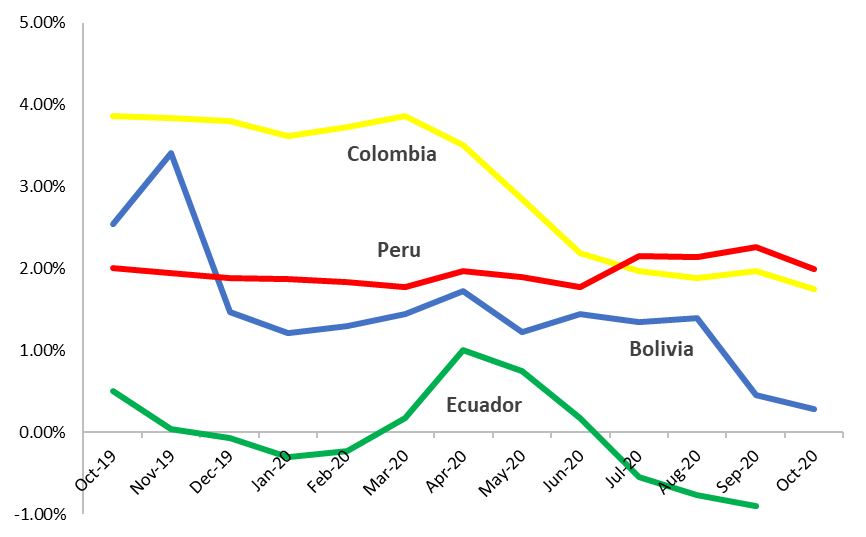
    Andean Countries: Inflation
    Monthly year-on-year figures

    Andean Countries: GDP growth (%)
    Quarterly figures are year-on-year growth
    GDP  End 2019 2020 forecast* Q4 2019 Q1 2020 Q2 2020
    Bolivia 2.2 -5.2 1.1 0.6 Not yet available
    Colombia 3.3 -5.6 3.4 1.4 -15.7
    Ecuador 0.1 -9.0 -1.0 -2.4 -12.4
    Peru 2.2 -13.0 1.8 -3.4 -30.2
    Venezuela -25.5 -26.0 No data No data No data
    *Figures from the United Nations Economic Commission for Latin America & Caribbean Jul 2020
    End 2019 and quarterly growth based on figures from the local central banks


  • MEXICO: Concerns rise over child labour exploitation

    Patrick de Courcy 21 May 2024 Hits: 3632

    On 1 May a group of minors from the Tzotzil indigenous group marched in the city of San Cristóbal de Las Casas, Chiapas state, to call for better conditions for working children. The demonstrations also called attention to increased violence in Chiapas, which they said was dissuading tourists from visiting and affecting livelihoods.

    The march highlighted the persistent issue of child labour in Mexico, where the number of children in work increased from 3.3m in 2019 to 3.7m in 2022, according to the latest figures from the national statistics institute (Inegi), released in October 2023. This means that Mexico is the country with the most children in work in the whole of North and South America, according to data compiled by national daily El Economista. 

    At the national level, the percentage of children in work increased from 11.5% in 2019 to 13.1% in 2022, according to a report released by the national minimum wage commission (Conasami) in April. A third of these children work in the agricultural sector, where most work without pay in order to help out on small family farms. Research from Conasami shows that falling prices of agricultural goods; the loss of crops due to pests or illness; and floods or excess rain are key factors in encouraging children to work.

    A further 25.7% work in mining, construction, or industry, and 15.3% in sales. Overall, 38% of girls and 37% of boys who work are unpaid, while 53% of girls and 46% of boys receive up to the equivalent of minimum wage. Almost a third of working children say they work to help their families, while 22.7% report that they do so in order to pay for schooling or other personal expenses.

    Those children who do work do not have as much time to study, meaning that they can fall behind at school or drop out completely. This limits their future prospects and keeps them in subsistence farming or low paid unskilled work. They also do not have time to play and develop social skills, potentially contributing to increased levels of stress and anxiety.

    There are signs that Mexican society is taking action to reduce the rates of child labour. At the end of April, the labour ministry (STPS) released details of its 2024 inspection programme, which will formally include child labour as one of its focus areas for the first time. This follows a similar move by the local government in Mexico City, which granted officials the power to order special inspections if they receive reports of child labour or the violation of children’s rights for the first time in January.

    And in April, the Sindicatos Unidos con México Moderno (Sucomm) labour organisation, which brings together 11 trade unions, included anti-child labour clauses in collective bargaining agreements for the first time in Mexican history. This was the product of collaboration between Sucomm and the AccioNNAr Project, run by the International Labour Organisation (ILO). The agreements establish a shared responsibility to eradicate child labour at textile and assembly plants operated by the local subsidiaries of two international firms.

    While these initiatives are certainly signs of progress, enforcement will likely prove difficult. In addition, it will be even more difficult to eradicate child labour in rural areas where family farms are still common and the Mexican state has less of a presence, and where rates of child labour tend to be higher.

    Child labour by state

    Guerrero state has the highest proportion of children in work, at 24.5%, followed by Chiapas (20.8%), Nayarit (19.1%), and Oaxaca (18.5%). Mexico City had the lowest percentage of children in work (4.0%), with Coahuila (6.4%), Baja California (6.5%), and Quintana Roo (6.9%) the next lowest.

  • ARGENTINA: Milei bets on more tax cuts to diversify and boost the economy

    Abbi Dicker 28 May 2026 Hits: 1013

    Emboldened by a freshly approved US$1bn disbursement from the International Monetary Fund (IMF) and a string of legislative victories, President Javier Milei is slashing export taxes and rolling out new investment incentives to develop frontier industries such as artificial intelligence, semiconductors, and advanced biotechnology.

    On 21 May the IMF completed the second review of Argentina’s US$20bn programme and released US$1bn in fresh funds, lifting total disbursements under the arrangement to around US$15.8bn. On the downside, the IMF noted that Argentina again fell short of its net international reserves target but cited recent policy improvements and strengthened market confidence.

    Economy Minister Luis Caputo, who led negotiations at the IMF’s spring meetings in Washington, called the disbursement “a very important step in consolidating the macroeconomic stability we have worked on for two years.” There was more good news this week for Milei. Economic activity in March accelerated 3.5% from February, far more than the consensus forecast of under 1%. The GDP proxy expanded 5.5% from a year ago, with agriculture, manufacturing, and mining driving growth.

    The IMF vote of confidence landed on the same day Milei stood before the Buenos Aires grain exchange and unveiled a sweeping set of export duty reductions. For decades, Argentina relied heavily on ‘retenciones’ – export duties levied on its manufacturing and massive agriculture sectors. While these taxes provided immediate revenue for a cash-strapped treasury, they were also a brake on growth, suppressing international competitiveness and discouraging multi-decade investments.

    Grain taxes

    Under the new measures, export duties on wheat and barley will fall from 7.5% to 5.5% starting in June 2026 - a structural, permanent reduction rather than the temporary suspensions that characterised earlier relief packages. For soybeans, Argentina’s most valuable crop and a cornerstone of its foreign exchange earnings, Milei outlined a gradual reduction schedule beginning in January 2027, with levies cut by between 0.25 and 0.5 percentage points each month through 2028, contingent on fiscal revenue and, he acknowledged, his re-election in 2027.

    Following long-standing complaints from Argentine manufacturers about the negative fallout from the opening of the economy to international competition, the Milei administration will over a 12-month period starting in July 2026 reduce export taxes to zero for the automotive, petrochemical, and machinery sectors. Alongside the export tax cuts, the government has moved to dramatically expand its flagship investment incentive programme. Under the original Régimen de Incentivo para Grandes Inversiones, or Rigi, launched in 2024, 15 projects worth US$29bn have been formally approved. But only US$1.2bn worth have reportedly actually entered the country.

    In a bill sent to congress, the government now proposed a ‘Super Rigi’ to target underdeveloped sectors such as artificial intelligence, data centres, semiconductors, advanced biotechnology, electric vehicles, solar panels, wind turbines, and uranium processing.

    Companies would pay a reduced corporate tax rate of just 15%, compared with the 25% rate available under the current programme and the standard statutory rate of 35%. The scheme also includes zero export taxes, accelerated depreciation mechanisms, unlimited deduction of losses, and a reduction in taxes on dividends and profits to 3.5% after four years. It establishes a minimum investment threshold of US$1bn per project, with companies required to commit at least 20% of pledged capital within the first two years.

    According to Caputo, the combined Rigi framework could pave the way for US$140bn in cumulative investment requests, including US$20bn-$30bn from a single large investor. “This is not a short-term scheme,” Caputo said, framing the plan as a generational pivot away from raw material exports toward higher value-added industrial production.

    Caputo's bet

    Caputo’s long-term bet assumes that the government’s fiscal discipline will be sufficient to allow foregone revenues from tax breaks and that global appetite for frontier-economy investment remains strong enough. So far, investment incentives haven’t worked very well. In fact, foreign direct investment in 2025 was negative, the worst result in over two decades.

  • Mexico: Tourism industry a global player

    LatinNews 04 August 2017 Hits: 369

    Mexico has pushed up one place in the World Tourism Organisation (WTO) ranking, to become the eighth most popular destination in the world last year, with a total of 34.9m visitors. Despite recurring worries over crime and drugs, the ministry of tourism (Secretaría de Turismo, Sectur) says there is room for further growth.

    Sectur claims Mexico could rise up the ranking by a further two positions during the current term of President Enrique Peña Nieto (which runs to the end of 2018) thereby becoming the sixth most popular global tourism destination. In the current ranking Mexico is now ahead of both Thailand and Turkey in terms of the total number of visitors. However, Mexico is still outside the top ten destinations in terms of total revenues earned from tourism. Last year these were US$19.6bn, placing it 14th worldwide. In the Western Hemisphere Mexico is the second most-visited country, after the United States.

    Despite fears to the contrary, some of the recent political turbulence in US-Mexico relations may not have hurt the tourism sector. Last year, uncertainty over the impact of the US elections on bilateral trade led to a sharp depreciation of the Mexican peso, which made visiting the country significantly cheaper for international tourists, many of whom come from the US. While the exchange rate has stabilised this year, the country is still seen as a price-competitive destination. Teresa Solis Trejo, deputy director of planning and policy at Sectur, has pointed out that tourism represents 8.7% of Mexican GDP, which makes it more important in economic terms than the country’s oil and gas industry, which accounts for 7% of GDP. “The tourism sector is an industry which, thanks to its size and performance in recent years, is becoming one of the driving forces of the national economy,” she says.

    The head of Sectur, Enrique de la Madrid, argues that tourism growth can be used counter-cyclically to offset the impact of slumps in the oil and gas sector. He recently pointed out “We Mexicans spend much less than foreigners who come to Mexico, our tourism balance has always been in surplus, which somehow helps us offset the decline in other sources of foreign exchange such as the oil industry, which was a key source but is today in deficit: we spend more importing gasoline than we earn from exporting crude oil”.

    The industry is not without its problems. For many years, Mexico has experienced violence associated with major drug-trafficking and criminal cartels which has existed in parallel with thriving and peaceful seaside resorts and tourist attractions. But these two separate worlds, each with their own geographies, have sometimes overlapped or collided. A surge in cartel-related violence has pretty much taken the once booming resort of Acapulco off the tourist and cruise ship route, and other coastal cities have also seen encroachment by organised crime. Nationally, the homicide rate is rising. Alejandro Schtulmann of political risk consultancy Empra told Bloomberg News Agency “This could drastically undermine the economy. People who have never visited Mexico are going to be much more reluctant to come here.”

    The turf war between the Sinaloa cartel – seen as losing territory since the arrest and deportation to the US of its leader Joaquín ‘El Chapo’ Guzmán – and the rising Cartel Jalisco Nueva Generación (CJNG) is in part being fought around Caribbean coast resorts like Playa del Carmen and Cancún, or Pacific Coast resorts like Los Cabos. Local newspapers have toned down their coverage of some of the shootings. Schtulmann says this is a deliberate policy. “They don’t want to sabotage themselves, because the moment these things get in the news, then tourism, the goose that lays the golden egg, dries up,” he says.

    Some resorts are nevertheless trying to improve security. Cancún has hired Julian Leyzaola, a former police chief credited with reducing the incidence of crime in Tijuana and Ciudad Juárez, as an adviser. A total of 150 police have been dismissed as part of a local purge to weed out those complicit with the cartels, and more officers are now patrolling the city’s streets. But executives in the tourism sector say there is still cause for concern: in Playa del Carmen hotel occupancy rates appear to have held up after a high-profile shooting at an electronic music festival in January: but fewer tourists now leave their hotels to come into the centre of town, and retail sales there are reported to have taken a dip.

  • Paraguay: Arms trafficking problem exposed

    LatinNews 25 September 2018 Hits: 561

    Paraguay has just ratified the United Nations Firearms Protocol (UNFP). The protocol commits Paraguay to combating the trafficking of firearms in exchange for receiving technical assistance. The ratification of the international treaty is encouraging. However, it came just days after the Paraguayan authorities uncovered what appears to be a major corruption ring dedicated to stealing firearms from the Paraguayan security forces, presumably to be sold on the black market. This has raised serious questions about the Paraguayan authorities’ capability to effectively tackle arms trafficking.

    Paraguay formally ratified the UNFP on 30 August. During a ceremony in Asunción, Paraguay’s new foreign minister, Luis Alberto Castiglioni, said that after ratifying the treaty, the Paraguayan government would now receive technical assistance and funding to “strengthen its capacity” to combat arms trafficking linked transnational crimes. The minister added that as part of the agreement, Paraguay had also signed a new cooperation agreement with the United Nations Office for Disarmament Affairs (Unoda) under which Unoda will provide training for Paraguayan government officials to prevent arms trafficking.

    Castiglioni was adamant that the new government led by President Mario Abdo Benítez, which assumed office on 15 August, was determined to combat arms trafficking and help to make Paraguay and the wider region safer.

    Castiglioni noted that the trafficking of weapons is “sadly a reality” in the region and that this illicit activity is increasingly used to fund “international criminal mafias”. Castiglioni was clear that the Abdo Benítez administration is interested in working with its regional neighbours and the wider international community to tackle this problem. Yet the ratification of the UNFP came just three days after Paraguay’s new interior minister, Juan Ernesto Villamayor, announced on 27 August that while conducting a general audit of the national police (PNP) arsenal, the authorities found that 42 firearms had been stolen. Villamayor said that the auditors had discovered that the missing firearms were replaced by wooden replicas or toys. He added that the audit also found that 90 PNP small firearms were reported missing between January and July.

    Villamayor noted that the attorney general’s office had launched an investigation to try to determine what happened to the firearms. According to local press reports, the weapons were stolen from a PNP firearms depot located in the city of Capiatá, Central department, and that among the stolen items were various military issue 7.62mm calibre Fal assault rifles that the PNP had received from the army. A few days later, on 29 August, Federico Delfino, the lead prosecutor in the case, said that he believed that the firearms were systematically stolen over an extended period of time from 2012 to September 2017. Delfino added that the missing weapons mainly belonged to the PNP forces in the departments of Paraguarí and Cordillera.

    The PNP commander, Bartolomé Báez López, dismissed the head of the institution’s arms and munition department, chief José Benjamín Segovia Cáceres, over the case after Cáceres revealed that the no proper audit of the PNP arsenal had been carried out when he assumed his post in January. However, Commander Báez was forced to recognise on 31 August that the preliminary investigations into the case suggest that the there could be more firearms missing from other depots. “It is very probable….that more weapons are missing, that they have been changed,” Báez said, without providing any concrete figures on how many weapons may have been taken from 2,500 arms held at the Capiatá depot (local press reports suggest that as many has 100 firearms may have been stolen). The commander also confirmed that the investigators’ main hypothesis is that corrupt PNP officers were implicated in the robbery of the weapons as only PNP officers have access to the Capiatá depot.

    A problem of scale

    Arms trafficking is not a new problem in Paraguay. The country has long been identified has having a large arms black market that supplies weapons to criminals across the sub-region. Pointedly, the Organization of American States (OAS) Justice Studies Center of the Americas (JSCA) estimates that between 100,000 and 700,000 weapons are sold in Paraguay’s black market each year. Notably, an investigative report conducted by local daily ABC Color after the theft of the weapons at the Capiatá depot became public, found that on official figures a total of 648,486 firearms and 331m rounds of ammunition legally entered the country in the last five years, a high figure when one considers that the country’s population is of just 6.5m, and which suggests that many of these weapons do not stay in Paraguay but are illegally sold on across the region.

    The ABC Color report also points out that the buying and selling of firearms and ammunition appears to be a profitable business (the sector sold US$76.2m-worth of weapons and ammunition in 2013-2018 on official figures), in which some influential individuals are involved in. Indeed, the ABC Color report notes that some 45 firms are currently dedicated to importing and reselling firearms in Paraguay. Among them are firms linked to prominent politicians ,including the former president (2013- August 2018) Horacio Cartes. The insinuation is that these individuals may be directly involved in the trafficking of firearms; and that stamping out this illicit activity could prove to be even more challenging for the Paraguayan authorities, as they may face opposition from politically influential individuals.

    • Yamgo SA

    The ABC Color report found that one of the leading firearms import firms in Paraguay is called Yamgo SA, which lists as its legal representative one Hugo Javier Portillo Sosa. Portillo is a long-time business partner of former president Cartes, who was a former manager at Cartes’ Banco Amambay bank. According to the official firearm import figures obtained by ABC Color, Yamgo SA imported 5,761 high-calibre firearms between 2014 and 2018 even though the firm is not listed a state supplier, meaning that all of the weapons it imported are for selling to civilians in the local market and potentially ending in the black market.

  • DOMINICA: Strong economic recovery as Dominica heads towards election

    LatinNews 13 June 2019 Hits: 615

    Prime Minister Roosevelt Skerrit and his ruling Dominica Labour Party (DLP) are due to meet the electorate in a general election by December. A continuing strong recovery from Hurricane Maria, with growth of 10% projected for this year, provides a solid base for his re-election bid.

    The DLP has been continuously in power since 2000, and if it wins in December this would be its fifth consecutive victory, and the third under the leadership of Skerrit. Its high point was in the 2009 election when it secured 18 out of the 21 seats in the National Assembly. This dropped to 15 in 2014. Sharp reversals are always possible, however. In 1980 it dropped from holding 16 seats to holding none in a landslide victory for the-then main opposition Dominica Freedom Party (DFP). The DFP, for its part, although it dominated the 1980s by 2000 it had no seats left in parliament.

    The main opposition to the DLP government is now the United Workers Party (UWP), a centrist party led by Lennox Linton which currently holds six of the 21 seats in the National Assembly. The party was formed in 1988 and entered parliament in 1990 with six seats. In 1995, it increased this to 11 seats and became the government, with a slim one-seat majority, under Prime Minister Edison James. It lost this majority in 2000.

    One of the UWP’s eye-catching promises is to build a new international airport by 2024. In addition, when launching the party’s candidates for the 2019 election in late May, party president Isaac Baptiste said the party’s areas of focus for “immediate attention” were “governance and public service, finance, state security, agriculture, tourism, education, health, industry, economic infrastructure, housing and human settlements, and conservation”, which pretty much covers the front. The UWP president also promised to create 12,000 new jobs in Dominica by 2025.

    One of the main problems for the UWP is that the economy is humming along as a result of reconstruction work following the September 2017 destruction wrought by Hurricane Maria. A ‘concluding statement’ by the International Monetary Fund (IMF) issued in May following an official visit to Dominica reported: “The economy is recovering strongly following the destruction…Output growth in 2019 is estimated at 10%, largely offsetting the cumulative decline of 10% since the hurricane.”

    The main driving force behind the recovery has been construction, with large investments in infrastructure and public services “aimed at building resilience to natural disasters”. However, the IMF reports that tourism and agriculture, which it says are key for exports and employment, “remain significantly below potential in light of the significant loss of trees and equipment”. Output in these areas will not return to pre-hurricane levels until next year, however the planned increase in hotel capacity should give tourism a significant boost once reconstruction is completed.

    But if strong growth is helping the government’s case in an election year, there are clear difficulties ahead. For instance, and not surprisingly, fiscal imbalance and debt are major concerns. As the IMF says, large-scale spending on reconstruction “has worsened the fiscal outlook”. In 2019/20, the fiscal deficit is projected to remain at 7% of GDP, better than the 11% recorded in 2018/19 but still too high.

    One of the problems, warns the IMF, is that the “fiscal space for public investment” is likely to decline to 4% of GDP by 2023. This, the IMF continues, “is insufficient to sustain resilient infrastructure needs and is a large decline from the 15% of GDP annual investment average in the previous five years”.

    The problem is compounded by the need to reach a public debt target of 60% of GDP by 2030. The IMF advises: “The government should prepare fiscal consolidation measures expeditiously, targeting savings of at least 6% of GDP to be adopted gradually over the medium term. Measures should be staggered over 5-6 years to smooth the likely negative impact on growth.”

    The IMF is urging a rationalisation of tax incentives and “a review of public wage allowances and a containment of wage increases below inflation”. It also wants the government to accelerate pension reform by bringing forward the planned increase in the retirement age.

    The IMF is also urging reforms to improve the performance of the private sector. It says: “The private sector needs to play a more prominent role to sustain growth in the long term. To increase employment, legal constraints on working hours should be removed and severance payments for redundancy should be reviewed.”

  • ANTIGUA & BARBUDA: Debt is still the thing

    Sarah Sheldon 23 July 2024 Hits: 690

    Fiscal adjustment and debt reduction should be top priorities for the government, according to an International Monetary Fund (IMF) mission led by David Moore, which visited Antigua & Barbuda on 17-21 June.

    The mission commented that GDP growth in the small Caribbean country – which has a population of nearly 100,000 - has been encouraging. GDP (half of which is tourism-based) grew by 4.2% in 2023 and is set to expand by 5.8% this year, lifted by the Small Islands Developing States Conference (SIDS4) and Antigua & Barbuda’s role co-hosting the T20 Cricket World Cup. Inflation peaked at 6.0% in April, up from 3.3% at the end of last year.

    A large part of the IMF press release issued at the end of the mission’s visit deals with the debt problem. The Fund says that the high public debt burden “poses ongoing challenges”. The debt-to-GDP ratio has actually improved from around 100% in 2020 to 76% in 2023, but this is partly due to a revision of GDP statistics: arrears are substantial, and cash constraints continue to be necessary. The mission welcomes the 2024 budget as an important step to build stronger fiscal buffers. The budget includes a range of measures which will improve the fiscal balance by 0.5 percentage points of GDP. One of them is an increase in the ABST sales tax, which goes up to 17% from 15% previously. The base of the tax is also widened; excise taxes on alcohol, tobacco and cannabis products are increased; and property taxes on luxury homes go up.

    Bank credit and NPLs

    The IMF mission to Antigua & Barbuda notes that bank credit to the private sector rose by 7% last year after contracting in both 2021and 2022. Non-performing loans (NPLs) for banks and credit unions remain “modestly above the prudential level of 5%”. The IMF calls for stronger regulation of credit unions.

  • GRENADA: Post Beryl economic bounce-back

    Abbi Dicker 20 March 2025 Hits: 3888

    In late January the International Monetary Fund (IMF) published a report following the conclusion of an Article IV consultation with Grenada, revealing that despite the damage caused by Hurricane Beryl last July – equivalent to around 16% of GDP – growth has been holding up well with GDP expected to expand by 3.9% in 2025.

    The report says Grenada has been benefiting from buoyant tourism, moderating inflation, and a narrowing current account deficit. This has been helped by higher-than-expected Citizenship-by-Investment (CBI) revenues.  The CBI programme was launched in 2013 and offers wealthy individuals residence rights and a passport in exchange for a US$235,000 donation to the country’s National Transformation Fund (NTF) or a minimum real estate investment of US$270,000.

    The IMF team says that another pro-growth factor has been the rapid response to Hurricane Beryl, which hit Carriacou and Petite Martinique as well as some parts of the main island but caused only limited damage to tourism infrastructure. The government responded with large recovery and reconstruction spending, funded out of substantial government savings and the triggering of disaster-contingent financial instruments. Fiscal spending rules have been relaxed because of the emergency; the report says a key decision for the government is how quickly normal spending constraints should be re-introduced. “Assuming a subsequent timely return to the fiscal rules” the report says, “public sector debt is projected to continue falling and reach the debt target of 60% of GDP by 2030”.

    The Fund suggests the major medium-term risks facing the small Caribbean island’s economy include a tourism slowdown because the sector is operating at near capacity, further natural disasters, and what it describes as the “uncertain scale” of future CBI inflows. The IMF Board of Directors made various recommendations, including further strengthening of public investment and budget planning to improve climate resilience, work on the energy transition, and a tightening of regulations against corruption and money-laundering.

  • PERU: Extortion on wheels

    Abbi Dicker 10 April 2025 Hits: 3876

    Bus, taxi, and delivery drivers held a second one-day strike in Lima on 10 April, as this issue went to press, demanding that the government do more to protect them from extortion and criminal violence.  

    An earlier protest had been held on 7 April after the death three days earlier of a bus driver employed by the Etuchisa company, who was gunned down in Los Olivos, a northern suburb of Lima. Drivers from other private bus companies such as El Rápido, Sesosa, Lorito, and Vipusa also backed the action. 

    Because of the protests in Lima and Callao, during the latest stoppage the authorities cancelled classes in the capital’s public schools. The strike was convened by the Asociación Nacional de Integración de Transportistas (Anitra) which says that so far this year a total of 15 drivers have been killed at the hands of extortionists and sicarios (paid gunmen) who demand protection money and threaten violence if it is not paid. Around 50 private transport companies are said to have been targeted by the extortionists.

    The president of Anitra, Martín Valeriano, told the local newspaper El Comercio, “We are in a war: entrepreneurs, independent workers, transport drivers from the working class are being killed, leaving thousands of families unprotected.” The government had earlier declared a state of emergency in Lima and Callao after a popular singer, Paul ‘Russo’ Flores, was killed in an attack in Lima carried out by suspected extortionists on 15 March [WR-25-11], but the transport drivers say they still receive insufficient protection from the police.

    According to police data compiled by the interior ministry there were 3,921 cases of extortion reported in the first two months of this year, up by 7% on the 3,669 reported in the same period last year. However, crime analysts say extortion is heavily under-reported because victims are threatened and told not to go to the police.

    • Extortionists

    There is also evidence that the extortionists are entering new markets, including schools. Nicolás Zevallos, the director of the Instituto de Criminología y Estudios sobre la Violencia, says, “We are in a phase where extortion is much closer to small and micro-entrepreneurs, families, homes, and for quite a small amount of money.”  

    The ombudsman’s office has requested that motorcycle use be restricted during any regionally declared state of emergency. In a statement it said that “motorcycles are tools used by criminals”. It added that 82% of reported crimes are linked to both firearm and motorcycle use, noting that motorcycles “enable a quick getaway and make it more difficult to capture and identify criminals”. It suggests that the carrying of motorcycle passengers should be outlawed, and that there should be a curfew, prohibiting motorcycle circulation between 6pm and 6am.

    Anitra, along with lobby groups Alianza de Empresas de Movilidad Urbana Sostenible (Aemus), Asociación de Empresas de Transporte Urbano (AETU), and Corporación Nacional de Empresas de Transporte (Conet), has demanded that the three powers of state (executive, legislative, and judiciary) compile an “inter-institutional plan to control transport-linked criminality”. The lobby groups say a lack of proper coordination has undermined government efforts to protect citizens. It also suggests that setting up a digital system would allow citizens to report extortion while remaining anonymous. It favours the appointment of an “anti-extortion czar” with power to lead a campaign, coordinate, and propose new initiatives.

  • TRACKING TRENDS

    LatinNews 10 July 2014 Hits: 1124

    ECUADOR-COLOMBIA | Import credit line. Colombia’s trade minister, Santiago Rojas, announced on 7 July that his government will open a new credit line for Ecuadorean exporters looking to supply products to Colombia. The decision comes amid complaints by Ecuador that its trade balance with its partners in the Andean community of nations (CAN) is being negatively affected by the fact that in recent months its neighbours’ currencies have devaluated against Ecuador’s official currency - the US dollar. This situation has already prompted the Ecuadorean government to introduce certain trade restrictions, which have led the CAN secretariat to consider taking action against Ecuador for violating the bloc’s regulations [WR-14-25].

    Rojas’s announcement looks like an attempt by Colombia to try to address some of Ecuador’s grievances. The announcement was made during Rojas’s visit to Quito, where he met his Ecuadorean counterpart, Francisco Rivadeneira, to discuss the bilateral trade agenda. Afterwards Rivadeneira said that the meeting had been “extremely positive and constructive”, highlighting that the two had agreed to continue promoting cooperation and collaboration in areas such as bilateral investment, trade and combating cross-border smuggling.

    Meanwhile, after stating that bilateral relations are going through a great moment, Rojas said that the Colombian government was keen on taking advantage of the opportunity to build closer supply chain links with Ecuador in order to increase productivity. To this effect, Rojas said that Colombia will soon open a new import credit line accessible to Ecuadorean exporters, although he failed to provide further details. The two ministers also announced that the next binational cabinet meeting is to be held in the Ecuadorean port city of Esmeraldas in the second half the year, when an agenda covering bilateral trade, financing, tourism, logistics and transport will be discussed.

    A few days earlier, on 2 July, Ecuador’s public transport ministry (MTOP) revealed that the Ecuadorean and Colombian governments had agreed to invest US$2bn in the construction of four new binational border administration centres (Cebafs) to house new customs and immigration control offices. A MTOP statement said that the two countries had agreed each to provide half of the financing for the Cebafs, construction of which is slated to start in 2015 following the signing of an official agreement due to take place at the next binational cabinet meeting.

    • Brazilian investment in Peru

    On 7 July Brazil’s ambassador to the Peru, Carlos Alfredo Lazary Teixeira, revealed that Brazilian investments in Peru have now surpassed US$6bn after growing at an average annual rate of 10% in recent years. Speaking at a business seminar in the northern Peruvian city of Chiclayo, Lazary said that Brazilian investments in areas such as mining, the medical industry, cement production and ports infrastructure have been increasing in recent years due to the “conviction” that Peru has the conditions to continue developing. He added that the new State procurement legislation currently being analysed by Peru’s congress could help attract even more investment to the Andean country by “providing conditions that will not only keep the firms that are already here but also attract new firms”.

  • NICARAGUA: More military concerns

    LatinNews 11 March 2015 Hits: 899

    A bomb that went off in the municipality of Pantasma, Jinotega department, killing three people last month, has again raised questions about the presence of armed anti-government groups in the north of Nicaragua. Top military officials were compelled to provide reassurances that the incident was not part of a military operation. But this has done little to reassure local human rights groups like the NGOs, Centro Nicaragüense de Derechos Humanos (Cenidh) and Comisión Permanente de Derechos Humanos (CPDH), the political opposition or the Catholic Church.

    On 9 February Cenidh released its report into the 20 January incident in which three individuals, identified as Modesto Duarte Altamirano, ‘Nacho’ and ‘Sereno’ were killed after a bomb left in a rucksack went off.

    Since 2009 the Church has raised concerns about the presence of armed anti-government groups in the north of the country (where the Contras were active during the first Frente Sandinista de Liberación Nacional [FSLN] government led by President Daniel Ortega [1979-1990]). It is also worth pointing out that this is not the first time that Pantasma has been the site of deadly violence as a result of confrontations between the military and alleged armed groups. In October 2013 clashes took place during efforts by the military to pursue a former Contra, Gerardo de Jesús ‘El Flaco’ Gutiérrez, a leader of the Coordinadora Guerrillera Nicaragüense (CGN). At the time the local media circulated a press release by the CGN claiming that it had forged an alliance with another armed group, Fuerzas Democráticas Nicaragüenses (FDN 3-80), since February 2012 to fight the “unconstitutional” government of President Ortega. Meanwhile in December 2013, clashes between the police and unknown armed men in the municipality of Bocas de Ayapal, also in Jinotega, left ten dead, including four police officers.

    As with previous instances, the Ortega government and the police dismissed the 20 January blast as an incident of intra criminal gang fighting. Yet these explanations have been met with scepticism. In its report, the Cenidh draws similarities between it and attacks that took place in the past against armed groups like the Frente Unido Andrés Castro (FUAC), formed of demobilised members of the Ejercito Popular Sandinista (EPS) disillusioned with the FSLN leadership. A week after the bomb went off, Cardinal Leopoldo Brenes said that the incident evoked the violence of the 1980s – a view echoed by the main opposition leader, Eduardo Montealegre, of the Partido Liberal Independiente (PLI). Further expressing such concerns, on 9 February, the Bishop of Jinotega, Carlos Enrique Herrera, told reporters that he was not satisfied with the investigations carried out by the police in the area or the official explanation for the violence. Since then, on 5 March, a human rights commission linked to another human rights organisation, Asociación Nicaragüense de Derechos Humanos (ANDH), has been set up in Pantasma at the behest of the local community to monitor the human rights situation in the area.

    • Avilés continues as military chief

    On 21 February President Daniel Ortega swore-in General Julio César Avilés as head of the armed forces for a second consecutive five-year term, making him the first military chief to serve in the post for longer than five years since 1995.

    Avilés’s ratification follows the military reform passed in January 2014, which removed the prohibition on the re-appointment of the head of the military (who is appointed by the president) [RC-14-02].

    As with the reform, Avilés’s continuance in the post reignites ongoing concerns regarding the military’s lack of independence and Ortega’s perceived efforts to incorporate the military into his political project, a blurring of boundaries that was embodied in Ortega’s choice of a former army chief, (ret.) General Omar Halleslevens, as his running mate in the November 2011 presidential elections.

    • New military equipment

    On 10 February Nicaragua’s army inspector, General Adolfo Zepeda, announced plans to purchase new combat aircraft so that Nicaragua could better enforce its airspace sovereignty over the expanded maritime territory it was awarded at Colombia’s expense by the International Court of Justice (ICJ) in 2012. The announcement provoked a response from Colombia, with Senator Jimmy Chamorro of the Partido de la U urging President Juan Manuel Santos to call on the senate’s foreign relations committee to analyse whether this intended purchase represents a threat for Colombia.

  • RASTREANDO TENDENCIAS

    LatinNews 26 June 2015 Hits: 492

    BOLIVIA | Nuevo hallazgo de petróleo en casi un cuarto de siglo. El gobierno Boliviano liderado por el Presidente Evo Morales anunció el 18 de junio el descubrimiento por parte de la petrolera estatal, Yacimientos Petrolíferos Fiscales Bolivianos (YPFB), de nuevas reservas de petróleo. Este es el primer hallazgo de esta clase en 23 años, y de un solo golpe casi llega a triplicar las actuales  reservas de petróleo de Bolivia, de 16m de barriles a 44m de barriles.

    YPFB espera que la explotación de las reservas de petróleo en el yacimiento Boquerón Norte localizado en la municipalidad de Yapacaní, en el departamento oriental de Santa Cruz, comience en el 2017. El ministro de hidrocarburos & energía, Luis Alberto Sánchez, dijo que el descubrimiento permitiría a Bolivia reducir sus importaciones de diesel por alrededor del 20%, pues unos 6.500 barriles de petróleo por día saldrán de este yacimiento a partir del 2019 en adelante. El Estado subsidia el combustible, y el mayor costo detrás de estos subsidios es el que produce las importaciones de diesel.

    Por separado, el Presidente Morales dijo el 20 de junio, en un evento en Cochabamba, que Bolivia espera exportar unos 8.000MW de electricidad para el 2025, cuando el país celebrará el bicentenario de su independencia. Morales dijo que gran parte de esta electricidad sería generada por una represa hidroeléctrica binacional que está siendo planeada con Brasil en el compartido Río Madeira para producir 3.000MW, con Bolivia exportando el superávit de electricidad a Brasil, y utilizando las ganancias que produzca para cubrir su porción del costo financiero, tal como hace Paraguay actualmente con la represa hidroeléctrica de Itaipú, aunque Bolivia estaría buscando condiciones más generosas, ya que esto ha sido una eterna  herida abierta entre Asunción y Brasília. La producción actual de electricidad de Bolivia es de 1.500MW, lo que satisface la demanda interna promedio de 1.300MW.

    COLOMBIA | Ley anticontrabando. “Con enorme satisfacción”. Así fue como reaccionó el ministro de finanzas de Colombia, Mauricio Cárdenas, ante la aprobación la semana pasada de una ‘ley anti-contrabando’, que había estado estancada en el congreso por más de un año. “El contrabando es el principal problema que afronta nuestro aparato productivo”, dijo Cárdenas. “Debemos declarar la guerra total al contrabando. El contrabando destroza empleos, destroza empresas”, agregó. De acuerdo con el ministerio de comercio, industria, & turismo, el contrabando genera el equivalente al 2% del PIB de Colombia y el 10% de las importaciones.

    Bajo la nueva ley, las sentencias de prisión irán de cuatro a ocho años para los distribuidores del contrabando, y multas que llegarán hasta el 300% del valor en aduana de los mismos productos ingresados de contrabando y vendidos. Los involucrados en el transporte o venta de mercancías de contrabando también estarán sujetos a la ley de ahora en adelante.

    Cárdenas también dijo que los funcionarios públicos serían penados con mayor severidad por complicidad en el contrabando. “Antes ellos podían librarse con una multa, pero ahora ellos irán a prisión”. Para aquellos que facilitan operaciones de contrabando en gran escala, que involucran mercaderías de más de Col$120mm (US$47.000) las sentencias de prisión serán de hasta 16 años.

    PERÚ | Piden acallar el ruido político. Martín Pérez, el presidente del poderoso lobby del sector empresarial, la Confederación de Instituciones Empresariales Privadas (Confiep), le ha pedido al gobierno liderado por el Presidente Ollanta Humala que reduzca el “ruido político” a fin de mejorar el clima de las inversiones y hacer posible que Perú llegue a un crecimiento económico de más del 4% este año.

    Pérez se estaba refiriendo a las abiertas escaramuzas con la oposición, en particular sobre cuestiones de corrupción, en momentos en que los partidos políticos y candidatos intentan  posicionarse antes de las elecciones presidenciales y legislativas de abril del 2016. Sin embargo, es difícil ver  ninguna otra cosa que no sea más decibeles en los ruidos políticos que serán emitidos durante los próximos nueve meses. También existe la recurrente preocupación de malestar social en las regiones, con Humala forzado a extender la intervención militar en las tres regiones sureñas de Arequipa, Puno, y Madre de Dios, la semana pasada, con el objetivo de mantener el orden [IL-15-24].

    El congreso votó 86 a 21 la semana pasada para otorgarle los poderes legislativos buscados por el primer ministro, Pedro Cateriano, para permitirle a la administración Humala legislar sobre materias económicas, financieras, y administrativas durante un periodo de 90 días (él había buscado 120) con el objetivo de dinamizar el crecimiento económico. Estos poderes estarán restringidos a la regulación de la generación de electricidad; la promoción de la inversión privada; acceso a la vivienda; asociaciones pública-privada; y el alivio de las restricciones comerciales.

    • Contrabando colombiano

    “El contrabando es el otro lado de la historia del narcotráfico”, dijo el ministro de finanzas de Colombia, Mauricio Cárdenas. “Las drogas se van del país, y estas retornan convertidas en  mercaderías baratas, mercaderías que no pagan impuestos”, agregó. El contrabando le niega al Estado unos Col$2,9trn (US$1,14mm) por año en impuestos, de acuerdo con la Dirección de Impuestos y Aduanas Nacionales (Dian) de Colombia.

  • PERU: Odebrecht investigations ruffle more feathers

    LatinNews 14 December 2017 Hits: 400

    “I deeply reject this affront that the public ministry is carrying out.” This is how Keiko Fujimori, the leader of Peru’s main right-wing opposition Fuerza Popular (FP), reacted to the raids carried out by prosecutors investigating the wide-ranging corruption case revolving around Brazilian engineering firm Odebrecht on FP party offices. The unprecedented move by the prosecutors against the party that currently holds sway in the national congress also produced concern among government ranks amid fears that this could lead the FP to lash out at the executive and the judiciary, potentially producing another institutional crisis.

    Prosecutors have been investigating allegations that Odebrecht made irregular donations to the FP and Fujimori’s unsuccessful 2011 and 2016 presidential campaigns, as part of the firm’s wider efforts to gain influence with Peru’s political leaders which could help it to secure state contracts. These investigations have been going on for months but, as recently happened with the linked investigations into the involvement of local construction firms in the Odebrecht corruption scheme [WR-17-48], the judiciary now appears prepared to move decisively. And so, on 7 December, prosecutors armed with a warrant issued by Judge Richard Concepción Carhuancho raided two FP party offices in Lima.

    José Domingo Pérez Gómez, the lead prosecutor in the case, said that the raids were carried out to seize documents and accounting records that could contain evidence that FP received undeclared campaign donations from Odebrecht. But the timing of the raids and the spectacle of prosecutors barging into buildings where Fujimori and other leading FP figures and members of congress have offices, at a time when the FP has threatened to impeach Attorney General Pablo Sánchez over the public ministry’s perceived failure to advance the Odebrecht investigations, has been questioned.

    In a press conference offered that same day, Fujimori, who was on her way to give evidence to Odebrecht investigators when the raids took place, insinuated that the public ministry was retaliating against her party. “I don’t want to think that this affront is an abusive and revengeful reaction to a constitutional complaint,” Fujimori said in reference to the dereliction of duty accusations presented against Sánchez by FP legislators. “I don’t want to think they have ordered these raids to put us in the same bag, to create a circus,” Fujimori added. She insisted that she and FP have collaborated with the Odebrecht investigations so far and voluntarily provided all the information requested by prosecutors.

    But the raids were not only questioned by Fujimori and the FP. Prime Minister Mercedes Aráoz commented that “there are more delicate ways to investigate political parties…political parties need to be respected…there may be different ideologies, but we have to respect them, and I don’t think this is the way to do it”. President Pedro Pablo Kuczynski also expressed concern at the raid. “I don’t say it to try to ingratiate myself with congress, I say it because if there is no respect for due process, we will not be respected internationally,” he said.

    If Kuczynski was hoping to avoid the wrath of the FP, he was sadly mistaken. On 13 December FP legislators called on him to resign after the congressional commission investigating the Odebrecht case presented fresh evidence obtained from the company showing that it had paid US$782,000 to Westfield Capital, a local consulting firm owned by Kuczynski, for consultancy work carried out while he was a cabinet minister under former president Alejandro Toledo (2001-2006).

    • Odebrecht case likened to Vladivideos

    On 12 December Peru’s housing minister, Carlos Bruce, commented on the impact that the investigations into the corruption centred around Brazilian engineering firm Odebrecht is having in the country. Bruce likened this to the impact of the so-called ‘Vladivideos’ case involving a series of video recordings that exposed the rampant corruption that took place during the government led by former president Alberto Fujimori (1990-2000), which helped to convict Fujimori and many of his government officials. Noting that Odebrecht investigations have led to the arrest of two former presidents, with a third a fugitive from justice, Bruce said, “This has implicated various political parties, various governments. It is a shock almost equivalent to that of the Vladivideos in their time”.