The modern tourism industry – or at least the industry as configured before the pandemic – has come to rely critically on airlift. In other words, the industry thrives when competitively priced airlines are available to get the tourists to where they want to go and back again, as quickly and as efficiently as possible. Without that critical airlink, many tourist destinations are simply unable to function. There are of course exceptions with tourists opting to staycation (holiday at home) which often involves using other means of transport – such as roads, rail, ferries, and cruise ships. But air travel has become an essential part of the international tourism equation. What the pandemic has shown is that medical protocols to help fight the virus, such as rigorous social distancing, are hard to observe on a long-haul flight. The initial suggestions that were made included leaving empty seats aboard an aircraft, for example by blocking off the middle row, so that passengers can fly in a more socially distanced manner. However, in most cases this has meant that load factors (the percentage of occupied seats on a flight) drop to unprofitable levels. The industry has focused on other measures to try and make travel safe, such the use of much more intensive cleaning and disinfecting procedures, contactless documentation and ticketing, and the adoption of airport testing for the coronavirus.
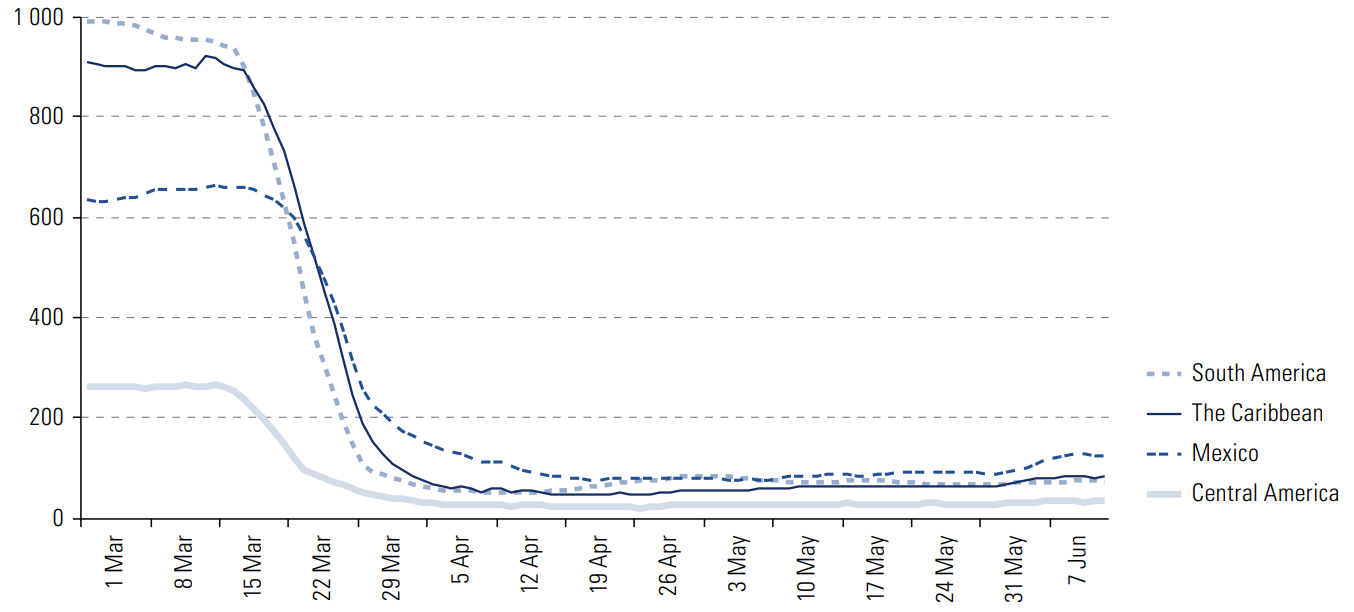
The pandemic also showed that shutting down air travel is much easier done than restarting it. The initial lockdown in March-April saw the number of daily international flights drop drastically as governments closed borders and initiated travel bans. However, given the complex, patchwork way in which quarantines began to be eased or tightened as the speed of contagion ebbed and flowed, getting aeroplanes back in the air has turned out to be a much more time-consuming process. Governments have tried to manage shifting lists of safe or unsafe destinations based on changing data on virus prevalence in different countries. Some have tried to set up safe travel ‘corridors’ or ‘bubbles’. Airlines have had to restart or stop services at short notice, increasing their costs at a time of financial crisis.
Latin America and the Caribbean (selected subregions): daily flight departures, 1 March–12 June 2020
Source: Economic Commission for Latin America and the Caribbean (ECLAC)
How the airline industry will emerge from the pandemic is still open to debate and depends in no small degree on the evolution of the battle against coronavirus over the next 1-2 years as well as on timelines for new vaccines and track and trace procedures. One estimate is that in the decade before the pandemic an air travel boom created an international network of 47,756 commercial air routes, of which more than half were concentrated in the US, Western Europe, and Northeast Asia, but that in the first six months of the pandemic, a lethal combination of border closures, lockdowns, and a generalised loss of public confidence in travel health safety led to the rapid loss of one-third of that total. In the week starting 2 November the number of routes had shrunk to 33,416 according to OAG Aviation World Wide. An early estimate from the International Air Transport Association (IATA) was that because of the Covid-19 crisis airlines around the world would have combined losses of US$314bn in 2020, US$18bn of which would hit Latin American carriers.
Clearly, how the air travel industry recovers will be of enormous importance for the future of tourism. The more extreme scenarios range from an unlikely complete return to business as usual to a perhaps also unlikely permanent decline. One suggestion between those extremes is that future business and holiday trips will cost more, require more airport stopovers, involve longer journey times, and incorporate more alternative modes of transport. According to Subhas Menon, director general of the Association of Asia Pacific Airlines, “It will take a good four or five years for connectivity to return to the same level we saw at the end of 2019; some of these routes may never be put back.”
Peter Cerda, an International Air Transport Association (IATA) executive in the Americas region, expects many regional airlines to emerge from the pandemic operating fewer routes. He estimates it will take until 2023 for domestic routes to recover, and to 2024 for the international ones to do so. The recovery will start with short-haul flights as travellers prioritise visiting family and friends. Long-haul business and holiday travel will take longer to become profitable again. Stephen Trent, a researcher at Citi, says the recovery will be stronger for Mexico, Central America, and Colombia, because they are within short-haul distance from the United States. Long haul flights to South American destinations will be slower to come back.
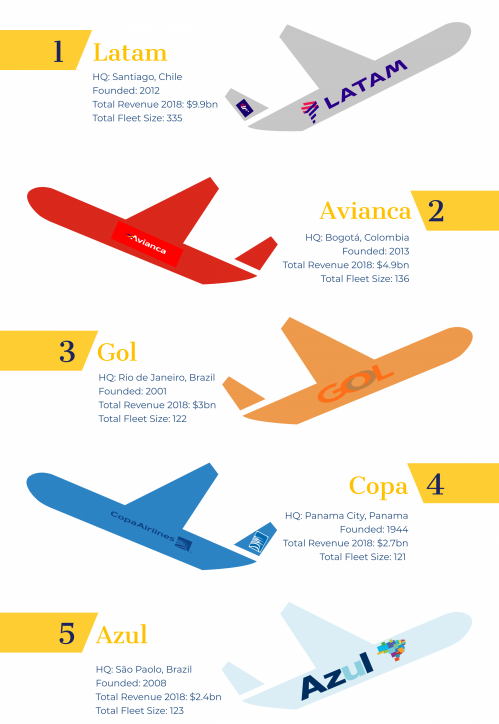
The crisis had a particularly big effect on major airlines operating in Latin America. In March research by JP Morgan suggested that in a scenario in which all flights remained grounded the region’s two largest carriers, Latam Airlines and Avianca, would have only three to four months before running out of cash. As it turned out these were indeed the first to file for bankruptcy and were followed by Aeromexico. Ecuador’s TAME and Caribbean carrier Liat also went out of business. Among other carriers the report suggested the most exposed were two Brazil-based carriers, Gol (five months) and Azul (six months). Panama-based Copa, widely seen as one of the financially strongest airlines in the region, would have ten months.
Latam, which had been created in 2012 as a merger between Chile’s LAN and Brazil’s TAM, shut down its operations during the lockdown phase of the pandemic and sought Chapter 11 bankruptcy protection in US courts. It also announced significant job losses and the permanent closure of its Argentina-based subsidiary. In early November the company said that in the third quarter of 2020 it had registered US$573m in losses. Revenue was down by 80.8% on year-earlier levels. Chief executive Roberto Alvo said the fall showed the deep impact of Covid-19 on demand for air travel, but that sufficient financial reserves were in place to help it weather the storm. These totalled US$3.3bn, of which US$866m was cash in hand and US$2.45bn was available through the Chapter 11 rescue plan approved by the US court.
Latin America’s Major Carriers
Source: SEC, Latam, Avianca, Gol, Copa, Azul
Alvo said the company’s priorities were to continue restructuring its operations as outlined in the rescue plan, to strengthen its alliance with the US carrier Delta, and to push ahead with a long-term plan to digitalise its operations. The company had earlier announced a further increase in its flights after the reduction to near-zero in the second quarter. Before the pandemic Latam had a fleet of 332 aircraft that were operating 1,400 flights a day to destinations in 26 countries. By June 2020 operations had been slashed to only 5% of capacity, shrinking to 39 domestic services in Brazil, 13 in Chile, and to four international flights. By November 2020, having first restored more domestic flights, Latam was moving gradually to re-open regular connections between Peru, Brazil, and Ecuador. At that point it was estimated that the airline was operating at 33% of its total capacity.
Colombia-based Avianca, which also operates regional hubs in El Salvador, Ecuador, and Peru sought bankruptcy protection in the US in May 2020 and laid off significant numbers of its employees. In the third quarter of 2020 it reported a loss of US$283.5m, compared with a loss of US$40.1m in the year-earlier period. Total revenues fell by 83% to US$206.9m. Before the pandemic struck, the company operated a fleet of 158 aircraft serving 76 destinations in 27 countries. In September, as it began re-opening its routes, Avianca said it had achieved a seat occupancy rate of 66.7%. In October a US court approved the company’s financial rescue plan, totalling US$2bn. A month earlier the Colombian government offered US$570m in loans to help bail out the airline, but this was challenged in court on fair competition grounds and ultimately abandoned. The company’s rescue package has therefore been put in place by private investors.
Brazilian carrier Gol Linhas Aereas, the region’s third largest carrier, estimates that as a result of the pandemic it lost around US$1.5bn in overall sales. The biggest hit came in the second quarter. At that point the airline operated only 57 flights a day, or about 9% of its total capacity. By the end of the third quarter, this had increased to 271 flights per day, or 40% of capacity. It hoped to raise that further to 490 flights per day, or 65% of capacity by the end of 2020. In the third quarter it reported a loss of US$300m, with operating revenues falling by 73.7% on year-earlier levels. The company nevertheless managed to maintain good load factors on the planes it was operating, with around 80% of all seats occupied, the highest among Brazilian carriers. Worries over Gol’s ability to survive the pandemic were heightened by reports that it would struggle to repay a US$300m loan due at the end of August. However, as part of a refinancing agreement with Delta of the US, it was able to make the repayment. The company said that as a result it had no significant debt maturities to repay until 2024.
As often happens during a downturn, there may be some winners – companies that despite the crisis are able to adapt and gain market share. Those that may benefit during this crisis include a new wave of budget carriers that have less debt and lower fixed costs. One of the potential winners is Mexico-based Volaris which already, before the outbreak of the pandemic, had overtaken Aeroméxico as the biggest passenger carrier in the country. Volaris operates entirely with leased aircraft. Its cost per available seat mile, a measure of efficiency, is roughly one sixth of Aeromexico or Panama-based Copa Airlines (the latter is nevertheless seen as having comparatively healthy finances).
In one optimistic scenario, the road to recovery might begin with domestic routes and smaller aircraft. The Economist has pointed out that, because of Colombia’s difficult geography, to get from Bogota to Cali takes almost 10 hours by road but only one hour by air. Making that route profitable and sustainable should not be too difficult. Some of the region’s low-cost carriers (LCCs) are upbeat about the current turbulence. Estuardo Ortiz, chief executive of Chile’s JetSMART, recently said: “We are not considering filing for bankruptcy at the moment. The fundamentals of JetSMART in its ultra-low-cost structure are still valid. We are still focused on long term sustainability and with our growth projection for 2026.” Colombian LCC Viva Air says it expects initially big price discounts as carriers try to entice customers back into the air. However, most analysts expect fares to ultimately end up higher than they were before the pandemic.
Travel, health, and red tape: As international travel is re-opened, Latin American countries have introduced a range of different health and documentation requirements. These vary in strictness. Uruguay, which still limits international travel, and which is regarded as one of the more successful countries in its efforts to control the virus, requires arriving travellers to complete an online health declaration. They must also produce evidence of a negative PCR test taken at least 72 hours before travelling. Visitors are required to quarantine for seven days, and to take an additional Covid-19 test on the fifth day after arrival, or in its absence, to extend the quarantine period for another seven days. Quarantine and test costs are paid by the foreign traveller.
With some variations a similar approach has been taken by Chile. The country also requires proof that each visitor has a health insurance policy that covers coronavirus-related issues. Visitors to Chile must have tested negative for Covid-19 through a PCR test taken less than 72 hours before travelling. However, unlike Uruguay, under rules taking effect from 7 December, and with the exception of travellers from high risk countries, the negative PCR test will make 14-day quarantine unnecessary. Chile uses the World Health Organisation (WHO) definition of high-risk countries which, significantly, includes the US. The net result is that for the immediate future US tourists arriving in Chile will need to quarantine for two weeks, a requirement which makes coming for a 1-2 weeklong holiday impractical.
At the other extreme a group of countries have very light touch requirements. Brazil for example, only requires evidence that visitors have insurance policies covering Covid-19. Mexico, which traditionally attracts very large numbers of short-stay US tourists, does not impose any quarantine requirements on international visitors. A decision in Colombia to lift the PCR test requirement has proven controversial. The government says it will instead rely on a form of self-certification where passengers must answer a health questionnaire and confirm they have no symptoms such as fever or breathing difficulties. They must also agree to take part in a tracking exercise conducted by their insurance companies or by the national health tracking centre (Centro de Contacto Nacional de Rastreo – CCNR).
José Ricardo Coelho of lobby group Asociación Latinoamericana de Transporte Aéreo (LATA) says quarantine requirements in effect “kill the demand” for air travel and tourism. He cites a survey of recent airline passengers commissioned by LATA which showed that 86% felt that the travel chain they were using (including not just the flight but connecting travel between airports and their homes or destinations) was safe.