All Categories

Subcategories

  • ARGENTINA: Small setbacks for the peso

    LatinNews 06 June 2013 Hits: 2439

    Sometimes small things can tell a big story. In this case, two very small stories make a relevant point about the fate of Argentina’s national currency, the peso.

    The first story concerns the small software applications - or apps – that sit on Android phones and are offered for download by Google, the US-based web giant. According to various sources in Argentina’s thriving software development community, Google has written to developers there saying that it will no longer be able to accept or remit payments on their behalf for paid-for-apps after 27 June 2013.

    The reason is not clearly stated (Google has not been very forthcoming), but the developers say it is all to do with Argentina’s byzantine foreign currency controls.  One Argentine developer, Pablo Grandinetti, told web-based publication Quartz that payments are in fact possible, but the requirements are so time-consuming that Google has simply given up, suggesting that developers open accounts elsewhere - in other Latin American countries.

    Grandinetti says that at the end of each accounting period, and depending on the number of downloads, Google must send a royalty payment to the developer in Argentina. This is easy to do – the dollars are wired to the developer’s Argentine bank, which in accordance with current regulations converts the amount into pesos at the (unfavourable) official exchange rate. However, also under existing regulations, the developer cannot actually withdraw these pesos unless or until he or she can produce an official receipt or invoice.

    According to Grandinetti, “that means developers have to send an invoice to Google, which Google doesn’t actually need or want, just so they can collect their money. That costs Google more time and, indirectly, money, all because Argentina’s banking system is still reliant on outdated paperwork. It’s a total pain for them to handle the customer support”. So Quartz interprets Google’s true sentiment as being “we don’t want to deal with Argentina, but feel free to open a bank account anywhere else”.

    A simpler story concerns the Buquebus ferry service that crosses the River Plate between Uruguay and Argentina. On board duty-free shops operated by Zeinal Hermanos have also given up on the Argentine peso. According to media reports, they are now only accepting Uruguayan pesos and US dollars. The background to this is the Buenos Aires government’s latest move to restrict access to the so-called ‘Colonia dollar’ – acquired by Argentines who take the ferry day trip to Colonia in Uruguay, directly across the River Plate from Buenos Aires, to get some greenbacks.

    Until recently, it was possible to do this at market exchange rates and without filling in any forms – simply by buying the dollars while in Uruguay via a credit card (and, of course, paying the special 20% Argentine tax on overseas dollar-denominated credit card purchases). But in April, the Argentine central bank started writing to all resident credit card holders demanding that they explain how they spent their money while overseas, notifying them of upper limits on their purchases, and requiring detailed evidence, supported by receipts, of how the hard currency was spent. This latest regulation is expected to have a major negative effective on Argentine tourism in neighbouring countries such as Uruguay, Chile, and Brazil.

  • HONDURAS: Underemployment is driving migration to US

    LatinNews 11 November 2020 Hits: 1028

    Honduras has seen a significant rise in underemployment in the past decade and the phenomenon is a push factor for migration, according to a new study.

    In 2009 the proportion of the economically active population in Honduras reporting no employment-related problems stood at 59.8%, but by 2019 this had dropped to 39.4%, according to a report released on 7 October by investigators  from the Universidad Nacional Autónoma de Honduras (Unah). In the public sector, 88.8% of workers reported no employment-related problems in 2009, falling to 57.7% in 2019, compared to the private sector (47.0% and 28.1% respectively) and self-employed people (59.4% and 35.2%).

    The investigators, who are from the university's demographic observatory (ODU) and masters programme in demography, say underemployment is characterised by occasional or seasonal work with insufficient hours or shift work with low salaries and poor conditions. The International Labour Organization defines underemployment as “underutilisation of the productive capacity of the employed population, including those which arise from a deficient national or local economic system”. 

    The ODU report’s findings show that the functioning of the Honduran labour market has worsened, with the study pointing the finger at some counterproductive job creation measures. The introduction of hourly and temporary contracts has helped to create jobs but have contributed to underemployment. It adds that “In general terms the labour market in Honduras lost capacity to generate formal jobs, which forces people to take short-term positions in other economic sectors such as the informal economy, or work in businesses in the formal sector but for fewer hours”. 

    Unemployment rates have fallen from 6.7% in 2016 to 5.2% in 2020, according to the World Bank, but the ODU researchers say this does not tell the full story. Official policy has focused on palliative measures such as  the ‘With work you live better’, ‘Work by the hour’ and the ‘10k grant’ programmes, which do not address structural issues in the labour market, the ODU says. People may technically have a job, but they are not necessarily earning enough to pay for basic necessities. This is one reason why Hondurans migrate to the US, according to researcher Alejandro Melgar, who was involved in producing the report, as the domestic labour market does not generate opportunities to pay for basic necessities.

    To improve the situation the Honduran government and private sector should work to diversify economic activities, moving away from the primary sector towards industry and technology, according to the paper. These industries would then be able to make more use of trained workers, reducing underemployment. One way to do this would be to encourage partnerships between businesses and educational institutions, so companies know they can employ people with the right skills. 

    As for the government, back in January then labour minister, Carlos Madero, acknowledged the issue of underemployment, calling it the “most dramatic problem facing Honduras,” and blaming employers for not paying agreed salaries. On 22 October Madero’s successor, Olvin Villalobos Velásquez, told reporters that underemployment figures are set to worsen due to the effects of the coronavirus (Covid-19) pandemic. Villalobos pointed to cash transfer programme ‘Bono Único’, paid to self-employed workers affected by the crisis, as one way in which the government is trying to help. However, as the ODU said, these kinds of payments do nothing to deal with structural issues.

    Bono Único

    On 14 October the Honduran government, with support of the United Nations Development Programme (UNDP), launched ‘Bono Único’ (‘single bonus’), a social protection programme aimed at supporting the most vulnerable population affected by Covid-19 in Honduras. The Bono Único is a one-time subsidy of HL2,000 (US$82) delivered through an electronic voucher that can be exchanged for food, medicine and /or medical supplies. The government says that up to 260,000 people in the country will receive the bonus in the next three months.

  • PANAMA/REGION: DEA administrator pays unprecedented visit

    LatinNews 25 January 2021 Hits: 1367

    On 7 December the acting administrator of the US Drug Enforcement Administration (DEA), Timothy Shea, arrived in Panama on an official visit, marking the first time a DEA administrator had visited the country. Shea’s visit comes as Panama, as elsewhere in the sub-region, continues to report high drug hauls. This in turn reflects ongoing concerns about the continued flow of drugs through Panama. In its latest (March 2020) International Narcotics Control Strategy Report (INCSR), the US State Department noted that Panama is not a major producer or consumer of illicit drugs, but that its location and geography make it a prime sea and land transit route for drugs, primarily cocaine, flowing from South America to North America and Europe.

    Upon his arrival on 7 December, Shea and US chargé d’affaires Stewart Tuttle participated in meetings with Panama’s President Laurentino Cortizo, attorney general Eduardo Ulloa, and public security (Minseg) minister Juan Pino, along with other high-level Panamanian security officials. According to a US embassy press release, during the meetings the US delegation reaffirmed its long-standing law enforcement relationship with Panama, and its role in maintaining security in the region. Shea’s visit was also a preamble to the annual US-Panama High-Level Security Dialogue (HLSD), which took place on 10 December and was attended by Admiral Craig Faller, the commander of the US Southern Command (Southcom), among other top officials. At the event, senior officials held bilateral security talks regarding efforts to combat drug trafficking and money laundering in the region.  

    Shea’s visit comes amid reports of continuing drug seizures. On 27 December Minseg reported that in 2020, Panama’s security forces had seized “over 80 tonnes” (t) of drugs, mainly cocaine, in various operations. In 2019, Panamanian authorities seized a record 90t of drugs, of which 77.96t were cocaine, according to a report by the attorney general’s office. In the latest INCSR, the US State Department noted that Panama was set to surpass 80t by the end of 2019, which would represent an 8.7% increase over 2018, and exceed 2017 as Panama’s highest year on record.

    • A regional tendency?

    The reports of high drug flows through Panama have been echoed in other parts of Central America. In August the Honduran government announced that the authorities had seized 2.24t of cocaine in just over seven months in 2020, exceeding the total 2.21t seized in the whole of 2019. 

       On 30 December Costa Rica’s public security ministry reported that authorities had seized a total of 71.2t of drugs in 2020, including over 56.7t of cocaine (see sidebar). According to the latest INCSR, Costa Rica seized 35.1t of cocaine in 2019, up from 33.7t in 2018 – the second year in a row of record seizures.

       Many of the operations in Costa Rica and Panama were carried out as part of a tri-national strategy against the drugs trade with Colombia, and with backing from the US, known as the South Triangle, which was created in 2017. Yet while the significant drug hauls and successful joint operations have been hailed by all sides, these developments also indicate increasing diversification in terms of smuggling routes, personnel, and methods, seemingly reflecting an increased flow. For instance, in mid-February, the Colombian navy and the Panamanian air service (Senan) carried out a combined operation that led to the capture of a semi-submersible which, in an interview with digital military magazine Diálogo , published in April, Colombia’s Vice Admiral Andrés Vásquez Villegas remarked  “was very surprising for us because for about 10 years we had not seen or detected a semi-submersible in the Caribbean.” END BOX

    • Record drugs haul

    In February 2020 Costa Rica’s public security minister, Michael Soto, announced the country’s biggest ever cocaine seizure, totalling over five tonnes (t). Hidden in a container due to be shipped to the Netherlands, the drugs were reportedly discovered during a check at the APM Terminals port of Moín, in Limón province.

  • REGION: Building state capacity seen as key to protecting Caribbean democracy

    Sarah Sheldon 22 June 2026 Hits: 127

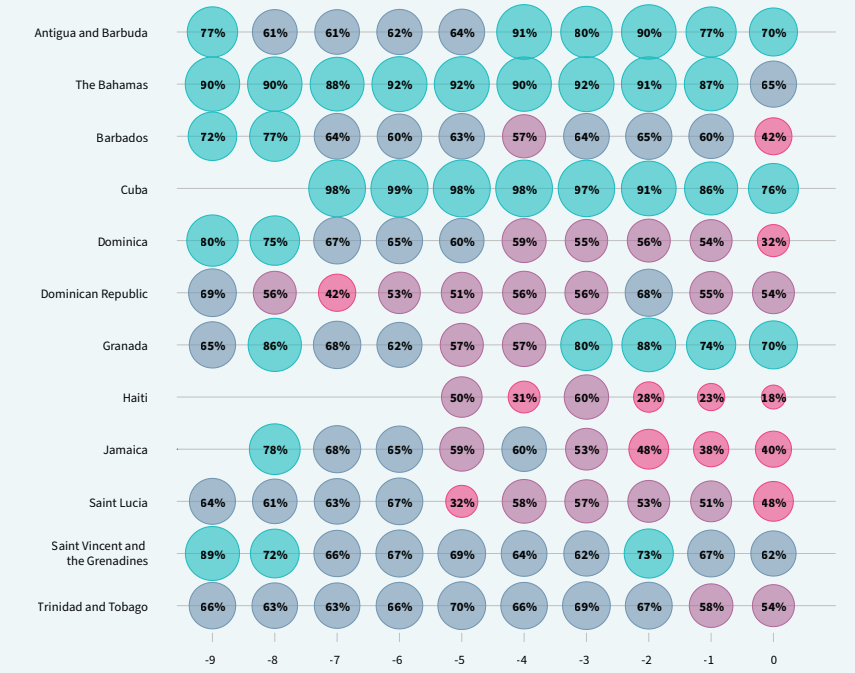
    The recently published Democracy and Development Report 2026 for Latin America and the Caribbean (LAC), from the United Nations Development Programme (UNDP), describes the Caribbean as “one of the most democratic regions in the developing world”, but it also cautions that Caribbean democracies are “under pressure”. Although the recent elections in Antigua & Barbuda and The Bahamas, with voter participation of 62.4% and 66.4% respectively, would suggest that the region’s democratic ethos is continuing to flourish, the UNDP’s concerns are not without substance as some of the less encouraging recent voter turnout figures in Table 1 below indicate, most particularly the figures for Barbados (42%), Dominica (32%), Jamaica (40%), and Saint Lucia (48%).

    Divergent trends in voter turnout in recent elections

    Note: 0 aggregates the data from the most recent elections, -1 aggregates the preceding voter turnout data, and so on back to the first studied (-9).

    Source: UNDP

    The UNDP report, which was published on 11 May, begins by noting some of the shortcomings of the Westminster-style system that dominates in the English-speaking Caribbean. These include the concentration of power in the prime minister, and the first-past-the-post ‘winner takes all’ voting system, both illustrated in the two most recent elections, in Antigua and Barbuda and The Bahamas.

    On the face of it, the Bahamian result, in particular, would suggest a healthy democracy, with the 66.4% turnout increasing from an already high 65% in 2021. In the 12 May election, the ruling Progressive Liberal Party (PLP) led by Prime Minister Philip Davis retained power with a resounding 33-8 victory over the opposition Free National Movement (FNM) under Michael Pintard, making Davis the first leader since the FNM’s Hubert Ingraham in 1997 to win re-election. However, the PLP’s 80% of the seats in parliament came on the back of a much lower 51% of the vote.

    In the 30 April Antigua and Barbuda election, the turnout was 62.4%, and although down nearly eight percentage points from the 70.3% turnout in 2023, it was also well within the acceptable range. The Antigua and Barbuda Labour Party (ABLP) under Prime Minister Gaston Browne won an emphatic 15-2 victory, with one seat each going to the United Progressive Party (UPP), under Jamale Pringle, and the Barbuda People’s Movement (BPM) led by Trevor Walker. However, Browne’s ABLP won 88% of the seats on 60.8% of the vote. By contrast, the UPP ended with under 6% of the seats on 37.3% of the vote. Also Browne’s victory was his fourth in a row, reinforcing the total dominance of the country’s politics by the prime minister.

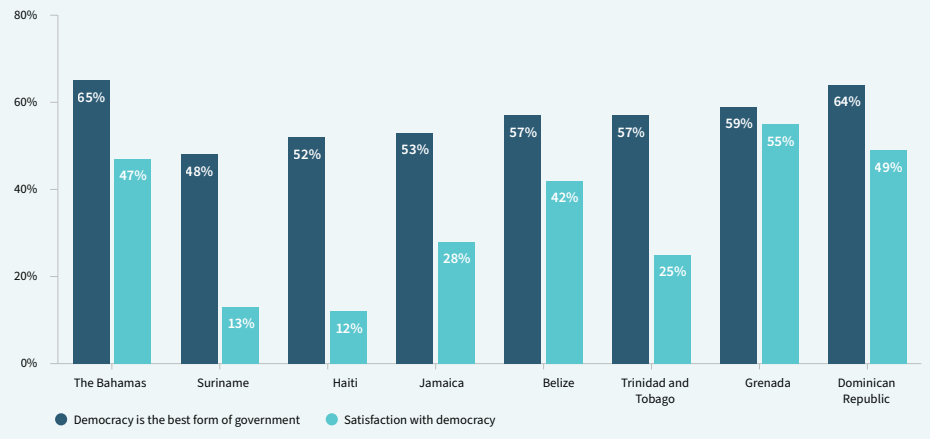
    One of the UNDP report’s principal findings is the declining satisfaction with what democracy is seen to be delivering. Table 2 below indicates that although democracy is recognised by most as the best form of government, satisfaction with what democracy is delivering is much lower. In Jamaica, for instance, 53% of respondents say that democracy is the best form of government but only 28% are satisfied with it. The pattern is mostly repeated in the eight countries surveyed, except notably in Grenada where 59% believe democracy is the best form of government and 55% are satisfied with it.

    Falling voter satisfaction with democracy

    Source: UNDP

    Reviewing the data in Table 2, the UNDP report warns that the gap between support for democracy as the best system and levels of satisfaction with the outcome of democratic government is a potentially dangerous one. It warns: “This gap reflects a pressure that, if not effectively addressed, may undermine the very foundations of democratic coexistence”. The risk, it adds, “is not an immediate abandonment of the regime, but rather a gradual erosion of legitimacy and of the bonds of trust that sustain the democratic contract. It is precisely within this gap that the main pressure on Caribbean democracies is concentrated today.”

    Given the English-speaking Caribbean has, in the UNDP’s words, “a well-earned reputation as a bastion of representative democracy, respect for the rule of law, and defence of democratic institutions”, this warning might seem exaggerated. However, the UNDP also points out that the region’s record is not pristine. Grenada, under the People’s Revolutionary Government from 1979-1983, and Trinidad and Tobago in 1990, when Islamist radicals mounted a failed coup attempt, have both suffered constitutional disruption. In Guyana, the 21-year rule of Forbes Burnham (1964-1985) was marked by authoritarianism and rigged elections, and although free and fair elections have been held since 1992, in 2020 then-president David Granger (2015-2020) attempted, ultimately unsuccessfully, to subvert the result of the general election, refusing to concede defeat for five months of legal wrangling.

    For the UNDP, the main challenge is the state’s capacity to deliver. The UNDP argues that democracy “acquires legitimacy” when citizens feel the effective presence of the state in their daily lives, most particularly in the key areas of education, health, justice, security, and social protection. It says: “The link between State capacity and human development is crucial: democratic institutions generate legitimacy and a shared sense of direction, but it is State capacity that enables the translation of these decisions into tangible outcomes that improve people’s well-being.”

    The right to vote, the separation of powers, and the rule of law are “non-negotiable minimums” for democracy, but they are not sufficient. Democracy also has to enable people “to live better”. When this expectation is not met, “the result is not a rejection of democracy as a principle, but rather a growing distance from its day-to-day performance”.

    Relatively small workforces and limited technical resources are among the factors that limit the capacity of Caribbean civil services, compounded by the migration of skilled professionals to larger economies and competition from the private sector.

    As a result, the UNDP warns, “many countries struggle to strengthen core State functions”. Failures of the education system are an additional problem. Across the Caribbean, enrolment rates in tertiary education are below 25%, which is half the rate in Latin America (52%). Below the tertiary level, in the 2024 Caribbean Examinations Council (CXC) results, only 4.9% of students passed five or more subjects.

    The problem with the failure of education in the Caribbean goes beyond its effect on state capacity; it is also one of the reasons for declining satisfaction with democracy. The failure of the education system to provide a path to advancement, diminishes public trust in the system and, in the UNDP’s words, “weakens the social contract”.

    Another area where a lack of progress is feeding dissatisfaction is health. While most countries in the Caribbean have made important gains in life expectancy, with a range of 66 to 76 years, it is still below the 77.8-year average in Latin America. And healthy life expectancy is below 70 in most Caribbean countries, including Barbados (67), Jamaica (67), Trinidad and Tobago (66), Belize (65), St Lucia (65), St Vincent and the Grenadines (64), Grenada (64), and The Bahamas (64).

    The UNDP emphasises how important strengthening health provision in the Caribbean is to maintaining faith in democracy. It says: “Ensuring equitable and timely access to health care is not only a sectoral objective, but an essential component of the social contract…The State’s capacity to protect the health of its population becomes a tangible indicator of legitimacy and an indispensable condition for social cohesion and democratic stability.”

    Security is another area where the state has to deliver or lose legitimacy, yet the Caribbean has some of the highest murder rates in the world. In 2022, 12 of the 20 countries with the highest murder rates globally were Caribbean states. This has led both Jamaica and Trinidad and Tobago to declare states of emergency in an attempt to counter rising gang violence and organised crime. However, the UNDP says, “many security institutions (police) lack the capacity and forensic resources to eradicate crime and continue to be hampered by outdated legislation and inefficient justice systems. Low level trust in the police forces and the government further aggravate eradication efforts.”

    In some parts of the Caribbean, for instance in Haiti and (to a much lesser, but still important extent) Jamacia, the expansion of gangs and criminal organisations has led to non-state actors controlling territory, providing parallel government structures, and regulating access to key services.

    Then there is climate change, which is putting ever greater pressure on the resources of the state. For example, in 2017 more than 3m people were displaced in a single month due to hurricanes. Between 2001 and 2020, extreme weather events increased by 85% compared to the previous two decades, according to figures cited by the UNDP, resulting in losses amounting to 3.6% of aggregate GDP. Rising sea levels are another threat, averaging 3.6 millimetres per year from 1990-2020. As a result, the UNDP reports, the region faces an estimated requirement for adaptation of “more than US$100bn, equivalent to approximately one-third of its annual economic output”.

    In conclusion, for the UNDP the key to strengthening democracy in the Caribbean lies in building state capacity. It says: “The link between democracy, State capacity and human development is crucial: democratic institutions generate legitimacy and a shared sense of direction, but it is State capacity that enables the translation of these decisions into tangible outcomes that improve people’s well-being.”

    But how can this be achieved? Not surprisingly, the UNDP does not have a magic wand. For the UNDP, greater regional and intraregional cooperation is a key starting point. It says: “Given the small scale of many Caribbean States and decline in democratic satisfaction, strengthening administrative, fiscal and technical State capacities is essential to provide public goods, guarantee rights and respond to citizens’ expectations. Regional cooperation, capacity-building initiatives and partnerships with civil society, the private sector and international organizations can play a crucial role in overcoming these barriers and promoting sustainable development and governance in the Caribbean.”

    The importance of building “capable, stable and professionalized public administrations” is emphasised, as is the need for meritocratic civil service systems “combined with accountability mechanisms” that “help reduce clientelism or institutional capture, promote public trust and the continuity of welfare-oriented public policies”.

  • POINTERS

    LatinNews 09 December 2011 Hits: 523

    MEXICO | Main turf war escalates in Sinaloa and Jalisco. On 23 November 17 burnt bodies were found in vehicles abandoned in Culiacán, Sinaloa, and another seven in outlying areas. The following days 26 bodies were found in cars abandoned in Guadalajara, Jalisco. In one of the latter was a placard in which Los Zetas claimed responsibility for the killings, which they presented as a warning to the Pacífico/Sinaloa drug trafficking organisation (DTO) and its local allies, the Jalisco/Nueva Generación gang. The abduction of ten of the victims had been reported to the police a few days earlier. Investigators were able to determine that out of 15 victims who had been identified, six had criminal records for fraud, car theft or retail drug trafficking, but said there was no evidence that all of them had belonged to any of the warring cartels.

    The message accused the governors of Jalisco and Sinaloa, Emilio González Márquez and Mario López respectively, of being ‘intimate friends’ of  Joaquín Guzmán (‘el Chapo’) boss of the Pacífico/Sinaloa DTO, and both the latter and his associate  Ismael Zambada (‘el Mayo’) of being ‘informants of the gringos’. In support of this last accusation it cites the statements made in the US by Zambada’s son, Vicente (see page 14). It also hints that Guzmán and Zambada enjoy the support of the army, the marines and the federal police. The message says that the intention of  the killings was to prove that Los Zetas could act without the help of any authority and that Guzmán, Zambada, ‘the Jalisco people’ and ‘the people of Salgueiro’ -the recently arrested boss of Gente Nueva, a gang allied with Guzmán that operates in Chihuahua- were ‘unable to protect even their own territory’.

    The fact that the Guadalajara message links the killings there with Jalisco - and the near-simultaneity of the massacres- has led the authorities in both states to investigate if the actions were coordinated.

    MEXICO | Police purges continue. In early November the federal attorney general’s office (PGR) sent dismissal notices to 600 officers of the Policía Federal Ministerial (PFM - formerly the Agencia Federal de Investigación, AFI) on charges of failing the ‘confidence test’ (vetting procedure), ‘bad character’ and ‘high stress levels’. On 7 November half of the dismissed officers issued a joint statement that they would challenge their severance in the courts; 70 of them went to congress to ask for support from the legislators in the lower chamber. They say they are in favour of the ‘cleansing’ of police forces ‘as long as it is fair, conducted according to law and respecting individual rights.’

    The dismissed officers have criticised the ‘confidence tests’ as ‘clumsy and manipulated’; they say the tests are administered by untrained youths who are unfamiliar with police activity. They have said that they intended to enlist the support of all dismissed officers (several of whom are posted outside Mexico City) and that they would stage public demonstrations.

    Elsewhere, the ‘cleansing’ of local police forces has continued. In late October and early November, 57 officers (46 in Montemorelos and 11 in Hidalgo) were arrested on charges of corruption or links with organised crime. On 14 November the governor of Sinaloa, Mario López, announced that 32 police officers of the municipal force of Ahome had been arrested on suspicion of having engaged in (unspecified) criminal activities. Among these are the force’s director, León Horacio Reyes, and its chief of operations, Omar Pérez. State ministerial police carried out the arrests with the support of federal police. The governor said that similar operations were likely to be conducted in other municipalities.

    Sinaloa is the home territory of the Pacífico/Sinaloa DTO, whose control is being challenged by Los Zetas (see above).

  • TRACKING TRENDS

    LatinNews 17 January 2013 Hits: 2289

    BOLIVIA | BOA announces more routes. On 15 January Bolivia’s state-owned airline carrier, Boliviana de Aviación (BOA) announced that from next month it will begin operating flights connecting Bolivian cities to the US destinations of Washington and Miami. The announcement was made by public works minister, Vladimir Sánchez, who explained that flights operated by planes with a 300-passenger capacity will fly from La Paz, Santa Cruz de la Sierra, and Cochabamba to the US. Following the collapse of flag carrier airline, AeroSur, last year BOA become Bolivia’s only airline, taking over AeroSur’s profitable routes to Europe. According to Sánchez the company, which last year carried some 1m passengers, is also considering expanding its fleet this year with the purchase of 12 new planes in order to meet an expected increase in demand.

    ECUADOR | US firms win oil provision contracts. On 16 January Ecuador’s state-owned oil firm, Petroecuador, announced that US firms, Citizens Resources LLC and Lukoil Panamericas had been awarded contracts to supply Ecuador with diesel and high octane petrol. A Petroecuador statement said that the firms had presented the best offers during the international tender process launched last year. Citizens has been contracted to supply some 2.16m barrels of diesel a month starting from February for an undisclosed price. Meanwhile, Lukoil is to provide 6m of high-octane petrol. In addition Petroecuador also revealed that another US firm, Arkham, has won a contract to export 540,000 barrels of low-octane produced at Petroecuador’s refineries.

    The deals come amidst the ongoing legal battle between Ecuador and US oil giant, Chevron, which has been ordered by an Ecuadorean court to pay US$18.2bn in damages as a result of the contamination produced by operations in the country’s Amazon region. Chevron is challenging the court’s ruling which it considers to be “illegitimate”.    

    PERU | Highlighted by Black Rock. Peru is now Latin America’s second safest investment destination behind its southern neighbour, Chile, according to the latest sovereign risk index report released by US multinational investment management corporation, Black Rock, the world’s largest asset management company.

    The ‘BlackRock Sovereign Risk Index’ (BSRI), which ranks countries in accordance with a series of financial, fiscal and institutional parameters, highlights that in recent years Peru has exhibited an optimal fiscal standing thanks to its prudent macroeconomic management. This has allowed the country to be ranked 19th in the global index above some developed countries such as France (27) and the United Kingdom (23).

    Commenting on this, Black Rock’s executive director for South America, Axel Christensen, stated that “it is worthwhile noting that Peru now takes second place in Latin America surpassing developed countries. In the variable categories measured, Peru stands out for the high valuation of its fiscal situation”. This will further raise Peru’s profile among international investors who use the BSRI as an important tool to develop their investment strategies.

    VENEZUELA | Food shortages persist despite billion-dollar imports. Consumer price inflation was 19.9% in 2012, down from 27.6% in 2011, according to the central bank. Part of the explanation is found in massive public sector purchases from abroad in a presidential election year. Imports soared to a new historic high of US$56.34bn in 2012, on preliminary central bank figures, up 20.4% from US$46.8bn in 2011 and beating the previous record of US$51.5bn set in 2008 (another election year).

    In 2008, a full three quarters (75%) of imports were brought in by the private sector; in 2012 the private sector’s share of imports was much lower, at 61.4%, while the public sector’s share rose to 38.6% in 2012, up from 25% in 2008. In total the public sector spent US$21.8bn on imports in 2012, up 28.3% from US$17bn in 2011, while private sector imports came to US$34.6bn, up 15% year-on-year.

    The bank also reported that the two official exchange rate agencies, Comisión de Administración de Divisas (Cadivi) and Sistema de Transacciones de Títulos en Moneda Extranjera (Sitme) between them authorised US$34bn in foreign currency (mostly US dollars) for private sector imports in 2012.

    Sidebar: Food price inflation

    Venezuela’s food price inflation was stubbornly high at 24.8% in 2012, down from 33.6% in 2011, and basic food shortages persist. Vice president Nicolás Maduro accuses shopkeepers of hoarding and has dispatched Karlin Granadillo, the head of the just prices superintendency (Sundecop) to crack down.

  • In Brief – Venezuela

    LatinNews 27 February 2013 Hits: 1793

    POLITICS | Government turns a deaf ear to student, opposition demands. Small groups of students continue to protest in Caracas calling for the government to clarify the uncertainty surrounding the seriously ill President Hugo Chávez. The students have shifted their focus from the Cuban embassy to the supreme court of justice (TSJ), where yesterday a group of about 50 demanded that the court swear in Chávez for the new term to which he was elected last October.  Chanting, “Who are we? Students! And what do we want? The truth!” and “No to the Cuban intervention!” the students were surrounded by national police officers to prevent them from chaining themselves to the building’s railings. Opposition media claimed that 10 protestors were injured. The government continues to reject the calls for Chávez to be sworn in, arguing that he remains in power and continues to run the country from his hospital bed. Vice President Nicolás Maduro yesterday admitted that the president was still suffering from breathing difficulties and added that he had begun “very tough” complementary treatments for his base illness (i.e. his cancer).  The supreme court argued in a 9 January ruling that the swearing-in ceremony could take place at any time and said that the president re-elect and his cabinet could remain in situ under the principle of administrative continuity.  National Assembly President Diosdado Cabello said on Monday (25 February) that Chavez would himself decide when to swear in, in consultation with the TSJ.

  • RASTREANDO TENDENCIAS

    LatinNews 04 August 2013 Hits: 556

    CHILE | Informe de la ONU sobre los Mapuche. Ben Emmerson, el investigador especial sobre derechos humanos y contra-terrorismo de la ONU, visitó Chile en julio y dijo que la situación era ‘volátil’ en la región sureña de la Araucanía y Bío Bío, donde viven cerca de 1,0m de Indios Mapuche. La violencia se ha incrementado de nuevo en la región desde el año pasado, a medida que los Mapuche están involucrados en una lucha para recobrar sus tierras ancestrales. El funcionario de la ONU urgió al gobierno para que halle una solución a la cuestión de la tierra. Emmerson dijo que la situación podría volverse en un gran conflicto regional a menos que el gobierno tome acción urgentemente. Él fue particularmente crítico del uso por parte del gobierno de la legislación antiterrorista contra los Mapuche, que proviene de la época de la dictadura militar de 1973-1990, y que fue aplicada de una “manera confusa y arbitraria” y que discrimina contra los pueblos indígenas. Una facción radical de los Mapuche ha ocupado e incendiado granjas; el 29 de julio, alrededor de 90 Mapuches atacaron una estación de policía en Alto Bío Bío.

    CHILE | Las encuestas aún favorecen a Bachelet. Una encuesta de opinión realizada para Radio Cooperativa por Imaginacción y la Universidad Central de Chile el 30 de julio, ubica a la candidata presidencial de centro-izquierda, la ex presidenta Michelle Bachelet (2006-2010), bastante adelante de su rival de la coalición conservadora, Evelyn Matthei, en la carrera de la elección de noviembre. Más de tres cuartos (76,9%) de los entrevistados creen que Bachelet ganará para convertirse en presidenta por segunda vez, contra sólo el 20,5% que espera que sea Matthei la que triunfe. Matthei, miembro de la conservadora Unión Democrática Independiente (UDI), el socio mayoritario en la coalición gobernante, fue nominada después de que Pablo Longueira abandonara la carrera por motivos de salud. Con una confortable ventaja en su favor, los analistas predicen que Bachelet ganará en la primera ronda, el 17 de noviembre. Los jefes de campaña de Bachelet, por su lado, negaron los rumores de que ella estaba sufriendo de fatiga y de que no era capaz de soportar periodos extensos de tiempo parada de pie.

    CHILE | Nuevo ministro del trabajo. El 24 de julio Presidente Sebastián Piñera tomó juramento a Juan Carlos Jobet como su nuevo ministro de trabajo. Él reemplaza a Evelyn Matthei, quien renunció oficialmente el 22 de julio para competir como la candidata presidencial por la gobernante Coalición por el Cambio en las elecciones generales del 17 de noviembre, después de que el candidato previo, Pablo Longueira, se retirara por razones de salud. Un miembro de Renovación Nacional (RN) del Presidente Piñera, el socio minoritario en la coalición gobernante, Jobet inicialmente sirvió como coordinador del ministerio del interior bajo el ex ministro del interior (y ahora ministro de defensa), Rodrigo Hinzpeter. Jobet fue transferido al puesto de subsecretario de vivienda en julio del 2011, una posición que él dejó en noviembre para actuar como coordinador del programa de campaña para el pre-candidato presidencial de la RN, el ex ministro de defensa Andrés Allamand (2011-2012), quien fue derrotado en las primarias del 30 de junio. Matthei, como Longueira, proviene del mayor partido de la coalición gobernante, la Unión Demócrata Independiente (UDI).

    BRASIL | No al rescate de Grecia por el FMI. En lo que puede describirse como un cambio de roles comparado con hace dos décadas, Brasil dijo que junto con otros diez países latinoamericanos no apoyaba el último rescate para Grecia del Fondo Monetario Internacional (FMI). Paulo Nogueira Batista, director ejecutivo de Brasil en el FMI, dijo que su país se había abstenido en una votación de la junta directiva sobre un desembolso de US$2,29mm para Grecia, debido a que las medidas de austeridad de Grecia habían sido “insatisfactorias en casi todas las áreas”.

    BRASIL | La confianza aún está decayendo. De acuerdo con el instituto nacional de estadísticas (Ibge), se perdieron 120.000 empleos en junio, a medida que la tasa de desempleo se elevó del 5,8% en mayo al 6,0%. El Ibge dijo que aproximadamente la mitad de los empleos industriales perdidos estaban basados en el área de São Paulo, el corazón industrial del país. Mientras tanto, el Índice Económico Líder (IEL) para Brasil, compilado por Conference Board y la Fundação Getúlio Vargas que no había tenido cambios en abril, cayó un 1,2% en mayo, y se contrajo de nuevo un 0,6% en junio. El economista de Conference Board, Ataman Ozyildirim, dijo que “El IEL apunta a una actividad económica lenta para el resto del 2013. La debilidad del IEL de Brasil está de acuerdo con la debilidad de los indicadores líderes en China e India”.

    • Pronósticos de Brasil tocan fondo

    El sondeo semanal ‘Focus’ del banco central de Brasil, que cubre a más de cien analistas privados, y difundido el 29 de julio, muestra que sus expectativas sobre el crecimiento promedio real anual del PIB para el 2013 habían tocado fondo en  un 2,3%, después de 10 semanas de consistentes reducciones semana en semana.

  • ECONOMIC OVERVIEW: CHILE

    LatinNews 15 April 2014 Hits: 1085

    Earthquake: On 1 April an earthquake registering 8.2 on the Richter scale struck northern Chile resulting in six deaths. The tremor mainly hit the region of Tarapacá and preliminary reports suggest that some 1,300 homes were severely damaged while another 10,600 more were partially affected. On 8 April the Bachelet government announced that it would assign C$1.6bn (US$3m) for reconstruction efforts in the north of the country.

    Inflation: A report released by Chile’s national statistics institute (INE) on 8 April put monthly inflation in March at 0.8%, bringing the accumulated rate so far this year to 1.5%, while the inter-annual rate now stands at 3.5%. Inflation closed 2013 at 3.0%.

  • TRACKING TRENDS

    LatinNews 31 July 2014 Hits: 1092

    BRAZIL| Industrialists demand fiscal reform. On 28 July the Brazilian confederation of industrialists (CNI) presented a document entitled Industry proposals for the 2014 elections which contains a set of “essential” proposals and recommendations to foster growth and competitiveness in the country. On 30 July, during a CNI-hosted meeting, copies of the document were handed over to the main presidential candidates taking part in the 5 October general elections – President Dilma Rousseff of the Partido dos Trabalhadores (PT), Aécio Neves of the centrist Partido da Social Democracia Brasileira (PSB) and Eduardo Campos of the Partido Socialista Brasileiro (PSB).  The CNI’s main demand is for a reduction in Brazil’s onerous tax burden which it complains currently limits the country’s growth rate (which the CNI forecasts will hover at 1.0% in 2014). The CNI, which also complains that the tax burden significantly increases the cost of opening new factories (by an estimated 10.6%), says that this tax reduction should ideally be accompanied by a simplification of the tax system itself and tax breaks for exports and investments. The document also calls for the government to boost spending on infrastructure which currently stands at R$73bn (US$32.5bn) per year. According to the CNI, this figure should be brought to at least 5% of GDP, or R$175bn (US$77.9bn). “The basis of CNI’s vision for the next four years is that there are numerous growth opportunities for the country and its industry but we need to overcome some challenges, the main one being competitiveness”, said José Augusto Fernandes,  the CNI’s director of policy and strategy, who presented the document. “Brazil has turned into an expensive and uncompetitive country”, he added.

    • Volkswagen scales back operations in Argentina

    On 24 July German car manufacturer, Volkswagen, announced it will suspend operations for two five-day periods (28 July-1 August, 1-5 September) at its plant in Córdoba, Argentina. According to the firm, the suspension - during which 1,100 workers will receive 75% of their salary - is due to a fall in exports to Brazil. The announcement follows the 18 July decision to close Volkswagen’s plant in General Pacheco, Buenos Aries province, for a ten-day period also due to a drop in regional demand. Argentina’s auto manufacturing sector has been experiencing a sharp fall in activity since June as a result of lower demand both in Argentina and also in Brazil as the two leading South American economies continue to experience a marked slowdown.

  • ARGENTINA: Tucumán casts shadow over October elections

    LatinNews 24 September 2015 Hits: 1537

    Allegations of ballot-box burning, shortages of ballot papers and other electoral malpractices resulted in the annulment of Tucumán’s gubernatorial elections by a provincial court on 16 September. A few days later, however, the province’s supreme court overruled the decision, declaring the results from the election on 23 August to be valid, thus handing the victory to Juan Manzur, the candidate for the federally ruling Frente para la Victoria (FPV). José Cano, the losing candidate, decided against appealing the decision at the national supreme court. But the row over the Tucumán results has led directly to Argentina’s electoral court outlining new measures to ensure confidence in the general elections next month.

    Last week three of the main opposition presidential candidates, Mauricio Macri, Sergio Massa and Margarita Stolbizer, held an unprecedented joint news conference to call for electoral reform. On 23 September the national electoral council (CNE) announced changes to the system, including the provision of witnesses and GPS tracking to monitor the postal system’s trucks that are used to transport ballots.

    The CNE also called on electoral parties to deliver more ballot papers to polling stations and to check regularly to see if ballots are missing. The body also permitted the creation of complementary polling booths where ballot papers from all political parties will be available to voters.

    • FPV wins Chaco

    In the northern province of Chaco, Domingo Peppo, the candidate from the FPV, won the gubernatorial elections held on 20 September by 55% to 42% over Aída Ayala, of the opposition Unión Cívica Radical (UCR).

    One of Argentina’s poorer provinces, Chaco has long been a stronghold of the FPV and the result surprised few. It is the last provincial election scheduled before the general elections on 25 October.

    • Poverty

    A federal judge in Argentina has called on the government to provide a report containing current poverty figures. Judge María José Sarmiento gave the finance ministry a five-day deadline to respond to an opposition petition asking for an update of the poverty situation, for which the most recent figures date back to 2013. The national statistics institute (Indec) stopped releasing its semi-annual poverty figures in the first half of 2013 when it reported that 3.7% of households were in a state of poverty and 4.7% of the population. Private bodies put the figure much higher, at around 25% of the population.

  • REGION: US accused of 'divide and rule'

    LatinNews 21 February 2020 Hits: 770

    A year ago, in January 2019, a split within the Caribbean Community (Caricom), and between leading Caricom members and the US, developed over policy towards Venezuela. A row over the visit this January to Jamaica by US Secretary of State Michael Pompeo shows that the split has not yet been healed.

    On 10 January 2019, the Organisation of American States (OAS) voted that Venezuela’s President Nicolás Maduro should no longer be recognised as president. Among the 19 OAS countries voting in favour of this move were Caricom members Jamaica, St Lucia, the Bahamas, and Guyana. On 23 January 2019, the president of Venezuela’s National Assembly, Juan Guaidó, declared himself president of Venezuela and this was promptly recognised by the OAS.

    This led Caricom to issue a statement on 24 January urging countries to respect the principal of non-interference. It then remonstrated with OAS Secretary General Luis Almagro in a letter dated 31 January. The letter was signed by Caricom chairman Timothy Harris, the prime minister of St Kitts & Nevis. He wrote to Almagro saying: “The Heads of Government consider it imperative that you publicly clarify that you did not speak on behalf of all member states. We are aware this is not the only occasion on which you have made public utterances in the name of the [OAS] without authority. This type of unilateral action by a head of an international organisation, whose membership comprises sovereign states, is a clear departure from normal practice and cause for great concern.”

    Two months later, the split within Caricom widened further when Jamaica’s Prime Minister Andrew Holness, Bahamas’ Prime Minister Hubert Minnis, Dominican Republic President Danilo Medina, Haiti’s President Jovenel Moïse, and St Lucia’s Prime Minister Allen Chastanet met US President Donald Trump on 21 March to discuss policy towards Venezuela, or rather to endorse US policy towards Venezuela.

    This meeting prompted a strong reaction from St Vincent & the Grenadines’ prime minister Ralph Gonsalves. Speaking the following day, Gonsalves made the point that this was in no way a Caricom delegation. He said that neither the chairman - St Kitts & Nevis Prime Minister Timothy Harris - nor members of the Caricom advisory committee, comprising Barbados’ Prime Minister Mia Mottley, Trinidad’s Prime Minister Keith Rowley, or Gonsalves himself, had been invited to the meeting.

    Gonsalves characterised US policy towards Venezuela as a “creeping coup”, and he then castigated the errant Caricom members by saying that it is not because of the subsidised Venezuelan ‘Petrocaribe’ oil scheme that Caricom is supporting the principles of “non-intervention and non-interference and no threats of force or sanctions” but because of “high principle and our commitment to international law”.

    In a final plea to his fellow Caricom members, Gonsalves said: “I just want to keep Caricom viable”; and in a final dig at the Trump administration he said: “I don’t have to try and make the Caricom civilisation great again. We are an alive civilisation of legitimacy. We have a history of achievement and we have a trajectory of ennoblement. We are not better than anybody, and nobody is better than us, and you must not try to divide us.”

    Gonsalves said: “None of those persons was invited, and for it to be a true Caricom representation you must at least have the chairman…It cuts across the agreement mechanisms that we have put in place.”

    Pompeo’s visit

    Now all this has blown up again with Pompeo’s visit to the region, and in particular with his selected invitations to regional leaders to a meeting in Jamaica on 21 January at which policy towards Venezuela was to be discussed.

    In addition to Jamaica, the invitation list included Barbados, The Bahamas, Belize, Haiti, the Dominican Republic, Trinidad & Tobago, St Kitts & Nevis, and St Lucia. However, three days before the scheduled meeting, Prime Minister Mia Mottley of Barbados, who is also the chairman of Caricom, declared: “As chairman of Caricom, it is impossible for me to agree that my foreign minister should attend a meeting with anyone to which members of Caricom are not invited. If some are invited and not all, then it is an attempt to divide the region.”

    Mottley immediately found support from Trinidad’s Prime Minister Keith Rowley, who said: “PM Mottley has the full support of the government and the people of Trinidad & Tobago in outlining our principles and vision of Caribbean unity. In the expectation of Caribbean unity, the prime minister of Barbados speaks for Trinidad & Tobago.”

    Mottley also received support from Antigua & Barbuda, St Vincent & the Grenadines, and Grenada. Antigua’s Foreign Minister Chet Greene said: “We are very much in support of, and identify with, the sentiments expressed by the Caricom Chair, PM Mottley of Barbados. As a government we stand in support of this position.”

    All of this forced Pompeo on the defensive, and he had to deny at a press conference in Kingston that the US was seeking to divide Caricom – “not yesterday, not today, not tomorrow”, he said, adding that it was natural for there to be occasional differences between members of Caricom and the US.

    Nevertheless, Pompeo gave little ground, strongly reiterating the US’s position on Venezuela, security issues in the region, and the dangers of relying too much on Chinese investment.

    On Venezuela, Pompeo was full of praise for the OAS and its support for Guaidó, but it is unlikely that he will make much progress in peeling away more Caricom members from the official position of non-interference. At the July 2019 Caricom summit meeting in St Lucia, despite the fact that Jamaica, St Lucia, the Bahamas, and Guyana had supported the OAS’s recognition of Guaidó in January 2019, the group reiterated its position on non-interference in Venezuela’s internal affairs and agreed “that mediation-related activities would continue to be pursued by the prime ministers of St Kitts & Nevis, Barbados, and Trinidad & Tobago”.

    On the security question, Pompeo said: “Isis fighters…have come from Trinidad & Tobago. Hezbollah has tentacles all over South America. [Colombian guerrillas from] Farc [Fuerzas Armadas Revolucionarias de Colombia] and the ELN [Ejército de Liberación Nacional] take refuge today in Venezuela. The manmade crisis Maduro has caused in Venezuela has driven an unprecedented migration crisis. Nearly 5m Venezuelans have fled his tyranny. Cuba and Russia continue to meddle in nations’ sovereign affairs, while trying to destabilize democracies. And of course, there are the drug cartels that we deal with, and the human trafficking, and arms trafficking, and the cybercrime that come alongside of them”.

    “This is very different than the times of the Cold War…The bad guys are more sophisticated, and more ruthless. And our nations have an obligation, therefore, for our very people, to work in the interest of our shared security much more closely. That’s what we’re already doing in the Caribbean Basin Security Initiative, now its 10th year, a decade on. We’re having incredible success seizing drug shipments. We’re helping kids stay away from crime. And we stand ready, America stands ready to keep doing those good things in partnership with countries in the region. “Let’s keep moving forward on those closer ties…”

    The China question

    Another clear focus of Pompeo’s trip was to warn the Caribbean about getting too close to China, but this issue raises some interesting anomalies. For instance, the Dominican Republic (which attended the meeting in Kingston) switched its allegiance from Taiwan to mainland China in May 2018. St Vincent & the Grenadines, on the other hand, which was not asked to the meeting, is one of the holdouts still supporting Taiwan. Of those invited to the meeting in Kingston, Belize, Haiti, St Kitts & Nevis, and St Lucia still recognise Taiwan.

    In May 2018, Trinidad became the first Caribbean country to sign up for China’s Belt and Road Initiative (BRI). Other Caribbean countries that have been welcoming China’s advances include The Bahamas, Jamaica, Guyana, Barbados, Grenada, and Suriname. Jamaica, Pompeo’s host, signed up to the BRI in April 2019.

    Pompeo based his warnings on China on the proposition that China does not have the Caribbean’s best interests at heart, and that its business practices were threatening to the rule of law. He said: “It’s tempting to accept easy money from places like China. But what good is it if it feeds corruption and undermines your rule of law? What good are those investments if in fact they ruin your environment and don’t create jobs for your people?”

    The “better alternative” that Pompeo proposed was to stay committed to the West. He argued: “Western firms, American firms, operate according to values proven to produce good deals and quality work, the work that we do in democracies, things like transparent contracts, the respect for the rule of law, honest straightforward accounting practices.”

    He returned to this point in a later press conference, warning that Western companies may not be prepared to operate in “places where there’s not rule of law, where there will be competitors that are permitted to participate in the economic ecosystem [and] who are doing so in ways that are outside of the law…”

    Warming to his theme, Pompeo added: “If you’re somebody who’s deciding whether to invest in a particular country, if that country’s permitting some other nation to show up and do deals, either through bribery or non-transparency, or with state-sponsored enterprises that are competing unfairly that they can’t possibly compete with, the chance of getting good money, money that’s coming in for the right reasons, is decreased.”

    However, it wasn’t just unfair business practices by China and Chinese companies that Pompeo warned about, he also warned against Chinese investments that were being made for more than for “economic purposes”. He warned that “we all owe it to the people of our nations to make sure that when foreign direct investment is taking place, that it’s coming truly for the right reasons – that it’s not coming for a national security reason to put at risk the privacy of the citizens of Jamaica, right; it’s not coming to have a political outcome; that it’s truly an economically based [investment]…”

    The US-Jamaica security partnership

    But if Pompeo was keen to warn his hosts about the danger that China’s investments could be “coming for a national security reason”, he was equally keen to emphasise that the US’s own relationship with Jamaica was firmly based on “national security” calculations. This was spelt out in a fact sheet put out by the US State Department to coincide with Pompeo’s arrival in Jamaica (see box next page).

    Jamaica and the US cooperation

    Entitled “Jamaica and the United States: A Model for Partnership in The Caribbean”, the fact sheet highlighted, inter alia, the following:

    • Over the past six months, the US and Jamaica finalized four key security-related agreements to expand our joint capabilities to combat transnational crime, illicit trade, and aviation safety.
    • The US State Department and US Agency for International Development (USAID) are working together to professionalize law enforcement and strengthen counter-narcotics, rule of law, child trafficking, and anti-corruption efforts.
    • The US is helping Jamaica enhance its marine domain awareness and intelligence surveillance and reconnaissance capacities, including through an advisor program for Jamaica’s Maritime Patrol Aircraft.
    • Both countries are advancing cybersecurity, including hosting the inaugural Cyber Capacity Building Workshop for the Caribbean and Latin America – the first of its kind for the region – and through the development of an innovative cyber security degree program with the Caribbean Military Academy and Arizona State University.
    • Together, at the OAS, the two countries have “consistently advanced policies in support of human rights and democracy in the region wherever threatened, including in Venezuela and Nicaragua”.
    • US Treasury Secretary Steve Mnuchin and Jamaican Prime Minister Andrew Holness launched the US-Jamaica Energy Infrastructure Finance Working Group in November 2018 to expand energy supply and generation, transmission and grid solutions, and energy investment.
    • In December 2019, Jamaica was one of the first four countries to join the Growth in the Americas Initiative, to accelerate private sector led economic growth in energy and infrastructure projects.
    • The US Department of the Treasury is establishing a resident advisor to assist the Ministry of Finance with the tendering and financing of large infrastructure projects, such as the proposed Government Oval project.
    • In consonance with the US Caribbean Resilience Partnership, the US is working with Jamaica to strengthen cooperation and advance resilience to withstand the impacts of natural disasters, climate change, and extreme weather events by leveraging Caribbean and American innovation and expertise.
    • In October and December 2019, the Partnership announced approximately US$19.5m in support of these objectives throughout the region.
    • The US is providing US$5m to support Disaster Risk Financing, which will make Jamaica more prepared for natural disasters and save lives.

  • CHILE: Massive blackout causes concern

    Abbi Dicker 27 February 2025 Hits: 4454

    A mass power outage affected 14 out of Chile’s 16 regions on 25 February, leaving some 8m homes without electricity and wreaking havoc on transport services, the mining sector, hospitals, and other important infrastructure. President Gabriel Boric delivered a sombre address at 10pm, as some power was gradually being restored. He characterised the situation as “intolerable” and laid the blame squarely on the private sector and one energy company, ISA InterChile, in particular. His government, which continues to face high disapproval ratings, will be keen to ensure such a widespread blackout does not happen again.

    The blackout affected large swathes of the country, from its northern border with Peru in the region of Arica y Parinacota to the main Chiloé Island in the southern Los Lagos region which serves as the gateway to Patagonia. The area included Chile’s capital Santiago, in the central region of the country, causing the city’s metro system to shut down and streetlights to turn off. By the morning of 26 February, the majority of power had been restored, although Interior Minister Carolina Tohá noted at 10am that some 220,000 people remained without electricity supply.

    Chile’s grid operator, Coordinador Eléctrico Nacional (CEN), announced that the power outage had been caused by the failure of a high-voltage transmission line around 3pm on 25 February. From the beginning, authorities were clear that sabotage was not the cause of the problem, ruling out any kind of attack on the electricity infrastructure.

    When President Boric made his address at 10pm on 25 February – some seven hours after the problems began - he announced that it had been a “difficult day for millions”. He implemented a state of emergency and curfew in all affected regions, covering an area of over 3,000km, from 10pm on 25 February to 6am the following day. Boric pledged to take action against those responsible for the blackout and get to the bottom of how such a mass power outage could have occurred. “What happened today is outrageous,” he declared, saying it was “not tolerable that one or several companies impact the everyday life of millions of Chileans”. He added that it was the state’s duty to hold these companies responsible.

    Chile’s electricity sector, including generation, transmission, and distribution, is privately owned and operated, allowing the government to distance itself from the outage. However, its response, which was arguably somewhat sluggish, and the way it proceeds with investigating the blackout, punishing those responsible, and ensuring compensation for those affected will be heavily scrutinised. If such an incident were to occur again, it would be much less easy for the government to place the blame elsewhere.

    Tohá, who has seen her approval ratings plummet in recent months due to her handling of the rape allegations against her former deputy, Manuel Monsalve (2022-2024), appears keenly aware of the importance of the government’s response. Following a meeting with the national disaster risk management committee (Comité Nacional para la Gestión del Riesgo de Desastres, Cogrid) on 26 February, she announced that the energy superintendency (SEC) would conduct a “thorough investigation” to establish the reasons for the blackout and the corresponding measures and sanctions. Tohá was clear that the situation was avoidable, stating that “with today’s standards, with today’s norms, yesterday’s failure should not have occurred. There are lessons to be learned, there are sanctions to be applied”.

    Approval ratings

    Both President Boric and Interior Minister Tohá have seen their approval ratings decline in recent months. According to a survey released by local pollster Cadem on 23 February, Boric’s approval rating stood at 29%, down two percentage points from a month before, while Tohá’s approval rating was 37%, making her the second-lowest evaluated cabinet minister after Carolina Leitao, the deputy minister for crime prevention.

  • PARAGUAY: Un nombre familiar asume en el ministerio del interior

    LatinNews 22 September 2011 Hits: 832

    El senador Carlos Filizzola prestó juramento como nuevo ministro del interior en la administración del Presidente Fernando Lugo el 26 de agosto. Filizzola, un miembro del Partido País Solidario (PPS), un partido en la coalición de izquierda Frente Guazú, reemplaza a Federico Acuña, que renunció por razones de salud. Acuña había asumido el cargo recientemente, el 17 de junio, de Rafael Filizzola, primo del nuevo ministro, que había sido destituido por Lugo en extrañas circunstancias.

    Lugo había acusado a Rafael Filizzola de no dedicarse exclusivamente a sus tareas, lo que implicaba que él había sido absorbido por  la ‘politiquería’, posiblemente con su visión puesta en competir por la presidencia en 2013; Rafael Filizzola se había opuesto a la reelección de Lugo y afirmó que éste había sostenido que quien se oponía a la reelección  estaba en contra de él [IL-11-25]. Carlos Filizzola, un ex alcalde de Asunción y médico de profesión, fue uno de los principales proponentes de la recolección de firmas para presentar una petición al congreso para que permita la reelección, que fue rechazada de plano en julio: él acusó a los senadores de la oposición, que dominan el congreso, de volver las espaldas al pueblo [IL-11-29]. Rafael Filizzola se confinó a expresar sorpresa por la designación de su primo, pero la esposa de Rafael Filizzola, Desirée Masi, a su vez diputada por el Partido Democrático Progresista  (PDP) de Rafael Filizzola, un partido rival en el Frente Guazú, afirmó que Carlos Filizzola carecía de autoridad y era el arquetipo de quien dice siempre “sí” a las órdenes de arriba.

    Carlos Filizzola inmediatamente trató de desmentir esa afirmación poniendo su impronta en el ministerio. El prometió una política de “tolerancia cero” para la corrupción policial y a los oficiales de ‘gatillo fácil’. Sus comentarios llegaron después que un niño de cuatro años fue muerto el 28 de agosto por una bala disparada por un policía mientras viajaba en un auto conducido por su padre. Los oficiales responsables afirmaron que habían cometido un error mientras intentaban perseguir un vehículo “sospechoso”.

    • EPP

    El obvio desafío para Carlos Filizzola será propinar alguna clase de golpes sobre el grupo de guerrilla Ejército del Pueblo Paraguayo (EPP), que ha desaparecido del radar en meses recientes. Las guerrillas del EPP han operado en los departamentos norteños de Paraguay, fronterizos con Brasil, pero con la excepción de dos ataques con bombas en enero, ellos han estado inactivos en gran medida desde el año pasado, cuando la policía mató a Gabriel Zárate Cardoso, reputado como el tercero en la línea de mando del EPPP.

  • TRACKING TRENDS

    LatinNews 20 October 2011 Hits: 2924

    MEXICO | Calderón accuses the PRI. In a 15 October interview with the New York Times (NYT), President Felipe Calderón accused the Partido Revolucionario Institucional (PRI) of considering going back to making deals with drug-trafficking organisations (DTOs). This was the first time that Calderón has accused the PRI of wanting to return to the so-called “old practices of corruption” and under-the-table deals with DTOs. The PRI reacted immediately and labelled the President’s comments as pre-electoral attacks and as interference in the presidential succession. The presidency, on the back foot, sent an official message claiming that Calderón’s comments had been misinterpreted by the NYT (see sidebar). Calderón claimed that some within the PRI back his security policy (which involves deploying the military to support the police) but said that he feared for this policy if the PRI won in 2012.  

  • An avoidable accident?

    LatinNews 23 November 2011 Hits: 1477

    The interior minister, Francisco Blake Mora, and seven other people were killed on 11 November when the helicopter in which they were travelling crashed en route from Mexico City to Cuernavaca, in the state of Morelos. The cause of the crash is still unclear, but it seems unlikely that sabotage or terrorism brought the helicopter down. Blake Mora is the second of President Felipe Calderón’s interior ministers to die in an air crash. The first was Juan Camilo Mouriño, a great chum of Calderón’s, who was killed on 4 November 2008 when his executive jet crashed near the centre of Mexico City.

    On 17 November President Calderón appointed Alejandro Poiré Romero as his new interior minister. Poiré is Calderón’s fifth interior minister. Traditionally, the ministry (Gobernación) is the most powerful in the cabinet and the minister handles the federal government’s negotiations with congress and state governors.

    Gobernación’s hard power, such as its control of internal security, has been whittled away however; first by the creation of the ministry of public security, which is effectively in charge of reforming the police (and is run by Genaro García Luna) and then by the deployment of the army and the marines from December 2006 in the war against Drug Trafficking Organisations (DTOs).

    As President Calderón is almost into his final year ahead of presidential and congressional elections on 1 July 2012 (the new president is inaugurated on 1 December 2012), Poiré’s acceptance of the post signals that he will not seek election in 2012.

    Poiré’s rise up the ranks in the government has been sensational. He is only 40 and moves to the interior ministry from the top of the national intelligence agency (Cisen), a post to which he was only appointed in September 2011. Calderón is keen on appointing Cisen graduates to his cabinet. Besides García Luna and Poiré, at least one of Calderón’s federal prosecutors has also headed the Cisen.

    Poiré is a political science graduate from the Instituto Tecnológico Autónomo de México (ITAM), the alma mater for most senior Partido Acción Nacional (PAN) officials, and has a doctorate in political science from Harvard, where he has also worked as a researcher and teacher.

    In public life in Mexico, he has worked for the Instituto Federal Electoral, (which runs elections) and was director of political analysis for both the presidency and also the interior ministry. He knows the interior ministry well, having served as a chief adviser and then as a deputy minister responsible for population, immigration and religious issues.

    Calderón’s interior ministers have been a mixed bunch. The first, Francisco Ramírez Acuña, a former governor of Jalisco, left under a cloud of corruption allegations after just a year. He was succeeded by Juan Camilo Mouriño, whom Calderón appeared to be grooming to succeed him as president (even though there were considerable doubts as to whether Mouriño was Mexican by birth).

    Mouriño was succeeded by Fernando Gómez Mont, a well-connected lawyer and PAN stalwart. He resigned on principle, in 2009, over the political alliance deals the government was cutting with the left-wing Partido de la Revolución Democrática (PRD) for the 2010 gubernatorial elections. These deals won three key elections, albeit with the help of dissidents from the Partido Revolucionario Institucional (PRI), and temporarily halted the PRI’s electoral steamroller.

    Then came Blake Mora, whose big success was establishing a cordial relationship with Javier Sicilia, a campaigner for the withdrawal of the army from the war against the drug gangs.

    Calderón said that Poiré was the obvious choice because of his experience of security and political issues. Prior to taking over the intelligence agency in September, Poiré was technical secretary and spokesman for the National Security Council (CSN). The CSN is tasked with harmonising federal and state security policies.

    Poiré’s main task will be ensure that next year’s elections pass off peacefully. This is a big ask: gang violence has erupted this year in Veracruz, the third biggest electoral district in the country after the Estado de México and the Distrito Federal (both of which have been comparatively free of gang killings).

    To date this year (to 18 November), 11,274 people have been killed by gangs across Mexico, according to Reforma’s Ejecutómetro. As the weekly death toll is running at between 150 and 200, the total for 2011 will be around 12,000, slightly above 11,583 officially registered in 2011. In Veracruz, the death toll has jumped from 52 in the whole of 2010 to 298 so far this year.

    The crash itself

    What is alarming is about the crash which killed Blake Mora is that according to the manufacturers Eurocopter, its helicopters in Mexico crash on average five times per 100,000 flying hours, which is well above its global average of 3.2 times per 100,000 flying hours. The Mexican authorities dispute these figures and claim that Mexico’s incidence of helicopter crashes is 0.15 per 100,000 “operations”.

    Following the precedent set by the near public investigation into the causes of Mouriño’s crash, the government is deliberately publicising initial findings from the crash investigation in an effort to puncture conspiracy theories. The government’s view is that the most likely underlying reason for the crash was poor visibility.

    Besides Blake Mora, the other victims included: the deputy minister responsible for legal affairs and human rights, Felipe Zamora; the ministry’s spokesman, José Alfredo García; the technical secretary, Diana Miriam Hayton Sánchez; a military adjutant, Major René de León Sapién; and three crew members.

    Conspiracy theorists cite sources ranging from the pilot’s brother – who, apparently, said that the pilot had told him that there was something wrong with the helicopter before taking off - to commentators, who say that it is more than a coincidence that the helicopter came down just a day after the government arrested Ovidio Limón Sánchez, an important member of the Sinaloa drug-trafficking organisation (DTO). These conspiracy theorists claim that Mouriño was also killed by the Sinaloa DTO.

    UNAM : The Rector of the Universidad Nacional Autónoma de México (Unam) José Narro Robles, a  medical doctor and researcher, has accepted a second four year term, which began on 16 November. The Unam holds an emblematic place in Mexico’s academic landscape and educated many of the technocrats who transformed Mexico. More recently it has been eclipsed, politically at least, by the Instituto Tecnológico Autónoma de México, though under Naro Robles the Unam has started to recover its leading position. The Unam is one of the top, if not the top, university in Latin America.

  • RASTREANDO TENDENCIAS

    LatinNews 25 June 2012 Hits: 596

    BRAZIL| Fusión bancaria. El 14 de junio, BTG Pactual, el mayor banco de inversiones de Brasil y de América Latina, emitió una declaración conjunta con la firma colombiana de valores Bolsa y Renta, informando que habían llegado a un acuerdo de fusión por el cual la firma brasileña pagará US$52m en dinero y acciones a la firma colombiana.

    La declaración, que fue emitida en São Paulo y Medellín, dice que la operación es “un importante paso en la expansión internacional del banco permitiéndole aprovechar la ventaja de la posición de Bolsa y Renta en el creciente mercado colombiano junto con plataformas de negocios que ya tiene en Brasil, Chile, Perú y Colombia”.

    Bolsa y Renta, una firma de valores líder en Colombia, actualmente tiene una cartera de gerencia por un valor de US$2,57 mm y una cartera de gerencia de activos por un valor de US$873m. Por su lado BTG Pactual tiene una cartera de gerencia de activos de US$71,5mm, como también una cartera de gerencia por un valor de US$23,1mm.

    Comentando sobre el acuerdo, el propietario multimillonario de BTG Pactual, Andrés Esteves, dijo que la “incorporación de Bolsa y Renta dará incluso mayor credibilidad a nuestras operaciones en Colombia, que actualmente se destaca por la fuerte demanda interna y el gran número de empresas que buscan capital a fin de expandirse”. Además, Esteves dijo que BTG Pactual está continuando con sus planes para convertirse en “el primer punto de referencia para inversionistas y compañías interesadas en América Latina”.

    Desde que fue formada en el 2009, BTG Pactual ha adoptado una agresiva estrategia de expansión, que lo ha convertido en el mayor banco de inversiones en América Latina. Fue votado como el mejor banco de inversiones en la región por la revista Global Magazine el año pasado. Este año ha logrado reunir US$1,99mm de su oferta pública inicial.

    El acuerdo con Bolsa y Renta será el tercero conducido por BTG Pactual este año, incluida la adquisición de la firma financiera chilena, Celfin Capital. Todo esto en un intento para lograr el ambicioso objetivo de Esteves de hacer del banco el mayor banco de inversiones en los mercados emergentes para fines de la década.

    ARGENTINA | Buscando reunir dinero para Anses. El tesoro de Argentina anunció el 18 de junio que emitirá bonos por un valor de US$113,7m a fin de reunir dinero para un fondo que será administrado por la administración nacional de seguridad social (Anses). De acuerdo con una declaración, el ministerio de economía ha autorizado la emisión de fondos para capitalizar el Fondo de Garantía de Sustentabilidad del Sistema Integrado Previsional Argentino con bonos con un año de vencimiento y un rendimiento anual nominal de 5%. La prensa local ha especulado que el dinero será usado para financiar el recientemente anunciado esquema de préstamos para la vivienda de la Presidenta Cristina Fernández.

    Al anunciar el esquena que se espera que facilite la construcción de unas 100.000 casas, de acuerdo con el gobierno, Fernández dijo que sería financiado por el tesoro, contribuciones de las compañías de construcción y la Anses. El uso de fondos de la Anses para financiar algunos de los planes del gobierno es muy controversial en Argentina, pues no hay mucha transparencia sobre cómo se gastan los ahorros de los jubilados: el gobierno ha nacionalizado los fondos privados de pensión en el 2008.

    CHILE | Manteniendo estable. El 18 de junio, el banco central de Chile anunció que estaba manteniendo su pronóstico de la tasa crecimiento del PIB para el año en 4,0% a 5,0%, pero que reducía su pronóstico de inflación  un 0,7 punto porcentual, a 2,7%. El banco atribuye la caída en la inflación al menor precio internacional de combustibles, de los alimentos y las materias primas, pero advirtió que este era sólo un efecto de corto plazo y que aún existían algunos riesgos a largo plazo que el banco estaba monitoreando.

    De acuerdo con el presidente del banco central, Rodrigo Vergara, aunque el panorama económico de Chile permanece positivo, la situación de la economía internacional es “preocupante”. Advirtió que su deterioro podría tener importantes efectos negativos sobre la economía chilena. Como un resultado, aunque el actual escenario en Chile con un crecimiento  más fuerte que el esperado y una inflación más débil de la esperada, conduce a adoptar una política monetaria menos rígida, el banco ha decidido mantener la tasa de interés de referencia en 5%, dado el riesgo de posibles impactos externos causados por la crisis financiera europea.

    • Paraguay avanza hacia el grado de inversión

    En un foro de negocios celebrado en Asunción el 20 de junio, el presidente del banco central del Paraguay, Jorge Corvalán, declaró que el país está “progresando sólidamente” hacia la obtención del rating de grado de inversión que otorgan las agencias internacionales de ratings. Corvalán señaló que el rating de la deuda soberana de Paraguay ha estado mejorando consistentemente en los últimos 10 años. De acuerdo con Corvalán, en el 2002 el rating del país era B-; cinco años más tarde fue elevado de grado a B; luego en el 2010 mejoró aún más a B+: y el año pasado alcanzó el rating BB-. En opinión de Corvalán, esta progresión positiva, que ha permitido a Paraguay estar a tres pasos para alcanzar el grado de inversión (BBB-), se orienta a continuar y él espera que el país logre el grado de inversión en los próximos tres años.

  • TRACKING TRENDS

    LatinNews 24 October 2013 Hits: 2523

    ARGENTINA | BCRA reserves continue to fall. International reserves have hit a new six-year low of US$34.27bn, the central bank (BCRA) revealed on 18 October, falling below the level observed in 2007 before President Cristina Fernández first assumed office. This as the BCRA appears to be unable to stop the haemorrhaging of funds it has been experiencing in recent years as result of the convoluted foreign currency exchange policies adopted by the Fernández administration.

    Local analysts have attributed the massive US$9.02bn drop in international reserves this year alone (an average rate of US$47.5m per day) to the maintaining of the artificially high official exchange rate and the tight foreign currency controls introduced in 2011 in support of it. The situation has resulted in a large discrepancy between the official rate of Ar$5.82/US$1 and the black market ‘blue’ dollar exchange rate, as despite the mounting restrictions, Argentines continue to try to get their hands on dollars in the belief that they are a much safer bet than pesos. This has created a vicious circle in which increased local demand for dollars has forced the BCRA to intervene more actively in the local currency markets to keep the exchange rate stable.

    Problematically for the government, local economic actors appear to be picking up on the fact that the BCRA is struggling to sustain the official exchange rate and that devaluation could be in the air. In fact the release of the BCRA’s latest figures was followed by another surge in demand for dollars in the black market, which drove the ‘blue’ exchange rate to breach the Ar$10/US$1 barrier for the second time this year on 22 October.

    PARAGUAY | Changes to fiscal policies. On 17 October Paraguay’s President Horacio Cartes formally vetoed a bill approved by congress the previous week, which called for the introduction of a new 10% tax on the country’s exports of grains. In vetoing the tax on exports, Cartes kept the promise he made to Paraguay’s agricultural producers that he would oppose the initiative even though it was promoted by his Asociación Nacional Republicana-Partido Colorado (ANR-PC), if they were to support an alternative proposal to tax agricultural profits and extend Value Added Tax (VAT) to the sector instead. The agricultural sector agreed and a new proposal establishing a 10% tax on agricultural profits (Iragro) was rushed through congress and approved on 10 September [WR-13-36].

    However, the exports’ tax bill was kept alive by the political opposition and dissident ANR-PC congressmen, all of which believe that the Iragro tax is insufficient and that the agriculture sector - the main driving force of the economy, accounting for 30% of GDP - should shoulder a larger fiscal burden. This sparked concern among local agricultural interests that given the current financial difficulties faced by the young administration, Cartes could be tempted to go back on his word and re-embrace the exports’ tax. However, Cartes stuck to his word issuing a presidential veto just a week after the bill was approved by the senate on 9 October. The decree stated that taxing exports without taking into consideration profit/loss levels made by the sector would represent an “unfair punishment” when production levels happen to be low. It added that “the implementation of such a tax would have a regressive effect as grains’ exporters would pass on the costs to producers undermining competitiveness and distorting prices”.

    Soon afterwards, on 23 October, congress approved a new fiscal responsibility law promoted by Cartes after protracted negotiations with the executive. The initiative, which imposes strict limits on government spending, was resisted by congress including ANR-PC representatives on the grounds that it represented an attempt to curtail congress’s constitutionally sanctioned prerogative to amend the budget at its discretion. However, after weeks of difficult negotiations with the ANR-PC benches in both houses of congress, both of which have a majority, the Cartes executive was able to strike a deal with the congressmen paving the way for the approval of the bill.

    The law sets a fiscal deficit ceiling of 1.5% of GDP and a limit on current account expenditure increases of no more than 4% above the annual rate of inflation. It also sets a 60% limit on budgetary spending in the first half of an electoral year. In exchange for all this the only apparent concessions made to congress in the bill are that the latter retains the right to introduce discretionary amendments to the budget as long as these do not exceed the established limits; and that congress has the power to suspend the application of the limits any given year in the face of extenuating circumstances such as a national emergency, an international economic crisis, or a sharp fall in domestic economic activity.

    • Chile’s agricultural investment

    Chile’s President Sebastián Piñera revealed this week that in 2012 his government spent over C$58bn (US$118m) on the acquisition of agricultural technology and machinery. According to Piñera this figure is double the amount spent in 2009, the year before he took office. Piñera added that this investment had been instrumental in helping increase Chile’s forestry exports by over 10% a year in the last three years, creating “Chile’s second most important export sector after mining”. He also highlighted that the government had doubled the amount of financing offered to agricultural producers via the agricultural development institute (Indap) which helped to increase the number of small-scale agricultural producers from 133,000 in 2009 to 293,000 currently.

  • Risk pointers

    LatinNews 22 January 2014 Hits: 427

    *** Russia’s strategic concerns.  On 21 January, Russia’s Defence Minister General Sergey Shoygu was reported locally as defining Russia’s main defence challenges as “the deployment of a global missile defence system and the placement of its elements near the Russian borders, the creation of effective new precision weapons with conventional warheads, and the militarization of outer space”.

    Shoygu added that Russia was “forced to retaliate” and that President Vladimir Putin had “set a task of securing the country’s defence in the new environment: strengthening our nuclear triad further, shaping a global intelligence system, including a space force, and developing general-purpose forces – the air force, the navy , and the ground troops.”

    Putin’s hardline stance on defence and other issues continues to pay dividends in the polls.  The latest Levada poll, published on 20 January, revealed that if there were an immediate presidential election 68% of Russians who are willing to vote and know who they would vote for say they would vote for Putin.  This is up 10 percentage points from December.

    *** Pakistan calls off polio vaccination drive after attacks.  On 21 January, three members of an anti-polio team working in the Qayyumabad area of Karachi were killed by gunmen and as a result the anti-polio drive in Sindh province has been suspended.  The attack came when the team were administering vaccination drops to infants.  It is possible that two other team members have been kidnapped.

    In 2003, the northern Nigerian state of Kano banned polio vaccination because of fears that it caused infertility and spread HIV.  Within 18 months the disease had reappeared in 12 African countries in which it had previously been eradicated.

    *** The Jordan Valley and Israel.  On 20 January, former Israeli general and prominent businessman Oded Tirah joined the debate on the wide of the hawks over security in the Jordan Valley.  In an article in Maariv, he said: “Opinions voiced recently that we can concede the Jordan Valley without damaging security play fast and loose with the truth.”

    For Tirah, the Jordan Valley is critical for moving troops north and south to meet threats as well as for preventing threats from Jordan – and to it.  On this latter point he said: “If we do not hold the Jordan Valley, Jordan itself will be exposed to the danger of a Palestinian revolution since it will be possible to transfer guerrilla equipment into Jordan and aid the overthrow of the king.”

  • ARGENTINA: Who Cries: Repsol or Argentina?

    LatinNews 29 May 2014 Hits: 3654

    Repsol, the Spanish oil major, has finally disentangled itself from Argentina. It had held a majority stake in Argentina’s Yacimientos Petrolíferos Fiscales (YPF) and was caught out when the Argentine government renationalised YPF in May 2012, effectively expropriating most of the Spanish company’s shares. After a series of international lawsuits, the Buenos Aires government and Repsol finally agreed a US$5bn compensation package payable in Argentine government bonds. On 23 May Repsol said it had sold all the bonds and its remaining shares, netting a total of US$6.3bn.

    Company officials noted that Repsol’s share price had climbed to EUR20.65 on 26 May 2014, above the EUR17.48 registered on 16 April 2012 (the day before the renationalisation was announced). At the darkest point of the dispute with Argentina, when investors saw little chance of compensation being paid, Repsol’s share price had slumped to EUR10.96. It is hard to assess the net cost of the entire affair. In Repsol’s initial court submissions, it had demanded some US$10bn in compensation for the expropriation, and it has in effect settled for considerably less. On the other hand, the outcome of legal action was uncertain; perhaps the only sure thing was that it would have dragged on for many years. Most of Repsol’s shareholders appear relieved that the dispute is over.

    Having had its fingers burnt in Argentina, the company now seems inclined to follow a more cautious investment strategy. Although it retains interests in Latin America (including an offshore block in Brazil’s Santos basin in partnership with Brazil’s Petrobras, China’s Sinopec and the UK’s BG, which recently reported good test results), it has suggested that it will now focus on acquiring assets in lower-risk OECD countries. Finance Director Miguel Martínez has said Repsol will be looking at investments in industrialised countries, including the US and Norway, where it can achieve an 8% or higher investment return. Repsol remains strongly interested in non-conventional hydrocarbons assets such as shale oil. Agencies including Moody’s Investors Service recently raised Repsol’s rating, arguing that the cash injection from exiting Argentina, along with the sale of gas assets, allows the company to improve its debt profile and strengthen its finances.

    Argentina too may be sighing in relief that the Repsol affair is now behind it (even though it was arguably an affair almost entirely of the Argentine government’s own making). It eventually dawned on Argentine officials that the dispute with the Spanish company was frightening away other investors in general, and oil and gas majors interested in the gigantic Vaca Muerta shale oil and gas reserves in particular. In the words of Ernesto López Anadon of the Argentina Oil and Gas Institute, “Argentina is sitting on a potential energy bonanza, if it could just get its act together and not squander it”. Vaca Muerta rights are mainly owned by YPF, and any international company would be cautious of the knock-on effects of an outstanding YPF-Repsol dispute. By settling the dispute, Argentina hopes to clear any roadblocks to that bonanza eventually becoming a reality.