All Categories

Subcategories

  • CUBA: Cuba not an island when it comes to corruption and inefficiency

    LatinNews 15 February 2017 Hits: 940

    President Raúl Castro’s efforts to boost public sector efficiency and accountability appear to be making only slow progress, if latest reports from the comptroller general’s office are anything to go by.

    As part of his reform efforts, in 2009 President Castro created a new comptroller general’s office. From the outset, this has been overseen by Gladys Bejerano, dubbed ‘La Dama de Hierro’ (the Iron Lady), who clearly has the president’s confidence. Bejerano now sits on the ruling Communist Party’s central committee and is also vice president of the State Council.

    Bejerano’s line is that Cuba cannot – and will not – tolerate corruption and inefficiency. To this end, the comptroller general’s office oversees an audit of decentralised public sector entities in Cuba’s 15 provinces every year. Results of the latest process (officially, the XI Comprobación Nacional al Control Interno) are now filtering through, and for yet another year they appear less than satisfactory.

    Between October and December last, for instance, the comptroller general for the province of Havana, Miriam Marbán González, oversaw an audit of decentralised entities in the area, along with some of the relatively new non-agricultural cooperatives in the capital (mostly set up by former state workers). In February, she reported that 67 completed audits had revealed significant losses, due to a lack of control and accountability, poor transparency and, by all accounts, quite serious inefficiencies. She put the losses at COP90m in the national currency (approx. US$3.4m) and CUC51m in convertible pesos, for a total of roughly US$54m. This, she dryly intoned, evidenced “failure to comply with the Lineamientos” – Castro’s so-called guidelines, first unveiled in 2008-2009, for the ‘updating’ of economic and social policies.

    Moreover, Marbán González also reported that in over a dozen cases, the audit process could not be completed, owing to missing documentation (and even the total lack thereof in some cases). She noted “insufficiencies and indiscipline”, along with poor planning and management, which meant that economic plans were “not being fulfilled”.

    Reports from other parts of the country, including Cienfuegos, Matanzas, Pinar del Río, Villa Clara and Holguín were no better. Luis Ángel Lastre, chief comptroller for the province of Santiago de Cuba, reported that of 32 entities audited there, 63% had “favourable results” but the rest, while meeting their social objectives, were found to be in difficulties, owing again to a failure to apply and implement guidelines for internal control.

    These incidents underline the difficulties involved in expecting current and former state workers brought up in large, rigid institutions – where decision-making was tightly controlled from the top – to adapt to ‘life on the outside’, as it were. Speaking in Santiago de Cuba after Ángel Lastre provided his report, Gladys Bejerano urged Cuban officials to go beyond complaints to deal with the root causes of the problems, citing a need for better training and professionalization. “If there is not organisation, discipline and control, it is impossible to achieve the prosperous and sustainable development that we are targeting” she noted.

    In similar vein, at the 60th ordinary general assembly of the Organization of Higher Audit Institutions of Central America and the Caribbean (OCCEFS), held in El Salvador in July 2016, Bejerano stressed that audit programs are essential for more efficient management and noted that they also can be used to promote transparency and prevent corruption. She highlighted Cuba’s interest in international best practices.

    Inefficiency (or incompetency) is not the sole problem it appears. Bejerano regularly warns that a lack of control can lead to criminality. Referencing the recently-deceased Cuban leader, Fidel Castro, in her address in Santiago, the comptroller general noted that one of Fidel’s mantras was that the Revolution must not allow itself to fall into lies and self-deception, which can lead to “serious problems”.

    Cuba ranked 60th out of 176 countries in Transparency International’s 2016 Corruption Perceptions Index (CPI), with a stable score of 47 (where 0 is highly corrupt and 100, very clean). In the Americas region, it ranked 11th of 33 countries, above the likes of Brazil, Panama, Colombia, Argentina, Peru and Mexico, among others. In other words, it is perceived to be one of the less corrupt countries in the region. While, in part, this may be a function of the Communist government’s ironclad grip on all aspects of life on the island, it may also reflect the fact that there is a lot less information available to the likes of Transparency International. While Cuba has tended to deal very harshly with senior officials caught up in corruption (to some controversy), policing petty corruption at lower levels of government is more difficult. In giving her annual report in July 2016, Bejerano told the national assembly that her office had estimated losses of COP132m (US$5m) to theft of resources alone in 2015, with increasingly more inputs (most of which are imported by the State) being ‘diverted’ for sale to the island’s lucrative black market. The worst offenders, she reported, were the agriculture ministry (MINAG), the external trade ministry (MINCIN) and the Havana provincial administration. The most affected resources included IT equipment, fuel, construction materials, tyres and spare parts.

    • Audit results

    Bejerano will give a full account of the 2016 audit results to the national assembly in July. For the cash-strapped central government, the US$50m+ in estimated losses in Havana province, most likely an underestimate, and presumably replicated across the country (if not to the same degree as in Havana), is no small amount at a time when the fiscal deficit could be heading for an eye-watering 12% of GDP this year (for details of Cuba’s latest budget position, see Latin American Economy & Business – February 2017).
  • TRACKING TRENDS

    Abbi Dicker 28 August 2025 Hits: 1184

    BRAZIL | Current account deficit widens in July. The central bank (BCB) released new figures on 26 August for the country’s balance of payments, which showed a current account deficit of US$7.1bn in July. This marks an increase from the deficits of US$5.1bn registered in June and US$5.2bn in July 2024. The accumulated deficit for the 12 months through July 2025 stood at US$75.3bn (3.50% of GDP), up from US$73.3bn (3.43% of GDP) in the 12 months through June and US$30.7bn (1.37% of GDP) in the 12 months through July last year.

    The trade balance of goods in July this year showed a monthly surplus of US$6.5bn, which is up from US$5.3bn the previous month but down from US$7.0bn in the same month in 2024. Exports in July totalled US$32.6bn, up 4.8% year-on-year, while the total import value came to US$26.1bn, up 8.3%. Meanwhile, foreign direct investment (FDI) in Brazil totalled US$8.3bn in July 2025, up from US$2.8bn in June and US$7.2bn in July 2024.

    BRAZIL | Brazil posts mid-month deflation in August. The national statistics institute (Ibge) released new figures for its mid-month inflation index (Ipca-15) on 26 August, which showed a monthly deflation rate of 0.14% in August.

    This is the first month in 2025 so far to register mid-month deflation. The annual inflation rate for the 12 months through mid-August stood at 4.95%, down from 5.30% in the 12 months through mid-July.

    Of the nine categories of goods and services measured by the Ibge, four posted monthly decreases in prices in August. The largest monthly deflation was registered in food and drinks (-0.53%) and housing (-1.13%).

  • RASTREANDO TENDENCIAS

    LatinNews 07 November 2014 Hits: 513

    ARGENTINA | Fueron suspendidas las operaciones de Procter & Gamble. La agencia fiscal de Argentina, la Administración Federal de Ingresos Públicos (Afip), ha suspendido las operaciones locales de la empresa de EU, Procter & Gamble (P&G), la empresa productora de bienes de consumo número uno del mundo, después de realizar una investigación sobre fraude fiscal y fuga de capitales.

    La Afip acusa a P&G, que cuenta con tres plantas manufactureras y dos centros de distribución en Argentina, de sobrecargar los precios en máquinas de afeitar y otros artículos de tocador por US$ 138m con el fin de canalizar el dinero fuera del país.

    Argentina tiene ceñidas restricciones sobre moneda extranjera en un intento por apuntalar las declinantes reservas internacionales del banco central (BCRA), que han caído un 17% en los últimos 12 meses a US$28mm.

    En septiembre de este año, el gobierno cambió la ley de manera de que los bancos argentinos deben obtener la autorización del gobierno para las compras de dólares de US$150.000 o más. Previamente, el umbral estaba fijado en US$300.000.

    La medida punitiva impide a P&G operar en el mercado local de cambio de divisas. “Necesitamos poner fin a esta clase de trampas utilizadas por las compañías globales”, se quejó el titular de la Afip, Ricardo Echegaray. Y expresó: “Nuestro objetivo principal es que P&G reintegre al Banco Central las divisas fugadas y que pague las sanciones aduaneras y el impuesto a las ganancias evadido por la manipulación de los precios de transferencia”.

    Paul Fox, el vocero de P&G, dijo que la compañía estaba tratando de entender los alegatos para esclarecerlos. “Nosotros no aplicamos prácticas agresivas de planeamiento fiscal, pues ellas simplemente no producen resultados sostenibles” dijo Fox.

    En el 2006 P&G cedió ante la presión del gobierno argentino y congeló los precios de 31 productos, incluyendo champúes, jabones y cremas por al menos un año, en un esfuerzo por ayudar al gobierno en su combate a la inflación.

    ARGENTINA | Acuerdo fiscal. Argentina ha firmado un acuerdo para compartir datos fiscales,  propuesto por la Organización para la Cooperación y el Desarrollo Económico (OCDE) para perseguir a los evasores de impuestos. Bajo el acuerdo, los 50 países firmantes prometen intercambiar automáticamente los datos recolectados por sus respectivas instituciones financieras.

    La mayor parte de los países miembros de la Unión Europea (UE) así como también México, Corea del Sur, y jurisdicciones tales como Bermuda y las Islas Cayman también firmaron el acuerdo.

    “Al incluirse en esta iniciativa, el gobierno nacional argentino está demostrando que está a la vanguardia de la lucha por la transparencia fiscal internacional”, dijo el titular de la Administración Federal de Ingresos Públicos (Afip), Ricardo Echegaray.

    ARGENTINA | Nueva ley de telecomunicaciones. El 29 de octubre el argentino gobierno envió al congreso su propuesta para una nueva ley de telecomunicaciones, ‘Argentina Digital’. La actual ley sobre telecomunicaciones es de 1972.

    El nuevo proyecto de ley hace de las redes de telecomunicaciones un “servicio público esencial y estratégico”, que obligará a los propietarios de infraestructuras a rentar su capacidad en las redes a una tasa fijada por el gobierno. La medida está diseñada para promover la competencia, así como también una mejor calidad del servicio a precios razonables para los consumidores.

    La nueva ley permitirá a un operador ofrecer un lote de servicios, tales como línea terrena fija, móvil, TV por cable, e Internet. Todas las llamadas telefónicas, sin considerar las distancias, serán cobradas a la misma tasa.

    También se consagrará la neutralidad del Internet en la nueva ley, así como también una velocidad mínima y la calidad de los servicios de banda ancha.

    BRASIL | Sube la deforestación. La ONG, Imazon, reveló que la deforestación de la selva tropical amazónica en Brasil se ha elevó un 191% en agosto-septiembre del 2014, comparado con el mismo periodo del 2013; 838kms2 de bosques fueron destruidos, comparado con 288kms2. Los estados más severamente afectados fueron Rondônia, Mato Grosso, y Pará.

    El ministerio del medioambiente se rehusó a comentar sobre las cifras; sus propias estadísticas, que cubren el mismo periodo, no serán difundidas hasta más tarde este mes.

    • Argentina pierde disputa con British Gas

    El 3 de noviembre la corte suprema de EU dictaminó que Argentina deberá compensar a British Gas por pérdidas de alrededor de US$185m, incurridas durante la crisis financiera del país sudamericano en el 2002. Una de las medidas de emergencia económica impuesta por el gobierno argentino durante la crisis, fue congelar los precios del gas. El British Gas Group alegó exitosamente que las acciones de Argentina perjudicaron su inversión y quebraron los términos del tratado de 1993 entre Argentina y el Reino Unido.

  • PARAGUAY: Cartes begins to encounter political resistance

    LatinNews 17 October 2013 Hits: 2257

    Less than a month into his term, Paraguay’s President Horacio Cartes is moving to introduce legislation aimed at reinforcing the country’s public finances. His efforts are being resisted in congress by his own party, the Asociación Nacional Republicana-Partido Colorado (ANR-PC). This is the first serious test for the political neophyte Cartes, who is facing mounting divisions within the ANR-PC.

    Determined to stem Paraguay’s current financial difficulties [RBS-13-08], Cartes has moved to tackle the issue head on: first with a commitment to fiscal probity in the 2014 budget and secondly proposing a new ‘fiscal responsibility law’ to impose strict limits on government spending.

    Traditionally, Paraguay’s congress has had a free rein over the country’s budget, a legacy of the dictatorial regime headed by Alfredo Stroessner (1958-1989) and the highly corrupt ANR-PC governments that followed it thereafter until 2008. Seen by members of congress as an opportunity to secure public funds for their various pork barrel projects, congress consistently inflates the annual budget. However, the scale of this has reached unprecedented levels in recent years, as the recent soya boom inflated treasury coffers.

    According to a local think-tank, Centro de Análisis y Difusión de la Economía Paraguaya (Cadep), government spending on ‘professional services’ (which accounts for 60% of current spending and includes salary payment for congressional and executive officials) increased by an average of 15.2% a year in 2002-2012, with the increase reaching 29.7% last year. Though the ANR-PC temporarily lost its hold on the presidency in 2008, it retained a majority in congress, which it used to influence the budget and in the process make life difficult for the administrations led by Fernando Lugo (2008-2012) and Federico Franco (2012-2013).

    Although Paraguay’s poor economic performance last year put the interim Franco administration in a particularly difficult financial position, congress showed little sympathy in approving a bloated and underfunded 2013 budget.

    The 2014 budget, drafted by the outgoing Franco administration in consultation with Cartes’s transition team, is currently being debated by the new congress., President Cartes has urged congress, and in particular his ANR-PC colleagues, not to make too many amendments to the proposal on the grounds that it was carefully put together to ensure that the two consecutive years of annual fiscal deficits could be reversed in 2014. After eight consecutive years of fiscal surpluses, Paraguay recorded a fiscal deficit of 1.5% of GDP in 2012 and expects another in the order of 1.7% of GDP this year. The president’s call was not welcomed by the ANR-PC, which complained that he was seeking to exert undue influence on congress. The relationship between Cartes and the ANR-PC is already tense given his failure to accommodate the various party factions by divvying up the various government posts, opting instead for a bunch of technocrats.

    New battleground

    Already struggling with a hostile congress over the budget proposal, Cartes upped the stakes by proposing a fiscal responsibility law that would set clear limits on budget spending and curtail the congressional ability to discretionally increase the budget, proposing instead that any mooted changes first be approved by a finance ministry technical commission. The proposal was presented to the ANR-PC senate bench on 29 August, ahead of its scheduled formal submission to congress on 3 September. It failed to receive full backing and was immediately criticised by those Colorado senators not in Cartes’s ‘Honor Colorado’ faction.

    The dissident ANR-PC senators, which include the bench leader and former vice-president Luis Castiglioni (2003-2007), who heads his own ‘Vanguardia Colorada’ faction, argued that legislation forbidding congress from modifying the budget at its discretion would be unconstitutional, undermining the congress’s constitutionally-sanctioned prerogatives. The senators said that in order to redress this, the initiative should only stipulate that congress and the executive must agree on budgetary spending limits on a periodic basis; and once agreed, these could become binding and enforceable by both sides.

    As the details of Cartes’s proposal became public, the congressional opposition backed the dissident ANR-PC senators, complaining that the proposed law was an attempt by Cartes to concentrate more power in the executive, at the expense of congress and in clear violation of the constitutional division of powers.

    The Leftist opposition also argued that the proposals for a fiscal deficit ceiling of 1.5% of GDP and a limit on current expenditure increases of no more than 4% above annual inflation would be insufficient to allow the country to sustain and/or increase social spending. Opposition leaders backed the calls by the dissident ANR-PC senators to amend the bill so that rather than imposing legal spending limits, the executive and the congress would together agree to certain limits via ‘political agreement’.

    Political wrangling

    The staunch resistance to the fiscal responsibility law proposal forced the Cartes administration to postpone its submission to the senate. In an effort to build a broader consensus behind the proposal, Cartes himself held a series of meetings with the leaders of the congressional benches, in which he stressed that his proposal was based on existing legislation successfully implemented in other countries in the region such as Chile, Peru and Mexico.

    However, after meeting with Cartes and his advisors on 4 September, Castiglioni said that the government had recognised that the proposal was “poorly drafted” and risked being interpreted as unconstitutional (see sidebar). As such, Castiglioni said, the two sides had agreed that the proposal should be “corrected”. According to Castiglioni, Cartes agreed to let the senate take over the initiative and draft a new proposal, based on the original but with modifications. However, when the senate amendments appeared to give congress the ability to control the executive’s discretionary funds, Cartes on 18 September publicly accused it of going beyond what had been agreed: “We want this law as we presented it; the modifications being made... may be interesting but they should not be included in this law”, the president stated, suggesting that the senate was trying to derail the initiative.

    After another round of meetings between Cartes and ANR-PC leaders, the two sides on 20 September said they had settled on version of the bill closer to the original proposal, but notably still allowing congress to make budget changes without having to obtain prior finance ministry approval. This amended bill was duly approved by the senate on 26 September. A few days earlier, on 22 September, Cartes made a series of appointments at the helm of important public institutions including the state telecoms firms (Copaco), the national land development institute (Indert) and the Yacyretá bi-national hydroelectric plant. All of these went to ANR-PC political leaders, in what looked like political appointments designed to smooth passage of the revised fiscal responsibility law bill through the senate and the chamber of deputies, where it is now. Cartes may be learning the hard way how to play politics; but it remains to be seen what concessions he will have to make in future to keep the congress onside.

    • Unconstitutional and inexperienced

    Luis Castiglioni said the proposed fiscal responsibility law needed to be “perfected” as it included articles “that clearly go counter to the constitution”. Castiglioni noted that presidential aides had admitted to this but had defended themselves by saying that they had asked ANR-PC senators to look over the draft proposal before submitting a formal bill to the senate. Castiglioni quipped that this evidenced the “inexperience of the president’s collaborators”.


    • The IMF loves fiscal responsibility

    On 26 September Kevin Ross, the International Monetary Fund (IMF)’s resident representative for Peru and Paraguay, welcomed the approval of the fiscal responsibility bill by Paraguay’s senate. Ross said that similar laws had been positive for the likes of Peru, Colombia and Mexico, stressing that fiscal discipline facilitates private investment by offering medium term stability and predictability in the medium and long term. Noting that Paraguay currently has “the highest rate of return on FDI [Foreign Direct Investment] in Latin America (est. 17% in 2012), Ross noted: “There is little FDI coming into the country....if the country could improve its public finances, it would attract more investment”. On UN figures, Paraguay took in just US$320m in FDI in 2012, from US$215m in 2011.

  • COSTA RICA: Solís midway through his mandate

    LatinNews 19 May 2016 Hits: 1000

    President Luis Guillermo Solís marked two years this month since his centre-left Partido Acción Ciudadana (PAC) government took office for a four-year term. While quick to point to positive economic indicators, in his state of the nation address President Solís reiterated calls for the 57-member unicameral legislature (in which his PAC has just 13 seats) to pass a much needed fiscal reform to reduce the country’s fiscal deficit which closed at 5.9% of GDP in 2015. The chances of this happening, however, remain slight – not least given that the annual 1 May vote to pick the six-member legislative directorate produced a victory for the opposition.

    In his address delivered on 2 May, President Solís pointed to GDP growth of 3.7% in 2015 and said that Costa Rica’s Central Bank and the International Monetary Fund (IMF) were forecasting 4.2% growth for 2016. A presidential press release, issued on 25 April, noted that the 2015 figure was up from 2.9% in 2015 and 1.7% in 2013.

    President Solís was also quick to flag up other signs of progress such as Costa Rica’s improved rankings in the latest World Bank’s ‘Doing Business’ index released in October 2015. The WB report, which measures 189 economies worldwide, had singled Costa Rica out as one of ten economies (the only one in Latin America and the Caribbean) to have registered a significant improvement in its rankings in the past year. Citing three key improvements – ease of access to electricity; access to credit; and low business taxes rates – the report ranks Costa Rica 58th, up from 79th the previous year. This is the fourth best score for a Latin American country after Mexico (38th), Chile (48th) and Colombia (54th). President Solís also pointed to improvements in foreign direct investment (FDI) in 2015, noting that while FDI inflows to Latin America dropped 23% that year, FDI to Costa Rica grew 3.7% to US$2.85bn. He said Costa Rica attracted 32 new investment projects – in the services sector, life sciences, light manufacturing, and advanced manufacturing – generating 12,000 new jobs directly.

    As well as progress in the economic and social sphere (see sidebar), Solís also expressed concerns regarding the fiscal deficit, urging legislators to take action and approve a fiscal reform. Sent down in August 2015, the reform includes, among other things, a provision which would replace the current sales tax of 13% with a value added tax (VAT) that would rise to 15% in the second year after entering into force. It also proposes increasing income tax marginally for low-to-middle income earners and introducing two higher-level tax bands for top wage earners, with those earning between ₡2.10bn and ₡4.21bn (US$7,800) to pay 20%, and over this figure, 25%. Warning the fiscal problems would not be solved by “draconian cuts in public spending” – alluding to the opposition’s insistence that it would continue to oppose tax reform without big public spending cuts, Solís said in his state of the nation address that the proposed reforms would reduce the fiscal deficit by 3.75%. He also warned that if the reforms are not approved, the next government due to take power in 2018 could face a deficit of over 8% of GDP.

    Congress presidency

    On 1 May, legislators elected Antonio Alvarez Desanti (Partido Liberación Nacional, PLN) as president for the 2016-2017 term, taking over from Rafael Ortiz (Partido de Unidad Social Cristiana, PUSC). Elected with just 26 direct votes, Alvarez defeated the PAC’s Emilia Molina, who received 22 votes (including votes from the Frente Amplio [FA] which has nine seats). While short of a 29 vote majority, as per internal rules, Alvarez also received all null and blank votes cast during the third round of voting.

    As was the case the previous year, the election of Alvarez, a seasoned politician (see sidebar) was the fruit of negotiation between six of the opposition parties – the PLN which has 18 seats; PUSC (eight); Movimiento Libertario (ML) (four), Alianza Demócrata Cristiana (one), Partido Renovación Costarricense (PRC) (two) and Partido Restauración Nacional (one) - which inked an agreement outlining their legislative priorities. In a further setback for Solís, the new 2016-2017 directorate does not include a single PAC deputy. The vice-presidency went to Alfaro Jiménez (ML) while, of the four other positions, another went to the ML; two to the PLN and the other to the PRC.

    In a speech to the national assembly following his election, Alvarez again reiterated that the directorate would not back new taxes unless the executive advanced public spending cuts and underlined that the new legislative leadership would seek to fast-track legislation aimed at constraining public spending. This includes a bill (19,923) to rationalise public spending which would reduce public sector salary benefits and a bill (19,922) which would make changes to pension legislation – both of which are vehemently opposed by unions.

    Union unrest

    On 26-27 April, thousands of people took to the streets in San José and around the country in a strike called by the umbrella trade union, Bloque Unitario Sindical y Social Costarricense (Bussco), insisting that the PAC government address a list of 18 demands. Chief of these is a call for no more taxes as well as the bill 19,923 which would rationalise public spending.

    Bussco includes influential unions like the Asociación Nacional de Educadores (Ande) teachers’ association and the Unión Nacional de Empleados de la Caja y la Seguridad Social (Undeca), which represents employees from the national social security institute (CCSS). According to a 27 April press release by Ande, more than 40 000 people took part.

    On 2 May, the government and Bussco reached an agreement which sets out an agenda to analyse union demands; establishes that lost work will be made up; and establishes that those taking part in the strike will not be sanctioned as long as dialogue remains open and the union does not hold further meetings calling for strike action.

    • Progress

    In an earlier presidential press release issued on 25 April, President Solís cited recent examples of his government’s commitment to public education, public health, and vulnerable sectors. These include a US$189m investment in school infrastructure; a US$420m loan signed with the World Bank which, if approved by the legislature, would pay off nearly 50% of the government’s debt with the national social security institute (CCSS); improvements in medical infrastructure, such as the construction of three new hospitals; and the national poverty reduction strategy which benefits some 27,388 families living in extreme poverty.


    SIDEBAR: Alvarez

    Antonio Alvarez Desanti served as the president of the legislative directorate in 1995-1996 under former President José María Figueres (Partido Liberación Nacional [PLN], 1994-1998). He also made an independent presidential bid in 2006 after losing a PLN nomination contest to former President Óscar Arias Sánchez (1986-1990, 2006-2010).

  • Mexico goes for green bonds

    Patrick de Courcy 05 June 2024 Hits: 1371

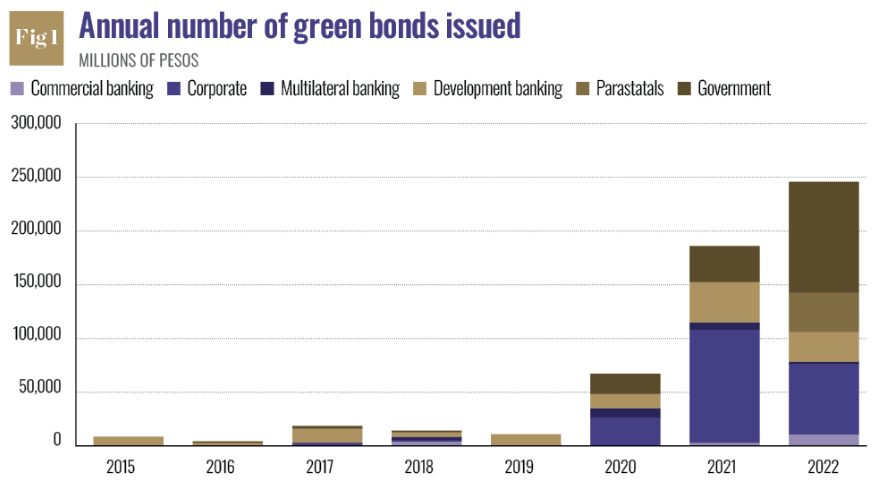
    ESG related green bonds are in fact expanding rapidly in Mexico, strongly supported by investment funds, insurance companies, and banks. The public sector has itself raised MXN131.6bn (US $7.5bn) in green bonds in 2022, 16 times more than it raised in 2015. Issuers include the federal government, state-owned enterprises, and development banks. In 2023 FIRA/Banxico, a bank, launched Latin America’s first international green bond worth approximately US$165m. The money raised by the 3-year bond was earmarked for investment projects to improve the resilience of producers and value chains in the agricultural sector and rural areas, aimed at mitigating climate change risks. 

    Mexican green bonds surge ahead

    Source: World Finance   

    Like Brazil, Mexico does not yet have a full taxonomy of ESG-linked bonds and financial instruments. Pending further government regulation, it has been left to the country’s stock exchanges, via their internal regulations, to provide a framework for the sector. Broadly speaking they have followed the recommendations of the ICMA, as set out its Green Bond Principles (GBP). ESG securities are classified into three groups: Green, Social, and Sustainable.

    For a security to be listed as “Green” the proceeds must be used exclusively to finance or refinance renewable energy, sustainable construction, energy efficient clean transportation, water, waste management, agriculture, bioenergy, forestry “and other similar related projects”. To be listed as “Social” a security must finance or refinance projects supporting a particular social group or sector. And finally, to be listed as “Sustainable”, securities must finance or refinance the activities of both green and social bonds combined.

    In addition to conforming to this three-way classification, issuers must acquire a certified opinion from a “specialised independent party” confirming that the proceeds will in fact be allocated to environmental, social, or sustainable activities. They must also document the objectives of the project or activity, and their decision-making process to secure environmental benefits. In addition, they must confirm that they meet the relevant eligibility criteria, and make an annual report to the stock market, assessing the environmental impact.

    CONSAR, the Mexican pension fund regulator, has also taken some regulatory steps. Since 2022 it has been mandatory for social security pension funds, known as AFOREs, to take ESG criteria into consideration when investing the retirement savings belonging to their clients. Official data shows that in 2022 AFOREs invested MXN110.4bn (US$6.3bn) in ESG bonds, five times the amount invested the year before.

  • Venezuela: A bloated budget

    LatinNews 29 October 2015 Hits: 321

    Venezuela’s latest annual budget suggests that the finance ministry has run out of ideas other than to keep on printing money.

    The finance minister, Brigadier General Rodolfo Marco Torres, in mid October submitted to the unicameral national assembly a 2016 budget plan worth BF1.55trn, which at the official exchange rate of BF6.3/US$ amounts to US$247bn, more than twice the US$117.7bn proposal sent down this time last year (itself over a third higher than its predecessor). “This budget will allow us to return to the path of economic growth”, Torres declared. Yet the budget’s sole nod to realism – an oil price forecast of US$40/barrel – totally belies that declaration.

    Venezuela is entrenched in recession and without an oil price recovery back towards the US$80-US$90 mark (at minimum), it is set to remain firmly in the doldrums next year. Perhaps the best that can be said is that the 2016 plan certainly promises to be inflationary – albeit the last thing most Venezuelans need right now is more inflation. The national assembly, dominated by the ruling Partido Unido Socialista de Venezuela (PSUV) under the tight control of the house president Diosdado Cabello, is unlikely to object to the new plan – if anything PSUV deputies seeking re-election in mid-term legislative elections on 6 December will inflate it even more.

    Inflation was 68.5% in 2014 and Venezuela’s central bank (BCV) has not released inflation data since February, when it confirmed the 2014 result. The government has barred the publication of most macroeconomic data on the grounds of the ‘economic war’ it claims is being waged against it a shadowy group of international right-wing extremists; and the budget presented by Torres contained no growth, inflation or exchange rate forecasts. However, appearing on state TV on 20 October as the budget went to congress, President Nicolás Maduro forecast that inflation this year would be 85%, falling to 60% in 2016.

    Local private economists, along with the likes of the International Monetary Fund (IMF) and the World Bank, put inflation in triple digits already; the IMF now projects average inflation of 159.1% in 2015 and 204% in 2016.

    According to the local workers advocacy group, Centro de Documentación y Análisis para los Trabajadores (Cenda), in August alone food prices rose by 22.2% month-on-month over July. Cenda calculates that the minimum wage covers just a week’s grocery shopping. In a similar vein, a BCV source recently told the local daily El Nacional that headline inflation in September was 16.9% month-on-month and 179.5% year-on-year, the highest since March 1989 (when monthly inflation was reported as 21.7%). The source put accumulated year-to-date inflation at 142%, translating into monthly inflation of about 16%, on average, in the first nine months of 2015.

    Having dubbed inflation “induced, criminal and speculative”, Maduro also announced the extension of the Law of Fair Prices (Ley de Precios Justos) to “all prices and all products" and promised tougher penalties for price-gougers and any retailers using the black market as a price guide. Maduro complained that the law, which sets maximum profit levels of 30%, had “not been applied” and warned that the government was going to “turn the screws”. To this end, he announced a new ‘national fair prices command’ to be led by the vice president, Jorge Arreaza, the food minister, Carlos Osorio, the industry and trade minister, José David Cabello, the president of the Superintendencia Nacional para la Defensa de los Derechos Socioeconómicos (Sundde), César Ferrer, and the head of the Bolivarian National Guard (GNB), Néstor Reverol Torres.

    The president was unclear as to why the Fair Prices Law had not been applied properly thus far, but he said that the Sundde needed to “reanimate, renenergise”, and gave the new ‘fair prices command’ 30 days to establish new maxims for fair profits and fair prices throughout the economy. In its first decision, the new command announced that importers would be subject to a new maximum profit ceiling of 20%, below the 30% ceiling applicable to national producers. Luis Vicente León, head of the local market research firm Datánalisis, said he expected the government to implement “aggressive distribution strategies” in the run up to the 6 December ballot, as it sought to shore up support in core low-income neighbourhoods.

    Maduro also extended an earlier 30% increase in national minimum wage, effective as of 1 November, to public sector workers and the armed forces. The minimum wage has now been increased four times this year (it is usually twice) and, with the legislative elections imminent, the latest comes well in advance of the usual year-end increase, typically given in early December, ahead of the Christmas period. The latest increase takes the minimum wage to BF9,648/month.

    Combined with a concurrent increase in food tickets, Maduro boasted that Venezuelan workers would have a total combined minimum salary of BF16,399 a month, which at the main fixed exchange rate is an impressive-sounding US$2,600, one of the highest in the region. Yet at the free-floating Simadi exchange rate, which trades at about BF200/US$1, it amounts to US$81. And at the black market rate, of roughly BF800/US$1, it is just US$20 a month, equivalent to the average wage in Cuba.

    Non-credible forecasts

    Presenting the budget last year, Finance Minister Torres had forecast real annual GDP growth of 3% for 2015, with inflation of 25%-30%. However, having contracted by 4% in 2014, Venezuela is in “deep recession” and will register a GDP result of -10% this year and -6% next year, according to the IMF’s latest World Economic Outlook, released on 6 October. The Fund’s inflation forecasts are equally eye-watering. It projects average inflation of 159.1% in 2015 and 204% in 2016.

    Meanwhile, the current account deficit is projected at 3% of GDP this year, improving to 1.9% of GDP next year as oil prices begin to recover slowly and imports are held at minimal levels. This is in a country accustomed to running sizeable current account surpluses, however.

    And finally, private analysts put the fiscal deficit at about 17% of GDP this year. Torres told the national assembly that the 2016 budget included indebtedness of BF195.2bn, which at the official FX rate is a not-inconsiderable US$30bn.

    In a recent note to clients, Barclays Bank forecast an annual GDP contraction of 9.1% for Venezuela this year, making the point that accumulated inflation over the 2014-2016 period could exceed 1,000%. With international oil prices set for only a moderate recovery in 2016, the recession will not abate until 2017. The US Energy Information Administration now expects West Texas Intermediate (WTI), the reference oil barrel for Venezuela, to average just US$53.57 per barrel (/b) in 2016, citing “significant uncertainties as the oil market moves towards balance”. Among these it specifically notes the re-entry onto global markets of Iranian oil, which will further weigh on prices.

    Debt payment – a priority

    While Torres may lack all credibility on the budget front, the Venezuelan government continues to meet its external debt commitments, now routinely drawing on its scarce central bank foreign reserves (previously, the treasury typically made these payments by drawing down US dollars from its external accounts, rather than buying currency at the time of payment). According to the finance minster, at year-end 2014 Venezuela’s debt was 68% domestic and 32% international. With almost a third of debt held outside the country, there are clear motives to avoid default.

    Torres insisted that the government had ready the US$3.5bn needed to make payments due in late October, including a US$1.41bn amortization on a 2015 Petrobono bond and US$2.05bn payment on a 2017 bond held by the state oil company Petróleos de Venezuela (Pdvsa). According to estimates by Bloomberg, Venezuela has some US$5.6bn in interest and foreign-debt bond principal due in the final quarter of this year, with an additional US$10.8bn falling due in 2016. Torres said that by year-end, the country will have made US$13bn in debt payments. As of 27 October, central bank reserves were just US$15.1bn.

    • “There will be no catastrophe or collapse here…Look, oil could fall to US$40 dollars and I would guarantee the people all their social rights, their rights to education, to health, to food, to life” – Nicolás Maduro in October 2014 promises that the oil price shock will not affect the social tenets of the Bolivarian Revolution.
  • ECONOMIC HIGHLIGHTS

    Abbi Dicker 18 July 2025 Hits: 3119

    COSTA RICA | CAF approves first green liquidity line for Costa Rica. On 29 June the Latin American development bank (CAF) approved its first “green liquidity line” for Costa Rica worth up to US$500m. According to a CAF statement, the credit line has two different components according to its purpose: “operations of up to seven years to support the country’s public debt management strategy when conditions for accessing international capital markets are not convenient for the country, as well as financing of up to 20 years to address emergencies or disasters caused by extreme weather events.” The CAF statement cites its executive president, Sergio Díaz-Granados, as saying that “this financing marks a fundamental precedent in our commitment to sustainability and economic resilience in the region”.  He goes on to say that “Costa Rica is a leader in environmental management and now has a cutting-edge financial tool that will allow it to respond immediately and effectively to both market crises and climate emergencies”.

    DOMINICAN REPUBLIC | Exports up. On 10 June the Dominican Republic’s customs authority (DGA) released new figures showing that the country’s exports in May totalled a record US$1.4bn, up 13.4% on May 2024. According to the same report, exports to the US, the main destination for Dominican exports, reached US$688.5m in May 2025, up 4.7% year-on-year. Meanwhile exports to Haiti, the second main destination for Dominican exports, totalled US$93.3m in May 2025, up 14.9% on May 2024. In the first five months of 2025, Dominican exports totalled US$5.6bn, up 8.6% on the same period in 2024, of which goods sent from duty-free zones accounted for 62.5% of the total.

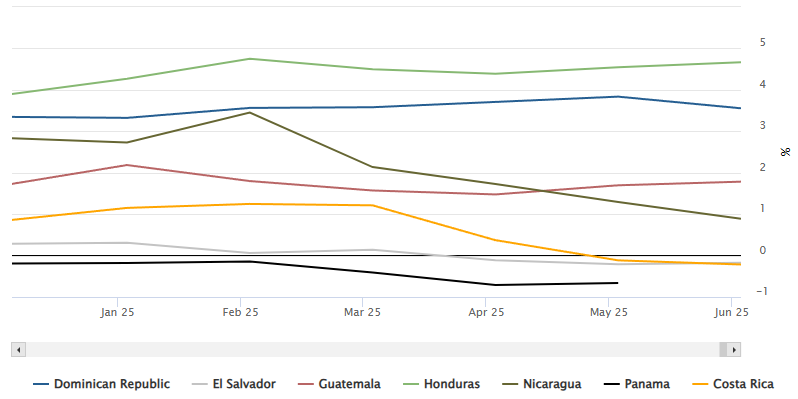
    Central America & Caribbean: inflation rate
    Percentage variation (year-on-year)

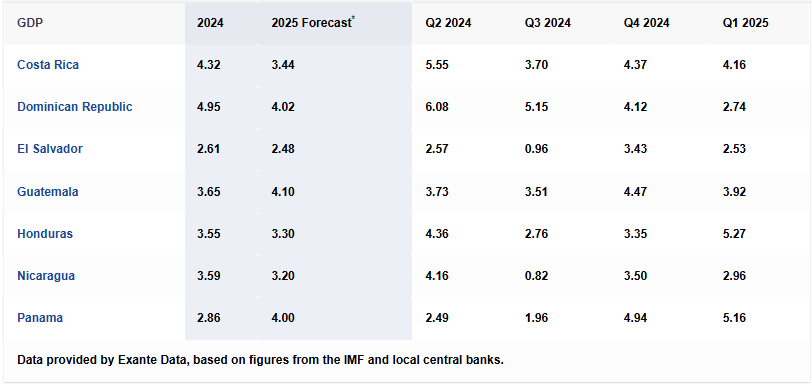
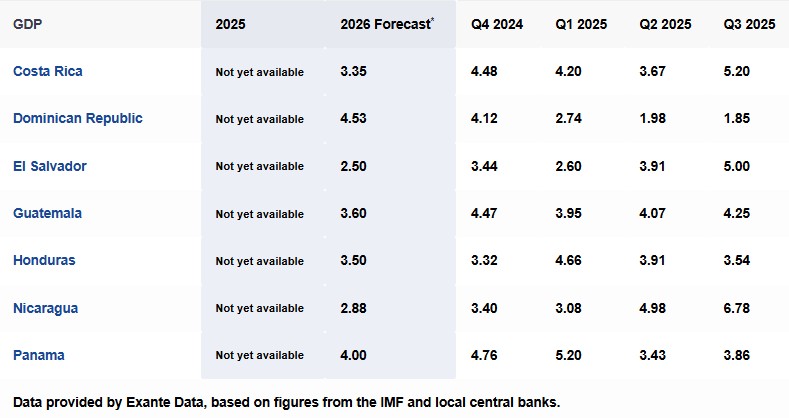
    Central America & Caribbean: GDP growth (%)
    Quarterly figures are year-on-year growth

  • GUATEMALA: Fresh moves against judicial corruption

    LatinNews 15 February 2017 Hits: 942

    In less than a year, three supreme justice court (CSJ) magistrates have been stripped of their immunity and forced to step down following investigations by the United Nations (UN)-backed anti-impunity commission in Guatemala (Cicig) and the attorney general’s office (AG). Hailed by civil society groups, the moves against the judiciary suggest this remains one of the current focuses of Cicig’s efforts. The changes in the judiciary are attracting particular attention given that the brother and son of President Jimmy Morales – Samuel Everardo Morales Cabrera and José Manuel Morales Marroquín respectively – were arrested last month on fraud charges [RC-16-10].

    The 158-member unicameral national congress voted on 2 February to strip CSJ justice Blanca Aída Stalling Dávila of her immunity from prosecution in order that she could be investigated for influence trafficking allegations. Stalling, who was then arrested six days later, is accused of seeking to meddle in a decision by a sentencing court on behalf of her son, Otto Fernando Molina Stalling, who was arrested in 2015, along with members of the directorate of the national social security institute (IGSS), for his suspected involvement in a corruption case.

    Stalling has also been linked to a larger, interconnected network of judicial corruption, nicknamed “el Bufete de la Impunidad” (Law Firm of Impunity), uncovered in 2015 by Cicig and the AG, which connected clients to judges willing to rule in their favour. Also implicated in this network was Marta Josefina Sierra González de Stalling, Stalling’s sister-in-law and fellow justice. González de Stalling was accused of authorising the release on bail and house arrest of six suspects involved in the corruption ring uncovered in the tax authority (SAT), known as ‘La Línea’, which was allegedly headed up by disgraced former President Otto Pérez Molina (2012-2015) who was forced to quit in 2015.

    The move against Stalling follows the resignations last year of two of her colleagues from the 13-member CSJ – justices Vladimir Aguilar and Douglas René Charchal Ramos. Both were similarly stripped of their immunity to face investigation in May 2016 with regard to another influence trafficking case implicating Pérez Molina. The case involved the awarding of a 25-year contract to the local branch of Spanish company Terminal de Contenedores Barcelona (TCB) to operate the container terminal at Puerto Quetzal (TCQ) in Escuintla department [RC-16-06].

    Another move against the CSJ

    In a further move hailed by civil society groups, on 30 January the constitutional court (CC) annulled the result of the September 2016 election of CSJ justice Silvia Patricia Valdés Quezada, who took up the post in October for the 2016-2017 term. The CC’s ruling was in line with an appeal filed by a leading local civil-society group, Fundación Myrna Mack. The appeal was based on anomalies regarding the composition of the CSJ plenary on the day that Valdés was elected, as it did not comprise the 13 CSJ justices but only 12 plus an alternate magistrate, which was in breach of procedure.

    While Fundación Myrna Mack had objected to Valdés’s election on procedural grounds, her election had also been criticised by human-rights groups amid doubts as to her impartiality regarding President Morales. These concerns stemmed from Valdés’s response to a September 2016 tweet critical of President Morales by Carmen Aída Ibarra, the director of ProJusticia, a local human-rights group. Valdés came to Morales’s defence, tweeting in response to Ibarra’s remarks: “He is trying to do things well. Leave him to govern in peace. As if he were Harry Potter with a magic wand!”, which left ProJusticia and other civil-society groups questioning Valdés’s political impartiality.

    • Corruption Perceptions Index

    The 2016 Corruption Perceptions Index (CPI) by international anti-corruption NGO Transparency International (TI), released on 25 January, showed Guatemala unchanging in its score compared with the previous year, scoring 28 (where 0 is highly corrupt and 100 very transparent) and ranking 136th out of 176 countries. This was the second-worst score in Central America, ahead only of Nicaragua (145; 26).

  • URUGUAY: Another tight contest in prospect

    Patrick de Courcy 29 January 2024 Hits: 2589

    Date: 27 October 2024. Run-off to be held on 24 November if no candidate obtains 50%+1 of the vote in the first round.

    Election type: Presidential and legislative elections (99 seats in the chamber of deputies and 30 seats in the senate).

    Main contenders: Frente Amplio (FA); Partido Nacional (PN, Blancos); Partido Colorado (PC, Colorados); Cabildo Abierto (CA); Partido Independiente (PI); Partido de la Gente (PG).

    Uruguay will stage nationwide primary elections in June to define candidates for the first round of presidential elections in October. President Luis Alberto Lacalle Pou’s popularity has stayed consistently high, at around half of the electorate, for the majority of his mandate but he is constitutionally barred from standing for consecutive re-election and it is not clear who will succeed him. Five parties forged a multi-colour coalition in order to eke out a narrow victory over the long-ruling left-wing Frente Amplio (FA) coalition in 2019 and they would need to stay together to repeat the feat.

    An electoral survey published by the national pollster Factum in December gave the FA 42% of the vote, 16 percentage points clear of President Lacalle Pou’s centre-right Partido Nacional (PN, Blancos) on 26%. At some distance from the PN followed the other three parties in the multi-colour coalition: the right-of-centre Partido Colorado (Colorados) on 9%, the right-wing Cabildo Abierto (CA) on 7%, and the centre-left Partido Independiente (PI) on 3%, with the remaining 8% either determined to cast blank ballots or undecided.

    This once again suggests that if all of the opposition parties preserve their electoral alliance then they are capable of defeating the FA in a tight contest, with the PN in pole position to select the presidential candidate to head the joint ticket, but separate surveys of the most likely candidates to stand suggest that the FA has a lead.

    Another poll published by Factum on 14 December showed that Yamandú Orsi is favourite to secure the FA presidential candidacy in primary elections. Orsi, the intendant (governor) of the department of Canelones since November 2020, and a member of the national leadership committee of the Movimiento de Participación Popular (MPP), the largest party in the FA, has been well out in front in a series of polls conducted throughout 2023.

    Orsi received 50% support, with his only real challenger being Carolina Cosse, a former cabinet minister and the incumbent mayor of Montevideo since 2020, on 36%. Another survey by local pollster Equipos Consultores gave Orsi a similar lead of 15 percentage points (46%-31%) over Cosse when only the four pre-candidates confirmed by the FA were included in the poll.

    Álvaro Delgado is favourite to win the PN primary elections, according to a separate Factum poll. Delgado, a former senator who resigned as secretary of the presidency on 21 December in order to concentrate on campaigning for the presidency, returned 52% support, 18 percentage points ahead of his closest challenger Laura Raffo, an economist and president of the PN Montevideo mayoral commission. Raffo, the daughter of former senator Juan Carlos Raffo, trailed by 37%-29% in the Equipos poll when non-contenders, such as President Lacalle Pou, were excluded.

    Despite the combined support for parties in the multi-colour coalition eclipsing that for the FA, Factum gave Orsi a 51%-41% lead over Delgado in a head-to-head contest. This suggests that the FA’s prospective candidate is more popular than his coalition.

    There is a long way to go until the primary elections, and Delgado will hope to make inroads into that lead after his campaign swings into gear. But if the polls continue to show a lead of this magnitude for Orsi by the time of the primary elections then there could be pressure within the multi-colour coalition to run behind one of the candidates running for the other parties. That said, there is no obvious alternative and the PN is the most popular party within the coalition by a distance.

    The overwhelming favourite within the PC is Pedro Bordaberry, although the veteran politician has said he will not run for the presidency again. If he is removed from the electoral survey then, according to the Equipos poll, little divides the top three candidates in the PC internal contest - Robert Silva (23%), Gustavo Zubía (20%), and Tabaré Viera (19%).

    The former commander of the army, General Guido Manini Ríos, has announced his intention to seek the CA presidential candidacy once again. But Senator Manini Ríos, who burst on to the scene as a right-wing populist in 2019, has lost some of his appeal now that he is no longer an outsider, in part because the public perception of security improved under the Lacalle Pou administration, with violent theft and robbery falling, although violent homicides are on the way up again. A scandal involving the Uruguayan drug trafficker Sebastián Marset, involving a passport obtained in 2021, has also been damaging for the government, ultimately leading to the resignations of the interior minister, Luis Alberto Heber, and the foreign minister, Francisco Bustillo, in November last year.

    Homicides

    There were a record 382 homicides in 2018, the last full year of the previous FA administration. Under the Lacalle Pou government annual homicides fell, reaching 306 in 2021. But they jumped back up to 383 in 2022 and stayed high, at 382, in 2023.

  • HONDURAS: JOH calls on the US to clarify its stance

    LatinNews 11 June 2014 Hits: 2494

    The Honduran government led by President Juan Orlando Hernández suspects that the US is acting obstructively in tacit protest at the new shoot-down law.

    “I feel that things need to be clear, Madam Ambassador, clear as water; either you are helping us, or you are going to continue helping us, but it is good to know with clarity”, President Hernández declared on 9 June at an police promotion ceremony attended by the US ambassador, Lisa Kubiske.

    President Hernández’s complaints appeared to confirm earlier press reports that the US has used a legal manoeuvre to prevent Honduran air force F5 jets – donated by the US in the 80s – from travelling to the US- or anywhere else for that matter – for needed repairs.

    The president noted that Honduras needs to recalibrate its aging fleet so as to be better able to tackle drug trafficking through the country. According to reports in the daily El Heraldo and the website www.defensa.com, the Israeli government had agreed to modernise the jets but baulked when the US trotted out a clause in the donation agreement preventing the jets from being removed from Honduras for maintenance.

    Honduras recently acquired three radars from Israel to be used for anti drug trafficking efforts, with Hernández noting that the new equipment would allow Honduras to end its dependence on other ‘friends’ – i.e. the US – for surveillance. The US previously has suspended radar cooperation with Honduras over shoot-down incidents. The US government reportedly has made clear its discomfort with the new shoot-down law in place in Honduras since early this year, which some suggest may be in contravention of the 1944 Chicago convention on civil aviation.

    Hernández was clear that he did not directly blame the local US embassy for the situation, hinting at differences between the Washington State Department and the Pentagon and US officials on the ground. Addressing Kubiske, the president stated: “I know that it’s not your case as you know the reality, I know that it's not the case of the head of SouthCom [John Kelly], who came recently and I cite him contextually; ‘It’s impressive the compromise and the results Honduras has achieved’ in the anti-drugs fight". Questioned by journalists afterwards for a response, Kubiske refused to comment.

    IAPA welcomes new law

    On 6 June the US-based Inter American Press Association (IAPA) issued a statement welcoming a new law for the protection of journalists in Honduras as “as step forward to end violence in the country”.

    On 4 June the Honduran congress approved in a first debate a bill for the ‘Protection of Human Rights Defenders, Journalists, Social Communicators and Operators of Justice’. The bill was sent down by the Hernández executive via the Human Rights, Justice, Governance and Decentralization department, according to the IAPA statement.

    The chairman of the IAPA’s Committee on Freedom of the Press and Information, Claudio Paolillo stated that: “This step is relevant and a move forward to end violence in the country and we hope that the law becomes a true institution that has sufficient resources to effectively carry out its objectives and protect journalists, social communicators and other groups in situations of risk”.

    • PEN International statement

    To mark World Press Freedom Day on 3 May, PEN International issued a statement welcoming “the recent advances made by the Honduran government in addressing impunity for journalist murders, including convictions in the cases of the June/July 2013 killing of Globo TV news presenter Aníbal Barrow and the 15 May 2012 murder of HRN Radio director Ángel Alfredo Villatoro Rivera.” However, it noted that attacks on journalists continue with impunity. “In fact, of 38 journalists murdered in Honduras since 2003 – 32 of which have occurred since the coup d’état that ousted President José Manuel Zelaya in June 2009 – only 10 cases have been prosecuted and just four have resulted in a conviction, according to figures provided by the government during the hearing at the IACHR in March”, it said.

  • TRACKING TRENDS

    LatinNews 24 July 2014 Hits: 1412

    CHILE | Growth forecast cut. The government has cut its economic growth forecast for the second time this year, from 3.4% to 3.2%. The Chilean economy has been suffering from a slowdown since last year when it posted a growth rate of 4.1% after averaging growth of 5.8% in the previous two years. Appearing before congress, the government’s budget director, Sergio Granados, pointed to a number of factors: a fall in activity in the domestic copper mining industry; the recent earthquake that hit northern Chile; the devastating fire in the city of Valparaíso; and the depreciation of the peso. A fall in copper mining activity means that the production levels for the state copper firm, Codelco, one of the main sources of government revenue, have been significantly reduced.

    The revision of the official growth forecast was quickly followed by a downward revision by the central bank to growth of 2.5%-3.5% this year from 3%-4%. The central bank also decided to cut its benchmark interest rate (TPM) by a quarter of a percentage point to 3.75% in a bid to boost economic activity. The TPM had remained stable at 4% for the last four months amid concerns about the higher-than-expected rate of inflation observed at the start of year. However, central bank president, Rodrigo Vergara, said that the bank expects inflation, currently running at a high 3.9%, to ease in the second half of the year.

  • Trinidad & Tobago: Despite rising gas output, outlook remains weak

    LatinNews 07 December 2017 Hits: 220

    Trinidad & Tobago has the unenviable reputation of registering one of the worst economic performances in the Latin America and Caribbean region in recent years, with only Venezuela faring worse in 2016. The International Monetary Fund (IMF) estimates that Trinidad & Tobago's economy shrank by 6% in 2016, following very weak growth in 2015 and a slight contraction in 2014. A combination of low energy prices and falling energy production are the main factors behind this weak performance, with energy-GDP slumping by just over 11% alone in 2016. Although 2017 is also expected to remain weak, prospects for 2018 are stronger, with additional natural gas capacity expected to come on stream. However, in the absence of significant fiscal and external consolidation, the country’s already-large twin deficits are set to remain extremely large.

    Trinidad & Tobago has been hit hard by the slump in energy prices in recent years. At its peak in 2010-11, the energy sector accounted for around 50% of GDP and fiscal revenue, as well as 75% of export earnings. A decline in both average prices and output volumes has hit the ratios hard, but the non-energy economy has struggled to compensate for the loss of support from weaker oil and gas dynamics. These developments have also generated large fiscal and current-account deficits of 12.1% and 10.7% respectively in 2016.

    New gas capacity set to come on stream

    In the conclusions of its Article IV consultation published in late November, the IMF was somewhat more positive about the country’s medium-term prospects. Although it is projecting another contraction in 2017, of 3.2%, it expects the economy to return to growth from 2018, expanding by a reasonably firm 1.9%.

    The main reason is an expansion of natural gas production, which is expected to have spill-over effects elsewhere in the economy, boosting downstream petrochemicals production, as well as supporting a recovery in fiscal receipts, which in turn will aid a broader recovery in government consumption.

    After exceeding 4bn cubic feet per day (cf/d) during 2007-14, peaking at 4.3bn cf/d in 2010, natural gas production has been falling. According to Central Bank data, production volumes fell to 3.8bn cf/d in 2015 and 3.3bn cf/d in 2016, before stabilising around this level in the first three quarters of 2017.

    Yet data from the coming months is likely to be slightly more positive, on the back of new capacity from BP Trinidad & Tobago’s (BPTT) new Juniper facility, which is the largest new production in the country in recent years.

    The US$2bn investment began producing gas in August 2017 and is expected to produce up to 590m cf/d at full capacity next year. The platform produces gas from the Corallita and Lantana fields, located 80kms off the south-east coast of Trinidad.

    In addition, BPTT’s Trinidad Regional Onshore Compression Project has started operations, which will lift yields from existing wells. Indeed, the Juniper and Onshore Compression Project represent two of BP’s “7 in 2017” – seven of BP’s most important major worldwide projects that the company is launching this year.

    The next major gas project is BPTT’s development of the Angelin field, which is located around 60km off the east coast of Trinidad and received the green light to go ahead in mid-2017. The facility will draw gas from four wells to the Serrette platform through a new pipeline and is expected to have a total production capacity of 600m cf/d. BPTT expects to start drilling in the third quarter of 2018, with the first gas set to be produced in the first quarter of 2019.

    As production from the facility increases over the course of 2019, total gas production is expected to rise again in that year, helping to explain the IMF’s projection of firming GDP growth (2.2%). As well as increased upstream output, the construction of a methanol and dimethyl ether plant in southern Trinidad in late 2018 or early 2019 will lift downstream production.

    IMF remains gloomy over reform prospects

    Although these developments will help reduce the external and fiscal deficits from the highs registered in 2016, in its November Article IV consultation the IMF was fairly negative about the prospects of significant and structural improvements in both areas. It stated that staff expect the current-account deficit to remain large, averaging 8% of GDP in the medium term, in the absence of measures to address the fiscal imbalance and structural reforms.

    Similarly, the Fund is not pencilling in any significant public-sector consolidation into their baseline forecasts, with the fiscal deficit projected to average 12% of GDP over 2018-22.

    Fund officials state very specifically that current government policies put public debt on an unsustainable trajectory, reaching an eye-watering 109% of GDP by 2022 (similar to levels in Jamaica, where heavy interest payments account for a significant portion of government expenditure, placing significant constraints on the economy). Not only that, but the IMF regards risks as tilted to the downside, with an even-more gloomy outlook likely in the event of further disruptions to energy supply.

    Even though gas supply is expected to pick up in the coming years, the government recognises the need to diversify the economy in order to develop non-energy sectors. To this end, the IMF has urged the authorities to allow the heavily-managed exchange rate to depreciate, pointing to recent shortages of foreign exchange as evidence that the local currency is overvalued. The government will be reluctant to do so, on the basis that currency depreciation would be likely to feed through to higher inflation.

    Pre-empting these concerns, the Fund stated that if the currency changes were made at the same time as a broader fiscal consolidation package, it would contain the impact on inflation, but it is doubtful whether the government has the political capital to push through measures that would be unpopular with the public at a time of heightened public discontent. As a result, an economy that five years ago seemed in fairly solid structural shape looks set to remain weak, highlighting just how quickly large fiscal and external deficits can accumulate, and reinforcing just how difficult it is to subsequently restore balance.

    Leadership vote

    The United National Congress (UNC), currently led by former prime minister Kamla Persad-Bissessar (2010-2015), was due to hold a leadership election on 26 November.

    Dr Roodal Moonilal, who challenged Persad-Bissessar in the 2015 internal elections, said he would not stand for election this time because he has “quite a few other matters on his table”. Moonilal is facing a corruption investigation.

    Another potential challenger, Dr Surujrattan Rambachan, said he would support the current leader but that he wants to see a “more vibrant” national executive (Natex). “I am supporting her but will have reservations about the quality of the people on Natex, we need a mix of professional people and political activists”, he stated.

  • Brazil may point the way for the rest of the region

    Patrick de Courcy 09 March 2023 Hits: 2225

    Brazil has both the largest population and the largest gross domestic product (GDP) in Latin America. Because of its sheer size, therefore, changes in the country’s energy matrix are likely to play a pivotal role in the region-wide energy transition. Put bluntly, if Brazil fails to meet key energy transition targets, it is highly likely that it will pull down the wider region with it.

    Two features are worth highlighting. The first is the central role played by the Amazon rain forest in the national energy balance. A total of 60% of the Amazon biome is in Brazil (other important Amazon counties include Colombia, Peru, and Venezuela). While the country is pursuing a transition to cleaner energies, the Amazon’s decreasing ability to sequester carbon – caused by deforestation from the unregulated spread of farming, mining, and ranching – is a central factor in what could be called the energy transition equation. The second feature is that both the treatment of the Amazon and some wider issues of clean energy and environmental protection have become highly politicised.

    In January 2023 veteran left wing politician Luiz Inácio Lula da Silva was sworn in as the country’s new president for a four-year term. Lula had served two earlier consecutive four-year terms in 2003-2011. That period had been marked by a commodities boom, rapid economic growth, and redistribution of income in favour of the poor. While broadly in favour of environmental protection in the Amazon, Lula did clash with green activists, as he supported the giant Belo Monte hydroelectric project which, they argued, had major negative impacts on indigenous communities.

    Lula was also (and to some extent remains) an enthusiastic supporter of oil and gas development, presiding over a period of increased investment in the ‘pre-salt’ offshore oil deposits. Critics say that the oil boom that developed in his second presidential term and under his chosen successor Dilma Rousseff (2011-2016) played a key part in funding corruption. In fact, the Lava Jato (‘car wash’) investigation showed state oil company Petrobras was paying off politicians who in turn were rigging publicly funded construction projects, including those built for the World Cup in 2014 and the Rio Olympics in 2016. Lula himself did not escape scrutiny: he was arrested on corruption charges and held in prison for over a year in 2018 and 2019 before the Supreme Court ruled that the judge had been biased and annulled his conviction.

    This was the context in which Brazil swung to the right under the presidency of Jair Bolsonaro (2019-2023). The new president was a sworn ideological opponent of Lula’s Partido dos Trabalhadores (PT) accusing it of corruption and communism. Under Bolsonaro the ideological battle swung back to the Amazon with the new president actively encouraging development inside protected areas and indigenous reserves, led by farmers, informal miners (known as garimpeiros), and cattle ranchers. Environmental and indigenous agencies had their budgets slashed. The result was a massive new surge in deforestation which turned the Bolsonaro government into something of an international pariah. Unlike AMLO in Mexico however, Bolsonaro did not express specific animosity towards renewable energies such as wind and solar, which were allowed to continue their successful commercial development.

    What this background shows is that Lula’s third presidency is likely to take major initiatives to reduce Amazon deforestation and increase clean energy output. However, Lula’s outlook appears to be to develop renewables and fossil fuels rather than renewables instead of fossil fuels. As president-elect, Lula attended the COP27 climate summit in Sharm El Sheikh in Egypt in November 2022. He said that his way of combining economic development and environmental protection would be to focus on “the opportunities created by the energy transition” with “investments in wind, solar, green hydrogen, and biofuels”, adding: “These are areas in which Brazil has immense potential, particularly in the Brazilian northeast, which is just beginning to be explored.” During the election campaign Lula promised, if victorious, to commit the country to achieving zero Amazon deforestation and zero greenhouse gas emissions from electricity generation.

    Brazil begins with a head start in the energy transmission race. At the start of the third Lula administration renewable energy sources (with a big contribution from hydroelectricity) account for nearly 84% of total electricity generating capacity (157 GW out of a total of 187 GW). Estimates compiled by the Brazilian Climate Observatory show that the energy and transport sectors account for almost 18% of the 2.4bn tons of carbon-equivalent greenhouse gases emitted in 2021. This proportion has been rising in recent years. Another big source of greenhouse gas emissions is land use (49%, a number which includes the impact of nationwide deforestation). Agriculture and livestock on the other hand, account for 24% of emissions. Separate estimates produced by the UN Environment Programme (UNEP) Brazil show Brazil was responsible for 3.5% to 4.5% of the world’s total emissions.

    In general terms, the government has been enthusiastic about the idea of green development with a special emphasis on helping the poor. The government’s relaunched subsidised housing programme (known as Minha Casa, Minha Vida) is likely to mandate solar energy and solar water heating. Herwerton Martins from lobby group Movimiento Solar Libre says renewable energy will create jobs, save energy costs, and release cash into local communities. He adds that keeping job generation at the forefront is important, whatever ideological spectrum it is viewed from.

    Lula appointed a centrist politician, Alexandre Silveira, as the new minister for energy and mines. In early comments Silveira said his ministry’s efforts would be focused on modernising the generation park and optimising management to balance affordable electricity tariffs with reliability of supply. On taking office he stated that “the future of our generation must be guided towards innovation, the expansion of renewable resources which, combined with the incorporation of storage technologies and low carbon hydrogen, will place the Brazilian energy matrix once again at the forefront of sustainability in the world”.

    Industry sources say the government will seek to invest in increased power capacity and renewable supply. However, there will also be investment in thermo-electric generators, particularly those powered by natural gas which are seen as providing cover for the intermittency of wind and solar power (caused by varying wind speeds and, in the case of solar, night-time falls in output). A significant issue this year will be the renegotiation of contracts at the giant Itaipú hydroelectric complex on the border with Paraguay, still one of the largest complexes of its type in the world.  Negotiations may be complicated by the fact that presidential elections will be held in Paraguay in April.  While the new centre-left ruling coalition will bring a number of planned privatisations to a halt, along with assigning a stronger regulatory role to the state and to state-owned companies, private sector participation will be encouraged particularly if it brings in new and transferable energy technologies.  

    Where does Brazil stand on the energy transition?

    Lobby group EMBER says Brazil is like many countries across Latin America where a rapid build-up in wind power and a somewhat smaller expansion in solar is now “at risk” as governments lose their focus on renewable electricity. To be consistent with the 1.5 degrees C limit on global warming, it says Brazil will need to ensure that all new electricity investment is in renewables. The International Energy Authority on the other hand has a more upbeat assessment, saying “Brazil’s energy policies match up well against the world’s most urgent energy challenges” and highlighting that, as a result of reliance on renewables including hydropower, the country’s energy sector is one of the least carbon intensive in the world.

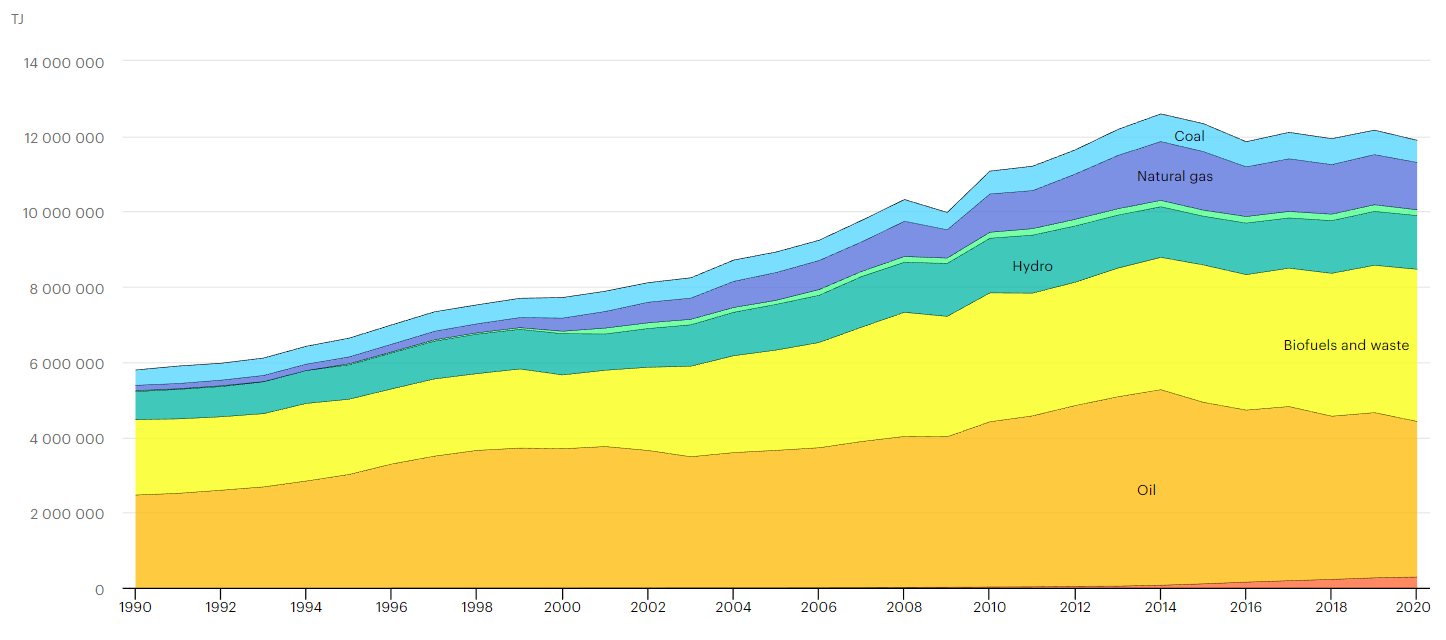
    Total energy supply by source (TES), Brazil 1900 – 2021

    Source: IEA 

    Climate Action Tracker remains more critical, describing Brazil’s overall energy transition performance as “insufficient”. The lobby group uses a five-category ranking system, starting at 1.5 degrees C compatible (the best) and then dropping down in steps to “almost sufficient”, “insufficient”, “highly insufficient” and - the worst category - “critically insufficient”. The lobby group noted that Brazil has modified its NDCs twice since the Paris Agreement, but that the latest version allows greater emissions than the original one, thereby violating the Paris principles of progression and no backsliding. It also notes that long term government plans see an expanded role for fossil gas and oil, which could receive new investment of up to US$500bn. As the country emerges from the effects of the Covid-19 pandemic, therefore, energy sector emissions will rise “locking Brazil into a more carbon intensive energy system and leaving much of it its considerable potential for renewable power untapped”. The assessment was written before the new Lula government took office, meaning that it could potentially be improved if, for example, the administration successfully reduces deforestation rates or takes further clean energy initiatives.

  • ECONOMIC HIGHLIGHTS

    Abbi Dicker 19 March 2026 Hits: 739

    PANAMA | Still on EU tax haven list. On 17 February the European Union (EU) opted to keep Panama on its list of non-cooperative jurisdictions for tax purposes in its latest update. The list was first established in 2017 and is updated twice a year. The decision is a major blow for the government led by President José Raúl Mulino, for which Panama’s removal from such lists is a priority. In July 2025 the EU removed Panama from its list of countries with strategic deficiencies in their anti-money laundering (AML) and counter-terrorist financing (CFT) frameworks. In response to the EU’s latest decision, Mulino said restrictions would be maintained on European companies participating in public tenders – a threat he first announced in October 2024 to the media in response to Panama remaining on the list. Writing on social media, however, he said that Italy, Greece, and Spain do not have Panama on any list so there is “no problem” with these countries.

    NICARAGUA | Trade deficit shrinks. On 27 February Nicaragua’s central bank released new figures showing that the country’s total exports in 2025 reached US$8.91bn, up 15.4% on 2024. Total imports reached US$11.40bn, up 7.5% on 2024. This leaves a trade deficit of US$2.49bn, down 13.8% on 2024. Exports were driven by agriculture, which totalled US$1.29bn last year, up 46.1% on 2024 due to an increase in volume and prices of coffee; mining, which totalled US$2.01bn, up 44.4% on 2024; and fishing and aquiculture which totalled US$186.4m, up 6.7%. The country’s main export markets are the US, which accounted for 38.0% of total export value last year, followed by Canada (17.4%), and El Salvador (9.4%), among others. Exports to the US were up 24.8% last year while exports to Canada were up 73.7% year-on-year.

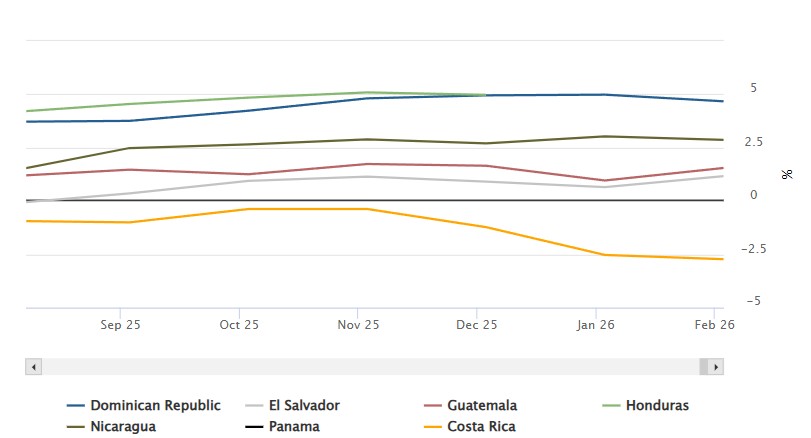
    Central America & Caribbean: inflation rate
    Percentage variation (year-on-year)

    Central America & Caribbean: GDP growth (%)
    Quarterly figures are year-on-year growth

  • MEXICO: Parties Measure Up For Pemex Battle

    LatinNews 09 July 2013 Hits: 3232

    During the course of June, Mexico’s main political parties began positioning themselves for what is shaping up to be the big business debate of the year: the battle over opening up Petróleos Mexicanos (Pemex), the state oil monopoly, to private sector investment.

    The case for change is strong. The Mexican government depends on Pemex (which generates about 40% of its total fiscal revenue), but Pemex in turn depends on its once-plentiful Cantarell oil fields, which are rapidly depleting. Mexican oil production has fallen every year since 2004, from around 3.4m barrels per day (bpd) to 2.5m bpd now. The country already imports a third of its gas requirements from the US, some of it by road, which is an extremely expensive way of doing things. Gas shortages could lead to power cuts in the near future. Analysts say that unless something is done to reverse the trend, Mexico will have to become a net oil importer by 2020 – only seven years away. To make matters worse, Pemex has a reputation for being poorly managed, and for having sweetheart deals with entrenched trade unions. It also faces allegations of corruption, including the suspected involvement of some of Mexico’s notorious drug syndicates in various supply contracts.

    A turn-around in the oil and gas sector is within reach. There are promising deep-water fields in the Gulf of Mexico, where 40% of the country’s possible oil and gas reserves are believed to be located. Part of the Eagle Ford shale-oil formation lies in Mexican territory (the rest is across the border in Texas) and this could position the country sixth in the world by size of shale oil reserves. The US$2.4bn Ramones gas pipeline project could allow the country to access cheaper gas imports from Texas.  All that is really needed is an injection of new investment money and management expertise, but the problem is that Pemex just can’t raise enough. According to Marcelo Mereles of energy consultancy EnergeA, “Pemex’s infrastructure is stretched to the limit. There is a desperate need for investment”. An industry insider cited by the UK business daily The Financial Times said: “It is just not possible for Pemex to do this alone. We are going to need hundreds of companies coming in”.

    In theory, energy reform, including a programme to modernise Pemex, is absolutely viable in Mexico. While President Enrique Peña Nieto, who took office last December, does not have an outright majority in Congress, the three main parties in the country have signed up to his Pact for Mexico, which commits them in general terms to a programme of structural reforms. Peña Nieto’s own Partido Revolucionario Institucional (PRI) is committed to making the changes in the energy sector. On the centre-right, the Partido Acción Nacional (PAN) has an ideological preference for a greater private sector role in the economy, so it too should be supportive. And even the centre-left Partido de la Revolución Mexicana (PRD), while ideologically uncomfortable with the idea, has on paper at least said that it recognises the need for change.  So, again in theory, there seems to be plenty of scope for a pragmatic cross-party agreement to make the changes happen.

    The problem, however, is that Mexico has a deep-rooted tradition of oil nationalism, and all politicians are scared of ending up on the wrong side of that tradition. Article 27 of the 1917 constitution, a product of the revolutionary upheavals at the beginning of the 20th Century, states that “all natural resources in national territory are property of the nation, and private exploitation may only be carried out through concessions”. In a still-celebrated move, the oil industry was nationalised in 1938 by President Lázaro Cárdenas (1934-1940), the father of the PRD’s founder Cuauhtemoc Cárdenas. All this may sound like ancient history, but it is still a current and highly emotive issue. An opinion poll by a local think tank, Centro de Investigación y Docencia Económica (CIDE), found that 65% of respondents opposed opening up Pemex. In CIDE’s words “Energy, particularly oil, continues to be the stronghold of economic nationalism”.

    Political tactics also play a part. President Peña Nieto announced the reforms while in London early in June – a good place to address international markets, but not the best place to send a message to his own electorate. He announced the government’s commitment to put the reforms before congress in September, but did not spell out the detail. While this is understandable – the president needs to keep some margin for negotiation – it was also unfortunate and has led to much speculation over his real intentions.

    What he did say was that the changes would be “transformational” and that constitutional reform would be necessary, so that foreign investors could have “absolute clarity”. This has led many, including a number of PRD leaders, to suggest that the president’s agenda is in reality to privatise Pemex. The PRD has published its own programme of proposed reforms. It says it opposes privatisation or constitutional change. Instead it is focused on reforming the tax regime and giving Pemex greater operational autonomy. Manlio Fabio Beltrones, the PRI coordinator in the chamber of deputies, has insisted that the presumed ‘privatisation’ of Pemex is a red herring. “I am more than convinced that the PRD is pursuing a false debate. Nobody is talking about privatisation. This needs to be absolutely clear, even if we have to repeat it a thousand times to avoid confusion”, he said recently. The PAN, meanwhile, says it will not publish its own proposals for the future of Pemex until after scheduled local elections on 7 July.

    The key issue to watch is how foreign investors and oil companies are to be rewarded for investing in Mexico. Nobody seems to be questioning the fact that their investment is needed and that they should receive a fair return on investment, what is not clear is the exact mechanism for doing so. For political reasons, any production-sharing or ‘payment in crude oil’ arrangements risk been presented as contrary to the spirit of Article 27 of the constitution. This is ultimately a question of perception and interpretation, but it will be critical to deciding whether Pemex is modernised under the Peña Nieto administration, or continues for the next few years on a pathway of gradual decay.

  • PANAMA: A dam deal?

    LatinNews 14 September 2016 Hits: 484

    President Juan Carlos Varela last month hailed a deal signed between his Partido Panameñista (PPA)-led El Pueblo Primero (EPP) coalition government and leaders from the Ngäbe Buglé indigenous comarca (indigenous political administrative region) regarding the ‘Barro Blanco’ hydroelectric dam on the Tabasará River located in the area. The deal ends 19 months of talks between Ngäbe Buglé representatives and a high-level governmental commission headed up by the country’s vice-president and foreign minister, Isabel de Saint Malo de Alvarado, regarding one of the country’s most contentious infrastructure projects.

    Construction on the Barro Blanco project, which began in 2011 and is 95% complete, was being carried out by local company Generadora del Istmo S.A. (Genisa). It was expected to add 28.84MW of installed electricity production capacity to Panama’s national grid. The project remained hugely controversial, however, with the Ngäbe Buglé community complaining that it would displace thousands of local inhabitants and they had not been properly consulted about the initiative prior to its launch. With the project then suspended in February 2015, after the government determined that it fell short of the requirements of its environmental impact assessment (EIA) study, talks between both sides had been taking place ever since.

    Signed on 22 August, the deal comprises various points. A presidential press release notes that these include Genisa’s withdrawal from the initiative with an as yet undesignated third independent party to manage and operate it instead. As well as the stipulation that 50% of all personnel employed in the project must be indigenous and ‘campesinos’ (peasant farmers) from the Ngäbe Buglé comarca, other points agreed include the establishment of a trust fund by President Varela with government contributions for the duration of the concession. The trust fund will promote local agriculture, fishing, forestry, eco-tourism and artisanal sectors, personnel training, and rural electrification in surrounding communities. President Varela also agreed to annul existing hydroelectric concessions on the Tabasará River and pledged that future concessions in the Ngäbe Buglé comarca must be approved by the local population through a referendum and local, regional and general congresses.

    Doubts have since emerged as to whether the deal will, in fact, put paid to unrest. At the signing ceremony, the local media reported that four police agents were injured after activists reportedly threw stones, complaining that they had not been represented by the local community leaders who inked the deal – Silvia Carrera, Jeremías Montero, and Chito Gallardo. Meanwhile, on 5 September, the local press reported that protests took place in Pacora, an area in Panama district, and the provinces of Bocas del Toro and Coclé by indigenous groups opposed to the initiative.

    Popularity

    The most recent (August 2016) survey by pollster Dichter & Neira, released on 23 August, showed President Varela with just 35% approval, down from 40% in July and 52% in September 2015.

    Amid ongoing concerns about transparency and security [RC-16-08], one public concern cited by the poll, which interviewed 1,200 people across the country bar the comarcas and Darién jungle region, is the cost of living which 86% of respondents said had increased.

    Yet the most recent (12 August) report by the national statistics institute (Inec) showed the urban consumer price index (CPI) for July was up just 0.1% compared with the previous month, and 0.1% on the same month in 2015, while the accumulated rate was 1.2%. A January 2016 report by the United Nations (UN) Economic Commission for Latin America & the Caribbean put the CPI year-on-year variation for 2015 at close to 1%, similar to the 2014 rate.

    • Other signs of commitment

    Announcing the deal between his government and the Ngäbe Buglé community over the Barro Blanco dam, President Juan Carlos Varela highlighted other signs of commitment to the development of the Ngäbe Buglé comarca, where more than 89% of the population lives in poverty. These include an investment plan worth over US$300m for health, education, drinking water provision, electrification, road construction, and basic sanitation.

  • ECONOMIC HIGHLIGHTS

    Patrick de Courcy 13 July 2022 Hits: 1536

    PARAGUAY | New economic measures announced. Paraguay’s President Mario Abdo Benítez announced a series of economic and social measures on 6 July, with the aim of alleviating the impact of global inflation and a drought that has hit the local agricultural sector. According to Paraguay’s central bank (BCP), monthly inflation stood at 0.5% in June bringing annual inflation to 11.5% for that month. Speaking in a press conference, President Abdo Benítez said that measures include capping the price of public transport until the end of the year and making social benefits available to 17,000 more recipients in Paraguay. The president has also made US$1.1m available in public investment to create 50,000 new jobs and build 2,800 houses for vulnerable families. A reduction on VAT to 5%, introduced in 2020, will be maintained as will the reduction in the Impuesto Selectivo al Consumo (ISC) sales tax to reduce the impact of the rise in fuel prices. As well as outlining government measures, Abdo Benítez highlighted that “private investment will complement the efforts of the public sector”. The measures are intended to limit the effects of inflation in the second half of the year.

    ARGENTINA | Protests over fuel shortages. Transport unions in Argentina carried out demonstrations and roadblocks throughout the country in late June due to the shortage of diesel and increase in fuel costs. Striking unions include the Unión Nacional de Transportistas y Afines de la República Argentina (Untra), Autoconvocados Unidos, Transportistas Unidos de Argentina (Tuda), and the Sindicato Único de Trabajadores de Administraciones Portuarias (Sutap). “After four months of warning about the painful situation that we were facing we had to come out to demonstrate and show the value of our work,” Tuda president, Santiago Carlucci, told local media. Among other things, the demonstrators asked for the establishment of a new trigger clause so that freight rates are raised proportionally to the increase in fuel prices. In a survey of Argentina’s 23 provinces and the autonomous district for the capital Buenos Aires (CABA), on 15 June, Argentina’s cargo and freight transport employers’ federation (Fadeeac) warned that there were fuel shortages in 21 provinces.

    Brazil & Southern Cone: inflation rate
    Percentage variation (year-on-year)

    Brazil & Southern Cone: GDP growth (%)
    Quarterly figures are year-on-year growth

  • HONDURAS: Imitation the sincerest form of flattery?

    LatinNews 13 March 2013 Hits: 3331

    President Porfirio Lobo led a delegation of seven including Foreign Minister Arturo Corrales to Venezuela to attend the state funeral of President Hugo Chávez on 8 March, where he described Chavez as “an extraordinary leader who fought for Latin American unity, social inclusion and social justice”.

    Although Chávez was the first to rail loudly against the coup d’état against his Honduran ally President Manuel Zelaya (2006-2009) in June 2009, and later vowed not to recognise as legitimate the subsequent November 2009 election in which Lobo came to power, Chávez and his Colombian counterpart Juan Manuel Santos later succeeded where the US had failed in negotiating the ‘Cartagena Agreement’ (May 2011) that allowed for Zelaya’s return from exile and his reincorporation into Honduran political life, effectively drawing a line under the Honduran political crisis. Chávez also offered to re-incorporate Honduras into Venezuela’s regional discount oil scheme, Petrocaribe.

    A few days after his return from Venezuela, Lobo called a press conference (11 March) to reiterate that the executive was intent on pushing through a set of ‘democratising’ reforms to the telecommunications law (Ley Marco de Telecomunicaciones). “The telecommunications party in Honduras is going to end, it can’t last forever” he declared, warning that if congress diluted the proposal he would submit it to a national referendum alongside the scheduled general election in November.

    The proposed reforms would give the government greater scope to regulate the media and include very broad censorship provisions that go beyond the country’s existing libel/slander laws. The proposals would amend at least 15 articles of the existing law and introduce a national ethics council to oversee the communications sector. The media, which Lobo has attacked directly for its coverage of the country’s security situation, official corruption cases and government policies, fears that the government is set on limiting press freedom and targeting media outlets it doesn’t like.

    The draft bill was prepared by the national telecommunications commission (Conatel) and the committee for free expression (C-Libre), an NGO comprising journalists and other sector experts set up in 2001 to promote freedom of expression and press freedom in Honduras. A representative of the Inter-American Press Society (SIP) in Honduras, Rodolfo Dumas, has already expressed scepticism about the new ethics council, warning that, “this type of articles [sic] has to be approached with great caution." The SIP is preparing a report about what it has dubbed a ‘Gag Law’ (Ley Mordaza), making direct comparisons with Venezuela’s 2004 law of social responsibility in radio and television (Resorte, in the Spanish acronym).

    The ruling Partido Nacional (PN) has a majority in the national congress and the Lobo executive has typically managed to get its legislation through under the watchful eye of the president of congress, Juan Orlando Hernández, who is also the PN’s 2013 presidential candidate. Both Lobo and Hernández have previously mooted the idea of adding a fourth ballot box to the general election in order to hold a national referendum on key constitutional reforms, potentially including the option of a constituent assembly.

    • Lobo praises Chávez

    “I met him in Cartagena de Indias, Colombia, and when I saw him I had the impression that he was a proper, serious man, and he was jovial, happy, and in the meeting, which lasted three hours, it drew my attention, his treatment of people, to the girls serving the meal he said to them all, “how are you?, how is your family”[…]he was very friendly and very close to people”, President Lobo told the Honduran daily El Heraldo in Caracas, Venezuela on 8 March.

    • Castellanos feted in the US

    Julieta Castellanos, the rector of the National Autonomous University of Honduras (UNAH), received one of the ‘International Women of Courage’ awards given by the US state department every year to mark International Women’s Day (8 March). Castellanos received her award from the US secretary of state John Kerry and First Lady Michelle Obama. Castellanos, who was a member of the national truth and reconciliation commission in Honduras in 2010/2011, has latterly become a crusader for police reform in the country, after her student son and his friend were murdered by renegade officers in November 2011. Castellanos last year dubbed Honduras a failing state because of the lack of justice and the widespread impunity in the country.

  • NICARAGUA: Debt rising but credit rating remains stable

    Sarah Sheldon 17 August 2026 Hits: 119

    Nicaragua's external debt continues to increase slowly, but international financial institutions remain largely positive on the government’s macroeconomic management even as political risks mount.

    Nicaragua’s external debt reached US$16.4bn in the first quarter of 2026, continuing its recent slow growth, according to figures from the country’s central bank. This means that public and private external debt has increased from US$15.5bn in 2021 to US$15.8bn in 2023 and 2024, and US$16.2bn in 2025 before hitting a new high earlier this year. Of the US$16.4bn currently owed, 54.6% corresponds to public sector debt while 45.4% corresponds to the private sector, according to data from Nicaragua’s central bank (BCN) published in July. However, according to calculations by opposition media outlet Confidencial published on 9 July, net inflows, or the money available to use, were worth just US$11.5m after taking into account the cost of servicing the existing debt. Confidencial also flags a number of other concerns, including the terms of new debt issuances, of which 71.1% were short term. This allows lenders to reassess the level of risk on a yearly basis, and reflects a lack of confidence in Nicaragua, according to Confidencial. In addition, private sector lending fell 28.8% in Q1 2026 compared to the same period in 2025, according to the outlet. However an anonymous finance professional interviewed by Confidencial said that the statistics show that Nicaragua’s private sector is still trusted by international lenders. “The private sector took on debt and paid it back in significant quantities,” he said. “This shows that the private sector has the capacity to absorb debt, administer it and repay it,” he said, adding that the public sector does not enjoy the same level of trust among lenders.  

    Nonetheless, international financial institutions have praised the government’s financial management in recent months. For example, in January the International Monetary Fund highlighted that the national economy has “weathered well multiple shocks since 2018, and strong fundamentals should help Nicaragua withstand headwinds from ongoing shifts in the global policy landscape”.

    Then in May, credit ratings agency Fitch Ratings maintained Nicaragua’s Long-Term Foreign Currency (LTFC) Issuer Default Rating at ‘B’ with a stable outlook, citing “a prudent fiscal policy and twin surpluses that support the accumulation of external and fiscal buffers”. The government has been using surpluses to repay higher-interest bonds, and general government debt is forecast to continue its recent decline from 39.7% of GDP in 2024 to 33.9% of GDP in 2027, according to Fitch. The agency also flagged that net external financing fell from 2.4% of GDP in 2023 to 0.6% in 2025, although multilateral disbursements have declined as more expensive private external creditor disbursements have increased significantly, a trend that is expected to continue. 

    In summary, the Nicaraguan government has shored up its fiscal position in recent years, and its governance record has received plaudits internationally due to efforts to improve debt sustainability, but risks remain. First, on 21 July co-president Daniel Ortega announced that the country would no longer hold elections, in a move that drew a wave of international condemnation. Notably, US Secretary of State Marco Rubio called for international action to further isolate the regime, and Representative María Elvira Salazar (R-FL) posted on X that “after Cuba, Nicaragua is next,” alluding to the Donald Trump administration’s stated aim of achieving regime change in those countries.

    It therefore appears that Ortega’s announcement has drawn international attention after a period in which it appeared that his regime was flying under the radar in terms of pressure from the US. And Washington does have several economic tools at its disposal. One option is to suspend Nicaragua from the Dominican Republic-Central America-US Free Trade Agreement (Cafta-DR) trade deal, under which the country runs a trade surplus with the US, which would have severe consequences for the export sector. Up to now, the US has been reluctant to inflict this kind of pain on the Nicaragua economy, perhaps fearful of setting off a wave of northward migration, but Ortega’s provocations increase the possibility of significant action from Washington.